



Abstract
This study examined the effects of sexual orientation disclosure, disability type disclosure (physical, psychiatric, no disability disclosed), and an applicant’s gender on employment interview ratings. Utilizing an experimental 2 × 2 × 3 analogue research design administered via Internet, a total of 424 undergraduate university students from a Southeast U.S. urban university volunteered to participate in the study. Volunteers were randomly assigned to one of 12 conditions in which a mock applicant’s sexual orientation and disability type were not disclosed. Participants reviewed resume and interview transcripts of the applicant they were randomly assigned to, and then rated the applicant’s qualifications, work skills, and their own personal comfort with disclosure. Participants were also asked to provide narratives regarding their decision-making process. A factorial MANCOVA revealed a statistically significant interaction effect for sexual orientation disclosure, disability type disclosure, and gender. Findings are discussed, along with limitations, implications for rehabilitation counseling, and implications for future research.
The U.S. Department of Health and Human Services (2016) reported that sexual minority persons (i.e., lesbian, gay, bisexual, queer [LGBQ]) are living with higher rates of health disparities. Sexual minority persons report significantly higher rates of chronic illnesses and poor physical health (Fredriksen-Goldsen et al., 2014; Institute of Medicine, 2011), including cardiovascular, pulmonary, digestive, medical (e.g., HIV, cancer), and chronic pain conditions (Centers for Disease Control and Prevention, 2013; Cochran & Mays, 2007, 2012; Conron, Mimiaga, & Landers, 2010; Lick, Durso, & Johnson, 2013). Sexual minority persons also report significantly higher rates of psychological and substance use disorders compared with heterosexual identified persons (Cochran & Mays, 2009). Given the high rates of chronic illness conditions, it is no surprise that the prevalence of disability is also significantly higher among sexual minority adults when compared with heterosexual identified individuals (Fredriksen-Goldsen, Kim, & Barkan, 2012; Fredriksen-Goldsen, Kim, Barkan, Muraco, & Hoy-Ellis, 2013). Sexual minority persons living with disabilities report more functional limitations in daily living, are less likely to have adequate health care resources (e.g., insurance, medical providers), and report receiving disability-related income at higher rates than heterosexual identified persons living with disabilities (Cochran & Mays, 2007).
Despite the disparate health rates impacting sexual minority persons, the work-related experiences of sexual minority persons living with disabilities have received sparing attention in the rehabilitation literature (Dispenza, Viehl, Sewell, Burke, & Gaudet, 2016). Sexual minority persons already encounter various forms of stigma, prejudice, and discrimination throughout their career-lifespan trajectory (Dispenza, Brown, & Chastain, 2016). They can be terminated, demoted, or denied employment because of their sexual minority identity (Chung, Williams, & Dispenza, 2009), and there are limited federal and state laws that prohibit workplace-related discrimination practices (Baron & Hebl, 2013). Relatedly, persons with disabilities are also subject to considerable discrimination throughout their career trajectories (Fassinger, 2008). Although the Americans With Disabilities Act (ADA) and the Amendment Acts of 2008 indicate that it is illegal to terminate or deny employment to any person living with a disability, it is not illegal to terminate or deny someone employment for having a sexual minority identity (Gordon, 2015). There are very few federal and state statutes that protect sexual minority persons from being discriminated against in the workplace (Human Rights Coalition, 2016), and there exist actual and proposed legislative policies that could further complicate issues of bias, discrimination, and identity disclosure in the workplace. According to the American Civil Liberties Union (2017), there continues to be a trend in the federal government and across states to author (and pass) legislation that would deny sexual minority persons various rights and freedoms (e.g., adoption, foster care, marriage-related exemptions, bathroom use) on account of another individual’s privilege to exercise their religious beliefs or first amendment right. Thus, sexual minority persons living with disabilities may be especially vulnerable to unfair discriminatory practices in the workplace, or from even entering the workplace if an employer has the right to utilize their religious beliefs or constitutional amendment to discriminate on account of an applicant’s sexual orientation or disability status.
Employment interviews are one work-related practice that may leave sexual minority persons living with disabilities particularly vulnerable to discrimination. Discrimination could easily take place as a result of personal information that is revealed during an employment interview (Lindsey, King, McCausland, Jones, & Dunleavy, 2013). More so, interviewers may possess explicit or implicit biases, prejudices, or even stereotypes about certain minority groups that could then influence the likelihood that they would not hire someone for a job, despite the qualifications of an applicant (Arvey & Fadley, 1988).
Several studies have reported discriminatory hiring practices when sexual orientation was disclosed in some capacity during the application or interview process (Ahmad, Andersson, & Hmmarstedt, 2013; Baron & Hebl, 2013; Hebl, Foster, Mannix, & Dovidio, 2002). In a more recent study employing experimental analogue research methodology, Nadler, Lowery, Grebinoski, and Jones (2014) had undergraduate students evaluate identical mock interview conditions. In the mock interviews, the fictitious applicant either disclosed their sexual minority identity or did not disclose any identity at all. Nadler et al. (2014) reported that undergraduate participants who were assigned to the sexual minority identity condition gave lower performance ratings (e.g., recommendation for hire, communication skills, problem solving skills, decision-making skills, and interpersonal skills) versus those participants who were assigned an identical mock applicant’s who’s sexual orientation was never disclosed. In addition, these lower ratings were regardless of explicit or implicit heterosexist attitudes that participants may have personally possessed.
Disability type disclosure (e.g., physical, sensory, psychiatric, cognitive) could also influence the employment interview process (Dalgin & Bellini, 2008; Gouvier, Sytsma-Jordan, & Mayville, 2003; Roberts & Macan, 2006). For instance in a between-within subject experimental design, Gouvier et al. (2003) found that persons with physical disabilities were rated as being more qualified for employment when compared with persons who disclosed living with psychiatric-related disabilities. Similarly, through the use of analogue experimental research design, Dalgin and Bellini (2008) found that qualification and employment ratings of a mock candidate were significantly higher if the candidate disclosed an invisible physical disability (diabetes) versus a psychiatric disability (bipolar disorder). These data further suggest that there may be a bias against hiring persons with psychiatric disabilities (Malachowski & Kirsh, 2013). Whereas, reasons for disability disclosure vary greatly, persons with disabilities choose to disclose because of the need for reasonable accommodations, reducing feelings of deception and possible resentment, and enhancing one’s own self-esteem (Roberts & Macan, 2006).
Last, an applicant’s gender has been shown to influence evaluations during the hiring process (Isaac, Lee, & Carnes, 2009; Johnson, Hekman, & Chan, 2016). In a meta-analysis examining hiring decisions, Olian, Schwab, and Haberfeld (1988) found marginal evidence to indicate that women were more likely to be discriminated against during the employment hiring process. Women are less likely to be hired when they are perceived as being less qualified for a job unlike men who are more likely to be hired despite being perceived as less qualified (Ng & Weisner, 2007). Women are also less likely to be promoted at work, and are likely to be evaluated more negatively and less accurately during performance evaluations (Bauer & Baltes, 2002). Furthermore, there is evidence that there exists an interaction effect between sexual orientation and gender during the hiring process. In an interview simulation study, Nadler and Kufahl (2014) reported that sexual minority men received significantly lower hiring scores than sexual minority women who disclosed their identities during a mock interview. Relatedly, sexual minority men are more likely to be discriminated from jobs that are stereotypically oriented toward heterosexual males (Ahmad et al., 2013; Tilcsik, 2011)
Present Study
Glover, Corrigan, and Wilkniss (2010) indicated that future studies should continue to investigate the role of intersecting contextual variables on employment hiring bias. Sexual minority persons, persons living with disabilities, and women are likely to encounter aversive discrimination during employment interviews. Employing theoretical tenets of aversive discrimination (which is an extension of Dovidio and Gaertner’s (1998) theory of aversive racism theory) as a conceptual framework for this study, aversive discrimination contends that persons possess unconscious prejudicial beliefs and feelings toward individuals with socially marginalized identities (Nadler et al., 2014). Independent raters are more likely to aversively discriminate when situations do not prescribe appropriate responses, and when they can rationalize their negative response based on something other than a person’s marginalized identity (Dovidio & Gaertner, 1998). Nadler et al. (2014) found evidence of aversive discrimination when mock applicants disclosed their sexual orientation during an employment interview. Aversive discrimination is also applicable with persons living with disabilities. Persons may harbor prejudicial beliefs toward persons living with disabilities, despite knowing that it is socially undesirable to do so (Deal, 2007). Relatedly, persons may aversively discriminate against women due to social role stereotypes or other biases (Nadler & Kufahl, 2014).
This study aimed to examine the effects of sexual orientation disclosure, disability status disclosure, and gender on potential hiring bias in a series of mock interview conditions. To better understand the effect that the aforementioned variables would have on employment ratings, an experimental 2 × 2 × 3 analogue research design was employed. As a simulated experimental research design that approximates real-life conditions, analogue research designs provide researchers greater control of internal validity by having direct control of the independent variables (Cook & Rumrill, 2005). It was also imperative to control for both explicit heterosexist and disability-related attitudes, as persons tend to present themselves as being less prejudice than they truly are (Lemm, 2006). Participants may be inclined to provide socially appropriate responses, and thus, it was important that we eliminate any rival explanations for our findings (Dalgin & Bellini, 2008). Those who aversively discriminate against persons with marginalized identities may justify their evaluations on factors other than prejudice, despite holding explicit prejudicial attitudes (Nadler et al., 2014). Nadler et al. (2014) found that explicit attitudes toward sexual minority men were negatively associated with hiring decisions. Alternatively, Marini’s (2012) review of the literature indicated that both positive and negative attitudes have been associated with employment outcomes for persons with disabilities. Thus, it was important to control for overall attitudes toward sexual minority persons and persons with disabilities in this study.
Controlling for heterosexist and disability attitudes, we predicted that there would be a significant interaction effect for sexual orientation disclosure, disability status disclosure, and gender on (a) perception of the applicant’s qualifications for the intended job and (b) adequacy of the applicant’s skills for the intended job. Given Roberts and Macon’s (2006) findings, we also predicted that there would be a significant interaction effect for sexual orientation disclosure, disability status disclosure, and gender on the participants’ personal comfort over the applicant’s disclosure during the interview. Moreover, we predicted that sexual minority persons living with both physical and psychiatric disabilities would be subject to more bias in the hiring process than those persons who did not disclose their sexual minority identity. Second, we predicted that sexual minority women living with disabilities would be the most subject to bias during the hiring process. Given that persons with psychiatric disabilities receive lower ratings (e.g., Roberts & Macan, 2006), we predicted that sexual minority women living with psychiatric disabilities would receive the lowest ratings when compared with all conditions.
Last, both quantitative and qualitative data were collected for the purposes of this study. Quantitative data consisted of measures that addressed attitudes and hiring bias, whereas qualitative data were collected to better understand factors that influenced participants’ decision-making. Collecting qualitative data served as a heuristic research technique to better understand the mechanisms involved in the decision-making process for the participants in this study, and to triangulate our quantitative data.
Method
Participants
A total of 424 undergraduate university students from a Southeast U.S. urban university volunteered to participate in the study. Average age was 25.06 (SD = 7.63, range = 19–62), and the sample’s grade point average was 3.13 (SD = 0.47). Approximately 57.8% identified as cisgender (i.e., defined as when one’s biological sex corresponds with their identified gender) women, 37.3% identified as cisgender men, 1.1% identified as transgender, and 3.8% did not indicate a gender identity. Regarding sexual orientation, 92.1% identified as Straight/Heterosexual, while 7.9% identified as lesbian, gay, bisexual, or queer. Approximately 16.5% reported having a chronic illness/disability (CID; ranging from medical, physical, sensory, and psychiatric) and 83.5% did not report living with a CID. Regarding race/ethnicity, 36.8% identified as Black/African American, 26.9% identified as White/European American, 20.6% identified as Biracial/Multiracial, 8.2% identified as Asian American, and 7.5% identified as Hispanic/Latin(o/a). Last, 33.1% reported working toward a social sciences degree (e.g., psychology, sociology), 33.5% were working toward a business degree (e.g., management, marketing), 12% were working toward a computer science degree, 11.8% were working toward a humanities degree (e.g., English, philosophy), 4.3% were working toward a science degree (e.g., biology, physics), and 3.3% were working toward an education degree.
Research Stimuli
Members of a research team (n = 4; one doctoral level researcher and three master’s level students studying rehabilitation and mental health counseling) created all research stimuli used for this study. A one-page resume, a one-page cover letter, a one-page job description, along with a one-page mock interview excerpt, were all drafted for a fictional applicant who was applying for an entry-level Public Relations Specialist position at a major university located in the southeast United States. The job description was created using the Occupational Outlook Handbook (Bureau of Labor Statistics, 2017). The name assigned to the applicant was “Samuel Williamson” for male and “Samantha Williamson” for female. These two names were selected for several reasons: (a) They both consist of three syllables, (b) the first three letters are the same for both names, and (c) they are easily distinguishable as male and female, and not too androgynous that it would obfuscate the gender condition. All resumes, cover letters, and job descriptions were the same. Interview transcripts were also identical, except for the manipulated conditions in which the applicant disclosed either their sexual minority identity, their disability type, disclosed both identity and type, or never disclosed their sexual minority identity or disability type.
After the creation of these documents, the research team held a 60-min focus group to review the authenticity and believability of the documents. There were seven people in the focus group who were recruited from an urban university in the southeast U.S. focus group members consisted of women (n = 3), men (n = 4), persons living with a CID (n = 3), and persons who identified as either gay, lesbian, or bisexual (n = 4). All focus group members had experience with hiring committees at a college or university, and all possessed graduate level degrees. The group came to consensus that the materials were believable and authentic interview material.
Research Design
As previously described, an experimental 2 × 2 × 3 analogue research design was used for this study. Procedures originally employed by other researchers (e.g., Dalgin & Bellini, 2008; Gouvier et al., 2003; Nadler et al., 2014) were adopted for this study. The independent variables included gender identity (man, woman), sexual minority identity disclosure (disclosed sexual minority identity during the interview, or did not disclose during the interview), and disability type disclosure (no disability, physical disability, and psychiatric disability). The physical disability condition was a person who experienced a catastrophic injury and used a wheelchair, while the psychiatric condition included a person living with bipolar disorder. There were a total of 12 condition combinations (e.g., sexual minority identified woman with a psychiatric disability, woman with no disability, man with a physical disability, etc.). Participants volunteering to participate were randomly assigned to one of the 12 conditions. All interviews were identical, except for the condition in which the fictional applicant disclosed either their sexual orientation or disability type. Below is an excerpt from a sample interview in which the disclosure took place:
We’re almost done with the interview. Is there anything else you would like for the search committee to know about your interest, skills, or qualifications for the position before we end our time together?
I want you to know that I am no stranger to adversity and hard work. I am a gay man who experienced a catastrophic injury and I now use a wheel chair. I have overcome a great deal, and because of that, I have learned a lot about who I am. I have channeled all that I’ve learned about myself into my work. I am really excited about where my life is heading, and what I can do in this position here at your university.
Measures
Demographics questionnaire
Participants were asked to provide information regarding their age, biological sex and gender identity, sexual orientation, CID type, race/ethnicity, academic major, and grade point average.
Manipulation check
Participants were asked a series of multiple-choice questions to assess whether they correctly read the cover letter, resume, and transcribed interview. Participants were specifically asked to identify the applicants’ gender, degree type, job title for which the applicant was applying, organizations the applicant was involved in during college, sexual orientation disclosure, and disability type disclosure.
Dependent variables
Two separate measures were utilized to assess participants’ perceptions of applicants’ qualifications and work skills. Participants’ comfort level with personal disclosure was also assessed. Last, participants were asked several open-ended questions to describe the choices they selected as part of the process.
Qualifications
Four items originally written and used by Roberts and Macan (2006) were employed in the present study to distinctly assess the suitability of the applicant’s achievements and work-related accomplishment. Using a 7-point Likert-type scale (1 = strongly disagree to 7 = strongly agree), participants were asked to assess the suitability of the applicant based on the degree in which the applicants (a) had credentials and experiences that were deemed favorable for the position for which they were applying, (b) appeared well-suited for the job due to past accomplishments and achievements, (c) made a favorable impression based on the interview, and (d) possessed the necessary qualifications (e.g., relevant education and previous work history) to be hired. Higher scores on the measure indicate more favorable perceptions of the applicant’s qualifications. Roberts and Macan (2006) reported that the internal consistency estimate of the four items in their original study was .92 and that scores on this measure strongly correlated with the degree in which participants reported liking an applicant. All four items significantly and positively correlated with one another in this study (bivariate correlations ranged from .58 to .81). The internal consistency reliability with this study’s sample was .90.
Work skills
Five items originally written and used by Nadler et al. (2014) were employed in the present study to distinctly assess if the applicant possessed domain specific abilities to effectively carry out the proposed job. Using a 5-point Likert-type scale (1 = poor to 5 = excellent), participants were asked to evaluate the quality of the applicants: (a) communication skills, (b) problem-solving and decision-making skills, (c) interpersonal skills, (d) overall work-related skillset to perform the job, and (e) the likelihood they would recommend the applicant for hire based on the applicant’s skillsets. Higher scores on the measure indicate more favorable perceptions of skills and abilities for the job. Nadler et al. (2014) reported that the internal consistency estimate of the five items in their original study was .91 and that scores on the measure negatively correlated with attitudes toward gay men. All five items significantly and positively correlated with one another (bivariate correlations ranged from .49 to .81). The internal consistency reliability with this study’s sample was .88.
Comfort with disclosure
Four items originally written and used by Roberts and Macan (2006) were employed in the present study. Using a 7-point Likert-type scale (1 = strongly disagree to 7 = strongly agree), participants were asked to assess the degree of ease they had about how much personal information an applicant revealed during the interview. Participants provided ratings on (a) general comfort levels, (b) level of comfort with how much was disclosed, (c) level of comfort with how much was inappropriately disclosed, and (d) level of comfort with how much was disclosed too quickly. Roberts and Macan (2006) reported that the internal consistency estimate of the four items in their original study was .71 and that scores on this measure moderately correlated with the degree in which participants reported liking an applicant. All four items significantly and positively correlated with one another (bivariate correlations ranged from .20 to .71). The internal consistency reliability with this study’s sample was .75.
Open-ended questions
Similar to other studies (e.g., Dalgin & Bellini, 2008; Roberts & Macan, 2006), participants were asked two open-ended questions regarding their decision to either hire or not hire the applicant: (a) describe your reason for recommending/or not recommending the applicant for hire and (b) what lead you to your decision about whether or not to hire the applicant?
Covariates
Both explicit attitudes toward sexual minority individuals and persons living with disabilities were assessed for this study.
Explicit attitudes toward sexual minority identity
Participants completed the Modern Homonegativity Scale (Morrison & Morrison, 2002) to assess subtle stereotypes, prejudices, and discriminatory beliefs toward sexual minority persons. The scale consists of 10 items, and participants were asked to respond to each item on a 7-point Likert-type scale (1 = strongly disagree to 7 = strongly agree). Higher scores suggest more negative attitudes. Although there are two separate versions of the instrument that can be administered in which either “gay men” or “lesbian women” are subjects of the sentence stems, the two were combined for the purposes of the study. A sample item includes, “Lesbian women/gay men should stop shoving their lifestyle down other people’s throats.” Morrison and Morrison (2002) observed an internal consistency estimate of .93 and that scores on the measure correlated with religious self-schema, religious behavior, and conservative political views. The internal consistency reliability with this study’s sample was .91.
Explicit attitudes toward disability
Participants completed the Attitudes to Disability Scale (ADS; Power, Green, & WHOQOL-DIS Group, 2010) to assess personal attitudes regarding inclusion, discrimination, gains, and prospects of persons living with disabilities. The measure consists of 16 items, and participants were asked to respond to each item on a 5-point Likert-type scale (1 = not at all to 5 = an extreme amount). Higher scores suggest more negative attitudes toward persons living with disabilities. A sample item includes, “People with a disability have problems getting involved in society.” Power et al. (2010) observed internal consistency estimates ranging from .76 to .80, and utilized both factor analyses and item response analyses to determine the psychometric suitability of the measure. The internal consistency reliability with this study’s sample was .80.
Procedures
An Institutional Review Board located in the southeast United States approved all study procedures prior to data collection. Similar to procedures reported by Nadler et al. (2014), all participants were notified that the purpose of the study was to assess the usefulness of including university student input during potential hiring decisions at the university. This was done to lend support to the study’s external validity and to increase participant motivation to volunteer time. All procedures were conducted online via Qualtrics, and the software program was coded to randomly assign participants to only one of 12 conditions. First, participants read over the informed consent. They were then asked to read over the job description, resume, and cover letter of a potential applicant for a job at the university the student was attending. Participants were asked several questions to assess that they read the material. Participants then read over an interview transcript of the potential job candidate, and again, they were asked several questions to assess that they read the material. Afterward, participants were asked to complete the aforementioned measures.
Data analysis
Quantitative analysis
An a priori power analysis was determined using G*Power 3.1.5. Estimating a small effect size, an alpha set to .05, a power estimate of .80 (so as not to overpower our needed sample), with 12 groups, a total sample size of 264 was necessary to detect a statistically significant effect. We determined that the collected sample size was sufficient enough to proceed with all analyses. All quantitative analyses were conducted with IBM SPSS 22.0. First, continuous variables were screened for normality, revealing reasonable values of skewness and kurtosis (e.g., skewness |3| and kurtosis |10|; Weston & Gore, 2006). Also no significant outliers were identified, and a total of 53 cases were dropped from analysis for either never finishing the study, incomplete responses, or failing to accurately answer the manipulation checks. Second, we examined whether there were any group differences on either the continuous variables or the conditions that participants were randomly assigned to during the study. With an alpha set to .001, a series of Kruskal–Wallis nonparametric tests revealed that there were no differences on either the continuous variables of study or the conditions that participants were randomly assigned to as a result of participants’ race/ethnicity, gender identity, sexual orientation, academic major, or whether they endorsed having a CID. This suggests that participant demographics did not have any effect on any of the study’s variables. Final analyses included bivariate correlations and factorial multivariate analysis of variance. A multivariate analysis of variance was selected given the theoretical and statistical association between the dependent variables. Table 1 reveals bivariate correlations of the dependent variables and the covariates.
Bivariate Correlations Among Study Variables.
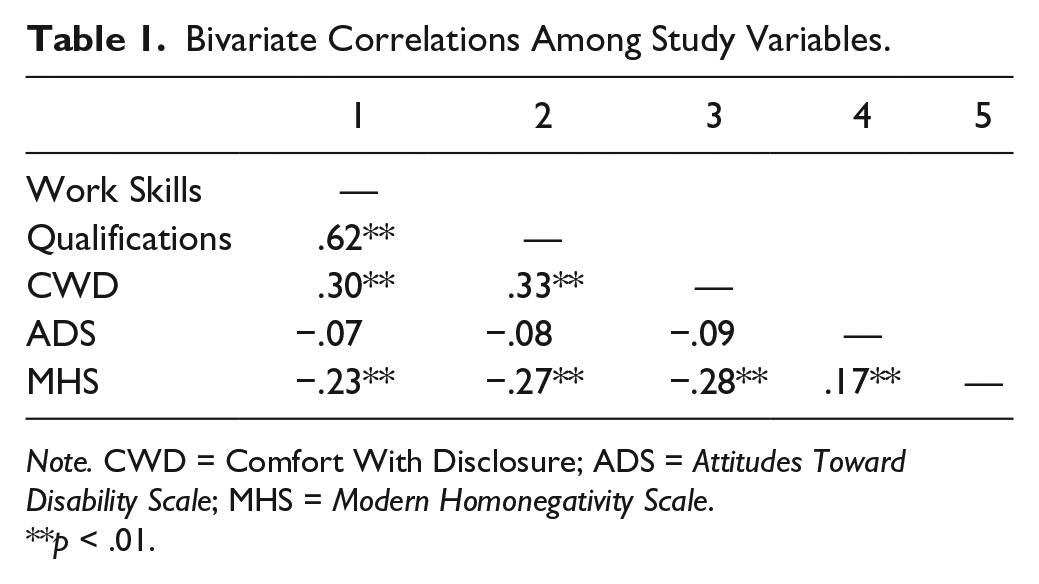
Note. CWD = Comfort With Disclosure; ADS = Attitudes Toward Disability Scale; MHS = Modern Homonegativity Scale.
p < .01.
Qualitative analysis
Qualitative content analytic procedures (Elo et al., 2014) were used to analyze open-ended responses from questions that asked participants to describe their decision-making process. All responses were reviewed by three members of the research team, and then condensed into thematic units (Elo & Kyngäs, 2008). Research team members used an inductive and comparative approach to code all of the responses (Merriam, 2009). A total of 638 responses were collected and coded for this study. Responses ranged from a few words to one to three sentences. Research team members independently coded each response, and then met as a group to discuss the thematic codes that were constructed during open coding. Several meetings took place to condense themes into categories. Research team members then deductively coded all of the original data using the final themes and categories that were inductively created (Dispenza, Harper, & Harrigan, 2016). The following procedures were used to ensure analytic procedures were credible and trustworthy: (a) critical questioning during coding team meetings, (b) review of codes and analytic procedures with an independent panel of researchers as a form of analytic triangulation, and (c) reflective documentation and journaling (Elo et al., 2014; Merriam, 2009).
Results
Quantitative Findings
Primary analysis
A 2 (sexual orientation) × 2 (gender) × 3 (disability type) factorial MANCOVA was used to test our primary hypothesis. Bivariate correlations (see Table 1) revealed that there were significant positive correlations between Work Skills, Qualifications, and Comfort With Disclosure, allowing us to analyze them together. Explicit attitudes toward sexual minority persons negatively correlated with each of the three dependent variables, but explicit attitudes toward disability did not significantly correlate with any of the dependent variables. Thus, explicit attitude toward sexual minority persons was included as the only covariate in the model. Given the unequal sample size among the groups, Box’s test of equality of covariance matrices was first examined. Results revealed that the assumption of homogeneity of covariances was not violated, Box’s M = 84.77, p = .095. Levene’s test of equality of error variance also revealed that variance was equal across all three dependent variables: Work Skills, F(11, 360) = 1.37, p = .19; Qualifications, F(11, 360) = 0.39, p = .96; and Comfort With Disclosure, F(11, 360) = 0.604, p = .83.
We then proceeded with the primary analysis. Refer to Table 2 for all MANCOVA results, including effect sizes (i.e., partial eta-squared) for each main effect and interaction test. Explicit attitude toward sexual minority persons was a significant covariate in the multivariate analysis, Wilks’s Lambda = .885, F(3, 357) = 15.48, p = .001, partial eta-squared = .12. Furthermore, explicit attitude toward sexual minority persons was a significant covariate for each of the three dependent variables (p = .001) in each of the univariate analyses. Next, we examined whether there were any significant main effects and interaction effects among our three independent variables, sexual orientation, gender, and disability type. Of the upmost interest, results revealed that there was a significant three-way interaction between sexual orientation, gender, and disability type disclosure, Wilks’s Lambda = .96, F(6, 714) = 2.47, p = .02, multivariate partial eta-squared = .02, observed power = .83. Follow-up univariate between-subject tests revealed that the interaction was significant with two of the dependent variables: Work Skill, F(2, 359) = 5.58, p = .004 and Qualifications, F(2, 359) = 5.25, p = .006. The interaction was not significant for Comfort With Disclosure, F(2, 359) = 2.28, p = .104.
Multivariate Analysis of Covariance.
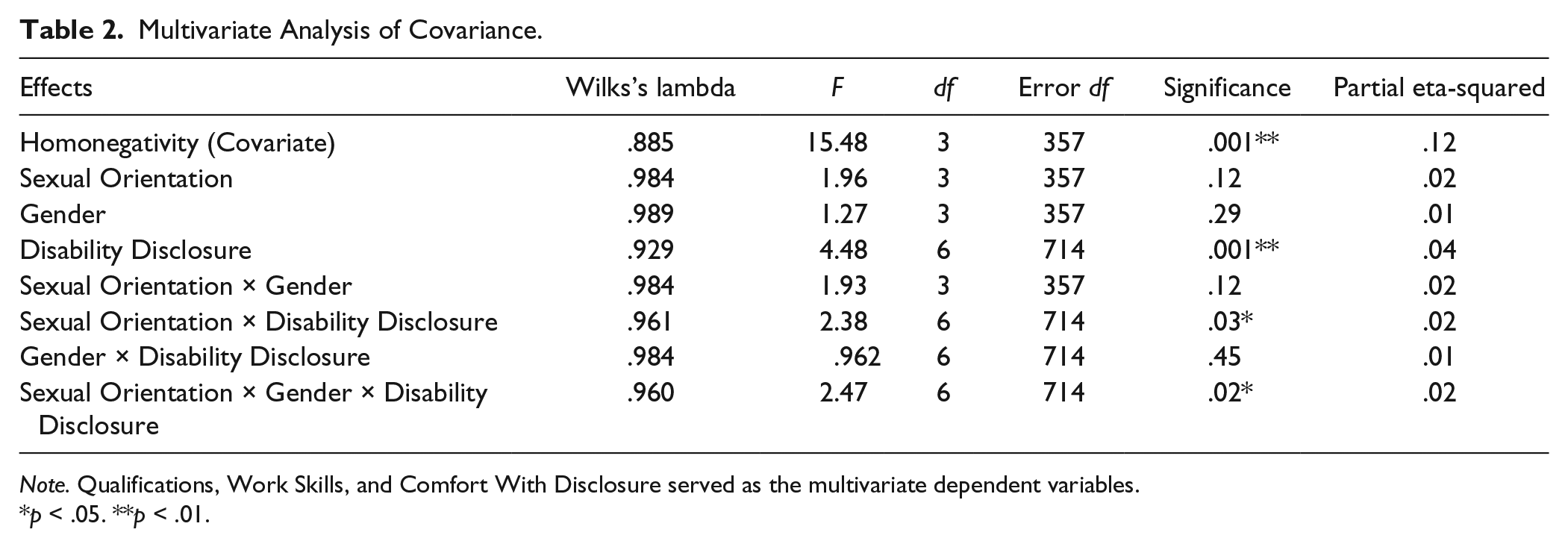
Note. Qualifications, Work Skills, and Comfort With Disclosure served as the multivariate dependent variables.
p < .05. **p < .01.
Simple effects analyses
Tests of simple effects were then consulted by examining the effect of one independent variable at individual levels of the other independent variables. Explicit attitudes toward sexual minority persons remained as a covariate in the analyses, and only Work Skills and Qualifications were explored for further analysis as Comfort With Disclosure was not significant.
No statistically significant effects for Work Skills were found for conditions in which sexual orientation was never disclosed, regardless of gender, or disability type. Relatedly, in the condition in which there was no disability type disclosed, no statistically significant differences were found for Work Skills based on whether the applicant was a sexual minority man or a sexual minority identified woman F(1, 367) = 0.25, p = .62. However, statistically significant effects were found on Work Skill ratings in conditions in which sexual orientation was revealed, in conjunction with gender and disability type. Participants who received the sexual minority man living with a physical disability condition provided significantly lower scores on Work Skills (M = 20.12, SE = 0.52) than they did for the sexual minority woman living with a physical disability condition (M = 22.15, SE = 0.62), F(1, 367) = 6.24, p = .01. Conversely, participants who received the sexual minority woman living with a psychiatric disability condition provided significantly lower Work Skill ratings (M = 19.06, SE = 0.59) than they did for sexual minority men living with a psychiatric disability condition (M = 21.18, SE = 0.6), F(1, 367) = 6.18, p = .01.
No statistically significant effects for Qualification ratings were found for conditions in which sexual orientation was never disclosed, regardless of gender or disability type. Relatedly, in the condition in which there was no disability type disclosed, no statistically significant differences were found on Qualification ratings based on whether the applicant was a sexual minority man or a sexual minority identified woman F(1, 365) = 0.76, p = .39. However, statistically significant effects were found on Qualification ratings in conditions in which sexual orientation was revealed, in conjunction with gender and disability type. Participants who received the sexual minority man living with a physical disability condition provided significantly lower Qualification ratings (M = 15.48, SE = 0.67) than the ones they provided to the sexual minority woman living with a physical disability condition (M = 17.67, SE = 0.80), F(1, 365) = 4.46, p = .03. Conversely, participants who received the sexual minority woman living with a psychiatric disability condition provided significantly lower Qualification ratings (M = 14.99, SE = .76) than they did for sexual minority men living with a psychiatric disability condition (M = 17.82, SE = 0.78), F(1, 365) = 6.76, p = .01.
Qualitative Findings
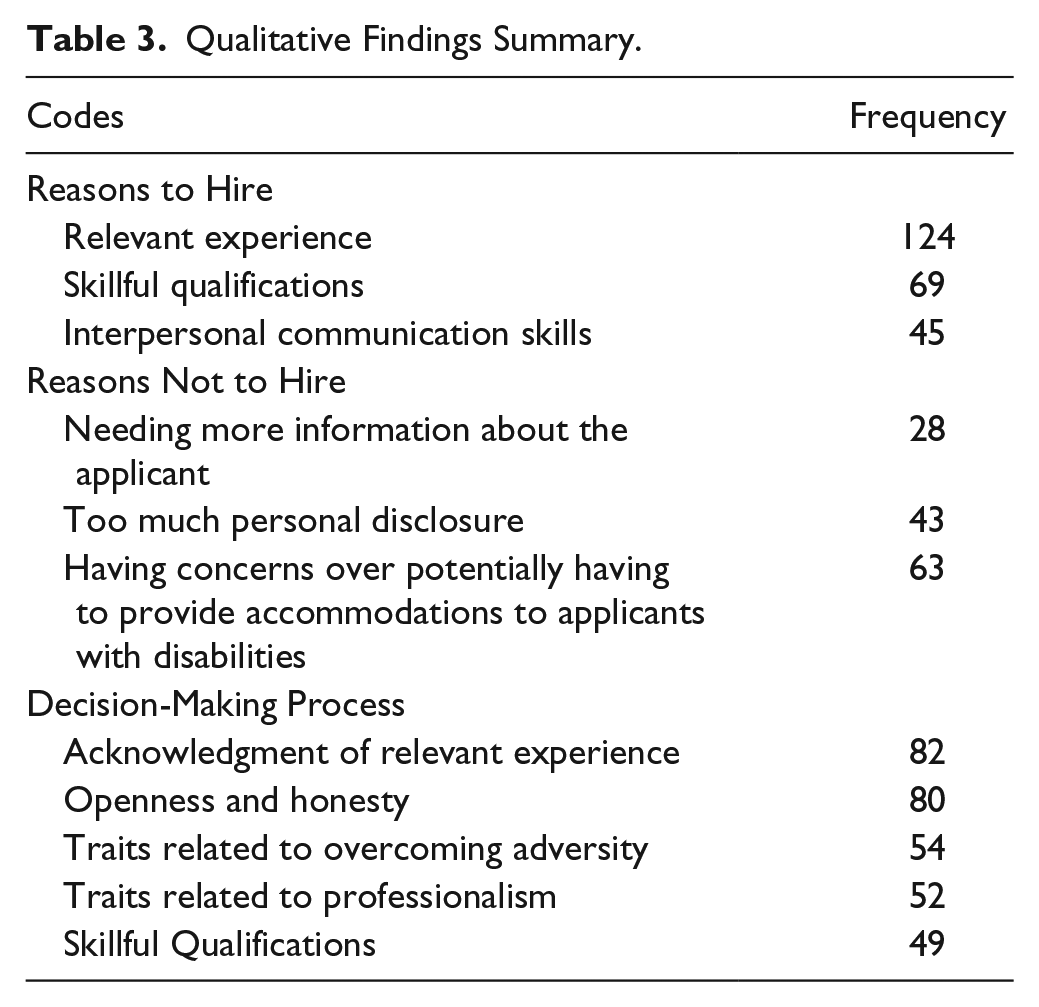
Findings are reported according to the open-ended prompts: decision-making process, and reasons to hire or not to hire. Frequencies of thematic responses are included below, and in Table 3.
Qualitative Findings Summary.
Reasons to hire
Three themes were identified as favorable justifications to hire applicants. In addition to relevant experience (f = 124), and skillful qualifications (f = 69), participants uniquely identified the applicant’s interpersonal communication skills (f = 45) as a reason to hire. Participants commented that the applicant “seemed able to express ideas in an excellent manner” and “has excellent interpersonal and communication skills.”
Reasons not to hire
Three primary themes emerged as to why participants would not hire the applicant: needing more information about the applicant (f = 28), too much personal disclosure (f = 43), and having concerns over potentially having to provide accommodations to applicants with disabilities (f = 63). Participants discussed the need to evaluate this applicant along with other applicants, and scheduling concerns for the applicants who disclosed living with either a physical or psychiatric disability. For instance, one participant stated, “If I could find a candidate that did not need potential accommodations, but was just as qualified as the other applicant, I would hire the other candidate.”
Decision-making process
Five major themes emerged from the data: acknowledgment of relevant experience (f = 82), openness and honesty (f = 80), traits related to overcoming adversity (f = 54), traits related to professionalism (f = 52), and skillful qualifications (f = 49). Participants reported that the “the applicant demonstrated some of the key skills needed for the position in the interview with adequate experience needed,” and “solid credentials to qualify the applicant for the position.” These data indicate that participants were carefully considering personal traits that would make the individual an adequate fit for the position for which the applicant was applying. Participants reported finding the applicant to be capable, well credentialed, and trustworthy for the job.
Discussion
Using a sample of undergraduate students located in the southeast United States, this 2 × 2 × 3 experimental analogue study explored whether an applicant’s qualifications and work skills would differ as a result of their sexual orientation, disability type, and gender. We also inquired whether participants’ comfort with disclosure would differ as a result of an applicant’s sexual orientation, disability type, and gender. Given that researchers have previously reported a statistically significant effect for hiring bias as a function of sexual orientation (Baron & Hebl, 2013; Nadler & Kufahl, 2014; Nadler et al., 2014), disability type (Dalgin & Bellini, 2008; Gouvier et al., 2003; Roberts & Macan, 2006), and gender (Johnson et al., 2016; Ng & Weisner, 2007), we predicted that there would be a statistically significant interaction effect among these three independent variables. This hypothesis was supported in this study, even after controlling for any global negative attitudes that participants may have possessed toward sexual minority persons. Homonegativity, explicit negative attitudes toward sexual minority persons, was both a significant correlate and a significant covariate in this study. This is contrary to Nadler et al. (2014), who, although found a small negative correlation between explicit homonegative attitudes and hiring ratings, did not find that it served as a significant covariate in their model. Coincidentally, attitudes toward disability did not have any significant association with any of the dependent variables in this study, despite its small significant positive correlation with negative attitudes toward sexual minority persons. This suggests that although the two constructs are related, explicit negative attitudes (e.g., stereotypical or prejudicial beliefs) toward sexual minority persons may bear more of an effect on hiring decisions versus explicit attitudes toward persons with disabilities.
Related to the main and interaction effects of this study, we found no significant effects for comfort with disclosure. The lack of any statistical significance contradicted our qualitative findings that indicated that participants were less likely to hire an applicant because they disclosed too much information. At best, these two findings should have converged in some way. Instead, we found that the three independent variables significantly interacted with one another with respect to qualification and work skill ratings. Examination of simple effects tests was consistent with our initial hypothesis. There were no significant differences on ratings of an applicant’s qualifications and work skills in conditions which sexual orientation was never disclosed. This nonsignificant finding was consistent across gender and disability types. However, there were differences on ratings of an applicant’s qualifications and work skills when sexual orientation was disclosed, even after controlling for explicit negative attitudes toward sexual minority individuals.
Furthermore, there were differences based on disability type and gender when sexual orientation was disclosed. As initially predicted, sexual minority women living with psychiatric disabilities were given lower ratings on qualifications and work skills than sexual minority men living with psychiatric disabilities. This may be the result of sociocultural standards that stigmatize those who possess multiple marginalized identities (e.g., lesbian woman) more harshly, and having what is considered one of the more stigmatizing of invisible disabilities—a psychiatric disability (Malachowski & Kirsh, 2013). However, to our surprise, sexual minority men living with physical disabilities were given lower ratings on qualifications and work skills than sexual minority women living with physical disabilities. Consistent with Tilcsik’s (2011) thoughts, sexual minority men living with physical disabilities may be perceived as not upholding “stereotypically male heterosexual traits,” and thus likely to be aversively discriminated against as a result of violating sex and gender norms. When examining the themes that emerged from the open-ended responses, participants identified that they would not hire candidates due to personal disclosure and the potential of having to provide disability accommodations. Thus, both sexual orientation stigma and lack of disability civil rights knowledge possibly influenced how participants evaluated the mock candidates in this study.
As previously implicated by Nadler et al. (2014), these findings lend support aversive discrimination theory. Unconscious prejudicial beliefs and feelings may have led participants in this study to provide lower ratings toward sexual minority individuals living with disabilities, despite being qualified candidates for employment. Aversive discrimination is further supported by some of our qualitative findings. As a research heuristic, the qualitative data provided some insight into potential factors that participants attended to when making their decisions, and the qualitative findings triangulated our data. Participants identified positive-laden work skills, personality traits (e.g., perseverance), and professional traits (e.g., openness and honesty) as important factors that influenced their decision-making process. However, the mock applicants who disclosed their sexual orientation and disability type were still provided significantly lower scores on qualification and work sills, despite having the same skills, personality, and professional traits as those who never disclosed. This discrepancy suggests the presence of aversive discrimination, as participants may have been rationalizing their negative evaluations as a result of mock applicants actually disclosing their sexual orientation and disability type.
Implications for Rehabilitation Counseling
The results of this study illustrate that sexual minority persons with disabilities can be negatively evaluated during the hiring process, and differentially evaluated when compared with persons who never disclose their sexual orientation. While simultaneously affirming both sexual orientation and disability identities (Dispenza, Viehl, et al., 2016), rehabilitation counselors may find it helpful to inform consumers and clients about how stigma and discrimination could impact the employment interview process. Rehabilitation counselors are also encouraged to help their consumer and clients explore the outcomes of disclosure during the employment interview, and ways of coping with potential unintended adverse consequences. In particular, rehabilitation counselors may want to utilize role-plays as a means of practicing how to disclose under various interview situations (Dalgin & Bellini, 2008). Utilizing role-plays to discuss how to effectively communicate one’s skillsets and job-relevant competencies is another important consideration for rehabilitation counselors. In a systematic review of the literature from 1973 to 2008, Isaac et al. (2009) found that one empirically supported way to limit hiring bias, particularly gender bias, was to ensure that applicants provided evidence of competence and record of excellent past performance related to the functions of the job.
Despite the fact that participants identified relevant qualification and work skills as reasons to hire applicants, they still differentially rated sexual minority identified applicants. Using scoping study methodology to review empirically supported workplace antistigma interventions, Malachowski and Kirsh (2013) reported that education in the forms of workshop and seminar trainings were effective at reducing negative attitudes toward diverse persons and persons with disabilities. Thus, rehabilitation counselors could explore whether certain employers require their employees to partake in such trainings to assess affirmative workplace organizational culture. Rehabilitation counselors could also consider providing such trainings for employers, and continue advocating that employers focus on job-related factors versus human diversity factors when making hiring decisions (Nadler et al., 2014).
Limitations and Directions for Future Research
The results of this study should be interpreted with respect to several limitations. First, although the interaction among the three independent variables was significant, the interaction effect size was small, indicating that only 2% of the interacting independent variables contributed to hiring bias ratings. Second, like other studies (e.g., Gouvier et al., 2003; Nadler et al., 2014; Roberts & Macan, 2006), we relied on undergraduate students to participate. We used undergraduate students from a variety of majors, because many people who make employment-related hiring decisions (whether in higher education or other employment settings) do not all possess formal degrees in business or business administration. Although we attempted a realistic situation to increase the ecological validity of the research conditions, undergraduate students do not necessarily make hiring decisions as part of their responsibilities as students. However, in a recent study conducted by Johnson et al. (2016), college students were shown to have more sensitivity to diversity when it came to making hiring decisions than were actual hiring managers in real employment settings. It is possible that real employers may actually show more hiring bias if they were directly tested, and thus, future research studies should replicate this study with actual employers responsible for making hiring decisions.
Third, our results are limited to only the disability conditions that were utilized in this study. Although our results cannot be extended to all other disability types, these findings warrant that future studies should explore other disability types, such as sensory- and cognitive-related disabilities. Future studies should also explore the effects that race and ethnicity would have as a contextual variable in conjunction with sexual orientation. Similarly, study conditions could be replicated with transgender and gender nonconforming (TGNC) persons. This is important to consider especially given the current state-level political legislations that specifically exclude TGNC persons from being protected against discrimination (American Civil Liberties Union, 2017; Human Rights Coalition, 2016).
Although no analogue research design could ever truly replicate real-life conditions, the conditions and stimuli were created as realistically as possible (Cook & Rumrill, 2005). We relied on textual material that were presented via Internet, but only included a transcript excerpt of the interview. Thus, this particular format for presenting stimuli may be a considerable limitation to this study’s external validity and generalizability. Future research studies should employ other real-world situations to increase the external generalizability of these results. Participants may have responded differently if they viewed a video recording of the interview with actors, or if they were placed in actual conditions in which they had to evaluate confederates who disclosed sexual orientation and/or disability status in real time.
Footnotes
Declaration of Conflicting Interests
The author(s) declared no potential conflicts of interest with respect to the research, authorship, and/or publication of this article.
Funding
The author(s) received no financial support for the research, authorship, and/or publication of this article.