



Abstract
This study focuses on the teaching and learning of the pre-numeracy concepts through technology at Foundation Phase. It pre-supposes that the use of information and communication technology resources presents an innovative way to improve teaching and learning mathematics. The author argues that young children's relational conceptions of number lie at the core of their mathematics education as any subsequent mathematics learning heavily depends on it. This learning process is by no little means assisted through the mathematical activities teachers engage their learners and the resources they avail them, such as information and communication technologies. Principally important are the discursive interactions that ought to arise around the activities and the resources used. The author presumes that mastery learning is advanced by teaching using the variation theory. Teaching through variation aims to anchor knowledge; to make mathematical knowledge visible to amateurs through distinguishing the essential features of an ‘object of learning’ from its non-essential features. A treatment group was taught with information and communication technologies against a control group that used traditional teaching methods. Despite other intervening variables, the results of the study suggested better learning outcomes from the experimental group.
Keywords
Introduction
Research suggests that higher student achievement and deeper student thinking skills are enhanced by information and communication technologies (ICTs) use in teaching and learning (Comi et al., 2017; Stols et al., 2015). Other research also shows that preschool children benefit from technology, particularly from open-ended programs that encourage communication, problem solving and conceptual development. The researcher asks: can ICTs mediation help develop pre-number learner thinking skills better than traditional teaching methods? Thus, the purpose of the research is to explore the efficacy of learning of pre-numeracy skills of kindergarten learners when ICTs mediate learning.
For long, researchers have pointed to the hard to track difficulty of teaching and learning mathematics. What can the new ITCs offer towards the amelioration of this problem? Van Niekerk (2010) argues that the use of ITCs in education is twofold ‘on the one hand it enables us to develop skills that were never before possible and on the other hand it also demands skills that were never before required’ (p. 41). Given that teaching and learning in the formative years are critical for the future of the learner, what opportunities may ICTs help in young learners’ development of pre-numeracy skills, numeracy as well as overall number sense? Although ICT technologies were at first concentrated in the developed world, in the recent past, ICTs such as cellphones and tablets have become more widespread to many learners including poorer rural learners. Such capabilities have enabled learners in the most remote parts of Africa to be in line with the rest of the world in as far as the capabilities enabled by internet.
Despite technology becoming increasingly available to teachers, teachers often do not make optimal use of it in mathematics classrooms. Research indicates that “although teachers in schools show great interest and motivation to learn about the potential of ICTs, in practice, use of ICT is relatively low and it is focused on a narrow range of applications” (Sime and Priestley, 2005: 131). Similarly, Howie and Blignaut (2009) found that only 18% of grade 8 mathematics teachers use technology in teaching and learning activities, with the main uses of technology related to administration and processes of monitoring learners' feedback.
Significance of the study
In recent times, many researchers have included technology as a definition of literacy. It is important to help learners use technology in school so as to prepare them to function in a technological world (Reys et al., 2009). Working with ICTs in the classroom is important for engendering digital literacy. Thus, learning to use ICTs is inherently important in its own right. Street (1984) sees literacy as social practices and conceptions of reading and writing. For mathematics teaching and learning, the National Council of Teachers of Mathematics (2000) argue: ‘electronic technologies…furnish visual images of mathematical ideas, they facilitate organization and analysis of data…they support investigations by students…and help students focus on decision making, reflection, reasoning and problem solving’ (p. 24).
ICTs individualise learning, allowing learners to relate to the content at their own pace. Having accessed the content, they can play it forwards or backwards or stop it as they wish till they understand. That is, they facilitate mastery learning (Guskey, 2005) by allowing learners to scrutinize the variations of what they want to learn. Also delivery of information is instant and of uniform quality. Learners can access some of the best teachers in the world on specific topics. To deepen learning and enhance problem solving it is important that the use of ICTs moves from a ‘transmission’ view of teaching to a ‘constructivist’ one.
Literature review and theoretical framework
I distinguish Regulative Discourses (RD) and Constitutive Discourses (CD) (Searle, 1969) in the use of ICTs in mathematics teaching and learning. Discourses are concerned with classroom talk between all members of the class including the teacher. CD regard talk about a subject, for example mathematical concepts, notation, terminology, principles, rules and definitions exclusive to mathematics for example, f(x), which is reference to a certain function is part of mathematics CD. This knowledge is quite different from other subjects say science or geography. Digital technologies have potential to boost CD. RD concern for example school or classroom rules which helps ordinary communication and promotes order in a learning situation. Thus, RD is not specific to any curricula subject, as it is used by all teachers for classroom management and administration. ICTs can be used for RD if curricula materials are posted online, but this use is only for transmission rather than to help learners construct mathematical knowledge. Learners are supposed to learn not from ICTs but with ICTs.
Although for some teachers the use of computers in kindergarten is mainly viewed novel, children see it as a game of some sort. This is helpful because the best way for children to learn is through play. Today's children can be regarded as “ilearners” since digital devices now dominate children's daily lives from as young six months.
The Unified Theory of Acceptance and Use of Technology (UTAUT) (Venkatesh et al., 2003) informs this research. The model explains human behaviour as they use technology. The model avers four factors that influence people's use of technology. The UTAUT model helps to answer the question on users’ attitudes for adopting ICT in education as well as its effects. The UTAUT (Figure 1) consists of four elements. These are: performance expectancy (PE), effort expectancy (EE), social influence (SI), and facilitating conditions (FC). These are independent factors that can influence the dependent variables of behaviors and usage, and hence effect. Other factors such as gender, age, experience, and voluntariness of use indirectly influence ICT usage as well as effect. Behavioral intention is regarded as a vital factor in predicting whether technology will be used (Venkatesh et al., 2003).
The UTAUT framework (adapted from Venkatesh et al., 2003).
PE is regarded as, “the degree to which an individual believes that using the system will help him or her to attain gains in job performance” (Venkatesh et al., 2003: 428). PE is hypothesized to be affected by gender, age and experience. EE is regarded as, “the degree of ease associated with the use of the system” (Venkatesh et al., 2003: 428). This expectancy is moderated also by gender and age, and experience. SI regards, “the degree to which an individual perceives that important others believe he or she should use the new system” (Venkatesh et al., 2003: 428). FC regard, “the degree to which an individual believes that an organizational and technical infrastructure exists to support use of the system” (Venkatesh et al., 2003:428).
Mastery learning
Performance is related to mastery learning. Ausbel (1963) argued that learning is a function of time. Assumed in this argument is that any learner can develop competency on any learning material if given enough time to learn it. According to Guskey (2005), Bloom proposed a pedagogical technique for mastery learning. Given that aptitude; the rate of learning something by a group of students falls under a normal curve, it is expected that after a teaching a particular topic when tested, learner performance will also be normative. Bloom argued that was not desirable, as some learners remained incompetent on the topic. He argued that to deal with the underachievement gap between the cohort, assessment must be used formatively rather than summatively. From it, learner difficulties on the topic such as their misconceptions are picked up and used as a basis for corrective teaching to the under-achievers (see Makonye, 2017; Makonye and Khanyile, 2015). Bloom argued that after re-assessment, this would lead to a negative skew distribution where most learners now perform well on a topic. Bloom et al. (1971) argued that using assessment formatively provided feedback that showed learners what they have learnt well and what they have not in order to do better next time (see Figure 2). It is envisaged that if there is time, more cycles can be done until all learners master the topic. These cycles can occur in the form of a “design-experiment” (Brown, 1992) which makes for repeated cycles of identifying an object of learning – planning to teach it – teaching – feedback – improvement.
The mastery learning instructional process. Adapted from Guskey (2005: 4).
It is noted that the Singaporean mathematical success was built on a solid primary school mathematics curriculum that is textbook based. Teaching primary school mathematics is strongly underpinned on the use of concrete-pictorial-abstract models for learners to deeply engage with just a few mathematics topics. The curriculum's focus is on problem solving. It is argued that mastery learning is not just knowing a fact but that it is the dynamic use of knowledge in increasingly more complex ways particularly problem solving. The Department for Education (DfE) argues that the criterion of a learner who has reached the required standard is being able to apply what they have learnt.
Bloom argued that teaching all students in the same way was counterproductive in addressing achievement gaps between learners, as they were inherently different (Guskey, 2005). He argued for providing variation in teaching because the students were different, so they learnt differently and at different rates. Bloom argued that as learners become competent on a subject, there were many other benefits such as positive attitude towards the subject and higher school attendance which promoted overall better education system. Further correcting minor learning problems just-in-time prevents these from becoming major learning problems. Mastery learning is advanced through variation in teaching and learning.
Variation theory in teaching and learning
The aim of using variation in teaching is to anchor knowledge through isolating a concept – distinguishing its essential features from non-essential features. Variation teaching eliminates the distraction of a complex background through decomposing the complex background into small chunks that can be examined one by one.
Using concrete-pictorial-abstract models and representations of a concept go a long way to promote learners’ categorisation of concepts and procedures. This way a concept can be isolated and also generalised across different contexts. In particular, when learners have such a deep understanding of a concept, they seek for it and espy it in unusual contexts, which is important in problem solving. Variation theory aims to help students’ put concepts into categories, that is to classify concepts through noticing their differences and similarities. Further, once categories have been made it is important to be able to unite them to realise what is common between them. This deepens the knowledge of a subject. When teaching using variation, the teacher first considers the goal of learning or the ‘object of learning’.
Adler (2017) distinguishes between two objects of learning; mathematical concept and mathematical procedure (p. viii). Thus, for grade 1 students, the object of learning could be sorting object by colour, size and shape (CSS). Those would be mathematical concepts. If learners are asked to count small red triangles, the counting is a mathematical procedure object of learning. These two objects are closely related. In particular, for it to be effectively learnt, the mathematical procedure has to be meaningful. In this case, the procedure relies upon the mathematical concept of sorting and classifying correctly. If not, the counting becomes incorrect. Note that counting itself is a mathematical concept as well. A further example of an object of learning in this study is finding the distance between two points on a number line, which requires classifying what needs to be counted and the points or the spaces between points. Other objects of learning in this study are encompassed in the tasks.
Gu et al. (2017: 16) comment on two types of variation, conceptual variation refers to the strategies that are used to discern essential features of a concept and to experience connotations of the concept by exploring varying embodiments of the concept… it aims to help students develop a profound understanding of a concept from multiple perspectives.
Linking concrete to abstract
Piaget (1954) argued that learners under 11 years operate at the concrete operations stage. This means that FP children can only apply logic to physical objects.
As Henning and Gravett (2011) have proposed, practical experiences and theoretical knowledge bootstrap each other. One asks; What can educators do to link the disconnection between the concrete and the abstract? Since the early civilisations, people have resorted to physical objects to help them unravel and solve mathematics problems in their daily life. At Foundation Phase, children begin to understand symbols and abstract concepts only after experiencing the ideas on a concrete level. Manipulatives are concrete objects that are seen as helping students to understand abstract mathematics concepts (McNeil and Jarvin, 2007). Furner et al. (2005) suggest that, the use of manipulatives provides both teachers and learners with great potential to use their creativity. As a consequence, students learn mathematics in an enjoyable way that enables them to form abstract concepts. McNeil and Jarvin (2007) regard manipulatives as helping learners to link real-world knowledge with textbook knowledge which helps increase their memory and understanding. In other words, use of manipulatives helps develop learners' relational understanding of mathematics (Skemp, 1976). Children learning kindergarten and preschool mathematics need concrete investigations so that they can grasp concepts at their own pace. As they return to former tasks, they look at them in different ways and so begin to form balanced concepts.
In order to learn pre-number concepts, children need real things they can handle such as blocks, shapes and counters which teachers can use as sources for discussions to develop children's mathematical ideas. As per constructivist view of learning, McNeil and Jarvin (2007) argue that learners' connection of concrete examples with abstract ideas can only follow when children have had enough time to manipulate concrete materials. In that, a teacher uses mathematical discourse to guide learners into the mathematical thinking she desires.
One important way for learners to learn mathematics is through games. These provide learners with ample opportunities for inter-personal communication as well as reasoning and argumentation in non-threatening ways. When connections have been made through critical engagement with concrete materials, it becomes natural to use abstract mathematical symbols. This is what Freudenthal (1983) regarded as the movement from horizontal mathematisation (informal mathematics) to vertical mathematisation (formal mathematics).
Counting and early number sense
Reys et al. (2009) argue that for counting and the number concept to be meaningful for learners, it is important for learners to understand the notions of classification and patterns. They argue that ‘classification is fundamental to learning about the real world, and it can be done with or without the real world’ (p. 136). Thus, a group of children can be classified as boys and girls, or pets can be classified as cats or dogs. Thus, if a child is asked to count girls, they must be able to distinguish girls from boys if they are to count properly. So if children are to count, they must know what to count. Classification helps to identify what is to be counted. Classification is enhanced by manipulatives. Manipulatives usher concrete experiences that help children make sense of mathematical ideas and support their mathematical thinking (Reys et al., 2009). They also help cater for learners’ diversity and increase learners’ active engagement with mathematics. This is what Stein et al. (1996) referred to as doing mathematics. Manipulatives promotes the development of mathematical ideas with connection to real-world contexts (Stein et al., 1996).
Reys et al. (2009) argue that classification helps learners to be flexible thinkers. If children disagree on classifying an object, Reys et al. argue that as they support their position, they develop argumentation skills which are highly valued in mathematics. They are likely to use qualitative words related to counting such as fewer, more, many, most and none. Reys et al. (2009) argue that attribute blocks are excellent in developing learners' classification skills (see Figure 3). These blocks can be commercial, but they can be made of cardboard or coloured manila. The first attribute is that of size: big or small (BS). The second attribute is that of colour: red, blue or green (RBG); the third attribute is that of shape: square, triangle, pentagon and circle (STPC).
Attribute Blocks (adapted from Reys et al., 2009: 137).
Thus games can be played by learners such as: I have three sides, I am red, I am small. Whom am I? When the partner answers correctly it is their turn to play the; ‘Who am I?’ game. Such games help learners to communicate and develop logical reasoning. Classifications can use logical connectives and, or and not which are very important in mathematics.
The study of patterns is at the core of mathematics. Uncovering and discovering patterns are very important in mathematics. Children can copy patterns such as those for beads, tangrams and tessellations. Attribute blocks are other objects offer learners opportunities to stack, arrange and order objects to make toys that simulate resemble real things such as cats or cars (see tasks 7 and 8 in the Discussion section). Number sense and other mathematical explorations grow from such patterns. Another important pre-number notion related to classification and patterns is that of seriation (Piaget, 1954). This concerns a learner's capability arrange items along some quantifiable dimension, such as length or weight.
Research methods and design
The qualitative design was used to investigate learners' development of pre-number skills through ICTs. Attribute blocks and pattern blocks were used as resources in the classroom. Further concrete attribute blocks and pattern blocks were availed to learners to provide a multimedia learning environment.
Purposive sampling was used in the study. A quasi-experimental study was done on grade one (1) learners aged between 5 and 6. This was done towards the end of the first teaching block. The treatment class composed of 15 learners: 7 boys and 8 girls. The control class composed of 15 learners: 6 boys and 9 girls. These classes were located at different schools in the same school district, in a Johannesburg township. The schools were two kilometres apart. The children came from roughly the same geographical area with the same socio-economic status.
The experimental group teacher was a female, 38 years of age. This teacher had been teaching at FP for 18 years. The control group teacher was a female, 40 years old who had been teaching at FP for 22 years. I thus regarded the experimental and control group of comparable parity.
Data collection
Data were collected, as students played games and answered questions concerning attribute blocks and pattern blocks (see tasks in the Discussion section). At the beginning of the study, all the groups of learners were availed attribute blocks and pattern blocks. Learners in the treatment group were given tutorial videos to watch in which a teacher was teaching about attribute blocks. These videos were loaded into the computers, and learners were guided to watch the videos before they were asked to do activities in small groups of three (3). In the control group, the teacher discussed classification of the attribute blocks and use of pattern blocks in the normal teaching way without any ICTs. The teaching intervention composed of four, 40-minute daily lessons from Monday to Thursday. After 25 minutes in each lesson of engagement with ICTs activities, the groups of students were given worksheets to answer questions to assess their understanding. In addition, a teacher read out the questions to learners. Learners were to say out their responses to questions in addition to writing them down on work sheets. A videotape was used to capture the data. These were hands-on activities to stimulate children's exploration, critical thinking and communication.
Initially, data were analysed with the use of descriptive statistics to compare effect of the tutorial videos intervention per task. Also some interviews were held with some learners to elicit their thinking on the tasks. Otherwise most of the analysis was qualitative, when field notes and video data were analysed as I played it on my laptop. Triangulation of data collection and analysis (Brannen, 2017) was done with the help of the two teachers who moderated my analysis. This was quite helpful, as the teachers had taught these classes for a long time and had better insight of what changes may have been attributed to the intervention.
Ethical considerations
Participants were minors. All ethical clearance protocols were followed and observed. Informed consent was read and signed for by parents, guardians and the two teachers. Permission to do the research was obtained from the appropriate Department of Education as well as the two schools' principals. The children themselves were asked if they wanted to take part in the study. In particular, learners were told that they could come in or leave the study anytime they wished without any bearing on how the teachers or researcher perceived their conduct. However, the learners were informed that participating in the study could be profitable to their learning.
Data analysis
First, I present the data collected from the two groups. The aim of data collection was to find if use of technology in one group helped learners more to develop pre-numeracy skills of classification, seriation as well as checking development of logical thinking of the learners. Does ICT mediation make any difference to the learners' learning experience? I regard questioning as very important in the learning process because it focusses learners' attention on important curricula knowledge and processes.
Classification activities
If the following chart is developmentally appropriate for your students, you may wish to create it on the chalkboard. The reader is kindly referred to Figure 3 for the attribute blocks learners used in these tasks.
Task 1: ‘Who am I?’ game
Children played this game in group of 3:
A: I have three sides, I am green, I am small. Who am I?
B: I am not red, I am not blue, I have four equal sides. Who am I?
C: I am red or blue. I have four sides. I am not large. Who am I?
D: I am not large. I have more than four sides. Who am I?
Which clues describe more than one piece?
Which clues describe only one piece?
Your turn: Play ‘Who am I?’ with a partner (task adapted from Reys et al., 2009: 137).

This task 1 showed that the experimental group was better in classifying shapes than the control group. One can argue that ICTs had a positive impact in this important task on pre-numeracy skills.

This was quite an involving question, in which learners had to take time to sort out the squares and pentagons which had equal sides. The experimental class did slightly better, but both had equally correct answers.

This sorting question was also involving, for the five groups each needed to bring three small squares of red, green and blue to give a total of 15, respectively. Again the experimental group was better at reasoning and sorting than the other group.

This task required learners to be able to classify what a side of a shape is. Also important was the ability for learners to count. To have a one-to-one correspondence of to each side to the set of counting numbers.
The researcher decided to ask the group that failed to count the number of sides of a square.
Researcher: What is the number of sides that a square has?
Silence on that group
Researcher: Show me a square
The learners showed me a pentagon
Researcher: How many sides does it have?
Learner: Four
This small interview showed that some learners could not classify a square and also that they could not count properly.
Task 5: What is the distance between A and B?

Task 5, the control class was slightly worse off. But for both it seems that learners were not clear on classification whether it was dots or intervals that were to be counted. This is a classification problem that affects many learners in school. It is clear that the experimental group were not clear on this classification, as this was not covered in the tutorial videos.
Task 6: Arranging shapes according to the number of sides (this was a seriation task).

In this seriation, task performance between the two groups was comparable.
Pattern activities
Students were provided pattern blocks.
Task 7: Copying a fish pattern (5 minutes)

Task 8: Copying a train pattern (5 minutes)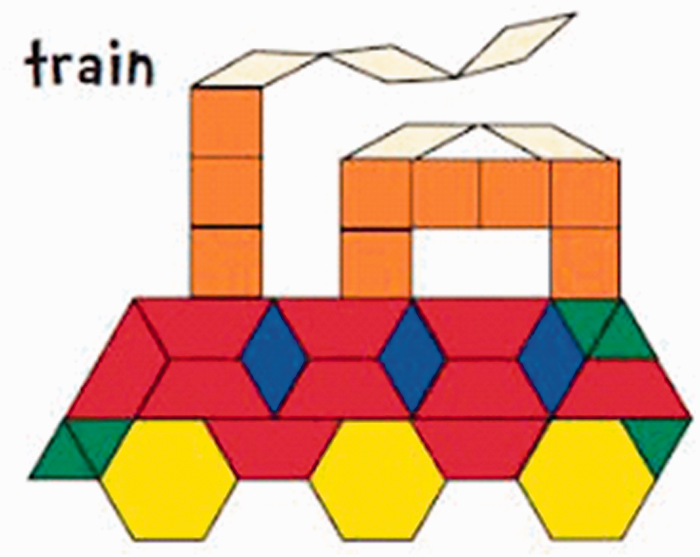

These were timed tasks. The experimental group did better. It could be that the control group could also do the task but they needed more time. It was clear that the learners in both groups enjoyed the tasks. It looked as if it was not mathematics but an Art class. The researcher realised the intimate connection between mathematics and Art.
Task 9: Copying a bead pattern (2 minutes)

This task seemed accessible to both groups, as it was correctly done in time. All children had to choose was the colour of the bead which was then put into the string.
Weighted scores on classification and patterns (experimental vs. control group).

In task 3, learners were to identify shapes smaller to the one given. These were to be three of each colour. Learners were particularly not exhaustive on their own answers in the control group resulting in lower correct responses. This is a result of non-exhaustive logical thinking.
The other task of arranging shapes according to the number of sides and finding the distance between points A and B was comparable. This means that technology had no effect on that competency on this task. The patterning results are very comparable between the experimental and control groups.
Discussion
At first the PE and the PE of the teachers and learners were quite low even though, because of my encouragement and the availability of ICT resources, the SI and the FC were high (Venkatesh et al., 2003). These were high because learners naturally are fond of ICTs, and teachers are keen to use them as they realise that their employer expects them to use them. The intervening variables of gender, experience, age and voluntariness were favourable because the experimental group teacher was a female; 38 years of age who was very interested in working with young children. The teacher had been teaching at FP for 18 years.
The hands-on activities enhanced by ICTs mediation proved to be quite helpful in promoting CD in addition to the RD (Searle, 1969). It seemed that these supported each other in enhancing learners' logical reasoning and mathematics sense-making.
Learners enjoyed using the ICTs when they watched the classification and patterning done on the videos. But this was more of transmittive teaching done by machine which helped them in their reflection (National Council of Teachers of Mathematics, 2000). Both the experimental and control groups enjoyed working together in small groups. These were effects of user behaviour and user intention (Venkatesh et al., 2003). In particular, the experimental group regarded use of computers as edutainment; this proved to be important (Venkatesh et al., 2003). In other words, it was learning through role play. The ‘Who am I?’ game proved most popular in both groups, as learners took turns to be the mysterious shapes that their partners had to guess. At times, in both groups, learners failed to give explicit characteristics of who they were particularly when using the logical connectives of and, or and not. This proved to be quite difficult for all learners, although the experimental ICT group was a little better.
Classification is an important variation concept and skill for learning, as it requires learners to compare and contrast features of an object in order to put it in a class. Comparing and contrasting features of a figure, its colour, size and shape, are key elements of teaching through variation. It involves the variation aspects of contrast, separation, fusion and generalization (Tong, 2012). On the seriation task, the experimental group did marginally better than the control group. On the distance between A and B, it was clear that most learners had difficulty to classify what had to be counted, the points or the spaces. These are important elements of variation because often when learners are asked to measure the length of a line segment in centimetres, they do not classify correctly what needs to be measured, which leads to wrong answers. This classification problem of measurement is an ongoing concern, as 75% learners the TIMSS 1994 gave the answer of counting the points (Reys et al., 2009). In the patterning of making a fish and the train, the ICT group also fared slightly better. On the bead pattern, all groups managed well. The patterning tasks were also very interesting to learners and they were engrossed in them. The learners all felt capable and motivated of doing the patterning tasks. The patterning task and the ‘Who am I?’ games were forms of problem-solving, although the students saw them as games. Learning became natural as it was infused with play. This brought about relational understanding rather than instrumental understanding of using rules without understanding their basis (Skemp, 1976). I think that for those who did not finish in the stipulated time (15 minute in each lesson), it was because they did not have enough time. One reason why learners in both groups may not have had all correct answers could be that they did not have ample time to engage with manipulatives (McNeil and Jarvin, 2007). This is because each lesson had 40 minutes. One way to increase mastery learning (Guskey, 2005) on sorting, classification and seriation using the shapes would be to use the concrete-pictorial-abstract modes as in Singaporean mathematics. In particular, the study showed that determination of conceptual objects of learning and procedural objects of learning helps learners to isolate what it is they are to learn. This occurred in both the experimental and control groups. I argue that concrete-coloured shapes of different sizes can start the activities. Then, the computer can be used to bring in the pictorial representations as in the learning. The shapes can be used as counters and then learners can draw number lines to connect the conceptual variation to procedural variation (Gu et al., 2017) on counting.
Conclusion
The research sought to explore higher order thinking skills, viz. mastery learning that can be facilitated by ICTs to foundation phase learners on pre-numeracy concepts. The participation and productivity of the ICT class was better. Skills developed were communication, analysis in the form of classifying shapes according to their attributes, seriation, as well as making patterns according to given specifications. These activities encompassed variation in teaching and learning.
What was a bit problematic was the management of the tutorial software because the children were not sure how to run it (Venkatesh et al., 2003) such as playing the tutorial videos. Even though ICT skills are not strictly mathematical, they are important for learners to acquire because they will need them both in school for studying other subjects as well as out of school. Granted ICT puts an extra cognitive load to learning mathematics (Van Niekerk, 2010), it is better for learners to learn how to handle it sooner than later. It is now an inescapable reality where ICTs have proliferated even to the most remote parts of the world.
Through observation, the study showed that learners’ motivation, confidence and enjoyment increased as a result of ICT usage. For both teacher and learners, the ICTs provided affordances for looking at curricula material in a new way. The ICTS provided variation. But there were also constraints as the teacher and learners also needed to study how to meaningfully integrate these in a mathematics lesson. ICTs improved learners’ interpretive plane by providing visual and audio images (pictorial), hence the better performance. The pictorial representations enhanced comparisons of the shapes as well as differentiating them, noting their categories and sub-categories. But there are still limitations as the teacher and learners did not have much experience in selecting the resources as well as using them. This is not unusual as most teachers find it difficult to conceptualise the use of technology for learners to construct mathematical knowledge in the constitutive sense (Stols et al., 2015). For ICTs, the constructive use opens up mathematical ideas, as well as through drill and practice in the form of games, like ‘I have three sides, I am green, I am small. Who am I?’
Limitations
This study showed that learners in the ICT intervention class did significantly better than the control group. As this was a quasi-experimental study, these results were suggestive given that there are many other variables (consider the UTAUT framework; Venkatesh et al., 2003) such as teachers' teaching ability as well as their motivation and other learner variables which could have been different between the two classes. Also, the learning dispositions of children are affected by attitudes and enthusiasm for learning. Perhaps the experimental class enjoyed the novelty of learning with ICTs, which might have affected the results. Many other factors may have affected learner outcomes. Nonetheless, this research is suggestive of the efficacy of ICTs mediation in enhancing pre-numeracy skills.
Recommendations
The questions that teachers ask their learners are important because they help learners to form categories and subcategories on objects of learning. The concrete-symbolic-abstract modes of learning help to deepen learning of pre-number concepts. In particular, ICTs can be used beyond transmitting information or presenting questions, but can also help learners to engage with learning material to enhance construction of mathematical knowledge. For this, teachers and learners need support, so that they learn how to use ICT resources to maximize learning. With expertise, ICTs can be used to help learners do in-class and out of class investigations that can enhance mastery learning particularly to low attaining pupils.
Footnotes
Acknowledgements
I acknowledge two teachers who took part in this study in the experimental and control class. I also acknowledge Prof Steve Lerman for helping me to prepare this article.
Authors' contributions
Sole authorship.
Declaration of conflicting interests
The author(s) declared no potential conflicts of interest with respect to the research, authorship, and/or publication of this article.
Funding
The author(s) received no financial support for the research, authorship, and/or publication of this article.