




Abstract
The religious minorities are underrepresented in governance at national, provincial and local political sphere in India. The inadequate representation of religious minorities in political sphere has perpetuated their minority status as socially marginalised, economically excluded and sub-ordinate social group in Indian society. Despite the fact, that neither the Constitution (73rd Amendment Act), 1992 nor the Tamil Nadu Panchayati Raj Act 1994 have provided reservation for representation of minority in rural self-governance, this paper examines the social factors that influence the election of religious minorities in Panchayati Raj Institutions (PRIs) through the Elite and Pluralistic theory of power structure. The quantitative and qualitative data collected in three districts of Tamil Nadu unfolds the influence of caste, class, religion and gender in the election of religious minorities to PRIs.
Introduction
The religious minorities in India grapple mainly with the issues related to their identity, security and equity due to their low socio-economic status and lack of representation in politics (Hasan, 2011) but the perception of deprivation is extensive among Muslims, and since Independence, there has no systematic attempt been made to analyse the conditions of religious minorities in India (Hasan, 2011; Sachar, 2006). The political deprivation and discrimination like victims of violence and maltreatment are widespread and not confined to a single community in Indian society. Nevertheless, the official deliberations continue to revolve around the issue of caste-based discrimination and there is a strong reticence to study the deprivation and disadvantage of religious minorities in politics (Hasan, 2011). Further, religious minorities are victims of violence and there is an alarming religious intolerance in some of the states in Indian society (Devichand, 2015; Pew Research Centre, 2017; Sifton, 2014). In contrast, religious minorities peacefully coexist with majority community in Tamil Nadu (Tripathi, 2008). Therefore, the present study seeks to investigate and analyse the political representation of religious minorities in the Panchayati Raj Institutions (PRIs) through the theoretical insights of power structure in rural Tamil Nadu.
Policy Overview
The international covenants, national policies and provision pertaining to religious minorities unfold that political rights of minorities have not been given much emphasis as it is given to human, religious and civil rights (Bieber, 2008). Evidently, though the International Covenant on Civil and Political Rights (1966) promulgated the minority civil rights, the covenant explicitly abandoned to enunciate minority political rights, overcoming its own agenda of being a political covenant. In view of the lacuna of UNCCP, 1 the United Nations pronounced its declaration on minority rights in 1992, which emphasised that the persons belonging to minorities have the right to participate effectively in cultural, religious, social, economic and public life (United Nation, 1992). 2 It is apparent that the United Nations Declaration made a noticeable difference to the International Covenant on Civil and Political Rights in terms of its enunciation of rights of minorities in public sphere besides the existing civil rights. In addition, it called for effective participation of the minorities in this civil and public sphere by promulgating them as their minority rights. As a result, the United Nations declaration also inadvertently abandoned the idea of mainstreaming the minorities in the political sphere by explicitly obviating the initiations of political inclusion of minorities. Paradoxically, the United Nations being an overarching global agency determining the policies of nation-states, such a neutral stand of the declaration proved critical in the enunciation of minority rights in member countries across the world including India in which minority political rights are forfeited (Dasthagir & Sathish, 2014). Further, at national level although there are several measures undertaken by the Indian constitution in the form of Articles 3 14, 15, 16, 21, 25, 29 and 30 for safeguarding the rights of minorities, it seems less instrumental in promulgating the political rights of minorities in India (Sachar, 2006).
Good governance and participatory democracy are possible when there is representation of every social group in the decision-making process. The Government of India 4 gave reservation for women, scheduled castes and tribes to participate in the decision-making process with a view to offer opportunities of inclusive development for marginalised communities. However, the religious minorities do not have any special provision for representation in PRIs, even though the 2011 census of India reported that the religious minorities constitute 19.32 per cent. 5 The institutions of panchayati raj carry forward the legacy of the international covenants and national policies in non-representing the political rights of religious minorities. Nonetheless, there are minority representatives occupying positions and functioning in rural self-governance. Paradoxically, no light is thrown on this reality as neither the Government of India nor the State Government of Tamil Nadu has developed any data base or compiled any information about such representatives. It is equally a neglected field of enquiry in Social Sciences in general and Sociology in particular. Moreover, Tamil Nadu is a distinct state which has an equal proportion of Christian (6.12 per cent) and Muslim (5.86 per cent) population compared to any other state in India (India Census data, 2011). 6
Methodology
The sample size is 170 that include village panchayat ward members, village panchayat presidents, panchayat union ward members and district panchayat ward member in Ramanathapuram, Tiruvallur and Villupuram districts 7 in rural Tamil Nadu. Interview schedule 8 was used to collect data from the minority representatives at four panchayat positions such as village panchayat presidents, village panchayat ward members, panchayat union ward members and district panchayat ward member. Besides, IDIs 9 were conducted with all the village panchayat presidents and case studies were conducted with the village panchayat presidents those who have served their maximum years in rural governance. The primary quantitate data were coded and analysed using the Statistical Package for Social Sciences (SPSS). The Chi-square statistical test is used to find out the relationship between two nominal categorical variables with the help of SPSS. Further, Cramer’s V statistical test is also used to find out the strength of the relationship between the categorical variables.
Theoretical Framework
Minority 10 status carries with it an exclusion from full participation in the life of society. Wirth (1951, p. 400) emphasised the inferior status by defining minority as a group distinguished from the rest of society which have become the object of differential and inferior treatment and have developed a consciousness of their inferior status. There are two important schools of thought—namely Elite and Pluralistic that debate the distribution of power and power dynamics in the society. The elite theorist Mills (1956) argued that the political power always went to those who enjoyed high status and wealth. On the other hand, Dahl (1961) and Polsby (1962) argued that it is too simplistic view to assume that upper classes always enjoyed greater power. According to them the distribution of power in society was generally determined by the combination of skills and resources enjoyed by people. There are many resources other than status and wealth which enabled people to acquire power. It is a plurality of social factors that enable people to acquire power (Baviskar & Mathew, 2009). Against this theoretical framework, the present study seeks to investigate the social factors that influence the election of minorities to panchayati raj in rural Tamil Nadu.
It is observed in Table 1 that Christians and Muslims are found in the positions of village panchayat ward members, village panchayat presidents, panchayat union ward members and district panchayat ward member whereas the other religious minorities were not found in the positions of panchayat raj. Muslim representation is greater than Christians in PRIs.
Representation of Minorities in PRIs

A more than half proportion of minorities are Muslims while only 45.88 per cent of minorities are Christians. A greater proportion of religious minorities are in the position of Village Panchayat Ward Member in PRIs. Village Panchayat Ward Member has limited devolution of power compared to other position in rural governance. Ramanathapuram district has greater representation of religious minorities than Tiruvallur and Villupuram districts.
Caste
Caste determines a candidate’s social position in rural society. Upper caste group is a serious contender for leadership position in PRIs (Sharma, 1997, p. 268). In contrast, Roy (2004) asserts that lower caste has succeeded in getting access to political power in rural society. Dominant caste wields political power in rural society (Srinivas, 1955, p. 18). Curiously, caste plays significant role in village politics and the primordial loyalty is the basis of support for the members of their own caste (Beteille, 2004, pp. 247–250). However, so far the caste among non-Hindu communities and its impact on rural leadership has not been given serious consideration in rural society. Moreover, caste still remains one of the significant sources of rural power structure in Tamil Nadu (Bhai, 2009). Thus, it is imperative to know the influence of caste in the election of minorities to PRIs.
Caste affinity is quantified based on the identical caste names between the elected minority representatives and numerically dominant caste group in village panchayats (Figure 1). Accordingly, a vast majority 97 per cent of Christian representatives with caste affinity are elected to PRIs whereas only 3 per cent Christians are elected without caste affinity to PRIs. This finding was validated through IDIs and it is found that Roman Catholic Christian man of Pirabukalur village panchayat in Ramanathapuram was elected to panchayat ward member unanimously due to his Natham caste affinity and religious identity. The Pirabukalur first panchayat ward is dominated by Hindu-Natham community which is numerically greater than other caste groups in this ward.

Melanoor is a Hindu dominated village panchayat in Tiruvallur district represented by RC-Adi Dravidar male representative as village panchayat president. This panchayat consists of Adi Dravidar, RC Adi Dravidar, Chettiyar, Udayar, Naidu and Vettaikaran Nayakar. However, Adi Dravidar is the dominant community in terms of numerical preponderance whereas less affluent compared to other caste groups. Chettiyar, Udayar and Naidu are economically superior to Adi Dravidar in the panchayat. Despite their economic affluences, RC-Adi Dravidar male was elected as village panchayat president because of his caste affinity with Adi Dravidar community.
Similarly, Thervoy is a Hindu dominated village panchayat in Tiruvallur district with different caste groups such as Adi Dravidar, RC-Adi Dravidar, Vanniyar, Chettiyar, Naidu, Kannaku, Yadav, Mudaliyars, Acharya and Poosari. Christian woman representative was elected to village panchayat president position due to her caste affinity with Adi Dravidar caste community. Likewise, Roman Catholic Adi Dravidar woman of Thottikalai, a Hindu dominated village panchayat in Tiruvallur district, was elected to village Panchayat president position due to her Adi Dravidar caste affinity. The same finding is reflected in Sathyamangalam a Hindu dominated village panchayat in Villupuram district elected Christian woman due to her caste affinity in the panchayat. In this panchayat, there are Adi Dravidar, Vanniyar, Chettiyar, Naidu, Labbai and Yadav. Nonetheless, Adi Dravidar is greater in number compared to other caste groups.
Vichioor, a Hindu dominated village panchayat in Tiruvallur district, is led by Christian man to village panchayat president. In this panchayat, there are Reddiar, Naicker and Adi Dravidar. However, the president is from CSI Adi Dravidar caste group. The caste and affluent factors facilitated the election of Christian man to village panchayat president. These findings are reverberated in Nungambakkam, a Hindu dominated panchayat in Tiruvallur district which has elected Christian woman to village panchayat position. There are Adi Dravidar, Naidu, Mudaliyars and Roman Catholic Adi Dravidar. However, Adi Dravidars are numerically preponderant and the primordial caste affinity between Hindu Adi Dravidar and Roman Catholic Adi Dravidar attracted votes for Christian woman to occupy position in PRIs.
Case study with Christian woman village panchayat president of Michael Pattinam, a Christian dominated village panchayat in Ramanathapuram unveils that Christian woman is the village panchayat president for Michael Pattinam from 1994–2001, 2001–2006, 2006–2011 and 2011–2016. This shows that consecutively Christian woman has been elected to PRIs since the inception of Tamil Nadu Panchayati Raj Act 1994. A probe into how Christian woman is elected consecutively for four terms to village panchayat president position reveals the caste affinity between Christian woman as well as Christian and Hindu communities in village panchayat. In this panchayat, there are Udayar, Maruthaver and Pallar communities however Udayar community is numerically and economically dominant than other communities. Christian woman hail from the Udayar community. Therefore, the dual identity cum dominant caste affinity influenced the election of Christian woman to PRIs. The same finding is found in Severipattinam, a Christian dominated village panchayat in Ramanathapuram district, that Christian woman is the village panchayat president from 1994 to 2016. She also belongs to Udayar community in Severipattinam. As a result, Christian woman was elected to village panchayat president position in PRIs.
The quantitative and qualitative data unfold that Christian representatives apparently gain greater support from both majority and minority groups due to their caste affinity and religious affiliation. Precisely, every Christian Roman Catholic representative is characterised by dual religio-caste identity that facilitates his/her representation. In fact, the caste affinity and religious identity of Christian minority representatives serve as the bases of gaining support from the majority and the minority groups in their village panchayats, which is not found among the Muslims (Sathish & Dasthagir, 2014). Thus, caste in the election of minority representatives is found more profoundly in the majority and Christian minority-dominated than Muslim-dominated village panchayats. However, in Muslim-dominated village panchayats, the religious identity is more prevalent than the caste affinity among Muslims.
Class
A large size of land ownership is a significant factor to access the political power in rural society (Chakravarti, 2003, p. 13; Dumont, 1970; Sharma, 1997, p. 288). Land is a source of economic power and it exhibits not only the individual’s social status but also their caste group’s social status in the village panchayat. Land ownership to a large size of land gets wide attention not only in their village panchayat but also in the periphery village panchayats.
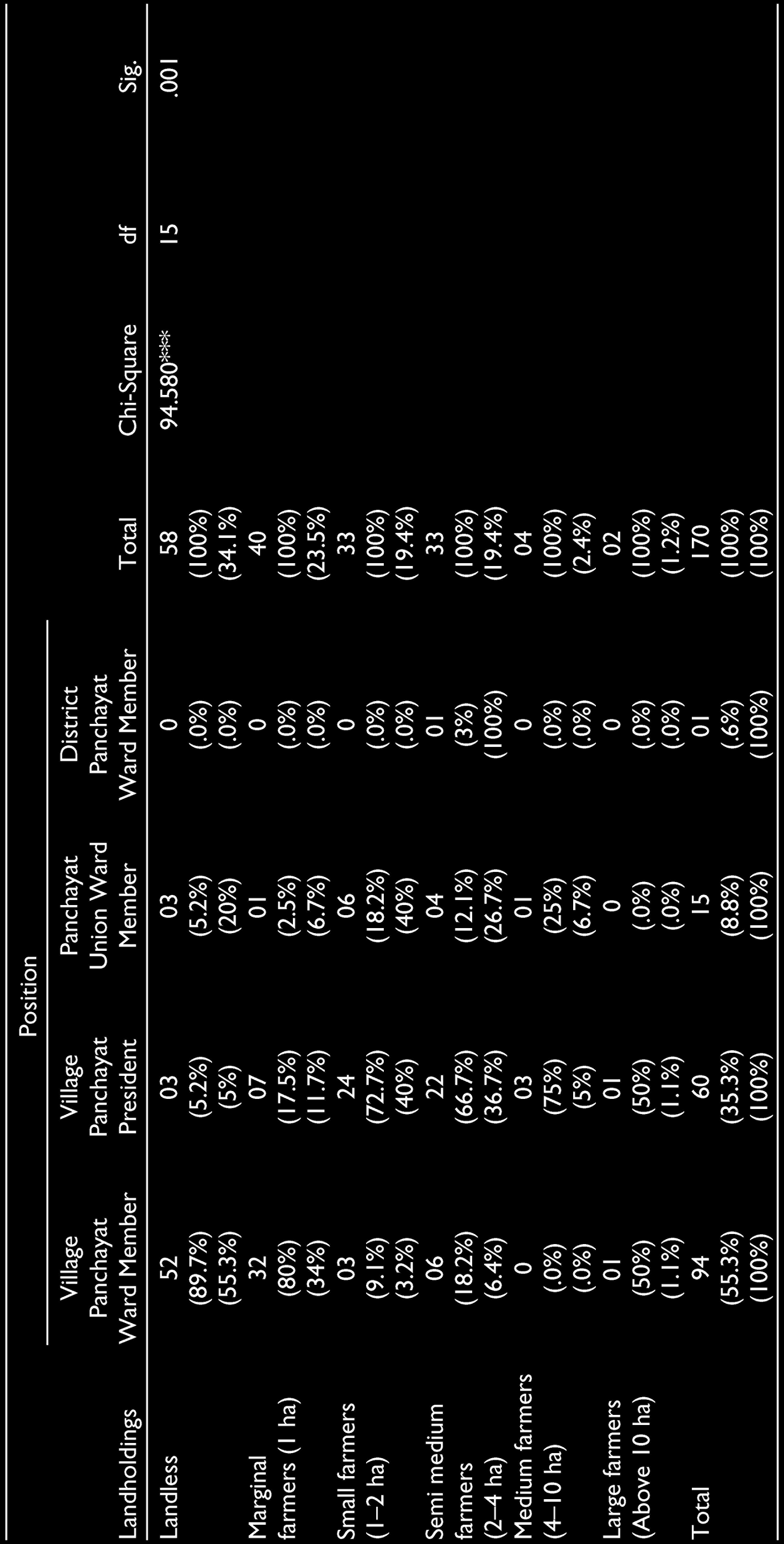
The chi-square test on size of landholdings and representation of minorities in PRIs generated the results x2 = 94.58, p < 0.01 (Table 2). As the p value is less than 0.01 levels, it justifies the highly significant association between size of landholdings and representation of minorities in PRIs. In addition, Cramer’s V value 0.431 shows the moderate association between size of landholdings and representation of minorities in PRIs. A vast majority 89.7 per cent of village panchayat ward members and 5.2 per cent of village panchayat president and panchayat union ward members do not own land in PRIs. Majority 80 per cent of village panchayat ward members are marginal farmers whereas majority of village panchayat president are small farmers, semi-medium farmers and medium farmers in PRIs.
It is evident that 34.12 per cent of minority representatives do not own land, 23.53 per cent marginal farmers and 19.41 per cent are small farmers as well as semi-medium farmers in village panchayats. In addition, 2.4 per cent are medium farmers and 1.2 per cent are large farmers in PRIs. Majority 55.3 per cent of minorities without land are largely elected to village panchayat ward members in PRIs. This finding shows the economic condition of minorities in general in Tamil Nadu.
Besides, 34 per cent of minorities with one hectares of land are also elected to village panchayat ward member. Minorities without land and with less than one hectare of land are likely to be elected to village panchayat ward member than other position in PRIs. In contrast, 40 per cent of minorities are elected to village panchayat president position own one to two hectares of land in village panchayat. Interestingly, 36.7 per cent of minorities with two to four hectares of landownership occupied village panchayat president position in PRIs. This finding shows that minorities with large landholdings mostly enter village panchayat president position due to greater devolution of power than village panchayat ward member. Likewise, 40 per cent of minorities elected to panchayat union ward member position also own one to two hectares of land in their villages. Therefore, it is evident from the preceding analysis that minorities economic condition, that is, class influence their representation to PRIs.
The Chi-square statistical results on family monthly income and representation of minorities in PRIs provided the results x2 = 111.46, p < 0.01 (Table 3). Since the p value is less than 0.01 levels the Chi-square test establishes a strong relationship between family monthly income and representation of minorities in PRIs. The Cramer’s V value is 0.467 and it exhibits the moderate association between family monthly income and representation of minorities to PRIs. A vast majority 94.2 per cent of minorities with less than ₹5000/- as their family monthly income are elected to village panchayat ward member position in PRIs. Similarly, majority 70.2 per cent of minorities with ₹5001/- to ₹10000/- as their family monthly income are also elected to village panchayat ward member position. This shows that with less family monthly income minorities are elected to the lowest tiers of PRIs. In contrast, majority 60 per cent of minorities with ₹10001/- to ₹15000/- as their family monthly income are elected to village panchayat president position in PRIs. Besides, a vast majority 70.6 per cent of minorities with ₹15001/- to ₹20000/- as their family monthly income are also elected to village panchayat president position. Moreover, a significant proportion of minorities with ₹20001/- to ₹25000/- and above ₹25001/- are elected only to village panchayat president position in PRIs. This analysis brings to light that higher the level of family monthly income of minorities greater their devolution of power in PRIs.
Landholdings 11 and the Representation of Minorities in PRIs
Family Monthly Income 12 . Representation of Minorities in PRIs
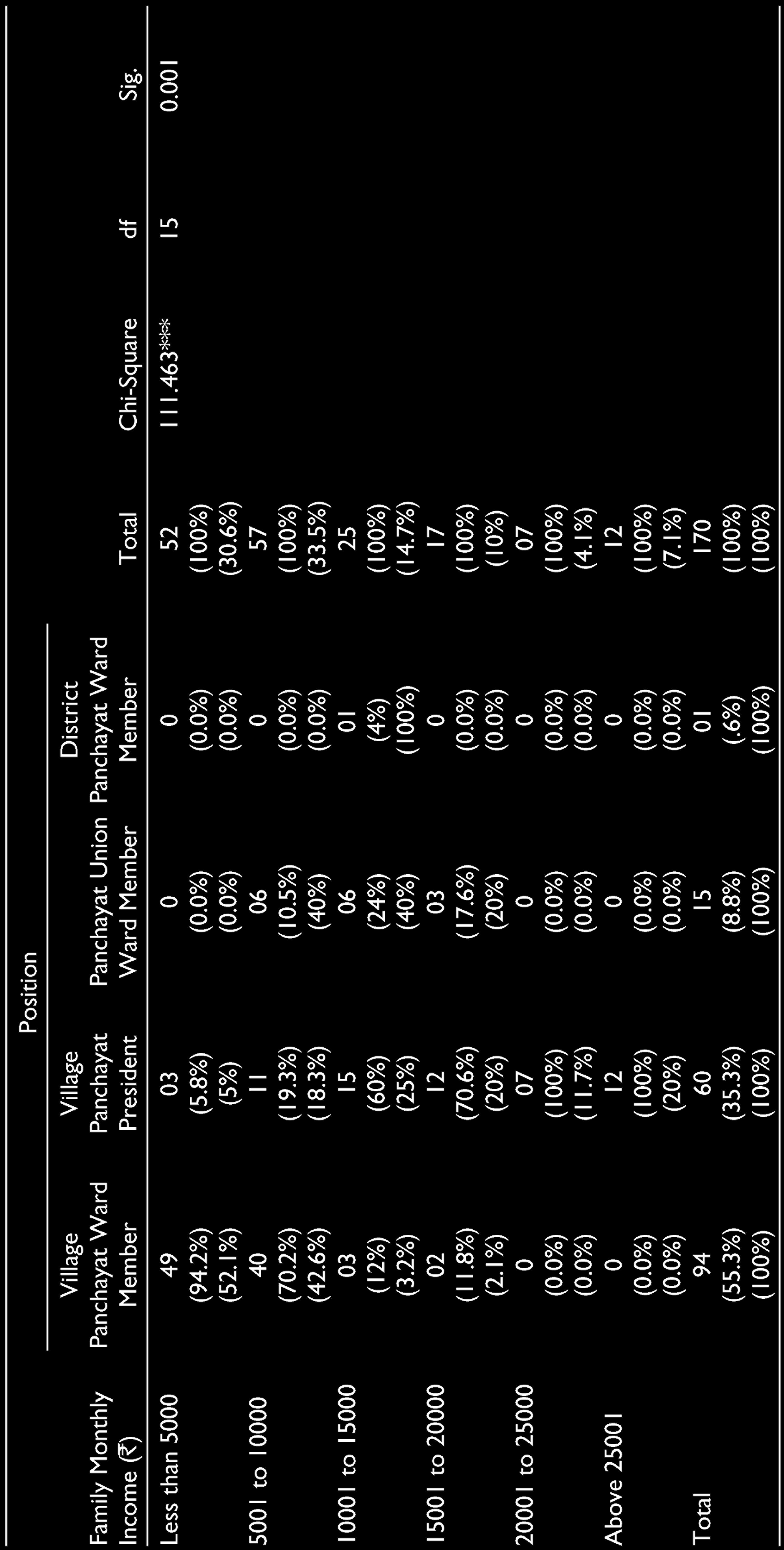
With regard to different position, a major share 33.53 per cent of minority representatives’ family monthly income is between ₹5001/- and ₹10000/- in village panchayats. However, 30.59 per cent of minorities family monthly income is less than ₹5000/- while 14.71 per cent of minorities family monthly income is from ₹10001/- to ₹15000/-. Besides, 4.12 per cent of minorities family monthly income is between ₹20001/- to ₹25000/- and 7 per cent of minorities earn their family monthly income above ₹25001/-.
Majority 52.1 per cent of minority representatives with less than ₹5000/- (rupees five thousand) family monthly income are elected to village panchayat ward member position. Besides, 42.6 per cent of minorities elected to village panchayat ward member position earn ₹5001/- to ₹10000/- as their family monthly income. At village panchayat president position, 25 per cent of minorities earn ₹10001/- to ₹15000/-, 20 per cent of them earn ₹15001/- to ₹20000/- and above ₹25001/- in village panchayats. In addition, 40 per cent of minorities with ₹5001/- to ₹10000/- and ₹10001/- to ₹15000/- as their family monthly income as well as 20 per cent of them with ₹15001/- to ₹20000/- of family monthly income are elected to panchayat union ward member position. The family monthly income and representation of minorities in PRIs shows that minorities those who receive less family monthly income that is less than ₹5000/- and ₹5001/- to ₹10000/ are largely represented in village panchayat ward member in PRIs. In contrast, minorities those who earns ₹10001/- to ₹15000/-, ₹15001/- to ₹20000/-, ₹20001/- to ₹25000/- and above ₹25001/- as their family monthly income are mostly represented in village panchayat president position in PRIs. This shows that minorities with lower the level of family monthly income are likely to enter village panchayat ward member than other position in PRIs. On the other hand, minorities with higher level of family monthly income are likely to become village panchayat president, panchayat union ward member and district panchayat ward member. Therefore, family monthly income influences the minorities in access to power in rural local governance.
IDIs with a Muslim man village panchayat president in Avathandai, a Hindu dominated village panchayat in Ramanathapuram district discloses that he is the village panchayat president from (1986 to 1991), (2001 to 2006), (2006 to 2011) and (2011 to 2016). He is a member of DMK political party. His sons are owners of the prestigious ST couriers in South India. His family owns above ten hectares of land and his family earns greater family monthly income of above ₹60,000/. This shows that Muslim man traditionally hails from an affluent family in this panchayat. As a mark of respect, temples in this region give their first respect to his family in Ramanathapuram District. Therefore, the different caste groups viz. Yadav and Thevar in this village panchayat unanimously encouraged him to contest the panchayati raj election. As a result, he contested and won the village panchayat election with overwhelming support from Hindu community.
Not only in the Hindu dominated village, a minority representative from affluent class is elected to PRIs but also in Muslim dominated village panchayat Periyapattinam in Ramanathapuram district highlights that Muslims mostly consists of Rawther and Labbai caste groups. In addition, there are Mutharaiyar, Nadar, Parayar and Pallar. The village panchayat president candidate Muslim man was working in Saudi Arabia for 42 years as a Human Resource Manager and recruited people from different countries namely Sri Lanka, India, Pakistan, Bangladesh, Nepal, Myanmar, Indonesia, Philippines and Turkey. He was elected as village panchayat president due to his religious identity and affluent class status. IDI with the Muslim male village panchayat president claims that he has an asset of ₹60 million money in bank and his family members are settled in the USA and Saudi Arabia.
Religion
The quantitative data in Figure 2 reveals that Muslim representation is greater than Christians in PRIs. A more than half proportion of minorities are Muslims while only 45.88 per cent of minorities are Christians. Among minorities, Muslims and Christians are represented whereas the other religious minorities such as Sikhs, Buddhists, Zoroastrians (Parsis) and Jains are not represented in PRIs. This is due to less numerical preponderance 13 of Sikhs, Buddhists, Zoroastrians (Parsis) and Jains compared to Christians and Muslims in Ramanathapuram, Tiruvallur and Villupuram Districts in Tamil Nadu. Therefore, numerical strength serves as a base for the election of minority candidates to PRIs.
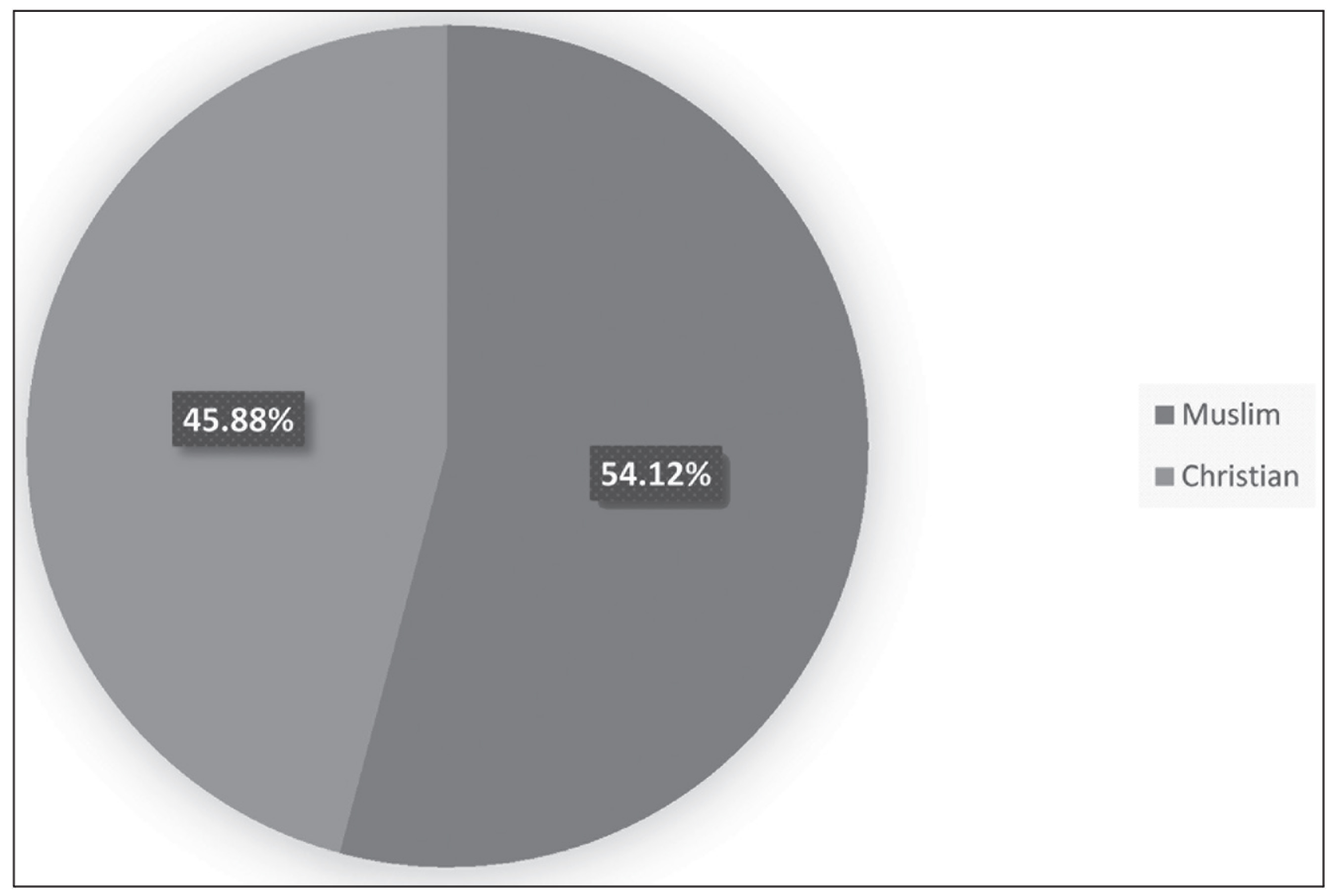
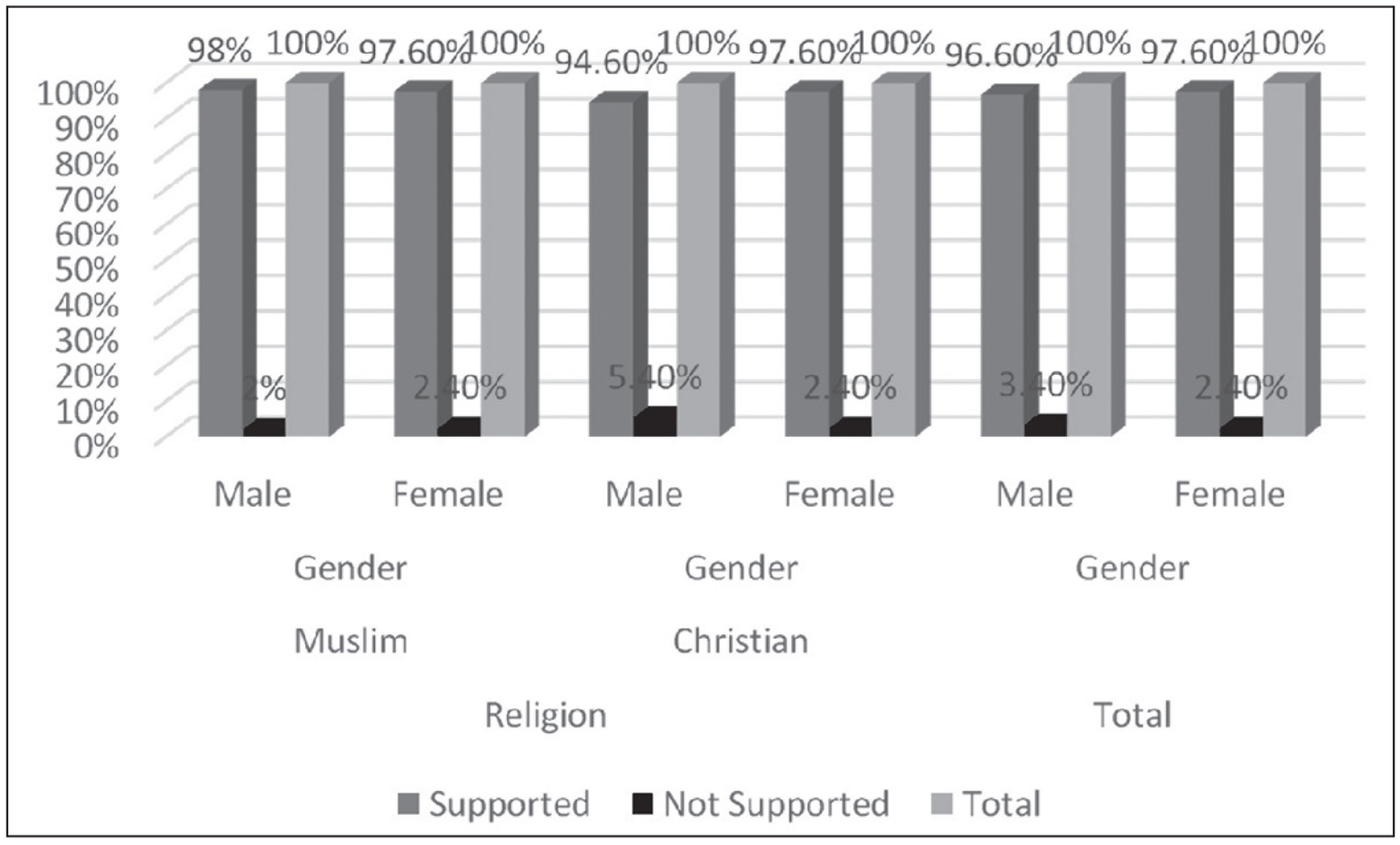
Figure 3 displays the support received by the candidates from their religious groups to contest in panchayat election. A vast proportion of support is received by the minority candidates from their religious affiliation to acquire power in rural governance. The role of religious institution in the election of minorities to PRIs draws greater support mostly in minority-dominated village panchayats compared to majority-dominated village panchayats. This is due to the ‘we feeling’ and ‘religious solidarity’ among the members of religious institution in rural society. Thus, religious institution facilitates their members to occupy position in PRIs.
The Chi-square statistical test on priestly approval and the election of minorities to PRIs unfolds that x2 = 12.13, p < 0.05 (Table 4). The p value of less than 0.05 levels affirms the significant association between priestly approval and the election of minorities to PRIs. However, Cramer’s V value is 0.267 and it highlights the weak association between priestly approval and the election of minorities to PRIs. Majority 64.9 per cent of minorities who have sort priestly approval are elected to village panchayat ward member position in PRIs. Similarly, 45 per cent of minorities with priestly approval got elected to village panchayat president position. Nevertheless, during IDIs with minorities asserted that priestly approval mostly plays crucial role in the minority dominated village panchayat or ward, that is, either Muslim or Christian dominated. Interestingly, a vast majority 73.3 per cent of minorities elected to panchayat union ward member did not get priestly approval because the political parties play a crucial role in the higher level of governance in PRIs. Therefore, the above analysis amplifies the fact that priestly approval in minority dominated village panchayat wards or village panchayats influence the election of minorities to PRIs. This finding contradict the study by Mathew (1997, p. 13), Pal (2000), and Subha (1997, p. 28) that religious leader did not assume any significance in supporting the candidate to panchayat position.
Priestly Approval on the Election of Minorities to PRIs

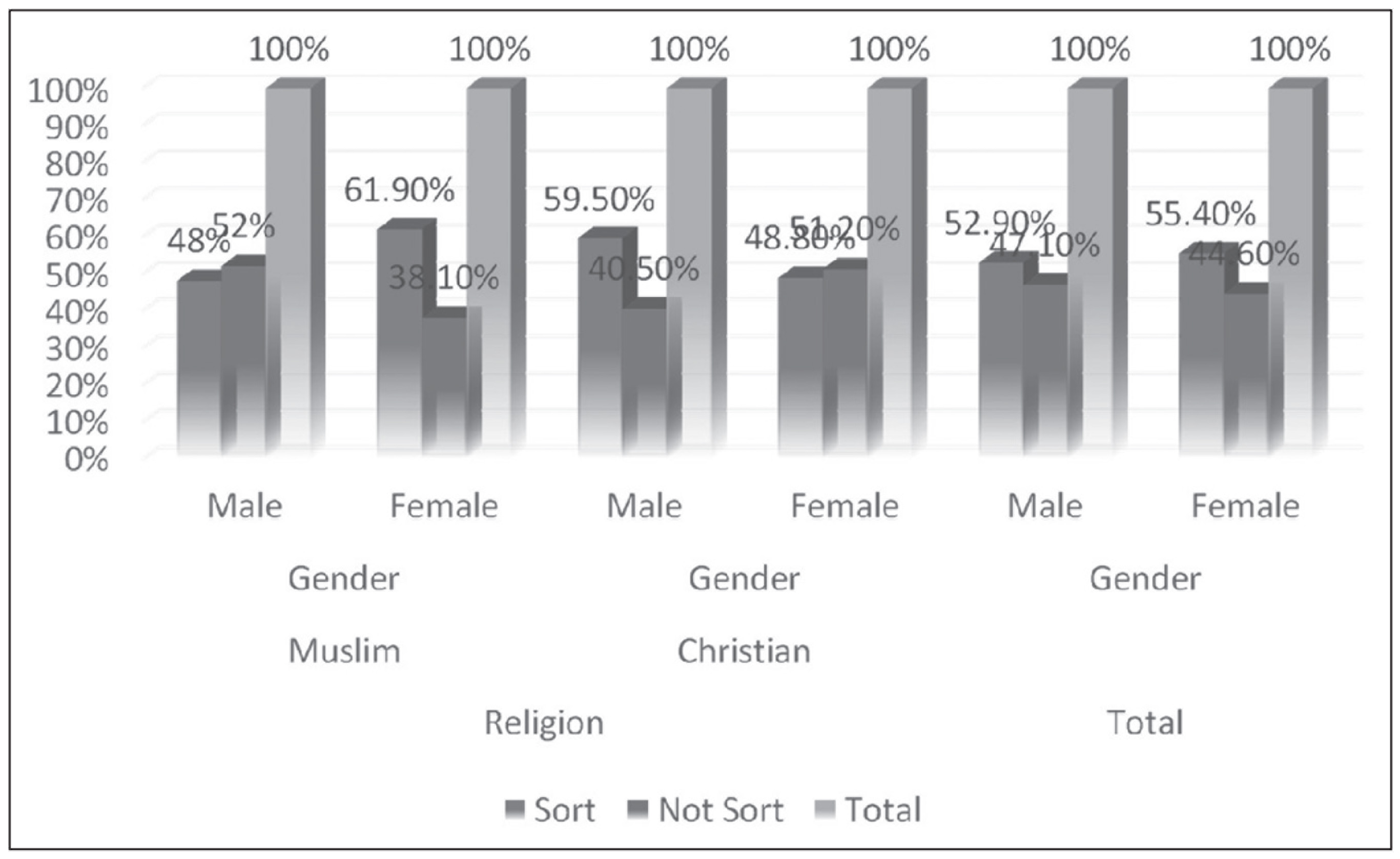
Figure 4 depicts that 52 per cent of minority men and 55.40 per cent of minority women sort priestly approval before contesting panchayat election. In specific, majority 52 per cent of Muslim men did not get priestly approval to contest in panchayat election whereas majority 61.90 per cent of Muslim women have sort priestly approval to contest in panchayat election. This analysis reveals that more than Muslim men, Muslim women are largely accorded permission from the Jamad to contest in panchayat election. In contrast, majority 59.5 per cent of Christian men have sort priestly approval from church committee before contesting panchayat election whereas in the case of Christian women 51 per cent did not get priestly approval to contest in panchayat election. Thus, priestly approved candidates are likely to be successful only in minority-dominated wards and village panchayats.
Gender
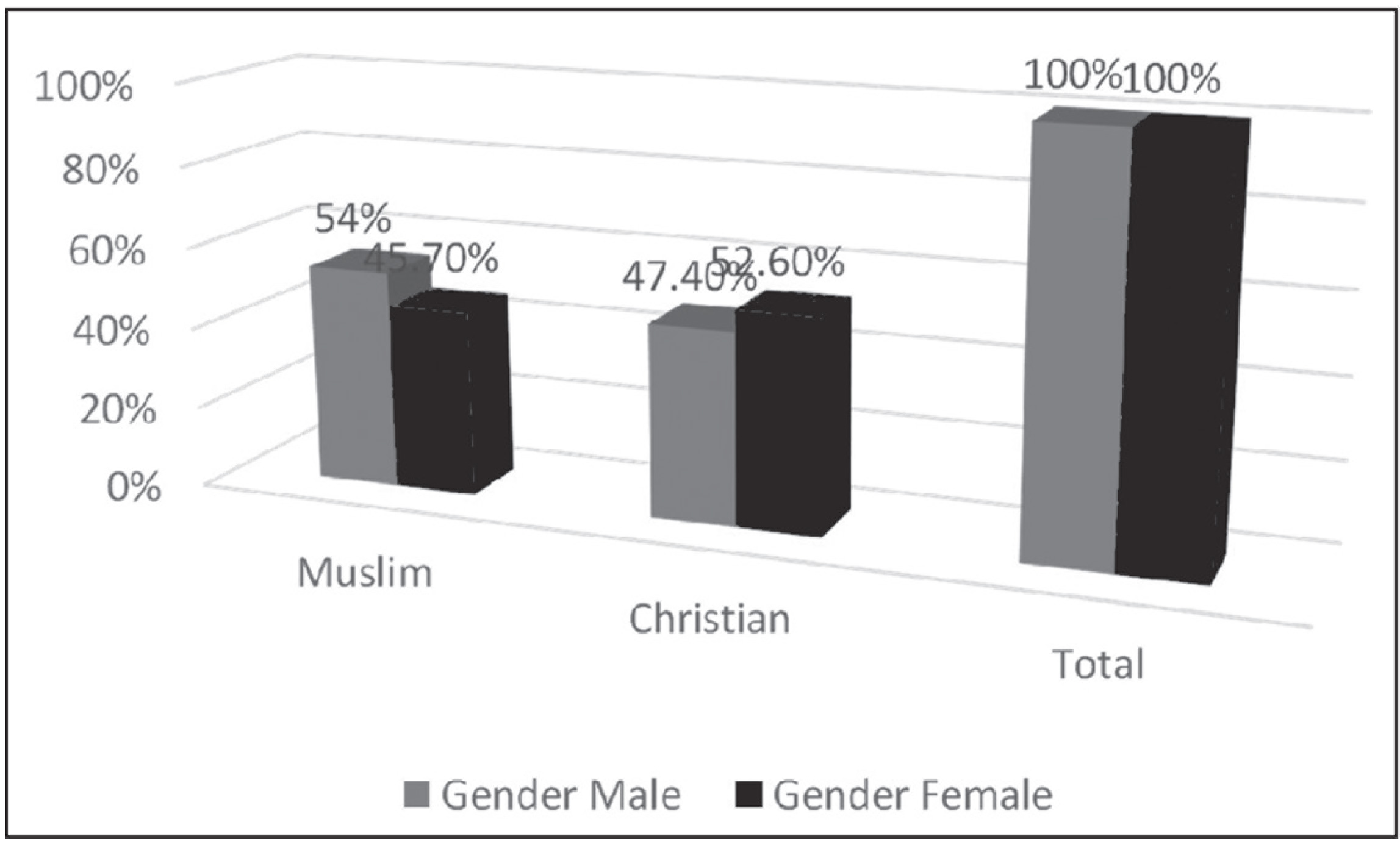
Gender-wise representation of minorities in PRIs reveals that Muslim men representation is greater than Muslim women while Christian women representation is greater than Christian men (Figure 5). This shows the differences that exist among the representation of minorities in PRIs. Muslim women are underrepresented due to socio-cultural, educational and religious reasons in PRIs. These factors pose not only great challenges for Muslim women but also pave way for patriarchy and proxy representation in local governance. In contrast, Christian women gained representation due to their socio-cultural and educational attainment in PRIs.
Gender Analysis of Minorities in PRIs
The gender analysis of elected minority representatives are analysed with regard to offices and seats reserved for women in PRIs, their choice of contesting and campaigning in panchayati raj election.
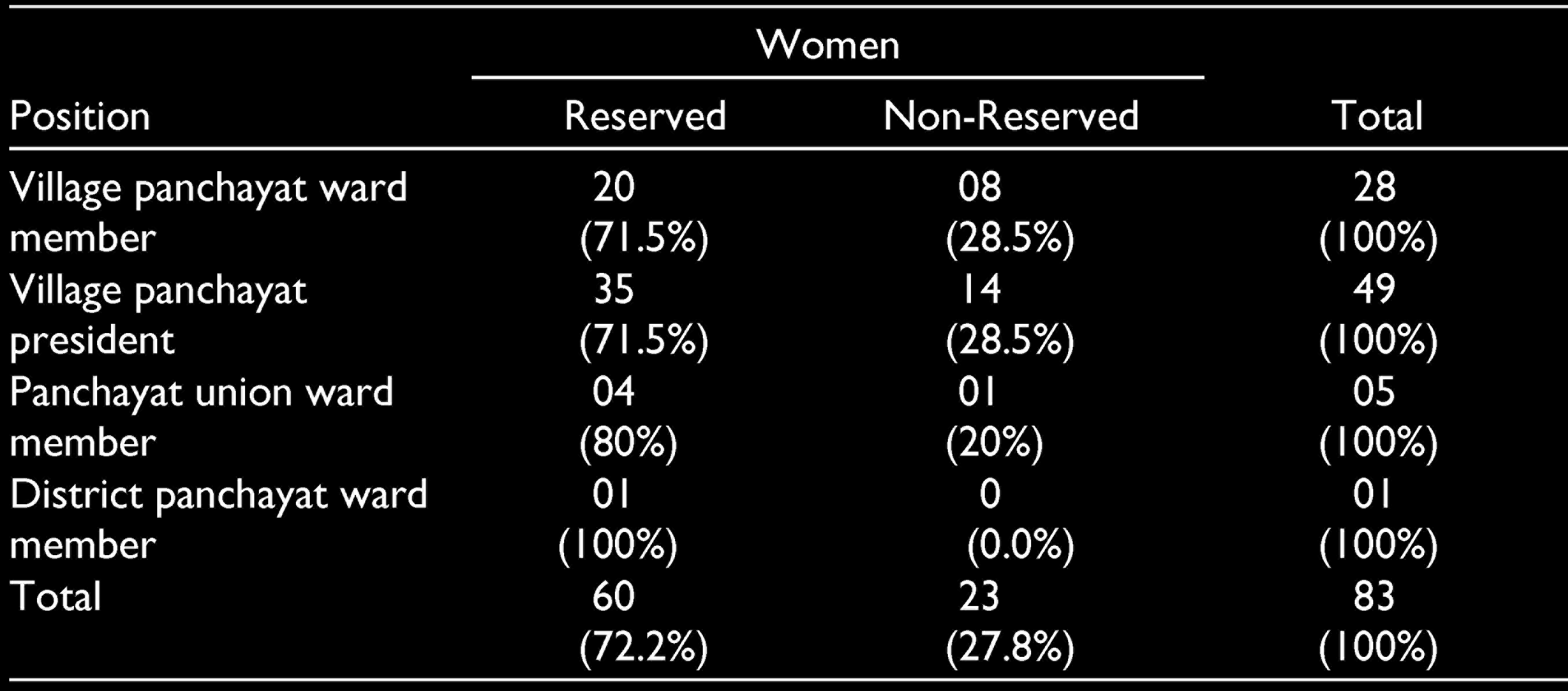
Table 5 describes the minority women representatives’ mode of election through reserved and non-reserved category in the positions of village panchayat ward member, village panchayat president, panchayat union ward member and district panchayat ward member. A greater proportion (71.5 per cent) of minority women representatives have found access to village panchayat ward member through offices and seats reserved for women in PRIs. On the other hand, 28.5 per cent of minority women have contested through non-reserved category in panchayat election. Similarly, a vast proportion (71.5 per cent) of minority women are elected to village panchayat president position due the offices and seats reserved for women in PRIs. Besides, significant proportions (80 per cent) of minority women are elected to a higher level governance of panchayat union ward member through reservation for general women in panchayat raj institution. A greater proportion of Minority women representatives asserted that they were allowed to contest the election due to the offices and seats are reserved for women in PRIs otherwise a male member of the family would have contested the panchayat election. This analysis shows that although minority women do not have special provision to participate in PRIs, the offices and seats reserved for women in PRIs latently paves the way for minority women to occupy position in PRIs.
Minority Women Representatives’ Mode of Election in PRIs
The Choice of Contesting in Panchayat Election
IDIs with Muslim women village panchayat presidents of Muslim dominated village panchayats such as Athiyuthu, Valinokkam, Vellaiyapuram, Puthuvalasai and Koraikuttam in Ramanathapuram; Vadakeeranoor in Villupuram district bring to light that Muslim women contested panchayat election due to the offices and seats reserved for women in PRIs. Muslim women consented with family members, imam, and jamad committee to contest panchayat election. Besides, Muslim women had also contested in Hindu dominated village panchayats such as Ithampadal and Pudupattinam in Ramanathapuram District; Nayaru in Tiruvallur district; Meenabu, Kannai, Vadaponparapi and Ramarajapuram in Villupuram District due to the offices and seats reserved for women in PRIs. Interestingly, Muslim women also contested against the general category in Hindu dominated village panchayat in Veravanoor in Ramanathapuram district with the consent of majority group and different community leaders before filing nominations to village panchayat president position. In addition, Muslim women village panchayat ward members of Alangaanoor, Sikkal, Kanjrangudi, Sethukarai, Manjur and Perunali in Ramanathapuram were motivated by their husbands to contest panchayat election due to the offices and seats reserved for women in PRIs. On the other hand, Muslim women have contested village panchayat ward member position against the general category in Kolunthurai and Bogalur in Ramanathapuram district by their self-motivation to develop their panchayat ward. Even Muslim woman have contested as district panchayat ward member and panchayat union ward member of Mandapam in Ramanathapuram through AIADMK and Mugaiyur in Villupuram district through DMDK political affiliation due to the offices and seats reserved for women in PRIs. The foregoing analysis shows the choice of candidature for Muslim women arise in most conditions due to the offices and seats are reserved for women in PRIs and that too it is decided by the male members of the family. This shows the patriarchy against Muslim women in panchayati raj election.
Conversely, Severipattinam is a Christian dominated village panchayat in Ramanathapuram district. Christian woman 14 was elected to village panchayat president position from 1996 to 2016. She was also the leader of a Non-Governmental women’s organisation since 1989 and carried out assistances for people filling in the applications, getting voter identity card, family card and income certificate before becoming the panchayat president. As a result, she becomes very close with people of this panchayat and earned recognition. Correspondingly, she was motivated by SHGs and the village leaders to contest for panchayat election. In 1996, she contested panchayat election due to the offices and seats reserved for women in PRIs however in 2001, 2006 and 2011, she contested against general category. Similarly, Christian woman of Ponnakenari, a Christian dominated village panchayat in Ramanathapuram district was elected through general category motivated by husband and the choice of contesting was decided by family and self-help groups (SHGs).
In addition, IDIs with Christian women village panchayat president of A. R. Mangalam, Orikottai in Ramanathapuram district; Pandoor in Tiruvallur; Viriyur in Villupuram district a Christian dominated village panchayats bring to light that the choice of contesting was decided by SHGs, family members and friends. They contested panchayat election due the offices and seats reserved for women in PRIs. This finding is reflected in Therovy, a Hindu dominated village panchayat in Tiruvallur district that Christian woman was elected to village panchayat president position due to the offices and seats reserved for women in PRIs. She is an active member of SHGs and a member of AIADMK political party for nearly five years. The choice of contesting was decided by her family members and SHGs members. In contrast, Christian woman village panchayat president of Sathyamangalam, a Hindu dominated village panchayat in Villupuram contested against general category and was motivated by SHGs, friends and relatives. She was interested in social service and consented with church father, consulted with majority group before filing nomination.
Likewise, Christian women village panchayat ward members of Nagarikathan in Ramanathapuram, Ikkadu and Nemilicheri in Tiruvallur district also contested panchayat election due to the offices and seats reserved for women in PRIs. The preceding analysis reverberates the presence of patriarchy against Christian women also in PRIs. However, compared to Muslim women, Christian women are emancipated to carry out social activities and also to be a member of SHGs group which is not found among Muslim women in village panchayats in Ramanathapuram, Tiruvallur and Villupuram districts. In specific, differences exist among Muslim and Christian women in the choice of contesting panchayati raj election. The choices of contesting panchayat election for Muslim women are mostly decided by family members whereas in case of Christian women, it is decided by family members, SHGs members and village leaders.
Moreover, IDIs with Christian and Muslim men village panchayat presidents of Ramanathapuram, Tiruvallur and Villupuram district unfold that the choice of contesting panchayat election is mostly self-centred. Nevertheless, in minority-dominated wards, the role of religious institutions determines the choice of contesting the elections mostly for Muslim women and less prevalent in case of Christian women. The choices of contesting for panchayat union ward members are determined by the political party.
Caste, Class, Religion and Gender
The roles of caste in Indian politics are extensively studied by Sociologists such as Andre Beteille, Rajni Kothari and Anil Bhatt. Caste play the role of pressure group in politics (Srinivas, 1955) and dominant caste wields political power in rural social life (Beteille, 1965). Dominant caste is a feature of the village in Tamil Nadu. The dominant castes are not the traditional upper castes, but they wield power due to the resources they have in the villages and numerical strength (Bhai, 2009, p. 278).
Scholars (such as Ahmad, 1978; Akbar, 1990; Karnath, 2007; Khanam, 2013; Siddiqui, 1973) argue the presence of caste among Indian Muslims in the form of localised phenomenon and must be understood in the local context. The minority politics in Indian society is the real politics of upper class and dominant caste Muslims which gets their interest by discriminating the backward and Dalit Muslims (Ansari, 2013). A vast majority of Indian Christians are largely descendants of converts from the lower castes and scheduled tribes (Oommen & Mabry, 2000). About 40 per cent of Protestant Christians in India are from Scheduled Caste background, about 30 per cent are from Scheduled Tribes, about 20 per cent are from Backward Caste origin and about 10 per cent are of upper caste background (ibid., p. 131). Thus, the scholars argue the presence of caste within Muslim and Christian minorities in Indian society.
In sociology, caste and class are often described as social stratification by scholars such as Andre Beteille, Louis Dumont, A. R. Desai, K. L. Sharma and Dipankar Gupta. However, amongst sociologists, caste occupied the most prominence in the form of stratification than class and gender (Doshi, 2010, p. 216). Religion in Indian politics gained momentum for political parties to attract votes (Kumar, 2018). Gender and politics in India highlighted the obstacles posed by patriarchy and masculinity for women’s participation in decision-making process (Menon, 1999). The most significant source of power is no doubt related to class or the control over means of production such as land and industry (Mohanty, 2004, p. 20). In the end of 20th century, the Indian political life recognised the interface of class, caste and gender (ibid., p. 16).
Conclusion
The caste, class, religion and gender play a vital role in the election of candidates to various positions such as village panchayat ward member, village panchayat president, panchayat union ward member and district panchayat ward member in PRIs. The attempted study argues that plurality of social factors such as caste, class, religion and gender influences the election of minorities to PRIs. As a result, this study contradicts the Mill’s argument (1956) that political power always went to those who enjoyed high status and wealth in the society. The high status and wealth is one of the social factor but it is not the only sufficient social factor that will determine a candidate to acquire political power in society. Therefore, this study corroborates with Dahl (1961) and Polsby (1962) argument that the distribution of power in society was generally determined by the combination of skills and other resources enjoyed by people. There are many resources other than status and wealth which enable people to acquire power. Therefore, it is a plurality of social factors that enabled minority to acquire power in PRIs.
Footnotes
Declaration of Conflicting Interests
The author declared no potential conflicts of interest with respect to the research, authorship, and/or publication of this article.
Funding
The author received no financial support for the research, authorship, and/or publication of this article.