



Abstract
This study investigates the representative patterns of MPs with immigrant backgrounds in the case of the Netherlands. Departing from existing literature on minority representatives, we claim that minority representatives can adopt suppressive, as well as supportive, framings when addressing constituencies with whom they share similar backgrounds. A content analysis was conducted on the parliamentary work of minority representatives to detect which frames those representatives adopt when they address cultural and/or religious rights and liberties. As for explanatory variables, we examined the role of the retreat from multicultural policies in the Netherlands on the one hand and individual and group related variables on the other. Our content analysis reveals no fundamental linear shift towards more suppressive framing during the 2002–2017 period. Minority MPs from progressive parties are more likely to use supportive frames than those MPs from conservative parties. Coming from a Turkish background – the most organized ethnic group with the highest social capital in the country – significantly adds to the likelihood of a supportive form of representation. Gender is another significant variable explaining where minority representatives stand, with male MPs being more inclined to use supportive frames on ethnic and/or religious rights and liberties than female MPs.
Introduction
Scholarly research on the political representation of immigrant minorities has gained greater attention with the transition of former outsiders into full citizens (among others, see Bird et al., 2011; Morales and Giugni, 2011). Indeed, there are legitimate grounds for that to be the case. The alleged political marginalization of migrants and their children has several potential negative implications for democratic politics: it undermines the process of democratic representation and accountability; undervalues the role of active participation in the polity; and perpetuates the view of immigrants and their descendants as outsiders to the community (Correa, 1989: 35). Such exclusion further marginalizes immigrant minorities in social and economic spheres since policymakers fail to grasp the problems, needs and demands of those newcomers if their voices cannot be heard (Morales and Giugni, 2011: 1). Politics can – at least theoretically – be expected to be the most prominent area in which immigrant minorities can safely voice their interests, wishes and needs in democratic regimes.
With the historical value given to proportionality, the Dutch Second Chamber has been a frontrunner for welcoming immigrant minorities. The share of MPs with minority backgrounds has more or less mirrored their total percentage in the population since 2003, after the first minority representative was elected in 1986 (Mügge, 2016: 513). Bloemraad (2013) portrays the country as even beyond perfect representation in her comparative analysis on advanced democracies of the West. The share of minorities in the Dutch National Parliament after the 2010 elections was 11.3% with a 10.5% minority population in the general society. Within the same study, the proportion of German parliamentarians of minority origin (after 2009 elections) equated to 0.8% with 3.1% of population having a migrant background. Those percentages for the UK (after the 2010 elections) were 4.2% and 12.1%, respectively. The rather successful mirroring of ethnic and/or cultural differences continued with the elections after 2017 (10.7%) after a rather ‘tolerable deviation’ in 2012 when the share of minority representatives decreased from 11.3% to 7.3%.
A growing literature on the substantive representation of immigrant minorities in Western Europe, however, questions the significance of such descriptive diversity in decision-making institutions (Aydemir and Vliegenthart, 2016; Bajpai, 2019; Durose et al., 2013; Garret, 2017; Murray, 2016). Those recent empirical works shed light on the outcomes of having minority representatives in political arenas by departing from Pitkin’s (1967) differentiation between descriptive representation and substantive representation. Despite an increasing understanding of the subject matter, our knowledge on whether, to what extent, and through which mechanisms, such descriptive representation yields to substantive contributions in representing minority interests remains limited. In particular, systematic comparisons of representative patterns of politicians with different backgrounds regarding gender, party ideology, and ethnicity, are still limited.
In this study, we focus on how minority representatives frame minority-related issues in parliament and the reasons behind a possible variation. We address several questions: Do minority representatives differ in their approaches towards group specific rights and freedoms of ethnic and/or religious constituencies? If so, what are the underlying grounds for supportive and/or restrictive stances in this regard? How do the impacts of group- and individual-related variables such as gender, party ideology and ethnic backgrounds differ? Are there differences in the representative patterns of minority representatives with changes in the Dutch citizenship regime?
To answer these questions, we first conducted a content analysis of the parliamentary questions posed by MPs of minority origin on minority-related issues in the context of the Netherlands. Thereafter, a multivariate analysis was performed on the outcome of this content analysis to systematically investigate the variation in framing and the underlying explanatory factors.
Studies on political representation of minorities
Western European literature on political representation (Bloemraad, 2013; Martiniello, 2005; Michon and Vermeulen, 2013; Pero and Solomos, 2010; Saggar and Geddes, 2000; Schonwalder, 2013; Thrasher et al., 2013; Togeby, 2008; van der Zwan et al., 2019; Vertovec, 1999) has largely focused on the election of ethnic and/or religious minority members to policy-making bodies, namely descriptive representation (Pitkin, 1967). Our understanding of the substantive contribution of such representation in Western European democracies remains limited. Relevant literature is still in the early stages of explaining (reasons for) variation in group representation. The relatively short history of ‘guest workers’ and difficulties of identifying ‘outsiders’ in the complexities of many different political systems can be identified as major reasons for this lacuna (Bloemraad, 2013). European minorities cannot be classified as monolithic and straightforward, so their rights and liberties also present themselves as complex issues. Unlike the example of the civil rights movement in the US, minority-related issues are present in numerous areas within the case of Western Europe such as healthcare, family reunification, criminality, radicalization, discrimination, and religion, among others. Lacking voting records in many European cases further adds to the difficulty in studying substantive representation within the context of Europe.
Proceeding from the substantive representation understanding (Pitkin, 1967), a group of European academics question the convergence between the agendas of representatives on the one hand and the interests, needs and wishes of those being represented by studying parliamentary documents. Relevant studies indicate a higher priority being given to minority related issues on the agendas of MPs of minority origin, reveal different strategies used by minority representatives in different settings, and analyze the role of ethnic and gender identity as well as the party ideology in explaining differences in minority representation (Saalfeld, 2011; Saalfeld and Bischof, 2013; Saalfeld and Kyriakopoullou, 2011; Wüst, 2014). These studies bring valuable perspectives on whether, when and why minority representatives stand out or abstain in minority-related debates. Yet, they come short in shedding light on what minority representatives say about cultural and/or religious rights and liberties of constituencies sharing similar backgrounds with them. Minority MPs’ policy preferences, namely their representative patterns, on such issue areas remain rather understudied. The aforementioned studies operationalize substantive representation by references made to minority-related issues. Such conceptualization, however, does not take into account the actual content of those references. What minority representatives say in the political arena might be very different than substantive representation studies would presume (Bajpai, 2019).
The presence of representatives from immigration backgrounds in decision-making bodies does not necessarily mean that their viewpoints are, indeed, visible. Whilst such presence does indeed contribute to the representation of minorities in bringing supportive content to matters concerning cultural and/or religious rights and freedoms, a supportive stance in this regard cannot be pre-assumed. Critical studies (Aydemir and Vliegenthart, 2016; Bajpai, 2019; Durose et al., 2013; Garret, 2017; Murray, 2016) indicate restrictive forms of representation being present frequently among minority representatives. Minority representatives might act as agents for the dominant norms rather than for (political) diversity (Bajpai, 2019: 19). In fact, the most intense criticisms of the cultural and/or religious symbols, practices and identities of minorities can even come from MPs from migratory backgrounds, themselves. At this point, the two-fold conceptualization of Aydemir and Vliegenthart (2016) brings nuance to our understanding of political representation by distinguishing and conceptualizing supportive representation vis-a-vis suppressive representation. Substantive representation is taken as ‘the normal’ when minority representatives’ role in cultural and/or religious rights and liberties is considered. The two-fold scheme of the aforementioned study, however, illustrates the domination of suppressive perspectives on minority rights and liberties by minority MPs, themselves.
In some ways, one can argue that minority representatives are largely disconnected from the ordinary classes of immigrant minorities they are supposed to represent. Their political legitimacy may depend on their allegiance to a party elite rather than grass-roots support or community activism. They are often exceptionally assimilated minorities, who are careful not to demonstrate any outward signs of religious affiliation (Aydemir and Vliegenthart, 2016; Garret, 2017; Murray, 2016). Based on an ethnographic study, Bajpai (2019) argues that minority representatives associate themselves more with their parties and the majority group rather than with minorities. Durose et al.’s research (2013) introducing the notion of ‘acceptable difference’, would seem to be particularly apt at this juncture. According to their interview-based research, party elites’ acceptance actually relies on conformity to particular aspects of the ‘archetypal candidate’, with the latter emerging as a white, middle-aged, able-bodied, heterosexual man (Durose et al., 2013: 258). A viable parliamentary career only becomes an option when differences are found acceptable by status quo holders in political parties. In such a context, there are no guarantees for support of cultural and/or religious rights and liberties by MPs coming from ethnic and/or religious groups, although descriptive representation provides an illusion of substantive contribution to group rights and liberties.
At this point, studies highlighting in-group heterogeneity (Bird, 2005 Bird, 2012 ; Celis and Erzeel, 2013; Celis and Mügge, 2018; Donovan, 2012; McGarry, 2014) rightfully take one step back and question what substantive representation means by underlining in-group diversities due to differences of social class, age, gender and ethnicity on the one hand and by the constructed character of group definitions and their interests on the other hand. It is important to note that political representation of ethnic and/or religious minorities often goes hand in hand with the representation of certain intersecting elements of identity such as gender, occupation and age. Rights and liberties of several of those cross-cutting identities are different (Bird, 2005; Celis and Erzeel, 2013; Donovan, 2012) and can even be in contradiction with each other. Individuals within minority groups may have totally different perspectives as discussed above. Sectarian, ethnic, age, gender, or other group or individual level variables, certainly lead to different demands within minority groups, which deny challenges to the idea of a unitary category with a recognizable set of political interests that can be acted upon (Celis and Mügge, 2018; Saward, 2006). When approached from a trustee perspective (Wahlke et al., 1962), any reference to minorities could be considered as a substantial contribution to the well-being of ethnic and religious groups. Yet, even if not being delegates – who take instructions from the constituencies – the activities of representatives could not be persistently against the represented and should be in a manner responsive to them, as Pitkin (1967) claims in her seminal work.
Minority interests and different patterns of minority representation
Next, it is important to clarify what we mean by different patterns in minority representation. First of all, this research abstains from any attempt to solve the convoluted issue of what exactly comprises the minority identity or the ‘minority interests’. Instead, we focus on how minority representatives frame cultural and/or religious rights and liberties of minorities rather than searching for particular arguments seeking pre-defined positions (for similar operationalizations, see Aydemir and Vliegenthart, 2016; Bajpai, 2019; McGarry, 2014). By doing this, we embrace different formulations of ethnic and religious minority interests such as sectarian and ethnic variations. Given the complexity of many political decision-making processes, a representative is likely to utilize his/her own judgment when formulating the interests of the represented. However, the fact that interests are varied does not mean that there are no interests of the group identity at all (Phillips, 1995). Hence, we adopted a rather problem-based understanding in detecting the frame and investigated whether the minority group or individual, particularly referred to in a statement, was/were enclosed into an inclusionary or exclusionary framing. Following the two-fold categorization of Aydemir and Vliegenthart (2016), our study identifies all those cases in which minority representatives are supportive towards cultural and/or religious rights and liberties as supportive representation. These references include promoting the practice of practicing cultural and religious rituals as well as standing against any kind of discrimination due to ethnic and/or religious identity. Suppressive representation framing, on the other hand, stands for those cases in which MPs of minority origin adopt a restrictive stance on the subject area. These references consist of associating ethnic and/or religious identity with fundamentalism, radicalism, extremism, delinquency, fraud, alienation as well as positioning minority identity in opposition to ‘Dutch values and norms’ (i.e. the rule of law, secularism, tolerance, female emancipation). A single statement of an MP can contain elements of both categories, or none.
As for factors leading to potential variation in adopting different framings, we adopt a holistic approach, which merges citizenship-related variables, party-related variables, minority-group-related variables, and individual characteristics of minority representatives.
Explanations of variation in substantive representation
Citizenship
We follow previous research (Cinalli and Giugni, 2013; Koopmans et al., 2005) in viewing citizenship regimes as part of ‘political opportunities’. Different citizenship regimes might bring different opportunities and constraints for representatives of minority origin as they do for other minority actors. A more inclusionary citizenship regime would enable ‘minority representatives’ to act at more liberty in voicing the cultural and/or religious rights and liberties of ‘minority constituencies’. The Netherlands has traditionally been identified with institutionalized diversity, which has enabled the peaceful co-existence of people within different ideological denominations within a political system based on negotiation, compromise and tolerance. Such tolerance had also been reflected in multicultural policies on immigrant minorities – sometimes with the expectations of an eventual incorporation into an alleged set of Western values and norms. By the end of the 1990s, however, the policy of multiculturalism was seriously challenged. Muslims have become identified with essentialism, fundamentalism, violence, terror and dissidence in a narrative shaped along the Clash of Civilizations thesis. The Netherlands shifted away from its multicultural citizenship and adopted an ‘integrative’ understanding necessitating the internalization of the liberal norms and values of the West (Kaya, 2009). Henceforth, we claim that the initial understanding of multicultural citizenship in the Netherlands would open the ‘corridors of power’ towards those minority representatives who are willing to support group rights and liberties on the one hand and allow the same representatives to act more in line with these rights and liberties on the other hand, but also that this becomes less self-evident over-time.
All in all, we hypothesize that ‘minority representatives’ will support cultural and/or religious rights and liberties more when there is a multicultural understanding of citizenship. Therefore, we expect that supportive framing is more prevalent in the earlier years of this period in the Netherlands as the country has diverted from traditional group-based multiculturalism since the early 2000s (Entzinger, 2003, 2007). Hence the first hypothesis to be considered was as follows:
H1: Minority representatives use less supportive representation framing over time
Party ideology
Recent studies show us that a majority of political parties – including those deemed conservative and right-wing – in Western countries respond pragmatically to changes within the electoral composition. Even traditionalist parties have started removing their barriers and embracing a greater diversity in their parliamentary composition (Bird, 2012; Murray, 2016; Saggar, 2013; van der Zwan et al., 2019). Nevertheless, studies on the substantive representation of immigrant minorities (Aydemir and Vliegenthart, 2016; Bajpai, 2019; Bird, 2005; Saalfeld, 2011; Wüst, 2014) reveal a different picture. The traditional pattern of the inclusive character of the progressive parties (Saggar and Geddes, 2000) continues when it comes to embracing religious and/or cultural rights and liberties with more opportunities to adopt inclusionary standpoints. All in all, we formulate our hypothesis on party dimension by sticking to a rather classical understanding, as follows:
H2: The more progressive the party a minority representative belongs to, the more likely (s)he will use supportive framing in representative activities
Ethnic background
The country of origin is another widely referenced factor in literature on political participation of immigrant minorities. The civic voluntarism approach underlines the role of socio-economic status as the root cause behind varying political participation patterns among ethnic groups (Verba et al., 1995). Explanations based on socio-economic differences, however, have not become well established in Dutch politics with negligible socio-economic disparity among immigrant minorities (Vermeulen et al., 2014: 243). An already acknowledged ‘Amsterdam school’ (Fennema and Tillie, 1999, 2001; Michon and Vermeulen, 2013; Tillie, 2004; Vermeulen, 2005) specifies social capital as the driving force behind varying political participation patterns across immigrant minority groups in the Netherlands (Schönwalder et al., 2013: 485). These studies on the case of Amsterdam define social capital as civic organizations and networks within ethnic circles. Such in-group activism plays a role in building civic virtues which leads to a more active, trusting, politically interested, and ultimately more participatory group of immigrants within the wider public (Fennema and Tillie, 1999, 2001; Michon and Vermeulen, 2013; Vermeulen et al., 2014). Turks come out as the minority group with the highest social capital, thus standing out in terms of political participation within all those studies conducted under the aforementioned ‘Amsterdam school’.
The increasingly active diaspora politics of Erdoğan’s government might have further strengthened such social capital among immigrant minorities of Turkish origin especially with the transnational facilities extending Turkey’s influence across borders (Aksel, 2018). Turkish media and other transnational institutions, such as the Turkish Directorate for Religious Affairs, provide ample opportunities for the conservative–nationalist Erdoğan government to keep a conservative form of Turkish identity alive in receiving countries, including the Netherlands. Studies highlighting the ethnic organization of religious institutions further add value to explanations based on ethnic identities. Religious rights and liberties are not practiced together with other immigrant minorities from the same religion but strictly along ethnic lines, especially when needing institutional structures such as mosques and other religious foundations (Kaya, 2009: 116–120; Koyuncu-Lorasdağı, 2013).
Explanations for representation based on ethnicity, however, are not without criticism. First, the subject of in-group heterogeneity weakens arguments based on ‘the country of origin’ identity. Internal divisions among people originating from the same country makes it highly difficult to view them as a unified front as discussed above. Differences across generations within immigrant minority groups constitute yet another challenge to ethnicity-based explanations. Unlike the earlier guest workers, ethnicity is not the main, much less the only, element in the organizing process (Vermeulen and Keskiner, 2017). Socioeconomic factors such as educational trajectories, professional ambitions, feelings of responsibility for other members are prominent – especially for more educated descendants of the original guest-workers. The much-discussed retreat from traditional multicultural understanding further undermines explanations on the basis of ethnic identity. Group-based mobilizations are no longer openly valued in the Dutch political arena. In fact, the strong bonds among Turkish minorities are now seen as a disadvantage rather than an advantage in accessing politically influential positions (Vermeulen et al., 2014). The study of Michon and Vermeulen (2013) in Amsterdam shows that a political party elite can open doors for candidates of Turkish origin and thus benefit from dense Turkish networks to gain ethnic votes. The same party elite, however, becomes restrictive when it comes to group-based representation after the elections. According to the authors, representatives of Turkish origin become more reserved in standing for ethnic issues after being elected.
Taking all these into consideration, we think that ethnicity has the potential to shape how minority representatives frame ethnic and/or religious rights and liberties. Still, we find it difficult to formulate a hypothesis based upon the direction of such influence. Instead, a research question is posed to investigate how the MP’s ethnic background, and in particular Turkish origin affects the use of supportive framing (RQ1).
Gender of representatives
Gender is another factor which might impact relevant representative patterns of MPs of minority origin. Traditionally speaking, female minorities have faced double disadvantages on the path towards political representation as they bring two excluded identities together. Yet, literature on descriptive representation of immigrant minorities shows that such double disadvantage has in fact turned into an advantage with political parties trying to be diverse both in terms of gender and ethnicity (Bird, 2005; Bloemraad, 2013; Hughes, 2008; Murray, 2016; Schönwälder et al., 2013). Contrary to conventional thought, existing studies show that women from ethnic minority groups do not only have higher chances than minority men but also are more advantaged when compared to majority women in descriptive representation (Celis and Erzeel, 2012; Garret, 2017; Celis and Mügge, 2018). However, we do not know much about whether such descriptive advantage facilitates making substantial contributions in the subject matter of minority rights and liberties.
As Ceyhan (2018) convincingly argues, the under-representation of women in decision-making mechanisms might lead to a solidarity with other under-represented groups – including ethnic and religious minorities. The female identity may bring a greater empathy to the interests of others who would seem to have been sidelined as well as creating an incentive to join powers in challenging the status quo established by the upper-class white men. Empirical results (Aydemir and Vliegenthart, 2016; Ceyhan, 2018; Garret, 2017; Murray, 2016), however, challenge such expectations. Female representatives of minority origin bring no additional difference in regard to reflecting ethnic and/or cultural diversity into decision-making processes. Mainstream politics might see female representatives as being more critical of the traditional lifestyles of the country of origin whereas associated male representatives of minority background adhere to traditional gender roles along a differentiated migration experience (Soininen, 2011). Schönwälder et al.’s survey-based research across federal states in the German case supports such a claim. Female representatives are significantly less attached to their ethnic and/or religious communities and less motivated to introduce issues concerning immigrant minorities than their male counterparts (Schönwälder et al., 2013: 485).
Explanations leaning to the intersection paradigm show us that multiple subordinate group identities are not always complementary but also compete with each other and are hard to unify. When gender intersects with ethnic and/or religious identity, female representatives of minority origin can be less prototypical examples of ethnic and/or religious concerns with their involvement in other subject areas such as discrimination against females (Celis and Mügge, 2018). This is especially the case under a hegemonic discourse where inter-group relations are restricted to gender issues with ethno-culturalist accusations pointed against minority culture and/or religion (Kaya, 2009; Phillips and Saharso, 2008; Roggeband and Verloo, 2007). The gap between minority and majority cultures is measured in terms of attitudes towards women in contexts where offensive practices such as genital mutilation and honor killings are defined in cultural and/or religious frames (Phillips and Saharso, 2008: 293). In such a political environment, female representatives of minority origin are admitted to the corridors of power only on the condition of symbolizing successful integration or assimilation to the mainstream society (Bird, 2005; Mügge et al., 2019; Murray, 2016).
Recent studies on the increasing number of female representatives (Garret, 2017; Murray, 2016) further argue that female representatives are mostly given more chances in descriptive terms for being seen as less threatening to the status quo established by white men. As Celis and Erzeel (2015) argue, minority women are seen as safer choices on the way towards diversifying parliaments as they ‘soften’ the possible racial threat associated with male minority candidates. In such contexts, high shares of minority women in decision-making bodies can be seen as an easy concession, helping party leaders to tick multiple check boxes of representation rather than a major achievement relative to substantive contributions to the counterparts (Garret, 2017).
Translating these debates into our research, female minority representatives might be less likely to use supportive framing. In this regard, our hypothesis on gender is as follows:
H3: Male minority representatives are more likely to use supportive representation framing than their female counterparts
Before going further into empirical analysis of our study, it is worth saying a few words on the preferential voting system in the open list proportional system in the Netherlands. Apart from choosing parties, the Dutch electorate can also vote for individual candidates through preferential votes. One would expect that a direct electoral support through the mechanism of preferential voting would have the potential to provide a leverage to representatives in opposition to the possible gatekeeping role of political party elites. Yet, throughout history, the preferential vote has rarely had an impact in bringing candidates from lower places to the parliament (Andeweg and Holsteyn, 2011; Mügge, 2016: 513). Regarding minority representatives, there has only been one candidate from a low position on the candidacy list able to enter the National Parliament due to preferential votes. Hence, we have not included the role of the preferential vote mechanism in our analysis.
Methods and data
With quite a number of minority MPs representing different political parties, the Dutch case facilitates the study of group representation of immigrant minorities in detail. We deliberately focused the time period between 2002 and 2017. In past decades, the Netherlands has received large numbers of migrants from its former colonies and ‘guest-workers’ from Mediterranean countries. However, only recently have the issues of immigration and integration of minorities become central in political and public debates. Economic stagnation and terrorist attacks in the 2000s led to profound policy changes, and seemingly endless discussions on migration and integration (Roggeband and Vliegenthart, 2007; Roodenburg et al., 2003). Once seen as the prototypical representation of multiculturalism, the country has adjusted its orientation towards an integrative approach in its policies towards cultural and/or religious groups (Entzinger, 2003, 2007; Meer and Modood, 2009).
A content analysis was conducted on the parliamentary questions of MPs of minority origin in the Dutch National Parliament (Tweede Kamer) between January 2002 and December 2017. 1 The data were collected via two keyword searches on the parliamentary questions in the archives of the relevant parliamentary websites. 2 Firstly, all parliamentary questions of MPs of minority origin were downloaded by entering the names of all such MPs. As stated above, we departed from official definitions when identifying minorities. In addition to the names and photo images of minority representatives, a search was also made on the website of the organization of Publics and Politics (Publiek en Politiek) revealing information about MPs with minority backgrounds. 3 Thereafter, only those documents related to migrant minorities were selected through a second keyword search and results were manually checked for relevance. 4 The total number of parliamentary questions requiring analysis was 292. Our content analysis facilitated examination of different patterns of representation within the final sample of 292 parliamentary questions though the help of a detailed codebook.
The relevant data were coded as supportive, suppressive, or neutral according to the model of Aydemir and Vliegenthart (2016). To illustrate, the Labor Party (PvdA) member Arib’s question 5 on discrimination against Rotterdam residents of Moroccan origin is coded in supportive framing as the minority representative takes a stance to solve the issues that minority members encounter due to their identity. In this question, Arib addresses experiences of discrimination that minorities face and asks the Minister for Housing, Communities and Integration to take action on the issue. On the other hand, Liberal Party (VVD) member Örgü’s question on non-registered Antillean youth is an example of suppressive framing. In this question, the Liberal MP refers to a newspaper article arguing that Antillean youth deliberately choose not to register at an official address so that they can escape police inquiries. She calls relevant agencies to take an action to solve this non-registration issue of ‘criminal Antillean youth’. 6 Those cases not containing any elements from the supportive and suppressive categories were coded as neutral. A fourth category of ‘other’ made it possible to identify those questions falling outside the subject area of cultural and/or religious rights and liberties. For the sake of clarity and concision, we refer only to supportive and suppressive categories within the text and do not consider the general attitudes of the minority representatives when deciding which frame is the most suitable for the data analyzed. We used a framing approach as it enabled us to systematically identify the interpretations of minority representatives. This understanding facilitated detecting salient aspects in the perceived realities of minority representatives as well as investigating how those MPs define problems; formulate causal interpretations, moral evaluations and/or treatment recommendations for cultural and/or religious rights and liberties (Entman, 1993).
A detailed codebook and a pilot study contributed to the inter-coder reliability of this research. An inter-coder reliability check was conducted on 25 of the texts. Inter-coder reliability for representation (based on differentiation between ‘substantive’, ‘suppressive’, ‘neutral’ and ‘other’) was satisfactory, with pairwise agreements of 74%. For our analyses, we assign the questions that contain supporting framing a ‘1’, while all other questions receive a ‘0’.
We follow Bloemraad (2013) in identifying the minority identity of the representatives. Following the official definition at the Central Bureau for Statistics, minority representatives are defined as those of whom at least one parent and/or grandparent was born outside the Netherlands. 7 A combined analysis of birthplace information, physical clues from published photographs and names were used in identifying minority backgrounds of the relevant MPs as well as using the lists provided by the aforementioned NGO. At this point it is important to acknowledge that visible minorities might have different motivations and/or patterns in addressing minority-related subjects. However, not including invisible minorities might also lead to other biases by side-lining the representations of non-visible minorities. Thus, studying both the visible and invisible minorities provided a more complete overview of the representative patterns of MPs of minority origin.
For each MP in the dataset, information on political party, ethnic background, and gender identity was collected. To look at changes over time (H1), we included the year in which the question was asked or the intervention was made as an additional independent variable. Political parties included in our analyses were Christian Democratic Appeal (CDA), D66, GreenLeft, List of Pim Fortuyn (LPF), Dutch Labour Party (PvdA), People’s Party for Freedom and Democracy (VVD), and DENK, a split-off of the PvdA consisting of minorities with various backgrounds. To assess their political positioning (H2), we rely on the Chapel Hill expert survey, which comprises a survey among experts to assess political parties’ positions on specific policy issues as well as ideological scales. We use the 1998, 2002, 2006, 2010 and 2014 waves to assess the positions of the Dutch parties. More specifically, we use the GAL/TAN positioning of the various parties. The GAL and TAN refer to the opposite ends of the scale and stand for Green-Alternative-Libertarian on the one hand and Traditional-Authoritarian-Nationalist on the other hand. It is one of the most frequently used scales to classify parties in a cultural dimension. Experts are asked to classify each party on a 0 to 10 scale in this dimension, where lower scores reflect a more progressive stance.
Additionally, a similar positioning on a traditional left–right scale is recorded. We use the scores for each party from 1998 until and including 2001, those from 2002 until and including 2006, and so forth. This scale does not pertain specifically to the cultural political dimension, but to the traditional economic dimension on which parties can be classified. It functions here merely as a control variable.
We separated the largest four ethnic groups: Antillean, Moroccan, Surinamese, and Turkish for the Netherlands. All other ethnic groups were placed in a fifth ‘other’ category. For our analyses, we are specifically interested in the MPs with a Turkish background (RQ1). The gender of a representative was coded as male or female (H3). All these factors were then utilized as independent variables in a logistic regression analysis to predict the likelihood of using supportive framing.
Explaining variance in framing cultural and religious rights and liberties
Figure 1 provides a graphical depiction of the variation over time in both the number of parliamentary questions per year addressing the position of minorities, together with the number that do so in a supportive manner. It is clear that attention to these issues spikes in 2009 (43 questions), when the issue is most heatedly debated. Yet, such salience does not necessarily go hand in hand with a sympathetic attitude on cultural and/or religious rights and liberties of immigrant minorities. Overall, this happens in a minority of instances when supportive framing (45%) is used, with a lower number during the absolute spike in 2009 (37%). In that year, several minority MPs in particular, Sadet Karabulut (SP) and Khadija Arib (PvdA), frequently addressed the position of minority women in their parliamentary questions.
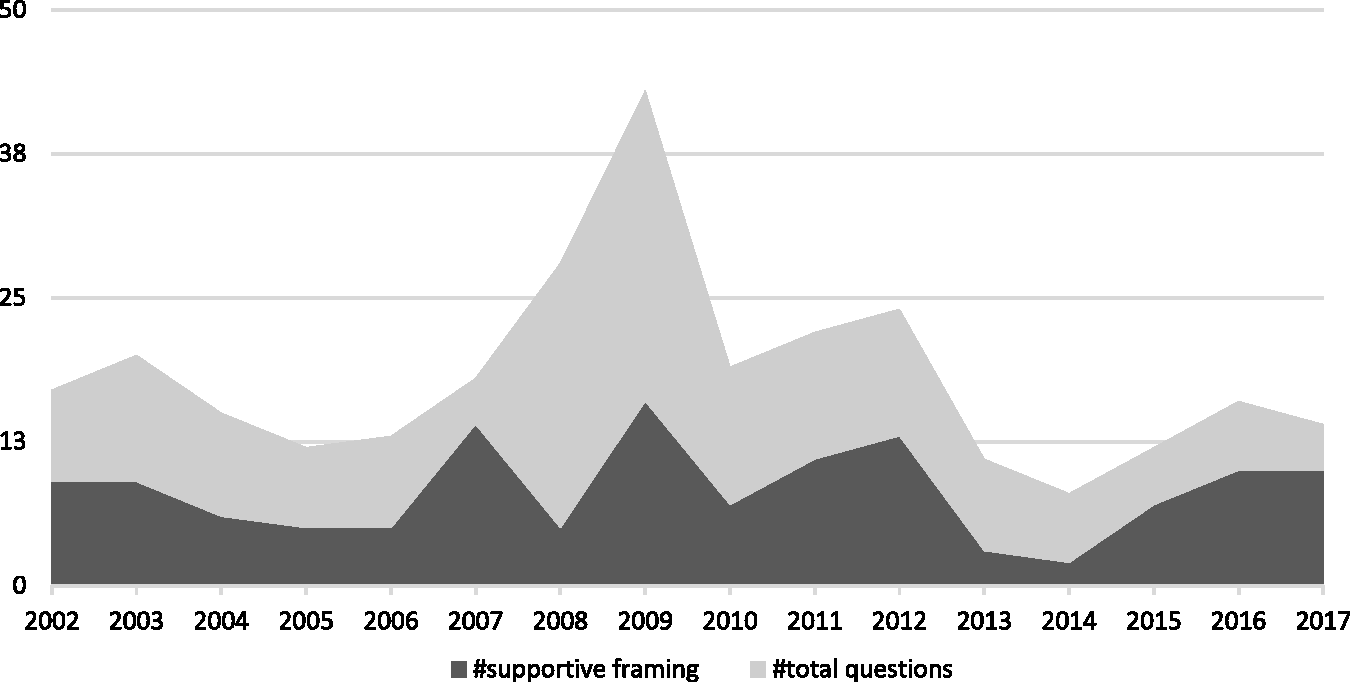
Number of questions and supportive framing across time. reference as appropriate.
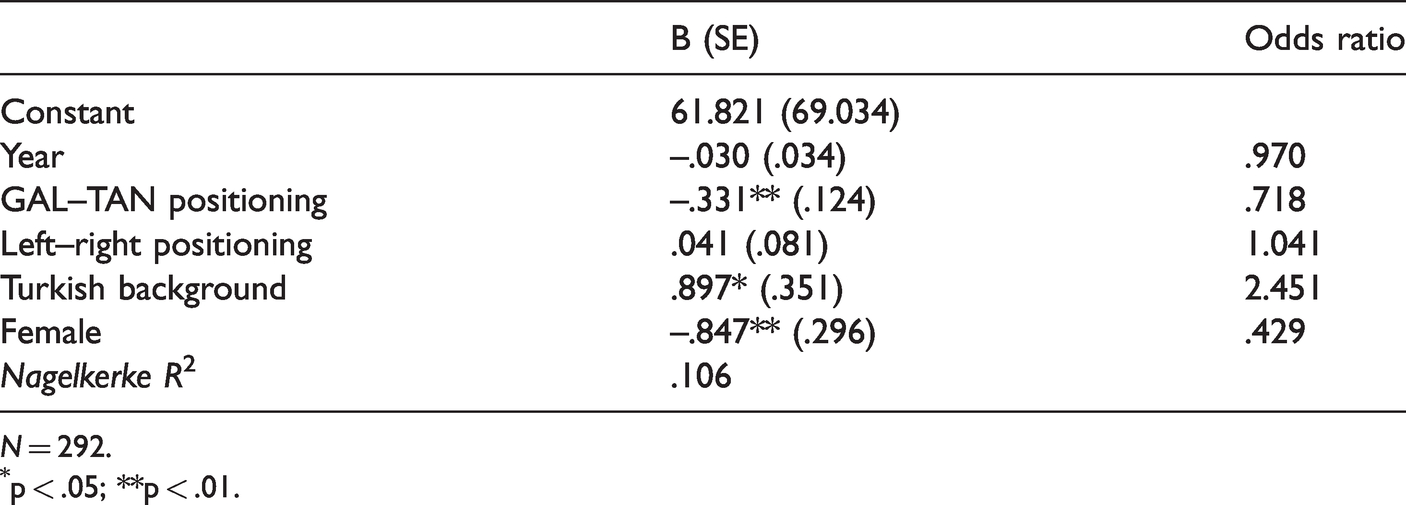
Our overall question is what determines the likelihood that the framing of a question will be supportive. The logistic regression presented in Table 1 provides a partial answer. It provides a confirmation for the majority of our hypotheses, but not all. To start with the first hypothesis: supportive framing would decrease over time; the results yield no confirmation. Our analysis reveals a slight decline in the share of supportive framing, however, it is far from significant. On such an account, this study indicates a modest influence of the shift away from the traditional understanding of Dutch multiculturalism in explaining the representative patterns of MPs with migratory backgrounds when addressing constituencies sharing similar backgrounds with them. The multivariate regression analysis that considers variation in suppressive framing in the Netherlands does not reveal a negative evolution across time while the country adopts a more ‘integrative’ citizenship regime. The transition towards a more monolithic understanding of citizenship does not have a significant influence on the distribution of supportive and suppressive framings over time in the Netherlands: the influence of the year variable in our model is insignificant. Thus, we have to reject H1.
Predicting supportive framing.
N = 292.
p < .05; **p < .01.
Our second hypothesis focuses on differences across political parties and their ideological orientation along the progressive–conservative continuum rather than left–right variation. We find support for the hypothesis in that the more progressive a political party is, the more likely it is that its minority MPs will use supportive framing. The odds ratio indicates that a one-point increase on the GAL-TAN dimension (thus becoming more conservative) yields a 28.2% decrease in the odds of using supportive framing. The results show that the traditional left–right cleavage is not influential. A further inspection of party differences reveals that minority representatives from the Dutch Labour Party or the Dutch Socialist Party do overall not show significantly different patterns than the right-wing parties in framing minority related issues. The lower share of supportive framing of the Labour party compared to the Christian Democratic Appeal further challenges the prevailing belief of Labour sympathy towards cultural and/or religious minorities in the Netherlands. MPs from progressive Dutch parties, the Green Left (Greens) and the D66, appear to be most supportive, while DENK solely relies on supportive framing. Yet, the conservative-liberal VVD, known for its restrictive stance against cultural and religious diversity, appears as the most suppressive. Overall, these results thus confirm our second hypothesis.
Research question 1 focuses on potential differences between MPs from Turkish and other ethnic backgrounds. Turkish MPs, having a strong organizational structure in Dutch society compared to other minority groups, are using more supportive framing. The odds of supportive framing is 145% higher for MPs with a Turkish background compared to other groups. This finding further illustrates the relevance of the idea of group-based rights and liberties within the pillar structure of Dutch multiculturalism. Our content analysis clearly indicates a variance of framing cultural and/or religious rights and liberties across different ethnic backgrounds.
Finally, gender differences are also in line with our expectations, with male MPs relying more often on supportive framing. This confirms our final hypothesis: the gender of an MP played a key role in explaining the framing of parliamentary questions in the Dutch case. As discussed above, a strand of literature underlines the contributory role of female identity on the way towards representing minority groups relative to descriptive representation women (Celis and Erzeel, 2015; Garret, 2017; Mügge, 2016). Our analysis on substantive representation, however, indicates a counter-picture. Female representatives of minority origin are more likely to use a suppressive frame on cultural and/or religious rights and liberties, at least in the case of the Netherlands. Such restrictive stances of female MPs confirm earlier studies claiming the ‘archetypal’ selection of MPs (Durose et al., 2013) with conformity to norms and values set by the upper-class white men on the one hand and a gendered notion of integration on the other (Kaya, 2009: 116–120; Roggeband and Verloo, 2007).
Conclusion
This study investigated the variance of the salience and framing of cultural and/or religious rights and liberties in the agendas of MPs of minority origin in the Netherlands and the possible underlying causes for variation. Our empirical findings reject a straightforward expectation of restrictive policy choices on ethnic and/or religious rights and liberties with the shift away from classical Dutch multiculturalism. Relevant parliamentary work of MPs of migratory backgrounds does not show significant difference over time and, overall, remains slightly more supportive than suppressive. Further studies could consider non-linear changes over time and can shed light on the impact of important events such as the assassination of the anti-immigrant party leader, Pim Fortuyn, in 2002, the murder of the controversial Dutch artist Theo van Gogh, and the economic crisis in 2008.
Our content analysis underlines the role of group and individual identities such as party identity, ethnic background and gender. Findings signify political party identity as a major factor in explaining variance in representing ethnic and/or religious minorities by MPs from migratory backgrounds. Yet, our study shows that differences on the progressive–conservative dimension, rather than that of the left–right, have priority. Dutch Labour members or Socialists do not differ significantly from rightist parties in framing cultural and/or religious rights and liberties. Culturally progressive parties, on the other hand, adopt significantly more supportive framings than do conservative ones. The higher number of supportive messages of MPs of Turkish origin illustrates the importance of high social capital in making the presence of politicians with migratory backgrounds meaningful in group representation. In this regard, our analysis challenges those studies expecting a more reserved stance by representatives coming from ethnic groups with higher social capital due to an increasing suspicion against group-based politics in political parties in the Netherlands. The dominance of suppressive messages in the discourse of female representatives in our sample verifies earlier works claiming that female representatives of minority origin are less interested in making substantial contributions to the representation of ethnic and/or religious identities.
Our study aimed to contribute to the understanding of the systematic factors in explaining variance of framing of the cultural and/or religious rights and liberties. The content analysis revealed the role of party identity, ethnic background and gender whilst challenging the explanatory power of deterministic changes in citizenship regime in the case of the Netherlands. Future research should include additional countries, in order to further unravel the varying impact of citizenship, gender, ethnicity and party membership on the MPs’ framing of cultural and/or religious rights and liberties across different political systems.
Footnotes
Acknowledgements
We would like to thank members of the ASCoR PhD club, Eda Bektas, and Pat Temiz for their valuable feedback to our work.
Declaration of conflicting interests
The author(s) declared no potential conflicts of interest with respect to the research, authorship, and/or publication of this article.
Funding
The author(s) disclosed receipt of the following financial support for the research, authorship, and/or publication of this article:This work was supported by the Scientific and Technological Research Council of Turkey (TUBITAK] under Grant 2214/A.
