



Abstract
Urban regeneration strategies since the 1980s have been framed around a recovery and extension of the urban realm by focusing on the redevelopment of streets as loci for public life and social interaction. Research has tended to analyse these changes through an exclusive focus on the effect spatial transformations have in reshaping social life. This article seeks to extend engagement with the concept of the regenerated street by examining its temporal dimensions. Bringing together Lefebvre’s trialectic of the conceived, the perceived and the lived with Adam’s notion of timescapes, the article argues that we need to attend more closely to the multiple temporalities that underpin interventions of urban change. In particular, this article explores how temporalities of planning, the environment and everyday life interact to create unique timescapes of urban change. By drawing on a longitudinal study of the regeneration of the Rambla del Raval in Barcelona, the article explores the multiple, at times interdependent, at times divergent temporalities that are tangled up in the making and experiencing of this street. The article suggests to approach urban regeneration as a long-term process and place making as a temporal practice where a diversity of temporal modalities interact to produce a diverse and dynamic sense of place.
Introduction
Since the 1980s, cities across the globe have experimented with urban regeneration strategies. 1 Much of this urban change has been framed around ‘a recovery and extension of the public realm by focusing on street-based urbanism’ (Hebbert, 2005, p. 592). The processes of urban regeneration can be experienced most tangibly through a series of transformations that take place on the street itself. Spatially this takes place in the form of the redesign of streetscapes (Madanipour, 2014). Aesthetically it is perceived through the cleansing, demolition or construction of new buildings along the street and the creation of new public spaces (Miles & Miles, 2004). Socially the new streetlife reflects the changing social practices brought about by its spatial redesign (Degen & Rose, 2012).
In urban studies to date, streets have predominantly been discussed from two distinct perspectives: either as the city’s network of public space and the physical manifestation of a (often contested and exclusionary) public realm (Carr, Francis, Rivlin, & Stone, 1992; Lofland, 1998; Mehta, 2014), or as a ‘communal register’ (Hebbert, 2005; Madanipour, 2014), drawing attention to the importance of streets in providing a sense of place and time for individuals and communities. Hayden (1995) famously described this as ‘the power of place’, where everyday small-scale actions shape the collective memory of places. Recent work has questioned this uniform collective temporal relationship focusing upon daily interactions with the monumental and instead has highlighted how in the vernacular use of the city, individuals interact with their surrounding environment drawing on and producing manifold temporal relations (Crang & Travlou, 2001; Degen & Rose, 2012; Lombard, 2013). This article expands these approaches by analysing the regenerated street as emergent from multiple and intersecting temporal processes and practices shaped by institutions, the surrounding environment and individual experiences.
Harvey has famously argued that ‘Command over money, command over space, and command over time form independent but interlocking sources of social power’ (1985, p. 2). Yet, while the spatialisation of urban regeneration has been the object of much critical einquiry highlighting ‘the form and character of new urban spaces and the broader socioeconomic impacts of projects on communities living in and around development areas’ (Raco, Henderson, & Bowlby, 2008, p. 2658), less attention has been given to the temporal relations shaping and emerging from urban redevelopment. Those that have analysed temporal relations in urban regeneration processes have highlighted their economic dimensions such as the ’24-hour city’ discourse used to redevelop urban areas and foster a vibrant night time economy (Adams et al., 2007); the recuperation of historical time in the form of heritage branding to boost economic growth and culture-led regeneration (Hetherington, 2013); or the discursive construction of areas as ‘stuck in time’, in need of acceleration, in order to implement urban change (Crang, 2001). While these studies provide important insights about how power relations in regenerated spaces are shaped temporally, they offer only a partial account. The complex interactions between a diversity of senses of time, emerging from institutions, environment and lived experience in shaping the construction and experience of place, are absent.
This article follows May and Thrift’s (2001) suggestion to more thoroughly examine the interdependency of ‘timespace’ in order to understand how a diversity of temporalities, or types of time (Crang, 2007), shape the construction and experience of a new street, the Rambla del Raval, as part of the regeneration of Barcelona’s historic city centre. Drawing loosely on Lefebvre’s (1991) triptych of the social production of space, I develop an analysis of the timescapes of urban change which are constituted by the temporalities of planning, the temporalities of the environment and the temporalities of everyday life. Drawing on a longitudinal study of urban regeneration and by focusing on the construction of one particular street, this study explores the emergent temporal character of urban change. The next section of the article discusses the relationship between time and space in the city, linking Adam’s notion of timescape (1998) to Lefebvre’s (1991) spatial triad of the lived, the conceived and the perceived to provide a framework for analysing the multiple temporalities of the regenerated street. I then introduce the case study and methodology and go on to develop Lefebvre’s spatial triad to account for the overlapping temporalities and temporal modes underpinning the making and experience of the Rambla del Raval. To conclude, the article argues that analysing the temporal relations imbricated in regeneration processes and experiences offers a new reading of the complex power relations involved in the making and experiencing of urban spaces and adds an understanding of the dynamic nature of urban life.
Time and urban regeneration
For a long time, space and time were regarded as background features of social action rather than key dimensions in shaping urban living (Giddens, 1985; Thrift, 1983/2002). It is only since the 1980s that social theory began to articulate a deeper understanding of space and time that moved away from such positivistic ideas. Influenced by Lefebvre, writers such as Harvey (1985), Soja (1996) and Massey (2005) argued that both time and space are created by and shape social action. Yet, despite this move, there has been a tendency to prioritise either an analysis of space or time. This led to ‘a powerful and persistent dualism’ in understandings of social life rather than their interdependency as timespace (May & Thrift, 2001). While there is a strong acknowledgement that ‘life is spatial as well as temporal’ (Massey, 2005, p. 29), most social disciplines have attempted to capture the passing of time within a spatial order, leading to a spatialisation of time. To put it simply, there has been the idea that ‘spatial framing is a way of containing the temporal. For a while you hold the world still. And in this moment you can analyse its structure’ (Massey, 2005, p. 23). Hence, much social research on urban change has examined transformations in spatial and social patterns within relatively fixed timeframes (for a discussion, see Lees, 2012). While there has been a long tradition in community studies to understand the long-term impact of spatial change on the social life of particular neighbourhoods (Coates & Silburn, 1980; for an overview, see Mckenzie, 2012), and more recent studies on urban change have focused on how individuals produce complex temporal narratives of resistance and belonging (Lewis, 2016; Lombard, 2013; Mckenzie, 2012), the interaction between a variety of temporal scales and practices in urban regeneration processes has been neglected. A recent exception is the work by Raco et al. (2008), who in their analysis of ‘the politics of space–time’ of Salford Quays redevelopment argue that ‘temporal aspects’ such as timing and timeframes play an important role in shaping power relations; concluding that dominant timescales are imposed so that ‘particular needs are prioritised ahead of others in temporal and spatial terms’ (2008, p. 2670). I argue that to understand the specificity of place making and place experiences we need to combine the analysis of structural temporal dimensions, such as planning practices and discourses, with the examination of in situ temporal experiences from a diversity of users. For the remainder of this section I provide some suggestions on how we can do this.
It is by now common knowledge in the social sciences that time is not one continuum, but multiple and diverse (Adam, 1990). Adam concedes that while there are natural and social times as well as lived and abstract times, one needs to transcend these dualisms and conceive: ‘all time [as] social time; … time is fundamentally embedded in the social forms which constitute it and which are simultaneously constituted by it’ (1990, p. 42). And, because time is social we need to be aware of various uneven networks of time which are materialised in the city (Adam, 1998). Adam suggests the notion of timescapes to highlight multiple temporal layers and show how different understandings of time interact in the construction of landscapes: both tangible phenomena such as the actual built environment or people’s activities and broader intangible political, social, financial or environmental processes.
Time is qualitatively different to space in that it is intangible, we cannot directly perceive it through the senses. Hence, Adam (1998) suggests that we perceive time through three main modes. We experience time through a variety of technologies that serve as ‘indicators’ whether it is objects such as calendars, clocks, or activities such as scheduled events that structure our lives and experiences of places. Time is further expressed and mediated through a series of cultural discourses that can be conveyed either through personal narratives and accounts, or framed through institutions such as local councils and set out in policy documents. Time is both a socio-technical institution, imposed upon the individual while simultaneously being an embodied and lived experience that we become aware of through a range of ‘symptoms’ such as sensory changes as for example day and night or the smell of something rotting. To summarise, while the working of time is intangible, it is framed through social and institutional practices and its ordering effects can be grasped by focusing on technologies of time, discourses of time and experiential symptoms of time. Yet, how are we to apply this on the regenerated street?
For Lefebvre, space and time are related: space only exists through time and time is apprehended in space, as both enjoy the same ontological status (Merrifield, 1993). While Lefebvre is most known for his spatio-temporal discussions of Rhythmanalysis (2004) and the repetition and cyclical nature of time in cities, I would like to draw and expand on his deliberations on the temporal as discussed in The Production of Space (1991). While his focus on the social production of space is an attempt to correct Marxism’s over-emphasis on the temporal dimension in its analysis of capitalism, he simultaneously attempts to pluralise our understandings of time (Merrifield, 1993). Lefebvre clearly regards space production as temporally embedded in a particular historical and political timeframe. Yet, he goes further to suggest that:
… the uncertain traces left by events are not the only marks on (or in) space: society in its actuality also deposits its script, the result and product of social activities. Time has more than one writing system. The space engendered by time is always actual and synchronic, and it always presents itself as of a piece; its component parts are bound together by internal links and connections themselves produced by time. (Lefebvre, 1991, p. 110)
Lefebvre describes the urban here as a palimpsest, composed of different temporal modes: past, present and future which are socially constructed and interconnect. I suggest that if we are to expand our understandings of temporalities in and of the street and how they shape power relations, we need to revisit Lefebvre’s well-known triptych of the lived, the perceived and the conceived from an explicitly temporal perspective. These three ‘scapes’ were conceived by Lefebvre as analytical spaces that contribute differentially to the social production of space, varying according to local conditions that frame and embed place within particular temporal constellations or ‘timescapes’. Rather than discussing these in detail now, I develop them through my case study.
The temporalities of regenerated streets: Analysing the Rambla del Raval
This section analyses the manifold and interwoven temporalities which underlie and constitute a particular regenerated neighbourhood and street by focusing on the Rambla del Raval in Barcelona 2 (henceforth, the Rambla). Since the rise of democracy after Franco’s death in 1975 the city has positioned itself on the ‘global urban catwalk’ (Degen, 2008) by opening itself to the sea, creating a dialogue between old and new architecture and regenerating its historic city centre, the ‘Old City’. Barcelona is now Europe’s fifth most popular tourist destination with 17.1 million overnight stays a year in 2015. 3 The Rambla, a broad boulevard, described as the most dramatic and large-scale urban intervention of Barcelona’s regeneration, was built between 1997 and 2000 in a Hausmannian fashion to cut across the district of Raval (see Figure 1). It provides an excellent case study for the themes of this article since its conception, construction and uses have been contested, and tensions have evolved from its diverse and intersecting temporalities.
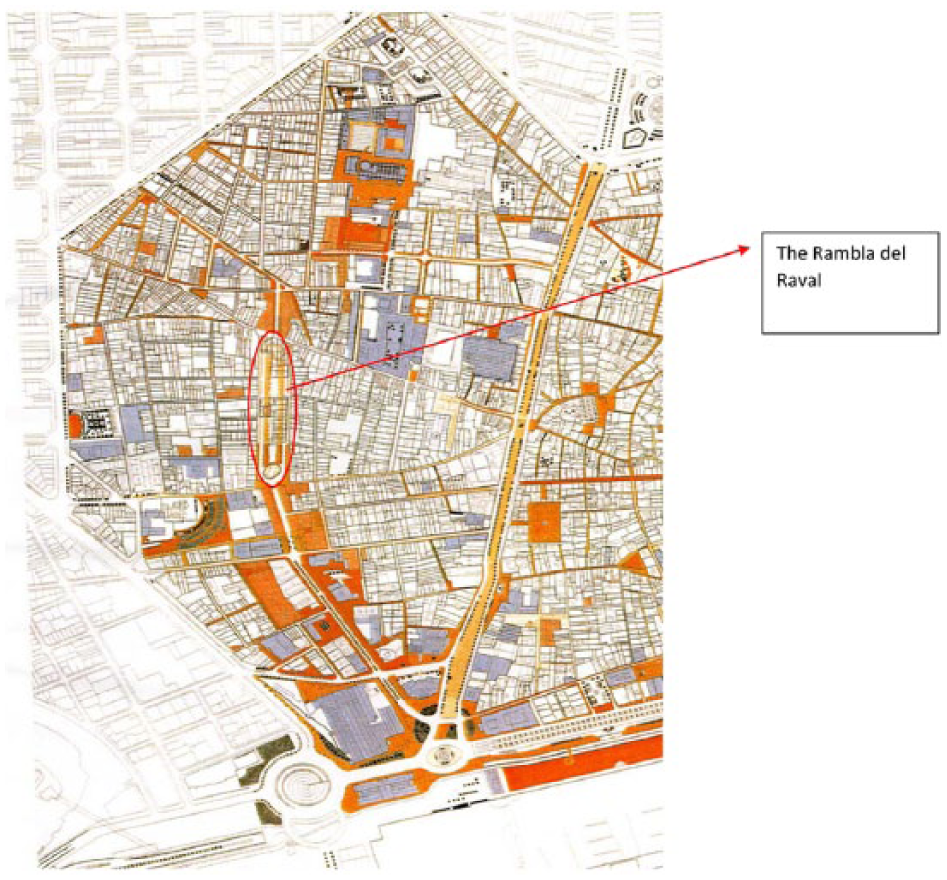
A map of the Old City in Barcelona indicating the location of la Rambla del Raval; to the far right of the map is La Rambla (see note 2).
The Raval has evolved in the last 25 years from being one of the most deprived and physically neglected areas in the city to become the cultural quarter of Barcelona, housing key cultural institutions (Aisa & Vidal, 2006; Degen, 2008). Since the mid-1990s the neighbourhood has experienced a series of urban renewal programmes that have created new public spaces, social and community centres and housing developments as well as rolling out a housing rehabilitation programme. Simultaneously, due to its cheap housing stock it has been historically the entry port for Spanish migrants to Barcelona and has continued to welcome large-scale non-European migration since the 1990s, with over 50% of its population not being Spanish.
This article draws on longitudinal qualitative research of the Raval’s regeneration since 1996. My initial research analysed the ways in which regeneration involves not only a spatial reorganisation of public space but a sensory recoding of place which encourages particular social groups to partake in the social life of redesigned areas while discouraging others (Degen, 2008). Since then I have continued to research the area through a range of projects that have included analysis of the branding of the neighbourhood (Degen, 2010) and of how temporal and sensory dynamics in the practices and uses of everyday life in the neighbourhood disrupt regeneration strategies (Degen, 2017). During this time, over 100 interviews with planners, city officials, local neighbours, local community groups, visitors and tourists were conducted as well as a continuous discursive analysis of official documents, newspaper articles and secondary literature related to the regeneration process over the last 20 years. While my long-term interest has been to analyse urban change through the prism of the senses to understand how planning, everyday experiences and place attachments of diverse users of the city are refracted through sensory paradigms (Degen, 2008, 2010), observing the neighbourhood over two decades has allowed me to witness its transformation as a timespace. I ordered and analysed thematically the data through NVivo to explicitly focus on temporal scales, practices and discourses to examine the processual nature of urban change as ‘the process of urban development unfolds over decades’ (Myers & Kitsuse, 2000).
The purpose of the next three sections is to develop Lefebvre’s triad to capture the generative process of urban timescapes, by emphasising the temporal dimension of place making. The division into conceived, perceived and lived temporalities is conceptual as in practice they overlap and interrelate.
Conceived temporalities of planning
For Lefebvre (1991), the conceived refers to the rationally abstracted space and time which is mentally conceived of in verbal, visual or written representations and imaginaries. It alludes to the discursively constructed conception of what a street is, the temporal markers it contains and activities it should encourage. The conceived has largely been linked to relations of production and to the order or design that these produce and ‘the representations of power and ideology, of control and surveillance’ (Soja, 1996, p. 67). Planning has thus been analysed as the ultimate expression of the conceived, as a range of spatial impositions executed by urban decision-makers through plans and policy documents. Yet, planning is also a deeply temporal activity (Abram & Wezkalnys, 2011; Myers & Kitsuse, 2000). First, it provides not only a tool and practice to manage the present, ‘of governing and organizing the relationship between the state, citizens, and other organizations whether private, commercial, or public’, but, moreover, it is ‘the transition over time from current states to desired ones’ (Abram & Wezkalnys, 2011, pp. 3–4). Hence, much planning practice consists of preparing for future activities by trying to organise, predict and manage the spatial outcomes of future times. This is because urban space is highly unpredictable and ‘messy’ and plans aid to ‘tame urban complexity’ (Hoch, 2009). Thus, not surprisingly, implicit in this future scenario building are promises for a ‘better’ material and temporal order, implying that the already present needs improvement: ‘Plans can be constructed to avoid undesirable futures, to make desired forecasts come true, or to create new, more desirable futures’ (Myers & Kitsuse, 2000, p. 223). Second, this future planning is informed by the past history of a place and present technologies, values and planning trends: ‘The future is not a disconnected end-state that exists only in the future; instead the future should be viewed as a continuous unfolding of time that is rooted in past and present’ (Myers & Kitsuse, 2000, p. 225). Let us examine how the conceived temporalities of planning unfold in the conceptions and motivations of the planning of the Rambla.
While the Rambla opened in September 2000, it was not regarded as a new intervention by planners, but part of a long-term, inherited historical planning process that could be traced back to Cerda’s plans to modernise Barcelona in 1859 when its medieval walls were demolished. In particular, Cerda envisaged two big thoroughfares Via A (nowadays Via Laietana) and Via B (today’s Rambla del Raval) which would connect the port area with the new city. While Via Laietana was built in 1907, the Raval’s avenue got stalled. Again, in 1932, the rationalist Plan Macia aimed to demolish and rebuild large parts of the Raval; the scheme ground to a halt with the Spanish Civil War. It is important to point out here that the subsequent deterioration of the Raval’s housing stock stems from the lack of planning implemented in the area and landlords abandoning the buildings legally designated to be bulldozed.
During Franco’s dictatorship, the Old City was largely neglected from a planning perspective, which led to a prioritisation of economic considerations over social ones and a deterioration of its public spaces and housing stock. In 1979, the emergence of a new democratic city council led to ‘Barcelona’s reconstruction’ which involved citizen participation processes. The reconstruction started with a practical approach by focusing on ‘what people could see, in other words, improvements that would quickly get to the people. What was the focus? Public space. Such interventions would have a timely impact on people and show them that things were improving’, as chief planner Albert explained in 1998. Such a planning emphasis could be interpreted as a temporal technology to signal the physical development of new democratic times. As developments started in other parts of the Old City, it was not until 1985 that the Special Plan of Interior Reform for el Raval (PERI) was conceived. However, its execution stagnated and it would take six years from the first conception of the plans in 1982 until their approval in 1989.
The PERI divided the Raval into two areas: the north of the neighbourhood was shaped by a cultural regeneration approach, whereas the south was subjugated to the Plan Central focusing on enhancing commerce, fostering economic activities and providing the area with a robust social infrastructure. It envisaged an extensive system of public spaces to inject new temporal rhythms that would activate social change in its dense urban fabric, its most dramatic element being the construction of a wide-open boulevard, the Rambla, which was conceived as a ‘showcase of a new city with global ambitions’ (Ortiz, Garcia-Ramon, & Prats, 2004). This project stagnated until 1994 when a European Union Cohesion grant funded 85% of its construction, which speeded up its implementation and lead to its inauguration in September 2000. (Figure 2 shows the Rambla area before and after the redevelopment.)
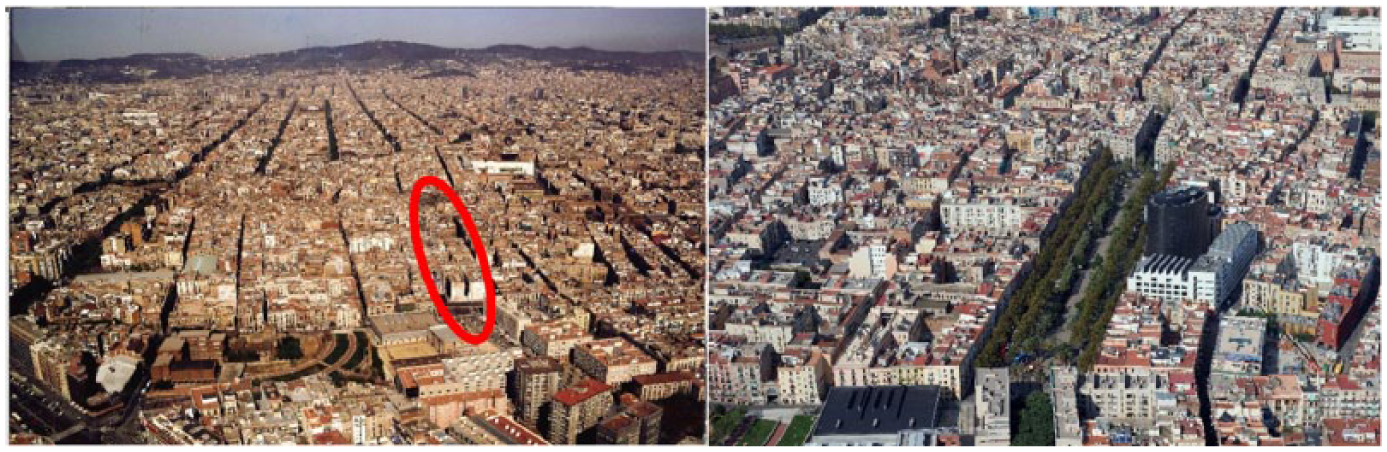
The picture on the left from 1997 indicates the future location of the Rambla del Raval; the picture on the right illustrates the built Rambla in 2010.
Throughout the early 2000s the Rambla went through a period of adaptation, where time was referred to by officials in terms of an envelope that gradually embedded the new space into the temporal practices of the neighbourhood. As an architect involved in its construction explained: ‘At the start [when you first construct a building] you get a lot of harsh critiques, then the modern building gets integrated. …The new architecture needs some time to acclimatize’ (interview, 1998). However, despite the construction of a new 4-star hotel on the Rambla in 2008 intended to act as a further accelerator for regeneration, officials felt the Rambla was lagging behind, leading regeneration manager Judit to conclude in 2012 that while other areas progressed to a successful present: ‘the south [of the Raval] has evolved into a different rhythm, very different rhythms. Despite all the urban regeneration of the Rambla there are very deprived pockets around it.’ In 2010 a further 15 million Euros were earmarked for investment to further speed up its regeneration, a process which stagnated until 2013–2014 because of the financial crisis (Lopez, 2011).
When discussing the conception of the Rambla from a longitudinal perspective it is important to consider how past, present and future are framed symbolically. In the public imaginary the Raval has historically been conceived as the infamous ‘Barrio Chino’, Barcelona’s red light district, a marginal neighbourhood associated with prostitution, drugs and poverty. This led to its historical representation as a place in constant social crisis which coincided with hygienist attempts of urban intervention (Fernandez, 2014). The construction of the Rambla cutting through the Raval’s most marginal streets renowned for its street-sexworkers, brothels and sex shops was undoubtedly intended to erase temporal and spatial indicators of its historic identity. The new identity and future role of the new space is described in official documents in temporally progressive terms: ‘to irradiate vitality’ (Foment de Ciutat Vella, 2001), ‘to activate change’ (Ayuntamiento de Barcelona, 2002). From its inception, the Rambla was conceived as a technology of time to regenerate the neighbourhood through a linear, yet slow, improvement described as an ‘urban process linked to the temporality of healing, suture and resetting of the urban fabric that surrounds it’ (Ayuntamiento de Barcelona, 2002, p. 3).
As the analysis of discourses from official documents, interviews and observation of actual planning practices reveals, the temporalities of planning have the following features. First, discursively, planners adopt a historicising perspective to place which allows them to establish a temporal-emotional distance. Second, planners view the redevelopment as a long-term process, implemented gradually through different phases, an oscillating temporal mode ranging from stagnation to acceleration as funding is received and legal planning frameworks develop and change. This resonates with Raco et al.’s findings of the ways in which administrative-bureaucratic timeframes as well as wider political timeframes shape the implementation of ‘not only what types of development should take place but also when they should be phased, and when different interests should expect their needs and priorities addressed’ (Raco et al., 2008, p. 2657, emphasis in original).
Once built, the Rambla was promoted as a space for public events and a venue for 24-hour spectacles organised by the council or local neighbourhood associations. By 2005 the Rambla had become the third most congregated place in Barcelona, attracting over 15,000 people at times. Crang suggests that such commodification of urban space operates not just spatially but also through temporal control ‘about finding and capitalising on the existing rhythms of a place and enrolling new users to them’ (2012, p. 2122). Official discourses hence conceive the Rambla as temporally and spatially ‘collaborat[ing] in the social integration of disadvantaged groups’ (Barcelona Turisme, 2016). Such an approach is common for contemporary urban regeneration projects where streets are conceived as an important backbone to the experience economy. In these cases, streets become conceived as strategic temporal devices to attract new activities and cultural and civic engagements. Segregated areas become connected through a common temporal geography to create an integrated urban whole (Madanipour, 2014).
Perceived temporalities of the environment
The previous section argued that multiple temporal modes are entangled in the conception, implementation and management of the Rambla. This section turns to a different timescape of the street, Lefebvre’s dimension of the perceived, in other words the directly observable built and natural environment and spatial practices, the actual physical and social arrangements of a street mapped through time: ‘here cityspace is physically and materially perceived as form and process, as measurable and mappable configurations and practices of urban life’ (Soja, 2000, p. 10). Temporal relations and expressions are observable in this dimension not just through discourses of time but through ‘experiential symptoms’ such as the changing textures of place that are framed by the natural rhythms of day and night, the changing seasons or observable spatial practices.
Long-term residents perceived the construction of the Rambla as a spatio-temporal imposition. While citizen participation was fostered during the early conception of the Raval’s PERI, none took place during its implementation. Particular controversy emerged around whose heritage was going to be preserved, highlighting how planners and residents understood the temporality of the city differently. Most planners and officials perceived the physical environment of the Old City as a flexible entity made out of temporal layers, as chief planner Albert states: ‘the Raval as every old city is made through the superimposition of historic moments that constantly change it’ (interview, 1998). Such perceptions suggest a temporal notion of the built environment as a malleable and recyclable construction that planners are in charge of, as the use of ‘we’ indicates: ‘we use the existing fabric and recycle it, we use very new technologies for that. We recycle the historic fabric’ (Jordi, planner, interview, 1998). The planners’ ‘perceived time’ ignored any ‘lived time’, the ways in which people gradually construct place attachments by identifying with their material environments. Through the construction of the Rambla an emotional topography was radically erased for many of its residents. During this time, many long-term residents would refer to their present neighbourhood as a place under siege (Degen, 2008), implying a time-determined state of existence. In front of the demolished buildings, the indicators of an unwanted past, hoardings advertised the conceived desirable future: ‘Barcelona is looking ahead’. (Figure 3 presents the architects’ vision for the boulevard.)
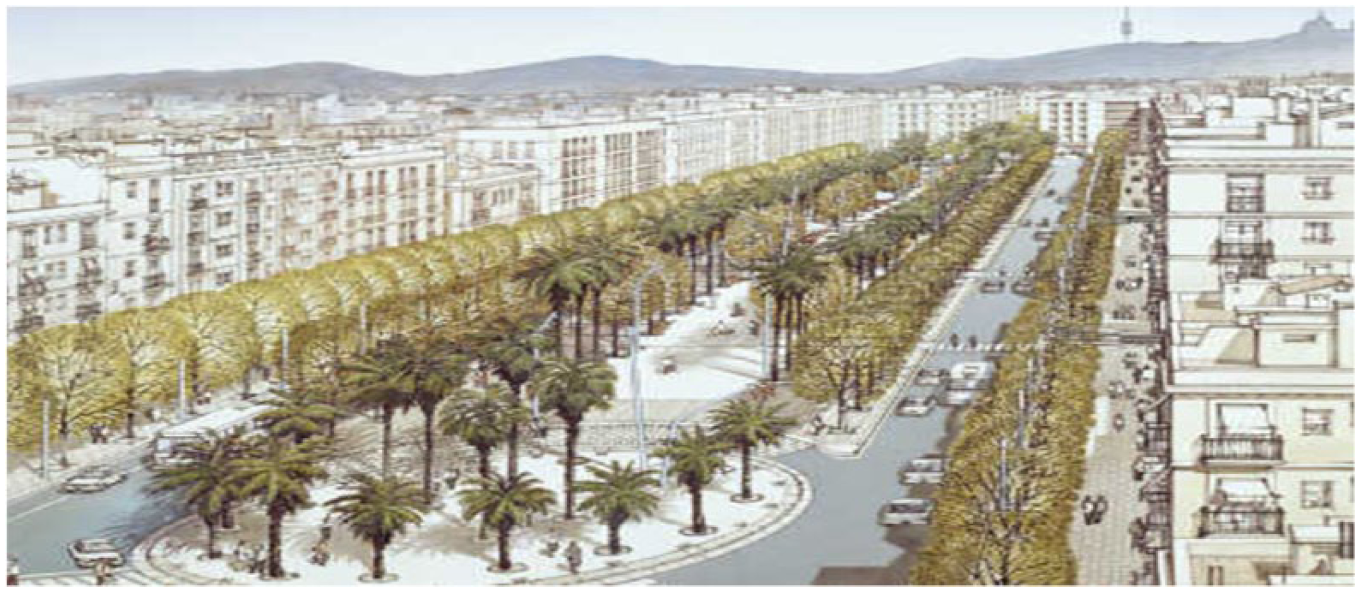
An architectural drawing of the Rambla del Raval.
This perception by officials of the built environment in terms of a malleable and recyclable temporal mode at the cost of lived time is reflected in the management of the demolition process. After decades of stagnation, the demolition occurred swiftly within a year and five housing blocks were demolished, which comprised 62 buildings with 789 flats and 140 business spaces. Up to 10,000 residents were displaced (Fernandez, 2014), leading one social worker to concede negatively in 1998: ‘the speed of the improvements of the Raval has taken its residents by surprise’.
While there were several listed modernista townhouses such as the Casa Buxeres from 1905 that residents’ associations campaigned to keep, the heritage status of these houses were downgraded during the PERI. Their ‘declassification’ was experienced as hasty and led to a protest movement against the destruction of the Raval’s working-class heritage (Sargatal Bataller, 2008). The city council dismissed these claims and a range of forced expropriations took place. Residents had to demonstrate a minimum of five years of continued legal occupation of the flats. 4 The planning process and expropriation was speeded up by rising property values and the subsequent temporal dissonance between how much residents had been initially offered to move and the actual market price (Scarnato, 2012, p. 10). Within months, Raval’s most marginal streets disappeared and no physical remnants remained. A regeneration manager in charge of the Old City reflected in 2012: ‘That was the last intervention in the Raval where they swept away a large space. I understand that this process has been very slow, very complicated. … It is to sweep away a large space, to affect the lives of lots of people and to decide to open it to lots of new people. Now, nobody would do this again as the economy has changed and the mentality.’ These reflections illustrate how planning policies and practices transform over time. Thus, one can detect a clear move since 2000 to more participatory planning approaches in Barcelona that take into account the everyday needs and expectations of residents.
Once the new Rambla was built, a 58 metre wide and 317 metre long modernist boulevard emerged. It consisted of a free walkway bordered by grass, benches and trees. The housing alongside, mostly built in the 1820s, got rapidly refurbished to create a uniform material temporal timeframe. One could argue that such practices operate in Adam’s (1998) sense as a technology of time that gestures to a homogeneous present. The past gets integrated into the present by eliminating any sensory traces of decay: the smells, the dirt or any other indicators of the natural passing of time. This aesthetic change feeds into the temporality of planning in that developers were selling ‘future investment’ to the gentrifying residents promising a increase in property values and a general ‘improvement’ in the neighbourhood (Fernandez, 2014, p. 322). Yet, 10 years later many of these residents left as the neighbourhood did not gentrify as expected (Degen, 2017).
Lived temporalities of everyday life
Ethnographic studies on urban change and place attachment have stressed the ways in which urban redevelopment disrupts long-term residents’ relationships between place and local identity, and how they respond with competing narratives that range from an experience of loss to a reconfiguration of social ties, or both simultaneously (Lewis, 2016; Lombard, 2013; Mckenzie, 2012). Studies on new residents and visitors have highlighted how place attachments develop over time and are moulded by everyday practices, memories, experiences and feelings towards particular spaces (Adams et al., 2007; Degen, 2008; Degen & Rose, 2012; Koch & Latham, 2012). Such studies demonstrate the centrality of the temporal in situating us biographically within an environment and constructing a sense of place through regular interactions and uses. The aim of this section is to use Lefebvre’s (1991) notion of the lived, a unifying moment that encompasses the conceived and perceived through personal perceptions and relations, to zoom into a newly regenerated street to uncover the consistent and habitual enactions that make time in this place and show how these are supplemented, changed, challenged and adapted over the lifetime of the Rambla. The lived is the intimate, direct relation we have to the street – as experienced through our use of it; ‘it is essentially qualitative, fluid, dynamic’ (Lefebvre, 1991, p. 42).
Long-term residents’ life-courses in the Raval are deeply entrenched in the material environment of this neighbourhood. Many arrived either as children or were born in the neighbourhood to migrants from other areas of Spain. As became clear from interviews with elderly long-term residents in 1998, they seldom ventured out of ‘their’ neighbourhood that is centrally located in Barcelona as it provided ‘everything one needs’ in terms of shops, recreation and social facilities (Degen, 2008). When asked how they had experienced the development of the neighbourhood since their childhood, long-term residents pointed to a ‘suspended temporality’, referring to the lack of urban redevelopment and characterised by temporal modes of waiting and (unfulfilled) expectations. These temporal modes complement the planners’ temporality of stagnation and yet add an important experiential and emotional nuance to it.
My research indicates a link between the length of time of residence and patterns of use of the new Rambla. While Edensor (2012) points out that iconic buildings tend to stabilise notions of place formation, we witness here the erasure of a lived place and the creation of a new icon in a neighbourhood. In interviews held with long-term residents in 1998 they described the destruction of the centre of the Raval as a ‘warzone’ where time had been annihilated, and referred to the construction of the Rambla as ‘the pulling out of the heart of the Raval’ (Ramon, interview, 1998) (see Figure 4). Both houses and streets are containers of meaning and memory as ‘the physical embodies the social and the cultural and provides the setting for these aspects of identity’ (Lombard, 2013, p. 816). The destruction of the buildings and streets inscribed by personal memories and lived time was experienced as extremely painful, consistent with a feeling of grief and loss. Hence, when the Rambla first opened in 2000 long-term residents viewed the Rambla with suspicion, and largely refrained from using it.
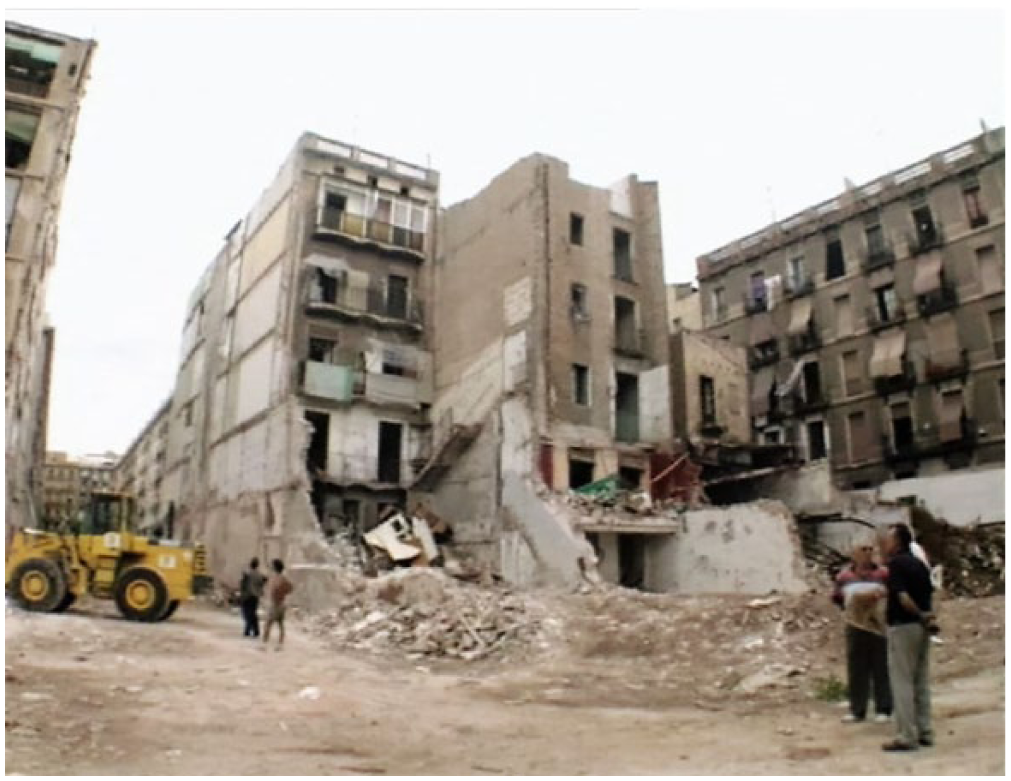
A still from a video following the demolition process.
Not surprisingly, during the first years of its existence, the Rambla was not well used locally as a place for encounter and rest, its primary function being a short-cut for locals to cross the neighbourhood (ethnographic diaries 2000–2004). It is helpful to draw here on Lefebvre’s method of rhythmanalysis to expose how the Rambla has been lived and used over time considering that ‘places are always in a process of becoming, seething with emergent properties, but usually stabilised by regular patterns of flow that possess particular rhythmic qualities whether steady, intermittent, volatile or surging’ (Edensor, 2010, p. 3). Initially a lack of regular activity and a feeling of emptiness characterised the boulevard. The passing of time was paced by the rhythms of nature – the seasons and associated weather patterns and the gradual growth and change in vegetation. Empty businesses once catering for a local population were gradually replaced by Pakistani kebab restaurants, trendy bars, call centres, a four-star hotel and charity shops catering for the new user groups of el Raval – new residents, tourists and migrants – yet not for long-term residents. Progressively, homeless people (some were former residents made homeless by the regeneration) started to use the grassy sides of the Rambla at night time to sleep, which led it to be locally known as the ‘Rambla of the Miserables’. Migrant men from Morocco and Pakistan started to regularly meet on the Rambla before and after their visit to the mosque, which led some long-term residents to label it ‘Ramblakistan’, pointing to some of the racist feelings aroused by the newly arrived Pakistani community (Horta, 2010). For Pakistani and Bangladeshi men the Rambla offered a public space to gain respite from their cramped living conditions, a space to congregate and gather information (Ortiz et al., 2004). Recent interviews with Pakistani residents in 2015 reveal that they named it the ‘Rambla of Sadness’ as Pakistani men meet here to lament their lack of legal papers and work. Over time the Rambla has become an important timespace for migrant groups that have settled in the Raval, as it offers a public space to temporally mark national holidays or important religious commemorations.
As mentioned in the section on ‘Conceived temporalities of planning’, the official promotion of the Rambla as a place for city events quickly established it as a destination not only among Barcelonians but also for the 21 million tourists that visit this neighbourhood every year. This has led to an intermittent rhythm of extreme activity through fairs and concerts at weekends, and a more placid local use during the week. I exemplify the everyday rhythms of the street through the following vignette.
In the early mornings, the Rambla is mainly a thoroughfare for local workers and children from a variety of ethnic backgrounds heading to school. It is otherwise quiet until 10:30 am when the bar staff start setting up outside tables. By midday, the warming sun lures a diversity of people to mingle on the Rambla. I observe a group of Japanese students studying their city maps and two Hindu men chatting animatedly beside them, all of which become engulfed by swathes of English and German tourists, ringing the bells of their rented bicycles and steering their children onwards to the next point of interest. This temporal synchronicity becomes spatially subverted in the late morning, when different social groups take a seat: tourists gravitate to the bars, migrants and homeless use the public seating and green areas. Spanish and Catalan people are hardly to be heard, and those I observe, cross quickly until lunch time arrives at 2 pm, when tourists and office workers mingle at the outside tables. It’s not only tourists and workers using the space: next to me an elderly couple sit opposite one another, I have a feeling they live on the street as they wear several layers of jackets, and have trolleys with carefully folded clothes and books. The woman alternates between listening to the radio and feeding the little dog on her lap, meanwhile the man is silent, fully concentrated on his crossword.
By 3 pm the rhythm of the Rambla slows once again as workers and tourists dissipate, before the next wave at 5 pm when schools close and scurrying mothers hurry their children, office workers talk on their mobile phones as they meander to nearby metro stations, and tourists amble out of galleries and museums. Around 6 pm it seems the Rambla is the preserve of European-looking middle-aged men who drink from bottle-filled shopping bags on public benches, whilst mothers clutching children cross with shopping trolleys. By night-fall these are all replaced by a younger, hipper crowd as the Rambla gives way to visitors and party people, especially so during the summer months and weekends.
During one night observation in May 2012, the benches and floor of the Rambla were carpeted by groups of Catalan youngsters drinking ‘Xibecas’ (large beer bottles) and chatting plus groups of standing Moroccan and Pakistani men talking to each other. It is difficult to get a free table, the bars near the hotels in the middle of the Rambla are crowded by tourists, whilst those at both ends of the boulevard near kebab shops are more local hangouts although waiters tell me that it quietens down here after midnight.
The different temporal uses of space show how ‘every rhythm implies the relation of a time with a space, a localised time, or if one wishes a temporalized space’ (Lefebvre, 1996, p. 230) and thereby frame an overall feel of place. Interviews with diverse local visitors of the Rambla held in 2012 reflect the temporally synchronic yet socio-spatially separated rhythms of place. Hence, most local visitors describe the Rambla as ‘fun’, ‘lively’, ‘multicultural’ and ‘different as it has cultural variety’. Yet, when asked about the negative aspects many pinpointed its sedentary use by migrants, homeless people and tourists, describing the Rambla as dirty and dangerous, as for example this visitor illustrates: ‘What I like best is the variety of people. It’s like the UN, it’s nice! What I like least is people like this [points to three homeless people]’ (Manuela, interview, 2012).
Over time, the Rambla has become integrated within the neighbourhood at different speeds for different user groups and has evolved into a meaningful location despite going through an uneven spatio-temporal development, as Carmen from a local resident association reflected in 2012:
This street is the square of the neighbourhood, its centre, … it’s the place where everyone can live through the identity of the neighbourhood … it’s interesting to see how a street picks up the identity of a neighbourhood, a street that 10 years ago did not exist. This was a haunted place. The residents in the neighbourhood suffered great pain because they had to move lots of people, lots of streets disappeared. All this is not easy to assimilate. But it’s incredible how something so grave and profound has been transformed, in a very healthy way, into something different. And now it has become the symbol of this neighbourhood and is making everyone curious about it.
Gradually the Rambla has become enveloped in the daily spatio-temporal practices and rhythms of the neighbourhood and has transformed into an iconic social and economic centre, a representation of the Raval’s complex identity as it features in tourist guides and postcards: ‘it is the image the Raval gives to the outside … it reflects the good and bad and so it amplifies the positive and negative’ (Carmen, interview, 2012). The longitudinal analysis of the unfolding nature of a new street (see Figure 5) within the daily life of a neighbourhood has revealed how ‘national and global rhythms increasingly pulse through place’ (Edensor, 2010, p. 3) reconstituting its experience in unexpected ways.
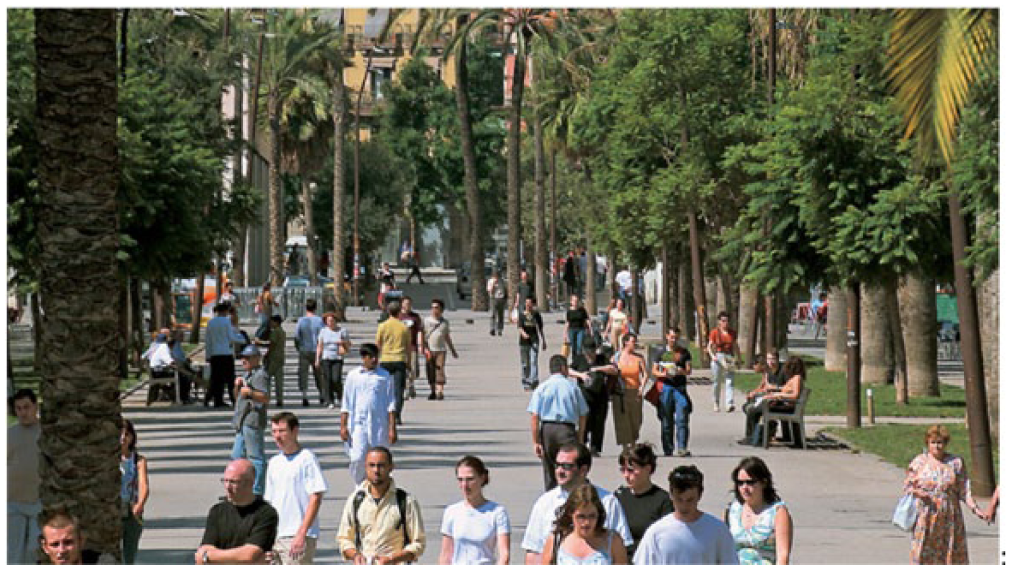
Rambla del Raval in 2016.
Conclusion
This article has demonstrated the ways in which interlocking timescapes such as the conceived temporalities of planning, the perceived temporalities of the environment and the lived temporalities of everyday life coalesce in a regenerated street as a ‘definable geography of time’ (Raco et al., 2008). By bringing together micro and macro configurations of time under the broad theoretical framework of timescapes of urban change, this article contributes to an emerging body of work that explores the social framing and experiential implications of urban planning as a continuously evolving timespace (Abram & Wezkalnys, 2011; Degen & Rose, 2012; Koch & Latham, 2012; Lombard, 2013). By linking Lefebvre’s trialectic of the conceived, perceived and lived to Adam’s concept of timescape, this article has developed an understanding of place making as a complex temporal achievement organised and materialised through the interactions between multiple and diverse temporalities such as those of urban decision-makers, the built environment and its users – all characterised by particular senses of time, timeframes and modalities of time. A complex spatio-temporal ecology emerges which ‘is less that of a singular or uniform social time stretching over a uniform space, than of various (and uneven) networks of time stretching in different and divergent directions across an uneven social field’ (May & Thrift, 2001, p. 5).
This ‘complex spatio-temporal ecology’ has various implications for researching urban regeneration processes. First, a longitudinal perspective of regeneration processes exposes urban regeneration as a fragile and dynamic process rather than a linear chrono-logical continuum. My longitudinal study has drawn attention to how an urban regeneration project is reconfigured over time through a range of temporal structural dimensions whether political events or financial cycles, or tourism and migration flows, which are outside the control of urban decision-makers. Such uneven developments suggest potential themes for further research into the practicalities and constraints that shape the work of urban decision-makers. While my historical discussion shows the negative consequences of a lack of planning in the Raval, the article also illustrates how urban decision-makers might be advised to craft regeneration plans ‘that allow for the uncertainty and ambiguity. … Complete or final agreement about the relevant representation and goals rarely exist, and then only for a short time because people and cities change’ (Hoch, 2009, p. 236).
Second, I have demonstrated how different social groups have distinctive temporal relations to places that shape their experiences, uses and perceptions and are situated within the temporal unfolding of a regeneration process. As Andres, a spokesman for a local business association for the Rambla, explains:
I think the change in perception is the most significant transformation [of the Rambla], as much interior as exterior perception. The residents of the neighbourhood have forgiven the drama that involved constructing the Rambla, and have become reconciled as this space has become theirs which they live and use. (Interview 2012)
As this quote illustrates, the construction and settling of the Rambla in el Raval invoked many different and contradictory experiences and practices which create its diverse and dynamic senses of place. However, it would be wrong to suggest a simplistic opposition between particular temporalities by ‘officials’ and ‘users’ or between ‘long-term residents’, ‘migrants’, ’new residents’ and ‘visitors’. Instead, paying attention to the diverse – at times overlapping, at times contested – temporalities and varied temporal modes can help to understand ‘the possibility of ambivalence and contradiction within and across different understandings of place’ (Lombard, 2013, p. 819) played out in the everyday life of the street.
Footnotes
Acknowledgements
I would like to thank Selene Camargo Correa for assisting me in collecting data on the Rambla del Raval in 2012. I am also grateful to Professor Marisol Garcia for inspiring discussions and the reviewers for their very helpful comments.
Funding
This work was supported by a British Academy Mid-Career Fellowship (grant number MD140041) in 2016, and through a four-month stay in 2012 sponsored by the Agencia de Gestio d’Ajuts Universitaris i Recerca of the Catalan Government.