




Abstract
In what ways do paces of movement shape places, and how do different places shape their movements’ paces? The objective of this paper is to provide exploratory answers to these questions by focusing on the mobility constellations of ferry-dependent islands and coastal communities of Canada’s west coast. I focus on the slower temporalities and spatialities of mechanized technologies of mobility by drawing upon research conducted for a larger ethnographic project aimed at understanding the multiple roles played by ferry mobilities in the lives of British Columbia’s ferry-dependent islands and coastal residents. Boats’ rhythms, speed, and the duration of journeys occasion the conditions for the cultivation of an empirically unique region-specific sense of time. Within this ethnographic context ferry boats serve as technologies through which residents of island and coastal communities weave distinct place temporalities and mobility constellations. Islanders and coasters employ the affordances of ferries to break away from the place temporalities typical of the city. Such movement toward separation from the urban is what I refer to as moving ‘out of time’. Moving ‘out of time’ is done in order to tune into the alternative insular and coastal temporal regimes deemed more desirable by the locals. Such movement toward attunement is what I refer to as moving ‘in time’.
Once my father came to visit from Victoria, we ended up having the inevitable discussion about ‘island time.’ Dad said that even on Vancouver Island these days you couldn’t expect to get anything done in a hurry. He had taken his radio to an electrician two weeks ago and he still hadn’t got it fixed. ‘That’s nothing’, said my elderly neighbor, Frieda Unsworth. ‘I took my car to a mechanic in Masset seven years ago and I haven’t got it back yet.’ (Margrave, 2008: 103–104)
Different places move at different paces (Edensor, 2006; Lefebvre, 2004). For example, we now have knowledge on such different timespaces as Sicilian time (Morello, 1997), ‘London time’ (Jarvis, 2005), Cittàslow speed (Parkins, 2004; Pink, 2007, 2008), the agonizingly sluggish pace of mountain ascension (Spinney, 2006; Wylie, 2002), as well the liminal time-out character typical of mobile spaces (Holley et al., 2008; Jain and Lyons, 2008; Watts, 2008) and of coffee shops (Laurier, 2008) – only to mention a few. Indeed the very idea that places move (e.g. Ingold, 2000, 2007; Thrift, 1996) and that they move with distinct temporal patterns is now well accepted in contemporary human geography (Edensor, 2009a; Mels, 2004). But in what ways, precisely, do paces of movement shape places, and how do different places shape their movements’ paces? The objective of this paper is to provide exploratory answers to these questions by focusing on the ‘mobility constellations’ (Cresswell, 2010) of ferry-dependent islands and coastal communities of Canada’s west coast.
As Lefebvre (2004: 7) writes, ‘the everyday establishes itself, creating hourly demands, systems of transport’ through ‘repetitive organization’. How we move is known to change our experiences, representations, and practices of time and place (Cresswell, 2006, 2010). Schivelbush (1986), for instance, has argued that the early days of train travel were marked by a gestalt shift in how riders and those around them experienced distance, due to the dramatic increase in travel speed which trains afforded over other means of transport. More recently, the growing speed of air travel has played a key role in changing contemporary attitudes about the world, making our planet feel shrunk, compressed, and globalized (see Adey, 2010). But interestingly enough, typically it is historical increases in the pace of mobilities which almost exclusively capture the imagination of researchers and theorists. Whenever attention is given to the pace of slower mobilities it is always non-mechanized forms of movement which dominate researchers’ agendas, especially walking (e.g. Edensor, 2000; Michael, 2000; Urry, 2000; Wylie 2002) and cycling (e.g. Spinney, 2006, 2009). In an attempt to counter these trends, in this paper I focus on the slower temporalities and spatialities of mechanized technologies of mobility.
In what follows I draw upon research conducted for a larger ethnographic project aimed at understanding the multiple roles played by ferry mobilities in the lives of British Columbia’s ferry-dependent island and coastal residents. An extensive network of ferry boats owned and operated by BC Ferries provides access to them. BC Ferries conducts operations in 47 ports of call situated on 22 islands and on the BC mainland through a multitude of routes ranging from 10 minutes to 36 hours in sailing length (see Figure 1). With the exception of the largest island – Vancouver Island, which hosts a population in excess of 700,000 – almost all of these communities are inhabited by 5000 residents or less. Because there are no fixed links in the region, these boats are lifelines. Depending on schedules, distance, lifestyle, and other variables, some people may travel as frequently as almost every day or as infrequently as once, twice, or half a dozen times a year, or even never. Boats’ rhythms, speed, and the duration of journeys occasion the conditions for the cultivation of an empirically unique region-specific sense of time.
Like the better known concept of sense of place, sense of time is specific to places, ‘unique to specific locations, and intersubjective, practiced and perceived collectively’ (Wunderlich, 2009: 46). Wunderlich (2009) refers to this idea as place temporality: an affective, performative, and representational dimension of time within a place. Different versions of place temporalities, as of lately, have often been examined from the lens of rhythmanalysis, a framework largely influenced by the seminal insights of Lefebvre (2004). Lefebvre’s (2004) suggestive ideas point to how rhythms deeply influence mundane experiences of place, shaping human experiences of both time and space, and intersecting with socio-political processes. ‘Rhythmanalysis’ – writes Edensor (2009b: 3) – is particularly helpful in exploring places’ interdependencies and how they ‘are always in a process of becoming, seething with emergent properties, but usually stabilised by regular patterns of flow that possess particular rhythmic qualities whether steady, intermittent, volatile or surging’. Rhythmanalysis yields insights into the multiscalar nature of timespaces as multifaceted, dynamic, and heterogeneous, often overlapping, intersecting, conflicting, and contradicting each other (Edensor, 2009a, 2009b; Edensor and Holloway, 2008; May and Thrift, 2001; Mels, 2004; Simpson, 2008). Rhythms – whether mechanical or natural, solar or lunar, calendrical or un-linear, daily or yearly, weekly or seasonal – are thus obvious manifestations of the complex ways in which different social organizations and livelihoods unfold.
Rhythms alone, however, do not tell us everything about place temporality. While Lefebvre’s rhythmanalysis is a useful tool through which we can explore how the interconnections amongst people and places unfold through ‘timespaces’ (May and Thrift, 2001), its limits are by now well recognized (see Edensor, 2009a; Simpson, 2008). More than just rhythm, Adam (1995: 66) suggests for example that we ought to focus on ‘when, how often, how long, in what order and at what speed’ temporalities unfold. More recently Cresswell (2010) argues that in order to understand how places and people interconnect we should examine ‘constellations of mobility’ which focus on dynamics such as mobility motives, speeds, rhythms, route, feels, and frictions. Cresswell’s argument is that a focus on the practice, experience, representations and politics of these six components of mobility will allow us to understand the temporalities and spatialities of ‘specific formations of movement, narratives about mobility and mobile practices’ (2010: 17).
But a focus on the temporalities of mobility constellations – thus a focus on patterns of movement existent within places – is not complete by examining rhythm and speed only, as Cresswell (2010) suggests. While issues of ‘when’, ‘in what order’, and ‘how often’ are matters of rhythm broadly defined, issues of ‘how long’ (Adam, 1995: 66) are significant issues of duration – an important element of mobility constellations missed by Cresswell (2010). Together, speed, rhythm, and duration ought to give us a more thorough understanding of place temporality and mobility constellations’ temporal aspects, and thus ought to produce a more sophisticated rhythmanalysis. To capture the diversity of these temporal processes, my mobile fieldwork (Buscher and Urry, 2009; Watts and Urry, 2008) entailed travel to, on, and from ferry boats, for a total of about 250 journeys over three years, and about 400 qualitative interviews conducted with a diverse sample of island and coastal residents. As an island dweller myself, I also have access to many experiences drawn from commuting. Instead of a typical data presentation I display fragments and narrative data montages which portray different sites and circumstances – without aiming, however, to provide a representative or realist picture of the diversity of experiences, practices, and politics.
My main argument is that within this ethnographic context ferry boats serve as technologies through which residents of island and coastal communities weave distinct place temporalities and mobility constellations. Islanders and coasters employ the ‘affordances’ (Ingold, 2000) of ferries to break away from the place temporalities which they find to be typical of the city. Such movement toward separation from the what they perceive to be the hegemonic urban is what I refer to as moving ‘out of time’. Moving ‘out of time’ is done in order to tune into the alternative insular and coastal temporal regimes deemed more desirable by the locals. Such movement toward attunement is what I refer to as moving ‘in time’. Moving ‘in time’ and ‘out of time’ are opposite sides of the same coin, and their mutual distinction is not meant to be a binary opposition but rather a dialectical orientation toward the same phenomenon. Like being ‘out of place’ (Cresswell, 1996), being ‘out of time’ refers to being separated and removed from a place. Like being ‘in place’ (Cresswell, 1996) being ‘in time’ refers to seeking inclusion, affiliation, and attunement. But on islands and small coastal villages one is never safe from the pressures of urban temporalities, and one is never fully at peace with the placid pace of marine and rural rhythms. Moving ‘out of time’ entails resistant separation but also marginalization – hence the different rhythms of the city occasionally need to be sought after again. And moving ‘in time’ is synonymous with desirable attunement, but also entails dependency and captivity – hence temporalities are occasionally found to be frustrating. Speed, rhythms, and duration patterns of ferry mobilities shape these dynamics deeply, and very differently from location to location due to the differences amongst them.
Speed
‘Excuse me; is this where we catch the ferry to Brentwood Bay?’
‘Yes,’ I answer, ‘as a matter of fact you can see the boat coming. See?’ I say, as I point, ‘It’s right over there.’
‘THAT?! That little dinghy?!’ the middle-aged lady marvels.
That little dinghy is the M/V Mill Bay – the smallest ferry in the fleet, at a car capacity of only 16. Despite her small size and old age the Mill Bay does what no other ferry in the BC Ferries system does: compete with a highway. Here, ferries generally replace fixed links, but not this one. The Mill Bay–Brentwood Bay ferry route is the only one that can be entirely circumvented by driving, and thus the passage across Vancouver Island’s Saanich inlet is an actual alternative, not just a replacement. And to everyone’s amazement, it still works.
‘Do you catch this ferry often?’ the lady asks me, as we strike up a conversation in the 15 minutes preceding the ferry’s arrival.
‘Not really’, I answer, beginning the usual explanatory spiel about my research, a spiel long enough to capture the attention of another couple of bystanders walking up and down the short car lineup. After a round of introductions the conversation soon turns to the purpose of this route.
‘It’s funny how a ferry works’ says Belinda, who lives in Vancouver Island’s Cowichan Valley, ‘look at the four of us. Here we are chatting away, soaking up a little bit of early spring sun, enjoying the morning, we wouldn’t be doing this if we were driving up the highway, would we?’
‘Yes’, remarks Tony, who is coming from Thesis Island, ‘I mean, yeah it’s sort of convenient if you’re driving to the airport, but not really. It’s more like an illusion that you’re saving time. That’s why I catch it, just for the illusion.’
‘What do you mean?’ asks the middle-aged lady who called the Mill Bay a dinghy.
‘It’s a long story,’ answers Tony, ‘But we should get back to our cars, I’ll tell you on the ferry.’
The Mill Bay–Brentwood Bay route, as Tony correctly observes, is just ‘sort of convenient’. A drive from the town of Mill Bay to the Victoria suburban community of Brentwood Bay can take about 40 minutes. The sailing time is only 25 minutes instead. But the math is not so simple. To exit the highway and reach the Mill Bay ferry ramp one has to slow down from 110 kmh to 50/60 kmh. The detour takes about eight minutes, to which you need to add at the very least five minutes of waiting for the ferry. As well, you need to add driving from the Brentwood Bay ferry ramp to wherever your destination may be, which may mean having to take a longer or slower route than the highway. But there’s more to account for.
While many say they catch this ferry to avoid traffic, Victoria’s traffic patterns are rather unique. Car traffic in Victoria has only one bottleneck that the Mill Bay–Brentwood Bay ferry users can dodge: the so-called ‘Colwood Crawl’, which chokes Victoria’s northern periphery from 7:15 am to 8:30 am, on the southbound lanes. But the earliest morning sailing out of Mill Bay is 8:05 am. A driver opting to leave Mill Bay at 8:00 am would hit the ‘Colwood Crawl’ at about 8:25 am, as the crawl is beginning to loosen up. Should that driver need to go south toward Victoria’s city centre, opting to sail across the Saanich Inlet would mean going in the wrong direction and thus wasting a lot of time getting back into the city. Should that driver need to go northeast, then the ferry would save her five minutes at the most, and at a higher cost than driving.
Once loaded, the four of us find a sunny spot on the car deck to continue talking. Like it is on all ferries, riding the Mill Bay is a mixed bag of opportunities. There is the opportunity to stay in the car, to walk about the decks, to sleep, or to strike up a friendly chat with old or newly made acquaintances. One can read a book or the newspaper, breathe fresh air, gaze at the landscape, or simply do nothing. But riding a ferry is also a lot different than driving a car. This is the true reason why this route is in existence: not every driver feels like driving at 110 kmh up and down the narrow and slippery twists and turns of a notoriously deadly mountain pass. During temporary road closures, due to accidents or adverse weather conditions, the Mill Bay also takes care of those who must get to the other side of the island at all costs. And during other days, according to Tony, ‘it’s just a way of making time, island time’.
‘What’s island time exactly?’ answers the middle-aged lady, who by now has a name, Andrea, ‘I always hear about it. Isn’t that just a way of saying that somebody is always late?’
‘Well, yeah, in part’, answers Belinda.
‘My teenage stepson uses it as an excuse when he comes home late at night on weekends,’ I add.
‘Contractors on Thetis Island use it an excuse to never start or finish their work!’ erupts Tony. ‘But, no, really, island time is not just about being 15 minutes late because the ferry is 15 minutes late’, Tony picks up again, ‘it’s state of mind, it’s a way of living your life at a slower pace’.
‘That’s true’, Belinda adds, ‘I live in Genoa Bay. Any visitor from the mainland says there is something different about the way we relate to life. This is not true of everyone, obviously. But those who are on island time try to take the time to think, to connect with friends and neighbors, to smell the roses, to go out for a walk, or to take up time-consuming hobbies, like gardening. I am very sensitive about this idea because I grew up in Calgary and when I moved to Vancouver Island my main reason for moving was to slow down, to switch off. And at first it was incredible how much energy it took me. I had to work hard at it. Sometimes I felt like walking up to the cashier at the grocery store to say: “ok, you’ve been talking with this customer for five minutes now, can you bag her shit and get us all going?” but I had to tell myself it was ok, there was no good reason to be in a hurry.’
‘That’s funny you just said that’, comments Andrea, just two days ago I was at the post office in Tofino and it took me 20 minutes to do what should have taken two minutes’.
‘Oh boy, the post office!’ I comment, laughing.
‘The post office in a small community is not a place to get business done’, says Tony, it’s the cheap version of a café!’
‘Another place like that where you can get a real sense of island time is a small island bakery. Even the names give you an idea. On Gabriola there’s Slow Rise, on Denman the bakery is actually called Island Time and the interior décor is wall clocks’, I say.
‘Look, Andrea’, says Tony, ‘it goes back to the very idea why I’m catching this ferry today instead of driving on the highway. I hate to be in a hurry, and I want to feel like I’m not. I want to think I have time to give to my community. I want to think that I moved to a place like Thetis because I can bake my own bread, because I can live on the rhythms of nature, because I’m free to determine my schedule, because I can procrastinate, and because I can live a lifestyle that revolves around re-using and making things last longer, rather than using and throwing, but it’s only true in part.’
‘I know what you mean’, agrees Belinda.
‘Yeah, look, we’ve got a lot of challenges as contradictions to deal with, so for the most part we can only chip away at the clock, we can only slow down this much, or at least we can just be perfectly okay with the illusion’, argues Tony.
‘I want to give you a couple of examples of what I think Tony is talking about’, says Belinda, ‘you can never slow down too much. It’s impossible to disconnect. Right now I’ve got a ferry to catch from Swartz Bay to the Gulf Islands, and Tony has a plane to catch at the airport. The idea of island time is all about trying, this is the keyword, trying, to slow down. So, yeah, most of us don’t wear a watch but on the other hand we can never lose sight of the rest of the world.’
‘Yep’, agrees Tony, ‘the ferry schedule is woven into our consciousness, it wouldn’t be if we didn’t need to use it.’
‘And that’s the thing about island time’, Belinda picks up again, ‘you change the speed of your life, but you don’t fully shut out the rest of the world. When you live in the city you don’t pay attention to its pace: you just keep spinning your wheels. If you’re on island time it’s like you’ve slowed down and moved to the side of the highway, but you know that sooner or later you need to get back on the highway, even if only for a short trip, and merging back onto it means you’re bound to crash hard. No man is an island, not even an island.’
As Cresswell (2010: 23) writes, speed is a ‘valuable resource and the subject of considerable cultural investment’. Speed is at heart of globalization and modernization, but it also lies at the core of mobility distinctions which separate those who travel faster from those who move slower (Klein, 2004). To travel slowly is a necessity for some people, in some circumstances (e.g. see Jiron, 2009), but it is also a choice for other people in other circumstances. For Andrea, Belinda, and Tony – who travel slowly by ferry instead of driving in order to recover a sense of sociality – travelling by ferry is a choice. For most of the dwellers of BC’s ferry-dependent communities depending on the ferries is a choice, as well. 1 In fact, many people, year after year, choose to relocate to (or remain in) BC’s insular or coastal communities for similar reasons: to cultivate different temporalities, to reflexively commit to time more attentively, to invest time with a different kind of significance, and – just like other practitioners of the slow movement worldwide – to engage in pleasure-driven, mindful practices of time (see Parkins, 2004: 364).
Whether serving places otherwise reachable by alternative forms of transport or serving places entirely dependent on their monopolistic power, ferry boats play a key transformative role on the BC coast. Much like clocks punctuating monastery life (Mumford, 2010), wooden boats (Jalas, 2006), or church bells (Zerubavel, 1985) ferries play the role of time-keepers and time-makers. Indeed, while places as different as Victoria – the cosmopolitan provincial capital situated on Vancouver Island – and Old Masset – the ancient Haida First Nation community situated at one of the most remote points in the Queen Charlotte Islands – may have otherwise very little in common, shared experiences, practices, and narratives of ferry-dependence bring them together as parts of a regional community ‘established by people together tackling the world around them with familiar manoeuvres’ (Frykman and Lofgren, 1996: 10–11).
Catching the ferry together and planning life around ferry schedules are some of those shared familiar mundane maneuvers. Through these movements people arrange together shared places, thus forming habits and routines. These bodily habits and routines form the basic experiences shaping a unique place temporality (Wunderlich, 2009) which in the region is commonly referred to as ‘island time’ (or ‘coast time’ in ferry-dependent non-insular regions). 2 Island time is the distinctive practice, experience, and discursive representation of the region’s mobility constellation. Being ‘in time’ in this region means being ‘on island time’ (see identifying references), while being ‘out of time’ means being safely removed from the hurried place temporality of bigger urban centers such as the maligned ‘mainland’ (a disparaging euphemism taken to mean the Vancouver metropolitan area, but implicitly city life in general).
Island time is a reality as much as it is a myth. On one hand, phenomenological evidence of island time abounds, and the distinctiveness of local paces of life is truly undeniable. Informants all over the coast identify multiple sensorial dimensions of island time such as a more relaxed attitude toward everyday routines, a slower pace of work, a less hurried disposition toward interacting with others, the ability to make time for appreciation of nature and its rhythms, and a sharp appreciation for peace and quiet. On the other hand, island time is not a hermetically protected bubble, and it would be a mistake to romanticize it as a temporally autonomous zone. A person is never fully ‘in time’, in other words, never fully independent of the wider mobilities shaping all places. Local dwellers do synchronize their life pace to locally preferred speeds, but they need to constantly remain on guard in order to gear up with outside world demands, pressures, and influences. Catching a ferry in order to catch an airplane epitomizes the interdependency of different mobility constellations.
Ferries play a key role in moving people ‘out of time’. They undoubtedly help in slowing down the pace of the communities they serve and in reducing their permeability to outside speeds. But as much as ferries take islanders and coasters away from the mainland and thus ‘out of time’, they take us back there, eventually. While it is easy to love the ferries for allowing us to be ‘out of time’, it is just as easy to hate them for periodically pulling us away from the generally pleasant feeling of being ‘in time’ within our communities. Tony is correct in suggesting that island time is an illusion; while the islands and the coast of BC have a distinct place temporality, their temporal autonomy is truly impossible. Mobilities, after all, beget interdependence (Urry, 2000). Ferries are therefore technologies that disconnect islanders and coasters from the mainland, connect us with one another, but also eventually re-connect us with the mainland and its diverse temporalities for better or for worse.
Tony’s remark that what he is doing by catching the ferry is practicing an illusion is very insightful for another reason as well. Riding the Mill Bay–Brentwood Bay ferry is not a strategy for saving time. While it is true that a few riders, at particular rimes of the day, with some relatively unusual travel trajectories, and with no concern for higher costs of travel, may indeed save a few minutes by taking a ferry such as the Mill Bay–Brentwood Bay as a shortcut, saving time as a goal in itself becomes less important when we attempt to understand the meanings of time within the context of the region’s place temporality. The ferries’ key cultural role (as opposed to their transport function) is indeed not that of saving time. If a majority of local dwellers were truly interested in saving time, fixed links would be planned and then built (or more reasonably if locals ‘were truly interested in getting around in a hurry’, as one informant put it, ‘we’d just move elsewhere’). But fixed links are openly rejected by local public opinion and even legislated against by numerous statutes and regional governing bodies’ bylaws because they are viewed as threats to islands’ distinctiveness. Rather than saving time, therefore, the key temporal affordance of ferry boats lies in ‘weaving’ distinct ‘place temporalities’ (Ingold, 2000; Wunderlich, 2009): that is, in allowing local dwellers to transform island and coastal communities’ timescapes, and therefore in setting them apart from the mainland’s perceived temporal hegemony. Ferries, in sum, give locals and visitors the material opportunity to slow down a bit and the symbolic semblance (the ‘illusion’, as it were) of such gear shift.
Island time, like all place temporalities, is a relational entity. In other words, one can only make sense of it by understanding it in relation to pertinent counterparts. Thus, the region’s pace of life is always slower or faster than other places – and never just ‘slow’ or ‘fast’ in absolute terms. People experience place temporality in relation to a familiar norm and judge sense of time in contrast to such norm. This is not to say that place temporalities like island time are subjective and therefore completely useless as trans-situational concepts, but rather to suggest that ‘sense of place is shaped by the mode and style of travel’ (Edensor, 2009b: 6) and that such modes and styles coalesce as both biographical and historical constellations against which other modes and other styles are measured. It is in this sense that one can say that ferries like the M/V Mill Bay are ‘slow’. Travelling across water at 10 knots (or 18 kmh) is simply slow in today’s world – or better yet slower – in contrast to travelling at 110 kmh on the motorway.
Mobilities are not only relational, but also performative. Ferry departures and arrivals are performative ‘events’ that ‘induce our bodies to follow their tempo and practice’ (Wunderlich, 2009: 50). The liminoid times of ferry travel allow us to physically ‘tune in’ (Crossley, 2004: 53) to the unique speed of ferry movement, by joining the ferry – as it were – into a ‘place ballet’ (Seamon, 1980) through which a distinct place temporality is created. In this sense, ‘slowness is constructed as a deliberate subversion of the dominance of speed [and] by purposely adopting slowness’ islanders and coasters ‘seek to generate alternative practices of work and leisure, family and sociality’ (Parkins, 2004: 364). Island time is thus a sense of time attributable to ecologies of mechanized technology, to place, to technology users and non-users, and to local dwellers that is deeply specific to the regional temporal order, and that is deeply autotelic, and deeply relational.
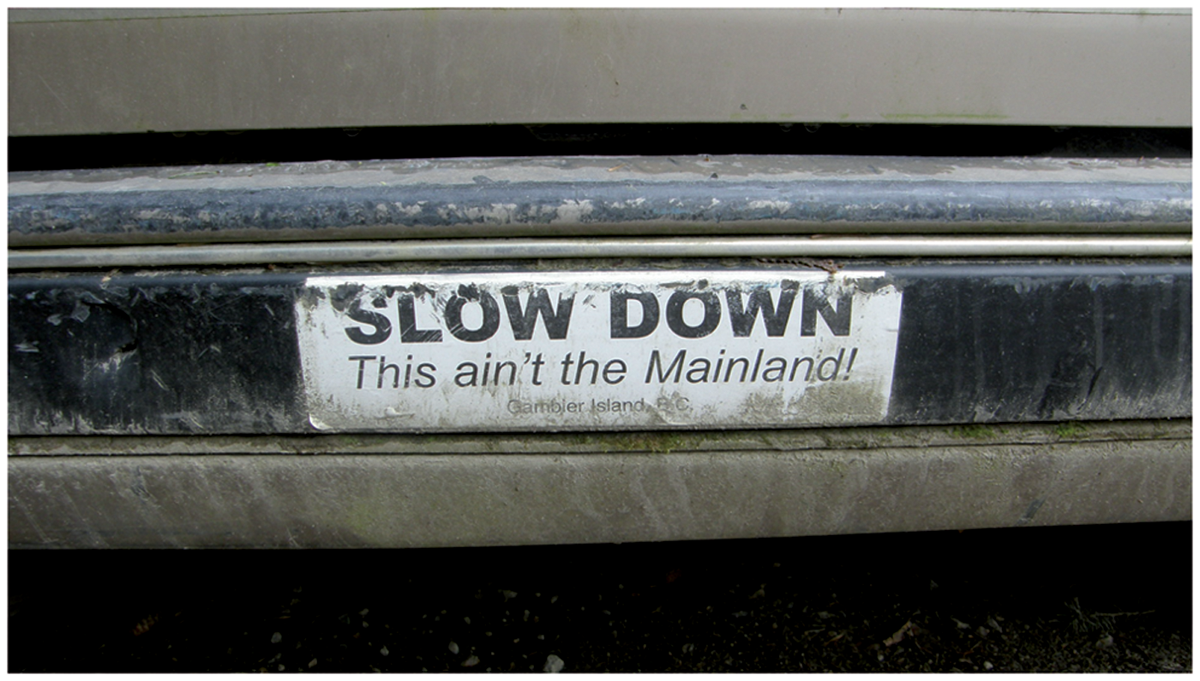
Because slowness is autotelic and relational, its choice and cultivation can be interpreted as a form of rejection and resistance – however putative – of the ‘relentless spread of speed in modern life’ (Parkins, 2004: 365). Tuning into the slowness of ferry mobilities and the slower place temporalities of ferry-dependent communities is thus somewhat of a ‘virtue’, much like rail travel is in some instances practiced as a ‘contemplative, quiet alternative to the hectic bustling of air travelling and the frustration of driving’ (Eriksen, 2001: 54), and much like living in communities subscribing to the Cittàslow movement is seen as a way of cultivating the pleasures of relaxation, restoration, and reflection afforded by time attentiveness (Parkins, 2004; Pink, 2007, 2008). Slowness is thus a project, a performative and ideological maneuver focused on constructing antagonists (i.e. places governed by the logic of speed) and taking distance from them. Places like Vancouver, London, Calgary, and Toronto – where so many of the region’s residents migrate from – become escape points as well as villainous reference points: distant relational counterparts to measure place temporality against, through both practices and representations (see e.g. Figure 2). Ferry-dependent communities, and the smaller ones in particular, thus become characterized by constant, conscious attempts to create alternative sensorial and institutional regimes that work as critiques of urbanism, globalization, and cosmopolitanism. Places like shops, roads, trails, post offices, ferry boats, ferry terminals, and cafés on small islands and coastal villages become points of intersection where slow-moving dwellers and their paths intersect constituting oppositional ‘geographies of commonality and continuity within which social activities are co-ordinated and synchronized’ and through which ‘collective choreographies of congregation, interaction, rest and relaxation produc[e] rhythms through which time and space are stitched together’ (Edensor, 2006: 537).
The BC Ferries network. (Reproduced with permission. All rights reserved.). A popular bumper sticker found throughout the BC coast.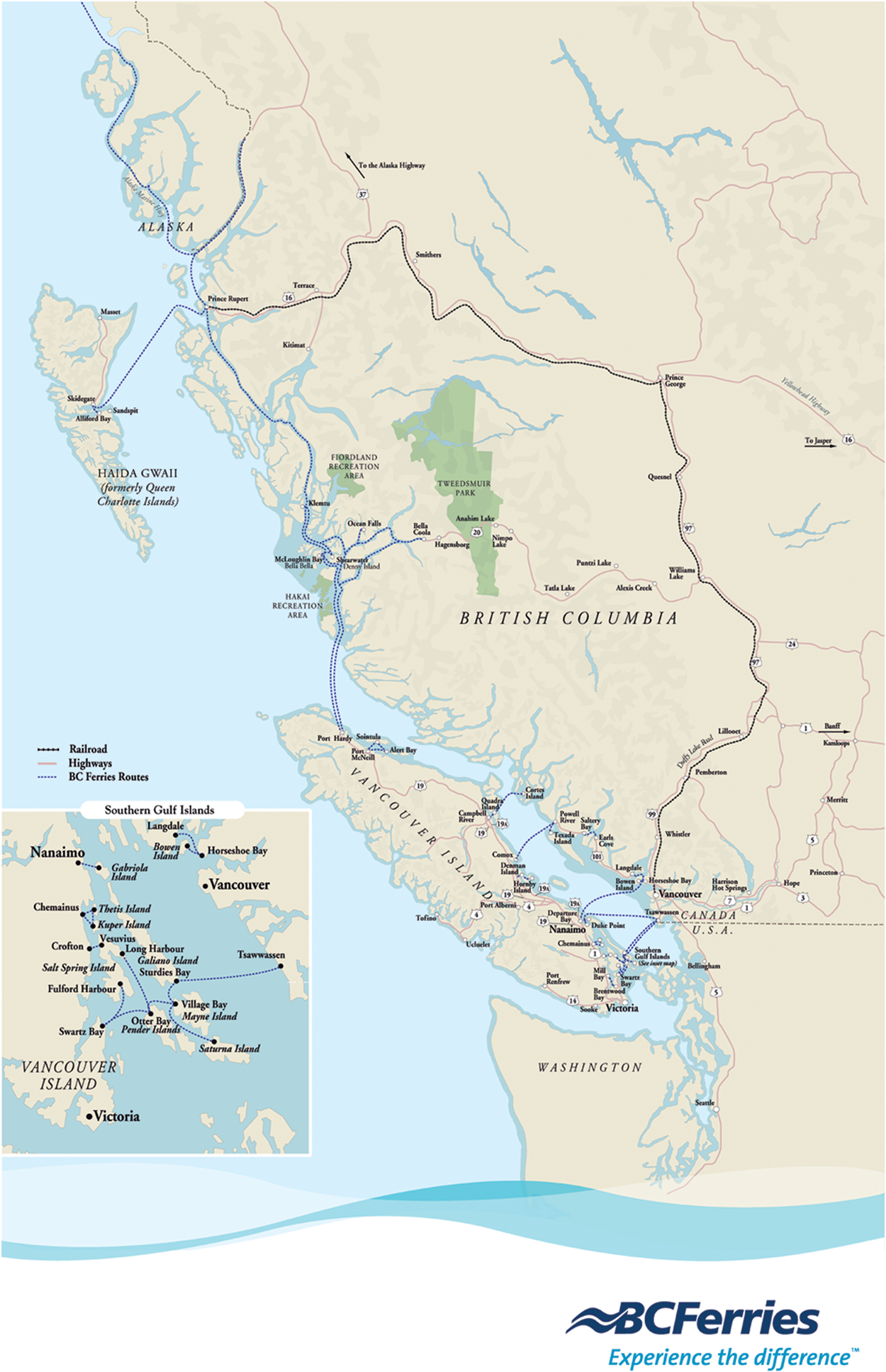
Rhythm
Rhythms intersect and often collide. No rhythm is a finite entity, but rather an intersection of open events, some of which are regular and even repetitive in nature, and others which are unique and irregular. Any ferry timetable is a palimpsest of such intersecting rhythms and pathways, and consulting it is like peeking into a mesmerizing kaleidoscope of mobile lifestyles crossing into one another. Pick a place, an hour, a day, and scratch the surface. Here is a broad random collection. 7:55 am, Friday, June 18, 2010: The Quadra Queen II leaves Sointula for the first sailing of the morning: too late for many Malcolm islanders to keep a regular working hours job on Vancouver Island, where fewer and fewer good paying jobs are available as the fishing industry continues to spiral downwards. Any night: Powell River residents go to sleep wondering why their beloved Queen of Burnaby is spending the night far from home, docked on Vancouver Island instead of where she belongs. ‘Even though we live on the mainland and they leave on an island’, Ernie from Powell River complains, ‘we are the true island, and we are in need of keeping our ferry birthed here at night!’ 6 pm, Monday through Thursday: Hornby Island sees the last ferry of the night depart. ‘We fought hard to have it this way’, says Nena, ‘it’s night time, and people on the island need to be at home to enjoy family, peace, and tranquility. We can’t be a true island with people coming and going all the time, all night long.’ Saturday night, 10:45 pm, Powell River: even though the movie isn’t over yet, an entire row of Texada Islanders (where there is no movie theatre) gets up to leave. This is the second time this month that the main feature either lasted too long or started too late for Texadans to finish watching it and still catch the 11:00 pm sailing back home, the last of the night. 10:45, any day of the week but Saturday: I fall asleep to the Queen of Alberni’s horn, departing from Duke Point. Our ferry, Gabriola Island’s own Quinsam always departs quietly in order not to wake us up. If only the Vancouver Island–mainland ferries were just as polite I might fall asleep 15 minutes earlier every night. Twenty minutes after the beginning of the school day, on a windy day: the principal of the West Vancouver high school attended by Bowen Island kids notifies everyone through the public announcement system that it’s rough weather out there and the Queen of Capilano is late. The math exam in Mrs Warren’s class is postponed due to weather. Thirty minutes before arrival time of the M/V Kuper on Thetis Island, May 6, 2008: Jeanine calls her friend Teresa to let her know that she is, ‘surprise surprise!’ coming over to visit her. Teresa calls her neighbor to get a copy of Thetis Island’s famous ‘Oh-my-God-they’re-on-the-ferry pie’ quick recipe. Time to go catch the Cumberland? ‘People here on Pender refer to times of the day and their travel plans by referring to the name of the boat that’s coming or going’, says Margaret, ‘it took me a year after I moved here to figure what the hell people were talking about and what time it was.’ ‘And you actually’, she adds with a smile, ‘you’d better wrap up the interview if you want to make the Mayne Queen.’ DC Day, different times of the day, different days of the week, on different islands (but only on some): Dangerous Cargo day, a day when certain sailings are reserved for vehicles carrying hazardous material. ‘If you’re bored and have nothing better to do go down to Quathiaski Cove 20 minutes before a DC sailing and watch the drama unfold. There are always at least a couple of tourists or even locals who either forget or don’t know. I’ve seen grown men in tears. And I’ve seen smart men who just have to catch that sailing scour the island in search of hay to load their trucks with, in order to qualify as dangerous cargo.’ Summer time: the Horseshoe Bay–Langdale ferry timetable switches to the summer schedule to accommodate the heavier tourist flow to the Sunshine Coast. ‘How would you feel’, asks Moe angrily, ‘if after building your entire daily routine and your work around the ferry schedule, all of a sudden they would change around everything by 20 minutes?’ Fortunately some day cares change their hours with the ferry schedule. Thirty minutes before sailing time: the time when worried tourists hurriedly ask for their bill at Horseshoe Bay’s pubs and restaurants. Twenty minutes before sailing time: the time when worried Vancouver Islanders hurriedly ask for their bill at Horseshoe Bay’s pubs and restaurants. Ten minutes before sailing time: the time when worried Bowen Islanders hurriedly ask for their bill at Horseshoe Bay’s pubs and restaurants. Sailing time: the time when Horseshoe Bay’s pubs and restaurants staff go on a smoke break. Thursdays right before a long weekend, Gulf Islands: hum … make that Fridays … I mean … Thursdays that feel like a Friday …: ‘have you ever seen that Seinfeld episode where George and Newman talk about how different days of the week feel? Well, some Thursdays here are defined as a Friday. How would you feel if you couldn’t figure that out by reading the schedule and missed an international flight as a result?’ – confides Anne, from Galiano Island. Odd days, as in ‘strange’ days: Texada Sandcastle Competition day, All Native Basketball Tournament day, big Alert Bay Potlatches, Christmas Carol Ferry sailings day – days when the ferry schedule changes for the day or part of the day just to accommodate extra traffic. Uneven days, as in ‘unfair’ days’: Saturna Island Lamb Barbeque day, unusually heavy island wedding day, Quadra Island baseball beer league tournament day, Sointula Artopia day – when the schedule doesn’t change to accommodate extra traffic, driving everyone nuts.
So, can you help wondering what will be happening as you read this? Will it be a special day for anyone, anywhere? Will it be the day that graduating high school kids from Texada Island give up their commute, commemorating it by writing ‘no more ferries’ on the school yearbook? Will it be Ryan’s long awaited rite of passage – the day he gets to dive off the upper deck of the Queen of Capilano like his brother did a few years ago? Will it be Milly’s equally long awaited rite of passage – the day she gets to catch the ferry from Powell River to Comox all alone to go visit her teenage cousin there? Will you read this at the very moment Gerry, Tina, and Bill head out from Ocean Falls on the Nimpkish just to go to Shearwater’s pub for a few hours? Or will it be the moment they get back off the Nimpkish, hungover and queasy, wondering why once again they decided to spend almost a day on the ferry just to go to a pub for a few hours? Or will it be the night that a pregnant mother has to wake the ferry captain and crew in the middle of a freezing night to ask them to turn the ferry’s engine on and drive it as fast as an ambulance? Or will it be the day that your kids are taking you out to town for an early Father’s Day dinner, and thus the time for you to stop working early – like me right now – in order to go and catch the ferry to town?
Ferry schedules punctuate the hourly, daily, weekly, monthly, seasonal, and yearly rhythms of life on BC’s islands and coastal communities. Nothing in these places is unaffected by their coming and going. Off-island employment is only available if ferry schedules permit early enough departures and regular late afternoon returns every workday. Seniors synchronize their supermarket trips to town with the discounted fare calendar. Families with schoolchildren move off-island when they feel that their teenagers are no longer able to handle the commute. Car traffic – in communities where otherwise there is hardly any – peaks and dies as the ferry unloads and loads. Seasons change as the ferry schedule changes. Rites of passage are marked by and through the ferries. These are just some of the myriad ways in which ferries play the role of synchronizing islanders in time, and of de-synchronizing them from the rhythms of their antagonized urban counterparts.
Humans are ‘rhythm-makers as much as place-makers’ (Mels, 2004: 3), and so are ferries. Ferries and their schedules make places through a combination of institutionally inscribed and locally organized rhythms (timetables are set from the BC Ferries Corporation in negotiation with local advisory committees). The negotiation of these rhythms intersects with the natural alternation of diurnal, weekly, and seasonal rhythms, inevitably clashing and/or harmonizing with different people’s habits, routines, and rituals – producing degrees of regularity in places’ way of life. Ferries enact rhythmic consistency according to the hourly/daily/weekly timing of departures and arrivals, the length of journeys, and the clustering or separation of service which set apart some highly connected from some highly disconnected places. Their predictable rhythms order local experiences, practices, and representations of place temporality, while they dis-order local sense in time in relation to what they view as the undifferentiated ‘mainland’. ‘We are in our own little world’, explains one informant, ‘and it all begins with the ferries. In cities everyone comes and goes from/to a million different places all the time. Here we can all go to only one place, and only five times a day.’
‘Everywhere where there is interaction between a place, a time, and an expenditure of energy, there is rhythm’, famously wrote Lefebvre (2004: 15). Ferry departures and arrivals embody that interaction, configuring local constellations of mobility as synchronized ensembles of overlapping rhythms. Indeed if ‘places are symphonies of events’ (Wunderlich, 2009: 54) ferries are the conductors. Similar to other media they shape local temporalities, producing repetitive experiences, embedding their schedules in the life course of individuals and in the histories of communities. Through this embedding individual routines become synchronized and people get ‘in time’ with one another, becoming emplaced with common material, social, and sensory contexts (Pink, 2007). Thus, ferries’ rhythms offer the ‘consistency’ (Edensor, 2009b: 3) of the experience of being ‘in-time’ by imposing ‘structuredness and orderliness’ (2009b: 7). And yet ferries merely foreground individual ways of life; they do not determine them. The rhythms of a daily commuter are different from those of a consultant or an artist who only leaves their place once a week to meet clients. Ferry rhythms channel livelihoods, they do not blend them together, as ‘various (and uneven) networks of time stretching in different and divergent directions across an uneven social field’ (May and Thrift, 2001: 4) always exist.
Rhythms are smooth, but also disjointed (Edensor and Holloway, 2008). As Lefebvre (2004: 6) correctly notes ‘there is no rhythm without repetition in time and space, without reprises, without returns, in short without measure’, however, ‘there is no identical repetition indefinitely … there is always something new and unforeseen that introduces itself into the repetitive’. Islands and coastal communities see their rhythms disrupted by weather, mechanical failures, special events, small incidents, and schedule changes that wreak havoc with their spatial mobilities across the water, evidence of how spatio-temporal mobility is inevitably ‘an emergent performance, an ordering precariously achieved and open to becoming, replete with potentialities and differentiation’ (Edensor and Holloway, 2008: 499). Thus ferry schedules are the most influential performers of polyrhythmic attunement, but also the key protagonists behind instances of ‘arrhythmia’ (Lefebvre, 2004).
For example at writing time our regular ferry boat, the M/V Quinsam, is experiencing mechanical problems which cause her to slow down her passage across the water by five minutes. This means that with the passing of the hours she falls behind schedule in progressively greater degrees. To avoid this problem it was decided that we would change the daily schedule by creating departures and arrivals earlier in the morning and later at night. This has effectively changed not only some people’s routines, but also the island’s sense of connectedness with the rest of the world. It is now suddenly possible, for example, to better connect with the ferries to the mainland or to stay out ‘in town’ longer at night before the last homebound ferry departs. The island is a little less ‘out of time’ than it was before, and while not everyone likes the new place temporality this goes to show how changing rhythms afford variable regularity to places, and how rhythms are dynamic (Crang, 2001; Edensor, 2009a) and kept by emergent technologies and embodied/emplaced users which maintain and adapt their mobilities in conjunctions with the affordances of their changing skills and styles, and variable means and conditions of movement (Spinney, 2006).
Different islands and coastal communities have their different rhythms. How often ferries depart, and at what times they do, deeply shape these differential rhythms. In Klemtu, for example, the ferry arrives only once a week, and as we will see later, that day – a Sunday – becomes a special day. On Mayne Island – which sits right in the midst of heavily trafficked Active Pass – the hourly sound of ferry horns is regularly embedded into the soundscape of the place, indeed so embedded that local musicians write songs featuring sudden random trombone blasts into their arrangements to reproduce a sense of place temporality. In Powell River the ferry leaves from downtown, right under everyone’s eyes. When the weather is poor and the ferry is unable to leave port people are not heard engaging in mundane conversations that begin with expressions like ‘terrible weather, isn’t it?’, but instead with expressions like ‘do you think the ferry is going to leave today?’ Being ‘in time’ means synchronizing quotidian activities, both with other types of activities and with other people. The events of ferry departures and arrivals build up this shared arrangement, this way of knowing the world and moving in it and alongside it (see Ingold, 2000). The events associated with ferries coming and going – in all their different rhythmic features – thus produce differentially embodied, embedded, and site-specific place temporalities ‘and these repetitive encounters with familiar features are apt to consolidate a sense of spatial belonging’ (Binnie et al., 2007: 167) that differs from ferry-dependent place to ferry-dependent place, but that differs even more from ferry-dependent place to non-ferry-dependent place.
Whilst being ‘in time’ brings a sense of harmony to islanders and coasters and being ‘out of time’ brings to them a feeling a distinction from the rhythms of the city and the mainland, their unique place temporalities bring more than pleasant and functional ‘eurhythmia’ (Lefebvre, 2004: 67). Being ‘out of time’ from what they perceive to be the uniform and hegemonic beats of the city and the temporal regimes of the mainland and the rest of the world cause great affective shocks to islanders and coasters every time they need to be in the city. ‘Catching the ferry to go to Vancouver even just for the day is too much, I can’t handle it’, explains Sarah, the chaos, the noise, the fumes, the constant frenetic pace of the city scares me, I am frozen with fear, with paranoia, with disgust. And that’s not good. I should have sympathy for fellow human beings, not prejudice for their ways of life. I should be adaptable, not feel helpless in the city. Being on a small island does this to you.
And if being ‘out of time’ has its dangers, so does being ‘in time,’ as the unique rhythms of the ferries can become overpowering. It is easy to obsess over the ferry schedule, allowing it to take control of the day, making one feel like a hostage. In a place marked by a slow pace, regular rhythms, and high degrees of individual temporal freedom from the constraints of the rest of the world it is almost impossible not to fall victim to the rigidity of schedules. ‘Some of us are so deeply intolerant of the imposition of a ferry schedule in our life’, an informant once told me, ‘because we are so spoiled with so much freedom in setting our own agenda in life’. The more ‘in time’ you are, the harder it is to get out.
Duration
Ferry travel is a routine, a habit, and a ritual with distinct duration patterns. Every individual has their own duration patterns. Sheila has been commuting to Victoria from Pender Island for 23 years, and holding strong. Guy quit the daily commute to North Vancouver from Gibsons after two years and three months, ‘worn out and forced to choose between work and life’. Charlene and Bob’s morning drive to the ferry terminal used to last 24 minutes; way too much for them. So they sold their house after one year and seven months of living there and bought one closer to the Quadra Island ferry terminal, and thus to Campbell River. Kendra and Marianne’s home at Mitchell Bay – also 24 minutes away, from the Malcolm Island ferry terminal – requires a trip of the same duration. But they can last weeks without needing to catch the ferry to Port McNeill. So they’ve lasted so far 13 years in their home. And me, well, I could last years without going to the mainland. But there aren’t many academic conferences on my little island, and I need to travel far to attend them. Some people, like me, can last only a little while without being mobile – because of work, health, shopping, or family. Others, like Rolph, can maroon themselves on a small island for two or three decades. ‘I can’t get my husband off this damn rock’, Rolph’s wife tells me with a grin, ‘he’s got his tools, he’s got his buddies, and he’s got his projects; this is his big sandbox and he’ll get buried too in here, I’m sure’.
Every place has its own duration patterns. Salt Spring’s, Thetis’s, Kuper’s, Denman’s, Pender’s, Quadra’s, Bowen’s, Gibsons’s, and Gabriola’s about half-an-hour-long ferry run means many residents can commute daily to work in bigger places. Vancouver Island’s 90–95- and 120-minute-long ferry trips to the mainland mean that some, few, commuters need to leave on Monday morning and only come home on Friday afternoon. Hornby Island’s two ferry hops (via Denman Island) aren’t too long for school kids to commute daily to Vancouver Island’s schools. Cortes’s Island two ferry hops (via Quadra Island) require journeys twice as long as Hornby’s and school kids need to find boarding homes on Vancouver Island. Haida Gwaii’s trip to Prince Rupert is just too damn long and treacherous for anyone to take nonchalantly, and local islanders for the most part just do without depending too much on the ferry. ‘Most of us have moved here because it takes a long time to reach this place’, tells me Lori with a sense of pride, ‘and that means that we can try and live life on our own terms. You don’t see big stores here. And that’s not because we go shopping on the mainland; you don’t see them because we don’t like to shop at all.’ ‘How long can you last without going to the mall?’ she says, ‘if your answer is one day then you belong on southern Vancouver Island. If it’s a week then you belong on Bowen or Salt Spring Island, maybe. If it’s a month or a year you’ll be ok on the other islands. If it’s a lifetime, grab some driftwood and build yourself a house in Masset’s North Beach, that’s where you belong.’
Duration generates unique place-defining rituals too. For years, on every Labor Day night, Hornby Islanders have organized an improvised festival called ‘wave off’. They gather by the pub adjacent the ferry terminal, drink beer, and set off fireworks as the last ferry of the evening carries away the last tourists of the season. Some revelers even streak on their boats, and the ferry captain sometimes even celebrates by ‘doing a donut’ in the water with the boat. Young men dressed in drag moon the Queen of Capilano as she sails away from Bowen Island on Labor Day. Summer crowds last three months, and islanders can’t last one day longer with them around the roads.
Some rituals have limited duration for unfortunate reasons, but they last long in old-timers’ memories. Jocey, who used to greet the ferry arriving in Bella Bella by yodeling festively, had to stop singing once the ferry moved to McLoughlin Bay, away from the village center, too long of a walk for her. Sointulan kids were asked to stop egging the ferry on Halloween night, and ferry crew were asked to stop hosing them down with water, once the merry-making started getting out of hand.
Duration has its interruptions, its nemeses. Weather is the ferries’ public enemy number one. Windstorms can last days in the Queen Charlotte Islands archipelago battering Hecate Strait so hard that it can take up to three days for a ferry to complete a sailing. Delays’ durations tell a lot about different places’ sense of resilience too. Most Vancouver Islanders and Lower Sunshine Coasters tend to complain when a ferry is delayed 15 minutes or more. Central Coasters are more patient: their ferries can be as late as three days. They do complain, however, when because of weather they get dropped off on the wrong island. Denny Islanders, for example, are occasionally disembarked on Campbell Island and have to either wait for the next ferry – which arrives one week later – or find a barge to hire for the short trip across the water. Unfortunately the meat and other perishable goods they have in their coolers do not last as long as their patience.
On the other hand, one of the weekly highlights of life in Klemtu lasts about three hours. Klemtu is far, far from everything and everyone else. When the ferry arrives there on Sunday afternoon it docks for up to four hours to allow for loading and unloading of freight and a very few passengers. Three hours is long enough for a few tourists to take a walk about the village, and for a handful of local Swindle Islanders take advantage of that peregrination for a few makeshift guided tours rewarded with small tips. But three hours is also long enough for the ferry to perform the role of a key attraction. As the ferry docks, half of the 300 islanders wait to greet it. As the doors open Klemtuvians enjoy all the ferry has to offer: its small video game arcade, small gift shop, and small cafeteria are the only shops in town. Boys and girls chase each other on the sun deck in between video games while their older siblings browse the weekly magazines available on the gift shop shelves. Grownups enjoy cafeteria-style meals, feasting on the Queen of Chilliwack’s famous crispy fried chicken recipe. As the meal hours wind down a guest pass number is drawn, and the lottery winner takes home a prize from the gift shop. Everyone else takes home goodies from the cafeteria: from dessert to fresh milk and fruits and vegetables. As the ‘chicken boat’ – as it’s affectionately called by the locals – pulls out, Swindle Islanders need to last another week without her company.
Duration has to do with ‘how long’ something or someone lasts. Drawing from Ingold (2000: 345) we can understand duration as a ‘crystallization of activity within a relational field’ constituted by ‘the regularities of form embodying the regularities of movement that gave rise to it’. Such crystallization lies at the core of place temporality (Wunderlich, 2009) and mobility constellations. Activities and movements are ‘events’, in Casey’s (2001) words, and places are constellations of events. ‘Far from being static sites [places], are continually changing in accordance with their own proper dynamism’, writes Casey (1996: 44). Journeys and their duration patterns can be thought of as some of the dynamic events capable of transforming place. Understood this way ferry journeys are thus part and parcel of the spatial dynamism of island and coastal villages. The duration patterns of ferries’ movements deeply shape the way local dwellers engage with the temporalities of their places and the rest of the world, affecting their perceptions of timespace. As journeys unfold islanders and coasters ‘gather’ (Ingold, 2000; also see Pink, 2007) the materialities of the places within which they dwell, absorbing and animating the multiple features which make up place temporality. Journeys-as-events are thus protracted experiences and practices through which places are dwelled within and moved alongside with (Ingold, 2000, 2007). Let us take into account the crystallization of processes such as journey duration, ritual duration, and islanders’ and coasters’ years of residence in their communities.
First is journey duration. The community of Klemtu, on Swindle Island, is one of the farthest to reach on the BC Ferries network. There is only one weekly departure to Klemtu from the small town of Port Hardy on the north-easternmost tip of Vancouver Island. To get to Port Hardy from Vancouver one would need to sail on the 95 minute-long ferry to Departure Bay (Nanaimo) and then drive four hours to Port Hardy. The Queen of Chilliwack departs Port Hardy for Klemtu on Saturdays at 9:30pm. She arrives at 3:00pm on Sunday. She stops three hours and then leaves – the only weekly departure from Klemtu – for Bella Coola. She arrives in Bella Coola at 6:30am on a Monday. She rests in dock till 8:00am the following day, when she departs again for Port Hardy, arriving at 9:00pm the same day. ‘No matter which direction you’re headed’, a local tells me, ‘either Port Hardy [pop. ca. 4000] or Bella Coola [pop. ca. 600], your round trip out of Klemtu to get to the supermarket, or the hardware store, or the medical specialist, or whatever, will last six days and 21 hours.’
As a result of the duration of their journeys life in Klemtu feels sharply ‘out of time’ even in comparison to the rest of the coast. But while the slow rhythms of Swindle Island are undoubtedly pleasant – at least some degree – to those who live there, Klemtu’s dramatic ‘out of time’ status comes with notable problems. The way the ferry is treated as a grocery store is a testament to those difficulties. Because fresh food takes so long to reach Klemtu by ferry, fruits and vegetables often arrive in poor conditions or last for a short time on the small band store’s shelves. The same goes for milk, which goes for up to $13 for a gallon – when a gallon jug can be found at all. Moving ‘out of time’ from the rest of the world always carries the danger of marginalization and the perils of seclusion. Embodied evidence of Klemtu’s marginalization is found in diabetes and in many other chronic diseases, which affect over a third of the locals. 3
Secondly, duration patterns crystallize subjectivities. On small islands and remote coastal towns a key claim to one’s membership into the community is how long one has lasted there. As opposed to Atlantic Canada’s islands and coastal towns, much of the west coast of Canada – and in particular the smaller islands – is populated by a majority of people who were not born and raised there. Being from ‘away’, therefore, does not carry stigma. But at the same time, in places where weekenders, seasonal residents, snowbirds, and people who fall in love with the romantic ideal of island life – only to realize they are not cut out for it shortly after buying a home – are legion, having been a community member for some time lends definite social status amongst the locals. Indeed, a common feature of interaction in these communities, especially amongst newly made acquaintances, is asking ‘how long have you lived here?’ and ascertaining whether someone lives there full-time or part-time. Duration of residence is proof that someone has adjusted to, and mastered, the unique place temporality of a community.
Through protracted interaction places are made and re-made, and also incorporated into emplaced selfhood (Casey, 2001). This is the third sense in which duration matters: like place, time is made and incorporated into place and into subjectivity (Ingold, 2000). Through duration time is ritualized. By cultivating duration – that is, by doing things over and over – people create significant habits and rituals. Rituals are long-lasting ways through which locals time the regular alternation of the seasons and the passing of the years. The duration of these rituals marks the historical character of a community, giving locals memories to share and giving their places a sense of social continuity. Ferries become key players in the performance of these rituals because their regular presence gives obduracy to relations amongst people and between people and their places. Ferries’ journeys in and out of places indeed become ‘routinized sequences of human acts’ (Schwanen, 2007: 12). And the longer the machine and its user develop together, ‘the more pronounced and intimate becomes the symbiosis’ between them (Spinney, 2006: 721).
The duration of these events – that is, the crystallization of activities and movements – over time builds and reinforces places’ unique temporal character. As unique timespaces settle on the regularity of distinct habits and rituals a deeper awareness of local time ensues, ensuring the localization of temporality and the transformation of locality (May and Thrift, 2001; Thrift, 1996). This is how moving ‘out of time’ unfolds: through such practices, experiences, and representations of place temporality local dwellers chip away at the perceived dominance of the world-wide temporal grid, pulling their communities ‘out of time’ and synchronizing them to shared, idiosyncratic durations of activities and movements.
But once again ‘being in time’ does not come easy or without costs. As tourists leave our idyllic islands at the end of the summer season and we rejoice in being able to reclaim our places – marking the importance of being ‘in time’ by sending off the last ferry with festive rituals – clear realizations of our interdependency unfold. Being ‘in time’, once again, feels like an illusion because it is precisely the unique place temporality of these islands and coastal towns which attract outsiders in search of a respite from the hectic pace of their cities. These are the very outsiders and mobilities from whose temporal patterns we move away, and yet the very outsiders we desperately need for our economic survival. As the last ferry departs on Labor Day we clearly realize the irony: we and our communities can only last here as long we allow the rest of the world to freely move in and out, thanks to the very ferries we have used to make ourselves less accessible.
Moreover, while journeys’ long duration can create problems so can journeys’ short durations. In other words, if being too much ‘out of time’ is possibly a problem, so is being too little out of it. Will, a Salt Spring Islander, captures this idea perfectly: ‘people move to an island to get away from the rat race, but sometimes that means they corner themselves, they get backed up against a wall with no way to escape except for the very path they came from’. From Salt Spring Island journeys to Vancouver Island are short and frequent, ‘so, even though you come here to step away you risk putting yourself in a position where you have basically just made your commute longer and worse’. There are no obvious ideals when it comes to moving ‘in time’ or ‘out of time’. While our place temporalities are ‘better’ – for our personal preferences – than those of what we chastise as the undifferentiated mainland, they are far from perfect. Ferries, in a way, are both causes and effects, subjects and objects, creators and products, as well as the material devices and cultural symbols through which all these uninterrupted and uninterruptable schizoid ‘place ballets’ (Seamon, 1980) of movement, rest, encounter, and rupture unfold and entangle.
Departing thoughts
Throughout this paper I have argued that islanders and coasters of BC’s ferry-dependent communities constantly struggle to separate themselves from the place temporalities (Wunderlich, 2009) which they find to be typical of urban life, and to tune into the preferred place temporalities of their slower communities. I have described their attempts to remove themselves from ‘the mainland’ as a movement ‘out of time’, and their attempts to synchronize themselves with the pace of life of their places as moving ‘in time’. The deeply overlapping, intersecting, contradicting, and conflicting experiences, practices, and representations of ‘island time’ – the region’s unique temporal ‘mobility constellation’ (Cresswell, 2010) – greatly explain why BC’s islanders and coasters say they have a ‘love/hate relationship with the ferries’. Mobilities beget interdependence, and technologies of mobility like ferries cannot but simultaneously disconnect and connect, insulate and isolate.
There is a key narrative and performative dimension to the dynamics of moving in and out of time. The stories that islanders tell one another about island time and mainland time are, to a great extent, but dramatizations of social conditions whose complexity inevitably escapes mundane storytelling. Indeed in everyday interactions amongst islanders urban temporalities are simplified to the point of caricature, often stereotyped, and reduced to mere binary oppositions that pit ‘us’ versus ‘them’ in order to exalt the local and condemn the urban outsider. These discursive representations antagonize ‘the city’ by ignoring diverse urban conditions from one city to another and different urban practices and experiences within a particular city. The urban and the global order of time thus become mere antagonists of the local/insular. Mainland temporalities act like villains whose narrative role easily becomes that of a uniform and unsustainable order to resist and take departure from. Of course these representations are – from a realist perspective – facile at best and erroneous at worst, and yet they are putatively real in deeply consequential ways. It matters little to islanders whether their representations of urban temporalities are ‘real’ or excessively simplified. What truly matters is that the dramatic play yields impressions and illusions with obvious transformative power.
As a form of slow living, island time is an explicit choice of place temporality, but as opposed to slow-living movements like Cittàslow (Parkins, 2004; Pink, 2007, 2008) – which are so dependent on walking and slow physical movement – island time hinges deeply on the temporalities afforded by modes and styles of mechanized mobilities. At first sight this might seem like a contradiction, or maybe even hypocrisy because to truly combat speed it would seem that one would have to seek stillness and reject all forms of spatial mobility, especially mechanized ones. Yet, sedentary lifestyles are illusory (Cresswell, 2006): mobilities permeate life everywhere, at all times, and stillness is utopian. Slowing down, as opposed to annihilating speed, is thus the only feasible compromise as one is never truly out of the dominant temporal regimes of the world. Alternative practices of spatial mobilities and relative immobilities in other words, rather than immobility and autonomy, are the ways in which locals perform unique senses of place and time.
To suggest that ferries allow for these alternative performances is not a way of re-introducing old technological determinist arguments. Ferry boats’ slower speeds (slower than cars, for instance) do not ‘determine’ or ‘cause’ the slower place temporalities of the region’s communities. Rather, and more subtly, ferries are actors in a complex performative ecology. Places, like all ecologies, are ‘ceaselessly (re)constituted by flows’ (Edensor, 2009b: 5) that course through them, and their speeds, rhythms, and duration patterns play an important role in performing a sense of place and time that is as unique as the flows themselves (Edensor, 2009b). Ferries do not have a determining power within these ecologies because their modes of use are extremely diverse, from individual to individual, from place to place, and from boat to boat. There are daily commuters and weekend travelers, there are communities served 15 times and communities served once a week, there are faster boats that resemble floating shopping malls and slower, sputtering dinghies covered in rust – hence the region as a whole and each of the places within it are inevitably ‘sites where multiple temporalities collide’ (Crang, 2001: 198) and not uni-dimensional spaces affected by uni-dimensional causes. Indeed, rather than ‘island time’ one should more properly speak of ‘island times’, and of course more in general of people, places, mobilities, technologies, and the performance of their distinct temporalities.
Footnotes
Acknowledgements
This research was made possible through a Social Sciences and Humanities Research Council of Canada Standard Grant. I also wish to thank April Vannini for her research assistance.