



Abstract
While understanding values of bureaucratic work has been a fundamental concern of organizational sociology, research has remained divided over the nature of the values that underpin it. Examining the more generalized sociological insights on the values of bureaucratic work using a rigorous approach to value measurement, this study contributes to the reconciliation of the divergent conceptual insights on these values. Using the European Social Survey data of highly rationalized societies, this study finds employed senior managers to place systematically higher value on self-enhancement and openness to change and lower value on self-transcendence and conservation than their self-employed, entrepreneurial counterparts. The study also contributes to the understanding of the values of bureaucratic work, by examining the value implications of the duration of the employment of senior managers in bureaucratic organizations, and the organizational and the managerial bureaucratization of their work.
Keywords
Introduction
Bureaucratization has been widely observed both in private and public sectors (Adler, 2012; Du Gay, 2005). Despite the reoccurring predictions of the demise of bureaucratic work (Giddens, 1998; Heckscher and Donnellon, 1994), bureaucratization has been manifested in intensification of managerial control (Thompson and Broek, 2010), increased reliance on performance management (Ritzer, 2011; Townley et al., 2003), managerialization of professional work (Leicht et al., 2009), and increase in the proportion of managers in national workforces (Fernández-Macías, 2012). Bureaucratic organizations increasingly maximize their efficiency by supplementing the centralized control of administrative hierarchy with the interpersonal control of co-workers in the functionally adaptable forms of interdependent work (e.g. self-managing teams and intra-organizational networks) (Barker, 1993; Hodgson and Briand, 2013; Thompson and Alvesson, 2005).
Recognizing the significance of bureaucratization, research in organizational sociology has been concerned with understanding values that underpin bureaucratic work. For Weber (1964) bureaucratic work was irreducible to formal means–ends calculation independent of values. Instead, it was underpinned by the normative concern with both routinized control and impersonal universalism. Inspired by Weber’s insights, research on the values of bureaucratic work has been divided among those who emphasize its preoccupation with power and control (e.g. Merton, 1952; Ritzer, 2011; Thompson and Broek, 2010) and those who highlight its individualizing and pro-social implications (e.g. Du Gay, 2005; Gittell and Douglas, 2012; Kohn, 1971). Recently, there has been an increased concern with the reconciliation of these perspectives (Adler, 2012; Kallinikos, 2011).
While sociological conceptualizations of bureaucratic work have provided a more generalized understanding of its values, they have been little concerned with the empirical validation of theoretical insights. Empirical research on bureaucratic work has typically derived its values from the study of bureaucratic organizations or workers without directly measuring their values. Kohn (1971) measured value differences among workers employed in bureaucratic and non-bureaucratic organizations. However, he focused only on the openness to change values, without assessing the self-enhancement values that have been widely linked with bureaucratic work. Assessment of the values of the bureaucratically rational as opposed to the non-rational forms of action has been a key concern of the socio-psychological research on value measurement (Braithwaite and Scott, 1991). However, methodological advances of this research have been largely ignored in the sociological research of values (Hitlin and Piliavin, 2004).
In this study, I examine the more generalized sociological insights on the values of bureaucratic work among the representatives of bureaucracy using a rigorous approach to value measurement (Schwartz, 1992). To assess the values of bureaucratic workers, I compare the values of employed senior managers with a comparison group of their self-employed, entrepreneurial counterparts, whose values are conventionally conceived to be most distinct from the values of bureaucratic work (Kohn, 1971; Sorensen, 2007; Weber, 1952). I assess the values of bureaucratic workers positioned at the top of the administrative hierarchy, because they are endowed with superior authority to exercise managerial control over planning and coordinating of work (Blau and Schoenherr, 1971; Walton, 2005). I also assess the value implications of the duration of the employment of bureaucratic workers, and the organizational and the managerial bureaucratization of their work.
Values of Bureaucratic Work
Values are enduring normative beliefs that have properties of “oughtness” and that guide human action and interaction (Kluckhohn, 1951; Rokeach, 1973; Schwartz, 1992). Values are irreconcilable and arranged in the hierarchy of importance. As irreconcilable normative beliefs having the properties of “oughtness”, values are irreducible to the properties of objects, such as price or statistical estimate, or to a particular mode of action, such as utility calculation in economic “valuation studies” (e.g. Mitchell and Carson, 2005). Values are socialized during human involvement in social and vocational experiences (Hitlin and Piliavin, 2004; Spates, 1983). Once socialized, values remain relatively stable and guide replication of the adopted patterns of action. In organizations values guide administration of work (Bourne and Jenkins, 2013; Weber, 1964), integration of human activities around shared goals (Parsons, 1956), justification of the legitimate modes of action (Boltanski and Thévenot, 2006; Thornton et al., 2012) and specification of work rules (Du Gay, 2005).
Following Max Weber (1952) I define bureaucratic work as a form of work that is structured by the values of calculative rationality. For Weber (1952: 24) bureaucratic work “is superior to any other form in precision, in stability, in the stringency of its discipline, and its reliability. It thus makes possible a particularly high degree of calculability of results.” In neo-Weberian research, bureaucratically rational work is conceived to maximize efficiency, on the one hand, by subjecting administrative staff to standardized discipline, sanction and control and, on the other, by formalizing sanctions against the arbitrary use of power (Adler and Borys, 1996; Gouldner, 1954). However, research is ambivalent about the implications of bureaucratic work for the pursuit of self-enhancement as opposed to self-transcendence values, and openness to change as opposed to conservation values.
Self-Enhancement vs Self-Transcendence Values
Perhaps the most systematic conceptualization of the values of calculative as opposed to non-calculative rationality has been introduced by Tonnies (1957) (Racko, 2011). At the level of pure reasoning, Tonnies systematically differentiates the values of calculative rationality or will (i.e. Wesenwille) emphasizing self-enhancement in the form of striving for domination and performance from the values of non-calculative, expressive rationality or will (i.e. Kuerwille) emphasizing self-transcendent pro-social concerns. Values of calculative rationality underpin the bureaucratic work of rationalized organizations of Gessellschaft and values of expressive rationality underpin the traditional work of guilds and communal work organizations of Gemeinschaft.
Drawing on Tonnies’ value dichotomy, Weber (1964) links bureaucratic work with the self-enhancement oriented striving for power and control. Since bureaucratically rational work seeks efficient utilization of means necessary for the attainment of a given end and since the attainment of an end is logically means to other ends in a subsequent chain of means–ends calculation, bureaucratic work seeks power both as means to an end and as an end in itself. Bureaucratic work thus maximizes predictability and control of means necessary for the attainment of a given end. While for Tonnies bureaucratic rationalization emerges from the dissociation of means from ends, for Weber it is structured by dominant religious values. However, Weber (1964) notes that as the values of bureaucratic work become institutionalized, meaningful selection among irreconcilable values is replaced with the “iron cage” of rational calculation in accordance with external necessities.
Neo-Weberian research demonstrates how bureaucratic work maximizes power and control by the quantification of work (Ritzer, 2011; Townley et al., 2003). Quantification involves the exercise of control through the decomposition of work into measureable inputs, processes and outputs that can be compared, calculated, planned and controlled. For example, as a mechanism of control, performance measures are more effectively reproducible, durable and transferable than non-quantifiable interpretations.
Bureaucratic work also maximizes power and control by the formalization of the hierarchical relations of authority (Edwards, 1979; Thompson and Broek, 2010), the narrowing of the boundaries of specialized expertise (Ritzer, 2011) and the widening of knowledge asymmetries as a result of the specialization of expertise (Crozier, 1964). The specialization of expertise (e.g. technical competence or occupational language) intensifies striving for power by generating power imbalances between those who are familiar with this expertise and those who are not (Reed, 1996).
In administratively rationalized societies, bureaucratic organizations increasingly manage employees using the interpersonal control of co-workers in the functionally adaptable work forms, such as self-managing teams and intra-organizational networks (Barker, 1993; Hodgson and Briand, 2013; Reed, 2005; Thompson and Broek, 2010). These work forms enable organizations to minimize employee resistance to managerial control by symbolically emphasizing their self-organization, while enforcing their commitment to work using the interpersonal control of co-workers in interdependent work.
However, in a few cases bureaucratic work is linked with the pursuit of pro-social, self-transcendence values. Bureaucratic work can encourage self-transcendence by emphasizing procedural fairness of impartial conduct, due process and formal protection against irrational and abusive behavior of co-workers (Du Gay, 2000, 2005). Bureaucratic work can also emphasize equal treatment of all irrespective of belonging to an in-group (Gittell and Douglas, 2012; Parsons, 1951), concern with socially responsible conduct (Goodsell, 2005) and alleviation of social inequalities (Henderson et al., 2007).
Conservation vs Openness to Change Values
Max Weber is conceptually ambivalent about the implications of bureaucratic work for the conservation as opposed to the openness to change values. In general, Weber (1964) highlights the homogenizing implications of bureaucratic work for individual autonomy and creativity. As human interactions become structured by bureaucratic rationality, individual choices, goals and idiosyncrasies become standardized in accordance with the formalized logic of rational calculation. Bureaucratic work thus entails subjugation of choice and initiative to greater consistency and control. As a result, bureaucratic work is distinct from the innovative and the creative work of entrepreneurs who have “been able to maintain at least relative immunity from the subjection to control of rational bureaucratic knowledge” (Weber, 1952: 26).
Following these insights, bureaucratic work has been typically conceived as the “automation” form of work that maximizes efficiency by the exclusion of human idiosyncrasies in favor of conformity to rules and routines (Bendix, 1952; Merton, 1952). Bureaucratic work curtails creativity, innovation and entrepreneurship by inhibiting the likelihood of discretionary conduct (Gleeson and Knights, 2006; Hirst et al., 2011; Rose, 2014; Sorensen, 2007) and by increasing the instrumental utility of workers for their organizational peers (Whyte, 1957). Administrative and interpersonal constraints on autonomy are likely to be particularly strong in the bureaucratically rationalized organizations with highly interdependent work (Thompson and Alvesson, 2005; Walton, 2005) and in the administratively rationalized societies that prioritize maximization of interpersonal utility (Riesman et al., 1970).
Bureaucratic work fosters homogenization of individual differences by the standardization of work processes, outputs and skills (Racko and Burchell, 2013; Ritzer, 2011). Bureaucratic organizations tend to homogenize their work in accordance with institutionalized quality management standards, such as ISO standardization and total quality management (TQM) (Thompson and Alvesson, 2005). In rationalized societies, data processing and coordination requirements of bureaucracies are increasingly accommodated using standardized information technology management software (Kallinikos, 2004).
However, according to Weber (1964), bureaucratic rationalization also facilitates openness to change by emancipating individuals from traditional norms and hierarchies. Research suggests that bureaucratic work can encourage openness to change, by means of functional differentiation (Blau, 1970), enhanced efficiency of adaptation to external environment (Parsons, 1951) and provision of superior resources for innovation (Dobrev, 2012). Also, bureaucracies accommodate the individualist values of rationalized societies by protecting employees against the regulation of the non-occupational aspects of their lives (Kallinikos, 2004) and by facilitating employee autonomy in the functionally adaptable work forms, such as self-governing teams, de-layered work hierarchies and flexible work arrangements (Hill et al., 2000; Reed, 2005; Thompson and Alvesson, 2005).
In addition, drawing on Tonnies (1957), Weber (1964) shows how bureaucratically rational work fosters openness to change by emphasizing striving for hedonistic satisfaction. As individual actions become guided by bureaucratic rationality, the spontaneous experience of satisfaction in the present is displaced as the instrumentally calculated future approaching goal. By subjugating spontaneous experience to calculation, the bureaucratically rational individual places him/herself into a state of constant dissatisfaction, in which the selection of means is approached with aversion or as the necessary sacrifice to future ends. Since spontaneous enjoyment is at the expense of calculation, satisfaction remains nothing but an intention.
Method
Sample
The sample of this study was selected from the populations of five European societies, that is, Germany, Netherlands, Switzerland, Norway and France, using the European Social Survey (ESS) data. The workforces of these societies share high levels of administrative rationalization in terms of their functional differentiation, technical rationalization, governance effectiveness and high proportion of managerial occupations (Drori et al., 2006; World Bank, 2013). Funded by the European Commission, ESS is an academically oriented bi-annual representative survey of European societies conducted since 2001. ESS is the only survey of national populations that includes Schwartz’s (1992) value measures, which were used in this study (discussed in the next section).
I used the ESS data collected in the rounds two and five (years 2004 and 2010). These are the only two survey rounds that include the supplemental work-related attitudes questionnaire, which provides relevant occupational data. A combined two round data set was used due to a relatively small number of the employed and the self-employed senior managers included in each of the survey rounds. Senior managers employed in relatively small organizations with less than 10 employees were excluded from the data set. Since organizations of this size typically have a very low level of functional differentiation and formalization, these organizations cannot be classified as bureaucracies (Blau and Schoenherr, 1971). Self-employed, entrepreneurial managers working in organizations with less than 10 employees were retained in the data set. I controlled the analysis of value differences between the employed and the self-employed managers for the confounding effects of organizational bureaucratization measured by organizational size. In the final sample, there were 582 employed and 93 self-employed senior managers. Data on the duration of bureaucratic work was available for 442 employed senior managers.
Measurement of the Values of Bureaucratic Work
While the early sociological conceptualizations of the values of calculative rationality, that underpin bureaucratic work, contributed value taxonomies of the various levels of typological differentiation (Parsons, 1951; Tonnies, 1957; Weber, 1964), they were more concerned with the generalized conceptualization of the relationship between values and rationalization than with the procedural aspects of value measurement (Spates, 1983). In the second half of the 20th century there was an increased concern with the elaboration of survey-based value measures that, while incorporating value dimensions associated with bureaucratic rationality, tended to provide a more differentiated classification of values. Yet these measures often confounded values with similar concepts, such as attitudes, behaviors, interests and needs (Braithwaite and Scott, 1991).
A significant methodological advance came from Rokeach (1973) who introduced a value measurement approach that crystallized values from related concepts and incorporated the measures of the values of calculative rationality. While Rokeach underscored the irreconcilable nature of values and introduced the ranking-based survey to measure personal value hierarchies (e.g. the Rokeach Value Survey), he did not provide a systematic conceptualization of the normative relations between the values of calculative as opposed to non-calculative rationality.
Highlighting the possibility of summarizing Rokeach’s values into fewer value dimensions, Schwartz (1992) extended Rokeach’s approach into what is currently the most significant contribution to value measurement research (Hitlin and Piliavin, 2004; Racko, 2011). Consistent with the conceptualization of values as the normative standards of desirable in the early sociological value conceptualizations (e.g. Kluckhohn, 1951; Parsons, 1951), Schwartz (1992) conceptualized values as enduring normative beliefs about the desirable forms of action. While methodologically drawing on Rokeach’s (1973) approach, Schwartz (1992) offered a more rigorous approach to value classification and measurement.
Schwartz (1992) has conceptualized the existence of four generalized value types that are systematically related in the form of a circular motivational continuum (see Figure 1). Value types that are diametrically opposed to each other on the circular continuum are most incongruent, and value types that are located adjacent to each other are less incongruent. Self-enhancement values, emphasizing striving for power and achievement, are motivationally opposed Self-transcendence values, emphasizing pro-social concerns of equality, social welfare and caring for others. Similarly, Openness to change values, emphasizing striving for self-direction, stimulation and hedonism are motivationally opposed to Conservation values, emphasizing the importance of conformity, security and tradition. Compared to Rokeach (1973), Schwartz (1992) systematically incorporates value dimensions that are highlighted in the sociological conceptualizations of calculative rationality (Parsons, 1951; Tonnies, 1957; Weber, 1964) and in the debates on the values of bureaucratic work (Adler and Borys, 1996; Du Gay, 2005; Thompson and Alvesson, 2005).

Theoretical model of relations among 10 value types (Schwartz, 1992).
While retaining the value phrasing protocol introduced by Rokeach (1973), Schwartz (1992) has distinctively measured values using rating scales. Compared to Rokeach’s (1973) ranking-based approach to value measurement, rating scales avoid the constraints of human information processing abilities arising from the rank-ordering of more than seven categories of information (Miller, 1956), do not force participants to differentiate between equally important values, allow for identifying values that participants seek to avoid and for adding new values (Hitlin and Piliavin, 2004; Schwartz, 1992). However, rating scales can be limited by variations in response styles. To offset this possibility, Schwartz adjusts the calculation of each value score for the mean importance attributed to all values.
Schwartz’s value taxonomy has been extensively validated in more than 40 societies using different value measurement instruments, such as the Schwartz Values Survey (Schwartz, 1992; Spini, 2003) and the Portrait Values Questionnaire (Davidov et al., 2008; Schwartz et al., 2001) and different multivariate statistical methods, such as smallest space analysis (Schwartz, 1992) and confirmatory factor analysis (Schwartz and Boehnke, 2004). The measures of Schwartz’s values are found to have good predictive validity, meaningfully differentiating between socio-demographic and occupational characteristics of individuals across different societies (Schwartz, 2007).
In this study, I measured Schwartz’s values using the 21 item Portrait Values Questionnaire (PVQ) included in the European Social Survey (Schwartz, 2002, 2007). Since PVQ contains less abstract items than the Schwartz Values Survey, it is likely to be more accessible to participants with different levels of cognitive sophistication (Hitlin and Piliavin, 2004). Value items of PVQ ask respondents to rate the importance of statements concerning their values, such as “Important to think new ideas and being creative” or “Important to do what is told and follow rules”, on a six point scale anchored from “very much like me” (1) to “not like me at all” (6) (Schwartz, 2002).
Scale reliabilities for the measures of the values of self-enhancement, self-transcendence, openness to change and conservation were .72, .67, .71 and .65. In view of the relatively limited number of items used in the construction of scales (four to six items), these reliabilities indicate an adequate level of the internal consistency of scale items (Schwartz, 1992). Previous cross-national studies have identified similar reliabilities for the value measures of PVQ (Davidov et al., 2008; Schwartz, 2007).
The dimensional validity of the four factor value model was supported by the Confirmatory Factory Analysis (CFA) using the maximum likelihood estimation method in AMOS 21 (SRMR = 0.079; RMSEA = 0.080; χ2/d.f. = 5.2). While the CFA is suitable for the assessment of the dimensional validity of Schwartz’s value types, it does not permit the assessment of the postulated circular structure of value relations.
I validated Schwartz’s (1992) circular value structure using the Multidimensional Scaling (MDS) method that measures the relationships between variables in terms of the distances between coordinate points in the Euclidian, two-dimensional space (Hair et al., 2010). The results of MDS analyses, using the ALSCAL program and Euclidean distance method (default) are plotted in Figure 2. Consistent with Schwartz’s (1992) circular value structure (visualized in Figure 1), value items measuring Self-enhancement value type (indicated with the letters “en”) are clustered in opposition to the cluster of value items measuring Self-transcendence value type (indicted with the letter “t”). Similar pattern emerges for value items measuring opposition between Openness to change (letter “o”) and Conservation values (letter “c”). Also, as postulated by Schwartz, items measuring Self-enhancement values are located adjacent to the value item cluster measuring Openness to change values.
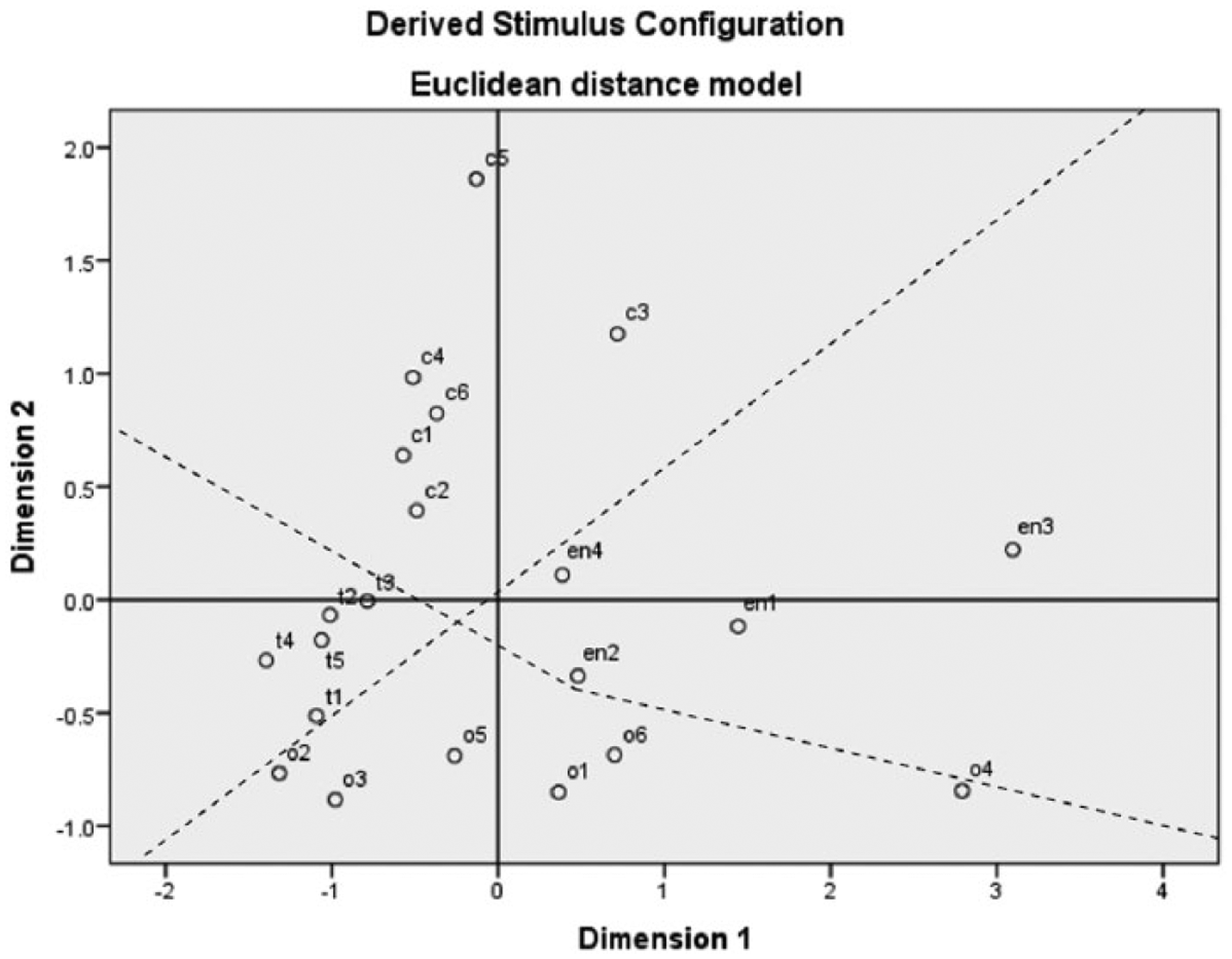
MDS plot for the location of value item coordinates in two-dimensional space.
Other Measures
Bureaucratic Work and Duration of Bureaucratic Work
To measure the values of employed senior managers, I constructed a dichotomous variable coded as 1 “employed senior managers” and 0 “self-employed senior managers”. According to the International Standard Classification of Occupations (ISCO-88) senior managers are classified as corporate managers of occupational group 12. Managers included in this ISCO-88 group are directors, chief executives and senior managers of various organizational departments, including production, operations, finance, marketing and IT departments. The duration of bureaucratic work was measured as the number of years a senior manager has been employed in a bureaucratic organization. Senior managers employed in relatively small organizations with less than 10 workers were excluded from analyses, since these organizations cannot be classified as bureaucracies (Blau and Schoenherr, 1971).
Organizational and Managerial Bureaucratization
Following established practice in the research of bureaucracy, I assessed the level of organizational bureaucratization using a measure of organizational size (Blau, 1970; Kohn, 1971; Sorensen, 2007). Similarly, managerial bureaucratization was assessed using a measure of the managerial span of control (Hinings et al., 1967; Meyer, 1968). Larger organizations and managerial spans of control tend to exhibit a higher degree of specialization, interdependence and formalization of work (Blau and Schoenherr, 1971; Walton, 2005). Larger organizations are more likely to use standardized work procedures to accommodate larger managerial spans of control and complexity. I measured organizational bureaucratization using the available ordinal scale measure of organizational size that differentiates organizations in terms of the number of workers involved: (1) 10–24; (2) 25–99; (3) 100–499; and (4) 500 and above. Managerial span of control was measured as a number of subordinate employees per senior manager.
Control Variables
I controlled analyses of the values of bureaucratic workers for the confounding effects of demographic, occupational, organizational, social and religious factors that have been theoretically highlighted as important predictors of personal values (Hitlin and Piliavin, 2004; Rokeach, 1973; Spates, 1983). The following controls were used in data analyses: Gender (coded 1 “female”, 0 “male”); Age (measured by an actual age of a participant); Years of education (measured by years of education completed); Academic degree in management (coded 1 “yes”, 0 “no”); Hours worked (measured as the total hours normally worked per week in main job overtime included); Years in employment (measured as the total number of years in the full-time or the part-time work); Previous unemployment (measuring whether participant has ever been unemployed and seeking work for more than three months, coded 1 “yes” and 0 “no”); Public sector organization (measured as an employment in a public sector organization, coded 1 “yes” and 0 “no”); Proportion of women in an organization (measured using an ordinal seven point scale ranging from 1 “none” to 7 “all”); Industry of an organization: finance and insurance, wholesale and retail trade, health and social work, and manufacturing, coded 1 “yes” and 0 “no” (these industries were selected due to a high proportion of senior managers employed in them); Social involvement (measured using an ordinal scale assessing the level of participants’ involvement in social activities ranging from 1 “much less than most” to 5 “much more than most”; Interpersonal involvement (measured by the frequency of meeting friends, relatives and colleagues, ranging from 1 “never” to 7 “every day”); and Religiosity (measured using an ordinal scale ranging from 0 “not at all” to 10 “very religious”). As is usually the case with the analysis of secondary data, selection of controls was constrained by the availability of measures included in the survey.
Findings
I assessed differences in the values of the employed and the self-employed senior managers using the Multivariate Analysis of Variance (MANOVA) and the Multivariate Analysis of Covariance (MANCOVA). Compared to its bivariate alternatives (such as ANOVA and t-test), MANOVA controls the analysis of the multivariate relationship between predictor (bureaucratic work) and multiple criteria measures (four values) for the experiment-wide Type 1 error rate (Hair et al., 2010). MANCOVA further controls the analysis of the relationship between predictor and multiple value measures for the possible confounding effects of control variables.
The results of MANOVA indicated that, compared to the comparison group of self-employed senior managers, employed senior managers were more concerned with openness to change values (p < .01) and less concerned with self-transcendence values (p < .01) and conservation values (p < .05). There was also a significant trend for employed senior managers to place a higher priority on self-enhancement values (p < .1). The results of MANCOVA indicated that the identified value differences between employed and self-employed managers were not affected by variations in their demographic, social and work-related characteristics (p < .01). Therefore, the results of multivariate analyses indicated that employed senior managers were systematically more and less preoccupied with the pursuit of values that in Schwartz’s (1992) circular value continuum are located in opposition to each other (see Figure 1 for visualization).
While MANCOVA controls the analysis of the multivariate relationship between predictor and multiple criteria measures for the experiment-wide Type 1 error rate, it uses covariates as non-metric controls, thus measuring only mean differences across the multiple scale categories of covariates (Hair et al., 2010). To isolate the analyses of value differences between employed and self-employed senior managers from the linear effects of control variables, I used OLS regression. The results of regression analyses were consistent with the results of multivariate analyses of variance (see Table 1). Above and beyond variations in the linear effects of socio-demographic and work-related controls, employed senior managers attributed a higher priority to self-enhancement and openness to change values (p < .01) and a lower priority to self-transcendence and conservation values (p < .01) than their self-employed counterparts.
OLS regression standardized coefficients predicting the importance of value types for a sample of employed and self-employed senior managers.
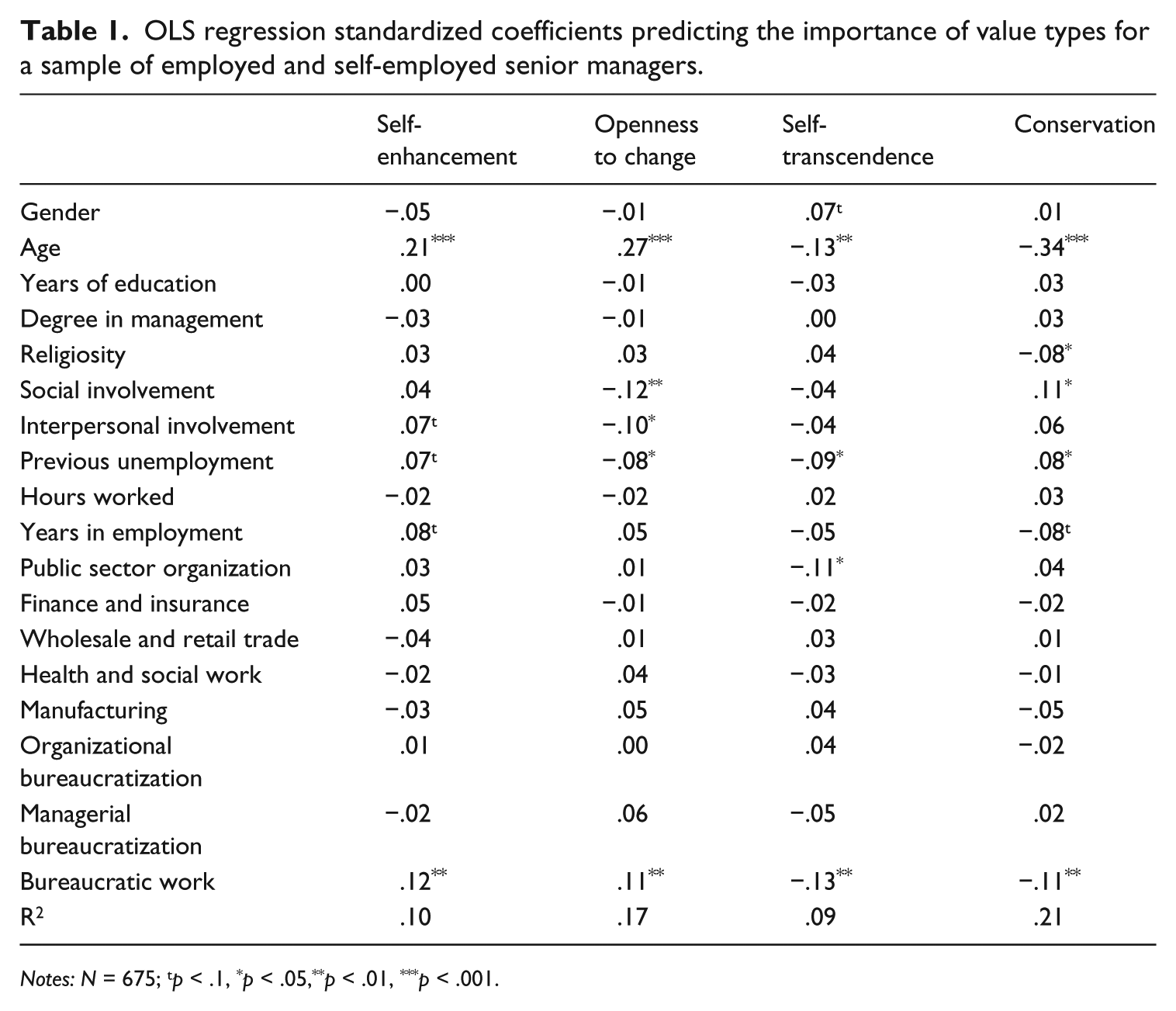
Notes: N = 675; tp < .1, *p < .05,**p < .01, ***p < .001.
To measure the value implications of the duration of the employment of bureaucratic workers, and the organizational and the managerial bureaucratization of their work, I regressed their values onto control variables and predictors (see Table 2). Consistent with the results of the analyses of value differences between employed and self-employed senior managers, the duration of the bureaucratic work of employed senior managers was associated with their higher concern with self-enhancement values and lower concern with conservation values (p < .01).
OLS regression standardized coefficients predicting the importance of value types for employed senior managers.
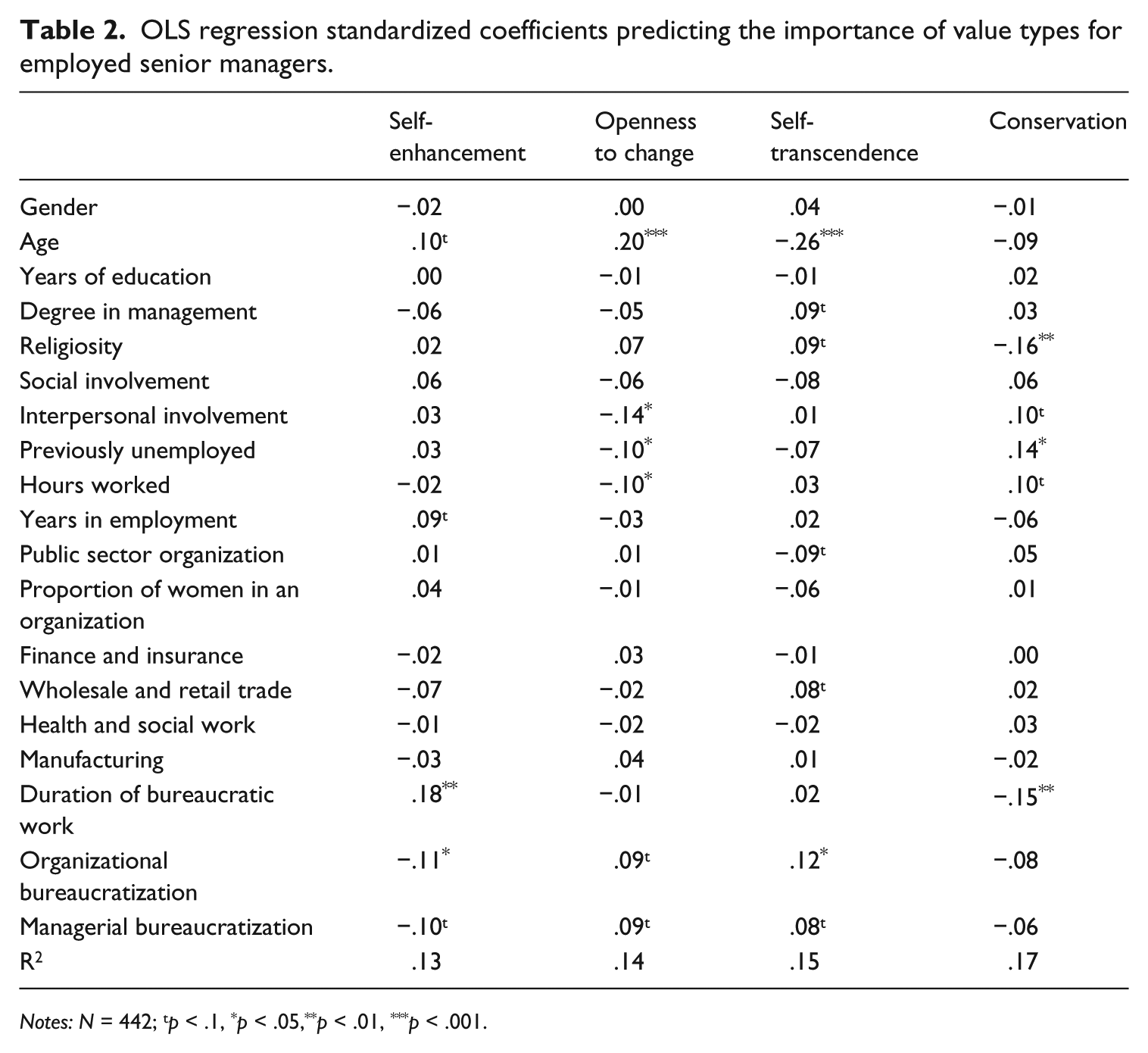
Notes: N = 442; tp < .1, *p < .05,**p < .01, ***p < .001.
However, senior managers employed in larger, more bureaucratized organizations systematically placed a lower value on self-enhancement (p < .05) and a higher value on self-transcendence (p < .05). Also, there was a significant trend for organizational bureaucratization to be linked with a higher concern with openness to change (p <.1).
The same value pattern emerged for managerial bureaucratization. There was a significant trend for managerial bureaucratization to be linked with a lower concern with self-enhancement values (p < .1) and a higher concern with self-transcendence and openness to change values (p < .1).
I examined the interaction effects of the duration of the work of employed senior managers, and the organizational and the managerial bureaucratization of their work on their values using moderated regression analysis. Following the procedures recommended by Aiken and West (1991), I centered predictor variables and multiplied them to create interaction terms. I then regressed value type scores onto control variables, predictors and relevant interaction terms. The results of moderated regression analyses indicated that there was a significant positive interaction between the duration of bureaucratic work and managerial bureaucratization in predicting the importance of self-enhancement values (β = .19, p < .05).
Discussion and Conclusion
While Max Weber has emphasized the value underpinnings of bureaucratic work, he has been ambivalent about the nature of values that shape it. Bureaucratic work emphasizes power and protects against its abuse. It constrains autonomy by standardized routines and enables autonomy by dissolution of traditional hierarchies. Neo-Weberian research on bureaucratic work has been divided among those who emphasize its normatively constraining or enabling implications. The findings of this study contribute to the theoretical reconciliation of these two research perspectives (Adler and Borys, 1996; Kallinikos, 2011).
Findings underscore the insights of studies that emphasize the constraining normative implications of bureaucratic work (e.g. Barker, 1993; Ritzer, 2011; Thompson and Broek, 2010). Employed senior managers are systematically more concerned with self-enhancement values and less concerned with self-transcendence values than their self-employed counterparts. The pursuit of self-enhancement values among employed managers is strengthened by the duration of their work, particularly among managers with the higher administrative span of control. These findings suggest that the bureaucratic work of senior managers is likely to be associated with the internalization of the normative principles of bureaucratic rationality that emphasize the striving for power and performance by maximizing calculability, predictability and control of human action (Ritzer, 2011). This striving is likely to be strengthened by the employment of managers in the more functionally interdependent administrative work that is more formalized in accordance with bureaucratic rationality (Blau and Schoenherr, 1971; Walton, 2005).
However, findings also highlight the individualizing normative implications of bureaucratic work. It is quite unexpected to find employed senior managers to be more concerned with openness to change and less concerned with conservation than their self-employed, entrepreneurial counterparts. Also, it is unexpected to find senior managers with longer experience of employment in bureaucratic organizations to place a lower priority on conservation. After all, hierarchically formalized, routinized and standardized bureaucratic work is typically perceived to be incongruent with the innovative and creative orientation of entrepreneurial work.
Bureaucratic work can facilitate openness to change by protecting employees against unregulated interference (Kallinikos, 2004). By dissociating formal from personal, non-occupational activities, bureaucracies offer employees a non-inclusive form of involvement that protects their autonomy against the arbitrary interference of stakeholders, such as co-workers, customers, partners, suppliers and investors. Since employed senior managers are protected against the uncertainties of unregulated interference, they can be less fearful of the new and the different and more able to assume personal responsibility for their actions (Briscoe, 2007; Kohn, 1971). In contrast, self-employed, entrepreneurial managers can be more inclined to constrain their autonomy in exchange relationships in an external environment in order to protect their investments by accommodating stakeholders. The pressure to accommodate stakeholders, such as customers, is likely to be particularly strong in rationalized societies that prioritize maximization of interpersonal utility (Fuller and Smith, 1991).
The individualizing implications of the bureaucratic work of managers can be also associated with their distinctive organizational involvement in the form of the functionally differentiated work (Blau and Schoenherr, 1971). Since employed senior managers perform specialized work in the area of their technical competence (e.g. finance, operations, production, marketing and information systems), they are unrestrained by the functional requirements outside of their specialization. In contrast, entrepreneurial managers typically identify and develop venturing opportunities by performing a functionally more inclusive work that requires accommodation of a wider range of functional requirements.
The findings of this study also advance understanding of the individualizing implications of bureaucratic work by suggesting that the employment of managers in the more bureaucratized organizations is likely to be linked with their pursuit of openness to change. Organizational bureaucratization can encourage openness to change by prioritizing career mobility based on personal merit (Du Gay, 2000) and by accumulating superior resources for innovation (Dobrev, 2012). Since bureaucratized organizations tend to standardize their work in accordance with institutionalized personnel management practices, they are more likely to utilize functionally adaptable work forms that accommodate the individualist values of rationalized societies (e.g. self-managing teams, decentralized knowledge exchange networks and flexible work arrangements) (Kallinikos, 2004).
Taken together these findings suggest that the constraining and the enabling functions of bureaucratic work are likely to be interdependent in societies with high administrative rationalization. In rationalized societies, bureaucracies are likely to control employees by emphasizing their self-governance and flexibility, while subjecting them to the control of peers in interdependent work. This form of control enables bureaucracies to overcome employee resistance by aligning their administrative strategies with the prevailing values of rationalized societies. At the same time, bureaucracies are likely to facilitate employee self-direction and creativity by institutionalizing rules that protect them against unregulated interference. These rules enable bureaucracies to accommodate normative and institutional changes in their external environment.
Further, the findings of this study highlight differences in the normative implications of the employment of senior managers in bureaucratic organizations and the level of the bureaucratization of their work. Paradoxically, in contrast to the stronger self-enhancement orientation of employed as opposed to self-employed managers, the employment of managers in the more bureaucratized organizations and managerial work is systematically linked with their lower concern with self-enhancement and higher concern with self-transcendence. Perhaps, the more bureaucratized work settings place stronger emphasis on procedural fairness and protection against the arbitrary use of power (e.g. Du Gay, 2005; Goodsell, 2005). Bureaucratized organizations can prioritize universalism as a result of their enhanced efficiency of adaptation to an external environment (Parsons, 1951). Also, managers with the more functionally differentiated span of administrative control can free themselves from less strategic and more routinized functions by passing them to clerical staff (Blau and Schoenherr, 1971).
Beginning with classical value conceptualizations (e.g. Parsons, 1951; Tonnies, 1957, Weber, 1964), understanding values of bureaucratically rational work has been a fundamental concern of sociology. Yet sociological research in this field has been little concerned with the methodological rigor of value measurement. This study makes a methodological contribution to this field of research by demonstrating how the more generalized sociological insights on the values of bureaucratic rationality can be systematically studied using a rigorous approach to value measurement. Using Schwartz’s (1992) value measurement approach, the study identifies the pattern of value conflicts and compatibilities of employed senior managers that systematically highlights the values of bureaucratic rationality conceptualized by the more generalized sociological approaches to value inquiry. Specifically, the identified concern of employed senior managers with self-enhancement and openness to change values, at the expense of self-transcendence and conservation values, systematically taps the value opposition highlighted by Tonnies’ (1957) conceptualization of the values of calculative as opposed to non-calculative rationality, as well as Parsons’s (1951) and Weber’s (1964) more differentiated operationalizations of Tonnies’ value conceptualization.
The study design has a number of limitations. Due to the lack of longitudinal data, I assessed the values of employed managers using a cross-sectional research design. With this design the identified values of employed managers can result both from their employment in bureaucratic organizations or their self-selection into these organizations based on their pre-enrollment values. While the latter possibility cannot be entirely ruled out, it is unlikely that employed managers have more complete and accurate knowledge of the values of bureaucratic work before their employment, than is usually the case, particularly in light of the widespread stereotypes about the routinized, de-individualizing nature of bureaucratic work (Kohn, 1971). In this study employed managers are found to be more concerned with openness to change than their self-employed counterparts. The design of this study is also strengthened by the assessment of the value implications of the duration of bureaucratic work.
The observed effect sizes for the identified relationships between bureaucratic work and values are on average relatively low, although higher than in Kohn’s (1971) investigation of the values of bureaucracy. However, this limitation is not uncommon in the analysis of representative survey data, and is probably in part affected by a highly heterogeneous composition of a surveyed sample. It can be also affected by the inclusion of Schwartz’s value item battery at the end of a relatively long questionnaire of the European Social Survey.
The sample size of the comparison group of self-employed managers is rather small (N = 93). Yet I control the analyses of value differences between employed and self-employed managers for the confounding effects of their demographic, occupational, organizational, social and religious characteristics that have been recognized as theoretically important predictors of human values (Hitlin and Piliavin, 2004; Rokeach, 1973).
I examine value differences between employed and self-employed managers in societies that share high levels of bureaucratic rationalization. Since the rationalization of organizations is likely to be influenced by the rationalization of the institutional and social environment in which they are embedded, future research may fruitfully investigate differences in the values of bureaucratic workers in the more and the less rationalized societies. Research may advance understanding of the values of bureaucratic work by examining the value implications of work intensification, meritocratic employee selection, rationalized decision making and standardization of work in societies with varying levels of rationalization.
In conclusion, while this study is not without limitations it advances understanding of the values of bureaucratic work. This study contributes to the reconciliation and integration of the theoretical insights of divergent research perspectives on the constraining and enabling normative implications of bureaucratic work. The findings of this study suggest that the senior managers of bureaucratic organizations are likely to prioritize values that enable these organizations to maintain their operational continuity by maximizing predictability, calculability and control of work, while accommodating and responding to normative and institutional changes associated with the rationalization of societies.
In highlighting the values of bureaucratic work, this study facilitates an awareness of the intended and unintended normative implications of the organization of work in accordance with bureaucratic rationality. Consequently, it enables bureaucratic workers to make an intentional and responsible choice of the alternative modes of action that can advance or inhibit the attainment of organizational goals. If bureaucratization entails the organization of work in accordance with the values of bureaucratic rationality, then awareness of value conflicts and compatibilities that underpin bureaucratic work becomes a critical presupposition for a purposeful action.
Footnotes
Acknowledgements
This article has benefited from the helpful comments of Pamela Tolbert, Kim Hoque and participants of the Brown Bag Seminar at the Warwick Business School. I also thank two anonymous reviewers for their suggestions and comments.
Funding
This research received no specific grant from any funding agency in the public, commercial or not-for-profit sectors.