




Abstract
This article calls for a critical reimagining of sociology teaching in today’s political climate, where post-pandemic learning, rising inequalities and institutional power demand urgent reflection. Inspired by bell hooks’ question – what truly matters most? – it asks: what does an ethical praxis of teaching sociology entail, and how do we navigate its politics? I foreground positionality, care and epistemic justice as normative commitments to guide ethical pedagogy, acknowledging they are deliberate choices rather than historically universal ethics. Using the concepts of pedagogic discomfort and doing good harm, I propose interventions that foster ethical reflexivity – an orientation grounded in responsibility, attention to power and relational accountability. The article explores what it means to teach ethically, not the teaching of ethics, considering how classroom decisions reproduce or resist inequalities. Ultimately, it advocates for a sociology classroom of hope: critical, reflective and transformative, ethically and politically engaged, and committed to social justice.
Introduction
This article stems from my research and reflections on teaching, shaped by dialogue with students, colleagues and community partners. In my sociology classroom, increasingly I hear students call for ‘objectivity’ and the presentation of ‘both sides’ of debates, assuming neutrality is possible in social justice-oriented sociology. Teaching migration studies, I notice how dominant policy terms – integration, crisis, borders, migration governance, deserving – continue to shape student thinking, even when we aim to challenge state-centred narratives (De Genova et al., 2022; Stierl, 2022; Vanyoro et al., 2019). Despite efforts to foster critical engagement with knowledge production, students’ work frequently prioritises peer-reviewed scholarship over activist knowledge. This raises fundamental questions: do we risk reinforcing state logics rather than challenging them? What knowledge is deemed legitimate in academia, and why? How do we ensure that the knowledge shared in our classrooms – its frameworks, sources and methodologies – does not simply reproduce inequalities but actively challenges them?
These tensions unfold in a world increasingly shaped by crises – genocide, austerity, authoritarianism, war and climate catastrophe. The crises of our times demand more than sociological analysis – they call for a pedagogy that actively engages with the realities of injustice as they play out in our classrooms. Sociology must not only examine power structures but also equip students to challenge them, fostering the skills and ethical commitments necessary for social transformation. But without pedagogic reflexivity, we risk reinforcing the very inequalities our discipline seeks to dismantle. How, then, do we create a sociology classroom that fosters critical inquiry, ethical responsibility and transformative learning? What does an ethical praxis of teaching sociology entail? How do we navigate its politics?
In this article, I argue that sociological teaching is, at its core, an ethical practice. Teaching is never neutral: every pedagogical choice reflects and reproduces social and political commitments. To develop this argument, I draw on three commitments – positionality, care and epistemic justice – as normative orientations for teaching sociology ethically. These principles are informed by my teaching and research practice. They are not presented as historically definitive but I have selected them for their capacity to centre relationality, responsibility and epistemic accountability in the classroom. These principles guide the interventions proposed later in the article: pedagogic discomfort and ‘doing good harm’, which aim to disrupt entrenched knowledge structures and foster transformative learning. While migration studies serve as the focal point, the arguments extend across sociology, advocating for a pedagogy that is critical, reflexive and politically engaged.
This article builds on two core concepts – pedagogic discomfort and doing good harm (Piacentini, 2024) – as interventions for reimagining teaching sociology. Discomfort is central to learning; it disrupts entrenched knowledge structures and fosters deep intellectual and emotional engagement. Conversations on social inequalities often evoke anger, guilt, frustration – emotions that should not be dismissed but harnessed for critical reflection. These responses are not barriers to learning but integral to it, prompting students to examine their own positions within systems of power. In this way, discomfort is generative of change; it can be used to do good harm. Yet, in these turbulent times, critical pedagogy must offer more than critique – it must cultivate hope. As hooks (1994) and Giroux (1997) remind us, education is an act of resistance, a space for imagining alternative futures. Hope is not naive optimism but a necessary framework for thinking beyond crisis, towards justice and solidarity. A sociology classroom should expose injustice and equip students with the tools to act, resist and reimagine. While migration studies serve as this article’s focal point, the arguments and interventions extend across multiple areas of sociological inquiry, advocating for a pedagogy that is as critical, ethical and politically engaged as the discipline itself.
The Classroom Is Also an Ethical Space
Sociology cannot be understood as ethically neutral. Its very objects of study – inequality, oppression, structural violence, social suffering – presuppose normative commitments about what matters and why. Recognising this clarifies that the aim of this article is not to introduce ethics as something external to sociological teaching, but to foreground how we teach ethically within a discipline already shaped by moral and political concerns. The classroom, like the research field, is a site of ethical reflection and responsibility, where pedagogical choices shape how knowledge, power and care are enacted in practice.
Why these commitments? Feminist, decolonial and Marxist scholarship has demonstrated that sociological knowledge has often been produced through extractive, hierarchical and unequal research relations. Positionality, care and epistemic justice offer a lens for rethinking these dynamics in the classroom, centring relationality, responsibility and epistemic accountability. They are neither exhaustive nor definitive – other orientations such as public sociology, critical theory or sustainability ethics propose different priorities – but they speak directly to the pedagogical concerns at stake: how power operates in the classroom, how knowledge is recognised and valued, and how we cultivate ethically engaged sociological imaginations.
Teaching sociology ethically requires acknowledging both the structural conditions shaping human life and our positionality within them. Positionality, care and epistemic justice guide how we engage students with knowledge, power and social inequalities. Ethical inquiry in sociology extends beyond subjective perspectives to the material and structural conditions shaping human life. Human needs, vulnerability and well-being provide concrete ethical stakes, while social arrangements – housing, migration policies, borders and resource access – shape life chances. Teaching ethically requires recognising these inequalities and examining how classroom knowledge may reproduce or challenge them, fostering critical awareness of injustice and responsibility for equitable action.
To examine teaching ethically, it is instructive to consider what researching ethically looks like – not as a bureaucratic exercise of compliance, but as a critical practice where ethical commitments, from social responsibility to questions of power and representation, should be foundational.
Researching ethically extends beyond researcher subjectivity; it encompasses safeguarding participants’ safety, dignity, autonomy and rights. These considerations are carefully regulated through formal guidelines and institutional review boards and researchers must obtain ethics board approval before conducting fieldwork, a process institutionalised through codes of conduct and statements of good practice. A core ethical principle, often derived from the Hippocratic Oath (‘First, do no harm’), not only prohibits physical harm but also upholds fairness, justice and equality. This extends to a broader commitment to minimising harm and maintaining ethical integrity. Numerous professional associations, government agencies and funding bodies have developed ethical frameworks with specific rules and policies. Additionally, emerging specialised guidelines in areas like migration (see Albtran et al., 2022; Clark-Kazak with the Canadian Council for Refugees, 2017) and disability research (see the National Disability Authority’s guidance 2024), 1 are important additions to existing ethical guidelines.
Ethical perspectives are constantly evolving. A notable shift has been the growing emphasis on ethics-in-practice, where ethical considerations are woven throughout the research process rather than seen as a mere bureaucratic formality. This shift is powerfully illustrated in Linda Tuhiwai-Smith’s (2021) groundbreaking work on decolonising methodologies, where she stresses the importance of engaging Indigenous communities as equal research partners. Tuhiwai-Smith argues that researching ethically should not be about extracting knowledge from communities, but rather about actively involving them in shaping research questions, processes and outcomes. More broadly, authentic collaboration and co-production with participants foster meaningful partnerships that enhance research practices (Held, 2020; Lenette, 2022). This approach is not simply about better representation, but about fundamentally rethinking how knowledge is produced, validated and valued in academic contexts.
Efforts to decolonise ethical frameworks have gained traction in settler-colonial contexts such as Canada, the USA, New Zealand and Australia (Brunger et al., 2020; Lenette, 2022). These efforts critique how dominant ethics guidelines rigidly define ‘communities’, impose restrictive informed consent models and overlook the political and historical context of research relationships. They highlight the issue of extractive research practices, where participants’ narratives are treated as ‘raw data’ for academic refinement, perpetuating power imbalances and undermining knowledge justice (Tuhiwai-Smith, 2012). Spivak’s (1992) concept of epistemic violence further illuminates how dominant knowledge systems marginalise communities as passive subjects, devaluing their perspectives and committing epistemic harm (Giroux, 2022; Stierl, 2022; Zembylas, 2023).
Despite these advancements, much of ethical practice discourse remains rooted in western and Eurocentric epistemologies, which shape ethical guidance through normative frameworks of right and wrong (Haggerty, 2004). Scholars like Pedwell (2016)and Held (2020) critique these frameworks for their implicit assumptions about power, risk and harm, which often reinforce, rather than dismantle, colonial logics. Additionally, ethical review processes, based on biomedical research governance, may fail to address the complexities of social science research, particularly in terms of community engagement and participatory methods (Dyer and Demeritt, 2009).
These considerations of researching ethically however are rarely applied with the same rigour to teaching ethically, despite the classroom, like the research field, being a site of power, knowledge production and epistemic authority that must be negotiated at every turn. This dissonance between ethical research and ethical pedagogy raises important questions. Teaching, as Giroux (1997) argues, is not a neutral act; it involves shaping knowledge, structuring debates and determining whose perspectives are prioritised. Every decision in teaching – from curriculum design to classroom interactions – reflects a set of ethical values. The texts we assign, the ones we ignore, the knowledge we impart and the ways we engage with students are all influenced by our positionality as teachers, our understanding of power and our assumptions about knowledge. Consequently, an ethical pedagogy requires a commitment to critically examining our teaching practices, course materials and classroom dynamics.
Teaching ethically extends beyond content to encompass the broader learning environment and the people within it – creating spaces that are inclusive, intellectually rigorous and socially just. As teachers, we bring our politics, beliefs and values into the classroom, which is why positionality statements (Gani and Rabea, 2024; King, 2024) can be valuable pedagogically. They offer a means to critically engage with our perspectives and develop a deeper awareness of how our identities and experiences shape our understanding of academic and social issues (hooks, 2003). Following the idea that the personal is political and the political is personal (Sivanandan, 1990), it may be useful to consider a conversation in class about positionality and how it influences course design, readings and teaching approaches. Incorporating these ethical considerations into teaching is not about bureaucratic compliance – since ethical approval is not required to teach – but about demonstrating that ethical commitments should permeate pedagogy, not just remain surface-level (Giroux, 2020).
Ethical dimensions affect students too, and shape not only what they learn, but how they learn. This includes challenging dominant epistemologies, fostering critical literacies and ensuring that students engage meaningfully with complex social issues. The ethical principles discussed above, which underpin our research, should similarly guide our teaching practices. As argued elsewhere (Piacentini, 2024), developing an ethical pedagogy is crucial not only for translating research into impactful learning experiences, but also for recognising how knowledge is emplaced, how curriculum decisions are made and how we engage with the political moment and its historical context. Teaching sociology thus becomes an inherently ethical and political act – one that demands careful consideration of how our pedagogical approach reflects and shapes the world. For teaching to be transgressive in meaningful ways (hooks, 1989, 1994), we must interrogate our practices and create space for uncomfortable, transformative conversations. To explore these ethical concerns, I propose pedagogic interventions through a framework of pedagogic discomfort and the concept of ‘doing good harm’, guiding pedagogic transformation and developing an ethical sociological imagination.
Pedagogic Discomfort
In these increasingly polarised times, where extreme views are amplified daily in social media, politics and everyday discourse, engaging with emotions in the classroom is no longer optional – it is essential for learning. Emotions influence how we explore social issues, reflect on injustices and decide whether to challenge or perpetuate them (Jones, 2021; Zembylas, 2023). The central challenge of teaching and research, then, lies in creating a courageous space that is intellectually rigorous, while also critical, respectful and compassionate. hooks’ (1994) Teaching to Transgress offers a vital starting point for thinking about how emotions – comfort or discomfort – can serve as vehicles for critical pedagogy. hooks (2003) argues that emotions are key to intellectual engagement, social change and transgressive possibilities, emphasising the need to centre diverse experiences and positionalities, and encouraging both students and teachers to confront biases and embrace vulnerability, as lived and not merely discursive. Boler’s (1999) concept of pedagogies of discomfort crystallises these ideas, proposing an approach that encourages students to confront unsettling ideas, emotions and experiences to challenge their beliefs. Importantly, this approach does not seek to make students uncomfortable for its own sake but rather uses discomfort as a tool for learning – encouraging students to critically examine not only what they know but also how they come to know it, what knowledge they reject, and why (Jones, 2021; Law et al., 2004). The aim is not to elicit guilt, but to provoke students to question assumptions, engage deeply with issues and challenge ingrained ideologies.
Boler (1999) identifies four key ways in which discomfort plays a crucial role in educational settings, particularly in fostering critical engagement and deeper learning. First, discomfort acts as a catalyst for challenging norms, prompting both students and teachers to critically examine dominant ideologies and assumptions (1999: 58–59). By unsettling familiar perspectives, discomfort creates space for questioning hegemonic narratives and engaging with alternative viewpoints that may otherwise be overlooked. Second, discomfort is closely tied to emotional engagement, often generating strong affective responses that are essential for meaningful critical thinking. Rather than viewing emotional reactions as barriers to learning, Boler (1999: 202–206) argues that these responses should be recognised as integral to grappling with complex social and political issues. Emotionally charged discussions can reveal the deeply personal stakes of knowledge production, making learning more dynamic and transformative. Third, risk-taking is an inherent aspect of confronting discomfort, as both teachers and students navigate difficult and sometimes contentious topics (1999: 181–187). Encouraging individuals to engage with challenging ideas – despite the unease they may provoke – fosters an environment where intellectual and personal growth can thrive. This willingness to take risks – whether by voicing an unpopular opinion, reconsidering deeply held beliefs or engaging in difficult conversations – can lead to deeper reflection and openness to new ways of thinking. Finally, discomfort fosters active empathy and self-awareness, compelling individuals to reflect on how their identities, histories and privileges shape their perspectives on social issues (1999: 188–189; 205). Experiencing discomfort allows both students and teachers to develop a heightened awareness of their positionality and how power, privilege and lived experience influence their understanding of the world. This reflective process encourages a more nuanced and empathetic engagement with diverse perspectives (Zembylas, 2018), ultimately contributing to a socially conscious learning environment filled with hope and possibility.
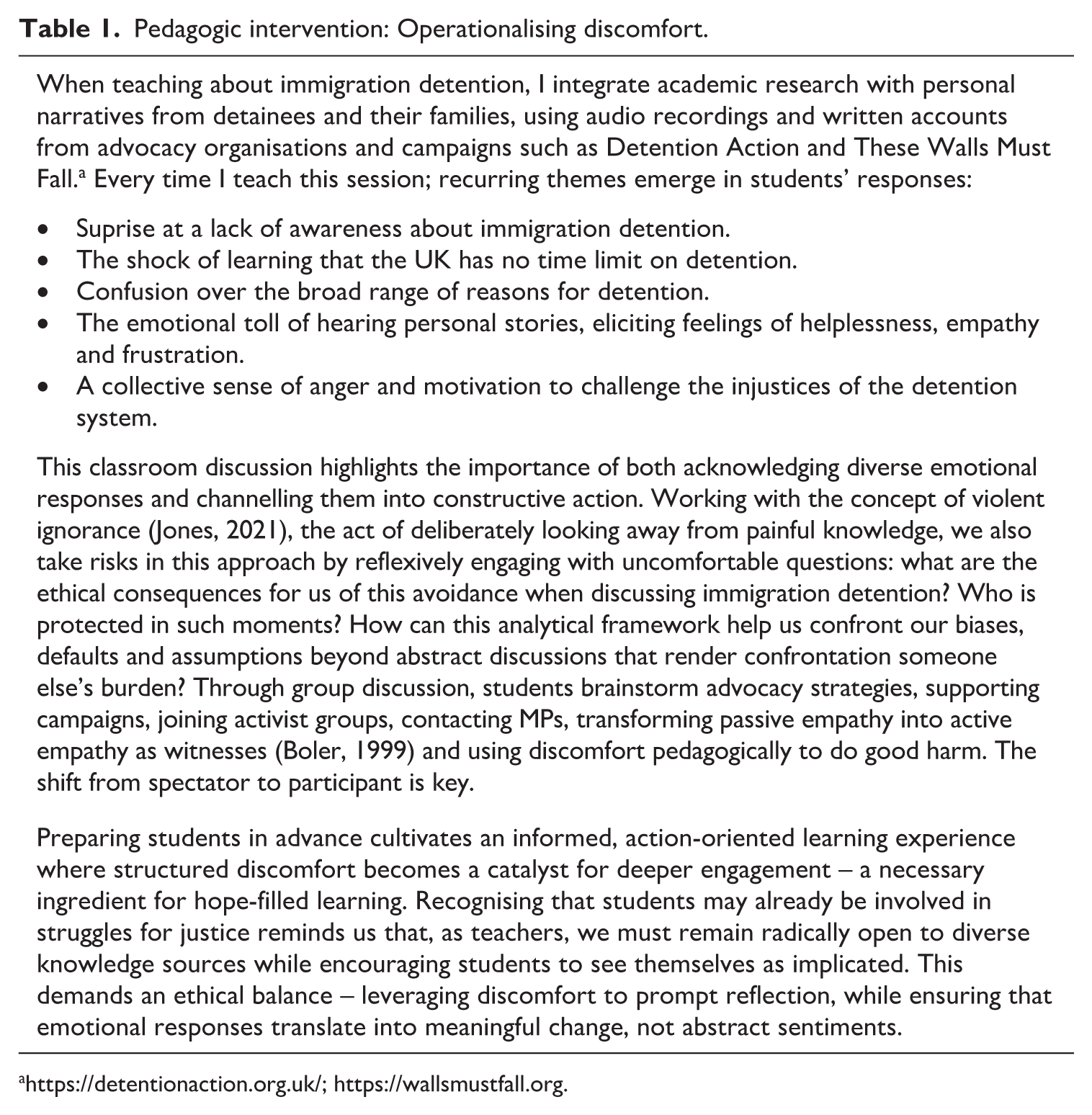
This raises the question of how discomfort functions pedagogically – whether it can be a generative space for ethical learning, or merely reproduce harm. As scholars such as hooks (1994), Boler (1999), contributions in Law et al. (2004) and Zembylas (2023) have argued, discomfort can serve as a productive pedagogical affect when it is held within relations of care and accountability. It invites students and teachers alike to confront complicity, vulnerability and responsibility, rather than retreating into defensiveness. In this sense, discomfort is not harm for its own sake, but a catalyst for ethical reflexivity and transformation. To see how pedagogic discomfort can be ethically and productively enacted, the classroom example in Table 1 illustrates how structured engagement with difficult knowledge fosters reflection, empathy and active ethical learning.
Pedagogic intervention: Operationalising discomfort.
Discomfort and ‘Safety’
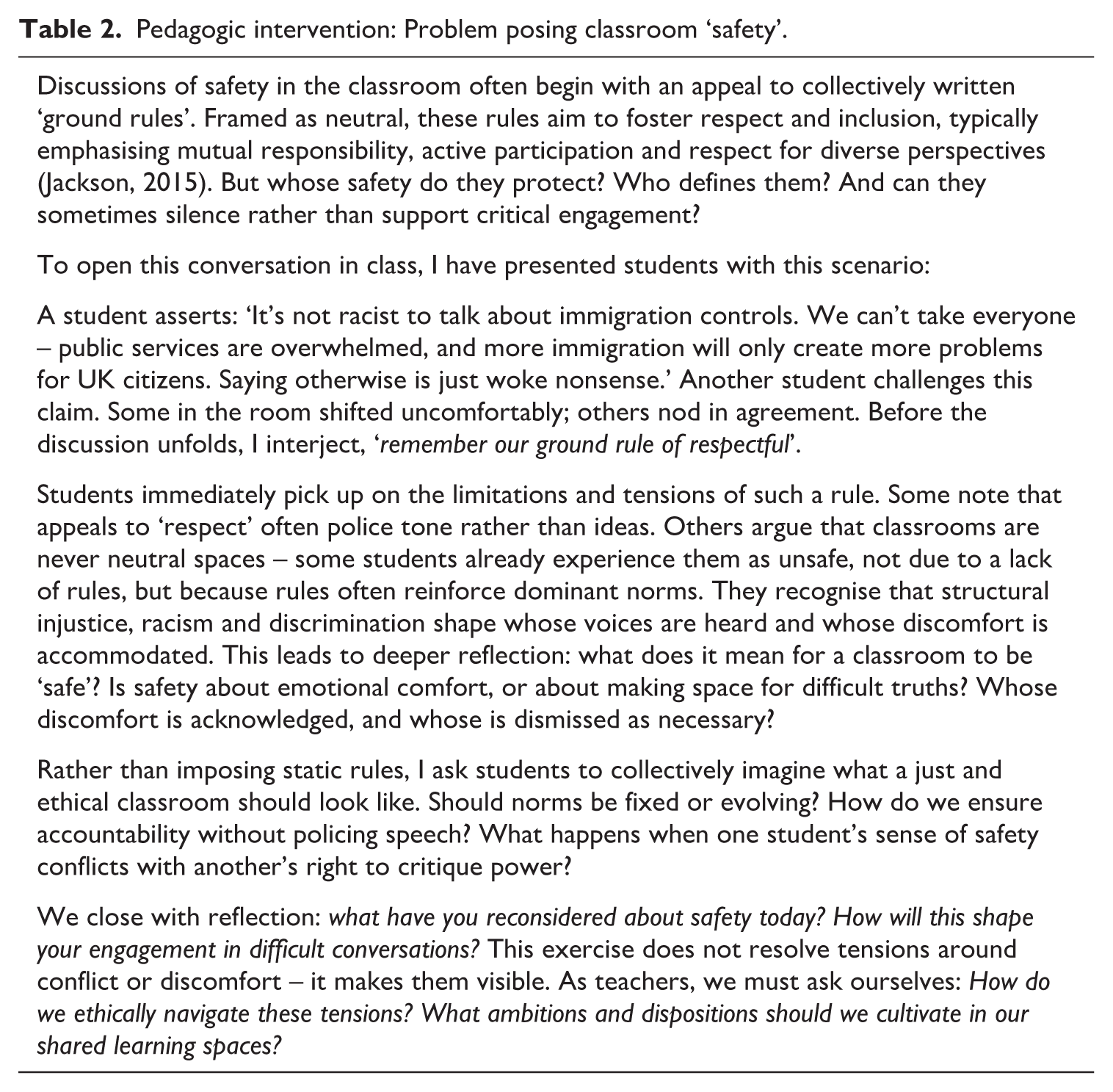
Building on the idea that pedagogical discomfort can drive transformative change, it is essential to recognise that discussions of discomfort in the classroom are often framed through concerns about safety – posed as both a counterpoint to harm and a prerequisite for open dialogue (Jackson, 2015). Yet, the notion of ‘safety’ in education is inherently ethical and political. It frequently assumes a universal, neutral definition that fails to address how power, privilege and structural inequalities shape whose safety is prioritised, how harm is understood and who is afforded protection (Ellsworth, 1989; Flensner and Von der Lippe, 2019; Zembylas, 2015). hooks (1994) contends that conventional ideas of safety are deeply influenced by power dynamics and interlocking systems of oppression. The pursuit of safety, she argues, can, at times, stifle necessary but challenging conversations. Rather than viewing safety and discomfort as opposing forces, we should consider how they might coexist, enabling discomfort to act as a tool for change within a compassionate yet critical space. This approach requires us to navigate discomfort with care, ensuring that it becomes a generative force for growth, rather than a justification for avoidance or disengagement. The example in Table 2 illustrates how classroom ‘safety’ can be problematised and navigated ethically, showing how discomfort and care intersect in real-time pedagogical practice.
Pedagogic intervention: Problem posing classroom ‘safety’.
Doing ‘Safety’ Otherwise
Frameworks like ground rules are often used to facilitate respectful classroom interactions, but they frequently overlook the structural oppressions embedded in these dynamics (Flensner and Von der Lippe, 2019). To be truly effective, these frameworks must explicitly address issues of privilege, exclusion and misinformation (Hogue et al., 1998). The concept of ‘brave spaces’ (Arao and Clemens, 2013) shifts the focus from comfort to engagement, encouraging students to navigate controversy with civility, reflect on the intent and impact of their words, and engage in constructive dialogue. However, Verduzco-Baker (2018) raises important concerns about whose bravery is valued and who bears the emotional burden of these discussions. For marginalised students – particularly those directly impacted by state policies – brave participation can be disproportionately taxing and oppressive (Flensner and Von der Lippe, 2019). Additionally, there is the risk of their personal experiences being consumed solely for reflection on contemporary injustices (Mintz, 2013), where we become spectators to others’ experiences (Boler, 1999). Without careful facilitation, brave spaces can unintentionally reinforce harm rather than alleviate it.
An alternative approach is ‘calling in’ (Trần, 2016), which avoids the defensiveness that often accompanies ‘calling out’. Rather than public shaming, calling in frames confrontation as an educational process. Verduzco-Baker (2018) advocates for a structured approach to calling in: restating problematic comments, providing historical context, articulating the harm caused and addressing underlying assumptions. This method balances critical engagement with care, fostering productive discomfort while minimising exclusionary dynamics.
The complexity of safety in the classroom underscores the need for openness to messiness, discomfort and even failure when engaging with pedagogies of discomfort. Confronting deeply held assumptions and navigating uncertainty are not incidental – they are essential to meaningful intellectual and personal transformation (Zembylas, 2015). In this context, failure is not an endpoint but an integral part of the iterative learning process – what can be understood as doing good harm. Here, radical community partners become vital, not just as knowledge sources but as experts in navigating these tensions. Their experiences often surpass traditional academic frameworks, offering crucial insights for reimagining pedagogy. Movements like Abolitionist Futures and Sisters Uncut 2 exemplify this, demonstrating that community-building is never smooth or conflict-free but requires continuous engagement with tensions. Instead of seeking immediate resolution, grappling with discomfort is key to fostering spaces that actively challenge interlocking oppressions.
Embracing discomfort is not merely a pedagogical choice – it is a political act. Bringing radical community ethos into the classroom resists entrenched academic hierarchies and affirms alternative forms of knowledge. The manifestos and organising principles of activist movements serve as powerful teaching tools, offering pedagogical approaches that centre lived experience, political struggle and collective resistance. Moreover, by adopting equitable citational practices when drawing on their work (Lenette, 2022), radical community partners do not just inform our teaching – they help refine it, offering blueprints for bridging theory and lived realities (Piacentini, 2024).
Ethical pedagogy is not moral relativism. Positionality, care and epistemic justice provide clear criteria: ideas or practices that reinforce oppression or harm are ethically weaker than those promoting equity, inclusion and critical awareness. Students’ perspectives can therefore be assessed against these principles, fostering reflexivity and responsibility.
Doing Good Harm
Discomfort should not be avoided but embraced as a powerful tool for challenging dominant ways of thinking. When used thoughtfully, discomfort creates a space where difficult issues – especially those related to social inequalities – can be openly explored, fostering sociological awareness and critical reflection on our positions within these systems (hooks, 2009). This process has the potential to lead to transformative learning, steering students towards what I term doing good harm. Doing good harm acknowledges that meaningful teaching and learning are rarely comfortable; indeed, transformative change often requires discomfort – encouraging students to take risks and engage with ideas that may feel painful but ultimately lead to both intellectual and personal growth (Bhattacharyya, 2013). In balancing critique with care (hooks, 1994), it is essential to ensure that pedagogic discomfort is generative, not paralysing. It is within this tension, this productive discomfort, where the real hope for change lies.
My conceptualisation of doing good harm draws directly from Stierl’s (2022)work, where he expands the traditional ‘do no harm’ principle beyond protecting vulnerable research participants. Stierl calls for a more nuanced understanding of harm, particularly in migration research. He urges scholars to critically assess the political and ethical dimensions of migration studies, with a particular focus on the relationships between researchers, policymakers and participants. Stierl emphasises that migration knowledge production is deeply entangled with power structures, often reinforcing harmful policies such as border control technologies. These policies not only harm individuals directly but also shape broader systems that govern migrant lives, perpetuating systemic injustice. His call to action is compelling: ‘Do harm [emphasis in original] could be the motto for a critical and impactful scholarship of migration that locates, and expands, ruptures in the European border regime’ (2022: 1098). This rallying cry is equally applicable to our teaching, as when we teach, we are actively contributing to the creation and reproduction of normative assumptions in the classroom. It compels us to critically question ourselves: are we inadvertently upholding harmful logics through our teaching? Do we rely on the very vocabularies and concepts that sustain oppressive policies? In essence, are we doing harm?
While discomfort can catalyse disruptive and transformative pedagogical work, it is essential to differentiate between discomfort that is truly harmful – where individuals are placed in situations that hinder their ability to process or cope with the material – and discomfort that serves a pedagogical purpose. When teaching politically charged and contentious topics like migration, we must move beyond surface-level reactions and encourage students to engage at a deeper level. Doing good harm is not about making students feel bad; rather, it challenges them to critically examine their own assumptions, the structures shaping their thinking and the very tools we provide to help them understand the social world.
Doing Good Harm in Turbulent Times
These entanglements illustrate the ideological struggles embedded within what has been termed the ‘culture wars’. This term, far from being just a rhetorical device, serves to obscure deeper structural inequalities (Davis, 2018). Often framed as a battle between traditionalist and progressive worldviews, the culture wars contribute to societal fragmentation (Davison Hunter, 1991). In the UK, debates over Brexit, decolonisation and so-called ‘woke’ policies have become key battlegrounds (Benson et al., 2021; Sobolewska and Ford, 2019). The language of the culture wars is far from neutral; it is frequently weaponised to delegitimise progressive movements and distort calls for social justice, often serving reactionary agendas (Davies and MacRae, 2023). These political struggles inevitably seep into our teaching. In this context, it becomes essential to encourage students to critically examine how their perspectives are shaped by broader social forces. This fosters intellectual engagement and challenges ideological rigidity. As argued in this article, cultivating intentionally uncomfortable classrooms is key, these are spaces where knowledge claims, positionality and power structures are actively interrogated and negotiated. However, discomfort must be purposeful: it should promote reflection, not alienation, and prompt both students and teachers to consider their ethical responsibilities and political agency within and beyond the classroom.
If we aim for students to become engaged witnesses committed to epistemic justice (Boler, 1999; Stierl, 2022) – rather than passive spectators consuming others’ lived experiences – we should heed Spivak’s (1992) warning against epistemic violence. To avoid perpetuating this violence, as teachers, we should critically assess whether our teaching meaningfully engages with the ideological debates and power structures of our time. Achieving this requires not only emotional engagement (Zembylas, 2023) and reflexivity but also concrete pedagogical strategies that address the politics of the culture wars, knowledge production and counter-storytelling.
How can we do good harm within the context of these ideological battles? Henry Giroux’s concept of public pedagogy offers a valuable framework for engaging with contested knowledge in the context of ideological battles, particularly today’s ‘culture wars’. Public pedagogy emphasises that learning extends beyond formal classrooms, permeating media, political discourse and daily cultural interactions (Giroux, 1997, 2021). In today’s polarised environment, sociology classrooms often become sites where ideological conflicts, particularly around race, racism, gender and migration, are brought to the surface (hooks, 1994, 2003).
Giroux’s model encourages teachers to critically examine how dominant narratives are shaped by broader socio-political and economic forces. In the context of migration, for instance, this involves questioning the nature of borders (e.g. the Free the Map project), 3 exploring how governmental data are collected and by whom (e.g. Stierl et al., 2022), and engaging in reflexive self-interrogation to confront our own violent ignorance (Jones, 2021). Pedagogic discomfort plays a crucial role in this process: it not only challenges personal emotions but also pushes us to amplify alternative, often marginalised, voices while confronting exclusionary dominant discourses. Integrating these diverse perspectives helps students engage critically with cultural debates, providing them with the tools necessary for thoughtful analysis.
Public pedagogy also emphasises the importance of civic engagement (Giroux, 2003, 2023). In times of heightened ideological conflict, education should move beyond the passive consumption of information, encouraging active participation in democratic life (Boler, 1999; Joseph-Salisbury and Connelly, 2021). The parallels between pedagogic discomfort and active civic engagement are both striking and instructive. Cultivating a classroom environment that fosters dialogue, debate and activism opens up the possibility for students – and teachers alike – to challenge harmful ideologies and actively engage in advocacy and community initiatives (Joseph-Salisbury and Connelly, 2021). Importantly, this approach does not aim to indoctrinate; rather, it seeks to foster critical awareness, equipping students with the ability to engage with complex issues in informed, transformative ways (DeMeulenaere and Cann, 2013).
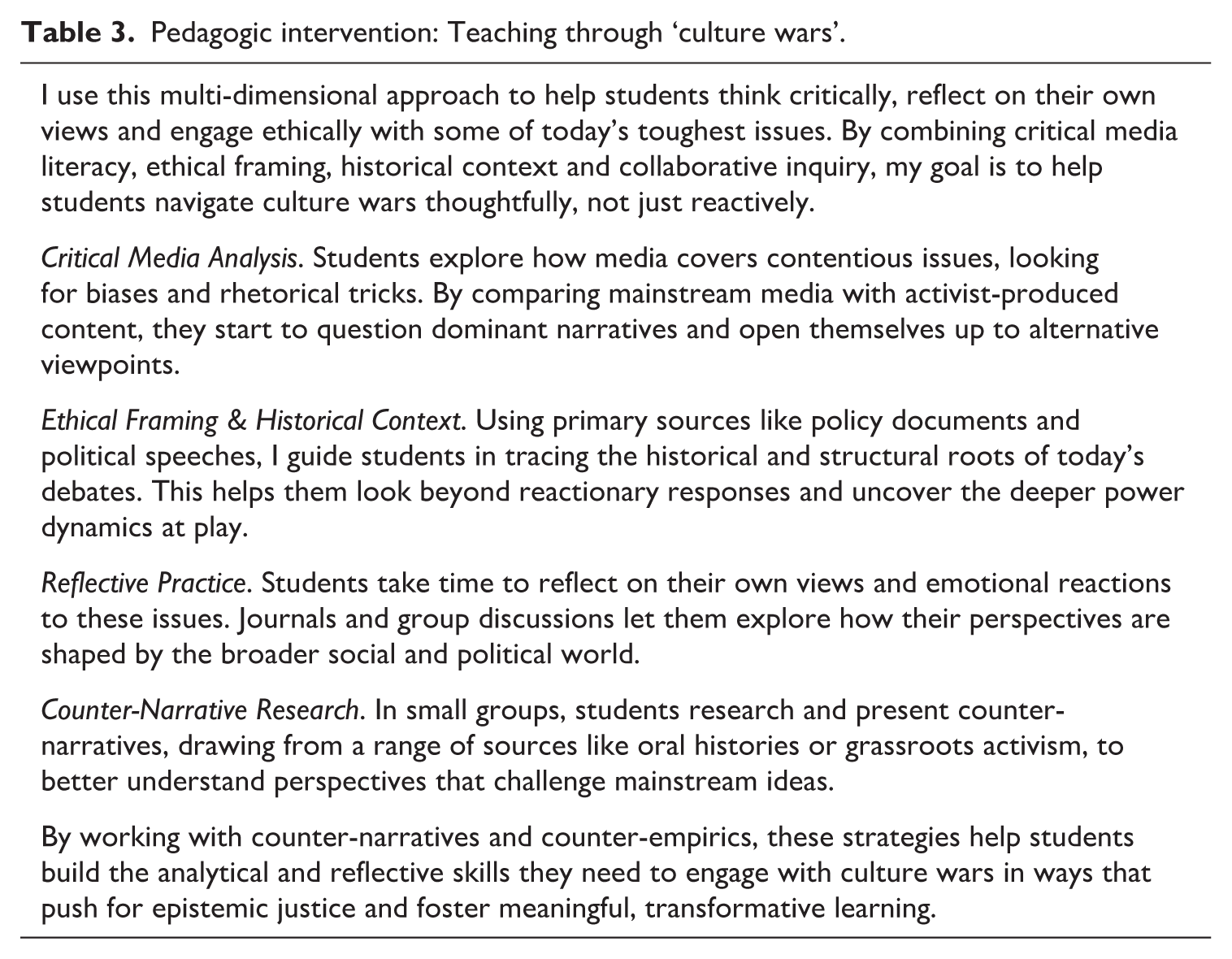
The example in Table 3 illustrates how pedagogic interventions can help students engage critically and ethically with the ideological battles of the ‘culture wars’.
Pedagogic intervention: Teaching through ‘culture wars’.
Knowledge Production in the Classroom
The politics of knowledge production are central to the critical pedagogical project, particularly when addressing the linguistic and systemic violence that underpins polarising ideological debates (Hadj Abdou and Pettrachin, 2021), both in the content we teach and in how we teach it. Historically, dominant narratives in academia have been shaped by western, white, male and heteronormative perspectives, which have been established as the canonical voices (Lenette, 2022). This hierarchical framing has long excluded and marginalised the contributions and experiences of underrepresented groups, resulting in an inequitable representation of what constitutes valid knowledge (Bhambra et al., 2018). As teachers committed to an ethically sound and politically aware pedagogy, we must interrogate not only whose knowledge we prioritise in our classrooms, but also how and why this prioritisation occurs. This requires careful reflection on the pedagogical tools we employ, to ensure that we do not inadvertently perpetuate the harm Stierl (2020) warns against – becoming complicit in the very structures we seek to dismantle.
Doing Good Harm with Counter-Stories
Redressing harm in knowledge production requires deconstructing harmful narratives and actively seeking out alternative epistemologies. Counter-stories and counter-empirics serve as vital pedagogical tools in this process, challenging dominant representations by repositioning and recentring marginalised voices as legitimate sources of knowledge (Blaisdell, 2021). This disruption of hegemonic narratives exposes systemic racism and oppression, offering a corrective to the mainstream discourse. Rooted in critical race theory, counter-narratives challenge the assumptions embedded in dominant academic frameworks, reshaping the discourse around race and identity (Delgado, 1989; Schulz et al., 2023). Blaisdell (2021) identifies four key aims of counter-narratives that align with critical pedagogy: unpacking power dynamics, reconstructing dominant narratives, fostering activism and driving social transformation. These aims go beyond critique; they represent proactive efforts to reshape knowledge production and dismantle entrenched hierarchies. As teachers, engaging with counter-stories requires an ethical approach – one that affirms these narratives as valid sources of knowledge (Tuhiwai-Smith, 2012).
However, working with counter-stories is not without its ethical challenges. Teachers and students must critically reflect on their positionality when engaging with these narratives. Are we merely extracting knowledge for academic purposes, or are we actively collaborating with these stories, recognising their intrinsic value? Furthermore, counter-stories often exist in non-traditional formats – such as oral traditions, poetry, music and other intergenerational modes of knowledge transmission – which challenge the boundaries of conventional academic knowledge. Incorporating these stories into the classroom necessitates rethinking the formats and frameworks of knowledge we use, ensuring that we do not tokenise or marginalise the very voices we seek to amplify.
Incorporating counter-stories requires an ethical praxis centring care to avoid perpetuating extractive practices for academic gain. A compelling example of learning from communities about how to do ethical engagement using counter-narratives comes from RISE (Refugees, Survivors and eX-Detainees), Australia’s first refugee-led advocacy organisation. Their manifesto, ‘10 THINGS YOU NEED TO CONSIDER IF YOU ARE AN ARTIST – NOT OF THE REFUGEE AND ASYLUM SEEKER COMMUNITY – LOOKING TO WORK WITH OUR COMMUNITY’ (RISE Australia, 2015) is a sharp critique (the capitalised heading shouts at us) of the growing trend among artists (and others) to seek participation from refugee communities for their projects. This manifesto expresses frustration with the performative ‘humanitarian’ claims often made by artists, which are framed as neutral and ‘safe’ but fail to acknowledge the biases, privileges and power dynamics inherent in their requests.
RISE’s manifesto directly challenges extractive knowledge practices and forces readers to engage with issues of power, accountability and representation. It is a powerful example of doing good harm – a critique that disrupts complacency, urging us to confront our own roles in the perpetuation of these dynamics. This example underscores the importance of ensuring that our pedagogical approaches do not simply extract knowledge from marginalised communities but rather engage with them in a manner that is collaborative, accountable and respectful.
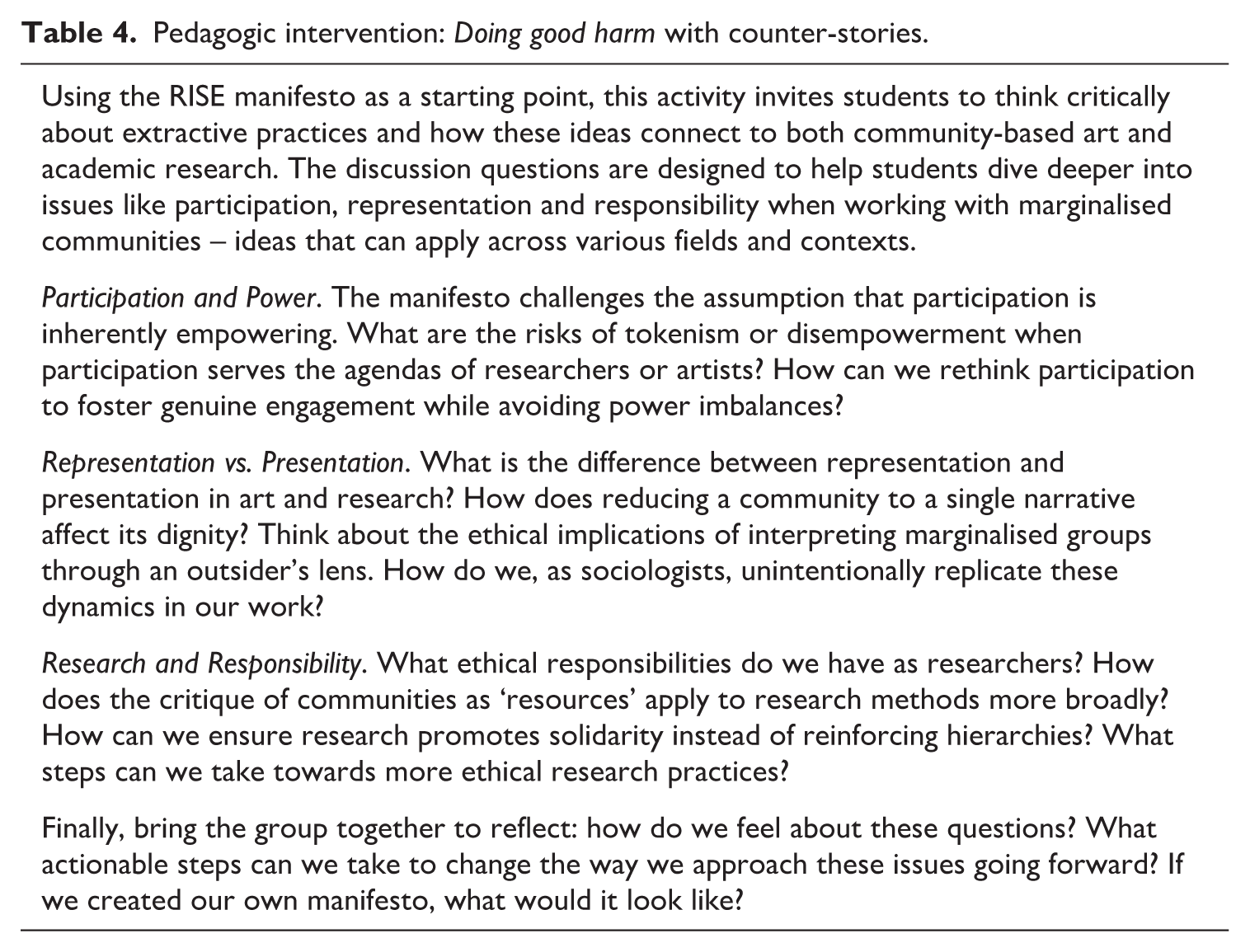
The example in Table 4 demonstrates how counter-stories can be used pedagogically to challenge extractive knowledge practices and foster ethical engagement.
Pedagogic intervention: Doing good harm with counter-stories.
Doing Good Harm with Counter-Empirics
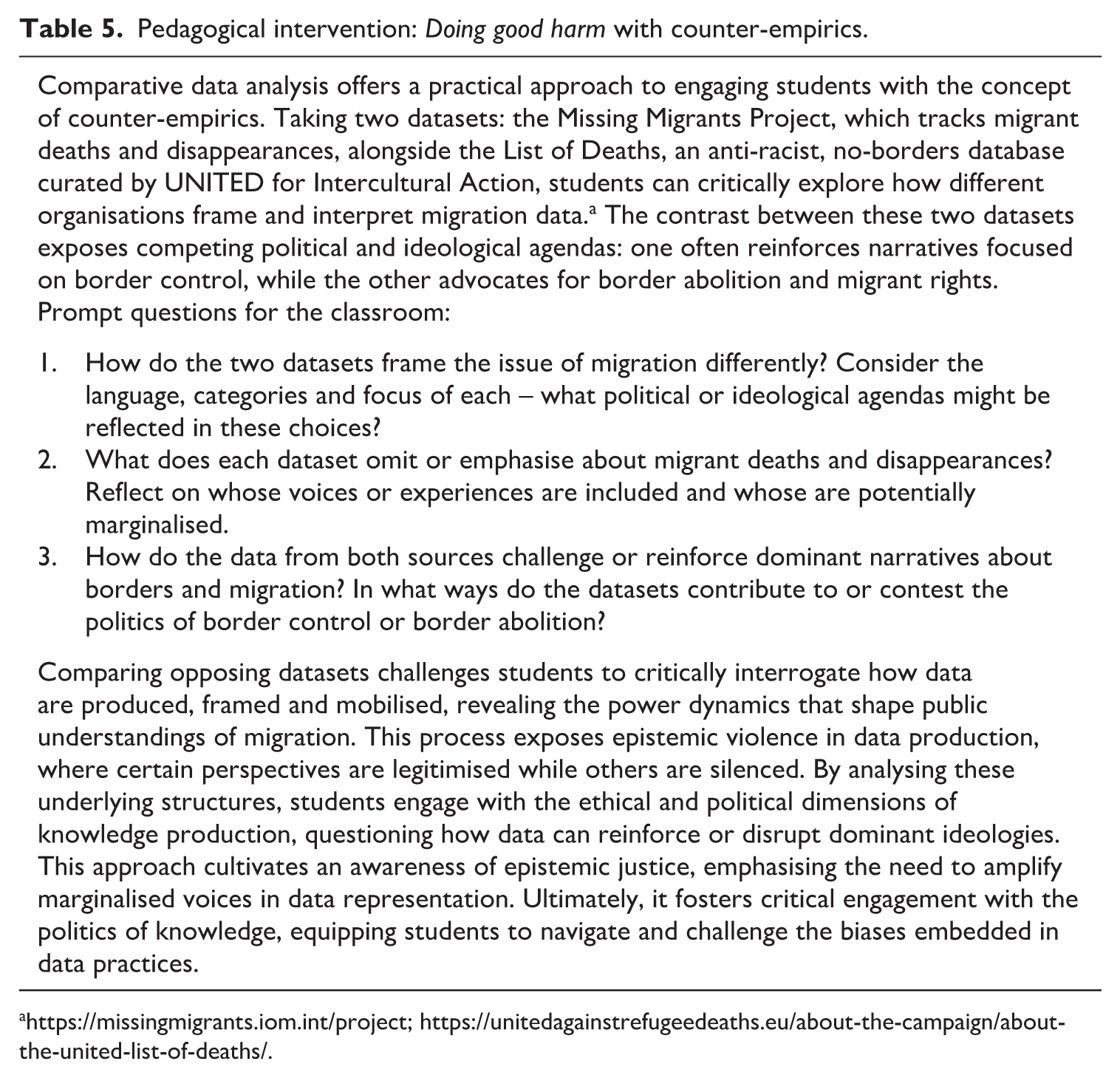
Counter-empirics offer an equally powerful pedagogical strategy of possibility, particularly in migration studies. In writing about knowledge produced by activists about the border, Pezzani and Heller (2013) describe counter-empirics as a ‘disobedient gaze’, which shifts the analytical focus from merely exposing clandestine migration – an issue that migration regimes already aim to surveil – to revealing the systemic political violence and human rights violations underpinning border control policies. This shift challenges state-centric narratives, highlighting the experiences of migrants, thereby disrupting dominant epistemologies. Examples of counter-empirical projects that can be integrated into the classroom include initiatives like Watch the Med, Forensic Architecture and StateWatch. 4 These activist-led efforts contest official state narratives by documenting human rights violations and exposing systemic abuses.
Building on counter-stories, the example in Table 5 illustrates how counter-empirics can be used in the classroom to interrogate dominant narratives, reveal epistemic violence and foster ethical, critical engagement with migration data
Pedagogical intervention: Doing good harm with counter-empirics.
By incorporating counter-stories and counter-empirics into our classrooms and ethically engaging with marginalised voices, we challenge the epistemological foundations of traditional academic knowledge production. This shift moves us away from top–down, hegemonic approaches to knowledge and towards a critical learning environment that prioritises both social and epistemic justice. In doing so, we create spaces where students can reflect on the power dynamics embedded in the production and dissemination of knowledge, engage with ideological struggles and actively participate in social change. Ultimately, this approach nurtures a deeper commitment to social justice and collective action.
Conclusion
This article has called for a fundamental rethinking of how we teach sociology in response to the social, political, economic and cultural crises of our time. As teachers, we must critically examine the politics of knowledge production, recognising that our pedagogical choices shape not only what is taught but also how power and inequality are reproduced – or dismantled – within the classroom. The demand for objectivity in social justice-oriented sociology often masks deeper ideological tensions, requiring us to confront the ways in which knowledge is framed, valued and contested.
At the heart of this pedagogical project is an engagement with discomfort – not as an obstacle but as a necessary condition for transformative learning. Discomfort emerges when students confront challenges to their worldview, especially when engaging with discussions on systemic inequalities and power dynamics, both in structural contexts and everyday life. Anger, guilt or frustration should not be dismissed as distractions but rather engaged as sites of critical reflection and political awakening. To cope with emotions, teachers must cultivate classrooms that embrace discomfort as a means of critical engagement, ensuring that students are equipped to interrogate dominant narratives as witnesses rather than passively consume them as spectators. However, this work must be done ethically, avoiding harm while fostering intellectual and emotional growth. By centring marginalised voices through counter-stories and counter-empirics, we enact positionality, care and epistemic justice in practice – embodying the ethical commitments that should be foundational to sociological pedagogy.
As hooks (1994) reminds us, education is not merely about transferring knowledge but about creating spaces for resistance, hope and transformation. And, as teachers, we are those ‘keepers of hope’. Teaching sociology today requires our collective commitment to epistemic justice, and valuing of activist and community knowledge alongside academic scholarship, ensuring that our classrooms are sites of radical possibility rather than spaces where dominant ideologies are possibly reproduced. By embracing pedagogic discomfort, interrogating knowledge hierarchies and prioritising ethical praxis, we enter a space doing good harm, and move beyond performative inclusivity to foster genuinely transformative learning experiences. In doing so, sociology classrooms can become spaces where students not only analyse the world but also imagine and work towards more just futures.
Footnotes
Funding
The author received no financial support for the research, authorship and/or publication of this article.
