




Abstract
A self-report questionnaire about past criminal behavior is presented here as a useful pedagogical tool to demonstrate the invalidity of crime rates, challenge stereotypes about criminals, exemplify policy problems, and personalize the ways in which race, gender, and class operate to disadvantage and advantage people in the administration of justice. Philip Reichel’s 1975 criminal activities checklist exercise, first published in Teaching Sociology, is updated pursuant to the Georgia 2016 criminal code. Additions include new laws around technology use (i.e., sexting, privacy, and piracy laws), substance use (pharmaceuticals and minor alcohol possession), criminalized driving offenses (aggressive driving and DUIs), and sex offenses. I found that most students in my classroom have violated a law. These findings, the findings of others who have administered similar checklists, and growing research suggest that crime commission is more the norm rather than the exception, and this gives instructors great opportunities to challenge student assumptions.
Making sociological concepts relatable in classrooms can be difficult, particularly in circumstances where prejudices dissuade reasoned discussion. Difficulties with students’ preconceptions, assumptions, and beliefs about criminals are often complicated by cultural constructions of criminalized people, which are often simply inaccurate. In an attempt to overcome such a problem, I have revised and used Philip Reichel’s (1975) criminal activities checklist, which helped him demonstrate that the study of crime and criminal behavior is essentially the study of our own behavior. “The criminal is not the large-eared, beady-eyed, hulking stranger hiding in the alley. Instead, he is the person sitting next to us in class, or looking back at us from the mirror” (Reichel 1975:83). From this vantage point, students are positioned to move forward with new eyes to examine segments on crime.
I draw directly from Reichel’s arguments that this pedagogical tool has great potential to illustrate the limitations of official crime rates, make sense of the social construction of laws, and challenge criminal stereotypes. I add that the tool is also useful for assessing justice policy effectiveness and for examining the roles of gender, race, and class differences in crime commissions, surveillance, and sanctions. Enabling the students to become a criminal is a pedagogical tool to elicit meaningful classroom discussions about these phenomena. This paper contributes a much-needed update to the checklist activity and offers a contemporary analysis of its contribution to sociological pedagogy.
I updated the checklist to match the current 2016 published Georgia criminal code (Criminal Code of Georgia 2016) and made it more relevant for people today, including laws around sexting, obscenity on social media, and illegal downloading and new laws around reckless and aggressive driving. I added prescription-drug and minor-possession laws that are increasingly relevant to young people.
The list is now 40 points, and the lesson can be completed in one 50-minute class period. However, it is best to revisit discussion throughout crime lessons. It works well with all class sizes. It is especially helpful in introductory classes, but it has also been used in advanced courses on crime. The checklist exercise is applicable in many social science or humanity courses. I argue that it is well suited for a student body that is socially distant from criminalized people; however, there may be unforeseen discoveries made by students in a variety of cultural spaces. This exercise is also valuable as a solidarity-building activist strategy and useful in political learning and training environments where exemplifying the prevalence of law breaking would be useful.
Crime Rates, Criminal Stereotypes, Justice Policies, and Disadvantage
Classroom techniques that make crime and its control more real for students have been useful (Hoffman, Webb, and Snell 1977; Wright 1998; Levy and Merenstein 2005) in challenging preconceptions about causes of crime (Williams, Rodeheaver, and Sethuraju 1995) and criminological theory (Osnowitz and Jenkins 2014). Few, however, draw upon students’ own law-breaking behavior to illustrate criminological concepts (Reichel 1975; Jacoby 1985).
It is well documented that the crime rates of the Uniform Crime Report (UCR), which uses arrest data, are far from accurate measurements of crime that occurs (Gibbons 1973; Lynch and Jarvis 2008). Self-reports may offer a more accurate representation of crime commission (Porterfield 1943; Wallerstein and Wylie 1947; Junger-Tas and Marshall 1999). Conducting the criminal activities checklist exercise in class illustrates this.
The social construction of a stereotypical, criminalized other occurs through the portrayal of offenders in mass media (Chambliss 1999; Brown 2009). Personal relations with offenders soften and deconstruct these damaging stereotypes (Hirschfield and Piquero 2010). In the absence of personal relations or experience with offenders, individuals commonly reduce the humanity and identification with those perceived as criminals (Presser 2014) and thereby limit and deny the possibilities of what criminals might be (Arrigo and Milovanovic 2009). This pedagogical border work allows the socially constructed offender to be perceived as more dynamic and capable of being something other than was previously understood (Woodall forthcoming).
The harms of incarceration affect individuals as well as communities. Barriers to housing, public assistance, and employment hinder successful reentry for the offender and ultimately infect our social fabric (Mauer 2002; Uggen, Manza, and Thompson 2006). With social distance comes increased penality and harms of reduction and repression (Arrigo and Milovanovic 2009). The consequences for people experiencing the social distance from interaction with the criminal justice system are related to increased punitiveness (Davila et al. 2011; Rowan 2012). The checklist activity gives students an opportunity to explore criminal justice policies as if they affect themselves.
Race, class, and gender all intersect to impact the type of crimes one commits, the likelihood of getting caught, the form of sentence received, and the experiences of reentry (Collins 1991; Daly 1996; Kennedy 1998; Fader and Traylor 2015; Reiman and Leighton 2015). The demographics of the students and their life experiences (including political and cultural leanings as well as previous lessons on inequalities) can influence how students interpret inequalities in the criminal justice system. When students can connect how the social forces of race, class, or gender impact their own behavior, they are more likely to make those connections to sociologically explain the behavior of others. Students become better armed to envision, interpret, and critique how the various aspects of their identity played a part in “getting away with it,” and students can more clearly envision what it would be like if they had been caught. This envisioning process facilitates discussion around all the intricacies of how their own characteristics of identity would intersect to privilege or disadvantage them further.
The Instrument
Using the basic structure of a questionnaire developed by Wallerstein and Wyle (1947), Reichel published his version of the tool in 1975. I used LexisNexis, accessed through Georgia’s state website, to develop the revised activities, codes, and maximum sentences. I wrote the Georgia code, a colon, and then a number. The checklist can be verified against other states’ criminal codes directly from the respective state’s legislative website. There is typically a search function on each state website that will locate each particular crime and give the respective maximum prison sentence. Recall that the point of the activity is not necessarily all about how many years the student owes in prison but just the fact that he or she has committed a crime. The number following the colon in Figure 1 is associated with the maximum number of years in prison for that crime (I do not let the students know that until they read all the laws down through the end of the list or until they complete the list as a worksheet). The numbers of years in prison that one can be sentenced to are maximums. The distribution of such a sentence entirely depends on the circumstances, the judge, the jurisdiction, the location, and other factors. I ask students to write down their engagement in that behavior since the age of 14 because, in Georgia, anyone over that age could be tried as an adult (but this varies from state to state).
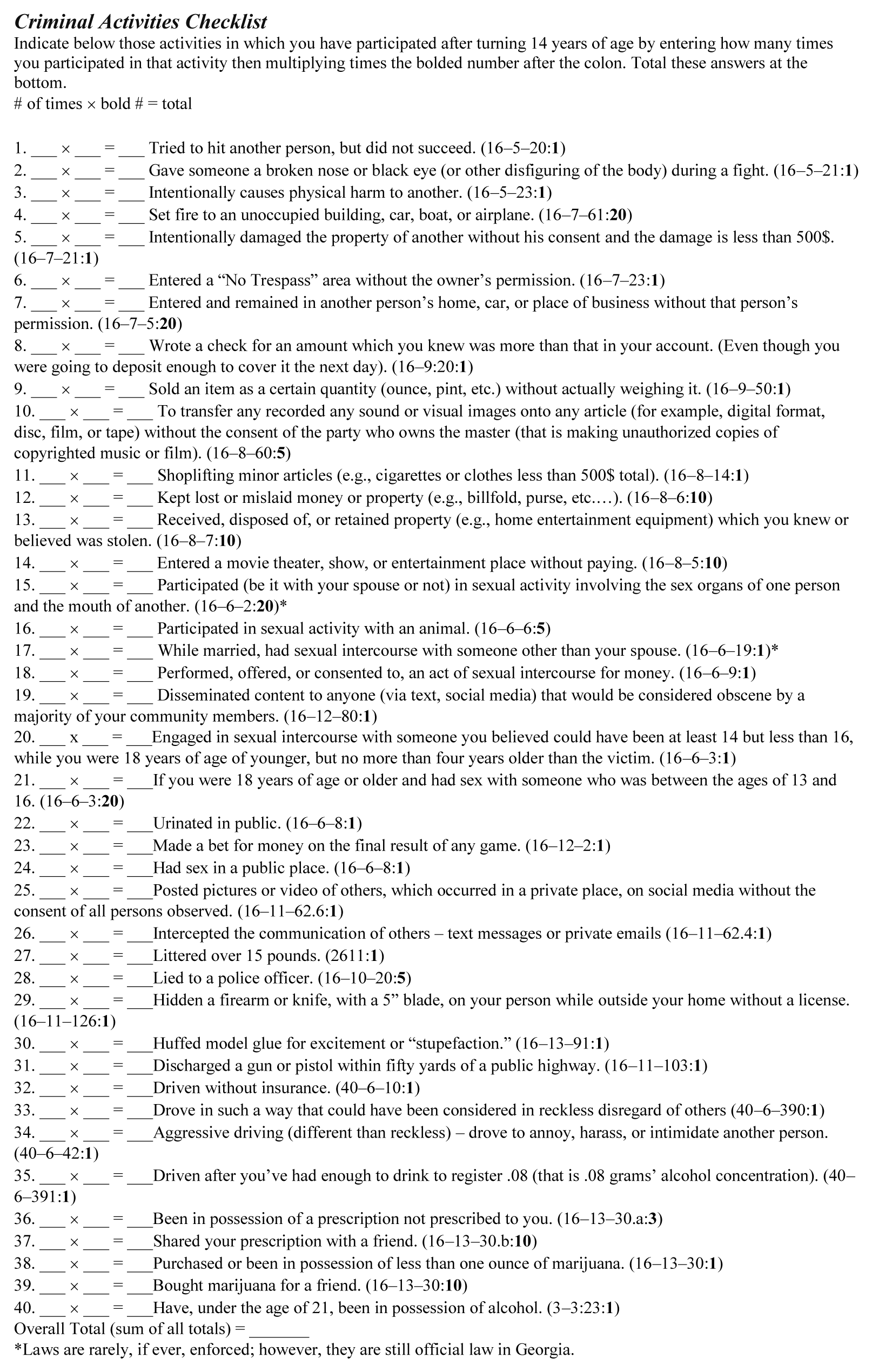
Criminal activities checklist.
The Instructions
Reichel distributed a form to each student and asked that the student respond to the instructions. The checklist is usable as a handout where students indicate how many times they can remember engaging in each activity, they need to multiply that times the bolded number following the colon for each crime, then they total at the end (see Figure 1). I prefer to read out loud the violations to the students to make the activity more interactive. I tell students that I am going to read a series of behaviors and that, if they have ever engaged in that behavior since the age of 14, they need to indicate it on their paper by writing down the number I tell them is associated with that activity. The number I read after each behavior is the number following the colon, which refers to the maximum number of years in jail or prison that one could receive for committing the act. Again, I keep that information to myself until the end of the exercise for engagement and impact.
I do not collect the sheets, and I make sure to tell students that they should not put any identifying information on their paper. After all, they are making admission to crimes. That sheet is for their use only. It is most important that they are honest for the exercise to be effective. It is not uncommon for students to want more information about the laws. There is quite a bit of haggling that occurs when I go through the list. I prefer to just suggest that they “tell it to the judge.” This usually generates a laugh. The point is that they have engaged in an activity that violates a written legal code. If they think they did something in their past that fits that description, then they need to write the number down. Once I get all the way through the checklist, I ask that they total up their numbers. This is usually a fun time to offer calculators or math tutors to help them with those. I then craftily deliver the bombshell that the number they have in front of them is the number of years they owe the state for their crimes. After much astonishment, I then ask for a show of hands to determine how many owe the state at least one year. Whether you use the verbal or the handout option, it is important that you ask for a show of hands of all those who owe the state at least one year for their crimes. The class needs to see how many other students have also engaged in arrest-worthy offenses.
Assessment
For safety and confidentiality concerns, I do not ask students in class to submit in writing how many crimes they have committed under any circumstances. I present here three potential assessments for use with this exercise: (1) ongoing expansion of students’ sociological imagination through their interpretations of real and hypothesized arrest scenarios in class discussion, (2) course content comprehension via graded essays requiring synthesis of the exercise experience and some specific class content, and (3) deconstructing of difference between students’ perceived self-identifications and criminal identities, increased empathy for incarcerated people, and reductions in punitive attitudes using pre- and posttest Likert scale surveys. All three assessment approaches may be used individually or in conjunction with one another. Your goals for using the exercise should determine which assessment is appropriate.
To assess the development of students’ sociological imaginations, I like to holistically assess the content of discussion. Questions I use include the following: Why do you think you were not caught? Do you think that there are any people in prison that engaged in the same behavior that you did but were caught and it affected their lives? Did you know anyone ever who committed a crime and his or her life was completely altered? Where would you be had you been caught? Do you think that your race, gender, or class affected why you got away with it? If you had been caught, would those aspects of your identity advantage or disadvantage you? How so? Do you think you are a bad person? Do you think some criminals are good? Does it make a difference that you can see how many of your classmates have also committed a crime? How does this affect you? In what ways are our crime policies hurting people/helping people? What could be done differently? If it was you who was directly affected, what would help you desist? How might a criminal record contribute to the temptation to commit more crime? Is there a criminal “nature?” What might be alternatives to sentencing? I sometimes put them in groups and grade the group to save class time, or I rate students’ sociological imagination, their ability to bring social forces into their explanations in class during discussion, on a scale of one to five. Although discussions went a variety of directions, I found students’ personal stories about friends whose lives were forever altered by an arrest quite useful. Students were often able to envision similar fates for themselves. Also, students were able to recognize how certain aspects of their identity shielded them from arrest. The majority of my students scored highly on this discussion exercise primarily because they often invoked explanations of how social pressures contributed to heir own behavior and were more apt to extend those explanations to others.
To assess how students synthesize their experience with content learned in class, I use assessed essays, each one requiring integration of at least one concept covered in my class. I typically expect students to have gained insight into a number of topics. The following essay questions illustrate useful approaches: (1) What does your outcome on the exercise say about official crime rates? (I expect them to talk about the UCR’s inaccuracy or the “dark figure” of crime.) (2) Explain what your total says about the social construction of laws. (I expect to see something about how laws can vary over time and place, perhaps mentioning symbolic interactionism or culture if we have covered those.) (3) How did this exercise challenge the stereotypes about who a criminal is? (I hope to see something about the construction of difference and statements that challenge essentialist ideas.) (4) Where would you be now had you gotten caught and how effective do you think social justice policy is? (I expect them to mention concepts like recidivism, stratification, or secondary deviance and to illustrate how social institutions operate together to generate inequality.) (5) Thinking about gender, race, and class inequalities, was there something specific about your gender, race, or class that contributed to your behavior or why you were not caught and what might have gone differently for you if you were sanctioned? (I expect them to acknowledge a privilege or a disadvantage in their essay.) I found that students often reconceptualized their definition of a criminal from being just a law breaker to something much more nuanced. Students also quite clearly envisioned and described their own alternate trajectory had they gotten caught, and they offered firm explanations about how their race or class operated to prevent arrest.
To assess transformation of attitudes, I examined punitive attitudes and identity change before and after the exercise. Three statements I ask students to rank on a 5-point Likert scale are “I am the same kind of person as a criminal,” “Criminal records should hold a lot of weight in considerations for employment,” and “I will support more humane responses to crime now that I know I too have broken the law.” Students turn in the pre- and posttest surveys with their names identified, enabling the study of change in attitudes over time. Students’ identification as “the same type of person as a criminal” increased, and their punitiveness decreased following the exercise.
I conducted a study of change in students’ identities and punitive attitudes at the opening of the crime segments in my Introduction to Sociology and Social Problems classes. Dummy-coded agree frequencies recorded before and after the exercise were compared. Strongly agree and agree responses were collapsed into the agree category. Of 209 students, 59 percent agreed they were not like a criminal prior to the exercise; this number decreased to 25 percent following it. Agreement that a criminal record should hold a lot of weight in employment considerations dipped from 54 percent support prior to the exercise to 39 percent after. Then, 52 percent of students agreed with the post-exercise statement, “I will support more humane responses to crime now that I know I too have broken the law.” The posttests were administered at the beginning of the following class period. More extensive analysis was conducted by Woodall (forthcoming).
In my research, 286 out of 297 students owed the state at least one year for their crimes. The study began as an estimate of the proportion of my students who engaged in unprosecuted criminal behavior; the identity and punitive measures were added in an amendment later. Over the years, checklists of this sort continuously reveal that most students owe the state at least a year (Porterfield 1943; Wallerstein and Wyle 1947; Reichel 1975). Although the sampling and collection is not rigorous, data provide immediate evidence of widespread prevalence of criminality in the larger population.
Conclusion
Following the activity, students articulated understanding about the vast underestimate of crime by the numbers, they seriously questioned the construction of laws, they rethought what a criminal is, and they examined how they have been defining that term and classifying people. Students began to deeply question the existence of harsh penalties for what they perceived as relatively harmless violations of formal code versus egregious acts of harm. They began to express that they had harbored preconceived notions about criminals and had not thought much about where they themselves would be today had they been caught. As Emily Baxter (2014), founder of the organization We Are All Criminals, says, “They realized they have had the luxury to forget.” Students became very critical of policy and became passionate about changing the system of punishment. Although more research is needed to determine the extent to which change can be attributed to the activity, the evidence suggest that they became excited about restorative justice measures, reductions in sentencing, and more humane responses to crime. They reported feeling more compassion toward criminals now that they know they, too, have committed crimes. They became more cognizant of the role of their race and of the myriad other factors that contributed to their “getting away with it.” They could clearly see how, if they had been caught and criminally marked, they might have had trouble getting a job and, perhaps, they would not even be in college at all. They understood intersectionality a bit more, as they could see more clearly how their race, class, and gender work to their advantage. Students in every class, every semester, list this activity as one of the most transformative of the semester. They go forward into the world with fresh eyes on criminality that they likely will not have the luxury to forget again.
Footnotes
Editor’s Note
Reviewers of this manuscript were, in alphabetical order, Michael Lenza, Beth Merenstein, and Sadie Pendaz-Foster.