




Abstract
Official sanctioning of students by the criminal justice system is a long-hypothesized source of educational disadvantage, but its explanatory status remains unresolved. Few studies of the educational consequences of a criminal record account for alternative explanations such as low self-control, lack of parental supervision, deviant peers, and neighborhood disadvantage. Moreover, virtually no research on the effect of a criminal record has examined the ‘‘black box’’ of mediating mechanisms or the consequence of arrest for postsecondary educational attainment. Analyzing longitudinal data with multiple and independent assessments of theoretically relevant domains, the authors estimate the direct effect of arrest on later high school dropout and college enrollment for adolescents with otherwise equivalent neighborhood, school, family, peer, and individual characteristics as well as similar frequency of criminal offending. The authors present evidence that arrest has a substantively large and robust impact on dropping out of high school among Chicago public school students. They also find a significant gap in four-year college enrollment between arrested and otherwise similar youth without a criminal record. The authors also assess intervening mechanisms hypothesized to explain the process by which arrest disrupts the schooling process and, in turn, produces collateral educational damage. The results imply that institutional responses and disruptions in students’ educational trajectories, rather than social-psychological factors, are responsible for the arrest–education link.
School completion represents a critical marker in the transition to adulthood, perhaps now more than ever as stratification by education continues to increase. Because delays in education or its cessation altogether can significantly alter life trajectories related to work and family formation, it is critical to understand the sources of educational attainment.
The purported causes of educational disadvantage are many, but one long-hypothesized factor has received little rigorous attention: official sanctioning by the criminal justice system. Empirical inattention to the educational consequences of criminal justice sanctions for students is puzzling given the high prevalence of arrest among young Americans, particularly urban male African Americans (Hirschfield 2009; Kirk 2008; Western 2006). Indeed, 9 of every 100 male youth aged 10 to 17 years are arrested annually in the United States (Office of Juvenile Justice and Delinquency Prevention 2009). In Chicago, as in many metropolitan areas, the rate is considerably higher, with a rate of 15 arrests per 100 male youth (or roughly 25,000 arrests each year) (Chicago Police Department 2006). One-quarter of these arrests occur in school.
There are several theoretical reasons to expect that official interventions such as juvenile arrest have consequences for educational attainment. Social control theory implies that weak bonds to school exacerbate problem behaviors such as truancy and school dropout. If the arrest of a student independently fosters alienation and weakened attachment to school, arrest may indirectly lead to dropping out. Rational choice theories suggest that students may drop out of school or opt not to enter college following arrest because they assess (perhaps correctly) that the touted benefits and added utility of education are not likely to materialize given the stigma of a criminal record. Dropout may follow arrest because of status frustration: A criminal record may make it harder for a student to compete against noncriminal schoolmates, with dropout serving as a solution to this status frustration (Elliott 1966; Elliott and Voss 1974).
Perhaps the most salient prediction comes from labeling theory, which asserts that being officially designated a “criminal” changes the way educational institutions treat students. In the interest of accountability and school safety, students with criminal records may be pushed out of high school through exclusionary policies, and they may be segregated into specialized programs for problem youth (Kirk and Sampson 2011). The stigma of a criminal label may also damage social relationships, thereby leading to rejection from teachers, parents, and prosocial students (Lemert 1951). Similarly, labeled offenders may face diminished prospects of enrolling in college because of unstated admission criteria as well as an inability to secure financial aid. Arrest may also reduce chances for high school graduation and college enrollment because time spent in court, in juvenile detention, or reporting to a probation officer leads to absences, a blemished transcript, and an unstable educational trajectory.
There are important counterarguments to these predictions, however. The most prominent is that arrest and educational attainment are spuriously correlated, with each explained by a third factor such as low self-control. Gottfredson and Hirschi (1987) are strong proponents of this view, arguing that the “apparent ‘effect’ [on future delinquency] of criminal justice processing is merely an artifact of ‘selection bias’” (pp. 601-602). In this view, external events such as an arrest do not influence dropout or other forms of future delinquency, because delinquency is the product of a stable propensity established early in life. By failing to account for variation in self-control, researchers, Gottfredson and Hirschi (1987, 1990) have argued, have erroneously concluded that criminal justice sanctions have labeling effects that produce continued delinquency. In addition, there are reasons to suggest that arrest may lead to a decline in the likelihood of dropout. Juvenile arrests that result in probation may carry a mandate of school attendance to avoid conviction (Mayer 2005). Compulsory attendance of this form may thus potentially strengthen attachments to education and lessen the likelihood of dropout.
In this study, we aim to adjudicate among these competing hypotheses by examining whether and why juvenile arrest contributes to later school dropout and hinders the prospects of college enrollment. We argue that, compared with incarceration, arrest is more “random” or variable in the juvenile population and therefore offers increased analytic leverage in estimating causal effects of criminal sanctioning. Incarceration is the last step in criminal justice processing, such that individuals who make it to prison are for the most part so unlike the general population that counterfactual comparisons are difficult to make (Loeffler 2011). Exploiting this relative difference in randomness, we use individual-level propensity score matching to answer three main research questions: (1) Does juvenile arrest increase the likelihood of later high school dropout? (2) If so, why does arrest hinder educational attainment among high school students? and (3) Does arrest independently diminish the likelihood of college enrollment among young adults?
Criminal Stratification and the Life Course
In Punishment and Inequality in America, Bruce Western (2006) detailed the systemic consequences of “mass incarceration” and the prison boom of the 1990s and 2000s on social inequality, in particular as it relates to wages, employment, and family life. He noted that the risk for imprisonment is concentrated in one social group: black male high school dropouts. Roughly 60 percent of this segment of society can expect to spend time in prison by age 34 (Western 2006:27). But this is a lifetime prevalence estimate, and most adult prisoners have accumulated long criminal records that set them apart from their nonprison counterparts (Blumstein et al. 1986), making it difficult to directly assess the unique experience of being in prison from confounding factors.
In our view, the stratifying mechanisms that sort lower-class blacks and Latinos from middle-class groups occur earlier than incarceration and, we argue, are embedded in educational failure as well as characteristics of neighborhood, school, family, and peer context. Although we do not deny the negative consequences that a term of imprisonment can have for one’s life-course prospects, well before reaching an adult penitentiary, most offenders have already traveled a path that includes juvenile crime, arrest, and ultimately educational failure. In this sense, prisons may be the warehouses for containing those segments of society already marginalized, in contrast to being the primary source of that marginalization (see also Wacquant 2000). If this is true, the causal effect of incarceration may be smaller than originally anticipated (Loeffler 2011). Our goal in this study is therefore to look directly at the stratifying consequences of events that come earlier in the life course than incarceration. Again, it is not that imprisonment is inconsequential but rather that the story of punishment’s salient role in shaping inequality in America should begin with an investigation of the potential “turning-point” consequences of juvenile arrest.
A large and convincing body of research dating back to the 1940s documents that a majority of adolescents engage in some form of delinquent behavior (e.g., Porterfield 1943; Short and Nye 1957, 1958; Wallerstein and Wyle 1947), with rates of delinquency peaking in late adolescence and declining precipitously thereafter (Gottfredson and Hirschi 1990; Sampson and Laub 1993). An equally compelling body of research reveals that only a small proportion of all delinquent acts come to the attention of the police, and of those that do, only a small proportion result in arrest. In their classic study, for example, Black and Reiss (1970) found that only 15 percent of police contacts with juveniles resulted in arrests, providing evidence of considerable discretion on the part of police. Although arrest in theory requires that a crime was committed, most criminal incidents do not end in arrest. Akin to the paradox identified by Lee Robins (1978) whereby most teenage delinquents do not become adult criminals, even though virtually all adult criminals were juvenile delinquents, virtually all arrestees have committed crimes, but far from all those committing crimes are arrested. The commonality of delinquency combined with the stochastic nature of arrest in the adolescent life course has potentially major consequences.
Life-course theories of cumulative disadvantage provide an orienting framework for analyzing the consequences of early contact with the criminal justice system and the remarkable continuity in problem behavior over the life course. Sampson and Laub’s (1993, 1997) theory of sanctions is derived from a linkage of social control (Hirschi 1969) and labeling (Becker 1963; Lemert 1951) theories with life-course principles about stability and change. A key hypothesis is that once an individual is labeled a deviant (e.g., through an arrest record), a variety of detachment processes are set in motion that promote the likelihood of further deviance, including school dropout, and lessen an individual’s likelihood of a successful transition to adulthood. Sampson and Laub (1997) thus argued that official sanctions serve as a negative turning point:
Cumulative disadvantage is generated most explicitly by the negative structural consequences of criminal offending and official sanctions for life chances. The theory specifically suggests a “snowball” effect—that adolescent delinquency and its negative consequences (e.g., arrest, official labeling, incarceration) increasingly “mortgage” one’s future, especially later life chances molded by schooling and employment. (p. 147)
Similarly, Moffitt (1993:684) described how some delinquents become “ensnared” by the consequences of their antisocial behavior, thereby narrowing the opportunities available to them to follow a prosocial behavioral repertoire. The snare of arrest may be an irrevocable event that drastically curtails a delinquent’s opportunity to “go straight.”
Mechanisms Leading to High School Dropout
How exactly would the stigma of an arrest record hinder the likelihood of high school graduation? One potential answer is found in the institutional reaction to arrest. Research shows that relations with school staff members and teachers strongly influence student outcomes such as academic engagement, achievement, discipline, and dropout (Cernkovich and Giordano 1992; Jordan, Lara, and McPartland 1996). To the extent that the arrest of a student signals to teachers the difference between “normal” delinquency and serious misconduct, it may trigger adverse reactions by school staff members and further alienation from school, in turn leading to high school dropout through the weakening of social bonds (see Hirschfield 2003).
In addition to such indirect pathways to dropout, criminal students may be directly excluded from school in the name of institutional accountability and school safety. Urban schools face an enormous challenge in fostering a safe learning environment while trying to provide an education to those students most at risk for crime and educational failure (Kirk and Sampson 2011). It is increasingly the case that schools, as rational organizations, promote policies and practices designed to demonstrate legitimacy and effectiveness (Hirschfield 2008b; Mayer 2005; Riehl 1999). Indeed, Mayer (2005) reported, on the basis of interviews with expert informants in the Chicago Public Schools (CPS), that the primary reason principals work to exclude criminally involved students from school is accountability: Test scores, truancy rates, and graduation statistics are all believed to be adversely affected by reenrolling students who have had contact with the criminal justice system. Moreover, one component of the No Child Left Behind Act is a mechanism providing students in “persistently dangerous” primary and secondary schools the opportunity to attend a safe school. One means to demonstrate legitimacy is to exclude those students who detract from a school’s appearance as a safe, effective school.
For a school to act on knowledge of a student’s criminal record necessarily requires that the principal or school staff be aware of the arrest. Even though juvenile records are typically sealed, there are a variety of routes by which school officials may become aware that a student was arrested. First and foremost, one-quarter of arrests of Chicago juveniles occur on school grounds (Chicago Police Department 2006). The highly visible nature of on-campus arrests leads to much stigmatizing potential. Recent ethnographic evidence also reveals an increasingly visible role for police discipline within the school (Nolan 2011). Second, Chicago youth who are detained in a juvenile facility must attend an alternative high school operated by CPS while detained. Upon an individual’s release from detention, the alternative high school contacts the school the student attended prior to arrest to notify the school of the student’s location (Mayer 2005). Third, a sizable number of delinquency cases that are referred to the juvenile court following arrest will result in a sanction of probation, with a condition mandating that the youth attend school. Schools may thus become aware of a student’s criminal behavior if the probation officer checks on the student’s attendance. Last, although direct evidence is hard to come by, it is likely that teachers become aware of student gossip and social interactions about who gets in trouble with the law.
In Chicago, once school officials are aware of a student’s arrest, there are exclusionary policies in place that can be used to expel the student. For example, students in violation of group 5 or group 6 acts of misconduct under the CPS Student Code of Conduct may be expelled from school and assigned to Alternative Safe Schools (Chicago Public Schools 2009b). Group 5 and group 6 acts involve serious criminal behavior either on or off school grounds, which may include arrest. As Mayer (2005) observed through interviews with school officials, such exclusionary practices are readily used: “Informants inside and outside of the Chicago Public Schools opined that court-involved youth were unwelcome at regular public schools and that the schools found ways to exclude them” (p. 4). Even though juvenile arrest has become relatively commonplace in some schools and neighborhoods, school officials still have ample reasons, including accountability and school safety, for excluding problem students.
Hirschfield (2003, 2008a) offered a potentially contrasting view of the use of exclusionary practices: Arrests are so common among the students of some schools that arrest has become normalized, with little stigmatizing influence. He presented evidence from qualitative interviews showing that arrested students reported little resistance from schools to returning or reenrollment following their criminal sanctioning. Hirschfield (2003) noted that many arrests of Chicago youth are for petty crimes and even “bogus” charges and concluded that arrests “become an unreliable gauge of student character” (p. 347). We agree, but even if an arrest merely validates a preexisting “deviant” reputation and does not further affect the student’s reputation, this official validation may be the ammunition necessary for a school to initiate exclusionary practices against students they have long assumed were deviant. Hirschfield’s (2003, 2008a) student-focused account is thus not as divergent as it might first appear from Mayer’s (2005) evidence garnered from school officials about the use of exclusionary practices. In particular, informal status hierarchies among students might not penalize arrest, but to those charged with institutional control, arrest constitutes an official marker of state judgment (see also Nolan 2011). To the extent that reactive exclusionary policies of expulsion or assignment to alternative programs creates educational instability, frays a student’s bonds to school, or facilitates association with deviant role models, school dropout may be the end result (see, e.g., Bowditch 1993; Kelly 1993; Skiba and Peterson 1999).
In addition to the factors such as school exclusion practices that push arrested teens to drop out, time spent moving through criminal case processing (i.e., arrest, detention, prosecution, and probation) is time lost from the educational process (Hirschfield 2003, 2009; Sullivan 1989). Even if students are allowed to remain in school following arrest, they may miss so many classes and exams because of criminal case processing that they inevitably fail a grade. Given that grade retention is one of the most robust predictors of school dropout (see, e.g., Janosz et al. 1997; Rumberger 1987), the end result of time away from the classroom could be dropout. In addition to dropping out because of grade retention, students may be automatically dropped from school because of excessive absences from, for example, time spent in a juvenile detention facility (Allensworth and Easton 2001; Chicago Public Schools 2006).
Finally, in addition to the largely involuntary paths to dropout such as school exclusionary policies, a student may voluntarily drop out of high school following arrest because of a loosening of his or her social bonds to school and school actors. Moreover, a student may voluntarily drop out because he or she rationalizes that the benefits of education are diminished given the stigma of a criminal record. As Morgan (2005) argued in his revision of the Wisconsin model of status attainment (Sewell, Haller, and Portes 1969), educational attainment is the product of educational expectations and is therefore contingent on the factors that shape one’s beliefs about the future. We argue that a criminal record is one such contingent factor. There is convincing evidence that contact with the criminal justice system, even when arrest results in acquittal instead of a criminal conviction, limits future employment opportunities (e.g., Pager 2003; Schwartz and Skolnick 1962). Therefore, it is rational to presume that the returns to education would be diminished by a criminal record. If assessments about returns to education are a basis of educational expectations and educational expectations determine educational attainment, as the Wisconsin model predicts, then arrest may inhibit educational attainment by lessening educational expectations.
College Enrollment
Although rarely studied, the negative educational consequences of arrest may extend beyond high school. For those individuals who graduate from high school despite arrest records, their educational transcripts may be marred by poor attendance and grades because of time spent navigating the criminal justice process or because of disciplinary infractions, thereby limiting their competitiveness in the college admission and financial aid process. In this case, the relatively more open admissions standards at two-year colleges may present a more viable route to higher education than a four-year school. In addition, high school staff members, particularly guidance counselors, may have little motivation for dedicating institutional resources toward preparing criminally inclined students for college. Similarly, if criminal arrest and subsequent sanctioning alter one’s family and peer network, then loss of social support may render college attainment a relatively more elusive goal.
In addition to the many student-centered reasons underlying the potential negative consequences of arrest for college enrollment, institutional mechanisms may also contribute to a lower likelihood of enrollment. The Chronicle of Higher Education (Lipka 2010) reported that more than 60 percent of U.S. colleges consider applicants’ criminal histories when making admissions decisions. The Common Application, which more than 450 U.S. universities and colleges use, added an admissions question in 2006 asking applicants if they had ever been convicted of a misdemeanor, felony, or other crime (Common Application 2011; Jaschik 2007). This information can then be used as a screening tool to deny admissions, presumably to dangerous individuals. 1 Some individual schools, such as the University of Illinois, ask for information about pending charges as well. Other schools go further by asking some applicants to furnish criminal-background checks, which may include information about arrests as well as convictions. In 2009, the University of North Carolina-Wilmington asked 10 percent of its applicants to submit such background checks and denied admission to all applicants who failed to submit the information (Lipka 2010). Regardless of whether educational institutions actually use criminal history information in admissions decisions, prospective applicants may assume that they do and therefore not even apply.
Policies denying educational benefits to ex-offenders are another form of institutional barriers to college enrollment. The Higher Education Act of 1965, as amended by the Higher Education Act of 1998, suspended higher education benefits for adults convicted of misdemeanor or felony drug charges (sale or possession of drugs). Denied benefits included student loans, Pell Grants, Supplemental Educational Opportunity Grants, and Federal Work-Study (U.S. Government Accountability Office 2005). 2 Without financial aid, some proportion of prospective students will not enroll in college, and some admitted students will not finish. Because racial-ethnic minorities are substantially more likely to be convicted of a drug offense than whites, these financial aid restrictions exacerbate educational inequality (Wheelock and Uggen 2008). In sum, there are several institutional mechanisms in place that make arrest, and especially subsequent conviction, a significant hurdle for college attainment.
Prior Evidence
Although limited, initial answers exist to some of the questions posed in the introductory section. Bernburg and Krohn (2003) found that police intervention, in the form of arrest and contact with the police, decreases the odds of high school graduation by over 70 percent. Sweeten (2006) found that a first arrest in high school nearly doubles the likelihood of dropping out. Hjalmarsson (2008) estimated that arrested individuals are 11 percentage points less likely to graduate high school than those not arrested. De Li (1999) and Tanner, Davies, and O’Grady (1999) similarly found a negative relationship between criminal justice contact and educational attainment.
Although these studies are informative, important questions and challenges remain. First, the observed correlations between arrest and school dropout or graduation may be explained by alternative, unmeasured factors. For example, low self-control, a lack of parental supervision, deviant peers, or neighborhood disadvantage may inflate the estimated relation between arrest and educational attainment in these studies. There are surprisingly few studies that account for such confounding, especially in a life-course or longitudinal framework. Hjalmarsson (2008) showed that this may be consequential, estimating in a sensitivity analysis that the observed relation between arrest and high school graduation in her study would all but disappear because of unobserved factors that influence both graduation and arrest. Absent an experiment, which would pose its own challenges to causal inference and policy relevance (Manski 2009), the challenge in disentangling the relation between arrest and educational attainment is to assemble a data repository that contains information on the many individual, family, peer, neighborhood, and school factors that jointly predict juvenile arrest and educational attainment.
A second challenge is the lack of empirical work that examines the effect of arrest on college enrollment. 3 What little information is available is largely descriptive and provides estimates of the number of prospective students affected by “tough on crime” policies designed to deny financial aid to drug offenders (U.S. Government Accountability Office 2005; Wheelock and Uggen 2008). Given the importance of a college education for future employment and earnings, it is imperative to understand to what extent arrest influences this aspect of the transition to adulthood.
A recent study by Hirschfield (2009) addressed many of the limitations of prior research on educational attainment, at least with respect to high school dropout, and provides an important advance in understanding the consequences of arrest. Using a variety of quasi-experimental analyses designed to reduce the potential for selection bias, Hirschfield found considerable evidence that arrest during high school leads to school dropout. Hirschfield’s sample was taken from an evaluation of Comer’s School Development Program in Chicago (see Cook, Murphy, and Hunt 2000), which targeted public schools in severely segregated and impoverished neighborhoods. What remains to be tested about the consequences of juvenile arrest is the effect, net of confounding influences, in a representative sample of adolescents, neighborhoods, and public schools that characterize contemporary urban school districts in the United States and whether and why any collateral damage from an arrest influences both secondary and postsecondary educational attainments.
Strategy and Summary of Hypotheses
An understanding of inequalities in the transition to adulthood and beyond necessitates situating our study within several literatures: life course, stratification, education, and criminology. Important work has disentangled the stratifying consequences of incarceration (e.g., Western 2006), yet in our view, a focus on incarceration tends to overlook important events taking place earlier in the life course that put some individuals on the path to prison. Indeed, the age of onset of criminal offending for prisoners is in the teens (Blumstein et al. 1986), so to better understand the origins of life-course disadvantage, we start there. Our strategy is thus to shift the focus to late adolescence and assess whether and why early contact with the criminal justice system delays or alters the transition to adulthood for American youth in high school completion and college enrollment. We test the following hypotheses:
Hypothesis 1: Arrest has an independent, positive effect on high school dropout above and beyond the influence of individual, family, peer, neighborhood, and school correlates.
Hypothesis 2: The effect of arrest on high school dropout is mediated by declines in educational expectations, school attachments, and friend support following arrest.
Hypothesis 3: Arrest has an independent negative effect on enrollment in college, net of the effect on high school graduation.
Data
We use a multiple-wave research design that combines individual-level data from the Project on Human Development in Chicago Neighborhoods Longitudinal Cohort Study (PHDCN-LCS), the Chicago Police Department, the Illinois State Police, and the CPS with neighborhood- and school-level data from the U.S. census, CPS, and the PHDCN Community Survey. This unique assemblage of data brings together information on the organization and functioning of neighborhoods, families, and schools with data on individual-level characteristics and behaviors.
As part of the PHDCN-LCS, seven cohorts of children and their primary caregivers were randomly selected on the basis of a clustered multistage probability design and interviewed up to three times. 4 Wave 1 of the survey was completed between 1995 and 1997, wave 2 between 1997 and 2000, and wave 3 between 2000 and 2002. The interval between interviews was about 2.5 years. The focus of our analysis of high school dropout is on the 12-year-old and 15-year-old cohorts; these youth were approximately 18 and 21 years old by the end of the data collection in 2002. For our examination of college enrollment, we draw on data from the 15-year-old and 18-year-old cohorts, who were approximately 21 and 24 years old by the end of the data collection. The PHDCN-LCS data contain a wealth of information on youth and family characteristics, including data on IQ, school enrollment, college enrollment, grade retention, disobedience in school, family structure and supervisory processes, parental educational attainment and sociodemographic characteristics, peer characteristics, and criminal offending (see Tables 1 and 2 for a list of the youth, family, and peer characteristics we measure). Importantly, these cohort data also contain indicators of youth’s neighborhood of residence and school of attendance, allowing us to combine the data with other information about the characteristics of Chicago neighborhoods and schools.
Covariate Balance Before and After Matching, Individual-level Characteristics, 12- and 15-year-old Cohorts
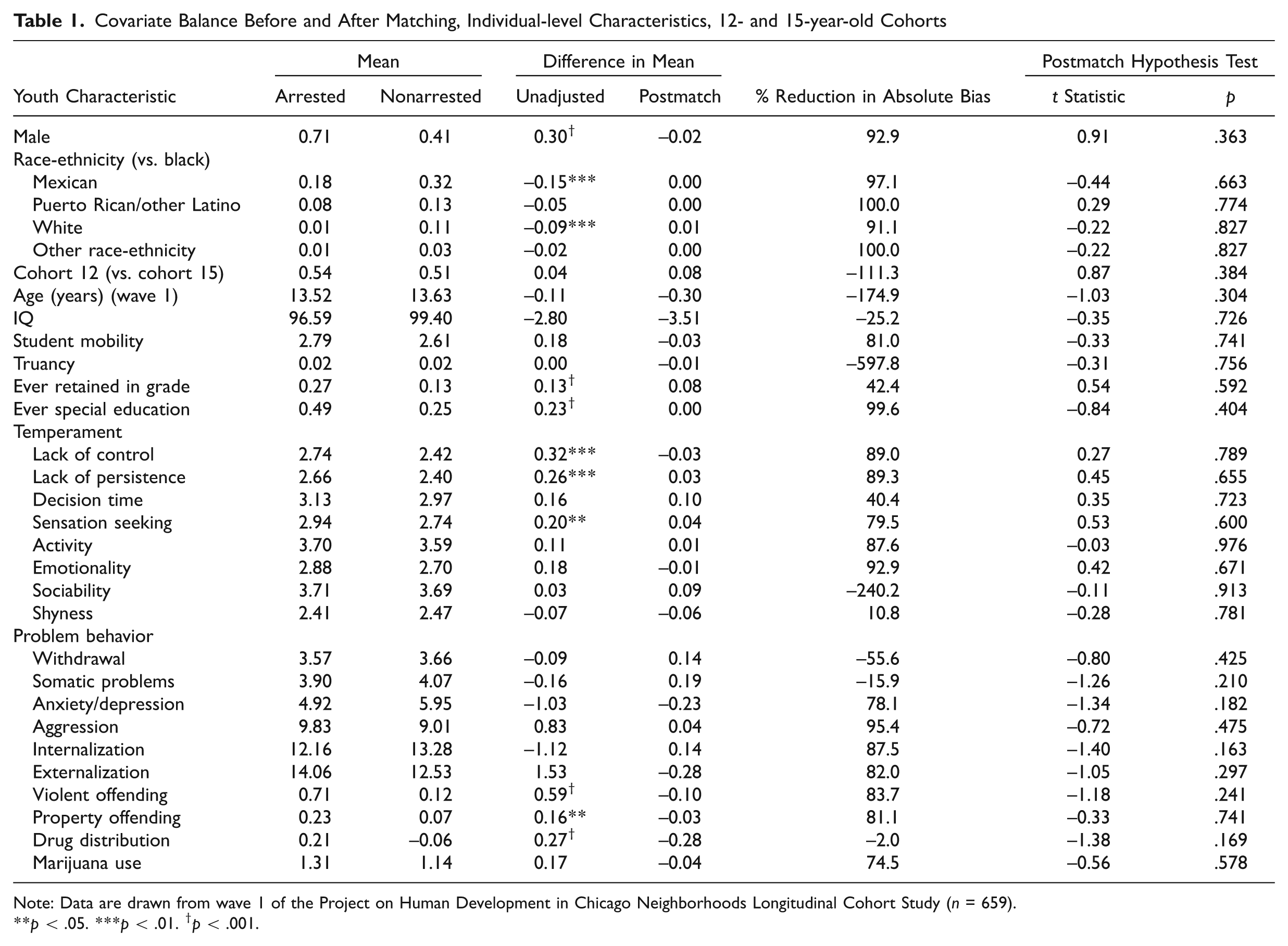
Note: Data are drawn from wave 1 of the Project on Human Development in Chicago Neighborhoods Longitudinal Cohort Study (n = 659).
p < .05. ***p < .01. †p < .001.
Covariate Balance Before and After Matching, Family and Peer Characteristics, 12- and 15-year-old Cohorts

Note: Data are drawn from wave 1 of the Project on Human Development in Chicago Neighborhoods Longitudinal Cohort Study (n = 659).
p < .05. *** p < .01. †p < .001.
From the PHDCN-LCS, we use an indicator of college enrollment as one of our dependent variables. This measure is taken from the third wave of the PHDCN-LCS and indicates whether the respondent was enrolled in a four-year college or graduate program (which presumably requires that the student had previously enrolled and graduated from college) at any point during the data collection. In a supplementary analysis, we broaden the measure to include enrollments in a two-year college as well.
We measure educational expectations, school attachment, and friend support from wave 3 PHDCN-LCS survey responses and assess whether these measures mediate the association between arrest and school dropout. To measure educational expectations, respondents were asked “How far do you think you will actually go in school?” with ordered response categories ranging from “8th grade or less” to “more than college.” For school attachment, respondents were asked whether they like school, whether grades are important, whether they get along with their teachers, whether doing homework is useful, and whether they usually finish their homework. For friend support, students were asked whether they have friends they can relax around, who trust and respect them, who share similar views and enjoy similar activities, and whom they can confide in.
Data on neighborhood-level social organization and social-interactional processes come from the 1995 PHDCN Community Survey, and neighborhood measures of racial-ethnic composition, concentrated poverty, affluence, residential stability, and immigrant concentration derive from the 1990 U.S. census. The PHDCN Community Survey yielded a probability sample of 8,782 residents across the 343 neighborhood clusters in Chicago who responded to a series of questions about the characteristics of their neighborhood environments. Data on school sociodemographic characteristics, including enrollment, poverty, mobility, English proficiency, and the racial-ethnic composition of the student body, come from the CPS Office of Research, Evaluation and Accountability.
With the use of key identifiers, such as Social Security number, name, and birth date, we linked CPS student enrollment records from 1990 to 2005 with the PHDCN-LCS data. One of our dependent variables, school dropout, is drawn from these CPS student records. These data indicate precisely when CPS registered the dropout, allowing us to determine temporal ordering with arrest events. From the CPS student records, we have determined under what circumstances a student exited the CPS system. These include if students completed high school, if they transferred to a non-CPS school, if they were “lost” by the CPS system (i.e., former students who could not be located by CPS), or whether they dropped out of CPS (without transferring to a different school district). To develop our dropout measure, we include students designated as dropouts by CPS as well as those students who obtained General Educational Development (GED) certification and students who could not be located by CPS. 5 We use the final student attendance record to determine dropout; for example, if a student dropped out, reenrolled, and then graduated, we treat that student as a graduate, not a dropout. Only if a student’s final disposition in the system meets our criteria of dropout do we measure it as dropout. Note that by law, students cannot drop out of the CPS system prior to age 16, and CPS cannot drop them from school (e.g., for truancy) before this age. 6 Because our dropout measure is derived from school records, as opposed to survey responses, we are able to track the educational progress of CPS students even if they did not participate beyond the first wave of the PHDCN-LCS data collection.
Finally, we linked official arrest records from 1995 to 2001 from the Illinois State Police and the Chicago Police Department with the PHDCN-LCS data and use these arrest records to construct our treatment variables for analyses of school dropout and college enrollment. 7 The arrest data contain information on all juvenile and adult arrests of sample youth occurring throughout the state of Illinois during the specified time period. Our first treatment variable, for the analysis of high school dropout, is a binary variable indicating whether the student had been arrested at any point while enrolled in high school. Most of the arrestees in our data were arrested for the first time during high school, as opposed to earlier. With information on the date of arrest, we are able to determine if the arrest occurred prior to dropout. Our treatment group, which makes up 13 percent of the sample, consists of students arrested while enrolled in high school; our control group consists of students who were not arrested while enrolled in high school. 8 Our second treatment variable, for the analysis of college enrollment, is a binary variable indicating whether an adolescent had been arrested at any point from age 15 to 18. Twelve percent of the sample was arrested at least once during this span.
Our analytic sample for the analysis of high school dropout consists of respondents from the 12- and 15-year-old PHDCN-LCS cohorts who were enrolled in the CPS during ninth grade and who then either completed their schooling in CPS or dropped out of CPS (n = 659). We exclude students who transferred to other schools outside of CPS. For the analysis of college enrollment, our sample consists of respondents from the 15- and 18-year-old PHDCN-LCS cohorts who attended CPS high schools and either graduated or obtained GED certification (n = 355).
We handle missing data in several steps. First, to account for any bias associated with attrition from wave 1 to wave 3 of the PHDCN-LCS, we use attrition weights in our analyses of college enrollment as well as the intervening mechanisms between arrest and dropout (i.e., educational expectations, school attachment, and friend support). We constructed weights by estimating the probability of responding at wave 3 as a function of the wave 1 covariates displayed in Tables 1 to 3. Because we are able to measure school dropout from CPS records, we can examine this outcome for the entire analytic sample irrespective of attrition in the PHDCN-LCS. Therefore, we do not use attrition weights in analyses of dropout. Second, for individuals who were interviewed but who did not provide information for a specific variable, we use the “ice” command in Stata to implement the multiple imputation by chained equation algorithm to create five imputed data sets (see Royston 2004; van Buuren, Boshuizen, and Knook 1999). For our propensity score analyses, we follow Hill’s (2004:13) multiple imputation matching strategy and calculate a propensity score of arrest for each observation in each of the imputed data sets. We then average the propensity scores for each respondent across the five imputed data sets.
Covariate Balance Before and After Matching, Neighborhood and School Characteristics, 12- and 15-year-old Cohorts
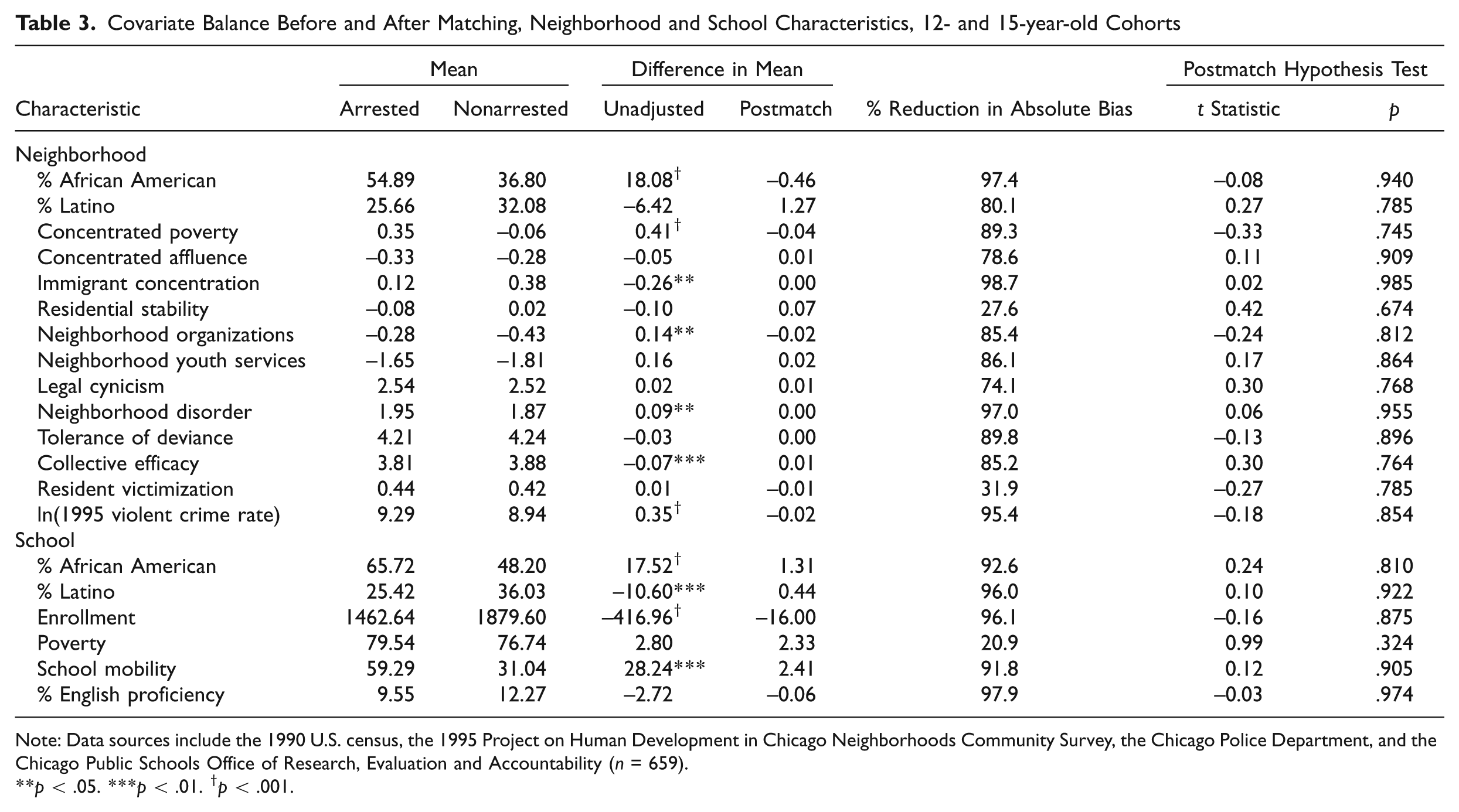
Note: Data sources include the 1990 U.S. census, the 1995 Project on Human Development in Chicago Neighborhoods Community Survey, the Chicago Police Department, and the Chicago Public Schools Office of Research, Evaluation and Accountability (n = 659).
p < .05. ***p < .01. †p < .001.
Analytic Models
Our analyses follow three paths. First, we wish to determine what would happen to the educational trajectory of the same individual under two different circumstances, one in which the student was arrested and the other in which the student avoided arrest. Yet we observe only one of these potential outcomes (i.e., a student is either arrested or not). Given that we observe only one outcome, we use propensity score matching to estimate the effect of arrest on school dropout and college enrollment. This approximates an experimental design in which treated youth (i.e., arrested) are equivalent to control group youth (i.e., not arrested) (Morgan and Winship 2007; Rosenbaum 2002). See the Appendix for a detailed description of our propensity-matched design.
Second, we use Rosenbaum’s (2002, 2010) bounding approach to examine the sensitivity of our propensity-matched inferences to hidden biases (see also Becker and Caliendo 2007; DiPrete and Gangl 2004). This approach allows us to determine how strongly an unmeasured confounding variable must influence selection into treatment to undermine our inferences about the causal effect of arrest on dropout and college enrollment. See the Appendix for further description of this bounding methodology.
Third, if arrest is causally related to subsequent school dropout, there are several potential mechanisms why arrest is predictive of dropout. We explore three: declines in educational expectations, school attachment, and friend support.
Results
Descriptively, our data reveal that among the CPS students who steered clear of the juvenile justice system, 64 percent went on to graduate high school. 9 In contrast, a mere 26 percent of arrested students graduated high school. Of those young adults without criminal records who graduated high school or obtained GED certification, 35 percent enrolled in four-year colleges. For arrestees, 16 percent subsequently enrolled in four-year colleges. 10 These gaps, though unadjusted for differences between arrestees and nonarrestees on the other correlates of education, do suggest that arrest has severe consequences for the prospects of educational attainment. Given the large differences in both high school graduation rates and college enrollment, arrest is a snare that reverberates at numerous points on the transition to adulthood.
The considerable differences in graduation and college enrollment rates between arrestees and nonarrestees are not the only points of divergence. Table 1 compares individual and demographic characteristics of arrested and nonarrested PHDCN sample members, before and after matching on propensity score. Focusing on the “unadjusted” prematch differences, the comparison reveals that arrestees are more likely to be male than nonarrestees and less likely to be Mexican or white. These demographic characteristics of our sample are similar to data reported by the Chicago Police Department (2006) on the demographic characteristics of all juvenile arrests citywide. Little difference exists between arrestees and nonarrestees in IQ, in truancy, and in student mobility. However, arrested youth are more likely to have failed a grade and to have been enrolled in remedial or special education. Thus, even prior to contact with the criminal justice system, eventual arrestees showed signs of educational difficulties. Our ensuing analyses seek to determine whether arrest further undermines educational attainment. Arrested youth also tend to have less self-control and persistence, and they are more commonly sensation seeking. In terms of problem behavior, those arrested tend to be more aggressive (this scale includes disobedience in school), yet the difference is not statistically significant. Not surprisingly, arrested adolescents are significantly more likely to engage in violent offending, property crime, and drug distribution than those not arrested.
Table 2 displays summary statistics for family and peer covariates by group. The results show significant differences across groups in immigrant generational status as well as differences in the proportion of students with married parents. Surprisingly, the results reveal little difference between groups in terms of family supervision and support. Arrested adolescents are more likely to have mothers with substance abuse problems and are more likely to have experienced parent-child conflict. In terms of peer influence, arrestees are significantly and substantially more likely to associate with deviant peers, a finding that is consistent with a long line of criminological research (see Burgess and Akers 1966; Sutherland 1947; Warr 2002).
Table 3 reveals significant differences in the racial-ethnic composition of respective neighborhoods and schools. Arrested youth tend to reside in neighborhoods characterized by substantially more poverty and violent crime and substantially less immigration. Arrested youth reside in neighborhoods with more neighborhood organizations (e.g., tenant associations, drug or alcohol treatment programs, or family health services) than do nonarrestees. As expected, collective efficacy is weaker in neighborhoods where arrested youth tend to reside.
Propensity-matched Analysis of School Dropout
Analyses presented thus far reveal that arrested students are substantially more likely to drop out of school than nonarrested students. Analyses also indicate that arrested and nonarrested students, on average, differ on numerous individual, family, peer, neighborhood, and school characteristics. Many of these differences are also associated with school dropout. For instance, parental marital status, family structure, and socioeconomic status are strong predictors of numerous types of problem behavior, including dropout and arrest (see, e.g., Cairns, Cairns, and Neckerman 1989; Ekstrom et al. 1986; Kirk 2008; Rumberger 1983). Therefore, it is important to determine if any apparent relationship between dropout and arrest is simply because each outcome has a similar set of causal predictors.
We attempt to isolate the specific effect of arrest on dropout by matching and comparing arrested and nonarrested sample members who are otherwise similar to each other in their frequency of criminal offending and all of the pretreatment characteristics displayed in Tables 1, 2, and 3. It is important for our analysis that numerous factors outside the control or background of an individual influence whether a crime will culminate in an arrest. Two key determinants include whether the crime is known to the police and police discretion. Most crimes are not in fact known to the police, and the police arrest proportionally few known suspects of a crime (Black and Reiss 1970). Thus, unlike many other behaviors under the control of an individual (selection), the arrest decision, which we conceptualize analytically as the “treatment,” lies with the police and is based on a host of external and often idiosyncratic factors in addition to the criminal behavior and other characteristics of the individual. For example, during his time as a Baltimore police officer, Moskos (2008) observed substantial variation in the number of arrests made by the officers in his squad. Officers patrolled the same drug-infested areas of the Eastern District of Baltimore and worked under the same sergeant, yet some officers made up to a couple dozen arrests per month, while many others averaged none or one arrest per month. Moskos argued that whether someone is arrested following a crime is largely a function of the characteristics of the officer, not the suspect.
It is in this sense that juvenile arrest has a random component, making it entirely likely that two otherwise equivalent individuals in the PHDCN sample, in terms of criminal offending and other pretreatment covariates, end up with different officially defined fates because one was unfortunate enough to get arrested following the commission of a crime while the other avoided arrest. Indeed, much attention in the criminological and juvenile justice literature has focused on the seemingly random and thus “inequitable” nature of juvenile arrest outcomes. As a result, there are strong substantive reasons to expect an overlap in the likelihood of arrest between the treatment (arrested) and control (not arrested) groups. Empirically, we validate this assumption by examining the overlap in propensity scores across groups (see Appendix Figure A1). By matching with replacement within a caliper of 0.03 (caliper refers to a maximum tolerance of distances between propensity scores of the treated and control subjects), we are able to match 79 of the 85 arrested youth to at least one control observation. 11
Before proceeding to estimate the effect of arrest on school dropout, we first determine whether our matching procedure has produced balance across the treatment and control groups on observed covariates. Our objective is to ensure that the treated and control groups are similar, on average, across all observable covariates. The postmatch t statistics and corresponding p values in Tables 1 to 3 reveal that among some 82 covariates used to estimate the propensity score, not one significant difference emerged between the treated and controls in our final matched sample. In addition, with few exceptions, matching on propensity score produced decreases in bias (see the Appendix for a discussion). 12
With common support and balance, we proceed with our comparison of dropout across groups. Our propensity-based results reveal that the probability of dropping out of school is 0.22 greater for arrested adolescents relative to otherwise identical individuals who were not arrested. This difference, which is known as the average treatment effect on the treated, is statistically significant. 13 On average, arrested youth have a 0.73 probability of subsequently dropping out of public school. In contrast, youth who avoid the snare of arrest have a probability of dropping out equal to 0.51. The data thus reveal that the likelihood of completing high school is tragically low overall for students in the CPS system. Yet for those youth who commit crimes and get caught, the repercussions of criminal justice sanctioning drastically limit the already dismal chances for high school graduation.
Sensitivity Analyses, Effect of Arrest
To assess whether our causal estimates are sensitive to our matching procedure and the influence of unobserved confounders, in this section, we present two sensitivity analyses. First, we reran the analyses under an alternative matching specification, this time matching treated and control youth without replacement using one-to-one matching. With this revised procedure, we still find a substantial, albeit slightly more conservative, difference in the probability of dropping out of high school between arrested youth and similar control youth. Arrested adolescents have a 0.74 probability of subsequently dropping out of public school, whereas control youth have a probability of dropping out equal to 0.55. In sum, we find a substantial effect of arrest on high school dropout, and this finding holds under alternative specifications of our matching procedure.
Second, despite our efforts, it is still possible that there are unobserved confounders that would change the results if included. Therefore, we estimate a sensitivity analysis based on Rosenbaum’s (2002) bounding strategy to address just how substantial unmeasured confounding influences would have to be present to substantially alter our inferences about the effect of arrest on dropout. In this procedure, we use one-to-one matching without replacement (i.e., the matching specification from our more conservative results) to implement the sensitivity analysis.
As described in the methodological discussion in the Appendix, Γ in Table 4 refers to the factor increase in the odds of treatment (arrest) due to unobservable factors beyond the influence of the estimated propensity score. At Γ = 1, we assume that there are no hidden biases and therefore conclude that arrest has a significant positive effect on school dropout (Q+ = 2.400, p = .008). Positive selection bias would occur if those students most likely to get arrested tend to have higher drop-out rates even in the absence of arrest. At Γ = 1.2, we are examining the effect of hidden bias that would increase the odds of arrest for an arrested individual by an additional 20 percent relative to an untreated individual, after accounting for the propensity score. Even under this scenario, we still find a significant positive effect of arrest on dropout (Q+ = 1.842, p = .033). It is not until a Γ value above 1.25 that unobserved heterogeneity is severe enough to render the treatment effect of arrest no longer significant at p < .05. As a comparison, we find that violent offending and residence in a neighborhood of concentrated poverty increase the odds of arrest by an additional 20 to 30 percent, after controlling for a propensity score that excludes these factors. We believe it is unlikely that there is an unobserved factor beyond the 82 we already include in our propensity score estimation and that would be just as influential as factors such as violent offending and concentrated poverty in the estimation of arrest, but that is what it would take (i.e., Γ > 1.25) for our observed treatment effect to disappear.
Rosenbaum Bounds, Effect of Arrest on Dropout
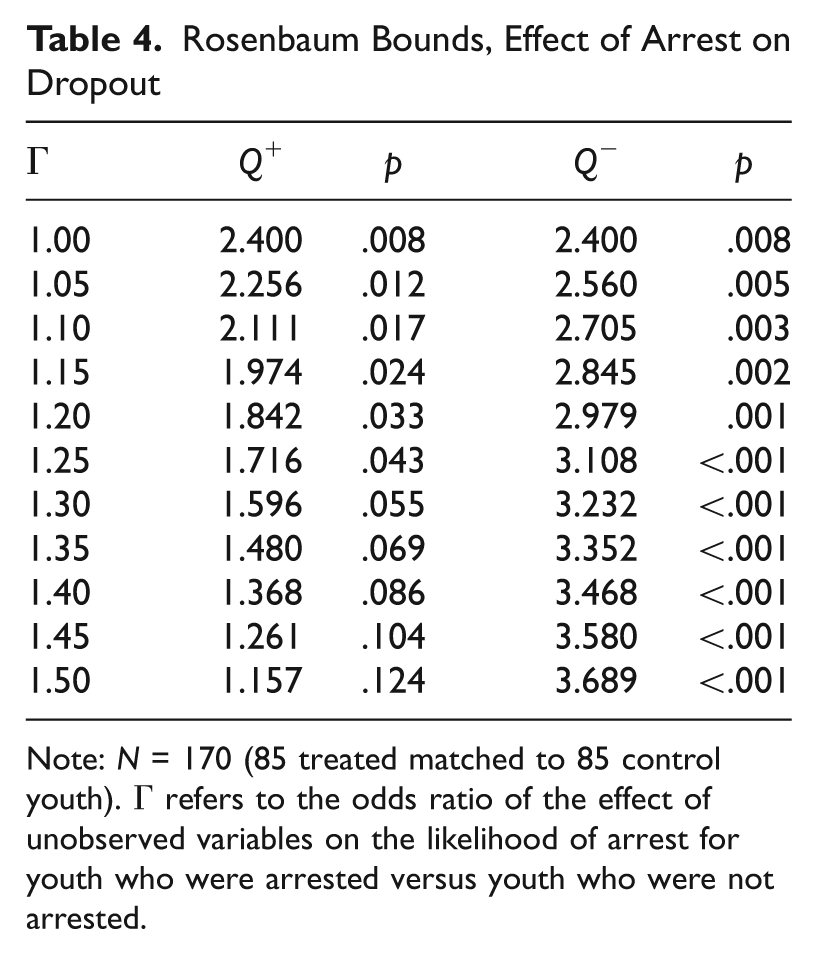
Note: N = 170 (85 treated matched to 85 control youth). Γ refers to the odds ratio of the effect of unobserved variables on the likelihood of arrest for youth who were arrested versus youth who were not arrested.
Mechanisms Underlying the Effect of Arrest
There are several potential mechanisms that may explain why arrest leads to school dropout. In Tables 5 to 7, we explore three potential mediating influences. First, the stigma of a criminal record could lessen one’s expected returns to education, which then influences educational expectations and ultimately educational attainment (Morgan 2005). Second, arrest may weaken a student’s attachment to school, which then increases the likelihood of dropout. Third, a criminal arrest may adversely affect social relationships, leading to rejection by prosocial peers (Lemert 1951; see also Bernburg, Krohn, and Rivera 2006). In exploring this third mechanism, we draw on the child development literature, which has shown that children with conduct disorders are more likely to be rejected by their peers, as a basis for arguing that an arrest has implications for a youth’s peer opportunities (Dodge 1983; Dodge and Pettit 2003). Beyond the effect of a stigma on peer relationships, an arrest that leads to juvenile detention or school transfers may adversely affect peer relationships by pulling an individual away from his or her social network. A result is that a lack of attachment to and support from friends may lead to school dropout.
Educational Expectations as a Mediator of the Effect of Arrest on Dropout
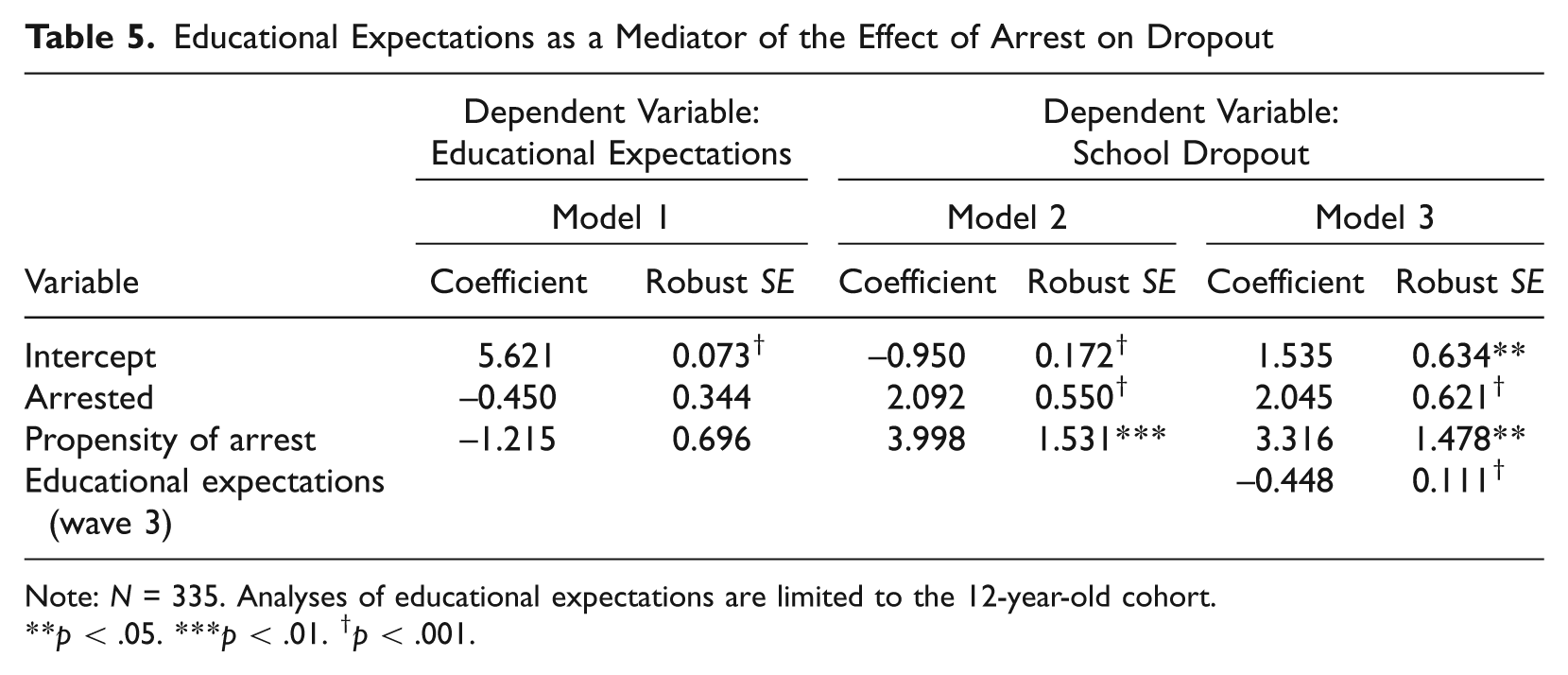
Note: N = 335. Analyses of educational expectations are limited to the 12-year-old cohort.
p < .05. ***p < .01. †p < .001.
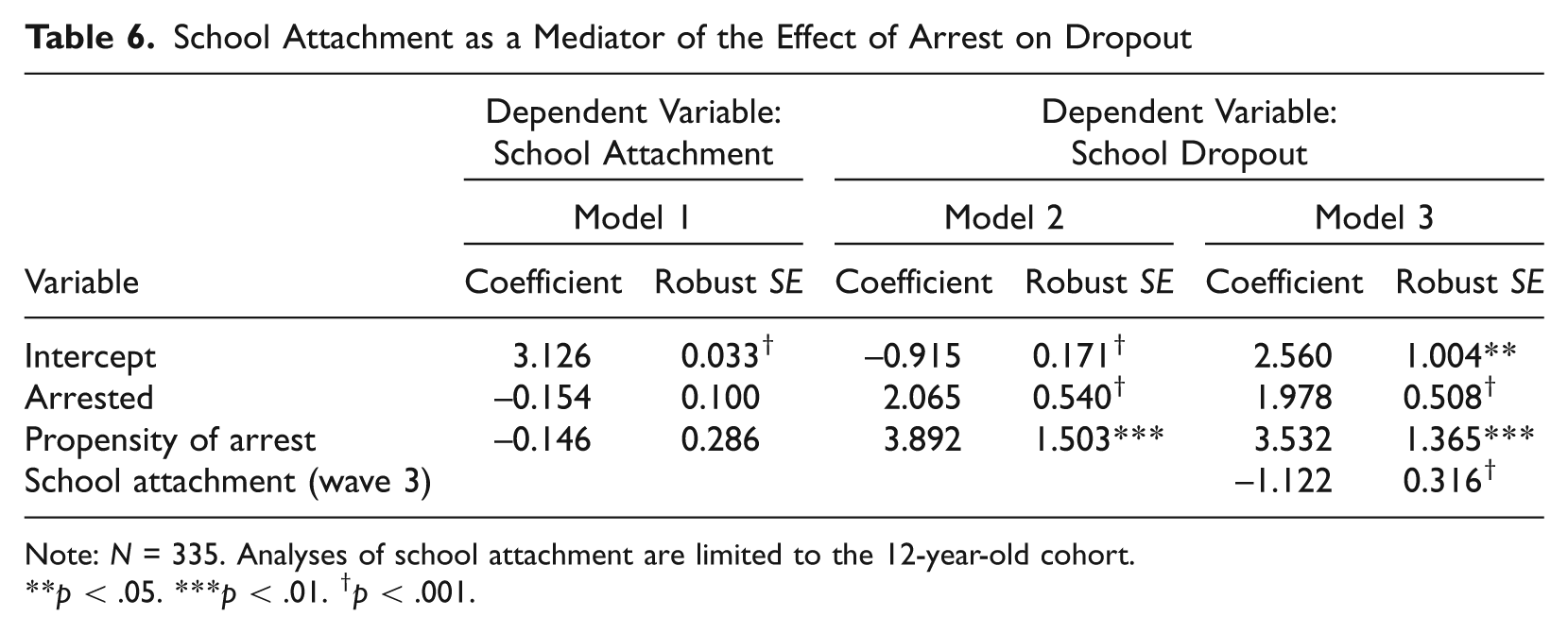
School Attachment as a Mediator of the Effect of Arrest on Dropout
Note: N = 335. Analyses of school attachment are limited to the 12-year-old cohort.
p < .05. ***p < .01. †p < .001.
Friend Support as a Mediator of the Effect of Arrest on Dropout

Note: N = 659. Analyses of friend support are based on the 12- and 15-year-old cohorts.
p < .10; **p < .05. ***p < .01. †p < .001.
To test the mediating influence of the three mechanisms, we first regress each (educational expectations, school attachment, and friend support) on arrest, controlling for the propensity of arrest. Second, we use logit regression models to estimate the effect of each mechanism on school dropout, controlling for arrest and the propensity of arrest (see Morgan and Winship 2007:Chapter 8). 14 We do not consider educational expectations, school attachment, or friend support to be isolated mechanisms for the causal effect of arrest on dropout, because each is determined by other factors besides criminal arrest that may also be related to our outcome variable. Yet by conditioning on the propensity score, we seek to block observed variables that confound our ability to estimate the effect of arrest on each of the three mechanisms as well as the effect of each mechanism on dropout.
Table 5 presents the results of our analysis of educational expectations as a causal mechanism. Model 1 reveals a nonsignificant association between educational expectations and arrest, which suggests that educational expectations will have little mediating effect on school dropout. Turning to estimates of school dropout, consistent with our propensity-matched results, we see in model 2 that an arrest record is significantly and substantially predictive of later school dropout. Model 3 adds the measure of educational expectations to determine whether this measure mediates the association between arrest and school dropout. Results reveal that educational expectations are negatively predictive of dropout; the greater the expectations, the less likely that dropout results. Given that arrest is unrelated to educational expectations (model 1), it is unsurprising that expectations do not mediate much of the effect of arrest on dropout. The coefficient for arrest declines by just 2 percent (from 2.092 to 2.045) from model 2 to 3 once adding educational expectations to the equation.
In Table 6, we examine whether arrest leads to school dropout by weakening a student’s attachment to school. Similar to results for educational expectations, model 1 reveals a nonsignificant association between school attachment and arrest. This finding suggests that arrest does little to undermine a student’s attachment to school. Model 2 provides the baseline results, and model 3 adds the measure of school attachment. The results reveal that school attachment is negatively predictive of dropout but does little to mediate the effect of arrest. The coefficient for arrest declines by just 4 percent relative to model 2.
Table 7 presents findings on friend support. Because of an individual’s arrest record, friends may come to reject the arrestee, thereby leading to a weakening of supportive relationships. Model 1 provides partial support for this assertion. We find a marginally significant negative relationship between arrest and friend support. Models 2 and 3 demonstrate the same general theme depicted in Tables 5 and 6; friend support is significantly and substantially predictive of school dropout but does little to mediate the effect of arrest on dropout. The coefficient for arrest declines just 4 percent between models 2 and 3.
In sum, educational expectations, school attachment, and friend support have limited roles in explaining the effect of arrest on later school dropout. Thus, sorting out the potential mechanisms underlying the observed effect of arrest remains an important area of investigation. Perhaps it is telling that each of the three mechanisms we investigated likely contributes to a student’s voluntary decision to drop out. One way to interpret their general lack of relevance as mediators is that arrest leads to dropout not because of voluntary mechanisms but because arrested students are involuntarily pushed out of school through enforcement mechanisms. In this sense, those students whose reputations are most stigmatized by their involvement in the criminal justice system may be the ones most likely to drop out of high school.
The Effect of Juvenile Arrest on College Enrollment
Our findings thus far reveal that arrest is a negative turning point that can derail a youth’s prospects of graduating high school. Theoretically, we expect that the consequences of arrest during adolescence stretch beyond secondary schooling, by lessening the likelihood of further educational attainments even for those students who do manage to complete high school. We are unaware of any research that has systematically investigated the effect of arrest on college attainment. Thus, we seek to isolate the specific effect of arrest on college enrollment by matching arrested and nonarrested sample members who graduated high school or obtained GED certification who are otherwise similar to each other with respect to pretreatment characteristics. To achieve balance across the treatment and control groups on observed covariates, we match each arrestee with up to two control youth and use a caliper of 0.03 to ensure that the matches for each treated subject are suitable. With these matching specifications, we are able to match 38 of 43 arrested youth to at least one control youth. 15 As with our matching for the analysis of school dropout, postmatch t statistics reveal no significant differences between the treated and control groups on pretreatment covariates. 16
Our propensity-based results for both high school dropout and college enrollment are compared in Figure 1. The probability of enrolling in a four-year college is 0.16 lower for arrestees relative to otherwise identical individuals who were not arrested, a gap just smaller than the difference in high school dropout. On average, youth with arrest records are not only much more likely to drop out, at over 70 percent, but they have only a 0.18 probability of enrolling in a four-year college. In comparison, nonarrestees have a probability of college enrollment equal to 0.34. 17

The probability of high school dropout and enrollment in a four-year college following arrest, individually matched arrested and nonarrested youth
We also broadened the analysis to include two-year colleges in the dependent variable and find no significant difference between arrestees and nonarrestees in college enrollment using this more inclusive measure. Thus, an arrest record, independent of its effect on high school attainment, does not adversely affect enrollment in two-year colleges, but it does limit one’s opportunity to pursue a degree in a four-year institution. Thus, one consequence of arrest is that it seems to narrow the postsecondary schooling opportunities available to individuals to those institutions with relatively open admissions standards, such as community colleges. To the extent that community colleges serve to stratify higher education (Brint and Karabel 1989), arrest records may ultimately limit the labor market prospects of those arrestees who do manage to enroll in college, by curtailing their options for pursuing a higher education.
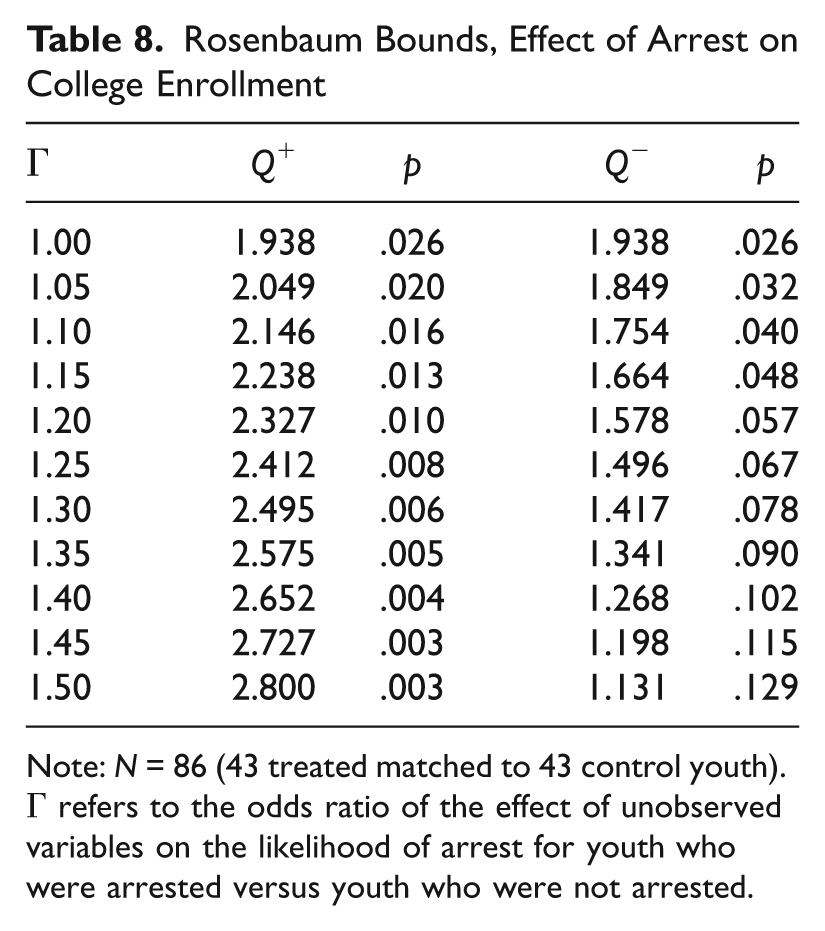
We again test the sensitivity of our causal estimates to hidden biases. Given the direction of our results—a negative relationship between arrest and college enrollment—positive selection bias would cause our findings to be conservative. Negative selection bias would occur if those students most likely to get arrested tend to have lower college enrollment rates even in the absence of arrest. Thus, we focus on negative selection and the Q− statistic in Table 8. We find that the significant negative relationship between arrest and college enrollment may be biased if an unobserved variable increases the odds of arrest by an additional 20 percent for arrestees relative to nonarrestees, after accounting for the propensity score. Again, we emphasize that our model includes nearly 80 different individual, family, peer, neighborhood, and school predictors of arrest, including measures of criminal offending. It is hard to conceive of additional measures that would increase the odds of arrest by another 20 percent.
Rosenbaum Bounds, Effect of Arrest on College Enrollment
Note: N = 86 (43 treated matched to 43 control youth). Γ refers to the odds ratio of the effect of unobserved variables on the likelihood of arrest for youth who were arrested versus youth who were not arrested.
Conclusions
To understand the transition to young adulthood in the United States, it is increasingly necessary to grapple with the consequences of contact with the criminal justice system. Meaningful life events such as school completion, labor force entry, and family formation are sequentially related and interdependent, and educational experiences can have profound effects on the shape of the life course. Western (2006:92), for example, reported that among black male high school dropouts aged 22 to 30 years in 2000, approximately 65 percent were jobless. Half of the jobless were incarcerated. The numbers are not much better for black men who graduated high school but did not enroll in college: 42 percent were jobless, and more than 40 percent of this jobless group was in jail or prison. Certainly for black male dropouts, but even for black high school graduates (without any further education), joblessness and imprisonment are now normative in the life course. The alarming differences in employment, wages, and family life between the never incarcerated and the incarcerated and formerly incarcerated can thus ultimately be traced to educational disadvantage.
Our analysis shows that arrest in adolescence hinders the transition to adulthood by undermining pathways to educational attainment. Among Chicago adolescents otherwise equivalent on prearrest characteristics, 73 percent of those arrested later dropped out of high school compared with 51 percent of those not arrested, a substantial difference of 22 percent. It seems unlikely that data limitations alone can explain the large gap. Our sensitivity analyses revealed that it would take an unmeasured confounding factor as consequential as violent offending or neighborhood poverty to overturn the difference, which we systematically investigated with one of the most comprehensive longitudinal studies to date. The educational repercussions of early exposure to the criminal justice system do not stop at high school. Among otherwise equivalent young adults with high school diplomas or GED certification, 18 percent of arrestees later enrolled in four-year colleges relative to 34 percent of nonarrestees.
What explains the apparently large effect of arrest on the educational life of adolescents? This is a crucial question that yielded an uncertain answer. We found little evidence of declines in educational expectations, school attachment, or friend support as mediating mechanisms. Rather than construing these results as “nonfindings,” however, we consider our analysis of theoretically plausible mechanisms to be a necessary analytic step toward disentangling why arrest is so consequential to educational attainment. Indeed, by ruling out the importance of such person-level mechanisms, we direct attention to the importance of institutional responses and the increasingly punitive “zero tolerance” educational climate (Nolan 2011) along the path to dropout. Institutional reactions to an arrest record may also work to narrow options available to college-seeking students, making community college the only viable option for higher education.
We recognize that our study was restricted to a single city, the public school setting, and a particular time period. Within the limitations of our research design, we nonetheless believe that the main results, considered in light of the sensitivity bounding, support the inference that arrest has substantive import for the educational attainment of students who attended the CPS. Although Chicago is of course only one case, it is the third largest U.S. city and broadly representative of the racial and ethnic diversity of urban school districts nationwide. Although a national sample would be desirable, we are not aware of any study with the density of information on individual adolescents and their multiple contexts in the transition to young adulthood—including the police, schools, and neighborhoods—that would furnish the kind of detailed empirical assessment we offer here.
We therefore suggest that more research is needed to examine why arrest appears to be so consequential to educational attainment. A focus on institutional responses to student criminality appears a particularly important and understudied avenue for future research. These responses would include both formal actions, such as expulsion for an arrest or denial of admission to college, as well informal responses, such as increased punitiveness on the part of teachers if the arrested student is subsequently disruptive in class. In addition to institutional responses, student absences, school and program transfers, and any resulting frustration with falling behind all deserve greater scrutiny. In line with this reasoning, we find that among the 22 (of 85 total) arrestees in our sample who managed to graduate from CPS high schools, not one was incarcerated in a juvenile facility. Conversely, an arrest that results in a period of confinement in a juvenile detention facility virtually guarantees that a student will not finish high school. Every youth in our sample who spent time in a juvenile detention facility ultimately dropped out of high school. Although data limitations prevent us from examining the specific reasons, we suggest that time in juvenile detention makes stigmatization more likely and makes it difficult for a student to reengage in the schooling process.
Another next step would be to assess the extent to which race, ethnic, and class differences in arrest account for group differences in educational attainment. In a similar vein, although juvenile arrest hinders educational advancement, its effect may not be uniform across social groups. “Second chances” may be unevenly distributed. Individuals in disadvantaged structural positions, because of race, poverty, and a lack of prosocial bonds, may be less able to avoid the snares of arrest (Sampson and Laub 1997).
With high school and even college graduation virtually a necessity for a successful transition to adulthood, we conclude that the evidence comes down on the side of viewing juvenile arrest as a life-course trap in the educational pathways of a considerable number of adolescents in contemporary American cities. That this snare appears to work independently of a number of traditionally hypothesized mechanisms raises troubling questions about the interaction of the criminal justice and educational systems.
Footnotes
Appendix
Acknowledgements
The PHDCN was conducted with prime funding from the John D. and Catherine T. MacArthur Foundation, the National Institute of Justice, and the National Institute of Mental Health. We thank the Russell Sage Foundation, the Spencer Foundation, and the Brookings Institution for analysis support and Pat Sharkey, Mark Warr, and the anonymous reviewers for helpful comments on earlier versions of this article.