



Abstract
Past research shows a statistically significant relationship between college completion and sociopolitical attitudes. However, recent scholarship suggests the effects of college on social outcomes may be confounded with unobserved family background. In this study, we leverage the shared family and social background of siblings to better identify the effect of college on sociopolitical attitudes. We draw data from the Study of American Families and General Social Survey and use sibling fixed effects to assess the effect of college on political orientation, support for civil liberties, and beliefs about gender egalitarianism. We find that earning a four-year college degree has a significant impact on support for civil liberties and beliefs about gender egalitarianism, but the effect of college on political orientation is confounded by family background.
Does college influence sociopolitical attitudes? Scholars suggest college campuses can promote interethnic relations (Bowman 2013), gender egalitarianism (Bryant 2003), and democratic norms (Bobo and Licari 1989). Through social interaction in the classroom, extracurricular activities, and residential life, students are constantly interacting with new peers who provide different viewpoints from their friends and family (Moffatt 1989). College campuses thus provide multiple avenues that might influence students’ sociopolitical attitudes: by their learning about other cultures and worldviews, which stimulates interest in different viewpoints (Bowman 2013; see also Tadmor et al. 2012); through direct peer effects (Dey 1997); and via the creation of “free spaces” that provide opportunities for students to develop alternative ideologies free from official oversight (Morris 1992; Polletta 1999).
However, there is an ongoing debate over whether the “effect” of college on social outcomes is causal or spurious. Kingston and colleagues (2003), for example, find substantial effects of college on attitudes, social and cultural capital, and news consumption. Similarly, Hout (2012), while noting the difficulties associated with estimating college effects, points to studies that use instrumental variables to demonstrate the causal effects of a college education on multiple outcomes. Nonetheless, some scholars remain skeptical; for example, Schnittker and Behrman (2012) find that the effect of college on supportive exchange behaviors is nonexistent or negative in a within-sibling model. They suggest that observed college effects are often due to unobserved family background characteristics and that college may undermine some prosocial attitudes (see also Markus et al. 2001). In line with this view, studies that use matching designs and sibling fixed-effects models often find the effects of college on social outcomes are spurious (e.g., Kam and Palmer 2008).
In summary, although existing scholarship generally supports the notion that college affects sociopolitical attitudes, there is a broader question regarding whether the effects of college education are confounded with family background. In other words, the college-effects model argues that family background affects the likelihood of college completion and sociopolitical attitudes, but a college education has real effects on sociopolitical beliefs by promoting interaction with peers, the presence of “free spaces,” and direct peer socialization. The spurious model, in contrast, suggests that measured and unmeasured family background characteristics are the primary driver of both college completion and social outcomes, and the effects of college are not well understood and may even undermine certain prosocial attitudes. We thus use sibling fixed-effects models to estimate the effect of a college education on sociopolitical attitudes, after removing all variation associated with measurable and unmeasurable family background characteristics shared by siblings.
Background
The Effects of College on Sociopolitical Attitudes
Sociologists, psychologists, and educators have long argued for the effects of college on political orientation, support for civil liberties, and egalitarian gender-role beliefs. Researchers posit different mechanisms to account for this association, but most scholars claim that college attendance socializes students to adopt more left-leaning attitudes. Generally speaking, they suggest this effect occurs primarily because of interactions with peers and student social norms rather than through classroom experiences.
Scholars have documented a strong association between education and liberal political orientation. Gross and Fosse (2012) argue that this is a major reason why college professors are themselves liberal, as they have spent far more time earning college degrees than the rest of the population. Popular media accounts suggest that college professors then inculcate liberalism in their students, reproducing political beliefs in the classroom (Gross and Fosse 2012; Mariani and Hewitt 2008). Dey (1996, 1997) finds that individuals attending more liberal academic institutions become more politically liberal, but he suggests this is related to a broader institutional context rather than student–faculty interaction. And Mariani and Hewitt (2008) find that faculty political attitudes have no effect on changes in student political attitudes. The evidence that institutional context—rather than faculty interaction—changes political values extends to conservatism as well; Dey (1997) finds that students who enter more conservative academic institutions also become more politically conservative.
Prior research has also found associations between college attendance and increased support for civil liberties, net of other demographic and background characteristics (Kingston et al. 2003). Bobo and Licari (1989) argue that college changes attitudes toward civil liberties because it increases cognitive sophistication (see also Ohlander, Batalova, and Treas 2005). However, there is evidence that learning about civil liberties fails to increase support for them (Green et al. 2011). Phelan and colleagues (1995) conclude instead that college socializes individuals to adopt the “official culture” of the United States: all individuals deserve “equal respect” but not “equal outcomes” (see also Finney 1974).
Considerable evidence shows an association between college education and greater support for gender egalitarianism and less support for traditional gender-role restrictions, and this relationship remains consistent over time (Bolzendahl and Myers 2004; Cunningham 2008; Harris and Firestone 1998; Kingston et al. 2003). However, this relationship depends on the type of peers a person socializes with. Bryant (2003) finds that men who socialize with other men or with people from conservative religious upbringings espouse more traditional gender-role beliefs. In contrast, talking about politics with peers weakens gender-role stereotyping.
Three potential mechanisms could help explain the relationship between college education and sociopolitical attitudes. First, Bowman (2013) argues that college provides an opportunity to interact with individuals from different social backgrounds, and as a result, students express more comfort with out-groups and a greater desire to learn about other cultures. This theoretical explanation is consistent with social psychological studies of intergroup bias (Tadmor et al. 2012), and college campuses do sometimes offer a diverse and multicultural student body to promote out-group interaction and support for new sociopolitical attitudes. Second, college campuses provide “free spaces” to develop alternative ideologies; these free spaces have been instrumental in developing left-wing and libertarian approaches to individual liberties as well as feminist thought (Klatch 1999; Polletta 1999, 2004). Participation in free spaces also provides ample opportunity to engage in political discussion. Finally, Dey (1997) argues that students directly socialize each other to adopt new sociopolitical attitudes. These proposed mechanisms are likely intertwined; for example, a set of individuals who participate in a free space may later directly socialize new students to adopt new sociopolitical beliefs.
In summary, the college-effects model posits that individuals who attend college are constantly exposed to interactions with a diverse set of individuals (Moffatt 1989). These interactions take the form of informal conversations and learning about different viewpoints (Bowman 2013), participation in activist free spaces (Polletta 1999), and direct socialization from peers (Dey 1997). As a result, students are likely to become more liberal (Dey 1996, 1997), express greater support for civil liberties (Bobo and Licari 1989; Finney 1974; Phelan et al. 1995), and support loosening gender-role restrictions (Bolzendahl and Myers 2004; Cunningham 2008; Harris and Firestone 1998; Kingston et al. 2003).
The Effects of Family on Sociopolitical Attitudes
Substantial evidence shows that college affects sociopolitical attitudes, but family influences play a large role in determining who attends and completes college (Blau and Duncan 1967; Conley 2001). Prior scholarship often accounts for the effect of measurable family influences on sociopolitical attitudes by controlling for observed parent characteristics. Kingston and colleagues (2003), for example, account for the role of parental socioeconomic status to estimate the effect of college on social outcomes, net of family background. But family socioeconomic status is not the only way that parents influence children; in particular, existing research emphasizes how parents socialize their children in ways that do not map neatly onto class-based variables.
Overall, there is substantial evidence showing that parents are able to instill their political beliefs and gender-role attitudes in their children, net of socioeconomic status (Acock and Bengtson 1978; Dalhouse and Frideres 1996; Glass, Bengtson, and Dunham 1986). Jennings, Stoker, and Bowers (2009) find that parents directly socialize their children to adopt certain political beliefs, and this effect is more pronounced in families with strong political viewpoints. Braungart (1971) finds that parents directly socialize their children’s political beliefs and steer their children toward specific political alignments by providing political discussions and modeling authoritarian or democratic values. In addition, Glass and colleagues (1986) find that while family socioeconomic status exerts a strong effect on children’s gender-role ideology, parental socialization has a statistically significant effect into adulthood.
In other words, childhood family influences have an effect on sociopolitical attitudes beyond parental socioeconomic status; this is problematic because these influences can also affect whether a person attends and completes college. Davis and Pearce (2007) find that children with more gender-egalitarian attitudes also have higher educational expectations. Furthermore, Elchardus and Spruyt (2009) find that college students tend to select into academic majors where they feel most politically comfortable; this implies that the relationship between college education and political attitudes is a reflection of childhood influences. Additionally, some evidence suggests that the effect of education on civic participation is spurious owing to family background (Highton 2009; Persson 2014; Schnittker and Behrman 2012). Specifically, Schnittker and Behrman (2012) provide a more stringent test of educational effects by using a fixed-effects design, which can remove the effect of shared family background on a dependent variable (see also Halaby 2004). They find that the effect of education on multiple social outcomes is overestimated or nonexistent once variation associated with family background is removed from the model. They also find evidence that some prosocial behaviors are reduced by college attendance, suggesting that college may socialize students in ways that make them more attuned to their own interests rather than others.
We know of one study that investigates the effect of education on various social and political attitudes after accounting for a wide range of family influences. Sieben and de Graaf (2004) use a sample of Dutch siblings to investigate the impact of shared family background and educational attainment on religious beliefs, several different measures of political orientation, postmaterialistic values, and gender-role traditionalism. After removing the effects of shared family background, they find that education has no effect on religious beliefs or political orientation and a much smaller effect on postmaterialistic values and gender-role traditionalism. The applicability of these findings to the United States is unclear because of dissimilarities between the U.S. and Dutch education systems, the uniqueness of U.S. political ideologies, and differences in gender stratification in the two countries. In the U.S. context, it seems reasonable to expect some effects of college on sociopolitical attitudes to remain statistically significant, but effect sizes should shrink and others may lose statistical significance after better accounting for family and social background characteristics.
In summary, researchers have traditionally attempted to separate college effects from social background effects through the use of controls in regression models. Because of data limitations, researchers can usually control only for some combination of parent education, family income, and parent religious beliefs (e.g., Kingston et al. 2003). Scholars who draw on the spurious model (e.g., Schnittker and Behrman 2012) suggest that this method of identifying college effects is problematic because it is unlikely a limited set of controls can fully account for social background characteristics. Parents influence the educational attainment and sociopolitical attitudes of their children in complex ways that are difficult to observe, operationalize, and measure. Due to these complex processes, some scholars have expressed concerns that observed college effects are biased by unobserved social background effects. In fact, more recent studies that use matching or within-family designs find more modest or even null college effects on an array of outcomes.
In this study, we disentangle background effects from college effects by basing model estimation on variation within sibling pairs. In doing so, we are able to offer a unique test of the effect of college on sociopolitical attitudes. Specifically, if college influences sociopolitical attitudes net of social background characteristics (as predicted by the college effects model; see Hout 2012; Kingston et al. 2003), then we should expect to observe college effects among siblings with different levels of education. Conversely, if college effects are confounded by social background characteristics (as predicted by the spurious model; see Schnittker and Behrman 2012), then we should expect to observe no statistically significant differences in sociopolitical attitudes among sibling pairs with disparate education levels.
Data, Measures, and Analytic Strategy
Data
We draw data from the 1994 General Social Survey (GSS; Smith et al. 2011) and the Study of American Families (SAF; Hauser and Mare 1994) to test the relationship between college and sociopolitical attitudes, net of family background. The GSS, conducted by the National Opinion Research Center at the University of Chicago, was administered to a nationally representative sample of non-institutionalized adults and included a variety of items on sociopolitical attitudes and respondent demographics. The SAF is a companion data set to the 1994 GSS, enabling researchers to test for similarities within families. The GSS first collected identifying information for one randomly selected sibling for each of the 2,992 respondents who had at least one sibling above the age of 25. SAF researchers then conducted telephone interviews with 1,155 siblings, asking a subset of the questions in the GSS. By combining SAF and GSS data, we were able to construct a data set that contains data on 2,310 individuals and 1,155 sibling pairs.
Of the original GSS sample, 2,663 respondents had an eligible sibling, but only 43 percent of the selected siblings were interviewed. The major source of nonresponse was the inability of GSS interviewers to collect sufficient information for SAF researchers to locate siblings for interviews. Although selective nonresponse is a potential source of bias and could limit the generalizability of the findings, we believe these data are representative of sibling pairs in the general population. We compared our analytic sample to eligible GSS respondents to test for differences. We present these findings and additional analyses in an online supplement. Overall, as shown in Table S1 of the online supplement, our analytic sample and the eligible GSS sample are similar on most characteristics. However, the analytic sample does have more white respondents, more respondents with a college degree, and more educated mothers. Respondents in the analytic sample were also less likely to have lived outside of the United States during adolescence. These differences could limit the generalizability of our findings.
Goldstein and Warren (2000), however, find consistent results across the GSS-only sample and the GSS-SAF combined sample, which suggests that nonresponse bias is not a serious issue. Following others who have used these data to examine within-family differences (Freese, Powell, and Steelman 1999; Warren 2001), we note the low response rate as a potential limitation and add that the present analyses should be interpreted cautiously for more disadvantaged populations. That said, we do not believe this biases our findings.
We impose two restrictions on our sample to increase the likelihood that siblings experienced similar social backgrounds when growing up. First, we exclude siblings who do not share the same mother and father (6 percent of sample). Second, we exclude siblings who did not grow up together, measured as living in the same household at age 16 (11 percent of sample). We also exclude sample members who are under the age of 25 and report that they are still in school (less than 1 percent of the sample). Additionally, for reasons further explained in the discussion of our measure of college attendance, we also exclude sibling pairs where one sibling completed an associate’s degree or some college (14 percent of sample). Before accounting for missing data, the analytic sample contains 1,652 individuals and 826 sibling pairs. We lose an additional seven sibling pairs to missing data on independent variables. The GSS uses a split-ballot survey design, which means not all respondents were asked all questions. As a result, the analytic sample size varies by outcome.
The combined GSS-SAF sample has one additional limitation: it was conducted in 1994. Close to half of the participants were college graduation age in the 1960s and 1970s, about one fifth of respondents were college graduation age prior to the 1960s, and about one third were college graduation age in the 1980s and early 1990s. As a result, the findings roughly reflect the effect of college education from the end of World War II until the Republican revolution that elected Newt Gingrich as speaker of the House. Since then, college costs have risen, the rate of college attendance has increased, and universities have become more oriented toward research and grant funding (Brennan 2008; Brint 2005; Horowitz 2015; Slaughter 1985; Slaughter and Rhoades 1996). Thus, the effects of college we report here are limited to a particular time frame and may have changed as the college experience itself has changed.
Nonetheless, the GSS-SAF data are unusual because they are nationally representative, include a wide variety of questions on sociopolitical attitudes, and include matching sibling data. Data that allow us to run fixed-effects sibling models, a powerful way to address family-invariant spuriousness (Halaby 2004), are rare. Although the age of the data is a limitation, these data permit a strong analytic design that more recent data sets cannot match.
Measures
Political ideology
We include two measures of political ideology. First, because college effects are most often described as “liberalizing,” we use a dichotomous measure of liberal political ideology: 1 = respondent identifies as extremely liberal, liberal, or slightly liberal; and 0 = respondent identifies as moderate, slightly conservative, conservative, or extremely conservative. Second, we use the full seven-item political ideology scale, where 1 = extremely conservative and 7 = extremely liberal. Political ideology is asked of all respondents; 7 percent of sibling pairs have missing data, leaving us with complete data on 767 sibling pairs.
As a robustness check, we also examine three alternative definitions of political ideology. The first is a more strict definition of liberal political ideology, where 1 = respondent identifies as extremely liberal or liberal and 0 = other. The second definition is a dichotomous measure of ideological conservatism, where 1 = respondent identifies as extremely conservative or conservative and 0 = other. The third measure tests whether college leads to more strongly held political views: 1 = respondent identifies as moderate, and 0 = respondent identifies as extremely liberal, liberal, slightly liberal, slightly conservative, conservative, or extremely conservative. Results for the alternative specifications are presented in Tables S6 and S7 in the online supplement.
We believe these are strong measures of political ideology, but there are limitations. Most notably, self-reported political ideology may vary by person-level characteristics, with liberal meaning different things to different people. The term may also vary by political context: for example, liberal may mean something different in Texas than in Massachusetts. Nonetheless, we believe self-reported political ideology is a useful measure, and existing research documents how self-described political ideology shapes a large number of other sociopolitical attitudes and judgments about political events, which in turn have substantial effects on voting behavior (Jacoby 2009).
Support for civil liberties
The SAF-GSS asked respondents questions on three issues related to the protection of civil liberties (making a public speech, having a book in a library, and teaching at a college or university) for five groups (communists, anti-religionists, homosexual men, militarists who advocate doing away with elections, and racists who believe blacks are genetically inferior). For example, respondents were asked, “Consider a person who advocates doing away with elections and letting the military run the country. Should such a person be allowed to teach in a college or university or not?” Respondents could answer allowed or not allowed. Respondents were also asked whether a militarist should be allowed to make a speech in their community and whether they would support removing a book by a militarist from the public library. Bobo and Licari (1989) find support for a single dimension of tolerance; therefore, we combine these 15 items to create a single scale that measures support for civil liberties (Cronbach’s α = .9222). Higher scores on the scale indicate greater support for the protection of civil liberties. One third of the sample is missing at random because of the split-ballot survey design, and an additional 29 percent of sibling pairs have missing data on one or more of the civil liberty items, leaving us with complete data on 381 sibling pairs.
Again, to ensure the results are robust to different specifications, we examine several alternative definitions of support for civil liberties, including three scales based on type of civil liberty (making a public speech, having a book in a library, and allowed to teach at a college or university), five scales based on the group (communists, anti-religionists, homosexual men, militarists, and racists), and each of the 15 possible combinations. Results for these models are presented in Table S8 in the online supplement.
Opposition to gender equality
We use three dichotomous measures of opposition to gender equality based on responses to three agree/disagree statements. The statements read, (1) “Most men are better suited emotionally for politics than women,” (2) “It is more important for a wife to help her husband’s career than to have one herself,” and (3) “It is much better for everyone involved if the man is the achiever outside the home and the woman takes care of home and family.” For each outcome, opposition to gender equality (i.e., agreeing with the statement) is coded as 1 and support for gender equality is coded as 0. Approximately one third of the sample is missing at random because of the split-ballot survey design, and an additional 19 percent have missing data on one or more of the outcomes, leaving us with complete data on 439 sibling pairs.
We also explore two additional measures of beliefs about gender equality. The first measure asked respondents whether they would vote for a qualified female presidential nominee from their own political party. The second asked respondents whether they agreed that women should take care of running their homes and leave running the country up to men. Unfortunately, with the limited analytic power, the variance in these outcomes is too small to include in the multivariate models—only 4 percent of college graduates said they would not vote for a female presidential nominee, and only 6 percent of college graduates agreed that women should take care of running their homes and leave running the country up to men.
College completion
We measure college completion with a reference variable where 1 = respondent graduated from college and 0 = respondent did not complete any education beyond high school. Unfortunately, data limitations do not allow us to consider a more nuanced gradation of educational attainment. In particular, for respondents who completed some college but did not receive a degree, it is unclear whether these respondents spent four years at college and left without graduating, attended a single class at a community college, or were somewhere in between these two extremes. Similarly, the number of respondents with an associate’s degree is too small to include as its own category. Rather than defining people who attended some college or had an associate’s degree as either college graduates or not attending college, we chose to exclude them from the analysis. These results are robust to other specifications. In particular, we created a reference variable where 1 = respondent graduated from college and 0 = respondent graduated from high school. This alternative measure excludes respondents who did not graduate from high school. Findings for the models using the alternative measure are presented in Table S9 in the online supplement.
Demographic and background variables
In our analysis, we estimate random-effects and sibling fixed-effects models. We first estimate random-effects models, using control variables for covariate adjustment. This allows us to compare the random-effects estimates to the sibling fixed-effects estimates. Specifically, we include controls for sex (1 = female, 0 = male), race/ethnicity (1 = nonwhite, 0 = white), a continuous measure of age, region of residence during adolescence (0 = South, 1 = Northeast, 2 = Midwest, 3 = West, 4 = foreign), religion during adolescence (0 = Protestant, 1 = Catholic, 2 = Jewish, 3 = none, 4 = other), mother’s education (0 = high school graduate, 1 = did not complete high school, 2 = some college, 3 = college graduate), and whether the respondent is the firstborn sibling (1 = firstborn, 0 = other). Race/ethnicity is limited to a reference variable because the GSS did not collect a more nuanced measure or include a large enough sample of nonwhites. Table 1 presents summary statistics for all variables.
Descriptive Statistics for All Variables.
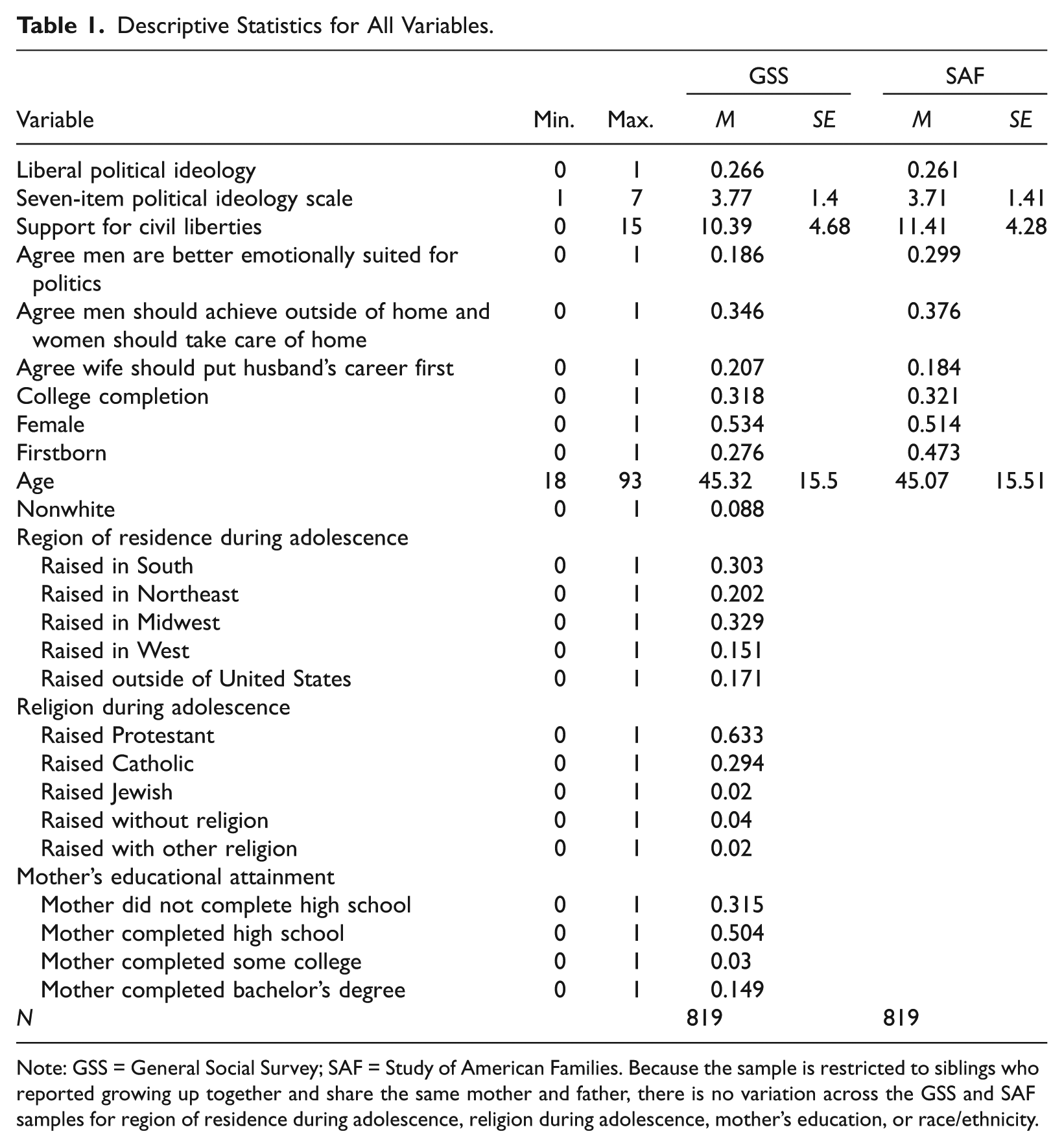
Note: GSS = General Social Survey; SAF = Study of American Families. Because the sample is restricted to siblings who reported growing up together and share the same mother and father, there is no variation across the GSS and SAF samples for region of residence during adolescence, religion during adolescence, mother’s education, or race/ethnicity.
Analytic Strategy
Our analysis contains two stages. In the first stage, we use random-effects models to estimate the effect of college completion on sociopolitical attitudes, net of observed social background characteristics and clustering by family unit. Thus, the first part of the analysis largely replicates past research. The basic model can be expressed as follows:

where Yif is the probability of holding a given attitude (e.g., identifying with a liberal political ideology) for individual i in family f. Xif represents whether respondent i in family f completed college, Z if is a vector of observed control variables, ϵ f is a family-specific error term, and ϵ if is a random error term. The coefficient for Xif (α) is the effect of college completion on attitudes net of observed control variables. However, the college effect will be biased if there is a correlation between college completion (Xif) and unobserved social background characteristics (ϵ f ). To address this shortcoming, we estimate sibling fixed-effects models—the second stage of our analysis. The basic model can be expressed as follows:

where the subscript 1 stands for the first sibling from family f and the subscript 2 stands for the second sibling from family f. The primary difference between Equation 1 and Equation 2 is the removal of ϵ f . Because ϵ f , the family-specific error term, is the same for Sibling 1 and Sibling 2, all background characteristics shared by the siblings are removed from the model. Sibling differences in the outcome variable are thus related to sibling differences in college completion and other sibling-variant covariates, but all unobserved family background characteristics that are shared by siblings are removed from the model (see also Halaby 2004).
A variety of studies have used sibling fixed effects to isolate the effect of interest from family background effects (see Campbell 2015; Currie and Thomas 1995; Geronimus and Korenman 1992; Guo and VanWey 1999); however, sibling fixed effects have several limitations. First, siblings are seldom the same age and thus may experience different social contexts. For example, family income or parenting styles may change over time. If these differences are correlated with college attendance, this could bias the college effect. As a robustness check, we conducted a reanalysis where we limit the sample to siblings who are close in age, increasing the likelihood that siblings were exposed to similar environments and experiences while growing up. Findings from these analyses are consistent with the analyses that do not impose an age similarity restriction on the sample (see Tables S3, S4, and S5 in the online supplement).
Second, there may be differences among siblings that are correlated with college completion. For example, a preadult difference in level of intelligence or having different sociopolitical interests could make one sibling more likely to attend college and also to hold different sociopolitical attitudes. This has the potential to bias the college effect. We cannot completely address this issue because our data are cross-sectional, and so postcollege differences may be due to either preadult differences or college effects. That said, because both intelligence and social interests tend to cluster within families, it is likely that much of this variation is removed by our design.
Third, sibling fixed effects cannot be estimated for individuals who do not have a sibling. If the effect of college is different for people without a sibling, the sibling fixed-effects models may over- or underestimate population-level differences in sociopolitical attitudes by college completion. This limits the overall generalizability of our findings.
Additionally, because many of the outcomes of interest are nonlinear and discrete variables, some fixed-effects strategies are not viable. Consequently, we estimate conditional fixed-effects models and linear probability models. The conditional fixed-effects models estimate logistic fixed effects using conditional likelihood functions. The linear probability model eases interpretation and has more statistical power, but it produces predicted probabilities that are theoretically not constrained between 0 and 1 and violates homoscedasticity assumptions. We estimated both models and found that substantively it makes little difference which models are used, as both models produce similar results. We present results from the linear probability models in the main text here, and results from the conditional fixed effects are available in Tables S10 and S11 in the online supplement.
Findings
Table 2 presents estimates of the effect of college completion on two measures of political ideology. In the first two models for each outcome, we use random-effect regression methods to replicate past findings (Equation 1). In the first model, we show the effect of college on political ideology without any additional covariates in the model. In the second model, we control for demographic and observed background characteristics. In the third and fourth models, we use sibling fixed effects to account for unobserved family background effects (Equation 2). The first sibling fixed-effects model includes college as the only covariate; the second sibling fixed-effects model includes college and additional covariates that vary by sibling.
The Effect of College Completion on Political Ideology.
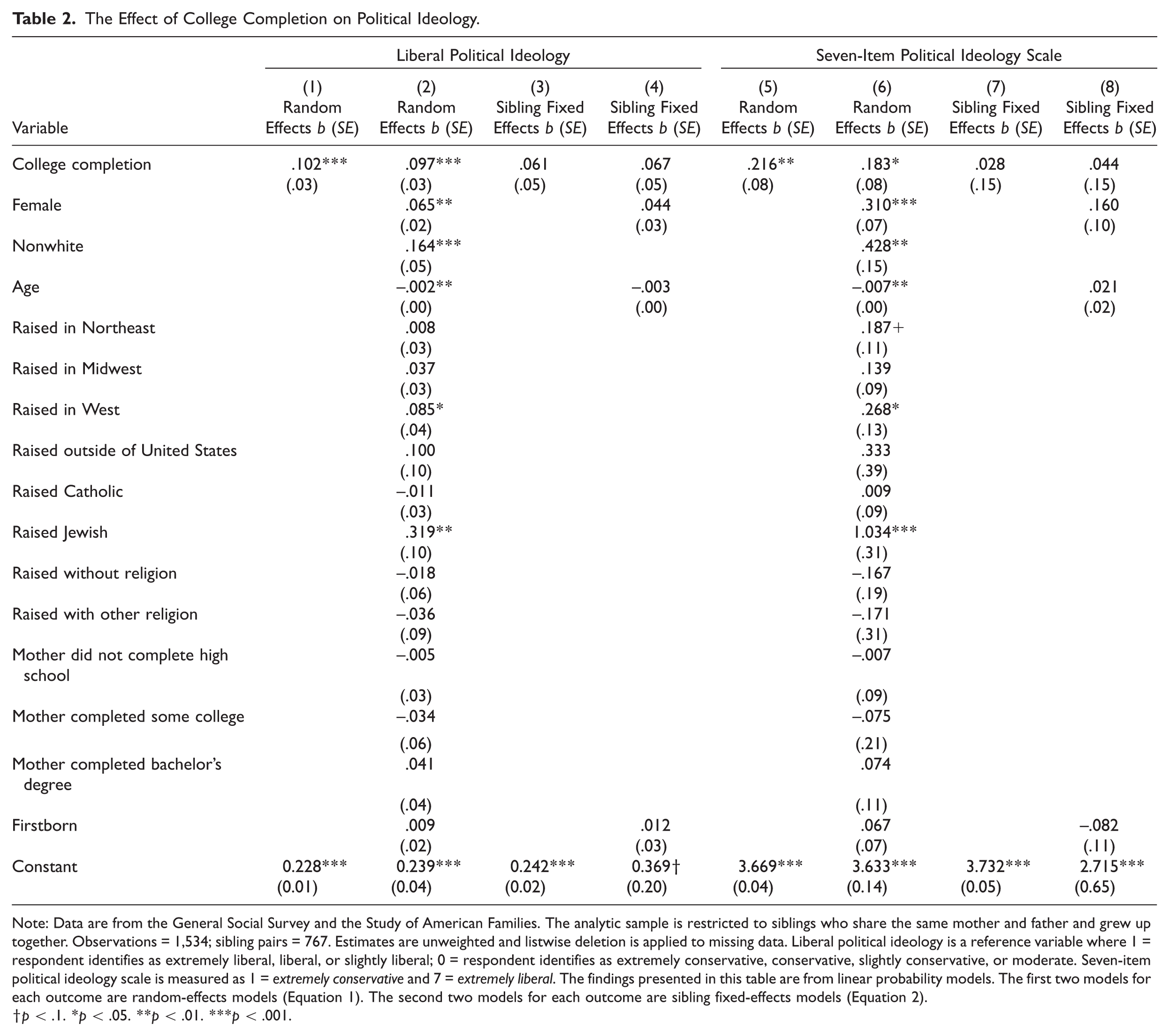
Note: Data are from the General Social Survey and the Study of American Families. The analytic sample is restricted to siblings who share the same mother and father and grew up together. Observations = 1,534; sibling pairs = 767. Estimates are unweighted and listwise deletion is applied to missing data. Liberal political ideology is a reference variable where 1 = respondent identifies as extremely liberal, liberal, or slightly liberal; 0 = respondent identifies as extremely conservative, conservative, slightly conservative, or moderate. Seven-item political ideology scale is measured as 1 = extremely conservative and 7 = extremely liberal. The findings presented in this table are from linear probability models. The first two models for each outcome are random-effects models (Equation 1). The second two models for each outcome are sibling fixed-effects models (Equation 2).
p < .1. *p < .05. **p < .01. ***p < .001.
For the first outcome, liberal political ideology, estimates from the random-effects models (Models 1 and 2) are consistent with past research: the probability of having a liberal political ideology increases by .102 with college completion (Model 1). Once demographic and observed social background characteristics are controlled for, the college effect decreases slightly to .097 but remains significant and positive (Model 2). The sibling fixed-effects models (Models 3 and 4), however, cast significant doubt on the liberalizing effect of college. Once we account for family-specific heterogeneity, the observed college effect is reduced and no longer statistically significant. This suggests that the estimates presented in Models 1 and 2 may be biased by correlation between unobserved social background characteristics and college completion. Our findings from the sibling fixed-effects models suggest that the relationship between college completion and liberal political ideology is confounded by unobserved family background characteristics.
Next, in Models 5 through 8, we estimate the effect of college completion on the full seven-item political ideology scale, where higher values are more liberal. We follow the same modeling strategy, estimating two random-effect regression models and then two sibling fixed-effects models. Overall, we observe a similar pattern. In the first random-effects model, college completion is associated with a .216 increase on the seven-item political ideology scale. Once we account for demographic and observed covariates, the college effect decreases slightly to .183. But the college effect is again greatly reduced and not significant in the sibling fixed-effects models, which again suggests that the relationship between college completion and political ideology is confounded by unobserved family background characteristics.
Next, we estimate the effect of college completion on support for civil liberties (see Table 3). As with our previous analyses, we first estimate the effect of college completion without any additional covariates in the model (Model 1), then control for observed background characteristics (Model 2), and finally, account for unobserved background characteristics that are shared by siblings with two sibling fixed-effects models (Models 3 and 4). Again, our estimates in Model 1 are in line with past research: college completion, net of observed social background characteristics, leads to greater support for civil liberties. Once we account for observed social background characteristics (Model 2), the college effect weakens slightly, but overall, the college effect remains: respondents who completed college were more likely to support civil liberties than those who did not go to college. College attendance is associated with a 2.5 increase on the 15-item support-for-civil-liberties scale. In addition, our sibling fixed-effects estimates in Models 3 and 4 show a statistically significant relationship between college completion and civil liberties, net of unobserved family background. In the full sibling fixed-effects model (Model 4), college attendance is associated with a 2.24 increase on the 15-item support-for-civil-liberties scale. This is the only statistically significant effect in the final fixed-effects model, but the substantive impact of college on support for civil liberties in the random-effects models is substantial in comparison to other measures. College attendance has approximately three times the effect of being female, over twice as powerful an effect as being raised in a non-South geographic region, and approximately twice as strong an effect as maternal educational background.
The Effect of College Completion on Support for Civil Liberties.

Note: Data are from the General Social Survey and the Study of American Families. The analytic sample is restricted to siblings who share the same mother and father and grew up together. Observations = 762; sibling pairs = 381. Estimates are unweighted and listwise deletion is applied to missing data. Support for civil liberties is a 15-item scale where higher scores indicate greater support for civil liberties. The first two models are random-effects models (Equation 1). The second two models are sibling fixed-effects models (Equation 2).
p < .1. *p < .05. **p < .01. ***p < .001.
Table 4 reports estimates of the effect of college completion on three measures of opposition to gender egalitarianism. We begin with random-effects models to estimate the effect of college completion on holding the belief that men are better suited for politics than women, net of demographics and observed background characteristics (Models 1 and 2). Our random-effects estimates are consistent with past research, showing that college completion leads to more progressive gender attitudes. In the full random-effects model (Model 2), college attendance is associated with a .147 decrease in the probability of holding the belief that men are better suited for politics. We then account for shared family background using sibling fixed-effects models (Models 3 and 4); the relationship between college and beliefs about women in politics remains statistically significant after accounting for background characteristics shared by siblings. In the full sibling fixed-effects model (Model 4), college attendance is associated with a .138 decrease in the probability of believing that men are better suited for politics than women.
The Effect of College Completion on Beliefs about Gender Equality.
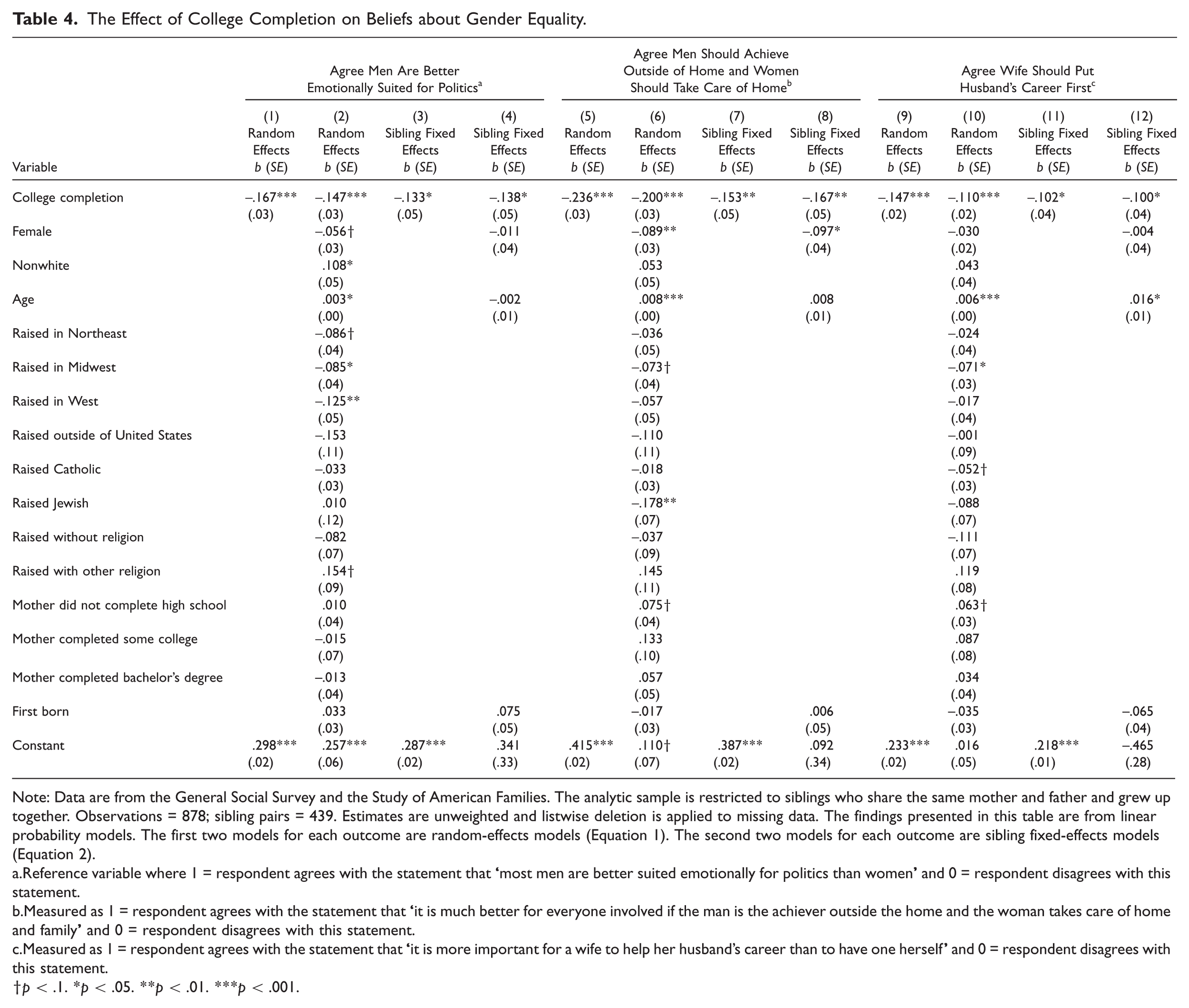
Note: Data are from the General Social Survey and the Study of American Families. The analytic sample is restricted to siblings who share the same mother and father and grew up together. Observations = 878; sibling pairs = 439. Estimates are unweighted and listwise deletion is applied to missing data. The findings presented in this table are from linear probability models. The first two models for each outcome are random-effects models (Equation 1). The second two models for each outcome are sibling fixed-effects models (Equation 2).
Reference variable where 1 = respondent agrees with the statement that “most men are better suited emotionally for politics than women” and 0 = respondent disagrees with this statement.
Measured as 1 = respondent agrees with the statement that “it is much better for everyone involved if the man is the achiever outside the home and the woman takes care of home and family” and 0 = respondent disagrees with this statement.
Measured as 1 = respondent agrees with the statement that “it is more important for a wife to help her husband’s career than to have one herself” and 0 = respondent disagrees with this statement.
p < .1. *p < .05. **p < .01. ***p < .001.
In Models 5 through 8, we examine the effect of college on the belief that men should achieve outside the home and women should take care of the home. In the full random-effects model (Model 6), college completion is associated with a .2 decrease in the probability of holding this belief in traditional gender roles. Our full sibling fixed-effects model (Model 8) shows a similar result, with college completion associated with a .167 decrease in the probability of holding this belief in traditional gender roles.
Finally, in Models 9 through 12, we examine the effect of college on the belief that women should put their husband’s career first. In the random-effects models (Models 9 and 10), college attendance is associated with a .147 and .11 decrease in the probability of holding the belief that women should put their husband’s career first; in the sibling fixed-effects models (Models 11 and 12), college attendance is associated with a .10 decrease in the probability of holding this belief. These findings are comparable to the effect of college completion on civil liberties; the effect of college completion on gender ideology remains even after accounting for unobserved family background.
College attendance is often the only statistically significant effect in our fixed-effects models for beliefs about gender egalitarianism. However, the effect sizes for college in the random-effects models are once again substantively large. The effect of college on attitudes toward women’s role in politics is roughly equivalent to a 50-year age gap, the effect of college on traditional gender-role attitudes is approximately the same as a 25-year age gap, and the effect of college on beliefs about men’s and women’s careers is about the same strength as a 20-year age gap. Furthermore, college attendance also has a stronger effect on beliefs about women’s suitability for politics than being nonwhite or being raised in a non-South region. Overall, college attendance has a notable effect on support for gender egalitarianism, and the effect sizes are large in comparison to other factors in the random-effects models.
Discussion
Does college influence sociopolitical attitudes? Present scholarship and folk theory assume that college makes students more “liberal,” but education might be confounded with unobserved family influences. We investigated the effect of college on political orientation, support for civil liberties, and egalitarian gender-role beliefs. First, we estimated the effect of college on sociopolitical attitudes in a conventional multilevel-model framework, controlling for family background. But this did not remove the effect of unobserved family differences; therefore, we used fixed-effects models across sibling pairs to remove the effects of shared unobserved family influences on sociopolitical attitudes (Halaby 2004). We found that earning a four-year college degree has a statistically significant impact on support for civil liberties and egalitarian gender-role beliefs, but the effect of college on political orientation may be spurious owing to family background. In other words, college does have a statistically significant effect on some sociopolitical beliefs, even if it does not necessarily make students more “liberal” in political orientation.
Research shows that many effects of education are actually caused by difficult-to-measure family characteristics (Highton 2009; Persson 2014; Schnittker and Behrman 2012), but our analyses provide evidence that college does create changes in some attitudes (Bobo and Licari 1989; Bryant 2003; Hout 2012; Kingston et al. 2003). This is an expected finding based on research showing the effects of interacting with a diverse set of peers, the presence of free spaces, and peer socialization; therefore, the results of this study primarily support the college effects model over the spurious model. That said, our results also suggest that individuals who grow up in certain types of families are more likely to both attend college and self-identify as liberal. Because preadult family influences reduce the effect of a college education to zero, this provides some support to the spurious model (e.g., Schnittker and Behrman 2012).
Because a college education leads to more support for civil liberties and egalitarian gender roles but not for liberalism, our results partially undercut the commonly held belief that progressive attitudes on civil liberties and egalitarian gender roles are constituent parts of a liberal orientation. Pampel (2011) finds that support for egalitarian gender roles diffused throughout the U.S. population from 1977 to 2004; progressive gender-role attitudes may thus not be a salient marker of overall political orientation today. Likewise, it is possible that although support for civil liberties was a marker of liberalism in the repressive McCarthy and COINTELPRO eras, such support was more widespread by the late twentieth century. Furthermore, the relationship between support for individual political positions and overall political orientation may not be linearly related. For example, support for more egalitarian gender roles would not lead a person to change political orientation if the person cares more about economic issues.
This study has important limitations that should be addressed in future research. The first limitation is that our analysis cannot pinpoint why college changes sociopolitical attitudes. There are at least three possible mechanisms: through learning about other cultures and ideas, which stimulates interest in different viewpoints (Bowman 2013; see also Tadmor et al. 2012); through direct peer effects (Dey 1997); and through the creation of free spaces that provide students the opportunity to develop alternative ideologies free from official oversight (Morris 1992; Polletta 1999). These three processes are often intertwined with each other; using the present data and analytic approaches, we are not able to assess the extent to which each one drives sociopolitical attitude change. Future research should consider investigating how these three processes matter in sociopolitical attitude change, in isolation and together.
Second, our analyses can rule out shared family characteristics as a confounding factor, but we cannot completely rule out selection mechanisms. Growing up in a shared environment does not mean that both siblings are equivalent on all unobserved characteristics, and siblings can have divergent sociopolitical attitudes. Davis and Pearce (2007) note that individuals with more egalitarian gender-role attitudes are more likely to attend college, and precollege attitudes might predict college attendance within families. Because our data are cross-sectional, our analyses cannot test for precollege attitudes. Assuming such data are available, we suggest that future scholars test for within-family and within-person differences to determine whether there are additional selection effects beyond unobserved family influences.
Third, the findings represent average college effects and do not consider possible heterogeneous treatment effects. The average effects might obscure important variations across social groups. For example, the effect of college may differ for men and women or for individuals from low- versus high-income households. To consider a more specific example, the effect of college on support for civil liberties may have a smaller effect on men that is balanced out by a large effect on women. The analyses presented here do not address this possibility and instead should be interpreted as the average college effect over individual-level effects. We explore this issue by conducting subgroup analyses by gender and adolescent socioeconomic status. Results for these models are largely consistent by gender but are less definitive across household socioeconomic status during adolescence (see Table S12 in the online supplement). A burgeoning field of sociological research has begun to consider how to systematically think about and address heterogeneous treatment effects, particularly as they relate to college attendance (Brand and Xie 2010; Morgan and Todd 2008; Xie, Brand, and Jann 2012). Future studies should draw on this research to attempt to more closely address how college effects may vary across social groups.
Fourth, our analytic methods and data may limit the generalizability of our findings. In particular, sibling fixed effects cannot be estimated for individuals who do not have a sibling. As a result, if the effect of college is different for people without a sibling, the sibling fixed-effects models may produce biased population-level estimates of the effects of college. Additionally, the GSS-SAF data have relatively high rates of nonresponse among eligible siblings, although this is largely attributable to insufficient information to contact eligible siblings during data collection. Our comparison of the analytic sample to the eligible GSS sample found minimal differences, but we suggest caution when generalizing these findings to more disadvantaged populations. The high rate of nonresponse is a limitation that may limit the external validity of our findings.
Finally, our findings demonstrate the effect of college on individuals educated in the latter part of the twentieth century. As the college experience changes, the effects of college may change as well. Although more recent data are not available at this time, similar analyses with more recent data would help show how the institution of higher education has changed.
Ultimately, this study provides considerable support to the argument that college affects sociopolitical attitudes (Hout 2012; Kingston et al. 2003), although we find no statistically significant effects on overall political orientation. The strength of the evidence is tied to the within-sibling design of our analyses, which allows us to rule out shared family characteristics. Our findings are largely counter to the expectations of scholars who question the consequences of a college education. However, college does not affect all social outcomes; Schnittker and Behrman (2012) convincingly demonstrate that some of the social returns to education are spurious, and we uncover a similar finding for the effect of education on political orientation. Our results thus prompt the question, In which social arenas does education make an impact, and when is a college degree confounded by family background? Further research on this question would help illuminate the role of higher education in the production of social life and help identify the unique effects of college campuses on social life.
Supplemental Material
Online_Supplement-2-1_MG_edits_CC – Supplemental material for Does College Influence Sociopolitical Attitudes?
Supplemental material, Online_Supplement-2-1_MG_edits_CC for Does College Influence Sociopolitical Attitudes? by Colin Campbell and Jonathan Horowitz in Sociology of Education
Footnotes
Acknowledgements
Each author contributed equally to the research and writing of this article. We thank the Sociology of Education editor and anonymous reviewers, as well as Shawn Bauldry and Jessica Pearlman, for their helpful and insightful comments.
Research Ethics
The research presented in this paper does not constitute human subjects research as defined by federal regulation and does not include research-like activities that require institutional review board approval either by federal regulation or university policy. The data used in this research do not include identifying information that is available to the authors of this study.
Author Biographies
References
Supplementary Material
Please find the following supplemental material available below.
For Open Access articles published under a Creative Commons License, all supplemental material carries the same license as the article it is associated with.
For non-Open Access articles published, all supplemental material carries a non-exclusive license, and permission requests for re-use of supplemental material or any part of supplemental material shall be sent directly to the copyright owner as specified in the copyright notice associated with the article.
