




Abstract
Today, many undergraduates are themselves raising children. But does college-going by parents improve their offspring’s educational attainment? I address this question using data from the National Longitudinal Survey of Youth–1979 and linked Children and Young Adults Survey. I first model postnatal college enrollment and bachelor’s completion by mothers and use predicted probabilities to minimize selection bias through inverse probability of treatment weighting. I then estimate the impact of maternal college enrollment and attainment on offspring’s likelihood of graduating from high school, enrolling in college, and completing a four-year degree. I find sizeable effects of maternal college completion on all outcomes, but the impact of maternal enrollment without completion is considerably muted. I review implications for sociological research and policies to assist nontraditional students.
Keywords
Between 1980 and 2010, undergraduate enrollment in U.S. colleges increased by 72 percent, while the underlying population grew by only 36 percent (Aud et al. 2013). This expansion occurred partly through greater enrollment by recent high school graduates; another source of growth was the extension of college-going beyond its “traditional” age base. Today, nearly 40 percent of degree-seeking undergraduates are at least 25 years old. Many undergraduates—27 percent of the total, or over 4.8 million individuals—are thus themselves raising children (Radford, Cominole, and Skomsvold 2015). The number of children who experience parents enrolling in college at some point during childhood is doubtless far larger.
Undergraduate parents face daunting challenges. Not only must they meet academic requirements while caring for children, 58 percent also maintain full-time employment (Choy 2002). Among college-going parents, 55 percent are raising children without the aid of a spouse—42 percent of male student-parents and 61 percent of females (Radford et al. 2015). More amazingly, 55 percent of single-parent college-goers also work full-time (Choy 2002). Such efforts may be worthwhile if they net substantial returns. Recent estimates suggest that among full-time workers, college graduates earn 60 percent more than high school graduates over their lifetimes (Hout 2012; Julian and Kominski 2011). But parents’ college-going may also benefit their children. It is well established that children of college graduates fare better in school than do children of less-educated parents. However, little is known about the impact of parental education attained during a child’s lifetime.
This question has practical implications. Undergraduates with children make up 34 percent of Pell recipients but have low completion rates (College Board 2015; Goldrick-Rab and Sorensen 2010). If parental enrollment benefits children, policy makers might want to subsidize parents’ tuition through public grants and low-interest loans. Supporting parental enrollment might be a relatively cost-effective strategy for raising the educational attainment of two generations simultaneously, while narrowing educational disparities.
Theory and Prior Research
Parental Education and Intergenerational Transmission of Advantage
Apart from appearances in Du Bois (1903), Weber ([1922] 1968), and Sorokin (1927), education was marginal to sociological theories of stratification until the work of Hollingshead (1949), the British “political arithmetic” school (Glass 1954; Hogben 1938), and American “status attainment” research (Blau and Duncan 1967; Sewell, Haller, and Portes 1969). Subsequently, that education is a crucial determinant of life chances and a vector for intergenerational status transmission has become a stylized fact (Mare 1981; Sirin 2005; Teachman 1987). But because education, unlike wealth or genetic endowments, cannot be bestowed upon offspring directly, how this transmission occurs is contested.
According to human capital theory, the educational system is a neutral mechanism instilling individuals with skills. Acquiring education increases productivity—the quantity and quality of one’s output per time unit—and hence one’s wages. When this framework is transferred to childrearing, parents are rendered analogous to schools and children to students: parents contribute “inputs” to their children’s future productivity. Parenting is also conceptualized as labor, and parents’“productivity” varies according to their educational attainment. Thus, highly educated parents’ inputs are of greater quality than those of less-educated parents, and their children receive greater “income” per parenting time unit (Becker 1981; Guryan, Hurst, and Kearney 2008).
In Bourdieu’s (1986; Bourdieu and Passeron 1977) contrasting perspective, parenting invests children most importantly with cultural capital. In its “embodied form,” this refers to speech and bearing, cultural knowledge and preferences, and ways of conceiving the world—an individual’s habitus insofar as it can realize profits. All children are invested with family-based cultural capital, but this capital varies qualitatively and quantitatively by social class. For Bourdieu, the value of one’s cultural capital depends on the field in which one exchanges it. And the educational field—the school system—recognizes and rewards bourgeois cultural capital while disdaining that of working-class families. Children of educated parents thus smoothly negotiate the school system, successfully converting embodied cultural capital into its institutionalized form: credentials. The chief function of the school is to reframe class advantage as merit.
Recent accounts have synthesized these perspectives. Harding, Morris, and Hughes (2015) discuss how parental education influences children through stocks of human, cultural, and social capital. Parental human capital—language skills, knowledge, and information-gathering abilities— affects the quality and quantity of engagement in stimulating activities with children and thereby children’s cognitive ability. Cultural capital—preferences, behaviors, and cultural styles—gives parents the capacity to understand the educational system and effectively advocate for their children. When conveyed to children through modeling and coaching, cultural capital improves children’s ability to negotiate educational experiences themselves. Parents’ social capital consists of the quality and quantity of their social relationships, through which they acquire information about educational strategies and opportunities. One must also examine effects of parental education operating through greater household wealth, assortative mating, and a higher likelihood of a two-parent home (Goldstein and Kenney 2001; Schwartz 2013). In summary, the total impact of parental education on children’s schooling is likely large and operates through a plethora of mechanisms.
Postnatal Education and Children’s Outcomes
There are three pathways through which postnatal college-going could improve children’s educational performance. First, a parent may realize monetary returns to additional schooling. Research confirms earnings gains from adult college-going (Jacobson, LaLonde, and Sullivan 2005; Jenkins et al. 2003), including among parents (Butler, Deprez, and Smith 2004). Plewis and Bartley (2014) find that the children of parents who experience substantial income gains tend to progress further in school. Greater monetary resources may directly influence educational outcomes through the purchase of educational services (e.g., SAT preparation courses, private tutors; Buchmann, Condron, and Roscigno 2010). Higher parental incomes may have indirect effects through familial residence, leading children to live in safer neighborhoods, attend better-resourced schools, and associate with more academically oriented peers. Finally, because individuals with college degrees are more likely to enter into marriage and less likely to get divorced (Isen and Stevenson 2010), the impact of education on household income could be compounded by adding a second earner.
Second, education may alter parenting strategies. Sociologists and others have documented how college-educated parents use interactional practices that cultivate academic facility (Davis-Kean 2005; Lareau 2003). Attewell and colleagues (2007) argue that education may affect parenting in two ways. First, it may increase a parent’s knowledge, imparting awareness of educationally beneficial childrearing practices or familiarity with high-status cultural forms to which they then expose their children (Chin and Phillips 2004). Parents may gain confidence vis-à-vis educational bureaucracies, rendering them more effective advocates (Lareau 2000). Second, parents may be socialized into the attitudes and beliefs of the educated classes to whom they are exposed, altering how they “academically socialize” their children (Taylor, Clayton, and Rowley 2004).
Third, parental college-going may affect children through interactional processes. Parents’ educational commitment could render them effective role models. Witnessing a parent’s prioritization of education could underscore spoken messages urging educational effort. If parental college-going is presented as for the good of the family, children may feel they must “redeem” this sacrifice through achievement—similar to the “immigrant bargain” (Smith 2005). Through getting a college degree “the hard way,” parents may reinforce the preferred path of completing school while young. Conversely, a parent’s nontraditional path may encourage persistence in the face of adversity, encouraging children to make multiple attempts at college-going despite setbacks.
Prior Empirical Studies
A handful of studies estimate effects of postnatal education on children’s schooling. In their study of teen mothers, Furstenberg, Brooks-Gunn, and Morgan (1987) observed that children whose mothers returned to school attained higher levels of education. In their reanalysis of a welfare-to-work field experiment, Magnuson and colleagues (Magnuson 2003; Gennetian, Magnuson, and Morris 2008) found that experimentally induced gains in maternal education increased children’s school readiness. Using data from the National Longitudinal Survey of Youth–1979 Cohort (NLSY79), Magnuson (2007) found that for mothers with low baseline education, increases in schooling were associated with improvements in children’s math and reading ability. Examining the National Institute of Child Health and Human Development Study of Early Child Care and Youth Development, Magnuson and colleagues (2009) found that maternal schooling increases are associated with larger gains in verbal skills of children of mothers with a high school degree or less, and with gains in school readiness among children of better-educated mothers. Harding (2015), analyzing the Head Start Impact Study, found increased maternal education is associated with improved academic skills but also with worse behavioral outcomes among children.
Research has also investigated the relationship between postnatal education and parenting. Magnuson and colleagues (Magnuson 2003; Magnuson et al. 2009) found that additional maternal education is associated with greater responsiveness, possession of learning materials, and engagement in cognitively stimulating activities. Crosnoe and Kalil (2010) and Domina and Roksa (2012), both using the Early Childhood Longitudinal Study–Kindergarten, found enrollment in education or job training is associated with greater school involvement, more learning activities at home, and more children’s books in one’s home.
Contributions and Limitations
This article makes four empirical contributions. First, this is one of a few papers to model college-going among parents, which occurs in a more individualized context than that of traditional students and is subject to different influences. Second, in contrast to most prior research, I investigate the impact of maternal schooling on children’s long-run attainment, rendering results relevant to children’s adult outcomes. Third, whereas prior studies focus on the effects of mothers obtaining lower levels of education, I exclusively investigate college-level schooling. Finally, given the importance of college graduate status, I consider separately the effects of college enrollment that does and does not result in bachelor’s degree attainment.
Two limitations should be mentioned. First, as with prior studies of postnatal education, owing to data restrictions I investigate the effects of maternal college-going only. However, because 70 percent of undergraduate parents are female (Gault et al. 2014b), this does not dramatically curtail relevance. Second, although I use rich data and strive to minimize selection bias, effects are insufficiently identified to permit causal claims. I address robustness to unmeasured confounders, but I cannot fully resolve this issue.
Data and Methods
Data and Sample
Data are from the NLSY79 and the NLSY79 Child and Young Adult Survey. Commissioned by the Bureau of Labor Statistics (BLS), the NLSY79 is a representative sample of individuals born between 1957 and 1964 and living in the United States in 1978. The initial sample of 12,686 respondents was first interviewed in 1979; they were reinterviewed annually until 1994 and biennially since. Survey retention has been impressive; taking into account deaths and discontinuation of oversamples, the response rate in 2010 was over 80 percent. The baseline survey collected background information, and in 1980 a cognitive test (the Armed Forces Qualifying Test, or AFQT) was administered to respondents. Researchers obtained transcripts and data on school characteristics from respondents’ high schools. Follow-up surveys queried respondents’ postsecondary enrollment and attainment, labor market behavior, marriage, and childbearing.
In 1986, the BLS began biennial interviews of all children of female NLSY79 respondents. Children under age 15 were administered the Child Survey, and beginning in 1994, respondents ages 15 and older completed a Young Adult Survey modeled on the NLSY79. As of 2012, 11,512 children are known to have been born to NLSY79 mothers.
I study the outcomes of the children of NLSY79 mothers. As I am interested in the effects of postnatal undergraduate education, I exclude children of mothers who earned a bachelor’s degree prior to having children. Mothers of multiple children may have attained a bachelor’s degree between births. I include only children born to mothers who had not completed a bachelor’s degree prior to their birth. Children born to NLSY79 women were between the ages of 0 and 42 in the most recent year for which data are available, and not all individuals were successfully interviewed each survey year. Because I am interested in outcomes up to college completion, I include only interviewees interviewed since reaching 23 years of age. The resulting analytic sample is N = 5,021 (see Online Appendix 1).
Variables
Dependent variables
Each round of the Young Adult Survey inquired into high school completion, college enrollment, and college completion since the previous interview. The survey also asked respondents’ highest grade of school attended and completed. I used both sets of variables to create three dichotomous outcomes: ever earning a high school degree or equivalent, ever enrolling in college, and ever completing a bachelor’s degree.
Target independent variables
Independent variables of interest are (1) experiencing one’s mother enrolling in higher education but not completing a bachelor’s degree and (2) experiencing one’s mother completing a bachelor’s degree. What counts as college enrollment was determined subjectively by NLSY79 respondents (i.e., a positive response when asked if they had attended “college”). College enrollment may have been in an institution of any level and may have lasted for any length of time, provided the respondent considered it significant enough to report.
The NLSY79’s yearly and retrospective questions permit flagging of years in which mothers enrolled in postsecondary education and earned bachelor’s degrees. These data were cross-referenced with children’s birth years to create two dichotomous indicators. These are coded 1 only if maternal enrollments and completions occurred prior to the offspring turning 17, to ensure the treatment did not occur subsequent to any outcome (e.g., high school graduation). Respondents for whom variables are coded 0 are not necessarily children of mothers who never enrolled in college but children whose mothers (1) did not have a bachelor’s degree at their birth and (2) did not subsequently enroll in college. I refer to mothers who attended college but did not earn a bachelor’s degree as postnatal enrollers; I call mothers who earned a bachelor’s degree postnatal completers. Among children, groups are defined not on the basis of what their mother did after the birth of her first child but what she did subsequent to the respondents’ birth.
Maternal-level control variables
Research on nontraditional college-going has established that family socioeconomic status (SES) retains relevance in adulthood (Elman and O’Rand 2007; Taniguchi and Kaufman 2007). Sociodemographic variables include race (black and Latino versus a white/other reference group), immigrant generation, an indicator of having been raised by a single parent, number of siblings, parental education, 1979 household income (as a proportion of median income, scaled for household size), parental occupational prestige (Duncan Socioeconomic Index), and rural background. Cognitive ability and high school performance are measured through AFQT percentile scores, average grades in high school (a combination of up to 12 grades from transcripts), an indicator for high school dropout, and an indicator for ever being suspended or expelled from high school.
To measure high school disadvantage, I created a summated rating scale combining the percentage of classmates who were black or Latino, the percentage who were socioeconomically disadvantaged, and the dropout rate (α = .61 in the full NLSY79 sample). Higher values of this scale indicate attending a school with more disadvantaged peers. I also include dummies indicating whether a respondent’s best friend planned to attend college and the respondent’s college expectations in the baseline year.
I include three attitudinal measures from 1979 and 1980 interviews. Higher values of the Rotter Locus of Control Scale indicate greater belief in external influence over one’s fate. Higher Rosenberg Self-Esteem Scale scores indicate positive self-image. I created a summated rating scale measuring agreement with five statements, such as “Employment of wives leads to more juvenile delinquency” (Likert-type response categories; α = .81); higher values signify greater espousal of traditional gender roles. Self-esteem and sense of agency have been shown to influence educational outcomes (Ross and Broh 2000), and I hypothesize that concurrence with traditional gender roles discourages college attendance among women.
Research shows that older adults who have been out of school longer are less likely to enroll, and adults who have completed more education are more likely to do so (Bradburn, Moen, and Dempster-McClain 1995; Jacobs and King 2002; Taniguchi and Kaufman 2007). Economists argue that individuals with more labor market experience and who have invested more in job-specific skills are less likely to enroll in college. Higher household income may increase one’s ability to enroll but decrease the necessity for doing so. Research has found that women are less likely to enroll in college when married than either before marriage or after a divorce (Bradburn et al. 1995; Taniguchi and Kaufman 2007). I include the following variables measured at childbirth: age, years since last enrolled in formal education, educational attainment (years), labor market experience (weeks), job tenure (weeks), household income (constant 2012 dollars), and marital status. For analyses of selection into maternal college-going, these variables are measured at mother’s first birth. For child-level analyses, they are measured at the time of the individual child’s birth. I address missing data in maternal variables through multiple imputation.
Child-level controls
Child-level variables include gender, race-ethnicity, birth year, and number of siblings. Data describing fathers and partners are slight, but I include father’s/partner’s highest reported level of education and father’s age at child’s birth. I include indicators for ever having been diagnosed with a learning disability, psychiatric condition, mental disability or delayed development, medical disability, or sensory disability. I also include age at last interview as an exposure control. Table 1 shows descriptive statistics for the offspring sample.
Descriptive Statistics for Offspring (N = 5,021).
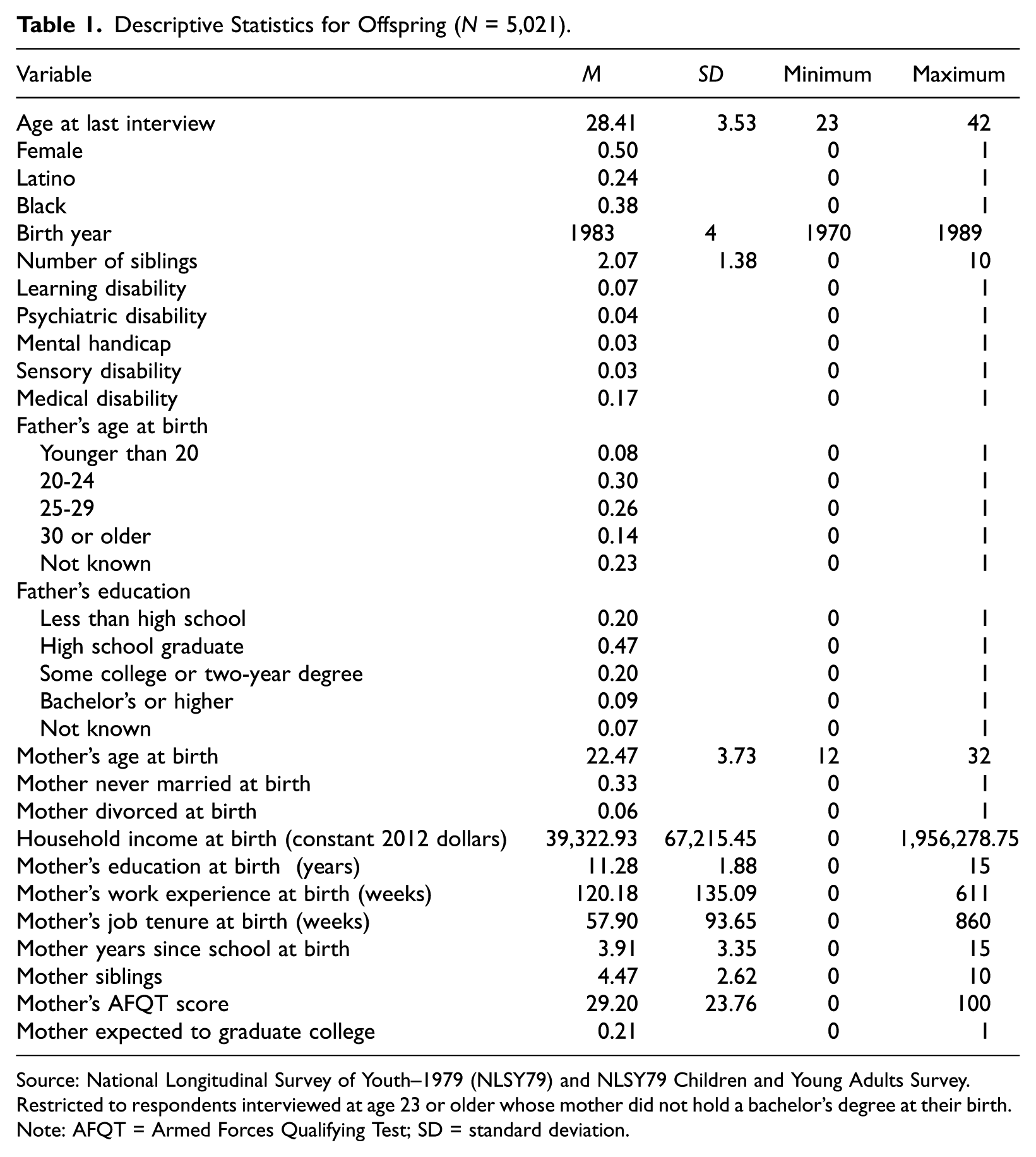
Source: National Longitudinal Survey of Youth–1979 (NLSY79) and NLSY79 Children and Young Adults Survey. Restricted to respondents interviewed at age 23 or older whose mother did not hold a bachelor’s degree at their birth.
Note: AFQT = Armed Forces Qualifying Test; SD = standard deviation.
Analytic Strategy
Inverse probability of treatment weights
In this study, the selection process of interest does not involve the individuals whose outcomes are under investigation (offspring). What must be modeled is maternal self-selection into college enrollment and attainment. I regress mothers’ postnatal college enrollment and completion behavior on a vector of background characteristics and circumstances at first birth. Because the outcome variable takes on three discrete values (no enrollment, enrollment without attainment, and enrollment with completion), I use multinomial probit regression and estimate probabilities of each outcome for each case. Each case is then assigned the conditional probability of the outcome it was empirically observed to have. The inverse of this probability is the inverse probability of treatment weight (IPTW):

IPTWs assign larger weights to cases statistically unlikely to engage in their empirically observed behavior (in terms of the target variable) and down-weight those for whom this behavior is probable, given the observables. Through weighting, I construct a pseudopopulation in which the cases in each category of the target variable resemble each other, on average, in terms of relevant characteristics (Cole and Hernán 2008; Robins 1999). Because this procedure can result in very large weights for a small number of cases, I truncate weights at their 90th percentile. To compare the children of postnatal enrollers and postnatal completers, I separately model the odds of completion conditional on enrollment and construct distinct IPTWs from the resulting predicted probabilities.
IPTWs are part of a larger family of propensity score methods and have attendant strengths and weaknesses (Caliendo and Kopeinig 2008). As a tool for causal inference, the relevant considerations are (1) whether balance is achieved between groups on observed confounders and (2) whether all relevant confounders are in fact observed. If both conditions are met, then treatment assignment is said to be ignorable. Condition (1) depends on sufficient overlap between groups but is frequently achievable and statistically verifiable. Whether condition (2) is attained is in principle unknowable in the absence of random assignment or a valid instrumental variable; one cannot assume it here.
Assessing balance
I investigate reduction in bias on observables through comparing standardized differences (SDs) before and after applying IPTWs (Austin and Stuart 2015). The SD of variable X is the absolute value of the difference in the expectation of X between two treatment groups, as a proportion of the average standard deviation of X across these groups:

I calculate the reduction in mean SD across all variables under consideration achieved through weighting. Additionally, I conduct T tests of the difference in means of covariates between groups after applying IPTWs.
Child-level regression analysis
Next, I assign the IPTW for a mother to each of her children for use as weights in child-level regressions. Child-level and paternal variables enter these models as controls. Because siblings of the same mother do not constitute independent observations, I apply a mother-level random-error term and estimate models through logistic regression (melogit in Stata). I also include the full set of maternal controls. The resulting “doubly robust” estimator—inverse probability of treatment weighting with regression adjustment—is preferable to either propensity score methods or regression in isolation, as it is robust to specification error in either the selection or outcome model although not in both (Bang and Robins 2005; Funk et al. 2011). This may reduce residual bias on observables, but it cannot remedy selection on unobservables.
Assessing robustness to unmeasured confounders
In observational studies such as this, one cannot assume conditional independence of the treatment and outcome (Rosenbaum and Rubin 1983). A common strategy is to quantify the sensitivity of inferences to unmeasured confounders. A number of sensitivity tests have been devised (Gangl 2013); I use a framework created by Frank and colleagues (2013). This test is appealingly straightforward and appropriate to logistic regression estimates. It recasts the question of internal validity as one of sample replacement.
Consider the observed sample as consisting of two proportions, one in which there is no selection bias and another in which bias exists; the proportions are α and 1 –α, respectively. We assume that the true treatment effect in α = 0, and that E(Y|T = 1) –E(Y|T = 0) in 1 –α is entirely due to bias. The question becomes, how large would 1 –α have to be to completely account for the observed effect in the full sample? Frank and colleagues (2013) determine this as

where
Results
Mothers’ Characteristics by Enrollment Behavior
The children of college-educated mothers should go further in education themselves. But among children whose mothers did not have a bachelor’s degree when they were born, educational outcomes differ depending on subsequent maternal enrollment and completion (see Figure 1). Children of postnatal enrollers have rates of high school completion, college attendance, and bachelor’s completion 7, 15, and 5 percentage points higher, respectively, than children whose mothers did not enroll. The children of postnatal completers have 9, 22, and 17 percentage-point advantages over the children of non-enrollers in these outcomes. Both groups, however, lag behind offspring of mothers who earned a bachelor’s degree prior to having children.

Educational attainment of National Longitudinal Survey of Youth–1979 offspring, by mothers’ postnatal college-going behavior. Restricted to respondents interviewed at age 23 or older.
Much of the apparent benefit of maternal enrollment and completion reflects differences among mothers prior to the birth of children (see Table 2). Theory and prior research regarding selection into educational participation and attainment are broadly borne out. Mothers who enroll in college are from more privileged backgrounds in terms of parental education and income, and they have fewer siblings than mothers who did not enroll. They have higher average cognitive ability, earned higher grades in high school, and are less likely to have dropped out. These mothers were also in a better position to garner more education: they were younger, had already obtained more education, were fewer years out of school, and had invested less in the labor market.
Descriptive Statistics For Mothers, by Postnatal College-going Behavior (N = 4,161).
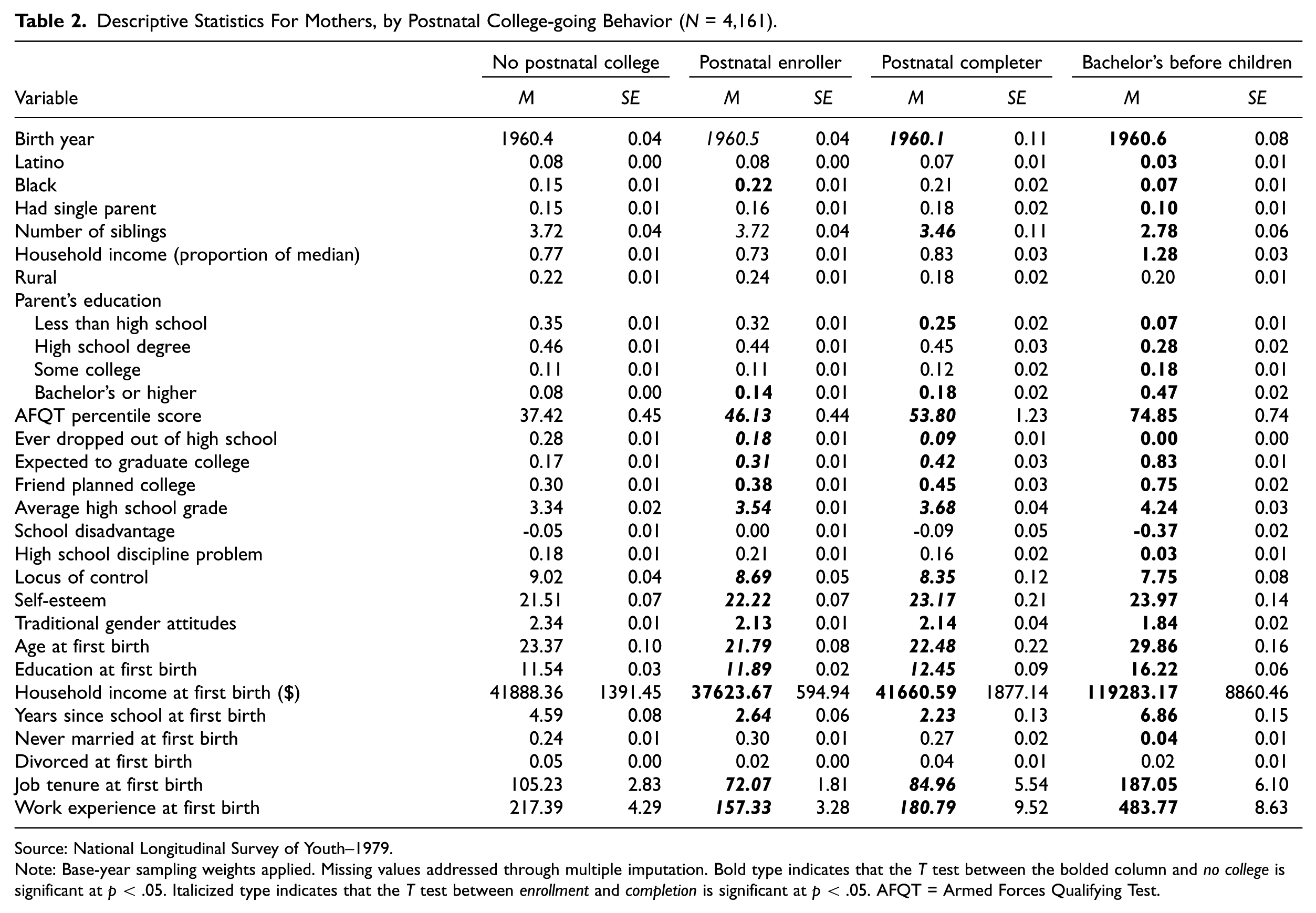
Source: National Longitudinal Survey of Youth–1979.
Note: Base-year sampling weights applied. Missing values addressed through multiple imputation. Bold type indicates that the T test between the bolded column and no college is significant at p < .05. Italicized type indicates that the T test between enrollment and completion is significant at p < .05. AFQT = Armed Forces Qualifying Test.
Also notable is how much more similar postnatal enrollers and completers are to mothers who do not return to school than they are to mothers who earned a bachelor’s degree prior to having children. For example, the difference between prebirth baccalaureate mothers and non-enrollers in the percentage having college-educated parents is 39 percentage points. The advantages held by mothers who later enroll and who later earn bachelor’s degrees are only 6 and 10 percentage points, respectively. Prebirth baccalaureate mothers tended to postpone children until older ages, after leaving school, spending several years in the labor force, marrying, and establishing higher-income households; this is not true of postnatal enrollers and completers. This suggests that such mothers present an opportunity to measure the impact of maternal education on children’s outcomes more cleanly than is typically possible.
What Predicts Mothers’ Enrollment and Attainment?
The first two columns of Table 3 show multinomial probit regression results. Coefficients reflect differences in the likelihood of either enrolling in college without earning a bachelor’s degree (column 1) or enrolling and earning a bachelor’s degree (column 2), relative to not enrolling. Net of other characteristics, childhood SES does not appear to influence postnatal enrollment behavior. Given SES differences in Table 2, null findings here suggest mediation by cognitive ability and prior schooling. Controlling for other factors, black and Latina mothers are more likely to both enroll and complete bachelor’s degrees than are white mothers. This is consistent with research showing greater minority college participation net of SES and academic achievement (Elman and O’Rand 2007; Taniguchi and Kaufman 2007). Higher cognitive scores and adolescent college expectations positively predict both enrollment and attainment, and dropping out of high school seems to impede these, even net of years of education completed at first birth. The only attitudinal measure to attain statistical significance is the scale of traditional gender attitudes, which has a negative relationship with college enrollment not resulting in a bachelor’s degree.
Multinomial Probit and Probit Regressions Predicting Postnatal College-going Behavior of Mothers without a Bachelor’s Degree at First Birth.
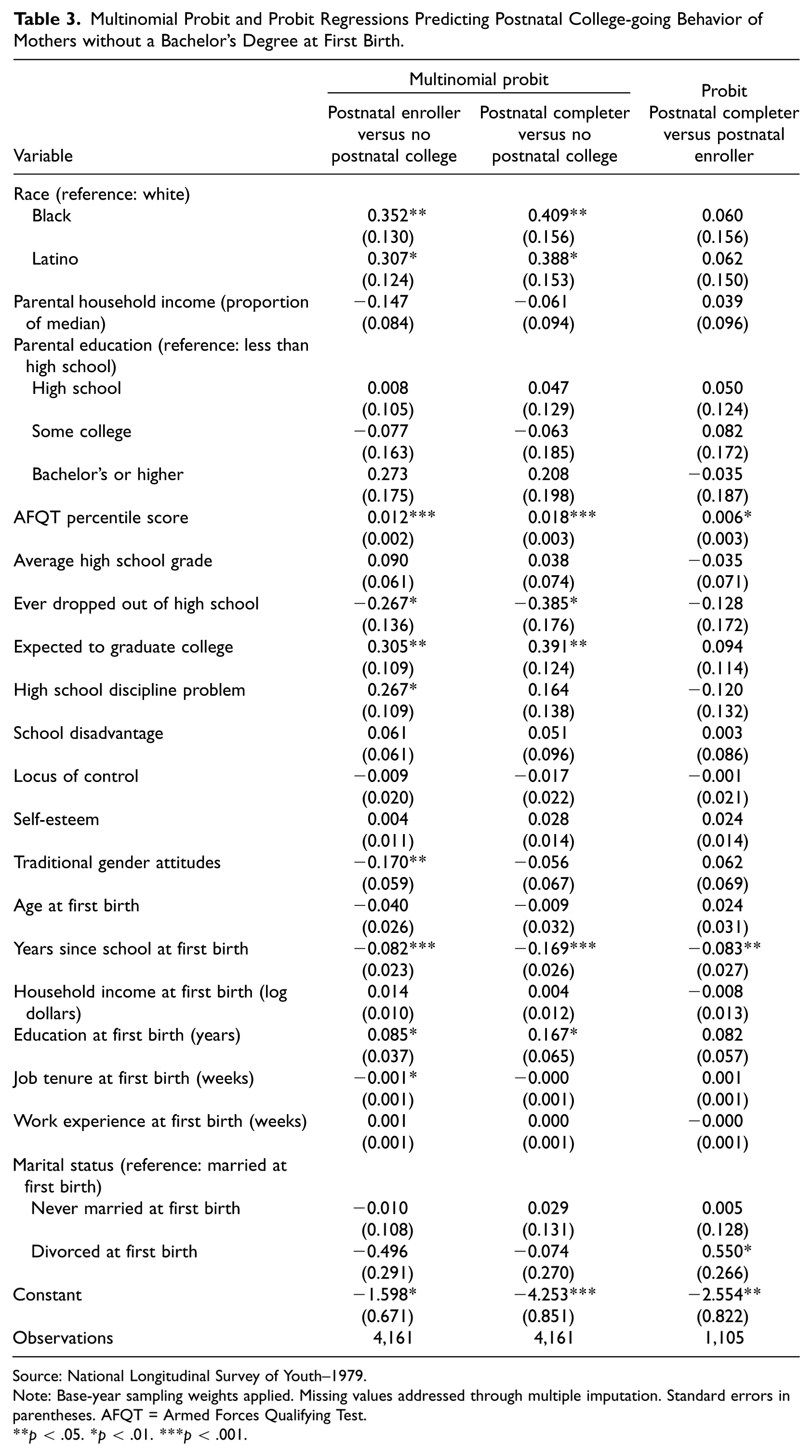
Source: National Longitudinal Survey of Youth–1979.
Note: Base-year sampling weights applied. Missing values addressed through multiple imputation. Standard errors in parentheses. AFQT = Armed Forces Qualifying Test.
p < .05. *p < .01. ***p < .001.
Proximate measures have the expected relationships with enrollment and attainment. Mothers are more likely to enroll if they previously completed more schooling and are fewer years removed from schooling. They are less likely to enroll (although not to enroll and complete) if they have greater job tenure. No relationships are apparent with either household income or age.
Column 3 of Table 3 presents results of a probit regression predicting bachelor’s completion among women who enrolled in college at some point after having a child. Table 2 indicated that these two groups are similar in terms of most background measures. In a multivariate context, only three variables have a significant relationship with postnatal completion: cognitive ability, years since schooling, and marital status. Interestingly, divorced mothers appear to be slightly less likely to enroll in college relative to married mothers, but given enrollment, they are more likely to complete a degree.
Bias Alleviation through Weighting
Regression models that actually generated IPTWs were adjusted iteratively to maximize bias reduction between groups. These models appear in Online Appendix 2. The application of IPTWs rendered enrollment groups far more comparable in terms of background characteristics. Between postnatal enrollers and mothers who did not enroll, mean bias on observables shrank by half, from 18 percent of a standard deviation to 8 percent (see Table 4). Weighting reduced bias between postnatal completers and non-enrollers from 24 to 15 percent of a standard deviation. The average SD between postnatal enrollers and completers was cut by 75 percent, from 11 to 3 percent of a standard deviation. Despite this, differences between groups remain statistically significant for a number of variables likely to affect both mother’s enrollment and children’s outcomes. A partial list includes AFQT score, dropping out of high school, adolescent college expectations, high school grades, education at first birth, and household income at first birth. IPTWs were more successful at balancing postnatal enrollers and completers; only differences in AFQT scores and job tenure at first birth remain significant at p < .05. Full balance statistics appear in Online Appendices 3 and 4.
Mean Standardized Differences across Covariates between Postnatal College Enrollment Groups of Mothers, before and after Applying Inverse Probability of Treatment Weights (IPTWs).
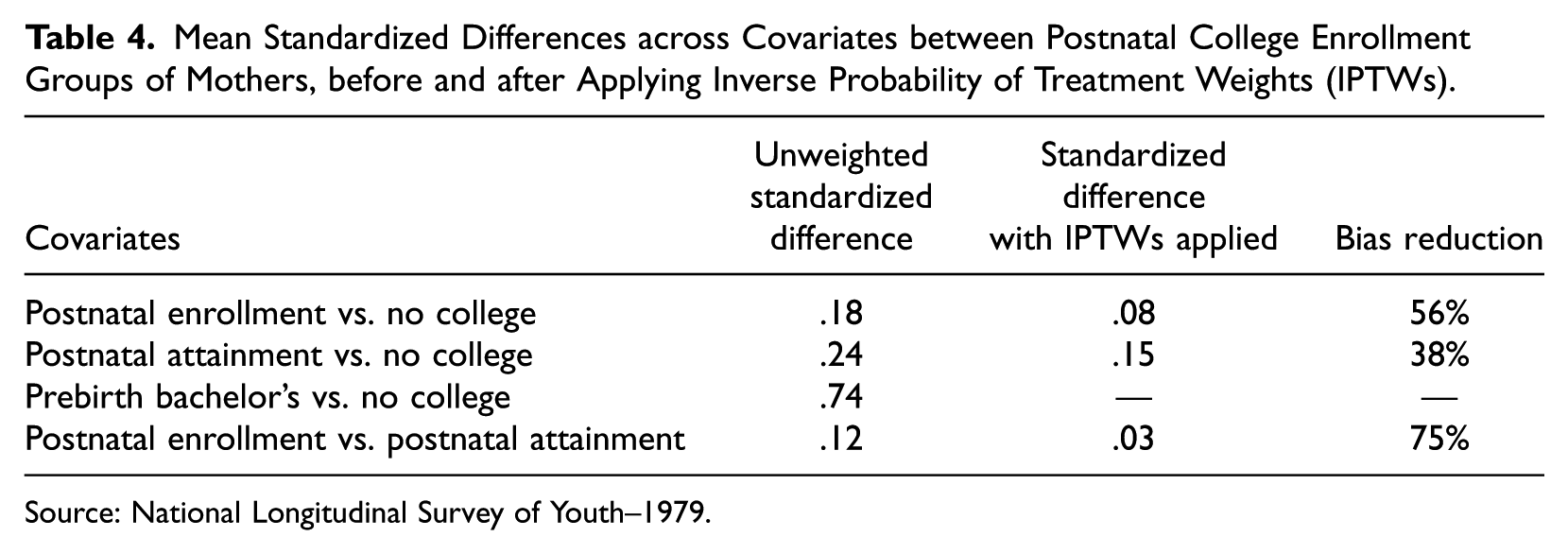
Source: National Longitudinal Survey of Youth–1979.
Maternal College-going and Children’s Outcomes
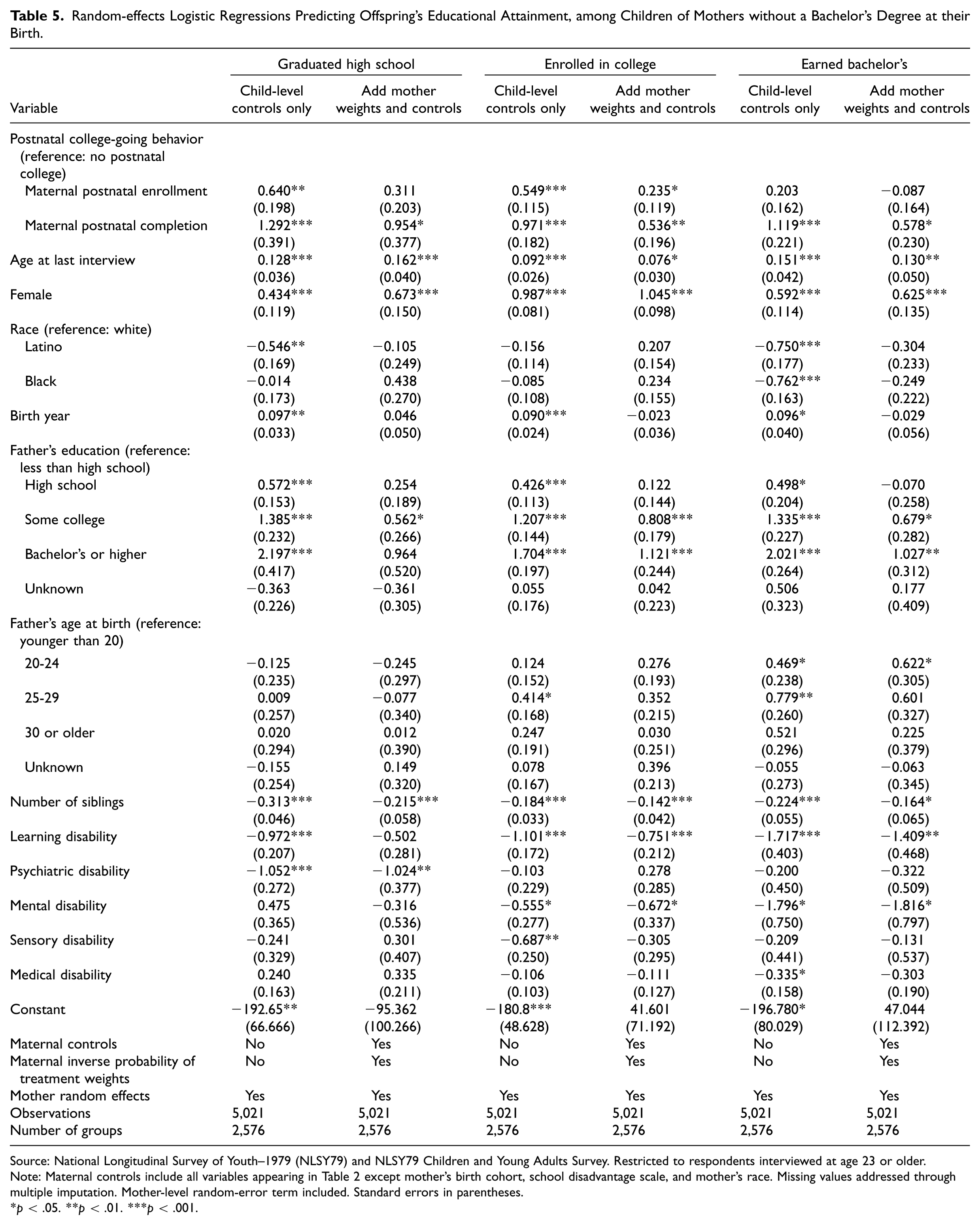
Table 5 shows the relationship between a mother’s postsecondary enrollment and bachelor’s degree completion and the educational outcomes of already-born children. For each outcome, I first present models without applying maternal controls and weights to demonstrate the attenuation of effects upon adjusting for selection on maternal observables.
Random-effects Logistic Regressions Predicting Offspring’s Educational Attainment, among Children of Mothers without a Bachelor’s Degree at their Birth.
Source: National Longitudinal Survey of Youth–1979 (NLSY79) and NLSY79 Children and Young Adults Survey. Restricted to respondents interviewed at age 23 or older.
Note: Maternal controls include all variables appearing in Table 2 except mother’s birth cohort, school disadvantage scale, and mother’s race. Missing values addressed through multiple imputation. Mother-level random-error term included. Standard errors in parentheses.
p < .05. **p < .01. ***p < .001.
Prior to adjusting for maternal traits, the children of mothers who enrolled but did not complete bachelor’s degrees appear to be more likely to both complete high school and enroll in college but not to complete a bachelor’s degree. Adding maternal controls substantially reduces all coefficients, but the relationship between maternal enrollment and offspring’s college participation remains significant at p < .05 (marginal effect = 3.8 percentage points). Estimated effects of maternal bachelor’s completion are, however, robust to maternal weights and controls. Marginal effects suggest that net of other characteristics, children of postnatal completers have advantages over the children of non-enrollers in high school completion (4.4 percentage points), college enrollment (8.4 percentage points), and college completion (6 percentage points).
Other child-level variables have relationships with educational attainment that are consistent with prior research. The positive coefficient for age at last interview is expected: respondents interviewed at older ages had more years in which to complete education. In contrast, the positive relationships between birth year and the outcomes likely indicate cohort effects on educational attainment. There are strong gender differences in each educational outcome modeled, and the children of more highly educated fathers are more likely to reach further levels of education. Having more siblings appears to reduce one’s educational attainment, as do learning, cognitive, and physical disabilities.
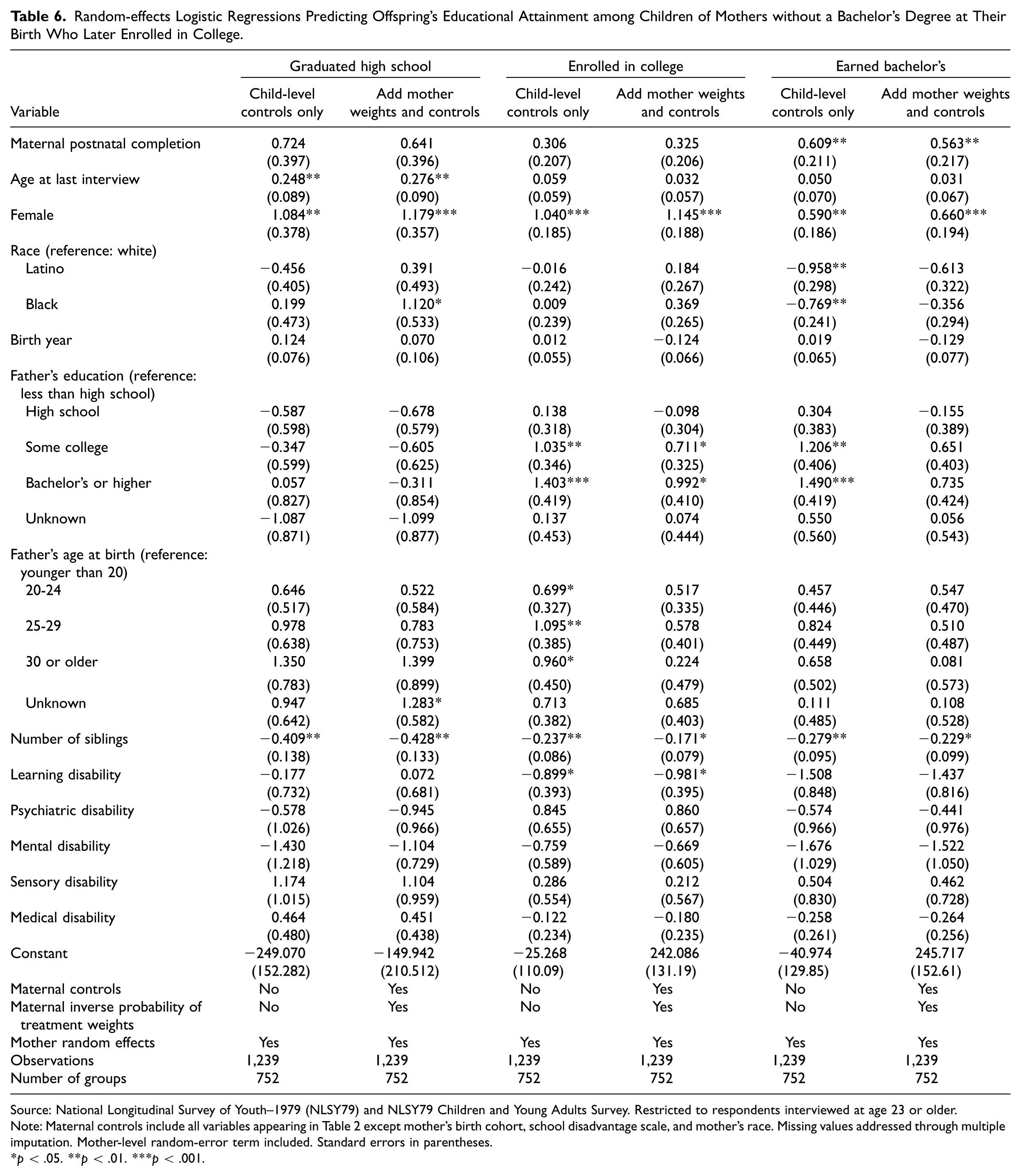
Table 6 shows analyses comparing outcomes of children of postnatal completers and enrollers. After the addition of maternal controls, the differences between the children of enrollers and completers for the most part do not remain statistically significant. However, the children of mothers who completed a bachelor’s degree were themselves more likely to complete college (marginal effect = 7 percentage points, p < .01).
Random-effects Logistic Regressions Predicting Offspring’s Educational Attainment among Children of Mothers without a Bachelor’s Degree at Their Birth Who Later Enrolled in College.
Source: National Longitudinal Survey of Youth–1979 (NLSY79) and NLSY79 Children and Young Adults Survey. Restricted to respondents interviewed at age 23 or older.
Note: Maternal controls include all variables appearing in Table 2 except mother’s birth cohort, school disadvantage scale, and mother’s race. Missing values addressed through multiple imputation. Mother-level random-error term included. Standard errors in parentheses.
p < .05. **p < .01. ***p < .001.
Robustness to Unmeasured Confounders
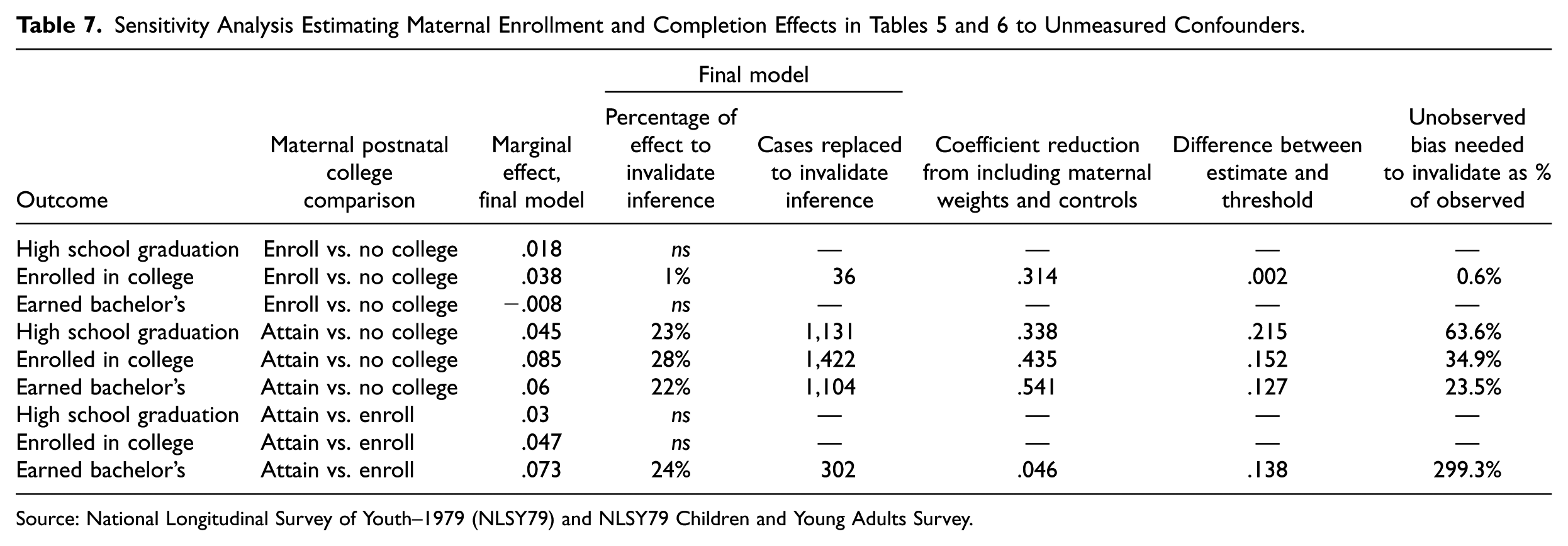
The estimated impact of maternal bachelor’s completion has proven robust to controls, but unmeasured factors might influence both maternal completion and children’s outcomes. 1 I address this possibility by determining what percentage of the observed effect would have to be due to bias to invalidate it. Results in Table 7 suggest that statistically significant inferences would be invalidated if 22 to 28 percent of estimated effects were due to selection. The exception is the estimated impact of maternal enrollment (without completion) on college enrollment, which would be invalid if only 1 percent were attributable to selection. Clearly this result inspires little confidence. But how robust are the other inferences? In 10 observational studies from Educational Evaluation and Policy Analysis explored in Frank and colleagues (2013), estimated effects required between 2 and 60 percent (median ≈ 25 percent) attributable to bias to invalidate, which places my estimates slightly below average.
Source: National Longitudinal Survey of Youth–1979 (NLSY79) and NLSY79 Children and Young Adults Survey.
We can add context by examining an instance of quantifiable bias reduction: the difference in coefficients in Tables 5 and 6 before and after adding maternal adjustments. Consider the effect of having a bachelor’s-completing mother on enrolling in college. The initial coefficient was .917; after the addition of maternal controls, it declined by .435 (to .536). The difference between that latter coefficient and the threshold for significance is .536 – .384 = .152. This means that if bias on unobservables accounted for about a third as much as bias on observables (.152 / .435 = .349), the inference would be invalidated. The last three columns in Table 7 present corresponding figures for the other statistically significant estimates. That unobserved bias would have to account for less than 1 percent as much as selection on observables does not inspire confidence in the estimated effect of having a postnatal-enroller mother on college enrollment. The effect of maternal bachelor’s completion (given enrollment) on offspring’s bachelor’s degree attainment appears robust in context—unobserved bias would have to be 300 percent as influential as bias on maternal observables. Other inferences would be invalidated if unobserved bias is between a quarter and two thirds as substantial as bias on observables. 2
Discussion and Conclusions
When a mother enrolls in college, and when she earns a bachelor’s degree, is this beneficial for her children’s educational trajectories? The evidence presented here suggests this is probable. I do not find strong evidence that maternal college-going that does not result in a bachelor’s degree has an appreciable impact on children’s outcomes, although had I investigated effects separately by institutional type, selectivity, or length of attendance, findings could be different. Maternal bachelor’s completion appears to increase high school completion by 4.5 percentage points, college enrollment by 8.5 percentage points, and bachelor’s attainment by 6 percentage points. Given the well-studied effects of educational attainment on earnings, this suggests that a parent’s college-going could facilitate children’s social mobility. Children born to college graduates have sizeable educational advantages. But given the relative accessibility of higher education in the United States, parents can increase their educational attainment after having children. My results suggest that doing so can make it more likely their children will complete college. If so, then later-life educational participation could narrow intergenerational educational disparities.
This study holds three implications for sociological theory and research. First, we should revise our received notions of status attainment and transmission, which presume that parents garner all of their education prior to their children’s birth. Parental education is in fact dynamic; the parents of millions of children earn high school diplomas, occupational credentials, and postsecondary degrees each year. My findings suggest that such changes in parental educational attainment affect offspring independent of baseline levels. Second, we need to piece apart components of SES when considering family effects on children’s life chances. Whereas social reproduction theories typically render parental education an aspect of class background, postnatal educational upgrading provides the opportunity to foreground it and establish its independent impact. Third, this article should contribute to a larger reorientation of the sociology of higher education toward the “marginalized majority” of undergraduates who are in some sense “nontraditional” (Deil-Amen 2015). This means moving beyond a disproportionate focus on elite institutions; in the era of universal access, it is imperative to take seriously the broad-access sector where, for instance, the overwhelming majority of undergraduate parents are enrolled.
An important finding is that maternal bachelor’s completion, not enrollment by itself, appears to benefit children. Although the completion rate of student-parents is low, we have reasons for optimism. Research suggests that, compared to younger students, adults tend to have developed noncognitive skills conducive to college success (Bye, Pushkar, and Conway 2007; Kasworm 2010). Additionally, when part-time attendance and academic preparation are controlled, older students appear equally or more likely than younger students to complete a degree (Calcagno et al. 2007; Jacobs and King 2002).
Parents presently receive little support in completing college. A major concern is the availability of child care, and the percentage of public colleges offering this service appears to be declining in both the two- and four-year sectors (Gault et al. 2014a). Open-access colleges should provide flexible, affordable, high-quality child care to students, and states and localities should fund them to do so. Greater experimentation with remote and hybrid courses is also welcome, permitting it does not lower schools’ quality or capacity to retain students. Colleges can help student-parents by easing credit transfer among institutions. Many student-parents attend multiple institutions through their educational careers, and the loss of credits at transfer is common (Monaghan and Attewell 2015; Simone 2014).
The financial aid system could be reformed to better serve student-parents (Baum et al. 2013). At present, it is cumbersome and complicated, and many undergraduate parents who are eligible for aid do not even apply (Huelsman and Engle 2013). Undergraduate parents are typically ineligible for merit-based programs, such as Georgia’s HOPE scholarship, and because they attend resource-poor institutions, they are less likely to receive institutional grants. Parents’ living costs— such as feeding and clothing children—are not included in the calculation of one’s aid package (Heller and Bjorklund 2004). And because federal aid formulas use income from prior years, prospective students who have been working are frequently offered little assistance. For nontraditional students, federal aid determinations should take into account the probability of reduced earnings during college. Research shows that adults and student-parents are more sensitive than younger students to increases in need-based aid (Seftor and Turner 2002; Simmons and Turner 2004), although this research speaks to enrollment rather than completion.
Finally, states or the federal government could ease restrictions on college attendance for individuals on public assistance. The 1996 welfare reform, by shifting from human capital–based to “work-first” policies, dramatically reduced the number of welfare recipients enrolled in college (Goldrick-Rab and Shaw 2005). Despite this, some state initiatives continue to provide low-income parents with postsecondary access (Butler et al. 2004). Such programs, if expanded, hold particular promise for minority children, whose mothers are disproportionately poor.
Given that millions of parents attend college each year, the number of children potentially affected is vast. Recently, child development scholars have shown renewed interest in “two-generation” strategies, which seek to move families out of poverty through human capital interventions that simultaneously target parents and children (Chase-Lansdale and Brooks-Gunn 2014). Because so many parents are already attending colleges, it would make sense to involve postsecondary institutions in comprehensive two-generation programs. For this to happen, colleges and policy makers must accept that enrollment by parents is neither marginal nor temporary. Parental college-going should be viewed as an opportunity to improve the lives of both parents and their children.
Footnotes
Acknowledgements
I would like to thank Douglas Lauen and Elaine Allensworth for comments on a prior version of this paper and Kenneth Frank for advice on methodology.
Research Ethics
This research involves analysis of publicly available data stripped of personal identifiers. Consequently, informed consent has not been obtained, but results are such that individuals cannot be identified.
