



Abstract
We ask whether patterns of racial ethnic and socioeconomic stratification in educational attainment are amplified or attenuated when we take a longer view of educational careers. We propose a model of staged advantage to understand how educational inequalities evolve over the life course. Distinct from cumulative advantage, staged advantage asserts that inequalities in education ebb and flow over the life course as the population at risk of making each educational transition changes along with the constraints they confront in seeking more education. Results based on data from the 2014 follow up of the sophomore cohort of High School and Beyond offer partial support for our hypotheses. The educational attainment process was far from over for our respondents as they aged through their 30s and 40s: More than 6 of 10 continued their formal training during this period, and 4 of 10 earned an additional credential. Patterns of educational stratification at midlife became more pronounced in some ways as women pulled further ahead of men in their educational attainments and parental education (but not income), and high school academic achievement continued to shape educational trajectories at the bachelor’s degree level and beyond. However, African Americans gained on whites during this life phase through continued formal (largely academic) training and slightly greater conditional probabilities of graduate or professional degree attainment; social background fails to predict earning an associate’s degree. These results, showing educational changes and transitions far into adulthood, have implications for our understanding of the complex role of education in stratification processes.
Keywords
Early work in the status attainment tradition documented the degree to which children of parents with more education and higher occupational status complete higher levels of education and go on to enjoy higher levels of occupational success (Blau and Duncan 1967; Sewell, Haller, and Ohlendorf 1970; Sewell, Haller, and Portes 1969). One aspect of the status attainment model that continues to constrain research is the static and orderly view of the life course that such a model implies. We typically think of educational attainment as preceding occupational entry, a modeling convenience that permits an unambiguous estimation of causal effects of origins on education, and education on occupation, based on temporal ordering. However, the paths adults follow through their educational and occupational careers are increasingly varied with respect to timing (Shanahan 2000), and deviations from the normative progression from education to occupation are becoming more common (Macmillan 2005; Milesi 2010; Settersten 2003). Stratification researchers are sensitive to issues related to the life course timing of occupational status and income from both origins and destinations (Mazumder and Acosta 2015; Solon 1989), but few studies consider how the educational career unfolds over the life course. This study investigates whether educational attainment in later stages of adulthood shifts our understanding of how advantages accumulate across life course stages and how later stage attainment affects the stratification of educational attainment.
The temporal bounds scholars typically impose on educational attainment are problematic; we often assume the educational career is over by age 25 or 30, but that is simply untrue. Among adults age 44 to 48 in 2010 who claimed to have earned a bachelor’s degree prior to 2005, roughly 1 in 10 earned that degree after the age of 34. Among those with a master’s degree, the most common graduate credential, the median age at degree was 31; one in four terminal master’s recipients earned their degree at age 38 or older (authors’ estimates based on the 2010 National Survey of College Graduates).
The timing of degree attainment varies by degree, social origin, and prior academic achievement. Students who conform to age typical patterns of educational progressions are, on average, more advantaged than those who earn credentials later in life. These age typical patterns may contribute to a pattern of cumulative advantage (CA) through “positive and steep trajectories of economic attainment” (O’Rand 2002:23), which can increase disparities in income and wealth over the life course. On the other hand, excluding individuals who earn their undergraduate or sub baccalaureate degrees “off schedule” risks overstating the extent to which educational outcomes in the population are stratified. When in the life course we observe respondents’ educational attainment may condition our understanding of how social background and prior academic achievement influence degree attainment.
In this article, we propose a modified version of CA theory—which we call “staged advantage”—to understand the role educational attainment plays over the life course in social stratification in the United States. Drawing on insights into processes of educational attainment offered by Mare (1980) and Breen and Jonsson (2000), we suggest the varied timing of educational continuation over the life course implies a much more nuanced pattern of social stratification in educational progression than is commonly appreciated. The population at risk of making each educational transition changes over the life course, as do the constraints they may face and the opportunities they may need to forgo to continue formal education. Rather than a persistent fanning out of opportunities and rewards, as asserted by CA, staged advantage anticipates both increases and reductions in the degree of advantage enjoyed by different groups over time.
We hypothesize that patterns of bachelor’s degree enrollment and attainment between people’s late 20s and midlife will reduce stratification by race/ethnicity and social background. At the same time, we anticipate that transitions to graduate and professional degrees will reinforce earlier patterns of social stratification and that an appreciable share of the marginal advantage enjoyed by children of more educated and more affluent parents will be accounted for by students’ levels of cognitive and noncognitive skills in high school.
We use midlife data from the High School and Beyond (HSB) sophomore cohort to examine educational attainment across the life course. The cohort graduated from high school in 1982, and the two most recent follow up surveys were conducted in 1992 and 2014, when respondents were approximately 28 and 50 years old, respectively. We aim to understand the sociodemographic patterns and predictors of new degree attainment of cohort members from their late 20s through their 30s and 40s, a period typically regarded as after the completion of formal education. By examining educational attainment later in life, we hope to produce a more accurate picture of how ascribed and achieved characteristics affect ultimate educational attainment than is possible when data collection is truncated in early adulthood.
We begin by providing a descriptive analysis of sample members who attained formal academic and/or vocational degrees between 1992 (around age 28) and 2014 (around age 50) and how these additional credentials alter the marginal distribution of degree attainment. We consider the frequency with which respondents holding each type of degree in 1992 returned to school by 2014 as well as the type of new degree respondents earned. Next, we model the probability that sample members participated in formal academic or vocational training (or both) between 1992 and 2014 as a function of social origin (race/ethnicity, sex, and parent income and education), high school achievement (test scores, grades, and the highest math course completed in high school), noncognitive skills in late adolescence, and life course events (including marriage and having children) that may impede a person’s educational career. Finally, we compare differences in the marginal and conditional probabilities of degree attainment between adulthood and midlife as a function of these same attributes and experiences.
Contrary to our expectations, we find relatively little change in the stratification of educational attainment over the life course. African American, but not Latino, individuals are more likely than non-Hispanic white individuals to earn a bachelor’s or graduate degree during this period. Parental income in respondents’ late adolescence does not predict further educational credentials between the ages of roughly 28 and 50. However, parental education continues to shape educational pathways as respondents approach midlife. The association between parental and respondent education is most pronounced for earning a graduate or professional degree, but it is also evident for the probability of earning a vocational certificate during this period. Prior cognitive and noncognitive skills do not have a consistent relationship with degree attainment between early adulthood and midlife, but they partially mediate the substantial relationship between parental education and graduate/professional degree attainment. Rather than being disrupted by the passage of time, patterns of educational stratification remain largely stable as adults reach midlife. The surprisingly large share of adults who participated in formal education between the ages of 28 and 50 followed stratified pathways to educational attainment, preserving patterns of inequality at midlife.
Educational Attainment and the Normative Life Course
Life-course theory asserts that people’s lives are structured by age, both formally and informally, into three distinct stages: education and training, continuous work, and leisure and retirement (Elder, Johnson, and Crosnoe 2003; Macmillan 2005; Settersten 2003). Laws and policies often reinforce these stages: Students in the United States are compelled to remain in school until they are at least 16 and, in some states, 18 years of age. Formal retirement ages and financial penalties associated with early retirement encourage people to persist in work through at least 62 to 65 years of age. Social norms reinforce these expectations.
Education dominates the first stage in the traditional life course structure (Crosnoe and Benner 2016; Pallas 2003; Settersten 2003). Upon exiting the education system, people are expected to enter the continuous work phase of life. If the timing or ordering of these events deviates from the normative schedule, others are often surprised or look unfavorably upon a person. As Settersten (2003:88) writes, “Being off time can be inconvenient and uncomfortable—and even come with costs for the individual” regardless of the absence of formal sanctions.
The assumption of strictly ordered transitions underlies much of the stratification literature, and as a result, it shapes many of the methodological decisions analysts make. For example, Maralani (2013:1525) confines her analytic sample to women at least 25 years of age “to capture completed schooling”; Beller (2009) likewise considers only individuals age 25 years or older but without explicitly invoking the idea that educational attainment is final at that stage. These assumptions may deviate from patterns of completed education or people’s first jobs for important subsets of the population (Denice 2017).
Although normative life course expectations for primary school through college may be clear, expectations about the timing for postbachelor’s degrees are not. The median age of graduate and professional students in 2015 was 30 to 34 (National Center for Education Statistics 2016), about the same as in previous decades going back to 1987 (Bell 2009). As we will discuss in greater detail, most entrants into graduate/professional degree programs have accrued some labor market experience. In the past, the number and share of adults going on to graduate and professional education was small enough to minimize the effect such an omission had on our understanding of educational and social stratification. This is no longer the case. Truncating the educational career at 30 would miss about a quarter of the professional degrees, over half of the master’s degrees, and nearly three quarters of the doctoral degrees earned by individuals with at least a bachelor’s degree in 2013. Age restrictions thus risk substantially undercounting graduate and professional degrees.
Understanding Stratification in Education across the Life Course
Truncating our measurement of education in the late 20s does little harm to our understanding of stratification in high school completion or college entry, but age restrictions may do more harm to our understanding of how ascribed and achieved attributes shape college completion and graduate and professional education. Among individuals who earned their bachelor’s degree in 2007 to 2008, 11.5 percent took at least 10 years to do so; another 12 percent took between 6 and 10 years. About one in three adults age 22 to 42 at the end of the 1980s left their first regular job (employed full time more than six months) to return to school (Elman and O’Rand 2004: Table 2). Students who stop out may continue their education episodically for years to come, some earning a credential at age 30 or older (Attewell and Lavin 2007; Jacobs and Stoner-Eby 1998). Enrollments among people age 29 and older have continued to grow over time, most notably for African American women (Denice 2017).
Students who are socioeconomically and academically disadvantaged are more likely to follow nontraditional education pathways, as are students enrolled in less selective colleges (Milesi 2010), those who stop out (Goldrick-Rab 2006; Shapiro et al. 2014), and those who enter college late (Bozick and DeLuca 2005). Adhering to normative time frames in our analyses not only affects our concept of the distribution of a cohort’s educational attainment, but it undermines our ability to assess social mobility, especially if the most disadvantaged are disproportionately likely to earn their terminal degrees later in life. Likewise, given the relationship between social origins and the likelihood of attaining an advanced degree (Posselt and Grodsky 2017; Torche 2011; Wakeling and Laurison 2017), taking a shorter view of educational attainment may risk understating the extent to which educational attainment is socially stratified.
Of course, many people enrolled in formal training programs pursue vocational rather than academic credentials. Fully a third of our sample members who returned to school (about 1,700) enrolled exclusively in vocational programs. Credentials in such programs include associate’s degrees and occupational certificates, represent a sizeable share of the postsecondary investments returning students make, and have been the focus of substantial policy discussions on pathways to upward mobility (Carnevale, Rose, and Hanson 2012; Rosenbaum, Ahearn, and Rosenbaum 2017).
Returning to School after Time in the Labor Force
What leads adults to reenroll in school after entering the labor market or starting a family? Much of the prior research on transitions from work to school, or returning to school while working or parenting, focuses exclusively on women’s experiences (Bradburn, Moen, and Dempster-McClain 1995; Felmlee 1988; Jacobs and King 2002). This research suggests that, rather than allowing individuals less advantaged in their youth to catch up with their more advantaged peers, time reinforces patterns of stratification set into motion earlier in the life course. Cognitive ability predicts returning to school for women (Felmlee 1988), as does prior level of education (Bradburn et al. 1995; Denice 2017; Felmlee 1988). Women enjoying greater earnings in the labor market (Felmlee 1988) and reporting higher levels of economic status (Bradburn et al. 1995) are more likely to return to school than are those with lower earnings or economic standing. Jacobs and King (2002) find that nonwhite women are significantly less likely than white women to complete a degree after an interruption in their education; in contrast, Elman and O’Rand (2004) report that African American women may be more likely than white women to return to school conditional on other attributes and experiences. 1 Other life course transitions beyond labor market entry seem to hinder women’s chances of returning to school. Marriage (Felmlee 1988) and childbearing (Felmlee 1988; Jacobs and King 2002) both reduce women’s likelihoods of continuing their education. However, Elman and O’Rand find that having a child prior to one’s first job is positively associated with returning to school.
Many of the patterns observed for women apply to men as well. Maternal (Astone et al. 2000; Elman and O’Rand 2004) and paternal (Light 1995) education predicts reenrolling in school for both men and women, although Elman and O’Rand (2004) find that paternal occupational status is conditionally independent of the hazard of returning to school. Findings on racial/ethnic differences in nontraditional enrollment are mixed. Elman and O’Rand find that African American men are no more likely than white men to return to school conditional on other attributes and experiences, but Jepsen and Montgomery (2012) report that African American men and women are more likely than white men and women to enter a four year college but not a community college. Life-course transitions, including marriage and having children, may reduce the chances of returning to school for both sexes, although findings on children are mixed. Unlike for women, Elman and O’Rand (2004) do not observe a positive association of having a child prior to one’s first job with returning to school for men. Jepsen and Montgomery (2012), on the other hand, find that having a child is negatively associated with returning to school for both men and women. More proximal experiences also shape reenrollment trajectories, with success in the labor market (as measured by full time employment and wages) reducing the likelihood of returning to school (Astone et al. 2000; Elman and O’Rand 2004; Light 1995).
Although findings in this literature are generally consistent, they typically fail to account for prior educational experiences or levels of achievement that may confound the relationship between social origins, early adult experiences, and returning to school. Light (1995) conditions her estimates on Armed Forces Qualification Test (AFQT) scores and Felmlee (1988) on IQ, but most studies lack even these rudimentary controls for cognitive ability. None of the studies we reviewed include other measures of academic success, like secondary school grades and course taking, because these are typically missing from the data sets on which prior studies rely. These indicators of past school success may be central to students’ decisions about whether to reenroll. They reflect important information about the likelihood of success in school and may capture aspects of students’ tastes for schooling. Grades, in particular, measure a mix of academic skills, effort (Allensworth and Luppescu 2018; Kelly 2008), and self control (Galla et al. 2019; Kaiser and Diewald 2014) and are substantially more predictive of persistence to degree among undergraduates than are test scores (Bowen, Chingos and McPherson 2009; Galla et al. 2019).
Finally, most of the reviewed research fails to adjudicate among the highly varied programs of study returning adults pursue. Jepsen and Montgomery (2012) distinguish between baccalaureate and sub baccalaureate institutions, but even this may be too crude to capture patterns of stratification among returning students. Returning for a graduate or professional degree looks quite different from returning to initiate a new spell of enrollment toward a bachelor’s degree or enrolling in a community college for the first time, yet few data sets include information on the degree programs in which returning students enroll.
How might our understanding of social stratification shift if we consider more carefully the education pathways people pursue across the life course? On one hand, our typically truncated view of the educational career may lead us to understate the magnitude of social stratification. The most advantaged individuals may continue to build on past inherited and achieved successes as they age by earning advanced graduate and professional degrees. This expectation is consistent with CA theory. First applied by Merton (1968) to the distribution of scholarly citations in the sciences under the rubric of “the Matthew effect,” CA theory in its simplest form asserts that early advantages beget later gains: The rich get richer and the poor fall further behind. In their review of the CA literature, DiPrete and Eirich (2006) distinguish between two types of CA: a strict form that leads to exponential growth in advantage and a second (unnamed) form that reflects “direct and indirect effects of a status variable” and leads to a more or less stable rate of growth in advantage. To illustrate the latter form, DiPrete and Eirich refer to Blau and Duncan’s (1967) analysis of racial inequalities in The American Occupational Structure. Blau and Duncan demonstrate that African Americans experience disadvantages at each stage in the life course, in their expected outcomes (main effects), and in the degree to which educational attainment contributes to those outcomes (relative to white individuals; interaction effects).
The few extant studies of CA in educational attainment fit the Blau-Duncan mold. For example, Kerckhoff and Glennie (1999) apply Merton’s (1968) logic of CA to patterns of college attendance in the United States. They find that completing an academic track propels students to and through a baccalaureate college, whereas completing a vocational track typically leads students to either end their education after high school or attend a community college. High school tracking thus leads to cumulative (dis)advantage: It contributes to diverging educational trajectories in the first decade after high school. In this sense, high school track may serve as an important point of inflection, pointing to divergent future educational paths.
Whereas Kerckhoff and Glennie (1999) focus on how CA takes root in a single stage of the educational career, Breen and Jonsson (2000) consider how CA can fluctuate over multiple decision points in the educational life course. They find that class origins exert ongoing influence across educational transitions, becoming more pronounced for the transition to tertiary education, and that, at least for men, origin effects may vary across the diverse pathways students follow through these transitions. Bernardi (2012, 2014) likewise finds heterogeneity in the effects of social origins on educational transitions, describing the pattern as one of “compensatory advantage.” Children of more advantaged parents experience a lower rate of school exit upon failing a comprehensive exam in Spanish secondary school (Bernardi 2012), and they are less likely to be retained in a grade, than are children who enter school at the bottom of the grade distribution for age in France (Bernardi 2014).
On the other hand, life gets in the way of educational progress more often for those born to less fortunate circumstances. Economic constraints, earlier family formation, and other events can thwart educational progress. However, early gaps in postsecondary attainment by social origin may diminish over time, with later enrollment and degree completion accruing disproportionately to historically marginalized groups and people from less advantaged families. Such paths may be less likely to result in successful degree completion (Bozick and DeLuca 2005), but they may disproportionately increase the share of degrees held by the less advantaged relative to the more advantaged. Long-run gains in education favoring the less advantaged would lead us to overstate the magnitude of social stratification based on a temporally limited window on degree attainment.
This leads us to propose a model of staged advantage. Distinct from CA, which anticipates a persistent, compounding, or increasing advantage based on earlier success, staged advantage allows for both increases in status that are predicated on earlier successes and attenuation of advantage at lower levels of attainment. Each stage of the educational career, and the life course, may offer new opportunities for mobility or may erect new barriers to equity. Unlike CA, which anticipates continued divergence in outcomes for individuals from more and less advantaged origins, staged advantage treats each possible educational transition, defined by the educational alternatives available, as a potential point of inflection in life course trajectories. In this way, staged advantage more closely resembles Mare’s (1980, 1981) model of educational continuation.
Stratification processes become more stage dependent across the life course. Consistent with CA, individuals who attain their postsecondary credentials earlier may capitalize on their timely progress by earning postgraduate degrees, whereas people whose prior ambitions were thwarted by structural or personal barriers to success may find their tenacity is rewarded over time. On the other hand, and contrary to CA, initially more advantaged people who fail to make timely transitions may squander their advantage, whereas individuals from more modest origins whose ambitions were hindered in an earlier period may seize opportunities later in life. CA should not be a foregone conclusion but instead should be a possibility we assess in a manner that reflects the educational processes, opportunities, and decision points people actually confront. Whereas CA implies increasing advantage, staged advantage permits prior inequalities in opportunities and outcomes to ebb and flow in their influence across levels of educational attainment. The same inflection point for occupation and education trajectories may serve to exacerbate or attenuate social stratification as cohorts age. The life course intersects with the educational system in ways that both promote and deter long run inequalities in educational attainment.
Staged advantage offers a descriptive account of educational transitions across the life course but is agnostic regarding underlying causal processes. Changes in stratification may reflect changes in the populations remaining “at risk” of particular transitions (Mare 1980), changes in structural impediments to making those transitions, or both. Take, for example, the process of earning a bachelor’s degree in one’s 30s or 40s. Descriptively, patterns of degree attainment by social origin may look different at this stage in the life course than they did for people entering college by their early 20s. Such differences may be due to (1) changes in selection that favor the less advantaged (as most of the more advantaged will already have made the transition) or (2) changes in the flexibility and fee structures of colleges later entrants attend compared with those on time entrants prefer.
We hypothesize that transitions that occur off schedule, like pursuing an associate’s or bachelor’s degree in one’s late 20s or beyond, will be redistributive. Less advantaged individuals will be more likely than the more advantaged to earn a credential during midlife.
On the other hand, more normative transitions, including earning a graduate or professional degree, will be more consistent with cumulative advantage. More privileged individuals will be more likely to make such transitions.
We anticipate that prior academic achievement will account for an appreciable share of the differences in transition probabilities we observe across levels of education at the associate’s and bachelor’s degree levels. Individuals from more advantaged origins who remain at risk of making those transitions are likely less academically prepared than their disadvantaged peers; otherwise, they would have capitalized on their advantage by making age typical transitions. On the other hand, prior academic performance will be a powerful predictor of graduate and professional degree attainment, accounting largely, although not entirely, for the advantages enjoyed by those from more privileged social origins.
The relationship between social origins and stratification in vocational education toward midlife is less clear. We may think of vocational education as sub baccalaureate education, but HSB respondents include surgical residencies and continuing professional education under the mantle of vocational training. The status and financial returns to vocational education thus vary widely. Understanding how staged advantage does or does not apply to vocational education requires a more careful classification of vocational programs than is possible with the available data. Although we retain vocational credentials in our analyses, measurement issues undermine our confidence in hypothesizing about how they contribute to social stratification across the life course.
Data
To understand how processes of educational attainment unfold over the life course, we turn to data from the HSB Sophomore Cohort (hereafter HS&B:So; Muller et al. 2019). HS&B:So began as a nationally representative sample of approximately 27,000 students surveyed as high school sophomores in 1980. A cohort of 14,830 sophomores was included in a panel and resurveyed in 1982, 1984, 1986, 1992, and 2014. 2 In addition to repeated survey measures, the HS&B:So data include measures of student performance on standardized tests of reading comprehension, vocabulary, and mathematics achievement in 1980 and 1982; high school transcripts; and college transcripts for institutions attended through spring of 1992. We focus here on data for the approximately 8,790 surviving sample members who participated in the 2014 follow up (about 60 percent of the original panel and about 65 percent of those not deceased). Of these, approximately 5,770 had complete data on covariates used in our analyses of patterns of continuing education. We multiply imputed the data using chained equations and a mixture of predictive mean matching and logistic regression (including multinomial and ordinal) to create five imputed data sets. We then deleted observations missing on the dependent variable in each analysis. The resulting sample includes 8,490 cases.
One might worry that this 2014 sample is biased due to substantial unit nonresponse. In fact, bias for the distribution of 2014 respondents relative to the full HSB sample in selected characteristics observed in 1980 ranges from 2 to almost 6 percent. However, applying weights included with the data to compensate for unit nonresponse reduces the bias to 0.70 percent at the mean. We weight analyses using the 2014 panel weights designed by NORC, the contractor that collected the data, to adjust for initial selection and panel attrition (for more information, see Muller et al. 2019).
Measures
We consider two primary outcomes: enrollment in some formal training between 1992 and 2014 and the type of new credential, if any, respondents earned during that period. Respondents in 2014 (around age 50) were asked separately whether they had taken any academic or vocational courses since the last time they participated in the HSB survey (which was 1992, or age 28, for most). Our measure of enrollment has four levels: no enrollment since last interview, enrollment exclusively in an academic program, enrollment exclusively in a vocational program, and enrollment in both an academic and a vocational program. If respondents answered yes to any formal enrollment, they were asked if they earned a credential and, if so, to identify the credential earned.
Response categories for earned credentials on the academic branch of the instrument were closed ended but open ended on the vocational branch. As a result, we classify respondents as earning a “vocational” credential if they report a certificate or license; we include vocational associate’s degree with academic associate’s degree to maximize comparability with earlier survey waves. Our measure of educational attainment in 2014 adjudicates among individuals who got no additional credential after 1992 versus those who earned a vocational certificate or license, an associate’s degree, a bachelor’s degree, or a graduate or professional degree. The latter category combines master’s degrees with doctorates and professional degrees (mostly JDs and MDs) due to sample size constraints.
Key predictors in our analyses are social origin, academic achievement, and noncognitive skills measured during high school. Our measures of social origin include parent education, defined as the higher of the two parents’ levels of education in 1980 for two parent families and the resident parent’s level of education otherwise, and family income, derived from the midpoints of a seven category ordinal measure. These measures are based on student reports in 1980. Additional origin measures include student self identified race/ethnicity, nativity, and sex. 3
We measure prior academic achievement by standardized test scores, high school grades, and the highest level of math course students took during high school. We take the average of students’ standardized test scores in math and reading (separately) across sophomore and senior testing occasions for the majority of students with data on both and the only available scores for respondents with data on only one occasion. Students sat for the exact same test on both occasions. We calculate high school grade point average (GPA) from transcript grades in academic courses, weighted by credits earned in each course and augmented with an additional grade point for Advanced Placement, International Baccalaureate, and honors courses. Note that GPA reflects a mix of academic skills and noncognitive skills, like self regulation and conscientiousness (Galla et al. 2019; Kaiser and Diewald 2014). We also consider the potential role of mathematics coursework, distinguishing among five levels of mathematics completed by the end of high school: less than Algebra 2, Algebra 2, advanced math, precalculus, and calculus.
We are able to condition on two dimensions of noncognitive skill measured when students were still in high school: locus of control and self concept. Locus of control refers to the extent to which respondents feel they control their destinies. The more internal the locus of control, the greater the degree to which this is the case. Our locus of control scale is composed of responses to four items drawn from Rotter (1966). 4 Past research has found that locus of control influences educational continuation (Coleman and DeLeire 2003) and labor market outcomes (Groves 2005). The other dimension of noncognitive skills we can investigate is self concept or self-esteem; this is based on four items from Rosenberg’s (1965) scale and has been associated with occupational prestige and earning differences later in life (Mahaffy 2004). 5
Finally, in addition to these key predictors, we include indicators of orientation toward higher education during high school. These include a measure of whether students had taken a college entrance exam by spring of 1982 (an indicator of preparatory commitment to earning a bachelor’s degree) and educational expectations from their sophomore year of high school. Following past research on the importance of life course transitions to delays in educational attainment (reviewed earlier), our models also include measures of marital status, the presence of children, and family income, all observed in 1992, a decade after sample members’ expected year of high school graduation.
Method
We begin by estimating multinomial logistic regression models of patterns of enrollment between 1992 and 2014, distinguishing among no enrollment (the reference category), enrollment in academic programs only, enrollment in vocational programs only, and enrollment in both academic and vocational programs of study. We consider these estimates as descriptive rather than causal and so are unconcerned about plausible (even likely) violations of the independence-of-irrelevant-alternatives assumption. 6
Next, we evaluate the probability of earning an additional degree between 1992 (age 28) and 2014 (age 50) for all respondents, adjudicating among vocational degrees or certificates, associate’s degrees, bachelor’s degrees, and graduate or professional degrees. We consider only new degrees at the end of the period that are higher in rank than the credential respondents reported at the beginning of the period. Thus, we considered respondents with bachelor’s degrees ineligible to earn an associate’s degree and those with a graduate degree ineligible to earn a bachelor’s degree. Additional lower degrees were uncommon; fewer than 1 percent of respondents reported such a degree in the 2014 follow up. We considered all respondents to be at risk of earning an additional vocational degree because a vocational degree could be anything from a certificate of cosmetology to completing a medical residency.
This approach to measuring additional credentials yields different choice sets across respondents contingent on their highest degree in 1992 and thus renders the multinomial logistic model inadequate. Instead, we estimate a series of conditional logit models, sometimes referred to as McFadden’s choice model, in recognition of McFadden’s (1973) contributions to the discrete choice literature. Although generally parameterized as a function of the attributes of choice alternatives, the conditional logit model can also be estimated as a function of chooser characteristics, as we do here. The number of alternatives available to respondents ranges from two (respondents with a professional or doctoral degree in 1993 could earn a vocational credential or no new credential) to five (respondents whose highest credential in 1992 was a high school diploma could earn no new credential or a vocational, associate’s, bachelor’s, or graduate degree). We exclude the outcome of high school diploma because only a handful of respondents claimed to earn such a credential during this period.
To accommodate the complex design of HSB, we estimate all models using weights for the 2014 cross section and cluster standard errors within the base year school. The weights we use correct for stratification of schools in the base year, selection of students for the panel beginning in the second follow up, and unit nonresponse. We present average marginal effects; odds ratios are available from the first author upon request.
Findings
Returning to School
Formal enrollment in education during this period of the life course is the norm (61 percent) rather than the exception in our sample. Among respondents, 16 percent (just over one in four of those who returned to school) said they participated in both academic and vocational programs, 24 percent exclusively enrolled in academic programs, and 20 percent exclusively enrolled in vocational programs. 7
Table 1 shows the degree of upward educational mobility between 1992 and 2014. About one in five adults reported a higher educational credential in 2014 than they did in 1992; the share earning a higher credential varies from 34 percent of those who had a high school diploma in 1992 to about 11 percent of those who reported a master’s degree at that time. Restricting our attention to the highest credential earned in 1992 would therefore understate educational attainment at midlife for one in five members of this cohort.
Educational Attainment in 2014 Conditional on Educational Attainment in 1992 (in percentages).
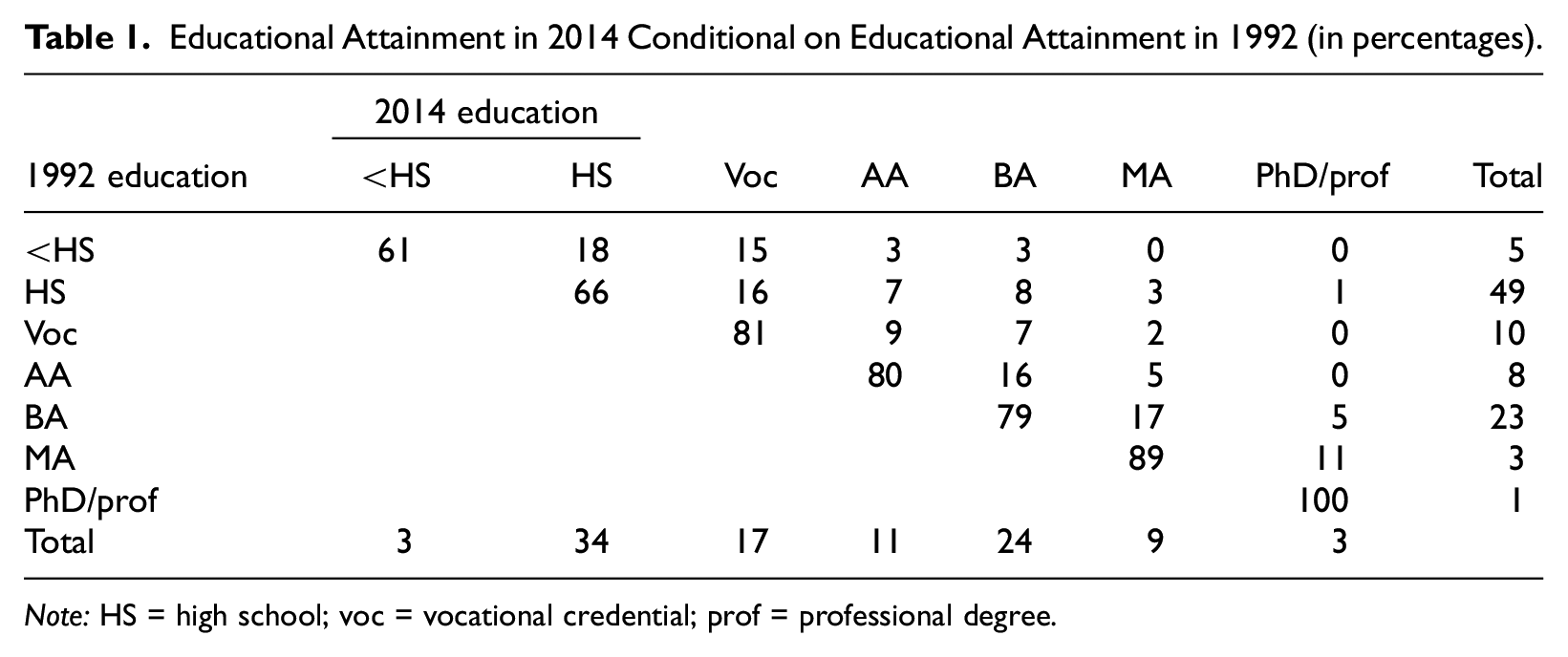
Note: HS = high school; voc = vocational credential; prof = professional degree.
Who returns to earn an additional credential? Here we focus exclusively on estimates of the association between origin attributes and enrollment. Table 2 shows two sets of estimated average marginal effects for each educational pathway. The first (reduced) model shows estimates for origin attributes without additional controls. The second set of estimates shows coefficients for the same attributes conditional on high school academic achievement, noncognitive skills, and destination family status measures.
Average Marginal Effect for Selected Coefficients for Enrollment between 1992 and 2014.
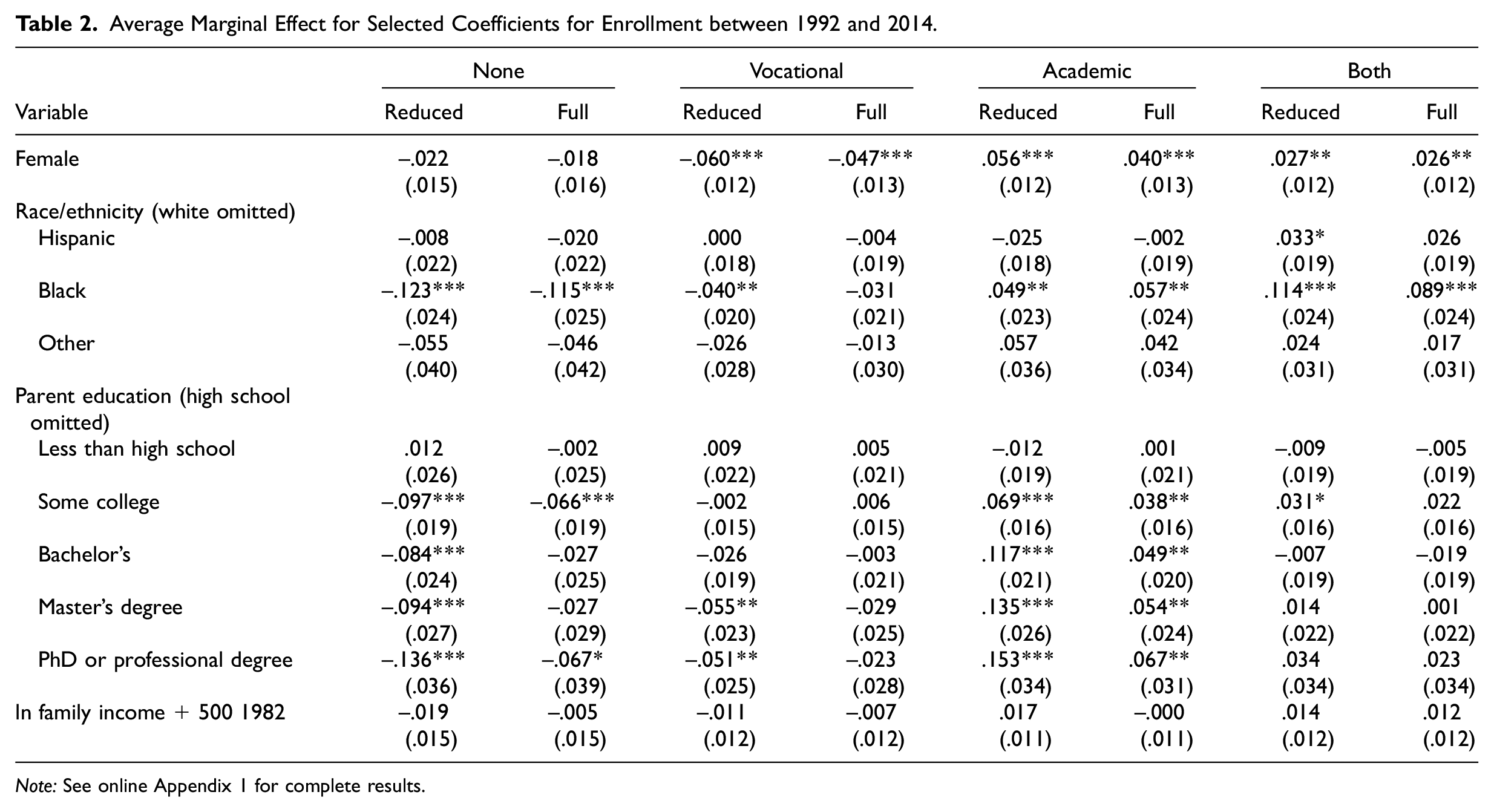
Note: See online Appendix 1 for complete results.
Estimates from the reduced model in Table 2 suggest the probability of returning for some sort of formal training is not significantly different by sex, but non-Hispanic white respondents (the omitted group) are about 12 percentage points less likely to get any further training than are black respondents (give or take about 5 percentage points). We also see a gradient in enrollment by parental education, whereby respondents whose parents attended college are 9 to 10 percentage points more likely to continue than are those whose parents completed high school but had gone no further as of 1980 (hereafter “parents who completed high school”). Children of parents with doctoral or professional degrees are almost 14 percentage points more likely to continue their formal training after their late 20s than are children of parents who completed high school (give or take around 7 percentage points). Differences in other attributes and experiences account for a substantial share of these differences in enrollment. Conditioning on high school academic achievement, expectations, noncognitive skills, and status attributes in 1992 appreciably attenuates the gradient in enrollment by parental education but not the black advantage in enrollment. Net of these other attributes, we estimate that black respondents are almost 12 percentage points more likely than comparable white respondents to enroll in formal education in their late 20s or older.
Women are about 6 percentage points less likely than men, and black individuals about 4 percentage points less likely than white individuals, to enroll exclusively in vocational programs. Differences by parental education are modest, with children of parents with a master’s degree or higher at the time of the initial survey a little more than 5 percentage points less likely to enroll exclusively in vocational programs than children of parents with a high school diploma. Differences in prior expectations, achievements, and experiences mediate some of the modest differences among students we observe, attenuating differences by parental education and black/white differences to nonsignificance. Differences by gender persist.
Turning to enrollment exclusively in academic programs, women are at a 5.6-percentage-point advantage over men (±2.4 percentage points) and black individuals at a 4.9-percentage-point advantage over non-Hispanic white individuals (±4.6 percentage points). Where education differences in the probability of exclusively vocational education are muted, they are pronounced for academic training. The probability of exclusively academic enrollment for children of parents with high school diplomas and those of parents with less education are statistically indistinguishable. However, the advantage of children of parents who attended college over those whose parents completed high school range from about 7 percentage points for children of parents with some college education to just over 15 percentage points for children of parents with a professional degree. A substantial share of the parental educational gradient in exclusively academic enrollment appears to be attributable to previous achievement, experiences, and attainments. Net of these predictors, the conditional variance in the marginal effect of parental education declined by 85 percent, with net enrollment advantage ranging from 3.8 to 6.7 percentage points. Gender differences are also slightly attenuated, to a 4-percentage-point female advantage, and race differences slightly exacerbated. Net of other predictors in the model, the net black advantage in exclusively academic enrollment is 5.7 percentage points (±4.8 percentage points) higher than otherwise similar non-Hispanic white respondents.
Finally, women are 2.7 percentage points more likely than men to enroll in both academic and vocational courses, all else equal, give or take about 2.4 percentage points. Hispanic respondents may be slightly more likely than non-Hispanic white respondents to enroll in both academic and vocational courses, experiencing a 3.3-percentage-point advantage in the reduced model that is slightly attenuated to nonsignificance in the full model. Black respondents, on the other hand, are almost 9 percentage points more likely than non-Hispanic white respondents to enroll in both academic and vocational programs, net of an extensive series of controls. There are no statistically significant conditional differences in the probability of academic and vocational enrollment across levels of parental education in the full model. We find no evidence of associations between logged parental income and enrollment changes in any model.
Overall, these patterns suggest inequalities in educational continuation in early to middle adulthood consistent with a modest erosion of white advantage and a continuation of advantages based on parental education but not on family income. At this point in the life course, African American individuals are more likely to continue their formal education than are white individuals, and African Americans and women are more likely to enter academic programs of study than are non-Hispanic white individuals and men. The advantages of higher levels of parental education are most pronounced for enrolling in academic programs and are substantially attenuated by the expectations and skills respondents had at the normative time they would have completed high school. These same skills do little to either mediate or suppress the (academic) enrollment advantages enjoyed by women and African Americans between the ages of roughly 28 and 50.
Earning a Degree
Just as earlier in the life course, enrollment does not always easily translate into a credential. In this section, we compare patterns of earning new credentials by social origins between 1992 (age 28) and 2014 (age 50). Approximately 40 percent of respondents earned an additional credential over this 22 year period.
Recall that respondents are at risk only of earning a credential higher than the one they had upon entry. Each respondent’s choice set also includes no new degree and a vocational license or certificate. For each respondent, we estimate the probability of completing an additional credential as a function of the same attributes on which we conditioned in the enrollment models discussed in the previous section.
As in the previous analyses, Table 3 presents average marginal effects and associated standard errors for two models for each potential outcome. The reduced model is strictly descriptive and reflects marginal differences in the probability of earning different credentials net of other ascriptive and background characteristics. The second (full) model conditions estimates on cognitive and noncognitive skills as well as family and labor market status in 1992.
Average Marginal Effects for Selected Coefficients on Degree Attainment between 1992 and 2014.
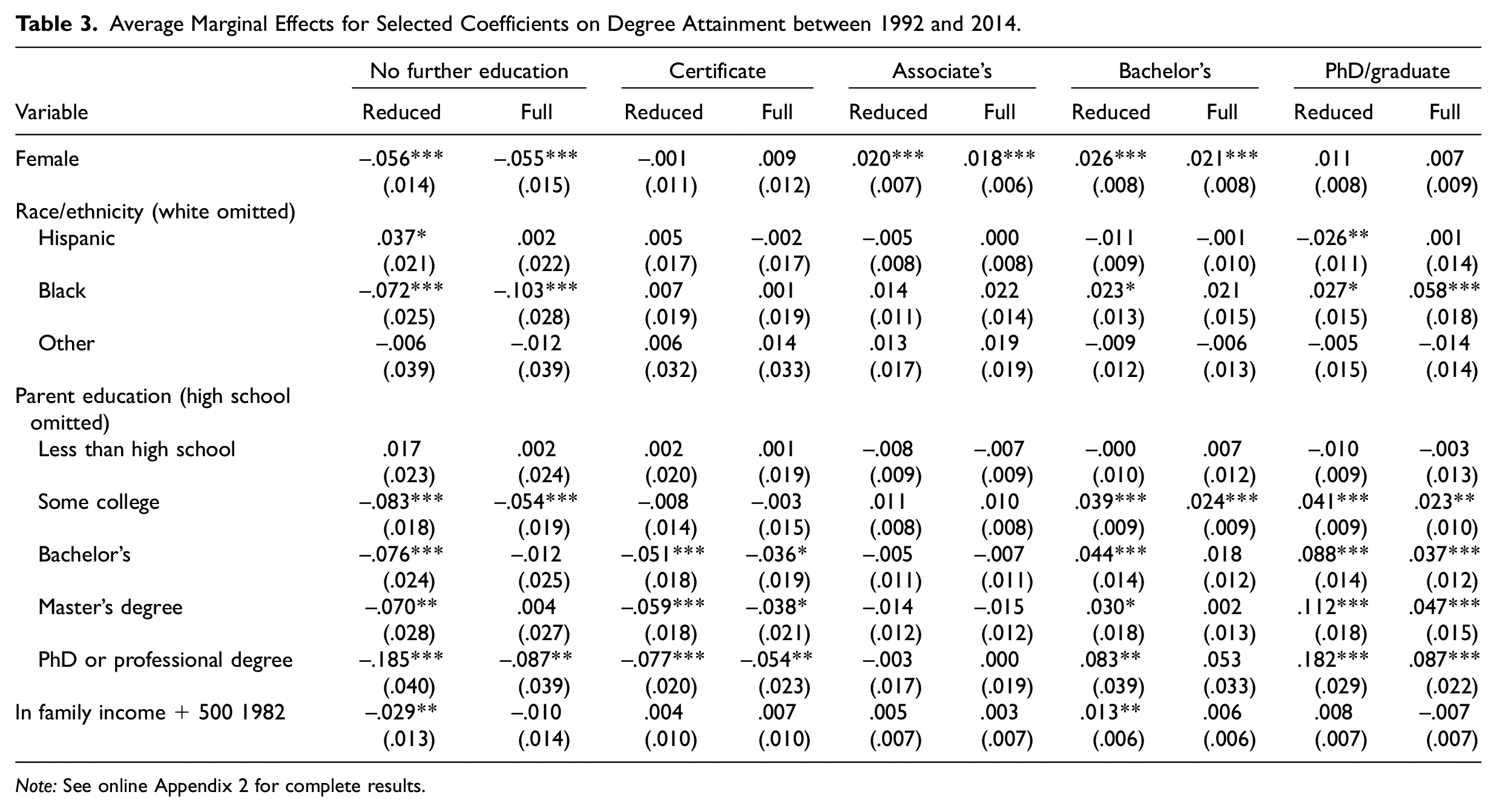
Note: See online Appendix 2 for complete results.
Women are more likely than men to return to school to earn an associate’s or bachelor’s degree (by around 2 percentage points) but not significantly more or less likely than men to return to earn a graduate or professional degree. Conditioning on prior skills, expectations, and status attributes in early adulthood does little to alter the descriptive estimates in the reduced models.
Racial/ethnic differences in the likelihood of earning various degrees toward midlife are modest with a few important exceptions. First, the descriptive models show Hispanic respondents are almost 4 percentage points more likely than non-Hispanic white respondents to fail to earn any additional credential during this period of the life course and 2.6 percentage points less likely to go on to earn a graduate or professional degree. These differences, however, are attenuated to almost zero and no longer statistically significant conditional on other attributes included in the full model.
In contrast, differences in the educational continuation patterns of African American and white individuals favor African American respondents and are slightly suppressed by differences in prior skills, achievements, and experiences. All else equal, African American respondents are about 10 percentage points more likely than comparable non-Hispanic white respondents to earn an additional credential between the ages of roughly 28 to 50. They are around 2 percentage points more likely to complete an associate’s or bachelor’s degree (although the advantage is not statistically significant) and 6 percentage points more likely to earn a professional or graduate degree. The advantage is all the more impressive in light of the fact that only 12 percent of all sample members hold a graduate or professional degree (Table 1).
Turning to parental education, respondents whose parents did not attend college continue to experience disadvantages in their chances of earning an additional credential compared with respondents whose parents attended college, even as sample members approach midlife. Chances of further credentials for individuals whose parents did not complete high school by the time of the initial survey and those whose parents earned a high school diploma are statistically indistinguishable from one another for all credentials.
The chances of earning an associate’s degree are notably uniform across levels of parental education, but chances of earning a bachelor’s degree, even off schedule, appear to favor children of the more highly educated. The descriptive (reduced) model suggests children of the most highly educated parents are about 8 percentage points more likely than children of high school graduates to earn a bachelor’s degree between the fourth and fifth waves of HSB. Children of parents with a master’s or bachelor’s degree enjoy a 3- to 4-percentage-point advantage over comparable children of parents with a high school diploma. Note, however, that differences in the likelihood of bachelor’s degree completion are attenuated to nonsignificance once we condition on differences in skills, achievement, and 1992 status attributes.
Children of the most highly educated parents continue to enjoy a greater likelihood of earning a professional or graduate degree between ages 28 and 50. The educational gradient in the descriptive model is steep. Children of parents with some college education enjoy a 4.1-percentage-point advantage over children of parents with only a high school diploma, and respondents whose parents held a doctorate or professional degree have a striking 18-percentage-point advantage over those whose parents ended their formal education after high school. About 80 percent of the variation in average marginal affects for earning a graduate or professional degree across levels of parental education can be accounted for by a combination of academic achievement, educational expectations, and noncognitive skills in high school as well as status attributes around age 28. However, the educational gradient persists even net of this set of opportunities, achievements, and experiences.
Heterogeneity in Returning to School
In his analysis of multiple waves of the October Current Population Survey (CPS), Denice (2017) finds small but statistically significant differences in patterns of off schedule enrollment for black women and men favoring black women. We estimated race by gender interactions for both the enrollment and degree attainment models to evaluate the possibility of gender differences in the net black enrollment advantage and found limited support for that proposition. 8 Point estimates were consistent with Denice’s results, suggesting a greater advantage for black women than for black men, but none of the interactions were statistically significant at the .10 level. This may simply be a function of statistical power due to our sample size relative to the CPS and, in the model for degree attainment, the small share of sample members earning each degree.
Discussion
Returning to school more than a decade after high school was the norm rather than the exception for individuals who were high school sophomores in 1980. Six of 10 respondents claimed some additional education between 1992 and 2014 (roughly ages 28 to50), and about 40 percent earned at least one additional credential during this time. Rather than settling into a stable state as they entered their 30s, members of the high school class of 1982 continued to develop their skills and abilities through formal education.
The implications of an open ended educational career for our understanding of social stratification are unclear. Our theory of staged advantage anticipated that patterns of bachelor’s degree completion toward midlife would favor less advantaged individuals, whereas patterns of graduate and professional degree attainment would favor the more advantaged. Our analyses, however, suggest a more complex story, in which social background continues to carry benefits across multiple educational transitions, but racial disparities in some cases appear to ease.
Parental education is not generally associated with returning to vocational or both academic and vocational courses of study, but it does predict returning exclusively to academic programs. The relative permeability of vocational programs across levels of parental education and family income suggests such programs are not the province of the less advantaged, in contrast to findings from the extensive work on secondary school tracking. This may reflect the greater heterogeneity of what counts as “vocational” later in life— running the gamut from trades and cosmetology to advanced information technology certifications.
On the other hand, the sharp distinctions in exclusively academic enrollment across levels of parental education follow familiar patterns. Even as they approached midlife, more advantaged respondents continued to reap the educational benefits of their parents’ academic (but not economic) success. The lack of conditional benefits to the more economically advantaged may suggest a pattern of stratification based more on cultural than economic capital, or it may simply reflect the poor measurement of parental income relative to parental education (as discussed in note 3).
Patterns of degree attainment also appear to be shaped by parental education as respondents approach midlife. Individuals who had not yet earned bachelor’s or advanced degrees by age 28 continued to enjoy advantages of birth, contrary to our expectations. Their chances of earning a bachelor’s degree were about 3 to 9 percentage points greater than the chances of an otherwise similar child of high school graduates. Consistent with our hypothesis, the chances of children of college educated parents earning a graduate or professional degree were 9 to 18 percentage points higher than those of children of parents with a high school education or less.
Where the advantages of parental education continue to shape enrollments into midlife, patterns of inequality by race/ethnicity and sex are more complex. African American respondents were around 12 percentage points more likely than white respondents to return to some sort of formal training and were more likely to pursue an exclusively academic or academic and vocational path. Although no more likely than men to return to some kind of formal training during this period of the life course, women were slightly less likely than men to pursue an exclusively vocational path and more likely to pursue an exclusively academic or mixed path (with differences on the order of three to six percentage points, depending on the path).
Finally, women were slightly more likely than men to earn an associate’s or bachelor’s degree during this period of the life course but no more or less likely to earn an advanced degree. Black respondents, on the other hand, were slightly more likely than white respondents to earn an associate’s or bachelor’s degree (although the standard errors reduce our confidence in this finding) and were significantly more likely to earn an advanced degree,
Consistent with our third hypothesis, prior levels of academic achievement, noncognitive skills, and educational expectations account for a substantial share of the inequalities in educational participation we observe at midlife. Conditioning on prior skills and expectations appreciably attenuates the educational gradients in returning to school, pursuing exclusively academic training, and earning a graduate or professional degree between 1992 and 2014. Prior skills and expectations also account for a small part of the estimated black advantage in the probability of enrolling in both academic and vocational courses but suppresses the estimated black advantage in the probability of returning to school and earning a graduate or professional degree. These racial/ethnic patterns may be due to the fact that black students, on average, perform worse in school but maintain higher educational expectations than do non-Hispanic white students, at least in this cohort of students (Morgan 1996).
In results available upon request, we further explored the contributions of academic achievement, course taking, noncognitive skills, and educational expectations to differences in the probability of earning a graduate or professional degree between roughly ages 28 and 50. Estimates from linear probability models suggest all of these sources contribute to the attenuation of gradients along the lines of parental education. However, suppression of the estimated black advantage in graduate and professional degree attainment is driven by prior academic achievement and, to a much lesser degree, math course taking.
Conclusion
Far from being over, the process of educational attainment continues for most adults into midlife. The share of our sample members whose highest credential was a high school diploma declined from 49 to 34 percent as they entered their 30s and 40s, and the share with a master’s, doctoral, or graduate degree tripled from 4 to 12 percent. Patterns of educational progression at midlife follow familiar fault lines of race/ethnicity, gender, and social origin, but patterns of relative advantage and disadvantage are ambiguous.
We propose a theory of staged advantage to account for patterns of educational continuation toward midlife. In contrast to theories of cumulative advantage, staged advantage holds that the processes governing off schedule educational transitions, as well as transitions that normatively take place across a range of ages, may be transition dependent. That is, CA may account for differences in rates of on cycle educational transitions, but off cycle transitions may either exacerbate or attenuate stratified patterns of degree attainment. The life course and points of inflection in the educational career intersect to produce varied patterns of stratification in educational progressions as a cohort ages. Failing to account for this life course variation may lead us to under- or overstate the degree to which children’s educational attainment is dependent on their race/ethnicity, gender, and social origins. This may be especially important for earning graduate or professional degrees, as the timing of graduate entry and completion is less closely bound to age than are other educational transitions (Posselt and Grodsky 2017).
We hypothesized that off cycle transitions to a bachelor’s degree would favor less advantaged individuals: We reasoned that students from more advantaged backgrounds, as well as white students, would disproportionately earn their degrees on time, while life circumstances and reduced resources would disproportionately delay the transitions of their less advantaged peers. We also suggested prior skills and expectations might be more favorable to the less advantaged who are still at risk of making the transition to a college degree. However, although we did find some evidence of a black advantage in the probability of earning a bachelor’s degree toward midlife, we did not find higher likelihoods of bachelor degree attainment for respondents whose parents were less educated or less affluent. Instead, we found marginal advantages for children of more educated parents, largely accounted for by respondents’ skills, expectations, and status attributes in 1992. We found no association between parental income and transition probabilities for any credential.
We expected to observe stratified patterns of graduate and professional degree attainment, but here the results were quite mixed. On the one hand, children of more educated (but not more affluent) parents enjoy an appreciable advantage in earning graduate and professional degrees at this stage in the life course. On the other hand, African American individuals enjoy a net advantage over otherwise similar white individuals. Graduate and professional degree attainment seems to reinforce stratification along one dimension and reduce it along another.
Although the empirical results of this study offer mixed support for our hypotheses, they do demonstrate the broader utility of our theory of staged advantage. Patterns of educational continuation and attainment toward midlife do not consistently conform to the CA hypothesis. Instead, different transitions appear to follow separate logics of stratification and to be variably shaped by prior achievements, opportunities, and expectations. Staged advantage offers a more flexible conceptualization of the educational transition experiences of nontraditional students, but this theory is clearly in need of further development.
This article advances our current understanding of the magnitude and variability of educational transitions across the life course, but it leaves several questions unanswered. Due to limitations of data and power, we have not distinguished among different types of graduate and professional credentials by degree or field of study, nor have we evaluated the academic standing of the institutions students attend or from which they graduate. We did not evaluate the extent to which these off cycle transitions alter adults’ economic, social, or heath trajectories at midlife or beyond. Our results with respect to stratification are therefore tentative. Our work complements other recent scholarship that asserts the prevalence of off cycle educational transitions and their potential importance to our understanding of social stratification in the United States (Denice 2017, 2019) and in Europe (Bukodi, Bourne and Betthäuser 2018; Virdia and Schindler 2019). We hope others will continue to engage with and extend this work in the future.
Supplemental Material
sj-xlsx-1-soe-10.1177_00380407211041776 – Supplemental material for Continuing Education and Stratification at Midlife
Supplemental material, sj-xlsx-1-soe-10.1177_00380407211041776 for Continuing Education and Stratification at Midlife by Eric Grodsky, Catherine Doren, Koit Hung, Chandra Muller and John Robert Warren in Sociology of Education
Footnotes
Acknowledgements
We are grateful for the generous support of the High School and Beyond Fifth Follow-up project.
Research Ethics
This study uses secondary (restricted) data from the National Center for Educational Statistics. It has been reviewed and approved by the Institutional Review Board of the University of Wisconsin-Madison.
Funding
This material is based on work supported by the Alfred P. Sloan Foundation under grant number 2012-10-27, the National Science Foundation under grant numbers HRD 1348527 and HRD 1348557, and the Institute for Education Sciences of the U.S. Department of Education under grant number R305U140001. This project also benefited from support provided by the Eunice Kennedy Shriver National Institute for Child Health and Human Development to the University of Texas at Austin (R24-HD042849), the University of Wisconsin-Madison (P2C-HD047873), and the University of Minnesota (P2C-HD041023). This manuscript has been subject to disclosure review and has been approved by the U.S. Department of Education’s Institute for Education Sciences in line with the terms of the High School and Beyond restricted use data agreement. Any opinions, findings, conclusions, or recommendations expressed in this material are those of the author(s) and do not necessarily reflect the views of our funding sources.

Supplemental Material
Supplemental material is available in the online version of the journal.
Notes
Author Biographies
References
Supplementary Material
Please find the following supplemental material available below.
For Open Access articles published under a Creative Commons License, all supplemental material carries the same license as the article it is associated with.
For non-Open Access articles published, all supplemental material carries a non-exclusive license, and permission requests for re-use of supplemental material or any part of supplemental material shall be sent directly to the copyright owner as specified in the copyright notice associated with the article.
