



Abstract
Water vapor transport through textile structures is complicated and governed by various factors, including fabric openness, fabric thickness, pore size, and intrinsic fiber properties. The objective of this study is to understand parameters that are critical in the moisture vapor transport through woven textiles and develop a predictive model that describes water vapor transport of woven fabrics using those parameters. Fifteen woven fabrics with various fabric thickness, weight, fabric construction, and staple fiber type were selected, and the water vapor transmission rate, fabric thickness, fabric count, weight, yarn number, yarn twist, yarn diameter, and pore size distribution were measured. Based on the mechanisms of water vapor transmission through porous textile materials, the fabric cover factor, solid volume fraction, yarn twist factor, and yarn packing factor were computed and used as possible predictor variables in the modeling. Moisture regains of fiber were obtained from literature and used as a possible predictor variable. Statistical analyses were performed to examine the relationship between these parameters and water vapor transmission. Statistical analyses revealed that fabric thickness, fabric cover factor, mean flow pore diameter of fabric, and moisture regain of fiber were significant parameters affecting water vapor transmission through woven fabrics. The adjusted R2 value for the final model selected was 0.97. Influence of yarn twist factor and yarn packing factor were shown to be insignificant at the 5% significance level for these experimental conditions.
Keywords
Water vapor transport plays a significant role in determining the thermal comfort of a fabric since it represents the ability to transfer perspiration from the body. It becomes extremely important in determining thermal comfort in hot environments in which sweat production and evaporation from the human body are the major cooling mechanisms for maintaining thermal comfort and avoiding heat stress. Free movement of moisture vapor to the fabric surface is essential in cold weather as well, since perspiration can cause fabric wetness, resulting in freezing in winter. 1
Water vapor transport through textile structures is a complex phenomenon determined by various parameters. The mechanisms of water vapor transmission (WVT) through porous textiles involve diffusion of water vapor through voids (openings) and diffusion through individual fibers. 2 Diffusion of water vapor through the void spaces is controlled by the water vapor pressure gradient across the two sides of the fabric. Pores in woven fabrics can be interfiber and interyarn; thus, the rate of diffusion is governed by the yarn/fabric structure, including the size and concentration of intra/interyarn pores and the fabric thickness. Transport of water vapor through the fiber can be either adsorption or absorption, depending upon the fiber morphology. Absorption involves the diffusion of water vapor through the polymer structure of the fiber by permeation or solution and its desorption at the outer surface. Thus, the ability of the fibers to undergo diffusion depends on the hydrophilic or hydrophobic nature of the fiber. Adsorption is a surface phenomenon with the adhesion of molecules of gas, liquid, or solids to a solid surface that can result in a liquid wicking through a fibrous assembly. There has been a great deal of research on the diverse aspects of moisture vapor transport through woven textiles, both experimentally and theoretically. 3 – 12 Fourt and Harris 3 studied the diffusion of water vapor through woven fabrics, and reported that the resistance of a woven fabric to the transport of moisture vapor depends on the type of fiber, fabric thickness, and the tightness of the weave. They also noted that water vapor transport occurs primarily through the voids in the material due to the readily available, low-resistance pathway; thus, the nature of fibers itself only contributes to vapor transmission when the volume occupied by the fibers is considerably larger. Rainard 4 showed experimentally and theoretically that the intrinsic permeability of a fabric was related to the amount of voids present in the fabric and the void geometry. Backer 5 reported that air/gas permeability of a fabric was dependent on the fabric thickness, pore size, and the number of pores in a given area. In a study of the geometry of fabric interstices as related to gas transport, Backer 6 observed that the different behavior of various textile structures possessing equal projected pore areas may be attributed to the nature of the interlacing of warp and filling yarns. He also suggested that where fabrics are woven with maximum tightness, it is likely that interfiber spacings within yarns also contribute to transport. However, if a reasonably circular yarn section is maintained in moderately tight fabrics, the relative flow- resistance of the interyarn pores should dominate the flow through the fabric.
Whelan et al. 7 developed an analytical and experimental model to predict WVT of textile fabrics based on vapor flow through the uniform holes of a perforated metal plate. The model showed that diffusion of water vapor through a perforated metal plate is a function of the thickness of the plate, the fractional pore area of the plate, and the diameter of the individual holes, which stresses the importance of fabric thickness and porosity in WVT through woven fabrics. This plate model, however, assumes that pore diameters are constant throughout the thickness of the material and that transmission through the solid areas of the plate, corresponding to the contribution of fabric yarns and fibers, is zero. Weiner 8 proposed two mathematical models to predict moisture vapor transmission in terms of fabric geometry. One model was based on a perforated plate theory in which moisture vapor diffuses partly through the pores and through the non-perforated areas of the fabric. In the other model, he considers the fabric as a relatively uniform mixture of fiber and air and calculates the resistance to diffusion as the sum of the components derived from fiber-space and air-space resistances. Woo et al. 9 presented an analytical model to describe water vapor diffusion through non-woven fabrics composed of non-hydrophilic fibers. They found that fiber volume fraction and shape coefficient are the most influential structural parameters affecting water vapor diffusivity through non-hydrophilic nonwoven fabrics.
Although theoretical models provide meaningful insight into the relationship between the various parameters and moisture vapor transport of porous textiles, assumptions underlying their calculations are often violated due to the complexity of a textile structure. As described by previous researchers, 6 the yarns of open-weave fabrics are often distorted both in and out of the plane of the fabric to achieve static equilibrium within the weave structure. In tightly woven fabrics, there is an increased tendency toward flattening of the yarns when they are bent over cross yarns, which violates the assumption in most theoretical models that textile yarns act as inextensible, circular cylinders. Furthermore, the pore structure in fibrous materials is complex in that multiple pores have different shapes and size distributions. Pore size may vary even along a single pore path, and the material may contain closed or blind pores that terminate inside the material, which do not contribute to fluid flow through. The numerous interrelated structural features of textiles make it hard to generalize the analytical aspects of the mechanism of flow-through fabrics.
From the aspect of providing information for practical situations, a statistical model would be useful as a supplement to theoretical modeling. Statistical analyses would further clarify the governing factors that impact the transmission of water vapor through woven textiles, reveal the relative significance of different variables, and improve the understanding of the complex behavior of moisture vapor transport through textile structures. Although previous studies elucidated influential factors in moisture movement through woven fabrics, much research has focused on parts of the elements contributing to moisture vapor transport, rather than covering the contribution of all the elements. To have a comprehensive understanding, a systematic approach based on the mechanisms of moisture movement through porous textiles is needed.
Our objectives in this study are to understand parameters that are critical in the moisture vapor transport through woven fabrics, to quantify the individual contributions of those parameters to water vapor transport, and to develop a statistical model to predict WVT through woven fabrics.
Materials and methods
Fabric descriptions
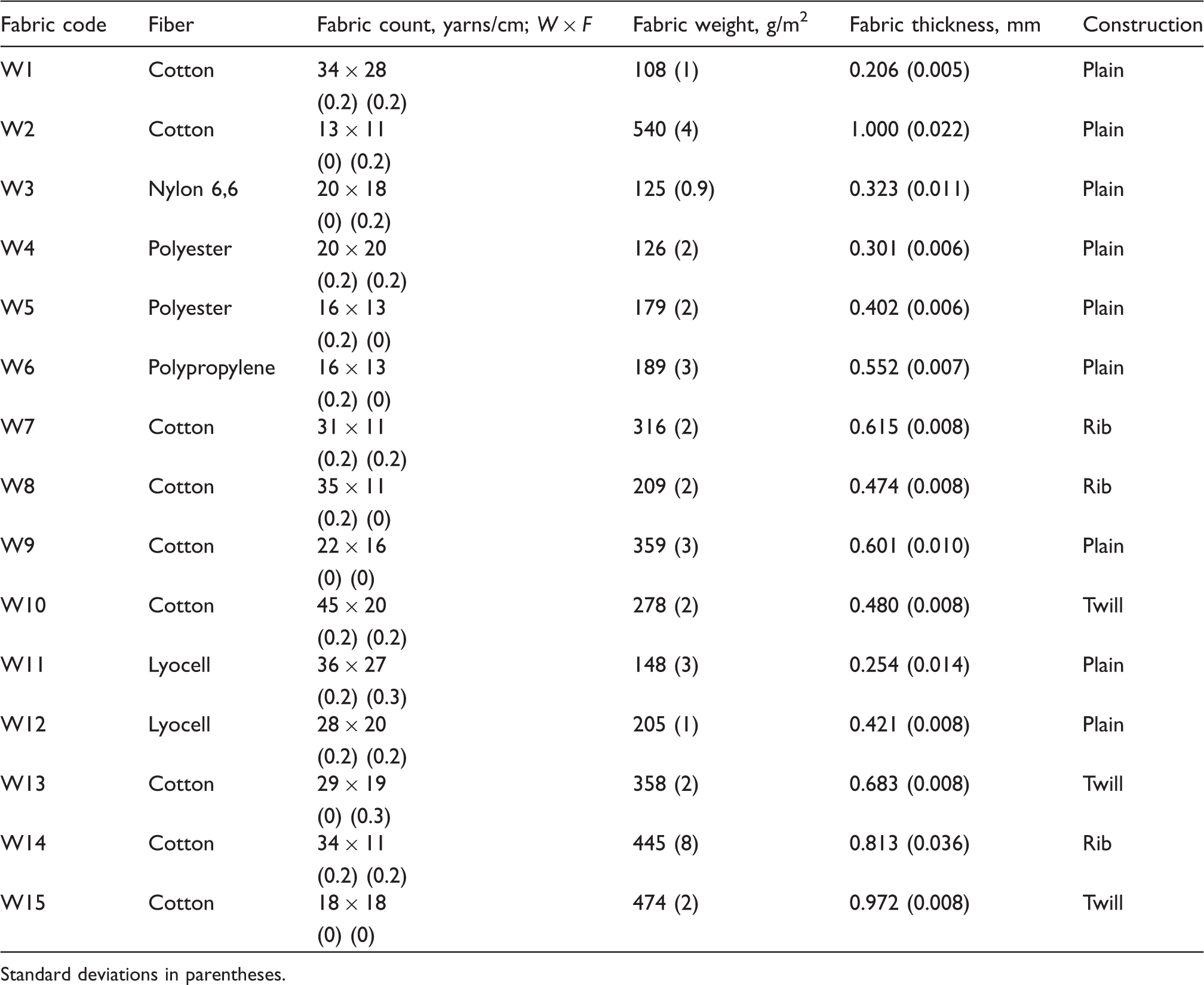
Standard deviations in parentheses.
Textile parameters
Fabric thickness
was measured according to ASTM D 1777-96. 13 Measurements were taken with a Frazier Compressometer using a 0.95 cm diameter presser foot at 6.9 kPa of pressure at 10 randomly selected areas.
Mass per unit area
Mass per unit area (weight) was measured according to ASTM D 3776-96. 14 Measurements were taken for four randomly selected samples.
Fabric count
Fabric count, that is, number of yarns per unit distance, was measured according to ASTM D 3775-03. 15 Measurements were taken at five randomly selected areas.
Yarn number
Yarn number was measured according to ASTM D 1059-01. 16 Measurements were taken from 10 warp samples and 10 filling samples for each fabric.
Yarn twist
Yarn twist was measured according to ASTM D 1423-99. 17 Measurements were taken from 25 warp samples and 25 filling samples for each fabric.
Yarn diameter
Yarn diameter was measured using a microscope equipped with a calibrated micrometer (Continuµm™, Thermo Nicolet Co., Madison, WI). Measurements were taken from 50 warp samples and 50 filling samples for each fabric.
Pore size distribution
Pore size distribution was measured by a Capillary Flow Porometer (Model CFP-1200-AEX, Porous Materials, Inc., Ithaca, NY). Gas flow rates through wet and dry samples versus differential pressure were measured, and pore diameters of through-pores at the most constricted part of the pore were determined. 18
Water vapor transmission
WVT rate was measured according to ASTM E 96-00 19 using a dish assembly (Vapometer, Thwing-Albert Instrument Company, Philadelphia, PA) for three samples.
Statistical analyses
Statistical analyses were performed on textile measurements and water vapor transport data using the SAS® system (SAS Institute Inc., Cary, NC). Multivariate statistical methods, including multiple linear and multiple polynomial regressions, all-subsets regression, and stepwise regression were performed. Before the analyses, data were centered by subtracting the mean foreach predictor variable to reduce the degree of multicollinearity.
Results and discussion
Selection of textile parameters
Fabric weight and thickness were measured for each specimen. Fabrics ranged in mass per unit area from 108 to 540 g/m2, and varied in thickness from 0.206 to1.000 mm. Weight and thickness are presented in Table 1.
Based on the mechanisms of water vapor transport through porous textile fabrics, water vapor may diffuse: (1) through the interyarn spaces; (2) through the interfiber spaces; (3) through the fiber substance itself. In order to have a comprehensive understanding of WVT through a textile fabric and to obtain an expression for the moisture vapor transport, the contribution of each of these parts needs to be taken into account.
Woven textiles have complex geometric configurations because of the fabric weave and yarn structure. In woven structures, pores can be interfiber and interyarn. The structure and dimension of intra- and interyarn pores strongly depend on hardness of twist in theyarn structure and compactness in the woven structure. 20 Thus, textile structural parameters that could describe the relative magnitude of interyarn space and interfiber space should be included in the modeling. In order to be used in modeling, the concepts described in the mechanisms of moisture vapor movement through porous textiles should be expressed in appropriate variables that are quantifiable.

Fabric parameters
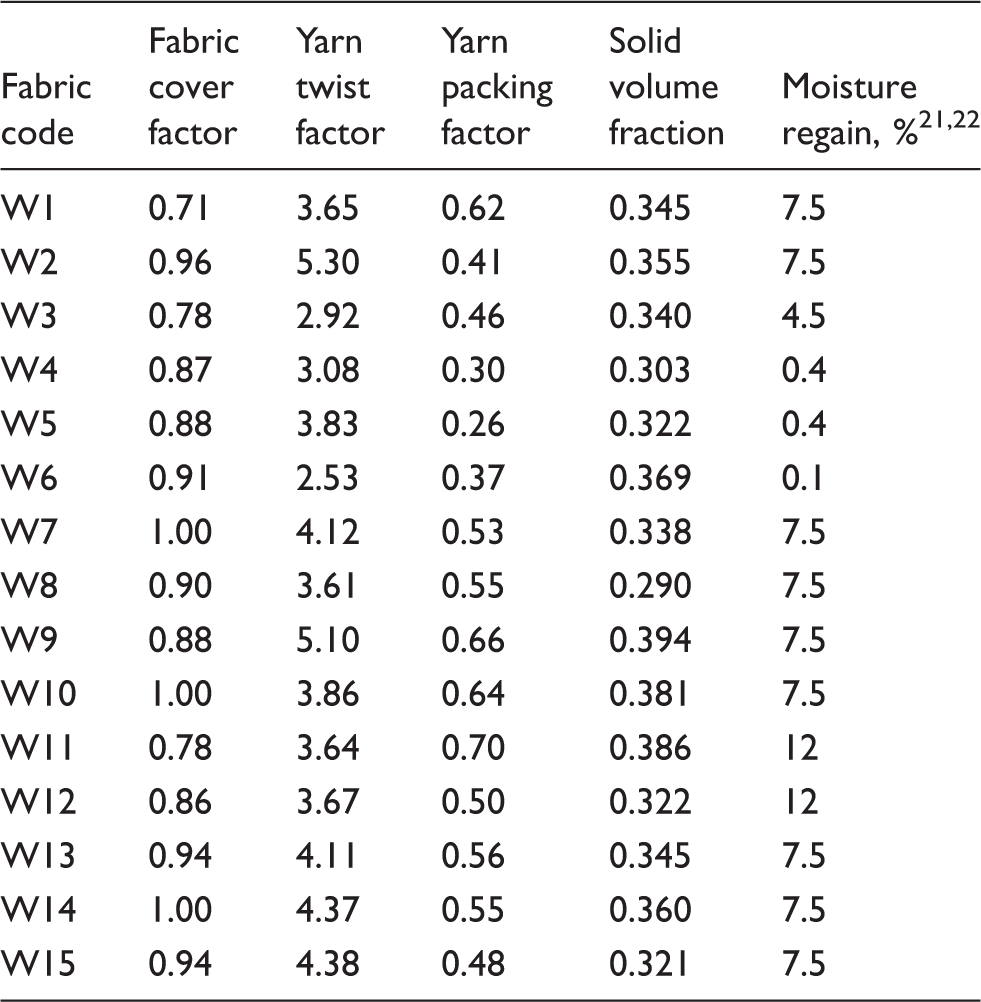
The relative magnitude of interfiber space could be quantified by textile parameters such as yarn twist factor or yarn packing factor. The twist factor is a measure of ‘twist hardness’ of yarn and describes compactness in yarns of the same size. The twist factor was calculated using the following equation:

The yarn packing factor, which describes the ratio of the total fiber area to actual yarn area in the cross-section of a multifilament yarn, was calculated as follows:

The solid volume fraction of fabric, the ratio of solid parts to the total volume of the material, which has shown to be an influential structural parameter affecting water vapor diffusivity through non-hydrophilic nonwoven fabrics,
9
was calculated as follows:

Since water vapor may diffuse not only through the void spaces but also through the fiber substance, the nature of fibers may contribute to moisture vapor transport. Moisture regain is a property that reflects the hydrophilic or hydrophobic nature of fibers, and such inherent fiber characteristics may affect moisture vapor transport through a textile fabric. Absorption of moisture can result in fiber swelling, particularly for hydrophilic fibers with high moisture regain. This moisture absorption is a dynamic factor until a steady state is reached, which is the condition at which WVT was measured. In this study, moisture regain of fiber was selected as a possible predictor variable to represent the hydrophilic or hydrophobic nature of fibers and possible changes in porosity due to fiber swelling. Moisture regains for cotton, lyocell, nylon, polyester, and polypropylene were obtained from literature21,22 and are presented in Table 2.
The fabric weave and nature of the yarn interlacing influence the amount and size of voids and the pore geometry, and therefore vapor transport through fabric. To represent the interlacing pattern between warp and filling yarns we chose variables that could reflect the effect of fabric weave and that are quantifiable to be used in the modeling. The fabric cover factor was selected to describe fabric tightness and solid volume fraction to quantify the amount of voids.
Pore size measurements and water vapor transmission rate of woven fabrics
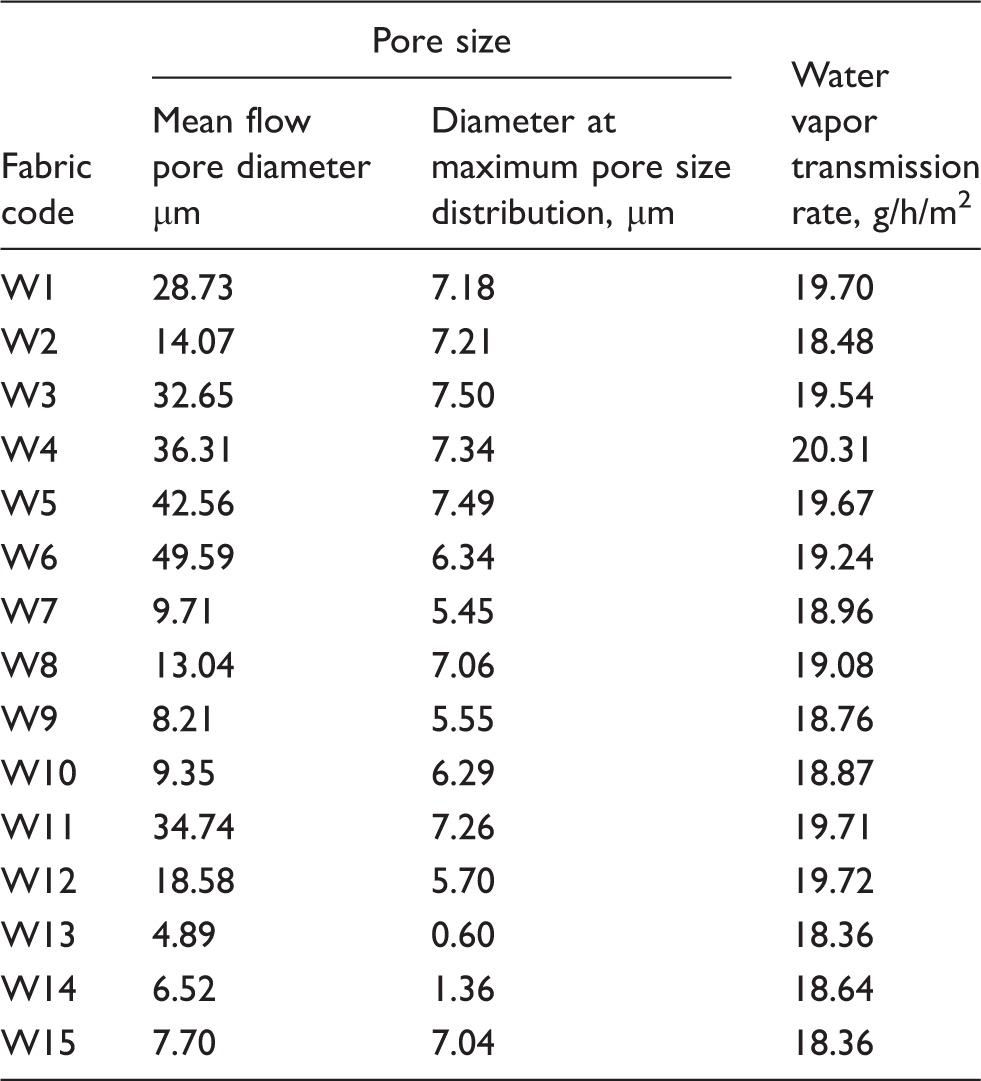
Based on the mechanisms of WVT through woven fabrics and previous studies, we selected seven factors for statistical analyses: fabric thickness, cover factor, solid volume fraction, yarn twist factor, yarn packing factor, pore diameter, and moisture regain of fiber. The selection process is summarized in Figure 1.
Influential factors involved in water vapor transmission through woven fabrics.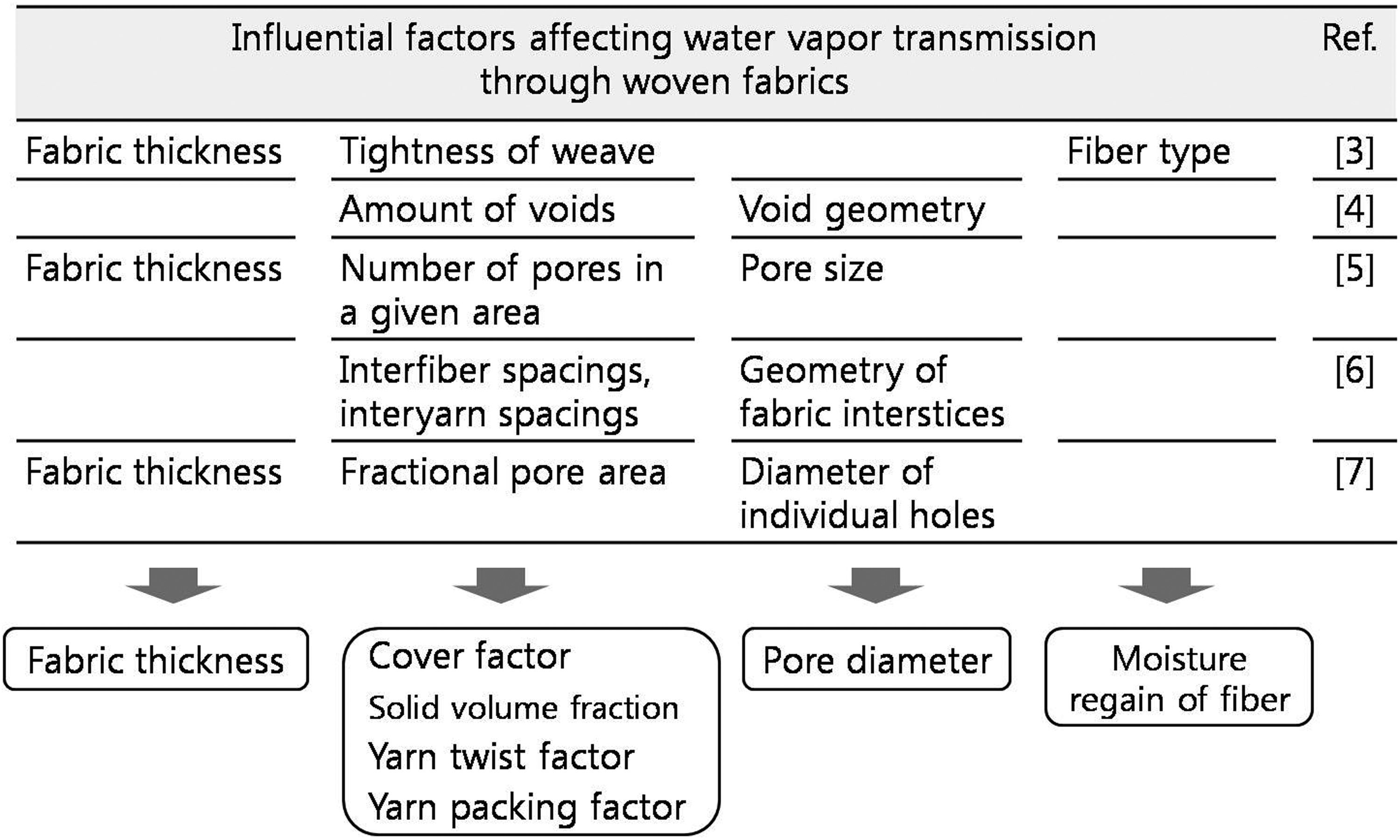
Parameters influencing water vapor transport
Correlation coefficients between water vapor transmission and fabric parameters
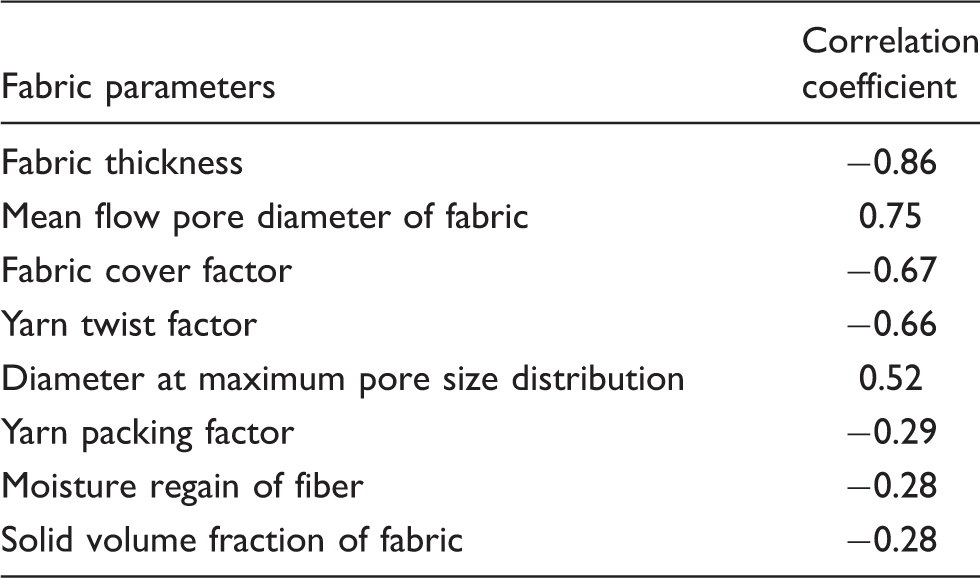
To develop a statistical model predicting WVT through woven fabrics, regression analyses were performed using those textile parameters. Since some of the parameters, such as mean flow pore diameter and diameter at maximum pore size distribution, are highly interrelated, all-subsets regression and stepwise regression were performed first to screen the variables that have little influence in predicting the response variable when other predictor variables are present in the model. We found that diameter at maximum pore size distribution does not contribute much to the model when the mean flow pore diameter is present in the model. Wealso found that solid volume fraction does not contribute to the model when the fabric cover factor is present in the model. Thus, the two variables, diameter at maximum pore size distribution and solid volume fraction of fabric, which were not significant in the presence of other predictor variables, were eliminated in further modeling efforts.

Summary of coefficients and R2 values for regression models for water vapor transmission
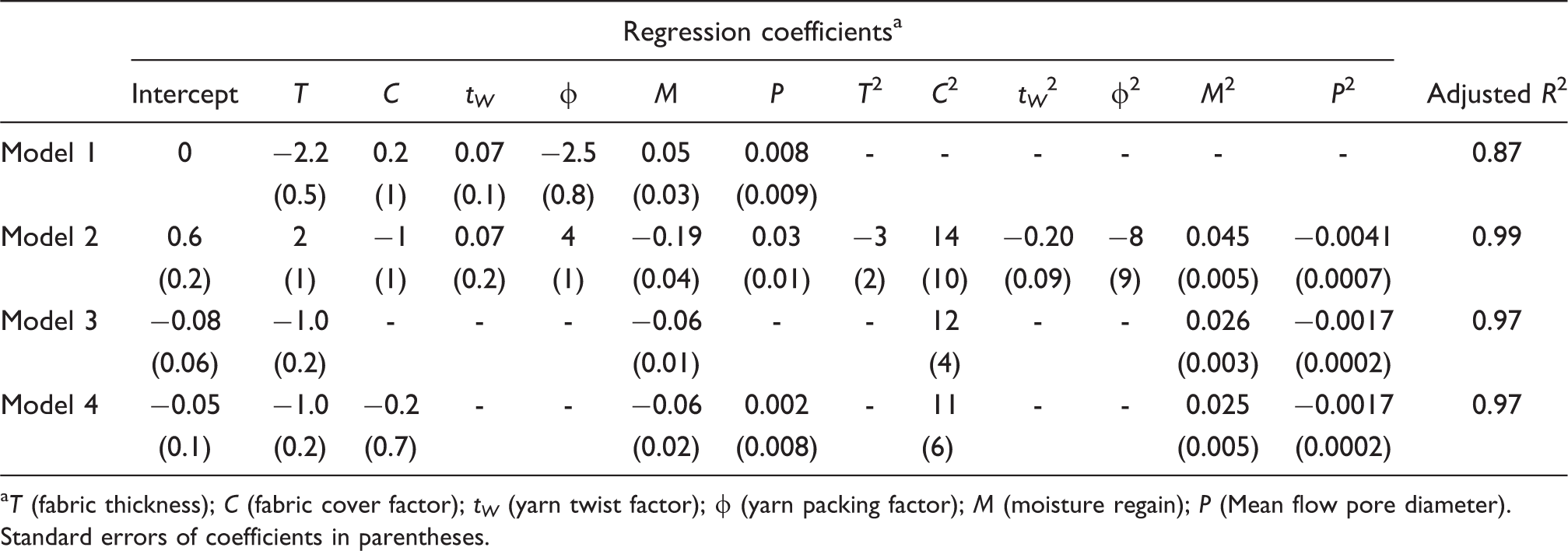
T (fabric thickness); C (fabric cover factor); tW (yarn twist factor); ϕ (yarn packing factor); M (moisture regain); P (Mean flow pore diameter).
Standard errors of coefficients in parentheses.
Conclusions
Water vapor transport through porous textile materialsis governed by various factors. Diversity and complexity of the involved parameters makes it hard to describe moisture vapor transport in relation to these factors.
We attempted to describe moisture vapor transport through woven fabrics in relation to conventional textile geometry parameters and the inherent nature of fiber and develop a statistical model predicting WVT through woven fabrics. Based on the mechanisms of the transmission of water vapor through woven textiles, we measured fabric thickness, pore size, and several structural parameters that could estimate fabric openness and quantify the contribution of interyarn and interfiber spaces. Moisture regain of fiber was obtained from literature to reflect the hydrophilic or hydrophobic nature of fibers. Statistical analyses revealed that fabric thickness was an important predictor of moisture vapor transmission through woven textiles. Fabric cover factor used as an approximation of the contribution of larger pores in the woven fabric such as interyarn/interfiber spaces also proved to be an influential structural parameter in predicting water vapor permeability. Mean flow pore diameter was found to better describe the pore dimension of woven fabric than the diameter at maximum pore size distribution in this application, and proved to be another important determinant of WVT through woven fabrics. Along with structural parameters, moisture regain of fiber, an intrinsic fiber property, had a significant influence on moisture vapor movement. The yarn twist factor and yarn packing factor describing the relative magnitude of interfiber spaces were found to be insignificant at the 5% significance level for our experimental conditions. A statistical model predicting WVT through woven fabrics was developed based on fabric thickness, cover factor, moisture regain of fiber, and mean flow pore diameter of fabric, with an adjusted R2 value of 0.97. This model would be valid for fabrics with characteristics within the range of the fabrics in our sample population, for instance, for fabrics woven of staple fibers when fabric thickness is in the range from 0.206 to 1.000 mm, etc. While based on statistics of a sample population rather than a physical mechanism, these findings are of practical use for engineering woven textiles with high water vapor permeability.
Footnotes
Acknowledgement

Funding
This work was supported by the Yonsei University Research Fund of 2010; the National Textile Center, projects M01-CR02, M02-CD03; and C05-CR01; Cornell Agricultural Experiment Station, North Central Regional Research Project NC 170; and the College of Human Ecology.