



Abstract
The research focuses on the influence of elastane (Spandex) incorporation in the weft direction of cotton fabrics, and the structural properties (fabric density, type of weave) on the thermal and water vapor resistance level.
For that purpose, woven fabrics, in plain and twill weave with two different densities (17 and 20 yarns/cm) in the weft direction, were made from 100% cotton (conventional) and from a mixture cotton/elastane in the ratio 93.8%/6.2% (elastic fabric) intended for men’s shirts for the summer season.
Thermal and water vapor resistance were determined with two novel methods, which were compared with the well-known Permetest method. The thermal resistance was calculated according to the thermal conductivity method which was established by the faculty research laboratory and with the Permetest, while the water vapor resistance was measured with the water cup method (developed by Professor D. Jaksic) and with the Permetest.
The research results indicate that cotton fabrics in twill weave with elastane in the weft direction have higher thermal and water vapor resistance compared to conventional cotton fabrics. The reason lies in the higher yarn density of fabrics with elastane in the weft direction in twill weave (from 24 to 29–31 yarns/cm in the warp direction) compared to the plain weave (from 24 to 28 yarns/cm in the warp direction).
Introduction
The garments intended for the summer season (e.g. shirts, blouses) are often made from natural fibers (cotton and flax). Cotton and flax garments are strong, comfortable and cool and they allow the body to breathe. Therefore, they are widely used in the manufacture of shirts and blouses for the summer season.
The clothing comfort, especially the sense of coolness, has become very important for the wearer. The clothing comfort depends mainly on the thermal and water vapor transfer properties of the fabric. 1
In the literature of the last few years, a wide number of papers dealing with the thermal and water vapor or moisture transmission have been written. Some researches studied the impact of structural variations in hollow yarn on the heat and water vapor transmission. 1 Some authors wrote about thermophysiological comfort in relation to fiber fineness, 2 while others dealt with the thermal comfort properties of knitted fabrics and thermal properties of knitted fabrics made from cotton and regenerated bamboo cellulosic fibers.3,6–8 Many researches have investigated the moisture transmission properties of different fabrics.9–12 Moreover, numerous methods for the determination of the heat and water vapor transmission have been introduced in the literature.4,13,14
Based upon the abovementioned facts, the influence of incorporation of elastane in the weft direction of cotton fabrics and the influence of structural properties (i.e. fabric density, type of weave) on the thermal and water vapor resistance level were analyzed.
For the purpose of this research, woven fabrics in plain and twill weave with two different densities in the weft direction were made from 100% cotton (conventional and non-elastic) and from a mixture of cotton/elastane yarns (elastic fabric) intended for men’s shirts for the summer season.
In the research, two novel methods for the determination of the thermal and water vapor resistance were used and compared with the well-known Permetest method. 13 The first method was the thermal conductivity method – a comparative method, to calculate the thermal resistance, whereas the second method was the water cup method 14 to calculate the water vapor resistance. The water cup method was developed by Professor D. Jaksic, 14 while the thermal conductivity method was established by the faculty research laboratory.
The aim of the research was to find out how strong the correlation between the results of thermal resistance obtained with the thermal conductivity method and with the Permetest is, and the results of the water vapor resistance obtained with the water cup method 14 and with the Permetest. 13
Thermal resistance
Heat transfer can occur by radiation (R), convection (C), conduction (K), evaporation (E), and respiration (Eres). Heat transfer by radiation occurs constantly between a body and the environment where the body dwells, i.e. in both directions, depending on differences in the body skin temperature and the temperature of other surfaces.
The heat transfer by convection is caused by the air flow around the body or by the movement of liquid drops if the body is in the water. Conduction means the rate of the temperature exchange between two substances, while evaporation is the changing of liquid water into vapor, requiring a large amount of energy.5,6
With the research the heat transfer by conduction was evaluated. The quotient between the heat conduction (H), and cross-sectional area (A), presents the density of the heat conduction (q), which is the vector with the definite direction to the region with lower temperature. The density of the heat conduction, q, is proportional to the quotient,
The negative temperature gradient is a vector with direction to the region with lower temperature.
The law of heat conduction, also known as Fourier's law, states that the time of heat transfer, q, through a material is proportional to the negative temperature gradient and to the area at right angles, to the gradient through which the heat is flowing, and can be calculated with equation (1).

The heat conduction of a fabric presents the transfer of the heat from a body to the environment through a fabric with the thickness, d, and the cross-sectional area, A, and is calculated with equation (2).

The heat conduction is also expressed as the temperature difference and thermal resistance, R, and follows equation (3).
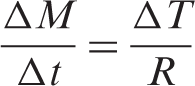
Thermal conductivity, λ, is the property of fabric that indicates its ability to conduct heat.
The rate of the heat flow is proportional to the temperature difference, ΔT, and the cross-sectional area, A, while it is inversely proportional with the fabric thickness, d. The intensity of the heat conduction depends on the thermal conductivity, λ, of a material. Higher thermal conductivity means higher heat conduction cross the fabric.5–8
With equations (2) and (3), the thermal resistance, R, is expressed with equation (4).

The thermal resistance, R, means the resistance of fabric with the thickness, d, to the thermal conduction, λ, from the region with higher temperature to the region with lower temperature, and is expressed in m2K/W.5–8
Water vapor resistance
Perspiration is the process of losing body heat due to the moisture evaporation from the skin to the environment. In this case, the perspiration is transported as vapor through the air gaps between the yarns in the fabric. 9
Fabrics present the media between the human body, skin and environment. If water vapor permeability is high, the water vapor transport is higher through the textile material to the environment. The latter is of extreme importance in a hot environment where a cloth must allow the water vapor transfer from the skin into the environment.
The water vapor transport, called diffusion, runs from the region of high concentration to the region of low concentration until the concentrations level out. 10
The rate of the transport

The Fick’s law describes the water vapor transfer and could also be presented as equation (6).

The water vapor diffusion resistance is the reciprocal quantity of water vapor permeability and is also given with the Ficḱs law.9,10

Methods
Basic properties of analyzed fabrics
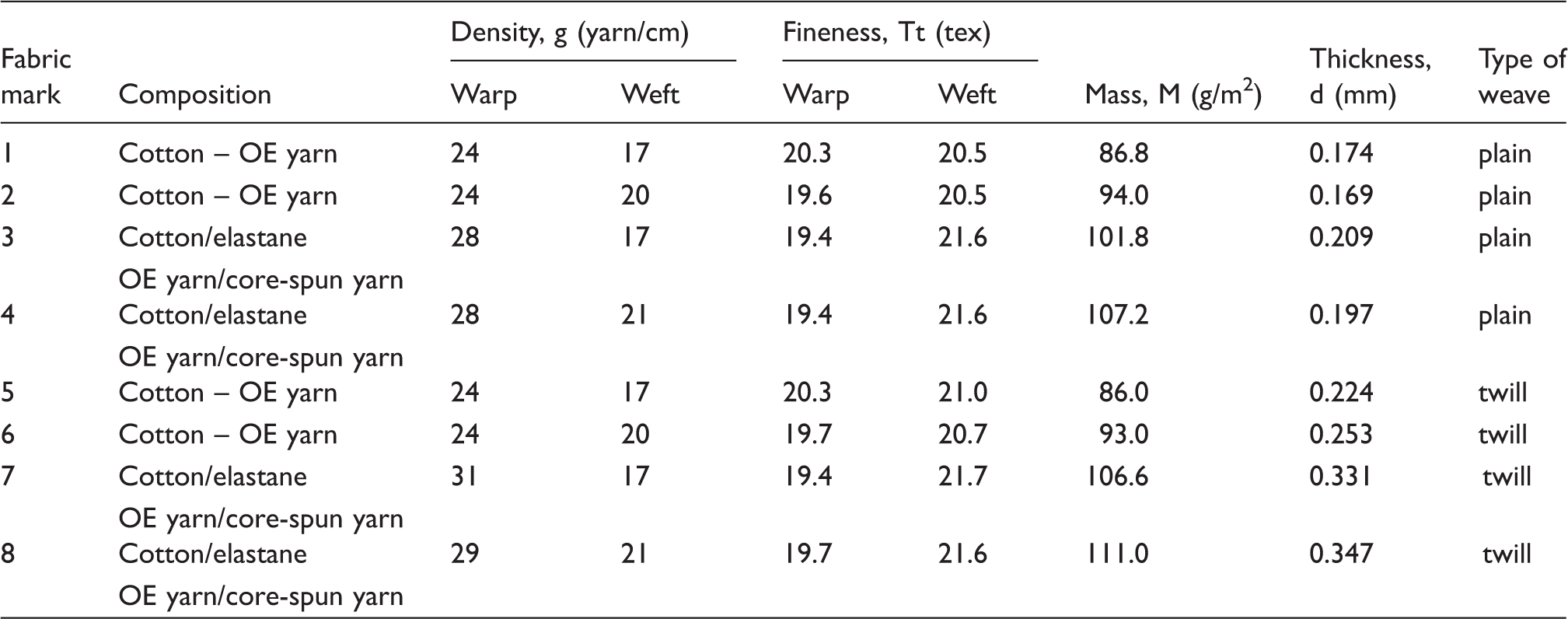
The significance of the variations was determined with ANOVA using SigmaPlot9 software. The significance of the parameters (the influence of yarn density increase in the weft direction from 17 to 20 yarns/cm, the elastane incorporation in the weft direction, the type of weave – plain or twill) was examined with p-values. If the p-value of a parameter was higher than 0.05 (p ≥ 0.05), the parameter was not significant for the observing variable – thermal or water vapor resistance. 16
The correlation analysis is used to compare the relation between the resulting values of the thermal resistance and water vapor resistance obtained with the presented methods. The correlation coefficients present the strength of the association between two variables – the results obtained with the two methods. The coefficient of determination (R2), was used to measure the strength of the linear association between variables. The value of the coefficient of determination ranges between -1 and 1. The positive value of coefficient of determination means that the values obtained with two methods are proportionally linear. If the coefficient of determination, R2, is +1, this presents the maximum positive correlation; if it is + 0.8, this means a strong positive correlation; and if the correlation coefficient is zero, this means zero correlation. 16
Thermal conductivity method (comparative method)
The thermal conductivity method was established by the faculty research laboratory and is used in common to evaluate the thermal conductivity properties. Measuring the thermal conductivity is based on the transport of the heat flow from a warmer to cooler region, from the bottom of the apparatus to the top. The massive frame of the apparatus has the insulating plate with block 1. On block 1, the thick copper plate is placed, with the temperature T = 60 °C which has the weight of 706 g. On that plate, the glass plate with known thermal conductivity is put, then a thin copper plate (m = 353 g), after that a sample is placed and finally, a cooler copper plate with T2 = 20°C is added, and a block 2 with the weight 2150 g (Figure 1). Between the blocks, there is a sample with an area of 100 cm
2
and a reference glass sample with known thermal conductivity, and an area which also amounts to 100 cm2. Both blocks and three measuring plates are connected with Ni/Cr/Ni thermoelements, with diameter 0.5 mm, to the temperature measuring instrument, ALMENO 2590. The whole system is isolated with thin grains of cork.
The principle of measuring thermal conductivity (using comparative method).
The measuring instrument, ALMENO 2590 has four available measuring places to measure temperatures T2, T3 and T4. With equation (8), the thermal conductivity λx is calculated.
Thermal conductivity is inversely proportional to the temperature differences between the blocks (equation (8)).

With equation (4), the thermal resistance R (m2K/W) is calculated.
Water vapor diffusion resistance method (water cup method with PES monofilament fabric)
The water cup method with the PES monofilament fabric 14 is similar to the water vapor diffusion measuring method according to the standard ASTM E96-00. 17
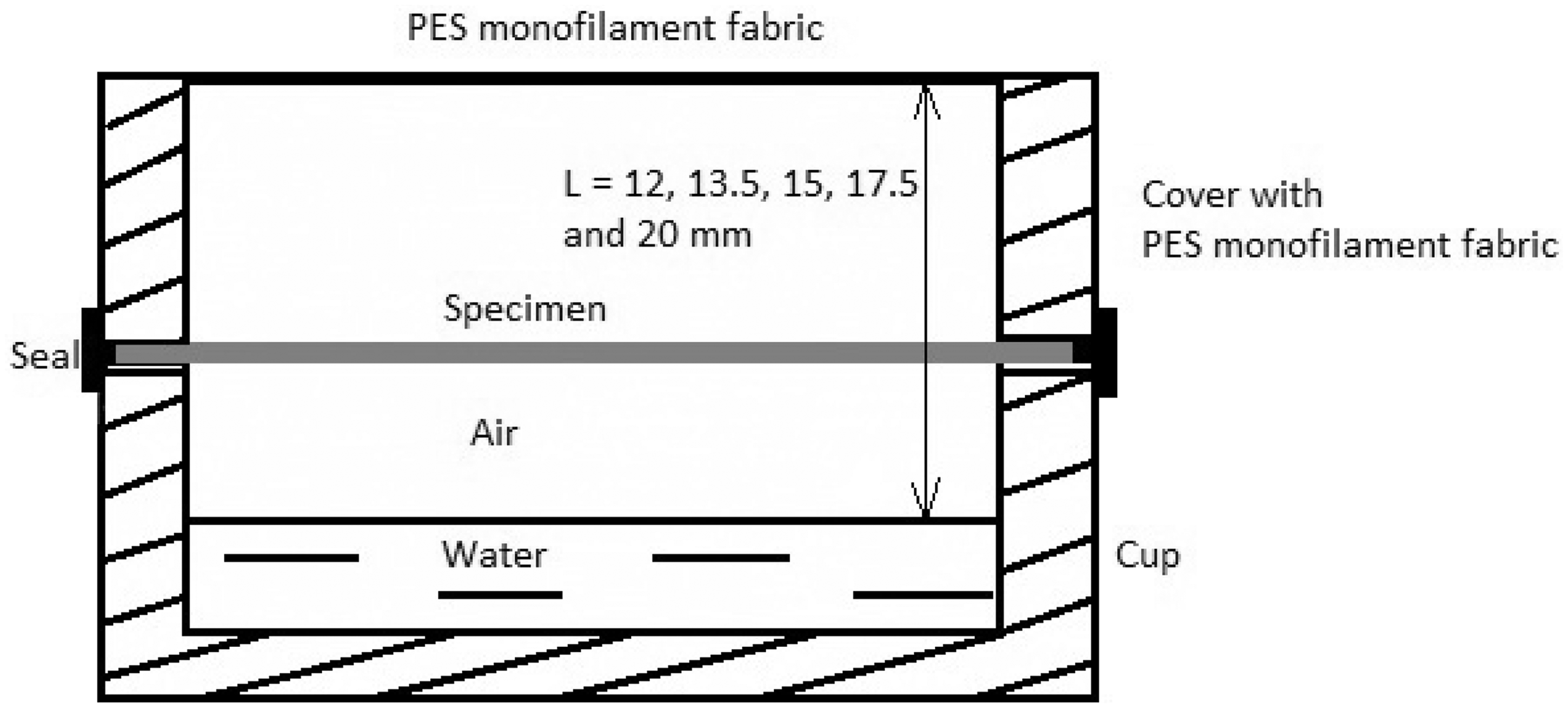
The sample with the area A = 50 cm
2
is set onto the round shaped cup, which is covered with the PES monofilament fabric (Figure 2). The five round cups which are covered with the PES monofilament fabric are filled with distilled water with levels, L, of 12 mm, 13.5 mm, 15 mm, 17.5 mm and 20 mm under the covered PES monofilament. The sample is placed under the cover with PES monofilament fabric (Figure 2). The other five round cups with the PES monofilament fabric are without the sample, however, with the same levels of distilled water.
The principle of measuring of water vapor permeability with the water cup method.
14
Before measuring the water vapor permeability, the weight of a sample is controlled. Afterwards, the sample with the area A = 50 cm 2 is put onto the water cups with different water levels and after one hour, the weight of a sample is controlled again (Wo). The measuring is repeated after 20 hours (W1). The water vapor transfer is calculated using equation (6).
The quantity of water vapor (W-mass) which transfers from the cup in a unit of time (Δt = 20 h) is irreversely proportional to the height of the air layer, L (i.e. the distance from the water level to the PES monofilament fabric; L = 12 mm, 13.5 mm, 15 mm, 17.5 mm and 20 mm), if the height of the air layer is lower than 20 mm. The water vapor transfer is expressed as the height of the air layer. The measurements were taken with different heights of the air layer for the results to be presented in a graph (Figure 3) with the height of the air layer, L (mm), on the x-axis and the water vapor resistance, R (1/U), on the y-axis. The obtained graph presents two straight lines with the sections on the y-axis, i.e. a0 and b0, one straight line shows the results for the measurements with a sample (section on the y-axis which is marked b0) and another straight line for the measurements without a sample (section on the y-axis which is marked a0).
14
Graphical method to determine the water vapor resistance, R (1/U); the values of height of the air layer, L (mm), are set on the x-axis, while the water vapor resistance values, R (1/U), are figured on the y-axis.
The water vapor resistance, R, is calculated from the graph (Figure 3) and is presented as the difference between the two heights of the air layer, L, with equation (12) and is expressed in millimeters (mm).

A more specific method is the analytical method where the straight line coefficient, a1, is calculated with equation (13).

The water vapor resistance, R, which is obtained with the analytical method (equation (14)) is the quotient between the difference between the section of the straight line on the y-axis for the measurements with a sample (b0) and the section of the straight line on the y-axis for the measurements without a sample (a0), and the straight line coefficient (a1). All the mentioned parameters (a0, b0 and a1) are calculated with equations (13) and (15). Both straight lines have the same straight line coefficient, a1, which means that they are parallel.

The section of the straight line on the y-axis for the measurements of the water vapor transfer with a sample, b0, is expressed with equation (15).

The section of the straight line on the y-axis for the measurements of the water vapor transfer without a sample, a0, is expressed with the same equation (15). 14
Results and discussion
Thermal resistance
Thermal resistance is calculated from heat permeability (equation (4)), which is measured with two different methods, i.e. the thermal conductivity method (comparative method) and the Permetest.
13
The results of the thermal resistance obtained with both methods are given in Table 2. The correlation between the two values of thermal resistance obtained with the thermal conductivity method – comparative method and the Permetest – is shown in Figure 4.
Relationship between thermal resistance, Rct, obtained with Permetest and with thermal conductivity method – comparative method, R2 = 0.8726. Thermal resistance values obtained with the thermal conductivity method – comparative method and Permetest

An increase in the fabric density and weight increases the thermal resistance due to the incorporation of elastane in the yarn. The incorporation of elastane in the yarn (in the weft direction) causes an increase of the yarn density in the warp direction, with fabrics 1–4 in plain weave, from 24 to 28 yarns/cm, while the fabrics 5–8 in twill weave have a higher density increase in the warp direction, i.e. from 24 to 29–31 yarns/cm (Table 1).
According to Table 2, by increasing the density in the weft direction from 17 yarns/cm to 20 yarns/cm, the rise in the thermal resistance is very low and is statistically insignificant (p = 0.118). The significance of the thermal resistance increase level was calculated by comparing fabrics 1, 3, 5, 7 with 17 yarns/cm and 2, 4, 6, 8 with 20 yarns/cm. Means that the weft density increase by 3 yarns/cm has statistically insignificant influence on the thermal resistance increase. Based upon the results of thermal resistance, it could be stated that yarn density increase in the weft direction (by 3 yarns) is not high enough to give a significant thermal resistance increase of analyzed fabrics, even if the yarn density in the warp direction increased in that way from 24 to 28 yarns/cm and fabrics with elastane increased from 24 to 29–31 yarns/cm).
A statistically significant increase was calculated by comparing the values of thermal resistance between fabrics 3, 4, 7, 8, which have incorporated elastane in the weft direction and conventional cotton fabrics 1, 2, 5, 6 (p = 0.0122). The elastane incorporation also causes the warp density increase (Table 1), which increases the thermal resistance value by more than 20%.
The highest statistically significant increase (p = 0.00515) of thermal resistance (by about 30–40%) was calculated with fabrics 5–8 in twill weave, which is compact and elastic in comparison with plain weave.
The correlation coefficient between variables (thermal resistance) evaluated with the thermal conductivity method (established by faculty research laboratory) and the Permetest method is 0.8726, which indicates a strong positive correlation.
Water vapor diffusion resistance
Water vapor diffusion resistance values obtained with water cup method and Permetest

The water vapor resistance, R, obtained with the water cup method 15 is presented as the height of the air layer and is expressed in millimeters (mm).
The correlation between the two values of water vapor resistance obtained with the water cup method (developed by Professor D. Jaksic) and Permetest is demonstrated in Figure 5.
Relationship between water vapor resistance, Ret, obtained with Permetest and with water cup method, R2 = 0.9025.
The analysis of the results of water vapor resistance of both methods indicates that the water vapor resistance increase, with increasing fabric density and weight, is statistically significant (p = 0.0134) (Table 3). The latter means that increasing the fabric density in the weft direction from 17 to 20 yarns/cm has a significant influence on the water vapor resistance increase (by about 30–40%).
As it can be seen from the results, the type of weave has a statistically significant influence (p = 0.00295) on the water vapor resistance increase. The water vapor resistance increases by about 40% using twill weave, this means that fabrics 5–8 have about 40% higher water vapor resistance value than fabrics 1–4 in plain weave.
Twill weave is more compact and elastic, and consequently influences the water vapor resistance level (Table 3).
The elastane incorporated in the weft direction (fabrics 3, 4, 7, 8) causes an increase in the density of warp yarns and increases the water vapor resistance value by approximately 20%. The elastane incorporation in the weft direction significantly influences the water vapor resistance increase (p = 0.0134).
The values of the water vapor resistance are the highest in the case of the twill weave with elastane in the weft direction (fabrics 7 and 8). The water vapor resistance of fabrics 7 and 8 is approximately 40% higher than with other used fabrics.
The correlation coefficient between the variables (water vapor resistance) obtained with the water cup method and the Permetest method is 0.902, indicating a strong positive correlation.
Conclusions
According to the research of the influence of elastane (Spandex) incorporation in the weft direction of cotton fabrics and the structural properties (fabric density, type of weave) on the thermal and water vapor resistance level, the following conclusions were drawn:
Thermal and water vapor resistance is the highest with fabrics in twill weave, which is more compact and elastic than plain weave. Increasing the density in the weft direction by 3 yarns/cm (from 17 to 20 yarns/cm) causes an insignificant increase in the thermal resistance of analyzed fabrics (comparing fabrics 1, 3, 5, 7 with 17 yarns/cm and 2, 4, 6, 8 with 20 yarns/cm). It could be stated that the yarn density increase in the weft direction (by 3 yarns) is not high enough to influence significantly the increase in the thermal resistance of analyzed fabrics. In contrast, increasing the fabric density in the weft direction from 17 to 20 yarns/cm causes a significant water vapor resistance increase (from 30–40%). The elastane incorporation of cotton fabrics (fabrics 3, 4, 7, 8) increases the thermal and water vapor resistance by about 20%. The use of twill weave increases the thermal and water vapor resistance by about 30–40%, compared with plain weave. Comparing the presented methods, thermal conductivity method – comparative method and the water cup method – with the well-known Permetest method, it becomes clear that a strong positive correlation exists among them.
Based upon the conclusions, it is clear that by choosing cotton mixtures with elastane (Spandex) in the weft direction for the shirts which are intended for the summer season, it is better to decide for plain weave with lower density (with the research 17 yarns/cm).
Furthermore, the research results indicate that the elastane incorporation in the cotton yarn increases the thermal and water vapor resistance by about 20%. That value is not so high, compared with the weft density increase (from 17 to 20 yarns/cm), which increases the thermal and water vapor resistance by about 40%. To make a compromise, lower density (17 yarns/cm) cotton fabrics in plain weave with elastane are chosen for the summer season shirts.
Footnotes
Funding
This research received no specific grant from any funding agency in the public, commercial, or not-for-profit sectors.