



Abstract
Multilayer fabrics have been widely used for cold weather clothing and thermal protective clothing. The thermal and water vapor resistances provided by multilayer fabrics are of considerable importance in determining thermal comfort of clothing. Firstly, those studies on the steady-state heat and water vapor transfer through multilayer fabrics are summarized. There are three circumstances between thermal resistance of individual layers and the total thermal resistance of multilayer fabrics, that is, additive thermal resistance of individual layers, less resistance per additional layer, and more resistance per additional layer. Secondly, an overview on unsteady-state heat and water vapor transfer through multilayer fabrics is presented. Thirdly, the models on the heat and water vapor transfer through multilayer fabrics at both steady state and unsteady state are summed up. Finally, several research themes for the future are described.
Heat and water vapor transfer through fabrics play a predominant role in determining their suitability for use in protective clothing. The thermal resistance of fabrics is a primary determinant of body heat loss in cold environments. Generally, high thermal resistance values of the clothing are required to maintain the body under thermal equilibrium conditions, as air temperatures are low if other environmental parameters are invariable and the activity level remains unchanged.1–4 In hot environments or at high activity levels, evaporation of sweat becomes an important avenue of body heat loss and fabrics must allow water vapor to escape in time to maintain the relative humidity between the skin and the first layer of clothing at about 50%.5–9 If resistance to water vapor diffusion is high, the water vapor transfer is impeded and the discomfort sensation of dampness and clamminess may arise.
Multilayer fabrics are chosen for cold weather conditions, which provide adequate thermal insulation. Generally, the usage of a multilayer clothing ensemble is better than single layer clothing in that the insulation provided by several layers can be easily adjusted. One layer is taken off or put on without disturbing the whole clothing ensemble. The body temperatures rise at high activity levels in cold climates. In these circumstances, the insulation can be readily controlled by using suitable closures, for example zip fasteners, buttons, toggles, and firm adhesions. 10
Multilayer fabrics have been widely used for thermal protective clothing, which is important in hot environments to protect the wearers from solar radiation or reflected radiation. Usually a thermal protective clothing consists of an inner layer, middle layer, and outer layer.11,12 The aim of the inner layer is to provide next-to-skin comfort by wicking the sweat at the skin surface for better evaporative cooling and faster drying. The primary role of the middle layer is to provide insulation. The goal of the outer layer is to protect people against environmental conditions (i.e., heat, flame, wind, precipitation) and to allow water vapor transfer to the environment.
Fundamentals
Steady-state heat transfer through fabrics is governed by Fourier’s law of thermal conduction:
13

The thermal resistance of fabrics is given by

Steady-state water vapor transfer through fabrics obeys Fick’s diffusion law:14,15

The sweating guarded hot plate apparatus, which provides water vapor resistance, is a calorimetric method. The total water vapor resistance of the fabric plus the boundary air layer under an isothermal condition is calculated by
15
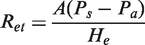
If a non-isothermal condition is applied, Equation (4) should be modified to

The water vapor resistance value can be easily converted to water vapor diffusion resistance by using the perfect gas law:
15

Steady-state heat and water vapor transfer through multilayer fabrics
Effects of number of layers on heat and water vapor transfer through multilayer fabrics
Much attention has been drawn to investigate heat and water vapor transfer through multilayer fabrics. Morris 16 determined the thermal resistance of 16 fabrics using a heat transfer apparatus and concluded that the thermal resistance of multilayer fabrics could be accurately estimated by adding values for the individual fabrics only if they provided smooth surfaces. For those individual fabrics with rough surfaces, the difference in thermal resistance between added and measured values was partially attributed to change in thickness. The test results also showed that a close linear relationship existed between thermal resistance and thickness and between thermal resistance and volume of air per unit area for both single and multilayer fabrics. Epps 17 used a hot plate to measure thermal transmittance of 10 fabrics and noted that the thermal transmittance declined as the number of fabric layers increased and that the relationship was nonlinear. Nevertheless, if the thermal transmittance values are converted into thermal resistance, a linear relation can be obtained between the thermal resistance and the number of layers. Babus'Haq et al. 18 noticed that less insulation was achieved when an additional layer was applied to the fabric assemblies due to more protection of the inner layer from the penetration of air.
Recently, McCullough et al. 19 conducted an interlaboratory test of the sweating guarded hot plate instrument. The calibration test data showed that the intrinsic thermal and water vapor resistances of the Nomex duck fabrics rose linearly when the number of layers was between one and four. Wilson et al. 20 used a modified version of the sweating guarded hot plate for the measurement of water vapor resistance of four infant bedding fabric assemblies and noted that the water vapor resistance of the bedding combination increased when the number of layers increased. Yadav et al. 21 evaluated the thermal resistance of two knitted polypropylene fabric assemblies (two to three layers) and indicated that the thermal resistance of fabric assemblies was higher than the sum of resistance values of individual fabrics due to the air entrapment between the layers. Laing et al. 22 measured the thermal resistance of six three-layer fabrics using a guarded hot plate apparatus and found that the percentage increase in thermal resistance was greater from one to two layers than the increase from two to three layers. Later, Laing et al. 23 studied the thermal resistance of nine three-layer fabrics used for the active wear and also noticed that the effect of adding a second layer exceeded that of adding a third layer. In addition, there were differences in thermal resistance due to various fibers and structures of fabrics, as the first layer was insignificant and the case varied with the outer layer.
Effects of raw materials on heat and water vapor transfer through multilayer fabrics
Huck and McCullough 24 used a guarded hot plate apparatus to measure the thermal resistance of 11 nonwoven battings, plus the inner layer and outer layer, and linear relationship between the thermal resistance and the thickness of fabric assemblies was obtained. The type of inner fabrics, the filling materials, and the outer fabrics had significant effects on the thermal resistance of fabric assemblies. Babus'Haq et al. 18 measured the thermal resistance of three multilayer fabrics (cotton, viscose, and polyester) under windy conditions and concluded that double or triple layers of fabrics with high air permeability were as effective in thermal insulation property as a single layer of fabric with low air permeability under windy conditions. It was obvious that a fabric with low air permeability was preferred to be used for the outer layer to minimize the heat loss of the body in the presence of wind. Barker and Heniford 25 evaluated the thermal resistance of one, two, and three layers of seven nonwoven batting materials. The test results showed that the thermal resistance of nonwoven battings was highly correlated with the bulk thickness. It was concluded that web layering was an effective way for increasing thermal insulation, since it contributed air layers and thickness without adding proportionally to the weight or to the thickness of the batting.
Recently, there has been much research investigating the steady-state water vapor transfer through multilayer fabrics. Rossi et al. 26 designed a sweating arm apparatus to measure the water vapor resistance of 12 polyester fabric assemblies at four levels of moderately cold temperature and found that the fabric assemblies with the outer layer of hydrophilic membranes provided lower water vapor resistance and less condensation than the assemblies with microporous membranes. Ren and Ruckman 27 drew the conclusion that the formation of condensation within the outer layer could be reduced by decreasing the thickness of the waterproof membrane and outer layer fabrics or by increasing the average diffusion coefficient of the outer layer and membrane. Zhou et al. 28 designed an apparatus to determine the water vapor resistance of four three-layer knitted cotton or polyester fabric assemblies and noted that more condensation appeared on the inner layer and middle layer, and little condensation in the outer layer. Furthermore, the more water vapor transferred through the outer layer, the lower the water vapor resistance of fabric assemblies. Wu and Fan 29 measured the water vapor resistance of nine batting assemblies with two covering layers (waterproof and vapor-permeable fabrics) using a self-designed sweating guarded hot plate at −20℃ and observed the most significant effect of the inner batting type on the WVTR and the moisture accumulation, followed by the interaction between the outer and inner batting types. Oh 30 tested the WVTR of 16 three-layer fabric combinations of two polyester fleece fabrics and two cotton fabrics with four waterproof breathable fabrics as the outer layer by using the cup method and reported significant effects of waterproof breathable fabrics on the WVTR of the fabric assemblies. Cui et al. 31 analyzed the WVTR of eight combinations of firefighter fabrics and indicated that the middle moisture barrier significantly influenced the water vapor transfer properties of the combinations. Later Wang et al. 32 reported a similar result.
The garments with sandwich structure, which is determined by practical experience, are a unique solution to protect people in cold or warm environments. However, the possibility of ventilation facilitates the heat and moisture transport through multilayer fabrics. Needle-punched fabrics, often used as the middle layer in sandwich-structured garments, have received broad applications in thermal protective clothing, which provides adequate thermal insulation. Some scientists have paid much attention on the effects of fiber and fabric parameters, and process variables on the heat and water vapor transfer properties of multilayer needle-punched fabrics. Shabaridharan and Das33,34 tested the thermal and water vapor resistance of 45 needle-punched polyester nonwoven polyester fabrics sandwiched between the inner and the outer layer by using a sweating guarded hot plate apparatus and observed significant effects of the inner and outer layer on the thermal resistance of the multilayer fabric assemblies. The test data also revealed that the thermal resistance of the multilayer fabric assemblies increased with an increase in the mass per unit area and decreased with an increase in the punch density. In addition, the water vapor resistance of the multilayer fabric assemblies increased with an increase in the mass per unit area and decreased with an increase in the punch density and the depth of penetration of needle-punched fabrics. Later on, Shabaridharan and Das 35 evaluated the thermal and water vapor resistance of 24 needle-punched polypropylene nonwoven fabrics with an inner and an outer layer and also noted significant effects of punch density, linear density, thickness, and mass per unit area on the thermal and water vapor resistance of the multilayer fabric assemblies.
In addition to the needle-punched fabrics, other insulation materials have received attention of researchers. Shabaridharan and Das 36 studied the thermal and water vapor resistance of 15 combinations of five different thermal insulation fabrics and three different coated fabrics with a woven cotton-coated fabric as the outer layer. The test results showed that the thermal resistance of sandwich nonwoven fabric was highest as a result of greater thickness and porosity, followed by through air-bonded fabric, raised fabric, needle-punched fabric, and spacer fabric. The reported data also revealed that the water vapor resistance of spacer fabric was lowest due to less thickness and larger aperture size, followed by needle-punched fabric, raised fabric, through air-bonded fabric, and sandwich nonwoven fabric. In addition, the type of coated fabric had a significant effect on the moisture permeability index of multilayer fabric assemblies and the moisture permeability index of the polytetrafluoroethylene (PTFE)-coated fabric assembly was higher than those of the polyester polymer-coated fabric assembly and rubber-coated fabric assembly. Shabaridharan and Das 37 measured the thermal and water vapor resistance of nine through air-bonded nonwoven fabrics plus the inner and outer layer and found significant effects of mass per unit area of the middle layer on the thermal and water vapor resistance of through air-bonded nonwoven fabrics. In addition, the significant effects of the pore size of the outer layer on the water vapor resistance of air-bonded nonwoven fabrics were observed.
Some researchers used the THL to describe the heat and water vapor transfer through multilayer fabrics. Wakatsuki et al. 38 measured the THL of 15 combinations of three layers of fabric assemblies (including five types of underwear, one station wear, and three types of firefighter clothing material) using a sweating guarded hot plate apparatus under non-isothermal conditions and indicated that the THL of fabric assemblies decreased greatly with the firefighter clothing material made from lamination. Williamson et al. 39 used a sweating guarded hot plate apparatus to assess the heat and water vapor transport properties of nine linen configurations and concluded that the linen configurations reduced the THL of the body.
Effects of pressure on heat transfer through multilayer fabrics
Clothing is often worn under a pressure load. The compression load is, therefore, a significant factor in determining heat transfer properties of multilayer fabrics. Hoge and Fonseca 40 used a guarded hot plate apparatus to measure the thermal conductivity of a sample of 12 layers of underwear material (50% wool and 50% cotton) and found that the thermal conductivity became high with increase in density produced by compressing the sample. It was also reported that the thermal conductivity of the multilayer fabric rose when the mean temperature of the sample was high. O'Callaghan and Probert 41 tested the thermal resistance of one to eight layers of woven cotton, polyester, and nylon fabrics under various mechanical loads and indicated that the thermal resistance of fabric assemblies reduced with an increase in applied loading and that these decreases were relatively low as compared with changes resulting from varying the thickness. In addition, n layers of fabrics provided less thermal resistance than a single layer of fabrics with the same thickness as n layers of fabrics. Karunamoorthy and Das 42 developed a modified version of the guarded hot plate apparatus and measured the thermal resistance and conductivity of 20 different multilayer needle-punched nonwoven fabric assemblies under three levels of compression load (700, 1400, and 2100 Pa). The test results showed that the punch density had no significant effect on the thermal resistance under higher compression load and that the thermal conductivity of fabric assemblies was greater when the compression load was higher due to a decrease in the volume of entrapped air.
Effects of air layer on heat and water vapor transfer through multilayer fabrics
When people wear multilayer clothing ensembles under cold weather conditions or in hot environments, air spaces are present between the skin and the inner layer or between two adjacent layers. These air spaces play a vital role in determining thermal properties of clothing.43–47 A variety of attempts have been made to study the effects of the air layer within fabric assemblies on the heat transfer properties of multilayer fabrics. Grise et al. 48 investigated the thermal resistance of 14 two-layer fabric assemblies (combinations of seven jacket fabrics and two shirt fabrics) with different thickness of the air layer between two layers and indicated that the thermal resistance of fabric assemblies increased significantly when air layer thickness was from 0, 3.175 to 6.35 mm. The fabric thickness turned out to be a significant factor for determining thermal resistance of two-layer fabric assemblies. Bomberg 49 employed a heat flow meter apparatus to study the thermal resistance of thick wool pile fabrics (one to four layers) without and with a 6-mm air layer between the fabric and the cold plate and found that the thermal resistance was linearly related to the number of layers. When thin polyester fabrics were tested with a 6-mm air layer, the linear relation did not exist. Wilson et al. 20 measured the water vapor resistance of four infant bedding fabric assemblies with various thicknesses of air layer below each layer and indicated that the water vapor resistance was higher for the bedding combination with thicker air layers regardless of the distribution of the air layer. MacRae et al. 50 measured the thermal resistance and water vapor resistance of five apparel knitted fabrics without and with air spaces (5 mm) and with another outer layer fabric (5 and 30 mm from the hot plate surface for the test fabric and outer layer fabric, respectively). The test results indicated that adding air space masked the difference in the thermal and water vapor resistances of five fabrics. It was concluded that the air layer dominated the resistance. Fu et al. 51 measured the thermal resistance of nine fabric assemblies under various low levels of thermal radiation and concluded that the total thermal resistance of fabric assemblies increased with the thickness of air layers. It was also found that the local resistance of the air layer close to the thermal radiation was more easily affected by the thermal radiation. Das et al. 52 investigated the thermal resistance of five three-layer fabric assemblies with different thickness of air gap between layers under three convective modes. They reported that the thermal resistance of the fabric assemblies increased at a high rate when the thickness of the air gap initially increased, and increased at a low rate after a specific level of air layer thickness. The thermal resistance of the fabric assemblies was lowest under the forced convective mode, followed by the natural convective mode and non-convective mode. In addition, the fabric assemblies with plain woven fabric as the outer layer exhibited a great fall in thermal resistance under the convective mode, while the use of coated fabric as the outer layer reduced the effect of forced convection.
In summary, the thermal resistance of multilayer fabrics with air spaces increased generally as the thickness of the air spaces increased up to a critical point. When the air space thickness increased further above this point, the rate of increase in thermal resistance was slow owing to disturbance of convection and turbulence. This critical thickness was observed to be variable in different studies. Thus, including air spaces (appropriate size and distribution) that are close to real life is an effective way to enhance thermal resistance of multilayer fabrics.
Summary of steady-state heat and water vapor transfer through multilayer fabrics
Table 1 lists the above-mentioned studies on the heat transfer properties of multilayer fabrics in chronological order. There are three cases as follows.
The thermal resistances of single layers were additive for the fabrics with smooth surfaces. The thermal resistance of multilayer fabrics could be obtained by adding the insulation values of individual layers. Less insulation per additional layer was obtained. This is attributed to the fact that the thermal conductivity of the multilayer fabrics increased under a given load or due to the compression between layers. Summary of studies on heat transfer properties of multilayer fabrics PTFE: polytetrafluoroethylene.

Many researchers focused on the heat transfer properties of multilayer fabrics by varying the fabric parameters, or under a variety of experimental conditions. As reported by a number of investigators, the thermal resistance of a single layer of fabric was directly proportional to the thickness.53–57 Similar to single layer fabrics, the thermal resistance of multilayer fabrics was also linearly correlated with the thickness.33–37 established the relationship between the types of fiber or fabric and the thermal resistance of needle-punched fabrics. The analysis revealed that high linear density of polyester fiber, great mass per unit area, and low level of punch density resulted in high thermal resistance.
Summary of studies on water vapor transfer properties of multilayer fabrics

PTFE: polytetrafluoroethylene; PU: polyurethane; ESSA: equivalent standard still air; WVTR: water vapor transmission rate; THL: total heat loss.
Modeling steady-state heat and water vapor transfer through multilayer fabrics
If the thermal or water vapor resistance of each layer is additive, the serial model can be applied to calculate the total resistance of multilayer fabrics without air space. In other words, the total resistance of the multilayer fabrics is the simple summation of individual resistances. Ziaei and Ghane 58 prepared three-layer fabric systems consisting of a polyester spacer fabric sandwiched between two layers of cotton fabrics and measured the thermal resistance of fabric systems and of each layer separately using a self-designed guarded hot plate apparatus. The test results were in good agreement with the theoretical values from the serial model.
Nevertheless, the serial model is invalid if air spaces are present between layers due to significant effects of air layers on the total resistance. Wissler and Havenith 59 developed a model of steady-state heat and water vapor transfer through multilayer fabric assemblies in cold environments, which considered the effects of air spaces between layers. The theoretical values of microclimate temperature, water vapor concentration, and water vapor permeability from iterative numerical analysis were consistent with the experimental observations in the study by Yoo and Kim. 60
Unsteady-state heat and water vapor transfer through multilayer fabrics
Heat and water vapor transfer through multilayer fabrics at the unsteady state
People seldom experience the steady state as strongly as dynamic changes in human factors and environmental factors. Therefore, fabrics to protect the human body, in most cases, are used under dynamic conditions. The heat and water vapor transport characteristics of fabrics under such situations are of importance in evaluating the overall thermal comfort of clothing.
Some studies on the dynamic heat and water vapor transfer through multilayer fabrics have been reported in the literature. Hong et al. 61 built a skin model apparatus to study the effects of layer arrangement on the microclimate and found the microclimate was dry when a two-layer fabric (C/N) was tested with cotton as the inner layer and nylon as the outer layer. However, the microclimate was not dry when a permeable and hydrophobic third layer was added to the two-layer fabric. Kim and Spivak 62 installed a simulated sweating skin system to measure dynamic changes in water vapor pressure and temperature at both surfaces of two-layer fabric assemblies and found that the two-layer cotton fabric assembly provided a slower rate of inner vapor pressure buildup and higher inner surface temperature than the polyester fabric assembly due to the higher absorption capacity of cotton fabric. Yasuda et al.63,64 studied the dynamic heat and water vapor transport through four three-layer fabric assemblies and also observed the slowest vapor pressure buildup and highest temperature with the wool fabric due to its greater vapor absorption, followed by the cotton, acrylic, and polyester fabrics. Kim et al. 65 used the Human-Clothing-Environment Simulator to measure the temperature and relative humidity inside each layer of two polyester fabrics plus an inner layer at unsteady state from 25℃ to −10℃. The results showed the polyester fleece fabric exhibited higher temperature and lower vapor pressure between the layers due to higher thermal insulation and air permeability than the PTFE-coated polyester fabric. Yoo and Kim 60 prepared three-layer arrays for a three-layer polyester fleece fabric assembly with the inner and outer layer and measured the temperature and relative humidity between two adjacent layers, and the amount of condensation on each layer using the same apparatus under a dynamic condition at −15℃. The results indicated most of the condensation occurred at the outer surface of the second and third fleece fabrics, rather than the inner surface of the outer layer. Furthermore, the layer array, in which the insulator (the third fleece layer) was combined with the outer layer, provided higher water vapor transfer and less condensation. These findings were consistent with the results from the following wear trial study. 66 Lee and Little 67 devised a new experimental equipment to measure changes in temperature and relative humidity in the microclimate between layers of four three-layer cotton and polyester fabric assemblies. The results revealed that the relative humidity within the polyester fabrics was higher, owing to hydrophobic characteristics, than that of the cotton fabrics.
In summary, layering fabrics is an efficient approach to manage water vapor transfer through fabric assemblies at the unsteady state. Most studies have shown that there are low vapor pressure and high temperature within the microclimate when the first layer of multilayer fabrics is a hygroscopic layer, for example cotton or wool, resulting in a dry, warm, and less clammy feeling at the onset of the dynamic state. In addition, appropriate layer arrangement within a multilayer fabric assembly may change the heat and water vapor transfer and the condensation distribution. Therefore, both selection of materials and layer manipulation with or without air spaces should be considered for the design of cold weather clothing.
Modeling unsteady-state heat and water vapor transfer through multilayer fabrics
Several researchers have modeled heat and water vapor transfer through multilayer fabrics at unsteady state. Fohr et al. 68 proposed a model of dynamic heat and water transfer through multilayer fabrics. This model took into account all the physical properties of actual fabrics, including sorption–desorption effects, occurrence of condensation or evaporation, and water diffusion. The model predictions (water vapor flux, water content) were in good agreement with the experimental values reported in the literature. Fan and Cheng 69 improved the dynamic model of couple heat and moisture transfer through porous fibrous battings sandwiched by two layers of thin fabrics. This model took into account the super saturation state in the condensing region, the dynamic moisture absorption of fibrous materials, and the movement of liquid condensate. The predictions from this model agreed well with the experimental results. The test data obtained from 15 plies of viscose battings with an inner layer and an outer layer of thin nylon fabrics showed that the inner fibrous battings with a higher fiber content, finer fibers, greater fiber emissivity, higher air permeability, a lower disperse coefficient of surface free water, and a lower moisture absorption rate led to less condensation and moisture absorption. In addition, the permeable outer covering fabrics exhibited advantage for reducing water condensation within the battings. Wu and Fan 70 formulated a dynamic model of heat and moisture transfer through multilayer batting assemblies. The model predictions, which were in good agreement with the experimental results, showed that the multilayer batting assembly with wool as the inner layer and polyester as the outer layer could reduce the water accumulation, resulting in low THL.
Future research
Layering fabrics, rather than using a single heavy fabric, has been found to be an effective way to maintain thermal comfort in cold environments, due to the entrapment of thin layers of air that impede the passage of heat. Clothing is, therefore, seldom worn as a single layer, and more frequently used in garments consisting of multiple layers. To better understand the mechanism of heat and water vapor transfer through multilayer fabrics, the following aspects are in need of research in the future.
There has been no report about the relationship between the total water vapor resistance of multilayer fabrics and the resistance of single layers. Contact resistance may have an effect when fabric layers are in direct contact with each other and significant effects of air spaces exist when fabric layers are spaced. Whether the water vapor resistance of single layers is additive or not remains unclear. Few studies have been reported to investigate the effects of air spaces on water vapor resistance. The Permetest apparatus, which is able to simulate the air gap between human skin and the fabric samples,
71
can be used to study the effects of air spaces on the water vapor resistance of multilayer fabrics. Although the effects of permeable membranes and outer layer fabrics on the condensation in the outer layer have been addressed in several studies,27–29 the effects of semi-permeable membranes on condensation are still unknown. Clothing is often worn under non-isothermal conditions, where the temperature gradient and water vapor pressure gradient are present simultaneously. In this case, moisture absorption or condensation forms within the fabrics and the heat of absorption or condensation is liberated, so the heat transfer is likely to interact with the water vapor transfer. The coupling effects of steady-state heat and water vapor transfer through a single layer of fabric have been addressed in several studies.72–76 Since multilayer fabrics are usually composed of different materials, very little is known about the coupling effects of steady-state heat and water vapor transfer through multilayer fabrics. The thermal resistance of multilayer fabrics with the inclusion of air spaces rises as the air space thickness increases up to a certain level, beyond which the effect is less due to natural convective heat loss. Spacers have been used in the sweating guarded hot plate to measure the thermal resistance of multilayer fabrics incorporating air spaces. However, this standard test method was not designed to measure the impact of air layers on the total resistance.77–79 There is a need to propose a special procedure for mounting the samples to minimize natural convection and lateral heat loss, for example a perimeter frame can be prepared to hold the samples. Fabrics are layered and the contact conditions between layers range from loose contact (e.g., pile fabrics) to perfect contact (e.g., fabrics with smooth surfaces). The contact thermal resistance of those fabrics with rough surfaces cannot be ignored.80,81 Most multilayer fabrics include at least two heterogeneous materials and water vapor diffusion and moisture condensation or absorption largely depend on the contact conditions between layers. Therefore, contact resistance needs to be considered in the model of dynamic heat and water vapor transfer of multilayer fabrics. Multilayer fabrics are frequently used under various pressures, for example sportswear for athletes, protective clothing (e.g., sleeping bags), and military uniforms. The pressure load plays a vital role in heat and water vapor transport through multilayer fabrics. The effects of pressure on heat transfer properties of multilayer fabrics have been addressed by several researchers. When different levels of mechanical load are applied on the multilayer fabrics, the surfaces of multilayer fabrics are directly contacted with an impermeable object. Thus, the water vapor resistance of multilayer fabrics reduces substantially. In this case, the moisture condensation or absorption distribution within the layers is still unknown.
Nomenclature
Thickness of fabrics (m) Moisture permeability index (ND) Thermal conductivity (W/m·℃) Water vapor flux (g/m2/s) Test area of the sample (m2) Equivalent standard still air (m) Enthalpy of vaporization of water (kJ/kg) Molecular weight of water vapor (18.015 g/mol) Water vapor pressure of the air (Pa) Saturated water vapor pressure at the temperature of the hot plate (Pa) Heat flux (W/m2) Water vapor diffusion resistance of fabrics (s/m) Intrinsic water vapor resistance of fabrics (m2·Pa/W) Total water vapor resistance of fabrics (m2·Pa/W) Intrinsic thermal resistance of fabrics (m2·℃/W) Universal gas constant (8.315 J/mol/K) Total thermal resistance of fabrics (m2·℃/W) Temperature of the air (K) Surface temperature of the hot plate (K) Total heat loss (W/m2) Thermal transmittance of fabrics (W/m2·℃) Water vapor transmission rate of fabrics (g/m2/day) Temperature gradient (℃) Water vapor concentration gradient (g/m3)
Footnotes
Funding
This work was supported by Natural Science Foundation of Hubei Province (General Program: 2008CDB355).