



Abstract
Dyeing of cotton with sulfur dyes is preferred to develop deep shades at low cost with all-round good fastness, except to chlorine. Sulfur dye is water insoluble; dyeing of cotton with this dye necessitates reduction and solubilization of dye with sodium sulfide at boil followed by oxidation with acidic potassium dichromate. Application of dichromate develops stiffness on dyed cotton due to the precipitation of chromium compounds, causing occasional change in tone and increasing the solid content of the discharged waste water. In this work, the feasibility of laccase as a potential oxidizing catalyst was studied for the oxidation of sulfur-dyed cotton in an attempt to substitute toxic dichromate. Attempts were also made to precipitate unused sulfur dye from the exhausted dyebath using laccase and reuse of the precipitated dye for the fresh dyeing of cotton.
Cotton is invariably dyed with sulfur dyes through reduction and solubilization with sodium sulfide, succeeded by oxidation with potassium dichromate, potassium iodate or hydrogen peroxide to restore the parent dye structure on cotton. Dyed cotton shows good fastness values, except versus chlorinating agents. Oxidation with dichromate is cheaper and hence commercially viable. Problems arising from the application of sodium sulfide and potassium dichromate are many in number: unused sulfide contributes to the toxicity of waste water; it develops unhygienic hydrogen sulfide and corrodes concrete supply pipes, whereas potassium dichromate increases solid content; precipitates insoluble chromium compounds on dyed cotton, causing harsh handle and reduction in hydrophilicity; occasionally changes the tone of shades; and generates solid particles. Alternate oxidizing agents, such as potassium iodate, and hydrogen peroxide. 1
Enzymes, in particular those from the oxidoreductase class, have been found to be reasonably effective for the oxidation of reduced and solubilized sulfur dyes, as well as for the precipitation of solubilized sulfur dye from the unexhausted bath, thus providing an alternative to the application of toxic potassium dichromate.
Laccases (benzenediol:oxygen oxidoreductases or p-diphenol:dioxygen oxidoreductase: EC 1.10.3.2), defined in the Enzyme Commission (EC) nomenclature as oxidoreductases, are multi-copper blue protein enzymes belonging to the group of blue copper family oxidases, and also fall within the broader description of polyphenol oxidases.2–5 Laccases are ubiquitous glycoproteins, and are synthesized from fungi, plants and insects, and a few bacteria too.3–7 They catalyze single-electron oxidation of a variety of inorganic and organic compounds by using molecular oxygen as an electron acceptor,2,3,8, that is, with concomitant reduction of molecular oxygen to water accompanied by the oxidation, typically, of a phenolic substrate.3,9–11 The range of substrates oxidized varies from one laccase to another and is remarkably non-specific to their reducing substrate. 9
Laccases possess a number of unique characteristics, such as low substrate specificity, lower redox potential (450–800 mV) and no need for the addition or synthesis of a low molecular weight cofactor, because of the presence of their co-substrate oxygen in their environment.2,8 Most of the studied laccase types are extracellular enzymes, which make the purification processes very easy and possess a considerable level of stability in the extracellular environment. 8 Intracellular laccases found in several fungi and insects are glycosylated monomer or homodimer protein. The isoelectric points of laccases from different origins are different, viz. isoelectric points (PI) from fungal laccases range from 3 to 7 with corresponding optimal pH between 3.6 and 5.2, because they are well adapted to grow under acidic conditions, whereas plant laccase PI ranges to pH 9 with corresponding optima between 6.8 and 7.4. Intracellular plant laccases have their optimal pH nearer to the physiological range. 5 These enzymes also differ in their function and, as fungal enzymes, are responsible in mechanism for removing toxic phenols from the medium in which these fungi grow under natural conditions, while plant enzymes are involved in synthetic processes, such as lignin formation. 5
Laccases contain typically four copper atoms in their structure and are classified into three groups based on ultraviolet (UV)/visible and electron paramagnetic resonance (EPR) spectroscopy features: Type 1 copper (T1) or blue, responsible for the intense blue color; Type 2 copper (T2) or normal, is colorless, EPR detectable and Type 3 copper (T3) or the coupled binuclear copper site, gives a weak absorbance near the UV spectrum but no EPR signal.2,3 The T2 and T3 copper sites are close together and form a trinuclear center involved in the catalytic mechanism of the enzyme. The T1 site is the primary electron acceptor where the enzyme catalyses four 1e-oxidations of a reducing substrate. The reduction of molecular oxygen occurs at the T2/T3 trinuclear site by accepting electrons from the T1 site. 2 It is believed that the initial oxidation of the enzyme by oxygen occurs at the T2/T3 site, followed by an electron transfer from the T1 to the T2/T3 site and further oxidation of the substrate. 10
Laccase is poorly water soluble;
4
the reactivity or broad substrate specificity of laccase could be expanded by using mediators, that is, redox mediators, which are low molecular weight compounds and easily oxidized by laccase, producing very reactive radicals that in turn attack more complex substrate before returning to their original state.3,10,12 With known mediators, the substrate can depolymerize non-phenolic (permethylated) lignin, synthetic lignin, non-phenolic substances and de-lignify wood pulps.3,13 Commonly used mediators are 1-hydroxybenzotriazole (HBT), 2,2-azino-bis-3-ethylbenzthiazoline-6-sulfonic acid (ABTS),7,10,13 benzotriazole (BT), remazol brilliant blue (RBB), chlorpromazine (CPZ), promazine (PZ), 1-nitroso-2-naphthol-3,6-disulfonic acid (NNDS), 4-hydroxy-3-nitroso-1-naphthalenesulfonic acid (HNNS),
3
1,2,4,5-tetramethoxybenzene,
9
etc. Laccase catalyzes the oxidation of the substrates to the corresponding radicals by direct interaction with the copper cluster (Figure 1(a)). However, when the substrates are too large, they cannot be directly oxidized by laccases because of difficulty in penetrating into the enzyme active site or maybe because they possess high redox potential. This limitation is overcome by the addition of redox mediators to act as intermediate substrates for the laccase; these are suitable compounds whose oxidized radical forms are able to interact with the bulky or high redox-potential substrate targets (Figure 1(b)).
4
Schematic representation of laccase-catalyzed redox cycles for oxidation of substrates (a) in the absence of and (b) in the presence of chemical mediators.
In textiles, laccase, along with a mediator, enhances the bleaching effect on cotton even at low concentrations when applied prior to H2O2 bleaching.8,12,13 In denim finishing, new products with laccase-mediator systems are capable of degrading indigo in a very specific way to obtain stone-wash look effects.12–15 Laccase showed better results in terms of yarn regularity as compared to that obtained in the conventional method in flax rove scouring and more effectively under mild reaction conditions when used along with a mediator.8,12,13 Other applications of laccase have been suggested in the anti-shrink treatment and dyeing of wool, dye synthesis and decoloration of waste water.8,13,14
In this work, we have studied the two-fold effectiveness of laccase during dyeing of cotton with sulfur dyes, viz. (i) as a potential oxidizing catalyst in the oxidation of sulfur-dyed cotton as a replacement for dichromate and other chemicals and (ii) for the precipitation of unexhausted sulfur dyes from the bath and dyeing of cotton using the recovered dye.
Experimental details
In this study, we used pretreated and mercerized cotton fabric (epi-92, ppi-72, warp-20s, weft- 30s and gsm-162). Laboratory reagent grade chemicals were used; laccase was of acidic nature and supplied by Americos, Ahmedabad, India. Ten different commercial grade sulfur dyes were used, viz., Black (CI Sulfur Black 5, CI 53205), Yellow (CI Sulfur Yellow 9, CI 53010), Brown (CI Sulfur Brown 8, CI 53020), Olive Green (CI Sulfur Green 12, CI 53045), Military Green (CI Sulfur Green 1, CI 53166), Red Brown (CI Sulfur Red 10, CI 53228), Navy Blue (CI Sulfur Blue 4, CI 53235), Royal Blue (CI Sulfur Blue 7, CI 53440), Green (CI Sulfur Green 22, CI 53451) and Khaki (CI Sulfur Green 8).
Control samples were prepared by dyeing cotton at 90–95°C for 5% shades in a water bath at a liquor ratio of 1 : 30 for two hours in the presence of salt (20 g/l) with 10 different sulfur dyes reduced with sodium sulfide. The dyed cotton was cold washed and oxidized with potassium dichromate and acetic acid (1 g/l each) at 50–60°C for 15–20 min with a liquor ratio of 1 : 30. In the laccase system, sodium sulfide was used as a reducing agent for the reduction of sulfur dyes and laccase was used for oxidation in place of dichromate at different concentrations, temperatures and times. To study the solubility of laccase, 1% solution was prepared by treating 1 g in 100 ml of water for 1 h at 30–80°C and pH 4–13; insoluble laccase was filtered out, dried and the extent of solubility was assessed by weighing. Unexhausted dye was precipitated from dyebaths first by neutralizing alkalinity using acetic acid followed by the addition of laccase. Precipitated dye against time and concentration of laccase was filtered out, dried, weighed and was reported after subtracting the insoluble laccase mixed in it. The process of precipitation was continued until a clear bath was obtained with complete precipitation; the latter was confirmed with no change in the amount of precipitated dye when precipitated further.
Dye strength (K/S) and CIELab values were assessed using Computer Color Match (Spectra, Datacolor, US), while the handle (flexural rigidity) of dyed and oxidized cotton was evaluated with a Shirley Stiffness tester. Color fastness of dyed cotton were assessed according to American Association of Textile Chemists and Colorists (AATCC) Test Methods 16-2004 (light), 61-2007 (wash) and 8-2007 (rubbing) using an ATIRA Light fastness tester (Paresh Engineering Works, Ahmedabad), a washing fastness tester (RBC Electronics, Mumbai) and a Crockmeter (Paramount, Delhi), respectively. A digital pH meter and digital combined oxidation reduction potential (ORP) meter (Century Instruments, Chandigarh) were used to measure the pH and redox potential of the bath, respectively; the redox potential was assessed using the reference electrode Ag/AgCl and the combined electrode Pt-Ag/AgCl.
Results and discussion
Cotton was dyed with 10 different sulfur dyes using sodium sulfide as a reducing/solubilizing agent and acidic potassium dichromate as an oxidizing agent under standard conditions of dyeing; dye strength (K/S) was assessed. The optimum dye yield occurred at a sulfide concentration of two times (2T, owd), and is shown in Figure 2.
Effect of sodium sulfide concentration on dye strength of sulfur dyeings.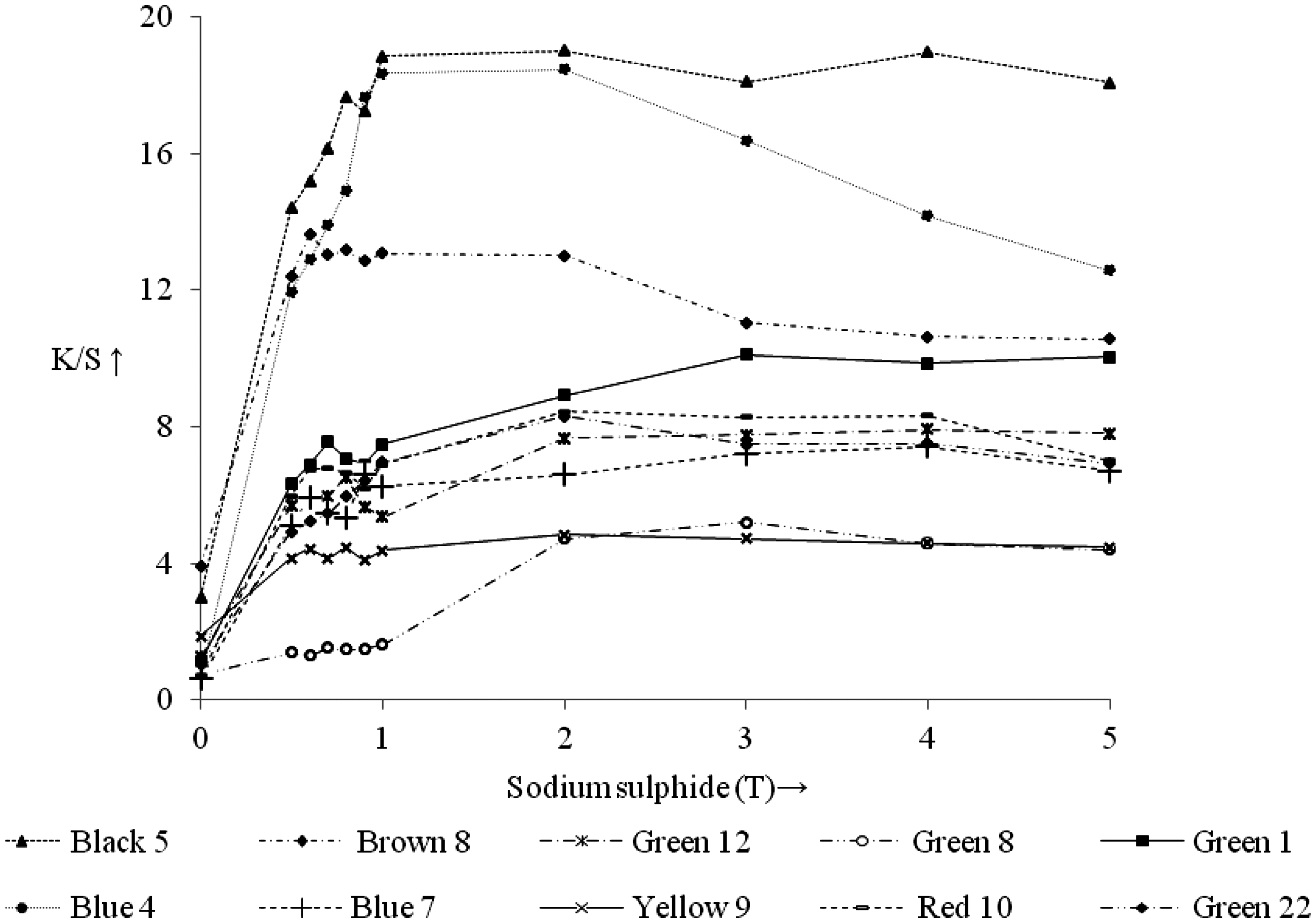
Solubility of laccase
Solubility of laccase at various temperatures and pH values

Color of laccase solution at different pH values and temperatures

L: light; D: dark.
Redox potential
Redox potential (mV) of laccase (1%) a at different pH values and temperatures

1% laccase in the volume of the bath.
Oxidation of dyeings
Cotton samples were dyed with sulfur dyes, using sulfide as the reducing agent as usual, and they were oxidized with laccase at different concentrations, temperatures and times. An increase in the concentration of laccase resulted in increased acidity in the bath due to its acidic nature. Dye strength (K/S), Lab values and color fastness of the samples oxidized with laccase were compared with those of samples oxidized with potassium dichromate. The dye yield of three of the dyes under study, viz., Black 5, Brown 8 and Green 1, were found to be maximum at a laccase concentration of 2 g/l at 50–60°C for 10 min (Figures 3–5). The change in pH of the baths due to the application of laccase at different concentrations is shown in Figure 3. These optimal parameters were later extended to 10 different sulfur dyes reduced with sodium sulfide followed by oxidation with laccase and potassium dichromate separately, as detailed in Table 4. It was found that dye strength values obtained for cotton oxidized with dichromate and laccase were comparable and possessed a close match. For most of the dyes, the color difference values remained within 2 and for some dyes it was even below 1, except Brown 8, which showed higher color difference values.
Effect of laccase concentration on dye strength and on the pH of the bath. Oxidation with laccase: effect of temperature on dye strength. Oxidation with laccase: effect of time on dye strength. Potassium dichromate and acetic acid: 1 g/l each. Laccase: 2 g/l.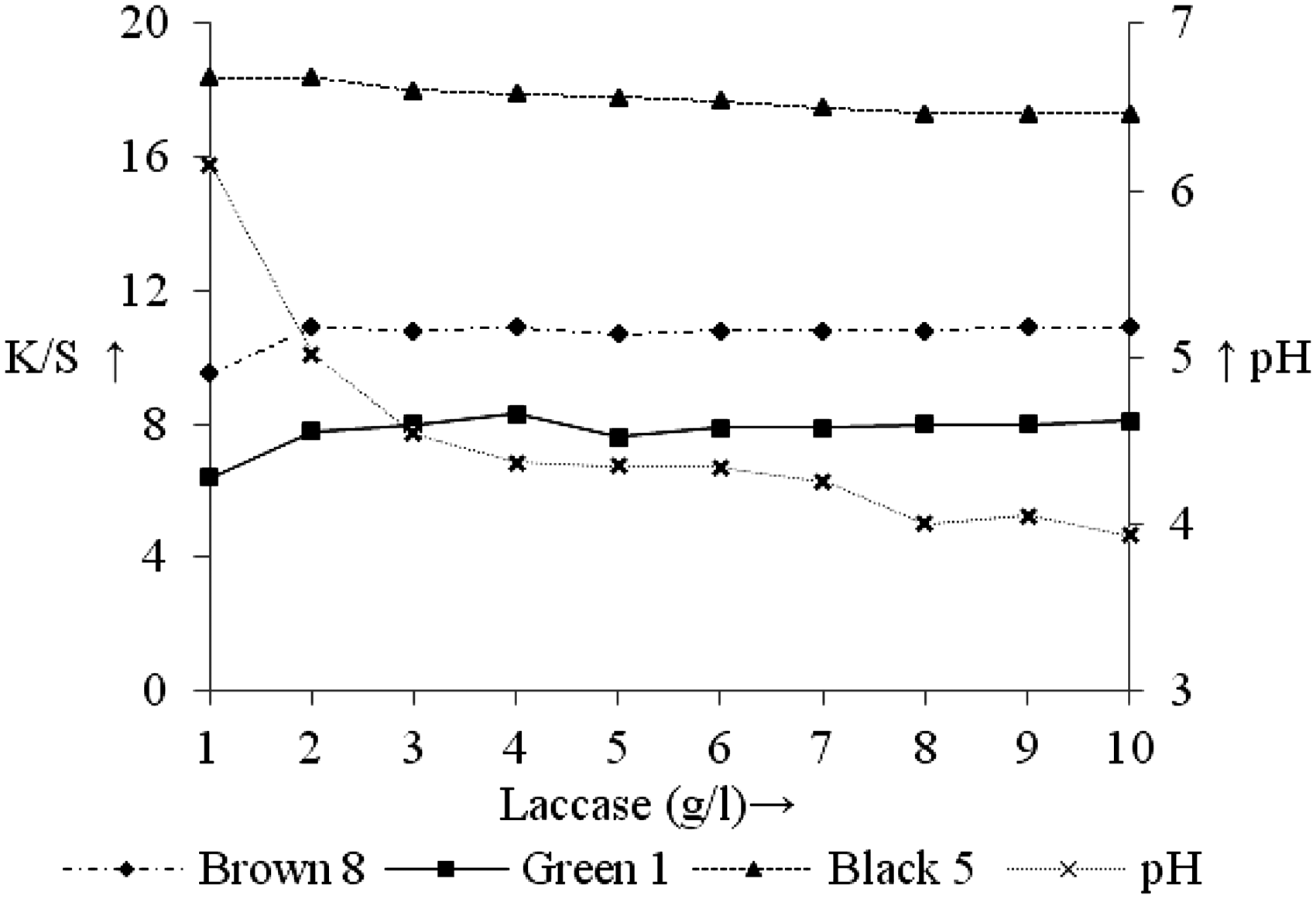


In addition, the handle of dyed cotton oxidized with laccase showed less stiffness compared to that developed with dichromate (Table 4). The increase in stiffness because of the application of dichromate may be attributed to the deposition of chromium compounds on dyed cotton.
Relative performance of laccase for oxidation
Potassium dichromate is invariably used for oxidation of sulfur dyeings with the problem of increase in stiffness, which restricts its application on sulfur-dyed sewing thread due to the fear of needle cutting in sewing machines. Hydrogen peroxide and potassium iodate are the alternate oxidizing agents, while air oxidation is preferred for small-scale dyeing purposes. To compare the performance of laccase as a potential oxidizing catalyst, cotton was dyed with three different sulfur dyes, succeeded by oxidation in all these feasible oxidizing agents separately. Although there was negligible difference in the dye strength of dyed cotton oxidized with laccase, potassium dichromate, potassium iodate and hydrogen peroxide separately, there was slightly less dye strength on air-oxidized sulfur-dyed cotton because of the migration of part of the reduced and soluble dye to the surface of dyed cotton while oxidation was in progress in open air. This resulted in oxidation of a part of dye on the surface of fabric and was removed during soaping and washing. The comparative performance of these oxidizing systems is shown in Figure 6.
Dye strength of sulfur-dyed samples with various oxidizing systems.
Precipitation of unexhausted dye

Laccase (1%) was based on 1 g of laccase per 100 ml of dyebath liquor.
Percent dye precipitated was based on grams of dye precipitated w.r.t. total dye molecules in bath, which was obtained after precipitation of 24 hrs.
All three sulfur dyes studied for precipitation showed nearly complete precipitation within the first hour, thus confirming the ability of laccase to precipitate sulfur dye from an unexhausted bath. Although the three dyes under study showed excellent precipitation with just 1% laccase (w.r.t. the volume of the bath), the effectiveness of laccase to precipitate other sulfur dyes from respective dyebaths may vary and requires further investigation.
It was found that neutralization with acetic acid could not precipitate unused dyes to any remarkable extent, even after 24 hours in the absence of laccase. In contrast, because of its acidic nature, laccase alone was capable of neutralization and precipitation, but this necessitated a large amount of laccase.
Application of recovered dye for dyeing of cotton
Cotton was dyed with recovered dye for 5–10% shades using sodium sulfide as the reducing agent and potassium dichromate for oxidation. The dyed specimens were evaluated for dye strength and Lab values, as well as fastness properties, against control samples.
Dye strength and CIELab values of dyeings with recovered dye

Controls were dyed using fresh sulfur dye and not with a precipitated one, while other samples were dyed with precipitated and recovered dye.
Fastness of dyeings
Fastness properties of sulfur-dyed cotton under various conditions and those with recovered dye

Dyed cotton showed fastness to washing of 4 or beyond (Table 7). Rubbing fastness was also found to be good to excellent in most of the cases: dry rubbing: 4.5–5 and wet rubbing: 4 or above. Light fastness of all the six final chosen samples showed promising results. It may be concluded that laccase-oxidized sulfur dyeings and dichromate-oxidized sulfur dyeings, showed a comparable match. In the case of recovered sulfur-dyed cotton, the fastness was equivalent to potassium dichromate-oxidized samples and, in some cases, even showed better results. Visual assessment of the samples showed that cotton dyed with recovered dye possessed good levelness as compared to that with fresh dye; this may be due to the removal of excess sulfur during the recovery of dye. The light fastness of the samples was identical to that of the control samples for both laccase-oxidized and cotton dyed with recovered dye.
Conclusions
Solubility of laccase increased with the increase in bath acidity; redox potential in acid and alkaline baths suggested their suitability only for the oxidation of sulfur dyes. Shades obtained with laccase showed good comparison with those obtained from potassium dichromate. In addition, laccase showed its capability to precipitate unexhausted dye from dyebaths. The recovered dye, when used for the dyeing of cotton, showed little fall in dye yield against that obtained with fresh dye, but showed better levelness. Fastness properties of dyeings oxidized with laccase, dyed with fresh/recovered dye but oxidized with dichromate, were found to be good and satisfactory.
Footnotes
Funding
This research received no specific grant from any funding agency in the public, commercial or not-for-profit sectors.