



Abstract
Using the theory of Zwikker and Kosten for sound propagation through a porous flexible media and the sound propagation boundary conditions at adjacent interfaces, a general computational model for the sound absorption coefficients of multi-layer non-wovens, αn, is presented in this paper. The iterative algorithm for calculating αn is given using the back-stepping method. In order to yield the highest sound absorption coefficients in the audible frequency range the model has been used for numerical calculation of the intrinsic characteristics of non-woven materials. The simulation demonstrates that the multi-layer structure of non-wovens can have good sound absorption over a prescribed frequency range by choosing the appropriate parameters for each layer. This model can also be used to calculate the absorption coefficients of a multi-layer non-woven comprising different non-woven components, and this can then provide a theoretical support for product design.
Non-wovens are one of the most effective sound absorption materials and can be used for controlling noise in a wide range of applications, including wall claddings, acoustic ceilings and barriers, and carpets.1–7 Experimental studies indicate that the sound absorption capacity of non-woven materials is comparable to that of traditional sound-proofing materials.3–8 A computational model is required for the optimal design of acoustic assemblies made from non-woven materials, enabling the prediction of the sound absorption coefficients of the non-woven medium as a function of its thickness, porosity, fiber type, and other intrinsic characteristics. The sound absorption mechanism of non-wovens has attracted increasing attention and has achieved fruitful results.1,9,10 The theoretical investigation of sound propagation through flexible porous media is of great importance for evaluating the sound absorption capacity of non-woven fiber webs.1,2
The first monumental work on this subject was presented by Zwikker and Kosten, 9 in which a porous medium was regarded as a mixture of two phases, air and solid fiber, in which sound waves behave differently. A mathematical analysis of the basic equations derived from this theory predicts two forward waves and two backward waves travelling through the medium. Based on the Zwikker and Kosten theory a more appropriate model was suggested by Dent, who examined the random mixture of fibers and air pores in a non-woven fiber web. 11 In addition, some investigations into the sound absorption of specific non-woven materials were carried out.12,13 For example, a theoretical model was derived for calculating the sound absorption coefficient of weft knitted fabrics with complex structures, combining theoretical models for non-woven and plain knitted fabrics. 12 The microstructure of the nonwoven was modeled using a macroscopically homogeneous random system of straight cylinders in order to optimize the acoustic properties of a stacked fiber non-woven. 13 In particular, the noise absorption coefficient calculated for some non-wovens, based on the work of Dent and Shosany, showed similar analytical results, demonstrating that the theory of Zwikker and Kosten for sound transfer through porous media was in agreement with experimental measurements on non-wovens. 1 The model was then used for the numerical calculation of the intrinsic characteristics of non-woven fiber webs, allowing the highest sound absorption coefficients over the audible frequency range to be achieved. 2 Furthermore, in order to calculate the sound absorption coefficient of non-woven materials containing a number of layers with different properties, a theoretical generalization of the Zwikker and Kosten model was developed, 10 and the effect of variations in porosity on the sound absorption coefficient of three webs made from cotton, acrylic and polyester, respectively, were examined using this model. 14
A layered absorption structure can obviously increase acoustic attenuation if it is constructed from different sound absorbing materials. 15 The results show that a layered absorption structure can achieve satisfactory absorption over a target range of frequencies.16,17 For example, by appropriate choice of porosity the sound absorption coefficients of three webs made from cotton, acrylic and polyester, respectively, can reach 0.99. 14 A model for calculating the absorption coefficient of multi-layer porous structures was given by using the acoustic propagation equation of the layered media, and optimization of the parameters was conducted. 16
Encouraged by this work, the present paper investigates more deeply the sound absorption of multi-layer structures of different non-woven materials. A more general model for calculating the absorption coefficient of such structures is presented, based on the theory of Zwikker and Kosten on sound propagation through the porous flexible media, and the boundary conditions at interfaces between adjacent layers. Compared with Shoshani’s theoretical generalization of the Zwikker and Kosten model, 10 our approach is more general and can be used for calculating the absorption coefficients of multi-layer sound absorption structures containing different non-woven components.
Absorption mechanism for sound propagation through non-woven materials
In this section, we review the sound absorption process through the porous flexible media. When sound waves are propagated through non-woven materials the incident sound pressure may be denoted as Sound propagation model in non-woven materials.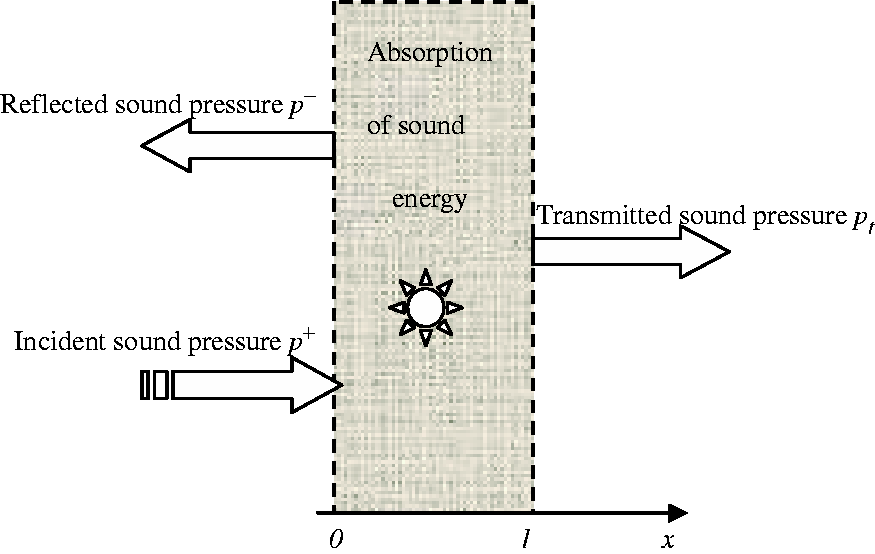
For convenience, let us denote

Then,

If we denote the sound impedance at the front face (x = 0) as


Based on the theory of Zwikker and Kosten for sound propagation through porous flexible media, a porous medium may be regarded as a mixture of two phases, air and solid material, in which the sound waves react differently in the two phases. The mathematical analysis of the basic equations derived from this theory predict that two forward and two backward waves are travelling through the medium. The sound pressure

Sound absorption model of multi-layer non-wovens
In this section, according to the theory of Zwikker and Kosten on sound propagation through porous flexible media, and knowing the sound propagation boundary conditions at the interface between adjacent layers, a model for calculating the absorption coefficient of multi-layer non-woven can be derived.
The sound propagation process in a multi-layer sound absorption structure composed of non-woven materials is shown in Figure 2, in which n is the total number of layers, and Sound propagation model in multi-layer absorbing structure.
Let


In the following, we consider the boundary conditions at the interface between any two adjacent layers.


For solving


Based on the results,
1
we have

Substituting the boundary conditions

Substituting the boundary condition s = 2, … , n–1 in Equation (4), we have


Noting that

In the open face case, the sound impedance of the multi-layer non-woven sound absorption structure at the front face (x = 0), zn, is given by

Combining Equation (4), Equation (10) can be further rewritten as

Therefore, according to Equations (2) and (11), we can see that the unknown quantities A11, A21, and A31 should first be solved in order to calculate the absorption coefficients of the multi-layer non-woven αn.
Based on the above analysis, we can calculate αn by the following steps, using the back-stepping method: Based on the boundary Keeping the iterative calculation process based on the boundary s for s = n − 2, … , 1. In the general case, if we supposeStep 1
Step 2


Then, based on the boundary s, i.e. Equation (7), we obtain


For t = 1, 2, … , 16,

Here, Based on the result of Step 2 and the boundary conditions Step 3
Step 4


Then, the absorption coefficient of multi-layer non-woven

Numerical simulation
In this section, various properties of the absorption coefficient αn will be examined and plotted using MATLAB software. For double-layered non-wovens with polyester in the outer layer and nylon in the inner layer, the model obtained above may be used for numerical evaluation of the intrinsic characteristics of non-wovens to yield the highest absorption coefficient. The programs which calculate the sound absorption coefficient α2 from Equation (14) are written as a function of l1, l2,
The constants involved in the calculation are as follows:
Taking Calculated sound absorption coefficient Calculated sound absorption coefficient Calculated sound absorption coefficient Calculated sound absorption coefficient Calculated sound absorption coefficient Optimal porosity va yielding the highest sound absorption coefficient when Optimal porosity va yielding the highest sound absorption coefficient when 

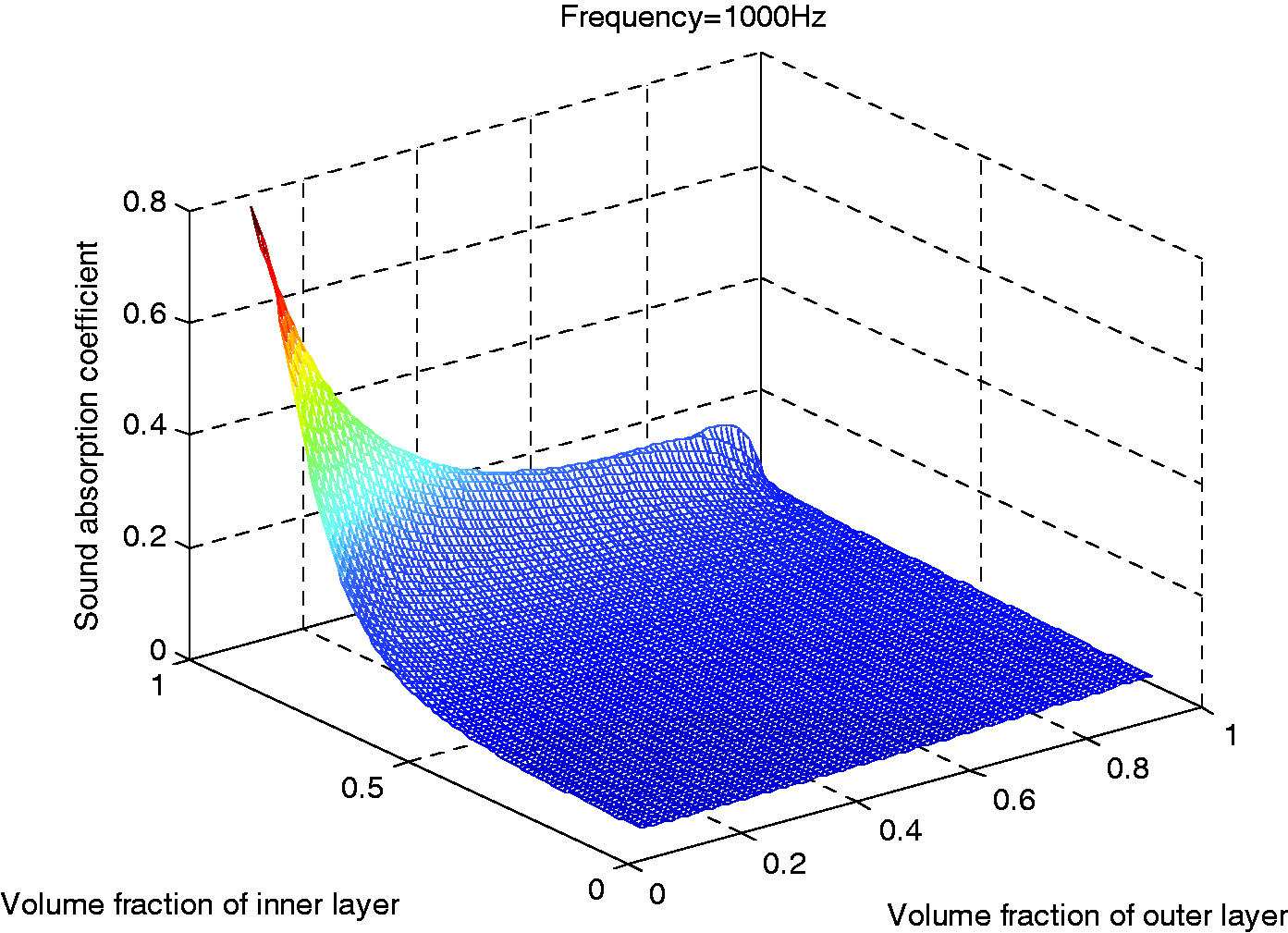
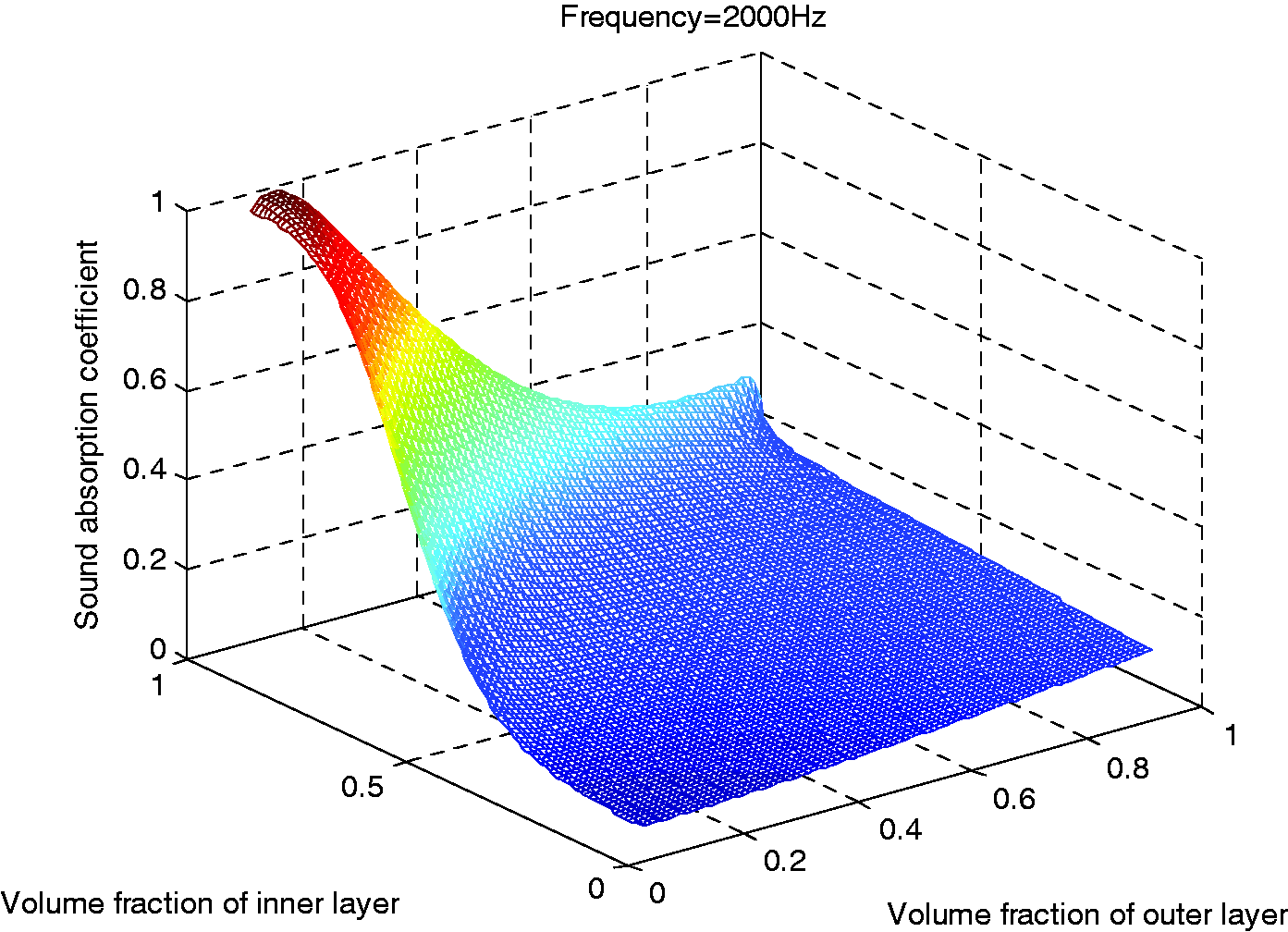
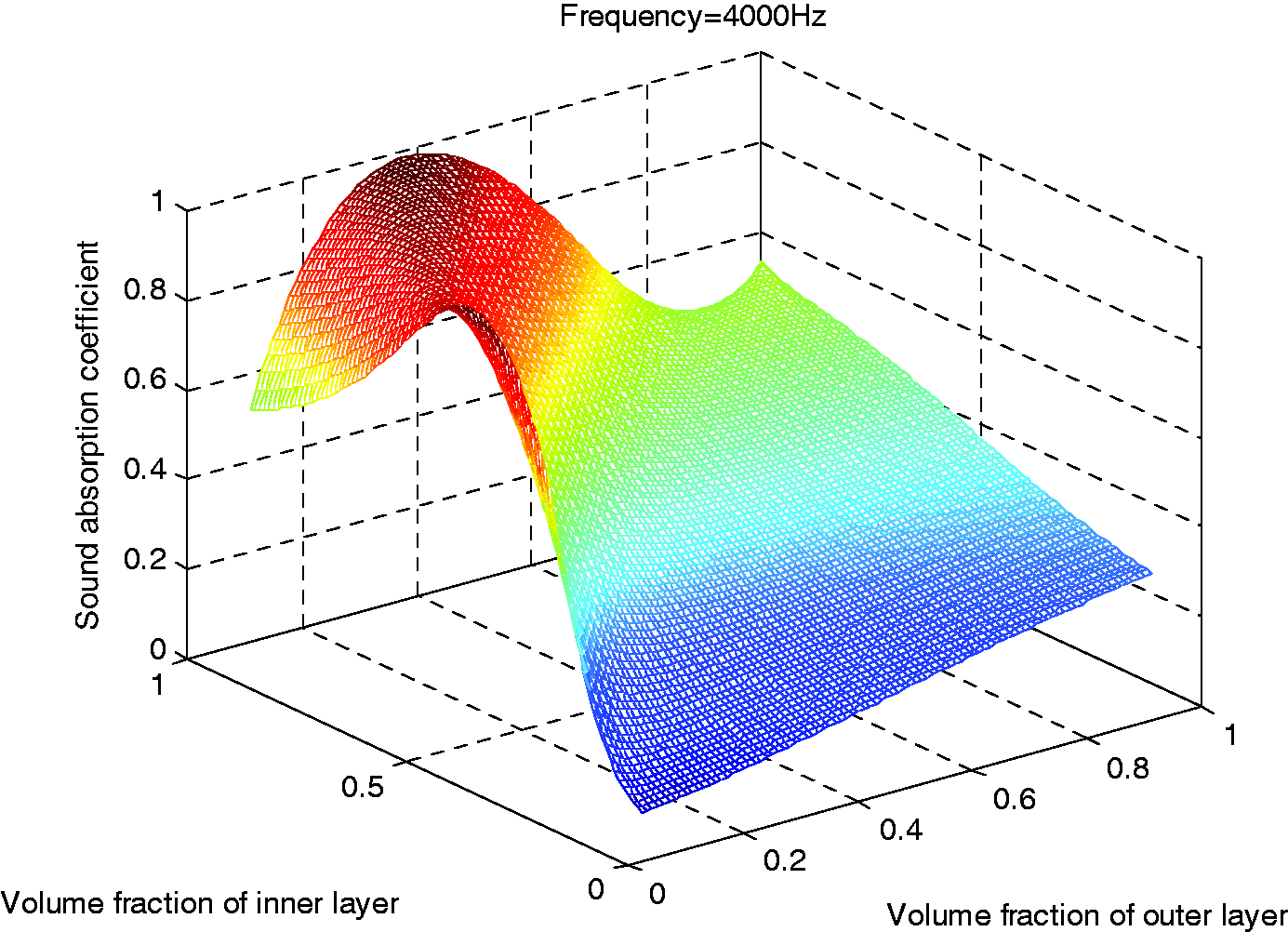


From the simulation results, we can see that the effects of volume fraction of outer layer
It is seen that a multi-layer sound absorption structure made from non-woven materials has good sound absorption and can give a satisfactory absorption level over a given frequency range by choosing the appropriate parameters for each layer. The model developed in this paper for calculating the absorption coefficients of multi-layer non-woven components can provide a theoretical basis for high performance non-woven absorbent design and manufacture.
Conclusions
A general computational model for the absorption coefficient of multi-layer non-wovens, αn, and the sound propagation boundary conditions at the adjacent interfaces has been presented based on the theory of Zwikker and Kosten for sound propagation through porous flexible media. An iterative algorithm for calculating the absorption coefficient αn has been developed using the back-stepping method. Compared with the theoretical generalization of the Zwikker and Kosten model presented by Shoshani, the present model is more general and can be used to calculate the sound absorption coefficients of multi-layer absorption structures containing a variety of non-woven materials, and provides a theoretical support for product design. The numerical simulations show that by selecting the appropriate parameters for each layer, a multi-layer structure based on suitable non-woven materials can give satisfactory sound absorption over the required frequency range.
Footnotes
Funding
This work was supported by the National Natural Science Foundation of P. R. China (grant number 11102072), the Fundamental Research Funds for the Central Universities (grant number JUSRP21104), the Natural Science Foundation of Jiangsu Province (grant number BK2012254), Prospective industry–university research project of Jiangsu Province (grant numbers BY2011117 and BY2012065), the China Postdoctoral Science Foundation (grant number 20110490098), the Special Financial Grant from the China Postdoctoral Science Foundation (grant number 2012T50754) and a project funded by the Priority Academic Program Development of Jiangsu Higher Education Institutions.