



Abstract
The main research objective of this study was to investigate the effect of the impregnation of Twaron® fabric with various shear thickening fluids (STFs) on the stab resistance at quasi-static conditions—being the main parameter characterizing the future application of the impregnated textiles in the scope of the new functionality of the elaborated protection of the multi-layer system. It was found that the STF/Twaron® fabric composites required significantly higher loading than the untreated fabric to achieve spike penetration. In the composite fabric tests, the spike did not fully puncture the material.
Keywords
Currently, ballistic body armor consists of inserts of 20–50 layers of para-aramid textiles with optional ceramic, metallic or composite inserts. 1 These structures make the body armor heavy, bulky and suitable for protecting only the upper part of the body because the material is too stiff to cover the arms and legs.
In many scientific and research and development centers, researchers are exploring new technologies to improve soldiers’ safety. 1 One promising technology is “liquid body armor”. This type of body armor makes use of a shear thickening fluid (STF) and exhibits remarkable properties. An STF is a non-Newtonian fluid, a fluid whose viscosity increases with an increase in applied shear rate.2–4 The shear thickening phenomenon can be explained by a few theories, such as clustering theory, 5 order - disorder transition (ODT) 6 and flocculation theory. 7 In general, low shear rates enable free movement of nano-particles in a carrier liquid, providing the viscous character of the STF. However, an increase in the shear rate over a particular threshold value promotes the formation of clusters that block the relative movement of the nano-particles, resulting in an abrupt increase in viscosity that converts the liquid into a solid body. This transformation is fast and fully reversible.
Wagner et al. initially applied the phenomenon of STF to the development of liquid body armor technology.8–11 The results of their research demonstrate that the impregnation of Kevlar® fabric with an STF can slightly improve its resistance to knife attack. 8 The ballistic properties of woven para-aramid fabrics impregnated with a shear thickening fluid were also investigated, and these materials demonstrated improvement over the ballistic resistance of Kevlar®.9–11
The combination of the STF with para-aramid fabrics has gained the attention of scientists all over the world. Sivastava et al. 12 investigated the effect of STF concentration and padding pressure on the performance of the STF-impregnated Kevlar® fabric; these parameters were varied using the Box and Behnken experimental set-up. 13
The behavior of ultra-high molecular weight polyethylene (UHMWPE) fibers, soft composite or glass fabric with and without STF impregnation has also been tested. Liang-Liang Sun et al. 14 demonstrated that the stab-resistant property of UHMWPE sheets improved after they were impregnated with an STF. The stab resistance significantly increased as the mass fraction of silica in the STF was increased. The authors suggested that the optimal mass fraction of silica in STFs for knife and stab protection is 38%.
Kejing Yu et al. 15 impregnated glass fabric with STF. Their quasi-static stab-resistant tests showed that the composite had a significant improvement over the pure glass fabric properties.
Application of an STF for para-aramid woven fabric impregnation has great potential in body armor design due to its superior properties. The impregnation of those fabrics with a specially selected STF may significantly increase the stab resistance at quasi-static conditions with a reduction in the number of layers of the fabric in the designed system.
The idea for the research was connected to the implementation of new, improved functional properties—the spike resistance in addition to the ballistic properties—to the designed protective multi-layer system. The application of an STF will improve the ergonomics of the multifunctional ballistic armor by reducing the number of layers in the protection system as well as reducing the stiffness of the final multifunctional ballistic inserts.
The aim of the studies was to design passive, multifunctional composite armor, containing colloidal STFs. The main research objective of this study was to investigate the effect of the impregnation of Twaron® fabric with various STFs on the stab resistance at quasistatic conditions—being the main parameter characterizing the future application of the impregnated textiles in the scope of the new functionality of the elaborated protection of the multi-layer system.
Experimental details
Materials
Plain, woven Twaron® fabric (Tejin Aramid, The Netherlands) with an areal density of 198 ± 2 g/m2 was used. The fabric was cut into square specimens of 100 mm x 100 mm.
STF1 contains fumed silica (FS) with an average particle size equal to 7 nm (FS7), a specific surface area of 395 m2/g ± 25 m2/g and a density of 1.53 g/cm3 (Sigma Aldrich, USA) and FS with particles size ranging from 200–300 nm (in the form of an aggregate) with a specific surface area of 200 m2/g ± 25 m2/g and a density of 1.53 g/cm3 (Sigma Aldrich, USA). The STF1 suspension contained 12.5% volume fraction of FS7 nm, 12.5% volume fraction of FS and 75% volume fraction of polypropylene glycol - PPG 400 (molecular mass 400 gmol−1) (Sigma Aldrich, USA). The fluid was prepared by dispersion of FS in polypropylene glycol - PPG 400 (molecular mass 400 gmol−1) (Sigma Aldrich, USA). The resulted dispersion was slowly mixed using sonication at room temperature using a UP400S sonificator (Hielscher Ultrasonics GmbH, Germany).
STF2 contains FS with an average particle size equal to 7 nm (FS7), a specific surface area of 395 m2/g ± 25 m2/g and a density of 1.53 g/cm3 (Sigma Aldrich, USA). STF2 contained 25% volume FS7 fraction and 75% volume fraction of polypropylene glycol - PPG 400 (Sigma Aldrich, USA). The process of STF2 fabrication was similar to that described for STF1.
Methods
Fabrication of Twaron® fabrics with STFs
Before the fabrication of the Twaron® fabric/STF composites, the STFs were diluted in ethanol at a 3:1 volume ratio (ethanol:STF). Each fabric layer (10 cm x 10 cm) was soaked in the above dispersion for 1 minute, then squeezed to remove excess STF and dried at room temperature to evaporate the solvent for 24 hours. The impregnation was carried out using the laboratory impregnation system (MORATEX, Poland) with the gap size of 1 mm.
Fabrication of the multi-layer systems
The tested multi-layer system was made of 17 pieces of the impregnated para-aramid fabrics. Additionally, the system containing 22 pieces of the untreated fabrics was designed and used as the reference. The reference system had a similar mass as the system with the STF-impregnated fabrics.
Analytical methods
The rheological properties of the STFs were characterized using an Ares Rheometer (TA Instruments, USA) operated in a plate–plate mode with a gap of 0.3 mm at a temperature of 25℃.
The parameters of the multi-layer systems consisting of untreated or STF-impregnated fabric systems were characterized as follows:
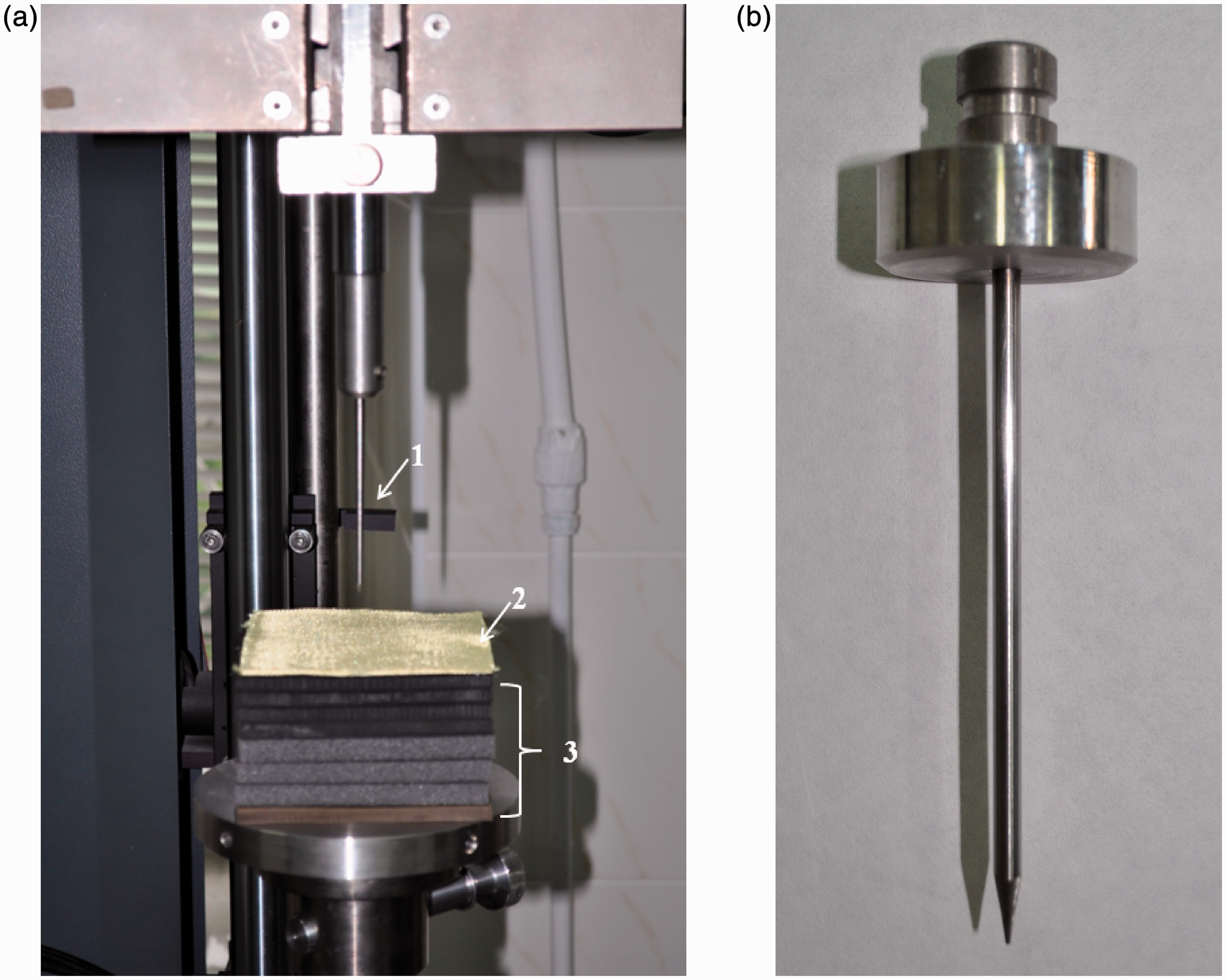
The areal density was calculated from the mass of the specimen (100 mm × 100 mm) multiplied by 100 to obtain a mass of 1 m2. The thickness was measured according to PN-EN ISO 5084:1999 “Determination of the thickness of textiles”. The thickness measurement device with a pressure foot of 1 kPa was used. The fabric multi-layer system was placed between the pressure foot and the reference plate by lifting the pressure foot. Next, the pressure foot was lowered onto the fabric, and 30 seconds later, the thickness of the multi-layer system was read on the gauge. The apparent density was calculated as the mass per volume unit of a material, including the voids which are inherent in the material. The bending angle was assessed with a testing procedure based on established flexibility and thickness tests.16,17 A schematic of the test is shown in Figure 1. In all cases, a mass (Q) of 35 g was used. Encapsulated targets, which were used as the test specimens, were attached to the surface for a quarter of their lengths. The bending angle was evaluated as a measure of target flexibility, with larger angles indicating greater flexibility. A quasi-static test of stab resistance was performed in order to verify the response of the designed system consisting of untreated layers or the system consisting of layers impregnated with STFs to the penetration with a spike. The test consisted of the slow penetration of a spike into the tested material at a constant, pre-set speed (5 mm/min) up to a certain depth, defined before the test. As the test result, the resistance of the tested material to the spike (load) was measured, which allowed for determining the best arrangement concerning the desired properties to get a system with an STF applied and also the best arrangement compared to the arrangement consisting of untreated para-aramid fabrics. Figure 2 shows the loading test configuration. The spike was attached to the upper grip of the testing machine (type 1456, Zwick–Roell, USA), pointing downward towards the multi-layer system, which is placed on a multi-layer backing device described in NIJ Standard 0115.00. The spike was then pushed into the fabric at the rate of 5 mm/min to a total depth of 30 mm. Each variant was tested three times. The average number of perforated layers and the perforation ratio (PR) in the tested multi-layer system was determined. The PR of each sample was calculated as follows, based on an equation in PP-03 Flexibility and a thickness test
18
Schematic of the bending angle test. (a) Loading test configuration for the stab tests with the components and (b) the spike used in the current tests.


Scanning electron microscope (SEM) investigations were performed to investigate the quality of the impregnation of woven fabric sheets with various STF. SEM microphotographs were taken using an S-3500 SEM and a SU-8000 SEM (both Hitachi, Japan).
Results and discussion
Rheological properties of the STFs
The rheological properties of the STFs are the most important parameters in terms of understanding and explaining the stab resistance behavior of the para-aramid fabric/STF composites.
One can see (Figure 3) that both STFs have similar rheological properties, although STF2 has a critical shear rate of approximately 10 s−1, whereas for STF1, the shear rate is closer to 7 s−1. The highest viscosity value for STF2 is 1200 Pa · s, at a shear rate of 24 s−1, which is approximately 280 Pa · s more than the highest viscosity value for STF1, at a shear rate of 26 s−1. The critical shear rate of STF2, at which the viscosity starts to abruptly increase, is approximately 30% higher than that of STF1. This observation may indicate greater flexibility of the samples made with STF2, although the viscosity of STF2 at low shear rates (lower than the critical shear rate) is higher than the viscosity of STF1. STF2 also has approximately a 25% higher maximum viscosity value.
Dynamic viscosity versus shear rate for STF1 and STF2.
Topography of woven fabrics after STF impregnation and the STF impregnation effect
The effect of STF impregnation on the Twaron® fabric and the topography of the fabric were verified with the SEM observations.
Figure 4 shows the SEM microphotographs of untreated Twaron® fabric or the Twaron® fabric surface impregnated with STF1 or STF2. The small, empty spaces between the fibers were observed in SEM microphotographs of the untreated sample resulting from the woven structure of the fabric (Figure 4(a)). After impregnation with the STF, all the empty spaces among the fibers became filled by the fluid confirming that the STF was continuously distributed into the single filaments of the yarns.
SEM microphotographs of the surface of the following: (a) untreated Twaron®, magnified; (b) Twaron® CT 709 fabric impregnated with STF1, magnified; (c) Twaron® CT 709 fabric impregnated with STF1, magnified; (d) Twaron® CT 709 fabric impregnated with STF2, magnified; and (e) Twaron® CT 709 fabric impregnated with STF2, magnified.
Figure 4(b) shows the fabric surface after impregnation with STF1. The fluid formed irregular spots on the surface of the fabrics as Figure 4(c) shows in details. The absence of the agglomerates on the surface of the para-aramid fabrics was found if STF2 was used for the impregnation (Figure 4(d)).
The above observation is connected to the properties of the FS used for the fabrication of STF1 which promote formation of the agglomerated particles that reduce the effectiveness of the covering of the fibers by the STF. Adding the FS with the higher particle sizes (STF2) yielded the complete coverage of the fibers surface with layers of the STF.
The STF2 dipped into the fabric structure, among the single fibers (Figure 4(e)). The irregular impregnation of the fabric surface, when STF1 is used, may result from the larger agglomerated particles size of silica in the STF.
Properties of the multi-layer systems
Parameters of the multi-layered systems of untreated fabric and Twaron® fabrics impregnated with STF

As shown in Table 1, the systems consisting of 17 layers of the STF-impregnated fabric had areal densities similar to those of the system with 22 layers of non-impregnated fabric. The STF-impregnated systems have a much greater apparent density (by approximately 20%), which may indicate that the empty space among the fibers is filled with the STF.
The thickness of the STF-impregnated system is lower than the untreated system (by approximately 18%). Taking the above into account, the most significant changes resulting from the STF impregnation are the reduction in the number of para-aramid fabric layers (by 23%) and the reduced thickness of the multi-layer system.
The untreated system consisting of fabric layers without STF and consisting of layers treated with STF had equal masses. However, the STF-impregnated system was designed with five layers less. This situation allows for concluding that applying the STFs onto a p-aramid fabric improves not only the resistance to perforation with a spike, but also allows for reducing the number of para-aramid fabric layers in the final multi-layer system.
Quasi-static stab resistance test
The quasi-static stab resistance test was performed to analyze the stab resistance of the multi-layer system consisting of the non-impregnated (22 layers) or the STF-impregnated fabrics (17 layers) using a stab hit to simulate impact.
The results of the quasi-static stab tests are shown in Figure 5, whereas Figure 6 shows the resulting PR. Moreover, Figure 7 shows the representative relationship between the load and deepening into the multi-layer systems: without or with STF.
Quasi-static stab resistance for the untreated and STF-impregnated systems. Effect of the STF impregnation of Twaron® fabrics on the PR in the quasi-static test. The relationship between the load of the spike penetration and its depth into the multi-layered system.


Figure 5 presents the results of quasi-static tests of the multi-layer system consisting of untreated fabric or layers impregnated with STF (STF1 or STF2). The multi-layer system designed of fabrics impregnated with STF proved to have a higher resistance to stab perforation (described by the resistance of the arrangement to the action of a spike under quasistatic conditions) than that of the multi-layer system consisting only of untreated layers.
The multi-layer system with untreated layers showed the maximum load at the level as low as 58.0 ± 4.9 N, wherein it should be mentioned, that all layers were perforated (Figure 6.). On the other hand, the system consisting of a lower number of layers (by 23%), but treated with an STF proved to have a much better resistance to the perforation (within the range from 144.0 ± 10.0 N for STF1 up to 179.0 ± 10.0 N for STF2). Moreover, in the case of the initial fabric system, all layers (22 pieces) were punctured (perforation ratio of 100%), unlike for the impregnated fabric systems, where only four or six layers were punctured (PR: 24% or 35%) depending on the type of STF used (Figure 6).
Figure 7 presents a representative relationship between the spike penetration load and the spike’s deepening into the multi-layer system. It showed that the resistance of the impregnated fabric systems reduces the spike penetration under quasistatic conditions. The developed systems of fabrics impregnated with STF featured a remarkably higher resistance to an action of the force of the penetrating spike (approximately 100% higher if STF1 was used for the impregnation and 200% higher for STF2). The above phenomenon confirmed the higher resistance of the material arrangements with STF2 to spike penetration.
The resistance of impregnated layers to puncture was almost three times higher than that of the system consisting of only untreated layers. It may be a result of the penetration of the silica particles deep into the structure of fabric, among the yarns or even single fibers, which further causes the lowering of the friction between them, manifesting as a consequence in the improved resistance to puncture. Furthermore, the restricted motion of the single filaments and yarns in the STF fabrics prevented the spike from pushing yarns and filaments aside, thus hindering penetration. The SEM observation of the STF affinity for the covering of a surface of woven fabrics as well as the effect of STF2 penetrating into the fabrics structure, were directly transferred to the results of the maximum load determination. The better covering, penetrating deeply into the fabrics structure and the absence of the susceptibility for the agglomerates formations yielded in the statistical increase of the maximum load for the multi-layer system of fabrics impregnated with STF2.
No differences in the penetration depth was evident for both the STF1 and STF2 multi-layer systems indicating the significant influence of the type of STF on the improvement of the stab resistance of STF impregnates rather than its effect on the elasticity. The above phenomenon also assisted the increase in the resistance of the multi-layer systems treated by STF against stab puncture.
The system consisting of Twaron® fabrics impregnated with STF (17 layers) required a significantly higher force than the non-impregnated fabric, to achieve spike penetration, thus proving the higher protection ability of the composite fabrics in terms of body armor applications.
The best stab resistance was obtained for the multi-layer system consisting of Twaron® impregnated with STF2. This observation is consistent with the rheological studies previously discussed, in which STF2 exhibited a maximum viscosity higher than that of STF1.
The above results indicate the high potential of using STF impregnation to improve the stab resistance of textile body armor.
Conclusions
This research was focused on STF/Twaron® composite systems fabricated by the impregnation of Twaron® fabric using two STFs, STF1 and STF2, for a comparative analysis. The empty space between fibers was filled by the STF, as confirmed by the SEM images. STF2 showed approximately 25% higher maximum viscosity in comparison to STF1. The reason for this difference is ascribed to the fact that STF2 consisted of smaller particles of silica, which enabled better penetration of the fluid into the fabric structure.
The STF-impregnated fabric systems (17 layers) had a nearly equivalent areal density to the non-impregnated Twaron® fabric (22 layers). They were also thinner and showed better quasi-static stab resistance, proving the improvement in the protective behavior of the STF-impregnated fabrics.
The composite STF/Twaron® fabric systems exhibited significantly higher stab resistance than the untreated system. Moreover, all layers (22 layers) of the untreated system were punctured (PR: 100%), unlike for the system of impregnated fabrics, where only four or six layers were punctured (PR: 24% or 35%) depending on the type of STF used.
The process of the textile impregnation results in an increase of mass which is the main disadvantage in many applications. The above aspect is also important in designing multifunctional personal armor (ballistic and impact-resistant features), especially in the context of the performance (ergonomics) as well as safety.
The multi-layer STF containing system, developed during the study, is not only resistant to stab puncture, but it is also lightweight, which shall directly improve the ergonomics of personal armor to be designed in future. The application of the STF for the impregnation of the woven fabrics yielded in the improved functionality—stab resistance and the reduction of the protection system mass as well as stiffness. The last two parameters significantly influenced the ergonomics of the personal protection.
The research shows the promising material behavior of textile-STF composites also with respect to the stab resistance. The incorporation of STFs into para-aramid fabrics will also improve their dynamic resistance, which will be validated in the next stage of the research—the dynamic stab test according to the NIJ Standard (0115.00).
Footnotes
Funding
Financial support for the project “Smart passive body armour with application of rheological nano-fluids ”, co-financed by the European Union; European Regional Development Fund, and Polish Government within the Operational Programme Innovative Economy 2007–2013, priority 1, activity 1.3, subactivity 1.3.1, agreement with MSHE No. UDA-POIG.01.03.01-00-060/08-00, is gratefully acknowledged.