




Abstract
The air gap size and distribution developed between clothing and a human body play a critical role in clothing performance, specifically for thermal protective clothing. Hot liquid is considered as one of the common hazards in industrial working environments. In this study, the clothing air layer entrapped between protective clothing and a manikin body was determined using three-dimensional body scanning, and the protective performance provide by the clothing was predicted using an instrumented hot water spray manikin evaluation system. The relationship between the average air gap size and overall protective performance was analyzed. The impact of clothing air gap developed along the human body on predicted burn injury was considered. In addition, the air gap distribution and its relation to skin burn injury were compared for the selected garments. In general, the results indicated that the average air gap size showed positive effects on the overall protective performance. For all body parts except the pelvis, the air gap size presented a significant relationship with the percentage of burn injury. For an individual garment, there was no significant correlation found between the air gap distribution and skin burn injury. The garment with a larger air gap size and minimal air gap changes during hot water spray provided better protective performance. The research findings could provide the technical basis for further development of high performance protective clothing.
Hot liquid splashes were considered as one of the main hazards encountered from industrial to home scales.1,2 Protective clothing was required to protect the wearer’s occupational health and life safety. The protection from hazards of hot liquid was different from the heat and flame. However, the typical clothing mainly designed for flame-resistant was worn by oil and gas industrial workers. 1 In recent years, several studies have been conducted to understand the heat and mass transfer through protective materials to human skin under exposure to hot liquid splashes.2–5 The results demonstrated that the protective performance of fabrics was affected by the permeability, surface properties, structure, thickness and fabric combination. Minimizing the mode of mass transfer during the liquid exposure was proved to be an effective way to improve the protective performance. 2 Protective clothing required a stringent conformity to wearer’s body dimensions, providing higher protective performance and lower thermal stress and physical burden. 6 Improper fitting garments might impair work efficiency or even cause an accident during working.7–9 For example, too long crotch might constrain worker’s mobility and flexibility or might make wearer vulnerable to hazardous environment in emergency conditions. 10 Comparing with the development of new materials, the design of garment construction and fit was relatively convenient to improve the overall performance. 11
In order to improve the protective performance for protective clothing, various garment design approaches were employed. The approaches include developing different garment patterns and styles, adding material layers and selection of proper garment fit. Several studies have demonstrated that the overall protection provided by clothing was strongly associated with the clothing air gap distribution. The air gap between clothing and the body surface influenced the heat transfer to skin and clothing performance.12,13 The garment fit showed a great influence on the air gap size and distribution, which greatly affected the heat and mass transfer in the microclimate under clothing.13–16 Air gap size and distribution in protective clothing depended on garment design features such as fabric properties and garment size. It was reported that loose-fitting protective clothing could provide better thermal protection against flash fire than close-fitting garments due to more air layer entrapped in loose-fitting clothing. 17 Fabrics with different mechanical properties affected the garment drape and formability. The stiff Kevlar®/PBI coveralls had larger average air gap sizes than more pendulous Nomex® IIIA coveralls with the same style and size. 18 The relationship of air gap size and burn predictions in single layer protective clothing exposed to flash fire was investigated. 18 To study the effect of body geometry, garment style, and fit on thermal protection, a flash-fire instrumented female mannequin evaluation system was applied.6,15 The findings demonstrated that air gap sizes were not evenly distributed over the mannequin, and depended on the garment style and fit, as well as the body contour. The locations with a smaller air gap developed more skin burn injuries.
The effect of garment fit on protective performance of protective clothing has been explored under flash fire conditions, whereas few studies focused on hot liquid splashes and steam hazards. A copper manikin was also applied in the garment protective performance evaluation exposed to a steam climate chamber. 19 The results showed that the impermeable garments provided greater protection against hot steam. Moreover, the garment made of thicker fabric provided better performance. The effect of an air gap on heat transfer through protective fabrics upon hot liquid splashes was investigated. 20 An air gap of 6 mm significantly increased the thermal performance of fabrics. However, vapor transfer through hydrophobic permeable fabric and its condensation on the sensor attenuated the positive effect of air gap on thermal protection. Under actual wear conditions, there exists air gaps between the human body and the garment, which is not evenly distributed,6,14,18 namely clothing may be in direct contact with the skin in some areas while hanging loosely in others. In addition, bench scale tests cannot simulate the location of air gaps distributed over the body, nor can they predict the areas of the body that will be burned. In our previous study, the effects of clothing design features on protective performance of protective clothing upon hot water spray was explored by spray manikin system and the mechanism associated with heat and mass transfer was discussed. 21 However, the relationship between the air gap distribution and thermal performance was still not elucidated.
The purpose of this study was to explore the impact of air gap size and distribution on body skin burn injury when exposed to hot water spray hazards. A three-dimensional (3D) body scan was applied to characterize the air gap distribution over the manikin surface. The thermal protective performance upon hot water spray was measured by an instrumented hot liquid spray manikin system. The relationship between the average air gap size and total predicted skin burn injury on the body was analyzed. The findings obtained will provide insight into the protective clothing design and the technical basis to develop high performance garments.
Experimental details
Testing garments
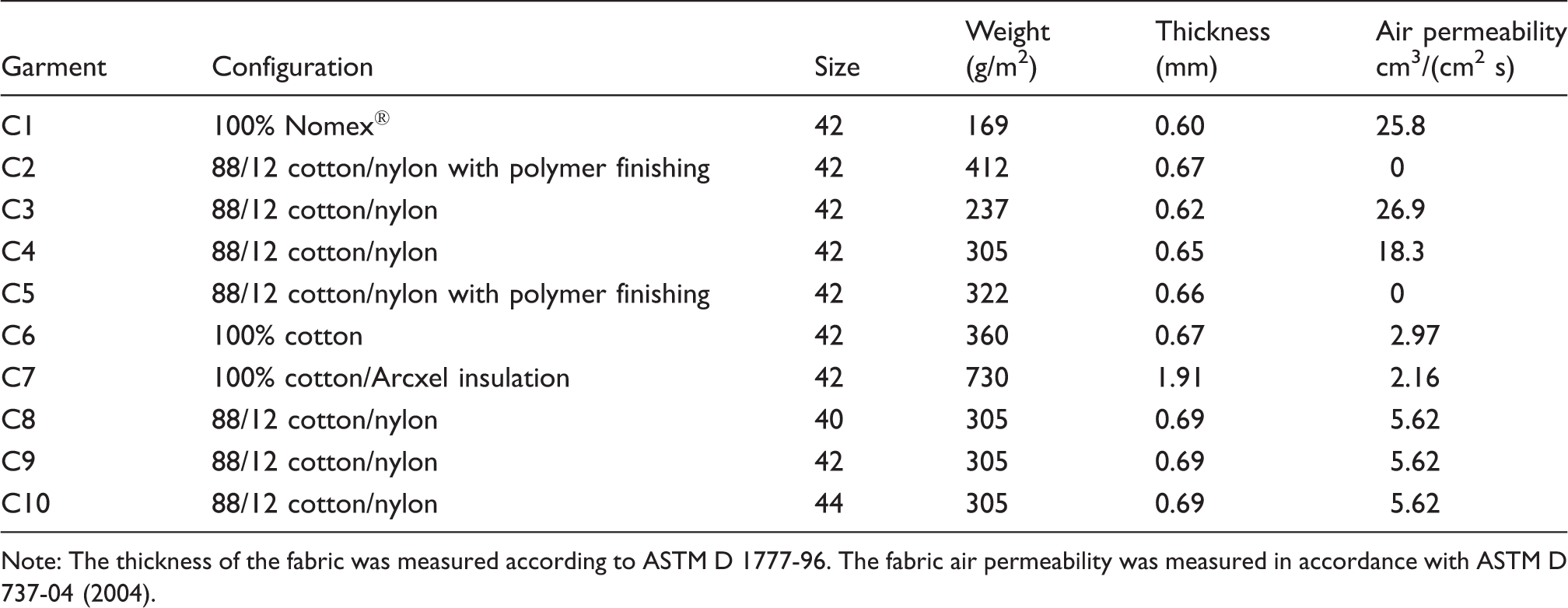
Several commercially available thermal protective coveralls typically worn by industrial workers were selected. The coveralls with different sizes (close-fitting, fitted and loose-fitting) were employed to study the effect of garment size on protective performance. The detail specifications of these testing garments are shown in Table 1. C4 and C3 are of the same woven structure but different in weight, and C5 was treated with polymer finishing on C4. C7 is a double layer coverall with the fabric of C6 as the outer layer. As shown in Figure 1, all the experimental garments consisted of a double layer fold-over collar and a top fly in the front centre as well as a horizontal segment line at the waist. Pockets such as chest patch pockets with flap, rear patch pockets and in-seam pockets were included in the designs. Reflective tape was also stitched on at the shoulder, cuff of sleeve and leg, and back.
Diagrams for testing garments. Specifications of the testing garments Note: The thickness of the fabric was measured according to ASTM D 1777-96. The fabric air permeability was measured in accordance with ASTM D 737-04 (2004).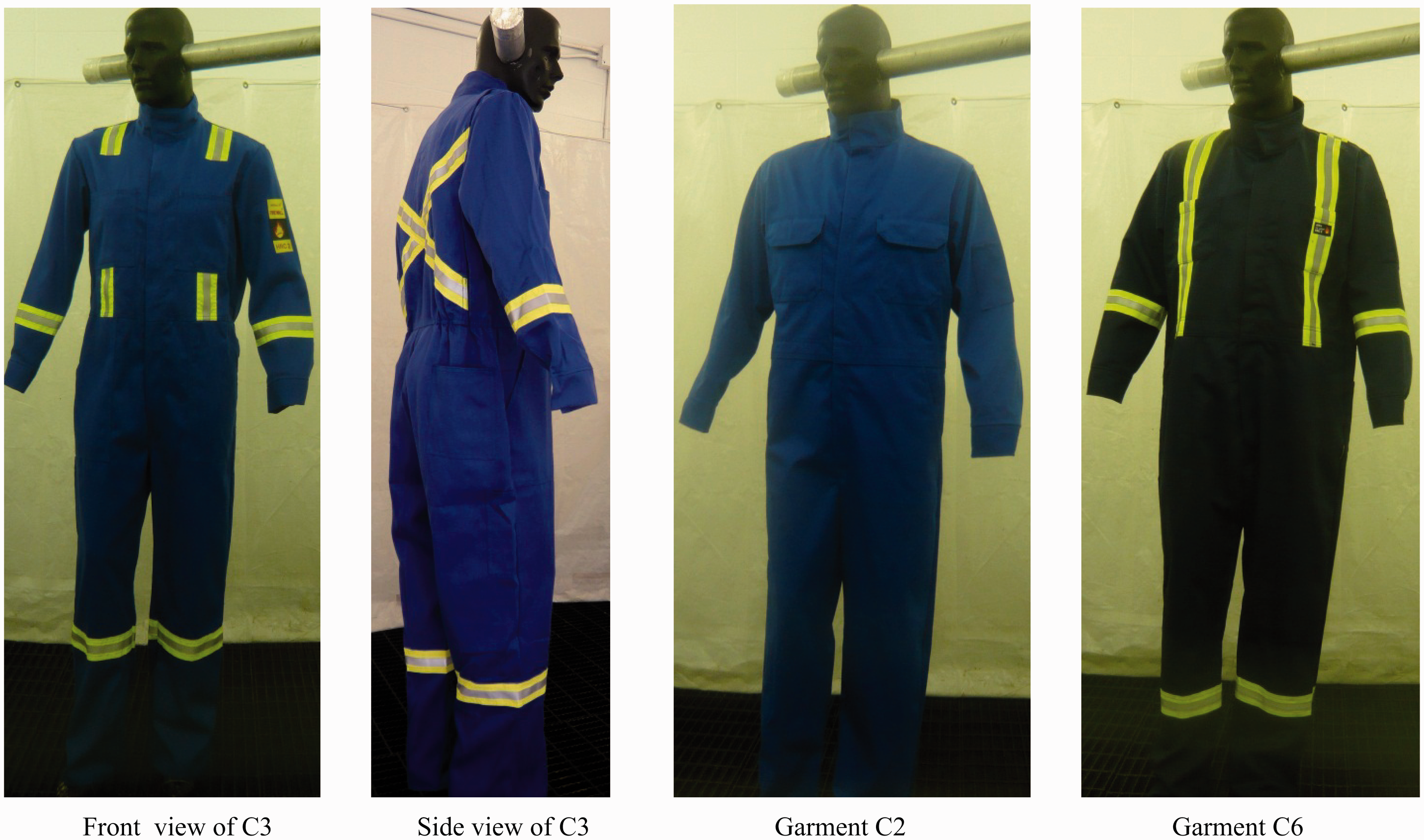
Air gap determination
3D body scanning
The VITUS Smart 3D whole body laser scanner (Human Solutions) was applied to obtain the 3D data of garment and body surface. Both the nude and clothed scans were required and minimal changes in the manikin position were essential to produce a perfect alignment. The detailed procedure of 3D body scanning could be found elsewhere. 6 In this study, a duplicate of flame manikin Harry was employed for the 3D body scanning. There were no sensors located on the surface of the manikin. The nude manikin was scanned first, and then the dressed manikin was scanned with the same position and posture. A dressing scheme was followed to minimize the effect on the size and distribution of air gaps for each garment due to manikin dressing. Also, photos of the dressed mannequin were taken and compared to ensure the consistency among the scans.
Scan data processing
The raw data of nude and clothed scans were imported in the software of Rapidform XOR. To accurately measure the air gap between the clothing and human skin, integral and smooth body surface processing was applied. Firstly, the scan data were meshed, then they were rewrapped and the appearing holes and dents were filled. Subsequently, the tool of Healing Wizard was applied and the optimized mesh was made to smooth the mesh model. Finally, the processed model was exported for the air gap measurement.
Both the processed nude and clothed scans were imported in the Rapidform XOV for deviation speculation. The nude scan and the clothed scan were aligned as accurately as possible by characteristic points. In previous studies,6,14 the air gap at each sensor position was measured. Due to the uncertain garment shape, the coefficient of variance for air gap was greater than 30% at some sensor locations. 6 In this study, the cross-section at the neck, chest, abdomen, arm, pelvis, thigh, knee, and calf were made. 22 There were a total of 72 sections with an equal interval of 2 cm developed. The principle of minimum distance was applied to determine the air gap at each point of the nude scan. The statistical analysis of the whole contour of the sliced cross-section was carried out. The overall air gap distribution over the body surface was also presented with different color bars.
Spray manikin test
An instrumented spray manikin test system was employed to investigate the protective performance upon hot water spray, as shown in Figure 2. The manikin surface except the head, hands, and feet was evenly equipped with 110 skin simulant sensors.
21
The manikin had the same upright posture to the duplicate manikin used in the 3D body scanning. The manikin trunk was simultaneously sprayed by four sets of twelve nozzles that located at four corners of the chamber. The hot water was prepared in a tank and pumped by a power variable motor. There are two outlets for the motor, one connected to the tank for circulation, the other connected to the nozzles. The pressure of the hot water spray is regulated by the circulation valve and the motor power. In this study, a pressure of 250 kPa was set before the exposure to mimic the hot water splashes in industrial work scenarios.
21
During the exposure, the heat flux change with time at each sensor location was recorded. The three-layer bioheat transfer model and Henriques skin burn model were used to predict the skin burn injury over the body.23,24 The total absorbed energy (TAE) during the test was also calculated.
the Spray manikin system.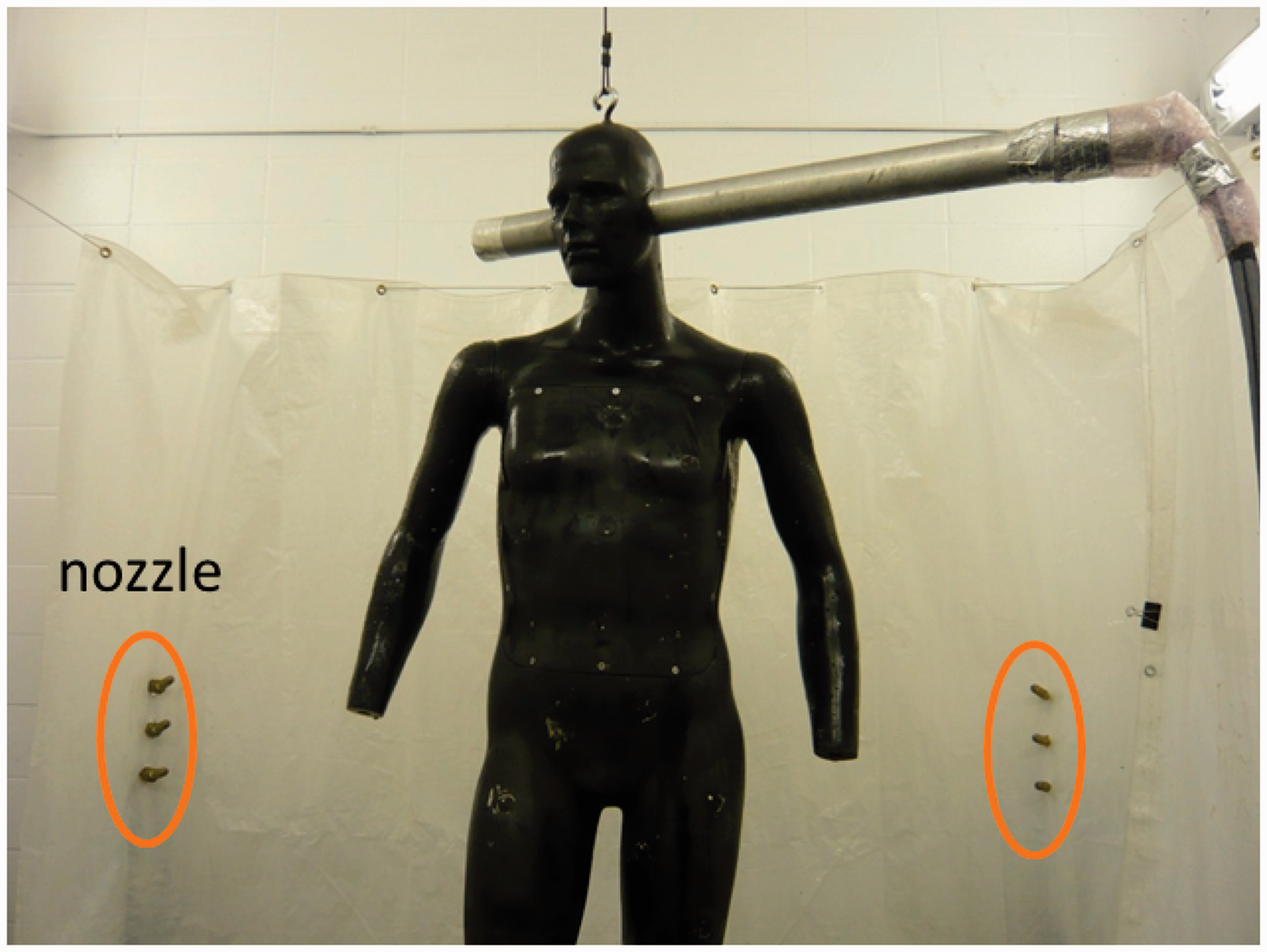
Experimental protocol
Number of sensors at different body parts

Results and discussion
Average air gap sizes (mm) at different body parts

Note: The values in brackets represent standard deviations.
Total burn injury (%) at different body parts
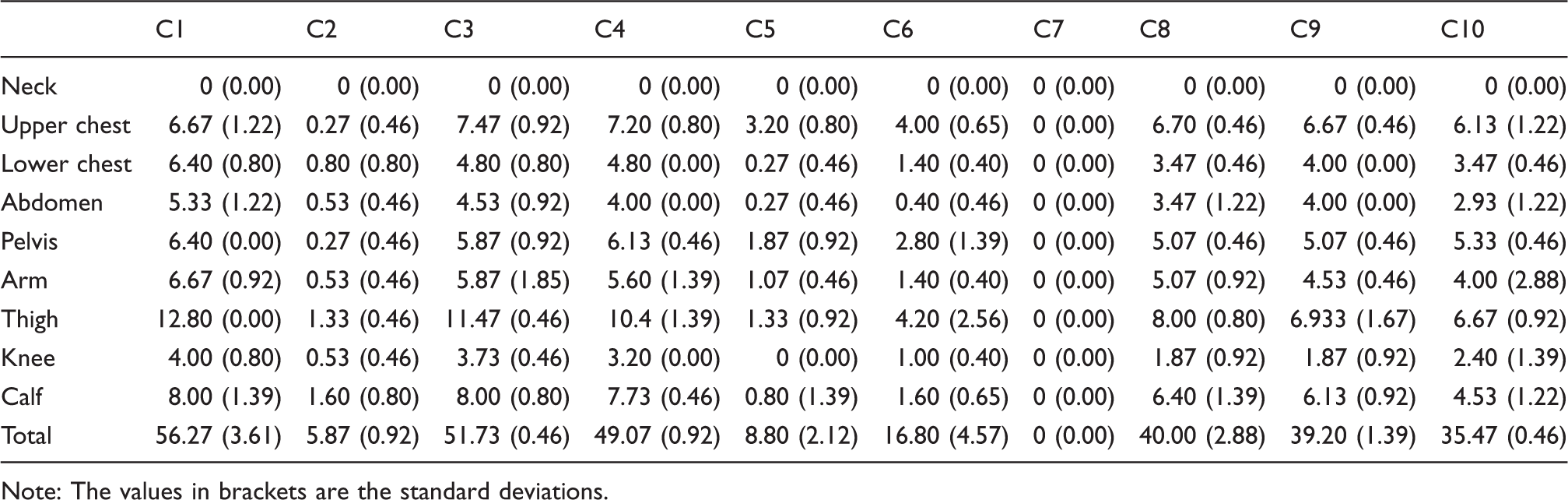
Note: The values in brackets are the standard deviations.
Effect of air gap size on overall protective performance
Figure 3 shows the relationship between the average air gap size of whole body and the total percentage of skin burn injury (Figure 3(a)) or the total absorbed energy (Figure 3(b)) while wearing different protective clothing exposed to the hot water spray. The average air gap size presents a significantly negative linear correlation with the percentage of burn injury using Pearson correlation analysis (r = − 0.737, p = 0.015, n = 10). This indicates that a bigger size of air gap entrapped in protective clothing develops less skin burn injury during hot water spray exposure. The average air gap size shows a negative linear correlation with the total absorbed energy (r = −0.731, p = 0.016, n = 10).
Relationship between the average air gap size and the percentage of burn injury (a) or the total absorbed energy (b).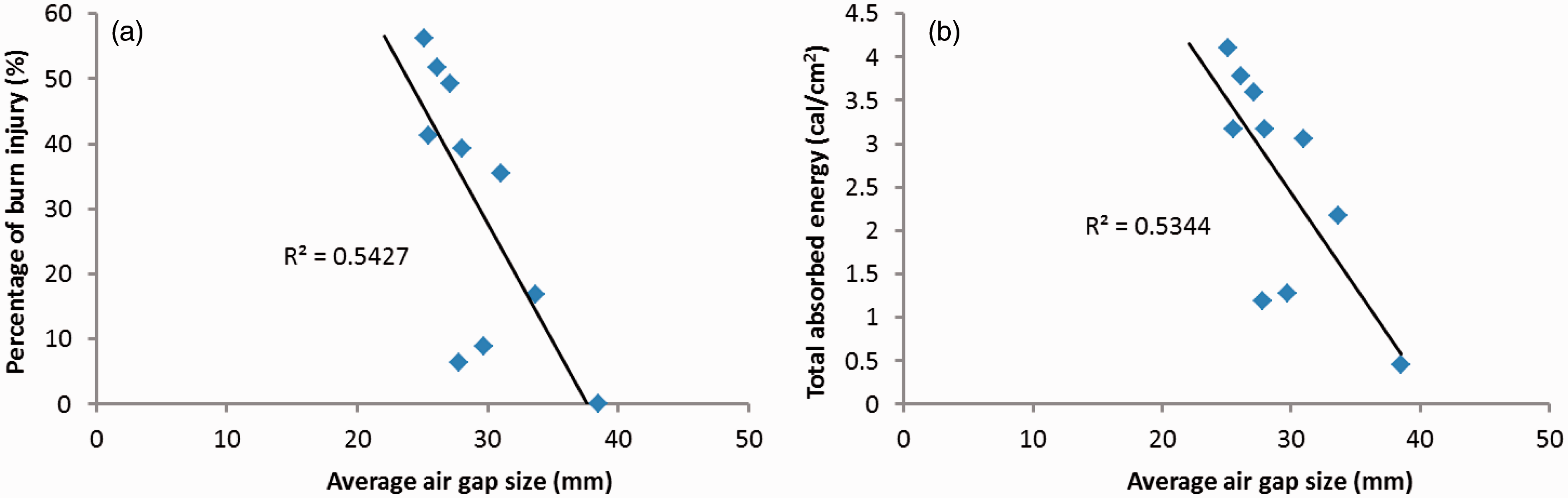
The results obtained in this study suggest that increasing of the air gap size can improve the overall thermal protective performance provided by the protective clothing upon hot water spray. This is consistent with previous studies on protection against flash fire exposure.
18
Under normal or high temperature conditions, the thermal insulation of clothing was significantly correlated with the air gap size.
25
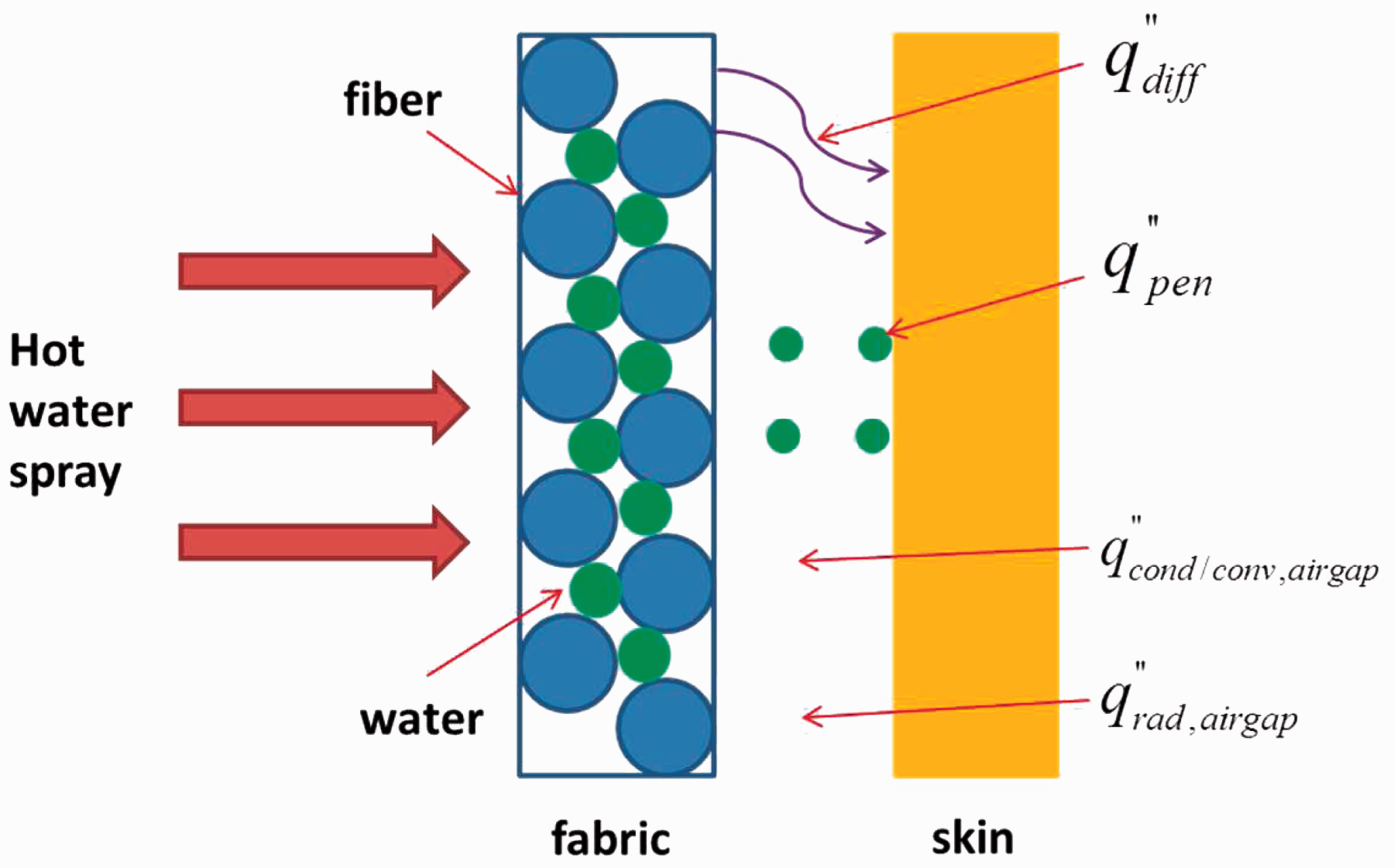
As shown in Figure 4, the heat transfer modes from hot water spray hazards to the human skin include heat conduction through the fabric and mass transfer (penetrating hot water),
2
radiation and conduction or convection in the air gap layer between clothing and skin, and potential condensation of transferred water vapor on the human skin.
20
Assuming one-dimensional heat transfer, the heat flux at the skin surface is given by:
Heat transfer modes in the air gap.


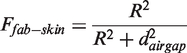
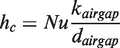



Assuming the maximum temperature at back surface is 85℃ and the sensor temperature is 25℃, then the Raleigh number is higher than 1713 when the air gap is larger than 7.8 mm. This indicates that the heat transfer by convection and radiation dominates for the impermeable fabric as the air gap is higher than 7.8 mm; otherwise the thermal conduction and radiation are two main modes of heat transfer to skin. With regard to the permeable and semipermeable fabric, the heat transfer modes become complicated due to the involvement of liquid mass transfer. The air layer might absorb moisture and become wet, therefore the thermal conductivity of the air increased, resulting in more energy transferred to the sensor comparing to those of the impermeable fabric. The vapor transfer and condensation on sensor might lead to more energy transfer. Liquid dropped from the saturated permeable fabric may contact the sensor, and then more energy was discharged to the sensor. That was why the semipermeable garment C2 and C5 provided better performance than any other single layer garments. The thermal conductivity of the air is about one sixth of the fiber, and thus the heat transfer is extremely lower when an air gap is exiting in clothing, resulting in decrease of heat transfer to skin. With the increasing of air gap size, the Ffab–skin and hc decreases, and thus the heat flux by conduction and radiation across the air gap decreases;
It should be noted that garments C2 and C5 exhibited a relatively large regression error, as shown in Figure 3. The semipermeable garments treated by EPIC finishing provided good protection against hot water spray. It is indicated that the effect of air gap on overall performance against hot water spray is minimal for those semipermeable garments.
Effect of air gap size on burn injury at different body parts
The overall effect of air gap size on the percentage of burn injury is shown in Figure 5. For all selected protective clothing, the average air gap size from various body parts (refer to Table 3) and its corresponding predicted percentage of burn injury (refer to Table 4) are correlated. The Pearson correlation analysis indicates that a significantly negative relationship between the air gap size and the percentage of burn injury was found (r = −0.243, p = 0.029 < 0.05, n = 81), but the relationship is weak (R2 = 0.0589). Generally, the heat transfer to skin decreases as the size of the air gap increases, and thus the percentage of skin burn decreases. This implies body regions with smaller air gap may get burns at a faster rate and the chances for burn injury are high.
Correlation of air gap size with percentage of burn injury.
In previous studies on the flash fire manikin test, the increase of air gap size predicted a longer second degree burn time and decreased the total absorbed energy, therefore providing higher protective performance. 15 This study showed a similar effect of air gap on heat transfer and protective performance. It should be noted that the air gap size at each sensor location and its corresponding protection were compared in Mah and Song’s study, and the variability of air gap size was high for some sensors, which might affect the results. In this study, a new method to determine the air gap size was used and the average air gap size at different body locations was applied to analyze the air gap effect on thermal performance. It is obvious that the reproducibility of the air gap determination has been greatly improved. In general, the area with a higher air gap size shows less energy transferred to human skin, providing less percentage of burn injury.
As shown in Table 3, the air gap demonstrates an uneven distribution over the body surface. Also, different body regions encounter different hot water spray hazards due to the laboratory-simulated hot water exposure condition.
21
Relationships between the air gap size and the percentage of burn injury at different body regions are compared in Figure 6. For all body regions, the air gap size shows a negative correlation with the percentage of burn injury. It indicates that the percentage of skin burn injury decreases with the increasing of air gap size at different body areas. Results of Pearson correlation are listed in Table 5. For all body regions except the pelvis, the air gap size shows a strong correlation with the percentage of burn injury at p ≤ 0.05, with lower chest and calf also significant at p ≤ 0.01. In addition, the absolute correlation coefficient for lower chest is 0.813, which is the largest value among all the body areas. The second largest occurs in the calf area. The absolute correlation coefficient for other body regions is close and is in the range 0.6–0.7.
Relationships of air gap size and total burn injury at different locations. Correlation between air gap size and percentage of burn injury at different body parts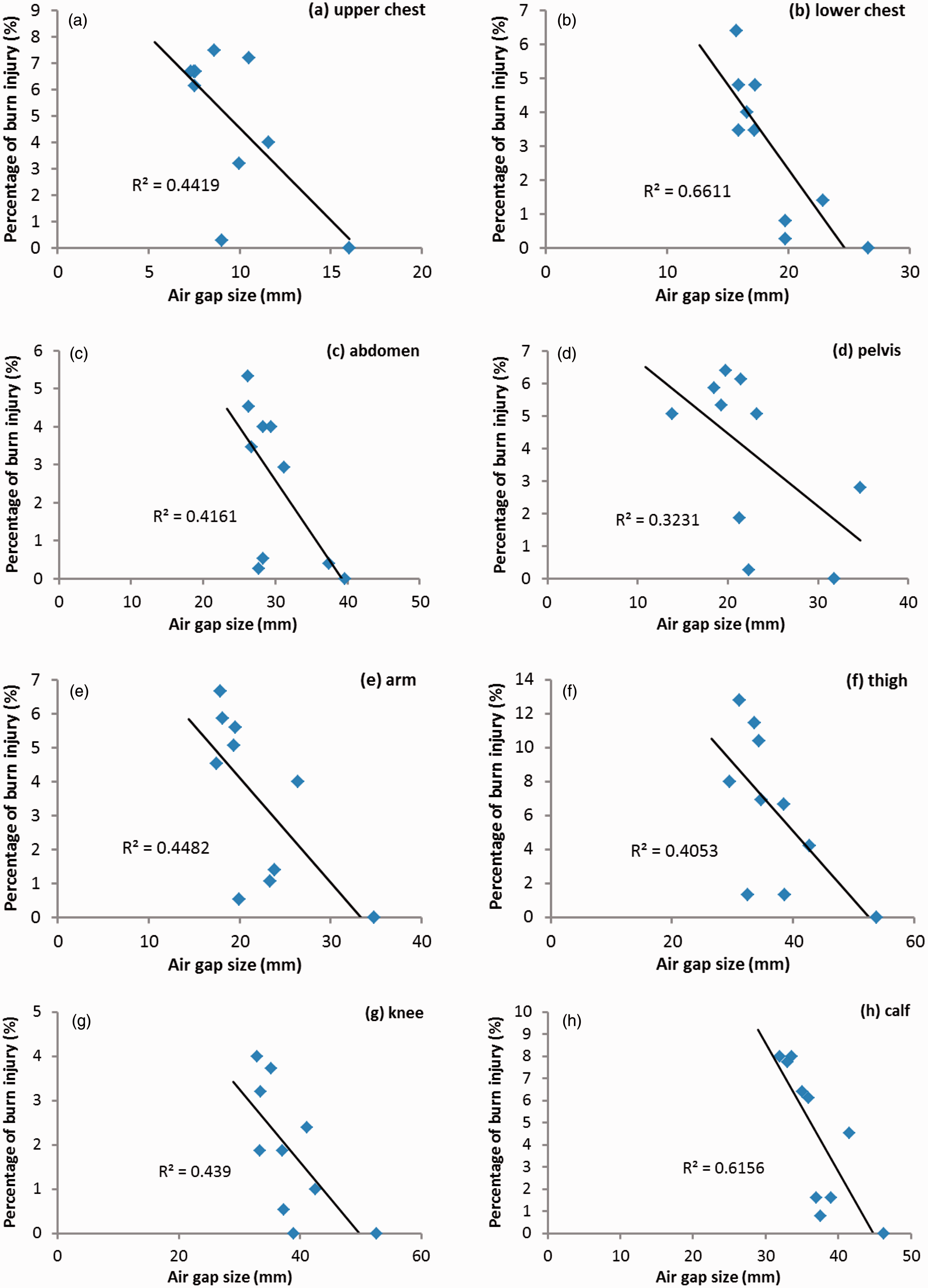

Upon the exposure to hot water spray, both the heat and mass transfer may occur on clothing and the air gap, and the air layer might be compressed during exposure. In our previous study, it was found that heavy water flow occurred at pelvis, sharply decreased the air layer or even made the wet clothing contact the skin in this area, thus enhanced the heat transfer to skin, resulting in skin burn injury. 21 The insignificant effect of air gap on thermal protection at pelvis might be relevant to the impact of compression caused by water. It has been noted that the proper design for clothing to maintain the air layer during exposure is critical to the thermal protection. The result demonstrates that the initial air gap size at the pelvis shows less contribution to the thermal protection.
Air gap distribution and skin burn injury
Figure 7 compares the relationships between air gap size and percentage of burn injury for different garments. As no burn injury is predicted for C7, it is not included in the figure. In addition, for all the garments, no burn injury occurs at the neck, and thus it is excluded from the analysis. In summary there are eight body parts presented by triangles in Figure 7, including upper chest, lower chest, abdomen, pelvis, arms, thigh, knee and calf. For all the garments, it was found that there is no significant relationship between the air gap distribution and the burn injury. According to above discussion, areas with a bigger air gap size should predict less burn injury, however, for an individual protective garment, there is no significant correlation observed in this study. A further analysis shows that the bigger air gap size at legs develops a higher percentage of burn injury. This is related to the accumulated water flow from upper body during exposure. As the water flow compresses the fabric and reduces the air layer, while at the same time the water flow increases the heat transfer in the fabric, resulting in a larger contact area and thus decreases the thermal protection provided by the fabrics at legs. Relationships between air gap sizes at the upper body (including upper chest, lower chest, abdomen, pelvis and arms) and the skin burn injury are also compared in Figure 7, represented by open squares. All the garments show a negative correlation, except C2. Pearson correlation results are shown in Table 6. For C3, C4, and C10, the absolute value of coefficient is higher than 0.8, suggesting a strong correlation of air gap size at the upper body with the burn injury; whereas the absolute coefficient for C1, C5, C6, C8, and C9 is in the range of 0.6∼0.8, showing a moderate correlation. However, the statistical analysis doesn’t show a significant relationship between the air gap size at the upper body and the burn injury at p ≤ 0.05, whereas the correlation for C3 and C4 is significant at p ≤ 0.1.
Relationships of air gap size and total burn injury for different garments. Correlation between the air gap size and the percentage of burn injury for different garments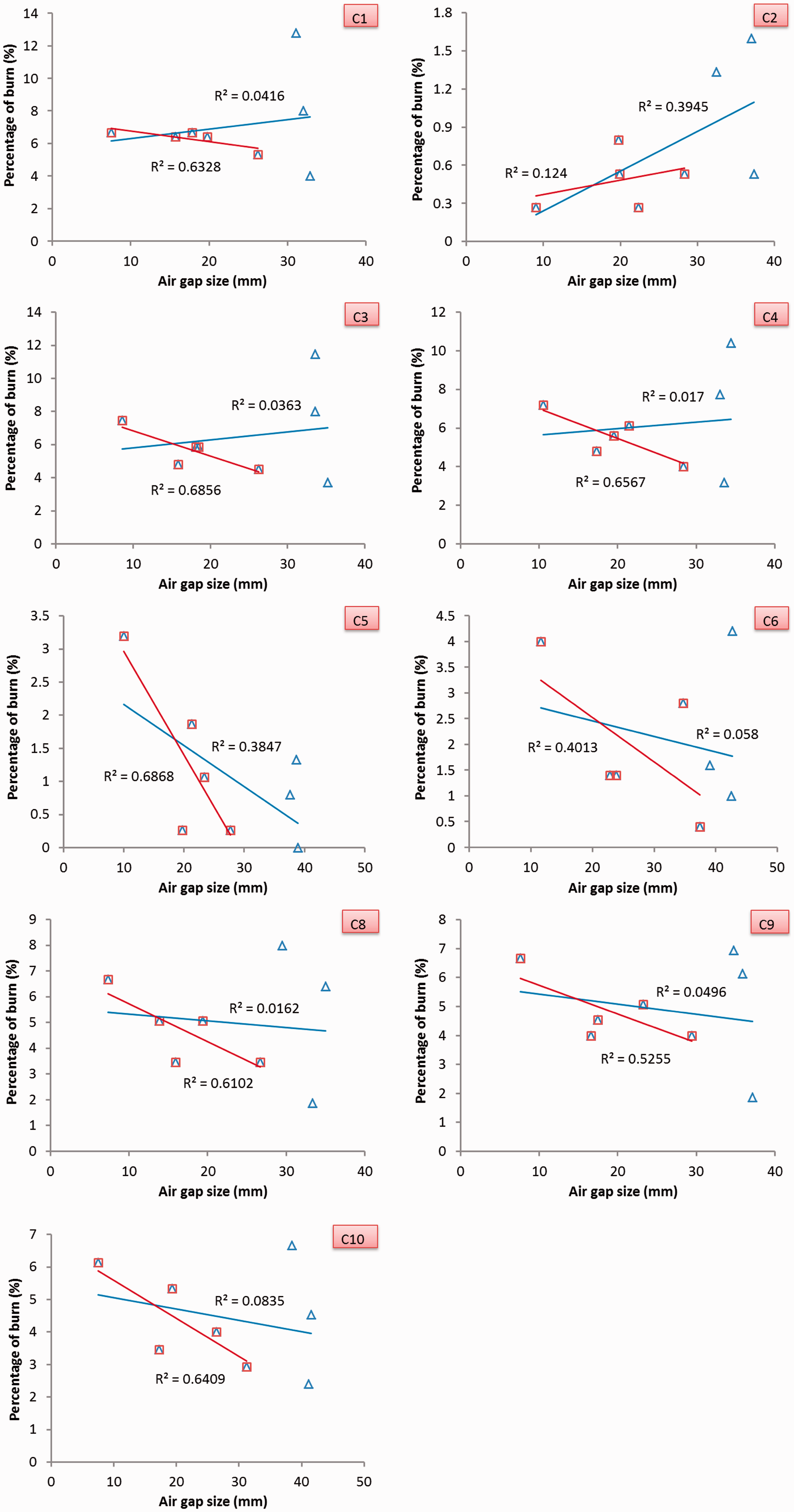

Conclusions
The developed air gap between the protective clothing and the human skin was investigated by 3D body scanning and the skin burn injury was predicted using a hot water spray manikin evaluation system. The relationship between the air gap size and thermal protective performance was explored. The results demonstrated that the air gap unevenly distributed over the manikin surface and the predicted skin burn injury was associated with the air gap size and distribution. The average air gap size presented a strong linear correlation with the total percentage of burn injury and the total absorbed energy (p < 0.05). The garment with a larger air gap tended to provide better thermal protection. For all body parts except the pelvis, the clothing air gap size exhibited a significant correlation with the percentage of burn injury (p < 0.05). Moreover, the absolute value of coefficient at the lower chest exhibited the largest, followed by the calf. For individual garments, no significant correlation was found between the air gap distribution and the burn injury; however, a strong negative correlation between the air gap at the upper body and the burn injury was obtained. It might be related to the exposure nature, which adds an additional force to the contact area and hence, the existing air gap which was exposed directly to the spray might change. The research finding demonstrated that proper garment design to maintain the air gap could provide better protective performance upon hot water spray, and specifically for specific body areas. The changing air gap size might be a strong feature for the exposure.
Footnotes
Acknowledgments
The authors appreciated the support from PCERF in University of Alberta and the manufacturers who provided tested garments.
Funding
This work was supported by the Starting up Funding of Soochow University (grant number Q411500214), China Postdoctoral Science Foundation funded project (grant number 2014M551657), and Natural Science Research Project for Colleges and Universities in Jiangsu Province (grant number 14KJB540001).