



Abstract
The main content dealt with in this paper was to make a theoretical analysis of the vibration transmission property of spacer fabric as cushion materials. A forced vibration test with sinusoidal excitation was conducted, and the corresponding model of the vibration transmission coefficient was established based on a single-degree-of-freedom system. Experimental and theoretical vibration indexes, including natural frequency and the vibration transmission coefficient, were obtained from experimental and theoretical vibration transmission coefficient–frequency curves, respectively. After comparing theoretical parameters with experimental parameters, we were pleased to find out that their maximum vibration transmission coefficient and natural frequency showed good accordance with each other. Moreover, the effect of different parameters of spacer fabric on vibration transmission properties, including thickness, filament diameter, area density and inclination angle and arrangement of spacer filaments, were investigated, which is helpful to better design spacer fabrics with good vibration transmission.
Keywords
Spacer fabric can be produced into ergonomic cushion materials and pressure-relief products by designing special structures for a wide range of applications, such as functional bra support, 1 buffer clothing, 2 knee braces, 3 insoles and bed mattress 4 and car seats. 5 These achievements may be attributed to heat and humidity comfort resulting from the void spaces of spacer fabrics, and the compression comfort property from the good pressure distribution property. Currently, some investigations make a solid basis to explain the static compression property under the static condition as they are superior to sponge and wool carpets. 6 This is due to the fact that the special sandwich structure is effective in evenly dispersing pressure to reduce pressure concentration. Corresponding theoretical models and characterization methods for physical properties of spacer fabric have been investigated, such as the stab-resistant property, 7 compression behavior,8,9 impact behavior,10–12 theoretical modeling,13–15 sound absorption,16,17 pressure reduction and comfort properties.18,19 These applications of spacer fabrics as mattress are often analyzed based on the static compression, while the dynamic vibration property is also a very important factor of spacer fabrics if they are to be a good substitute for polyurethane foam due to their good vibration attenuation property. 20
Nowadays, spacer fabric has being widely utilized as cushion mattresses under the dynamic condition, wherein the vibration transmission property is one of the main mechanical properties of spacer fabrics. Spacer fabrics with proper structural parameters can be used as car seats to relieve passengers’ dizziness and fatigue when the car is running on an uneven road. This is due to the fact that spacer fabrics have good vibration reducing performance because of damping. When the transient vertical vibration frequency of cars and wheelchairs is close to the natural frequency of the human body, it will make passengers extremely uncomfortable, inducing dizziness and emesis, especially for weak and old people. In addition, vibration can accelerate the progress of human fatigue. Therefore, the dynamic vibration properties of cushion materials are the main evaluation indexes of comfort when people sit on the cushions, especially the vibration reducing performance.
However, little further progress about the vibration transmission property has been made. The normal measuring methods for materials like spacer fabric are the free vibration method and the half power points method,21,22 unlike for other materials, such as composites, foam and mats. 23 However, there are few investigations on the dynamic vibration transmission property, which consists of key vibration indexes, including the natural frequency, vibration transmission coefficient and damping ratio, and there are also few investigations on the relations between structure of the spacer fabric and vibration transmission indices. The forced vibration method with sinusoidal excitation is an efficient method to test the natural frequency and vibration transmission coefficient. The vibration transmission property should be deeply studied following on from our previous study on the structure and properties of spacer fabrics.24–27
Therefore, this paper intends to make a theoretical analysis of the vibration transmission property of spacer fabric as a cushion material based on the forced vibration test with sinusoidal excitation, and vibration indexes, including the natural frequency and vibration transmission coefficient, were featured. In addition, the effect of different structure parameters of spacer fabric, including thickness, filament diameter, area density and inclination angle and arrangement of spacer filaments, was adopted to analyze the relation between structure and the vibration transmission property. This is helpful to better design spacer fabrics with reasonable vibration transmission properties in application.
Theoretical analysis
Description and assumption of forced vibration based on sinusoidal excitation
In order to conduct the analysis of the forced sinusoidal excitation vibration of spacer fabric, the set of the vibration test of a knitted spacer fabric is schematically shown in Figure 1. A support platform is fixed in an excitation platform, and the spacer fabric is tightly pasted on the surface of the support platform; then, an isolator connected with an acceleration sensor is put on the spacer fabric where the isolator on the surface of spacer fabric is used to simulate a human sitting on the spacer fabric. When the excitation platform produces sinusoidal vibration, which can drive both the spacer fabric and the isolator to do sinusoidal vibration, they are formed into an assembly to vibrate.
Schematic diagram (a) and single-degree-of-freedom system (b) of the sinusoidal vibration of spacer fabric.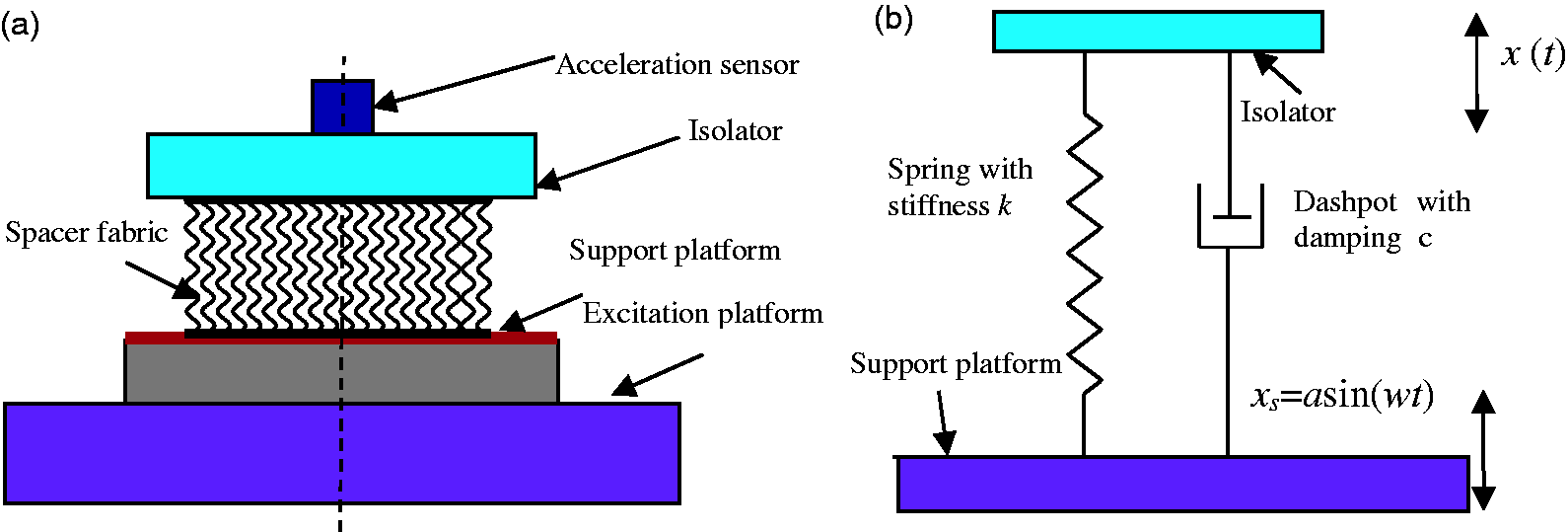
Based on the observation of the spacer fabric and the isolator during the preliminary test, the isolator keeps contacting with the spacer fabric during the whole vibration test, and the following assumptions are made for the theoretical analysis of the spacer fabric.
The mass of the isolator made of iron is much larger than that of the spacer fabric made of polyester (ranging from 100 to 300 g). So, when considering the assembly consisting of spacer fabric and the isolator, the mass of the spacer fabric can be ignored in the vibration system for the assembly. Spacer fabric is a viscous-elastic body, the elastic stiffness of spacer fabric is far lower than that of the isolator and vibration transmission is mainly dominated by the spacer fabric. Therefore, elastic stiffness and damping of the assembly are assumed to be equal to that of spacer fabric during the whole vibration process.
Mathematical modeling
When the excitation platform is driven to have sinusoidal vibration by the electromagnetic vibration exciter, it produces a forced vibration on the assembly consisting of the isolator and the spacer fabric, and then the assembly vibrates by sinusoidal vibration. The vibration transmission can be analyzed as a single-degree-of-freedom system with force, as shown in Figure 1(b). In this model, the spring with stiffness k and the dashpot with the viscous damping c are connected with a mass m. The displacement x can be integrated by the acceleration recorded by the acceleration sensor. If the vibration system is under a support motion xs, the vibration differential equation of the system can be expressed as equation (1)

As seen from the equation (1), the mass is supposed to be supported by two component forces. One is the
When the support motion caused by external force is sinusoidal excitation, that is,

This is a nonhomogeneous differential equation and the complete solution x is composed of a general solution x1 from the corresponding homogeneous equation and a particular solution x2 from the nonhomogeneous equation. So, the complete solution x can be expressed by a general solution x1 and a particular solution x2

In order to solve equation (1), some symbols are introduced in equation (4)

When 0 < ξ < 1, the general solution x1 of the corresponding homogeneous equation is yielded in equation (5)

The particular solution x2 from the nonhomogeneous equation is expressed by a complex number in equation (6)


Then, the vibration amplitude B of the particular solution is the module of

The particular solution x2 of the vibration differential equation of the system is described

Thus, the complete x solution is calculated by equations (3), (5) and (9)


The general solution of the corresponding homogeneous equation expresses the attenuation vibration, which is referred to as transient vibration. It exists only for a short time after the start of vibration and it disappears quickly. Generally speaking, it is negligible. The particular solution of the nonhomogeneous equation expresses the forced vibration caused by the simple harmonic excitation of a constant vibration with the same amplitude under steady-state vibration. The reason for the existence of the steady-state vibration is that the system can obtain energy from outside to supplement lost energy caused by damp motion. Therefore, only the particular solution of the nonhomogeneous vibration differential equation is considered when spacer fabric is under sinusoidal excitation.
When spacer fabric is used in cushion products, the vibration transmission coefficient Tr can be used to express the vibration transmission property. The vibration transmission coefficient is the ratio of the output displacement of the system and the input displacement of the vibration platform

The vibration property of the single-degree-of-freedom system can be shown by the changing law of the vibration transmission coefficient Tr. No matter what the damping ratio ξ is, there will be a significant damping effect only when λ is higher than
Experimental details
Sample preparation
Warp-knitted spacer fabrics suitable for cushion products with vibration attenuation were designed. The feeding forms of yarns of the two surface layers were selected as the chain stitch and weft inlaid methods, and spacer filaments were polyester and knitted into the chain stitch structure of both the upper surface and the bottom surface to connect the two surfaces into a whole fabric.
Specifications of 13 spacer fabrics

C: number of courses per 5 cm; W: number of wales per 5 cm; M: number of meshes per 25 cm2; AD: area density; AM: arrangement method; DR: damping ratio; DC: damping coefficient.
Forced sinusoidal excitation vibration test
The test system of the vibration property of the spacer fabric is shown in Figure 1. In Figure 1(a), there is an excitation platform underneath that is one part of the electromagnetic vibration exciter (DC Series Basic Electro-Dynamic Shaker, model number is DC-3200-36, as show in Figure 2). In addition, the electromagnetic vibration exciter can offer sinusoidal excitation in the vertical direction to the spacer fabric. An acceleration sensor was installed on the center of the isolator, and the acceleration sensor was connected with the data collector and a PC computer. The apparatus parameters were set as follows: the range of sweep frequency was from 5 to 100 Hz, which is based on the resonance frequency of the human body; the sweep rate was set as 1 oct/min; and the vibration displacement was set as 1 mm. Acceleration velocity–time curves were obtained by the acceleration sensor. The vibration transmission coefficient and frequency curve were calculated by using MATLAB software based on the data collected from the test; then, the vibration indexes, including the natural frequency and maximum vibration transmission coefficient, were extracted. In order to calculate the natural frequency and maximum vibration transmission coefficient, and to analyze the influence of structure parameters on the vibration transmission property, spacer fabrics with different structure parameters were tested by forced sinusoidal excitation vibration. Thirteen spacer fabrics were cut into circles with diameters of 16 cm, and all samples were kept flat for accurate measurement. The spacer fabric was tightly pasted on the support platform.
DC Series Basic Electro-Dynamic Shaker.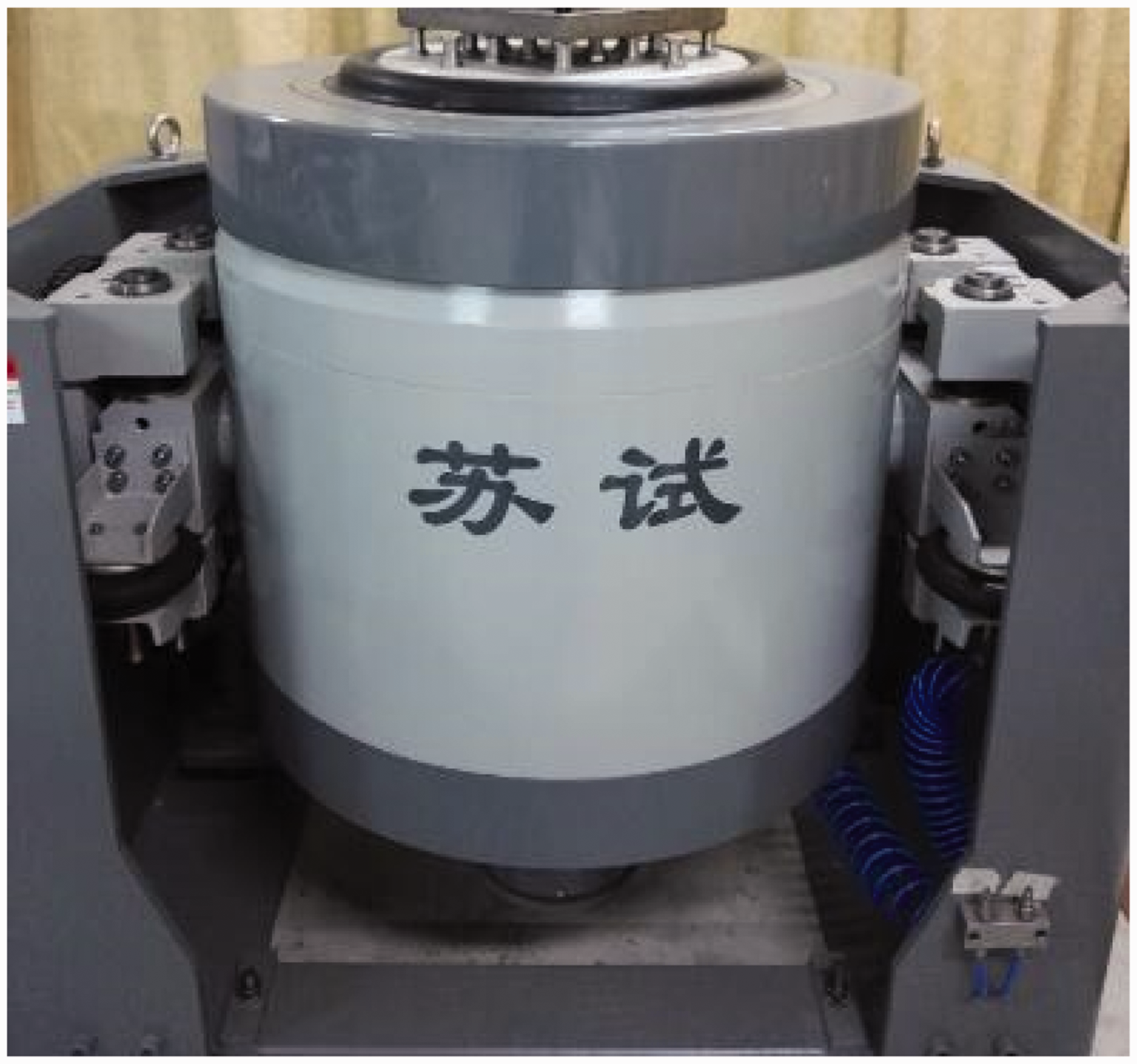
Results and analysis
Comparisons of theoretical and experimental vibration transmission properties
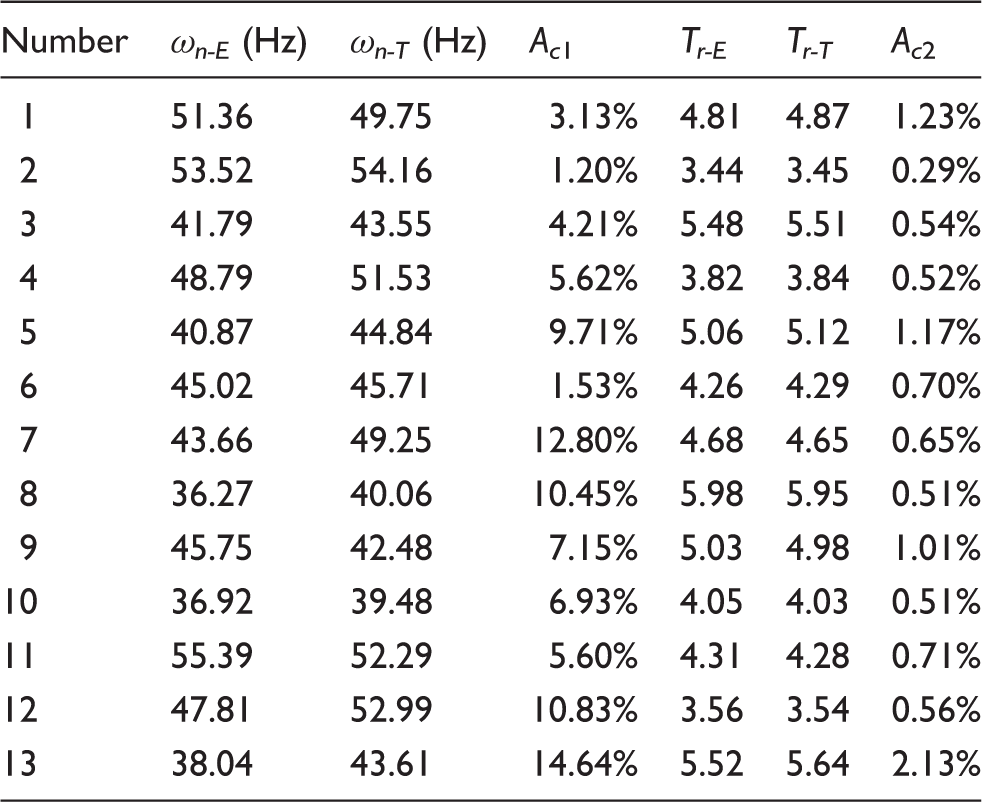
The vibration transmission coefficient and frequency ratio curves of the spacer fabrics were directly measured by the tester, and the theoretical vibration transmission coefficient and frequency ratio curves were calculated based on equation (12). Typical experimental curves and theoretical curves of spacer fabrics’ vibration transmission properties of samples 6 and 10 are shown in Figure 3, and experimental and theoretical results of the natural frequency and maximum vibration transmission coefficients are listed in Table 2.
Typical experimental curves and theoretical curves of the vibration transmission property of spacer fabrics 6 (a) and 10 (b). Experimental and theoretical results of vibration indexes ωn-E: experimental natural frequency; ωn-T: theoretical natural frequency; Tr-E: largest experimental vibration transmission coefficient; Tr-T: largest theoretical vibration transmission coefficient; Ac1: relative error of the natural frequency; Ac2: relative error of the vibration transmission coefficient.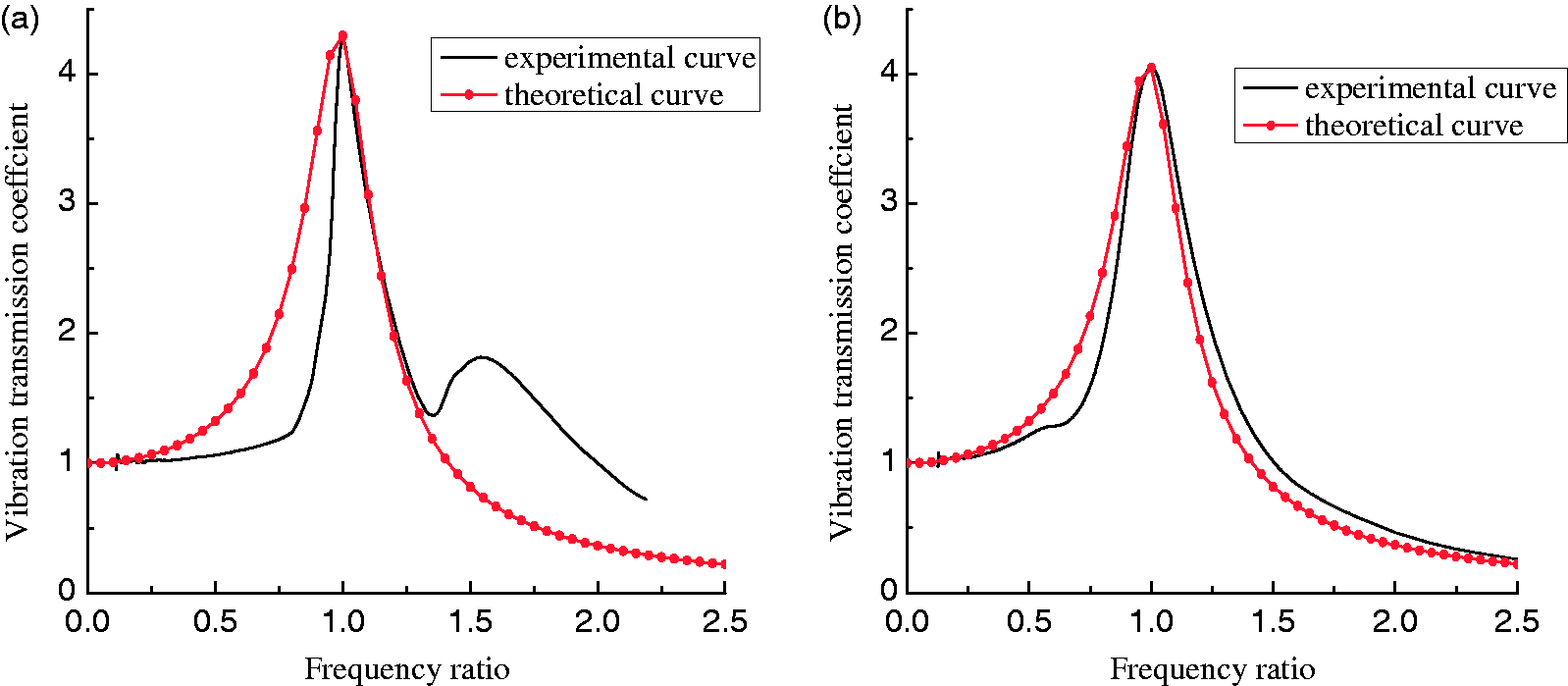
It was obvious that there existed a typical resonance peak for the theoretical and experimental curves for all spacer fabrics in Figure 3, which resulted from harmonic vibration. In addition, it should be noted that nonlinear factors had greater influence on some spacer fabrics, including the super-harmonic and sub-harmonic in Figure 3(a). It should be noted that nonlinear vibration means that the restoring force is not linearly proportional to displacement or the damping force is not linearly proportional to velocity. There is no general method to solve the nonlinear differential equation at present; the theoretical study of the linear differential equation is very mature and simple. In addition, many samples showed smooth vibration transmission property curves, which were less affected by the nonlinear factors, and the experimental results are close to the theoretical results. This means that the theoretical values can represent experimental results; theoretic calculation is able to estimate experimental results accurately. Hence, the theoretical study of the linear differential equation is always used to solve the nonlinear problem when the nonlinear factor has little influence.
Moreover, it can be seen from Table 2 that the relative error between the theoretical and experimental natural frequencies was very small, where Ac = |E – T| / E, E is the theoretical value and T is the experimental value. The maximum error between the theoretical and experimental natural frequency was 14.64%. The maximum error between the theoretical and experimental largest vibration transmission coefficient was 2.13%. It is found that the theoretical curve coincides with the experimental curve very well. Thereby, the spacer fabric vibration transmission property can be achieved by the theoretical formula. Due to the fact that the experimental period of knitting appropriate spacer fabrics for our daily life and industrial purposes takes a long time and that it is also a waste of materials for knitting substandard products, it is very significant if we can take advantage of the theoretical model to find specific structural parameters of spacer fabrics that can be used in different application scenarios.
Influence of the structure parameters of spacer fabric on the vibration transmission property
Based on the structure of spacer fabrics, the vibration transmission property is related to the structure parameters of spacer fabrics. In order to better design spacer fabrics to control vibration transmission, the effect of different structure parameters of spacer fabric, including thickness, filament diameter, area density and inclination angle and arrangement of spacer filaments, is used to analyze the relation between structure and the vibration transmission property.
Effect of the inclination angle of spacer filaments
Two sets of spacer fabrics were designed to have the same structural parameters, except for the inclination angle of the spacer filaments. One set is simple 4 and 6; the other one is simple 7 and 12. They were adopted to discuss the effect of the inclination angle of spacer filaments on the vibration transmission property. The corresponding vibration transmission coefficient–frequency curves and the largest vibration transmission coefficient are shown in Figure 4 and Table 3.
Transmission coefficient and frequency curves under different inclination angles. Vibration indexes of spacer fabrics under different inclination angles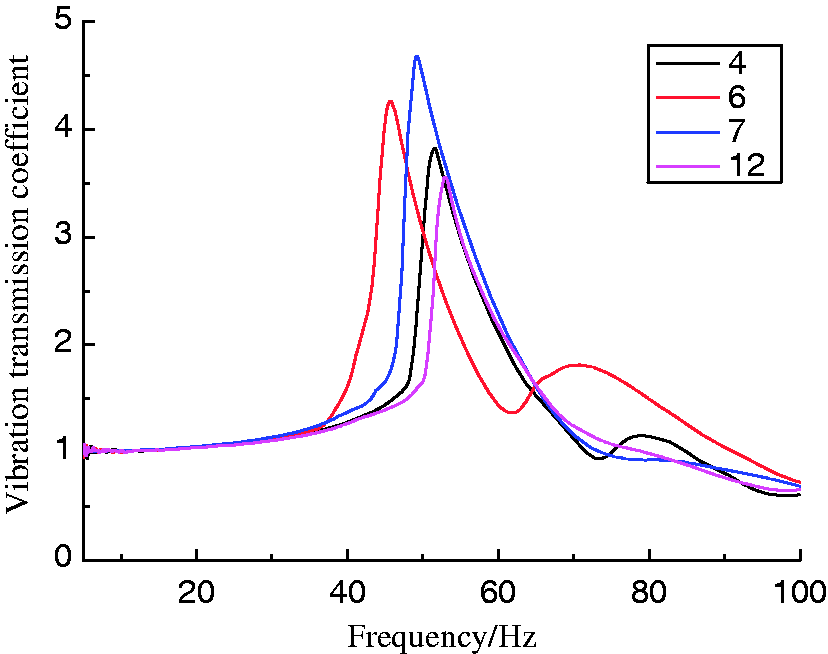

It can be seen from Figure 4 that two sets of spacer fabrics (samples 4 and 6 and samples 7 and 12) with different inclination angles of spacer filaments all exhibited significant resonance peaks, which manifested that the inclination angle of the spacer filaments had a significant influence on the vibration property. Table 3 shows that the natural frequencies of samples 4 and 6 were 51.53 and 45.71 Hz, and the natural frequencies of samples 7 and 12 were 49.25 and 52.99 Hz, respectively. The larger the inclination angle is, the larger the natural frequency is. For vibration transmission, the largest vibration transmission coefficient of sample 4 was 3.82 lower than that of sample 6 being 4.26, and the largest vibration transmission coefficients of sample 12 were 3.56 lower than that of sample 12, being 4.68. This is due to the fact that spacer fabric with a larger damping ratio possesses smaller a vibration transmission coefficient, and has a better vibration attenuation property.
Effect of the arrangement of spacer filaments
Comparing sample 1 with sample 13, all structural parameters are basically the same except for the arrangement of the spacer filaments. Therefore, sample 1 and sample 13 are selected to analyze the influence of the arrangement of the spacer filaments. The effects of the arrangement of the spacer filaments on the vibration transmission coefficient–frequency curves are shown in Figure 5 and the corresponding largest vibration transmission coefficients are listed in Table 4.
Transmission coefficient and frequency curves under different arrangements. Vibration indexes of spacer fabrics under different arrangements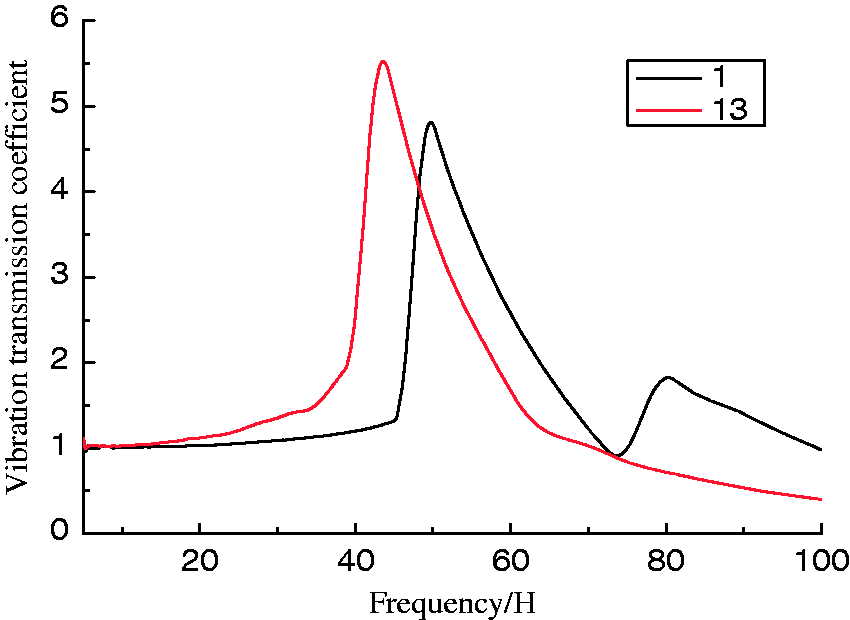
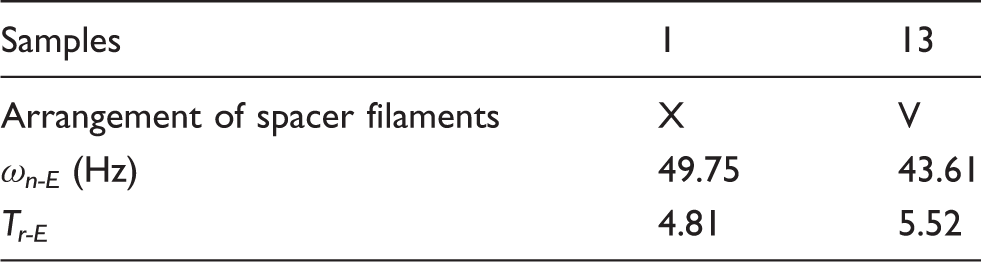
Samples 1 and 13 in Figure 5 both showed a significant resonance peak, which indicated that the arrangement of the spacer filaments had a significant influence on the vibration property. It can be seen from Table 4 that the natural frequency of sample 1 is 49.75 Hz larger than that of sample 13, being 43.61 Hz. This shows that the natural frequency of spacer fabric with X-shape spacer filaments was higher than that of spacer fabric with V-shape spacer filaments, which may be attributed to spacer fabric having higher elastic stiffness k for X-shape spacer filaments. Moreover, the largest vibration transmission coefficient of sample 1 was 4.81 lower than that of sample 13, with 5.52. This is because the damping ratio of spacer fabric with X-shape spacer filaments is larger than that of spacer fabric with V-shape spacer filaments. So, the vibration transmission coefficient of spacer fabrics with X-shape spacer filaments is smaller than that of spacer fabric with V-shape spacer filaments.
The effect of thickness of the spacer fabric
Spacer fabrics 1, 10 and 11 were prepared with different thickness as 5.96, 13.23 and 9.1 mm, respectively. They were utilized to analyze the influence of the thickness of spacer fabric on the vibration transmission property. The effects of thickness on the vibration transmission coefficient–frequency curves are shown in Figure 6 and the corresponding and largest vibration transmission coefficients are listed in Table 5.
Vibration transmission coefficient and frequency curves under different thicknesses. Vibration indexes of spacer fabrics under different thicknesses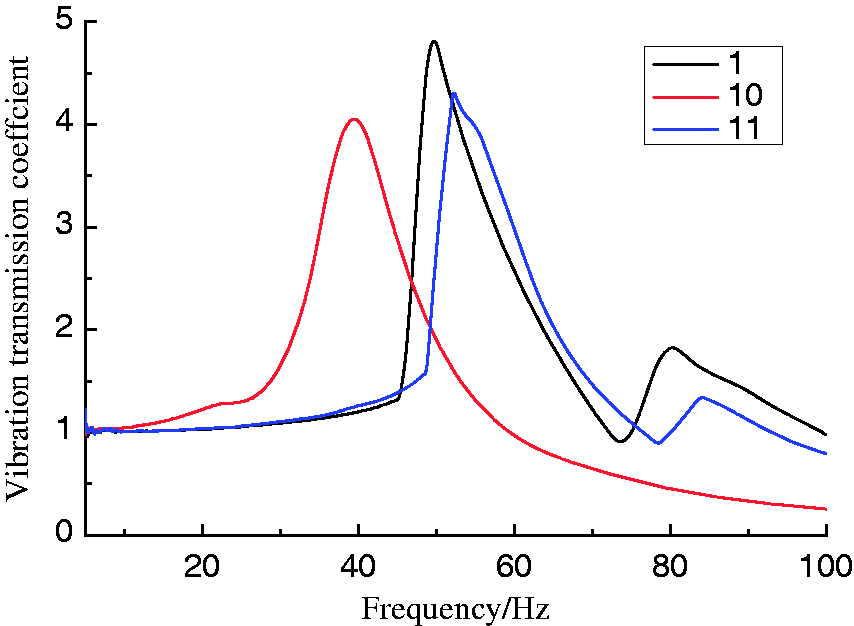
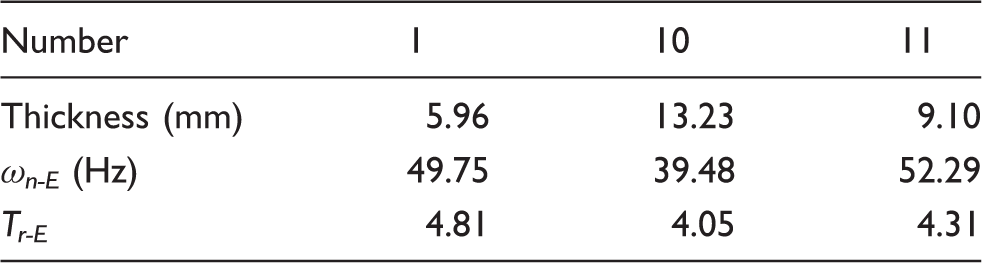
It can be seen from Figure 6 that sample 1 had a smooth vibration transmission curve that was less affected by the nonlinear factors, while samples 10 and 11 had super-harmonic and sub-harmonic peaks. Table 5 shows that the natural frequencies of samples 1, 10 and 11 were 49.75, 39.48 and 52.29 Hz, respectively; sample 11 had the largest natural frequency, followed by sample 1 and sample 10 in sequence. This was because elastic stiffness k was related to the thickness of the spacer fabric; there exists a nonlinear relation between elastic stiffness and thickness. It can be seen from the plate compression experiments that sample 11 had the largest elastic resistance, sample 1 was smaller and sample 10 had the smallest one, as did the natural frequency. The largest vibration transmission coefficients of samples 1, 10 and 11 were 4.81, 4.05 and 4.31 respectively; therefore, sample 1 had the largest natural frequency, followed by sample 11 and sample 10. This is due to the fact that the damping ratio increases with the increase of thickness, and a higher damping ratio results in a lower value of the largest vibration transmission coefficient.
The effect of the diameter of spacer filaments
In order to evaluate the effect of the diameter of filaments on the vibration transmission property, three groups, that is, samples 1 and 5, samples 3 and 8, and samples 9 and 11, were selected. The corresponding vibration transmission coefficient–frequency curves under different filament diameters are depicted in Figure 7 and the largest vibration transmission coefficients are listed in Table 6.
Transmission coefficient and frequency curves under different diameters. Vibration indexes of spacer fabrics under different diameters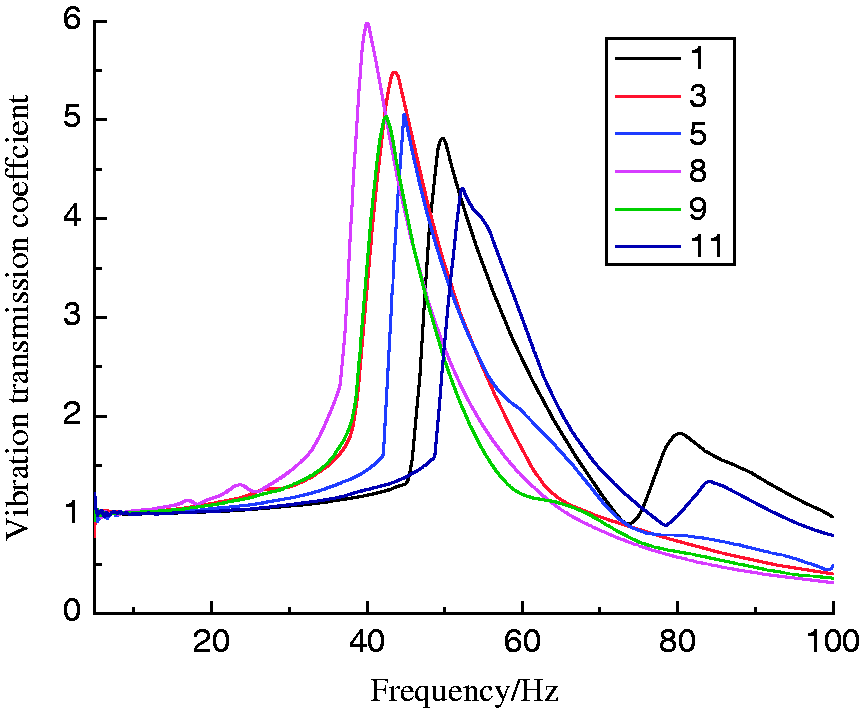

As shown in Figure 7, samples 3, 8 and 9 had smooth curves that were less affected by the nonlinear factors; sample 5 jumped at the resonance point; and the combined vibration of super-harmonic and sub-harmonic happened on samples 1 and 11. In addition, Table 6 shows that the diameters of samples 1 and 5 were 192.7 and 132.6 µm, respectively, and their corresponding experimental natural frequencies were 49.75 and 44.84 Hz; therefore, sample 1 had the larger experimental natural frequency. Similarly, the diameters of samples 3 and 8 were 228.1 and 178.0 µm, respectively, and their corresponding natural frequencies were 43.55 and 40.06 Hz; therefore, sample 3 had the larger experimental natural frequency. The diameters of samples 9 and 11 were 169.7 and 204.3 µm, respectively, and their natural frequencies were 42.48 and 52.29 Hz; therefore, sample 11 had the larger experimental natural frequency. This means that the larger the diameter, the better the elastic resistance and the larger the experimental natural frequency. Moreover, the largest experimental vibration transmission coefficients of sample 1 was 4.81 lower than that of sample 5, at 5.06, that of sample 3 was 5.48 lower than that of sample 8, at 5.98, and that of sample 11 was 4.31 lower than that of sample 9, at 5.03. This is because the damping ratio increases with the increase of the diameter, while the largest vibration transmission coefficient decreases.
The effect of the area density of spacer filaments
Similarly, the structural parameters of samples 2 and 4 are basically the same except for their area density of the spacer filaments, so the two samples are chosen to analyze the influence of the area density of the filaments. The relationship between the vibration transmission coefficient and frequency is shown in Figure 8. According to the curve extraction, the largest vibration transmission coefficient was established. The relative parameters are listed in Table 7.
Transmission coefficient and frequency curves under different area densities. Vibration indexes of spacer fabrics under different area densities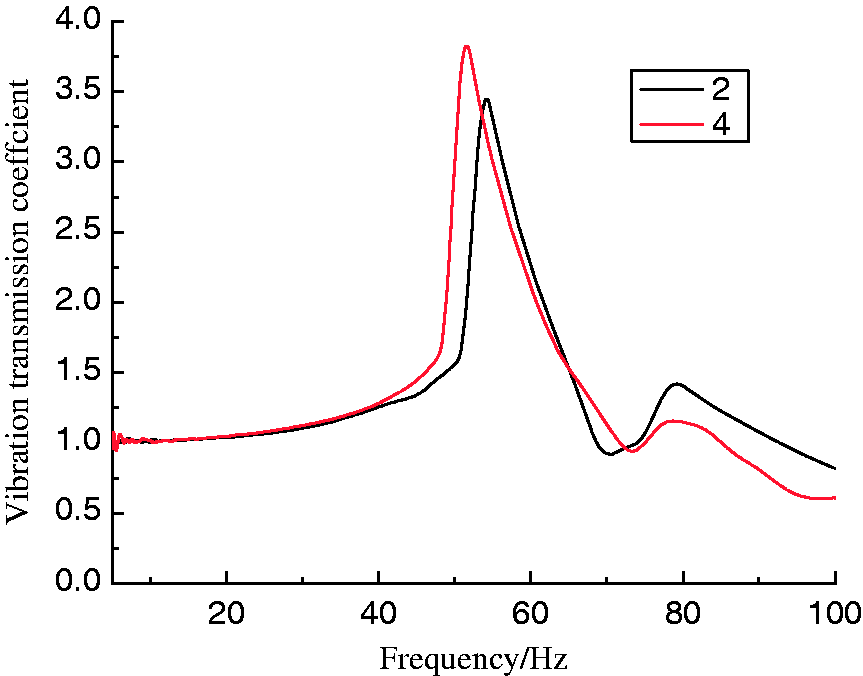

It was obvious from Figure 8 that there existed a similar vibration trend for samples 2 and 4 with combined vibrations of the super-harmonic and sub-harmonic, which showed that the natural frequency of sample 2 was 54.16 Hz larger than that of sample 4, at 51.53 Hz. This indicates that the larger the area density is, the better the elastic resistance is and the larger the natural frequency is. Furthermore, the largest vibration transmission coefficients of samples 2 and 4 were 3.44 and 3.82, respectively. Thus, the experimental largest vibration transmission coefficient of sample 2 was smaller than that of sample 4. This is because the larger the area density is, the larger the damping ratio is and the smaller the vibration transmission coefficient is.
Conclusions
The forced sinusoidal-excitation vibration method to study the vibration transmission property of spacer fabric was constructed, and the theoretical model of a single-degree-of-freedom system was made based on the viscoelastic behavior of spacer fabric during forced vibration with sinusoidal excitation. The vibration transmission coefficient and frequency ratio curves were obtained, which were effective in featuring vibration indexes, including the natural frequency and maximum vibration transmission coefficient. Compared with the natural frequency and maximum vibration transmission coefficient of the experimental curves, the theoretical values are consistent with them. The largest error value between the experimental and theoretical natural frequency is 14.64% and the largest value between the experimental and theoretical vibration transmission coefficient is 2.13%. Therefore, the theoretical equations can be used to express the vibration transmission property of spacer fabrics. In addition, the relationship between the structure and damping property of the spacer fabric was investigate, which showed that the parameters of spacer fabric, including thickness, filament diameter, area density and inclination angle and arrangement of spacer filaments, had a significant effect on the vibration transmission property. It can be concluded that warp-knitted spacer fabric has a great damping property and it is an excellent type of damping material that can be used as cushions applied in wheelchairs, trains, cars and other transport.
Footnotes
Declaration of conflicting interests
The authors declared no potential conflicts of interest with respect to the research, authorship and/or publication of this article.
Funding
The authors disclosed receipt of the following financial support for the research, authorship, and/or publication of this article: This work was supported by the National Natural Science Foundation of China (grant numbers 11272086, 51203022), the Fundamental Research Funds for the Central Universities (2232014A3-02), the “DHU Distinguished Young Professor Program (B201307)” and the Fok Ying Tung (huoyingdong) Education Foundation (151071), and supported by the National Key Research and Development Program of China (Grant No.2016YFC0802802).