



Abstract
Random fiber arrangement in slivers is the direct and intuitive factor resulting in sliver limit irregularity. In this study, by simulating the fiber arrangement in slivers, the effect of fiber configuration on sliver limit irregularity is investigated. The tracer fiber technique was employed to ascertain fiber straightness and the incidence of different fiber configurations in carded slivers. It is observed from the results that the majority of fibers are hooked in the carded sliver. It is fiber straightness rather than hook type that affects the sliver limit irregularity more; with the increase of fiber straightness, the sliver limit irregularity decreased. In addition, the simulation proposed in this study can not only portray fiber arrangement in slivers more practically, but also present sliver limit irregularity more accurately compared with the method mentioned in previous studies.
Sliver (or yarn) irregularity is an important evaluation indicator of sliver (or yarn) quality, and the research on sliver irregularity has been widely acknowledged as a classic topic in textiles. Normally, the irregularity of slivers is mainly composed of two parts, limit irregularity (also referred to as theoretical irregularity, which is the limit value of irregularity) caused by the random arrangement of the fibers in the sliver and additional irregularity caused by processing.1–4 The method of fiber arrangement in the sliver can directly reflect sliver irregularity, and provide a basis for studying fiber performance in the subsequence process. However, fiber arrangement in the sliver is influenced not only by fiber geometrical characteristics, such as fiber length and fiber fineness, but also by fiber morphological characteristics, such as fiber straightness and hooked fiber type.
In 1945, Martindale
1
first deduced an equation to express sliver limit irregularity in terms of the variation in the number of fibers per cross-section, with the assumption that all the fibers in the sliver are identical both in length and fineness, which is expressed as below


Martindale not only developed an equation to express sliver limit irregularity, which is composed of identical length fibers, but also put forward basic assumptions of the ideal sliver. Further, Rao 6 formulated a stochastic model to describe the configuration of fibers in an ideal sliver and gave a mathematical definition of the ideal sliver. Moreover, Brown and Nhan 7 studied the number of fiber ends in a sliver segment statistically and revealed that the number of fiber ends in a segment is a function of the segment length, the number of fibers that intersect a normal cross-section and the mean fiber length. Brown and Nhan's study provides a theoretical basis for determining the total number of fibers within a given sliver segment. Zhang et al. 8 and Hu et al. 9 experimentally showed that the locations of fiber left ends are evenly distributed along the sliver longitude, which is consistent with the assumption proposed by Rao 6 and Yan et al. 10 To get the arrangement of fibers in the yarn directly, Yan et al.11,12 and Jiang et al.13,14 built random-yarn models by Monte Carlo methods that can reflect how fibers arrange in a yarn directly and present the relationship between sliver limit irregularity and fiber characters.
The above investigations for calculating sliver limit irregularity are all based on the assumption that all fibers in the fiber assembly are ideally straight. Actually, the majority of fibers in carded slivers are hooked rather than straight. The formation of hooks during carding and their reduction in the downstream drafting process have already been investigated by many researchers.15–17 Morton and Summers 18 first observed the configuration of fibers in carded slivers by using a trace-fiber technique and classified them into five categories. Lindsley 19 used the ‘combing ratio’ and ‘orientation index’ to characterize the orientation of fibers in slivers and roving first, which was optimized by Fei 20 later, using fewer indicators to characterize fiber straightness more accurately. Wang 21 studied the factors affecting sliver irregularity; he found that fiber straightness has a profound influence on sliver limit irregularity. Therefore, Jiang et al.’s models cannot present sliver limit irregularity accurately, because in their simulation, all the fibers in the sliver are assumed to be straightened and hooked fibers are not considered. To get the limit irregularity of slivers more accurately, a simulation of fiber arrangement considering fiber configuration is needed.
In this study, based on previous studies, the fiber arrangement in slivers was further improved by taking both geometrical parameters and morphological parameters of the fiber into account. Simultaneously, the configuration of fibers in the carded sliver and the effect of fiber straightness and hooked fiber types on sliver limit irregularity have also been explored. This simulation of fiber arrangement can not only describe the state of fibers in slivers much more closely to reality, but also provide a basis for further studying the dynamic performance of fibers during subsequence processing, such as drawing.
Method
Fiber configuration and straightness in slivers
Fibers in the sliver exist in various forms, such as hooked (Figures 1(a), (b) and (e)), clumped (Figure 1(c)), straight (or fibers without significant hooks, Figure 1(d)), etc. Normally, in a hooked fiber, as shown in Figure 1(g), the long part ( The common configuration of the fiber in the sliver and the simulated sliver.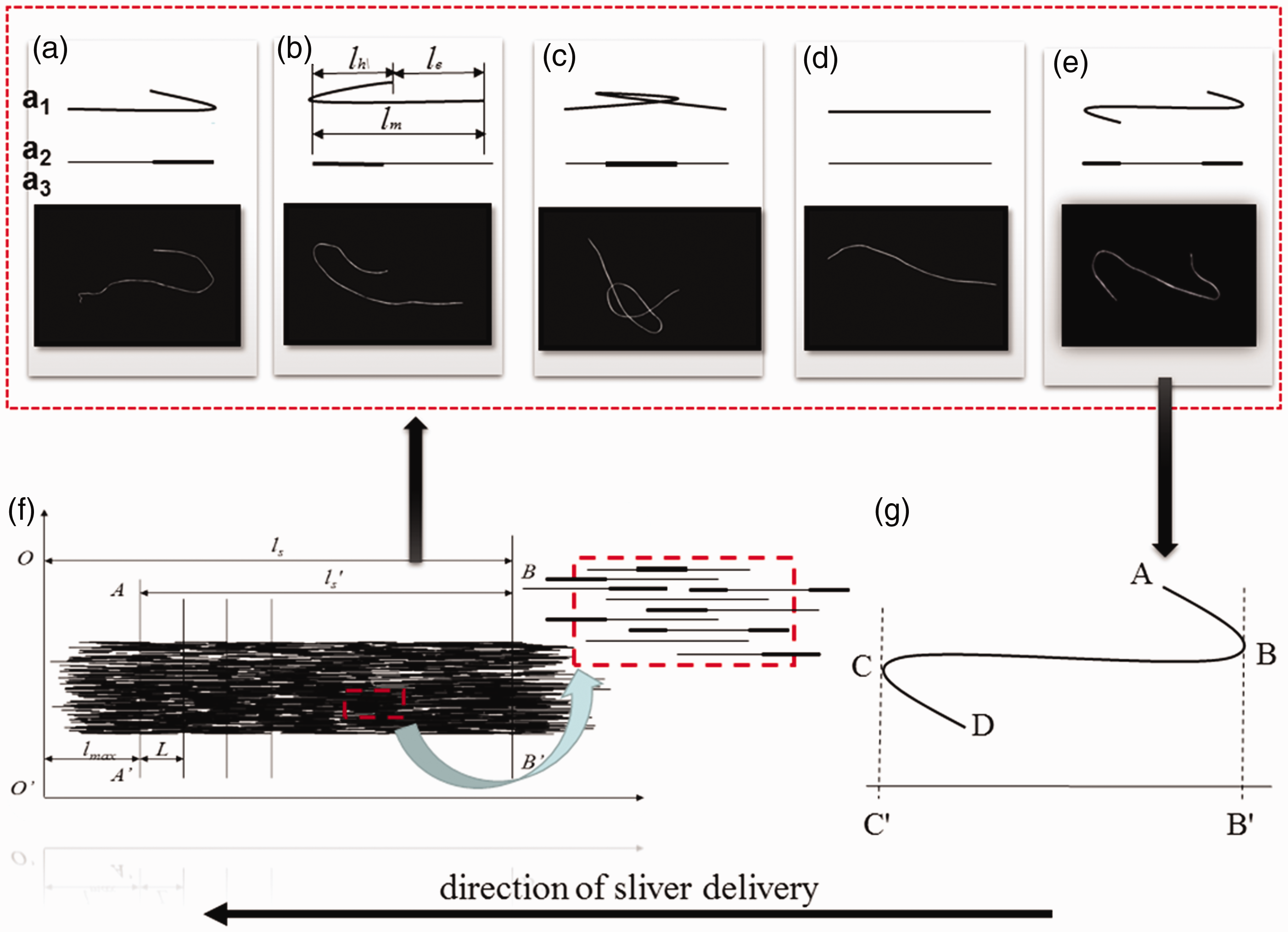

Simulation and assumptions
A random sliver is defined as a linear assembly of parallel fibers arranged at random along the axis of the sliver. The term ‘at random’ signifies that the chance of finding a specific location, say the fiber left end, of a fiber within a given interval is proportional to the length of the interval.
2
Considering the hooked fiber, in this paper, the assumptions can be modified by follows:
the hooked fiber is divided into two parts, the hook part and body part, and these two parts are on the same horizontal line; the locations of the fiber left end are independent of its characteristics and submit to the uniform distribution along the sliver lengthwise; linear density is uniform along with its length for each fiber, while linear densities between different fibers can vary but are independent of fiber length distribution.
All those idealizing assumptions are needed in the fiber arrangement simulation. Assumption (1) is the special assumption for the consideration of fiber configuration rather than straightened fibers in previous studies. Assumptions (2) and (3) are essentially the same as those given by previous researchers1,2 in defining ‘random’ slivers.
Along the direction of sliver delivery, the fibers in the sliver are classified into five categories, namely, fibers with trailing hooks, fibers with leading hooks, clumps, fibers without hooks and fibers with both end hooks, (Figures 1 (a)–(e)), as Morton and Summers 18 and Garde et al. 15 studied. Taking the trailing hook as an example (Figure 1(a)), a1 presents a simplified configuration of a trailing hook, a2 presents the simulated configuration of a trailing hook in the sliver according to the assumptions above, where the bold line represents the portion of hook that overlaps the body; and a3 is a real state of the fiber hooked at the trailing end in the sliver.
In this paper, considering the five types of fiber configurations described above, the simulation of fiber random arrangement of the sliver was constructed; sliver limit irregularity was also calculated based on this fiber random arrangement. The simulation mainly consists of two steps, the details of which are shown as follows.
Step 1: generation of fiber left ends in the sliver segment
In this step, the left ends of fibers, which are supposed to evenly distribute along the sliver length, 8 were generated employing the Monte Carlo stochastic method. The detailed process of generating fiber left ends in a given sliver segment was the same as the method for straight fibers described by Jiang et al. 13
Step 2: formation of the sliver segment considering hooked fibers
Fiber length, fiber straightness and the type of hooked fibers are another three major parameters to determine the state of a hooked fiber in a simulated sliver. The fiber hooked at the leading end (Figure 1(b)) was taken as an example to explain the relationship among fiber length, fiber straightness and the length of the hook and body of the fiber.
The bending point of the leading hook is the coincidence of the body left end and the hook left end. The relationship between the length of the body and hook is presented by the following equations
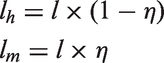
The distance from the right end of the body to the right end of the hook, l
e
, can be calculated by the following

Therefore, combining the special positions of the fiber left ends generated in first step, once the fiber length and fiber straightness are given, the state of the fibers can be ascertained in a given sliver segment by the above equations. A simulated random parallel fiber array with known mean linear density (or the mean number of fibers in the sliver cross-section) considering hooked fibers is shown in Figure 1(f).
lmax is the longest fiber length in the sliver, l
s
is the given length of the sliver to generate the fiber left ends,
The calculation of sliver limit irregularity
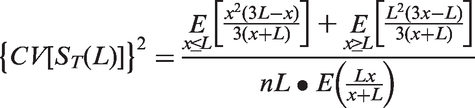
Generally, sliver irregularity refers to the linear density variation in the lengthwise direction of the sliver. In this simulation, there are two ways to express sliver limit irregularity. One way is to calculate the fiber number variation per cross-section in the sliver, which is the same as Martindale's equation, while another way is to calculate the fiber mass variation per unit interval in the sliver, which is the same as Suh's model and much closer to the practical testing on sliver irregularity. The first way to calculate sliver limit irregularity is to consider the number of fibers in the sliver cross-section, while the other way is to consider fiber mass variation per sliver unit interval. Assuming all fibers in sliver are identical in fiber linear density, thus the fiber mass in a chosen interval L is directly proportional to the sum of length of all fibers founded in this interval. According to Suh's study, the length of a fiber founded within a randomly chosen interval L is a part or entirety of the fiber. Therefore, both the relative position of the fiber with respect to the interval L and the fiber characteristics (such as fiber length, fiber straightness and the type of hooks) will influence this length. The details of calculating sliver irregularity are shown as follows.
Before we start to calculate sliver limit irregularity, the incomplete segment of the simulated sliver (from OO' to AA', Figure (f)) should be removed, and the rest of sliver segment (between AA' and BB', Figure 1(f)) was divided into t (
Due to fiber fineness being independent of fiber length, the expectation of the weight of total fibers per unit interval can be derived by
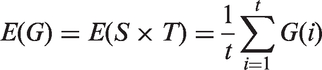
Similarly, the variance of the weight of total fibers per sliver unit interval can be derived by

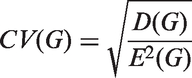
Finally, the sliver limit irregularity, the coefficient of variation of the sliver weight among each unit interval in the sliver, can be derived by
Experiments and results
Examination of the fiber configuration in carded slivers by the tracer fiber technique
Distribution of hooked fibers in cotton and ramie carded slivers

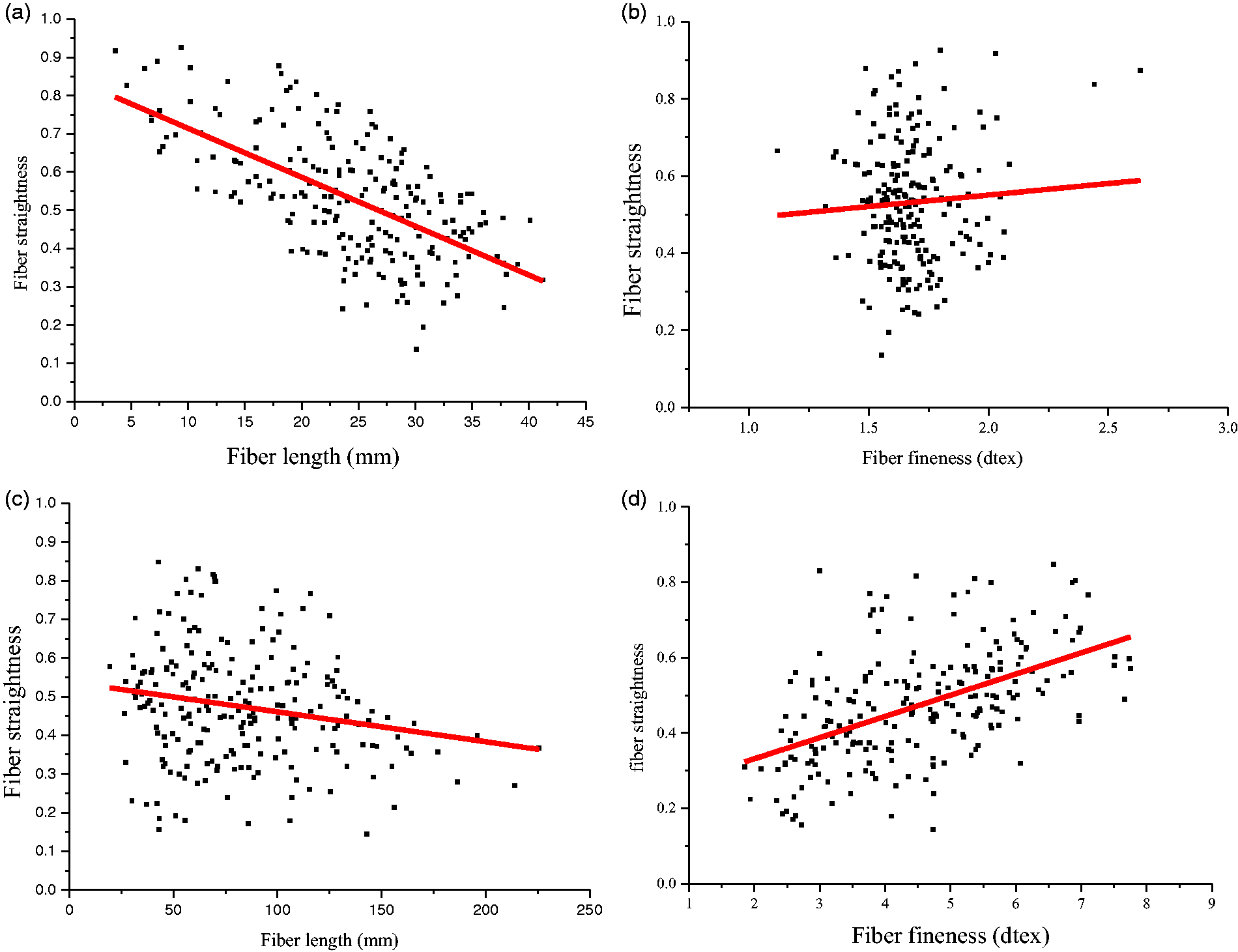
It was obvious that most of the fibers, more than 80%, in the carded sliver are hooked, with the majority in the form of trailing hooks (hooked at the trailing end). In addition, the average fiber straightness in the carded sliver was 0.55 for cotton and 0.47 for ramie, respectively. This is because both fiber length and fiber fineness affect fiber straightness. To explore the effect of fiber fineness and fiber length on fiber straightness directly, the fiber length, fiber fineness and fiber straightness of 100 cotton and ramie samples were tested, respectively. The results are shown as follows.
From Figure 3, it is shown that for cotton fiber, the length has a greater influence on the straightness; with the decrease in fiber length, there is a general increase in fiber straightness. However, the effect of fiber fineness (linear density) on fiber straightness is not obviously for cotton, which may be because the fineness of cotton fiber varies less, most of which is at 1.5–2.0 dtex. For ramie fiber, both fiber length and fiber fineness affect fiber straightness. With the decrease of fiber length, the straightness increases; with the increase in fiber linear density, the straightness increases correspondingly, but the effect of fineness on fiber straightness is much more significant for larger variation in the fiber fineness. That is, for longer and finer fiber it is easy to have low straightness. The detailed relationship among the length, fineness and the straightness of fiber needs further exploration.
Different cases of S(i) and N(i) relative to the location of the fiber left end, fiber length, interval size L and fiber straightness in the leading hook fiber simulation. Effect of fiber length and fiber fineness on fiber straightness.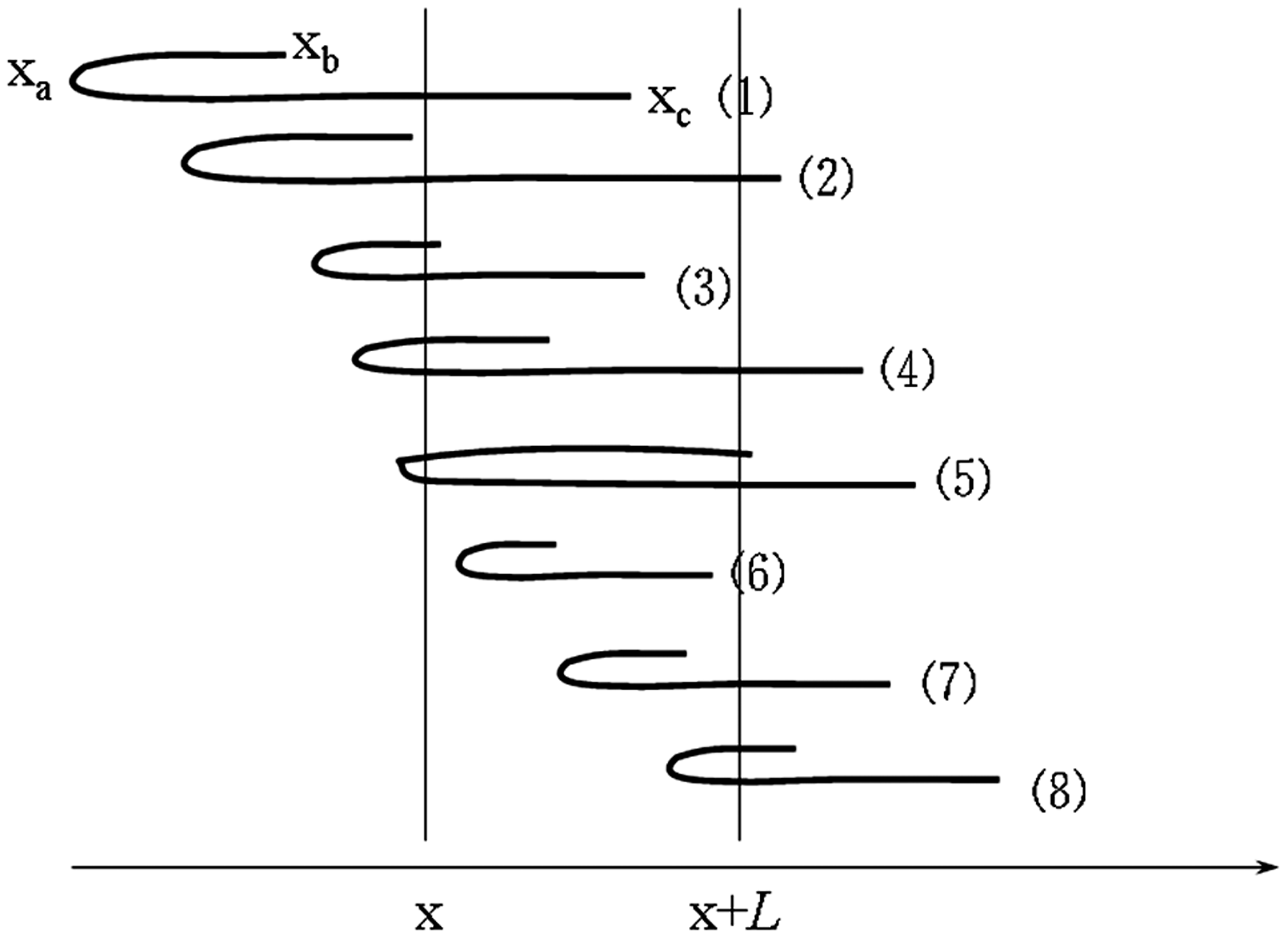
Influence of hook type on sliver limit irregularity
As mentioned above, fibers in the carded sliver can be classified into five categories according to their configurations (as shown in Figure 1), but there has been a lack of knowledge about the effect of hook type on the sliver limit irregularity until now. Therefore, in this paper, four slivers are simulated, identical in all respects, such as fiber length and fineness, apart from the type of hooks that exist in each sliver. To simplify, it was assumed that all hooked fibers are only bent once without overlap and, therefore, the straightness of fibers falls in the range from 0.5 to 1. The mean length and fineness of fibers (both cotton and ramie) used in the simulation are shown in Table 1, and the average number of fibers per sliver cross-section is assumed to be 100. Variation of total fiber weight per 8 mm interval was calculated as sliver limit irregularity. Figure 4 compares sliver limit irregularity caused by hook types under different fiber straightness.
Effect of fiber hook type on sliver limit irregularity.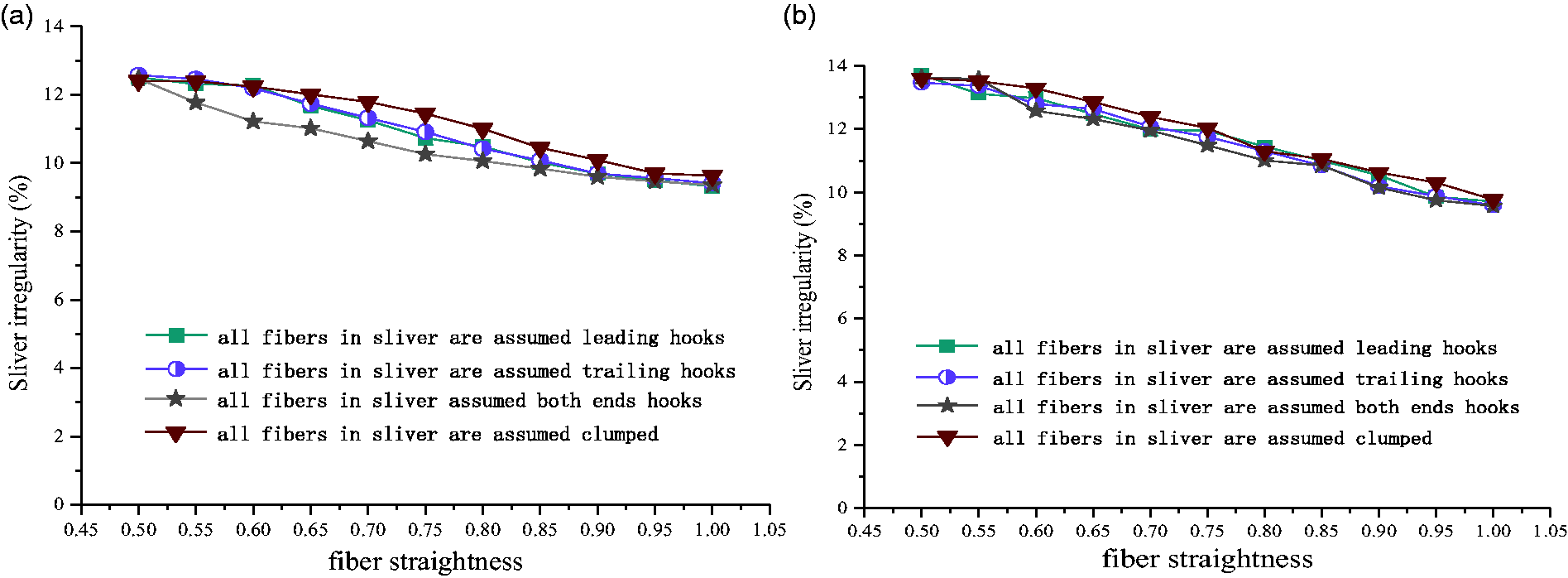
The results presented in Figure 4 indicate that even if the fiber types constituting each kind of simulated sliver are completely different, the difference among the sliver limit irregularities of those four kinds of simulated slivers is small. In other words, hook type has no significant influence on sliver limit irregularity.
The results of the Kruskal–Wallis test
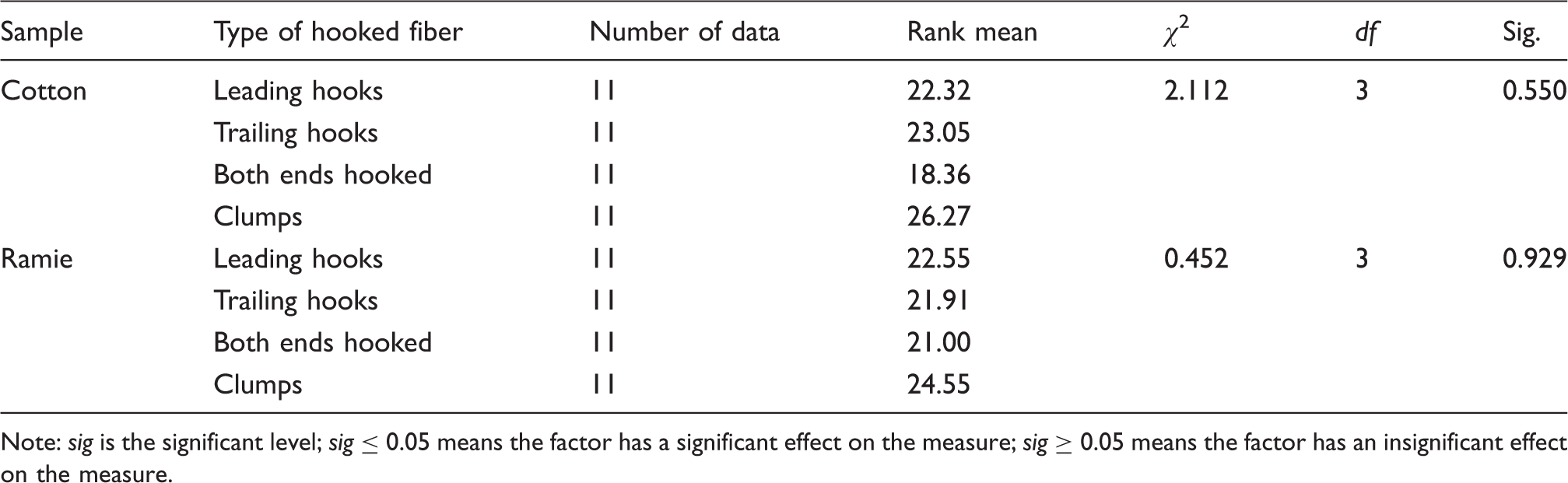
Note: sig is the significant level; sig ≤ 0.05 means the factor has a significant effect on the measure; sig ≥ 0.05 means the factor has an insignificant effect on the measure.
The results from Table 2 supported the conclusion that the type of fiber configuration (leading hook, trailing hook, etc.) has no significant influence on sliver limit irregularity.
Theoretical derivation of the influence of fiber straightness on sliver limit irregularity
According to Martindale's theory,
1
when fibers in the sliver are all straight and parallel to the axis of the sliver, the sliver limit irregularity can be calculated by Equations (1) or (2). When fibers in the sliver are not straight but hooked, the expression of sliver limit irregularity is not accurate. Therefore, correlation between fiber straightness and sliver limit irregularity was explored by analyzing a continuous arrangement of single fibers with different cases, as shown in Figure 5.
Several relative positions of adjacent fibers.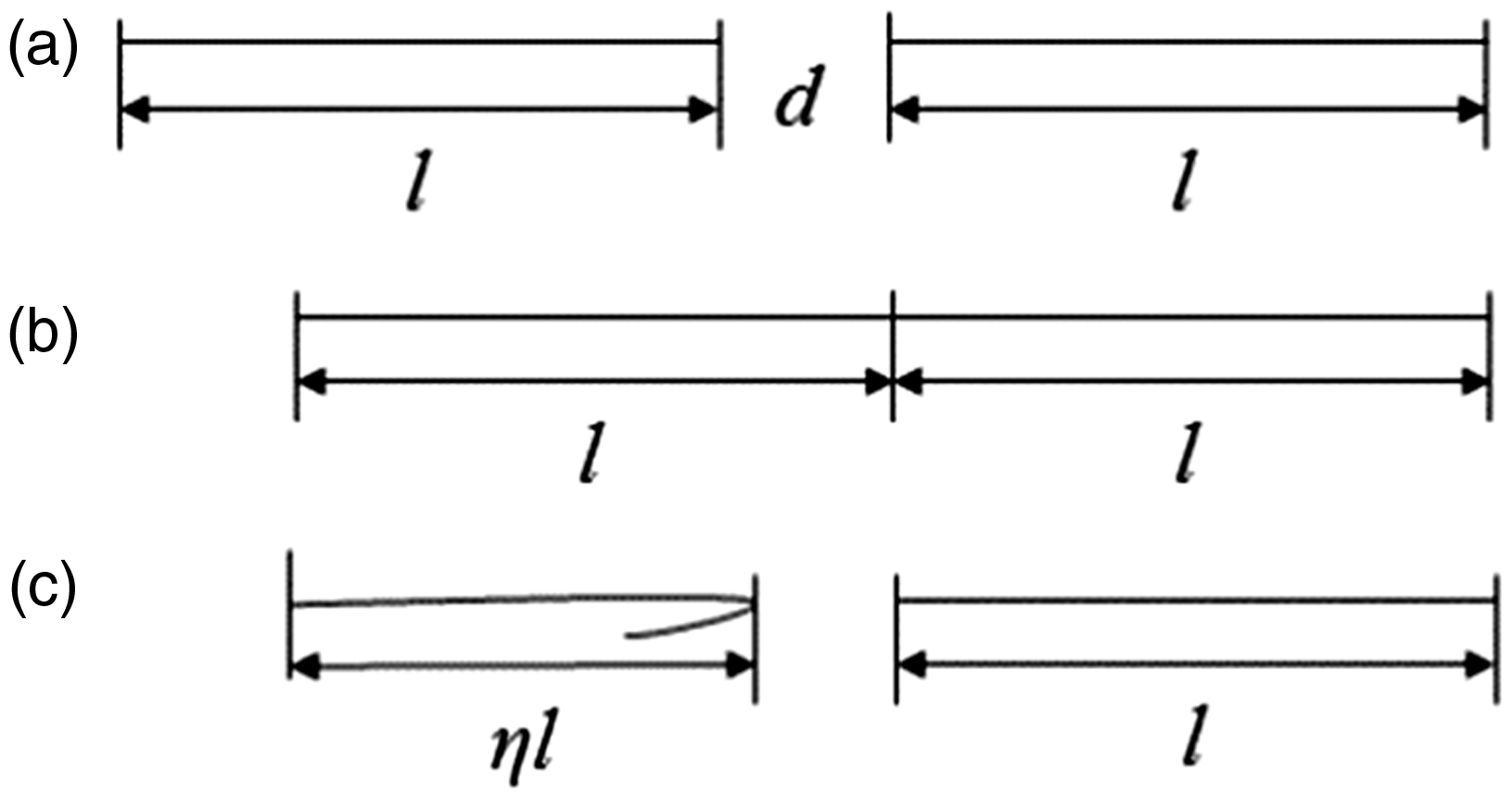
Assuming that the length of fibers is l, the distance between the ends of two adjacent fibers is d (Figure 5(a)) and ξ is defined as a chance that a fiber will be found within a section of length (l + d), then we can know that ξ follows the 0–1 distribution. The probability can be obtained by

As ξ follows the 0−1 distribution with the probability p, then the expectation and the variance of the fiber to be found within a section of length (l + d) can be derived by


Hence, the coefficient of variation in the number of fibers per cross-section can be deduced as
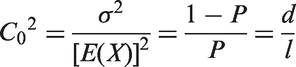
Assume no other factors are contributing to the displacement between the two fibers except drawing. Slivers are attenuated by drafting, that is, the distance between the two leading ends is increased E-times (E = draft ratio). The coefficient of variation in the number of fibers per cross-section after drawing can be expressed as follows:

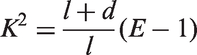
From the above equations, we know that the increased additional irregularity caused during drafting is proportional to (E – 1). If the fibers are connected end to end before drawing, as shown in Figure 5(b), that is, d = 0, C0 = 0, the irregularity caused during drafting is 

Equations (3) and (4) can clearly reveal the effect of fiber straightness on sliver limit irregularity, and it was interesting to find that when all the fibers were considered as straight (η = 1, then K = 0), this equation will turn into Martindale's equation. 1
Verification of the simulation
Although this simulation can characterize the fiber arrangement in slivers as well as present sliver limit irregularity, the accuracy of this model still needs further verification. As studied above, for the simulated sliver, the types of fiber hook have no significant influence on sliver limit irregularity. Therefore, slivers composed of trailing hooked fibers only can be taken as an example to study the verification of this simulation. Since the number of fibers per cross-section in slivers does not significantly affect the tendency of the fiber straightness to sliver limit irregularity, the mean number of fibers per cross-section in slivers can be assumed as 100. In addition, to simplify the calculation, we also assumed that all fibers are identical in length (25 mm) and fineness (0.167 tex). The limit irregularity of simulated slivers was characterized by the coefficient of variation of the total fiber weight per 8 mm interval and the coefficient of variation of the fiber number per sliver cross-section, respectively. By using Equation (3) and (4), sliver limit irregularity is also obtained. Figure 6 presents the simulated sliver irregularity and the calculated sliver irregularity under different fiber straightness (from 0.5 to 1).
Simulated sliver irregularity and calculated sliver irregularity under different fiber straightness. Note: C1 is the sliver limit irregularity calculated by Equations (3) and (4); C2 is the limit irregularity of the simulated sliver, characterized by the coefficient of variation of the fiber number per sliver cross-section; C3 is the limit irregularity of the simulated sliver, characterized by the coefficient of variation of the total fiber weight per 8 mm interval.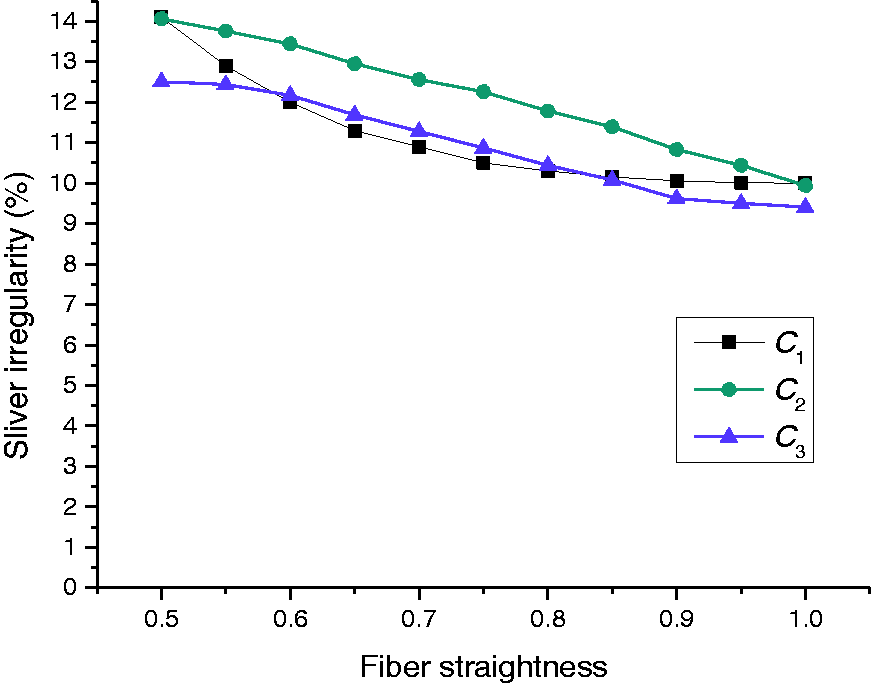
As shown in Figure 6, the following conclusions can be drawn.
With the increasing of fiber straightness, the limit irregularity of slivers gradually decreases until it reaches its minimum values. In other words, fiber straightness plays a very important role in contributing to the limit irregularity of slivers. Although the three curves (C1, C2 and C3) shown in Figure 6 have the same tendency of irregularity varying with the straightness of fibers, there is little significant difference among them. C2 is almost parallel to C3 but higher than C3, which is because the shorter selected unit interval of the sliver had higher sliver irregularity. This is also in good agreement with Suh's study,
2
which means that when a shorter interval of sliver is selected, higher sliver irregularity obtained.
Conclusion
In this study, a new simulation of fiber random arrangement in slivers was proposed. In this simulation, in addition to straight fiber, other fiber configurations were also taken into consideration, which made the fiber arrangement in slivers more real. Sliver limit irregularities were expressed by calculating the variation of fiber number per cross-section and total fiber weight within unit interval of the sliver, respectively. The effect of fiber straightness on sliver limit irregularity was explored. It can be seen from the results that fiber straightness affects sliver limit irregularity greatly; the sliver limit irregularity decreases as fiber straightness increases, which indicates that consideration of fiber straightness makes the simulation of fiber random arrangement in the sliver more accurate and reasonable. In addition, the effect of hook type on sliver limit irregularity was also explored. It can be inferred from the results that hook type has no significant influence on sliver irregularity. Finally, the reliability of this simulation was verified, with the result showing that the simulated sliver limit irregularity is in good agreement with the results calculated from the equations, which expressed the relation between fiber straightness and sliver limit irregularity. Therefore, the improvement of the simulation of fiber random arrangement in slivers by introducing fiber straightness could predict sliver limit irregularity more accurately, and it could provide a foundation for further studies, such as fiber motion during the drafting zone and the effect of the drafting process on yarn processing.
Footnotes
Declaration of conflicting interests
The authors declared no potential conflicts of interest with respect to the research, authorship and/or publication of this article.
Funding
The authors disclosed receipt of the following financial support for the research, authorship, and/or publication of this article: This work is supported by the National Natural Science Foundation of China (Grant No. 51773034).