



Abstract
Flushable wipes have become popular among consumers who worry about environmental problems the world confronts today. However, whether these wipes have a positive effect on environmental protection is contradictory because of the lack of government regulations and legal obligations. Starting from this point, in this study, we characterized commercially available flushable products, which were manufactured from various raw materials by different production methods, in order to understand the relationship between their structure and performance properties. The results showed that production technology had a significant effect on the structural, mechanical, and dispersible properties of nonwovens. The disintegration percentage of nonwovens was inversely related to their wet strength. The findings of this study will be helpful in the design of new flushable nonwovens for improved wet strength and dispersibility performance.
Plastic production has risen from 1.7 million tons in 1950 to 335 million tons in 2016.1–3 The increasing use of synthetic polymers causes larger plastic debris and, accordingly, higher contamination of the aquatic environment.2–5 Plastic pollution has harmful effects on the marine ecosystem and human health.4,6–8 Microplastics, which are synthetic organic polymer particles with <5 mm in size, are aquatic environmental polluters.2,3,7,9–11 Synthetic textile fibers, which are a subcategory of microplastics, can be used in consumer wipes in an effort to improve their strength properties and might be transported into the marine environment through sewage systems.2–4,6,7,11,12 Water pollution can be reduced by not using synthetic fibers in the structure of such consumer wipes.
Flushable wipes are defined as disposable nonwoven products, which break down into small pieces and disperse immediately in order to be transported from the toilet to the sewage system.13,14 These wipes have become popular in recent years due to their ease of use and consumers' environmental awareness, and are used as cleaning products in different fields, such as baby wipes, moist toilet tissues, bathroom cleaning wipes, and so on. The flushable wipes market is growing rapidly, and the sales of these wipes are expected to double to reach $2.7 billion through 2020.13,15 The flushable wipe manufacturers have claimed that these wipes are compatible with the sewer systems and are suitable to be disposed of into the toilet bowl. However, because of the lack of government regulations and legal obligations, the water treatment industry and environmental organizations have doubts about whether these products have flushability performance as claimed. They have reasonable grounds (e.g. clogging in sewer systems, damage to equipment) for worrying about this issue triggering the environmental pollution.6,16–20
The products should be labeled and sold as “flushable” when they provide the requirements of the current guidelines presented by the Association of the Nonwoven Fabrics Industry (INDA) and the European Disposables and Nonwovens Association (EDANA),
21
the International Water Services Flushability Group (IWSFG)
22
or the Water UK.
23
There are certain features that the wipes should have in order to be accepted as truly flushable. These can be listed as follows:
The wipes should be nonbuoyant, should quickly sink to the bottom of the toilet bowl to be washed away and should be disposed of by the sludge.12,21–23 The wipes should contain biodegradable and dispersible fibers (e.g. wood pulp, viscose, lyocell, cotton) in their structure to eliminate the negative impacts of synthetic fibers on the environment.12,21–24 The wipes should disintegrate under agitation, not damage any sewer systems and not lead to environmental pollution.12,21–23
A flushable wet wipe should be strong enough to be stored and converted, and should also resist tearing and puncturing during use. Furthermore, it should have a sufficiently weak structure to disintegrate in sewage systems. Namely, the wipes should have sufficient temporary wet strength.25,26 Therefore, the dispersibility and wet strength properties should be balanced during the production of these wipes. This balance can be achieved by using appropriate raw materials, process parameters and production technologies. 13 Scholz and Sigmund 27 reported that the length of biodegradable fibers was a significant factor in the dispersible properties of nonwovens, and the nonwovens manufactured from the conventional staple fibers could not be completely disintegrated into individual fibers due to the formation of ropes. Therefore, short length fibers should be used for making dispersible spunlaced nonwovens. Nowadays, the airlaid web forming process is used for manufacturing flushable wipes. The airlaid pulp is bonded with light hydroentanglement or ion-sensitive cationic or triggerable polymer binders.6,12,25 The wetlaid-hydroentanglement (wetlace) process is a proper process to manufacture a nonwoven, which has good mechanical and dispersible performances.25,28–30 Zhang et al. 28 observed that as a result of the increase in the proportion and length-to-diameter ratio of the Danufil fiber in the wetlace nonwoven structures, the dispersibility and bending rigidity of nonwovens decreased and their tensile and tearing strengths increased. Zhang and Jin 31 found that the basis weight was a crucial parameter on the dispersibility of nonwovens produced when the hydroentanglement pressure sum was above 135 bar. In addition, Zhang et al. 32 examined the wet strength and dispersibility properties of wetlace materials produced from different short length fibers and with water-jet pressure sums. They claimed that the wetlace material made of wood pulp/lyocell fiber was the most suited in terms of the balance between the properties investigated.
Although many studies have been conducted to characterize the nonflushable nonwoven products, there are a few studies elucidating the structure–property relationships of flushable wipes in the related literature.27–32 The purpose of this research was to characterize various commercially available wet wipes, which are labeled as flushable, in an effort to clearly understand the differences in their surface morphology, mechanical performance and dispersible characteristics. Such an understanding will allow one to design and develop truly flushable wipes with enough wet strength.
Materials and methods
Constructional parameters of samples used in the study. Data are shown as mean values (standard deviation)

Commercial wet wipes were pre-rinsed to remove water-soluble lotions and additives before the various tests that were carried out using dry samples. The six samples from the same brand were submerged in a 20-l tap water container at once and were swirled in the water for 30 s. 33 Then the samples were dried in an oven at 105℃ for 3 h and conditioned at least 24 h in standard atmosphere conditions at 21 ± 2℃ temperature and 65 ± 5% relative humidity according to ASTM D1776/D1776M–16. 34
A field emission scanning electron microscope (FE-SEM) (FEI Teneo, FEI, Inc., Hillsboro, OR, USA) was used to observe the surface morphology of selected samples and the morphological changes caused by the disintegration process. Also, their chemical structures were investigated using a Fourier transform infrared (FTIR) spectrometer (Thermo Scientific Nicolet iS10) and an X-ray diffractometer (Thermo Scientific ARL X'TRA). The crystallinity index (CrI) was determined using the Segal empirical formula as shown in equation (1).

The maximum load and extension at maximum load were determined using the Instron tensile tester (Instron 4400R, Norwood, MA, USA) along the machine direction (MD) and cross-machine direction (CD) of samples, in compliance with ASTM D5035-11 standard. 37 The gauge distance was 50 mm, and the cross head speed was 25 mm/min. The sample size of 25 mm × 125 mm was used, and five samples were tested in both the dry state and the wet state (in-use and post-use). While pre-moistened wipes, which were in the package, show the in-use state, these wipes were soaked into tap water for 15 min to mimic the post-use state. The waiting period in water of the samples was determined as 15 min according to the results of the preliminary tests.
Dispersible performance of the nonwovens was evaluated according to the UK Water Industry Research (UKWIR) Flushability Protocol—Sewer Disintegration Test.
23
To determine the average dry weight of each sample, three test samples were dried in an oven for at least 3 h at 105℃, left in a desiccator until cool and weighed by an analytical balance. The 2-l conical flask including a test sample and 1 l of tap water was shaken on an orbital shaker with a speed of 150 rpm for a period of 6 h. At the end of the time, the content of the flask was poured onto the 5.6-mm perforated plate sieve, and the residuals on this sieve were rinsed for 1 min by using a showerhead with a 4-l/min flow rate. The residuals remaining on the sieve were placed in the drying oven at 105℃ for 3 h, and the dried residuals were weighed. The percentage of the product weight passed through each sieve (PPW) was calculated by equation (2).

Statistical analyses were conducted with SPSS 22.0 statistical software package (IBM, Armonk, NY, USA). The differences in the mechanical and dispersible performances between nonwovens were analyzed using one-way analysis of variance (ANOVA); results were considered statistically significant for p < 0.05.
Results and discussion
Scanning electron microscope analysis
The surface morphology and microstructure of nonwoven specimens were characterized by the FE-SEM. Because some nonwovens used in the study had similar constructional parameters (Table 1), understanding the structural features of selected nonwovens is important. Figure 1 demonstrates the morphological structure of the F1, F4 and F5 samples. The scanning electron microscope (SEM) micrographs revealed that the wood pulps had a flat cross-section and an irregular structure along the fiber axis. Examining the images of wetlace samples, it was determined that the wood pulps were more curved and twisted as compared to other fibers used in the structures. These deformations might have occurred during the hydroentanglement process due to the low bending rigidity of wood pulp fibers.
Scanning electron microscope micrographs of the (a) F1, (b) F4 and (c) F5 samples.
Figure 1(a) and (b) shows that the wood pulp and regenerated cellulosic fibers were interlaced during the hydroentanglement process. The surface of viscose fibers, which had an almost round cross-section, was serrated and had striations along its lengthwise direction (Figure 1(a)). On the other hand, the lyocell fibers had a round cross-section, and their surface was smooth without striations (Figure 1(b)).
Increased fiber rigidity generally decreases the interlocking during hydroentanglement of fibers. 38 The flexural rigidity of the wood pulp is lower in comparison with that of the viscose and lyocell fibers.28,31 Therefore, it is likely that viscose and lyocell fibers could not be entangled as easily as the wood pulp because of their higher flexural rigidity. On the other hand, it was observed that these fibers formed the U-shaped entanglements providing the needed interlocking of fibers, which is similar to the findings of earlier studies.28,31,39 Also, their round cross-section improved the inter-fiber contact and the cohesion in the structures. 12 The F5 sample was made from wood pulp only, and any binder particles were not observed on the surface of wood pulp fibers in this structure (Figure 1(c)).
Mechanical properties
The maximum load and the extension of nonwoven specimens were measured as indicators of their mechanical performance. Figure 2(a) and (b) presents the measured maximum load of nonwovens in the dry, in-use, and post-use conditions. As can be seen in these figures, the MD maximum load of nonwovens was generally higher as compared to the CD ones (p < 0.05). As the nonwovens got wet, their strength generally decreased in both the MD and the CD. This reduction was quite apparent in the nonwovens produced by the airlaid-triggerable binder system (F5–F7). Their wet strength in the in-use condition was about 92–95% lower than the dry strength values. When these products are soaked in the water for mimicking the post-use condition, their strength also continues to decrease in that condition. This decrease might be due to the binder used to hold the fibrous materials together. The coherency of this binder might be maintained in the in-use condition of nonwovens, thanks to the insolubilizing agent in the wetting composition. However, when this agent is diluted with tap water, the binder becomes water-soluble owing to the triggerable polymer in its structure, and consequently, the inter-fiber bonding and the wet strength of those webs decrease.
40
(a and b) Maximum load and (c and d) extension of machine direction (MD) and cross-machine direction (CD) of nonwoven samples. Data are shown as mean values with error bars indicating 1 standard error.
The devastation of fiber entanglements leads to tensile failure in the hydroentangled nonwovens. All wetlace products used in this study were relatively stronger due to the fiber entanglements formed during the hydroentanglement process, which prevented the webs from disintegrating during use. As shown in Figure 2(a) and (b), the maximum load of nonwovens made of wood pulp/viscose fibers (F1–F3) was slightly reduced when the conditions were changed from dry state to wet state. On the other hand, the difference between the maximum loads measured in the dry and wet conditions of the structure comprising wood pulp/lyocell fibers (F4) was more significant, and the in-use strength decreased compared to that measured in the dry state by 43% and 59% in the MD and the CD, respectively. These observed reductions in strength might be due to the fact that the wet strength of the regenerated fibers used in these wipes is lower than their dry strength. The improvement of web strength of hydroentangled nonwovens in the wet condition is associated with the high fiber-to-fiber friction coefficient, and the adequate contact areas of fiber entanglements.32,41–43 These findings are consistent with the observations of Zhang et al. who examined the wet strength of wetlace materials.32,43
Figure 2(c) and (d) illustrates the extension of nonwovens at maximum load. The extension of airlaid nonwovens (F5–F7) was almost similar in the MD and CD. However, the extension values measured in the CD of wetlace nonwovens (F1–F4) were higher than those in the MD (p < 0.05). The reason might be the predominant fiber orientation forming the ribbons in the MD. Viscose and lyocell fibers might be separated from these ribbons during the extension in the CD and might settle perpendicularly to the ribbons, and hence the extension process in this direction might take a longer time as compared to that in the MD. 29
Although the extension of airlaid nonwovens slightly decreased as they were exposed to the water, the extension of wetlace nonwovens in the wet conditions showed a significant increase in comparison with that in the dry state (p < 0.05). This result is likely due to the regenerated cellulose fibers in the structure of wetlace samples because the wet elongation of these fibers is greater than their dry elongation.44,45 On the other hand, wood pulps in the airlaid nonwovens might have disintegrated rapidly owing to the binder losing its efficiency in the water as discussed above.
Dispersible properties
Dispersion is a process where products break up into small particles separating from each other and distributing themselves in water.13,21 This disintegration process is important so that the flushable product can move in the toilet, drain line, sewage ejector pump and municipal treatment system without causing any blockages and sewer floodings. Figure 3(a) gives the percentage of the disintegration of nonwovens used in this study. This percentage in wetlace nonwovens was between 12.4% and 19.0%, and there was no statistically significant difference in terms of the disintegration percentage among the wetlace nonwovens investigated (p < 0.05). As can be seen in Figure 3(b), the spunlace process, which provides the entanglements of wood pulp and regenerated cellulose fibers, might lead to larger residuals remaining on the sieve after the orbital shaker test. On the other hand, airlaid nonwovens lose 57.4–84.1% of their dry weights during the disintegration test. The airlaid nonwovens made of wood pulp might be broken up into smaller pieces easily within the test duration due to the triggerable binder, which dissolves in water and loses its efficiency (Figure 3(c)).
(a) Disintegration test results of the nonwovens. Images of residuals of the (b) F1 and (c) F5 samples, which remain on the sieve after the shaker test.
Figure 4 illustrates the relationships between the disintegration percentage and the maximum load in the wet state. The coefficient of determination (R2), which describes the proportion of variance in the dependent variable explained by the regression model, was 75% and 86% for in-use and post-use maximum loads, respectively. The results demonstrated that the disintegration of nonwovens was inversely proportional to the wet strength of nonwovens, and strong correlations were observed between these parameters (in-use, R = –0.866; post-use, R = –0.926). Understanding this relationship helps in designing products with a good balance of wet strength and dispersibility.
Relationship between the percentage of disintegration and the maximum load in the wet states measured from the nonwovens used in this study.
Figure 5 shows the structures of the F1, F4 and F5 samples before and after the disintegration test. As can be seen in the SEM images, the wood pulps were apparently damaged in the water under agitation. In addition, the stacked fibers in wetlace nonwovens started to disentangle, and the knots created by regenerated cellulose fibers largely disappeared at the end of the disintegration test. This may arise from the fiber–fiber and water–fiber frictions and the shear stress caused by turbulence in the water during the disintegration test.
Scanning electron microscope micrographs of the (a) F1, (b) F4 and (c) F5 samples before (left-hand side) and after (right-hand side) the disintegration test.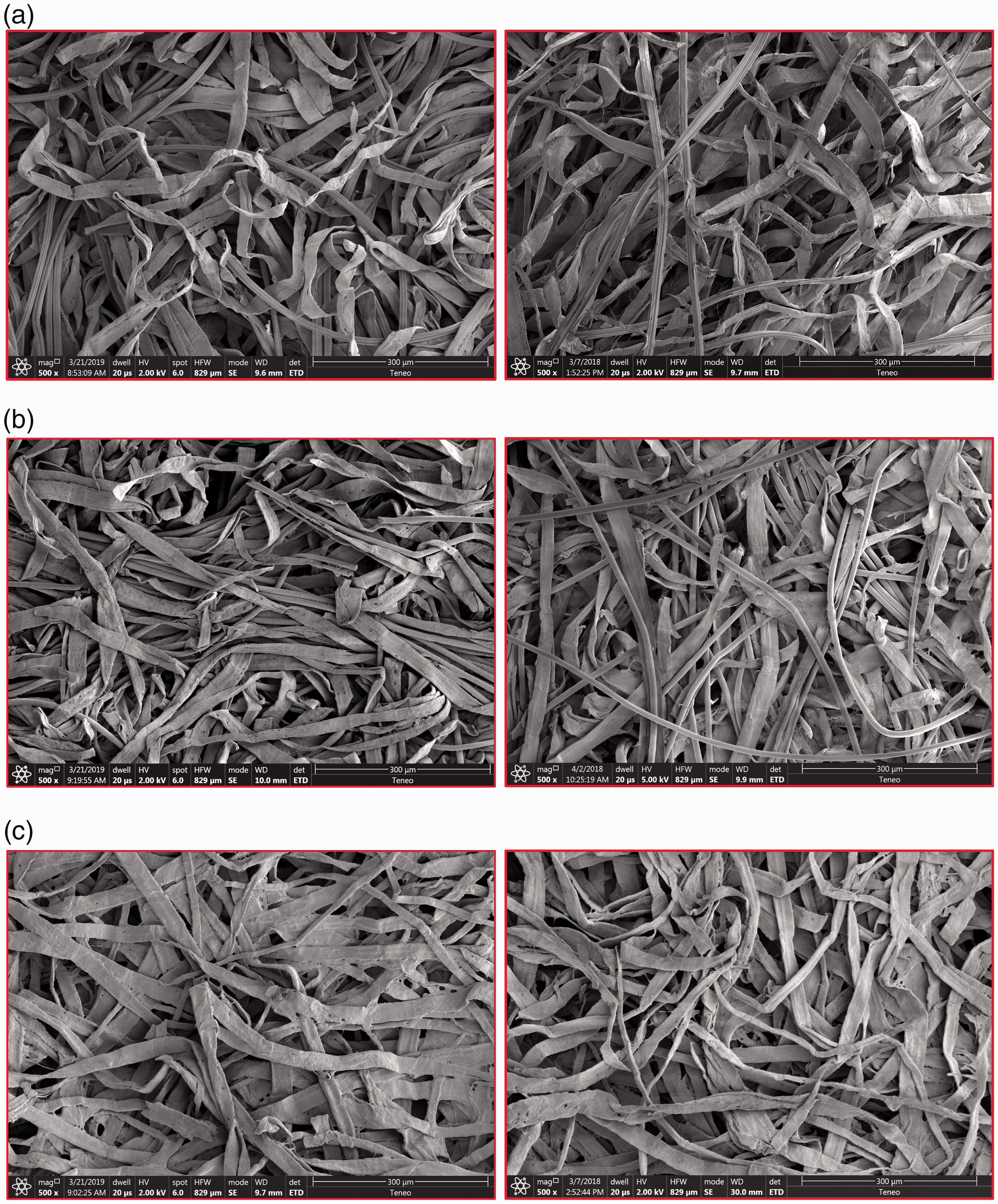
FTIR analysis
Figure 6 presents FTIR spectra of the F1, F4 and F5 nonwoven fabrics before and after the disintegration test. All samples give spectral bands at 3301–3334 cm−1 and 2890–2900 cm−1 attributing to -OH stretching vibration (intermolecular hydrogen bonds) and C-H stretching vibration, respectively.46,47 The sharp peak at 1028–1030 cm−1 indicates the C-O stretching vibration belonging to polysaccharide in cellulose.48,49 The peak at 1160–1161 cm−1 may be owing to the anti-symmetrical deformation of the C-O-C band.47,50,51 The -CH2 symmetrical bending vibrations in cellulose is located at the band at 1428–1434 cm−1.47,52,53 Moreover, the spectral bands at 889–899 cm−1 and 1314–1316 cm−1 can be ascribed to C-O-C stretching at the β-(1→4)-glycosidic linkage and -CH2 wagging vibrations in cellulose, respectively.47,51,52,54 The F1 and F4 samples showed similar peaks before and after the disintegration test (Figure 6(a) and (b)). On the other hand, the peak at 1245 cm−1 band in the FTIR spectra of the F5 sample, which is assigned as the C-O stretching vibrations,52,55 disappeared after the disintegration test, and the intensity of the peak at 1730 cm−1 (C=O stretching vibrations)52,55,56 decreased (Figure 6(c)). These are due to the partial removal of the binder of the airlaid F5 sample after the disintegration test. That is why there was a higher percent weight loss due to disintegration as discussed earlier.
Fourier transform infrared spectra of the (a) F1, (b) F4 and (c) F5 coded samples before and after the disintegration test.
X-ray diffraction analysis
The effect of fiber content and disintegration on the crystalline structure of the F1, F4 and F5 nonwoven fabrics was investigated using X-ray diffraction (XRD) analysis (Figures 7 and 8). As can be seen in the figures, the samples had main diffraction peaks at 2θ angles of about 15° (1 X-ray diffraction pattern of the F1, F4 and F5 fabrics before the disintegration test. X-ray diffraction patterns of the F1, F4 and F5 fabrics before and after the disintegration test. Crystallographic data of the nonwoven fabrics A: after disintegration; B: before disintegration. CrI: crystallinity index.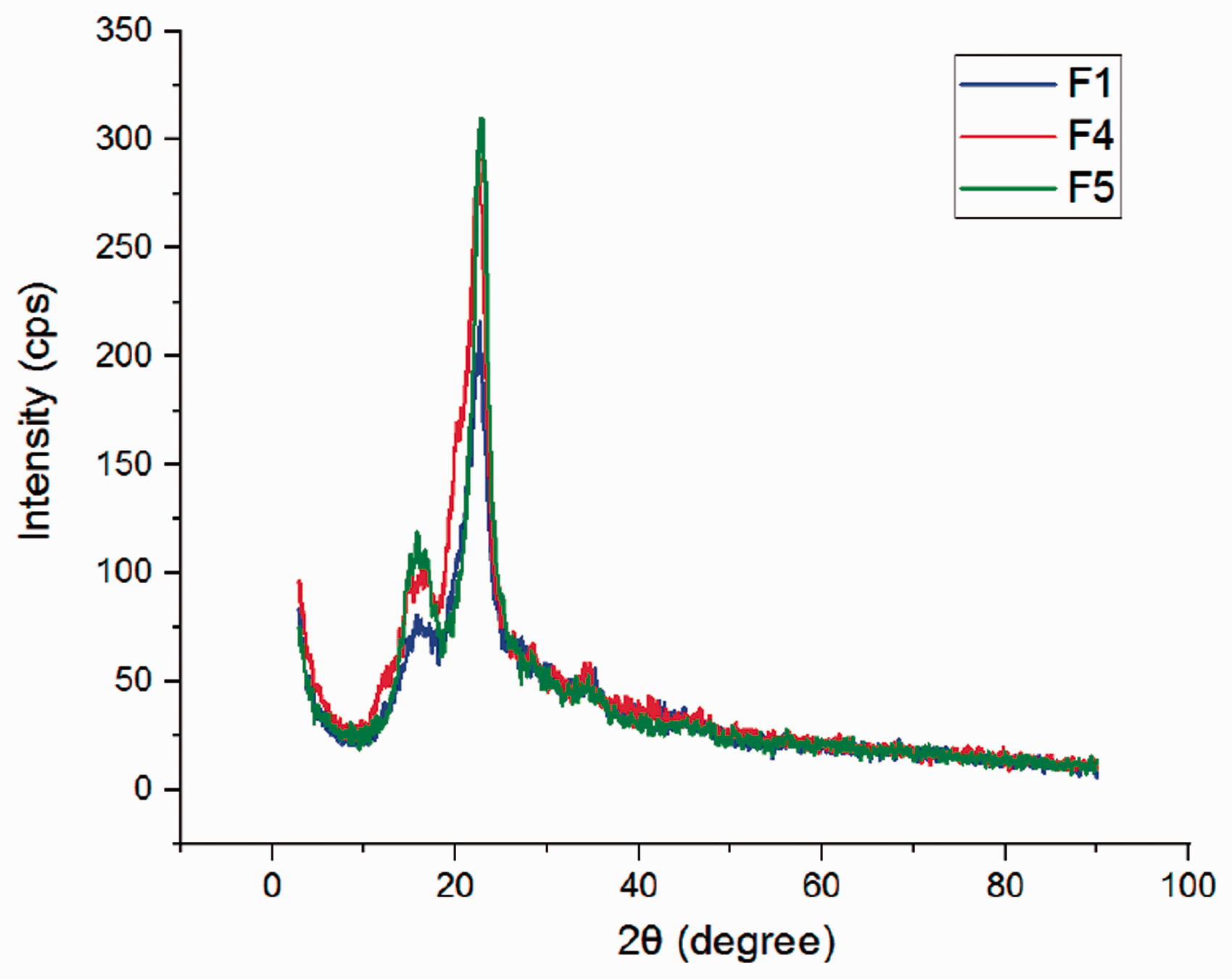


Conclusions
In this study, the mechanical performance and dispersible properties of commercially available flushable nonwovens were investigated. FTIR spectra and XRD patterns of nonwoven samples were also obtained before and after their disintegration process. The results indicated that while a noticeable increase was recorded in the extension of wetlaid products after the wetting process, their maximum load slightly decreased. Furthermore, the effect of the disintegration on the FTIR spectra of wetlaid products was not significant. On the other hand, the airlaid products had the lowest maximum load and extension values in wet conditions due to the removal of the binder of these samples when they are wet. The crystallinity indexes of all the tested samples were almost similar before and after the disintegration process. In addition, the disintegration of nonwovens was strongly related to their wet strength (in-use and post-use conditions), and the increase in wet strength gave rise to a simultaneous decrease in their disintegration percentage. The findings of the study will provide an insight to the researchers and manufacturers in an attempt to develop truly flushable wipes, which are more suitable for sanitary and other applications. Although all the components used are biodegradable, further studies will be required that focus on the biodegradability of flushable nonwovens to better understand their effects on the environment.
Footnotes
Acknowledgements
The authors would like to thank Dr Yasemin Seki and Shuangyan Wu for their support and suggestions throughout the study.
Declaration of conflicting interests
The authors declared no potential conflicts of interest with respect to the research, authorship, and/or publication of this article.
Funding
The authors disclosed receipt of the following financial support for the research, authorship, and/or publication of this article: The Scientific and Technological Research Council of Turkey (TÜBİTAK)—2219 International Post-Doctoral Research Fellowship Program.