



Abstract
Chinese women’s apparel and accessories have been often mentioned by other countries in history and nowadays, and the underlying culture along with these apparel and accessories contributes to this developing world to some extent. The assessment of the international reputation for these kinds of apparel and accessories is important for better understanding the worldwide cultural exchange, globalization, social development and so on; however, it remains unknown. This study presents a work with the overall objective to measure and predict the international reputation of Chinese women’s apparel and accessories. To reach this objective, the study first proposes a data mining procedure to use online query volume data from the Google Ngram corpus to construct a reputation index in order to measure the international reputation of Chinese women’s apparel and accessories. Then, by establishing a series of socio-economic and political determinants associated with the international reputation of Chinese women’s apparel and accessories, several forms of support vector machine based models are developed, aiming to predict their international reputation. There are two contributions out of this work: (1) presenting the first ever large-scale quantitative examination of the trend and measurement of the international reputation of Chinese women's apparel and accessories, which provides a new method to identify the dynamic transition of sociocultural development; (2) constructing a quantitative model to predict the international reputation of Chinese women's apparel and accessories, which generalizes an implication to understand the other sociocultural object and its impact factors.
Apparel is the term used for items worn on a body, and accessories are items contributing to apparel to complement a wearer’s look. 1 The reputation of Chinese women’s apparel and accessories refers that they are favorable and publicly recognized. 2 Chinese women’s apparel and accessories have a long history, and they play important roles in inspiring international apparel and accessories design. 3 Typical Chinese women’s apparel, such as the ruqun, has been mentioned in designing the kimono and hanbok, 4 and realistic flower patterns and traditional embroidery design processes have also been considered in the pattern design in several well-known apparel brands, such as Valentino and Elie Saab. 5 Besides, Chinese women’s apparel elements, such as straight sleeves, round collars and straight-line silhouettes, are well received in Western women’s apparel and accessories 6 ; in particular, brands such as Yves Saint Laurent and D&G like to use these Chinese elements. 5
The above worldwide influence of Chinese women’s apparel and accessories shows their international reputation and indicates the degree of Chinese culture contributing to this developing world. In order to have a better understanding of this reputation, the assessment of the international reputation is necessary, such as how good the reputation is, how it is formed, what the reputation is associated with and which factor accounts for more in influencing the reputation. However, to the best of our knowledge, such assessments have not yet been quantitatively investigated. Thus, this paper presents a study of measuring and predicting the international reputation of Chinese women’s apparel and accessories that solves the aforementioned issues. The paper is organized as follows. The second section discusses related work in the literature. The third section illustrates the methods of measuring and predicting the international reputation of Chinese women’s apparel and accessories. The fourth section presents the results. Finally, conclusions, discussions and future perspectives are given in the fifth section.
Related works
In the current literature, to the best of our knowledge, there are no measurement-related works regarding the reputation of apparel and accessories. However, quite a few measurements in other domains have been conducted; in particular, the reputation is commonly measured by statistics. For instance, Chen et al. 7 analyzed the international reputation of China's world cultural heritage in the past 500 years by calculating the frequency of China's world cultural heritage from Google books, and Zhang et al. 8 investigated the international reputation of Chinese cultural celebrities and masterpieces over the past 500 years by calculating their frequency through the same source. Manaman et al. 9 used the frequency of positive and negative tweets to represent a company’s reputation. Liu et al. 10 conducted a frequency analysis by applying the Baidu index to explore the urban reputation in China. Lande et al. 11 proposed an index of an author's reputation, which is generated by calculating the total citation numbers and the Hirsch index on Wikipedia and encyclopedias. Abdullah et al. 12 used a hybrid approach to extract opinions from Arabic tweets to measure service providers’ reputation by applying the number resulting from positive and negative tweets in the polarity equation to estimate reputation scores. Besides, the reputation can be measured through proposing comprehensive models when the object domain is complex. For instance, Navarro-Chávez et al. 13 developed a hybrid model by using partial least squares structural equation modeling (PLS-SEM) to measure the reputation of the Mexico government, where the government is a complex system. Similarly, Baruah and Panda 14 addressed a comprehensive model to measure the large-scale corporate reputation by scoring five broad categories including the guiding definition, methodology and data sources, multiple stakeholders emphasized and the extent of inherent objectivity, and considering their weights. In this work, the international reputation of Chinese women’s apparel and accessories is simply related to their appearance and the underlying cultural expression, 5 as a preliminary study; thus, statistics will be applied.
In order to predict a reputation, factors influencing the reputation should be clarified at the beginning. 15 Regarding the reputation of apparel and accessories, quite a few works show the links between the popularity of apparel, accessories and socio-economic and political factors. In the aspect of economy, Barron 16 found that since the Silk Road business activities had increased the economy and openness in the Tang dynasty and stimulated people's consumption desire, apparel consumption has become a prominent aspect; in particular, low cut blouses were the favorite for women in the Tang dynasty. Moreover, Zhao and Li 17 discovered that after China had carried out reform and opened up, a large amount of advanced equipment for fabric manufacturing had been imported, which largely expanded the apparel and accessories industry at that time. This kind of expansion also relied on social development and political influence. Another example in the aspect of policy is that in the early 1950s, after Mao Zedong released women's liberation theory, Chinese Soviet style apparel prevailed and was popular among women; in particular, the Lenin suit became the best representative due to its expression of political ideal and status. 18 In the aspect of culture, the Chinese thousands of years of feudalisms once affected the dress code of women. For example, the so-called Mingfu apparel was the apparel only worn by women who had a husband as an officer, and this apparel has its hierarchical levels that were determined by a husband’s job title. 19 This kind of apparel was quite popular in telling the public that the wearer’s family was noble at that time. Another example is what we presented in the first section in that many Chinese apparel and accessory elements are mentioned or referred to in worldwide apparel and accessory designs, and this is also triggered by social development and globalization nowadays. The above studies indicate that the popularity of apparel and accessories is somehow related to economy, policy, culture, social development and globalization. However, there is no method to illustrate the weight of these factors contributing to the popularity or reputation. Thus, the following study will take the existing works as a good foundation to investigate the measurement and prediction of the reputation of Chinese women’s apparel and accessories, where the weights for factors influencing the reputation are clarified.
Methodology
The study first builds an index to measure the international reputation of Chinese women’s apparel and accessories in last 500 years, and then develops a quantitative model to predict the reputation.
Reputation measurement
In this study, as we analyzed in the second section, the frequency ratio is applied to measure the international reputation of Chinese women’s apparel and accessories, and it is defined by

The data for measuring the international reputation of Chinese women’s apparel and accessories is from Google Books Ngram Viewer (2019, 3rd ed.). This database contains Google’s text corpora in English, Chinese (simplified), French, German, Hebrew, Italian, Russian and Spanish from 1500 to 2019. 20 The collection of these texts required manually scanning millions of books covering hundreds of years. 20 As of 2019, the English corpus alone comprised close to half a trillion words. This study uses the English corpus as the data source of the international reputation of Chinese women’s apparel and accessories due to the fact that English is a worldwide language, and this corpus contains a larger vocabulary than other languages do.
In order to obtain
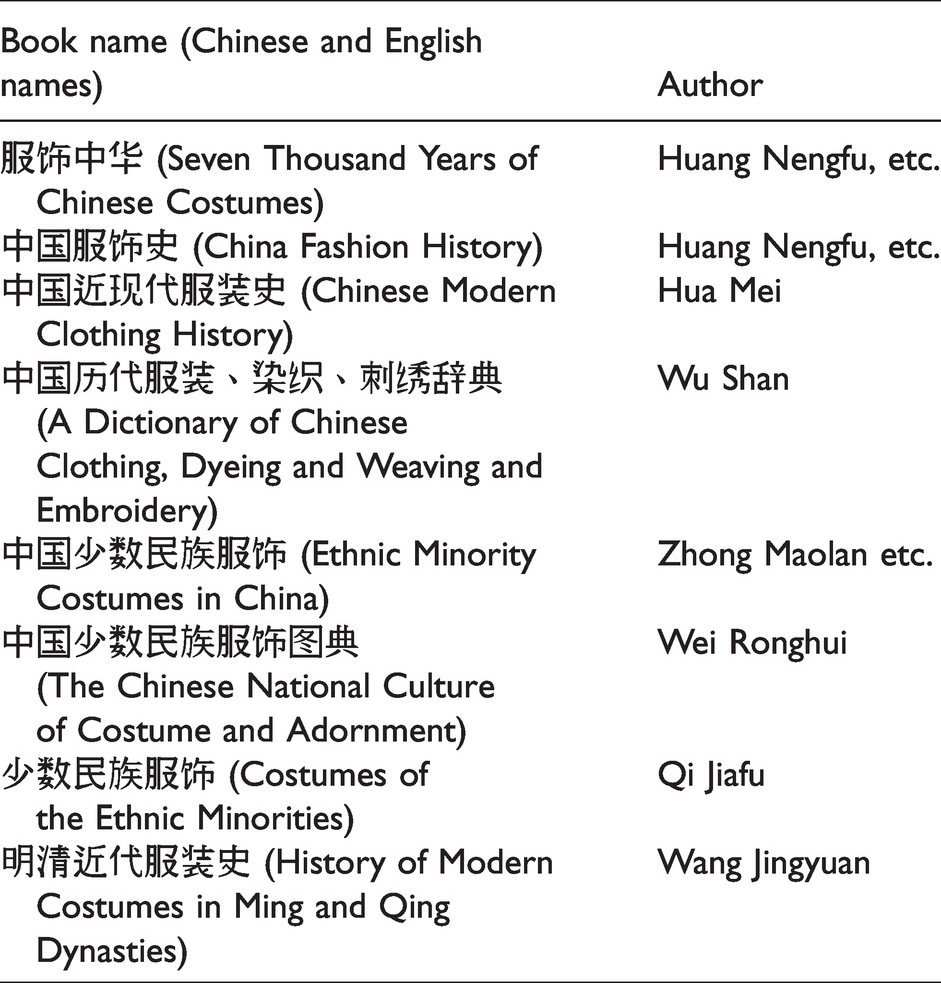
Eight Chinese classic books in the apparel and accessories domain
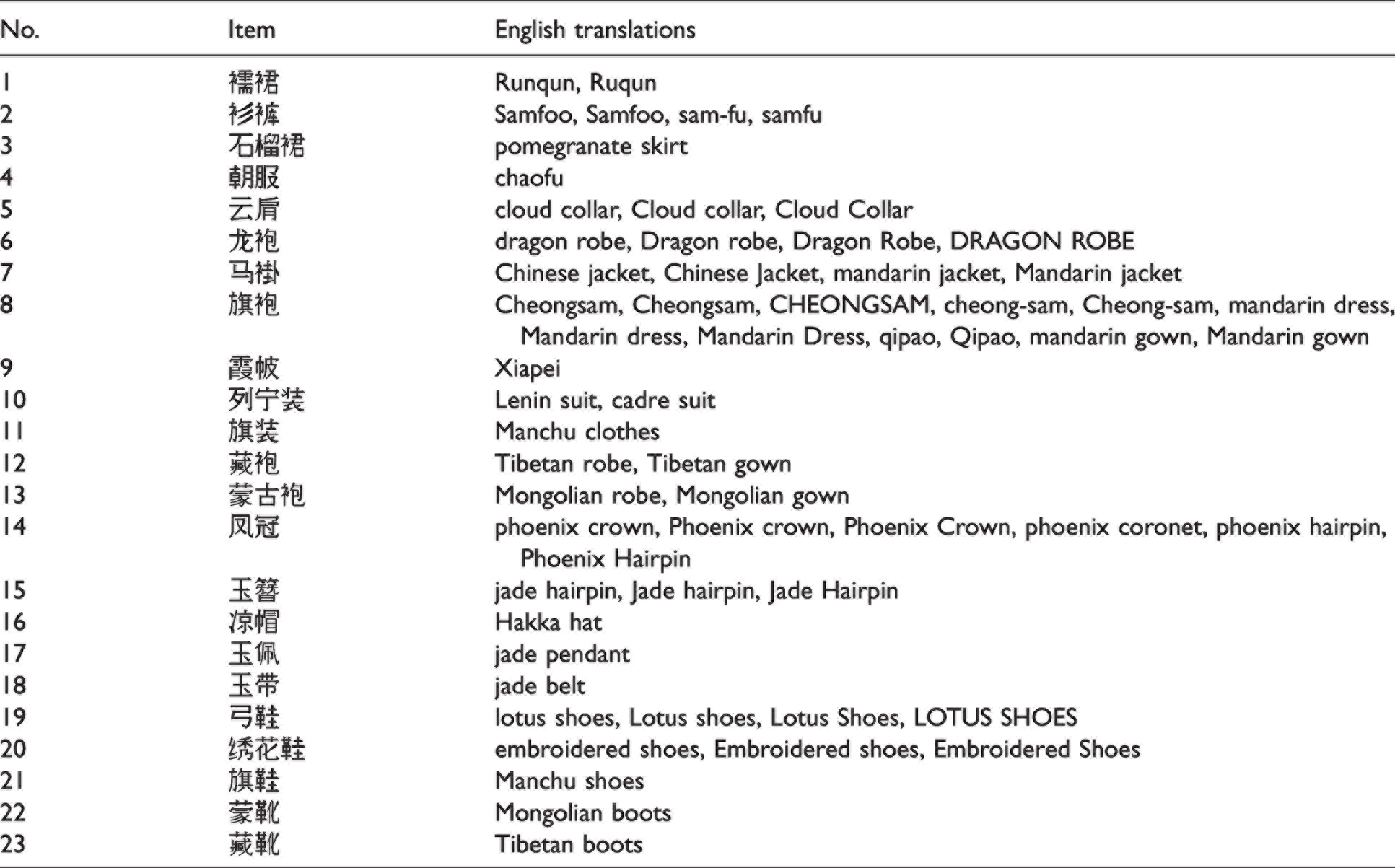
Full translations of terminologies for Chinese women’s apparel and accessories
Reputation prediction modeling
In the second section, we found the potential relations between the international reputation of Chinese women’s apparel and accessories and aspects of economy, policy, culture, social development and globalization from the popularity of women’s apparel and accessories. Each of the above aspects may include more than one indicator. Since our prediction is quantitative, our data for the indicators has to be quantitative as well. The data is in the time range of the last 500 years in our study, as mentioned in the Reputation measurement section. It can be noted that the features of the data are high-dimensional, large-scale and complex. Thus, the support vector machine (SVM) is selected to deal with our issue. The SVM is a type of machine learning technology that supervises learning models with associated learning algorithms analyzing data for classification and regression analysis, no matter whether the data is linear or non-linear.
21
It can not only efficiently deal with our featured data, but also can be robust even when the training samples have some bias, and it performed a fast prediction along with good accuracy.
22
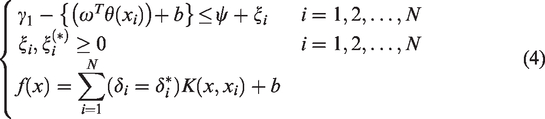
The network structure of a SVM can be seen in Figure 1. Given the training dataset Z = {

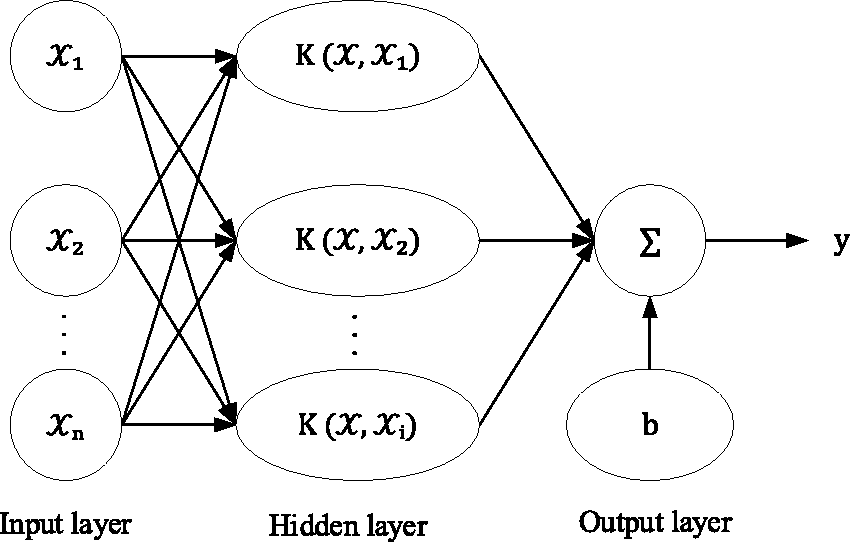
Schematic diagram of the support vector machine.
The SVM contains a useful technique kernel, and the kernel provides for choosing a function that can be linear or non-linear. 21 Different basic functions as the kernel can be used in the SVM, such as the linear function, polynomial (poly) function and radial basis function (RBF). 24 In this study, the aforementioned kernel functions are all applied in the SVM-based model development, and the one with the most accurate prediction will be found.
Results and discussion
Reputation measurement analysis
In terms of
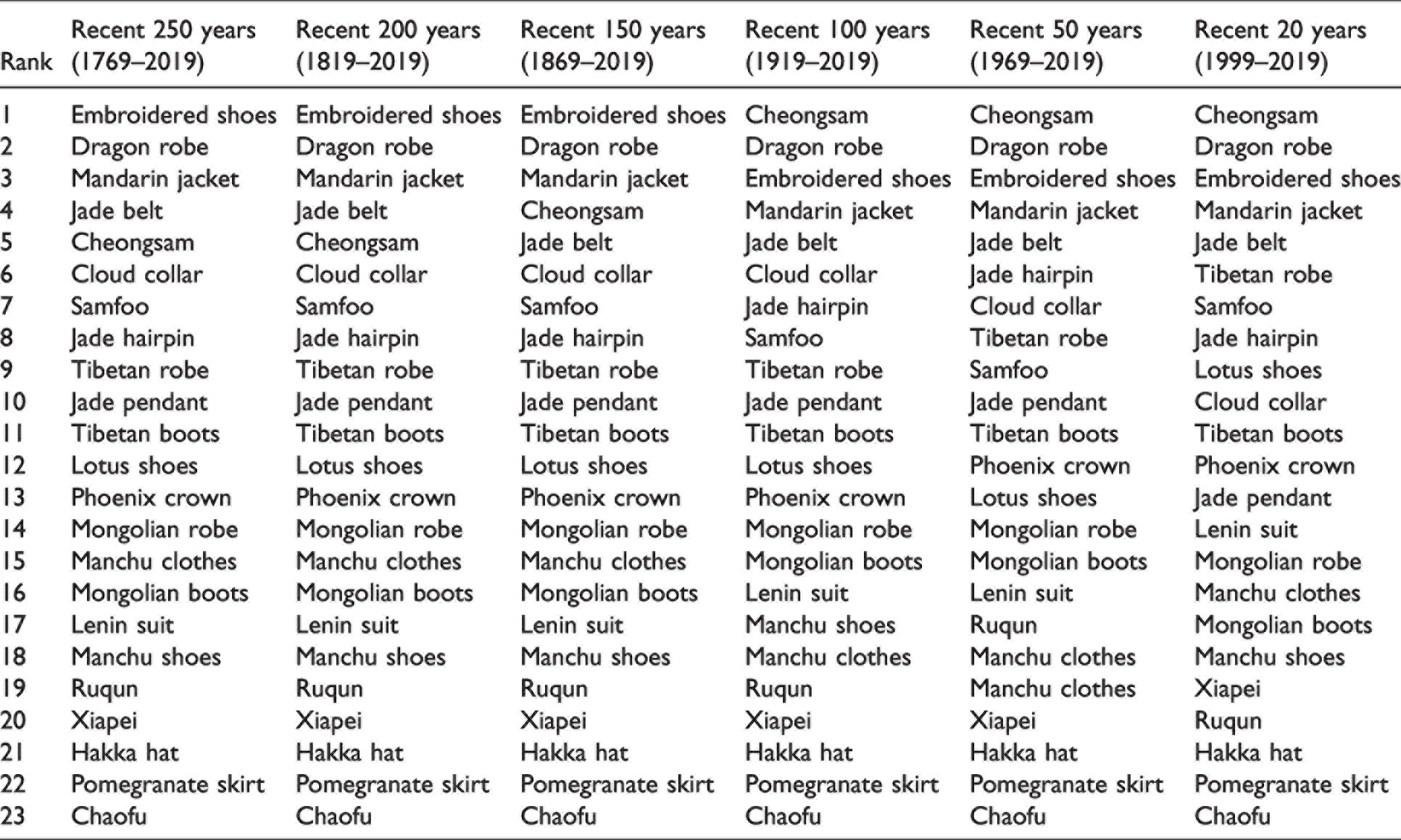
The rank of IR for Chinese women’s apparel and accessories

International reputation of some Chinese women’s apparel and accessories in the past 250 years.

International reputation of the cheongsam in the past 250 years.
As can be noted in Table 3, the average reputation ranking of the top 10 Chinese women’s apparel and accessories is generally stable in the past 250 years, and these are embroidered shoes, cheongsams, dragon robes, mandarin jackets, jade belts, cloud collars, samfoos, jade hairpins, Tibetan robes and jade pendants. In particular, embroidered shoes are top one from the most recent 250 years to the most recent 150 years, and this may due to the fact that embroidered shoes have been regarded as the national identity in China since the Spring and Autumn period. 25 Moreover, cheongsams are the top one from the most recent 100 years to the most recent 20 years. The reason may be that after the revolution of 1911, Han women began to wear cheongsams, and then they became popularized with the increased communication between China and Western countries. 26 It can be seen that the xiapei, hakka hat, pomegranate and chaofu are in the bottom four apparel items during the most recent 250 years. The reason is probably that they are applicable to a small range of people due to the generation gap, regional restrictions and apparel hierarchy. 27 In addition, it can be found from Table 3 that apparel from the top 15 to the top 21 slightly fluctuates during the most recent 250 years. For example, the international reputation ranking of the Lenin suit was 17th in the previous three stages, it stepped up to 16th in stages 4 and 5 and finally rose to 14th. This may because the Lenin suit appeared in the mid-1950s, and both women working in the party and government as well as female students in schools generally wore Lenin suits sewn with blue khaki. Since then, the Lenin suit has become more popular and used for women to express their political pursuits. However, with the deterioration of Sino–Soviet relations, the Lenin suit became less popular than that before. 18 Similarly, Manchu clothes ranks 15th in the first three periods, dropped to 18th in stages 4 and 5 and returned to 16th in stage 6; the situation was similar for Manchu shoes and ruquns. The reasons for these slight fluctuations are also similar to those of the Lenin suit, in that these kinds of apparel were popular corresponding to a specific era and activity. 28
To further discuss the evolution of the reputation of Chinese women’s apparel and accessories, this study gathers several typical Chinese women’s apparel and accessories in Figures 2 and 3. In Figure 2, behind the appearance of embroidered shoes, the dragon robe has the second-most appearances in 1796. Its reputation does not have too many changes until the peak year of 1952. The change of the cloud collar is similar to the dragon robe in that its reputation reaches a peak around 1952. The reason for these peaks may lie in that the founding of the People’s Republic of China brought a new cognition of China to the world, and thus more attention and understanding of Chinese apparel and accessories. 29 Around 1970, the reputation of embroidered shoes and dragon robes suffered troughs during the cultural revolution. However, after that, the dragon robe sharply increased and reached one of its peaks in the 1980s. This may relate to China's reform and opening up in 1978, which provided a political environment and support for the recovery and development of Chinese culture and opportunities for cultural and economic exchanges among countries. 30 It is noted that around 2008, the reputation of almost all apparel and accessories increased; in particular, embroidered shoes, dragon robes, jade hairpins and jade belts had very significant rises. This may be due to the 2008 Beijing Olympic Games, which brought an opportunity for the world to have a better understanding of China, including the culture of Chinese apparel and accessories. 31 Moreover, in Figure 3, the cheongsam, a well-known representative women's item of apparel in China, has a very similar transition as embroidered shoes and dragon robes have. The cheongsam’s reputation suffered troughs from 1962 to 1976 during the period of the Cultural Revolution in China, and significantly rose around 2008 during the Beijing Olympic Games. Therefore, it can be concluded that the reputation of these Chinese women’s apparel and accessories is connected with economic, political, cultural and social factors, as well as globalization, as discussed in the second section.
Reputation prediction analysis
Setting of interpreted variables and core explanatory variables
The international reputation of Chinese women’s apparel, denoted by
Data sources
All the original data, except for the NTL, come from the China Statistical Yearbook from 1997 to 2018. It is noted that even though we are studying the last 500 years, the earliest year of recording our required official data by the Chinese government is from 1997; thus, the prediction modeling only uses data from 1997 to 2018. Since the NTL data is not available, we calculated them from multiple data resources, including global satellite-observed NTL images from the Defense-Meteorological Satellite Program-Optical Line Scanner (DMSP-OLS) and Visible Infrared Imaging Radiometer Suite (VIIRS) Day/Night Band (DNB). 33 In addition, because of the long lifespan and the missing data in each indexing system, the interpolation method was used to fill in the data. 40 Also, in order to minimize the redundancy from a set of relations, we normalized the data of variables and converted them into [0, 1] intervals; the major statistics of the variables are shown in Table 4.
Descriptive statistics of the variables

GDP: gross domestic product.
Correlation analysis
Figure 4 shows the scatterplots between the interpreted variable IR and the explanatory variables. It can be seen that IR-NTL, IR-DTO and IR-CS are positive correlated. However, it seems there are no very strong linear correlations for IR-Ada, IR-NGO, IR-FTR and IR-FDI. Table 5 shows the result of Pearson correlation analysis, and it shows the similar correlations as illustrated in Figure 4. The P-values of IR-Ada, IR-NGO, IR-FTR and IR-FDI are larger than 0.05, which show the non-linear relationships for these explanatory variables and IR, and this phenomenon is consistent with Figure 4. It can be inferred from the high correlation coefficients of IR-NTL, IR-DTO, IR-CS and IR-FDI that economic development, cultural development and degree of globalization are the top three determinants in shaping IR.
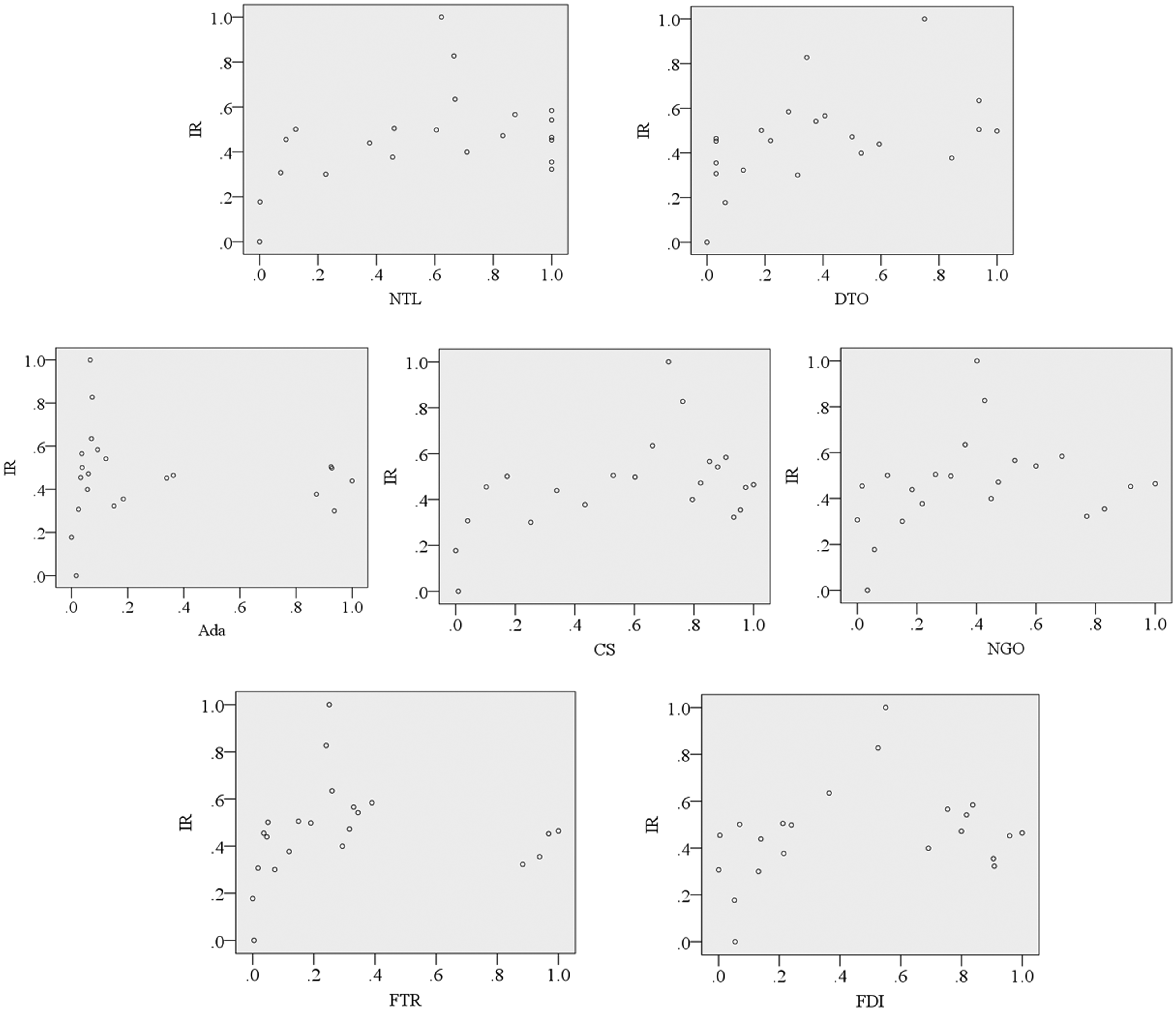
Scatterplots of the variables. NTL: nighttime light; DTO: degree of trade openness; Ada: administrative legislation; CS: college students; NGO: non-governmental organizations; FTR: foreign tourism receipts; FDI: foreign direct investment.
Pearson correlations with IR

Note: *, ** and *** denote the levels of significance test at 10%, 5% and 1%, respectively.
NTL: nighttime light; DTO: degree of trade openness; Ada: administrative legislation; CS: college students; NGO: non-governmental organizations; FTR: foreign tourism receipts; FDI: foreign direct investment.
SVM-based model
In order to deal with the aforementioned linear and non-linear relationships, and complex variables, SVM-based models are developed in this study to illustrate how the international reputation of Chinese women’s apparel and accessories are formed. During the model development, the input layer is the data of a set of explanatory variables including NTL, degree of trade openness (DTO), administrative legislation (Ada), college students (CS), non-governmental organizations (NGO), FTR and FDI, and the output layer is the data of the interpreted variable, which is the international reputation. We tried several combinations of the training data and testing data, including 75% for the training and 25% for the testing, 80% for the training and 20% for the testing and 90% for the training and 10% for the testing. Moreover, the linear function, poly function (including quadratic function and cubic function) and RBF were all applied in the study, as discussed in the Reputation prediction modeling section. The root mean square error (RMSE) is employed to check the accuracy of the developed models. The mathematical expression of the RMSE is as follows

Root mean square errors (RMSEs) for all model combinations (10−6)

RBF: radial basis function.

Observed IR and predicted IR.
Conclusions, discussions and future perspectives
In this paper, a new index of IR indicating the quantification of the international reputation of Chinese’s women’s apparel and accessories was first presented by employing a web mining technique. Then, by identifying the socio-economic and political determinants associated with IR, different combinations of training data, testing data and kernel functions of SVM-based models were developed to investigate weights of socio-economic and political determinants contributing to IR, and to quantitatively predict IR. The accuracy of the SVM-based models was evaluated by the RMSE.
The construction of IR and SVM models to measure and predict the international reputation of Chinese women’s apparel and accessories is meaningful, such that the subjective reputation can be quantified to an extent and weights of determinants contributing to the reputation can be carried out, thus providing a better understanding of Chinese women’s apparel and accessories. The implications of our study are that (1) Chinese women’s apparel and accessories are a kind of carrier illustrating Chinese culture, aesthetics, way of thinking, etc., in all ages, and by figuring out the determinants contributing to the reputation, we can find according ways to illustrate an authentic image of China, which is not only about the culture, but also politics and society; (2) our results regarding IR and SVM models can be a foundation for a further study on apparel and accessories. For example, apparel companies can use this method by taking the economic, political, cultural and social indicators as the input and investigating the popularity of apparel and accessories as the output, which can help them to make a decision on whether they should increase the production of such apparel and accessories, or they can predict the trend of apparel and accessories to an extent.
The main contributions of this study include the following: (1) the development of a quantitative approach to measure the international reputation of Chinese women's apparel and accessories with large-scale empirical evidence at the first time, and providing a new method to identify the dynamic transition of sociocultural development; (2) the construction of SVM-based models to clarify the weights of socio-economic and political determinants contributing to the international reputation of Chinese women's apparel and accessories, and thus come up with a way to quantitatively illustrate a sociocultural object and its impact factors.
Our work nevertheless has some limitations that deserve further discussion. The first limitation is the lack of multiple sources for selecting terminologies regarding Chinese women’s apparel and accessories. Although the Chinese books that we chose in the study are classic and authoritative for obtaining the terminologies of Chinese women’s apparel and accessories, other sources may also contain “informal” terminologies, such as online news, social media, online forums and so on. The single source apparently compromises the result of international reputation measurement toward Chinese women’s apparel and accessories. Future work is warranted to overcome this limitation with more types of sources to improve the result of the work.
The second limitation is the lack of consideration of global factors, such as countries’ socio-economy and culture across the globe, in affecting the international reputation of Chinese women’s apparel and accessories. The worldwide impact may contribute to forming the reputation to some extent. Thus, we would like to include global factors in our future work.
The third limitation is the limited selection of explanatory variables indicating the economic development, political development, cultural development, social development and degree of globalization. As a preliminary study, we only chose one or two indicators representing each of the above dimensions, which may not be inclusive for illustrating these dimensions. This limitation needs to be fixed in the future by involving more well-rounded indicators, and thus a more comprehensive prediction.
This study the applied frequency ratio and SVM for measuring and predicting the international reputation of apparel and accessories, respectively. There are several extensions to our current work, which need to be done. The first work is to employ more varied methods to measure the reputation, and a comparison between these methods can be carried out. A hybrid model may be employed. 41 The second work is to try other machine learning technology to predict the reputation and see its efficiency for the prediction. The artificial neural network (ANN) may be employed due to its success in similar domains of this problem. 1 It is noted that depending on the machine learning technology, the sample size has to be consistent with the technique. The ANN requires a larger sample size compared with the SVM.
Footnotes
Declaration of conflicting interests
The author(s) declared no potential conflicts of interest with respect to the research, authorship, and/or publication of this article.
Funding
The author(s) disclosed receipt of the following financial support for the research, authorship and/or publication of this article: This work was supported by the Humanities and Social Science Funds of the Ministry of Education (grant no. 21YJCZH239), the Fundamental Research Funds for the Central Universities (grant no. SWU2109241) and the Innovation Research 2035 Pilot Plan of Southwest University (grant no. SWUPilotPlan027).
