



Abstract
In this study, an equation to obtain reliable diffusion coefficients for the sublimation diffusion of disperse dye in paste into polyethylene terephthalate film using the film-roll method was derived from the solution of the diffusion equation with the constant surface concentration. The constant surface concentration in the equation, where the total amount of dye passed through the first-layer surface is a linear function of the square root of time, was obtained by the steady-state straight line for a sufficiently long heat treatment time. The diffusion coefficients were obtained by the constant surface concentration and the slope of the linear regression line for the plot of the total amount against the square root of time. Their reliability was proved by the good linearity of linear regression for the Arrhenius plot. The activation energy for the diffusion coefficients obtained by this equation was similar to that obtained by another equation derived from the solution with the time-varying second-layer surface concentration. The diffusion coefficients for data containing
The film-roll method is very useful for studying the kinetic behaviors of various dyes on polymer substrates and has long been used to measure the diffusion coefficients because the diffusion behaviors can be precisely observed and the ratio of concentration between adjacent layers can be easily determined by the concentration–distance curve.1–3 In a study on the kinetic behavior of vat dyes in cellulose, Sekido and Matsui
4
proposed a method for determining the diffusion coefficient by obtaining the variable
In a study on the sublimation diffusion behaviors of disperse dyes for transfer printing, Jones and Leung
5
proposed a technique for determining the diffusion coefficient by inserting a transfer-print paper and two films between the top and bottom hot plates, by constantly replacing the transfer-print paper at the top and the film at the bottom with fresh paper and film every 15 seconds, and by applying the equation
It was expected that the film-roll method could also be applied to sublimation diffusion, so the factors influencing the sublimation diffusion of disperse dye in paste into polyethylene terephthalate (PET) film were investigated using the film-roll method,
6
and the diffusion coefficients were determined by obtaining the variable
In the first attempt to obtain the diffusion coefficient for the sublimation diffusion of disperse dye in paste into PET film,
In the second attempt, on the premise that the steady-state condition was set up at a sufficiently long heat treatment time, the equation for obtaining the diffused total amount by the steady-state first-layer surface concentration and the steady-state diffusion length was derived from the solution of the diffusion equation in the form of a trigonometrical series.
10
The linearity of the diffusion coefficients obtained from the steady-state straight lines was very good
In the third attempt, the equation for obtaining the steady-state first-layer-passed total amounts passed through the second-layer surface was also derived from the solution of the diffusion equation in the form of a trigonometrical series. The diffusion coefficients were determined by the time lag obtained from the plot of the steady-state first-layer-passed total amounts against time, the steady-state first-layer surface concentration, and the steady-state second-layer surface concentration.
11
The linear regression line for the Arrhenius plot had good linearity
In the fourth attempt, on the premise that the second-layer surface is the surface for the diffusion of the time-varying surface concentrations, the equation for obtaining the total amount passed through the second-layer surface was derived from the solution of the diffusion equation for the diffusion of the time-varying second-layer surface concentrations.
12
The reliability of the diffusion coefficients for the diffusion of the time-varying second-layer surface concentrations was identified by the Arrhenius plot
In this study to find an equation for obtaining a more reliable diffusion coefficient for the sublimation diffusion of disperse dye in print paste into PET film using the roll method, the equation for obtaining the total amount passed through the first-layer surface was derived from the solution of the diffusion equation for a semi-infinite medium whose surface was maintained at a constant surface concentration. The constant surface concentration was obtained by the steady-state straight line at a sufficiently long heat treatment time. The reliability of the diffusion coefficients obtained by the constant surface concentrations and the slopes of the linear regression lines for the plots of the total amounts passed through the first-layer surface with respect to the square roots of times was proved by Arrhenius plots and by comparison with the diffusion coefficients for the diffusions of the time-varying second-layer surface concentrations.
Materials and method
Materials
Biaxially oriented PET film with a thickness of 40 μm was supplied by SKC Co. Ltd (Suwon-si, Gyeonggi-do, Rep. of Korea). Sumikaron Bordeaux SE-BL (C. I. Disperse Violet 26, Sumitomo Chemical Co. Ltd) was used for disperse dye without purification. Sodium alginate (Duksan Chemicals, Inc.) of extra pure grade was used.
Preparation of paste and film roll
The paste was prepared by mixing 35 g of sodium alginate, 300 g of dye, and 665 g of water. The dye concentration was determined as the concentration satisfying the infinite dye-bath condition through preliminary experiments. A schematic diagram illustrating the film-roll preparation process is shown in Figure 1. The thickness of the film and the height of the film layers were enlarged at a ratio of 25:1 to the size of the glass rod. The PET film of 0.004 cm thickness and 58 cm length was wound tightly around a glass rod of 2 cm diameter (a). Both edges of the film roll were wound with aluminum tape of 0.5 cm width to make barriers of 0.018 cm height. The paste containing dye was primarily coated on the surface of the film roll between both barriers to be about 0.01 cm thick and was dried in a dryer at 100°C for 5 minutes (b). The paste was finally coated on the surface of the primarily coated paste to be 0.018 cm thick and was dried at 100°C for 5 minutes. The surface of the paste-coated film roll was wrapped with aluminum tape to prevent the paste from falling off the film surface and to prevent the dyes in the paste from sublimating into the air (c). A round glass rod was pressed and both barrier parts of the glass rod were tied tightly with cotton yarn to prevent dye penetration for dividing the film layers (d).9–12
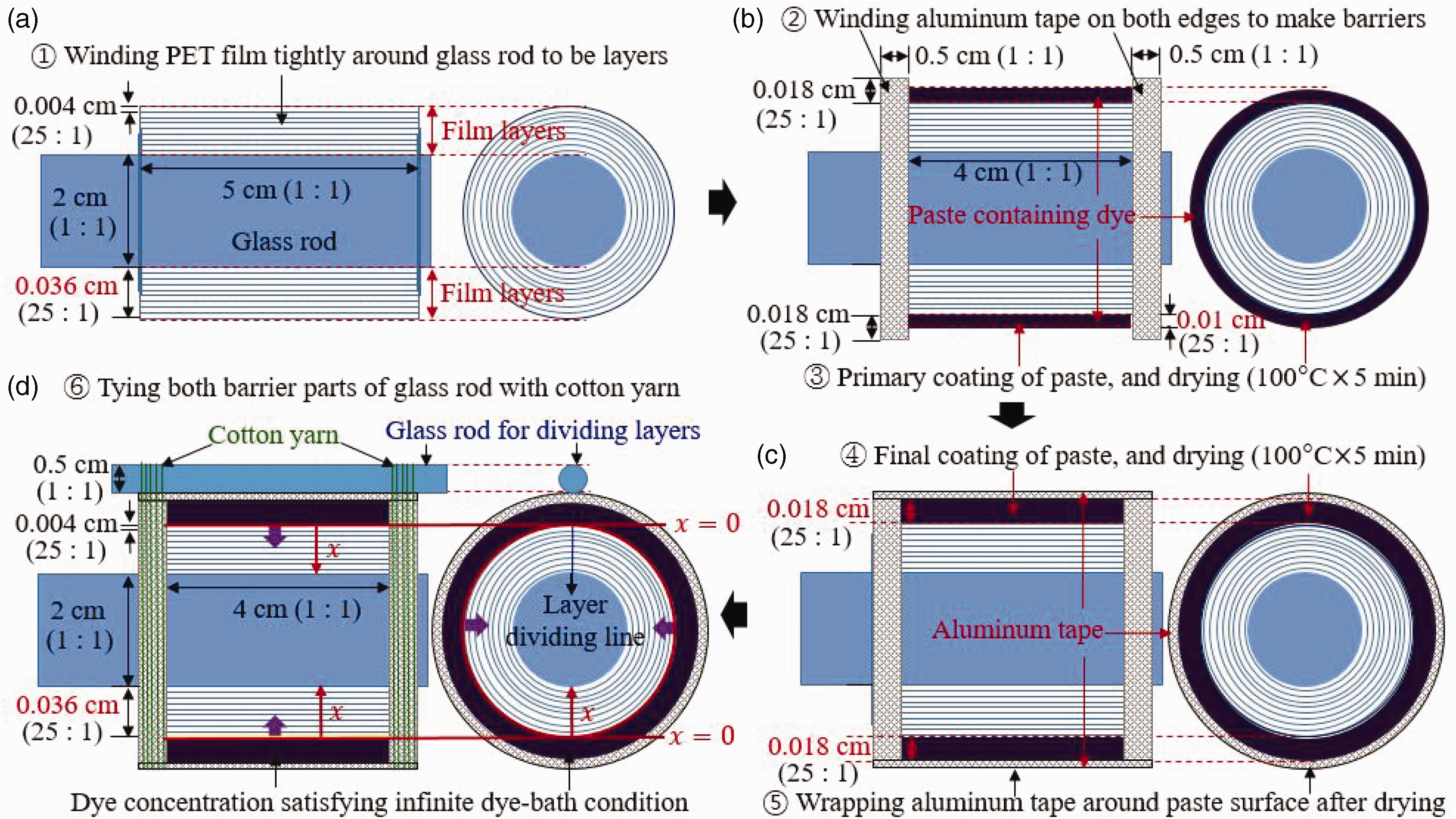
Schematic diagram illustrating the overall film-roll preparation process, including the paste coating. PET: polyethylene terephthalate.
Heat treatment
The heat treatment of the film roll was performed in a laboratory curing chamber at 170°C, 180°C, and 190°C for various times. The heat-treated film roll was washed with water after removing the coated paste, unrolled, and cut into the section pieces.
Determination of mean dye concentration
To extract the dye in the film, each section piece was immersed individually in a test tube containing chlorobenzene of 20 mL and heated at 132°C until the dye was completely extracted.
13
The optical density at the maximum absorption wavelength of the dye was measured using a spectrophotometer (Agilent Cary 8454) and the mean dye concentration
Results and discussion
Diffusion equation with constant surface concentration
When the diffusion coefficient is constant, the diffusion equation for the diffusion in one dimension is given by






By this dilation property, a solution
In order to obtain a special solution of the form

Similarly, since

Combining Equations (7) and (8) with Equation (1) gives


The second ordinary differential




Since the boundary condition is

Since the initial condition is

Therefore,

The rate of transfer,

Let

The rate of transfer at


The slope of the linear function of

Since

Determination of constant first-layer surface concentration
In order to obtain the diffusion coefficient
Mean dye concentration of each layer over various heat treatment times at 190°C
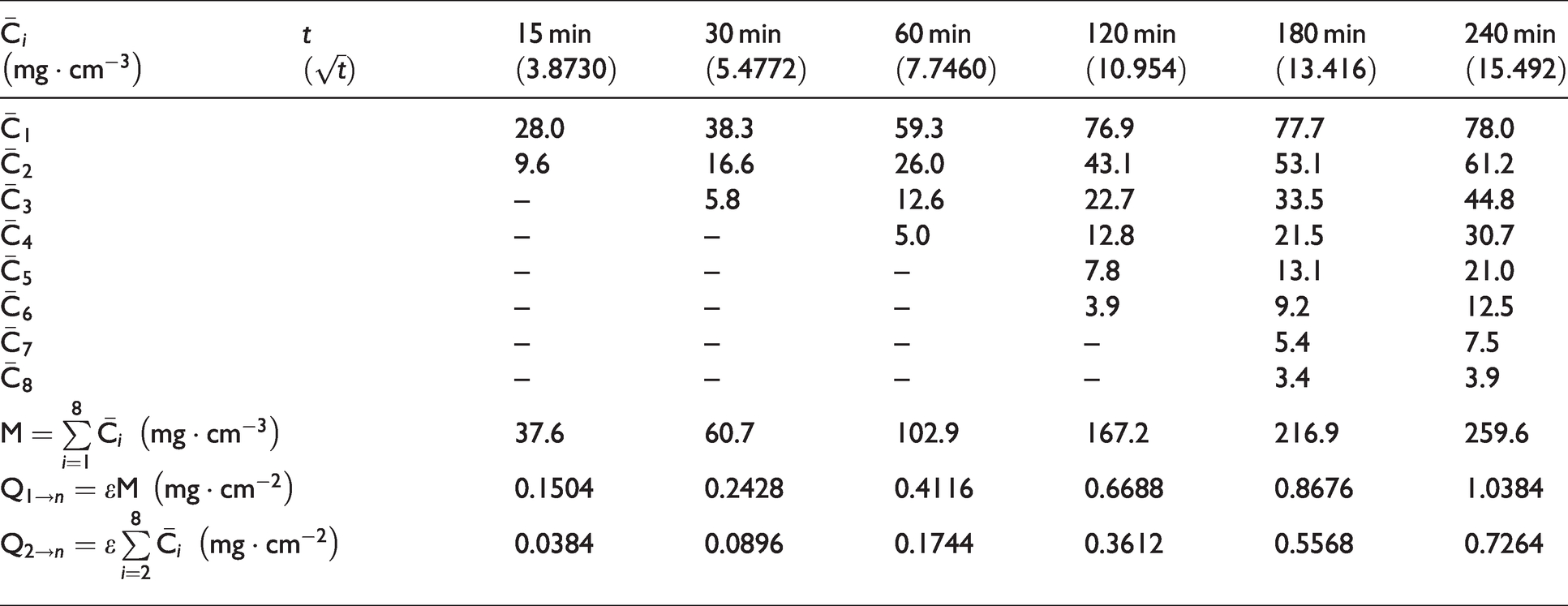
The value of
Figure 2 shows the distance–concentration distributions according to the heat treatment times for the diffusion at 190°C under the same condition as the infinite dye-bath and the steady-state concentration distribution deduced from the diffusion for 240 minutes. As time increased,

Concentration–distance curves over time and steady-state concentration distribution for diffusion at 190°C.
Assuming that the concentration distribution for the diffusion at 190°C for 240 minutes satisfies the steady-state condition approximately and the steady-state straight line passes through 
Since 
Converting Equation (26) into a quadratic equation for 
Therefore,
Table 2 presents the mean dye concentration (
Mean dye concentration of each layer over various heat treatment times at 180°C


Concentration–distance curves over time and steady-state concentration distribution for diffusion at 180°C.
Table 3 shows the mean dye concentration (
Mean dye concentration of each layer over various heat treatment times at 170°C

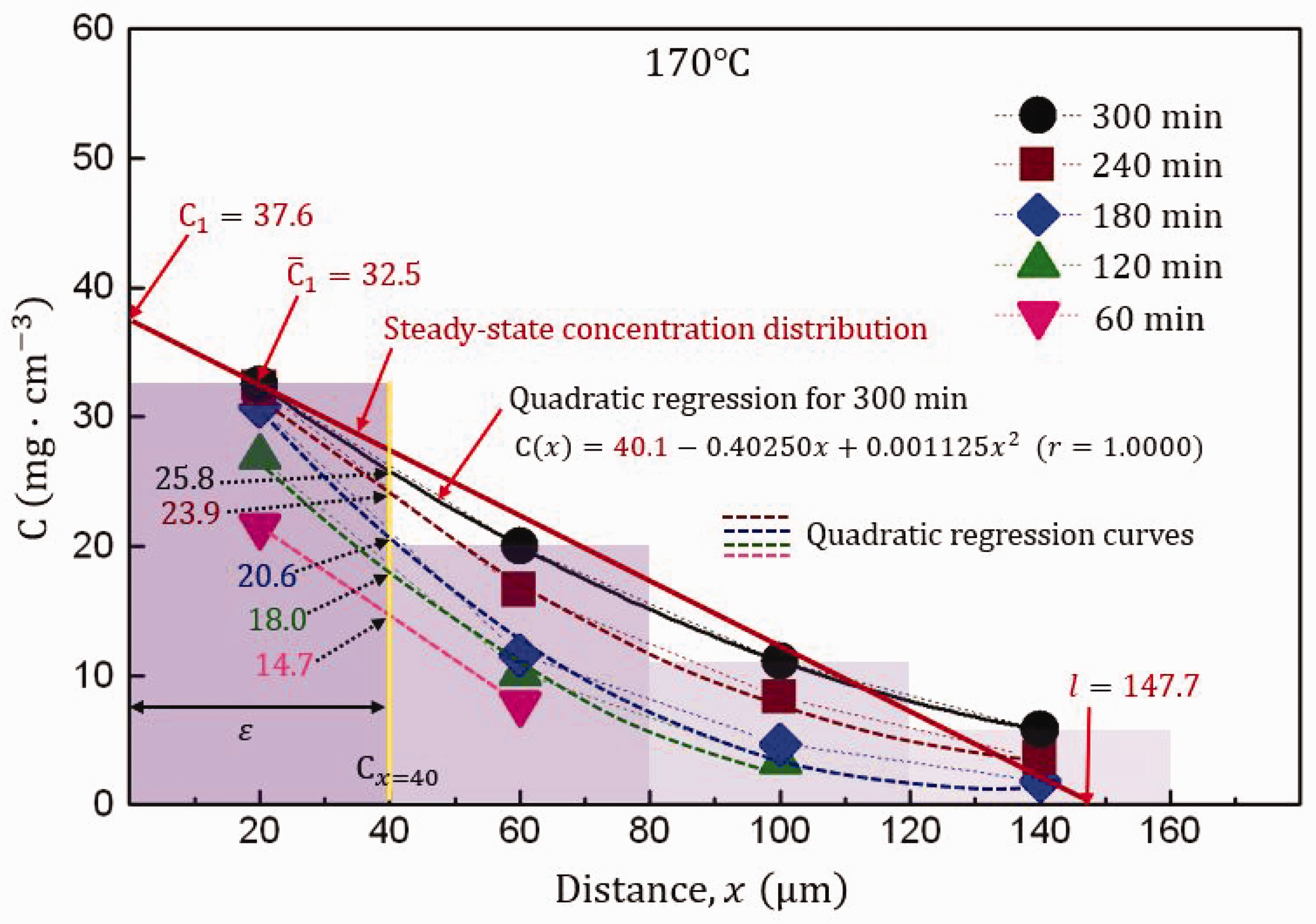
Concentration–distance curves over time and steady-state concentration distribution for diffusion at 180°C.
Diffusion coefficient by constant first-layer surface concentration
According to Equation (22),
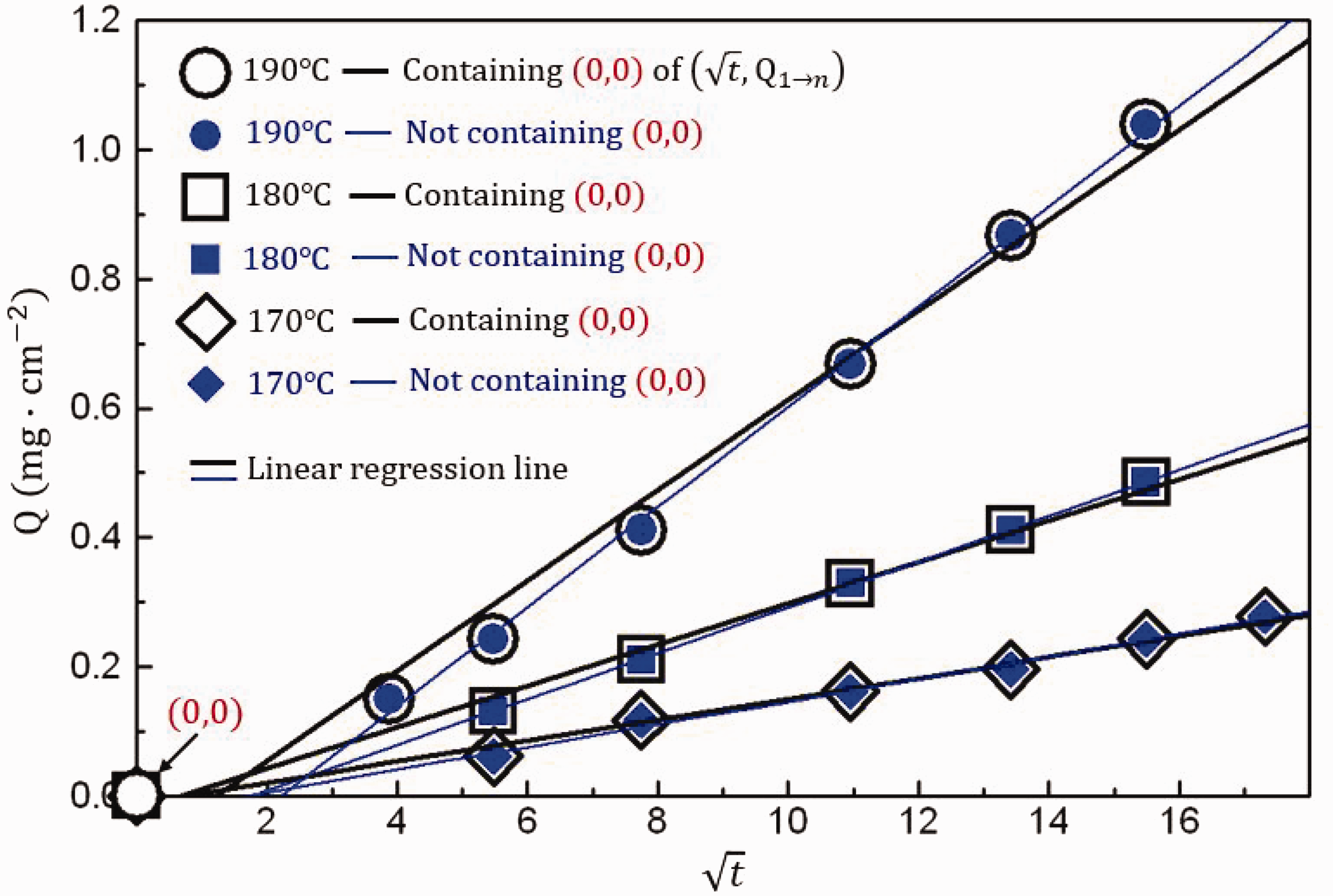
Plots of total amounts against square roots of treatment times for diffusions at 170°C, 180°C, and 190°C.
Correlation coefficients

In the diffusion at 190°C, the correlation coefficient of linear regression for data not containing
In the diffusion at 180°C, the correlation coefficient of linear regression for data not containing
In the diffusion at 170°C, both the linear regression line for data not containing
Diffusion coefficient by time-varying second-layer surface concentration for comparison
In a previous study on the diffusion of the time-varying surface concentrations, the solution of the diffusion equation for 
Figure 6 shows the surface with constant 
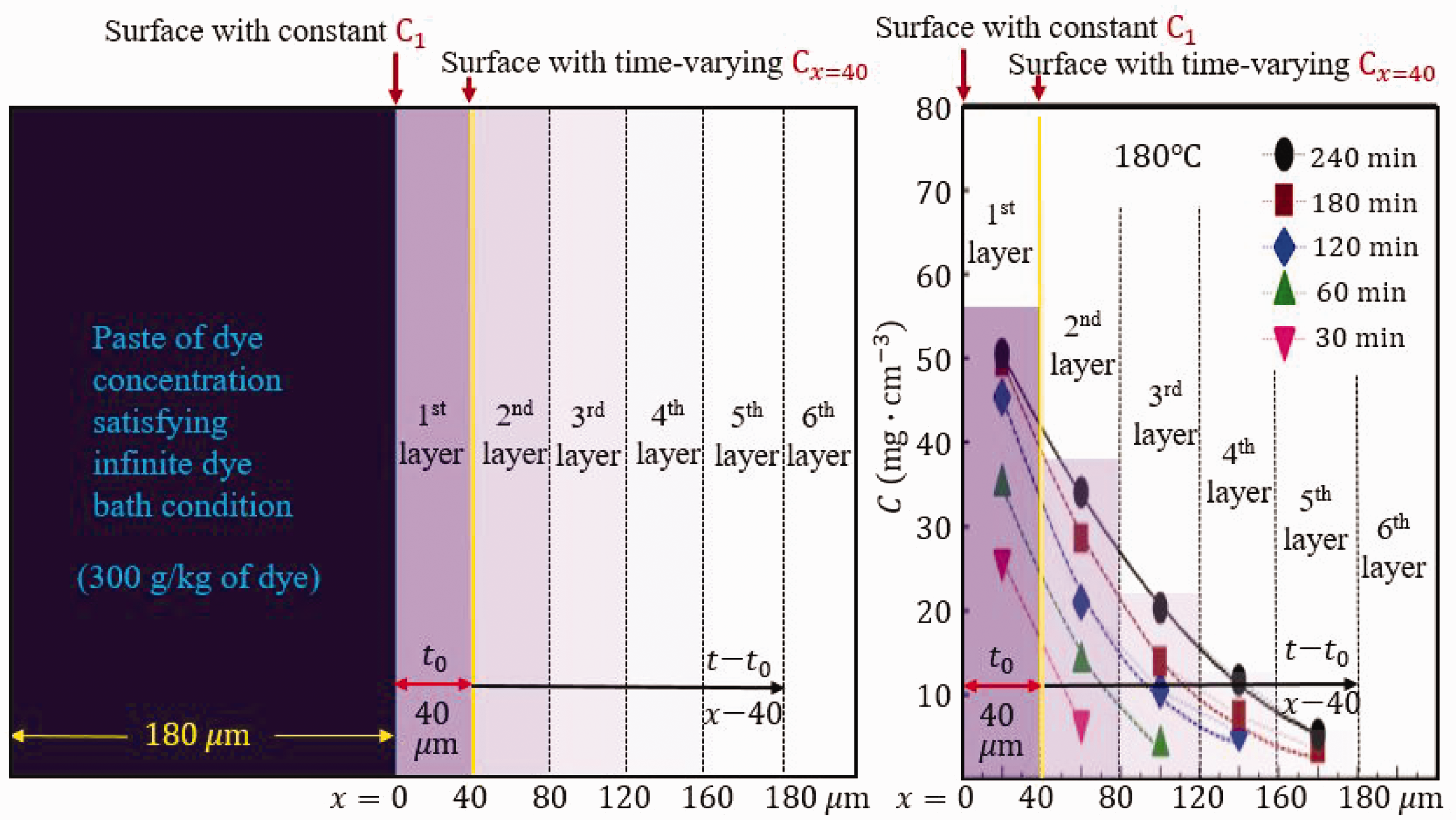
Surface with
The rate of transfer 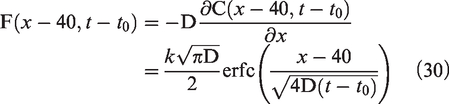
Since 
The total amount 
The delay time
Let us put 
Figure 7 shows the plots of

Plots of total amounts for time-varying second-layer surface concentrations against heat treatment times.
Time-varying second-layer surface concentrations according to square root of treatment time
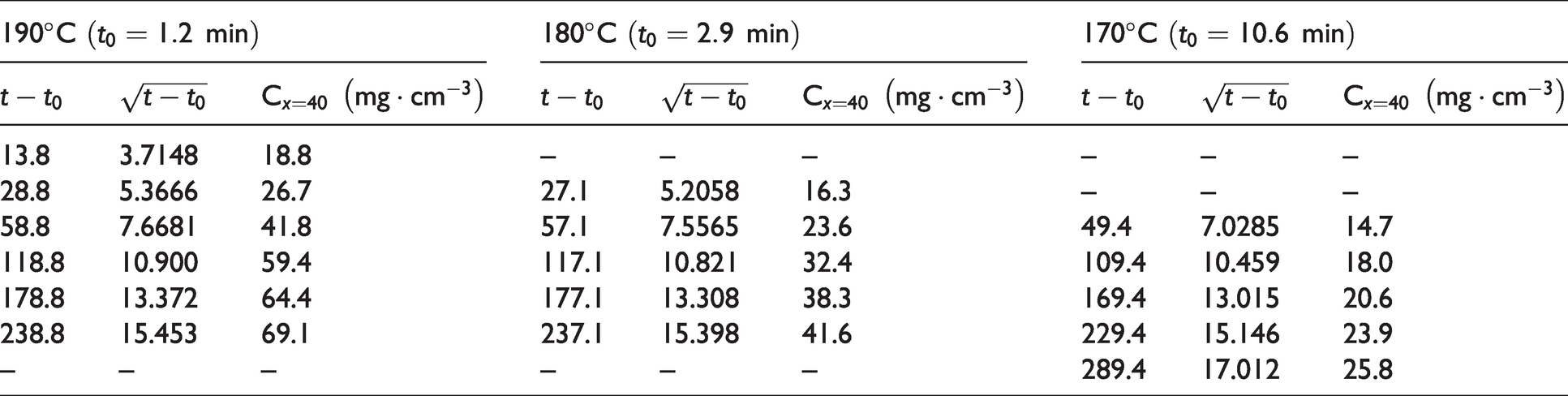
Figure 8 shows the linear regression lines for the plots of
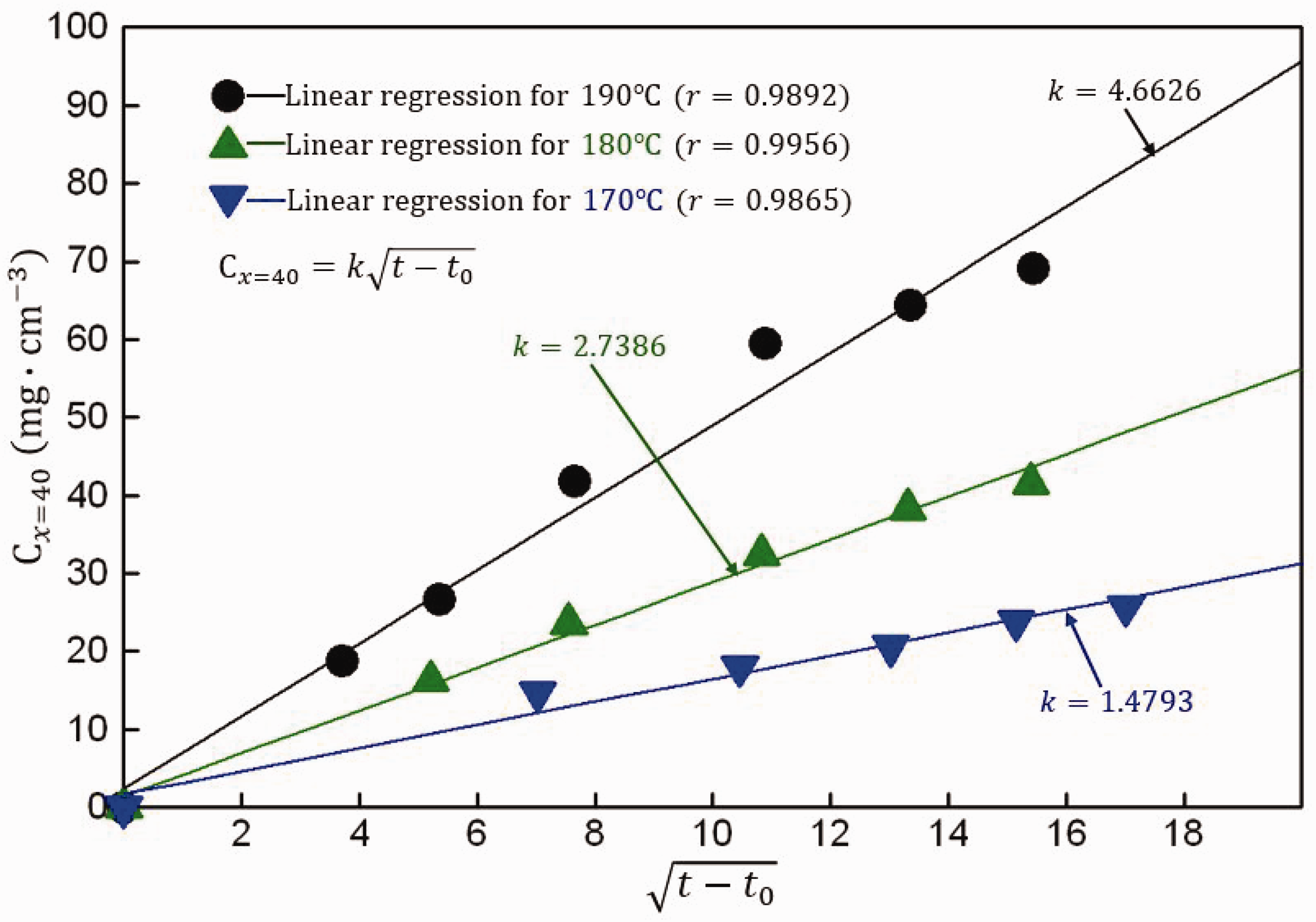
Plots of time-varying second-layer surface concentrations against square roots of diffusion times.
Arrhenius plot and activation energy
The dependence of the diffusion coefficient on temperature is given by the Arrhenius equation as follows


The activation energy 
The closer the correlation coefficient of linear regression for the Arrhenius plot is to 1, the clearer it becomes that the diffusion coefficient for diffusion at a specified temperature is constant and the reliability of the diffusion coefficients increases. In this study, the linearity of linear regression for the Arrhenius plot was used to prove the reliability of the diffusion coefficients obtained by Equation (22) and to confirm that the diffusion coefficient for diffusion at a specified temperature is constant. The activation energies were also used to prove the reliability of the diffusion coefficients by comparing them with that for the diffusion coefficients by the time-varying second-layer surface concentrations.
The diffusion coefficients
Diffusion coefficients for constant first-layer surface concentration and time-varying second-layer surface concentration

Figure 9 shows the Arrhenius plots for

Arrhenius plots of diffusion coefficients for constant surface concentration and time-varying surface concentration.
Conclusions
In order to find an equation for obtaining a reliable diffusion coefficient for the sublimation diffusion of disperse dye in paste into PET film using the film-roll method, an equation where the total amount of dye passed through the first-layer surface is a linear function of the square root of time was derived from the solution of the diffusion equation with the constant surface concentration. The constant surface concentration was obtained by the steady-state straight line at a sufficiently long heat treatment time. The diffusion coefficients obtained by the constant first-layer surface concentration and the slope of the linear regression line for the plot of the total amount against the square root of time have been proven highly reliable by the good linearity of linear regression for the Arrhenius plot. The activation energy for the diffusion coefficients obtained by the equation with the constant first-layer surface concentration was similar to that obtained by another equation with the time-varying second-layer surface concentration. The diffusion coefficient
Footnotes
Declaration of conflicting interests
The author(s) declared no potential conflicts of interest with respect to the research, authorship, and/or publication of this article.
Funding
The author(s) received no financial support for the research, authorship, and/or publication of this article.
