



Abstract
Knitted seamless sportswear offers ‘body-mapped’ comfort and support, but there is a risk of exposing the human body in public due to the low density and large fabric deformation of the sportswear when wearing it. This paper presents an experimental study on the light transmission behavior of different weft-knitted fabrics for seamless sportswear in different stretching modes to understand the light transmission principle. Three plain knit fabrics for seamless sportswear made from three yarn combinations were compared: a polyamide 6 (PA6) yarn, a combination of spandex and PA6 yarns, and a combination of spandex, PA6, and polyethylene terephthalate (PET) yarns. Three modes of stretching were performed on the three fabrics, namely uniaxially, uniaxially with transverse restraint, and biaxially, to simulate wear deformation. The stretched fabrics are analyzed in terms of cover factor, thickness, and light transmission. The results showed that light transmission increases with increasing tensile strain. The presence of restraint further increases the light transmission, and biaxially stretched fabrics have the greatest light transmission. The thinnest PA6 fabric has the lowest cover factor and the highest light transmission, while plating a spandex/PA6 covered yarn on a PA6 yarn shrinks and tightens the fabric, and therefore reduces the light transmission. Adding an additional PET yarn reduces shrinkage and thickness, increasing light transmission. Light passing through the fibers and loop meshes of a fabric accounts for total light transmission. Plating a coarser elastomeric yarn into weft-knitted fabrics for seamless sportswear is an effective way to increase the spaces in yarns and shrink the loop meshes, thereby reducing the light transmission.
Keywords
Sportswear has remarkably increased in demand as people are becoming more conscious of living a healthy life. Seamless knitting not only eliminates seams from sportswear construction that could often be irritating to the skin, but also offers superior characteristics, including soft handling, tight-fitting, light weight, and pleasing aesthetics.1,2 Consequently, there is an increasing demand for seam-free sportswear that delivers the required ‘body-mapped’ performance attributes. 3 The properties are accomplished by adopting a variety of elastomeric fibers, structure variations, and jacquard patterns. As seamless knitted sportswear is usually sheer, low density, light-colored, and tightly fitted, the visual shielding capacity is insufficient to hide or mask the human body or dark underwear on the back of its stretched fabric. In particular, sportswear deforms on the buttocks largely in both coursewise and walewise directions when doing sports. As shown in Figure 1(a), sportswear is in a relaxed state. However, when worn, it immediately deforms on the buttocks (Figure 1(b)) and the deformation becomes greater as the movements change (Figures 1(c) and (d)), which increases the risk of exposure. It is extremely embarrassing to appear virtually naked in public while wearing low visual shielding-capable seamless sportswear.

Diagrams of different deformations of sportswear on the buttocks: (a) relaxed state; (b) standing still; (c) performing a squat and (d) standing forward bend.
The light transmissivity of fabrics, which is a measure of the visual shielding capacity, is a result of the construction of the fibers, yarns, and fabrics.4,5 The main factors include fiber fineness, internal voids and cross-sections, yarn twist, fineness and structure, and fabric pattern, color, thickness, and cover factor.6,7 The structural uniformity and fineness of the fiber affect the reflection interface. The number of reflection interfaces in the fibers increases dramatically when the number of internal voids increases and the diameter decreases, so that the opacity is improved.8–10 A profiled fiber endows the fabric with higher visual shielding capability than a round cross-sectional fiber, because the profiled fiber has the ability to change the light incident angle and increase the rate of light reflection and scattering inside the fibers and yarns. 11 Liu and Wang 12 developed a theoretical model and investigated the optical properties of a single trilobal cross-section fiber and a single quadrilobe cross-section fiber. Under the same conditions, the quadrilobe cross-section fiber can increase the rate of light reflection and scattering inside the fibers and yarns when compared with trilobal cross-section fibers, and give the fabric a lower light transmission. Adding high-refractive index mineral fillers is an effective method to enhance fiber opacity. 13 Titanium dioxide (TiO2) or carbon black (CB) particles are usually added to profiled fibers to increase multidirectional light scattering.14–18 Wang et al. 19 reported that increasing the amount of TiO2 and its diameter can increase the intensity of scattering, decreasing light transmission. Normally, a proportion of 2.5–4% TiO2 or 0.0025–0.005% CB was added. 20 A lower proportion of CB is added to avoid severely altering the fiber color. To further minimize the influence on fiber color, a core/sheath structure was adopted by adding CB in the fiber core with a profiled sheath. 21 However, adding more TiO2 and CB particles to the fibers not only wears out spinning and knitting machines, but also reduces fiber strength.
Yarn constructions also play an important role in determining the visual shielding capability of fabrics. False twist polyester yarn that had a crimp of 10–26% and a TiO2 content of 4.0–12.0% was reported to improve opacity. 22 A covered composite yarn composed of an air-textured core and outer yarns was used to reduce the transparency of synthetic fibers. 23 TEIJIN Fibers Ltd developed an opaque composite multifilament yarn, of which the outer yarn is a porous polyester multifilament of porous fibers, and the core yarn is a false twist textured polyester multifilament containing 3.0–12.0% TiO2. 24
The fabric architecture, thickness, tightness, and color are also important to fabric opacity. A warp-faced woven shielding fabric was developed by interlacing a set of weft yarns with two sets of warp yarns to prevent 90–100% of light from passing through. 25 A triple-layer gauze fabric was developed to exhibit high opacity, in which the surface and back layers were woven with hollow yarns and the middle layer connecting the two layers was woven with ordinary yarns. 26 Szmyt and Mikołajczyk 27 measured the light transmission of 10 decorative knit curtains with different jacquard patterns and found that the greater the cover factor, the lower the light transmission. Kumar et al. 28 reported that red and violet curtain fabrics have much lower light transmission than ivory and indigo fabrics under natural light conditions, because ivory and indigo have higher RGB values, making light easier to transmit.
A series of transparency prevention products have been developed and commercialized for military uniforms, 18 leisurewear, 29 sportswear, curtains, etc. However, the methods adopted in woven fabrics by adding TiO2 to the fibers, utilizing textured yarns and composite-covered yarns, or increasing fabric tightness, are not suitable for weft-knitted fabrics for seamless sportswear to reduce their light transmission. High-quality and fine yarns are needed to knit sheer and elastic fabrics because seamless knitting machines usually have fine machine gauges of E28 and higher. The addition of TiO2 and the adoption of textured or composite-covered yarns will impair the knittability and elasticity of the fibers. Moreover, seamless sportswear is tight-fitting and highly stretchable in use, so increasing the fabric tightness does not work as well as woven fabrics. Hence, there is a need to seek new methods to enhance the opacity such that it matches that of sheer and elastic knitted fabrics, and a thorough understanding of the light transmission principle is a prerequisite. In this work, the light transmission of different weft-knitted elastic fabrics for seamless sportswear under different stretching modes was experimentally investigated using a spectrometer capable of recording the light transmission of visible light. This study is expected to inspire textile technologists to find new and effective solutions to enhance the visual shielding capacity of sheer seamless knitted sportswear.
Experimental details
Materials
In this study, three knit fabrics that cover the majority of fabrics used in commercialized seamless sportswear were selected, as shown in Figure 2. Their yarn materials and specifications are listed in Table 1. The fabrics were knitted on a seamless circular knitting machine (SANTONI SM8-TOP2 FAST) with a plain knit stitch. While the fabric knitted with a white 70D (77.78 dtex) polyamide 6 (PA6) yarn is denoted as SF1, which is the thinnest and lightest among the samples, SF2 was knitted by plating a 20/30D (22.22/33.33 dtex) spandex/PA6 covered yarn to a 70D (77.78 dtex) PA6 yarn, and SF3 was knitted by plating a 20/30D (22.22/33.33 dtex) spandex/PA6 covered yarn to a plied yarn from a 75D (83.33 dtex) black polyethylene terephthalate (PET) yarn and a white 70D (77.78 dtex) PA6 yarn. The tension of the spandex/PA6 covered yarn during knitting is 3 cN.

Fabric photographs: (a) SF1; (b) SF2 and (c) SF3.
Yarn materials and specifications of the fabrics

PA6: polyamide 6; DTY: drawn textured yarn; PET: polyethylene terephthalate; FDY: fully drawn yarn.
Test methods
A Hitachi S-4800 field emission scanning electron microscope (FE-SEM) was used to examine the morphologies of the three fabrics in the relaxed state. A YG028 electronic fabric strength tester (Ningbo Dahe Instrument Co., Ltd, Zhejiang, China) was used to test the three fabrics for their elastic recovery properties according to ISO 20932-1:2018 and to characterize their tensile properties according to ISO 13934-1:2013. The specimen is cut to a rectangle of 200 mm × 50 mm and the test gauge is 100 mm. The loading and unloading rates are 500 mm/min and the elongation is 60% for the elastic recovery test, while the loading rate is 100 mm/min for the tensile test. The tensile strength and the elongation at break were determined at the first breakpoint on the tensile load–displacement curve. The cover factor and thickness of the fabrics were measured in the stretching state from 0% to 25% at an interval of 5%. Loop images of the stretched fabrics were captured via a microscope (NIKON SMZ745T) and processed using MATLAB 2021b (MathWorks, Inc.). The cover factor is the ratio of the looped yarn area to the overall area of the image, which is calculated by the following:

Fabric thicknesses were measured using a digital thickness gauge (Shenzhen Yuanhengtong Science and Technology Co., Ltd, Shenzhen, China). The shape factor is the ratio of the coursewise density per inch to the walewise density per inch, and it can be calculated by the following:

The light transmission of the fabrics in different stretching states was measured using a spectrometer (Ocean, USB2000+), for which the working principle is described in Figure 3. Light from the source propagates to the fabric through an optical fiber, and then light transmitted to the fabric propagates to the spectrometer through the other optical fiber. The light transmission data were collected at a wavelength ranging from 400 to 800 nm. The intensity value of the light source is set from 40,000 to 60,000 counts, and the light spot of 5 mm diameter is located at the center of the sample. All the test results are average of three tests.

Schematic diagram of the light transmission test.
The fabrics were stretched uniaxially without transverse restraint, uniaxially with transverse restraint, and biaxially up to different strains in tests to simulate the deformation of seamless knitted sportswear in wear. A pair of jigs was specially produced to perform the three test modes, as shown in Figure 4. The jig was made from acrylic, which is a hollow rectangle with an outer profile of 14 cm by 14 cm and an inner profile of 10 cm by 10 cm. Consequently, three different specimens were used for the three test modes. For the uniaxial without restraint mode, a rectangular specimen of 20 cm × 10 cm was used (Figure 4(a)). The width of the specimen is equal to the hollow width, so the fabric can be stretched axially along the Y-axis at an interval of 0.5 cm (5% strain) without restraint from the two transverse sides (Figure 4(d)). For the uniaxial with restraint mode, a cross-shaped specimen was utilized for which the fabric was cut to have the shape shown in Figure 4(b) consisting of four rectangular borders for clamping. The fabric can be stretched axially along the Y-axis at an interval of 0.5 cm (5% deformation), while the two transverse fabric borders clamped by the jig remain unchanged (Figure 4(e)). For the biaxial mode, a cross-shaped sample was also utilized for which the fabric was cut to have the shape shown in Figure 4(c) consisting of four rectangular borders for clamping. The two pairs of fabric borders on both the transverse and vertical sides of the sample can be adjusted to stretch or clamp along the X- and Y-axes, so the fabric can be stretched biaxially in the X- and Y-axes at an interval of 0.4 cm (5% strain) to 25% (Figure 4(f)). In stretching tests with restraint, extra clips were used to fix the two jigs to ensure that the fabric borders are firmly constrained.

Samples for the three stretching modes: (a), (d) uniaxial without restraint mode; (b), (e) uniaxial with restraint mode and (c), (f) biaxial mode.
Results and discussion
The morphology and mechanical properties of fabrics
The structures and morphologies of the three fabrics are different in terms of pores, loop shapes, and yarn crimp, as shown in Figure 5. The stretch and recovery load–displacement curves of fabrics up to 60% are shown in Figure 6. Three-dimensional (3D) scan data indicate that the deformation of a human leg in flexion ranges from –20% to 30%. 30 Therefore, a tensile strain of 60% is adequate to analyze the elastic recovery properties of seamless knitted sportswear.

Scanning electron microscopy images of the three fabrics: technical face of (a) SF1, (b) SF2, and (c) SF3; technical back of (d) SF1, (e) SF2, and (f) SF3.

Stretch and recovery load–displacement curves of the fabrics: (a) coursewise and (b) walewise.
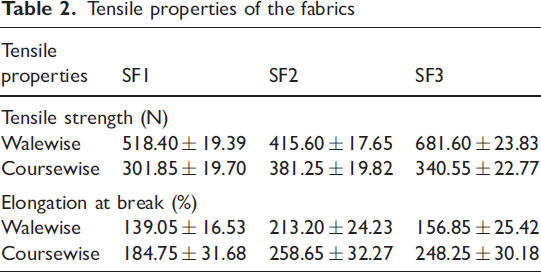
On the technical face, SF1 knitted with a PA6 yarn has a rough and full surface with pores of different sizes, and its loops are uniform and relatively loose. On the technical back, SF1 has uniform semicircular needle loops and sinker loops. SF1 has the highest tensile load but the lowest recovery in both coursewise and walewise directions among the three fabrics, and the walewise load is higher than its coursewise load. By contrast, SF2 has a smooth surface with few pores, and the loops are irregular and compact on the technical face, but on the technical back, the yarns are curled and disordered. SF2 has the lowest load and the highest recovery. This is because the PA6 face yarn was plated with a spandex/PA6 covered yarn that shrank and tightened the fabric, which makes the fabric easier to stretch and gives the fabric a better elastic recovery. There are few uniformly sized pores on the relief surface of SF3, and the loops are full and regular on the technical face. The yarns are arranged on the technical back more regularly than those in SF2, but less so than in SF1. SF3 has intermediate load and recovery. This is due to the high bending stiffness of the polyester yarn, which prevents the contraction of the fabric induced by the spandex/PA6 covered yarn. The addition of spandex yarn shrinks SF2 and SF3, which enlarges the gaps among fibers in the shrunk yarns, thereby increasing the number of internal voids for scattering of light. The tensile properties listed in Table 2 are consistent with the stretch and recovery results. SF1 and SF2 have the lowest and highest elongation at break, respectively. Plating the spandex/PA6 covered yarn shrinks SF2 and therefore increases the elongation. The addition of polyester yarn reduces the shrinkage of SF3, so its elongation decreases.
Tensile properties of the fabrics
Cover factors and thicknesses of stretched fabrics
The yarn arrangements in the fabrics are varied under different stretching modes, as shown in Figure 7. It can be observed that all three fabrics stretched with restraint up to 25% have larger meshes than those without restraint. This is because the fabrics become narrower when stretched without restraint, which is called the Poisson effect, minimizing the pores. When the fabrics are stretched with lateral restraint, their widths remain unchanged, so the pores are enlarged as the fabrics elongate axially. Likewise, the pores of the fabrics are enlarged both coursewise and walewise when stretched biaxially. In addition, it is evident that the pores in SF1 are the largest and those in SF2 are the smallest among the three fabrics, regardless of the tensile modes. The spandex yarn inside SF2 shrinks the fabric, and therefore its loops with higher elastane content in the yarn are not as wide as those of SF1 at the same strain of 25%. 31 It is also noted that the loops open wider when stretched coursewise than when stretched walewise. Stretching in the coursewise direction straightens the arched needle loops and sinker loops and then elongates the yarns to enlarge the loops. However, stretching in the walewise direction only elongates the initially straight side limbs, which has little effect on the pore size of the fabrics. 32

Loop images of the fabrics at a strain of 25%: (a) SF1, (f) SF2, and (k) SF3 stretched walewise without restraint; (b) SF1, (g) SF2, and (l) SF3 stretched coursewise without restraint; (c) SF1, (h) SF2, and (m) SF3 stretched walewise with restraint; (d) SF1, (i) SF2, and (n) SF3 stretched coursewise with restraint; (e) SF1, (j) SF2, and (o) SF3 stretched biaxially.
The light transmission of a fabric is believed to decrease with increasing cover factor and thickness. Hence, these two important factors are examined. As the fabrics elongate and deform, their cover factors and thicknesses decrease, as shown in Figures 8 and 9, respectively. Compared with fabrics stretched axially with restraint, those stretched axially without restraint have a higher cover factor and thickness, but those stretched biaxially have a lower cover factor and thickness. In addition, the fabrics stretched walewise have a higher cover factor and thickness than those stretched coursewise. As the fabric is stretched coursewise, the initially arched needle loops and sinker loops are flattened and straightened. Meanwhile, the gaps among fibers in a yarn under tension are diminished to further reduce the cover factor and fabric thickness. By contrast, as a fabric is stretched walewise, the initially straight side limbs are straightened, and fibers in the yarns are also compactly packed. This explains why all fabrics are thinner when stretched coursewise than walewise at the same strain. When a fabric is stretched biaxially, both arched loops and straight side limbs are straightened and their fibers are packed tightly, so the cover factor and fabric thickness are the lowest among the three stretching modes. Among the three fabrics, SF3 has the highest cover factor regardless of the stretching mode, due to it having the largest areal density resulting from the thickest yarns used. However, SF3 is not as thick as SF2 due to the lower shrinkage. SF2 has a higher cover factor and thickness than SF1 due to its initial shrinkage.

Fabric cover factor under stretching: (a) SF1; (b) SF2 and (c) SF3.

Fabric thickness under stretching: (a) SF1; (b) SF2 and (c) SF3.
Light transmission of fabrics
Knitted fabrics are multiscale porous media. The sizes of the spaces between the fibers and the meshes between the yarns are different. Light not only transmits through the fibers, but also through those spaces and meshes. Highly compact fibers have more light transmitted through the fibers, whereas more spaces between fibers reduce the light transmitted through the yarns due to light scattering. Seamless knitted sportswear fabrics deform in the coursewise and walewise directions and biaxially while worn in daily physical activities. Complex deformation changes spaces in yarns and meshes in fabrics, so the light transmission behavior of fabrics is highly complicated.
Visible light transmission from 400 to 800 nm of the three fabrics stretched in the three modes is presented in Figures 10–12. In the relaxed state, all three fabrics are almost opaque, because their light transmission is around 1%, 0%, and 0.1% for SF1, SF2, and SF3, respectively. By contrast, the light transmission of stretched fabrics differs significantly. Generally, the thinnest and lightest SF1 has the highest light transmission, the thickest SF2 has the lowest light transmission, and the heaviest SF3 has a moderate light transmission. As the fabrics are stretched, the light transmission increases with increasing tensile strain, regardless of the stretching mode. The direction of stretching and the presence of restraint greatly affect the light transmission of the fabrics. Coursewise stretched fabrics have higher light transmission than walewise stretched fabrics. The presence of restraint further increases the light transmission of all the fabrics. Biaxially stretched fabrics have the greatest light transmission.

The light transmission of SF1 under (a) walewise stretching and (b) coursewise stretching without restraint, and under (c) walewise stretching, (d) coursewise stretching with restraint and (e) biaxial stretching at different strains.

The light transmission of SF2 under (a) walewise stretching and (b) coursewise stretching without restraint, and under (c) walewise stretching, (d) coursewise stretching with restraint, and (e) biaxial stretching at different strains.

The light transmission of SF3 under (a) walewise stretching and (b) coursewise stretching without restraint, and under (c) walewise stretching, (d) coursewise stretching with restraint, and (e) biaxial stretching at different strains.
The light transmission of the three fabrics in the three stretching modes has different features. Figures 10(a) and (b) show that the light transmission curves of SF1 stretched without restraint have two distinct phases. In the first phase ranging from 400 to 480 nm, light transmission increases substantially and gradually for stretching in the walewise and coursewise directions, respectively. Light transmission remains relatively constant up to 800 nm in the second phase. In the relaxed state, the fabric has high light absorption in short wavelength light. In addition, white fabrics have lower ultraviolet (UV) transmission and gradually increased visible light transmission. 33 As the strain increases, the slope of the first phase for walewise stretching increases, but that for coursewise stretching is equivalent. The possible reasons for this phenomenon might be twofold. Firstly, stretching in the walewise direction tensions the loop side limbs and, therefore, narrows the spaces between fibers in the PA6 yarn, reducing light transmission in the short wavelength region. Secondly, the Poisson effect in the absence of restraint produces unevenly sized meshes in the fabric and some of the meshes in the center of the sample are minified, possibly decreasing the light transmission in the short wavelength region. As shown in Figure 6, the coursewise extension is greater than the walewise extension, which weakens the above two effects, so the slope change at 400–480 nm for coursewise stretching is lower than that for walewise stretching. Figures 10(c) and (d) show that SF1 stretched in the walewise and coursewise directions with restraint has relatively constant light transmission throughout the whole spectrum. This mode of stretching not only tensions fibers in the yarns, but also enlarges the meshes formed by the yarn loops. In this connection, more light passes through both the fibers and the meshes, so the light transmission is higher in the uniaxial stretching with the transverse restraint mode than that without the restraint mode. The light transmission curves of SF2 stretched without restraint plotted in Figures 11(a) and (b) are similar to those of SF1. However, the light transmission curves of SF2 stretched with restraint in Figures 11(c) and (d) are not as constant as those of SF1. The first phase has gradually increased light transmission and the second phase has relatively constant light transmission. The addition of the spandex/PA6 covered yarn shrank and thickened the PA6 yarn, leading to more curved fibers and therefore more spaces between fibers, as shown in Figure 5(b). Stretching SF2 in the coursewise and walewise directions with restraint of up to 25% does not fully straighten the curved fibers in the PA6 yarn to diminish the spaces between fibers, as shown in Figures 7(h) and (i). Hence, uneven spaces in the stretched SF2 result in lower light transmission in the short wavelength region. Figure 12 shows that stretched SF3 has relatively constant light transmission throughout the whole spectrum regardless of restraint. This is because the PET yarn in the fabric is a black fully drawn yarn (FDY) composed of straight and stiff PET fibers, which prevent the contraction of the fabric induced by the spandex/PA6 covered yarn. The PA6 fibers in SF3 are not as curved as those in SF1 and SF2, so the effect of spaces on the light transmission is not evident.
Biaxial stretching not only simultaneously tightens the yarns in terms of needle loops, sinker loops, and side limbs, but also opens the meshes, as shown in Figures 7(e), (j), and (o). In this regard, more light can pass through both the fibers and the meshes. The light transmission curves of the three fabrics under biaxial stretching are much greater than those under uniaxial stretching with or without transverse restraint. For example, at the strain of 25%, the thickest SF2 has the lowest transmission of about 7%, the thinnest SF1 has more than twice the transmission of SF2, and the heaviest SF3 has intermediate transmission of about 11%. SF1 is found to have the highest risk of exposure from wearing it, since light transmission can increase from 1% in the relaxed state to 17% at a biaxial strain of 25%. Plating a spandex/PA6 covered yarn significantly reduces the risk of exposure, while adding an additional black PET yarn increases the risk of exposure. 34
Influence of the cover factor on light transmission
The light passing through the meshes accounts for a large portion of the light transmission of the stretched fabrics. Plating a spandex yarn or adding an additional PET yarn significantly affect the mesh sizes of fabrics under stretching in different modes, thereby altering their light transmission behavior.
Stretched fabrics with larger meshes have a lower cover factor. The average light transmission ranging from 550 to 620 nm is used to plot the relationship between the light transmission and the cover factor in Figure 13. Light transmission is shown to decrease as the cover factor increases, regardless of the stretching modes. It is also observed that the three fabrics have different light transmission when their cover factors are equivalent. Under uniaxial stretching without transverse restraint, SF1 has the highest light transmission and SF2 has the lowest light transmission. This implies that more light passed through the yarns in SF1 than in SF2. The thickest SF2 has more spaces between PA6 fibers that increase the intensity of light scattering, reducing light transmission. The heaviest SF3 has more light transmitted through the yarns than SF2. This is because SF3 has more compact fibers and fewer spaces between fibers compared to SF2. Under uniaxial stretching with transverse restraint, the heaviest SF3 can have more light transmitted through the yarns than the lightest and thinnest SF1 when the cover factor is in the range from 94% to 96% for the walewise direction and from 91% to 93% for the coursewise direction. This phenomenon is even more evident when the fabric is stretched biaxially, as SF3 has the highest light transmission. This is because the PA6 and PET yarns in SF3 are straighter and more compact with fewer spaces between fibers, which allows more light to be transmitted.

The relationship between cover factor and light transmission of fabrics under (a) walewise stretching and (b) coursewise stretching without restraint, and under (c) walewise stretching, (d) coursewise stretching with restraint and (e) biaxial stretching.
Conclusions
The light transmission behavior of three typical commercialized weft-knitted fabrics for seamless sportswear, a pure PA6 plain knit fabric, an elastic fabric made by plating a spandex/PA6 covered yarn, and a heavier fabric made by further adding a PET yarn, was investigated under three different stretching modes to simulate real wear deformation. From the test results and analyses, the following conclusions can be drawn.
Weft-knitted fabrics with plain knit stitch for seamless sportswear in the relaxed state are almost opaque, but stretched fabrics in use have increased light transmission. Light transmission increases with increasing tensile strain. The presence of restraint further increases the light transmission, and biaxially stretched fabrics have the greatest light transmission. Plating a spandex/PA6 covered yarn on a PA6 yarn shrinks and tightens the weft-knitted fabric for seamless sportswear, which effectively reduces the light transmission of the stretched fabric. The shrinkage increases the spaces between fibers and minimizes the loop meshes. The increase in spaces inside the yarns enhances light scattering and reduces light transmitted through the fibers. The decrease in mesh size further reduces the light transmission through the meshes. The addition of a PET yarn to the seamless knitted elastic fabric increases the areal density and the cover factor, but the light transmission also increases. The stiff PET yarn prevents the contraction of the fabric induced by the spandex/PA6 covered yarn. The spaces between fibers are reduced and loop meshes are enlarged, both of which increase the light transmission.
The findings suggest that fabric deformation should be considered in assessing the risk of exposure from wearing seamless knitted sportswear, and plating a thick spandex yarn can reduce the light transmission. In addition, a PA6 fiber with a core/sheath structure can be developed, adding TiO2 to the fiber core instead of the fiber surface.
Footnotes
Declaration of conflicting interests
The author(s) declared no potential conflicts of interest with respect to the research, authorship, and/or publication of this article.
Funding
The author(s) disclosed receipt of the following financial support for the research, authorship, and/or publication of this article: This work was supported by the National Key R&D Program of China (grant number 2019YFF0302100).
