



Abstract
The purpose of this inquiry is to consider how the U.S. Department of Education’s Promise Neighborhoods (PNs) program can improve persistently low-achieving urban schools by making their “neighborhoods whole again” through community capacity building for education reform. As the “first federal initiative to put education at the center of comprehensive efforts to fight poverty in urban and rural areas,” we frame our inquiry according to PNs’ intent to build capacity in high-needs communities in ways that provide high-quality educational and systematic support for children and families. We begin with an overview of PN, followed by a discussion of community capacity for urban school reform. Next, using descriptive case study methods, we present the case of the Las Vegas Promise Neighborhood Initiative to illustrate the ways in which a low-capacity community in the American West engaged in community capacity building activities to improve selected urban schools, albeit unsuccessful in its ability to secure federal grant funds. We then deliver our analysis of this local initiative according to Chaskin’s framework for building community capacity and consider lessons learned and implications for similarly positioned low-capacity communities interested in community-based school reform.
In this country—of all countries—no child’s destiny should be determined before he takes his first step. No little girl’s future should be confined to the neighborhood she was born into. Our government cannot guarantee success and happiness in life, but what we can do as a nation is to ensure that every American who wants to work is prepared to work, able to find a job, and able to stay out of poverty. What we can do is make our neighborhoods whole again.
In a July 18, 2007, speech titled “Changing the Odds for Urban America,” then U.S. Senator Barack Obama outlined his plan for addressing poverty. He argued, “If poverty is a disease that infects an entire community in the form of unemployment and violence, failing schools, and broken homes, that we can’t just treat those symptoms in isolation. We have to heal that entire community" (White House, 2011). His remarks illustrate one of several views on the ways in which neighborhood context informs the life chances of children and families. Across academic disciplines and service sectors, researchers, practitioners, policymakers, and local community advocates continue to discuss and debate the degree to which neighborhood-level conditions such as residential segregation, unemployment, crime, hunger, and community health influence student learning and achievement. These views reflect not only a range of theoretical, ideological, and cultural assumptions that inform public policy concerning economic development, neighborhood revitalization, and urban renewal but also federal education policy in the form of the Obama Administration’s Promise Neighborhoods (PNs) program.
Unlike its signature Race to the Top program, which largely ignores the substantial body of research evidence documenting the relationship between schools and neighborhoods (Anyon, 1997, 2005; Berliner, 2006; Crowder & South, 2003; Payne, 2008) and influence of out-of-school factors on student achievement (Berliner, 2006, 2009; Coleman, 1966; Noguera, 2003; Oakes, 1989), PNs grounds its theory of action in finding ways to mitigate the effects of concentrated, intergenerational poverty on student success. It recognizes, as Berliner (2006) observed, that “all educational efforts that focus on classrooms and schools . . . could be reversed by family, could be negated by neighborhoods, and might well be subverted or minimized by what happens to children outside of school” (p. 951)—factors that are rarely, if ever, acknowledged by top-down, high-stakes accountability approaches to education reform (Berliner, 2009; Darling-Hammond, 2004, 2007; Horsford, 2013; McNeil, Coppola, Radigan, & Vasquez Heilig, 2008; Ravitch, 2011).
The purpose of this inquiry is to consider how the U.S. Department of Education’s PNs program can improve persistently low-achieving urban schools by making their “neighborhoods whole again” through community capacity building for education reform. As the “first federal initiative to put education at the center of comprehensive efforts to fight poverty in urban and rural areas” (U.S. Department of Education, 2010, para.1), we frame our inquiry according to PN’s intent to build capacity in high-needs communities in ways that provide high-quality educational and systematic support for children and families (U.S. Department of Education, 2013b). We begin with an overview of PN, followed by a discussion of community capacity for urban school reform. Next, using descriptive case study methods, we present the case of the Las Vegas Promise Neighborhood (LVPN) Initiative to illustrate the ways in which a low-capacity community in the American West engaged in community capacity building activities to improve selected urban schools, albeit unsuccessful in its ability to secure federal grant funds. We then deliver our analysis of this local initiative according to Chaskin’s (2001) framework for building community capacity and consider lessons learned and implications for similarly positioned low-capacity communities interested in community-based school reform.
PNs: Building Neighborhoods of Opportunity
Both practically and politically, the “Changing the Odds for Urban America” speech laid the groundwork for the Obama Administration’s urban policy agenda, which included what would become the PNs program. He explained, “What you learn when you spend your time in these neighborhoods trying to solve these problems is that there are no easy solutions and no perfect arguments.” Yet, Obama used his remarks about poverty and opportunity to highlight a place-based initiative in New York known as the Harlem Children’s Zone (HCZ), created to “change the odds” for children residing and attending school in Central Harlem through a network of social, educational, and financial supports. Formally established in 1997, but with roots as far back as 1970, HCZ covers 97 blocks and has served 12,316 children and 12,436 adults through its “baby college,” early childhood and family support centers, after-school and college readiness programs, and two K-8 charter schools (HCZ, 2014). This community-based approach to expanding educational opportunity and improving student achievement would serve as the model for PN with plans to “create 20 Promise Neighborhoods in areas that have high levels of poverty, crime and low levels of academic achievement in cities across the nation” (Obama, 2007, para. 3).
From Campaign Promise to Grant Competition
A campaign promise kept, on April 30, 2010, the U.S. Department of Education launched PN as a federal grant competition with $10 million to support up to 20 communities with 1-year planning grants (up to $500,000 each) used for plan development in creating their own PNs located within an economically distressed target area (i.e. urban, rural, or tribal). Within these PNs, children and youth would “have access to great schools and strong systems of family and community support that will prepare them to attain an excellent education and successfully transition to college and career” (U.S. Department of Education, 2013b). Only nonprofit organizations, higher education institutions, or Indian tribes reflecting the target area could serve as the applicant and lead agency and were required to partner with at least one public school in the target area. Together, the community-based collaborative would be expected to demonstrate the capacity to meaningfully improve child and youth educational and developmental outcomes by
Identifying and increasing the capacity of eligible entities that are focused on achieving results for children and youth throughout an entire neighborhood;
Building a complete continuum of cradle-to-career solutions of both educational programs and family and community supports, with great schools at the center;
Integrating programs and breaking down agency “silos” so that solutions are implemented effectively and efficiently across agencies;
Developing the local infrastructure of systems and resources needed to sustain and scale up proven, effective solutions across the broader region beyond the initial neighborhood; and
Learning about the overall impact of the Promise Neighborhoods program and about the relationship between particular strategies in Promise Neighborhoods and student outcomes, including through a rigorous evaluation of the program (U.S. Department of Education, 2013b).
To be competitive, each collaborative would need to demonstrate convincingly the need in its clearly defined target neighborhood; its plan to build a cradle-to-career continuum of solutions; intentions to use data and conduct a needs assessment; the strength of its experience, organizational capacity, and partners; and a commitment to work with a national evaluator.
A Demographic Profile of PNs
Characterized as both “a place and a strategy,” PN gained widespread popularity among nonprofit organizations and social service providers eager to leverage financially the community-based work in which they were already engaged, particularly amid the Great Recession when both public and private budgets were being slashed and the demand for social services were at their peak. These social and economic forces made what was already a highly competitive program even more so, with only 21 planning grants awarded in 2010 (out of 339 applications submitted and 911 notices of intent to apply). In 2011, the Department awarded 15 planning grants (out of 199 applications) and 5 implementation grants (out of 35 applications). In 2012, 10 communities received planning grants (out of 182 applications) and 7 implementation grants (out of 60 applications). In short, PNs received an impressive 815 applications (720 planning, 95 implementation) from communities across every region of the country, as well as Puerto Rico and American Samoa, competing for just under a total of $100 million in federal funding for capacity building and collaboration activities in distressed neighborhoods.
The U.S. South received the largest number of grants (33%), followed by the Northeast (29%), the West (24%), and only 14% awarded in the Midwest. Interestingly, 86% of PN grants in the West went to neighborhoods in California, with only two others going to Montana and Utah (See Figure 1 and Table 1). Urban communities garnered the larger number of applications (81%) with only 14% of applications from rural neighborhoods and 5% from organizations serving tribal communities. Most lead agency applicants were nonprofit organizations (53%), while 43% were higher education institutions, and Indian Tribes represented only two (3%) of lead applicants (U.S. Department of Education, 2013a). Given program requirements, PNs served school-aged populations and communities that were largely poor, Black, and Latino. Approximately four out of five students (81%) residing in or attending school in target neighborhoods qualified for free-or-reduced lunch. Of the total number of children, youth, and families to be served through PN funding, 38% are African Americans, 38% are Latino/Hispanic, 20% are White, 4% are Native American, 3% are Asian American/Pacific Islander, and 7% were designated as other. 1
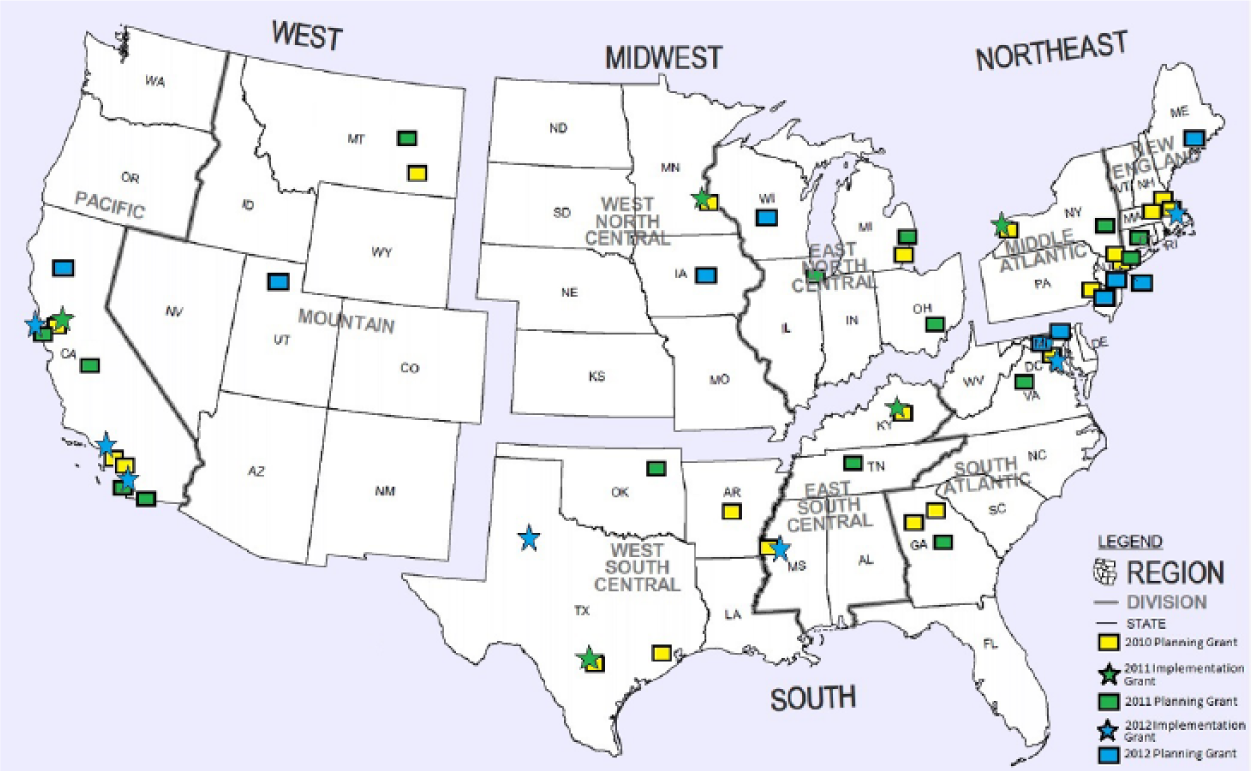
Map of Promise Neighborhoods grantees by region and sub-region.
Distribution of Promise Neighborhoods Grantees by Region and Sub-Region.
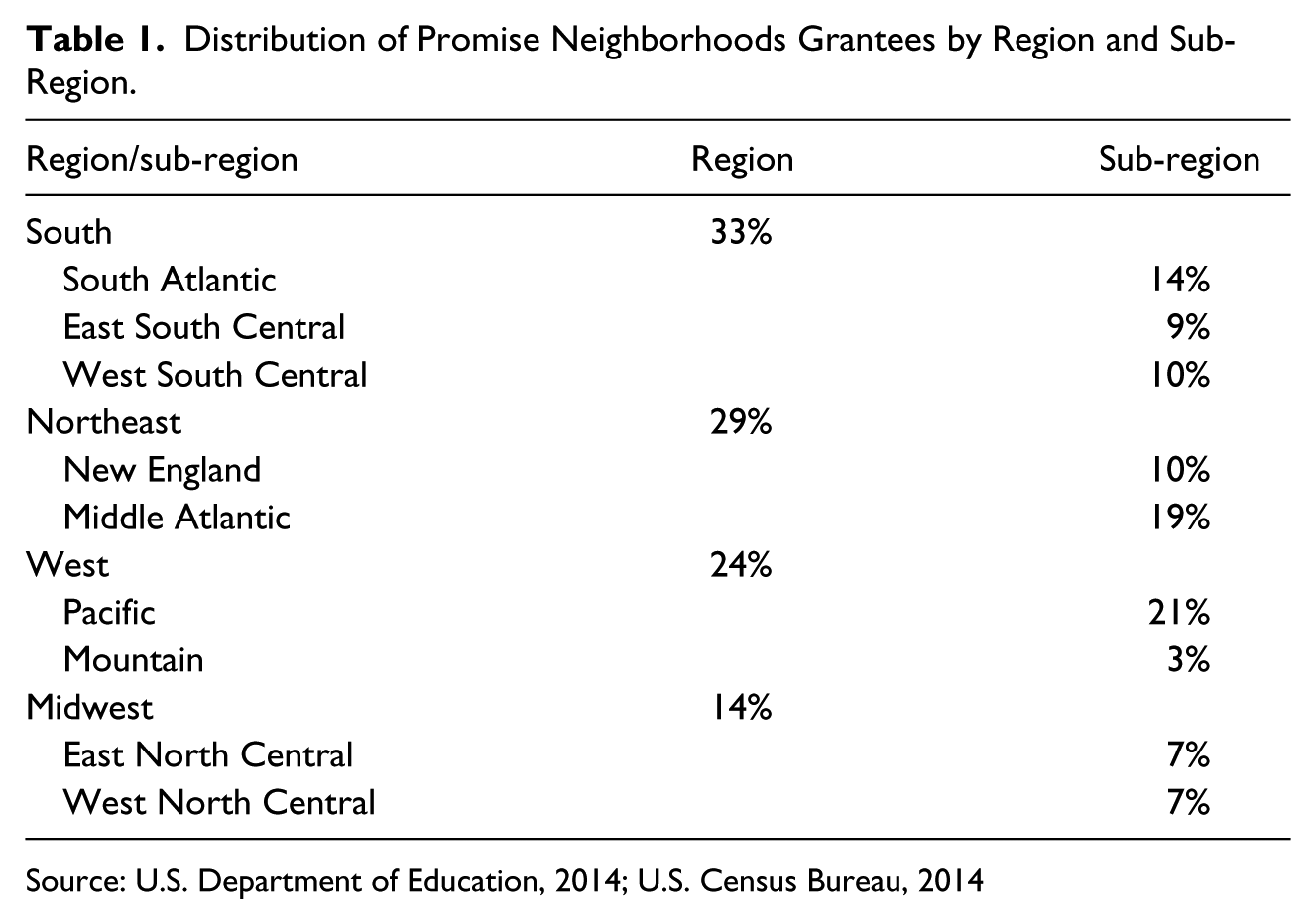
Source: U.S. Department of Education, 2014; U.S. Census Bureau, 2014
A Community-Based Approach to School Reform
As noted earlier, the degree to which neighborhood-level conditions impact student achievement, and thus, the effectiveness of community-based approaches to improving urban schools remains a topic of fierce debate. Despite HCZ’s popularity and embrace by President Obama as the model for his urban education program, some have criticized PN as an anecdotal-based investment that lacks empirical support given its origins in HCZ. For instance, Whitehurst and Croft (2010) of the Brown Center on Education Policy at the Brookings Institution found that HCZ charter school students fared no better on tests than their area charter school peers. They concluded, “There is considerable evidence that schools can have dramatic effects on the academic skills of disadvantaged children without their providing broader social services” (Whitehurst & Croft, 2010, p. 10) and that federal investments like PN should be substantiated not by instinct but by evidence-based research: President Obama was a community organizer before he was a politician, so it is natural that his instincts are to invest in community programs. But President Obama has repeatedly called for doing what works. Doing what works depends on evidence not instincts. (Whitehurst & Croft, 2010, p. 9)
It is still too early to determine the effectiveness of PN on student achievement in the communities that have received planning and implementation dollars, although such data should be available in the coming years.
In its Building Neighborhoods of Opportunity report published in 2011, the Administration outlined its neighborhood revitalization initiative as a “bold new approach to helping neighborhoods in distress transform themselves into neighborhoods of opportunity through integrated, comprehensive support” (p. 1). Guided by practices identified by communities achieving some measure of success in neighborhood revitalization, the initiative emphasized (a) resident engagement and community leadership, (b) developing strategic and accountable partnerships, (c) maintaining a results focus supported by data, (d) investing in organizational capacity, and (e) aligning resources to a unified and target impact strategy while improving coordination and collaboration among its own federal departments that address poverty (i.e., the White House Domestic Policy Council, White House Office of Urban Affairs, and Departments of Housing and Urban Development, Education, Justice, Health and Human Services, and Treasury).
By better aligning federal resources and efforts in ways that support leaders at the level working to leverage neighborhood assets, grow local economies, and improve the quality of life for their residents, the strategy sought to better position the federal government as a “catalyst for change” at the local level since, to use President Obama words, “in this country, changes come not from the top down, but from the bottom up.”
Community Capacity Building for Education Reform
Within the context of neighborhood revitalization, community development, and making change “from the bottom up,” community capacity is a term frequently used in many disciplines and areas of study (e.g., public health, environmental health, public policy, social services, education, public administration), but not always clearly defined (Chaskin, 2001). This lack of definitional precision results in a similarly indistinct body of research literature, which makes community capacity, and thus, the practice of building capacity at the community level, a particularly challenging area of inquiry (Freudenberg, Pastor, & Israel, 2011). We consider these definitions here and their application to not only the practice of building community capacity, but doing so within the context of the highly politicized and contested space of urban school reform, which include competing values and interests, divergent political views and ideologies, and perennial struggles for power and scarce resources (Henig, Hula, Orr, & Pedescleaux, 1999; Shipps, 2003; Shipps, Kahne, & Smylie, 1999; Stone, 2001; Stone, Doherty, Jones, & Ross, 1999; Stone, Henig, Jones, & Pierannunzi, 2001). Our conceptualization of community is informed by Warren and Mapp’s (2011) definition—“a group of interconnected people who share a common history, a set of values, and a sense of belonging—in short, a culture and identity” (p. 20) within the context of geographic and spatial boundaries, and in the case of the present inquiry, neighborhoods.
Defining and Building Community Capacity
The concept of community capacity building, first used in 1977 by the United Nations (cf. Mohamad et al., 2012), is often associated with the sociological notions of social capital (Chaskin, George, Skyles, & Guiltinan, 2006), defined by Robert Putnam (1993) as “features of social organization, such as networks, norms, and trust, that facilitate coordination and cooperation for mutual benefit” that “enhances the benefits of investment in physical and human capital” (pp. 1-2). This includes the networks established through bonding, bridging, and linking of individuals and groups (Ostrom & Ahn, 2010; Putnam, 1993, 2000; Rainie & Wellman, 2012). Social capital theorists often correlate such capital with economic resources and view it as a public good beneficial to the larger society. Research on social capital, however, often fails to examine the ways in which community engagement or capacity building might work to develop and sustain social capital within a community.
Community capacity building also has origins in the practice and research of community organizing, specifically as it relates to school reform. According to Warren and Mapp (2011), the primary task of community groups organizing for school reform lies in “building the capacity of community members to create institutional and policy change on their own behalf” (p. 7). They explained, Organizing groups do the patient, long-term work to build the capacity and leadership of people to create change in their communities and schools. They teach people the skills and knowledge necessary to bring residents of their communities together, identify issues of pressing concern, research those issues to develop an agenda for action, build alliances with other groups, negotiate with public officials, and collaborate with educators and other institutional agents to create and implement new policies and practices. (p. 6)
Their research found that organizing efforts focused narrowly on building community capacity successfully addressed poverty and racism by increasing power among marginalized communities through strategy sessions around policy issues, cross-sector partnerships between families, faith-based communities, and schools, youth leadership development programming, and student-led political activism (Warren & Mapp, 2011). In these cases, such power was often used to improve children’s access and opportunities to better and more equitable schooling by empowering communities to advocate for social change (Warren & Mapp, 2011).
According to Freudenberg et al. (2011), community capacity is a “set of dynamic community traits, resources, and associational patterns that can be brought to bear for community building and community health improvement” (p. 124). Within the context of environmental health policy, they argue that community capacity represents modifiable characteristics that “enable communities to protect and improve their well-being” (p. 123) and can be increased through community capacity building activities (p. 124). Similarly, Mohamad et al. (2012) defined community capacity as a “combined influence of a community’s commitment, resource, and skills, which can be deployed to improve community strengths and address local community problems” (p. 175).
Amid many definitions and considerations, we focus our attention here to the work of Chaskin (2001) who developed a multi-dimensional framework for community capacity based on empirical case studies of federally funded comprehensive community initiatives (CCIs) in Detroit, Michigan; Hartford, Connecticut; Memphis, Tennessee; and Milwaukee, Wisconsin. Chaskin defined community capacity as the interaction of human capital, organizational resources, and social capital existing within a given community that can be leveraged to solve collective problems and improve or maintain the well-being of a given community . . . through informal social processes and/or organized effort. (p. 259)
He claimed that such interactions create a relational model given the interconnected nature of six distinct, yet related dimensions useful for empirical analysis, which include (a) fundamental characteristics of community capacity, (b) levels of social agency, (c) functions of community capacity, (d) strategies that promote community capacity, (e) conditioning influences that either support or inhibit capacity, and (f) desired or subsequent community-level outcomes. Although scholars such as Mohamad et al. (2012) have critiqued this model for its depiction of community capacity building as an interaction as opposed to a process, we find these dimensions a useful starting point for both the framing and analysis of our examination of community capacity building for urban school reform through PNs.
Fundamental characteristics
The first dimension includes the fundamental characteristics of a community’s capacity, which focus on four areas: a sense of community, level of commitment, ability to solve problems, and access to resources. According to this model, community capacity is achieved when community members feel connected to each other, committed to the community, take action on behalf of the community, and use resources within and outside of the community to improve and sustain it.
Levels of social agency
The second dimension recognizes individuals, organizations, and networks as three areas of social agency an initiative uses to build community capacity. The individual level represents the ability for an individual to enhance the economic, social, and political well being of the community, whereas the organizational level reflects the capacity and agency of organizations to deliver products and services for the community. Network-level agency emphasizes the relational aspect of individuals and organizations to build capacity.
Functions
Functions such as communication, decision making, and oversight constitute the third dimension of community capacity and represent a community’s formal or informal way of planning, organizing, and engaging stakeholders in community-based efforts.
Strategies
Related to functions of community capacity are the strategies used to build such capacity—the fourth dimension, which typically include four areas: leadership development, organizational development, community organizing, and fostering collaborative relations among organizations that are implemented through programs, processes, or systems.
Conditioning influences
The fifth dimension consists of the conditioning influences that take into account various elements that inform the community’s ability to build and sustain capacity. These elements might be community-level factors such as safety and trust or structural-level dynamics, such as institutional racism or political patronage.
Community-level outcomes
The final dimension encompasses the existing and anticipated results within the targeted community that may “result from the functions of community capacity that already exist or that are being development through a capacity-building initiative” (Chaskin, 2001, p. 300).
Building Community Capacity to Improve Schools
In the case of urban school reform and school improvement, community capacity building within historically underserved and underresourced neighborhoods has proved challenging for a multitude of reasons. Whether lack of trust (Geller, Doykos, Craven, Bess, & Nation, 2014) or the difficulties associated with bridging diverse networks and contexts across organizations, culture, and space (Geller et al., 2014; Miller, Wills, & Scanlan, 2013), the politics of education reform in urban communities demand strategies that address issues of power and inequality in terms of existing wealth and assets (local tax base and political power) and resource allocation, both public and private. As Chaskin (2001) discovered in his analysis of CCIs in Milwaukee and Hartford, The community-building agenda that drives CCIs and many other neighborhood-based revitalization efforts focuses largely on drawing from and strengthening a community-level capacity that, in turn, supports and sustains the agenda. Such a capacity is typically referred to in quite general ways and serves as an evocative conceptual banner behind which community-building activities can advance. But for this broadly stated concept to prove useful guidance for such activities or for understanding their effects, one must unpack the concept into components that can be analyzed (individually and in relation to one another) and acted on. (p. 314)
Like the various federal initiatives that came before it, PNs presents an opportunity to consider how communities not only engage the work of building capacity in distressed neighborhoods, but also how such efforts transform low-performing schools. Recent studies focused on PNs specifically, to include the development of leadership networks in PNs established in urban and tribal communities (Miller et al., 2013) and a case example examining the roles of resident engagement, school–community interactions, and trust in an emergent PN initiative in the Southeast (Geller et al., 2014), offer important contributions to our knowledge around this federal program and its implications for education and urban school reform. In addition, Chaskin’s (2001) findings, which have underscored two challenges to capacity building in particular (a) “the constraints of collaboration” and (b) “the complexity of broadly involving neighborhood actors in the community capacity-building process” (p. 315), provide a useful knowledge base on which to examine similar community-based approaches to education reform.
Method
To better understand how the federal PNs program aims to improve schools by incentivizing community capacity building in economically distressed communities, we analyze community capacity and related capacity building efforts in the development of the LVPN in the Historic West Las Vegas community of Southern Nevada. Using qualitative descriptive case study methods and Chaskin’s (2001) six-dimensional framework as a conceptual guide, we examine the planning and engagement of the LVPN Initiative from its intent to apply for a PN planning grant in August, 2011 to the present, with a focus on building community capacity for urban school reform as contextualized by the larger PNs grant program. As both the lead agency researchers and conveners of LVPN at its inception, we draw from multiple data sources to include (a) the LVPN planning grant application (which we prepared and submitted), (b) LVPN Collaborative agendas and meeting notes, (c) external technical reviews of the grant application, (d) and relevant data and research on PNs broadly.
Similar to Chaskin’s (2001) rationale for exploring “the practice of community capacity building in some detail, with attention to the nuances of approach, process, and context that inform the implementation of these efforts generally and condition their effects” (p. 300), this case study will provide an empirical example of such processes and interactions in the LVPN. Unlike Chaskin’s multi-site study, which examined well-established projects in communities with existing institutional and organizational capacity to leverage federal dollars for resident engagement and cross-sector neighborhood and economic development and capacity building, this case study describes an emergent place-based initiative in Las Vegas, Nevada—a much younger city with a highly mobile population, less-established neighborhoods and neighborhood identities, and limited historical examples of community capacity building. Located in the U.S. Mountain West, a region of the country experiencing significant population growth and demographic change, but with a thin history of securing, much less leveraging, federal dollars for community-based initiatives, this descriptive case example provides important insight into how one community, with limited experience in such efforts, approached and engaged the process of building community capacity to improve its neighborhood schools.
LVPN: Context and Characteristics
On August 3, 2011, researchers 2 from The Lincy Institute at University of Nevada, Las Vegas, convened 26 community stakeholders to present an overview of the PNs grant opportunity and gauge interest in working collaboratively to submit an application on behalf of the Las Vegas community and avoid the possibility of competing against one another as partners in the same region. Attendees included representatives from the Clark County School District (CCSD), UNLV Center for Academic Enrichments, City of Las Vegas, Clark County, Nevada Partners, Nevada Institute for Children’s Research and Policy, Acelero Learning Clark County Head Start, United Way of Southern Nevada, Las Vegas Urban League, Family Leadership Initiative, Communities in Schools, Clark County Department of Juvenile Justice Services, Las Vegas-Clark County Library District, Southern Nevada Health District, Southern Nevada Regional Housing Authority, Culinary Academy of Las Vegas, and The Smith Center for the Performing Arts. Invitations were sent primarily to chief executive officers, executive directors, and top-level administrative staff with decision-making authority to ensure meeting attendees had the power to determine quickly whether or not their agency or organization could become a formal partner in the grant application. After careful review of grant requirements, partner expectations, and the timeline for submission, (applications were due September 6, 2011), the members of what would become the LVPN Collaborative agreed to move forward to design and develop the LVPN Initiative.
Arguably, much of the unanimous support for the initiative was based on the role The Lincy Institute would play as lead agency for the grant application, as well as its envisioned role as the newest member of Las Vegas’ nonprofit community. As a newly established research institute charged with working directly with community organizations and stakeholders to improve Southern Nevada’s education, health, and social service indicators through a range of needs assessment, capacity building, and grant making and writing activity, meeting participants were interested in seeing how The Lincy Institute’s engagement would connect to their respective work and possible benefits of collaboration. Indeed, there was an acknowledgment of the possible benefits of working across sectors and agencies in ways that would leverage existing resources and efforts to serve Las Vegas’ underserved children and youth, coupled with the prospect of receiving a $500,000 planning grant award, to be followed by $4 to $6 million in implementation grant funds provided additional incentive, as agencies struggled with diminishing federal and state budgets while seeking to serve those hardest hit by the Great Recession. Consequently, meeting participants agreed to not only pursue the grant but also move forward with cross-sector coordination and collaborative activities “with or without the grant” to build community capacity and position Las Vegas for what was clearly the Obama Administration’s and local philanthropic community’s preference for competitive and performance-based grant funding in the education, health, and human service sectors.
Neighborhood Characteristics
As a place-based initiative, the second order of business at the original convening, after determining whether or not to apply for the grant, was the selection of the initiative’s target neighborhood and schools. Given the limited time before the planning grant deadline, participating stakeholders selected the Prime 6 Schools Attendance Zone, located within Historic West Las Vegas, as the target neighborhood. Based on previous research conducted on the history of education in West Las Vegas, the site of African American settlement in Las Vegas (cf. Horsford, Sampson, & Forletta, 2013), and the extensive amount of data collected around this community from interested partner agencies (e.g., West Las Vegas Investment Report, CCSD Prime 6 Schools Report, Superintendent’s Equal Opportunity Advisory Committee Recommendations), the lead conveners made the case for this community, which sits at the intersection of multiple jurisdictions to include City of Las Vegas, City of North Las Vegas, and Clark County (See Figure 2), each of which has its own elected governing body and at least one representative serving this historically African American community.
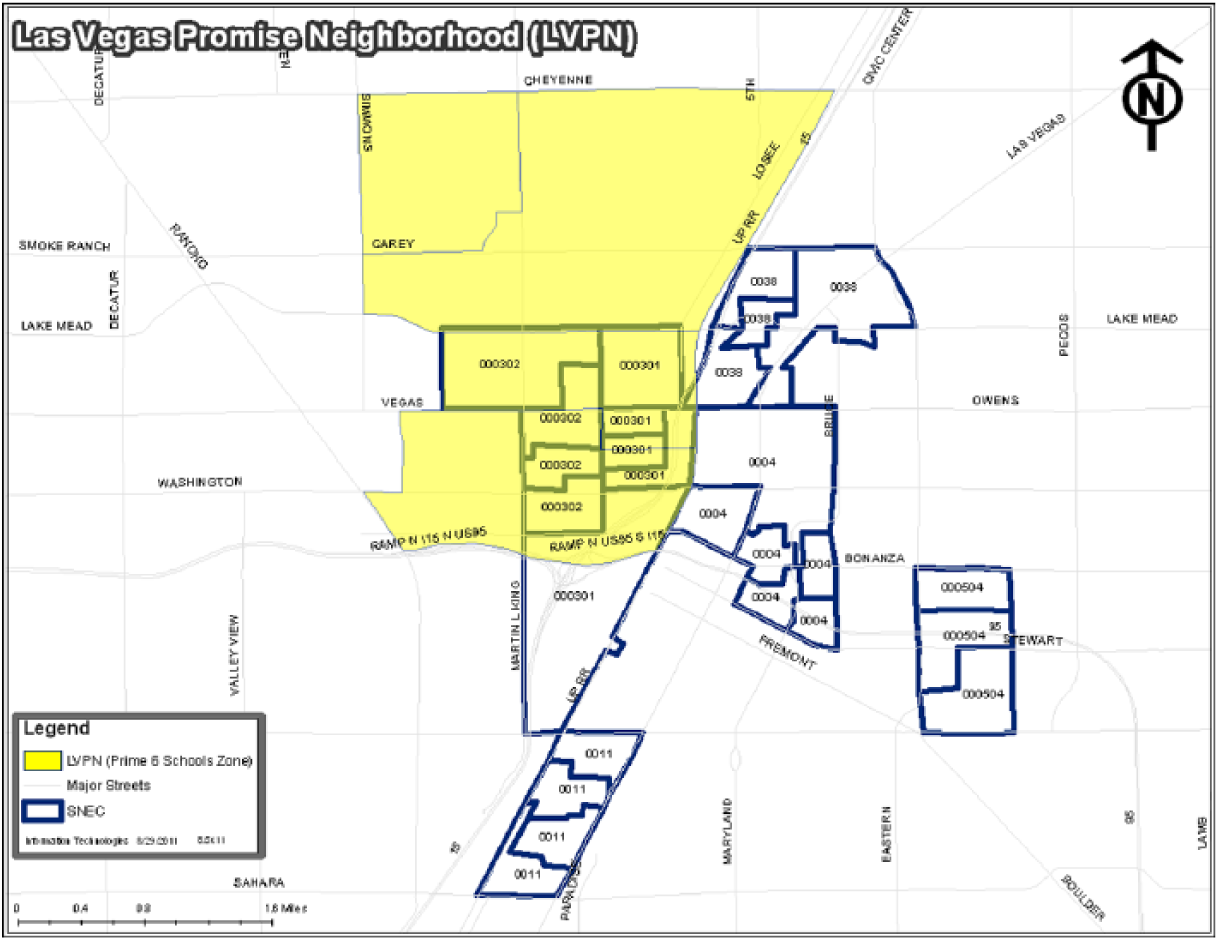
Map of proposed LVPN (Horsford & Sampson, 2013).
Before the 1960s, West Las Vegas, commonly referred to as “The Westside,” was home to Las Vegas’ Black working and middle class and a thriving local economy that experienced gradual decline post-desegregation (Horsford, Sampson, & Forletta, 2013) resulting in the neighborhood disinvestment and economic distress observed today. In the mid-1990s, the Secretary of Housing and Urban Development designated the area an enterprise community, and during the 2007 Nevada Legislative Session, it became the focus of coordinated economic and community development efforts as part of the newly designated Southern Nevada Enterprise Community (SNEC). The purpose of SNEC was to not only increase economic opportunity, sustainable community development, community-based partnerships, and a strategic vision for change, but as a governing body made up of elected officials from each jurisdiction that included West Las Vegas as part of its service area, along with neighborhood residents and local business leaders, it also aimed to improve policy coordination around the unique needs of the Historic West Las Vegas community.
Like the larger Las Vegas Metropolitan Area, which is home to approximately 1.9 million residents of whom a growing share are low-income, school-age, and immigrant (Horsford & Sampson, 2013; Horsford, Sampson, & Forletta, 2013), Historic West Las Vegas has seen a significant demographic shift in its resident population. Experiencing the same trends that has made Nevada the state with the highest density of English learners and Las Vegas home to the second largest English learner student population in the nation (behind Los Angeles), this formerly predominately Black neighborhood is now increasingly Latino, which has dramatically changed the racial composition of its formerly all-Black neighborhood schools. These Prime 6 Schools, often considered Las Vegas’ “Black” schools given their historical resonance as the site of school segregation, desegregation, and resegregation in Las Vegas (Horsford, Sampson, & Forletta, 2013), are now roughly 45% Black and 45% Latino, have enrollments where 86% to 100% qualify for free and reduced lunch, and serve student populations where nearly one in three children (30%) speak a language other than English at home, overwhelmingly Spanish (Horsford, Mokhtar, & Sampson, 2013).
As noted in the application, the geographically defined area for the LVPN is the CCSD’s Prime 6 Schools Attendance Zone, which primarily serves the elementary school children and families residing in Historic West Las Vegas, as well as those families who choose to send their children to magnet or charter schools located within the target neighborhood.
Created in 1992 as part of CCSD’s voluntary school desegregation plan, with the purpose of offering innovative and supplemental educational programs for PK-5 students during the “Prime 6” years of learning, the Prime 6 Schools Plan originally included seven traditional public K-5 schools, adding its first magnet school program in 1993. As of the writing of the LVPN planning grant application, 6,639 children attended school within the Prime 6 Schools Attendance Zone boundaries to include 3,556 in the Prime 6 elementary schools; 1,771 at West Preparatory Academy (a public K-12 school); and 1,312 enrolled in one of the three area charter schools. In 2014, the Prime 6 Schools now consist of nine public elementary schools (six traditional, three magnet), and represent a wide range of student achievement and overall school performance (as measured by standardized test scores). Within the attendance zone, although not a part of the Prime 6 Schools, are two traditional middle schools (Grades 6-8), three charter schools, one alternative school, and an adult education high school. To avoid the creation of a de facto racially segregated high school, given existing housing patterns, no high schools 3 were built in the Prime 6 School Attendance, although changes to school structure at CCSD’s Charles I. West Middle School and the establishment of charter schools in the area, one of which includes Grades 9 to 12, demonstrate the variety of educational reforms and configurations reflective of this geographic area. Both middle schools and four out of six Prime 6 elementary schools had been deemed persistently lowest achieving according to the No Child Left Behind Act of 2001 (Horsford & Sampson, 2013; See Table 2).
Schools in the Las Vegas Promise Neighborhood.
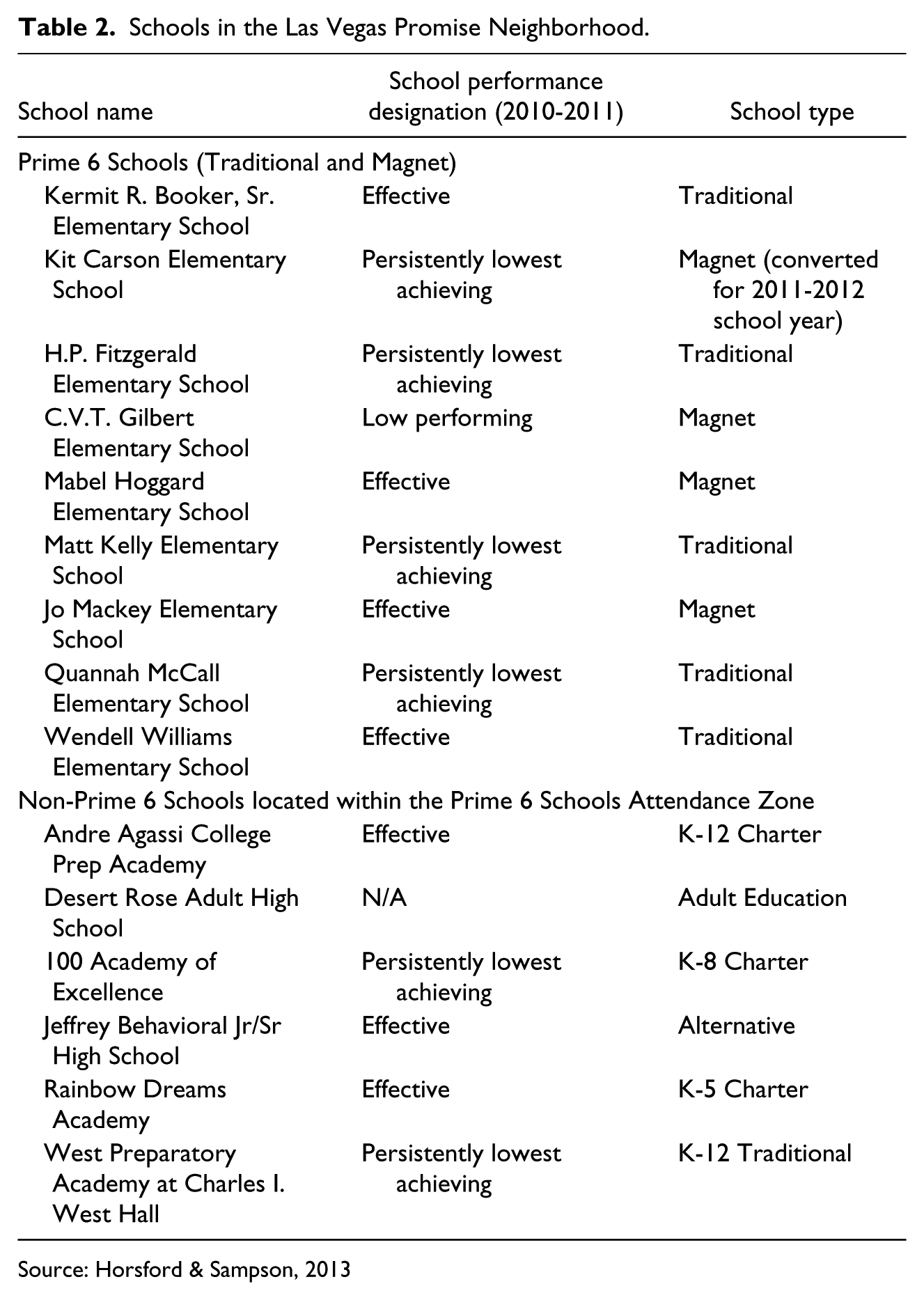
Source: Horsford & Sampson, 2013
Sadly, when compared to Greater Las Vegas, a mapping analysis of child and youth-related indicators within the boundaries of the Prime 6 Schools Attendance Zone revealed more than double the amount of substantiated investigations of child abuse and neglect, juvenile arrests, households with children living in poverty, lowest average daily high school attendance, lowest graduation rates, proficiency exam failures, and high school credit deficiencies (Applied Analysis, 2008), providing significant rationale for a coordinated, comprehensive system of supports from cradle-to-college or career. Such figures are particularly troubling given the legacy of educational inequality and economic disempowerment within this geographical area. After failed attempts at voluntary desegregation, 20 years of a forced busing plan, and subsequent return to neighborhood schools at the urging of West Las Vegas’ predominately Black community and parents (cf. Horsford, Sampson, & Forletta, 2013), the CCSD’s Prime 6 Attendance Zone served as an easily identifiable, geographically bounded area for which it was easy to demonstrate need as part of Las Vegas’ planning grant application.
Moreover, a 2009 review of the Prime 6 Schools Plan commissioned by then CCSD Superintendent Walt Rulffes and conducted by Gary Orfield’s research team at the Civil Right Project/Proyecto Derechos Civiles at UCLA reported as follows: (a) students enrolled in Prime 6 Schools perform well below CCSD’s average on math and reading tests, (b) African American and Latino Prime 6 students average lower math and reading test scores than their African American and Latino peers in other District schools, and similarly, (c) students who qualify for free and reduced lunch (FRL) enrolled in Prime 6 Schools average lower math and reading test scores than FRL students enrolled in other CCSD schools. They also found that on average, teachers working in Prime 6 Schools had fewer years experience than their district and non-Prime 6 School colleagues. Moreover, the instructional resources and supports for its growing and substantial population of English learners were woefully inadequate, resulting in what the research team described as “triple segregation” by race, class, and language within the Prime 6 Schools Zone (Terriquez, Flashman, & Schuler-Brown, 2009).
In his presentation to the school board, Orfield discussed the importance of improving the school choice system—the key component of the Prime 6 Schools Plan, as well as increasing teacher quality in Prime 6 Schools. He also made reference to the ways in which the school district, in collaboration with the greater Las Vegas community, could work together to improve educational quality and opportunity in the Prime 6 Schools and asked, “What can be done to challenge the other agencies in your city to help with these problems? The housing agencies, the health agencies, and others?” He questioned the board on what its member and district administrators could do to “collaborate in helping figure out how to change some of these destructive dynamics that exist there” and explained, “there’s a staff here in the district that has the capacity of coming up with some important answers, and there’s lots of people outside that they can call upon to help them in one way or another” (Clark County School District, 2009).
In the following section, we describe the components included in the LVPN planning grant application to include Mission and Purpose, Theory of Change and Action, and Continuum of Solutions—all required components of the application and relevant to this inquiry’s focus on community capacity and efforts to build much-needed civic infrastructure within the LVPN.
Initiative Characteristics
Mission and purpose. The mission of the LVPN is
to provide cradle-to-college and career support services to children and families in Historic West Las Vegas through strong schools, leveraged resources, and coordinated community-building efforts that would allow all children in the LVPN to have a safe, healthy, and strong academic start in life. (The Lincy Institute, 2011, p. 7)
As “both a site and strategy for neighborhood revitalization and community transformation” (LVPN, 2011, p. 11), plan development would include a wide range of stakeholders (i.e., parents, children and youth, neighborhood residents, service providers, researchers, community organizers, business leaders, and elected officials) through a community-based partnership among the agencies and organizations who committed to participate at the original meeting through a formal memorandum of understanding, which outlined each participating partner’s organizational mission and its alignment to the mission and purpose of the LVPN. The initial focus of the initiative would be the turnaround of the neighborhood’s persistently low-achieving Prime 6 Schools (Fitzgerald, Kelly, McCall and Williams), as identified by the Department’s criteria and eventually reaching a greater share of students by including the Prime 6 magnet schools (Carson, Gilbert, Hoggard, and Mackey) and charter schools (Agassi, 100 Academy, Rainbow Dream Academy) as part of its cradle-to-college and career continuum of solutions (The Lincy Institute, 2011). The aims of the LVPN were not limited to improving schools, but also the facilitation of ongoing communication among stakeholders to “integrate programs, break down agency silos, enhance partner capacity, develop a local infrastructure of systems and resources, and scale up effective solutions” (The Lincy Institute, 2011, p. 9) to ensure project coordination and sustainability.
Theory of change and action
LVPN’s theory of change and action, as endorsed by it stakeholders, were grounded in a commitment to fostering strong families and neighborhoods, expanding educational opportunity from cradle-to-college and career, supporting community building and organizing activities, developing integrated data systems, and engaging in program evaluation activities to hold partners accountable to continuous and measurable improvement. This framework for change and action would guide the formation of the LVPN’s comprehensive continuum of solutions, as required by the PN planning grant, and in coordination with existing activities by partnering organizations, like the United Way of Southern Nevada’s Success by 6® early childhood initiative, Nevada Public Education Foundation’s Ready for Life Southern Nevada movement, intended to connect youth to school and work by age 25; and the Southern Nevada Regional Planning Coalition’s Shared Youth Vision initiative, part of a federal collaborative to improve outcomes for the country’s high-needs youth. LVPN also proposed aligning directly with the CCSD’s Ready by Exit initiative, launched by its new superintendent, Dwight Jones, and establishing a new set of student achievement benchmarks to be reached by June 2016, to include annual progress in the percentage of students who (a) read on-level in Grades 1, 3, and 5; (b) take Advanced Placement (AP) courses; (c) graduate in 4 years, are admitted to a postsecondary institution, and do not require college remediation (Jones, 2011). Perhaps revealingly, the last three initiatives have since been abandoned and disbanded due to limited capacity in resources and staff, and/or staff turnover, to include the departure of CCSD’s superintendent after a 2-year tenure.
Continuum of solutions
A primary requirement of the grant was to build a comprehensive continuum of solutions from cradle-to-college and career that would leverage and coordinate the delivery of partner services, programming, and resources in ways that would advance the LVPN’s mission, vision, and commitment to school improvement. The key focus areas, delineated according to the Brookings Social Genome Project life stages, 4 included High-Quality Early Learning Programs and Services, PK-12 Education Reforms, College and Career Programs, and Family and Community Supports. The plan proposed to build strategic relationships and leverage existing resources and programs, which could help position the collaborative for increased public and private funding and build community capacity. For example, an emergent priority in Greater Las Vegas had become the provision of high-quality early childhood education programs from birth to third grade—a cause championed by the United Way of Southern Nevada and the Nevada Institute for Children’s Research and Policy, in partnership with the Nevada State Office of Early Childhood Programs, across Southern Nevada and statewide. As partners in the LVPN Collaborative, these organizations agreed to invest and expand access to high-quality early learning opportunities in the LVPN, which had some of the lowest rates of three and four-year-olds in the state enrolled in early childhood education programs.
In terms of PK-12 education, the PNs grant application required partnership with a local educational agency and clear demonstration of how community-level planning efforts would align with existing education reform efforts in the target school, most notably the Department’s top-down approach to accountability through its four turnaround models. As part of its continuum of solutions, the LVPN Collaborative proposed to achieve measurable results and meaningful outcomes through comprehensive education reforms, particularly in its persistently lowest-achieving and low-performing schools, by scaling up effective school-based reforms and using both student-level and school-level data to ensure students are not only meeting adequate yearly progress indicators, but are demonstrating academic growth from where they started. (The Lincy Institute, 2011, p. 14)
These goals aligned with the Nevada Department of Education’s release of the state’s first ever growth model, which the LVPN argued would “prove valuable in measuring, for the first time in CCSD, academic growth at the student-level for children in the LVPN” (The Lincy Institute, 2011, p. 14). The proposed PK-12 Education Reforms also included alignment with the work of the Superintendent’s Educational Opportunities Advisory Committee’s (SEOAC), which originally was formed in 2010 as a community advisory board to Superintendent Walt Rulffes with the charge of identifying reform strategies for persistently low-achieving schools district-wide.
In 2011, however, months after hiring a new superintendent and subsequent community reaction to the findings of the 2009 Prime 6 Schools Review, Superintendent Dwight Jones decided to narrow the focus of SEOAC to Prime 6 Schools performance. After several months of meeting, the committee recommended the hiring of a Prime 6 Manager to report directly to the Superintendent and work hand-in-hand with the principals of the Prime 6 Schools, while also granting the schools greater autonomy and access to professional development; creating high-quality early learning, English learner, and parent engagement programs in each Prime 6 school; and providing the school community with ongoing communication concerning student achievement and school performance (SEOAC, 2011). Structurally, the Prime 6 Schools Attendance Zone would also become its own Performance Zone—a new configuration of feeder-aligned schools established by Superintendent Jones with the purpose of flattening the organization and streamlining efforts to improve student achievement and ensure that all students are “ready by exit” (Jones, 2011). Indeed, with one of the worst graduation rates in the country, high school completion was a top priority for both CCSD and LVPN and held significant implications for the PNs’ focus on providing a continuum of solutions from cradle-to-college and career. Located in a city and state with some of the lowest college-going and completion rates in the nation, the LVPN Initiative sought to leverage the more than $5 million the UNLV Center for Academic Enrichment and Outreach (CAEO) received in TRIO grants (i.e., Upward Bound, GEAR UP, Student Support Services, and Ronald McNair Scholars Institute), which served approximately 2,303 low-income students, many of who lived in the LVPN, in addition to partnerships with federally funded youth and workforce development programs to include YouthBuild (Workforce Connections); Positive Youth Impact (Nevada Partners); Build Nevada, Future Culinary Leaders (Culinary Academy of Las Vegas); and CCSD’s call to ensure all students are “ready by exit” meaning they are “prepared to step into college or other postsecondary opportunities and complete without remediation” (Jones, 2011, p. 17). Community college and university partners such as College of Southern Nevada and UNLV would also play key roles in promoting college readiness at the early stages of the continuum.
Family and community supports
According to the LVPN’s theory of change and action, “strong families and strong neighborhoods go hand-in-hand, and family and community supports in the areas of quality health care, food and security, social services, education, employment, and safety are essential elements to any comprehensive continuum of solutions” (The Lincy Institute, 2011, p. 18). As part of the continuum, the LVPN plan sought to expand educational opportunities for parents (i.e., parenting courses, GED and adult education programs, citizenship and English language courses, and employment training opportunities) while also coordinating service delivery by co-locating child and family service providers (e.g., social services, child welfare, mental health, and juvenile justice) to not only provide better support for families, but also facilitate cross-agency communication, collaboration, increased organizational and network capacity, to enhance service delivery overall. In addition, based on the LVPN’s focus on community building and organizing, the plan included efforts to engage parents, family members, and caregivers in opportunities to advocate for not only their own children but all children in the LVPN around issues of educational equity and opportunity, to include demands for adequate and equitable funding in the target schools. Although the proposal indicated a desire to jump-start parent organizing efforts through the “grassroots work of partners such as the Family Leadership Initiative, Las Vegas Valley Interfaith Sponsoring Committee, and newly established Nevada PTA Urban Family Engagement Initiative” The Lincy Institute, 2011, p. 19), capacity at the organizational level posed additional barriers to community capacity building. For example, the Family Leadership Initiative—a nonprofit organization specifically dedicated to serving Latino parents serve as partners for their children’s’ education, has since closed its doors due to a lack of sustainable funding and resources.
Summary
On December 19, 2011, the U.S. Department of Education notified The Lincy Institute that it had not received a planning grant. In the spirit of moving on “with or without the grant,” the conveners shared the news with the LVPN Collaborative and scheduled a meeting to discuss plans to move forward. After that meeting and receipt of the technical reviews, which partners were extremely interested in seeing, The Lincy Institute funded a series of meetings with the Director of the Promise Neighborhoods Institute (PNI) at PolicyLink. The purpose of its first meeting on May 29, 2012, was to provide the LVPN Collaborative with a national perspective of PNs, share how the model was being implemented in other communities, and offer guidance as to how the model could improve educational outcomes in Las Vegas in way that could position LVPN for a future planning or implementation grant (Horsford & Sampson, 2013). This would prove especially challenging given the number of communities with high community capacity and established histories of collaborative work and community organizing for school reform who were also competing for these grants.
LVPN’s Dimensions of Community Capacity
In this section, we describe and analyze LVPN’s community capacity and community building activity according to Chaskin’s (2001) definitional framework and six dimensions of community capacity: fundamental characteristics, levels of social agency, functions, strategies, conditioning influences, and outcomes. As we stated at the onset of the article, we selected LVPN as a case example largely because of Las Vegas’ low-capacity and limited experience and success with comprehensive community initiatives and/or community-based education reform. Although the LVPN was not funded, participation in the grant process resulted in external feedback from expert reviewers in the areas of youth and community development and education reform, which provided valuable insight and perspective concerning the LVPN’s existing capacity and efforts to build it. We contextualize our discussion of LVPN’s capacity and capacity building plan according to the LVPN application and technical reviews, consultant feedback from the PNs Institute, and subsequent work of the LVPN since its initial convening in August of 2011.
Fundamental Characteristics
Through its selection of Historic West Las Vegas, and more specifically, the geographic boundaries of CCSD’s Prime 6 Schools Attendance Zone as its target area, LVPN leveraged the strong sense of community established in this historically African American neighborhood. In fact, Historic West Las Vegas is one of few neighborhoods in the Las Vegas Metropolitan Area that enjoys a strong community identity, for better or worse, by individuals and organizations both within and outside of the area. As the site of former school segregation, mandatory desegregation, and most recently, voluntary desegregation by virtue of the Prime 6 Schools Plan, the designated LVPN and its area schools reflect “a degree of connectedness among members and recognition of mutuality of circumstance, including a threshold level of collectively held values, norms, and vision (McMillan & Chavis, 1986)” (Chaskin, 2001, p. 296). This connectedness and subsequent sense of community has changed over time as a result of the demographic shifts that have transformed what was a predominately Black community into a now Black and Latino neighborhood serving a disproportionate share of children and youth living in poverty and with greater educational needs. Despite the shared experiences of LVPN residents in the areas of housing, education, hunger, crime, and health, racial, cultural, and linguistic differences have limited the community’s capacity to organize and mobilize in ways to improve their shared circumstances.
Nevertheless, there are yet many community members and organizations that reflect a strong level of commitment as a fundamental characteristic of community capacity. They “see themselves as stakeholders in the collective well-being of the neighborhood” and “participate actively in that role” (Chaskin, 2001, p. 296) as evidenced by the support for LVPN and ongoing efforts to invest in and support the Prime 6 Schools. Such commitment is often translated into action at both the individual and organization level with a number of residents and groups who engage in problem identification and maintain constant communication with their elected officials. Although such engagement is not always structured or sustained, informal relationships and networks reveal community members’ capacity to make decisions about what happens in their lives, to include the Stop F Street closure coalition and effort to keep the neighborhood’s beloved KCEP FM 88.1 radio station, which was in threat of shutting its doors due to insufficient resources.
While the site of the LVPN has had access to significant federal, state, and local resources based on need and formula-based funding allocations, its capacity to access political, economic, human, and physical resources beyond its boundaries has been limited. Since, as Chaskin (2001) noted, “Neighborhoods are embedded in and intimately tied to the broader socioeconomic systems of the metropolis and region,” their economic security is largely contingent upon political and policy decisions made far beyond their geographic bounds. In the case of education reform, the increasingly federal role and state-level push for increased standardization and accountability through a politics of competition has further limited access to resources for low-capacity, high-needs communities like LVPN. As one expert reviewer observed, The State of Nevada consistently ranks low on the amount of funding available for education and social programs and therefore, sustainability is questionable. The lack of existing resources may inhibit the quality of existing programs available to supplement the proposed LVPN.
Levels of Social Agency
In terms of social agency, the LVPN is home to many engaged residents and individuals committed to ensuring Historic West Las Vegas was not excluded from the economic growth and prosperity enjoyed throughout Greater Las Vegas. The LVPN Initiative, however, was extremely ineffective in harnessing this human capital and individual leadership at the neighborhood level, with most convenings and meetings filled with agency administrators, elected officials, and staff representatives rather than the residents, parents who lived, worked, and attended school within the LVPN. At the organizational level, a host of nonprofit organizations, service providers, government agencies, civic groups, but in far too many cases, they lack the organizational capacity (i.e., funding, staff, leadership) to sustain their own work or existence, let alone contribute to broader capacity building efforts.
In many ways, the purpose of the LVPN sought to also build institutional capacity by establishing a network level of social agency among existing organizations that operated and provided services in the neighborhood. Certainly, the goal was to develop a civic infrastructure among the partner organizations in ways that would “provide individual organizations with greater access to resources and to a socially defined context that informs decision making within organizations and structures relation among them” (Chaskin, 2001, p. 298). In the short-term goal of receiving a PNs planning grant, the LVPN sought to position itself for federal resources to fund its community capacity building efforts, while also developing a governance and organizational structure in which it could serve its shared constituencies more efficiently and effectively. In recognition of the critical role that policymakers representing the Historic West Las Vegas could play from both apolitical and policy perspective, the SNEC became an important player in the LVPN, providing both a link to residents through open meetings and public comments and by aligning existing efforts of the neighborhood revitalization plan with those of the LVPN (Horsford & Sampson, 2013).
Functions of Community Capacity
Beyond LVPN’s overarching mission “to provide cradle-to-college and career support service to children and families in West Las Vegas through strong schools, leveraged resources, and coordinated community-building efforts that will allow children in the LVPN to have a safe, healthy, and strong academic start in life,” (The Lincy Institute, 2011, p. 7) specialized functions centered around the development of a community needs assessment and segmentation analysis. This analysis, as required by the grant, would be used to assess degrees of educational and developmental need in ways that would inform the planning and implementation of a comprehensive continuum of solutions. According to the application, child and family-level data from the partnering organizations, as well as focus group interviews, citizen advisory panels, and neighborhood surveys, would be collected and compiled into an integrated data system that would increase community capacity and in turn, address out-of-school factors that would allow schools to focus more directly on student learning and achievement.
According to the technical reviews, a key weakness demonstrated in the LVPN application was a lack of clarity around its Theory of Change and Theory of Action. In response, the Director of PNI shared with the collaborative the importance of determining not simply “how” to get the job done (theory of change), but “who” can get the job done (theory of action), a distinction with significant implications for the functions of community capacity. As part of our larger conversation around the need for Southern Nevada, as a region, to establish a common set of indicators to assess its progress in serving children and families, the LVPN Collaborative followed the consultant’s recommendation to adopt the “10 Results and 20 Outcomes” indicators (See Table 3) as a guide for program implementation and evaluation and framework for determining which agency or organization would be responsible for addressing and measuring specific results and outcomes.
Promise Neighborhoods: 10 Results/20 Outcomes.
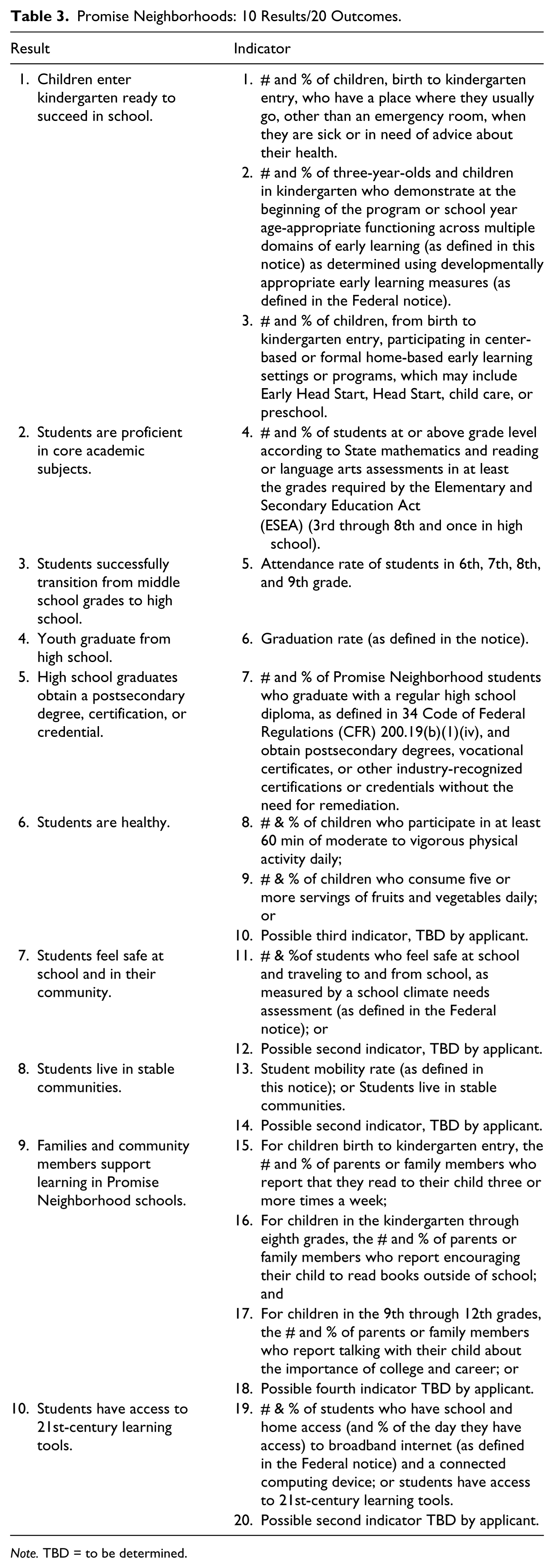
Note. TBD = to be determined.
Strategies for Building Community Capacity
While the functional dimension of community capacity speak to LVPN’s intent to engage its capacity and agency, strategies reflect the means by which LVPN’s community and capacity building efforts included leadership development, organizational development, community organization, and fostering organizational collaboration (Chaskin, 2001; Chaskin et al., 2006). The organizational structure of LVPN was proposed to have three areas of leadership: LVPN Management Team, LVPN Advisory Board, and LVPN Planning Councils. The LVPN Management Team would consist of approximately 10 members, including a project director, director of research, research advisors, and program managers and coordinators. This team would work directly with an already-existing regional governing council that was represented by key constituencies and elected representatives within the area of LVPN. The second area of leadership, the LVPN Advisory Board, would provide direction and recommendations to the management team. This 11-member board would consist of three representatives of the regional governing council and eight advisory members assigned to each of The LVPN Planning Councils. The previously described eight LVPN Planning Councils would be required to include a representative from each partner organization, local service provider, and a neighborhood resident. The neighborhood representative would be assigned to the role of the advisory board for both that particular council and the larger LVPN Advisory Board.
To ensure policy coordination, the SNEC Governing Board, a legislatively authorized governing body that consists of elected officials who represent the geographic target area on the Las Vegas City Council, North Las Vegas City Council, Clark County Commission, Nevada State Assembly, and Nevada State Senate, two neighborhood residents, and one business representative from the enterprise community, would serve as a key partner. In addition to providing strategic alignment between LVPN and SNEC’s larger economic development and neighborhood revitalization efforts, SNEC’s monthly, publicly noticed, and record open meetings allowed a mechanism for both key constituencies and their respective elected officials to offer input and direction concerning needs, issues, and concerns at the neighborhood level, while also leveraging federal, state, and local resources and relationships.
Conditioning Influences
Several external factors impact the ability of the LVPN to build community capacity. The history of racial exclusion and discrimination that led to community organizing among African Americans and resulted in a handful of victories toward racial and economic equality brings a sense of pride and accomplishment to many in the West Las Vegas community. However, these limited victories were often short-lived and some, such as the mandatory school desegregation plan, negatively impacted West Las Vegas, placing unequal burdens for African American children and leaving many of them without a neighborhood school for close to 20 years.
For years, Las Vegas experienced unprecedented growth, leading the nation as the fastest growing metropolitan area from 2000 until 2010 (The Brookings Institution, 2013). The Great Recession followed this growth, making Nevada number one in the nation for home foreclosures in 2011 (Nevada Education Reform Blue Ribbon Task Force, 2010). Population increases and economic downtowns have resulted in extreme demographic shifts and high transiency among children and families, as well as organizational leaders, particularly school district officials, all of which have challenged the community’s capacity building efforts in many ways.
In addition, the LVPN area has a legacy of being both predominately African American and the center of the Civil Rights Movement. Yet, shifts and population changes have resulted in a decreasing number of middle-class African Americans and increasing numbers of Latino residents in this area. The “Black-Latino issue” was readily noted by Dr. Gary Orfield in his 2009 presentation of the Prime 6 study in which he presented the question: “How can you help school people who have been struggling to create a good school for African Americans who suddenly find it full of 70% Latinos address that issue?” (CCSD, 2009). Such racial and economic shifts, especially those that occur rather suddenly, present unique challenges for building leadership, trust, and collaboration among groups who might feel they are competing for scarce resources and community power.
Nevada is often ranked among the lowest in terms of per-pupil spending and adequate funding for K-12 education (Baker, Sciarra, & Farrie, 2014; Nevada Education Reform Blue Ribbon Task Force, 2010). Although the racial and economic landscape has changed dramatically, Nevada has not changed the way that it funds K-12 education since the creation of its funding formula in 1967. This formula is one of the nation’s most equal funding methods, but it fails to account for the additional needs of various populations such as students who are at-risk and/or English language learners (ELL). For instance, until 2013, Nevada was one of eight states that did not fund ELL education. This failure has led to inequities in achievements and opportunities for Nevada’s most vulnerable populations, including those that dominate the LVPN. Decades of inadequate and inequitable funding of education placed many constraints on the LVPN to build capacity.
Community-Level Outcomes
Beyond building organizational and community capacity, the LVPN’s primary focus was to improve student achievement and school performance within the lowest achieving traditional public and charter schools in the neighborhood. Through the development of this capacity building initiative, the LVPN Collaborative initially sought to improve a host of indicators by life stage (i.e., conception to birth, early childhood, middle childhood, adolescence, transition to adulthood, and adulthood), but upon the recommendation of the Promise Neighborhoods Institute at PolicyLink, elected to focus on the “10 Results/20 Outcomes” indicators included in the PNs grant notice and attend more specifically to educational improvement.
A Promising Approach or Empty Promise?
As Chaskin (2001) concluded through his empirical analysis of four comprehensive community initiatives in the United States, in order for the term community capacity to prove useful for the research and/or practice of community capacity building, “one must unpack the concept into components that can be analyzed (individually and in relation to one another) and acted on” (p. 314). Through our descriptive case study analysis of the LVPN Initiative and the development and work of the LVPN Collaborative, we sought to explore the ways in which the federal PNs grant program could hold promise for low-capacity communities desiring to enhance a distressed neighborhood’s ability to translate its commitment to improving its schools into action.
We discovered that while efforts to revitalize neighborhoods through collaboration, capacity building, resident engagement, local leadership, comprehensive support, and sustained and leveraged investment—all of which the Obama Administration highlighted as successful strategies for revitalizing neighborhoods—require a fundamental level of community capacity without which it is nearly impossible for low-capacity communities to compete for much-needed capacity building resources. Consequently, we argue that community capacity building in economically distressed and racially minoritized communities should prioritize community organizing as a key function and strategy for future capacity building efforts, particularly around urban school improvement (cf. Mediratta et al., 2008; Stone, Doherty, Jones, & Ross, 1999; Warren, 2005; Warren & Mapp, 2011). As Mediratta (2007) explained, “community organizing for school reform is about the intentional building of power among parents, young people, and community residents in low-income communities of color, to transform the accountability relationships between schools and the constituencies they serve” (p. 197).
Indeed, community organizing as “a vehicle for building community capacity, which plays a critical role in school reform” (Gold, Simon, & Brown, 2005, p. 37) was noticeably missing from the LVPN Initiative’s efforts—an area requiring greater attention moving forward. In addition, characteristics of community capacity such as a sense of community, commitment, and the ability to solve problems were also underdeveloped, along with the LVPN’s low levels of social agency at the organizational and network levels. To be fair, such weaknesses reflected the very reason community stakeholders joined the initiative. In fact, the lead agency for LVPN, The Lincy Institute, was established with private dollars to address the Las Vegas community’s low social agency by building networks and helping organizations develop their own institutional capacity for problem solving and resource leveraging. As such, this case reveals the difficulty in engaging the functional and strategic dimensions of community capacity without adequate social agency, particularly when conditioning influences such as economic constraints, demographic change, and increased human service demands converge suddenly upon the agencies charged with meeting the educational, health, and social service needs of its community members.
In the case of Las Vegas, the even larger challenge of limited civic capacity (Stone, 2001) around social issues, to include education reform and improvement, community capacity building serves as an important first step in a long-term strategy for supporting and sustaining democratically controlled schools committed to equity and improved achievement outcomes for all students. This is where Chaskin’s framework proves useful, particularly for low-capacity communities like Las Vegas, through its defining and describing of community capacity in terms that can help guide the work of communities with limited experience in organizing, coalition-building, and civic engagement. A major limitation, however, of his conceptualization of community capacity lies in its silence on matters of power, privilege, and the politics of race and class in historically underserved and economic distressed communities. The ways in which shared racial and/or cultural identity, for example, impact a community’s ability to build capacity is a question worth asking, particularly in communities like Las Vegas that have experienced significant demographic change within neighborhoods in a very short period of time (Horsford, Sampson, & Forletta, 2013). Although such factors could well be considered conditioning influences in Chaskin’s typology; overall, the framework would benefit from a more robust theoretical analysis of issues of power and privilege, particularly in analyses concerning urban school reform. For example, local neighborhood histories and community counternarratives often include legacies of exclusion, resentment, and competition as uniquely experienced by certain racial or cultural groups. When ignored, such disregard of community history and context can quickly undermine any such community capacity building efforts before they even begin.
In addition, larger questions remain concerning the ways in which community capacity building can improve schools and the degree to which better schools affect neighborhood poverty. As the first federal initiative of its kind whose hope rests on the arguable success of one urban community in Harlem, PNs might be an untenable promise for hundreds of communities without a sustained history of successful organizing or promise of future investment and resources. As John Smyth (2009) noted in his critique of community capacity building, PNs could serve as a way for the government to de-politicize social ills by shifting responsibilities to these highly vulnerable communities while using “warm fuzzy terms” (p. 11) associated with community capacity building as “a progressive discourse to veil a cost-cutting agenda by the state” (p. 11).
Through PNs, the federal government demonstrated some commitment to supporting community capacity building for neighborhoods with the capacity and leadership to successfully compete for grant funding. Yet, communities with the greatest need are far too often the least able to obtain federal support. With more than 800 applications for PNs grants, the limited number and concentrated areas of awardees suggest that thousands of high-need, low-capacity communities are left to fight poverty on their own, resulting in increased capacity to improve schools for some, and perhaps just another empty promise for others.
Footnotes
Declaration of Conflicting Interests
The author(s) declared no potential conflicts of interest with respect to the research, authorship, and/or publication of this article.
Funding
The author(s) received no financial support for the research, authorship, and/or publication of this article.