



Abstract
Through a close reading of the talk of a self-identified critical educator of color, we explore the contradictions, possibilities, limitations, and consequences of this identity for teachers and teacher educators. We examine how the performances of particular critical educator of color identities problematically intertwine claims of Freirian pedagogy with crude dichotomizations of people as critical and non-critical. We explore how particular tropes limit the productive possibilities of being critical for other educators of color and erase the centrality of dialogue, reflexivity, and unfinishedness that define Freirian-inspired notions of being critical.
If there’s ever an educational program where you need to kick [non-critical] people out, it’s this program.
This provocative admonition by Hugo, 1 a first-year teacher education student who self-identified as a critical educator of color, reflects the emerging tensions and contradictions as programs of teacher education attempt to recruit teachers of color with commitments to racial justice. Hugo’s exasperation embodies both his legitimate anger, rooted in experiences of racism, and his struggle with channeling these emotions into sustained institutional change. Hugo’s reprimand of his “non-critical” and White peers poses a profound challenge to teachers and teacher educators committed to urban education. If teachers of color with commitments to social justice and teacher activism are key to the transformation of urban schools (Cochran-Smith, 2005; Gomez, Rodriguez, & Agosto, 2008; Ladson-Billings, 1995; McDonald & Zeichner, 2009; Parker & Hood, 1995; Rios & Montecinos, 1999; Villegas & Davis, 2008; Weisman & Hansen, 2008), teacher educators must validate yet push students like Hugo to engage with the intricate and intersecting forms of power that permeate all institutions, including teacher preparation programs. The superficial categorizations of educators and the naïve solutions of exclusion that are manifest in Hugo’s statement are often counterproductive to institutional transformation as they erase the complexity and contested nature of urban schools and allow educators of color to simplistically reject, with moral certitude, differing perspectives.
As teacher educators of color, we have increasingly observed passionate demands such as the one quoted above uttered in the same breath with expressions of reverence for Paulo Freire and critical pedagogy. We find that fervent appeals for dialogue, reflection, and alternatives to “banking” methods of teaching, particularly by young prospective “critical” teachers of color, too often reside in a disturbing confluence with crude dichotomizations that position some in solidarity with “youth of color” and others as simply not “down enough.” Our attempts to engage with other teacher educators in a careful analysis of these trends most often result in responses that halt further dialogue on the issue. The rejoinders vary: Some express disappointment that prospective teachers do not adequately understand Freire; some attribute these comments to students’ naiveté and their early stage in a developmental process of becoming critical; some cautiously suggest that such comments should be overlooked, so that these prospective teachers are not further marginalized in institutions where they are already ideological minorities; and some forcefully argue that there is no time or need for dialogue with the other side.
In attempting to seed reflection and reflective action, this article explores how a particular critical educator of color identity, often performed with hyper-masculinity, closes off important forms of learning and transformation for educators of color and their allies. We are particularly concerned that the rhetoric of “us” and “them,” which is common in self-acclaimed critical circles, narrows the possibilities of “being critical” for teachers, teacher educators, and researchers of color and negates alternative ways of engaging in critical work that does not conform to these simple binaries. In this article, we map out the competing and complementary discourses from which statements such as those made by Hugo emerge. In doing so, we explore implications for critical pedagogy as a field and for teacher education more generally, thus providing teacher educators with tools for understanding how critical standpoints can serve to not only marginalize teachers but also limit their potential in becoming critical educators.
Hugo, like each of us, is a complex being with diverse experiences, insights, frustrations, struggles, and emotions. With the acknowledgment that any analysis of Hugo would be partial, even if it accounted for his milieu and history, we emphasize that our intention is not to study Hugo the person. Instead, we attempt to draw out some of the contradictions, possibilities, limitations, and consequences of what it means to be a critical educator of color by contextualizing Hugo as a participant in contested discursive fields. With this objective, we highlight particular “performances” 2 by Hugo through which he attempted to embody and enact his notion of an idealized critical educator of color.
An Important Caveat
When we have shared our preliminary analyses with colleagues, we have found that our findings and arguments invariably invoke strong emotional responses that are deeply rooted in personal experiences. On one hand, some people read this article as a vindication for the frustration that they have felt with students like Hugo. They read this piece as an unmasking of the irrationality and self-righteousness of critical students of color. On the other hand, other colleagues take issue with our findings and argument and feel that this article erases the legitimate anger that students like Hugo feel from living in a racist society. They identify with Hugo as they have experienced, or are empathetic to, the marginalization he might have endured in school and the immense barriers he must have tolerated when attempting to engage Whites in dialogue about race and racism. While these strong reactions to our analysis point to the significance and relevance of our findings, particularly as students like Hugo enter and contest teacher education spaces that have historically excluded or silenced them, these charged responses also create a challenge, whereby our arguments are often read through a strong emotional lens and are thus misinterpreted or entirely missed.
In no way do we argue that Hugo’s performances are irrational or unreasonable. They are deeply rooted in his racialized experiences. Nor do we intend to minimize his frustration or marginalization. As teacher educators of color and former students of color, we have and continue to experience the pain and the anger that is reflected in Hugo’s performances. However, we also believe that Hugo’s performances, similar to many of our own performances in the past, are often not the most effective means of facilitating or making change in schools, classrooms, or communities. (We acknowledge that these very same performances might have a crucial role in other contexts.)
We state as clearly and explicitly as possible what we are and are not investigating in this article. We are not studying Hugo in this article. We do not have any intention to change students like Hugo to be less angry, frustrated, or militant. We are studying the discourses that Hugo used as he negotiated his identity as a critical teacher of color. We are arguing that these discourses are partially co-constructed by teacher educators and intellectual leaders in critical pedagogy and teacher education. We are closely examining the ideological tropes that Hugo employed, so that we might better understand our role as teacher educators, particularly teacher educators of color, as we facilitate spaces where students like Hugo make sense of the purpose and nature of their work as critical educators of color.
Framing and Ideology: A Lens to Understand Hugo’s Discursive Performances Within the Field of Critical Pedagogy
To distinguish some of the creative and restrictive tensions in critical pedagogy, we found it generative to turn to scholarship on how groups that demand changes in the distribution and exercise of power “frame” issues that are important to them (Benford & Snow, 2000; Snow & Benford, 1988). From this analytical perspective that builds on theories of representation (Hall, 1982), leaders, participants, and supporters of critical pedagogy are all continually engaged in “the politics of signification.” Through contestation, meanings are reproduced, challenged, and re-fashioned in attempts to alter or maintain relationships of power between and within groups. Prospective teachers like Hugo are thus actively engaged in the production and maintenance of meaning that is “intended to mobilize potential adherents and constituents, to garner bystander support, and to demobilize antagonists” (Snow & Benford, 1988, p. 198). Signification is often achieved through framing, which, according to Snow and Benford (1988), involves the development of a shared understanding of some problematic condition or situation that is perceived to be in need of change, the determination of who or what is to blame, a vision of an alternative, and the motivation for others to affect that change. Framings themselves are dynamic, emergent, and continuously contested. Ideologies, the pronouncements of leaders, the appropriation and re-articulation by participants, and challenges and resonances from outside, all affect each other in non-deterministic ways; it is from these convergences and divergences that framings arise, change, and wane. As prospective teachers such as Hugo are shaped by leaders in critical pedagogy, so too, their resonances, challenges, allegiances, and resistances partially influence the field’s direction and the legitimacy of its spokespeople. Within critical pedagogy, these continual contestations (in which we are knowingly participating here) attempt to define and re-define what constitutes “critical.”
We argue that Hugo’s performance in the introductory quote, which called for expelling “non-critical” students from his teacher education program and attempted to articulate a framing that appealed to his “critical” peers, existed at the intersections of competing ideologies, authoritative texts, and social relationships (Wetherell & Potter, 1992). By re-voicing and re-accentuating the speech of critical educators with whom he identified, and by drawing distinctions between himself and other types of educators, Hugo’s performances socially positioned (Wortham, 2001) himself as a particular type of critical educator of color.
Too often, Hugo’s articulation is only seen in cognitive terms (“Did he really understand Freire?”) or moral terms (“Is he justified in taking such an exclusionary stance?”). We make the case instead that the framings in Hugo’s performance drew on and rearticulated a range of complementary and conflicting positions. We argue that Hugo dichotomized and essentialized critical and non-critical teachers, while drawing heavily on aspects of arguments about dialogue and banking methods of education (Freire, 1970), cultural intuition and solidarity between students and teachers of color (Delgado-Bernal, 1998; Rios & Montecinos, 1999; Su, 1997; Villegas & Davis, 2008), and White privilege (McIntosh, 1992; Wise, 2011). For prospective teachers like Hugo, being a “critical educator” indexes an inherent quality that differentiates teachers like him from others.
Dialogue and Reflexivity: Working Principles of Critical Pedagogies
Dialogue and reflexivity not only characterize what a “critical pedagogy” should look like in practice; they are also vital processes by which the field continues to grow and transform through its own contradictions and tensions. Kincheloe (2007) traces the emergence of critical pedagogy from roots in critical social theory (the Frankfurt School and a neo-Marxist tradition) and progressive education movements in the United States (John Dewey, Miles Horton, Maxine Greene) and Latin America (Paulo Freire). These schools of thought grew in response to the rise of fascism in Europe during the 1930s and the intensification of a capitalist–colonialist education in the United States and Latin America. More contemporary theorizations (Allman, 1999; McLaren & Farahmandpur, 2004) have repositioned critical pedagogy as a political project against the expanding capitalist world system. In addition, well-known critiques (Biesta, 1998; Ellsworth, 1989; Kumashiro, 2000) from different traditions and frameworks, in our view, have much to contribute to the internal dialogue that has been central to the ongoing development of critical pedagogy. We concur with Kincheloe (2007) that “critical theory and critical pedagogy—in the spirit of an evolving criticality—is never static; it is always evolving, changing in light of new theoretical insights, fresh ideas from diverse cultures, and new problems, social circumstances, and educational contexts” (p. 18).
Our readings of dialogue and reflexivity are undoubtedly partial, as is Freire’s. Nevertheless, we build on these working principles with an acknowledgment of our “unfinishedness” as human beings (Freire, 2001)—a central, unifying quality that we see throughout the broad field of critical pedagogy. This condition for growth is captured in Freire’s (1970) argument that “those who authentically commit themselves to the people must re-examine themselves constantly” (p. 60). In our reading of the field, critiques and expansions of critical pedagogy continue to build on Freire’s understandings of unfinishedness. Even in her critique of particular usages of dialogue in critical pedagogy, Ellsworth’s (1989) reminder about the “interested partialness of [our] knowings” and the process of “unsettling every definition of knowing arrived at” resonate with unfinishedness. Similarly, Kumashiro’s (2000) work on anti-oppressive education and May and Sleeter’s (2010) work on critical multiculturalism engage essential aspects of Freirian dialogue and reflexivity to continually and iteratively address the tensions that arise from our multiple and intersecting identities.
Dialogue, in the context of our “unfinishedness,” is more than a descriptor of human communication. It is a creative, generative experience by which people name the world and by naming it enter the historical struggle to transform it (Freire, 1970). Dialogue is tied to power. Given people’s multiple and intersecting identities, the condition for authentic dialogue is never a given and is always contested. Dialogue cannot occur “between those who deny others the right to speak their words and those whose right to speak has been denied them” (Freire, 1970, p. 88). Within these contestations, dialogue cannot exist without humility and an acknowledgment of our own ignorances and limitations (Freire, 2001). Ultimately, in dialogue and praxis, the purpose of being critical is to transform the world and to work for more equitable and just relationships of power. In our subsequent analysis, we explore how crude dichotomizations of people and power trivialize the transformative potential of dialogue, and how simplistic notions of dialogue promote naïve understandings of power.
Studying Hugo’s Performances
Hugo’s performances, which we discuss below, were enacted within a focus group of 10 self-identified critical educators of color in a 2-year masters and teacher credential program (hereafter referred to as “the program”) in a major southern California university. The 3-hr videotaped focus group, conducted by one of the authors in the spring of 2010, was meant to provide a space for these prospective teachers to describe their experiences as self-identified “critical educators of color” in the teacher education program and to explore how programs might better meet the unique needs and strengths of these students. The focus group conversations presented a rich body of data that spoke to these students’ assets, struggles, growth, and development as critical educators of color—processes that we have examined in greater depth elsewhere (Philip, 2013).
Our analysis of the focus group is undoubtedly influenced by our positionality as male teacher educators of color who teach courses in the social foundations of education in our respective teacher education programs. Both of us were former public school teachers in the same urban district in which these participant student teachers taught. Both of us have been deeply involved in organizing and activism with issues intricately tied to race and racism. While one of the authors taught in the program in which the participants were enrolled, he did not work with Hugo in any official capacity.
In this article, we focus on Hugo’s performances, to name and examine some of the inadvertent challenges and limitations of the “critical educator of color” identity. This was an identity that we did not problematize or trouble adequately when we first recruited students for the focus group. The difficulties associated with the identity emerged from our multiple viewings of the focus group video and our readings of the transcripts over time. We were particularly intrigued by Hugo’s discursive moves. What drew our attention to Hugo was how he positioned himself throughout the interactions with his peers as a teacher who was closely aligned with the struggle of youth of color, and was utterly frustrated by the lack of critical analysis and practice demonstrated by others. His unequivocal dichotomization of people, his conviction that he spoke for and worked for youth of color, and his rejection of institutions as vehicles for change paralleled tropes that we often hear from self-acclaimed critical people of color in educational and community organizing spaces and that we have come to recognize in ourselves in our own development. The recorded focus group and transcripts provided an opportunity to more systematically study these tropes and refine our previous informal reflections.
We do not imply that critical students, teachers, and activists of color uniformly engage in these tropes. Even within the focus group, we noticed a diversity of perspectives and voices that both complemented Hugo and diverged from his performances. For instance, a Latina participant who had a number of years of experience as a community organizer positioned herself in ways similar to Hugo. Three other participants, two Latino men and one Arab American woman, who had worked in university-based recruitment and retention programs, shared critical analyses of race but also stressed the importance of learning, growth, and change over time. While there was variation within each of these five participants’ performances, they represented the most consistent poles in the discussion. There was significantly more variation in the positions articulated by the other five participants, who often resonated with and moved between the various perspectives articulated by those at the poles. This movement indicates not only the possibilities of growth and collective meaning making but also the potential for performances such as Hugo’s to reify superficial distinctions between teachers. By closely studying Hugo’s performances as an exemplar, we strive to identify how these tropes limit the possibilities of being critical among prospective teachers of color.
Analysis
We used Wetherell and Potter’s (1992) approach to discourse analysis to help interpret Hugo’s performances within the discourse of critical pedagogy and other ideologies. Their approach focuses less on stylistic and grammatical elements of discourse and is more concerned with “language use, what is achieved by that use and the nature of the interpretative resources that allow that achievement” (pp. 90-91). The process of analysis as suggested by Wetherell and Potter (1992) is cyclical: As understandings of particular themes develop, it is necessary to “go back to original materials and search through them again for instances” that could only then be seen as relevant (p. 100). In our analysis of Hugo’s talk 3 , we similarly started with themes such as the dichotomization of people, the invocation of external authority, and the selective use of Freirian concepts. Through multiple, iterative analyses of Hugo’s talk, five significant themes about the purpose, nature, possibilities, and responsibilities of the work of critical and non-critical teachers emerged.
Our approach to studying Hugo’s performances also builds on the work of narrative scholars, who have demonstrated the power of understanding “positions and ideologies from the larger world” through a close analysis of talk (Wortham, 2001, p. 40). We emphasize that in identifying tropes (re)voiced by Hugo, we do not intend to fossilize meanings or to reduce his complex being as a person into a simplified self. We recognize, as Wortham (2001) argues, that Hugo’s voice is “not simply a static social position,” but that he speaks from a position as he engages in the “ongoing process of self-definition” (p. 39). As Wortham (2001) argues, “speaking with a certain voice, then, means using words that index some social position(s) because these words are characteristically used by members of a certain group” (p. 38), in this case “critical educators of color.” An analysis of the tropes that Hugo invoked allows us to reposition his performance as constitutive of discourses and ideologies that work in and through everyday talk and are interconnected with voices of others who may not be present. What he voiced and how he voiced it are resources by which he positioned himself in proximate and distal ways. By proximate we mean the positioning that takes place within a close sphere of social interaction. By distal we mean the positioning that takes place even when the social others in and through which speakers position themselves are not immediately present.
While we argue for an analysis that emphasizes ideological positioning, we also recognize its limitations. We do not explore how Hugo’s articulations emerged within particular historical or situated contexts; ethnographic studies and analyses of talk in situ (see Erickson, 2004) would contribute immensely to understanding these aspects of Hugo. In no way do we imply that the analysis we present here fully characterizes Hugo or substitutes for other valuable analyses that can represent him more holistically. Instead, our analysis of ideological positioning links performances by educators like Hugo to ideological tropes that index particular critical educator of color identities. Our analysis, thus, explores a dimension of the lives of teachers of color that has hitherto been largely overlooked. Reiterating our focus on performance, we orient the reader to a particular level of abstraction: Rather than focus on Hugo the person, we shift our analysis to his performances through the talk he invokes and revoices.
Linking Hugo’s Performances to the Performances of Leaders in the Field
In the contexts in which we engaged with Hugo, he was most visibly influenced by Duncan-Andrade’s (2007) characterization of teachers as “Gangstas,” “Wankstas,” and “Ridas.” In this paradigm, Duncan-Andrade argues that schools are comprised of Gangsta teachers who are dissatisfied, racist, and deeply resentful of parents and students; Wanksta teachers who have given up and are disinvested; and Ridas, who are deeply involved with students, get notable effort and achievement from them, and would sooner die themselves than let their people down.
We focus on Duncan-Andrade’s work on Gangstas, Wankstas, and Ridas because of its profound impact on Hugo and many other critical educators of color we encounter in our teacher education programs. In addition, Duncan-Andrade’s associated talk on this topic is one of his two most popular public presentations. 4 During the focus group interview, Hugo referenced Duncan-Andrade’s article, but more frequently referred to his public presentations that reified the categorization of teachers into Gangsta, Wankstas, and Ridas. As evidenced by Hugo, public performances by scholars such as Duncan-Andrade have passionate reverberations, often more so than their written word.
Similar to our engagement with Hugo’s performances, we emphasize that our intention here is not to focus on Duncan-Andrade, but particular types of performances in critical pedagogy that erase nuance and complexity and thus stifle dialogue. We seek to highlight the tensions that emerge from critical pedagogy and teacher education when oversimplified labels of teachers, such as Duncan-Andrade’s (2007) “three types of teachers” (p. 622), are used and promoted. Sorting teachers in this manner obscures important questions about the ways in which teachers’ situated actions and ideologies challenge or reproduce forms of social, political, and economic power. It should be noted that Duncan-Andrade provides a passing caveat in recent presentations that his labels are not “locked categories” (cf. http://vimeo.com/71671351). The ensuing descriptions of the “types of teachers” in this presentation, however, reinforce a fixed notion of these classifications. The rigid categorizations are particularly stark through imagery that associates Gangstas with Adolf Hitler and the xenophobic, vigilante Minutemen group, and Ridas with revolutionary figures such as Malcolm X and Emiliano Zapata.
We would be remiss not to emphasize the value we see in Duncan-Andrade’s scholarship and the ways in which it has profoundly affected our own thinking about the roles and responsibilities of teachers. Our analysis of the dynamics that emerges between Duncan-Andrade’s categorization of teachers and Hugo’s performances does not undermine our high regard for his work. Our intention is not to focus on Duncan-Andrade but to critically examine prominent discursive practices in the field that simplistically categorize and polarize teachers. In addition, in the spirit of dialogue that we attempt to promote, we have shared earlier versions of this manuscript with Duncan-Andrade for his insight and critique.
Findings
Below, we outline five ideological tropes that we identified through a close analysis of Hugo’s talk within the context of the focus group.
Simple Dichotomies: We’re Critical, They’re Not
During the course of the focus group, a number of participants expressed that the program should be more judicious and discerning about students who were admitted. At this point, a participant preparing to become a mathematics teacher drew a parallel between problems of educational equity within mathematics and how the focus group participants were talking about their peers. He argued that math teachers do not help students become better critical thinkers; they just “sort out those who are already critical thinkers.” He cautioned that the arguments for only admitting prospective teachers to the program who were “already down” fell into a similar trap of simply sorting those who were presumably critical.
Hugo initiated his comments by cursorily referencing the previous statement about sorting students. Subverting the intention of the last speaker, however, his performance reified presumed distinctions between teachers. Drawing on his interpretation of Duncan-Andrade’s (2007) Gangsta, Wanksta, and Rida paradigm, Hugo explained that people can be divided by “those that are already critical and those that are willing to be critical, and those that are not and don’t care”: The Whites who aren’t critical or don’t want to be critical have the privilege of not having to be critical. They have the privilege of bouncing from these schools where anyone in this room I don’t think has that privilege. We don’t think of what we’re doing as something we kind of want to do, but something we have to do. And for them, it’s I get the privilege of going and teaching these little Brown and Black kids something and I get to go back home.
In these assertions, Hugo’s performance strategically used a number of arguments about teaching in urban schools that resonate with critical educators of color. He stressed that teaching is a calling that requires standing in solidarity with students (Nieto, 2006). He similarly problematized the missionary attitude that often accompanies teaching (Martin, 2007) and the long-term professional benefits that some teachers receive in corporate America by having “served in the inner-city” (Veltri, 2008). Hugo also indicated that these factors are shaped by White privilege and his observations are consistent with a number of studies that suggest that teachers of color often enter the profession with a deeper commitment to addressing racism based on their lived experiences (Gomez et al., 2008; Su, 1997; Villegas & Davis, 2008). However, there was no acknowledgment of the teachers’ overlapping, intersecting, and hybrid identities, the dynamic nature of their understandings, and their capacity to change—all of which complicate Hugo’s performed simple binaries. This dichotomization becomes more pronounced when articulated in conjunction with Hugo’s positions described below.
Unidirectional Learning: We’ll Teach Them If They Are Ready to Follow
Hugo expressed that he was “really torn [about] wanting to continue to try to teach [the non-critical students] and work with them.” In his performance, Hugo recounted a speech by an influential critical teacher educator to explain that he had learned to “pick his battles” because he was “tired of having to help people recuperate from their hate.” Hugo added, [He] was talking about racist hate. Because there are people in this program who are racist, period. And we’re not talking about having some racist thoughts. They’re just racist.
Hugo’s performed position aligns with anti-racist education perspectives that Whites must cease from expecting people of color to continually teach them about racism and must take the onus upon themselves to work through and actively resist racism (Potapchuk, 2005). However, as Hugo highlighted his ambivalence about teaching his colleagues, there is a latent presumption about his ability to teach urban students of color. As explored by Achinstein and Aguirre (2008), we saw Hugo struggle in his ensuing years as a teacher working under the assumption that his “cultural-match” and solidarity with urban students would automatically translate into a rich learning environment. His pre-service stance of having nothing to learn from his non-critical peers and his dismissal of ways of teaching that were seen as less than “revolutionary” continued to undermine his ability to learn the complex craft and multiple dimensions of teaching and co-learning with students in schools. Hugo’s performed invocation of the popular critical teacher educator of color, whom he often referenced, provided a justification for him to simply write off colleagues whom he considered racist. Rather than seeding and creating an opening for dialogue, the advice provided Hugo with the rationale for terminating conversation. As Hugo further explained, “For those who aren’t there yet and don’t want to be there, I don’t want to, for a lack of a better term, help them. . . . I’m willing to help those who [I] see potential in.” The elements of humility and an acknowledgment of our own ignorance, so central to Freire, are notably absent in these statements by Hugo.
Expulsion of the Opposition: If They Don’t Agree, Kick Them Out
Building on his previous argument about the two types of people who exist and the unidirectional learning that needs to take place, Hugo advocated that the previous suggestion about better recruitment was insufficient: “if there’s ever an educational program where you need to kick people out, it’s this program.” Hugo made the case that the administrators of the program should expel students “after the first day,” if they hear inappropriate comments. He provided an example: I’ll tell you a comment right now; I don’t know if some of you have heard it, I was rolling down Soto in East LA with one individual in my cohort. And she told me, she was looking at the houses, the East LA houses you know are big homes, there are families, like 5, 6 families in these homes. She was looking at them and she was saying, like you know if these people took the time and invested their time in these houses, they would be really cute houses. She said that. And she was saying how they were not nice houses because the people don’t care about them. And that’s her mentality.
Rather than seeing these comments as a potential opportunity to engage his peer in a conversation about the historical, social, political, and economic forces that have shaped the conditions they were seeing, or about the ways in which his colleague was re-inscribing inequitable relationships of power by not acknowledging her positionality as a suburban middle-class White woman, Hugo simply urged her dismissal from the program. The inflexibility adopted by Hugo disallowed the possibilities for reflexivity in this context and closed the possibility of dialogue, both central to critical pedagogy.
Hugo’s performance also reflected a unidimensional and simplistic understanding of social change and his role as a teacher: Why doesn’t this program, kick people out. I don’t want to be a history teacher and have an English teacher who has that type of mentality. Because, then, not only are you trying to fight—let’s say you’re teaching 11th grade history—against 12 years of oppressive education, but now, they’re in second period with a teacher like that.
Ignoring the relatively small number of teachers who are credentialed by this program, even within the local area, Hugo’s performance denounced the program for not being an adequate gatekeeper. In doing so, he simultaneously abdicated his own responsibility toward transforming institutions and agents within these spaces. There is no need, in his eyes, to develop the “micro-political literacy” (Kelchtermans & Ballet, 2002) to navigate, contest, and change schools. Perhaps the antithesis of dialogue, Hugo’s solution was simple: “Kick people out.” Echoing what he saw as a legitimate discourse in the field of critical pedagogy, he highlighted his moral authority and the moral burden he carried: He was “tired, like [the critical teacher educator referenced above] said, of helping these people recuperate from their hate.” Instead, he said, he had “more important things to do.”
Selective Role of Agency: Bank Them, Not Us
In a number of instances during the focus group, the participants stressed that critical pedagogy and Freire were essential to any teacher education program that was committed to issues of equity and social justice. One participant proudly described that she had previously worked in a space where they “lived by Paulo Freire.” Hugo’s performance stressed how influential Freire was to him, and critiqued the program for not understanding Freire. He denounced the program by leveraging Freire and describing it as a place where “banking came to life.” Similar to other instances where he positioned himself in simple opposition to institutions, Hugo explained, “If I’ve gained anything from these classes, it was to know exactly what Freire said about banking by simply sitting in the classes we’ve taken.” In his performance, he felt that instructors would simply “stand up here and give you information and make you go do busy work” and would not “really care to have a community with [the students].” In addition, Hugo drew damning parallels between his experiences as a student, the lives of workers, and athletes of color: I wish this program didn’t treat us like workers. You know if we’re looking at it from like an economic angle. I feel treated like a worker. Where I’m still—you know there’s an interesting book like basketball is the new slavery. You know, where there are black players, but all the owners are white. And it doesn’t matter that they’re getting paid, 40, 80, 100, 200 million dollars, they’re still controlled. There are still trades going on. Look at the draft people. They literally go up on stage and white people there trading them. You know it’s a mentality that’s going on. And I feel it in this program, I have no say.
Similar to Hugo’s other dichotomizations, his performance erased critical distinctions between the experiences of pre-service teachers of color who are preparing to enter middle-class professions, members of the working class, and athletes who have at least temporary access to exorbitant incomes. The unity that Hugo attempted to create across people of color goes beyond cultural intuition (Delgado-Bernal, 1998) or strategic essentialism (Spivak, 1994). Instead, Hugo’s framing attempts to construct an imagined community (Anderson, 1991), where “regardless of the actual inequality and exploitation that may prevail” in and between groups, the group is “conceived as a deep, horizontal comradeship.”
Hugo’s performed totalizing portrayal of the program and the experiences of students like him are remarkable when juxtaposed with what he felt was necessary for the other students. He disapproved that the program made material optional for students and reproached it for not being “more rigorous.” When discussing instances where the other (non-critical) students wanted choice, he argued that the program should “tell us, you’re going to do this, or else. You’re going to read this book by tomorrow. Period.” But, within a few sentences, he returned to the sentiment: “I want to feel like I’m empowered. Like I can make a decision.” Despite the contradictions that an outsider might see, Hugo’s argument that others must be told what to do, while students like himself should be given autonomy, fits perfectly well with his binary categorization of students and related notions of unidirectional learning and exclusion. Rather than a lens that advocates for our collective learning and critique, Freire’s work is strategically referenced as an instrument with which to promote one’s own needs while critiquing others. The power of dialogue and reflexivity is undermined in these instances when Hugo selectively appropriates Freire.
Fight the Institution: It’s Us Against Everyone
Throughout the focus group interview, Hugo’s performance invoked his personal relationship with the popular teacher educator referenced earlier to lend validity to his stance that institutions were monolithic, had nothing of value to offer, and had to be fought against. In Hugo’s words, I got called out this weekend, again by [the teacher educator]. [He] will call you out, [he] will call you out on some things you say. And I’m glad. Man was I wrong on this. [ . . . I asked him], “Do I stop the program and continue my education and do a different program, where I meet critical people?” You might agree with this or not, with his point of view. He’s like, “Stop looking to the university for something they were never meant to do. The university is not there to challenge you. Why aren’t you valuing the challenges the students are giving you every day? You’re thinking about continuing your education. It’s not going to change. The university wasn’t meant to challenge you. Look to your students.” And that’s where I turned.
Hugo revoiced Duncan-Andrade’s (2007) vision of Ridas who are “often uncommitted to the larger school structure because they perceive it as morally bankrupt and hesitate to take on any challenge that would mean time away from their direct service to students” (p. 623). In this statement, Hugo’s performance staked out a position that negates change within institutions and validated his own position by aligning it with his students’ struggles.
Hugo’s disregard for institutions was also apparent in comments such as “99% of my undergraduate education here at [this university] was worthless.” His misgivings about institutions were also conveyed as he lumped the program with all the other forces that critical students must fight against for a more just world: When we say, man we have to fight the District, we have to fight the national government, we have to fight the economic system, add [the program] to it. We’re having to fight [the program] to fix the schools, to fix the problems in the schools. Because they are not doing [it]. Because they’re being neutral. That’s their agenda. To maintain the status quo.
In these statements, Hugo’s performance positioned himself as “outside” institutions, governments, and society. He simplistically separated those who are critical from those who are embedded in these institutional and state forces that perpetuate oppression. He viewed these sites of power as wholly controlled by a nebulous other. Such a position is yet another dimension of Hugo’s continued eschewal of responsibility and agency in working within the complexities of interpersonal, institutional, and social relationships.
Discussion
Figure 1 summarizes Hugo’s arguments and the framings that position himself as a critical teacher of color within the context of the focus group. Viewed holistically, it makes evident some of the ambiguities and incongruities as well as the misalignments of the identified problems and proposed solutions in Hugo’s multiple performances. Exploring his discursive associations provides a partial, but by all means real, representation of the tropes used by the leaders in critical pedagogy with whom he identified. We do not claim that our portrayal of these educators’ stances is complete (and we would argue that a truly complete depiction is not possible), but we strongly contend that Hugo’s performances emerged from the voices of leaders in the field and thus provide insight into these educators’ positions and own performances. As teacher educators of color, better understanding of the tropes used by Hugo allows us to support students like him in nuancing and complicating their notions of what it means to be a critical educator of color.
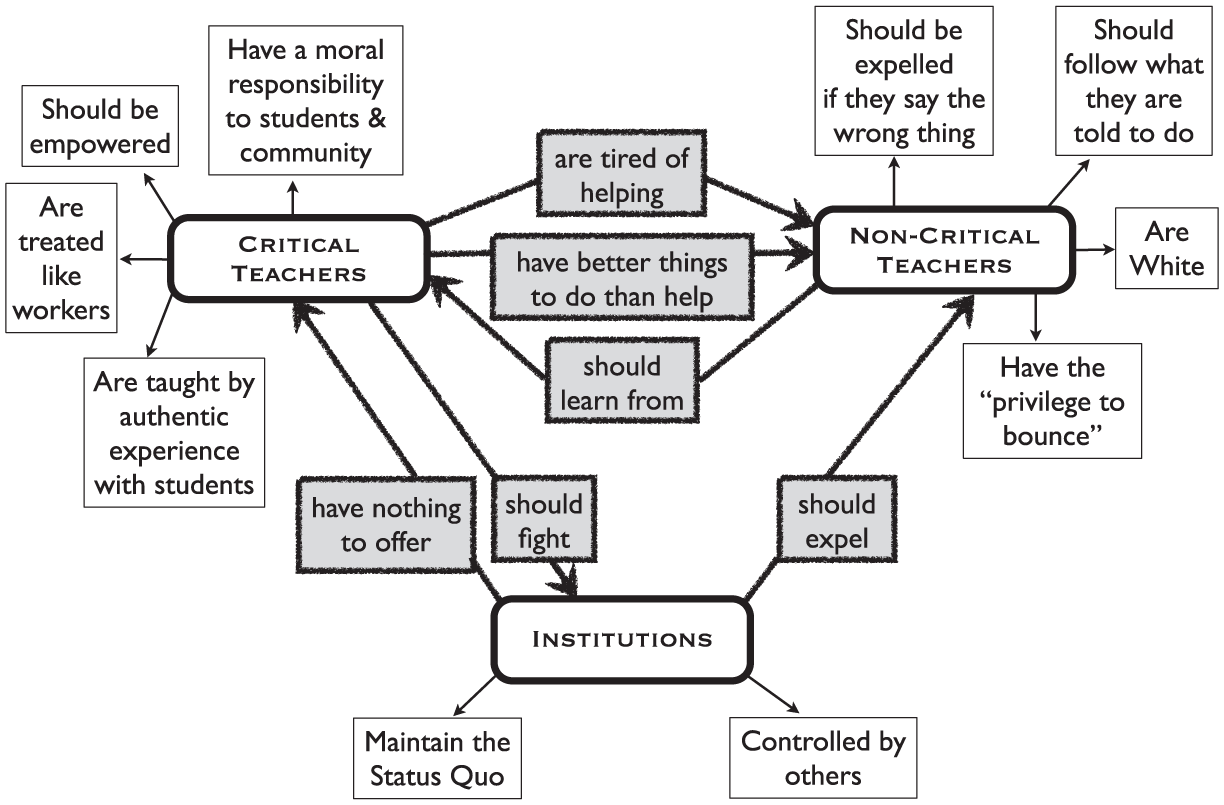
Summary of Hugo’s arguments.
Hugo’s performed self-acclamation as a critical prospective teacher of color served to reposition him outside of the complexities of working in state institutions. He embraced a Rida perspective that schools are “morally bankrupt” and not worth transforming as it would mean “time away from direct service to students” (Duncan-Andrade, 2007, p. 623). Institutions are seen as a monolith that have nothing to offer and should be fought against, but should also paradoxically assent to the desires and wishes of critical teachers by expelling their dissenters. By viewing institutions as homogeneous and erasing the contestations of power that exist within them and shape them, Hugo’s performed ideological position allowed him to abdicate any responsibility in their formation or transformation. Hugo’s stance is also interlaced with contradictions concerning “consciousness raising” that are predicated on a belief that such knowledge will lead his students to transform their own realities. However, there is a disjuncture if teachers’ own “raised consciousness” does not drive and oblige them to transform their institutional realities or their macro-structural contexts, which inevitably shape the possibilities for them and others to engage in critical pedagogical work.
At one level, Hugo’s “fragmentary, disjointed and episodic” (Hall, 1996, p. 43) sense-making is nothing exceptional—we all do it (Philip, 2011). But, the patterned dichotomizations are not accidental or coincidental either. We argue that Hugo’s performed stances re-voiced and re-accentuated a particular set of discourses and practices that intersect with critical pedagogy as an emergent and contested field. We see Hugo’s position emerge from spaces where critical educators of color fluidly and uncritically move, at times, between articulations of Freirian principles and self-descriptions more akin to a Leninist notion of a vanguard-party that is entrusted with the leadership to guide the oppressed into liberation. Fundamental philosophical differences between these positions and their implications for strategy and action are rarely engaged. Instead, as with Hugo’s performance, they are selectively and advantageously used to position oneself as more critical or “down with the struggle” of “the people.” Certain critical educators of color, at times, overlook the repetition of this discourse pattern, we conjecture, because of the perceived urgency to address oppression. The haste is voiced in instrumentalist arguments that do not promote spaces for pause and reflection.
Within critical pedagogy, terms such as critical, progressive, decolonizing, and revolutionary come with a set of rigid prescriptions about who and what practices are marked as such. Rather than providing lenses for understanding identities, language, and actions, these markers are often taken out of context and thereby promote essentialist labels rather than situated meanings. We find frameworks such as Duncan-Andrade’s (2007) paradigm of Gangstas, Wankstas, and Ridas important in strategizing about power relationships in school, in highlighting the centrality of pedagogy and solidarity that so often falls to the sideline, and emphasizing the uncompromising commitments teachers must have toward their students. Simultaneously, we are also concerned that such positions are prone to promote essentialist identities and the concomitant effects of failing to see value and potential for growth in presumably “non-critical” voices, silencing diversity within “critical” perspectives, and negating the possibilities of alliances across a broader spectrum. Similarly, we share Duncan-Andrade’s (2007) and Hugo’s righteous anger against histories of racism, colonialism, and imperialism, and recognize this rage as a legitimate expression against the oppressive conditions that historically dominated people continue to endure to this day. We are apprehensive, however, of the tendency for such anger to reify dichotomies by constructing the “enemy” in abstractions such as “sell outs,” “neo-colonials,” and “fascists.” These all or nothing labels problematically obscure underlying relationships of power and the situational complicity that we all have in reproducing racism, classism, sexism, heterosexism, and oppressions along other axes of difference.
Critical pedagogy cannot stay stagnant; it must address changing realities and engage with perspectives such as cultural intuition (Delgado-Bernal, 1998), strategic essentialism (Spivak, 1994), and anti-racism (Potapchuk, 2005) that Hugo brought to light. Our naming of the anti-dialogical tropes in the discourse of self-identified critical educators of color highlights the responsibility and obligation for educators of color to disrupt patterns and transform spaces where contradictory and selective uses of diametrically opposed principles are often left unquestioned and unchallenged. Our analysis is an invitation for prospective teachers like Hugo to understand the contradictions and tensions in their positions and demand greater clarity from themselves, their peers, and leaders in the field. Individuals like Hugo are working their way through contradictions, resolving what it means to be a “critical” educator in light of their own trials and tribulations; this is especially true given their status as ideological and ontological “minorities” in spaces of higher learning. Yet, we cannot underestimate the influence scholars of color have on such new teachers of color. The contradictions evidenced by Hugo must prompt leaders in critical pedagogy to be more nuanced in their articulations, even if it means instilling a different type of fiery passion than they have in the past. As teacher educators of color committed to principles of critical pedagogy, Hugo’s performances urge us to critically reflect on difficult pedagogical moments where we re-inscribe or allow for the re-inscription of anti-dialogical frames and discourses.
As we look forward to developing the arguments seeded here, we recognize certain challenges. Empirically, the strength of this study is also one of its limitations: understanding tensions in the field of critical pedagogy for educators of color through an analysis of one participant. On one hand, categorical approaches that summarize patterns or trends among critical educators of color are informative in their own right, but fail to unearth the complexities that emerge when intensely focusing on the nuances of a single case such as Hugo. On the other hand, while Hugo is representative of a pattern we have consistently observed in our work in educational and community organizing spaces, he is not illustrative of the multiplicity of ideological positions and discursive strategies used by critical educators of color (as we observed in the multiplicity of perspectives during the focus group interview); neither do we want to fossilize Hugo’s talk, as he himself experiences ideological change. In our attempt to map anti-dialogical frames and discourses, we had to gloss over the ways in which Hugo’s discursive moves were made possible “precisely because he is a person of color, particularly a man of color, talking to other people of color” (K. Kumashiro, personal communication, November 24, 2012). As Kumashiro further reminds us, “These moves are significantly racialized and racializing moves, drawing on discursive histories that have positioned (rightly or wrongly, positively or negatively) people of color as speakers of authority and beyond criticism.” As we continue to study and map the anti-dialogical frames within critical pedagogy and in other social justice spaces, we hope to bring other methodological strategies and frameworks that will assist us in painting a more comprehensive and nuanced assessment of their constitution and co-construction.
Conclusion
Discerning that pedagogy is political and that the political is pedagogical allows critical educators to see their work as intimately tied to symbolic and material power and to its redistribution. However, appeals to the political can be taken up in different ways. How power is dialectically linked with pedagogy is subject to various interpretations based on how power is conceptualized. It may, for instance, be seen in structural terms—as the effect of competing and vying interests of different and oppositional groups. From this perspective, teaching is political by virtue of its enactment within a corporate–capitalist–colonial state. However, power might be viewed as something from “below”—a relational and situated interpretation of power. In this sense, pedagogical praxis is defined as “political” by virtue of the social relations internal to the pedagogical. The tropes we identified above overemphasize the first usage of political and minimize the second. The appeal to the pedagogical as political in the macro-structural sense allows for its participants to name their pedagogy as political work (or as anti-racist education, social justice work, etc.) by defining the pedagogical solely in opposition to homogenized others, such as institutions, the State, or “White people.” The inattention to the situated and relational aspects of power leads to carte blanche self-categorizations of the efforts of “critical” educators of color, who work with urban youth of color, as political or social justice work, without attention to the situational, intersecting, and dynamic identities within the classroom and beyond.
As teacher educators, we co-inhabit and co-construct pedagogical spaces in our work with prospective teachers who will do the same with their own students. Occupying contradictory and privileged locations as teacher educators of color in university spaces, we recognize that dialogue and pedagogy are not the only processes that are important for the transformation of structures of domination. However, we also recognize and embrace the possibilities of dialogue and pedagogy in our situated work as teacher educators working with beginning teachers. In this article, we focused on understanding, problematizing, and addressing anti-dialogical tropes invoked by “critical educators of color” in our ongoing reflective practice to realize the dialogical and pedagogical possibilities of our classrooms.
As we stressed in the introduction, we reiterate here that our focus in this article is not on Hugo. Hugo’s performances simply provided a lens into the contradictions within critical pedagogy, which he embodied. We also emphasize that his anger and his dichotomizations emerged in response to the systemic violence that is committed against people of color and in response to the exclusions that he has faced within institutions. His anger is legitimate and necessary. It certainly has the potential, in particular contexts, to create dialogue and reflection and to confront the deeply emotional dimension of teaching and learning as racialized beings. Naming and engaging with experiences of oppression and violence have the potential to heal and transform spaces (Zavala, 2015; Villanueva, 2013). But, it is also restrictive and counterproductive at times. The moral convictions of certitude that stems from such anger stamp out alternatives, the need to work in solidarity across differences, and the possibility of self-critique. We have attempted to understand and problematize the discourses within critical pedagogy that encouraged Hugo’s reactionary anger. As teacher educators of color, we also attempt to turn our critical eye inward through this analysis, asking our colleagues and ourselves how we intentionally or inadvertently fuel such reactionary anger by recklessly moving between the language of dialogue and moral certitude. How do we, as scholars and practitioners, learn to create spaces for our students and ourselves to critically read the discourses of critical pedagogy by examining the voices that we re-voice, modify, resist, and silence? We hope that our identification and exploration of the “critical” tropes echoed by Hugo will prompt a collective reflection among teacher educators through which we might learn to support teachers of color in ways that legitimate their anger while building solidarity across differences, that emphasize the uniqueness of being racialized while acknowledging the intersectionality of identities, and that embrace the power of strategic essentialism while seeing our shared humanity.
Footnotes
Acknowledgements
We thank the following colleagues for reading early drafts of this manuscript and for providing valuable suggestions, comments, and critiques: Jeffrey Duncan-Andrade, Antero Garcia, Kevin Kumashiro, Danny Martinez, John Rogers, Christine Sleeter, and Shirin Vossoughi (listed alphabetically).
Declaration of Conflicting Interests
The author(s) declared no potential conflicts of interest with respect to the research, authorship, and/or publication of this article.
Funding
The author(s) received no financial support for the research, authorship, and/or publication of this article.