



Abstract
In this manuscript, we recognize that young children learn stories that propagate white supremacist narratives through selective traditions of early childhood curriculum. The role of early childhood teachers, therefore, is to critically examine curriculum for biases, omissions, and distortions, as well as to rewrite curriculum to tell accurate stories and disrupt what Viet Thanh Nguyen refers to as “narrative scarcity”. Through a qualitative study of pre-service teachers’ (PSTs) re-imaginings and revisions of early childhood structures, processes, and texts, we highlight the moves that teachers made to rectify, represent and expand narratives related to communities of Color.
Monolithic narratives, mounted as universal truths, position the experiences of people of Color (POC) in the United States. As Asian American women who have achieved relative success, the “model minority” myth served us well in school and instead of disrupting the stereotype of hard-working and compliant Asians, we accepted and perhaps embraced this narrow identity marker as a means for social positioning (Liu & Shange, 2018). Meanwhile, the insidious workings of white supremacy created an illusion of scarcity, forcing marginalized groups to compete for resources, access, and opportunities. The model minority myth is a narrative tool upholding white supremacy through notions of meritocracy as our stories were/are often used to tout the benefits of hard work. This fuels anti-Black racism and obscures how larger institutional forces play a significant role in the struggle for Black liberation.
We begin with our positionality to ask how narratives maintaining white supremacy are constructed, circulated, and reinforced. Hegemonic narratives begin in the early years when children learn selective stories that become central to everyday life. American exceptionalism, bootstrap mentalities, and Eurocentric ideologies are presented through curriculum as common cultural knowledge (Templeton & Cheruvu, 2020). Therefore, children begin to construct “grand narratives” (King & Swartz, 2015) or universally accepted “truths” about history. Crafted to center whiteness, certain historical accounts gain prominence, circulate widely, are documented and memorialized; they become grander, obscuring the experiences and narratives of POC. For example, Pilgrims discovering occupied lands erases the violent removal of Indigenous people and further substantiates white imperialism over POC throughout time, including constructing Africans as property, Japanese as prisoners, and Mexican lands as justifiable conquests (Ladson-Billings & Tate, 1995).
We situate EC curriculum (PK-2) within historical and contemporary contexts where neoliberal agendas (Yoon & Templeton, 2019) and settler ideologies (Keenan, 2019; Templeton & Cheruvu, 2020) have privileged certain acts, topics, and knowledges. In recent years, educators have urgently called for more inclusive, anti-racist curriculum in schools, positing that we teach and confront hard and difficult truths about our nation's past. For example, The 1619 Project: An Origin Story, an endeavor led by Pulitzer Prize-winning Nikole Hannah-Jones, retells the story of America's founding. Positioning slavery at the center of the American narrative, the project performs a staggering archaeological feat: it forces us to realize that our knowledge of the past is not only partial and wildly distorted, but also a significant obstacle to our evolving together.
The 1619 Project, alongside countless social movements and protests for social justice, prompted many U.S. educators to critically examine and revise traditional school curriculum. Yet, with every revelation made by POC that disrupts the status quo, there has been backlash (Hannah-Jones, 2021; Vickery & Rodriguez, 2022). Recent backlash over critical race theory (Kendi, 2021), homophobic and anti-Trans legislations across multiple states, and increased surveillance prohibiting teachers from teaching accurate histories (Vickery & Rodriguez, 2022) are just a few examples of conservative acts to exclude POC perspectives and histories. Largely, these concerns have to do with school curriculum, beginning in early childhood. For example, during Judge Ketanji Brown Jackson's Supreme Court confirmation hearings, GOP politicians aggressively expressed a number of uninformed concerns regarding Judge Jackson's affiliation with a local DC private school that practices an anti-racist curriculum (Rogers, 2022). Their distress had to do with fears that preschool-aged children would be subject to what one GOP member called “progressive indoctrination” (e.g. anti-oppressive pedagogies meant to ensure inclusion and belonging).
Curriculum has been, and continues to be, a powerful tool for determining standard knowledge, and scholars identify urban education as a key site for racial reckoning and contestation (Busey & Coleman-King, 2020). Our interest as teacher educators within an “urban intensive” (Milner, 2012a) context like NYC (where this study is set), is in how pre-service teachers (PSTs) re-imagine curriculum through re-reading, re-writing, and re-imagining curricular materials that privilege whiteness. What “grand narratives” present themselves in school curriculum, and how do PSTs interrogate these dominant stories? How do teachers take this awareness and engage in social action as curriculum designers and critically conscious educators?
Gay (2021) argues that POC have a right to tell and hear their own stories as “legitimate content” (p. 219). Therefore, PSTs in urban contexts need preparation in making “rational, appropriate, and responsive curricular decisions” (Milner, 2013, p. 164), intentionally uplifting and preserving the legacies of POC. All teachers (sub/urban and rural contexts included) should be prepared to teach in classrooms of diverse learners, fully aware of the political economy schools cultivate through curricula. But as those responsible for passing on cultural knowledge to Black and brown children in urban classrooms, urban teachers—who are not often from the cultural backgrounds of their students—need to understand the situated and subjugated knowledges of their students; otherwise they are prone to reifying toxic social orders that play a role in race-based violence and that affect the well-being of students of Color (Boutte & Bryan, 2021; Faircloth, 2018). While Hannah-Jones (2021) notes that “we all suffer for the poor history we’ve been taught” (p. xxii), inarguably children of Color are most harmed by the curricular violence that they might experience through textual omissions, distortions, and inaccuracies (Boutte & Bryan, 2021; Faircloth, 2018).
Literature Review
Curriculum in PK-12 centers whiteness by privileging white middle-class histories, norms, and practices as dominant and essential knowledge (Au et al., 2016; King & Swartz, 2015; Pérez & Saavedra, 2017). The whitened curriculum, paired with negative media and popular culture discourses around communities of Color, lends itself to what King (1991) refers to as dysconsciousness or “uncritical habits of mind (including perceptions, attitudes, assumptions, and beliefs) that justify inequity and exploitation by accepting the existing order of things as given” (p. 135). “Eurocentric, white male onto-epistemologies” (Saavedra & Pérez, 2018, p. 750) underscore the competencies, norms, and dispositions viewed as essential to learning (Brown & Brown, 2015; Muhammad, 2020; Paris & Alim, 2014). Consequently, white supremacy is legitimized and bolstered as schools exclude the historical encounters and viewpoints of Indigenous peoples, communities of Color, and those with limited power and fewer opportunities to be heard (Brown, 2019; Saavedra & Pérez, 2018). In the U.S., racial violence is not an event of the historical past. Rather, it endures through curricula, literature, routines, and school spaces, protecting white supremacy through a veneer of “racial progress” and equality (Jackson, 2008). In this literature review, we begin with curriculum as a cultural project that privileges whiteness; then we highlight the role of teachers in destabilizing hierarchies of knowledge.
(Early Childhood) Curriculum and Cultural Erasure
Curriculum draws from “ideologically and racially distorted knowledge” (Brown & Brown, 2015, p. 112) and perpetuates enduring “racial myths” (p. 112). In EC, beliefs about children's racial innocence (Templeton & Cheruvu, 2020) justify color-evasive ideologies (c.f. Annamma et al., 2017) and fail to address power dynamics. Moves to dismantle racist beliefs must confront “the mechanisms of white supremacy which also create, disseminate, and reinforce pathological imageries of racialized groups” (Escayg, 2019, p. 4). Without facilitating a divestment of white privilege, white children benefit from in/visible norms and conditions, which in turn elevates their sociopolitical positioning. Furthermore, “goodness” and “innocence” reinscribe racial hierarchies with real effects impacting children of Color—increased surveillance (Powell & Coles, 2021), symbolic and physical violence (Boutte & Bryan, 2021; Proffitt, 2022), limitations on play (Yoon, 2020), and mis/readings of ability (Souto-Manning & Yoon, 2018).
In a set of critical ethnographies conducted by Nash and Miller (2015), for example, teachers and children regarded whiteness as “good, normal, and appropriate” (p. 191), in stark opposition to damaging discourses around Blackness. Manifested partially by the materials children encountered in official and unofficial school curricula (e.g. newsletters, books, images on display), children expressed discomfort around POC, specifically Black men. Furthermore, teachers’ comments invoked racial microaggressions and perpetuated white savior complexes.
Curricular materials
The problems with curriculum are evidenced in materials, resources, texts, participation structures, and assessments that give white groups a heightened sense of importance. For example, Core Knowledge (see https://www.coreknowledge.org/)—a widely used and mandated curricular program in PK-8 schools in NYC—specifies, curates, necessitates knowledge for a “culturally literate” American citizenry. The program's founder E.D. Hirsch Jr. (1987), a white, Ivy League educated male, viewed multicultural education as a threat to the U.S. social fabric, reiterating school's “responsibility to ensure our children's mastery of American literate culture” (p. 18). Core Knowledge lessons and materials present white, middle class cultural experiences as valued, essential knowledge. Knowledge is presented as both a subject matter issue, as well as a racial and cultural issue (Howard & Milner, 2021). Core Knowledge, along with other kinds of prescriptive curriculum, reifies cultural hierarchies or altogether erases cultural difference in favor of basic skills (Souto-Manning & Yoon, 2018).
Curricular enactment
Much research is dedicated to how critical subject knowledge influences student learning and teacher efficacy (Gay, 2021; Howard & Milner, 2021). Yet, relatively little research positions EC teachers as content experts and gatekeepers to the knowledge economy (Swartz, 2009). Given the larger set of historical and political factors that influence what children learn, Moll & Arnot-Hopffer (2005) argue for sociocultural competence and ideological clarity—an understanding of schools as sociopolitical spaces where curriculum reproduces social hierarchies (Howard & Milner, 2021). In other words, curriculum and teaching are ideological and political; curricular content, structures, and perspectives can limit and/or expand children's worldview. Alongside the sociopolitical realities of urban centers—segregation, racial tensions, wealth gaps—teacher preparation programs must also make political and ideological choices that rethink and reimagine curriculum, particularly for those harmed by invisibility, control, and deculturalization (Howard & Milner, 2021; Milner, 2012b; Morris, 2021).
Structural and systemic factors hinder the work of racial justice, and these macro challenges (e.g. poverty, racism) in urban centers circulate in the micro challenges of classrooms, including underqualified teachers enacting problematic curricula from a deficit perspective (Ladson-Billings, 2021; Proffitt, 2022). Over/attention to development and universality inevitably reinscribes whiteness as the norm, ignoring much-needed interrogation of materials and structures (Escayg, 2019; Husband, 2019). Scholars have long advocated for diverse literature to engage children in explicitly political and social conversations about race (Husband, 2019; Price-Dennis et al., 2016). Yet, facilitating the conditions for critically literate conversations (Vasquez et al., 2019) goes beyond exposure to difference. For example, through multiple readings of one text, Fontanella-Nothom (2019) details how children excavated their racial identities and reached deeper levels of productive classroom dialog. Demonstrating the capacity of preschool children to (re)consider the effects of race historically and contemporarily, she argues that these conversations require trust, mutual respect, and time—all of which are in short supply amidst a toxic educational climate of accountability and achievement.
Teachers’ Critical Consciousness in Curriculum-Making
Neoliberalism—the ideology and ensuing policies that turn institutions for social good into market-driven commodities (Yoon & Templeton, 2019)—drives much of the school reform movements in urban contexts, from charter schools to privatization, leaving urban schools beholden to curriculum publishers and corporations for funding (Ladson-Billings, 2021). Inevitably, corporate funding comes with regulations on what is considered “good teaching” and “good schools”. Rather than teachers as intellectual leaders, they are judged by neoliberal metrics: test scores, universal benchmarks, and school readiness. Furthermore, EC classrooms are largely overlooked as sites for curricular transformation (Yoon et al., 2020) though these spaces “[occupy] a critical moment in the process by which students become competent in the rules, norms, values, and dispositions “necessary” to function within institutional life as it now exists” (Apple & King, 1977, p. 348).
Following Pérez & Saavedra (2017), critically conscious teaching begins with interrogating teachers’ positions as raced, classed, and gendered beings. Teaching involves actively “crafting counter-hegemonic knowledge that fosters changed consciousness” (Collins, 2000, p. 285) while naming and critiquing how we (as teachers) might have contributed to epistemic violence. By creating spaces of critical self-action, Pérez and Saavedra (2017) challenge educators to reposition the authority of whiteness with transformative pedagogies of practice that decenter Global North onto-epistemologies. Particularly for white teachers, acknowledging and confronting privilege rooted in supremacist ideologies is necessary in disrupting the superiority of white, western canon as “universalized grand narratives” (Swartz, 2009, p. 1051).
Yet critical consciousness is the first step toward transformative potential (Jemal, 2017). Reflecting on the conditions that shape one's cultural worldview must be coupled with individual and collective actions that change the “socio-ecosystemic” structures of institutions (Jemal, 2017)—in this case curriculum and pedagogy. Baines et al. (2018) demonstrate that “culturally relevant, humanizing, and decolonizing teaching” (p. 118) takes deliberate and informed action, underscoring the importance of knowing families and communities through deep engagement and participation rather than “drive-throughs” (p. 34) resulting in voyeuristic and superficial understandings. Baines and Tisdale (classroom teachers) intentionally centered the African-American children in their classrooms through overhauling classroom libraries to provide mirrors and windows (Bishop, 1990). They created alphabet walls featuring children in their classrooms and frequently visited landmarks around the neighborhood. They honored children's funds of knowledge (Moll & Gonzalez, 1994) by including and interacting with important adults in children's lives (e.g. grandmothers), acknowledging and engaging with out-of-school educational spaces (e.g. barber shops), and elevating children's rich African-American histories. When culturally appropriate materials were scarce, the teachers created their own books to better connect with and represent children in their classrooms.
Conceptual Framework
We feature the important steps early childhood PSTs engaged in to design more equitable curriculum. Through analyses of official curriculum, PSTs rewrote curriculum by applying critical frameworks and attending to issues of representation, power, and the construction of knowledge. That is, critical consciousness is developed by teachers who study curriculum, critique and interrogate knowledge, and rewrite how curricular materials are (re)presented in classrooms.
Excavating the Truth and Constituting Knowledge
If knowledge in schools is constituted as a relationship amongst documents, materials, experiences, and voices, then it matters who curates sets, how materials are selected and made relevant, and where they are positioned in relationship to each other. Curriculum can easily uphold American exceptionalism (Keenan, 2019; Templeton & Cheruvu, 2020), maintain power for a select few (Brown & Brown, 2015; Hannah-Jones, 2021), dilute and/or erase stories of oppression (King & Swartz, 2015), and circulate this knowledge as agreed-upon, objective truths (Sonu, 2020). For example, while some social studies educators have advocated for primary source documents as tools for presenting accurate representations of history, others have urged us to ask which documents are privileged and how they are mediated (Stanton, 2012).
Historical accounts are selective—deliberately chosen to present specific epistemological standpoints. Origin stories, like that of the birth of America, uphold white supremacy politically, culturally, and socially; these stories are passed down generationally as a selective tradition (Hannah-Jones, 2021). Indigenous voices are consistently silenced in favor of dominant narratives populating curriculum, especially in early childhood (Reese, 2018, Templeton & Cheruvu, 2020). These dominant narratives delegitimize the authority and contributions of Indigenous communities, specifically when white people are falsely credited with discovering lands, knowledge, stories, and practices. The past is refracted through whiteness and ideas/practices of communities of Color are colonized by Eurocentric viewpoints. If knowledge is an “appropriation” of the past rather than an actual reflection of it, teachers need to be engaged in intellectual excavation— researching the origins of commonly accepted stories, foregrounding the contributions of POC, and destabilizing the authority of Eurocentric perspectives. Important to consider is whether official curriculum is a revisionist history or accurate scholarship from the stories communities tell about themselves (King & Swartz, 2015; Moll & Gonzalez, 1994).
Retooling Knowledge: Telling Truthful Stories
History is replete with excluded and untold stories, left out for dominant groups to maintain power, control, and economic resources (Hannah-Jones, 2021). Even today, it is difficult for writers of Color (including curriculum writers) to author stories of their experiences in diverse, complex, and varied ways. Furthermore, racist ideas and hierarchies of power continue to work in overt and covert ways, along the axes of politics, history, and ultimately, in/visibility (Jackson, 2008). Preserving a history where whites are supreme and where racism is veiled by social progress, propagates policies where critical race theory and discussions of racism are seen as divisive and antithetical to the neatly crafted narratives of American pride and patriotism (Hannah-Jones, 2021; Kendi, 2021).
Viet Thanh Nguyen (2018) uses “narrative scarcity” to illustrate the lack of different kinds of stories told about POC. This happens in literature and history, consistently flattening the experiences of POC to enslavement, exclusion, immigration, civil rights, and other traumatic events. Rarely explored are the humanity, experiences, and contributions of POC to U.S. history. The sheer lack of diverse representation across different kinds of texts limits the platform for POC's experiences and decenters their narratives from historical accounts. By extension, curricular knowledge is not an accurate rendering of historical events, but an indicator of where power resides and extends. A recent review of Social Studies Weekly, a curriculum reaching 4.3 million elementary students across 13,000 schools nationwide, found over 400 examples of racial and ethnic bias (Schwartz, 2019). Native Americans were positioned as “troublemakers” and enslaved Africans as “workers,” alongside activities directing students to empathize with enslavers. While the company quickly edited content and formed a “diversity board,” academic publishing companies remain dominated by whiteness.
In an “economy of narrative scarcity,” diverse stories told about communities of Color remain limited in number (Nguyen, 2018). In the midst of racial reckoning and a COVID-19 pandemic, both popular media and schools rushed to create more mirrors and windows (Bishop, 1990) for minoritized communities. But as stories are more widely (re)presented, we question whether these accounts expand the narratives of POC. For example, Black exceptionalism remains the story perpetuated in school curricula. In an effort to diversify curriculum, schools present materials with more POC who typify greatness while still populating the everyday experiences of white people as the norm. These images and content run the risk of being stereotypical and/or one-dimensional. That is, diverse stories are still essentializing and narratively scarce.
When we frame curriculum from multiple perspectives, specifically from those of underrepresented groups, counternarratives (Solórzano & Yosso, 2002) are critical in illuminating multiple truths and demystifying harmful stereotypes perpetuated about POC. Highlighting POC only by exceptionalism illustrates worth through their achievements and accomplishments rather than their personhood. Racial/ethnic groups have “tremendous intragroup diversity of language, ethnicity, culture, religion, socioeconomic class, education, and historical experiences” (Rodríguez & Kim, 2018, p. 17), yet are often subsumed under racial categories of sameness rather than difference. Therefore, diverse representation must be undergirded by a commitment to “narrative plenitude” (Nguyen, 2018) of marginalized identities—both the ordinary and exceptional—broadening the multiple perspectives and cultural plurality within racial/ethnic communities.
We honor the work many have been doing to bring justice to children and teachers in schools—from culturally sustaining pedagogies (Ladson-Billings, 2014; Paris & Alim, 2014) to diverse representation (Bishop, 1990) to calls for transformative curricular reform (Au et al., 2016). In this study, we highlight how PSTs come to rewrite the colonial stories often told in EC classrooms. We discuss the ideological shifts they make and the unsettled tensions.
Methods
Drawing from a larger, 2-year qualitative study on PST identities, curricular practices, and critical pedagogies, we focus on the ways they critiqued and redesigned curriculum from critical stances, foregrounding children's cultural, social, historical, and political contexts (Muhammad, 2020). The PSTs were placed in various EC classrooms (infant to second grade classrooms) with diverse populations across New York City. We face the same issues that many teacher preparation programs in urban and urban-adjacent programs contend with—a predominantly white teaching force whose prior understandings of POC are constructed from a distance. Interrogating whiteness in one's own life and taking responsibility is a difficult and challenging order for many of us (including ourselves) who benefit from systems of power (Matias, 2016). For many, they are asked to confront the privilege of whiteness (or their proximity to it) for the first time. In fact, 72.5% (45 out of 62) of the participants were white and Asian (international and Asian American), primarily from middle and upper class backgrounds, reflecting the issue with which urban teacher education programs today contend: many of these teachers may be underprepared to teach children with different lived experiences. The examples in this paper were crafted in a curriculum course for EC educators and serve as the beginning of a longer process of becoming critically conscious practitioners. We structured the Rewriting Curriculum Project (RCP) to set up conditions where teachers question dominant knowledge, decenter their own experiences, and disrupt what is considered standard knowledge. In pursuing further this line of inquiry, we explored the following questions:
How does school curriculum present “grand narratives,” and how do PSTs interrogate these dominant stories? How do PSTs take this awareness and calls to diversify school materials into social action as curriculum designers and critically conscious educators?
Data Collection and Analysis
We bring together data (student work/artifacts, fieldnotes, interview transcripts, and researcher notes) from a 2-year period pertaining to re-reading, re-writing and re-conceptualizing EC curriculum. Inspired by King and Swartz’s (2015) rewriting of the Harriet Tubman story in a 1st grade text (pp. 74–81), we sought to reframe grand narratives that diminish the magnitude of systemic oppression. King and Swartz identified how grand narratives of enslavement are perpetuated in EC texts—failure to name white people as oppressors; sanitized truths about the horrors of enslavement; omission of risks Harriet Tubman took to gain freedom for others; dehumanization of enslaved Africans; etc. The text referred to the underground railroad as a “special path” and likened escaping from slavery with “moving to new places” (see p. 75). There was no mention of whites as enslavers, and Harriet's bravery was cast as a pursuit for “fairness” rather than the livelihood of her community and their right to be free.
Drawing from this example, the PSTs worked to analyze and deconstruct curriculum from their placements with a critical lens. Some PSTs chose a specific curriculum (e.g., 17 out of 44 projects focused on an aspect of Core Knowledge), and others selected curricular resources and materials. Others chose site-specific lessons (created by their schools), structures, and routines. Curriculum—broadly defined—encompassed materials, resources, interactional structures, and environmental factors related to teaching and learning.
In analyzing curriculum, we read and coded official curricular documents alongside PSTs’ rewritten projects, focusing on: Whose knowledge is centered? Whose perspectives are featured? Whose knowledge and experiences are excluded? How are materials selected, presented, and curated? What modes of inquiry and ways of being are given value? We read curriculum both deductively and inductively, making note of striking ideas, key words, and phrases. We blocked off specific chunks of curricular documents that resonated with us as troubling—one-sided, inaccurate, incomplete, monocultural, distorted, etc. Knowing PSTs also brought their ideologies and experiences to reading, we engaged with PSTs’ curricular rewrites in similar ways: we coded inductively and deductively following our guiding questions. Table 1 is a breakdown of the projects across two years, the official curriculum descriptors, and the initial codes applied to data.
Curricular Rewrites & Codes.
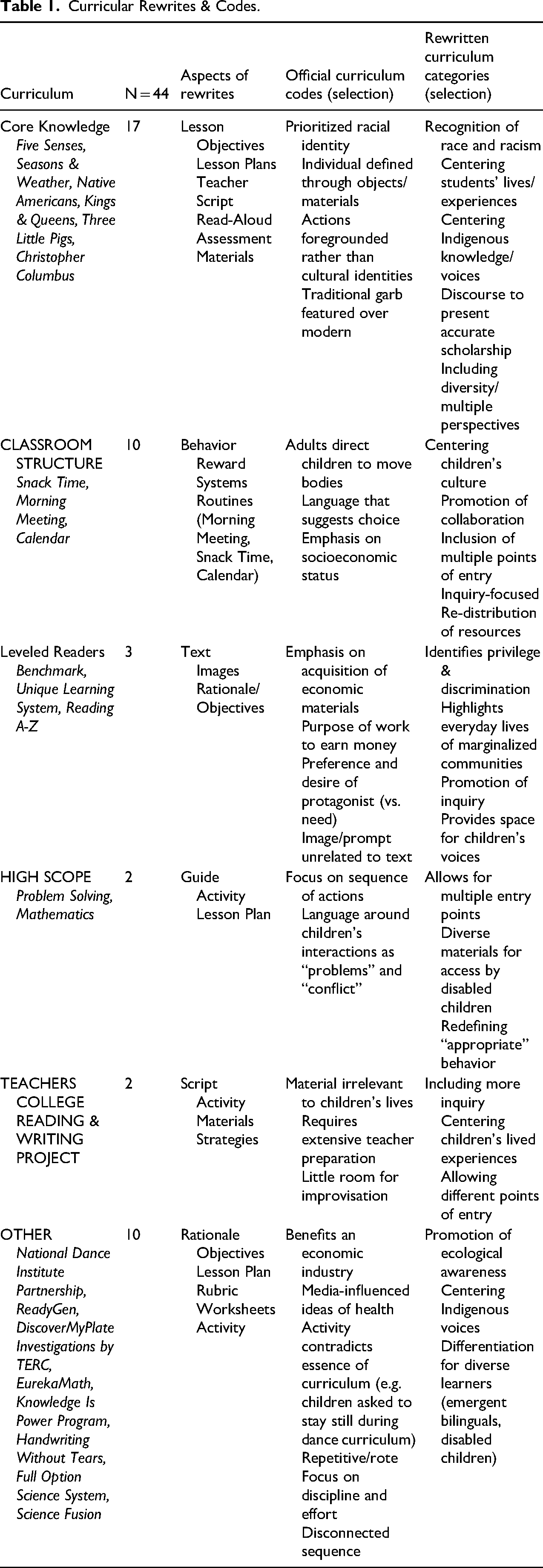
We compared the rewritten curriculum with the official curriculum and looked again more closely at excerpts PSTs chose to highlight. As we analyzed texts side-by-side, we identified the standpoint and perspective PSTs took in rewriting their own versions. For example, Yue Wan (all names are pseudonyms) chose to rewrite a Core Knowledge (Hitchcock, 2014) section on Barack Obama (featured in findings). Initial codes stayed close to the text and were descriptive in nature. That is, when Barack Obama's presidency was featured during “African-American history month”, we coded this initially as “prioritizing racial identity”. When Obama's job was categorized by the materials: “big desk”, “important papers”, and “phone”, we coded this as “defining president through objects/materials”. The unit (although categorized as one on important people) introduced Obama's section with activities on voting and ballot boxes, again de-emphasizing the personhood of Obama by “foregrounding actions rather than a person”—another initial code. While the whole section on Barack Obama was coded and read, Yue Wan focused most of her attention on the “family letter”. In following her lead, we re-read the family letter, making note of the words, sentences, and ideas she critiqued in her reading of the text. We compared her revisions to the original family letter, tracking her omissions, revisions, and additions. In addition, her written reflection provided insight into her process of rewriting: Why did she omit certain words or ideas? Why did she add to the text? The codes in Table 1 show how we collapsed or grouped initial codes into categories based on patterns (Bogdan & Biklen, 2007).
To look at the data holistically, we wrote integrated data narratives of selected projects, three of which we feature in this article. In these narratives, we synthesized the PSTs’ ideas using a combination of direct quotes from written reflections, rewritten curriculum, and official curriculum. We infused our own interpretations (i.e. researcher notes) of the revisions, exploring and expanding on salient themes. While honoring the important critical moves and shifts teachers made to rewrite and reimagine curriculum, we recognize there are still gaps in their revisions of dominant curriculum.
Findings
Thirty-five of the 44 projects (80%) focused on curriculum meant for pre-kindergarten and kindergarten, and while 36% of the projects centered on English Language Arts curriculum with an emphasis on history and social studies, most (64%) focused on other areas of curriculum. This detail is important to note, given that these other subjects (mathematics, science, writing) are construed as culturally neutral when work across content areas reveals otherwise (Emdin, 2016).
Cultural Identities: From Singular Representations to Multiple Narratives
By drawing upon their own cultural identities and interactions with young children, PSTs challenged the misconception that young children are devoid of cultural identities. For example, Rhoda accounted for children's religious identities by adding Jewish and Islamic icons to the preschool classroom calendar. Beth, Stacy, and Lee translated a leveled reader on Chinese immigrants into Mandarin, including details specific to aspects of Chinese culture in the English and Mandarin versions. Drawing from their own ethnic affiliations as Chinese students, they highlighted hybrid and diverse Chinese identities embodied in languages, customs, and historical events. Additionally, they researched the experiences of Chinese Americans (unfamiliar to them as Chinese nationals) at the turn of the 20th century.
Participants’ focus on identity was not limited to race, religion, language, and markers typically associated with culture. Eleven of the 44 projects (26%) emphasized aspects of official curriculum the PSTs analyzed as ableist, privileging particular knowledges and modes in which they take shape. They questioned normative modes of communication in writing (e.g. Tiffany's rewrite of a writing assessment included multimodal representations), problem solving (e.g. Renee's rewrite of the High Scope problem solving protocol recognized children's extraverbal communication and linguistic differences), and behavior (e.g. multiple rewrites of classroom procedures included movement and more flexibility within interactive spaces).
Cultural identity was informed, in many instances, by children's day-to-day experiences, such as children living in an urban space or existing within particular family structures. Na's revision of a prekindergarten “Family and Communities” unit included children from LGBTQ families. Tracy rewrote a leveled reader entitled Amazing Places to Work; instead of featuring glamorous jobs, reflected the everyday jobs children in her classroom knew from their NYC commutes. By replacing images of a ship captain and an opera singer with subway and sanitation workers, Tracy brought children's contact with those in their daily lives into the curriculum. Working from lived experiences contributed to the PSTs’ revisions to curriculum in the service of sustaining cultural pluralism and multiple perspectives.
In what follows, we unpack the process of rewriting curriculum by featuring three projects in depth. We present these as examples of PSTs’ processes, exemplary of early career teachers’ ongoing critical consciousness formation, rather than as perfectly rewritten curriculum. Because the official curricula used by teachers are under copyright, we describe them but cannot provide the actual figures.
The Over- and Under-Racialization of Obama's Presidency
Many claim Barack Obama's presidency as “proof” of a post-racial United States, marking forward progress from brutal and violent racial histories. Concurrently, curricula explain topics like racism, sexism, and other exclusions as remnants of a historical past rather than relevant and lived by non-dominant groups daily. Current political moments involving race and racial violence (e.g. #BlackLivesMatter, #StopAsianHate) are ignored or watered down, and this “cumulative lack of attention to present-day racism communicates, via omission, the impression that racism and racial violence are simply problems of the past” (Aukerman et al., 2019, p. 295).
When race is mentioned in EC curriculum, it is decontextualized and sanitized, suggesting an exaggerated sense of racial progress and patriotism. Yue Wan (East Asian female) focused on a family letter for a preschool Core Knowledge unit on “Important People in American History”. The letter explains the section on Barack Obama as simultaneously occurring during African American history month. Notably, the opening sentences are the only instance in the section (which included various elements) when the word “African American” and any notions of race are mentioned, despite the purported racial and historical foci of the letter. Yue Wan questioned the decision to include Barack Obama in this particular month, especially if race is suggested by the curriculum to be inconsequential to the narrating of Obama's life.
In the letter, Yue Wan notes how central the White House is to Barack Obama's story. After introducing Obama as the 44th U.S. president, the content quickly shifts to the White House as a “big, fancy house in Washington D.C.” (n.p.). The segment describes the White House as both a residence for presidents and a place of business where work gets done. Half of the page-long document describes the White House as a place of everyday activity, “just like you do in your house”. The Oval Office is described through recognizable objects (e.g. big desk, papers, phone) and given more air time than Obama himself. Malia and Sasha Obama are briefly mentioned by name as having “wonderful” lives, and Michelle Obama is never mentioned as an important figure during Obama's presidency, despite the inclusion of a family photo. Rather than “Important People in American History”, the focus is on objects, the White House, and general descriptors of a president's job, having little to do with the person himself.
In contrast, Abraham Lincoln's story (in the next parent letter) is told with a narrative arc focused on his humanity. The letter begins with Lincoln's childhood where he worked all day on his family's log cabin and studied all night by teaching himself how to read. The narrative documents his childhood and adulthood, before highlighting his political leadership. Unlike the story of Obama which began when he started his political career, Lincoln's qualifications are built up with specific, “truthful” accounts from his experience. They show Lincoln as intellectual, a voracious reader, an honest boy, hard-working, trustworthy, and committed to his promises. Meanwhile, Obama's narrative was coupled with the technicalities of his job as president. Both are figures represented in the section on “Important People”, but the stories invariably place importance on different aspects of their in/humanity.
In rewriting the curriculum, Yue Wan featured Barack Obama as the first Black president, relayed specifics about his accomplishments, noted his various responsibilities during his tenure, and conveyed how social media connected him to people in contemporary times. She chose images focused on his personhood rather than the office, the White House, and any objects obfuscating his importance. She also made racial tensions clearer, President Obama tried his best to help and listen to everyone, but it was not an easy job! There were people that did not like him because he was African-American. They did not want him to do well, so they made fun of his skin color and called him names. They talked badly about his family too. But, President Obama did not let the teasing get to him. He kept doing his job to make a better life for everyone.
She noted, If teachers are required to introduce President Obama on African-American history month, they should not shy away from the subject of race. We have looked over curriculum where writers paint rosy pictures, like everyone was friends. We know, however, that it was not true. President Obama faced a lot of racism and criticism because of that. I cannot be as pointed as I would like, but it does not mean that we should avoid the subject (sic).
Omissions of racial identity, racism, and historical oppression, especially in this case, diminish the experiences of POC. The section noticeably refrains from mentioning the historical significance of Obama's election while numerous efforts were made to emphasize the ordinary and relatable characteristics of his life: he sleeps, eats, and gets dressed in the White House “just like you do in your house” (Hitchcock, 2014, n.p.); the White House is like an “office building” (n.p.); Sasha and Malia do chores, go to school, and do homework; they have a dog. At the same time, Obama is reduced to his racial identity rather than the multiple identities he holds as a husband, father, academic, and leader. He is purposefully included during African American history month as a representative of his race. In the section, he is likened to Martin Luther King Jr., also described as someone who gave speeches so “everyone could live peacefully and nicely together in our country” (Hitchcock, 2014, n.p.). Yue Wan's revisions to the family letter portrays how race factored into Obama's presidency. Unlike other presidential candidates, she notes he was subject to racial discrimination. She was specific about his individual contributions rather than those associated with presidency in a generalized way. She does not reduce his life to ordinary or relatable factoids, but centers his identity as a Black man, as a president, and as a contemporary figure.
The Multiple Origins of Cinderella
At Ana's (white and Latina female) school, the students were exploring different versions of Cinderella stories to illustrate the fairy tale's significance across time and space. Part of a larger study on fairy tales, this month-long unit explored versions of Cinderella stories across cultures—Mexican, Zulu, Korean, and European (as described by the school's curricular map). The unit's introduction, written by the administrative team, described the story of Cinderella as a “timeless piece of traditional literature” spanning across geographic and cultural borders. However, the unit begins with American writer and illustrator Marcia Brown's adaptation of Cinderella, drawn from French writer Charles Perrault. Brown's version is explicitly described as the “classic version” of the story, setting up the European Cinderella as the standard. As new texts were introduced, the students compared them with Brown's text, in accordance with curricular guidelines. Again, “cultural” stories are set against the backdrop of whiteness as the normalized narrative. Each cultural story was accompanied by a one-page handout, purportedly synthesizing the “entire” culture of Mexico, Korea, and South Africa. Even though text sets claimed diverse perspectives, Ana felt “uninspired and more uncomfortable” when cultural one-pagers offered limited and essentialized portraits of the cultural backgrounds listed above. Ana observed that connecting cultural information with the various Cinderella stories was absent, in favor of describing cultural tropes unrelated to the story, like quinceañeras (coming of age ceremonies), communal living in Zulu villages, and Korean traditional dress. That is, featuring non-Western voices without attention to changing historical and political contexts reduces cultural narratives to stereotypical and superficial understandings (Nguyen, 2018).
Ana focused first on the unit's framing, noting, “the purpose behind the entire unit had to be taken in a different direction”. She began with the essential question of, “How does the oppression of certain groups influence the stories we read?” Ana rewrote the unit summary to feature the origins of the “classic” story. These origin stories are important in accurately conveying certain traditions, stories, and aesthetics that usually come from the Global South, Indigenous cultures, and various other communities of Color. Tracing where and when stories—specifically those canonized in Western cultures—originated disrupts taken-for-granted presumptions. The Western canon of Cinderella, as Ana noted, stems from Charles Perrault, a Frenchman who stole the story from ancient cultures. Ana wrote, The story of Cinderella we most commonly know today originated from the Ancient Egyptian story of Rhodopis recorded in 1st Century BC, the Ancient Chinese story of “Yeh-Shen” recorded in 856–860 AD, and countless other stories from the Middle East, Greece, Philippines, and Japan, all told before the European version of 1697 AD.
Ana featured the contributions of other cultures and at the same time, questioned which cultural stories gain prominence. She researched the origins of the story and credited Indigenous communities that constructed and circulated Cinderella stories long before the European “classic”. Ana began her rewrite describing the common tropes in the Western imagination: glass slippers, the pumpkin, the fairy godmother, the evil stepsisters, and the handsome prince. Rather than comparing this story with other cultural texts, she introduced this story as an appropriation of ancient cultures who have passed it down across generations long before Western writers. Ana wrote, Ultimately, we want students to understand that different cultures and civilizations outside of Europe and America have made tremendous contributions to our world, despite the fact that we might not know about them. We also want students to think about how power can influence the stories we bring to the forefront.
Ana worked to represent accurately the origin of popular stories like Cinderella, largely co-opted by media, popular culture, and corporations like Disney. She learned that the first recorded Cinderella stories came from Egypt and China, both missing as stories in this unit. Moving away from a Eurocentric view (King & Swartz, 2015), Ana rewrote the unit with stories from ancient cultures and highlighted their influence on contemporary versions. By rewriting how the unit was introduced to children, she repositioned the dominant narrative and centered non-Western voices.
In addition, Ana felt the ancient stories allowed children to see Cinderella as a heroine rather than the “kind-hearted yet passive girl who remains helpless until magic and a rich Prince help her”, perpetuated by Western narratives. In contrast, some of the cultural stories portrayed the protagonist as more active and less helpless. She proposed looking at historical, political, and cultural contexts situating the roles and positions of women. Ana did not ignore students’ need to understand literacy skills outlined in the goals: compare/contrast; characters and plot; setting; fairy tale elements. Yet, she also underscored the potential to interrupt dominant storylines. She reflected, While I agree that these are important literary elements to discuss, I wanted to create a more meaningful reason in doing so. The old unit failed to address the underlying message that marrying into wealth is an appropriate way to solve problems and that women should be passive recipients of help instead of active members of their community. Therefore in the new unit, students will get an opportunity to compare and contrast characters and analyze story elements by critically thinking about Cinderella as a heroine and examining the lessons we should learn or not learn from this story.
Even the most beloved and well-known stories are open for interrogation and critique, as Ana asserts. Through her revisions, she posits that the skills and resources of literacy are also tools for social and cultural exchange of ideas and perspectives (Vasquez et al., 2019). Ana and many of us grew up with static notions of these “timeless” stories, uncritically accepted from one generation to the next. Ana's reframing of the story introduces multiple narratives and ways of being for women.
Emergent Literacy and Representation in Leveled Readers
Early literacy text sets—emergent readers, and leveled books—are specifically written for children to “acquire literacy” in linear ways. Less attention is paid to representation in emergent texts, many of which compromise visual representation and cultural content in favor of basic, literacy skills: beginning sounds, repeated words, letter recognition, and sight words. That is, “windows, mirrors, and sliding glass doors” (Bishop, 1990) should apply to increased representation in all kinds of textual encounters (e.g. emergent readers, worksheets, posters, word cards) where whiteness remains uninterrupted (Thomas, 2016).
A Black and West Indian pre-service teacher, Mia was increasingly attuned to the white, middle-class curriculum that the predominantly Black and brown students in her classroom site received. Mia worked in a special district serving children and youth with disabilities and described her students’ multiple identities and lived realities as raced, classed, and disabled. Mia rewrote an emergent reading text entitled Jordan's First Job. In this leveled reader, the protagonist is a white male by the name of Jordan, which Mia notes was not “representative of [her] classroom culture”. Upon newly acquiring a car, rather mysteriously, Jordan looked for his first job to pay for gas and insurance. After going through job advertisements in a local newspaper, Jordan settled on a job walking dogs, earning him enough for car maintenance. Prior to this, Jordan never held a job, which Mia makes note of (“never held a job, but has a car”), emphasizing the privilege of the character's situation. This, coupled with Jordan's reluctance to take a dishwashing job simply because, as the text describes, “he does not like to wash dishes,” signaled to Mia a socioeconomic and social class freedom enjoyed by a few. These class privileges intersect with the subtle forms of able-bodied and male privilege inherent in Jordan's choices. Though he can do it, he does not want to.
In considering another job, Jordan could cook for the job as a chef, but could not cook “all that food”. The issue, as Mia argued, however, was due to his lack of training and skill as a chef, making him unqualified for the position. The text dismissed the knowledges that come with navigating a kitchen and understanding the mechanics of meal preparation. Ultimately, in the text, Jordan took a job walking dogs, something he decided he enjoyed and could do. Mia critiqued this as unrealistic; she wondered how walking dogs could earn enough to pay for gas and maintenance, along with other life expenses. Jordan's choice, motivated by preference and desire, was an able-bodied luxury not all individuals had, especially Mia's students for whom independent living and vocational skills are not taken-for-granted.
Units in economic literacy such as this one, titled “All in a Day's Work”, are not free of a hidden curriculum that aids in “the production of a capitalist ideology” (Weber as cited in Sonu & Marri, 2018), increasingly emphasized in EC curricula. The economic market is positioned as indispensable to American lives, and citizenship comprises of participation within this individualistic, capitalist logic rather than as “a kind of ethno-political response-ability that regards the individual as part of a collective well-being” (Sonu & Marri, 2018, p. 14). In Jordan's First Job, children received messages about a perceived valuable logic: acquire a preferred vocation and gain capital for a commodity. This text emphasized Jordan's individual desires and subsequent pursuits within a “neoclassical free market capitalism” that “serves as the unquestioned order of things” (p. 14).
In Mia's rewritten curriculum, she told the story of Tiffany, a Black youth, whose job pursuits were tied to family contributions: helping her grandmother pay bills. Mia's revision positioned working-class POC and disabled individuals as part of the economy, rather than as a burden to economic development, in usual framings. We can assume that as an older individual, Tiffany's grandmother can no longer work to pay for the family's bills; by neoclassical economic standards, she is disabled. Yet, Tiffany's grandmother contributes to and participates in care networks not accounted for by capitalism; Mia stated “it's really common” for grandparents to care for children and youth in the family. She drew from knowledge of her students’ lives and her personal life; her own grandmother adopted and raised independently two of her cousins (and continued to care for great-grandchildren). Mia's revision, notably following the original structure and order of the leveled text, communicated Tiffany's job search as significantly related to her intimate relationship with her grandmother (as imaged by a stock photo Mia chooses to feature of two Black women, one young person and one older person,). She wrote: … I began by utilizing an African American female protagonist who resided with a grandparent opposed to the typical nuclear family. Every student in my classroom is a racial minority and there are several students … who do not reside with their biological parents.
By portraying the protagonist as a young Black woman, Mia disrupted the visual prominence of white males as central to social and economic life. Mia's version of the story included similar elements to Jordan's First Job, except for changes in words such as “experience” to signal the skills necessary for cooking; as well as “applied” to emphasize that one does not simply “get” a job just because one wants one. Additionally, her visual choices represented POC, as well as depictions of family structures like Tiffany's, where young people assumed responsibility in caring for elders. Tiffany, and others like her, extend their responsibilities through weekend hours; Mia deliberately chose professions “plausible” for teenagers who must balance the expectations of home and school.
The choices Mia made in her rewrite appear simple, but are informed by her racialized, gendered, and classed identities. Mia's positioning in her own world, as well as what she understood of her students’ intersectionalities as disabled POC from working-class backgrounds, guided her critical examination of the original text and her revision. She was not trying to present POC as a monolithic group, yet she centered children's cultural communities on book covers and illustrated pages—an important visual and contextual move communicating value and importance (Bishop, 1990). While teachers like Mia many not always have autonomy over curriculum, they play an important role in determining, selecting, and presenting material to children (Aukerman et al., 2019).
Discussion
From structural changes, to rewriting curricular content, to centering accurate knowledges of POC, the PSTs analyzed whose stories were missing from larger narratives. Mia's revisions to Jordan's First Job maintained the structure of the text but changed the content to reflect the knowledges and experiences of working-class POC. Ana's revisions to the Cinderella unit reminds teachers that Westernized childhood stories originate in places like the East and the Global South (Pérez & Saavedra, 2017). She drew attention to how power played a role in the production and circulation of certain narratives, suppressing Indigenous stories while uplifting and commercializing their Western derivatives. Yue Wan noted how particular stories are not only missing but manipulated. Her revision to the Core Knowledge unit on Barack Obama, meant for Black History Month, brought to the fore Obama's accomplishments as a Black man in America, rather than simplifying nature of his bureaucratic office.
By focusing the conversation on PSTs, we disrupt binaries positioning PSTs as inadequate and uncritical, in opposition to in-service teachers who are considered more qualified. PSTs destabilize hierarchies of expertise as they work against narrow curricular ideologies towards critically conscious practices. Giving truthful accounts about race in America (e.g. Barack Obama's presidency), re-ordering the goals and questions in curricular units (e.g. the Cinderella unit), and re-writing images/texts for diverse populations (e.g. leveled readers) centered children's cultural identities and illustrated PSTs’ capacities to confront critical social and political issues.
Like Ladson-Billings (2014), we argue for sociocultural consciousness in teacher education programs where teachers draw from children's “funds of knowledge” (Moll & Gonzalez, 1994), uplift their multiple narratives, and integrate and learn from their lived experiences. Prior to these projects, the participants in this study conducted artifact analyses and ethnographic observations of their classrooms, schools, and neighborhoods. Curriculum, therefore, was conceived as situated within these larger realities.
Implications and Limitations: Critically Conscious Pedagogies in Urban Settings
While we could see how images and texts were rewritten, shifted, and inclusive of diverse identities, transformative curriculum takes work, energy, and sustained effort. As King (1991) asserts, we should adopt critical habits of mind, questioning knowledge and interrupting presumptions in our work as teachers and teacher educators. The questions asked in revising curriculum are the same questions we should ask in our daily interactions with “curriculum”, from teaching manuals and lessons to media and popular culture. Who is overly represented and overvalued? Who is undervalued, delegitimized, and excluded from dominant narratives? Consistently on the margins are children whose linguistic repertoires clash with dominant English (Boutte & Bryan, 2019), whose social/emotional identities follow non-linear patterns of development (Yoon, 2018), and whose racial/ethnic communities experience structural inequities across the sociopolitical landscape (Ladson-Billings, 2021). In an era where scripted curriculum is the norm, we argue for critical analysis of content and responsive decision-making that account for children's intersectional identities and experiences.
However, in urban contexts like NYC, de facto segregation coupled with curricular mandates contribute to racial disparities and continued exclusion (Milner, 2013; Noguera & Alicea, 2021). Because this study stopped short of PSTs’ entry into classrooms as full-time teachers, we do not know if they continued this work. If they did, we know it would not be without its challenges. The first-year teachers in Picower’s (2011) study, for example, faced numerous challenges while attempting to enact equity-oriented curriculum. Their colleagues, lacking the tools for critical consciousness, shied away from, or critiqued, overtly political lessons. As a response, the new teachers camouflaged their critical pedagogy in moments but also found it necessary to “go public” (p. 1125), making themselves vulnerable to risk, hypervisibility, and increased scrutiny. Practicing socio-politically charged curriculum rooted in students’ lives isolated the teachers, and the inquiry group facilitated by Picower acted as a refuge for them. Through a range of social networks, critical educators need connected communities where emotional, social, and physical support is nurtured and sustained (Picower, 2011; Stern & Brown, 2016).
Criticality and Special Education Classrooms: Addressing the Gaps
To do this work, PSTs had to understand children as subjects who embodied “complex knowledge, experiences, and ideas that are often ignored in classrooms” (Wynter-Hoyte et al., 2019, p. 444). For the most part they did and this study allowed for us to probe the limits of that. Out of eleven projects (26% of total projects) focused on classrooms with disabled children, only Mia's revised specific content. The others questioned the accessibility of content (e.g. allowing for manipulatives in math) and the appropriateness of expectations and rubrics (e.g. what is “good” behavior?). Implicit in these rewritings is that children with disabilities be offered “accommodations,” watered-down curriculum and lowered curricular expectations.
Further, only four of the 11 projects (36%) focused on special education classrooms connected to an academic subject (as compared to 25 of the other 33 projects, or 76%, designed for mainstream classrooms). The overwhelming focus on structures, while admirable, also reveal the implicit ability hierarchies reified in traditional special education training. Waitoller and King Thorius (2016), for example, offer accounts of how accommodations and planning tools can be “cross-pollinated,” with critical pedagogies. In repositioning student capacities, disabled students who are typically viewed as “in need” of support would be reconceptualized as “experts in and about their schools and communities” (p. 375). Accordingly, as white supremacy continues to manifest itself in schools and beyond, Waitoller and King Thorius urge teachers to consider how race, gender, class, and dis/ability intersect to produce inequitable effects.
Conclusion
Paris and Alim (2014) define cultural pluralism as a democratic project that moves beyond acts of inclusion and demonstrates a commitment to disrupt dominant ways of being as no longer the standard by which power and access are distributed. Rather than an additive approach to curriculum, we call for transformation (Sleeter & Carmona, 2017) where a multiplicity of POC's experiences across content areas are brought from the margins to the center; where classroom communities foster multiple ways of being and knowing; where both the individual and collective experiences of POC are centered in curricular materials; where diversity within and across cultural communities are explored deeply and truthfully.
This paper examines rewriting EC curriculum in order to foster teacher development in which the “core interest is to sustain, revitalize, and nurture the identities, practices, ingenuity, agency, and humanity of [children] of color, on their terms” (Domínguez, 2017, p. 226). We are aware of the political tensions narrowing teacher agency, given the limits of standardization, scripted curricula, and teacher evaluations. The discourse around “readiness” (Graue, 2006) continues to frame curriculum around basic skills of reading, writing, and numeracy, often devoid of context. Curricula are not “static, neutral documents of fact, but rather dynamic, ideological, cultural artifacts that do something” (Ladson-Billings & Brown, 2008, p. 153), and what they can do has to do with the individuals charged with the doing.
Footnotes
Declaration of Conflicting Interests
The author(s) declared no potential conflicts of interest with respect to the research, authorship, and/or publication of this article.
Funding
The author(s) received no financial support for the research, authorship, and/or publication of this article.
