




Abstract
The Every Student Succeeds Act redefines the priorities of our nation’s education system. Prior to its passage, turnaround strategies advanced solutions for low-performing schools. Research literature examining how these reforms impacted the schooling experiences of students attending these schools is lacking. We present the results of a qualitative case study of a reconstituted urban school in the Southwest United States, providing the perspectives of 10 students with dis/abilities and the effects accountability reform efforts had on their high school experience. Three expressed needs and desires were identified: (a) a positive school identity, (b) stability, and (c) to be recognized and heard.
Keywords
Since 2002, U.S. public schools have been charged with demonstrating their students could meet specified standards of academic performance and school-improvement benchmarks advanced by the No Child Left Behind Act (NCLB; 2002). Students in each measured subgroup including students with dis/abilities (SWD), students receiving free and reduced lunch, and students classified as limited English proficient (LEP) were expected to make adequate yearly progress (AYP) on state accountability measures in incremental percentages each year. When a school failed to meet AYP and received unacceptable accountability ratings for 5 consecutive years, districts had the option to initiate a change in leadership and specific strategies within the school designed to turnaround the negative pattern of academic performance. The logic of high-stakes accountability initiatives dictated by NCLB was to compel schools designated as “low performing” to improve student performance on standardized, content-area exams and reduce the achievement gap across student subgroups. The shortcomings of this approach have been well documented (Crocco & Costigan, 2007; Hursh, 2007).
On December 10, 2015, President Obama ended the era of NCLB (2002) by signing into law the Every Student Succeeds Act (ESSA), a bipartisan effort of Congress (U.S. Department of Education [USDOE], 2015). The ESSA replaces NCLB’s prescriptive requirements, eliminating the progressive sanctions leveled against schools that fail to make AYP via state accountability measures (Association for Supervision and Curriculum Development, 2015; USDOE, 2015). When the law officially goes into effect in 2017, the oversight and decision-making powers regarding specific actions or consequences for schools in need of improvement shift to the states. Nevertheless, the apparent relief provided by this new law provides little solace or restitution for students who, whether by choice or necessity, attended a school designated as underperforming and in need of improvement prior to the enactment of the ESSA, particularly within the urban school context. Moreover, states can still choose to reconstitute schools or enact similar NCLB-type policies if they choose to do so.
Although ESSA will most likely help to decouple standardized tests from other important educational decisions and emphasize the voice of parents and educators in state and local decisions, the residue and discourses associated with labeling students and schools as “failures” or “deficient” will undoubtedly remain (Carey, 2014). Milner and Lomotey (2014) characterize the current context in which urban education exists as an “identity crisis” (p. xvi). They underscore the need to examine the “structural forms of inequity” (p. xvi) that are detrimental to student success rather than focus on the inaccurate perceptions of others who pigeonhole certain students as deficient due to identity markers such as poverty, race, or dis/ability. 1
Researchers have attempted to chronicle the broader institutional effects of school reform and efforts from the students’ perspectives (Deeds & Patillo, 2015; Kirshner, Gaertner, & Pozzoboni, 2010; Kirshner & Pozzoboni, 2011; Liou & Rotheram-Fuller, 2016; Taines, 2014). Such an approach can assist in (a) understanding how a group of individuals perceive a particular phenomenon, process, or outcome (Brantlinger, Jimenez, Klingner, Pugach, & Richardson, 2005; Maxwell, 2005; Paul, Kleinhammer-Tramill, & Fowler, 2009); and (b) providing “compelling and instructive accounts of the qualities of life and culture in schools” (Paul et al., 2009, p. 11). Few research studies, however, have specifically examined whether students with and without dis/abilities are affected by school restructuring as a consequence of accountability reform and only a handful have sought to understand the effects of reform from the perspectives of SWD (Fitch, 2003; Pazey, Vasquez Heilig, Cole, & Sumbera, 2015). We build on this body of research by focusing on student voice from a diverse group of students with and without dis/abilities, including some engaged in leadership and advocacy work.
The purpose of this study was to examine how high school–age students with and without dis/abilities attending a turnaround urban high school described the school turnaround process. We draw on literature focused on school turnaround, student voice, and critical dis/ability studies (DS) to analyze and explore what students liked and disliked about their school, how school turnaround policies impacted their identity and daily academic life, and alternative recommendations students identified for improving their school. Ten students with an identified learning dis/ability (LD) attending an urban high school defined as “low performing” by the state based on accountability results for the 2010-2011 school year were individually interviewed. At the request of the initial participants, a focus-group interview was conducted with members of their leadership group, enabling us to gain further insights into the school’s turnaround process. What emerged from these students’ perspectives was a twofold discovery: (a) Students were fully aware of the negative view the larger community held of their school due to the media attention their school received, and (b) students could not escape the compounding fallout and consequences of school turnaround and threats of school closure, but were empowered to advocate for what they believed was a better course of action.
Accountability and School Turnaround
For more than 30 years, the United States has been involved in a number of educational reforms endorsing arduous goals for student achievement. A Nation at Risk (National Commission on Excellence, 1983) became a turning point in public education because it oriented educational reform initiatives toward values of competition, standards, and a comparative assessment of students. Schniedewind (2012) refers to the graduated changes that have occurred since A Nation at Risk as “a creeping ambush of public education” (p. 4). Davis (2003) characterizes such educational reform efforts as “blurred,” “faulty,” and “bankrupt,” attributing its failure to a disconnect between “theoretical solutions” and “educational practice” (p. vii). Others contend accountability reform policies are premised on the belief that threats of school closure will motivate educators to work harder and cause students to learn more (Shepard, 2008; Vasquez Heilig & Darling-Hammond, 2008).
Impact on Individual and School Identity
Several researchers assert the identities of individuals and institutions are dialogically constructed by the interactions that take place between them and others, the ways they are perceived by others, and the contexts in which their identities are formed (Bacon, 2015; Holland, 1998; Rubin, 2007). Others highlight the intersection of multiple identity markers such as race, culture, ability, ethnicity, social class, and gender (Ghosh, Mickelson, & Anyon, 2007), noting their membership within a marginalized versus privileged group is determined through interactions “between people, institutions, and practices” (Faircloth, 2009, p. 325). Hatt (2012) surfaces the notion of “smartness as a cultural construct” (p. 438), particularly among turnaround urban school settings. As a verb, “smartness” is displayed through the simultaneous interplay of “culture, power/status, and identity within practices of everyday life” (Hatt, 2012, p. 444), as “something done to others as social positioning” (p. 439). According to Jones-Walker (2015), micro-level interactions are apprised by the social and historical realities of the organization which act together to develop the identities of “individuals and the spaces they inhabit” (p. 5).
Turnover of Teachers and School Leaders
Turnaround efforts have included the removal of “ineffective” teachers and leaders plus the implementation of specific steps geared toward improving school climate and leadership (Mathis, 2009). In some instances, veteran and/or effective teachers with expertise in core content areas and classroom management have left their schools or the profession due to uncertainty caused by (a) fear of eventual school closure, (b) potential for termination, (c) stigmatizing and demoralizing effects of working in a school advertised as low performing (Hamilton, Vasquez Heilig, & Pazey, 2014; Maxcy, 2009), and/or (d) emotional fallout caused by working in a high-stress environment (Smarick, 2010). Novice leaders and teachers who lack expertise in critical content areas, long-term substitutes, or teachers unable to obtain positions at other schools have frequently filled vacancies created by their departure (Hamilton et al., 2014; Malen & Rice, 2009; Mathis, 2009). Turnover causes a broad disruption within the school, impacting both students and the morale of the remaining teachers (Ronfeldt, Loeb, & Wyckoff, 2013).
Student Perspectives
Students attending reconstituted schools under threat of state oversight or closure spoke about an overriding focus on test-prep classes, Saturday school, and anxiety over needing to pass the state test (Pazey et al., 2015). Other students adjusting to displacement caused by the closure of their former high school expressed anger and sense of loss in terms of former relationships with teachers and friends and the stigma applied to them at their new school (Kirshner et al., 2010; Kirshner & Pozzoboni, 2011). Despite students’ belief their voice and involvement in determining school policy could improve their school and classrooms, they were nervous about what might happen if they overstepped their boundaries or were viewed as opposing school authorities (Taines, 2014).
Effects on Students
Students attending low-performing schools have reportedly experienced instability, a casuality of the education reform strategy of reconstitution (Losen & Orfield, 2002). Reconstitution, a school turnaround tactic and major restructuring option under NCLB (2002), involves the replacement or removal of school staff, including the school principal. Yet, achievement gaps have remained intact or widened even further (Darling-Hammond, 2007; Supovitz, 2009), making SWD and other marginalized student groups the scapegoat for schools deemed ineffective (Bacon, 2015; Jones, Jones, & Hargrove, 2003). Students in this study represent numerous NCLB subgroup categories (i.e., economically disadvantaged, LEP, racial diversity, dis/ability) and have been penalized through accountability reforms rather than regarded as unique due to their diversity. These marginalized student populations become “faceless” entities, reduced to a “mere statistic and/or score” (Bejoian & Reid, 2005, p. 227) with no sense of agency. They become even more stigmatized due to pressures imposed on their school to increase test scores (Bejoian & Reid, 2005). Rather than recognizing students’ diversity as an asset, they are judged by their “ability to perform on multiple choice tests” (p. 227) and otherwise made invisible. Moreover, accountability policies of school turnaround contribute to distrust among the school and community which causes the overall school community to become “stigmatized and demoralized” (Mathis, 2009, p. 13).
Student Voice
Student voice provides a useful tool for highlighting how students are oppressed within the context of school reform and exploring how, if at all, students advocate or fight for a voice in the educational policy arena. One of the purposes of research on student experiences in schools is to investigate how the identities of a particular group of students may be impacted by what happens in their classrooms and schools (Thiessen, 2007). Using student voice has been referenced as “emancipatory” and “empowering” as it can effect change and show “how lives are constrained by systems that are oppressive” (Lewis & Porter, 2007, p. 324).
Student voice has been advanced as a viable approach to involve youth in the “broader democratic mission of schools” by affording them the opportunity to share in “school decisions that will shape their lives and the lives of their peers” (Mitra, 2009, p. 819). Nevertheless, students are rarely consulted or heard in national, state, or local policy debates and their lived experiences and perceptions of school and learning are rarely given voice (O’Hair, McLaughlin, & Reitzug, 2000). Goodman and Eren (2013) suggest our nation’s focus on educational reform and current obsession with high-stakes testing has struck a major blow to the possibility for student voice since educators are under “daily pressure to improve academic progress, always facing the relentless gun of an approaching test” and recognize “their own status is contingent on student performance” (p. 123). Drawing upon students’ experiences to inform educational policy by “including the excluded” has been termed “a radical idea” and requires us to ask different questions, challenge old assumptions, think outside the box, and move beyond the “privileged perspectives of adult academics” (Cerecer, Cahill, & Bradley, 2013, p. 220). Keefe, Moore, and Duff (2006) concur, naming SWD the real experts on learning.
Reconstituting a school might elicit a new purpose for achieving success, separate from the typical assumptions of school accountability mandates and high-stakes testing requirements for graduation (Shepard, 2008; Vasquez Heilig & Darling-Hammond, 2008). However, including students’ perspectives when adopting changes made to the school, particularly for high school–aged students, is critical. Students generally possess a strong sense of what is “fair and just” regarding how they are treated, plus their views may not align with “conventional notions of hierarchy, policies, rules, and school procedures” (Smyth, 2007, p. 641). When schools do not offer spaces for students to express themselves, students will be more likely to resist any change efforts, alienate themselves from school authorities, and disconnect from school altogether.
The incorporation of individuals’ voices and perspectives serves as a form of inclusive research (Nind, 2014). According to Harris et al. (2014), when we listen closely to students regarding their school experiences, we are in a better position to (a) understand and address school-related topics and problems, (b) rethink policy and practice, and (c) embark on school-improvement efforts. Listening to students’ voices, including SWD, has been justified by several researchers for several reasons:
Students provide an alternative source of knowledge and expertise due to their insider perspective of school culture and climate (Cooper, 1996);
Investigations into issues concerning students should represent their experiences and viewpoints (Walmsley & Johnson, 2003);
Any determination of whether an adopted policy/practice is effective can only be achieved by communicating with students who are most directly affected (Keefe et al., 2006); and
Once students voice their concerns and suggestions, they should be allowed to engage in future decisions so their views can be transformed into the school’s policies and practices (Cefai & Cooper, 2010).
Leiding (2014) underscores the need to recognize student voice in reform initiatives as “central to the daily schooling experience because this is where the students are” (p. 24). Despite the argument that any chance of success in accountability reform must include a consideration of the hopes and aspirations of the students themselves (Smyth, 2006), the pressures placed on school leaders to demonstrate their school’s success tend to preclude any readiness on their part to fully indulge the different opinions offered by students (Conner, Ebby-Rosin, & Brown, 2015; Mitra, 2008).
Arguments relevant to improving school and student outcomes support the importance of eliciting input from SWD as the acumen of “students who are not succeeding under current conditions are often the most important voices that need to be heard in reform efforts” (Mitra, 2009, p. 821). To authenticate the significance of various student experiences, input must be garnered from students representative of multiple backgrounds and abilities, not just students from privileged backgrounds (DeFur & Korinek, 2010; Kozleski & Smith, 2009; Silva, 2003). Barnes and Sheldon (2007) contend that “emancipatory” research should not be premised on the view that SWD have “needs that are ‘special’” (p. 237); rather, one should focus on a social model of dis/ability that recognizes their needs are similar to any child but are not being met by the current educational system.
Disability Studies (DS)
DS offers an additional analytical framework to explore student voice (including other marginalized student groups) and “examine the policy from the perspective of the ones for whom the policy was implemented” (Ferguson, 2006, p. 173). Although all the students in this study were not identified as SWD; arguably, they were viewed as academically “deficient” and in need of a school turnaround policy remedy.
DS exposes the socially constructed assumptions influencing a particular policy from the perspective of those for whom the policy was actualized (Baglieri & Shapiro, 2012). Educational systems juxtapose social difference against a construct of normality that sorts, organizes, educates, and evaluates students by using a standardized set of criteria. Instead of recognizing the diversity of students on the basis of race, class, gender, dis/ability, and other areas of difference and the potential qualitative differences of their school experiences and outcomes, they create a normative code that honors and rewards homogeneity over heterogeneity (Erevelles, 2006). Dis/ability is reframed as a social construct entrenched in social and educational structures; therefore, the “practices of schools, the failures experienced by some students, both those labeled as ‘special needs’ and those who are not, must be reexamined as social and institutional problems” (Gallagher, 2006, p. 72).
DS scholars advocate for listening to the experiences of individuals with dis/abilities as a legitimate and promising approach to research and the possibility of “an inclusive, anti-hierarchical democratic dialogue” (Danforth, 2006, p. 87). Thus, the need to honor the voices of SWD and their peers transcends any argument for social justice.
Method
Qualitative Research Design
An in-depth qualitative case study approach was used to examine how 10 SWD and their friends understood, felt, and reacted toward an accountability-based school turnaround process in a low-performing urban high school (Yin, 2014). Concentrating on a single case with these boundaries established a depth of interviews and document analysis to capture the intricacies of accountability related to school turnaround, and the opportunity to explore student voice, student leadership and advocacy, and the effects of school turnaround on students within a school and community (Merriam, 1998). Our approach centered on student voice, focusing on the personal meanings participants attributed to their own experience and giving voice to individuals “who have been historically silenced or marginalized” (Brantlinger et al., 2005, p. 199).
Criteria used to select the 10 students were identical to the criteria used for previous studies conducted at the same school at two different points in time: Central High School (CHS) in 1995 and Heritage High School (HHS) in 2010 (Pazey, 1996; Pazey et al., 2015). Six of the 10 SWD were first-time participants; the remaining four students were students who participated in the 2010 study as ninth- or 10th-grade students.
In 1995, the following criteria were used to select the school site: (a) The student body reflected a diversity in ethnic composition, socioeconomic status, and student achievement; (b) the school contained a wide range of educational programs, curricular offerings, and social and community support systems; (c) the school provided special education services to approximately 11% of the student population; and (d) the school offered a variety of extracurricular activities, clubs, and student support programs. Pseudonyms were used for student names and the school site.
School Profile
HHS is situated within a prominently Mexican American and African American (AA) section of a metropolitan city within the Southwest United States. According to the state education agency website, for the 2011-2012 school year, the student body at HHS totaled approximately 600 students. Students receiving special education services numbered 116 or 18.8% as compared with a district total of 9.9%. The ethnic breakdown of students attending HHS was 80% Hispanic, 16% AA, 1.6% White, and 1.3% Asian. In addition, 91.3% of the students were categorized as economically disadvantaged, 20.3% as LEP, 72.8% as at risk, and 36.8% as students of mobility.
Selection of Participants
To get as comprehensive a sample of students as possible, SWD representatives of the student population were recruited from all four high school grades—ninth, 10th, 11th, and 12th—who were knowledgeable about the school’s history and turnaround efforts were recruited. Other criteria included their involvement in school-based activities or programs. With the assistance of the principal and lead special education teacher, students with an identified LD, receiving special education and related services according to the Individuals With Disabilities Education Act (IDEA; 2004), were asked to participate in the study. 2 Ten students representing each of the high school grade levels agreed to participate: (a) two female ninth graders, one Hispanic, and one AA; (b) two male 10th graders, both AA; (c) one AA male, one Hispanic female, and one AA female in 11th grade; and (d) two AA males and one Hispanic male in 12th grade. All 10 students received their academic instruction in general education classes with or without a special education teacher assigned to provide academic support. Table 1 provides a brief description of each student and their grade level, race, and dis/ability status.
10 Individual Student Participants with an Identified LD.
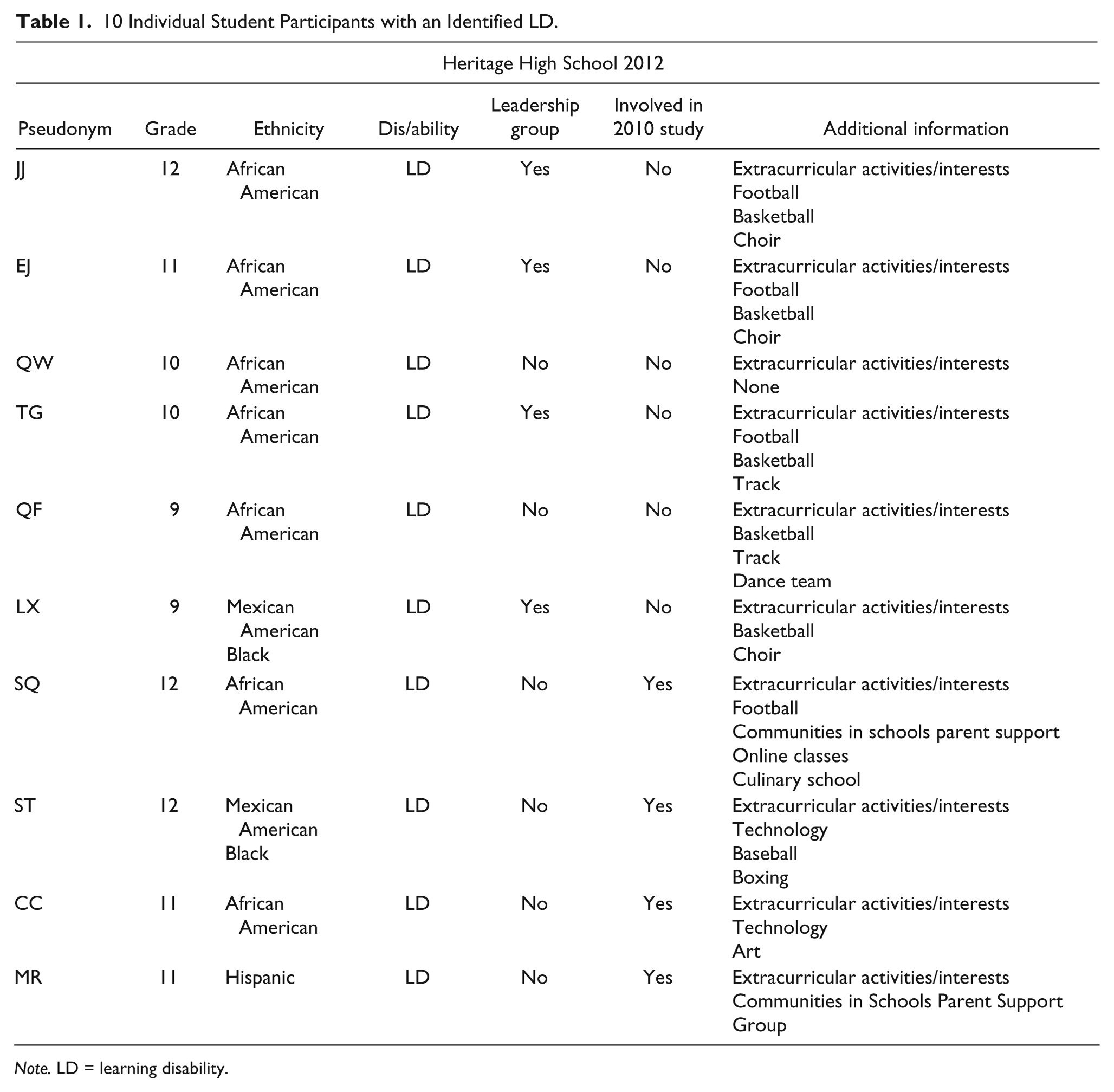
Note. LD = learning disability.
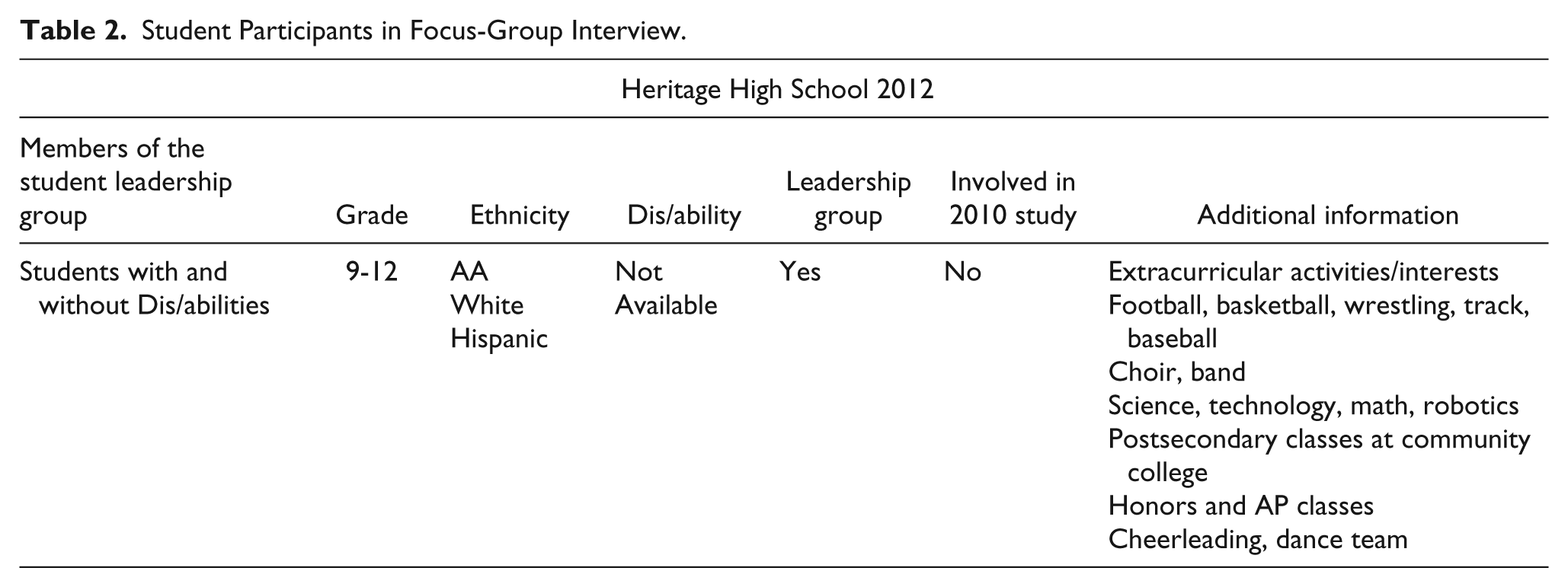
Within the course of the initial interviews, the lead author discovered four students were part of a school-wide, student-formed “leadership group” encompassing students across Grades 9 to 12. 3 One student, EJ—a junior male AA student with a LD—served as one of the core members of this group during his sophomore year. The assistant principal, who previously served as the principal of one of two schools-within-a-school from 2009 to 2011, asked him and several of his friends to search for ways to bring pride to their school and help other students prepare for the state-mandated test so they could receive an acceptable rating from the state. Although they now had a different high school principal, he and other students in the leadership group—four of 10 students involved in this study and their friends—viewed themselves as “advocates” for the school, even though they were not part of the Student Council. In fall 2011, they attended information sessions with the superintendent to discuss various options available to their school and spoke at school board meetings in December 2011, protesting the proposal to change their school to a charter school. After each participant was interviewed separately, they asked the lead author to pose the same questions to the leadership group via a focus-group interview (see Table 2).
Student Participants in Focus-Group Interview.
Data Sources and Analysis
Using a semistructured interview protocol, data obtained from 10 individual interviews and the focus-group interview served as primary data sources. Interviews were conducted in a classroom/office, a courtyard outside the school cafeteria, or the school library and ranged from 20 to 45 minutes. Interviews were audio-recorded and fully transcribed. Secondary data sources included data from newspaper articles, local media reports, district and school websites, a House Education Committee hearing, and anecdotal evidence from field notes.
Primary data sources were used to identify and highlight categories, properties, and dimensions within and across interviews. Discrete data parts derived from students’ perspectives, reactions to, and descriptions of specific experiences were grouped into larger categories and subcategories. Initially, the lead author coded all transcripts and checked for validity, accuracy, and an adequate representation of the data (Miles & Huberman, 1994). Throughout the initial data collection, data analysis, and data translation process, she met with two doctoral students familiar with the phenomenon being explored due to their involvement in a previous study at HHS (Pazey et al., 2015). To further analyze the data, she generated additional inductive codes representing important topics and patterns (e.g., policy perceptions, district interactions, advocacy, pressure, frustration, fairness, hope, disappointment, criticism). The second author reviewed the codes and patterns, raised questions, discrepancies, and inconsistencies with the lead author, and helped to refine the codes into themes, made evident between and among study participants, through critical conversations and reflective memos (Bogdan & Biklen, 2007). Both authors collaboratively utilized the secondary data sources to inform, clarify, supplement, confirm, and/or refute the findings.
Follow-up interviews were conducted with each of the 10 students, allowing them to review their transcripts and clarify and/or provide feedback on the preliminary findings. A draft copy of this manuscript was shared with three SWD who were members of the student leadership group to ensure their voices and perspectives were accurately represented. By engaging student participants in data analysis, our assumptions were challenged. Students asked tough questions about the research approach and interpretations (Creswell & Miller, 2000); however, they did not make any changes or additions to the transcripts, codes, or categories and indicated the translation of their schooling experiences and concerns had been accurately represented (Cho & Trent, 2006).
Throughout the process of making meaning of their experiences, both researchers and the participants examined “unanticipated and unexpected findings and dilemmas” (Cook-Sather, 2007, p. 859) to construct their own knowledge and understanding of participants’ experiences. Based on initial interviews conducted with two of the 10 student participants, it became immediately apparent their responses, stories, and rationale were inextricably linked to what they had experienced within the past year. The need to “listen and respond” (Cook-Sather, 2007, p. 860), tell their story, and provide an account of how SWD and their friends—who have traditionally been left out of any conversation about school improvement—took precedence.
Positionality
Researchers must have experience related to their research focus and must be “reflective” and “introspective” (Brantlinger et al., 2005, p. 197). Both authors have extensive experiences working in the area of general/special education, school administration, and teaching in high-needs urban public schools. These experiences directly contributed to our attitudes and beliefs about accountability reform and their effects on various stakeholders at the campus level. We recognize all students, particularly students with LDs, have unrecognized and undocumented strengths, abilities, and experiences. These undocumented aspects of their lives are intricately related to the context of their learning environment and how they feel connected to or disconnected from teachers and school (McCray & Garćia, 2002). 4
Background: HHS
CHS and HHS have undergone numerous changes since opening: from a neighborhood school in 1960 to an integrated school in 1980, to a magnet school in 1987, back to a neighborhood school in 2002 (Pazey et al., 2015). In 2008, the school was closed by the state and reopened with its current name, HHS. The following year, in 2009, the school was split into two separate academies. Two years later, spring 2011, anticipating an academically unacceptable rating for 3 consecutive years, the district administration prepared a reconstitution plan for the 2011-2012 school year which, according to the district website, was approved by the school board in May 2011. District officials publicly and privately disparaged HHS due to what they perceived to be an exorbitant expense to maintain separate administrative teams for both academies within the school. After 2 years, administrators were “fired” and told they needed to reapply for their positions (Academy principal, personal communication, May 18, 2011).
In June 2011, preliminary results on the state-mandated, high-stakes test from the SEA revealed students at one academy had improved their achievement scores across all five content areas, with the promise of receiving an acceptable performance rating from the state after years of unacceptable ratings. Attendance, dropout, and student removal figures showed signs of improvement. As stated in the editorial commentaary of the city newspaper in 2011, gains in student performance were achieved at the second academy as well. HHS was moving in a positive direction, and school turnaround efforts seemed to be paying off. Nevertheless, the district downsized the administration and reconstituted the two schools into one, led by one principal and administrative team for the 2011-2012 school year.
In August 2011, HHS started the school year with a new principal. As the semester progressed, conversations came to light about a possible agreement between the district and an outside charter school organization to convert HHS into an in-district charter school, slated to open in fall 2013. Community meetings held with the superintendent took place at the school and coalitions for and against the charter began to form. To add to the plight of the students and school community, the newly hired HHS principal announced his resignation on December 1, 2011, via an emergency staff meeting due to personal reasons (HHS principal, personal communication, December 13, 2011). An assistant principal from another high school in the district was named as interim principal for the remainder of the school year, effective January 2012.
When the school board met in December 2011 to discuss the possible merger with the charter school, students, teachers, parents, community members, and school supporters attended the meeting to speak against the proposal. Other local community members plus student, parent, and administrative representatives from the charter school spoke in favor of turning HHS over to the charter school management organization. Although current students were assured they could graduate from HHS without having to adopt the identity of the new charter school, they were devastated. Despite efforts to stop the plan, the board voted to approve the proposal, based on the superintendent’s argument that students would be better served due to their exposure to a college-preparatory curriculum. When students returned to HHS in January 2012, they met their third principal over the course of 1 year. Press coverage from mid-December to mid-January was mixed: some defending and others decrying the school board’s decision to approve the charter school takeover of HHS.
Findings
Searching for a Positive School Identity
Students attending HHS wanted to maintain every aspect of their school, including its name. CHS maintained its founding name until 2008, when the school was closed, reconstituted, and reopened as HHS (Pazey et al., 2015). When HHS opened with two academies in 2009, students who were freshmen or sophomores recalled the excitement they felt when they entered the school. When asked what they liked about the school, SQ referenced the “team building activities” at the beginning of the year; CC, MR, and ST mentioned the laptop computers they received to complete their work; and EJ and JJ recounted the “positive” and “welcoming” atmosphere of their school academy and principal. According to EJ, “My freshman year was my best year when I came here.”
Identified by a negative label
In spring 2012, students told a different story. They were told the opening of HHS represented a clean break from the previous history and negative press surrounding the state’s low-performing label of academically unacceptable attributed to CHS. They soon discovered this was not the case. EJ explained,
A lot of people already still compare us to CHS. What we’re trying to show the people is that we’re not CHS, we’re HHS and HHS is going to strive for more than what CHS wanted to strive for. And really, when they said that this school was going to be a new school and they was going to give us a new name, they should have gave us a new school number. But they didn’t. They had us keep the CHS number. If they would have gave us a new school number and let us start fresh I don’t think we’d be going through half of the stuff we’re going through.
EJ’s statement reflects the power of labels and problematic aspects of accountability reform policies that inhibit a school’s ability to craft a positive identity when identified as unacceptable, in need of turnaround, integral terms used to describe HHS.
Unbeknownst to students, CHS’ school number assigned by the state was carried over to one of the academies in the new school. Their state performance rating for the 2009-2010 school year was compared with the school’s previous test scores from 2008 to 2009—when the school was in disarray, recovering from the state’s closure. Although their academy had reached an “acceptable” rating 2 years after they reopened in 2009, their accomplishments were not fully recognized. Alumni from CHS were working behind the scenes, hoping to maintain a clear connection with the past history of their school. They attended school board meetings and asked the board to change the name of the school to reflect its original name. In June 2011, CHS alumni formed a coalition with neighborhood and community members and asked the SEA to close CHS and reopen the school under an alternative form of management because 29% of the senior class failed state-mandated tests and could not graduate.
Creating a new identity
Students at HHS wanted to achieve a complete break from anything related to CHS and establish their own positive identity. Because they believed the CHS alumni played a role in trying to take away the identity of their school—as they knew it—from them, maintaining the HHS name was paramount:
Since you actually started as a new school, would you rather have the identity be HHS as opposed to CHS?
Yes.
And there’re other people that don’t want that?
CHS alumni don’t want HHS.
And some of them are the ones that want the charter school to come in.
They don’t see our school as making progress—that we’re actually doing stuff. They still view our school—them, the [school district], the state still views our school as CHS. They still have their old numbers, which shows that the test scores were academically unacceptable. We still have all their old information and people just see our school as what CHS was.
Members of the student leadership group expressed the same reaction to their situation as EJ. TG stated, “I don’t like that we don’t have our own identity even though we’ve been HHS for over three years.” They realized their state rating was being compared with the academic performance of students who attended the former CHS. Rather than getting a new identity and fresh start, they believed the SEA, school district, community, and CHS alumni were holding them hostage to a school which no longer existed. For them, creating a new identity was a process that would take time. What they seemed to want most was the opportunity to create their own traditions. According to JJ,
Our school, it lacks tradition. I mean, we’re still kind of like a newborn school. We’re on a campus that has lots of tradition but it hasn’t carried over to HHS. And if you really haven’t got the chance to start your own tradition it’s because it keeps changing teachers, principals. What they want, I mean, they wanted higher test scores and we gave it so apparently it wasn’t enough in the end.
EJ added to JJ’s remarks, underscoring the importance of school spirit and being able to change the public’s estimation and characterization of HHS:
It just makes me feel like everything at this school is just going in a big hole unless we get spirit. Then this school will come out of that hole and become something in the light. And the only way we’re going to come out of that hole is if we get people to think positive about our school.
Other students recognized the importance of perception and argued their school’s culture could not be remedied by a name or a quick fix. LX, a ninth-grade female in the leadership group, displayed great insight into her understanding of the complex and uncontrollable factors students attending the school faced in their daily lives. She asserted the ability to transform a school involved more than a simple name change, shedding light on the variable aspects of their lives that accountability reform initiatives, and federal and state legislators creating such policies tend to ignore:
How I see it is that you still have the same students that live in the same area. You still have the same types of teachers that come and teach here. You have the same drugs, alcohol, pregnancies, everything that’s in this area that still comes in this school. So, why change the school when you can’t change the situation that comes to the school? You see what I mean? That’s my issue. Why change the school name or try and change the way the school is when you can’t change what comes into the school or get out of the school? It has no point to it. So, it conflicts with itself, it contradicts itself. So, it has no purpose.
LX stressed she did not want to change the people because they contributed to the uniqueness of HHS: “I’m not saying the people that come here needs to change because that’s what makes the school. That’s what makes the people. That’s what makes the attitudes, the atmosphere.”
A Need for Stability
The need for stability—related to identity—was a common concern due to changes and threats leveled against the school, teacher turnover, and inconsistent leadership. Students watched their favorite teachers come and go and had to figure out how to adjust to their new teachers’ instructional style. CC detailed the type of turmoil students at HHS had to endure:
We’re going through so many changes! So many principals from this year to last year! Most teachers are like, not wanting to lose their jobs. But they’re just taking—leaving from left to right. That’s what I don’t like about the school because you take more teachers that most students like, like teaching them, because everybody teaches in different ways. So, if that teacher’s gone, then what is a student supposed to rely on? Well, she taught me this way and a new teacher coming in? He or she will feel confused about it.
Changing the school’s curricular focus
Another student noted when HHS first opened, the curricular component was supposed to be guided by a focus on project-based learning (PBL). Every student in the leadership group indicated they liked PBL:
. . . It’s pretty good. It teaches you a lot. . . . It teaches you how to work with people. . . . It gets you ready for life. . . . Like hands-on; it’s like applying to a real-life situation.
Another student reminisced about the first year the academy opened, when every student was given a laptop computer to work on specific projects and assignments: “At the beginning, we were PBL. Then the next year, they said they didn’t want that and we didn’t get any laptops.” JJ noted, “It really all comes down from [District name], like, the school board not giving it a long enough time.”
EJ’s assessment of the situation was tied to the superintendent’s claim that having two teachers in the classroom to co-teach placed a financial drain on the district:
We started out with the project-based learning and the two programs because the first superintendent that put all this in place left. And when [Superintendent name] came in, for whatever reason, she didn’t think it was working. Like we had our classes, like we had a traditional schedule but they would take a block of classes and the two teachers would team-teach and it was really sticking with the model, especially the first semester. Then it came down from the top that we didn’t have money to keep that up or pay to have two teachers in the classroom so they started to go to a more traditional model.
One student admitted they rarely engaged in PBL anymore: “We’re supposed to be doing project-based learning, but we don’t do that very often. Maybe one teacher will try. But, the teacher who tried the most was [teacher name] and she’s gone.” JJ followed up by highlighting the need for more continuity and structure: “I don’t like the constant change in the school and changing of teachers. I would like more structure. Like, as far as the changing of procedures and the way things are structured here.”
Teacher and leadership turnover
TG, a male student in 10th grade, referred to three different teachers who were assigned to his English class during the first semester:
At the beginning of the year, teachers would get laid off. A few of my teachers got laid off and now we got like new teachers, so I got to get to know them and stuff and they get to know me. Actually, like the first semester, we actually went through, for our English class we went through three teachers.
Echoing TG’s predicament, students in the leadership group stressed the value of stability due to having to adjust to how each new teacher provided instruction and the different ways they related to the students:
I think that the best one [learning environment] is one that’s stable for all students—where there’s not going to be a constant change all the time. I guess I mean teacher wise. They have the same teacher, that’s very beneficial. When one leaves and another one comes in and tries to pick up where the other one left off they may have a whole different teaching method which confuses the student, I think.
Then they tell us that they have to start all over again . . .
From the beginning . . .
And there’s already a certain way that we’re learning . . .
That’s all the way my Chemistry and my Math class were . . .
CC conveyed the confusion she experienced within the past year due to teacher turnover, the uncertainty and lack of consistency that ensued, the negative effect the changes had on student attendance, and the laissez-faire approach toward completing assignments:
I wish they’d kept the teachers who are good for this school to teach the kids so they can help them go to school. Because most kids? They either skip or they just don’t come to school. That’s what I don’t like. That makes them feel, “Well, since teachers are leaving, I’m not going to do my work or pick up a pen or pencil.”
A number of students in the leadership group disdained the revolving-door approach taken by the newly hired principal who resigned 2 weeks prior to the school board’s vote in December. His decision to leave while they were already receiving “bad press” documenting the school’s failures and weaknesses caused one student to label him as “an idiot.” LX shifted the conversation about the number of teachers leaving to the principal’s sudden departure: “Not just the teachers, but the principal. Who gives up on the school like that?”
EJ extended the argument of inadequacy to the district administration and school board. He vehemently disagreed with their decision to partner a charter school management organization and attributed their actions to incompetent leadership:
Like the charter school trying to come here? I don’t really like it. It’s just that I don’t think they should send somebody else to do their job. That’s basically what the school board is doing. They can’t make the changes by themselves so they have to get a charter school to come make the changes.
Loss of a neighborhood public school
For LX, the very notion of the decision to eliminate their neighborhood school by parceling students out to other high schools and splitting them up if they chose not to attend the charter school was ludicrous:
Don’t change what people need and what people would have. Some people? For example, some people only have school. That’s the one thing they have. Why try to change the academics of it or the surroundings of it? Some people don’t have families: They don’t have no cousins to chill with or daddies and mommies to love them. So the only thing they do have is school. All they have are sports here or their teachers here. So when they don’t have it [HHS], what do you do?
LX also decried the action to eliminate the library at an elementary school managed by the charter school organization. For the students, the library epitomized the educational benefits and social aspects of attending a neighborhood public school.
Like [Elementary school], they won’t even have a library. So how do you do that to a kid and to a student?
Limit their education. A school without a library . . . what’s the point of a school with no library?
The library provides like the social aspect that all the kids need. I think all of us, a majority of friends come to school with you or you meet them at school. That’s how that is. But you keep changing it around; I mean, if you bring in the charter? I mean, charters have limits to what they can teach you: what they can provide for each kid versus public school. Yes, public school has to cover a broader range of education, but it also makes you a more rounded student.
Pressure
When asked to characterize the 2011-2012 school year, QF described the varying uncertainties and student, teacher, and administer reactions as ongoing “drama” while EJ narrowed his answer down to two words: “the pressure.” He referred to the pressure each person was feeling, both individually and collectively, due to the possibility of the charter school “coming up and taking over.”
Despite the successes they had achieved at the school, students believed outsiders and district-level officials were placing greater emphasis on their mistakes. Yet, they alleged their actions were motivated by what they perceived to be the failure of the school district and school board:
. . . They’re watching everything that we do and if we mess up once, then they take that and they use it against us. . . . One of the worst things about this school is that the school board controls everything we do. . . . The school board doesn’t know how to control the school, for which they’re hired to do, that’s why. . . . They come and walk around but they don’t talk to the students. They don’t really . . . I mean, they may walk through a classroom but they don’t sit there and pay attention to how we learn.
CC was completing the second semester of her junior year. She recounted the turmoil she felt due to the reorganization of HHS from two academies into one school prior to fall 2011, and the continuing pressure she felt due to the changes made throughout the year. Rather than stay at the school for her senior year, she decided to transfer to a different school: “I want to have more fun in my senior year and just do more activities. I don’t feel like that’s happening here because of all the pressure that’s on the school.” She underscored her rationale for changing schools to avoid the pressure: “I don’t want to feel like that every day when I come here.”
A Need to Be Recognized and Heard
In April 2012, EJ went to the State House Education Committee meeting with two of his friends to testify and advocate on behalf of HHS. He started his speech by saying, “We need your help to be heard.” To justify their right to speak on behalf of the student body at HHS, they highlighted their own achievements. All three spoke about how they worked hard to earn high grades. Based on their grade point average (GPA), they were ranked in the “top ten percent” of their class.
EJ and his two friends were ambivalent about their achieved status and academic prowess. In their estimation, the district administration and school board totally ignored their accomplishments: “They don’t see us as making progress. They don’t treat us like a new school.” To the contrary, EJ pointed out the unity among the HHS student body and milestones they had already reached: “We have students standing up for their school and what they believe in and we also have students getting ready to go to college.” In fact, EJ displayed confidence in their ability to achieve even greater things as a school—if given the chance:
There’s a lot of good things going on at this school and we just want people to understand that we’re coming, we’re coming, a change is going to come. Just like the song says. And it might not be tomorrow, it might not be the next day, but HHS is going to be known unless [charter school] comes to take over. We’re going to make sure HHS is known—for something.
Most of the students in the leadership group believed the dark cloud of school closure that predated the opening of their school appeared to be following them into the 2011-2012 school year, overshadowing the success stories they had to tell about themselves as well as the school. Any recognition of what they had achieved had not warranted the attention of others. Even worse, they were ignored although at times they felt empowered to resist and speak out.
Choosing not to act
Some students believed their opinion and voice did not carry any weight or credibility. TG expressed the belief he could not do anything to change the school because for him, “school is always going to be the same, really. I won’t be able to change that, I don’t think.” When asked to clarify whether the focus for change pertained to his ability to become involved, he responded, “Oh, I can’t do nothing.”
ST expressed a preference for not bringing in a charter school, yet he chose to distance himself from the struggle to be heard because he did not want to do anything to jeopardize his ability to graduate his senior year. Yet, he stated, “I would prefer for them to keep it the way it is, but I don’t know. They have their reasons.”
Fighting to be heard
Despite the fact she would be transferring to another school the following year, CC praised the continuing efforts of the students, teachers, parents, and school supporters to have their voices heard in protest to the school becoming a charter school:
This school will fight for everything. Everybody always talks down on them, but this high school fights for everything. Like raising money to get what they need. And they had a voting thing to make sure this school? Don’t make a charter school. They stand up for what they believe in and they take charge in it. That’s what I like. It’s strong. Everybody around this school; everybody does. Even when they get mad at each other they still help.
EJ, LX, JJ, TG, and other members of the leadership group attended several school board meetings in fall 2011 to speak on behalf of their school and persuade the board members to vote against the proposed charter. Nevertheless, the board listened to the Superintendent and voted to move forward with the charter school proposal.
The fight to be heard, however, was not relinquished. The following spring 2012, parents, students, teachers, and community members continued to attend school board meetings. One of the most vocal students in the school, EJ, decided to attend a meeting during state testing in April to speak “on behalf of all the families and students terrified by the seeming disinterest from the board about what their planned handover to [Name of charter school] means for his community” (City Newspaper, 2012, para. 2). He read the following excerpt at the school board meeting, quoted by one of the local newspapers, which recognized EJ and a student from another school in the district, the “smartest kids in the room.”
His opening remarks exemplified the school and students’ commitment—who have “small numbers” but are “big in heart”—toward establishing their own identity and the future legacy of HHS as their neighborhood school:
There were a lot of students who would like to be here tonight, but they’re resting for the [state-mandated] test, so they sent me as a representative for HHS students. I want to tell you that I’m tired. I’m not tired of being an HHS student. I’m not tired of showing my [school mascot] pride. I’m not tired of fighting for my school. I’m tired of showing up every month and feeling like it doesn’t matter and you don’t hear me. I’m tired of watching teachers stand up for me and then disappearing. I’m tired [of] parents taking their kids out of my school because they think it’s turning into a charter school and shutting down next year.
At the end of his speech, he asked, “What are y’all planning to do for the next three years to help HHS again be successful?” His final plea to the board asked them to provide “support” and “stability” and “ensure and offer a variety of programs” for the school so they could increase their student numbers.
Finding voice
While some students may have given up on making their voice heard, EJ and two friends in the leadership group traveled with their teacher sponsor to speak before the state Education House Committee. The hearing was dedicated to student discipline; however, they took the opportunity to talk about their school, hoping someone would hear them and support their cause.
EJ shared how he had lobbied the superintendent and school board to support the school by bringing more clubs and activities to the school. He told them the superintendent countered every question with another question or shot down their requests and concerns with a reason their requests could not be granted. On the other hand, when EJ and his two friends (F1, F2) explained their perspective to the state legislature and one of the legislators (L) on the committee appeared to be thinking in line with their view, they felt like someone was finally listening to what they had to say.
We talked to [superintendent] about bringing more activities to our school but she told us that in order for them to bring more activities to our school, we got to have more students. But a lot of the students were telling her that it’s the other way around . . . In order to have students come to our school, we got to offer . . .
If you build it, they will come.
Yeah.
Exactly.
But she doesn’t see it.
Our [superintendent] likes it the other way around. She’s not going to bring . . .
How’re they going to come if there’s nothing to do?
Exactly! She don’t understand that.
We got it. She could be watching this right now, you know.
I hope she is.
Several weeks later, when asked what he learned by going to speak to the legislature and at school board meetings, EJ answered, “I learned legislatures and school boards: they actually cared.”
Discussion
This study highlights how students are impacted by school turnaround policies and subsequent staff turnover and raises important questions for how policy makers and district administrators construct and understand school turnaround. Student voice was generally ignored, students often felt deficient as a result of test scores and sanctions, and adults in power left the school or made decisions that did not reflect any knowledge or consideration of context and the lived experiences of students. This point is not made to suggest HHS did not need to engage in ongoing improvements, but to highlight that school turnaround policies can create even greater school-improvement challenges while damaging positive student identity it arguably intends to foster. HHS obviously had numerous issues that needed to be addressed in terms of academic achievement, school culture, and staff turnover, but these issues as well as mainstream accountability discourses and special interests associated with charter school management prompted the adults with power to minimize the view and voice of students. The case of HHS highlights how “failure is a dangerous category, easy to overuse institutionally and terribly unfair to young children who are increasingly subject to classification before their potentials are meaningfully explored” (Varenne & McDermott, 1998, p. xiv).
The students who participated in this study were thoughtful, strategic, and well aware of the political instability and turmoil associated with school turnaround policies. Dis/ability was not central to their identity because students regardless of dis/ability classification felt marginalized and unheard due to the politics of the turnaround process. This case highlights the importance of student voice, and although we did not particularly emphasize the importance of dis/ability throughout this study, it was clear: the students engaged in this process felt marginalized, criticized, and ignored. Our findings are in line with previous research that draws upon critical dis/ability discourses to highlight how students from various backgrounds struggle to build and maintain a positive identity in the context of urban schools and school reform. For example, Peters (2010) found students attending high school who were identified as having a LD struggled to “develop a positive identity” and draw upon the “politics of hope” (p. 592) through which, according to Barton (2001), individuals strive to change their current situation and relationships out of “a desire to be in a different situation” (p. 3). In this study, students fought continually to be heard and viewed as a community of value. They felt the powerful negative stigmatization of accountability discourses and believed adults with power were setting them up for failure (Bacon, 2015; Faircloth, 2009; Holland, 1998; Rubin, 2007).
The students demonstrated a community-oriented leadership approach despite adult resistance and purposefully educated themselves to articulate a critically informed opinion of policy and school turnaround processes (Burke, Greene, & McKenna, 2016; DeMatthews, Edwards, & Rincones, 2016). Although they struggled to understand why the actions of adults like the superintendent and school board were so misguided, they found solace in each other and engaged in ongoing advocacy based on their core values and practical beliefs about what it takes to reform a school. As much as possible, these students took control over their own democratic and civic education while dealing with continuous staff turnover, including three different school administrators and numerous teachers. Notwithstanding numerous marginalizing conditions in their lives and schooling experiences, these students trusted their beliefs which told them school turnaround could not work without sustained effort from a committed staff. Policy makers and leaders ignored their opinions regarding how the school was being managed despite the fact their perspectives were aligned to school-improvement research highlighting the importance of systemic improvement, teacher and leadership stability, and positive school culture (Hopkins, Stringfield, Harris, Stoll, & Mackay, 2014).
The way student voice was ignored is clearly related not only to the politics of school reform but also to the numerous intersectional and marginalizing conditions associated with high-poverty, urban communities of color (Ghosh et al., 2007; Su, 2016; Venzant Chambers & McCready, 2011). Students sought to break free from the constraints, pressures, and labels associated with their school and community which were placed upon them as a by-product of high-stakes accountability as well as larger social and historical issues associated with the community (Jones-Walker, 2015). Although they did not deny their school and community were struggling with various educational and social issues, they recognized numerous areas for improvement, were unwilling to give up on their school even though they believed many adults (e.g., principals, teachers, board members, central office administrators) already had, and posed new ideas for improvement which were ultimately ignored. Their “smartness” (Hatt, 2012) and desire to learn and advocate was overlooked and not understood by adults as a sign of school improvement or a reason to follow the students’ recommendations.
In a context where adults refused to listen and continued to implement top-down policies without student input, HHS students had to establish and maintain a positive identity and sense of self. They found ways to adjust to the constant turnover of teachers and administrators from their school, both emotionally and academically. The experience of having their perspectives overlooked and ignored by those who seemed to control the destiny of their school and their individual futures propelled them to search for anyone who would take time to listen to what they had to say. Throughout the year, they turned to one another for motivation to remain politically active on behalf of themselves, the school, and the community. They searched for individuals who would honor them as individuals and provide opportunities for them to resist or retaliate against structures or actions that epitomized a denigrating and degrading force directed toward them, both as a school and as individuals. Unfortunately, many of the adults they sought help from failed to act responsibly or challenge the status quo of education reform.
To deal with the disruptive forces that upended their schooling experiences, these students wanted to be able to associate their educational experiences within the context of a school with a positive identity. This desire was inextricably linked with the ways in which they were forced to respond, react, and fit in with the structural and programmatic changes enacted in their individual classes, their school, the school district, and the community at large (Johnson, 2012). Through individual and collective action, they drew upon their awareness of school-, district-, and state-level policies to develop survival strategies acceptable within the mainstream environment of their classroom, school, and school community (Hatt, 2012). As they fought to have their voices heard, they learned new ways to negotiate and advocate for themselves within the school (Peters, 2010) by becoming an integral member of the school leadership team. They continued to search for alternate and legitimate means to express their views. Those committed to the long-term goal to save their school vowed they would continue to do so until others took them seriously.
Students voiced their dissatisfaction with what they interpreted to be a disregard on behalf of district officials to include them in the change process. Regarding their need to be honored as integral members of the school and school community, most students espoused a personal goal to pursue a specific career path through additional training or a postsecondary education. Nevertheless, their academic achievement efforts were motivated more by a need to be recognized and heard—to have both their achievements and voices recognized as a legitimate force within their individual schooling experiences. Students were angered and felt frustrated and let down by the number of adults who failed to acknowledge their perspective, experiences, and the real issues they believed impacted student achievement and school turnaround (e.g., staff turnover, time, culture).
Within the context of being targeted as a turnaround school and reconstituted numerous times, the students had to contend with the positive and negative media attention regarding the district’s recent decision to contract with an out-of-district charter organization to improve their school. Many were searching for ways to honor their school and school community through both individual and collective action to obtain a satisfactory rating from the state agency for their school. After all, they had done it once; why could not they do it again? If given the chance, they believed they possessed the innate ability and fortitude to forge a different path for themselves, as individuals and the school.
To some extent, these findings highlight how accountability policies deemphasize other important academic outcomes related to democratic and civic engagement for students (Rothstein & Jacobsen, 2006; Sleeter, 2007). Some might argue these students and their school deserved significant attention because of the meaningful political engagement of students. While their outcry to be heard and taken seriously was ignored by many, the legitimacy they received by state legislators as voices to be reckoned with infused them with hope and the determination to keep pressing ahead.
At the conclusion of this study, it remains unclear how students will feel about education policy, civic engagement, and democracy in the future. We found ourselves asking the following questions: “Could HHS sustain further changes in leadership and school personnel given the way students feel about themselves and the school?” “Would the students be able to build a meaningful relationship with yet another set of administrators and teachers?” “How will HHS students interpret their voices failing to be heard in terms of buying into a new school and remaining motivated academically?” “Will students be less likely to politically engage and advocate for policies they value because of the impact of school turnaround policies at their school?” or “Will these experiences provide them with resources, skills, and strategies to become more actively engaged and more skilled as advocates for policies they believe are effective and important?” These questions put students at the forefront of school turnaround policies and practices. These questions and other student-centered questions should be continually considered in school turnaround discourses. Although the long-term outcomes are unclear, it is obvious school and district officials did not consider or take heed to the arguments and concerns students voiced in regard to the policy-related issues that directly impacted their lives.
Conclusion
The ESSA (USDOE, 2015) still requires states to identify consistently underperforming schools based on the performance of student subgroups on state-created assessments (Klein, 2015). Under this new act, several important questions remain unanswered: How will reform efforts and actions affect already marginalized students? How might reform efforts balance a stable learning environment with other school reform priorities? Will policy makers and district administrators acknowledge the marginalized voices of high school students and allow them to meaningfully participate in important decisions related to the school reform process?
Between 2008 and 2012, HHS changed leadership 5 times. Thus far, America’s affair with accountability reform and the media spotlight chronicling the ups and downs of HHS over the past two decades have helped to ensure HHS’ successful failure, creating a pressurized learning environment due to the outward gaze of outsiders, ready to pounce when something at the school goes awry. In the case of HHS, failure hovers as a dangerous category, waiting for powerful decision makers to microscopically examine the data and determine whether the school and its inhabitants should be assigned a negative classification, hindering their ability to meaningfully explore their innate potential to craft a positive future.
Regardless of whether U.S. public schools continue to prioritize scores on statewide tests, student voice needs to be at the forefront of our educational research and discourse, particularly at the high school level. The individual stories of SWD must be told if we are going to remain dedicated to the purposes of social justice and allow individuals to make choices and advocate for themselves. To model democracy within our educational system, we must diffuse the democratic values of choice and autonomy throughout our districts and schools. Any attempt to make school reform decisions through a top-down, authoritative approach, in practice, repudiates the principles of social justice.
We must begin to recognize and honor the strengths, abilities, and talents of every high school student as legitimate members of the school community. Their unique voices and perspectives have the potential to inform us on how the construction of various accountability-based reforms and incentive systems can disrupt and complicate the lived experiences of these students while they can empower and motivate students to leadership, if given the opportunity and support necessary to act. More importantly, as organizations of change, initiating the practice of incorporating their voices into our investigations of school improvement and policy-making endeavors may assist us in finding ways to best support the needs of each and every student in urban high schools and sustain those supports over time.
Footnotes
Declaration of Conflicting Interests
The author(s) declared no potential conflicts of interest with respect to the research, authorship, and/or publication of this article.
Funding
The author(s) received no financial support for the research, authorship, and/or publication of this article.