



Abstract
This article addresses what we are calling “the gaps,” the divergent and contextual understandings of “opportunity gap” and “achievement gap” evident in interviews with principals and school district leaders. Drawing from a sample of 22 interviews in urban, inner-ring suburban, and outer-ring suburban schools in a northeastern state, we explore how school leaders define the “gaps,” use data (in its many forms) to pose questions and construct solutions, and position themselves. Analysis unearthed varied dispositions among the school leaders about how to frame gaps in achievement and opportunity, varied capacities to address these gaps, and varied leadership responses.
Keywords
Introduction
The adoption of the No Child Left Behind Act (NCLB) in 2001, with its emphasis on standards-based, high-stakes accountability reform, pressed school leaders to become more aware of educational disparities. One intention of NCLB was for high-stakes accountability systems to challenge public K-12 school institutions to produce improved achievement results for all students (Fusarelli, 2004). One outcome has been the now prominent discussion of data use to identify and remediate racial and class gaps in educational success. Schools now have greater access to various forms of data, providing new tools at the disposal of school leaders. As borne out in schools in our study, data emphasize the existence of achievement gaps by race or social class and sometimes a combination of both. Meanwhile, advocates of more equitable educational spaces have included those shifting focus to an “opportunity gap” in education (Ladson-Billings, 2006; Milner, 2010, 2012a, 2012b).
In play are distinct dispositions toward inequity in education. A major effort to reshape the direction of the practice and professional preparation of school leadership was manifested in 1996 with the creation of the Interstate School Leaders Licensure Consortium (ISLLC) by the Council of Chief State School Officers (CCSSO). The Consortium established 200 indicators desired of school leaders placed within six standards—(a) vision of learning; (b) culture of teaching and learning; (c) management of learning; (d) relationship with the broader community; (e) integrity, fairness, and ethical responsibility; and (f) political, social, economic, legal, and cultural contexts (Murphy, 2003; Murphy & Shipman, 1999). Moreover, within the six standards, the CCSSO perceived that indicators be situated under headings of knowledge, disposition, and performance. The Consortium faced criticism for the inclusion of disposition because critics saw “no place for beliefs and values in a standards framework” (Murphy, 2003, p. 34); yet, as CCSSO members discovered during the process of constructing the Consortium, dispositions were positioned at center stage of school leadership practice because in “many fundamental ways they nourish and give meaning to performance” (Murphy & Shipman, 1999, p. 219).
Drawing from our findings from an interview study with 22 principals and other school district leaders in an urban-emergent area in the U.S. Northeast, we suggest that educational leaders’ dispositions and school context help shape their interpretation of “justice in the gaps” as either a gap in achievement, opportunity, or some combination thereof. School leaders who enroll a critical mass of students of color tend to see gaps in student success as either arising from lack of opportunity or lack of effort on the part of the student. School leaders who hold a disposition for reducing or eliminating racial disparities do so with a focus of caring responsibility for students. These distinct differences suggest that to address justice in the gaps, school leader preparation needs to focus on leaders’ dispositions, positionality, and school context.
Literature Review
Reframing the achievement gap as an opportunity gap challenges individuals to deepen and broaden analyses of their educational practices (Milner, 2012a). Researchers have begun to look at the school leader as a locus for this important work. Leithwood, Day, Sammons, Harris, and Hopkins (2008) find that all schools in their study that were successful in turning around students’ achievement trajectory had talented leadership. Katz and Dack (2013) argue that consumers of data—in our case, school leaders—can help challenge the status quo and lead schools to become more meaningful professional learning communities. Historically, race has had an influence on how individuals perceive differences in student achievement scores in the United States (Howard, 2010). The underachievement of students of color has predominantly been portrayed “as individual failures of students instead of instructional failures of the system” based on “impartial tests of ‘ability’” (English, 2002, p. 306). For these and myriad other reasons, we can expect how school leaders think about differential achievement to be important, to vary, and to influence their practice. We can expect how school leaders engage their practice with the “gaps” in turn will influence students’ educational experience and differential achievement (Robinson, Lloyd, & Rowe, 2008).
The Opportunity Gap
Researchers have begun to challenge the abstract and technical understanding of the achievement gap (Ladson-Billings, 2006; Milner, 2010, 2012a, 2012b). A point of departure of perceiving so-called achievement gaps toward an asset-based approach of opportunity gap represents distinctions that have been raised in the research literature (Carter, 2009; Carter & Welner, 2013; Diamond, 2006; Flores, 2007; Milner, 2010, 2012a, 2012b). Prudence Carter and Kevin Welner (2013) argue that the “opportunity” framework moves focus from school achievement outcomes to the societal, school, and community inputs that create the significant difference in educational outcomes. Researchers who highlight opportunity gaps discuss issues of “educational debt” (Ladson-Billings, 2006) and examine how social policies such as the NCLB (Kantor & Lowe, 2013), housing segregation (Orfield, 2013), quality of teachers (Darling-Hammond, 2013), and school tracking (Oakes, 2005, 2008) help reproduce educational inequality through systematic differential opportunities.
An issue, according to researchers supporting the perspective of opportunity gaps, is that educational reform policies fail to recognize that our public K-12 educational system is established within social structures that can either enable or impede any well-intentioned policy (Huguley, Kakli, & Rao, 2007). Boykin and Noguera (2011) argue that identification of gaps is insufficient: “If we are not willing to acknowledge and confront the numerous barriers to the opportunity to learn that many poor and minority children experience, greater progress in reducing racial disparities will be difficult to bring about” (p. 7). Much of the literature on the effects of high-stakes accountability policy suggest that merely focusing on achievement test scores tends not to build capacity (Carnoy, Elmore, & Siskin, 2003), and only in limited cases do school leaders respond to external testing pressures to build capacity toward greater educational equity (Skrla & Scheurich, 2004).
The literature on the opportunity gap offers educators and policymakers a more holistic approach to tackling educational inequities. Partly, the literature focuses on developing the understanding of issues inside and outside the school. That literature repositions the blame of the achievement gaps of students of color and students of low-socioeconomic status (SES) away from the innate academic skills of students and their lack of “cultural capital.” As Carter and Welner (2013) argue, narrowing the concentration on the achievement gap based on test scores limits the dialogue on “the opportunity gaps that arise outside of schools [which] never get addressed and, in fact, contribute to our misunderstanding of the opportunity gaps that arise inside of schools” (p. 223).
Disposition
The importance of disposition in the principles of school leadership has been its close relationship to social justice (Murphy, 2003; Murphy & Shipman, 1999). Researchers have since then taken on the task to examine the significance and influence dispositions have in school leaders engagement with the practice to ensure that all students are provided the opportunities to succeed; especially those students who have historically been marginalized. Research has demonstrated the positive influence dispositions have on school leadership that engages in equitable practices (Brooks, Jean-Marie, Normore, & Hodgins, 2007; L. Johnson, 2007), and literature reviews have also revealed equitable school leadership practices influenced by dispositions (Brown, 2004a; Capper, Theoharis, & Sebastian, 2006; Johnson & Uline, 2005; Leithwood & Riehl, 2003). In addition, studies have examined dispositions development at the school administration preparation programs (Brown, 2004b; Jackson & Kelley, 2002; Theoharis & Causton-Theoharis, 2008).
To conceptualize a framework to better prepare leaders for social justice, Capper and her colleagues (2006) reviewed 72 published works in the literature of leadership for social justice. As a result, Capper et al. established a framework with both three horizontal (critical consciousness, knowledge, and skills) and three vertical (curriculum, pedagogy, and assessment) domains that generate nine aspects they believe are critical to social justice leadership preparation. Although, in this framework, Capper et al. replace the disposition terminology with what they prefer to call as critical consciousness because they “argue that school leaders need to embody a social justice consciousness within their belief systems or values” (p. 213), the principle disposition of believing all students can succeed remains germane. In short, Capper et al. argue school preparation programs must develop dispositions and/or critical consciousness across the curriculum, pedagogy, and assessment to introduce a social justice foundation for school leaders in the course. In fact, Theoharis and Causton-Theoharis (2008), using Capper and her colleagues’ (2006) theoretical framework, find disposition critical in their study of a purposeful sampling of three professors who are recognized to inculcate their school leadership preparation courses with social justice. Theoharis and Causton-Theoharis found their study suggests the three experts “purposefully select curriculum ad pedagogical techniques to foster the essential dispositions to develop and sustain inclusive schools” (p. 236).
However, as research demonstrates the important role that certain dispositions have in school leadership, further research is needed. For example, in her attempt to review the literature on educators’ beliefs, attitudes, and values regarding issues of diversity, social justice, and equity, Brown (2004a) finds it harder to find empirical studies that specifically looked at school leadership (in the broader sense of the term) disposition to the targeted issue.
Data and Decision Making
Our examination arose from the first author’s study of emerging practices on data use and research that either argues for the importance of data-driven decision making in creating more effective schools or reports upon its varied effectiveness (Armstrong & Anthes, 2001; Bernhardt, 2000, 2003). Evidence suggests that school leaders have an important role in creating schools that help reduce achievement gaps. Research has shown the use of data be recognized by school districts as significantly influencing school improvement (Chrispeels, 1992; Copland, Knapp, & Swinnerton, 2008; Earl & Katz, 2002; Wayman & Stringfield, 2006), not only to raise test scores (Johnson, 2002), but also to change norms (Datnow, Park, & Wohlstetter, 2007). The use of data can help shift school cultures and teacher attitudes (Feldman & Tung, 2001; Gerzon, 2015), especially assumptions about students who fare poorly in accountability schemes or who are labeled “at risk” (Armstrong & Anthes, 2001). Furthermore, research suggests that school leaders help shape school vision (Gill, Borden, & Hallgren, 2014; Mandinach, 2012; Militello, Bass, Jackson, & Wang, 2013) and presentation (Earl & Fullan, 2003). At the same time, little is understood about the gap between theorized best practices in the use of data and the actual practices and misunderstanding of the use of data in real-life settings.
Theoretical framework
We proceed in this study with a “justice in the gaps” theoretical framework, drawing together the literatures on dispositions, opportunity gap, and data use (Ladson-Billings, 2006; Milner, 2010, 2012a, 2012b; Murphy, 2003; Murphy & Shipman, 1999) to query how school leaders define their commitments to addressing inequities. We acknowledge that the use of data toward the ends of equity and justice in schools is challenging and its success a rare feat, subject as it is to many pitfalls described in the literature. The asset-based beliefs about children that are embedded in the discourse about the opportunity gap and educational debt are relatively new to school leader preparation, and so their use and prevalence among practicing school leaders is not fully known but potentially vital for creating new plans of action for addressing opportunity gaps. Our way in to studying school practices is by tapping into the dispositions that school leaders describe about their own practice. Their articulations of their own views about children we suspect have deep meaning for the educational experiences of their students.
Method
This study used a constructivist qualitative interview design to seek an understanding of how school leaders talk and think about differential achievement and opportunity in their schools (Lincoln & Guba, 1985; Rubin & Rubin, 2005; Seidman, 2013). Because of the recent critique of the dominant deficit narrative of achievement gap and the call for a shift to an asset-based opportunity gap perspective, we wished to focus on how school leaders talk and think about their practice as this shift in discourse is occurring. A constructivist research design is appropriate for this study because limited theory exists that captures the complexity of the relation between theory and practice of school leaders (Creswell, 2006; Merriam, 2009; Tierney & Dilley, 2002). In taking this view, we recognize realities are “constructed in and out of interaction between human beings and their world, and developed and transmitted within an essentially social context” (Crotty, 1998, p. 42).
Our interviewing design incorporated the three components of Irving Seidman’s (2013) longer form interview approach: focused life history, details of experience, and reflection on meaning. As Seidman suggests, “to understand the meaning people involved in education make of their experience, then, interviewing provides a necessary, if not always completing sufficient, avenue of inquiry” (p. 10). The interviewer first obtained respondents’ professional histories and philosophies of education. The interview then turned to details of their experience as a leader in their current context, specifically their use of data, their perspectives on differential educational experiences of their students, and their approaches to address educational disparities. The interviews lasted between 50 and 90 min. The first author, a Latino male doctoral student and former urban high school teacher, conducted the interviews. The second author, a White male educational philosopher and higher education administrator, contributed to data analysis and writing. Interviews took place at the participating school principals’ offices or conference rooms at their schools. Interviews with two district administrators took place at the district office location. Data collection occurred from Summer 2014 through Summer 2015.
The study participants were 22 school leaders from school districts in an urban metropolitan area in the Northeastern United States. The metropolitan area has features of an urban-emergent area, smaller than the larger urban intensive metropolitan areas (Milner, 2012). Much of the research on data use by school leaders has focused on urban school districts (Kerr, Marsh, Ikemoto, Darilek, & Barney, 2006; Park, Daly, & Guerra, 2012) and charter schools (Datnow et al., 2007). In this study, our sample includes school leaders from multiple school districts within the urban area, including some districts that would be characterized more accurately as inner-ring suburban or outer-ring suburban—They are located within an urban county, but the percentages of White students is very high and the percentages of economically disadvantaged students is low. Suburban principals remain in the sample to show some contrast in dispositions and plans of action for addressing justice in the gaps. Also, the area is experiencing some shifting in student populations, as ongoing urban redevelopment leads to relocation of families of color and families who qualify for free and reduced-price lunches outside the city center into neighboring urban areas and inner-ring suburbs. Subjects were sought to broaden the diversity of schools based on percentage of Black and Latina/o students and percentage of students meeting the state’s definition of “economic disadvantage.”
As measured by the state’s accountability system, some of these schools and districts are being held accountable for the achievement of new and emerging sub-groups of students. Table 2 indicates characteristics of the sample. The sample includes 20 principals and two school district leaders. A purposeful sampling using familiar and peer network sampling (Merriam, 2009) was used to identify 20 of the participants. Chain sampling (Merriam, 2009)—referrals from initial participants—enabled us to secure two additional participants. We sought leaders who attested to equity orientations in their leadership.
Fifteen of the participants are male and seven are female. These school leaders serve student populations that vary greatly in their degree of racial, ethnic, and socioeconomic diversity. Overall, the participants come from 13 school districts. One district, the largest in the area, has five represented in the sample, five districts have two leaders each, and seven districts each have one school leader represented. Participant characteristics are summarized in Table 2.
Analysis of transcribed interviews proceeded with both authors, using a method of constructivist analysis adapted from several sources (Emerson, Fetz, & Shaw, 2011; Lincoln & Guba, 1985; Saldaña, 2016). The co-authors used open coding, memo writing, and focused coding to identify patterns in the data and to produce a textured analysis of emergent themes (Saldaña, 2016). We read and analyzed the interview transcripts independently and engaged in regular conversations to develop themes after initial interviews were conducted. Analysis led to the identification of distinct patterns in the data sets of dispositions held by the school leaders that made their thinking about gaps distinct across three main patterns. Construction of Figure 1 began early on to help us visualize relationships between developing categories (Merriam, 2009). As Strauss and Corbin (1998) recommend, we were flexible during the progression of developing our model. Next, we develop three major categories of disposition, resistance/restrictions, and action through the writing and rewriting of memos. Focused coding helped refine the model.
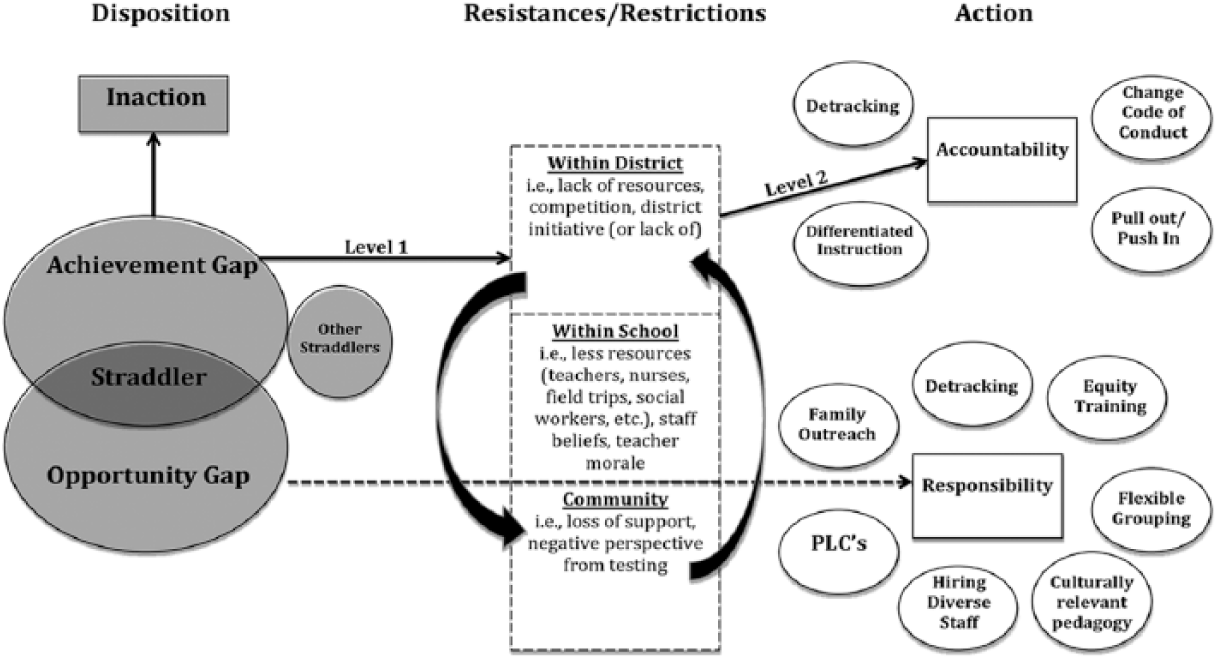
Justice in the gaps.
Findings
In this article, we develop the themes of disposition and school context as they relate to differing plans of action for justice. Educational leaders’ dispositions help shape their interpretation of the “gap” as either achievement, opportunity, or some combination thereof. While all our participants attested to be advocates for educational equity, school and district contexts undoubtedly shape leaders’ dispositions toward “justice in the gaps.” Our data suggest that school leaders who enroll a critical mass of students of color tend to see “gaps” arising from either lack of opportunity or lack of effort. Furthermore, our analysis suggests that a school leader’s understanding of the gap influences practice and interaction with data to ignore, address, or perhaps interrupt justice in the gaps.
Minding the Gaps
A school leader’s disposition toward the gap influences whether he or she takes action toward justice in the gaps. Research by Hallinger, Bickman, and Davis (1996) suggests that school leaders are influenced by both personal experience and school context. On one hand, our analysis demonstrates efforts by school leaders to adjusting their dispositions toward language accentuating opportunity gaps. On the other hand, many school leaders continue to perceive the achievement gap in an abstract and technical manner. For instance, two participants specifically used the term “opportunity” to describe the achievement gap. Of the other 20, some used different language that suggested a developing opportunity gap framework (perhaps without knowing about or recalling the concept for the interview). Others kept their language at the level of abstract and technical, and others seemed to ignore gaps entirely. Table 1 sorts the respondents into four categories based on their dispositions—those who hew to an opportunity gap disposition, those who demonstrate an achievement gap disposition, those who straddle those two dispositions, and a small number with unique dispositions that we categorize as “other straddlers.” Table 2 provides full details about the sample.
Dispositions of Participating School Leaders.
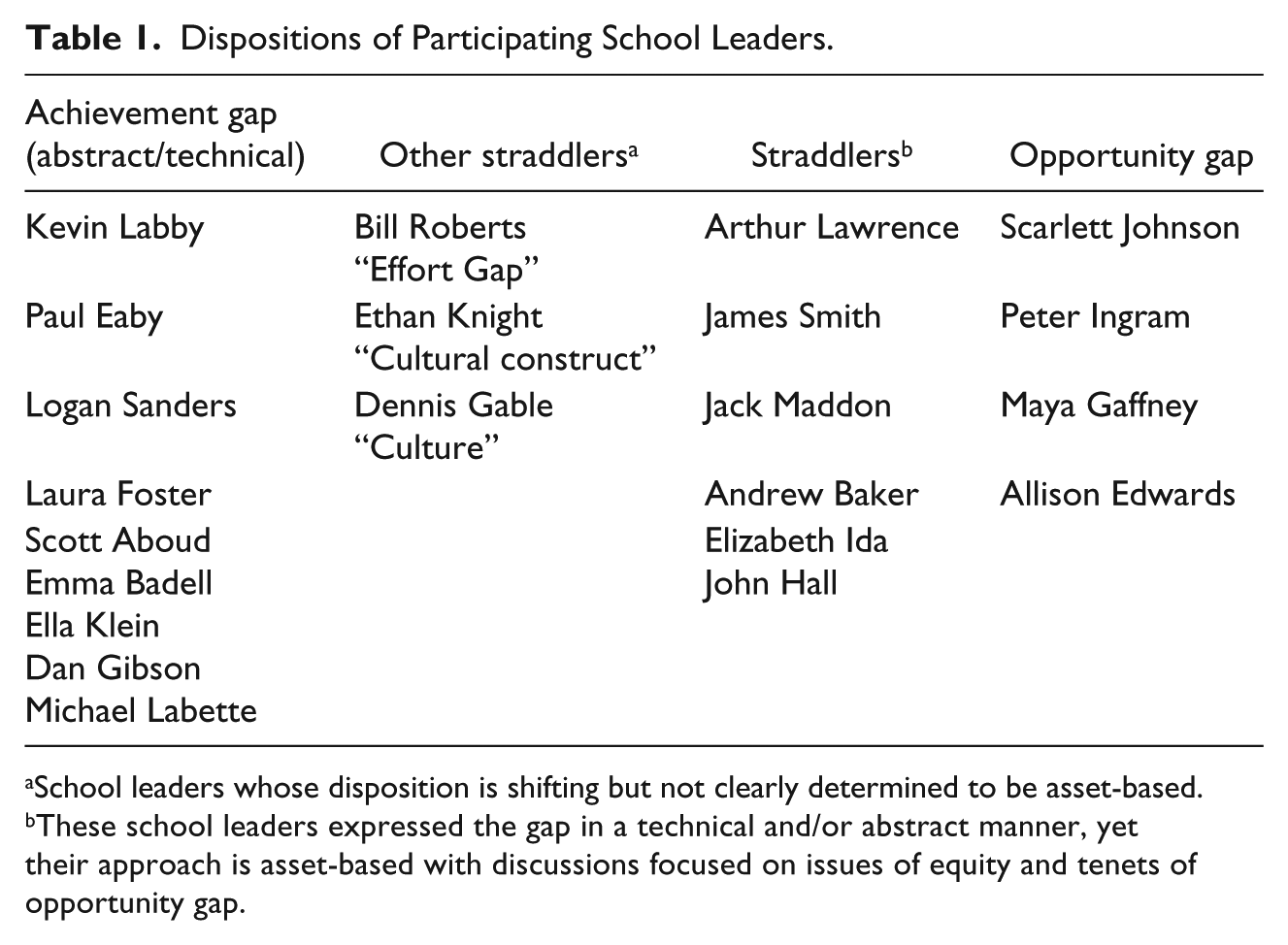
School leaders whose disposition is shifting but not clearly determined to be asset-based.
These school leaders expressed the gap in a technical and/or abstract manner, yet their approach is asset-based with discussions focused on issues of equity and tenets of opportunity gap.
School Leader Characteristics.

Note. Pseudonyms are used and percentages of students of color and of students on free and reduced lunch have been given in ranges to protect the identities of participants.
School data collected from the U.S. Department of Education Institute of Education Sciences, National Center for Education Statistics, Common Core of Data for the 2013-2014 school year.
The state’s profile data are used for these two charter schools.
The high school data are used to represent the district.
The opportunity gap disposition
For the participants who mind the gap as a gap in opportunity, the disposition toward their students is asset-based, grounded in the value of the community, and expressed as a commitment that they intend for their students to see and understand. Furthermore, the disposition is connected to their positionalities—their individual histories and identities in relation to race, ethnicity, social class, and experience (Alcoff, 1988; Shapiro & Gross, 2013).
At the time of her interview, Scarlett Johnson had just completed her first year as principal of her urban elementary school. Johnson, an African American woman, is the principal at a school with 92% African American students and 84% students identified as economically disadvantaged. When asked about her understanding of the achievement gap, Johnson said, So, that is something that I hate, that terminology, so I don’t use it. I don’t like the word, the terminology achievement gap, because that puts it on the child. It kind of blames the child . . . because it is their achievement, it’s a gap in your achievement versus a white child’s achievement.
Johnson added, What I like to call it is an opportunity gap. Our students have not had the same opportunities . . . But, as soon as we give them those opportunities, they can achieve at or above the level of white students.
With a hint of resentment, Johnson described her antipathy toward the language of the achievement gap because it places a judgment on the student. She replaces it with a clear understanding of what the literature calls the opportunity gap.
Johnson’s disposition toward the opportunity gap is further explained by the value she ascribes to the diverse population of students in her school and neighborhood:
“What value do black and Latino students bring to your school?”
“Tremendous value, tremendous. That’s the foundation of our school . . . I love diversity, pass that flavor, [it] teaches us so much, that we can teach each other.”
“Our students . . . they bring the richness of their cultural experiences . . . They bring us certain strengths and resiliency to them. That regardless of what we don’t have, regardless of what people think about us, regardless of what our community doesn’t have, we still are strong, we are still proud, we still care, we still choose to be here, and that strength, that’s what keeps us going.”
In a lighthearted tone, Johnson indicated her belief that diversity is mutually enriching. Furthermore, she declared the community she serves influences her dispositions. In the passage above, when she talks about the community, she shifts from “they” to “we” and “us,” suggesting a positionality distinct from most other school leaders in the sample. Johnson names her school as a community and identifies with the community in which she works.
As evident elsewhere in the interview, Johnson’s disposition toward her students reflects a personal and professional commitment. Students’ perseverance drives her; she said she could not be an educator “without our kids saying ‘I am still here, I am still in it, I still want to be here.’ And they show up every day with the same attitude—‘I am here’—and that is powerful.” According to Johnson, justice in the gaps means providing her students with the same opportunities as those of more affluent school districts.
Two other participants presented similar sense-making about an opportunity gap but without using that specific language. Both are African American women, Maya Gaffney and Allison Edwards. At the time of the interview, Gaffney had just finished her first year as principal of an urban middle school. Her language about the achievement gap incorporates concern for equity: [O]ur situation is to look at things from an equity standpoint. Equity does not mean equal, but right now I think the achievement gap is largely attributed to giving everybody the same thing because . . . we don’t look at how people learn things differently, we don’t look at cultural competency . . . [When my teachers tell me] “I treat all of my students the same.” Well, to do that is a disservice, because they are different.
From this statement, we can understand Gaffney’s interpretation of the importance of educators acknowledging cultural differences in students.
Gaffney identified two forms of opportunity gaps relevant in her context—her school district’s gifted and talented model and access to highly effective teachers—that according to her perpetuate racial achievement gaps: [Students in the gifted program] are in separate classes, they have separate education, sometimes they have better teachers, and so that [contributes] to it too. The other part of that I think sometimes also is . . . when we think about teachers and quality of the teachers, our students who are the most neediest weren’t getting the most highly qualified teachers, so they were behind even more.
Here, Gaffney presented two historical practices that researchers attribute to the opportunity gap and distinctly different career trajectories (e.g., Miranda et al., 2014; Oakes, 2008).
A glimpse into Gaffney’s disposition can be understood in how she prioritizes relationships with her students: I try to get to know them, know where they live, know their parents, understand their circumstances . . . We have kids that come to our school, they have lots of baggage they come with. And so I try to make sure I have relationships with kids so that if there is something going on with them that I need to know that is impacting their ability to learn, I can figure out what I can do, so that, that obstacle is not in the way. While they are here, for the time that they are here, it’s to make things as smooth as possible, so they can focus on learning.
This statement shows something of the resolve of Gaffney’s concern toward empathy; regardless of the circumstances that her students face, her responsibility as a school leader is to make sure students learn.
Similarly to Gaffney, Allison Edwards had just completed her first year as principal of her elementary school at the time of the interview. Edwards situated the achievement gap as based on students’ race and SES. Edwards described the value and meaning of education “is to give everyone hopefully an equal opportunity, a fair chance at being successful. And not just money successful, but being a productive citizen.” Moreover, she made the following remark about what education would be like if she were in charge: It would be ensuring that every child is getting an appropriate education . . . meaning that they were cared for, that they were loved, that their external factors that affect them, they are acknowledged. But, you know, still be able to carry on with the business during the school day.
As the above response illustrates, Edwards named a major argument made by opportunity gap scholars—acknowledging the external factors to engage effective in-school practices. For Johnson, Gaffney, and Edwards, their positionalities as African American women contribute to their dispositions toward their students (Alcoff, 1988).
Abstract and/or technical disposition
A second set of dispositions about justice in the gaps was more prevalent in our sample and spanned many types of schools and districts—an abstract and technical disposition toward gaps in achievement. School leaders in schools with a small percentage of students of color revealed a lack of direct strategies to reduce the gaps. For example, Kevin Labby, a White male in his fourth year as principal of an outer-ring suburban high school with less than 10% students of color, does not use data to support his students of color. As Labby said, “There is no specific plan for that, you know. If we see a group isn’t performing like other groups we use that information to take action.” This passage is a coalescence of his further remarks about his school context and his lack of a stated disposition toward supporting students of color. His claim is abstract (“If we see a group . . . we take action”), but his leadership practice does not take into account gaps.
Scott Aboud is a White male in his fifth year as principal of an urban high school in an old steel town. His student population—high poverty and nearly equal percentages of White and Black students—could provide a context to spark justice in the gaps. Yet, we found that was not the case. One response in particular highlights his disposition. He describes the following conversation he had with a White female teacher who wanted to improve her instruction with Black males: I once had a teacher . . . tell me that the one thing she wanted to be better at is teaching black males how to read. And I don’t know of any teacher who, that is a group . . . that is a subgroup of kids, who are notorious for struggling in school. Find that answer, you won’t be teaching here, right; you are making millions of dollars. And so, you know . . . I think that there are things that they could do better. Sure, but I think for the most part, I think that they do a pretty good job dealing with diverse groups of kids.
In the context of the rest of his interview, these comments evidence a missed opportunity to engage in reflective dialogue toward justice in the gaps with his teacher. Rather than engaging the teacher’s interest in developing her capacity, the principal seemed to think it was futile or at the very least beyond his own capacity.
Later, Aboud identified two subgroups—students in special education and Black males—scoring below others on standardized testing. To address these challenges, his school has changed its special education instructional model toward a push-in model and co-teaching. He added, With the black subgroup . . . the students in that subgroup that are struggling are almost all special education kids and . . . you know to address them specifically would be, it would be almost be . . . I mean it sounds terrible to say, almost like applying the same response twice . . . to me that, you know, that subgroup of black males is umm, they need more than . . . there is more than academic issues that cause their academic difficulties . . . and we don’t do anything about it frankly, unfortunately we don’t.
In this statement, Aboud reveals the predicament he faces in his school. When asked how he uses data to support his diverse students, he started with a laugh and followed with a pause: We don’t do it in general . . . Everybody knows that you should be using it . . . but it is so time consuming and we have so many kids who need support that we don’t, we just don’t do it.
On one hand, this principal recognizes the abstract need for race-conscious practice. On the other hand, he lacks a framework for making it happen. As in interviews with other principals of schools with a combination of both White and non-White low-SES students, this principal has no language or rationale for cultivating a specifically race-conscious strategy, and time is seen as an obstacle. Although the gaps in achievement are evident and acknowledged, there is neither the capacity to respond nor the conditions in place to develop the capacity. When confronted with resistance or restrictions, Aboud’s disposition commits to inaction (found within Level 1 of achievement gap disposition).
Straddlers
Another group is the “straddlers,” school leaders whose understanding of the gap straddles the abstract/technical and opportunity dispositions. These school leaders initially defined the achievement gap using the technical language. At the same time, these leaders also demonstrated a semblance of an alternative and shifting interpretation on the gap. Six of the 22 school leaders were straddlers—two in urban settings, one in an inner-ring suburban setting, and three in outer-ring suburban settings. Moreover, these school leaders were influenced by their dispositions, beliefs, educational experiences, and work experience.
Arthur Lawrence, an African American male in his first year as principal of an urban 6-12 magnet school in the city center, defined the achievement gap as the difference between how his school educates Black and other minority students in comparison with White students. Lawrence initially revealed something of an abstract Black–White binary definition on the achievement gap, stating, “How are we educating our African American students, our minority students, how do we ensure that they are just as successful as white students on our standardized achievement test as well as in the classroom.” Unlike those school leaders who hold an abstract/technical disposition on the gap, however, Lawrence also revealed a strong disposition and courage to engage with issues of race in his school. Lawrence emphasizes culturally responsive and culturally relevant pedagogy with his teachers:
What would you say to a teacher that says, but [culturally relevant practice] doesn’t influence test scores?
It would influence test scores if you learn how to incorporate pedagogy that is culturally relevant. The disconnect is the approach that we take as educators. The conversations that we have, the fact that we don’t create scaffolds and put in place instructional practices that tap into our students’ interest. So it is not the students that [are] the issue, it’s the educator that is the issue.
For Lawrence, the inaction of educators—and their inability to be responsive in their pedagogy—has resulted in gaps.
Two White male school leaders working in suburban districts also indicated a straddler disposition. Andrew Baker said that race or class do not lead to achievement, “but there is definitely a connection between the two,” thus suggesting reliance on a technical definition. Baker also described his experience working in an urban school district in a Southern state, where a focus on narrowing the achievement gap was taking place. He described this experience as both “dynamic” and “beautiful.” When he became the principal of the school, “We just kept growing the school from there, and it was [pause] professionally it was so exhilarating [pause] but it was also exhausting.” Although he no longer works in a school district with a large population of Black and low-SES students, Baker’s previous experience in working toward narrowing the achievement gap—by his indication succeeding—continues to have influence on his disposition on the gap.
A second White male school principal, Jack Maddon, describes how his school has the largest population of Black students (10%) and low-SES (50%) students in his district, an otherwise upper-middle-class suburban district. In his eighth year as leader of his elementary school, Maddon identified issues related to preschool experience, nutrition, educational exposure at home, and prenatal care as influencing achievement gaps. Furthermore, Maddon described how the school is directed toward closing the gap. He stated, “So closing the gap is one of those things that we try. [Pause.] We pride ourselves on, we put everything in place. If one intervention doesn’t work, then we try another one.” Although Maddon holds many principles of the opportunity gap disposition, he did not convey race-consciousness when describing his leadership practice. In his practice, diversity means socioeconomic diversity: “I mean diverse students are the kids that you know . . . we would say the low-SES or the children in the high-SES.”
We identified a fourth group of school leaders whose interviews about the achievement gap were so different and so influenced by the contexts in which they work that they do not adequately fit into the previous three categories. We identified these as “other straddlers” (see Table 1). These school leaders referred to the gap as “effort gap,” “cultural construct,” or “culture.” These school leaders’ dispositions are also shifting; however, we cannot determine if they are shifting to an asset-based approach (as evident in the next section on context). Nevertheless, as displayed in Figure 1, their disposition to the gap mainly holds to the technical and/or abstract ideology.
Acting on Justice in the Gaps
Figure 1 displays the four disposition patterns found in our data and the plans of action that ensue from those dispositions. Our data suggest that the plans of action depend upon school context and school leader disposition. Within the county under study, with multiple urban districts, inner-ring suburban districts, and outer-ring suburban districts, conditions that support the capacity for race-conscious, opportunity gap leadership vary greatly. We propose Figure 1 to capture some recurrent patterns. As noted in the figure, some leaders with an abstract/technical disposition have no recognizable plan of action. For others, a first-level plan of action stops when met with resistance. Whereas some in the achievement gap disposition that are able to break through resistance and reach a second level of action typically take an accountability orientation, those with an opportunity gap disposition work through the resistance they encounter and have a plan of action characterized by a responsibility orientation, using practices such as family outreach, equity training, and culturally relevant pedagogy.
Our data collection focused on strategies that school leaders use to address justice in the gaps, such as de-tracking, discussions of the data with students and families, cultural relevancy, and challenging teacher biases. Leaders with different dispositions toward the gaps respond to teacher biases and the issues that those biases create for student opportunities. Recalling Lisa Delpit’s (2006) argument about the serious responsibility to educate other people’s children, there is a distinct difference between school leaders who confront issues that can be detrimental to student success and school leaders who evade or avoid issues. Research suggests the patterns and conditions that contribute to evasion, avoidance, and practices that actively harm students (Ferguson, 2001).
In the contexts we studied, there is potential for increased external accountability pressures to intensify teachers’ negative perceptions about the value and capabilities of children of color, but especially African American males. There is strong evidentiary support for the significance of negative teacher perceptions on student outcomes and thus the need for school leaders to be willing to confront this issue. Previous research has shown that school principals can support equitable practices by supporting staff discussions that materialize teacher biases (Ross & Berger, 2009). As educational leadership researchers Shoho, Merchant, and Lugg (2011) argue, to address issues of fairness and equity, school leaders “must be prepared to adapt, change, and most important, challenge existing educational policies and practices, whether they originate at the building, state, or national level” (p. 46).
Dispositions matter
One of our respondents, Maya Gaffney, predicted that the implementation of the Common Core Curriculum would bring to the surface the deficit-thinking mind-set broadly held by teachers. She believes that long-held racist practices in her urban school district will surface because of the expectation in Common Core that all students experience rigorous content. One example she provided is that previously in her district, only students in advanced or gifted classes were exposed to novels like The Metamorphosis. Now, all students in the 10th grade will be required in her district to read a book similar to The Metamorphosis. Consequently, she predicts teachers will raise the argument that “students can’t handle it and that they can’t do it.” Her response to this teacher argument was, “Well they haven’t been prepared, but they can do it if we give them access to the books. You learn how to read; step one, read; step two, read some more; step three, read.”
Gaffney pointed out that through conversations with her teaching staff, she has gathered that some teachers in her school do not see the value that Black and Latino students bring to the school. She had this to say: “Just based on their conversations about students and even with a lot of my Latino students, they approach from a deficit-mind-set of these students, and I hate that, ‘these students have nothing.’” As a result, Gaffney implemented a community walk as professional development to strategically confront teacher biases: I am purposefully taking them to the places where my black students live, where my Latino students live . . . They have to see that, because our kids come with so much that can be tapped in at school and it’s not looked at as a valued resource. And so with that, I am trying to make them see it, more and more.
Gaffney has decided to take a stand and confront educators in her school who hold a deficit-thinking mind-set.
Two other school leaders in the urban, center-city district explained how they have implemented a district initiative that looks to challenge the racial perception of teachers. According to these two school leaders, the district has promoted the use of Glenn Singleton’s (2014) book Courageous Conversations About Race. Singleton (2014) argues that “tightly held beliefs and understandings regarding the significance of race make it difficult for teachers to comprehend, examine, and rectify the very ways in which race dramatically impacts achievement” (p. 6). With this in mind, Arthur Lawrence, the principal of a high school, contended that to address achievement gaps in his school requires “discussing race, and how does race impact student achievement” as he tapped his finger on the table. He uses Courageous Conversations to focus on equity with his staff. He added, “We always have to [taking a deep breath] keep that open eye toward practices that may not be equitable, you know, and how are we addressing those things within the school.” This is a specific intervention by a school leader with a straddler disposition, who responds to what he perceives as an achievement gap with an institutional response—a structural change that moves toward a more holistic response. In other words, he institutes an intervention consistent with an opportunity gap disposition, but without conveying that disposition. Unlike many principals in the district, he took Courageous Conversations seriously and made its implementation a priority in his school.
Scarlett Johnson, the urban principal mentioned in a previous section who operates with an opportunity gap disposition, further underscores the value of having professional development on race toward challenging “White privilege.” She stated, First and foremost, one thing we do here is we do equity training, where we talk about, even how white privilege shows up in us, when we are dealing with our children and we want to check that baggage at the door and make sure that we are not looking down, especially on our black males, that this is how they are and they are never going to get better.
Johnson has used professional development to implement equity training that confronts negative biases toward Black males by her staff. In fact, as she sees it, this training is important for all her staff because “white privilege shows up in us, people of color as well.” Although it is important to note that she has made some observation where she has “had some [teachers] where you are looking at them, I know you’re not all the way on board, but it is what it is right now, where people are working on it.”
Moreover, Allison Edwards, who also operates with an opportunity gap disposition, demonstrated the responsibility necessary to challenge her teachers’ biases in a suburban context. She has observed some resistance from teachers when working with students of color and of low-SES. She said she has created a culture in her school of open and honest dialogue with her staff. Yet, she described how she has challenged those teachers who attempt to use external factors and use data as an excuse for why a student should not be in a particular class. Indeed, these open dialogues sometimes become fierce and sometimes “more than heated, but I feel like if we don’t allow each other to say what is on our mind and what we really feel . . . about standardized [testing] and accountability, we wouldn’t be a productive school.” This kind of detail demonstrates her resilience as a school leader in challenging cultural norms in schools that negatively affect some students.
Edwards has observed that some of her staff members use data to determine a student’s ability and do not do the necessary work to improve the educational experiences of those underperforming students. She finds that the positive use of data for teachers is to use the information obtained on students to guide their instructional practices. Yet, she feels that some teachers attempt to blame the students for not learning because their instruction works for the majority of students, but her response is “well we no longer have that option to let those . . . that [bottom] 25 [%] down here to just let them go, it’s not appropriate.” This statement shows something of the resolve of Edwards to ensure that students who are underachieving are not ignored.
As Ruth Johnson (2002) argues, a push for higher expectations for students who have traditionally not achieved will encounter resistance. Accordingly, Edwards says, “I need to change the culture” of teachers using data as an excuse to place students in lower level classes, “which is . . . going to be difficult to do, but you know . . . it will be difficult, but it will be achievable.” Edwards revealed the courage that school leaders require to transform school cultures disadvantages diverse students.
Contexts matter
Our analysis suggests that school context matters greatly for how school leaders think about justice in the gaps. Based on what they told us in interviews, leaders in well-off districts and in schools with a low percentage of students of color rarely attend to the achievement gap. Based on how these school leaders talk about gaps, these leaders lack a specific disposition to address justice in the gaps and/or they are inhibited by their school context. In these schools, it seems that principals do not have to take action and therefore do not have a well-developed disposition toward opportunities for students of color. In nearly all schools with large numbers of students of color, opportunity dispositions are evident in the principals, except in a few cases: In these settings, there are large numbers of both White and Black students who meet the thresholds for free or reduced-price lunch. These school leaders group economically disadvantaged students together and race-consciousness does not inform these leaders’ practice.
Conclusions and Implications
Based on the analysis of our data from 22 interviews, school leaders in urban communities have widely varied dispositions toward gaps in educational attainment. Despite the growth of the concept of an opportunity gap, the concept is largely absent from the school leaders’ talk. Just one of the participants used the term in a manner found in the research literature, while others conveyed the general meaning of the concept, but without using the language. Much more prevalent, school leaders with an abstract/technical disposition toward gaps in achievement lack race-conscious practice and talk about their practice as being guided by accountability for scores. In contrast, school leaders operating with an opportunity gap disposition respond with a clearer notion of responsibility for student learning.
An opportunity gap disposition also signals stronger, more responsible plans of action as were evident from school leaders with opportunity gap dispositions, suggesting that a race-conscious perspective is behind a concerted effort to address differential school success. Not recognizing race—ignoring patterns of differential achievement of students who identify in different racial categories—paradoxically leads to attributing differential achievement to racial background, rather than a systematic consideration of practices and conditions that provide differential opportunities (Noguera, 2001). Schools need to engage with the diversity they have, seek more diversity among their staff, and engage with homes and communities. Schools can consider programs like Courageous Conversations or restorative justice practices as models to build capacity within their schools. Such practices can lead to more holistic educational settings.
We recognize that taking responsibility for justice in the gaps requires school leaders to possess both courage and resilience because they are focused on not only transforming adults but also challenging historical beliefs and cultural norms. The strategies responsible leaders use, such as challenging teacher biases, require school leaders to develop their courage and resilience. Our analysis suggests that school leader dispositions need to be strengthened if their goal is to attend to justice in the gaps. In our respondents, these dispositions were cultivated through personal experience, racial and ethnic positionality, and experience working with diverse populations of students. In addition, those dispositions also developed from reading about social justice practices. The collaboration proposed above is also relevant here, because school leaders can learn from each others’ dispositions and strategies.
In agreement with Murphy (2003) and Murphy and Shipman (1999), we find that dispositions are a fundamental component to school leader practice, and we have shown that the various dispositions found in school leaders’ practice are reflected in distinct plans of action for addressing justice in the gaps. Significantly, an accountability orientation leads to practices that are less reflective of students’ cultural history and context and largely ignore race and race history as significant aspects of students’ lives. Our findings suggest that an opportunity gap disposition is much more preferable in a school leader than other dispositions. Cultivating an opportunity gap disposition among school leader candidates—if the disposition were to take hold in a school leader—is promising as a curricular intervention. We have limited data on how these school leaders developed these dispositions, but it was clear among those with an opportunity gap disposition that their awareness of their own positionality seemed to make a difference, and none of the school leaders with an abstract/technical disposition volunteered that their own positionality might be important.
By presenting our finding on strategies for justice in the gaps, we hope to convey an understanding of present forms of practices that shift educators toward more equitable educational leadership practices. The three strategies presented in this article demonstrate particular strategies some school leaders have used to make use of data to challenge inequities. They show the dispositions in action. School leaders need to be experts in the ability to use and not misuse data (Cho & Wayman, 2014), because data use can easily fall into a default use of a deficit mind-set (Park et al., 2012). Across all respondents, leaders acknowledge that with lack of improvement in achievement test scores, teachers get demoralized, and some want to blame their students.
The most basic, frontline strategy has to recognize diversity and engage it. This strategy is conveyed in our participants’ willingness to promote more equitable educational practices. School leaders who frame the gaps they see as opportunity gaps had also developed varied strategies, as displayed in Figure 1. Developing these strategies demonstrates responsibility, we argue. Framing gaps as opportunity gaps is accompanied with efforts to create new and different opportunities for students.
A second strategy is particularly relevant at the school district level, and that is the condition of competition. School leaders in many settings are reluctant to collaborate with schools with lower achievement scores. Principals feel vulnerable in describing their weaknesses. Creating more collaborative settings, especially across different dispositions, may build capacity across settings. Findings suggest that building teacher collaboration around data use has a positive affect with teachers (Gill et al., 2014; Jimerson & Wayman, 2015). Studies also show that collaboration and/or sharing of ideas was the least discussed skill or sought-after professional development technique (Gallagher, Means, & Padilla, 2008; Jimerson & Wayman, 2015). Consequently, we argue that district and building leaders need to create systems and policies that will enable collaborative efforts to discuss the use of data practices.
Leaders will experience pushback, and they need to have the language, resilience, and grounding to make it work. Consistent with Ross and Berger (2009), we find that school leaders have to take a critical stance toward the issues that prohibit social justice in whatever school contexts they may find themselves. Across varied contexts, we see patterns of strength that can be replicated. Although the strategies we identify emerge from discussions of the uses of data, we do not mean to imply that these are the only strategies. Yet, because the culture of schools is increasingly focused on the use of the data (Gerzon, 2015; Mandinach, 2012), this is a vital site for current social justice work. Our results provide a foundation to explore an opportunity to do social justice work in schools, while guarding against some of the dangers of the misuse of data toward replicating or intensifying inequalities.
Furthermore, significant attention should be devoted to the cultivation of dispositions, particularly dispositions toward students who have historically experienced a gap in educational opportunities. Based on the experiences of our respondents, personal history and experience in diverse educational contexts need to be centrally considered, along with concerted efforts to grow those dispositions in relation with other colleagues. No instruction on the use of data without a firm foundation in responsibility can be expected to lead to anything more than repetition of long-standing achievement gaps.
Footnotes
Author’s Note
Osly J. Flores is now affiliated with Massachusetts Department of Education, USA.
Declaration of Conflicting Interests
The author(s) declared no potential conflicts of interest with respect to the research, authorship, and/or publication of this article.
Funding
The author(s) received no financial support for the research, authorship, and/or publication of this article.
