



Abstract
This article explores how extracurricular programs designed as interventions in the criminalization of Black girls may constrict their identities. Through a womanist theoretical framework, authors investigate the discourses about Black girlhood that permeate one extracurricular initiative which aims to counter the effects of exclusionary discipline practices on Black girls. The authors find that these discourses advance respectability politics, thus reinforcing an exclusive model of ideal Black girlhood as one aligned with White, Western, Judeo-Christian, patriarchal, heterosexist, and middle-class values. Authors conclude with suggestions for how extracurricular initiatives may develop programming and curricula that are inclusive of pluralized Black girlhoods.
Keywords
I am a Sister of Promise
I love and respect myself and others
I speak to be understood and
I listen to hear others
I promote sisterhood and not dissension
I lead through positive actions and words
I am balanced in mind, body, and soul
I am establishing a promising financial future
I embrace, encourage, and uplift my sisters
I carry myself with poise, grace, and dignity
I am a Sister of Promise
—Sisters of Promise program creed (SOP, 2012, p. 5)
By noon, on Thursday, April 21, 2016, the badly battered body of Amy Inita Joyner-Francis, a 16-year-old Black 1 girl, lay lifeless on a bathroom floor at Howard High School of Technology in Wilmington, Delaware (Baker, 2017). According to witnesses, Amy suffered a deadly assault in the hands of three Black girls, who, like the deceased, were students at the urban school. On April 17, 2017, Trinity Carr, a 17-year-old Black girl, was convicted of criminally negligent homicide for Amy’s untimely death (Chase, 2017; Thompson, 2017). Almost a year passed between Amy’s death and Trinity’s criminal conviction; however, school officials suspended Trinity, Zion Snow, and Chakeira Wright—the three Black girls branded as assailants—immediately after the altercation (Clearly, 2016). In the court of public opinion, judgment against Trinity, Zion, and Chakeira was also delivered swiftly, undoubtedly influenced by grainy viral video footage of the violent fight, which had been captured via an onlooker’s cell phone camera. Social media outlets were overrun with comments such as, “They should charge the 3 evil girls as adults who killed poor Amy Joyner-Francis scum of the earth people like that all 3 need life #ripamy” (AinskcCasey, 2016). Such widespread outcry made it clear that the trio was perceived as the personification of Black girls lacking “poise, grace, and dignity” (SOP, 2012, p. 5). The vilification of these girls, however, failed to address the context of this tragedy, thereby releasing the school from its responsibility to all the actors involved. Both the school and society-at-large cast aside Trinity, Zion, and Chakeira, shunning the girls and marking them as disposable.
Research shows that for Black girls, “discipline, punishment, and the juvenile system [are used] to regulate identity and social status” (Morris, 2016, p. 11). By spring 2011, concerns with the number of school fights involving Black girls, and observations of the reactionary over-disciplining of this population by teachers, led to the creation of Sisters of Promise (SOP), the extracurricular program (ECP) discussed in this article. SOP was developed by Tiffany Nyachae, first author on this article, who was a seventh and eighth grade teacher at the time, and two other Black women teachers at Grandeur Charter School, 2 an urban school in a northeastern rustbelt city in the United States. Tensions erupted when a fight broke out on the school lawn between a group of eighth grade Black girls amid a crowd of students and teachers. The girls involved were not perceived as “troublemakers” per se and had been known to be good friends for years prior to this incident. Therefore, this fight was quite shocking to onlookers. School administrators suspended all of the girls involved in the fight for several days and when they returned to school, as Tiffany recalls, limited efforts were made by school personnel to restore the girls’ formerly strong bond.
In response to the aforementioned incident, a three-person collective of Black women teachers (Tiffany included), met in summer 2011 to create SOP for Black girls in Grades 5 through 8 at Grandeur. After a few informal conversations, one co-founder wrote the SOP creed shown at the beginning of this article. Building from the creed, the collective developed the mission, vision, goals, and logistics. For the first year of the program, SOP collaborated with a girl-centered community organization run by Black women that implemented their own curriculum. SOP founders spent the summer of 2012 further developing programming materials and creating curriculum. An analysis of the creed led to the articulation of the following core values, which were then infused into the curriculum: sisterhood, leadership, self-awareness, dreaming big (goal setting), financial literacy, health awareness, effective communication, and womanly character. For example, the line, “I am establishing a promising financial future” (SOP, 2012, p. 5) from the creed, highlights financial literacy as a core value. In addition, each founder developed learning sequences for several of the core values. To illustrate, Tiffany created the learning sequences for dreaming big (goal setting), leadership, and health awareness. Another co-founder developed the learning sequences for self-awareness and financial literacy and yet another developed the learning sequences for effective communication and womanly character. Collectively, these three Black women teachers created the learning sequences for the core value of sisterhood within the curriculum.
A main goal of SOP was “that . . . discipline referrals, and conflicts among girls will decrease” (SOP, 2012, p. 3). Moreover, program founders aspired for SOP to provide a place of sanctuary for Black girls such as Trinity, Zion, and Chakeira—that is, those positioned as social pariahs—in response to the marginalization and criminalization that they encountered in their schooling. Program founders also set out to develop an extracurricular initiative that would “promote sisterhood and not dissension” (SOP, 2012, p. 5), thereby working within the lineage of liberatory womanist history that underpins Black women teachers’ roles in the socialization of Black girls—manifesting, for instance, as Black women teachers engaging teaching as necessary “community work” (Dixson & Dingus, 2008). The hope was that, through SOP, participating girls would learn to love themselves and each other, and feel safe enough to leave behind the “mask of resistance” (Kinloch, 2012) that many wore to survive within and beyond the school.
Criminalized Black Girls
Broadly speaking, there is a growing sociocultural awareness about the criminalization of Black girls within U.S. schools (Crenshaw, 2015; Morris, 2016; Winn, 2011). Teachers, administrators, and other school officials tend to enact policies (e.g., zero tolerance) aimed at policing and controlling Black girls’ bodies, essentially pushing these girls out of classrooms and schools (Morris, 2016). The reasons for this are both racialized and gendered. Black girls are seen as “the epitome of exactly what whiteness (as maleness) and femininity (as whiteness) is not: dark, sinister, raunchy, belligerent, burly, and licentious” (Evans-Winters & Esposito, 2010, p. 18). Thus, as Morris (2016) argues, Black girls “are rendered invisible or cast as deserving of the mistreatment because of who they are misperceived to be” (p. 13; emphasis added). Increasingly, education researchers are questioning the dehumanizing effects of this criminalization vis-à-vis exclusionary discipline practices such as discipline referrals, suspensions, and expulsions (e.g., Annamma et al., 2016; Hines-Datiri & Carter Andrews, 2017; Wun, 2016). This article adds to such scholarship by turning toward the emergence of ECPs 3 focused exclusively on Black girls that are appearing as interventions on the educational landscape. Using one such program as a site of discourse analysis (Fairclough, 2016; Lazar, 2007), we ask what primarily working-class Black girls in an urban school 4 are being exposed to and taught about girlhood and womanhood through written texts or materials produced by an ECP created specifically for them. The key research question here is as follows:
With respectability politics (Higginbotham, 1993) and womanism (Walker, 1983) as our conceptual and theoretical frameworks, and feminist Critical Discourse Analysis (CDA; Lazar, 2007) as our methodology, we find that SOP (re)produces discourses that effectively mold Black girlhood in the shape of a singular White, Western, Judeo-Christian, heterosexist, middle-class model through its programming and curricular texts. Broadly, our purpose is to contribute to a deeper comprehension of the implications of such constricted programmatic and curricular configurations of Black girlhood, and to explore how ECPs committed to countering the effects of exclusionary disciplinary practices on Black girls can be more inclusive of a multiplicity of Black girlhoods with regard to program and curriculum development. Our primary argument is that well-intentioned programs, such as SOP, can cause harm if not (re)viewed through a critical lens. SOP was both successful in using certain measures and problematic in using others.
The successes of ECPs for Black girls are reported in numerous studies. Our research is possible because of the pioneering love and labor of the scholars behind these studies, who have chosen to attend to and uplift Black girls in their inquiries (e.g., Brown, 2009, 2013; Greene, 2016; Lane, 2017; Muhammad, 2014). This study extends such research by moving beyond the blanket celebration of Black girl-centered ECPs. Specifically, we interrogate and illustrate the degree to which these ECPs may constrain Black girls’ humanity by advancing discourses that promote narrow definitions and understandings of Black girlhood. More generally, this study enters into a larger conversation regarding the experiences of Black girls in urban schools. Urban schools are highly stigmatized, and unfairly viewed as dumping grounds for society’s least desirable youth, most of whom are youth of Color, youth who live in poverty, and youth whose native language is not English (e.g., Aaronsohn et al., 1995; Schneider, 2017). This study irradiates how ECPs may inadvertently function to further “other” Black girls already othered—that is, already marginalized and criminalized.
We proceed by elucidating the connection between exclusionary discipline practices and extracurricular programming for Black girls and offering an overview of SOP. A review of literature on extracurricular programming for Black girls is next. We then articulate our conceptual and theoretical frameworks, which are informed by our analysis of extant literature. This section is followed by our research design and findings. We conclude with concrete suggestions for how ECPs, such as SOP, may adopt expansive programmatic and curricular designs that embrace the iterations of girlhoods found among Black girls.
Situating the Discourse Analysis
Schools are dangerous settings for Black girls given that it is in these settings that Black girls are more likely than their non-Black counterparts to experience corporeal and emotional harm (Crenshaw, 2015). There is a relationship between exclusionary discipline practices (e.g., discipline referrals, suspensions, expulsions) and the criminalization of Black girls. Once disciplined and excluded from schooling, Black girls are characterized as anti-school, and are often thrust into the juvenile system, thus being made—both discursively and materially—into criminals (Morris, 2016). This criminalization leaves them perpetually “‘betwixt and between’ enslavement and freedom” (Winn, 2010, p. 426). There are several studies of ECPs in the United States created to combat the criminalization of Black girls (Edwards, 2005; Henry, 1998; Lane, 2017; Nyachae, 2016). SOP, one such program, ran for two academic years at Grandeur Charter School (2011–2012 and 2012–2013). 5
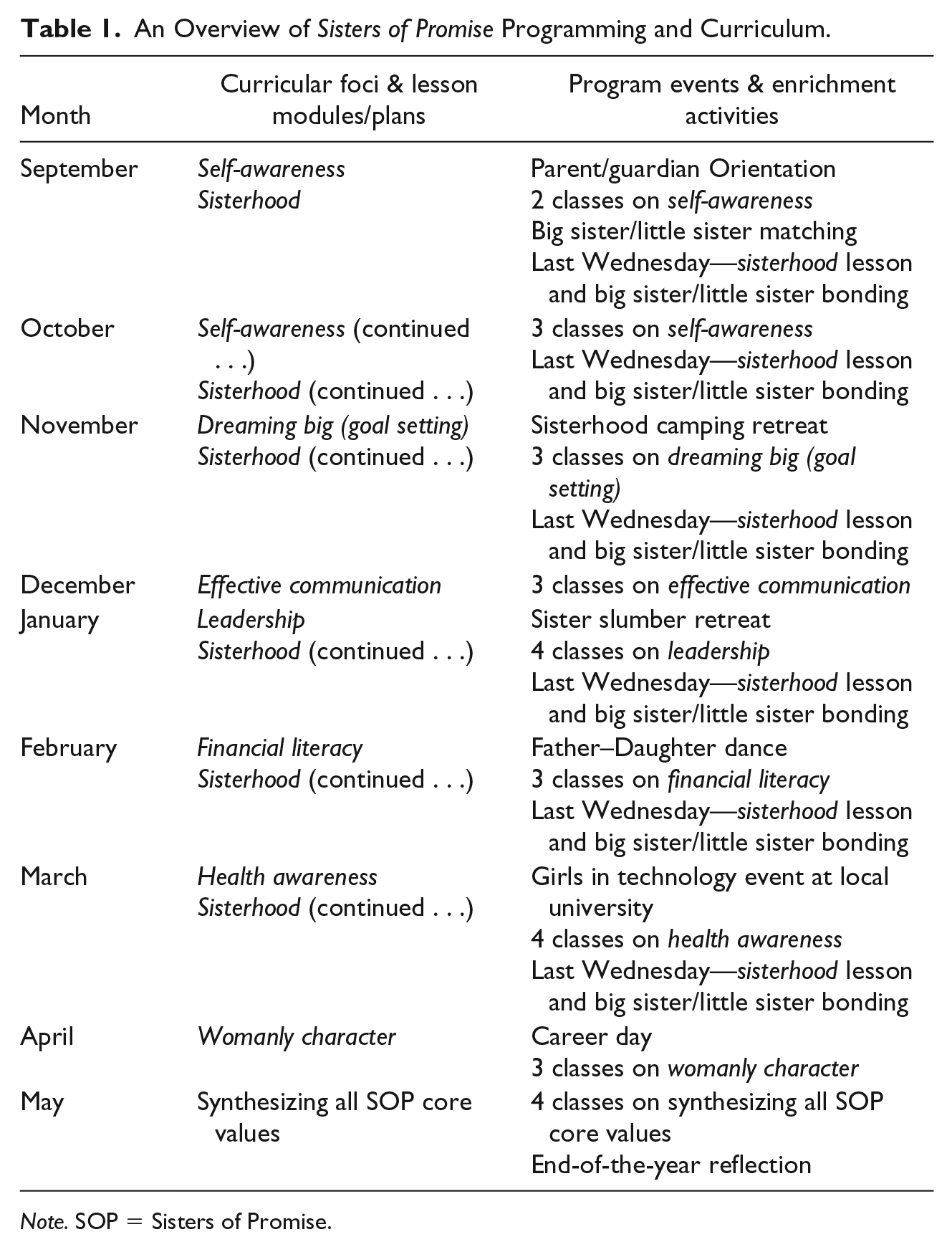
For this study, we focus on the programming and curricular texts produced and distributed in SOP during the 2012–2013 academic year. During this year, 77 Black girls in Grades 5 through 8 participated in the program, which was facilitated by four Black women teachers—the three program designers, and an additional volunteer. SOP participants met once weekly, after the end of the regular school day, for approximately 2 hr. Each meeting began with the recitation of the program creed and was followed by grade-level group breakout sessions. In these sessions, facilitators would implement the curriculum by teaching lesson plans or modules with specific foci. As indicated in Table 1, the curricular resources and lesson plans for each meeting revolved around at least one SOP core value. Table 1 also shows the program events and enrichment activities that complemented each month’s curricular and lesson plan foci.
An Overview of Sisters of Promise Programming and Curriculum.
Note. SOP = Sisters of Promise.
Based on aforementioned criteria, SOP can, in fact, be considered successful: 82% of participants were not suspended, as compared with the city school district, wherein—among Black students—62.2% received in-school suspensions, and 68.5% received out-of-school suspensions (Office of Civil Rights, 2011–2012; SOP, 2012). 6 However, our goal is not to evaluate the program overall. Our wonderings are about the ideologies that the program spread discursively.
Literature on Extracurricular Programming for Black Girls
In 1918, a special committee of the National Education Association set the foundation for what U.S. school-based ECPs should entail (Cuccia, 1981). Basically, school-based ECPs were designed with the expectation that these entities would develop students’ individual talents, and to promote national unity and citizenship education (“Citizen Training Through Extracurricular Activities,” 1956; Commission on the Reorganization of Secondary Education, 1918). Researchers of these early ECPs were primarily concerned with social outcomes based upon students’ participation in extracurricular activities (Cuccia, 1981; Feldman & Matjasko, 2005; Holland & Andre, 1987). Findings showed that students who participated in ECPs were more likely to “stay out of trouble” and achieve academic success (Brantley, 2014; Holland & Andre, 1987). Over time, urban school districts in the United States received federal and/or state funds to create ECPs in response to the growing number of students (largely of Color) labeled “juvenile delinquents” (Giroux, 2003), “high school dropouts,” and “latchkey kids.” These programs were intended to provide supervised structured programming, thus keeping students out of trouble, and deterring them from criminal activity.
Here, we discuss select research studies of ECPs created for Black girls, 7 ages 10 to 19 years, living in the United States. These include school, university, and community-based programs aimed at the following: racialized and gendered socialization (e.g., programs focusing on cultural rites of passage); development/empowerment; and content knowledge, specifically, literacy and/or STEM (i.e., science, technology, engineering, and math). 8 Funding sources include federal and/or state entities, foundations, universities, and out-of-pocket donations. Researchers studying these ECPs inquired into the following themes: (a) the influence of Black feminism (e.g., Lane, 2017), (b) the components and evaluation of programs for Black girls (e.g., Belgrave et al., 2004; Kuperminc et al., 2011), (c) the racial, cultural, gendered, and ethnic identity development of Black girls (e.g., Campbell, 2015; Sears, 2010), (d) Black girls’ experiences in and out of ECPs (e.g., Chen et al., 2016), (e) Black girls’ identities and self-representations (e.g., Greene, 2016; Muhammad, 2015c), (f) Black girls’ perspectives of their realities (e.g., Henry, 1998, 2001; McArthur & Muhammad, 2017), (g) the effects of program interventions on academic identity and orientation (e.g., Campbell, 2013; Lane, 2017), and (h) the measurements of Black girls’ achievements, interests, and attitudes (e.g., Ferreira, 2002; Ferreira & Patterson, 2011).
A number of studies on ECPs focused on acculturation and socialization—such as rites of passage programs—indicate that they have had positive effects on the racial, ethnic, and gendered identities of Black girls (Aston & Graves, 2016; Belgrave et al., 2004; Campbell, 2013, 2015; Grimes et al., 2013; Lane, 2014, 2017; Lewis, 1988; Sears, 2010). However, some researchers’ findings raise questions about the programs studied. For example, in a study of the Girls’ Empowerment Project (GEP), Sears (2010) argued that the Afrocentric womanist femininity promoted quickly morphed into a politic of respectability. While GEP critiqued the racialized and gendered oppression of Black girls, it also dichotomized correct and incorrect displays of Black femininity. This finding is mirrored in Campbell’s (2015) study of a rites of passage program. In short, these studies show that some ECPs produce and promote messages about good and bad behaviors and bodies, which are messages about configuring one type of (chaste) Black girlhood as ideal. What they do not highlight—and what our study shows—is how these messages are discursively produced and circulated.
Other studies document efforts to actively renounce the projection of restrictive standards of behavior on Black girls (Brown, 2009, 2013; Henry, 1998, 2001; McArthur, 2016; Muhammad, 2012; Winn, 2010, 2012), perhaps in an effort to allow for “carefree” Black girlhoods (Reynolds & Hicks, 2016). To illustrate, the carefree-ness seemingly stoked in a summer writing institute for Black girls contrasted sharply with one participant’s experience of “having to mask herself to meet the standards of what she feels is expected of her in a classroom setting” (Muhammad, 2012, p. 209). Similarly, some studies of literacy programs for Black girls revealed those to be spaces where Black girls could articulate their various identities, and have those affirmed (Chen et al., 2016; Edwards, 2005; Greene, 2016; Henry, 1998; Jackson, 2014; Lane, 2014, 2017; McArthur, 2016; McArthur & Muhammad, 2017; Muhammad, 2012, 2014, 2015a, 2015b, 2015c; Muhammad & Womack, 2015; Winn, 2010). For example, in a study of the program Girl Time, Winn (2010) found that incarcerated and formally incarcerated Black girls were able to use playwriting and performance to construct and reconstruct themselves while reimagining what was possible for their lives.
In summary, our analysis of select literature on ECPs for Black girls exposes the need for researchers to explore what types of messages about Black girlhood are produced and circulated in extracurricular spaces. In addition, our study fills a void in current research by drawing theoretical attention to how ECPs and their curricula forward discourses that limit the multiplicity of Black girlhoods. Thus, the insights gained from scrutinizing this body of literature informed the conceptual (i.e., respectability politics) and theoretical (i.e., womanisim) frameworks anchoring this inquiry.
Conceptualizing and Historicizing Respectability Politics
The phrase “respectability politics” describes the efforts of marginalized peoples to police the appearance, behaviors, and speech of their members, with the intention of easing their navigation of mainstream society, and engendering their attainment success based on mainstream (i.e., White, Western, Judeo-Christian, patriarchal, heterosexist, middle-class) ideals (M. Smith, 2014). The politics of respectability are fundamentality the politics of power. Historian Evelyn Brooks Higginbotham’s (1993) influential scholarship on this concept illustrated how Black women in the Black Baptist Church trafficked in a politics of respectability to advocate for both the reform of individual behavior, and social reform with regard to racism and sexism. Of note here is the fact that the reform of individual behavior was perceived as a route to social change where “respectability served a gatekeeping function, establishing a behavioral ‘entrance fee,’ to the right to respect and the right to full citizenship” (Harris, 2003, p. 213).
The concept and use of respectability politics within Black communities has been vigorously debated (Harris, 2003), and thoroughly critiqued by Black feminists (e.g., B. C. Cooper, 2017; Lindsey, 2017). Historically, in the Black community, 9 claims to respectability could be understood as a “form of resistance to the negative stigmas and caricatures about their morality . . . Claiming respectability through manners and morality furnished an avenue for African Americans to assert the will and agency to redefine themselves outside the prevailing racist discourses” (Gross, 1997, para. 3). For example, the advent of the 19th century found Black women attempting to build (public perceptions of) themselves as not only intellectuals but also as women (A. J. Cooper, 1892/2016; B. C. Cooper, 2017; Higginbotham, 1993). Anna Julia Cooper (1892/2016), among the most prominent Black women of the time, invoked the discourses of respectability when relishing “in the quiet, undisputed dignity of . . . womanhood, without violence and without suing or patronage” (p. 12). Cooper also called for “a deeper, richer, nobler and grander meaning to the word ‘womanly’ than any one-sided masculine definition could ever have suggested and inspired” (p. 21; emphasis added). With these words, Cooper crafted an image of the ideal or proper Black woman as dignified, demure, and genteel. On one hand, such descriptions countered the prevailing images of Black women as fractionally or nonhuman—images that contributed to still pervasive cultural tropes of Black women as aggressive Sapphires, matronly Mammys, and licentious Jezebels (Collins, 2000; B. C. Cooper, 2017; West, 2012). On the other hand, these interpellations “constituted a deliberate concession to mainstream societal values” (Gross, 1997, para. 3), which upheld the White, Western, Judeo-Christian, heterosexual, middle-class woman as the epitome of womanhood. Thus, respectability politics function(ed) as a double-edged sword. The detrimental dimension of such descriptions, which present a singular vision of Black womanhood as aspirational, is indicated by the fact that they “resulted in the proliferation of analyses which can be characterized as culturally defensive, patriarchal, and heterosexist” (Gross, 1997, para. 3). A consequence was that Black ways of being that were outside of these norms were demonized (White, 2001). In contemporary times, these analyses continue to underpin intra-communal, classed tensions about decorum and in/appropriateness. This explains why, with regard to Black girlhood and womanhood, “sometimes, if not oftentimes, the incessant critique of Black girls comes from Black women” (B. C. Cooper et al., 2017, p. 109).
Conducting a Womanist Critique
Black feminism is a critical school of thought that aims to validate Black women’s lived experiences of interlocking oppressions in the pursuit for social change (Collins, 2000). Black feminism responds to the erasure of Black women from both the mainstream feminist movement, which caters to White, middle-class women, and the struggle for Black liberation, which focuses on Black men (e.g., Hull et al., 1982). Respectability politics informed the endeavors of pioneering Black feminists 10 of the Progressive Era, like Anna Julia Cooper—and many Black women of her ilk in women’s clubs, and civic and church-based organizations—who worked to teach poor Black women bourgeois culture and practices while convincing White people that Black women could assimilate (Davis, 1998). Since the 19th century, Black feminism has spread far beyond its middle-class roots, as evident by the existence of womanism.
Omolade (1994) observes that, “black feminism is sometimes referred to as womanism because both are concerned with struggles against sexism and racism by black women who are themselves part of the black community’s efforts to achieve equity and liberty” (p. xx). Other scholars, however, argue that there are distinct epistemological differences between the two standpoints (e.g., Collins, 1996). The moniker “womanist” has its 20th century origins in Alice Walker’s (1979/2006, 1981/2006, 1983) works. In Walker’s (1983) “In Search of Our Mother’s Gardens: Womanist Prose,” the writer explains the Black-centric, matrilineal etymology of the term. Relevant here is Walker’s poetic conceptualization of a womanist as “a black feminist” 11 (p. xi) who (a) is “[w]anting to know more and in greater depth than is considered ‘good’ for one,” (b) “loves other women, sexually and/or nonsexually,” and (c) “Loves the Spirit. Loves love and food and roundness . . . Loves struggle. Loves the Folk. Loves herself. Regardless” (p. xi; emphasis in original). Resting on this three-pronged definition, Walker’s (1983) womanism is a theoretical framework that recognizes subversive curiosity as a valuable disposition; acknowledges oppression vis-à-vis race, gender, and sexuality (B. Smith, 1990); and promotes a holistic love of self and community that welcomes—rather than distances itself from—friction. This theoretical and conceptual framework is what allows us to problematize what is troubling within an otherwise seemingly successful program.
Research Design
This article is authored by two Black women researchers bound by a shared ideological investment in Black feminism and womanism, broadly theorized, and a shared commitment to improving the educational experiences of Black girls. We are former classroom teachers in urban schools that served predominantly Black youth. Also, in our personal lives, as youth, we participated in ECPs geared toward working-class students of Color, and in our professional lives as teachers, we created curricula for Black girl centered ECPs that were located in the schools in which we taught. In addition, Tiffany’s role as a founding member of SOP allows for the making of knowledge claims from an emic or internal position of authority. However, Tiffany did not research SOP during the program’s creation and implementation but returned to it following exposure to Black feminism 2 years after the program ended as a doctoral student. It is this that helped Tiffany reflect on the SOP curriculum and theorize regarding the limitations of the curriculum through a Black feminist framework (Nyachae, 2016).
Methodology
We employed feminist CDA, which takes as its chief task the examination of “how power and dominance are discursively produced and/or (counter-)resisted in a variety of ways through textual representations of gendered social practices” (Lazar, 2007, p. 149). CDA originates from researchers’ curiosities about language and power (Fairclough, 2016), and feminist CDA attunes to the trinity of gender, language, and power.
Data Sources and Data Analysis
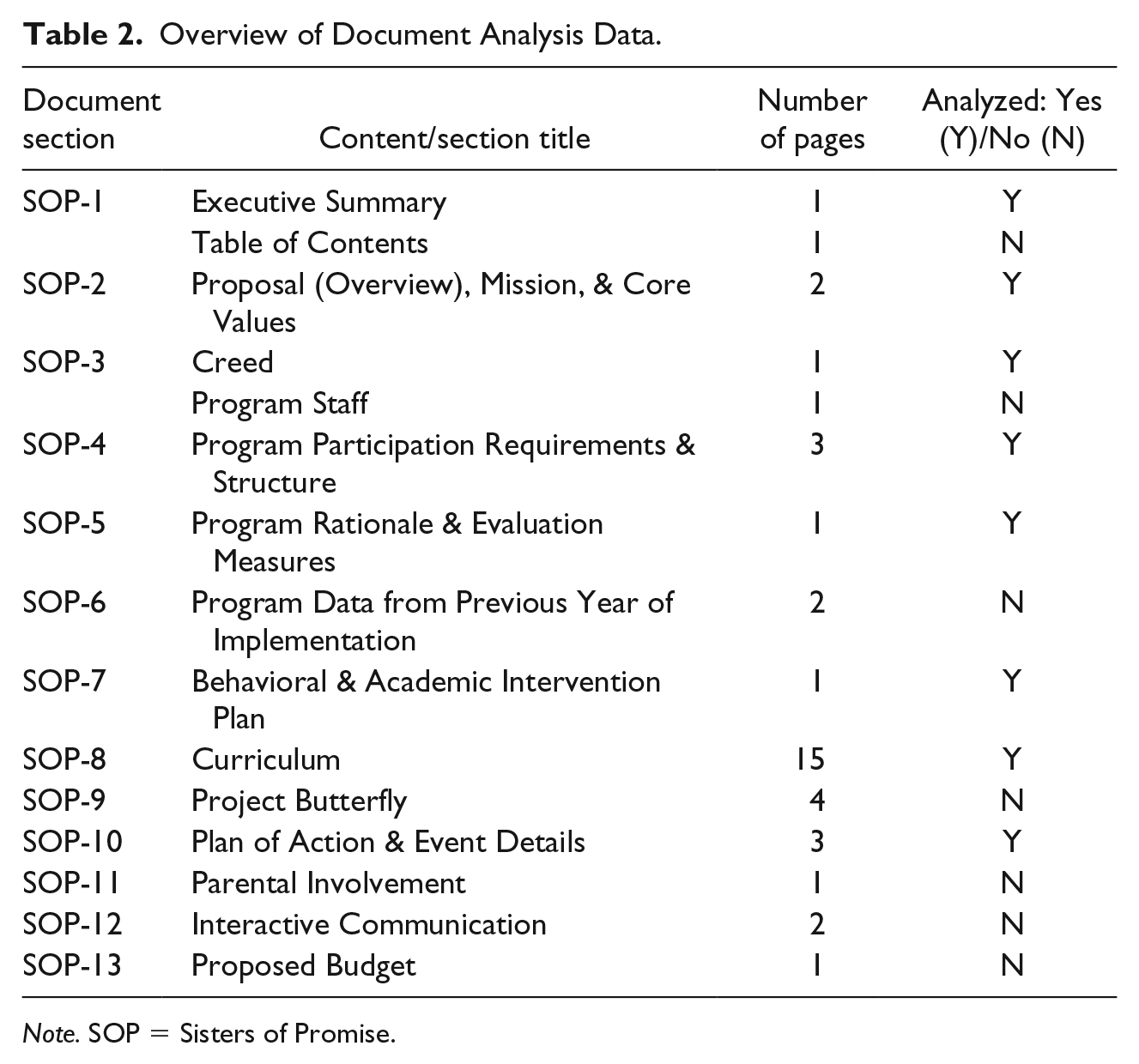
As shown in Table 2, our data sources included the SOP mission statement, creed, description of core values and program participation requirements, program rationale, evaluation measures, behavioral and academic intervention plan, curriculum, and the plan of action and event details. Overall, we analyzed 27 pages of text (see Table 2), not including text unrelated to curriculum and program design and implementation (e.g., budget, list of program staff).
Overview of Document Analysis Data.
Note. SOP = Sisters of Promise.
We performed our data analysis using Huckin’s (1997) multistep approach to CDA: first, reading the written text uncritically; second, re-reading the text with a critical lens; third, analyzing the framing of the message(s) in the text; and fourth, analyzing specific words, phrases, and sentences. To aid with this last level of analysis, we turned to the method of directed content analysis (Hsieh & Shannon, 2005), which starts with a theory. Using respectability politics and womanism as our conceptual and theoretical constructs, we employed elaborative coding (Auerbach & Silverstein, 2003; Saldaña, 2013) of the program materials, which allowed us to leverage codes developed as part of a previous study on SOP (Nyachae, 2016). For example, we searched the document for text that reflected the code, “personality and disposition,” and then using NVivo, qualitative data analysis software, attached words such as “virtuous,” “refinement,” and “lady,” to this code.
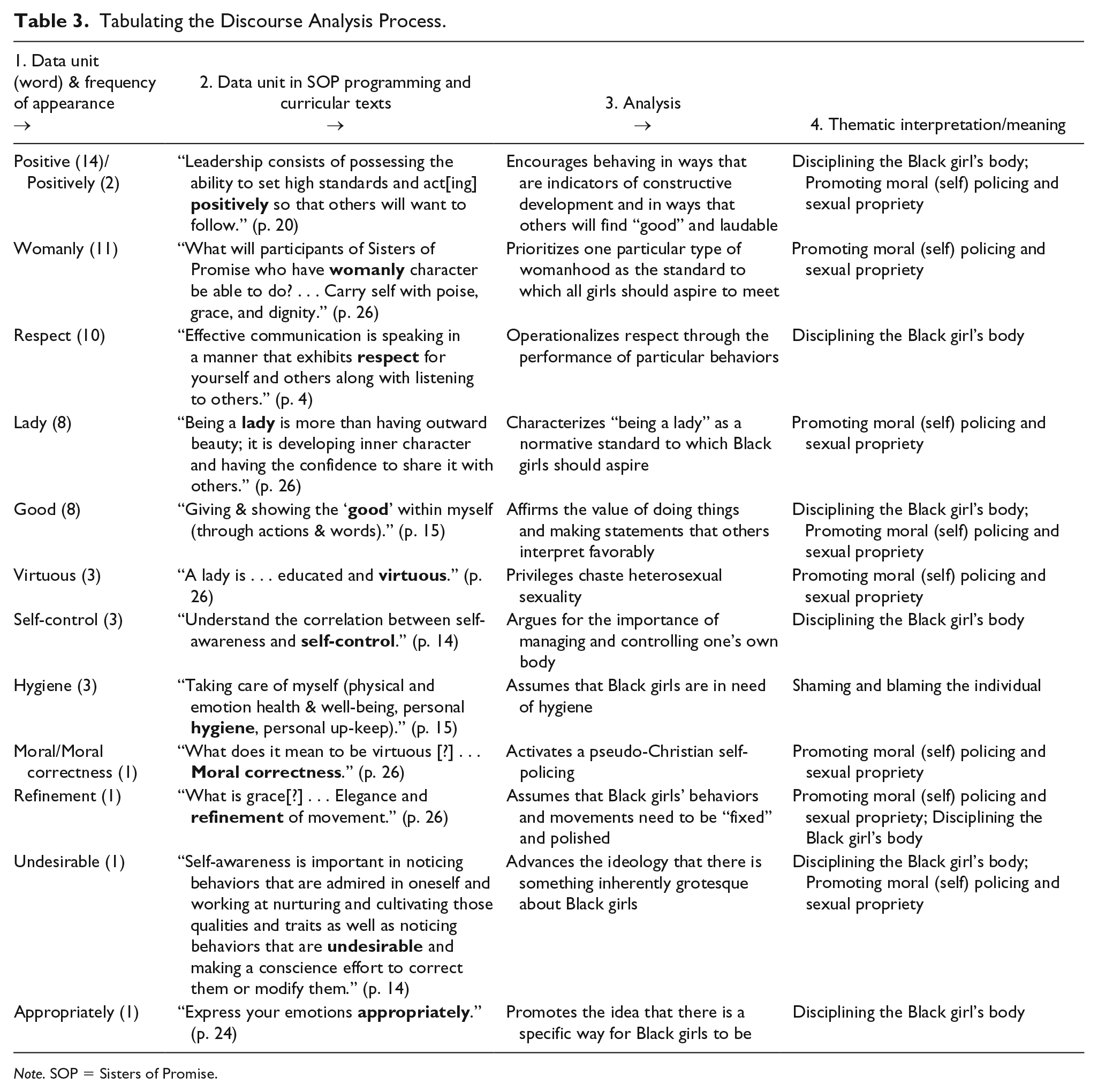
Following from the suggestions of Greckhamer and Cilesiz (2014), we tabulated the discourse analysis process and crafted the description of the findings. First, tabulating the discourse analysis process increases transparency by irradiating the researchers’ thinking and meaning making. For example, as shown in Table 3, according to our analysis the use of “womanly” in one data unit prioritizes one particular type of womanhood as the standard to which all girls should aspire. Our thematic interpretation of this analysis is that it promotes moral (self) policing and sexual propriety (refer to Table 3).
Tabulating the Discourse Analysis Process.
Note. SOP = Sisters of Promise.
Second, crafting the description of findings encompasses “laying out a study’s conclusions instantiated by prototypical quotes from the data” (Greckhamer & Cilesiz, 2014, pp. 435–436), as apparent in the forthcoming discussion section. Our collaborative undertaking of this project allowed for researcher triangulation, which occurred as we compared our interpretations of data, further ensuring rigor.
Findings
We analyzed the data with a focus on how discourses about respectability appear and are reinforced in SOP programming and curricular materials. In doing so, we noted that (through a womanist lens), there are some notable ways that the initiative’s program and curricular materials prompt engagement with a Black woman-centric conceptualization of girlhood. For instance, self-awareness, sisterhood, and health awareness are listed as core program values. Self-awareness is defined as “having a consciousness of self in terms of who you are and your purpose in terms of the rest of the world” (SOP, 2012, p. 4). The corresponding lesson or module on self-awareness within the curriculum includes a section on “[m]y black is beautiful (embracing physical appearances, shades of black, physical features)” (p. 14). Sisterhood is explained as “developing a strong bond with other girls to support each other in achieving similar goals” (p. 4). Health awareness is “knowing the general condition of your body . . . and being balanced in mind, body, and soul” (p. 4). These core values can be interpreted as the program’s attempt to promote a holistic love of self and community within and among Black girls. That aim, however, is compromised when those ideals are juxtaposed against some additional core values noted—specifically, effective communication and womanly character. The former entails “speaking in a manner that exhibits respect for yourself and others along with listening to others,” and the latter, “embodying the poise, grace, and dignity of a sophisticated young lady” (p. 4). Thus, effective communication and womanly character promote adherence and conformity to hegemonic ideals of proper (Black) womanhood. These core values promote as normative a narrow vision of Black girlhood aligned with mores of mainstream society.
We identified three themes illustrative of how respectability politics permeate SOP programming and curricular materials. These discourses of respectability are circulated through language that first shames the individual Black girl for her appearance, and blames her for her behavior, and second, aims to discipline the Black girl’s body, and third, promotes moral (self) policing and sexual propriety as pertinent to the attainment of proper Black girlhood, which is a precursor to proper Black womanhood.
Shaming and Blaming the Individual
In the curriculum, “personal hygiene” and “personal up-keep” (see Table 3) are described as markers of self-awareness and self-confidence (SOP, 2012, p. 15). This echoes messages about cleanliness and etiquette that were delivered to working-class Black people by middle- and upper-class Black people, such as members of The Baptist Women’s Convention. These messages were embedded in pamphlets with titles such as “Take A Bath First” and “How To Dress” (Kelley, 1994, p. 40). Underlying these messages is the belief that by being (physically) clean and “cleaning-up” one’s image or public persona, the (working-class) Black individual will become more palatable to mainstream society. Relatedly, within these messages, there is an insinuated castigation or shaming of individuals who do not comport themselves to mainstream standards of physical and metaphorical purity. The intersection of the ideologies of respectability and (capitalist) individualism is also found elsewhere in the curriculum, specifically in a lesson module on goal setting. Examples of goals that are to be provided to participants are as follows: No debt, have $1 million dollars, not run out of money, pay for college, buy a house, receive scholarship to college, get into a high-quality high school, get on the honor roll, get on the merit roll, travel, donate money, start my own business . . . (p. 16)
What are presented to program participants as worthwhile goals are those that fuel economic mobility, and ascendance into the middle- and upper-class echelons of society.
Within the program rationale, it is stated that the SOP initiative is necessary “[t]o increase student responsibility, thereby decreasing the number of disciplinary referrals (including suspensions)” and “[t]o increase conflict-resolution skills, thereby decreasing the number of conflicts between girls” (SOP, 2012, p. 10). The former assertion suggests that discipline referrals result from irresponsibility, and the latter implies that conflicts stem from un(der)-developed conflict-negotiation skills. Similarly, in the behavioral and academic intervention plan, it is noted that “[p]articipants will also be held accountable for work completed in classes and will be expected to always strive to perform to their greatest potential” (p. 13). These statements center the individual’s actions as unattached to person, place, or thing, nor do they engage societal, cultural, and/or temporal factors. In other words, they fail to reflect an acknowledgment of how the relationships between an individual and her environment—as well as the human and nonhuman agents within that environment—influence her actions. Thus, then Black girl is taught that she is expected to assume full blame for her behavior.
Disciplining the Black Girl’s Body
The belief that the material Black female body, in its natural state, is a wild object to be tamed has been contested (e.g., B. C. Cooper, 2017; Ohito & Khoja-Moolji, 2018). This belief, however, is revived in SOP, as evidenced by the data. For instance, in the lesson module on self-communication, it is stated that “participants of Sisters of Promise who dream big and set goals [will] be able to . . . [c]ontrol body language” (SOP, 2012, p. 17). Parameters regarding appropriate posture, gestures, eye contact, facial expressions, and vocal qualities are provided. Specific to voice and the act of speaking, participants are advised that “raising the volume of your voice can suggest anger, mumbling can suggest lack of self-confidence, speaking overly slowly and deliberately can communicate that you think the other person doesn’t understand you” (p. 20). Also, with regard to their use of their voices, Black girls are taught the importance of “speaking in a manner that exhibits respect for yourself” (p. 17).
SOP’s preoccupation with disciplining Black girls’ bodies extends to sexuality and sex. There is programmatic and curricular silence on the issue of sexuality, although the use of the masculine pronouns (e.g., him) as universal or gender-neutral (e.g., SOP, 2012, p. 18), along with a reference to “get married, stay married” (p. 16) as legitimate goals for participants to set, couple sexuality and marriage—which, arguably, is an institution that exists within the paradigm of compulsory heterosexuality (Rich, 1980). This reveals the program’s investment in patriarchal, heterosexist perceptions of proper Black girlhood. On the subject of sex, however, the program takes a firm, puritan stance, labeling this act one of many “negative factors” to be shunned (SOP, 2012, p. 15)—the others being “alcohol, drugs, tobacco.”
Promoting Moral (Self) Policing and Sexual Propriety
Proof of the program’s promotion of moral (self) policing can be found in the creed, which participants were expected to recite at the beginning of each weekly meeting. The creed includes the following sentences: “I carry myself with poise, grace, and dignity,” and “I lead through positive actions and words” (SOP, 2012, p. 7). The importance of moral (self) policing is further affirmed within the sections of the SOP curriculum that detail the self-awareness and womanly character core values. This is substantiated by the frequency and collective volume of particular words that allude to Victorian ideas of virtue and morality. These appear in the program materials, as indicated in Table 2.
An emphasis on moral (self) policing is present in the behavioral and academic intervention plan, too, wherein it is indicated that by “completing the core value modules (i.e., sisterhood, self-awareness), participants will be able to understand the importance of demonstrating behaviors reflective of the positive character traits Sisters of Promise faithfully represents. These traits include; dignity, respect, poise, and grace” (p. 13; emphasis added).
The emphasis on “demonstrating behavior” suggests that the program encourages corporeal (self) management. Behavioral (self) control also appears to be the aim of the accompanying lesson module on self-awareness, which calls for “avoiding negative factors (alcohol, drugs, tobacco, sex)” (p. 15). In that vein, a lesson on the health awareness core value encourages participants to learn how to “[e]xpress your emotions appropriately” (p. 24).
Discussion
The Treatment of the Black Girl’s Body as Aberrant
Like some socialization programs mentioned in our literature review, SOP integrates into its documents a concern with bodily control that is wrapped in discourses of respectability. An example of this can be located in the lesson module on “[d]ealing with negative emotions ([e.g.,] anger, jealousy, embarrassment, nervousness)” (SOP, 2012, p. 16; emphasis added). Here, the Black girl’s body is constructed as a material point of crisis. This is troublesome for the following reasons. First, the implicit message being delivered to Black girls in the program is that their bodies are innately flawed. This contradicts the explicit call for “embracing physical appearances, shades of black, physical features)” (p. 14). Moreover, it may be challenging for a working-class Black girl to grow “a consciousness of self in terms of who you are and your purpose in terms of the rest of the world” (p. 4) if the messages conveyed render her racialized, gendered, and classed body as deviant in that world. Second, this configuring of the Black girl’s body as a problem impedes exploration of the emotions or affects housed within that body as forces that can fuel positive social action. Emotions or affects “do things,” (Ahmed, 2004), and Black women intellectuals have theorized the uses of anger for the project of social change (e.g., Lorde, 1984; hooks, 1995). Audre Lorde (1984), for instance, asserts that anger “can become a powerful source of energy serving progress and change” (p. 127) and emphasizes that, “[e]very woman has a well-stocked arsenal of anger potentially useful against those oppressions, personal and institutional, which brought that anger into being.” In addition, the Black woman can be the recipient and producer of corporeal and carnal pleasure (Collins-White et al., 2016; Miller-Young, 2014; Nash, 2014). Hence, by (re)claiming her right to feel pleasure(d), the Black girl can puncture the dominant hetero-patriarchal and misogynoiristic narrative of her body as abject (Ohito & Khoja-Moolji, 2018).
The Absence of a Structural Analysis of Oppression
SOP’s laser-sharp focus on the individual Black girl’s appearance, behaviors, and speech convey to her the core message that she is accountable for her experiences with oppression (Nyachae, 2016). This focus rests on the idea that social change is predicated upon individual—as opposed to structural and institutional—shifts. Yet, Lorde (1984) illuminates the faulty logic in the line of thinking that blames the individual Black girl or woman for the many ways in which she may be disempowered by subjugation, and for the myriad effects of the misuse of power within a grander global and political economy. Hence, with regard to SOP, teaching the individual Black girl that her orientation to mainstream ideals determines her experience of marginalization obfuscates the structural and institutional reasons for and manifestations of oppressions. Program participants remain un(der)exposed to critical frameworks for dissecting inequity, and thus, are potentially hindered from developing structural analyses of racialized, gendered, classed, and other forms of oppression. Without this, participants may believe that they, as individuals, are culpable for their subjugation, which, in the context of schooling, is exemplified by exclusionary discipline practices. They may also remain unaware of how social class structure and (limited) capital may complicate working-class students’ efforts to “pay for college, buy a house, receive scholarship to college, get into a high quality high school . . . travel . . . start my own business” (SOP, 2012, p. 16). Stated otherwise, the absence of critical frameworks increases the possibility that programmatic and curricular conversations about (the entwinement of) racism, sexism, classism, and other forms of marginalization will rotate around individual agency, instead of power.
In summary, the discourses of respectability that undergird SOP’s programmatic and curricular treatment of the Black girl’s body as aberrant, and that anchor the absence of a structural analysis of oppression, (re)inscribe the knowledge that Black girls’ (physical) bodies and beings are broken and due for repair, rather than the notion that Black girls are intrinsically whole—personifications “of Black people as complete, complex, undiminished human beings” (Walker, 1983, p. 85; emphasis in original)—and it is, in fact, the structures and systems within which they function that are faulty, and require fixing. 12
Limitations and Lines of Inquiry for Future Research
Our study is limited by our data being drawn solely from one program’s written texts (see Table 2). Hence, our conclusions paint a partial picture of one initiative’s efforts to shape participants’ perceptions of Black girlhood based on one data source. In addition, the absence of the girls’ voices and narratives raises questions about how they internalized the program’s problematic and harmful messages. We plan to address this limitation by interviewing the girls about how SOP affected their self-understanding and self-image. We also plan to have the girls critique SOP’s curriculum based on who they have become years after their participation, thus allowing us to better understand how the program’s (re)production of respectability discourses informed their evolutions.
The aforementioned limitation creates opportunities for several future lines of inquiry. Meanings made of discourses in written texts are mediated by human (inter)action. Future research on language and power in ECPs for Black girls may investigate how human (inter)actions influence discourses of respectability. Using a range of theoretical frameworks and methods, researchers may probe how program participants and/or curriculum implementers take up, resist, and/or subvert discourses of im/proper Black girlhood. For example, researchers may perform an intersectional analysis of how SOP and other similar programs define Black girlhood through a race, gendered, and classed lens. The knowledge gleaned from such research endeavors may contribute to ensuring that the discourses in equity-oriented ECPs inculcate students with ideas about gender—as intersecting with other social identities—that invite social change.
Toward Pluralized Black Girlhoods in Extracurricular Programming
Improving Black girls’ experiences in urban schools is a necessary step in the journey toward attaining educational equity for multiply-marginalized students and, thus, is of crucial concern to critical scholars of urban education. Brown (2009) recommends a focus on “power, not programs” when working with Black girls (p. 19). B. C. Cooper et al. (2017) call for “a shift in how we perceive care for Black girls, and . . . acknowledgement of what Black girl magic means in those moments when Black women believe the hype of cultural respectability” (pp. 109–110). In this article, we gesture toward a shift in how we perceive (and) care for Black girls in extracurricular spaces, and a move toward helping all Black girls recognize their power and believe in the “magic”—or the powerful magnificence—of their girlhoods. The question of how to achieve this is one that we invite program and curricular developers, as well as other stakeholders in urban schools, to consider with us.
Implications for Program Development
This study illustrates that discourses about gender and other forms of social identity are inherently political. Thus, it is important for program developers to make visible their politics and inquire into how those politics inform the discourses that circulate in the program. We also recommend that program designers embedded in ECPs that espouse a focus on a particular racialized, gendered, classed, and otherwise marked group question how discourse creates conditions for inclusion or exclusion. For example, with regard to programming for Black girls, designers may ask themselves and each other, which Black girls? In addition, program developers may benefit from studying the specific types of girlhoods contained in the context in which the program exists. Having this information handy could strengthen a program’s efforts to develop materials richly reflective of the multiple yet specific girlhoods flourishing in a specific context, and acutely attentive to Black girls as they are, instead of as the program would construct them (Haddix et al., 2016).
Implications for Curriculum Development
By gesturing toward an idealized “good” Black girl, program and curriculum materials imagine the existence of her opposite, a “bad” Black girl. Within this good/bad binary, Black girls’ beings—which include their bodies and their sexualities—are boxed into stagnant categories. Hence, with regard to curriculum development, our findings illustrate the need for lesson modules that disturb the rigid good/bad dichotomy. One such lesson could introduce program participants to Black women considered by mainstream society and/or in a particular time period “badly behaved.” These women concerned themselves less with that which was deemed right, and more with that which was just, and therefore, engaged in social action (e.g., Claudette Colvin and Marsha P. Johnson). Lessons could bring visibility to Black women in the African diaspora, thereby unsettling the global North/global South dichotomy; transgender Black women, who have disrupted the male/female binary; and queer Black women who have troubled heterosexuality, and increased knowledge of Black female sexuality as existing along a continuum. Exposure to these women may move program participants toward understanding the tremendous power in and of self-definition, and locating the hopeful possibilities for that self-definition within Black girlhoods and womanhoods. An additional set of lessons could address sex education vis-à-vis the Black female body and sexuality. From these lessons, program participants may learn to see their bodies as dynamic sources of pleasure, not only pain. Ergo, instead of focusing on what is “undesirable” (SOP, 2012, p. 14) with regard to Black female sexualities and bodies, ECPs such as SOP can teach Black girls to “name and claim desires” (Nash, 2014, p. 58).
No Disrespect
Ultimately, we are calling for program and curriculum developers to ask what works for whom—as opposed to simply what works—to create ECPs that respect the diversities of girlhoods existent among Black girls. Specifically, we urge developers to engage in ongoing introspective and reflexive work that surfaces their ideologies and positionalities, and then draw from this work to inform their (re)design of Black girls-centered ECPs.
The importance of recognizing pluralized Black girlhoods when (re)constructing ECPs becomes emphasized when considering the following: In an interview with Kimberley Foster (2015, October 13), Higginbotham posited that the utility of respectability politic for the Black woman is that it gives you a moral authority to say to the outside world, “I am worthy of respect. You don’t respect me, but I’m worthy of respect. You don’t treat me like an equal person, but I know that I am an equal person, and because I am an equal person, I’m going to fight for my rights. I’m going to demand equality. I’m not going to let you treat me like a second class citizen.” (para. 8)
Higginbotham’s comments highlight the trouble with the politics of respectability, which is that they both require and reify a hierarchizing of citizenry. Hence, ECPs that are premised upon discourses of respectability welcome “sisters of promise” (SOP, 2012, p. 17) at the peril of sisters, or Black girls, who are interpellated (Althusser, 1970/1971) as “scum of the earth” (AinskcCasey, 2016). These are Black girls—such as Howard High School of Technology’s Trinity Carr, Zion Snow, and Chakeira Wright—who are restricted to the edge of an ideal girlhood. The discourses of respectability in ECPs such as SOP render these girls unworthy of respect, and undeserving of full citizenry. Both the judicial courts and the courts of public opinion may see fit to judge and vilify the Black girl whose being is beyond what is normalized as good with regard to girlhood and womanhood. However, ECPs are uniquely positioned to foster spaces that may ensure that this girl “[l]oves herself. Regardless” (Walker, 1983, p. xi). Moreover, ECPs established with the intent of improving the educational experiences and therefore lives of girls more likely to be marginalized and materially hurt by exclusionary disciplinary practices in schools must grapple with the proposition that even “evil girls” (AinskcCasey, 2016) such as Trinity, Zion, and Chakeira have a right to respect; and in fact, a denial of this respect is disrespectful of their claim to a full humanity that is not predicated upon their proximity to, and potential to assimilate into mainstream—that is, White supremacist—society.
Footnotes
Declaration of Conflicting Interests
The author(s) declared no potential conflicts of interest with respect to the research, authorship, and/or publication of this article.
Funding
The author(s) received no financial support for the research, authorship, and/or publication of this article.
