



Abstract
Using portraiture methodology, this study features caring classroom experiences between Latina teen mothers and their teachers at an alternative school along the U.S./Mexico border. Classroom observations and in-depth interviews were conducted to piece together three classroom portraits which reveal the following: (a) authentically caring pedagogical interactions in the classrooms enabled Latina teen mothers to develop a pro-school ethos, and (b) these pedagogical interactions of care and support in the classroom were made possible within a caring schooling structure. This article contributes to the field of urban education by showcasing successes and effective practices in an urban setting.
Introduction
[Before,] I didn’t care about school. I wasn’t even thinking about college. I wasn’t thinking about what I was going to do later . . . I stopped doing what I used to do which was smoking, [I] stopped drinking [and] started concentrating on [school] . . . cuz now I have a baby, so I want him to have what I didn’t have. And well I came back to school. And it was hard, but I mean I did it for my baby, cuz if I probably didn’t have my baby I wouldn’t be where I am right now. And now it’s different, I was student of the month. Like, I was never student of the month [before]. I think they admire who I am because . . . I’m real dedicated to my work . . . I don’t give them trouble, like before I used to talk back to my teachers. I used to not do my work, I would just walk out of class whenever I wanted. It’s different now. I respect my teachers, it’s kind of nice to have respect for older people, because then they’ll respect you and see you as an older person, more mature. (Kira; 17 year old, Senior, 7-month-old son)
Kira, a teen mother of Mexican-origin, described the extent of the transformation she had undergone after having a baby and transferring to an alternative school in the Rio Grande Valley in South Texas. This school validated her needs as a Latina woman with caregiving responsibilities and provided a flexible structure to achieve her educational goals. She could have been another statistic, as students who do not fit the rigid mold of traditional schools are often pushed out. Kira’s achievement is awe inspiring because as several scholars have pointed out (Erdmans & Black, 2015; Pillow, 2004; Wright & Davis, 2008), teen pregnancy, especially in urban schools, is often framed as a life ruiner, something to be ashamed of, and even something to be punished. For Mexican-origin mothers, in particular, pregnancy is charged with national, racial anxieties about the “browning of America” (Chavez, 2013; Gutiérrez, 2008), and sentiments of Mexican American communities as “deficit,” especially in urban schools (Valencia, 2002). So, what is done differently at RGV School (pseudonym) and what can it teach us about the changes that are needed in urban schools to care for all students facing tremendous odds?
I got closer to the answer every time I observed and talked with a teacher at RGV School. They seemed to be invested in the lives of students and thought highly of the mothering students, emphasizing their “family approach” to care for them. The student of the month display was located among student artwork that featured cultural pride of being both Mexican and American. Colors of the Mexican flag, self-portraits, and phrases like “Viva la Raza” adorned the main hallway. In other words, a teen mom of Mexican-origin was being celebrated along with her American and Mexican cultural heritage. When I asked Kira what she thought about her new status as a “model student,” she proclaimed that she was proud of how the teachers viewed her at school. Not only was she being recognized for her hard work as a student, but also a teen mother overcoming the odds. Kira’s words were especially striking given the reality that students of color and low-income youth “are less likely than their White peers to have access to a ‘highly qualified’ teacher” (Heilig et al., 2015, p. 526). Moreover, even highly qualified teachers are rarely prepared to teach in contextually relevant and caring ways for students of color in urban classrooms (Ladson-Billings, 2015).
Still, to seek further answers to my questions, I zoomed in on the everyday interactions that unfolded between mothering students and their teachers. I used portraiture methodology (Lawrence-Lightfoot & Davis, 1997) to construct three portraits that illustrate what it takes for Latina mothering students to feel cared for in a way that enabled them to recraft their identities in a transformative way. These portraits also show how caring interactions between teachers and students were made possible through the family-like environment of the school in which care and mutual respect for all students is prioritized. Through Bourdieuian theory and ethics of care, this article makes sense of an interplay between structure and practice, so that caring teachers are fostered through caring schooling structures and vice versa. That said, this article contributes to the field of urban education by answering Milner and Lomotey’s (2015) call for research that explores successes and effective practices in urban schools. To echo Milner and Lomotey, the goodness discussed in this research setting is not meant to be replicated across contexts, but rather provide insights of what has worked within this particular urban context and why. This article ends with a call for education scholars and practitioners to center student perspectives, particularly of Latina teen mothers, in mapping out the contours of what counts as authentically caring in urban classrooms and what schooling structures are necessary to support such practices.
Latina Mothering Students Within Urban Schools
In this article, pregnant and mothering teens are discussed within the context of urban education in which Latina students, due to gender, racial, and class factors, already face challenges in schools prior to their pregnancy. Contrary to popular belief that early pregnancy causes teen mothers to drop out of school, this common assertion is oversimplified, empirically unsound, and just plain wrong (Pillow, 2004). Most parenting students thought about dropping out or had already dropped out of school by the time they had a baby (Luker, 1996). In fact, the term “dropout” is a misnomer because it signifies sudden departure from school when in reality many teen mothers become disenfranchised or pushed out of school over time (Erdmans & Black, 2015).
While teen pregnancy is a challenge, students in urban settings already face multiple challenges. In this study, “urban” is a term used to describe a particular school setting and is also understood as code for schools that serve primarily non-White students and have fewer resources than schools in other settings (Milner & Lomotey, 2015). Most urban youth attend schools in which teachers often have low academic expectations for their students (Liou & Rotheram-Fuller, 2019) and disciplinary policies are rigid and exclusionary (Diamond & Lewis, 2019). These schools are also typically overcrowded and diverse along the lines of race, ethnicity, language, immigration status, and other social identifiers (Irizarry & Welton, 2015). However, procedures and policies in urban schools are usually adapted from historically White, middle-class school structures and are designed to manage large numbers of non-White students, rather than accommodate their diverse needs like fostering a sense of belonging (Brooms, 2019). Other challenges that urban schools usually face is inadequate funding and resources, which results in poor teacher quality and few curricular opportunities that intellectually challenge students (Milner & Lomotey, 2015). Within this educational landscape, teen mothers often get lost in the shuffle even before they become pregnant. Leaving school is not a one-time event, but rather a process (Erdmans & Black, 2015).
Latinx youth are currently among those with the highest risk for poor educational outcomes like school dropout (Loera et al., 2018). They also receive “harsh disciplinary sanctions, are overrepresented in the lowest academic tracks, have significantly lower chances of completing high school within four years, and receive limited resources and supports to matriculate to college” (Irizarry & Welton, 2015, p. 240). Although current educational practices and policy approaches aim to address these challenges, it is usually done in a way that positions Latinx youth and their communities as the source of the problem that needs to be fixed, rather than addressing the failure of current school structures. This leads to the issue of subtractive policies that repress Latinx students’ cultural and linguistic identities (Valenzuela, 1999). Rather than drawing upon the strengths and resources of Latinx students and their families, Latinx students are the target of deficit perspectives from educators who aim to assimilate them to the school structure, instead of changing the school structure to better serve them. This creates school climates that negatively impact Latinx youth’s level of connectedness and engagement in school (Antrop-González, 2011).
To make matters worse, the high-stakes accountability system shapes urban schools in ways that prioritize impersonal academic goals over interpersonal and human connections between teacher and students (Kumashiro, 2015; Ravich, 2010). Teachers often use grades and other metrics to engage students and care for their well-being, and while studies (such as this one) highlight ethics of care (Noddings, 2013) as a way to help urban students, there is a difference between a more connected “authentic care” and a more impersonal or “aesthetic care.” According to Valenzuela (1999), subtractive schooling and the preoccupation with standards, inflexible schedules, and “English-only” policies encompass “aesthetic care”—that is to say, care that is impersonal and detached from the students’ everyday lives. Authentic care, on the contrary, encompasses a nurturing and mutually respectful relationship, which will be further elaborated in the theoretical framework. The difference between these two types of care is critical for Mexican-origin youth who seek belonging in the classroom. These students perceive an overemphasis in aesthetic care as teachers not caring about them, leading to disengagement from school. Teachers interpret this disengagement as students not caring about getting an education, when in fact, they are expressing resistance toward an impersonal care (Solorzano & Delgado Bernal, 2001).
Like their peers, Latina teen mothers also disengage from school before the onset of motherhood as a result of feeling like they don’t belong in school (Zachry, 2005). However, when teachers express aesthetic care toward Latinas, there are specific gendered, classed, and racial dimensions that are ignored and contribute toward Latinas feeling even more disconnected from the education system. For instance, young Latina women and women of color in general are typically charged with gendered responsibilities like caregiving (Fine & Zane, 1991). Yet, teachers often do not recognize the work of young Latinas who care for younger siblings, grandparents, or for some, their own children. This includes cooking, cleaning, babysitting, and other chores, as well as the expectation that they will do their homework and be a role model for their siblings (Hurtado, 2003). Some Latina students are even be expected to contribute to the home financially if they are of working age (Proweller, 2000). When teachers ignore these responsibilities while at the same time berate Latina students for doing poorly in test scores or being late to class, it may amplify the young women’s interpretation of their teachers as not caring about them (Valenzuela, 1999). If teachers do not take the time to learn about Latina students and their backgrounds, as is the case with most marginalized students, the young women do not feel a sense of connection to their teachers, nor a sense of belonging in the classroom.
Moreover, teachers are even more unprepared to accommodate students’ mothering responsibilities. Given the highly impersonal and subtractive schooling landscape, it is rare for teachers to care for Latina teen mothers in authentic ways that are responsive to their needs. This problem is compounded by the fact that teachers’ morals and attitudes toward Latina teen mothers play a major role in how they are treated in school. For instance, Kelly (1998) found that the “good choices discourse” permeates the beliefs of teachers in regard to the kind of support and services parenting students should receive in schools. This discourse among teachers rests on the notion that teen pregnancy is a poor choice that is based on the young women’s irresponsibility and lack of morality. Such gendered and sexual stigma makes mothering students feel inadequate, alone, and unmotivated.
Site of Opportunity
The educational experiences of Latina teen mothers mirror the multiple layers of the complexities and injustices that youth of color and low-income students face in urban schools. Moreover, their gendered lives inside and outside of school, and the stigma they commonly face, highlight additional areas of concern. However, pregnancy should not been seen as something that ends students’ educational lives. In fact, early motherhood can be an opportunity for reengagement (Johnson, 2009). As a result of early motherhood, many mothering students undergo a “turning point experience” (SmithBattle, 2007) in which they attain a renewed sense of motivation for academic achievement. Motherhood “serves as a site of transformation” in which teen mothers “chart a more positive life course and fashion a new identity as mother . . . which entails personal improvement . . . as young women establish new goals and purposes” (Johnson, 2009, p. 257). This transformational point in the lives of mothering teens, however, must be supported by teachers who are willing to work in solidarity with teen mothers to fuel their renewed motivation in school and forge caring relationships and instructional support (Wright & Davis, 2008). Rather than resorting to deficit or even punitive approaches in which teen mothers are treated as “bad students” who do not deserve accommodations and support, as is often the case in urban schools (Byrd, 2011), teachers can draw upon the strength of these students to engage and help them pursue higher education. Hence, the reality that some teen parents are returning to school after their early pregnancy signifies an opportunity for educators to provide support that urgent for these students.
Context
This study is situated in the Rio Grande Valley (RGV), a region located in the southernmost tip of Texas along the U.S./Mexico border. RGV is a unique area for research due to its racial/ethnic composition, growth in population, and high poverty. Currently, over 90% of the 1.3-million RGV residents are of “Hispanic” origin (Ryabov & Merino, 2017). During the past two decades, the population has increased by almost 75%, whereas in contrast the U.S. population has only grown by 24% over the same time period (Ryabov & Merino, 2017). On the one hand, RGV is one of the poorest regions as it “leads the nation in unemployment and poverty and ranks near the bottom nationally in per capita income” (Ryabov & Merino, 2017, p. 2). However, on the other, RGV is also “one of the most dynamic cultural areas in the United States” (Mier et al., 2004, p. 16), as cultural exchange with Mexico occurs at all levels of society. The familiar code switching between Spanish and English is a linguistic representation of how RGV straddles the U.S/Mexico border. Part of its dynamism comes from the high rate of border crossing by shoppers, tourists, workers, and students.
Currently, RGV has 37 school districts and nearly 415,000 pre-K–12 students who are more than 97% Latinx (Jara & Taylor, 2017). Taking all of the school districts as a whole, RGV approaches the definition of an urban school district due to large populations of students of varying immigration status, who are culturally and linguistically diverse. Schools in the region are also characterized by high concentrations of poverty and low resources. Because of this, RGV has already been imagined as an urban setting and has been compared to other large urban cities in Texas like Houston and San Antonio (Jara & Taylor, 2017; Perez-Hernandez, 2018). RGV has been compared to other urban schools in Texas to show how it outperforms these schools despite having similar challenges (Perez-Hernandez, 2018). Education leaders in RGV seek to understand why one of the poorest regions in the country is outperforming every other region in the state (including affluent ones). However, it is important to highlight that these reports are based on the state standardized test or STAAR test. This raises the question of how success and “performance” is measured and what this means. For instance, a study conducted in South Texas (Cruz & Brown, 2010) demonstrated that teachers have been pressured to change their pedagogical strategies to prepare students for the Texas high-stakes exam. This has led to systematic teaching practices and the narrowing of curriculum, which maximizes efficiency rather than fostering meaningful learning experiences. Teaching to the test has also lead to emotional and mental stress for students and teachers.
RGV School
RGV School is an alternative school for students who were pushed out of their prior schools. It is a small campus with 131 students in Grades 8 to 12, and about 35 teen parents made up part of this population. The number of students fluctuates throughout the year because some students may attend the school for a couple of weeks to catch up on their credits to later return to their traditional/home school, or they may choose to stay and graduate at RGV school. Mirroring the local population, approximately 96% of the students are “Hispanic” and the rest are White non-Hispanic students. Most students are considered “at-risk” students (98%) and of low SES (socioeconomic status) backgrounds (95%), but only 3% are considered limited English proficient (LEP). Although, few students are LEP, most students code-switch between English and Spanish, including most teachers of “Hispanic” origin (83%) and the few White teachers at the school. Class sizes are small with an average of 11 students per teacher.
In a newsletter, the principal described the school as a “nurturing culture of caring.” They offer flexible schedules with self-paced modules and individualized instruction. However, there are accelerated programs (particularly for eighth graders) in which curricula, typically taught within a school year, is compressed into a semester. Yet, teachers provide flexible deadlines and extensions for these students. Family and community events in the school are common during and after school, including weekends. Parents and family are welcome at any time, and students are free to walk in and out of their classrooms to check-in with other teachers, the school nurse, and counselor. The school district’s teen parenting program is housed within this school, so it also offers support services such as child care, teen parenting classes, peer counseling, and a homebound teacher. Although, the school is atypical from most urban schools (i.e., small class sizes and specialized support), it serves student demographics that parallel those of typical urban schools (i.e., low SES and “at-risk”). Students also come from schools in which their needs were not met. Thus, this study offers insights into what happens when urban students are provided with support.
Theory
I used ethics of care and Bourdieuian theory to understand the personalized forms of care I witnessed at RGV School. First, according to Noddings (2013), an ethic of care is a relational and contextual practice. For example, students often feel that caring teachers give “second chances,” so that they have the opportunity to make mistakes and learn from them (Rogers, 1994). Caring teachers are fair, they create meaningful and engaging activities, push students to perform better, initiate conversations to learn about students’ lives, and create a community in the classroom (Rogers, 1994). A caring teacher also guides students through tasks, projects, and assignments (Dempsey, 1994). Although much known about how students understand care, it is nonetheless a situation- and person-specific act (Noddings, 2013). What may work with one group of students may not work with another group. For instance, teachers treating all students the same may not be understood as caring by a pregnant student who needs accommodations like extensions on assignments, multiple bathroom breaks, and a chair with extra back support. Therefore, the knowledge of what kind of care works for students is co-constructed by teachers and students through everyday classroom experiences (Dempsey, 1994).
The second part of my theoretical lens is Bourdieu’s (1990) “dialectic of expressive dispositions and instituted means of expression” (p. 57)—that is habitus, dispositions, and institutions. Habitus can be defined as the dispositions that individuals learn over time, which organize their actions toward social situations. Individuals can have multiple forms of expression organized by the habitus, but for these expressions to count, they must be validated by the institutions in which they operate. According to Bourdieu, institutions do not fully determine how individuals will act, behave, or talk because individuals have different life histories that have taught them lessons about what is appropriate in different situations (and if they do not know, they improvise). In addition, institutions cannot exist if people do not collectively behave according to some semblance of what the institution sanctions as appropriate behavior. As Bourdieu (1990) writes, the habitus is what enables the institution to attain full realization: it is through the capacity of incorporation, which exploits the body’s readiness to take seriously the performative magic of the social, that the king, the banker or the priest are hereditary monarchy, financial capitalism or the Church made flesh. (p. 57)
An authentically caring school can only exist as long as teachers and students within it act in ways that give validity to the school’s values.
These two theories work together because it is not enough to say that an ethic of care happens from an innate, heartfelt place within individual teachers, but rather school structures (institutions) must allow for the development of caring teacher dispositions. In other words, what enables a teacher to be authentically caring (and to be evaluated as so by students) is a school structure that promotes evaluative criteria centered around care. Moreover, Bourdieu claims that there has to be an interplay between structural change and change in practice. To change the structure is to change the conditions that enable the production of dispositions. People embody the structure through their disposition. Thus, teachers are apt to engage in caring pedagogies within an institution that validates such practices as part of its core logics of what make a “good” teacher. A traditional school that does not prioritize care produces a different set of pedagogical interactions in which care is the exception rather than the rule. Caring institutions enable an ethic of care, and it affords teen mothers opportunities to position themselves differently than what is offered in a traditional school.
Method
Portraiture methodology was used to examine pedagogical interactions. Portraits are based on (a) classroom observations 3 times out of the week over the course of one scholastic year and (b) in-depth interviews with the three teachers whose classrooms I observed and five teen mothers between the ages of 15 and 19 years. Two of the classrooms that I observed were co-ed and served both parenting and non-parenting students. I obtained IRB (Institutional Review Board) approval for my study after I secured approval from the school district and the school principal. The following research questions guide this study:
Portraiture
Drawing from case study protocol, narrative inquiry, and ethnographic methods, portraiture merges art and aesthetics with empirical research to create windows into research sites (Lawrence-Lightfoot & Davis, 1997). Rather than walking into a site asking what is wrong, the researcher enters asking, “What is good here?” There is a long tradition in the social sciences of documenting “pathology and disease rather than . . . health and resilience” (Lawrence-Lightfoot & Davis, 1997, p. 8). Investigators most often document failure instead of describing examples of success. While it is important to take note of what is not working within schools, in portraiture the investigator looks for expressions of “goodness” (what is good or healthy). Portraits can be presented in many formats like poems or narratives about specific teachers or students (Dixson et al., 2005). For this study, however, portraits are presented as short narratives about how teachers and students experience care in the classroom.
My background also imbues my choice in using portraiture. I am a heterosexual, cisgender, Chicana/Tejana working class woman who grew up in the same area as the students in this study. I was also a high school biology teacher in this region. I am also the daughter of a teen mother who did not have school support to finish her education. For me it is important to position teen mothers from the border as worthy of educational investment. Thus, portraiture aligns with my goal of humanizing teen mothers and the educators who work with them.
Participants
Mrs. Santos, teacher and coordinator of the teen parenting program, introduced me to the mothering students at RGV School. During her classes, students were asked for their course schedules and their favorite teachers. This process revealed two things: (a) where the highest number of mothering students were located during each class period and (b) which teachers to prioritize for classroom observations. Three teachers were chosen and they enthusiastically agreed to participate. Recruiting mothering students for in-depth interviews was challenging because of irregular attendance due to childbirth, home schooling, and parental obligations. Five students turned in their consent forms in time for in-depth interviews; however, classroom observations and informal conversations with other mothering students are also included in the data analysis.
Data Collection
There are three stages of data collection: (a) classroom observations to identify preliminary themes, (b) themes were then used to inform interview protocols, and (c) classroom observations continued simultaneously alongside the interview process. During the first stage, classroom observations were conducted a month before the interview process to identify preliminary themes. During the second stage, these themes informed the interview protocols which were designed to answer the research questions. Questions revolved around how the teacher and students understood their interactions with teachers and how they understand care. For member-checking and validity, the interviews also provided opportunities for participants to check my understanding about classroom events and interactions. Finally, I conducted the interviews while I continued classroom observations. Observations were continuously coded to reveal new themes or modify pre-existing ones. Thematic updates in the data subsequently informed the interview protocols to check on new patterns with participants. Although I did not ask the exact same questions (linguistically speaking) in each interview, all of my interviews explored the same research questions. Each interview session was tape-recorded and immediately transcribed before the subsequent interview. I also kept self-reflexive notes about my own positionality and relationship to the study (Harding, 1987), and I engaged in member-checking by discussing notes and themes with participants. Finally, triangulation and the ongoing coding process ensured internal validity (Merriam, 2002).
Data Analysis
A grounded theory approach was used to code data and identify themes (Charmaz, 2006). Initial codes described actions like “teacher takes out prop” and “student shares personal memory.” Focused coding involved grouping actions into pedagogical approaches like “theatrical teaching strategies” and “moments of self-disclosure.” The theoretical framework was then used to organize codes into themes. For instance, codes that described moments in which teachers took notice of a teen mother’s performance in class (“winning a bingo game” or “being an example for others to follow”) were eventually grouped into the theme, “repositioning teen mothers as model students.” In this example, Bourdieuian theory pointed out how teachers’ recognition of teen mothers’ performance in class reinforces a structure of care that positions teen mothers as model students.
This process of letting the data speak for itself allowed me to construct an interpretive lens for what I observed in the classroom, and what the teachers and students were telling me about their perceptions of care. Classroom interactions as a unit of analysis revealed that care is a shared priority among teachers and students, so care (as the common denominator) became my interpretive lens. Figure 1 shows classroom interactions as my focal unit of analysis. It is through interactions that I responded to the research questions about what care looks like and what teachers and students need to give and receive care. The diagram also shows how this mode of analysis connects to the findings.
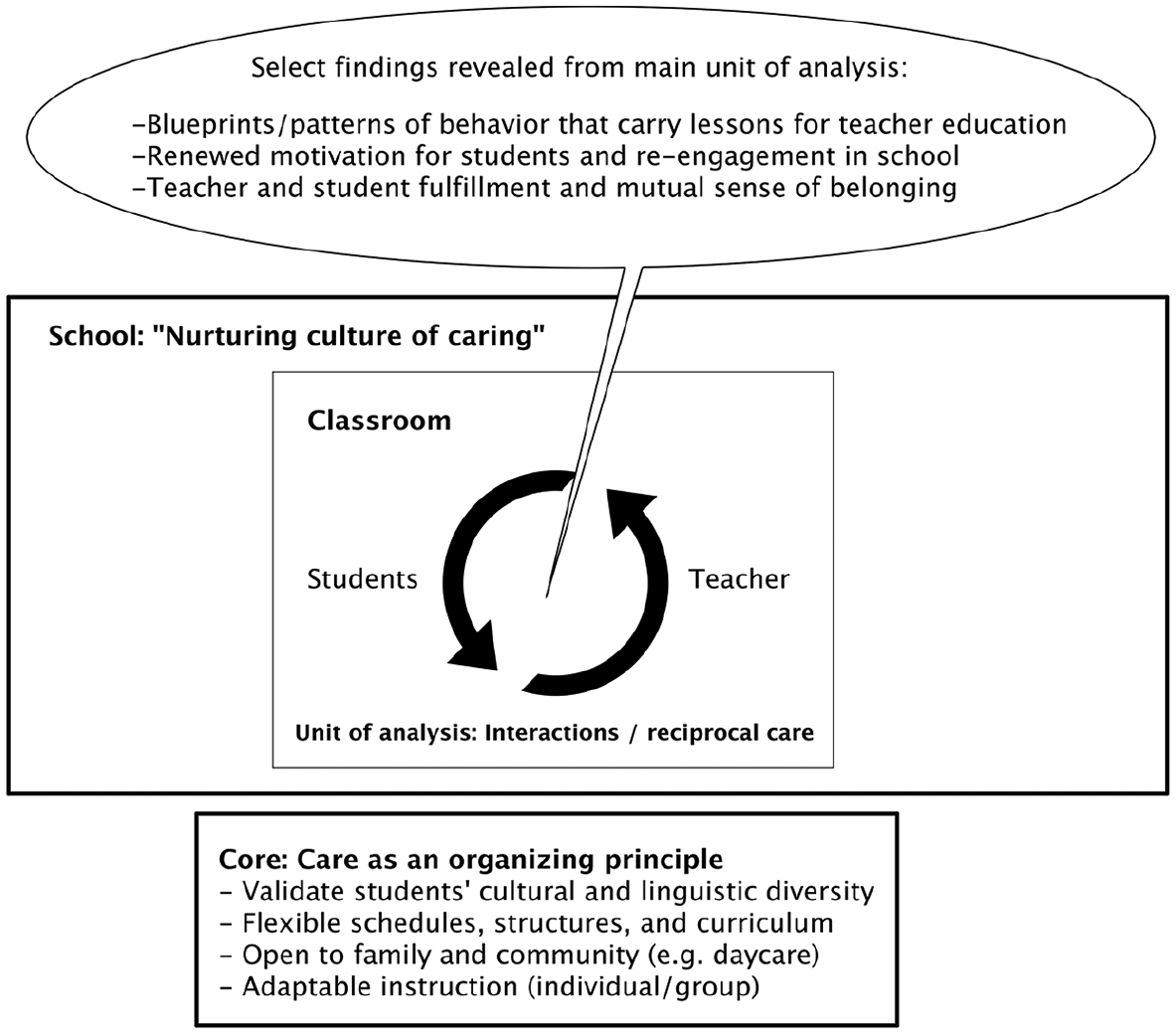
Interactions and reciprocal care as main unit of analysis.
Results
Three classroom portraits are presented to show what caring interactions look like between teachers and mothering students.
“You’re a Champion . . . But You’re Gonna Stand Up, Right?!”
Mrs. Santos began her Teen Parenting Class by raising the volume of one of the songs playing from her computer. Referring to the music, Mrs. Santos exclaimed, “This is you guys, right?! You’re a champion, you’ve been pushed around, but you’re gonna stand up, right?!” Janet, a shy mothering student, yelled, “Yes!!” It surprised me that Janet agreed loudly because she is usually more reserved about when she speaks. She was caught up in the high-energy wave radiating from Mrs. Santos. The tune that was playing was “Roar” by Katy Perry, a motivational song from a popular pop star. The lyrics that she was referring to were as follows: “I got the eye of the tiger, a fighter, dancing through the fire ’cause I am a champion and you’re gonna hear me roar louder, louder than a lion!” She continued talking about the song: “Is it true or false? The song fits for ya’ll. I’ll print out the lyrics.” Janet startled me again when she exclaimed, “It will be our graduation song!” Vicky then interrupted the conversation to release her frustration that she did not get enough sleep the night before. Like Vicky, some of the mothering students usually came into class dragging their feet from exhaustion because they usually stayed up all night with their babies, or they were overworked with chores and school work from the day before.
The motivating pop-music and words of encouragement is an example of how Mrs. Santos responded to the realities of the students while acknowledging the effort it takes to be a mother and a student. She called her students champions and assured them that no matter who has pushed them around they will stand up for themselves. This message was certainly welcomed by Janet who affirmed that she and her peers were indeed champions “dancing through the fire” to overcome the stigma and obstacles that came with being a teen mother. Janet even took up the leading role alongside Mrs. Santos to spark some energy from the exhausted young mothers who continued to wander into the classroom. This is very different from what the students were used to hearing from teachers in their previous school. Many of them were perceived as not fitting into the ideal good student image because of their stigmatized status as teen mothers. They were used to interacting with educators who thought of them as lost causes and did not believe it was possible for them to finish high school, let alone attend college. Esperanza, who was pregnant at the time of my study, clearly explained this to me outside of class: [Mrs. Santos] thinks we can still do it even though we’re young and having kids. She won’t see it like some other people like, ‘Oh! She’s pregnant, she ruined her life!’ I really don’t know people like her that believe that we can still go to college. Some people are like, “Ooh this is going to be hard for you” and stuff, instead of giving you encouragement. She still sees a future in us. That’s the thing I like.
Mrs. Santos’ positioning of the students as champions, rather than lost causes, is the foundation from which this teacher and her students crafted caring interactions. For these young women, it was critical for teachers to acknowledge their dual identities as students and mothers, and to simply believe in them.
The encouragement to overcome obstacles, however, was a two-way street between teacher and students. On several occasions Mrs. Santos told me about the many negative comments she hears about teen parents. One specific memory that she told me about was the time she did a presentation about her students at a parenting conference held at a local community college in town. While some people in the audience gave positive feedback, most were critical of the need for a teen parenting program in the school district. Several people in the audience thought that teen parents should not have accommodations and services because it “glamorizes” teen pregnancy and may even motivate other students to become teen parents as well. After telling me about the negative feedback from the audience, she paused and stared off into the distance with a dazed expression. She admitted that negative comments sometimes discourage her, but then she looked back at me with a hopeful gaze to say, “But you know, if my girls can do it, I can do it too.” She pointed out that her students inspire her to continue her work as the coordinator of the school district’s teen parenting program. Although her profession is often critiqued and questioned, she looked up to her students for strength to continue her work as an educator for a stigmatized group of students. She reasoned that if the young women can work hard despite the stigma, then she can too.
Students also connected with Mrs. Santos through her teaching style. Dynamic, dramatic, and comical are just some of the words that are fit to describe Mrs. Santos’s pedagogical style. When she taught, it was like a theatrical performance in which she acted out scenarios using props like a baby doll, a timer, chair, whatever she could get her hands on while she taught. As Sandra explained to me, “she puts character into her lessons when she teaches . . . She’ll joke around and then she’ll ask questions, and she’ll sometimes play dumb like, ‘Oh! Really, I didn’t know that!’” I observed what Sandra described during one classroom discussion about child abuse. Mrs. Santos used a baby doll to demonstrate ways of coping with a crying baby. As she held the baby, she modeled different actions that can either hurt or comfort the baby. In one of her demonstrations she shook the baby doll as she said, “It’s ok everyone, if I do this, it will calm the baby down.” Many of the students yelled “No!” So, Mrs. Santos “played dumb” (as Sandra pointed out) while she proclaimed, “What? No, really? Then what should I do?” One student suggested that she can ask someone else to hold the baby for a little while to take a break. Mrs. Santos obeyed and handed the baby doll to another student and acted out the scenario: “Here Elena, you take the baby for a little bit so that I can take a little break.” Then she broke character and asked Elena, “Now what are you gonna do with the baby?”
As I watched these interactions, I realized that Mrs. Santos was drawing upon the students’ experiences to piece together the best way to handle the situation. Through role-playing she positioned the young women as experts by asking them what they do as mothers for their children. After class, Sandra commented: “[Mrs. Santos] takes time to ask us questions and listen to us, and she gives everybody a chance to talk.” By providing opportunities for the young women to dialogue, she opened up a space where the young mothers could learn from one another and share their everyday experiences, and they often gave one another advice and childrearing tips. During an interview, she explained that it is critical for students to share their ideas: “They open up my eyes! I don’t know everything, so I want them to tell me what they know!” In other words, motherhood became a source of knowledge that Mrs. Santos tapped into to create a sense of belonging for students. Rather than keeping their realities as mothers apart from their responsibilities as students, they were encouraged to draw upon their roles as mothers to be knowledgeable students.
Mrs. Santos’s care went beyond a taken-for-granted or blanket approach that sees all students as the same. She treated the mothering students like humans with potential, rather than static stereotypes with no future. In her class it was common to see the students forging a sense of community among each other through the commonality of their struggles, experiences, and aspirations as teen mothers. In Mrs. Santos’s class, the young women were more than stereotypes, they were champions.
“Very Demanding, Very Mean Teacher”
Ms. Luna stood firmly at the front of the classroom as she explained chemical bonds using an animation video. The animation moved in synchronized steps as she explained each stage, and she paused the video to ask student questions about what they observed. The student desks were arranged in straight rows, so they had a clear view of the screen and the teacher. On the one hand, Ms. Luna’s method of delivering the lesson reflected order and symmetry, and on the other hand, student comments were sporadic and sometimes off-topic. Anyone who asked the most random question generated the most laughter from their peers, so the playful banter quickly became an informal competition. Ms. Luna, however, remained committed to her stance at the front of the room and continued her lesson. To redirect student behavior, I consistently heard her repeat phrases like, “pay attention,” “turn around,” and “what’s so funny?” With her feet firmly planted on the ground and a fixed expression, she acted as an anchor to keep her students in their place to complete the lesson. Once the video was done playing, some of the students sarcastically exclaimed, “Yay! It’s over!” Ms. Luna then returned the sarcasm, “Yay! You have a quiz!” Darlene, one of the mothering students, smirked and joked, “Why are you so mean Ms.!”
At first glance, Ms. Luna’s teaching style invokes the familiar image of aesthetic care in which teaching revolves around strict schedules and distance from students. According to Ms. Luna, this pedagogical approach made her known as the “mean teacher” compared to other teachers at school. Even Darlene asked her, “why are you so mean?” However, it was apparent that Darlene was actually joking with Ms. Luna about her being mean. She and her peers were playing with the stern image of Ms. Luna. Although students joked throughout the lesson, they were ready for their quiz. They asked several questions related to the lesson, and they also answered several of Ms. Luna’s questions about chemical bonds. Moreover, the competition of who can ask the most random question was actually about the teacher’s personal life. Students asked questions like, “Ms.! What kind of car do you drive?” or “Do you speak Spanish?” Contrary to what these interactions look like at face value, there is an undercurrent of playfulness and community building. The students were amused with her composure, and they understood that she meant business; they were going to be ready for their quiz no matter what.
After class, Ms. Luna informed me that she was “strict” with completing the lesson on chemical bonds because she was catching up with the timeline of an accelerated science curriculum. During our conversation, she seemed stressed that she and her students were behind schedule, yet she decided to postpone the upcoming test anyway to provide more time for students to practice key concepts, especially for those who were absent that day. Despite the time constraint, she looked for ways to provide flexibility. But how did she decide when to be “strict” while adjusting her pacing to ensure students did not fall behind? I learned that her pedagogical decisions were largely informed by students’ personal lives. She took their hardships and complex responsibilities into account when she planned for classes. During an interview, Ms. Luna explained in a serious tone, “I concern for my kids [sic], I care for them, I try to give them plenty of opportunities.” She further explained that she gave students opportunities to bring up their grades because she knew that many of her students were going through extenuating circumstances at home. It was hard for them to attend school consistently and keep up with assignments. Thus, she tailored classroom activities in ways that guaranteed they would receive as much credit as possible each day they made it to class. This especially applied to mothering students who often missed school.
For instance, I noticed that Ms. Luna was poignant about establishing class routines and a strict schedule for students. Even though there were no tardy bells in the school that marked the beginning of each class, she used “bell ringers” (warm-ups) at the beginning of class to get all students working at the same time and avoid chatter. While this was a structured activity, the purpose of the bell ringers was to boost students’ grades, which often suffered from missing assignments due to absences like a sick baby or other complexities related to child care. It was a way to buy time for students to get credit while they completed bigger projects and assignments. Mothering students like Esperanza, who was in Ms. Luna’s biology class, especially liked this built in academic support structure. The mothering students were often the first students to get started on their bell ringers. Ms. Luna’s preoccupation with strict routines may seem like aesthetic care, but her concern about students falling behind invoked an authentic mode of caring that operates under the guise of aesthetic caring. Thus, her style was a delicate dance between providing the necessary structure students needed to stay on track and the flexibility they needed to cope with extenuating circumstances and not fall behind.
What especially resonated with the mothering students is that Ms. Luna never gave up on making sure that all her students understood the content in class. This is a pedagogical trait that Esperanza pointed out in an interview:
So how do you get along with Ms. Luna?
I really get along with her. I didn’t get along with my other Biology teacher before.
No?
I guess . . . [my past Biology teacher] would explain [things to] me and then like [she would] get mad cuz I wouldn’t understand. And [Ms. Luna] she’ll be there until I understand what she is talking about. Until I get it. She’s a really helpful teacher.
How do you feel in her class?
Smart. I failed Biology [before]. I don’t really like science. But this time like I actually found an interest.
Esperanza strongly disliked her prior biology teacher at her traditional school, and she felt insecure in her class. She explained that that everyone around her understood what was being taught, while she felt isolated and confused. She admitted that her self-confidence was low in a classroom setting in which she felt like she was the problem for not understanding what was being taught. In Ms. Luna’s class, however, she understood that she was not to blame for not understanding a concept in class. Ms. Luna embraced that it was her responsibility to try another way. This boosted Esperanza’s self-confidence and she even became the top student in biology class. She even developed plans to pursue a career in the health sciences to merge her goal of helping people with her new-found passion in science.
Toward the end of my study, I shared with Ms. Luna what Esperanza thought about her and the class. A huge smile came over Ms. Luna’s face as she exclaimed, “Really?!” She couldn’t believe the “mean” and “strict” teacher can make a deep impact on students. I chuckled and admitted to her that I don’t think the students actually see her that way. Even when Ms. Luna was being pushy, the mothering students interpreted Ms. Luna’s actions as caring. The family-like schooling structure compelled students to interpret their teachers’ actions through the contextual lens of a caring school, including Ms. Luna. In other words, the mothering students co-constructed the identities of their teachers. Although Ms. Luna thought of herself as “mean,” the mothering students interpreted her strict actions as supportive. Like Esperanza, the teen mothers I interviewed shared that their self-esteem improved greatly after forging positive relationships with teachers like Ms. Luna.
“You Learn Something New Every Day!”
Mrs. Richardson was making her usual rounds around the classroom in her rolling desk chair during her language arts class. The students usually sat in desks that were arranged in a circle formation around the room so that Mrs. Richardson could easily roll from one desk to the next to check on students’ progress with their self-paced modules. Mariana (a non-parenting student) raised her hand and exclaimed, “Ma’am, can you help me!” Mrs. Richardson rolled over to Mariana, who was sitting next to Kira (the mothering student introduced at the beginning of the article), and asked what she was working on. Mariana responded, “What am I supposed to do with Gloria Anzaldúa?” Mrs. Richardson explained to Mariana that she needed to conduct research about who Gloria Anzaldúa was and explain her contributions. After collecting enough information, she was to either write a short paper or create a PowerPoint about her accomplishments. Mrs. Richardson then rolled over to Kira who also had her hand up. Kira was working on a project about the feminist movement during the 1960s and 1970s, but she was having a difficult time understanding the time period in which the movement took shape. She began an extensive and in-depth conversation with Kira about the struggles women were facing at the time. She asked Kira to imagine particular events during the movement when women “were fighting for their rights” because “they were very constricted.”
Midway through the class, Mariana printed out a document in which she compiled information about Anzaldúa. She walked over to Mrs. Richardson’s desk to show her what she had found. Mrs. Richardson took the paper and began reading the content. She suddenly stopped reading as a curious expression spread across her face. She took on an inquisitive tone to quiz Mariana on a key point she noticed:
“Wait, where is Hargill, Texas?”
Mariana: “I don’t know.”
“It’s in Hidalgo County!”
“Where is that?”
(chuckling) “That’s next door to us! Like 50 miles or less! It’s part of the McAllen area!”
(looking up the town on her phone) “It’s actually 40 minutes from here!”
“I didn’t know [she was from] here!”
“I didn’t know either!”
(chuckling) “Oh good! That makes me feel better. You learn something new every day!”
After class, Mrs. Richardson explained to me that she came across Anzaldúa’s name when she was looking up literary and historical figures that would resonate with her students. She expressed how delighted she was to learn that Anzaldúa is from the area. Upon hearing that, I let her know that Anzaldúa wrote an amazing book that changed my life. After I talked about the book and gave her the complete title of Borderlands (Anzaldúa, 2007), her eyes lit up as she made a mental note of the title and immediately said she would order the book. Weeks later, toward the end of my fieldwork, she approached me with great gratitude and expressed that she loved the book! She shared that she was excited to implement the book in class, especially with “her girls” (the mothering students).
As an older White woman from central Texas, Mrs. Richardson worked hard to learn as much as she could about South Texas—a drastically different region from Central Texas. She was cognizant of the hybrid border culture around her, and she drew upon the students’ border identities to modify the self-paced modules into projects and assignments that reflected the students’ cultural knowledge. She drew from the students’ collective hybrid U.S./Mexico border identity to draw connections between course modules and students’ lives. For her Latina students more specifically, she modified course curriculum to include strong women historical figures of various racial backgrounds to provide opportunities for them to think about their own lives as women. She also positioned herself as a learner alongside her students. She liked to assign new topics to her students as a way to learn more about them. It was as if her students were her research assistants. Any topic or name that she came across that seemed relevant to her students in some way would be an opportunity for her to change up the modules and assign something she was curious to learn about herself. She merged her culturally relevant strategies with her own curiosity to expand her knowledge about topics that engaged her students.
What separates Mrs. Richardson’s class from the two that were previously discussed is that this class was self-paced and highly individualized. Mrs. Richardson’s classes functioned like a central hub or an international airport, in which students landed, settled in, and left at different times throughout the semester based on which credit they were completing—Speech, Theater, or English. Each student had their own work, and they shaped their timeline according to their own goals. For a focused and driven mothering teen like Kira, this classroom structure worked well for her. Because Kira was self-disciplined and mostly kept to herself to avoid distractions, she also liked that the class was quiet: “I like it quiet, so as long as it’s quiet, I can do anything. That’s what I like about her class, she makes it quiet.” Kira also liked that everyone in the classroom worked on different modules and worked at their own pace. It was important for her to be able to move ahead of others and manage her own time at an individual level, so that she could graduate on time. What was especially helpful for Kira was the ability for her to be in control of her surroundings and pacing, and to have consistent accessibility to Mrs. Richardson’s guidance and instruction. During classroom observations I noticed that Kira separated her desk away from the rest of the group to have her back against the wall and have a clear view of the room and everyone in it. She expressed that she needed to know what was happening in the room at all times so that she could concentrate on her work. Mrs. Richardson respected Kira’s preference and allowed her to change the layout of the desks. Kira’s determination and self-driven style meshed well with Mrs. Richardson’s individualized attention and general setup of her classroom.
During my time observing Mrs. Richardson’s classes, Janet (who was pregnant at the time) had already completed her credits with Mrs. Richardson; however, during an interview she had much to share about the class. For instance, Mrs. Richardson taught Janet how to access different resources. Janet shared: “She was very nice to me . . . if I ever needed resources like for the work in class or a book [for casual reading] she would lend them to me.” Janet expressed that reading is her “favorite subject,” so she took advantage of Mrs. Richardson’ literary knowledge to access good books for her own personal enjoyment. Not only did she have access to books for casual reading, but she also accessed books about pregnancy and child development. At the time of my study, Janet was pregnant, so she approached Mrs. Richardson to ask her questions about her pregnancy. In response, Mrs. Richardson recommended several books to help her learn more about her body, common pregnancy experiences, and how children develop in the womb. Janet explained that the books were helpful and that she appreciated Mrs. Richardson’s openness in providing advice and reading materials. During my interview with Janet, it showed that she “felt comfortable” in the classroom, and she felt at ease approaching Mrs. Richardson. Like Kira, Janet was a quiet and reserved student who kept to herself, so Mrs. Richardson’s equally quiet style meshed well with Janet.
Discussion
I showcased three portraits that demonstrate the everyday interactions of care between three different teachers and Latina mothering students. These portraits show how each classroom was its own microcosm of dynamics due to distinct pedagogical styles, resulting in different forms of care from each teacher. For instance, Mrs. Santos allowed students to share their experiences of being a teen mother. Ms. Luna acted as a strict motivator who set high standards and structure for students to raise their self-esteem. And finally, Mrs. Richardson allowed students to develop ownership of their work and self-structure their efforts. Despite the differences, what made their care authentic (Noddings, 2013) is that they connected with their students at a personal level, showing a genuine interest in their development as young women, accommodating their personal needs, or learning about their particular interests and culture.
However, simply saying that the teachers “cared” for their students does not explain the educational transformation the teen parents experienced. Several teachers across the country may be driven by their “care” for students (Wellman, 2007), but what makes “caring” at RGV school different from “caring” at traditional schools? First, RGV School has institutionalized systems of support for mothering students like the teen parenting program, the onsite day-care center, and connections with community organizations and health clinics outside of school. This demonstrates a school structure that validates the needs of teen moms and prevents teachers and administrators from marginalizing them. Moreover, community building events at the school, the camaraderie among faculty, and the caring presence of the principal fostered an intimate “family-like setting” with the purpose of making everyone feel like they belong. Everyone, including mothering students, were validated as part of the community, and in turn everyone validated this communal structure by practicing care. Because care is what organizes the school, there was a common axis of care that teachers aligned with regardless of their teaching style.
For instance, all three teachers understood their roles to encompass more than teaching content. They also saw themselves as mentors, advisors, resources, and even extended family members to the students. Mrs. Santos would especially make this clear to her mothering students by regularly telling them that she loves them, and that they need to take care of one another. The teachers made sure to listen to their students and validate their hardships, but they also motivated and challenged them to find ways to overcome life’s obstacles. They made space to listen to personal problems and provided resources for how students can best address the issues they face at home, with family or romantic partners. Mrs. Santos made this point when she said, Imagine if we didn’t talk about [hardships] at all, how would [they] be feeling the rest of the day? [They] wouldn’t be able to concentrate on math or social studies, or whatever classes they’re in . . . these girls deserve to be listened to!
Given these practices and school structure, the teachers at RGV School had the power to influence the expectations of students (at least within that institution) so that teen motherhood at RGV School is evaluated in a different way that can positively impact teen mothers’ educational experience.
The portraits also reveal who is recognized as a good teacher and what counts as good teaching from the perspective of the mothering students. Given the caring structure of the school, the Latina teen mothers became part of the evaluative system of what counts as care and who counts as caring. Drawing from Bourdieu’s (1990) theory, the teen mothers must be part of the evaluative practices for transformation to happen. In other words, the teachers do not monopolize what counts as caring, but rather the teen mothers have a stake in validating care. Given their position as young parents furthering their education for themselves and their child(ren), Latina teen mothers are willing to give schools and teachers a second chance in letting them know what kind of care they need. They offer expert knowledge of what works for them and why. This became evident when students like Darlene and Esperanza reconfigured Ms. Luna’s teacher identity not as a “mean” teacher, but a teacher who expresses care by providing the much-needed structure and flexibility they need to graduate on time. The way teachers at RGV School evaluated teen mothers, and in turn how mothering students evaluate their teachers, is influenced by the way in which the school is structured to promote care and goodwill as a whole.
Not only did the mothering students play a central role in shaping the value system of how teachers crafted their pedagogy, they also helped redefine what it means to be a “model” student. At the beginning of this article, Kira explained that she would never be named student of the month at her prior school. Through relationships of mutual respect with her teachers, Kira reshaped the mold of who counts as a model student. Rather than teachers monopolizing what it means to be a “good” student, students like Kira shared this authority with teachers. This raises serious questions about what it means to foster student agency in a way that is actually transformative for U.S. schooling structures. This theoretical finding presents an opportunity to make sense of real-world possibilities for institutional change.
A limitation of this study is that it focuses on the experiences of mothering students. Future research can look into the experiences of fathering students. Also, the homogeneity of this school population creates different classroom dynamics than at a more typical urban school, so research about care practices in racially diverse urban school contexts is recommended. Finally, the focus on classroom interactions in this study does not factor in teachers’ understanding of students’ families and the local community. Studies such as Wong (2010) reveals the importance of authentic care in community centers, which can support the work of teachers.
In sum, I witnessed that it is possible to have meaningful, rewarding, and transformative relationships and experiences with students who are traditionally labeled as difficult to teach, like teen mothers. As Ladson-Billings (2015) has noted, individuals may ask, “Isn’t this just good teaching?” However, she cleverly rephrases this common critique to ask, “Why is so little of this teaching evident in urban classrooms serving African American and Latino students?” (Ladson-Billings, 2015, p. 447). This study shows that it takes a school structure that centers care to create the conditions necessary for teachers to craft adaptable pedagogical strategies that enable positive and meaningful working relationships between teachers and historically marginalized youth. The problem in urban schools is that abstract and dehumanized standards are central to how they are organized, which thereby structures teaching.
Thus, the call to action is for education leadership and policy makers to prioritize relationships and care, rather than abstract institutionalized standards. This shift can dramatically change the landscape of teaching. Rather than working against the grain (Reyes, Radina, & Aronson, 2018), caring teachers can work in concert with a culture that aligns with their orientation. It is not enough to demand or train teachers to become culturally relevant or not think in deficit ways; instead, there must be a fundamental restructuring of urban schools so that everyone (administrators, teachers, and staff) can work in conditions that foster teacher dispositions to care. Teachers and students should not take up the responsibility alone in creating caring interactions, but instead this is a collective responsibility of multiple actors within the educational milieu.
Footnotes
Declaration of Conflicting Interests
The author(s) declared no potential conflicts of interest with respect to the research, authorship, and/or publication of this article.
Funding
The author(s) received no financial support for the research, authorship, and/or publication of this article.
