



Abstract
This study examines two equity-elaborated social and emotional learning (SEL) competencies among Black adolescents: coping responses to race-related stress at school (self-management) and racial identity (self-awareness), and their relation to school adjustment (school belonging, school valuing, cognitive strategy use). The sample included 151 Black high school students (Mage = 16.42; 52% female) from the southeastern United States. Hierarchical regression analyses revealed that racial centrality moderated the relationships between active coping and school valuing and active coping and cognitive strategy use. Findings support the value of using an equity-elaborated lens to understand the role of SEL competencies for Black youth’s school adjustment.
Black youth face a myriad of race-related stressors in school due to interpersonal and institutional racism (Benner et al., 2015; Hope et al., 2015), and these experiences have serious consequences for academic achievement and school adjustment (e.g., Benner et al., 2018; Chavous et al., 2008). Race-related stress refers to the psychological distress associated with experiences of racism (Harrell, 2000), and the evidence that Black youth experience race-related stress from varied experiences in school is robust (Fisher et al., 2000; Hope et al., 2015; Leath et al., 2019; Rivas-Drake et al., 2009; Seaton & Douglass, 2014). In urban settings, teachers and peers use racial invalidations by questioning the intelligence of Black youth, particularly in classrooms where they may remain the numerical minority, such as honors or advanced placement classes and those designated as gifted (Allen, 2013; James, 2012). Mistreatment from peers and teachers can result in exclusion from certain groups and programs and lead to social isolation. Black students attending urban schools also report experiencing unfair treatment and harsh and disproportionate punishment when they speak out against discriminatory practices and advocate for fairness (Diamond & Lewis, 2019; Hope et al., 2015). Although urban schools may in some instances have a predominantly Black and Brown student body, students still often contend with a teacher workforce that remains predominantly White and female (Emdin, 2016; Goldenberg, 2014). Therefore, Black youth in urban schools face racism via multiple pathways including negative stereotypes and low academic expectations for their capacity to learn in academic settings (James, 2012; Pringle et al., 2010; Tenenbaum & Ruck, 2007).
Given the documented prevalence of race-related stress, Black youth must have strategies to cope and maintain a positive racial identity to mitigate the deleterious impact racism has on school adjustment (Hope et al., 2015; Leath et al., 2019; Seaton & Douglass, 2014). The ability to cope and adjust to race-related stress through the use of cognitive and behavioral strategies that result in positive outcomes, either by actively changing the context or by affirming a sense of self, are strategies that align with social and emotional learning (SEL). SEL refers to “the process through which children and youth learn how to regulate emotions, set goals, take responsibility and develop positive relationships with others” (Collaborative for Academic, Social, and Emotional Learning [CASEL], 2017). The SEL literature suggests that socioemotional assets and skills support academic learning and success; however, this literature rarely considers the realities of racism and race-related stress in the lives of Black students. A broader call to the field recommends that we seek to understand how SEL competencies operate for Black students in the context of race-related stress at school and whether Black youth acquire and utilize additional SEL competencies to mitigate race-related stress. The present article draws from the transformative SEL framework (Jagers, 2016; Jagers et al., 2019), which offers equity-elaborated definitions of the existing SEL constructs, to examine associations between two SEL competencies, self-management and self-awareness, and school adjustment outcomes.
SEL and the Equity-Elaborated Framework
CASEL’s framework identifies five core competencies of SEL: self-management (regulating one’s emotions, thoughts, and behaviors in various situations), self-awareness (accurately recognizing one’s emotions and thoughts and their influence on behavior), social awareness (taking perspective of and empathizing with others from diverse backgrounds and culture, and understanding social and ethical norms for behavior), relationships skills (establishing and maintaining healthy relationships with diverse individuals and groups), and responsible decision-making (making respectful choices about personal behavior and social interactions based on consideration of ethical standards, safety concerns and social norms, and the well-being of self and others) (CASEL, 2017). Evidence from a meta-analytic review indicates SEL has a positive impact on youth’s educational outcomes, including increased academic performance and improved classroom behavior (e.g., Durlak et al., 2011). However, one consistent critique is that the conceptualization of SEL competencies and its role in promoting student success is rooted in a color-blind perspective that does not explicitly consider racism and the associated race-related stress that Black youth encounter in school or the ways school policies also perpetuate systemic racial inequities (Gregory & Fergus, 2017).
This absence has led to the development of an equity-elaborated SEL lens, which takes a transformative approach by making issues such as power, privilege, prejudice, discrimination, social justice, and empowerment, focal, and explicit in SEL research and practice (Jagers, 2016; Jagers et al., 2019). The transformative SEL approach also calls for equity-elaborated definitions of the widely used SEL competencies identified by CASEL (Jagers et al., 2018). For example, a traditional SEL approach conceptualizes self-management as learning how to appropriately respond when frustrated with an academic assignment. Yet, for Black students, self-management includes coping with not only the frustration of the academic assignment but also frustration that a teacher has made a pejorative assumption about the student’s ability to complete the work. Coping with the race-related stress that accompanies racial discrimination is qualitatively distinct and thus may require different strategies than those that aid in coping from general stressors, such as time management for homework completion. Furthermore, while a traditional conceptualization of self-awareness includes recognizing one’s own feelings, the equity-elaborated framework argues that positive racial identity is an additional, and integral, component of self-awareness that provides racially marginalized youth with the psychological facilities to understand themselves in relation to their group (Jagers et al., 2019). Research documenting race-related stress in schools (e.g., Hope et al., 2015; Leath et al., 2019) necessitates Black students learn and draw upon SEL skills to navigate school settings, but such competencies must exist through an equity lens. That is, SEL competencies for Black youth include a more dynamic group of strategies that support how youth deal with the daily stressors of school while navigating and coping with stress from racism. In this study, we consider how coping with racism and racial identity can be reimagined through an equity-elaborated lens for two SEL competencies: self-management and self-awareness. Our analysis examines the role of these equity-elaborated SEL skills in urban Black students’ school adjustment.
Self-Management: Coping With Racial Discrimination at School
CASEL (2017) defines self-management as the ability to manage stress effectively, to control impulses, and to achieve personal and educational goals through individual- and group-level challenges. An equity-elaborated lens of self-management considers how stress associated with racial discrimination can create different situational demands for Black students (Jagers, 2016; Jagers et al., 2019). In other words, racial discrimination further agitates or adds a layer of stress to school experiences, and thus Black youth develop self-management skills in a racialized context. Managing the stress associated with racial discrimination may necessitate reliance on coping strategies that are dispositional (reactions typically used when under stress) or situational (reactions to specific difficulties and stressful circumstances) (Brown et al., 2011; Carver & Scheier, 1994). Furthermore, management of stress or personal- and group-level challenges resulting from racial discrimination may require Black students to use active coping and social support. The primary goal of active coping is to engage in intentional efforts to tackle the problem or situation that is causing stress, whereas the primary goal of social support involves seeking other individuals for emotional or behavioral assistance in coping with a problem or situation (Ayers et al., 1996).
An equity-elaborated lens for self-management includes a focus on active coping and social support given that prior studies demonstrate their prevalence among Black youth who rely on such strategies to deal with racial discrimination. For instance, Clark and Gochett (2006) found that Black youth most often endorsed taking action and talking to someone to cope with racial discrimination. Similarly, Scott and colleagues (Scott, 2003, 2004; Scott & House, 2005) found that participants endorsed seeking social support as one of the top two most used coping strategies. In addition, active coping strategies were endorsed moderately across a sample of Black youth in three different investigations examining coping with racial discrimination. Other studies indicate that Black youth rely on social support to help them manage the negative emotions that arise through mistreatment and racial exclusion they experience in school settings (Butler-Barnes et al., 2016; Henderson et al., 2018). Taken together, prior research suggests that active coping and support seeking can promote positive school adjustment (e.g., Skinner et al., 2013). In the current study, we consider how an equity-elaborated version of self-management, that includes race-related stress management, may be related to other SEL competencies and their relation to school adjustment for urban Black students.
Self-Awareness: Racial Identity Beliefs
According to CASEL (2017), self-awareness includes recognizing individual strengths and maintaining an accurate positive self-concept. For Black youth, making sense of racial group membership and developing clarity about the role of race in their definition of the self is a core component of self-awareness (Jagers, 2016; Jagers et al., 2019). The Multidimensional Model of Racial Identity (MMRI; Sellers et al., 1998) posits that racial identity encompasses beliefs and attitudes related to membership in one or more racial group, which includes the importance of race to one’s self-concept (centrality) and affect about one’s racial group (regard). Racial centrality and private regard are important aspects of the self that can mitigate negative effects of racial discrimination and promote positive adjustment and academic outcomes for Black students (Dotterer et al., 2009; Perry, 2008; Smalls et al., 2007). In a meta-analysis of 25 studies with more than 7,000 adolescents of color, researchers found a small positive effect of positive racial beliefs on academic adjustment (Rivas-Drake, Syed, et al., 2014). Other comprehensive studies have found a small positive effect of positive racial-ethnic identity on academic achievement for Black students (Miller-Cotto & Byrnes, 2016). Additional research continues to support these findings for Black adolescents. For instance, racial centrality was positively related to perceived academic competence among urban Black high school students (Tang et al., 2016) and school efficacy among Black male adolescents (Ellis et al., 2015). Also, Leath and colleagues (2019) found that urban Black students in majority Black schools who have high racial centrality and private regard are more likely to demonstrate high academic persistence and curiosity.
In addition to the direct relation between racial identity and academic adjustment, a focus on racial identity as a critical component of self-awareness for Black youth is warranted because research documents its role in protecting these youth against the negative effects of racial discrimination and race-related stress in schools (Rivas-Drake, Seaton, et al., 2014). For example, in a study of African American middle and high school girls, private regard was positively related to academic persistence and academic curiosity over time (Butler-Barnes et al., 2017). Findings also indicated that private regard and centrality mitigated the negative effects of a poor racial climate and a lack of a sense of belonging (Butler-Barnes et al., 2017). We contribute to current SEL literature by examining racial centrality and private regard as critical aspects of self-awareness that may contribute to the effect that Black students’ self-management of race-related stress has on their school adjustment.
Current Study
The current study revisited the CASEL core competencies of self-management and self-awareness through an equity-elaborated lens (Jagers et al., 2019). First, we examined how Black youth’s strategies for coping with race-related stress resulting from school-based racial discrimination, an equity elaboration of self-management, were associated with three school adjustment indicators: school belonging, school valuing, and cognitive strategy use. Corroborating research linking coping with school adjustment (e.g., Skinner et al., 2013), we expected active coping and support-seeking self-management strategies to be positively related to these outcomes. Second, we examined the role of racial identity, an equity elaboration of self-awareness, for Black youth’s school adjustment. Consistent with prior research (e.g., Dotterer et al., 2009; Perry, 2008; Smalls et al., 2007), we expected racial centrality and private regard to be positively associated with school adjustment outcomes. We also expected that self-awareness regarding race centrality and affective beliefs about one’s race (i.e., private regard) would moderate the association between Black youth’s self-management of race-related stress and school adjustment. Specifically, for youth with higher race centrality and higher private regard, we expected that active coping and support seeking would have a stronger positive association with school adjustment. In contrast, we hypothesized that for youth with low race centrality and low private regard, the relationship between these self-management strategies and school adjustment would not be as strong or would be nonexistent.
Method
Participants
This study included 151 students, who self-identified as Black or African American, selected from two public high schools located in the southeast region of the United States. To address concerns in variability of schools, the lead author matched school sites by enrollment, academic performance outcomes, and racial/ethnic diversity of school personnel and students.
Student age ranged between 14 and 19 years (M = 16.42, SD = 1.56) and 52% of participants in the sample self-identified as female. Regarding participants’ grade classification, 35% were ninth graders (n = 53), 14% were 10th graders (n = 21), 16% were 11th graders (n = 24), and 35% were 12th graders (n = 53). Most participants in the study were eligible for free or reduced lunch (74%), and 57% of participants had parents who graduated high school. See Table 1 for demographics of participants and school sites.
Demographics of Subsamples and School Sites.
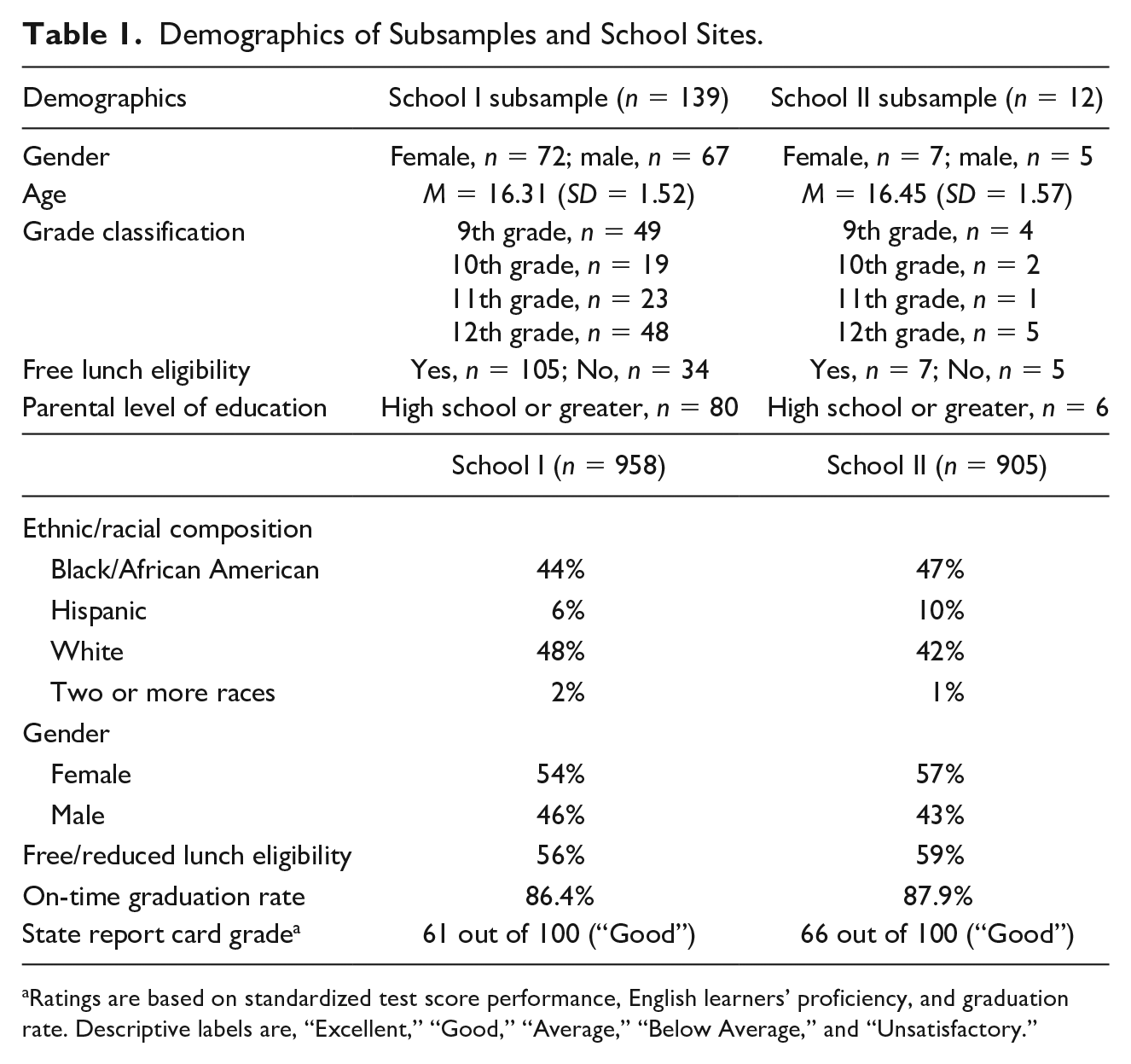
Ratings are based on standardized test score performance, English learners’ proficiency, and graduation rate. Descriptive labels are, “Excellent,” “Good,” “Average,” “Below Average,” and “Unsatisfactory.”
Procedure
The participants for the study were recruited with the assistance of the schools’ data manager and school counselor. The research team met with potential participants who met the primary inclusion criteria (i.e., students who self-identified as Black/African American) to provide an overview of the study and purpose. In School 1, 422 students met the inclusion criteria and in School 2, 425 students met the inclusion criteria. Consent forms to obtain parental permission were distributed, along with a short demographic survey. The research team requested that consent forms and the demographic survey be returned to the school within 1 week of the initial recruitment meeting. The response rate was 35% at School 1 and 36% at School 2. Most (i.e., 93%) returned consent forms provided parental permission for students to participate in the study. Although the number of returned consent forms was proportionately low, we found that our response rate is commensurate with what has been documented in previous research with similar samples (e.g., Cooper, 2009). Eligible participants provided assent and completed paper and pencil surveys in groups of 12 approximately 1 month after consent forms were returned; surveys took between 20 and 30 min to complete and were completed at school. All participants received a US$10 gift card for completing surveys. The study received University IRB (Institutional Review Board) approval (#00000204) and adheres to ethical principles in obtaining participants’ and parental consent.
Measures
Equity-elaborated self-management
Items adapted from the Brief COPE Scale (Carver, 1997) assessed how participants self-manage coping with stress as a result of racial discrimination experiences at school. The Brief COPE is a self-report measure assessing 14 theoretically identified situational coping responses. Knoll et al. (2005) conducted confirmatory factor analysis to support four higher order factors: (a) Focus on Positive (acceptance, positive reframing, humor), (b) Support Coping (use of instrumental support, use of emotional support), (c) Evasive Coping (self-blame, denial, and venting), and (d) Active Coping (active coping and planning). As adapted from Brown and colleagues (2011), participants were told, “Think of how you deal with stress brought on by racial discrimination and racism experienced at school. Use the scale below to indicate what you usually do when you experience this type of racial stress at school.” Participants rated their endorsement of each item on a 4-point Likert-type-scale, ranging from 1 (I usually don’t do this at all) to 4 (I usually do this a lot). In the current study, youth reported their use of Active Coping (“I try to come up with a strategy about what to do”; Cronbach’s α = .79; M = 3.15, SD = 0.63) and Support Coping (“I try to get advice or help from other people about what to do”; Cronbach’s α =.83; M = 2.88, SD = 0.76). Higher mean scores indicated more frequent use of a coping skill.
Equity-elaborated self-awareness
To assess self-awareness, participants completed the Multidimensional Inventory of Black Identity–Teen (MIBI-T; Scottham et al., 2008). Focus groups were used in the initial development of the MIBI-T, and confirmatory factor analysis supports the measure’s construct validity and the measure demonstrates model invariance across grade level and gender, and predictive validity (Scottham et al., 2008). Prior research among Black/African American adolescents has demonstrated Cronbach’s alpha ranging from .62 to .76 in research using items from the MIBI-T, and the measure has been used successfully in research with Black/African American adolescents (e.g., Stevenson & Arrington, 2009). Scales included items related to participants’ racial centrality and private regard, and possible responses ranged from 1 (strongly disagree) to 5 (strongly agree). Items on the Racial Centrality subscale included statements like “I feel close to other Black people” and report a Cronbach’s α = .73 (M = 3.35, SD = 0.93). Items on the Private Regard subscale included statements like “I feel good about Black people” and report a Cronbach’s α = .73 (M = 4.04, SD = 0.89). Higher mean scores indicated more positive perceptions of racial identity.
School adjustment
Our study used well-established items by Wang and colleagues (2011) to assess three empirically validated school adjustment outcomes. Previous studies established internal consistency, convergent and divergent validity, and invariance across gender, race/ethnicity, and socioeconomic status (SES) for the adapted scale items (Wang et al., 2011; Wang & Holcombe, 2010). Prior research studies using these scales among Black/African American adolescents indicated Cronbach’s α ranging from .72 to .75 (Wang et al., 2011; Wang & Fredricks, 2014; Wang & Holcombe, 2010). All the items were coded such that higher ratings indicated greater academic adjustment.
School belonging
The degree to which students felt part of their school was assessed with three items (α =.73). A sample item includes the following: “In general, I feel like a real part of this school.” Responses were rated on a scale from 1 (strongly disagree) to 5 (strongly agree), and the mean for this sample was 3.30 (SD = 0.84).
School valuing
The degree to which students felt it was important to go to school was measured with five items (α =.74; 1 = strongly disagree to 5 = strongly agree; M = 4.06, SD = 0.71), and an example item is as follows: “I value what I am learning in school.”
Cognitive strategy use
Four questions measured youth’s desires to master academic material (α =.71; 1 = almost never to 5 = almost always; M = 3.35, SD = 0.92). A sample question includes the following: “How often do you try to relate what you are studying to other things you know about?”
Demographic controls
To address potentially confounding factors in the study, we collected data regarding participants’ age, gender, SES, and grade point average (GPA). All students self-reported their age. Participants self-reported gender as a binary variable: 0 = female and 1 = male. As a measure of SES, parent-reported eligibility for free/reduced school lunch was coded as follows: 0 = eligible and 1 = ineligible for free school lunch. GPA was collected from school records and used performance in core academic courses: English, math, science, and social studies. Scores ranged from 0.0 to 4.0, and letter equivalents were 0.0–0.9 = F (n = 7), 1.0–1.6 = D (n = 16), 1.7–2.6 = C (n = 76), 2.7–3.3 = B (n = 39), and 3.4–4.0 =A (n =13), and the mean of scores was 2.32 (SD = 0.75). Participants’ gender, free lunch eligibility (as a proxy of SES), and GPA functioned as control variables in all models to identify the unique effects of coping and racial identity on participants’ school adjustment.
Analytic Strategy
Hierarchical regression analyses were used to examine how coping responses and racial identity were related to youth’s school adjustment. We ran one model for each school adjustment outcome: school belonging, school valuing, and cognitive strategy use. To reduce multicollinearity between interaction terms and related variables, all continuous variables were standardized, and interaction terms were created from standardized variables (Iacobucci et al., 2016). For Step 1, demographic control variables (i.e., gender, age, free/reduced lunch status, and GPA) were entered in the model. At Step 2, focal variables of interest including situational coping responses (i.e., active coping and support coping) and potential moderators (i.e., racial centrality and private regard) were entered. Two-way interactions between coping responses and racial identity were entered at the third and final step. To interpret significant interactions, we assessed the statistical significance of simple slopes at one standard deviation above the mean and one standard deviation below the mean of the moderator variables. A priori power analyses conducted in G*Power (Faul et al., 2013), with an alpha of .05 and a power of .80, indicated that the sample size of the present investigation was adequate to detect moderate (f2 ≥ 0.15) to large (f2 ≥ 0.35) effect sizes according to Cohen’s (1988) guidelines.
In addition to running the aforementioned analyses, we checked regression assumptions. No regression assumptions were violated. We explored for potential outliers and no data points warranted exclusion from substantive analyses. Missing data ranged from 1% to 3%, and analysis revealed no systematic relationship between missing and nonmissing values among study variables.
Results
Correlation analyses revealed associations between equity-elaborated SEL and school adjustment measures. More frequent use of active coping strategies was associated with more frequent use of support coping strategies (r = .44, p = .003) and cognitive strategy use (r = .39, p < .001). Use of support coping strategies was positively associated with racial centrality (r = .22, p = .008). Racial centrality and private regard were intercorrelated (r = .65, p < .001). Furthermore, racial centrality was positively associated with school belonging (r = .36, p < .001) and school valuing (r = .17, p = .041), and private regard was also positively associated with school belonging (r = .38, p < .001) and school valuing (r = .17, p = .034). Analyses also revealed that positive relationships among outcome variables were statistically significant. However, there was no significant association found between youth’s sense of school belonging in school and their cognitive strategy use (r = .02, p = .859). We wish to remind the reader that all continuous variables were standardized. Thus, for each continuous variable in our model, the unstandardized regression coefficient represents the change in units of the dependent variable per every one standard deviation increase in the independent variable.
School Belonging
Table 2 displays unstandardized regression coefficients estimating school adjustment outcomes. For the model estimating school belonging, the demographic variables entered at Step 1 did not explain significant variance in the outcome variable (R2 = .04, p = .20). In Step 2, we added coping and racial identity variables into the model, and these predictors significantly explained an additional 16% of the variance in school belonging (R2 = .196, p < .001; ΔR2 = .156, p < .001). Higher private regard was significantly associated with higher school belonging, b = 0.21, t(142) = 2.46, p = .015. No significant variance was explained by the Coping × Racial Identity interactions entered in Step 3 (R2 = .245, p < .001; ΔR2 = .049, p = .069).
Unstandardized Regression Coefficients Estimating School Belonging, School Valuing, and Cognitive Strategy Use.

Note. Significant coefficients are boldfaced. All continuous variables are standardized. Gender was coded as female = 0, male = 1. Lunch price was coded as 0 = free/reduced lunch, 1 = full-priced lunch. GPA = grade point average.
p < .05. ***p < .001.
School Valuing
The demographic variables entered at Step 1 explained approximately 1% of the variance in school valuing (R2 = .011, p = .81). At Step 2, an additional 5% of variance in school valuing was explained by the coping strategy and racial identity predictors (R2 = .064, p = .30; ΔR2 = .053, p = .10). As a set, the variables entered in Steps 1 and 2 did not significantly explain variance in school valuing. Compared with the prior model, the interaction terms entered at Step 3 were associated with a statistically significant increase of about 9% of the total variance in school valuing (R2 = .152, p = .024; ΔR2 = .088, p = .008). This final model revealed a significant interaction between active coping and racial centrality, b = −0.17, t(138) = −2.42, p = .017. As shown in Figure 1, for Black high school students with lower racial centrality, more active coping was related to more school valuing, b = 0.22, t(138) = 2.58, p = .011. However, for Black high school students with higher racial centrality, more active coping was unrelated to school valuing, b = −0.11, t(138) = −1.18, p = .238.
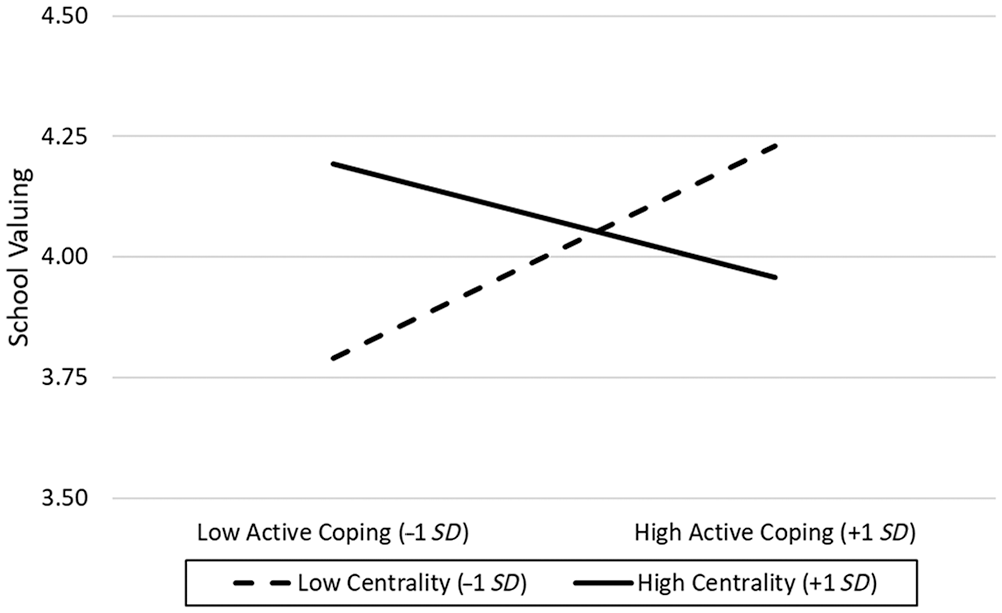
School valuing as a function of racial centrality and active coping.
Cognitive Strategy Use
The demographic variables entered at Step 1 did not explain significant variance in the cognitive strategy use (R2 = .02, p = .48). The coping and racial identity variables entered at Step 2 significantly explained 15% of additional variance in cognitive strategy use (R2 = .174, p < .001; ΔR2 = .15, p < .001). Specifically, greater active coping was significantly associated with greater cognitive strategy use, b = 0.34, t(142) = 4.62, p < .001. Compared with the prior model, the interaction terms entered at Step 3 were associated with a statistically significant increase of about 8% in the total variance explained in cognitive strategy use (R2 = .254, p < .001; ΔR2 = .081, p = .006). This final model revealed a significant interaction between active coping and racial centrality, b = −0.19, t(138) = −2.22, p = .028. As shown in Figure 2, for Black high school students with lower racial centrality, more use of active coping strategies was related to more cognitive strategy use, b = 0.55, t(138) = 4.95, p < .001. For Black high school students with higher racial centrality, more use of active coping strategies was unrelated to cognitive strategy use, b = 0.14, t(138) = 1.15, p = .254.

Cognitive strategy use as a function of racial centrality and active coping.
Discussion
This study applied an equity-elaborated framework to examine the role of SEL in Black students’ academic adjustment, particularly within the context of urban education. Black urban-dwelling youth are burdened by historical and contemporary racism that present a unique context for learning as a result of issues such as gentrification and urban decay. Racism experienced in the larger community also spills over to permeate urban education spaces and can impede Black youth’s academic success (Diamond & Lewis, 2019; Grant et al., 2014; Young, 2011). For instance, urban-dwelling Black youth contend with a predominantly White and female teacher workforce and therefore face racism via multiple pathways as a result of deficit perspectives about their academic ability and disproportionality in disciplinary experiences and outcomes (James, 2012; Pringle et al., 2010; Tenenbaum & Ruck, 2007). As such, Black students attending urban schools are in need of SEL support that intentionally considers the racial stress they encounter in schools. Indeed, there is growing evidence to support the positive impacts of SEL on school outcomes (Jones & Kahn, 2017) as well as the need to transition to equity-elaborated SEL approaches that consider social justice, culture, power, and privilege (e.g., see Jagers, 2016; Jagers et al., 2019). In this study, we used existing concepts (coping with race-related stress, racial identity) to reimagine SEL competencies with a racialized and equity-elaborated lens that reflects normative development for Black adolescents.
We operationalized self-management skills to capture how Black students manage coping with race-related stress. Our findings indicate that active coping (e.g., planning a student walkout in response to a teacher using an anti-Black slur in the classroom) was related to cognitive strategy use (e.g., relating study material to prior knowledge). In other words, when Black students engaged in planned action to actively address the race-related stressor, they also reported more mastering of academic material. In contrast, seeking help with addressing race-related stressors (e.g., talking to a school counselor about emerging feelings resulting from a teacher using an anti-Black slur in the classroom) was not associated with academic adjustment. This was surprising given previous research suggesting Black youth rely on social support to help manage negative race-related experiences at school (Butler-Barnes et al., 2016; Henderson et al., 2018) and additional evidence linking this coping strategy to academic adjustment (Skinner et al., 2013).
One interpretation of these findings is that self-management strategies involving planned action to address the source of race-related stress may be related to academic adjustment while strategies that engage help from adults or peers may not. This interpretation is consistent with previous research that finds Black students are concerned about retribution from teachers and administrators for seeking help to address racial discrimination in schools (Hope et al., 2015). This fear of retribution may be particularly evident in urban schools where there often exists a “cultural conflict” (Milner, 2010), between students of color from mostly low-income households and their teachers who are predominantly White and middle class, resulting in potentially strained relationships. Furthermore, scholars have found that when racially marginalized students in urban secondary schools are able to develop a greater awareness of racism, they are more likely to have higher GPAs over time (Seider et al., 2019). Therefore, in the urban context, self-management strategies to cope with race-related stressors may contribute to a young person’s academic adjustment as a result of developed resilience cultivated by their overexposure to racism in the broader community. Altogether, this suggests that it is possible for urban schools and teachers to undermine help-seeking coping strategies, and also possible for members of the schooling system to support active coping strategies to understand and combat race-related stress. For urban educators, this might include facilitating Black students’ intelligence and skills to actively resist racism in school and considering the knowledge these students may bring about resisting their race-related oppression outside of school. Doing so requires that urban educators properly recognize Black students’ actions and rhetoric in classroom settings as valuable cultural capital critical to SEL skill development (Goldenberg, 2014).
Our measure of equity-elaborated SEL self-awareness was racial identity—specifically racial centrality and private regard. Here, we found partial support for our hypothesis that greater racial identity would be related to more positive school adjustment for Black high school students. As expected and consistent with prior research (e.g., Dotterer et al., 2009), a more positive sense of self in connection with Blackness (i.e., private regard) was related to more positive adjustment in school. Contrary to our expectations, racial centrality, or how important race is to one’s sense of self, was not directly related to any of our school adjustment outcomes. This may be, in part, due to how racial identity may develop and function differently for students in varied school contexts. The person-context congruence perspective (Byrd & Chavous, 2012) suggests that racial identity promotes school adjustment in environments that promote alignment between students’ positive feelings about being Black and what being Black means in that specific school context. In our study, Black students were in schools with a sizable Black student population and also a sizable population of White students and teachers. Previous research finds that in predominantly White schools, racial centrality is not related to academic persistence for Black students (Leath et al., 2019). Thus, it is possible that racialized self-awareness is not related to school adjustment for all Black students given the racial contexts of their school. Not all urban schools are poor or predominantly Black and Brown. There are a growing number of racially diverse urban schools as middle-class, professional, and White families in gentrifying cities increasingly choose neighborhood public schools (Freidus, 2019). Our findings suggest that for Black youth in racially mixed or predominantly White urban schools, there is an even greater necessity for affinity spaces that celebrate and affirm Blackness and help youth heal from the racial assaults they may be experiencing in this context. Overall, this unexpected finding suggests the necessity that discourse on SEL in urban education not leave these schooling contexts (i.e., racially mixed or predominantly White) out of the conversation.
Last, our findings partially supported hypotheses regarding potential interaction effects between self-management and self-awareness for Black youth but not in the direction we expected. We found that the relationship between active coping and school adjustment varied by racial centrality. Specifically, while greater use of active coping strategies was related to greater school valuing for youth with low racial centrality, there was no relationship among these variables for youth with high racial centrality. There was a similar pattern for cognitive strategy use such that for Black students with low racial centrality, more active coping was related to more cognitive strategy use and for Black students with high racial centrality, there was no relationship between these variables. Considering these findings, one might imagine that for a Black student feeling less connected to the Black community, leading an awareness campaign at school with the intent to draw attention to the lack of representation in the curriculum (i.e., active coping) may be a helpful way to self-manage racial stress and ultimately relate to more positive school adjustment. Continuing with this example, our findings suggest that planning such a campaign in response to race-related stress may not result in increased academic adjustment for a Black student who centers their self-concept on their Blackness. Altogether, these findings align with previous work that suggests that the relationships between students’ interpretations of race-related experiences and school adjustment are not always straightforward for Black youth (Wong et al., 2003; Worrell, 2007). This can be explained in part by the idea that race-related experiences are bound to produce varied school adjustment outcomes among Black youth who vary in the importance and meaning they place on being categorized as Black (Byrd & Chavous, 2011). For Black youth whose race is not as central to their self-concept, using planned action in the face of race-related stress (e.g., starting a Black Student Union organization at their high school to promote a more positive racial climate) may be particularly important for building academic resilience in urban contexts, which are pervaded with these distinct, noxious stressors that might otherwise undermine their academic adjustment (Bryan et al., 2018). In contrast, Black youth who have a significant connection to their Blackness may be more aware and attuned to racial-related stressors in school and the broader urban context (Sellers & Shelton, 2003), and may already have high academic adjustment outcomes (Leath et al., 2019). Therefore, more use of active coping strategies, specifically, may not have an association with greater academic adjustment for these youth. Overall, our data suggest that, in the face of race-related stress, racial identity, as an additional competency within self-awareness, might interact with self-management coping strategies and in turn relate to school valuing and cognitive strategy use.
Limitations
The current study should be seen as a springboard for more in-depth investigations of race-focused interpretations of SEL competencies and relations to school adjustment. Although we used established measures of school adjustment, it is possible that more culturally sensitive measures of school adjustment (e.g., opportunities to belong; Gray et al., 2018), and a broader range of school adjustment outcomes, could make it possible to detect other race-based factors that influence school adjustment. Also, instead of using a precise measure of youth’s personal experiences with racial discrimination, we assessed student stress as perceived to be a result of discriminatory and racist experiences. Therefore, we are constrained in our interpretation of findings because we did not use a measure specifically designed to assess for racial stress. Although our primary focus was to examine Black youth’s use of coping strategies when faced with racism at school as a foundational skill within self-management, future research should specifically assess for frequency of racial discrimination experiences and resulting racial stress and include a school-level fixed effect to account for between-school differences in discrimination prevalence. We also suggest using qualitative and mixed-method approaches to probe students’ thinking about the connection between racial discrimination, stress, and coping, as a form of self-management and longitudinal designs to examine how associations may develop over time. Finally, the concern about threat to validity due to low response rate is important and should be addressed in future studies. Although prospective participants expressed interest in study participation to the research team, students often forgot or simply failed to return their completed consent form from home which contributed to the observed rate of return. Researchers should identify strategies for getting consent forms signed by parents without students having to take them home (e.g., handing out information at Parent–Teacher Conferences or school events where parents are in attendance).
Conclusion and Implications for Educators in Urban Contexts
Undoubtedly, more research situating SEL competencies within a sociopolitical, racialized context experienced by urban-dwelling Black youth is needed. Nonetheless, results of this study have important implications and considerations for educators who work with Black youth in urban contexts. Our findings indicate that racialized self-awareness supports feelings of belonging in schools for Black students. While schools might not be the primary socialization setting for racial identity development (Hughes et al., 2006), educators must avoid a color-blind approach to SEL and consider how being Black is an important part of the self that supports school adjustment and academic success (Aldana & Byrd, 2015; Guy, 2014; Lewis et al., 2008; Shevalier & McKenzie, 2012).
From this research, we also find support for self-management to be considered from an equity-elaborated lens. As Black urban-dwelling students experience race-related stress in their schools and larger communities (Hope et al., 2015; Seaton et al., 2008), they also develop strategies to mitigate the negative effects of those experiences (Gaylord-Harden et al., 2012). From our data, we see that when Black high school students cope with race-related stress by developing strategies to address it, they also master more academic material. For urban educators, this suggests that we must first understand Black students’ unique school experiences amid the presence of anti-Black racism in school (Coles, 2020). This includes educators examining their own racial identity and taking into account the sociohistorical contexts that shape the relationships, schools and communities that these Black students navigate (Jagers et al., 2019). Second, urban educators should consider how their own instructional practices and institutional policies teach and encourage students to engage in active coping strategies against racism and racial discrimination (Gray et al., 2018). When Black students experience race-related stress, their attempts to address the roots of such issues must be supported by teachers and administrators in positions of power. Our data suggest that this will support their academic development, and other scholars find that support from teachers and administrators will also support mental health and civic development (Aldana & Byrd, 2015; Bañales et al., 2019). Ultimately, our study advances the burgeoning literature (e.g., Gregory & Fergus, 2017; Jagers, 2016; Jagers et al., 2019) on an equity-elaborated conceptualization of SEL as a meaningful strategy to help promote positive academic outcomes for Black students despite the deleterious effects of racism and racial discrimination in urban schools.
Footnotes
Acknowledgements
We would like to express our gratitude to the adolescents who participated in this study.
Authors’ Note
Dawn X. Henderson is now affiliated with Center for Truth, Racial Healing & Transformation, Duke University, Durham, USA. Views expressed in this article do not necessarily reflect those of the funding agencies acknowledged.
Declaration of Conflicting Interests
The author(s) declared no potential conflicts of interest with respect to the research, authorship, and/or publication of this article.
Funding
The author(s) disclosed receipt of the following financial support for the research, authorship, and/or publication of this article: This work was supported by the National Association of School Psychologists (NASP) Graduate Student Research Grant and the University of South Carolina Support to Promote Advancement of Research and Creativity (SPARC) research grant, both awarded to the first author.
