



Abstract
This article examines how three Black women educators disrupt oppressive norms in urban schooling through their applications of critical race womanist pedagogy (CRWP). Using narrative excerpts formed from semi-structured interviews exploring how they contend with sociopolitical injustices through their pedagogical choices and actions, CRWP characterizes their daily classroom practices in four ways: (1) teacher reflexivity and student-centered curriculum, (2) authentic and reality-based curriculum, (3) culturally and politically relevant pedagogy, and (4) self-actualization and capacity-oriented approaches. Concretizing enactments of CRWP can inform the work of teachers, teacher educators, and administrators committed to prioritizing student-centered, politicized, academically responsive, and asset-based urban education.
While many Black women educators have sustained commitments to teaching and fighting for liberatory education, the recurring uprisings have expanded the movement of Black, Indigenous, People of Color (and white co-conspirators) who are taking to the streets, protesting, and demanding Black liberation and an end to state-sanctioned violence. A demand for more pervasive anti-racist resources and structural, curricular and pedagogical transformation across schools is no exception. Unfortunately, many urban schools in the U.S. continue to uphold white supremacy, obscure the voices and experiences of Black and Brown students, and remain under-resourced and ill-equipped to meet the needs of students of color and students from economically dispossessed backgrounds (Moore & Lewis, 2012). Given the pervasiveness of this legacy, growing vigilance for learning, healing, and embodying anti-racist and liberatory teaching needs to continue long beyond attempted returns to “normalcy.”
We cannot continue to maintain urban schools built on a system that excludes and sorts students (Kliebard, 2004; Oakes, 2005) based on perceived deficit notions of their cultures and abilities (Ladson-Billings, 2006) and strives to assimilate them into dominant norms (Bartlett & García, 2011; Valenzuela, 1999). We cannot stand by while Black and Latinx students face dehumanizing curriculum and spirit murdering (Love, 2013, 2016) in our classrooms. We must heed the reports of many Black and Latinx young people who express that they experience less favorable racial schooling climates, feelings of safety, connectedness, or opportunities for engagement (Voigt et al., 2015). Schools are often silencing, alienating (DeCuir & Dixson, 2004), and unresponsive to their cultural practices and academic interests (Carter, 2005). Black students, in particular, often contend with “the denial of inclusion, protection, safety, nurturance, and acceptance because of fixed, yet fluid and moldable, structures of racism” (Love, 2013, 2016, p. 2). For this reason, we turn to the experiences of three Black women New York City educators who build on legacies of womanist and anti-racist teaching in order to attend to the material realities of the predominantly low-income and racially marginalized student populations they serve.
Many Black women teachers facilitate positive schooling experiences and academic outcomes for Black and Brown students (Carver-Thomas & Darling-Hammond, 2017). At the same time, Black women’s instructional practices are not homogenous (Watson, 2017; Gist et al., 2018) and the responsibility of creating humanizing learning experiences must be a shared one. Unfortunately, Black women educators remain an underrepresented minority within the educator workforce, accounting for only 5% of the U.S. teacher population compared to the 80% of America’s teachers who are white (U.S. Department of Education, 2016). Further, Black women teachers have notably higher turnover rates than their white and male counterparts (Carver-Thomas & Darling-Hammond, 2017). This is especially concerning given research indicating that many white and middle-class teachers, due to their inexperience with cultural competence or institutional analyses, low expectations, and racial biases—often inefficiently cultivated in teacher preparation programs—are not prepared to teach in urban public schools attended by low-income and racially marginalized students (Brown & Rodriguez, 2017; Howard & Milner, 2014). The legacy of Black women teachers captures their commitments to grounding their teaching in sociopolitical and cultural understandings (Watson, 2017), and speaks to the ways that they embody their roles as classroom crusaders, displaying “activism as praxis” (Gist et al., 2018) and carrying out their womanist traditions (Beauboeuf-Lafontant, 2002). Accordingly, we need more educational research that centers their impact and the critical roles they occupy in the lives of students of color (Dingus, 2006; Dixson, 2003). Thus, as Black women scholars ourselves, we explored how Black women educators use knowledge of their students and the sociopolitical and racialized urban schooling context to inform their curricular and pedagogical choices and actions.
Review of Womanist Pedagogies
Over the last few decades, a small, but growing number of scholars have examined how Black women teachers enact womanist traditions and pedagogies in and through their behavioral, curricular, and pedagogical decisions and practices. As a derivative of Alice Walker’s (1983) term “womanist,” womanism is a theoretical and epistemological stance that centers the experiences of Black women within the context of the United States’ history of enslavement and multiple forms of oppression as its own standpoint, rather than as a variation of Black male or white female experiences (Beauboeuf-Lafontant, 2002, 2005; Collins, 2000). Womanists maintain a commitment to “the enfranchisement and dignity of all human beings across the social divisions of race, gender, class, and sexuality” (Beauboeuf-Lafontant, 2005, p. 438), thus making them committed social justice educators (Beauboeuf-Lafontant, 2002, 2005).
Because very little attention is typically given to Black women’s contributions to education (Giles, 2006), it is critical to put their legacies into perspective. Dating back before the establishment of formal public schooling, Black women teachers “stood in the gap and created alternative pathways to sustain hope for the next generation [while advocating for] policies and practices that could restructure liberatory educational possibilities for Black youth” (Gist et al., 2018, p. 57). As early as the nineteenth century, education was widely viewed as a tool for advancement and acceptance, but particularly for the Black community, it meant opportunity for uplift and improvement (Baker-Fletcher, 1992–1993; Collins, 2000). Nineteenth and twentieth century educators like Dr. Anna Julia Cooper, Kathleen Crosby, and Bertha Maxwell-Roddey took on womanist pedagogies in their roles in classrooms, schools, and communities by placing their students’ well-beings at the center of their educational philosophies—embodying a nurturing, but forceful energy (Ramsey, 2012) and “shapeshifting” to occupy various change-agent roles (Giles, 2006).
While several scholars have discussed womanism in relation to community empowerment, Beauboeuf-Lafontant (2002, 2005) specifically examines how womanism is enacted in classrooms. She discusses three main characteristics that ground Black women’s pedagogy—maternal sensibility, political clarity, and an ethic of risk (Beauboeuf-Lafontant, 2002). A maternal sensibility prioritizes building significant relationships with students while holding them accountable—an act of care that is both personal and political and employed through concrete action as a means of removing barriers that hinder students’ access to a range of opportunities (Beauboeuf-Lafontant, 2005). As her study suggests, this requires womanist educators to constantly remain open to their own growth, development, and possibility as teachers, as well as those of their students (Beauboeuf-Lafontant, 2005). Womanist teachers strive to be politically clear by arming their students with the knowledge and strategies needed to survive in a racist U.S. society (Thompson, 1998). Drawing from Welch’s (1990) feminist ethic of risk, Beauboeuf-Lafontant argues that womanist teachers fight for the common good, establish a sense of community, and set the tone of collective work and responsibility in their classroom routines and modeled behavior.
More recently, through the examinations of Black students’ memories of their experiences with womanist teachers, Patterson et al. (2011) concluded that despite their school’s lack of equitable resources, the students in their study still developed personal and academic skills and confidence to compete with their white peers and succeed. As white researchers, they challenged the effectiveness of public schools, multicultural education courses, cultural proficiency initiatives, and teacher preparation programs for their lack of addressing how racism impacts students of color (Patterson et al., 2011). Their findings drew on student accounts to provide further context for how womanist pedagogy gets embodied in classroom practices to empower racially and economically marginalized youth.
Indicative of womanist educators’ practices, research shows that as advocates, Black women teachers often fight for marginalized students in urban schools, which are commonly hostile sites enacting racist policies and practices toward students, their families, and their communities (Dixson, 2003). By challenging their colleagues, developing meaningful and responsive curricula (Dixon, 2003), attending to the urban sociopolitical context (Watson, 2017), and accessing a critical consciousness to inform their teaching (Gist et al., 2018), womanist teachers perform anti-oppressive, culturally uplifting work in classrooms on a daily basis (Gist et al., 2018). Womanists often take students under their wings, evoking politicized care (Watson, 2019) and creating safe spaces and acting as surrogate parents to them (Dixson, 2003; Dixson & Dingus, 2008). As “other mothers,” counselors, benefactors, encouragers, race cheerleaders (Siddle Walker & Tompkins, 2004), and beyond, the roles that womanist teachers have maintained over time in schools and in the education system requires ongoing documentation and analysis to inform practice and social change. It is this understanding of womanist teachers that allows us to push the dial forward and contribute to the growing body of literature as we capture how Black women educators continue to lead and center students’ needs within an ever-shifting urban sociopolitical context. Thus, this study explores three Black women educators’ conceptualizations of their purposes as teachers in relation to their students’ positionalities and the sociopolitical context and how this informs and shapes their embodiments of critical race womanist pedagogy.
Conceptual Framework: Critical Race Womanist Pedagogy
Critical race womanist pedagogy (CRWP) draws on concepts from critical race theory, feminism and pedagogy in order to synthesize curricular and pedagogical approaches that are deeply rooted in a womanist tradition. While the aforementioned frameworks offer analytical concepts to help us understand how white supremacy and other forms of dominance intersect to shape educational oppression as well as ways to disrupt these norms, they remain abstract in their material application to classroom life. Concepts from critical race theory offer a lens for examining the racialized material realities participants and their students are navigating. Critical race feminism upholds the nuances and validity of the perspectives and stances maintained by Black women participants in this study given their standpoints and priorities as educators. Critical race pedagogy moves us closer to exploring how such epistemologies and ideologies are acted upon in practice. We synthesize these concepts to capture the theoretical underpinnings rooted in a womanist epistemology, anti-racist curricular and structural critiques, and embodied nature of critical race womanist pedagogy.
Critical Race Theory
While critical race theory (CRT) maintains roots in critical legal studies, educational scholars and practitioners uphold its interdisciplinary nature and historical and structural racial analysis (Delgado Bernal, 2002; Ladson-Billings & Tate, 1995; Wing 2000). CRT scholars contend that colorblindness and neutrality ignore multiple forms of oppression and the material realities of racially marginalized groups (Bonilla-Silva, 2010; DeCuir & Dixson, 2004; Ladson-Billings & Tate, 1995). They critique whiteness as property or the right to exclude, define, and normalize (Harris, 1993; Ladson-Billings & Tate, 1995). Their critique of liberalism questions complacency and piecemeal reforms that maintain the status quo. Aligned with their critique of colorblindness and liberalism, they also problematize the myth of meritocracy that ignores settler colonialism and relies on schooling to facilitate oversimplified promises of social uplift (Patel, 2016). Critical race theory’s critique of whiteness as property and liberalism help to uncover how participants in this study challenge the neutrality and normalization of standards and dominant curriculum. Critiques of meritocracy help to illuminate how participants enact capacity-oriented approaches in ways that honor the interests and skills of their students while removing blame from them for their failure.
Critical Race Feminism
Critical race feminism draws from women of color standpoints in order to examine the nuances of how race, gender, and the multiplicity of identity intersect to shape internalized, interpersonal, and institutional oppression (Berry, 2010). Said differently, such a framework recognizes that “Black women are not white women plus color, or Black men plus gender” (Wing, 2000, p. 7). Black women’s racialized, gendered, and otherwise intersectional identities contribute to their experiences and philosophies of and approaches to curriculum and pedagogy. We therefore draw on critical race feminism as a way to uphold the ideologies, experiences, and approaches of Black women as valid and essential in understanding the sociopolitical and cultural contexts of schools and society.
Critical Race Pedagogy
We draw on critical race pedagogy as a framework that begins to help educators apply their analyses of constructions of dominance, a critique of self, and a commitment to counter-hegemonic work (Lynn et al., 2013) to teaching and learning. Examinations of dominance require considering the intersections of how race, gender, and class are negotiated in schools in ways that marginalize students of color (Delpit, 2006). Educators engage in critical reflexivity requiring them to unpack their positionalities within the context of an unjust society while also creating counternarratives that challenge multiple forms of dominance (Jennings & Lynn, 2005). We build on this work and begin to explore how teacher reflexivity influences teachers’ student-centered curricular and pedagogical decision-making.
Counter-hegemonic education emphasizes a belief that transformation at the school level is necessary in order to achieve justice within society (Jennings & Lynn, 2005). Such liberatory education “affirms healthy self-esteem in students and promotes their capacity to be aware and live consciously. It teaches them to reflect and act in ways that further self-actualization, rather than conformity to the status quo” (Hooks, 2003, p. 72). We use this lens to concretize the strategies used by participants to promote self-actualization in ways that are counter-hegemonic. Moving from theory to practice, problem-posing education, an inquiry-based pedagogical approach that centers marginalized experiences and knowledge (Freire, 2000; Lac, 2017) remains one concrete conduit for creating counter-hegemonic change. We look specifically at how Black women teachers actualize problem-posing education in ways that attend to the racialized material realities of students.
Research Design
This study was part of a larger case study examining the barriers early career special education teachers faced and their efforts to enact social justice approaches to building classroom community, curriculum and pedagogy. Data sources included semi-structured interviews, field notes from class discussions, and selected course assignments. In this article, we focus on semi-structured interview data with three Black women participants to specifically understand commonalities in how they describe their curricular and pedagogical choices as rooted in their respective sociopolitical contexts (the what) and their enactments of their stance (the how). We asked three main questions: (1) How do Black women educators describe their curricular and pedagogical approaches given the sociopolitical context where they teach? (2) What curricular and pedagogical choices do they make given their understandings of the sociopolitical and racialized context where they teach? (3) In what ways are they responsive to and centering students’ strengths, needs, and interests?
Context of the Study
Black women in this study first connected with each other and the first author in 2014 as full-time special education teachers and credential candidates in an urban teacher preparation program located within the largest school district in the United States. The program allowed candidates to earn their credential and Masters in Adolescence Inclusive Education in two years while teaching full-time. One component of their outlined mission is to provide pragmatic learning opportunities that attend to the racial, cultural, and socioeconomic context of teaching. Within a two-year span, participants in this study took three courses with the first author focused on curricular design and pedagogy, differentiation, and classroom community. Throughout several semesters of coursework, we grappled with their barriers to and dreams of building transformative classroom communities and culturally relevant curriculum when working with hesitant colleagues and/or in accountability-driven schools.
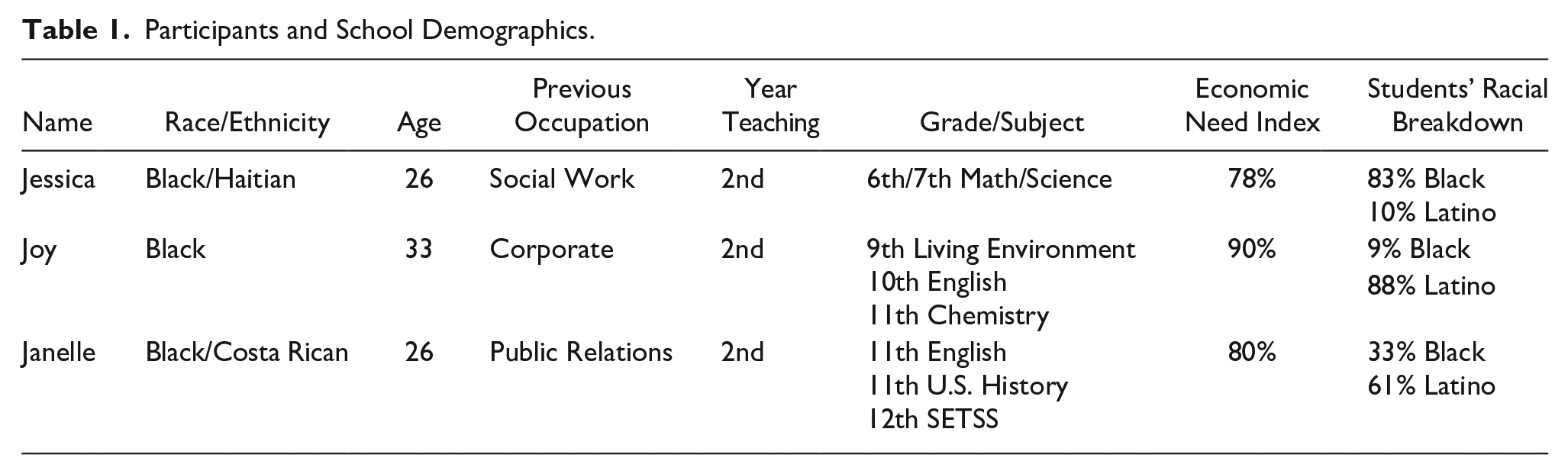
This study commenced spring 2015 at the height of uprisings resulting from the police killings of Eric Garner in New York City and Freddie Gray in Baltimore. Participants and their colleagues were contending with how to remain responsive to the humanity of their students during this time. During class, many teachers discussed their participation in and support of student walkouts and protests at their schools. One participant actively incorporated relevant themes in her curriculum, which is further discussed in the findings. All three participants taught at Title 1 public schools with over 75% of their students classified as in economic need based on their eligibility for free lunch, public assistance or residence in temporary housing. At each of their schools 90 to 100% of students were Black and/or Latinx. (See Table 1 for further details). Within the context of these demographics, participants positioned themselves as advocates for Black and Latinx students who were often underperforming, marginalized in their school settings and navigating social injustices.
Participants and School Demographics.
Participant Selection
Author one used a criterion-based comprehensive approach (LeCompte et al., 1993) to select participants who identified as early career Black women urban educators. She selected the three participants for this study out of the larger group of 11 based on the nuanced ways they referenced their Black racialized and gendered backgrounds as informing their curricular and pedagogical choices. All three self-identified as Black. Joy did not identify an ethnicity, but often spoke about being Black and centering blackness in her teaching and purposes as an educator. Jessica explicitly stated that she identified as Black and ethnically Haitian, but not African-American. She expressed that she “loved” that the students and staff at her school were predominantly Black. Janelle discussed the importance of her students witnessing her identifying as Black and Latina, given that many of her Latinx students were disconnected from their African heritage. Joy described a similar sentiment. Participants were born and raised during the Reagan, Bush, and Clinton eras, which is sometimes characterized by a move away from investing in social services like education and a turn toward neoliberal policies that center individualism and meritocracy (Meeropol, 2001). They recognized how their varying class backgrounds positioned them in relation to students and ways they may or may not reinforce notions of meritocracy in their beliefs about their students’ life and career opportunities. Understanding participants’ intersectional identities informed analysis of commonalities as well as some of the nuances across their critical race womanist approaches.
Data Collection and Analysis
Author one conducted semi-structured interviews with each participant during spring 2015. Each interview ranged from 90 to 120 minutes in length. Interview questions explored participants’ purposes as educators, their analyses of the sociopolitical and racialized context where they taught, and their curricular and pedagogical choices. Sample questions included: Why did you choose to become an educator? What do you see as your purpose? What barriers do you face as a special education teacher in NYC public schools? How do you work around or challenge these barriers? Share specific moments and/or curricular and pedagogical practices. What experiences and course content do you draw from to inform your choices? The first author asked follow up questions throughout the interviews in order to clarify ideas and deepen participants’ reflections. She conducted additional interviews and member checks during summer and fall 2016 as a way to maintain face validity (Lather, 1986) by gathering updates about participants’ teaching contexts, pedagogical highlights, and to create space for clarifying or challenging emerging analyses of transcript data.
Co-authors openly coded interview transcripts (Dyson & Genishi, 2005; Marshall & Rossman, 2011) for examples or descriptions of curricular or pedagogical choices and acts, specifically as it related to their or their students’ racialized and/or gendered identities as well as the sociopolitical context. We engaged in a process of inter-rater reliability by first openly coding the data separately, comparing codes, and agreeing on themes. We then close coded data using the following emerging themes: student- and family-centered pedagogy, authentic reality-based pedagogy, culturally relevant pedagogy, political education, and capacity-oriented approaches. We engaged in ongoing peer debriefing (Marshall & Rossman, 2011) as a way to maintain reflexive subjectivity (Lather, 1986) and ensure that our analyses were grounded in the data. We relied on an iterative process of drawing from the words and concepts used by participants and juxtaposing them with our theoretical framework in order to determine findings. We synthesized data to form narrative excerpts and thick descriptions of practices indicative of CRWP.
Critical Race Womanist Reflections, Choices, and Actions
Navigating bureaucratic demands that are disconnected from the realities faced by students in urban schools often forces educators to choose between being responsive to their students or accountable to normalized curriculum and assessment and oftentimes racist schooling experiences. Findings from this study revealed four main ways Black women teachers navigate this dilemma through a critical race womanist pedagogy: (1) teacher reflexivity and student-centered curriculum, (2) authentic and reality-based curriculum, (3) culturally and politically relevant pedagogy, and (4) self-actualization and capacity-oriented approaches.
Teacher Reflexivity and Student-Centered Curriculum
Black women educators in this study practiced reflexivity by taking responsibility for learning about their students in ways that helped them remain responsive to their needs and experiences. Such reflexivity required them to examine their own assumptions about their students’ realities, consider their students’ perspectives, and take responsibility for shifting their thinking and teaching. It allowed them to move away from decontextualized and prescribed curricula to create meaningful learning experiences. Janelle described what this process entailed for her: I try to get to know my students because I can’t be engaging if I don't know what their interests are. So, I try to be there. I try to be really observant as far as the things that they say in class, and I try to frame the lessons through a lens based on the things that they’ve said or the things that they’ve demonstrated that may interest them.
Janelle’s reflexive practice forefronts the relationship between getting to know students and engaging them in learning. She drew on observation and listening as two main strategies that helped her learn about students’ interests. Janelle described how she has to take responsibility for educating herself about her students and not assuming that because they may have similar racial backgrounds, they experience the world the same. She shared that I have to be open to learning those things and researching certain things so I can be culturally relevant. Even with the Civil Rights Movement, I didn't know until last year. . . that these kids do not connect to it in the way that I connect to it. And especially being a first-generation American, with my Hispanic students who may look like they’re Black, or be darker than I am, they completely don’t identify in the way that I do. I understand that in America it doesn’t matter where your family is from, if you look a certain way you are Black. No one cares if your parents aren’t from here. . . But I also have to understand that in [the] Dominican Republic. . . when it comes to race, it is completely skewed and kind of tragic. . . So, the perception that I have, sometimes I have to take a step back and really research and look through their lens to make things culturally relevant.
The Civil Rights Movement, a potentially standard curricular unit and teaching standard, can be taught in a myriad of ways. While the prescribed curriculum often upholds whiteness as property and is presented as neutral, Janelle’s reflexivity highlights how to consider students’ experiences when making curricular choices. Janelle’s approach to teaching this unit was informed by her working through differences between her self-identification as an Afrolatina and the fact that many of her students who she perceived to be Afrolatinx did not identify with their blackness. She used resources like the film Black in Latin America to help her students understand how racism and colorism operate across Latin America as a starting point for understanding anti-/blackness in the United States. Such reflexive practice required Janelle to reflect on her and her students’ intersectional identities and gaps between her own positionality and that of her students and how that informed her pedagogy.
Becoming attune to students’ backgrounds, experiences, and interests allows teachers to cultivate student-centered curriculum. Jessica reflected on how she decided to frame the English as a Second Language course that she taught while working with many Cuban and Haitian students in Miami: So, my section, which was Introduction to Language. . . It wasn't just this is what we are going to do and this is how you say “cat.” It was more in depth. It was also relating to all of the questions that they had about the culture, especially because a lot of these students I had were earthquake survivors, and they lived to tell their story. So, I also wanted them to have the opportunity within that space to share a part of them and who they are.
Jessica critiqued normative language development curriculum that relies heavily on back to basics teaching and drills. Instead, she chose to contextualize her language instruction based on the needs and interests of her students, which prioritized understanding relevant cultural norms in the U.S. and drawing from their experiences as earthquake survivors. Joy also reflected on how she used her knowledge of her students to make the curriculum more meaningful to them. She described that We’re doing Romeo and Juliet. A lot of kids are just, they’re not vibing. So, of course, it’s Shakespeare and they’re like, “Why is he talking like this? I hate this.” So, I found an assignment. It was a Perfect Mate assignment. . . They know [in Romeo and Juliet] their parents don’t want them to be together. . . So [for the assignment] the students would describe their perfect mates. Their parents also had a part in it—they described who would be a perfect mate for their child. . . Some of the kids freaked out like, “I don't wanna talk to my parents!”. . . But I liked that they had to have a conversation with their parents, and their parents were involved with something dealing with their schoolwork.
Shakespeare is another mainstay within the public-school curriculum. Upon noticing how disconnected her students were from reading Romeo and Juliet, Joy tried to help them relate it to their everyday lives. While it’s important to account for varying family structures and dynamics, she also tried to involve students’ parents. These examples illustrate various ways of using knowledge of students and how they are relating to content in order to contextualize the curriculum based on their realities.
Authentic and Reality-Based Curriculum
Reflexivity creates the foundation for a CRWP that is rooted in the realities of Black and Latinx students. Black women teachers in this study reflected on the existing gap between traditional colorblind and eurocentric curriculum within classrooms and the experiences and lives of their racially marginalized students outside of school and used these understandings to inform their practice. They recognized that in order for students to be academically successful, teachers must enact a form of reality pedagogy that helps students engage with content in ways that resonate and provide opportunities for them to connect and grapple with it deeply (Emdin, 2011). These Black women teachers openly problematized the normalized and neutral use of standards forced upon Black and Brown students, and acknowledged the need for curricular approaches that would align content with students’ needs. Janelle reflected on this disparity as it applied to her school’s math curriculum: I think if courses like economics. . . statistics. . . early finance. . . accounting, or something in that manner were offered and worked into the curriculum, it would be more beneficial to our students to push them into living productive lives as adults. That [way] they can overcome their socioeconomic status, and find ways to save money and not rack up a whole bunch of debt. . . and know how to get money or how to work to get money. I have a student now. He got a scholarship for $1500. He just discovered trading stocks, and he's really into that.
Through her understanding of how math courses are often taught in a decontextualized manner, Janelle was processing how to approach this content in ways that allowed students to learn with purpose and apply their knowledge to their lives. Given that many of her students came from economically dispossessed communities, she believed that developing their financial literacy could assist her students with leading financially sustainable lives. It was this kind of investment that led womanist teachers in this study to create relevant, meaningful learning experiences for their students.
For Black women teachers in this study, not only was it important for them to learn directly from their students, they found it important to immerse themselves in their communities (which were sometimes shared), and draw from community cultural wealth (Yosso, 2005) to inform their teaching. Jessica took a slightly different approach to financial literacy by connecting the curriculum to the realities of students’ lives in their urban communities. She recalled a particular math lesson she curated: There's this one man. His name is Anthony McAnderson. He rides the train, sells candy, and he makes $35,000 a year. So, I did a lesson on him, and I showed them a picture in the Do Now, and he was counting his money. I said, “By the look of this picture, infer what you think this man does for a living. . .” Somebody said, “He has his own store.” That was very close. Somebody said, “He sells drugs.” I'm not sure (laughter). I said, “But all I know is that I see him on the train, and I live in the Bronx. I don't know if you guys see him,” and one of the kids was like, “I was gonna say that, but I didn't want to sound crazy.” I said, “So you probably have seen him. This gentleman makes $35,000 a year selling candy and chips and cookies on the train. . . Do you think that’s possible?” All of them were like, “No, no, no,” and I was like, “We’re gonna figure it out using unit rates.” And we did. And he did [make $35,000 a year], according to the figures they gave in the article I printed out. And so they were like wow, he does have his own business. I was like, “Yeah, it’s not a store per se, but he had his own business.”
Because Jessica was a member of her students’ community, riding the same trains and even having encountered some of the same individuals in the neighborhood, she was able to cultivate an authentic and reality-based instructional experience. Similar to Janelle, she was centering financial literacy in her math course, but in a way that exposed students to alternative ways of earning money. She took an inquiry-based approach by posing a question to students that they could connect with and then engaging them in a process of using their mathematical reasoning and fluency skills in an engaging manner. Through this lesson, she provided her students an opportunity to practice calculating unit rates while validating a member of their community. Jessica’s lesson, then, moved beyond sterile math content, as she helped students make connections between who Anthony McAnderson is to his community and who they can be to theirs. She discussed how A barrier for a lot of them was thinking passed their community. You’re here, you see all of these things going on, but how are you going to not take yourself permanently away from your community? What are you going to do to influence it? You see how this young man can go from the Bronx to Brooklyn to wherever he goes and he has some type of impact or people know him or he’s doing something for himself. What is going to be your impact in your community or different communities? What is something you are going to start and do for yourself?
Black women teachers in this study made consistent efforts in their curriculum to prioritize preparing students for the realities of society. Jessica connected her math lessons to helping students think about how they can use this knowledge and skills to inform their life choices and contribute to their communities. She made it a point to help students see the meaning in everyday people and scenarios that they may often take for granted.
Culturally and Politically Relevant Pedagogy
Participants in this study had to contend with how to make learning culturally and politically relevant given standards and testing demands that often uphold white supremacy. They found ways to make connections to themes, concepts, and skills that were relatable to students in their classrooms. These connections brought the past into the present and vice versa. Joy described how she integrated poetry into a high school global history unit about revolutions. She stated: In global history, they were going over revolutions. So, I put together a mini-unit in English [about] poetry and revolutions. We were looking at different poets who have poems about revolutions so [the students] can better understand the concept. So I did a lesson with Gil Scott Heron’s The Revolution Will Not be Televised. I had them listen to it. I forgot what website it is, but if you click on the lyrics it will give you explanations.
Whereas thematic-based teaching and learning often diminishes by high school, this example shows how a unifying politically relevant theme such as revolutions can integrate literacy and history. Joy used the poem The Revolution Will Not be Televised to extend and deepen her students’ understandings of revolutions. She drew from the work of Gil Scott Heron, a Black male poet who centered social and political commentary in his work, to create meaning for students. Ultimately, this also allowed them to construct their own meaning about revolutions in ways that were relevant to their lives. Joy described how That was cool for them to see. And then I had them write their own revolution poem. And kids who were just like “I hate writing, I don't like to write,” they wrote. There is one particular student who. . . I just did not get him. I'm like, “You're a writer!” His poem was excellent, and it just blew my mind. . .but everyone was involved and everyone liked it.
She introduced poetry that although not initially familiar to her students, allowed them to make connections. Joy found that incorporating reading and writing in ways that were culturally and politically relevant helped students engage with the content and revealed skills students didn’t know they possessed.
CRWP involves making learning engaging for students and connected to the everyday racialized and sociopolitical realities of living in urban communities. Janelle was intentional about how to accomplish this while meeting standards for her high school U.S. History class. Janelle explained that I will try to mix in the engaging aspect. . . and try to make things as culturally relevant and as real to them as possible. Unfortunately, a lot of the things in the curriculum that [are] tested [aren't] culturally relevant, and it doesn't make sense to them. As a U.S. History teacher, even the Civil Rights Movement, some of our kids don't identify with it. So what we did this year to. . . make it relevant to them was relating it to the Baltimore riots, and that made a difference. It's funny, at the beginning of the year, one of the students was like, “Why do we only learn about Martin Luther King, Jr.?” And it's true, you know? But if you look at the Regents, they don't care about Malcolm X. They don't care about anyone else, but Martin Luther King, Jr. So [I’m] trying to find that line [between] what they have to know based on the standard curriculum and mainstream curriculum versus what may be beneficial for their thinking and knowledge development.
Janelle’s reflexive practice guided how she approached balancing what she knew about students with curricular and testing requirements in order to integrate anti-racist curriculum. She presented history as dynamic and in the present by drawing connections between the Civil Rights Movement and present day demands for racial justice. She referenced history and posed a problem that allowed students to apply their learning to a contemporary issue. Janelle elaborated on how they approached the Civil Rights Movement unit: So what we decided instead of going into the usual Civil Rights Movement unit, we were going to present that through the lens of the Baltimore riots. The question that we asked for the socratic seminar argumentative paper was: Is violence ever morally justified to encourage a change in society? But. . . the packet that we gave them was Martin Luther King Jr.'s ideology on mob violence, Malcolm X, and the Blank Panthers’ ideology on asserting violence when necessary.
Janelle grounded her unit in an inquiry-based question. This provided students with multiple entry points and created meaning for the concepts they were studying as well as their skills development. Her choices were counter-hegemonic in that she focused on the Baltimore “riots” which occurred while she was teaching in 2015 after Freddie Gray, a 25-year old Black man, died as a result of a violent and inhumane arrest by police officers. Students were able to develop their skills of analyzing historical perspectives and writing an argumentative paper within the context of something that was very racially and sociopolitically real to them and their communities. In this sense, the unit was academically rigorous and built students’ critical consciousness, two main goals of culturally relevant pedagogy (Ladson-Billings, 1995). What’s notable, is that Janelle did not strive to define culture or reality for students, but rather, created an entry point that allowed them to draw from evidence and their own interpretations.
Janelle continued this approach while teaching U.S. Government and The Constitution. She described her curricular and pedagogical choices: So I planned the socratic seminar around the Central Park 5, a documentary, and in that, we talked. It was a way to solidify. It was a final assessment [of] their knowledge about the Amendments. So we looked at the 14th Amendment, but within that, we talked about the 5th Amendment and the 6th Amendment and the Miranda Rights—you know, the right to remain silent. They were really into that, and a lot of our students are from Harlem and the Bronx. And the Central Park 5, they were Hispanic and Black [and] from Harlem and the Bronx. As they were watching it, they were like “Oh, that’s by so and so. Oh!” They were excited about it. But it also kind of helped them understand their. . . constitutional rights. So that’s my way of keeping it culturally relevant.
Pedagogically, these two examples show how Janelle incorporated a range of resources, including texts from multiple perspectives about the use of violence to create change and the Central Park 5 documentary. Janelle also relied on socratic seminars as a pedagogical structure that allowed students to examine evidence, draw conclusions, and share a range of perspectives. She made connections across various time periods in order to grapple with relevant themes and questions. In this case, she helped students understand key constitutional amendments and make connections to the Central Park 5, a case from 1989 which wrongfully charged 5 Black and Latino men for the rape of a white woman in New York City, while making sure they knew their rights and could apply them to their daily lives. She avoided neutral or liberal decontextualized approaches to teaching about The Constitution and focused on how several key amendments in the Bill of Rights could inform movements for racial justice. Critical race womanist pedagogues draw from their reflections on self and their students and awareness of racism to create learning experiences that align with the standards, but more importantly, allow students to grapple with politically relevant issues that challenge anti-blackness and other forms of oppression.
Self-Actualization and Capacity-Oriented Approaches
At the root of the pedagogical choices made by critical race womanist educators in this study was a belief in their students’ capacities, despite oppressive dominant narratives that often suggest otherwise. They communicated with students in ways and created learning experiences that helped them build self-awareness and recognition of their potential. Joy described how she affirmed and motivated students and helped them move through their self-doubt: Whatever you're doing, do your best. . . Don't just say you're not going to do it. . . Make an attempt because you're capable. Don't be discouraged. . . I try my best to encourage them. I let them know they are capable. Even though you can't do this problem. Even though you can't understand them. They didn't teach you this. That's why you don't know it. It's not because you’re lacking or stupid or dumb. You have not been taught this. And so once you let them know that, you get, “Okay, I'll try.”
Joy witnessed how students often internalized negative messages about their capabilities. Her intent was to disrupt these patterns and encourage students to “try” and give themselves a chance to learn. She was explicit about helping students remove the blame from themselves by acknowledging the ways the schooling system had failed them. Black women teachers in this study understood that in order to help their students move toward self-actualization, they would have to draw upon their strengths and desires, purging the curriculum of its rigidity and infusing students’ interests. Jessica described such an encounter with one of her students: I wanted to relate to one young man saying that he didn't feel like he was going to amount to much, which is. . . a sentiment a lot of the kids felt, unfortunately. He was really into graffiti, so I was just using that as a start to another lesson. . . on scale drawings. . . [using] the concept of fractions. So I said, “You have your graffiti on a piece of paper. Imagine when you do it on a wall. That's a scale model. The picture you have in front of you [as] opposed to when you do it like a mural. . . There are a lot of famous graffiti artists and some that actually have galleries.” And he was like, “Wow, I didn't know that.” And I was like, “Don't ever think that your skills and your talents are only limited to what society thinks it should be.”
By introducing her lesson on scale drawings from the angle of her student’s interest in graffiti, Jessica was able to meet him where he was and connect his artistic strength to the math content. Further, she expounded his thinking about where his graffiti art had the potential to take him—noting famous graffiti artists with galleries, and reaffirming that he does not have to succumb to the limitations that others place on him. In this sense, Black women teachers in this study validated and valued the assets their students brought to the classroom. Rather than fitting them into normalized conceptions of what it means to be successful, they creatively found ways to help students see how they could build on their existing skills and experiences.
…Womanist teachers in this study were intentional about unlocking their students’ potentialities and helping them create alternative pathways to success beyond the normalized road imposed on them. Joy elaborated on this process: So I'm just trying to get into a lot of their minds as far as what do you see for yourself? I've cut out the whole. . . college college college college college because it's not realistic. No matter where you are and what your situation is there are other options to further yourself and be successful than just college. So I'm trying to figure out, “What do you want to do? What do you see yourself doing? What do you like to do?” And some kids are like, “I don't know.” Like, they actually do not know. And it's just a lack of exposure to careers, hobbies. . . Let's try vocation programs. Let's try to find you something. Just letting them know, hey, let's figure it out. Let the school work with you. . . Interest survey, conversation. . . What do you want to do so we can get a plan together no matter what it is. So that's my goal. Try to build that trust because I care. It's not me caring like I'm trying to shove one thing down your throat.
Joy’s understanding of success being achieved through multiple avenues—one no more meaningful than any other—allowed her to see past the notion that all students should go to college. To be clear, Joy was not denouncing college, but rather the liberal idea that college is the only option. Her goal of building trust with students, manifested in her ethic of care, enabled her to invite their voices into conversations about their plans for the future. Here, she acknowledged their lack of exposure to alternative vocations, realizing the existence of an opportunity gap between Black and Brown students and their privileged counterparts, and the obligation that schools (should) have to fill that gap. Janelle, similarly, reflected on the opportunity gap experienced by many of her students and the need for explicit support with finding and defining their own pathways toward success. She stated: I think they are aware that the world may not want them to succeed, but I don't think they understand the basis of it. I think they understand the expectations for them are low, but I don’t think they’ve developed how to go about defying those expectations or what that plan is so that [they] won't give into those low expectations. . . They want to be successful, but for them they want to be rich, you know? I don't think they really thought out how to go about achieving the success in a way that's reachable for them. Because everyone’s path to success is different. You have to look at what you’re good at and what you know you’re passionate about.
For Janelle, the process of teaching for self-actualization entailed debunking low expectations and helping students concretize the various paths they could take in life. Janelle further described how her school encouraged and supported students’ exposure to different pathways by introducing various programs and speakers and establishing a college-bound initiative where students attended overnight trips to different universities. They also created opportunities for students to speak with a range of business and sports professionals, but Janelle critiqued the disconnect in terms of age and racial background. These programmatic and curricular efforts highlight the importance of not only helping students build their self-awareness, but also the responsibility schools and teachers have to create structures and opportunities that facilitate the growth of their racially marginalized students.
Discussion: Toward a Critical Race Womanist Pedagogy
Black women educators in this study embodied a form of critical race womanist pedagogy characterized by teacher reflexivity and student-centered choices, authentic and reality-based curriculum, culturally and politically relevant pedagogy, and self-actualizing and capacity-oriented approaches. CRWP operated as both a philosophy and praxis in that participants drew on their beliefs about how best to educate their Black and Latinx students to inform their curricular and pedagogical choices. Findings from this study help to reveal how critical race womanist pedagogy moves from theory to practice in ways that attend to the racialized material realities of students and bureaucratic demands of urban schools.
We extend the womanist project of centering Black women’s standpoints as a transformative source of knowledge by examining participants’ reflexive practice. Their reflexive praxis was aligned with the womanist tradition of maintaining a commitment to self-development and an openness to new possibilities (Beauboeuf-Lafontant, 2005). More specifically, we found that rather than assume that they shared the same perspectives and interests as their students due to similar racial backgrounds, participants took up critical race pedagogy’s call to reflect on their positionalities in relation to their students’ intersectional identities and the sociopolitical context of urban schools (Lynn et al., 2013). Such a process required the humility to examine assumptions made about students in ways that facilitated a shift in their teaching practice. For example, Joy and Janelle reflected on the disconnect many of their Dominican students had from their African roots and Black experiences in the United States. Janelle shared how she decided it was important for them to explore anti-/blackness and colorism in “Latin America” in order to deepen students’ engagement in the Civil Rights unit. Participants used strategies like listening, asking questions, observing, self-educating, and empathizing with students as ways to inform their reflexive practice. They engaged in a combination of learning from students while taking responsibility for their own self-education in ways that helped them develop reality-based and relevant curriculum.
Reality-based and culturally and politically relevant curricula and pedagogy rejects the neutrality of the standards. Instead, critical race womanist pedagogues draw from knowledge of students and community cultural wealth (Yosso, 2005) to teach in ways that allow them to grapple with meaningful themes, concepts and questions while cultivating the skills needed to act on such knowledge. In this regard, learning is often problem-posing (Freire, 2000) and inquiry-based, relying on guiding questions like “Is violence ever morally justified to encourage a change in society?” Teachers in this study drew on multiple perspectives like Gil Scot Heron’s poem and used various instructional structures such as socratic seminars to allow students to construct their own conclusions. Such pedagogical approaches meet state standards while also centering Black and people of color experiences and content. Learning experiences like learning about constitutional rights within the context of the Central Park 5 is consistent with womanist commitments to equip their students with knowledge necessary to survive in a racist society (Thompson, 1998). In this regard, history is explored in ways that inform the liberatory work of the present. These curricular and pedagogical approaches function to build students’ self-awareness and understandings of their utility in life as well as the broader sociopolitical context they must navigate.
A central nuance we found in the capacity-oriented and self-actualizing approaches of the Black women teachers in this study was a commitment to demystifying the curricular and structural ways Black and Latinx students were marginalized in their schools while expanding their visions for their life trajectories beyond dominant norms and definitions. Participants were nurturing while maintaining high expectations (Ramsey, 2012), served as counselors and encouragers (Siddle Walker & Tompkins, 2004), while helping students carve out their own personal and career goals (Gist et al., 2018). As illustrated in this study, CRWP entails disrupting self-blame that occurs on the individual level and turning a gaze toward existing structural opportunity gaps. Teachers identified lack of opportunities to explore, experience, and discuss life and career trajectories as a barrier to self-actualization. Teachers in this study, depending on their own class backgrounds and beliefs rooted in meritocracy, varied in the extent to which they focused on alternative career routes, vocational learning, and/or college attendance as outcomes for their students. Nonetheless, the ultimate goal was to provide examples and opportunities to help students recognize their capacities and power in their skills and experiences that often go overlooked.
Implications for Teachers and Teacher Educators
While many schools serving predominantly Black and Latinx young people continue to contend with structural oppression, findings from this study remind us of the educators and schools that maintain a commitment to emancipatory teaching and learning. In much of our work with pre- and in- service teachers we are confronted with their desires to deepen their understanding of how such pedagogical frameworks move from theory to actualization. Findings from this study have several implications for cultivating pre- and in-service teachers’ embodiments of CRWP. Each element of CRWP—reflexivity, reality-based, culturally and politically relevant pedagogy, and capacity-oriented approaches operate in an iterative fashion to facilitate student learning and engagement. Teacher preparation programs can support pre-service teachers by integrating CRWP in a holistic and iterative fashion across clinical practice and coursework.
Critical reflexivity grounds this work by providing teacher candidates with opportunities to both learn about the sociopolitical context of school communities past and present, unpack their own positionalities, and examine implications for relationships with students and families and their curricular and pedagogical choices. Such praxis can begin with coursework that examines how intersectional forms of oppression manifest in urban schools and how communities have transgressed despite such structural inequity. The theoretical must be coupled with the practical through community ethnographies and engaged learning opportunities. Within this, pre-service teachers should cultivate their ideological clarity (Watson, 2017; Bartolomé, 2004) in which they explore their positions of power and marginalization, how it’s constructed in various contexts, and the ways they can take responsibility as educators. Given that many teacher education programs focus on white privilege at the expense of anti-racist pedagogy (Amos, 2010; Lensmire et al., 2013), it’s important to differentiate these experiences so that all teachers, including teachers of color, are deepening their CRWP. Such work requires support with recognizing how their areas for ongoing learning and shifts in practice will vary based on their intersectional positionalities in relation to their students and the school context. It’s important for this work to occur on an ongoing basis; informing lesson planning, classroom community building and instructional and assessment practices. Ultimately, as illustrated through this study, such reflexivity allows teachers to make intentional student-centered curricular and pedagogical decisions.
Ongoing reflexivity operates as a way to intentionally design and evaluate the responsiveness of reality-based, culturally and politically relevant pedagogy. Within CRWP these components inform each other and teachers center the lived experiences of their students while attending to both the cultural and political. Teacher preparation programs and in-service professional development can support teachers as they analyze and design authentic learning experiences that are rooted in students’ fluid and multilayered cultural and political realities. Inquiry-based approaches to lesson planning and assessment can help teachers translate their reflections to inform their practices. Pedagogically, it becomes important for teachers to recognize gaps in their knowledge and experiences and make choices about how best to engage students with the content. Part of this work entails assisting teachers with taking a standards conscious approach in which they meet key standards and adapt the prescribed curriculum. Teacher preparation programs can incorporate opportunities to interrogate the standards and prescribed curriculum for examples of white supremacy, patriarchy, and multiple forms of oppression while thinking creatively about how to remix and disrupt them through thematic-based units that center marginalized perspectives and analyses of social injustice, applications of their knowledge, and ways to create change.
Developing and sustaining teachers’ capacity-oriented practice requires learning about various frameworks like community cultural wealth and funds of knowledge (González et al., 2009) and exploring concrete ways they inform their actions. Teacher education programs can immerse candidates in such literature while incorporating hypothetical and practical applications. Such immersion should explore individual biases and opportunities to expand knowledge of students and families to inform interpersonal relationships and curricular and structural shifts in practice. Interpersonal interactions might entail exploring how to shift power dynamics for Back to School Night or report card conferences so that students and their families are positioned as active co-creators of their academic journeys. Teachers should have hands-on experiences with assessing whether their curricular and structural practices are aligned with their ideological clarity while promoting self-actualization for their students. What we found from this study’s enactments of CRWP is the importance of communicating with students and creating concrete curricular experiences that help students understand the structural reasons for why they might face barriers with the curriculum, assessments, or various other normalized modes of operating in school in order to help them destigmatize their differences and remove blame from themselves. With that, teacher preparation programs and school communities can help teachers think about and obtain the resources and structural shifts needed to help young people concretize their personal and career goals. This might entail offering pre- and in-service teachers guidance on how to navigate these conversations with students and their families and carving out space for researching local resources and building connections to community members. Teachers can also benefit from deeper understanding of how other social issues impact school to guide them with setting boundaries and knowing when to seek help.
Limitations
The three Black women educators who participated in this study were located in the same geographic region, close in age, and all early in their teaching careers. Given this particular positionality, our intent is not to generalize across all Black women teachers or educators more broadly, but rather offer anecdotes that illustrate nuanced points of reflection and pedagogy for those seeking guidance. Because the study specifically focuses on Black women educators, it misses a possible opportunity to examine the experiences of other marginalized groups of teachers, which could help construct intersectional understandings of multiple forms of resistance and embodiments of critical race womanist pedagogy. This study also only explores the participants’ reflections and practices at one particular point in their early careers, and does not examine how their pedagogies originally formed or the ways they may have evolved over time. Moreover, the study does not consider pre-service or veteran teachers’ experiences. Further research is needed that addresses these limitations and embeds students’ viewpoints and experiences into the discourse to ensure that educators' liberatory efforts are driven and informed by the people most impacted by urban schooling.
Conclusion
Many Black women teachers have continued the long-term legacy of upholding caring and politicized approaches to teaching. This study reminds us of the formerly enslaved Black people in the south who sacrificed money and labor to fight for universal public education as a way to establish their self-reliance and true emancipation. They upheld a deep-seated belief that “Freedom and school books and newspapers, go hand in hand. Let us secure the freedom we have received by the intelligence that can maintain it” (New Orleans Black Republican, 1865, as cited in Anderson, 1988, p. 18). We are reminded in the present moment of this charge to make healing-centered affirming education the norm, rather than the exception. There are myriad educators; Black women, queer, teachers of color, and white co-conspirators, who know a better way, and yet are stifled by the deeply ingrained policies and accountability measures that uphold such oppressive schooling structures. At the same time, educators alone cannot solve the many problems affecting urban communities such as housing segregation and homelessness, police terrorism, and inequitable access to quality healthcare. Such change requires sustained organizing to dismantle interlocking systems of oppression while building new ones. Critical race womanist pedagogy offers some insights to help teachers, teacher educators, and administrators deepen their embodiment of reflexive reality-based culturally and politically relevant and capacity-oriented teaching. We need to continue researching and documenting such praxis in ways that can illuminate the possibilities, shift practice, change policies, and help educators take the risks necessary to abolish oppressive models of urban schooling and build transformative ones.
Footnotes
Declaration of Conflicting Interests
The author(s) declared no potential conflicts of interest with respect to the research, authorship, and/or publication of this article.
Funding
The author(s) received no financial support for the research, authorship, and/or publication of this article.
