



Abstract
We synthesize the tools of Critical Discourse Analysis and Anti-Racist Pedagogy to define and exemplify Critical AntiRacist Discourse Analysis (CARDA) as a tool for addressing expressions of systemic racism in institutional policy. We then demonstrate CARDA with the example of a university course syllabus, which represents an institutional policy text negotiated between an individual and an institution. Findings indicate how CARDA can be used to uncover unconscious and implicit racism and amplify antiracism in a syllabus. Implications include areas in which to expand CARDA as a tool for pursuing antiracist policy and pedagogy in multiple educational and other contexts.
In the summer of 2020, we witnessed a resurgence of the Black Lives Matter movement after the murder of George Floyd. The unwavering visual of 9-min and 29-s presented an undeniable story, told many times before: Waco in 1916, Chicago in 1955, Selma in 1965, Los Angeles in 1991. In response to the increasing volume of voices protesting racialized marginalization and violence, several states pushed back by adopting laws banning the teaching of Critical Race Theory (CRT; Asare, 2021; Belsha et al., 2021).
Never mind that no one is really teaching CRT in K-12 schools or that the legislators passing these laws are not able to accurately define CRT. Across the country, instructors from kindergarten to teacher preparation are experiencing wariness and fear when incorporating important pedagogies and methods designed to make the urban classroom a more equitable space for all learners. And yet, even when (especially when) the explicit teaching of CRT is banned in our instructional content, we can still engage in the work of antiracist teaching.
In this present context, we bring together the tools of Critical Discourse Analysis (CDA; Mullet, 2018) and Anti-Racist Pedagogy (Kishimoto, 2018) to define and exemplify Critical AntiRacist Discourse Analysis (CARDA) as a tool to unmask and unmake the expression of systemic racism in institutional policy. We begin by defining CARDA and ground this toolset in existing work involving the CDA of racial discourses. We then apply CARDA to a university course syllabus as an example of a policy text negotiated between an individual and an institution.
Findings indicate how CARDA can be used to uncover normalized and implicit racism and amplify antiracism in educational spaces through the negotiation of policy documents. Implications include areas in which to expand CARDA as a tool for pursuing antiracist policy and pedagogy. We believe that defining and exemplifying CARDA provides a necessary, adaptable tool for educators who want to undermine the subtle tendrils of scholastic violence in urban classrooms and teacher preparation (Johnson, 2021; Wynter-Hoyte & Smith, 2020).
Defining CARDA
Several recent examples of antiracist pedagogy in urban PK-12 settings (Matias & Liou, 2015; Utt & Tochluk, 2020), with school leaders (Welton et al., 2019), and in higher education (Diem et al., 2019) offer guidance for approaching institutional policy from a CRT framework. Although educators and researchers frequently conceptualize antiracist work as happening through instructional practices, every classroom is governed by policies open to analysis, and these policies are not race-neutral. CARDA is a tool specifically designed to analyze how policy documents might be negotiated between an individual instructor and an institution toward more equitable ends for all students. Such documents are key because they represent a contestable space between the institution setting policy and an individual charged with implementing policy.
As CRTheorists contend, racism is normalized (Ladson-Billings, 1998), ordinary (Delgado & Stefancic, 2017), and endemic (Milner, 2007). As such, racism should be expected to show up in policy documents, but rarely explicitly. The ordinariness of racism means that it often presents as neutral or objective in policy documents, thus requiring specific tools of analysis. CARDA presents an adaptable seven-step process that can be replicated across many types of policy.
As negotiable spaces, established by institutions but implemented by individuals, policy documents represent a space for struggle between master narratives and counter narratives, harkening back to CRT's foundations in legal theory and the contesting of objectivity in the law. In leveraging CRT toward antiracist ends, Critical Discourse Analysis (CDA) is one tool that has been used to analyze and expose systemic racism. Such applications are well-established in education across multiple audiences and purposes.
Racialized CDAnalyses have considered local leadership (Carpenter & Diem, 2015), teacher preparation (Wetzel et al., 2021), and governing policy (Rogers, 2012). Participants have included African American males (Wright, 2021) and White women (Case & Hemmings, 2005) in urban contexts. And these analyzes are not merely descriptive; CDA has driven antiracist action (e.g., Rogers, 2018; schneider & Nicolazzo, 2020). Rogers (2018) especially has been explicit in her use of CDA toward antiracist ends, calling her work a “reconstructively oriented, school-embedded approach to CDA focused on racial justice” (p. 466). schneider and Nicolazzo (2020) turned a racialized CDA lens on themselves to investigate how their Whiteness and trans*ness influenced their use of critical pedagogy.
More similar to our own project, Carpenter and Diem (2015) used CDA to analyze race-related policy to better understand how policy texts shaped programs; their implications identified how dominant discourses at the federal level influence the preparation of educational leaders. However, a CARDA might take this work in a new direction. Instead of just identifying influences, a CARDA would come from a stance of questioning how the policy texts represented sites for negotiation toward more equitable educational leadership. In this way, CARDA leverages CDA as proactive intervention instead of a reactive description.
In a time of increasingly visible racial counternarratives around police brutality, economic marginalization, and health disparities, we see how specific CDA tools can expose the ways institutional White supremacy and systemic racism reify master narratives through official policy documents. To further such work, we present and define CARDA by breaking it down into component pieces: Critical, AntiRacist, and Discourse Analysis. Again, this is not a new tool but a synthesis of existing approaches into a tool that is readily adaptable.
Critical
In our conception of CARDA, Critical (with a majuscule-C) refers to the act of uncovering implicit or concealed power relationships (Van Dijk, 1993; Wodak & Meyer, 2009). When applied to both CRT and CDA, Critical is about the agency and dominance experienced by individuals and communities within institutions and systems. Institutions often use master narratives to maintain dominance and deny agency, privileging some and marginalizing others. Critical theories are interruptions to such master narratives, seeking out resource imbalances and exposing systems that maintain unequal access. In CARDA, specifically Step 5 described below, the intersection of two continua becomes a primary analytical framework, analyzing the individual v. the institution and agency v. dominance.
Thus, Critical theories concern knowledges and actions enabling individuals to emancipate themselves through specific attention to reflection and self-awareness (Wodak & Meyer, 2009). Exempli gratia, several Critical theories address increasingly specific power systems: Critical Pedagogy (Freire, 1970; Giroux, 2020), Critical Race Theory (Delgado & Stefancic, 2017), Critical Media Literacy (Kellner & Share, 2006), and Critical Race Media Literacy (Hawkman & Shear, 2020). Each of these Critical theories is interested in linguistic manifestations of power and how individuals might work together to unmask and unmake those systems through specific analytical tools. Thus, Critical provides a purpose when engaging tools like CRT or CDA.
AntiRacist
Antiracism represents an enactment of CRT with the objective of unmasking and unmaking the structures that perpetuate systemic racism. In application to a pedagogy, antiracist explicitly includes a double focus on (a) upending systems of racial inequity (Galloway et al., 2019) through (b) specific engagement of policy (Kendi, 2019). First, antiracism refers to a posture that seeks to unmask and unmake unequal distribution of power along racialized demarcations of agency and dominance. Antiracism represents specific organization toward institutional and systemic change (Kishimoto, 2018), not just the work of individual teachers (Pollock, 2008); herein lies a key difference between Antiracism and racialized CDA, as described below. Antiracist pedagogy builds on the understandings of CRT to develop “analysis of structural racism, power relations, and social justice” (Kishimoto, 2018, p. 541). As a part of CARDA, we make use of CDA tools to effect such analyzes in policy discourses.
Second, antiracism specifically addresses policy, not just individual belief or action, a specific difference from CDA of racial discourses. CARDA looks to unmask and unmake racist policy and create antiracist policy via discourses that outlive an individual or semester by creating educational spaces that promote and enact agency for marginalized students. We understand that policy often seems big – something that others write at the level of governments or institutions. However, antiracism asks us all to recognize the spaces where we ourselves have agency in our implementation of policy. A portable, adaptable tool like CARDA may help avoid White apathy (Saad, 2020) that strands educators wondering “what to do” or “how to do it” when implementing policies created outside their classrooms.
Antiracist pedagogy (Kishimoto, 2018) develops three primary components, which we label Topics, Methods, and Organizing:
Topics: “the discussion of race or people of color should not be additive or tokenized but integrated throughout the curriculum” (p. 544); Methods: “Teaching and course delivery that [seek] to (1) challenge assumptions and foster students’ critical analytical skills; (2) develop students’ awareness of their social positions; (3) decenter authority in the classroom and have students take responsibility for their learning processes; (4) empower students and apply theory to practice; and (5) create a sense of community in the classroom through collaborative learning” (p. 546); and Organizing: “Its main focus is organizing for community, and institutional transformation, not transactional change” (p. 550).
As described below, these three components (Topics, Methods, and Organizing) are enacted through the tools of CDA. Although we refer to “pedagogy” in defining antiracism, we conceptualize policy and pedagogy as interrelated, each influencing the other. These primary components also inform Step 5 of a CARDA, as described below.
Finally, antiracism as a component of CARDA builds on one precondition to the three primary components listed above: self-reflection (Pollock, 2008). Although common in several CDA projects, CARDA specifically prescribes racialized self-reflection: “Although we may be capable of analyzing power, privilege, and oppression in others, it is much more difficult to apply this analysis to ourselves” (Kishimoto, 2018, p. 543). Using CDA for antiracist purposes asks questions about whom policies are designed to serve. As we describe below, consistent engagement in a critique of the self is necessary for any CARDA because the individual represents a primary party in policy negotiations that enact agency or succumb to dominance.
Discourse Analysis
In general terms, Discourse Analysis is a transdisciplinary approach (Fairclough, 2001; Wodak & Meyer, 2009), exploring connections between social contexts and discourse practices (Mullet, 2018). Discourses describe how language works in society, in which they are integral (Fairclough, 2001), and they often serve to sustain and reproduce the status quo, enacting agency for some while maintaining dominance over others. Discourses tell us how to act, talk, and write in ways that, oftentimes, limit individual agency and maintain institutional dominance. The ideological effects of discourses work to dominate both directly (through text or talk) and indirectly (by influencing thought; Van Dijk, 1993). Too often, discourses are used to justify inequity, with positive representation of those privileged and negative representation of those marginalized.
Discourse analysis represents a set of tools to discover hidden beliefs and linguistic constructions that communicate power via various analogies, metaphors, and expressions (Wodak & Meyer, 2009). In short, discourse analysis looks at a text and asks “how is language working here?” By dissecting a discourse at work, language becomes a site for negotiation that can be leveraged toward equitable objectives. To this field, we add CARDA as a toolset to analyze racialized power as moving toward dominance or agency through various discourses expressed through policy documents negotiated between an institution and an individual. As Mullet (2018) synthesized, various CDA approaches seek to examine power relations, social contexts, and positionalities, both internal and external to a text (Carpenter & Diem, 2015; Rogers, 2012); CARDA follows this lead by examining discourses represented in negotiable texts that might maintain dominant institutional racism or enhance individual antiracist agency.
The CARDA Method
The possibilities for CARDA are as varied as the policies that harbor racialized power. In this exemplar, we analyzed a widespread but often ignored text common to higher education that represents a key point of negotiation between an educational institution and an individual instructor: the course syllabus. The actual deployment of CARDA follows the general seven-step framework of CDA laid out by Mullet (2018) and summarized in Table 1. In Table 1, we provide a label for each step in column one, key questions to be asked in column two, and a brief summary of our own present exemplar in column three. More in-depth definitions of these steps are provided below. Although presented in seven succinct steps, the CARDA process is necessarily iterative and often messy.
The CARDA Method Exemplified (Adapted from Mullet, 2018).
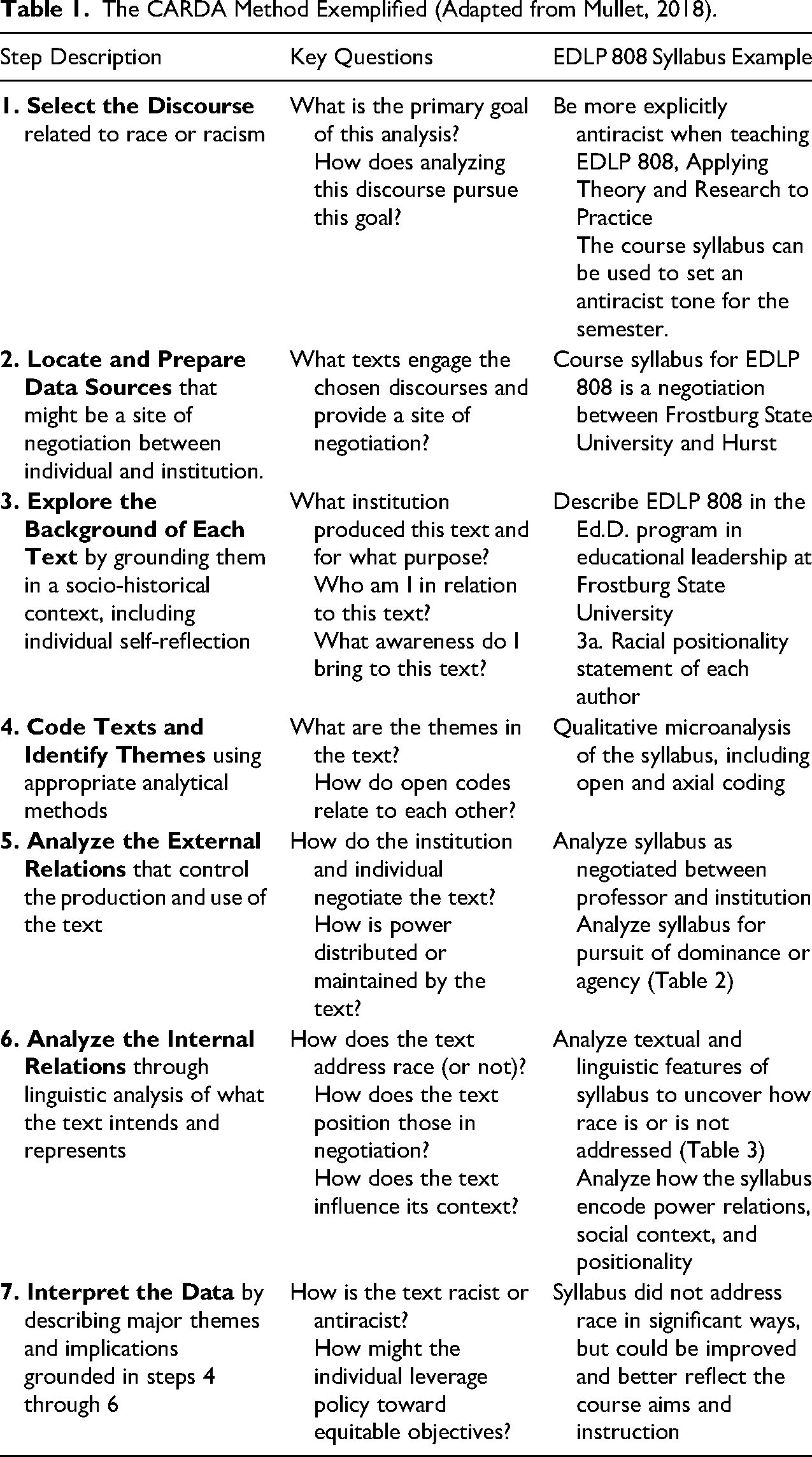
The first two of these steps proceed much as they would for any CDA with the additional grounding in a text as a site for policy negotiation. At step 3, CARDA includes the specific requirement for the analyzer(s) to engage in self-reflection, particularly around their racial identity and posture, as a key partner in the policy negotiation. Step 4 brings the primary components of antiracism (Kishimoto, 2018) into conversation with the tools of CDA (Mullet, 2018). Once coding and sorting are completed, analyzing the syllabus for its external relations (Step 5) and internal relations (Step 6) commences; Step 5 in particular brings the three primary components of antiracism into conversation with the Critical continua of individual v. institution and agency v. dominance. When these analyzes have been completed, interpretation of the data (Step 7) provides implications paired with diagnosis for improving access to individual agency and diminishment of institutional dominance.
CARDA of a University Course Syllabus
To exemplify the process of CARDA, we present here findings from a step-by-step CARDA of a university course syllabus. A syllabus may appear a pro-forma necessity with no relation to systems of oppression. However, as a widespread institutional discourse, syllabi are ripe for CARDA to unmask implicit or explicit policies aligned with the racist or antiracist dictates and culture of an institution.
Step 1: Select the Discourse
The goal of CARDA is to analyze racism and antiracism in educational discourses; in this example, we focus on a university classroom. We know that the university is an institution where myriad inequities exist, surrounding and within the university classroom (Pilkington, 2013). These are historically marginalizing spaces where sustained interpersonal and institutional responsiveness can serve to reify or disrupt existing power structures (Murray & Brooks-Immel, 2019; Walter et al., 2017). Oftentimes, students interact with faculty across multiple courses and extend their relationships through advising, mentorship, and committee chairing.
To analyze racism and antiracism in higher education instructional spaces, we address the following research question: How are racism and antiracism communicated in a course syllabus?
Step 2: Locate and Prepare Data Sources
We chose to analyze a course syllabus because a syllabus is the primary policy document used to present and define instructional spaces at the university. In addition, the syllabus represents a negotiable space between institutional influence and requirements while remaining under the primary development of the course instructor; an individual instructor has specific agency over the syllabus while required to conform to the norms and expectations of the institution. As such, syllabi present an important arena for engaging CARDA to examine the interplay between an institution and an individual.
Language included in a syllabus often shapes students’ first impressions (Harnish & Bridges, 2011) and can set the mood for an entire course (Slattery & Carlson, 2005). However, a student might not be aware of tensions between instructor and institution. As the precedent of a course, then, a syllabus can be a space for an instructor to communicate an antiracist stance and expectations, or replicate the marginalizing practices of academia. Herein we see the circular influences of individual pedagogy and institutional policy contained within a single document.
Step 3: Explore the Background of Each Text
The syllabus we analyzed frames an Ed.D. course designed to help educational leadership students connect theory and research to their context and practice. The program offering this course is affiliated with the Carnegie Project on the Education Doctorate (CPED) to help reimagine the Ed.D. and distinguish it from a Ph.D.; thus, this course focuses on applying theory and research to address problems of practice specific to the students. At Frostburg State University, EDLP 808, Applying Theory and Research to Practice, was designed to bridge the theory/practice gap and deploy theory and research around equity and diversity in practical ways. (The complete syllabus is available online https://www.academia.edu/76864177/EDLP_808_Applying_Theory_and_Research_to_Practice_Syllabus.)
These Ed.D. students take this course as a cohort in their first year. With a recent transition to an online model, the program attracts students from higher education contexts, including instructors at urban community colleges, administrators in student services, faculty, and university executives, and it matriculates students from PK-12 educational contexts, nonprofits, and state and federal government. The specific version of the syllabus analyzed here was presented in Spring 2019 in a blended modality that was 50% asynchronous and 50% face-to-face.
Prior to moving fully online, the program was offered on two campuses, one with mostly White students in an urban characteristic context and one with more students of color in an urban emergent context (Milner, 2012). Since moving online, the program attracts many more students from urban contexts who are more racially diverse than previous cohorts. Hurst became program coordinator in 2018 and chose to redesign this course to intentionally and more specifically address race and equity throughout the program. Students typically have Hurst for a four-course sequence, of which EDLP 808 is the second. In addition, Hurst often acts as dissertation chair or methodologist on students’ dissertation committees.
Step 3a: exploring the background of each author
In defining and presenting an exemplar of CARDA, we found benefit in working collaboratively, as per Kishimoto’s (2018) suggestion. Although CARDA could be conducted by a single researcher, the opportunity to critique oneself and work with at least one partner provides the possibility of deeper insight into the self and the work, particularly when analyzing racialized discourses (McMillon & Rogers, 2019). The authors of this article met when participating in an online learning community centered on antiracist work in teacher education and educational leadership. Through group conversations around an antiracist approach to institutional policy documents (including syllabi, promotion and tenure rubrics, and faculty evaluation templates), Hurst and Laughter came to recognize the possibility for a tool like CARDA and agreed to work together to define and exemplify the method.
Laughter is an Associate Professor of English Education at the University of Tennessee, Knoxville, a land grant R1 and flagship of the state university system; he takes seriously the land grant call to be ever working for the residents of Tennessee. Laughter is a White, hetero, cis-gendered male who represents almost the complete demographic catalog of power in the United States. For over a decade, he has drawn on CRT as a theoretical and analytical tool for research on racial injustice in education. He uses culturally relevant education to work with teachers to build more equitable classrooms. With this background, he brings a Critical eye to CARDA that specifically works to unmask and unmake White supremacy and seeks to create opportunities to leverage his own privilege to such ends.
While engaging in self-reflection in relation to this project, Laughter found that he had not taken syllabi seriously in the past, seeing them more as a pro forma exercise in which to bury jokes and generally lay out a calendar for a course. His teaching style relies heavily on a model of Freirean dialog driven by student needs and interests in ways not captured in a syllabus. In approaching this CARDA project, he strategically used questions to elicit a deeper understanding of the structures behind a syllabus and looked for ways to manipulate those structures to effect changes both in the course described and in the institution.
Hurst is an Associate Professor of Education at Frostburg State University (FSU), a regional comprehensive university with a solitary doctoral program, an Ed.D. in Educational Leadership. Hurst teaches full-time within this program and has served as its coordinator since summer 2018. Although she began teaching in the literacy and teacher education programs at FSU, she now teaches qualitative research and doctoral writing courses within the Ed.D. program and chairs doctoral dissertations. Hurst is aWhite, heterosexual, cisgendered female who, like Laughter, benefits from systems of privilege and power, although she has experienced gender-based discrimination and harassment.
Since her time as a classroom English teacher, Hurst has situated her pedagogy, research, and writing in a broad social justice framework. However, while reading antiracist texts such as Kendi (2019) and Oluo (2019), she began to grapple with how she had been using this social justice framing to avoid honest and sustained reckoning with race and racism. She has since sought out learning opportunities, within articles and books, recorded videos, webinars led by people of color, and accountability groups. She has also engaged in practitioner inquiry (Cochran-Smith & Lytle, 2009) in collaboration with other antiracist educators to identify aspects of her teaching practice that are racist, as she believes that, despite her intentions, her existence within a racist education system means that she is likely to subconsciously design aspects of her syllabi and courses to reify characteristics of White supremacy (Jones & Okun, 2001).
In engaging in this CARDA project with Laughter, she selected this syllabus because it was, at that time, her most recently designed course and therefore most reflective of her then-recent thinking about equity and diversity. However, it was also designed before she began reading extensively about antiracism; thus, we felt that the syllabus was unlikely in its current instantiation to reflect much antiracist pedagogy, but references to social justice, diversity, or equity could suggest places where she could become more deliberate in expressing antiracism.
Step 4: Code Texts and Identify Themes
To analyze the syllabus for EDLP 808, we engaged in a process of qualitative microanalysis (Strauss & Corbin, 1998) using the web-based platform Dedoose. This allowed us to collaborate virtually, using its tools during a series of synchronous Zoom meetings. We initially utilized open coding, primarily at the level of paragraph or subsection, because we wanted to capture context of specific text fragments; as such, coded blocks of text often received several codes. This process allowed us to organize the syllabus into discrete parts and to begin the analysis. For example, the academic integrity policy on the syllabus was quoted directly from the Student Code of Conduct; as such, we utilized codes such as “institution,” “distancing as instructor,” and “consequences” for this section. However, these open codes were used more as organizing tools than for additional analysis.
We then used the three primary components of Antiracist Pedagogy (Kishimoto, 2018) as axial codes, to which we added “Language Features” to gather stylistic and grammatical choices in the syllabus. Examples of each axial code include the following:
Topics concerning race and inequity. Here we primarily coded course readings and focal topics for each course session. For instance, the course design statement included inquiry questions for the course. “How can I hear, listen to, and incorporate diverse perspectives in my work as an educational leader and scholarly practitioner?” was coded as a topic addressing race. A topic such as “participants and sampling,” though, was coded as not addressing race, even if the lesson itself included content about how research has harmed Black individuals. An important observation was that the words “race” and “racism” were never explicitly used in the syllabus. This alone clearly necessitates revision to the syllabus. However, a topic was coded as addressing racism and inequity if it mentioned diversity, social justice, or research methodologies, such as community-based participatory action research meant to trouble historical researcher/participant hierarchies. Although we do not mean to suggest that these terms suffice in conveying our stance of antiracist pedagogy, we wanted to distinguish them from topics that had no indication of antiracist or social justice concerns, as we see here an artifact of Hurst's fixedness on broader topics of social justice and an opportunity to shift to antiracism. Methods of interaction. We conceptualized course assignments, interactional structures (such as group work or individual tasks), and course policies such as means of contacting the instructor, attendance and punctuality, and academic integrity as methods of interaction because all of these required some sort of interaction between two or more individuals. Methods of interaction addressing racism were sparse on the syllabus, but we found a few that encouraged student choice and agency in decision-making, such as “three chapters from Capper ch. 5–11 (one agreed on by all; two of your choice)”. The inclement weather statement, indicating that “the class session will be adapted to an asynchronous format and posted to Canvas” was coded as a method of interaction not addressing racism. Organizing to extend efforts into the surrounding community. For this code, we noted outside influences mentioned in the syllabus, such as university policies and organizations like CPED or assignments that ask students to work on a problem outside of the course context. Language Features: pronoun usage (first person singular; first person plural; second person); passive voice; interrogative mood.
Step 5: Analyze the External Relations
Analyzing external relations considers how different discourses work with each other (Kishimoto, 2018) through the negotiation of a policy between institution and individual. In a syllabus, the primary discourses at work are those of the individual instructor in negotiation with institutional requirements; both discourses can work to maintain or disseminate power. To analyze external relations of the EDLP 808 syllabus, we considered each open code as representing either the institution or the individual and as describing power as moving toward either dominance or agency. We then compared these new categories to the axial codes for the primary components of antiracist pedagogy. In Table 2, we present the number of times these codes overlapped.
Analysis of External Relations.
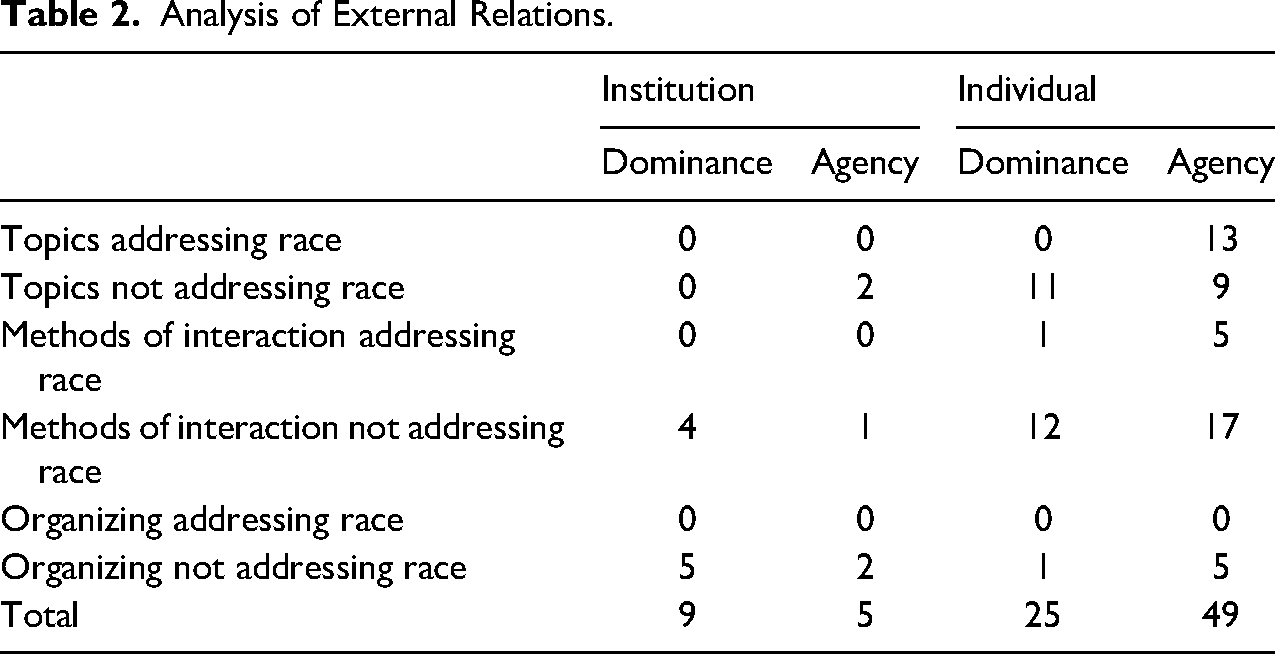
To be clear, Institution/Individual and Dominance/Agency represent two separate but intersecting binaries. As defined above, the dialectic between Dominance and Agency is understood as the struggle of the Critical; agency is the praxis by which individuals move to emancipate themselves, while dominance is the prevention of such movement. Thus, the category “Individual Agency” should not be understood as “the agency of an individual” but as describing a decision made by the individual instructor to promote agency. Likewise, “Institution Dominance” should be understood as a description of how the university maintains its dominance.
Overall, the syllabus avoided references to race and racism more than it made these systems explicit. Across the syllabus, 13 topics addressed race, but 22 topics did not. Similarly, only six methods of interaction addressed race, whereas the vast majority of methods of interaction (34) did not. Finally, the syllabus missed all 13 opportunities to organize in the greater community around race.
Coding for references to race and inequity presented a conundrum because of the degree of choice built into this syllabus. We coded text as “addressing race” if obvious in the syllabus; intentions of the instructor or student choice were not coded as “addressing race,” even if in course instruction they did address race. This allowed us to identify places in the syllabus where topics, methods, and organizing held the possibility of addressing race explicitly.
For instance, students select, in consultation with the course instructor, a theoretical text utilized for several application assignments. This theoretical text represents a topic, methods of interaction (in that the decision-making process involves a one-on-one conference with the course instructor and further interaction through the response papers the student writes for the instructor to read), and potentially the opportunity to organize into the surrounding community (through sharing ideas and concepts from their theoretical texts in their work contexts and other organizations) – but whether these possibilities address race depends on a student's choice.
Some students have chosen texts like Bonilla-Silva’s (2018) Racism without Racists: Color-Blind Racism and the Persistence of Racial Inequality in America. Yet the assignment overall could not be coded as addressing race because other students chose general social theory. Thus, this represents a place where the syllabus could explicitly recommend addressing race through the choice of text. Antiracist methods of interaction in future iterations of the syllabus might include an indication that students with White privilege will be encouraged to read a theoretical text related to race, such as a Black Feminist text or Critical Race Theory.
Additionally, some topics were coded as not addressing race but may address race when taught. For instance, a topic like “research questions” does not address race on its own but certainly could be taught and modeled as antiracist. In fact, course readings like Capper (2019) and Patel (2016) explicitly address racist research and research questions. In this instance, antiracist readings could be highlighted, and research questions could model addressing race and organizing to extend antiracist efforts into the community.
Although opportunities offering students agency within the syllabus were almost twice the number of those communicating instructor's dominance, we cannot just equate this agency with antiracism. We found many places where an instructor's antiracist intentions could be made more explicit, thus frontloading a more antiracist stance for the entire course, but this must be done with significant forethought and knowledge of students.
Forcing a PoC to engage in topics of racism might require inequitable emotional labor, whereas granting a reprieve from engaging in race work may relinquish White people from doing the work of dismantling White supremacy. A challenge inherent in a policy document like a course syllabus is how to develop freedom for those who are historically marginalized while holding others who benefit from privileges accountable.
Step 6: Analyze the Internal Relations
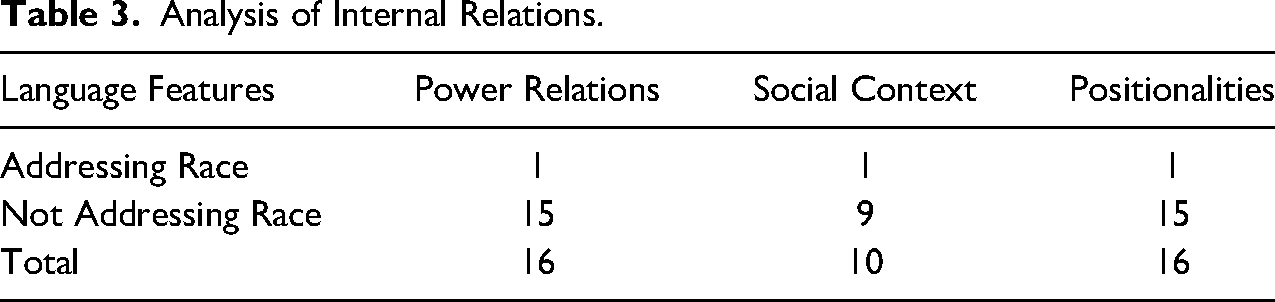
To analyze internal relations of the syllabus, we conducted a close reading of the coded linguistic features to uncover how they did or did not address race. We took the language features and analyzed them twice: first for addressing or not addressing race and second for how they related internally through considerations of power relations, social context, or positionalities (Mullet, 2018). We determined a feature as related to power when it conveyed something about an individual's ability to “achieve [their] own will against the resistance of others” (p. 118). Social context related the syllabus to events, actors, or locations, either in or beyond the course described. Positionalities referred to specific references to identities, such as “teacher” or “student.” We see these as related to antiracist pedagogy in that they invite us to consider how, for example, the instructor's Whiteness as historically oppressive to the opportunities offered Black people requires more explicit invitations for students to exercise choice and agency.
In Table 3, we present the number of times these codes overlapped. As each piece of coded text could represent any or all of Power Relations, Social Context, and Positionalities, the overall totals do not represent the total numbers of analyzed fragments. As we dug into the interactions of the codes within a single fragment, we found worthwhile areas for deeper consideration. First, there were no internal relations coded as representing solely power relations, social context, or positionalities; that is, every language feature was enacting at least two of the three, demonstrating the overlapping and intricate ways discourses work.
Analysis of Internal Relations.
Second, we found the overlaps instructive as to how language serves to restrict the possibility of addressing race without intentional thought toward that end. For example, the following fragment was initially coded as including the language functions “second person” and “passive voice” and then recoded as addressing internal relations through power relations and social context: At the end of the course, you will develop an abstract for a research study you might conduct. This abstract will show that you have considered how to integrate theory, research design, and specific research methods such as participant selection and data collection in response to a research problem. A rubric will be posted to Canvas. (p. 8)
In this fragment, Hurst removes herself from the assignment process, using passive voice to describe responsibilities (posting a rubric to Canvas) and direct second person to tell students what they will do. Perhaps describing her responsibilities in first person would allow Hurst to recognize the power she has, which then could be leveraged to address race through recommendations or the rubric.
Similarly, the following was coded for passive voice, first person, and second person and, in a separate round of coding, as addressing power relations and positionality: INSTRUCTOR RESPONSIVENESS: I make every attempt to reply to emails from currently enrolled students within 24 h of receipt. However, sometimes your questions are better answered in person, and I will reply with a request that we meet in person or synchronously through Canvas. (p. 6)
Here, we see a dialogic back-and-forth between first and second persons, between instructor and student. However, the positionality of the actors reifies power relations between teacher and student. The instructor decides the best method of replying to questions, rather than allowing student agency to define their part of the conversation.
For an example of an overlap between social context and positionality, we present this fragment initially coded as second person, consoling, and inspirational: Developing new identities, as we do when we grow ourselves as scholarly practitioners, is hard, messy, confusing, and non-linear. You will likely feel challenged at some points in the course, but you should never feel unsupported or alone. Please lean on your cohort-mates and your instructor in your struggles, and trust the process. Our deepest learning occurs when we take risks and venture into the unknown. New knowledge can sometimes feel uncomfortable, but like a new pair of shoes, sometimes we need to persist through a breaking-in period before we reject the knowledge outright. We need to give ourselves time and space to assess the discomfort, to discover where the points of friction are with our existing knowledge and beliefs. We must allow for moments of reflection to name where we were, where we are, and where we hope to go next. (p. 2)
In this inspirational passage, the initial reference to cohort-mates and instructor morphs into a first person plural litany of how “we” are all working together through the moments of cognitive dissonance experienced during identity work. To some extent, Hurst alludes to the hidden curriculum of graduate school by explicitly flagging confusion and struggle; in so doing, she delineates aspects of coursework that have led past doctoral students to question their intellect and ability and instead reframes these as commonalities. And yet, race is not addressed as part of identity or of this work.
In the one fragment coded as addressing race, internal relations via power relations, social context, and positionalities are all addressed through a list of essential questions (pp. 1–2); that is, the 1 s in each square of Table 3, Row 1 refer to the same fragment. While we cannot extrapolate from one instance, we do find it interesting that, when race is addressed explicitly, all three internal relations are represented. Perhaps this is because race comprises power, context, and positionality through definitions that are social, legal, political, and historical (Milner, 2007). Even in this instance, race is not addressed sufficiently. While we coded the fragment as addressing race based on its inclusion of “identity,” “socially just,” and “diverse perspectives,” these oblique references serve to displace specific consideration of race. Instead, the syllabus hedges these considerations under terms more comfortable for students who choose to avoid race altogether.
Step 7: Interpret the Data
Step 7 moves into the development of interpretations that tackle actionable possibilities; in short, how can an individual implement institutional policies in ways that pursue and promote antiracism. In this specific instance, our initial questions asked “How is Hurst's syllabus racist or antiracist?” This second question may seem premature in addressing a syllabus that was not constructed originally with antiracist objectives. That is, antiracism is not accidental and is not enacted through good intentions or a broad social justice approach. This syllabus was constructed by Hurst before she was actively engaged in antiracist work. Thus, CARDA identified instances of a social justice stance, which offered opportunities to be explicitly antiracist.
In approaching these questions, we found two interrelated areas in which to formulate answers: the syllabus itself and the enacting of the syllabus in the course. In short, the syllabus did not significantly address race; when it did, it used terms that were oblique or evasive. We interpret these data as indicative of the silence and invisibility that often maintain racist systems. However, in the enactment of the syllabus while teaching the course, Hurst regularly addressed race and promoted antiracist approaches to theory and research. We imagine this represents a common obstacle for instructors who wish to pursue antiracist topics, methods, and organizing; although their antiracist stance is readily apparent in the experience of the course, it may not show up in the syllabus.
In this light, CARDA of a syllabus brings to light areas where antiracist topics, methods, and organizing can be addressed explicitly, thus setting an antiracist intention even before the first class meeting. For example, after completing the CARDA of this syllabus, Hurst chose to revise the fragment considering the development of new identities discussed above in Step 6. In this way, the interpretation step of a CARDA was used to identify and revise a text in ways that more specifically address race and present an antiracist stance.
(Of course, we recognize that some instructors may mask the ways a course addresses race through an intentionally vague syllabus so as to avoid the scrutiny of their institutions [or internet trolls]; that strategic move deserves deep consideration but is not our focus here. The many layers of public-ness associated with a syllabus may, at times, put faculty or students at risk of being doxxed, put on “watch lists,” or even physically harmed. As White scholars, we acknowledge that we have the privilege to be open about the ways we address race and racism in our teaching and scholarship without having to fear professional retribution or physical harm.)
Relatedly, the interpretation of data from this CARDA has already affected the instruction of later instantiations of the course. By examining the syllabus in this specific way and seeing how it did not address race sufficiently, Hurst has made instruction and interactions with students more explicit about antiracist approaches to theory and research. For example, she has begun to co-teach the course with a quantitative colleague who is also committed to antiracism. They explain to students early in the course that they have chosen to co-teach so that the students can hear how their perspectives differ even though they both see disrupting inequities and racist systems as fundamental to their work.
Hurst also believes that offering students choice throughout the course is indicative of her antiracist stance. The choice of theoretical text allows White students the space to begin or extend their learning about subjects like Black feminist theory or Critical Race Theory, while also not requiring her students of color to engage in topics of race. However, this choice also allows her White students the freedom to opt out of reading about equity or diversity. She and her co-teacher have been discussing this dilemma and, in individual meetings with students to select texts, have been actively guiding students away from broader social theories.
In the collaborative rewrite of the syllabus, they also removed policies such as lateness penalties for assignments, believing that these present an unnecessary barrier. The syllabus now explains the instructors’ reasoning for due dates while also encouraging communication and allowing students flexibility without needing instructor permission. It also precludes instructors from inequitably issuing lateness penalties or being the arbiters of what constitutes a legitimate excuse for late assignments.
In considering responses to the CARDA process, we believe it is a useful tool for finding the blank spaces in institutional policy that need filling in by an individual. When considering revisions to a text following CARDA, it is important to address all three primary components of antiracist pedagogy: topics, methods, and organizing (Kishimoto, 2018). On a first pass through a syllabus, explicitly demarcating how texts and topics address race might be easy; an instructor may just need to include some additional information about the texts and topics. Similarly, descriptions of how instructional methods address race could also be included.
We believe intentional thought must also be given to how a course and its syllabus address antiracist organizing to extend into the surrounding community. This may represent a heavier lift as it moves beyond the classroom and away from the control of the instructor and institution. We know of several academic institutions seeking to increase and label service learning components to their academic courses; perhaps these experiences could be leveraged toward specifically antiracist ends.
Discussion
The years 2020 and 2021 provided numerous examples of top-down educational policies designed to limit the teaching of history and current events and quash classroom conversations around race and racism (Belsha et al., 2021). We expect 2022 will deliver more of the same. However, these policies need teachers to implement them at the school and classroom level, which sets up these policies as sites for struggle and negotiation. By bringing together the tools of CDA with the goal of antiracist pedagogy, CARDA provides a seven-step process (summarized in Table 1) that may lead to more equitable, socially-just educational outcomes. Our CARDA of a university course syllabus is just one example. We believe other policy texts could benefit from a CARDA with the objective of unmasking and unmaking expressions of systemic racism in institutions.
For example, Laughter is a member of a research team using CARDA to analyze a K-8 scripted curriculum employed in a local school district (Rigell et al., 2022). The negotiation between the master narrative of a scripted curriculum and the classroom implementation of that curriculum could promote antiracist pedagogy that pushes back against the White supremacist script dominating the curriculum. Similarly, school-level policies like disciplinary or grading procedures might be analyzed to help avoid entry into the school-to-prison pipeline by challenging the school-based policing and hyper-surveillance of students in urban schools (Johnson, 2021), facilitating more agency in students.
CARDA could also promote curricular and pedagogical equity through the negotiation of teacher evaluation models, state standards, or state legislation limiting what can be taught and how. For example, in Tennessee, a state-adopted teacher evaluation model describes effective teaching in ways that run counter to recent laws limiting the teaching of real history or the inclusion of certain texts. Likewise, the state-adopted standards require students to have access to multiple sources and points of view, in defiance of recent legislation. A concurrent CARDA of these policies might move teachers and teacher educators to use these points of contention as leverage for more agency in instruction and pedagogy.
Finally, and moving outside of urban education, Laughter is also a member of another team using CARDA to analyze policy documents at a local urban healthcare facility. As a tool engaged in Public Health Critical Race praxis (Ford & Airhihenbuwa, 2010), CARDA can uncover assumed objective healthcare protocols that lead to diminished care for patients from marginalized communities. In each of these possible examples, policy is a site for struggle and negotiation, not just a directive from the top to be implemented without critique.
In conclusion, and in considering the experience of the whole CARDA process, we want to highlight the importance of collaboration. Although CARDA could be implemented by an individual, we believe CARDA is more effective and fruitful as a shared project. In our experience, our roles as an insider and an outsider helped for multiple reasons. For one, Laughter does not have the experience of course instruction to influence his analysis of the exemplar syllabus. As such, he was able to focus on what was present in the syllabus alone and not consider the enactment of the syllabus through course instruction. This was particularly important when considering whether an open code did or did not address race.
Similarly, the interaction between authors kept us accountable as to how we were defining race and whether or not race was being addressed; partnership did not allow encoding and decoding to happen through just one person. Instead, we had to negotiate understandings, which is important particularly when considering race as part of a system that works to deflect and silence (Delgado & Stefancic, 2017); likewise, sections of this manuscript were reviewed by colleagues of color and their insights included.
Hurst has taken this lesson a step further and intentionally chosen to co-teach EDLP 808 . Through co-teaching, she and her colleague demonstrate to students both the process and results of co-created knowledge when considering antiracist theory and research. In this, we see another benefit to collaboration between an insider and an outsider; the partnership produced a more thorough CARDA that could see immediate application to instruction.
Although not a new tool, the specific definition and exemplification of CARDA as an adaptable tool for negotiating policy implementation serves a current need to respond to the myriad racist discourses being developed and amplified in 2022. As a method, CARDA works to make visible what is too often hidden through various institutional policies and linguistic functions that seek to limit agency and maintain dominance. Yet, we must acknowledge that CARDA is a tool that only seeks to unmask and identify. We must also act on what we find. CARDA can tell us where we might negotiate policy via a syllabus, a curriculum, or a state standard, but the work of antiracist policy development and implementation remains.
Supplemental Material
sj-docx-1-uex-10.1177_00420859221097029 - Supplemental material for Critical AntiRacist Discourse Analysis (CARDA)
Supplemental material, sj-docx-1-uex-10.1177_00420859221097029 for Critical AntiRacist Discourse Analysis (CARDA) by Judson Laughter and Heather Hurst in Urban Education
Footnotes
Declaration of Conflicting Interests
The author(s) declared no potential conflicts of interest with respect to the research, authorship, and/or publication of this article.
Funding
The author(s) received no financial support for the research, authorship, and/or publication of this article.

Supplemental material
Supplemental material for this article is available online.
Author Biographies
References
Supplementary Material
Please find the following supplemental material available below.
For Open Access articles published under a Creative Commons License, all supplemental material carries the same license as the article it is associated with.
For non-Open Access articles published, all supplemental material carries a non-exclusive license, and permission requests for re-use of supplemental material or any part of supplemental material shall be sent directly to the copyright owner as specified in the copyright notice associated with the article.
