



Abstract
This study develops a theoretical concept of how regional cultural values develop, manifest, and become visible in regional images. Moreover, it tests the impact of regional images on attracting interregional migrants. Specifically, we test whether the values held by inhabitants of particular regions can explain variances in intra-country migration. Analyses are conducted on data collected from official statistics and from the European Social Survey on the level of European NUTS 2 regions. Cultural values are measured using a selection of items from the Human Value Scale developed by Shalom Schwartz. Analyses show that independent from unemployment rates, economic prosperity, and the degree of urbanization, net migration rates are dependent upon the cultural values held by the inhabitants of a region. Individuals are more likely to migrate to regions where inhabitants adopt hedonistic values and a certain degree of ‘social indifference’.
Introduction
Following the publication of Richard Florida’s The Rise of the Creative Class (2002), cultural and other non-economic factors of cities and regions have suddenly become a subject of interest in economic geography and urban studies. The reason is that Florida found that the cultural dispositions of inhabitants of cities can serve as amenities that attract the occupational milieu of ‘the creative class’– a social group that (Florida argues) is essential for regions to economically develop. This is because in post-industrial ‘people driven’ economies, economic growth has incrementally become dependent on human creativity (Florida, 2002: 6). Consequently, places that attract the creative classes develop economically more favourably than places that do not (Florida, 2002: 218).
Further, Florida argued that since the ‘creative ethos’ is held as a general social (class) disposition rather than as a work-specific trait, individuals that belong to the creative classes prefer living in a social and cultural context in which they can realise their creative dispositions, not only in their occupational activities, but also in their private relationships with friends and partners, and in their leisure activities (Florida, 2002: 22). They wish to live in a sociocultural climate that gives them ‘the opportunity to validate their identity as creative people’ (Florida, 2002: 218). Such a climate, Florida argued, would be characterised by cultural values such as tolerance or openness to diversity (Florida, 2002: 79).
Although Florida focused on the social and cultural dispositions of the inhabitants of certain cities and regions, he rarely ever directly measured the impact of cultural values on attracting the creative classes. Rather, he used structural indicators like the ‘Gay’ index or the ‘Melting Pot’ index to determine whether a place is characterised by a tolerant climate, and tested the measures’ correlations with economic-related indicators like the ‘High Tech’ index or the ‘Talent’ index (Florida, 2005: 106).
In contrast, the goal of this study is to explicitly measure and determine the impact of the cultural climate of a region on net migration rates. Although this study is related to the work of Florida in that it tests the impact of cultural ‘amenities’ on migration behaviour, it does not specifically focus on migration flows of the creative classes. Instead we aim to determine, first, whether cultural values held in regions are at all correlated with net migration flows when adjusting for structural variables such as unemployment rates, regional gross domestic product, and urbanity. Second, we wish to examine which dimensions of cultural value patterns are positively or negatively associated with net migration rates.
In order to empirically pursue this aim, we collect data from five waves of the European Social Survey, which includes Schwartz’s (2006) scale of human values. We use these items to derive four cultural value factors and apply them to describe 119 NUTS 2 regions 1 for 14 European countries. In a second step, we use data from Eurostat (2012), providing information on net migration rates between these same NUTS 2 regions. Since between-country migration rates in Europe are low (Belot and Ederveen, 2005: 2), we restrict our analyses on intra-country migration flows.
The paper is structured into four sections. Following the introduction, we delineate the theoretical background in terms of the formation and measurement of the cultural values of regions. Moreover, we derive the hypotheses that guide the analyses. The next section addresses the operationalization of the study, provides an overview of the data, and presents the findings from our regression analyses. We close with a discussion and a brief conclusion of the results.
Theoretical background
Before empirically examining the relevance of cultural values as amenities to attract migrants, we have to address two theoretical and one methodological issue.
The first issue relates to the question of whether the formation of specific cultural values can be considered a consequence of structural aspects of regions like urbanity or the degree of modernization. An alternative possibility is that values predominantly rely on non-structural, semantic peculiarities such as regional traditions, which in turn may coalesce with global trends and/or those of specific subcultures to shape (rather unpredictable, path-dependent) cultural value outcomes.
Second, the question arises as to whether and how cultural values can convert into cultural amenities. This issue relates to the way in which values contribute to shaping the image of a region. Since cultural values refer to the latent dispositions of individuals, they need to become both manifest and accessible to a broader public order to become effective amenities.
Third, we have to treat the problem of adequately operationalizing the (basic) cultural values held by the inhabitants of regions by means of survey data. This step is crucial in order to be able to compare regions and to empirically decide whether specific value patterns are more attractive than others for those who are residentially mobile.
Structural and semantic aspects of the creation of cultural values
A comprehensive treatise of the sources of cultural values and their transition would go beyond the scope of this paper. Nevertheless, we want to briefly discuss some basic theoretical considerations. Specifically, we wish to depict the potential influence of the structural properties of regions in determining the general cultural values held by its inhabitants, and we also want to determine to what degree culture can develop independently of these structural aspects. This is, as it seems, an important issue, because when studying the possible impact of culture on behaviour, the question arises as to whether culture is, in fact, a genuine driving force in this process. An alternative possibility is that culture is a dependent variable of the structural aspects of a given region that both influences migration behaviours of individuals and determines the cultural dispositions of individuals living in that region.
We focus on two structural features of regions that might influence the development of certain cultures: urbanity and the degree of economic modernization.
Urbanity
Urbanity was always, in a basic way, associated with the creation of culture. This is mainly because cities are ‘a locus of dense human interrelationships (out of which culture in part grows)’ (Scott 1997: 324). To deal with the effect that urbanity can have on culture and cultural value formation, we rely on a classical study by Claude Fischer (1975) that examines the formation of subcultures in urban areas. Fischer argues that a central characteristic of urban settings is that they catalyse the creation of unconventional values and behaviours. This can be explained by the fact that they provide the ‘critical mass’ (Fischer, 1975: 1325) necessary to create both subcultural varieties, and to ensure that subcultures can grow large enough to make unconventional behaviour and values flourish and become institutionalized: given basic market mechanisms, arrival at certain critical levels of size enables a social subsystem to create and support institutions which structure, envelop, protect, and foster its subculture. These institutions (e.g. dress styles, newspapers, associations) establish sources of authority and points of congregation and delimit social boundaries. (Fischer, 1975: 1325–1326)
Examples for such subcultures are ‘artistic subcommunities, student subcultures, young singles’ but also criminal subcommunities (Fischer, 1975: 1326).
A second key idea of Fischer’s concept is that the development of unconventional behaviour does not follow a ‘universal direction’ (Fischer, 1975: 1335). Rather, it is ‘content free’ (Fischer, 1975: 1335) in the sense that urbanity does not structurally define which values and behavioural patterns are created. The semantic properties depend solely on the characteristics of the inhabitants of a region (such as their ethnic origins, regional traditions, education, and dominance of specific occupations). Urban life, from this perspective, is not necessarily the spearhead of modernization; however, by providing the critical mass, it does facilitate the rising of latent cultural dynamics to the surface, which enables these dynamics to manifest and become institutionalized. Moreover, (successful) long-term subcultural developments are often flowing into mainstream culture (McCracken, 1990: 80), thereby slowly changing dominant values and behavioural scripts. Therefore, urban developments are, as a rule, the first manifestation of future trends.
Economic modernization
Conversely, the perspective of modernization theory suggests that economic development is accompanied by a directed process of value change. The degree of economic prosperity is, in other words, a clear indication of the cultural dispositions that prevail among the inhabitants of a region because ‘economic development is linked with coherent and, to some extent, predictable changes in culture’ (Inglehart and Baker, 2000: 21). One central assumption is that ‘the rise of postindustrial society leads to a growing emphasis on self-expression’ (Inglehart and Baker, 2000: 22) in all areas of life comprising ‘changes in gender roles, attitudes towards authority and sexual norms’ (Inglehart and Baker, 2000: 21). To be precise, the direction of change is toward less obedience to authority, and more tolerance and openness toward lifestyles that deviate from traditional patterns.
The link between economic modernisation and value change seems reasonable at first glance; however, the process is not as obvious as argued. For a long time, modernisation theory – inspired by Talcott Parsons and others – conceptualised societal development as an evolutionary process (Parsons, 1977a), which heads toward the convergence of values across all modernised societies. Today, this model can only be maintained in a ‘softened’ version. A prominent alternative concept is Eisenstadt’s ‘multiple modernities’ theory. He argues that while cultural modernity proliferates in all regions of the world, its concrete patterns are being adjusted in accordance with historically developed local traditions. Consequently, different versions of modern cultural agendas, rather than a uniform pattern, prevail (Eisenstadt 2004). In recent decades, even Inglehart and his colleagues admit that the process of modernization is strongly path-dependent in the sense that traditional values remain persistent even when societies are economically developing (Inglehart and Baker, 2000: 20).
Taking the concept of path-dependencies seriously has, however, significant consequences in determining the impact of structural modernization on cultural values. Even when following the assumption that economic modernization determines the general pathway along which cultural values can develop, the concept of modernization leaves a margin where specific regional semantic properties can develop as outcomes of regional traditions or the dominance of certain milieus or sub-cultures. Similar to Fischer’s model (1975), it can therefore be assumed that cultural values can develop independently of structural factors, to a certain degree.
Summarising these considerations, we assume that both urbanity and economic modernization play an important role in the process of cultural value formation. We, however, adopt Fischer’s premise of content freeness on the one hand, and Eisenstadt’s adjustment assumption on the other hand to model the idea that there are endogenous regional mechanisms that allow variations of culture to develop.
According to the idea of content freeness, structural aspects of regions only determine the probability with which sub-cultural values and behaviours manifest themselves institutionally. Following the adjustment assumption, globalization influences local culture and puts regions under pressure to adapt to global conditions. Conversely, by realising global concepts in concrete local patterns, regions can preserve their local characteristics and thus remain a ‘repository of distinctive cultures’ (Scott, 1997: 324).
To conclude, we interpret regions as spatial units with their own specific constellation of historical, social, cultural, and intellectual elements that can shape cultural patterns independently of structural factors.
The impact of values on the formation of regional images
By culture, we are referring to the mental character of the inhabitants of certain regions, which is made up of central cultural values. We define a cultural value in accordance with Kluckhohn’s notion that these values are conceptions ‘[…] of the desirable, which influence(s) the selection from available modes, means, and ends of action’ (1951: 395). Cultural values, in other words, express trans-situational motivational goals (Rokeach, 1973; Schwartz, 1992). At the individual level, they affect the way people see and interpret the world, they provide orientation for action, justify these actions, and thus influence certain types of attitudes, decisions, and actions (Rokeach, 1973: 13; Schwartz, 2006: 139). At the collective level, values reflect the solutions that groups develop by figuring out how to deal with challenges like organising social relations, regulating conflicts, and dealing with the peculiarities of their concrete social and physical environments (Gillin, 1955; Schwartz, 2006). Thus, values can be interpreted as socially constructed conceptions as to how to deal with societal tasks and needs in material, social, and psychological respects. Following other authors, we conceive of collective culture by means of the system of shared values (Hofstede, 1980; Schwartz, 2006) and define regional culture as a system of values shared by the inhabitants of a specific region.
Since values affect both one’s view of the world and one’s social behaviour, underlying values create certain attitudes, decisions, and interaction types. The reason for this is that individuals who are socialised within a region’s specific value system usually adopt its values and norms (Linton, [1947] 1999) because they identify with their region, and because they learn, through social interaction, the ‘right’ emotional and behavioural patterns to display in social life (Linton, [1947] 1999: 8). Thus, typical social patterns arise, leading to a certain level of homogeneity within a region that concerns not only its inhabitants’ values, but also their behaviour patterns, which can be described as being indicative of a region’s character. If individuals from outside a specific region are moving into the region, they face the region’s unique character and learn to adapt to the regions’ rules. In addition, it is plausible to assume that after a while, quite a few of these individuals also start to identify with the region and express their self-conception by living the local habitus.
Having clarified the concept of culture for our purposes, we have to deal with the question of how cultural values held by inhabitants of regions shape the creation of a regional image. 2
We argue that, as outlined above, since cultural values become manifest in actions, codified rules, institutions, organisations, events, symbols, and even goods and services (Kleiner, 2012), they can also be perceived by other individuals. Sources that directly or indirectly spread the message of regional cultural characteristics, and that therefore inform individuals from other regions about the cultural peculiarities of a region, are manifold. Moreover, the processes through which such information is selected, distributed, and cognitively processed by the recipients are highly complex (Rubin, 2009). In the following, we list the most significant sources, assuming a simple, ‘mechanistic’ communication approach in which information reflecting a fragment of reality flows relatively unbiased from a source to a recipient:
Informal personal channels: Since personal experiences directly affect individuals, they have the strongest impact on creating a stable cognitive impression of regional mentalities (Myers, 1996: 288). Individuals can experience manifestations of these mentalities in direct communications with individuals from other regions during business travels, city trips, vacations, and/or when visiting friends or relatives. Personal networks can, however, also provide indirect information, for example when friends, colleagues, or relatives tell stories about their encounters with inhabitants of other regions.
Mass media: Prominent people like athletes, creative artists, and other stars and starlets we know from TV, the internet, or newspapers can influence the impressions we have of the cultural mentalities of the inhabitants of other regions. Moreover, regional traditional events like the Munich ‘Oktoberfest’, ‘La Fête du Citron’ at the Côte d’Azur, or ‘Palio di Siena’ that are reported in (national) media influence individuals’ perceptions of regional cultures. Further, since regions incrementally compete in the marketplace for ‘inward investment, sporting and cultural events, tourists and skilled knowledge workers’, they frequently use marketing measures to spread a certain (positive) image of the mentalities held by their inhabitants (Clifton, 2011: 1974).
Goods and products: Evaluating consumer products that are typically found in certain regions can help influence a region’s image, as these products can attribute certain characteristics to the people living in that region (Clifton, 2011).
Of course, not all passed stories, documents, pictures, products, or social interactions become part of a region’s image. Rather, elements that are experienced frequently or are considered as being significant to the region in question are communicated and interpreted in complex information and communication processes. In the end, features that are deemed ‘typical’ coalesce into a prototypical picture of the focal region. Such archetypal pictures are conglomerates of notions of typical characteristics, motives, and behaviours, as well as of underlying values. Since these features are judged either positively or negatively, they are no longer referred to as specific contents; rather, they are regarded as broad generalisations that serve to reduce time and energy when gathering information and making evaluations (Ajzen and Fishbein, 1980: 5). As such, images are simple shorthand concepts that help individuals summarise and evaluate multiple sources’ information about complex groups of people (Anholt, 2010).
We argue that such images can influence individuals’ decisions to move to a certain region or not. In this way, the ‘geography of culture’ (Scott, 1997: 324) can transform into a ‘mobility map’.
Measuring regional cultures
To depict the cultural value patterns of the inhabitants of different regions, we use a selection of the items from the Human Value Scale developed by Schwartz (2006). Schwartz’s approach originally aims to grasp cultural value orientations that ‘evolve as societies confront basic issues or problems in regulating human activity’ (Schwartz, 2006: 140). The aim of this analysis, in comparison, is focused on depicting the cultural values that are likely to express and signify certain discernible behavioural patterns; this should not be confused with a mere lifestyle analysis (for which the inventory was not applicable). Rather, the question of whether the Schwartz scale indeed depicts basic pattern variables (Parsons, 1977b) that are at the core of every cultural system is not of interest at this point. It can be assumed that these values are relevant enough to depict some significant aspects of a cultural system, which in turn structure social action and can thus become manifest in the regional image. 3
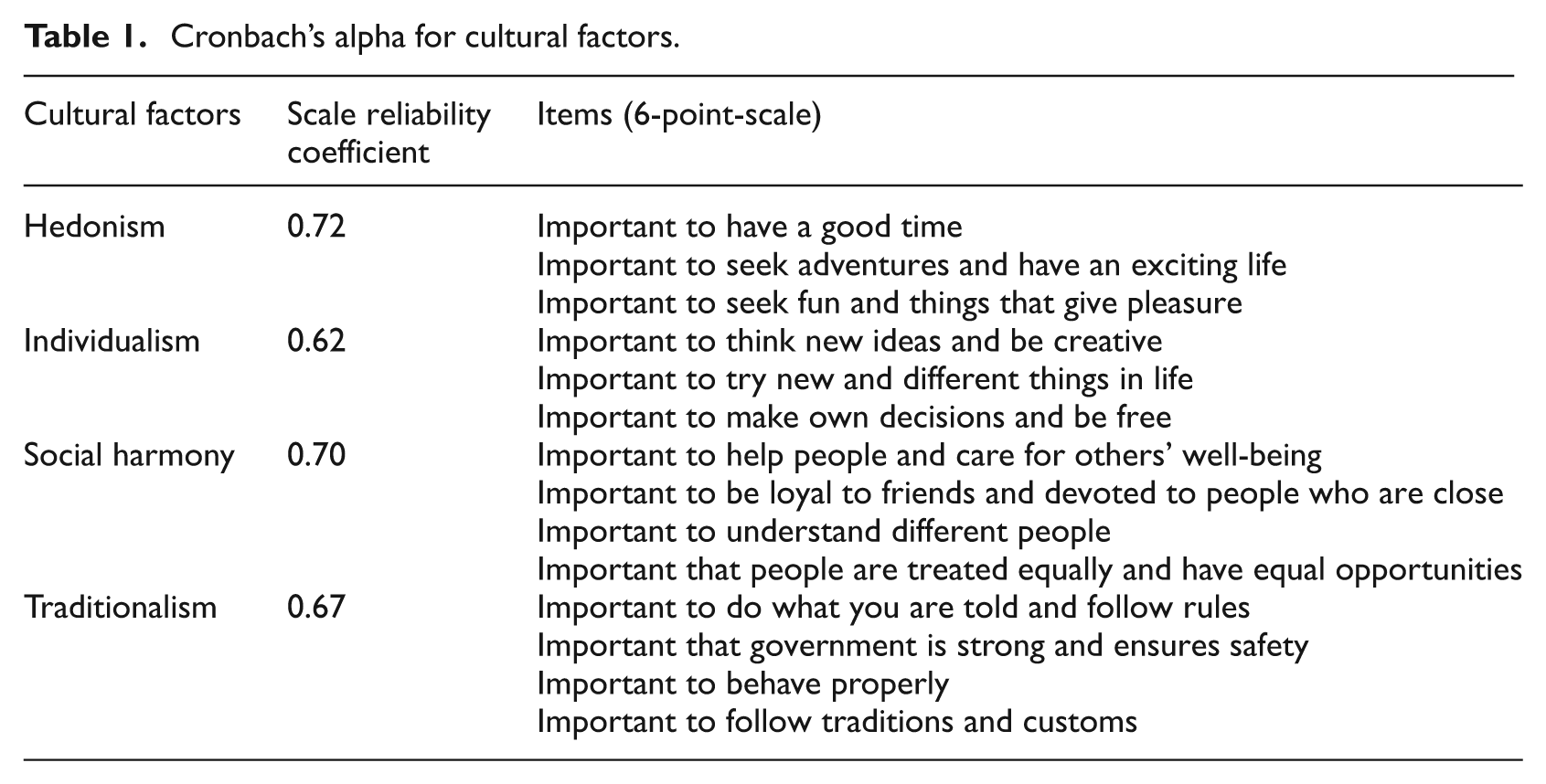
The Schwartz value scale itself is available from the European Social Survey (ESS) and is able to capture regional values across five points in time (European Social Survey, 2002, 2004, 2006, 2008, and 2010). In order to obtain as many observations as possible for each NUTS 2 unit, we use all five waves of the ESS. To construct the value factors, we use 14 out of the 21 available items from the Schwartz scale, 4 and derive four cultural value factors that we label hedonism, individuality, social harmony, and traditionalism.5,6
The variables behind each factor and the scale reliability coefficients (Cronbach’s alpha) are listed in Table 1.
Cronbach’s alpha for cultural factors.
By distinguishing these four cultural dimensions we address the following social action- and image-related patterns:
Hedonism relates to an individual’s propensity to socially connect with friends, to party, as well as to go out to clubs, bars, restaurants, and cafés. Places with above-average ratings on this factor should be regarded as being socially vibrant, characterised by an excessive night-life culture, and populated by a pleasure-seeking social milieu. Behaviour and corresponding values are interrelated with the opportunities available to go out (restaurants, bars, clubs, concert halls, events). The existence of these opportunities enables individuals to realise and embody hedonistic values, which simultaneously reinforces these values. Hedonistic values can therefore be conceived of as a proxy for three features shaping the image of a place: the social milieu, the actual behavioural patterns, and the infrastructures. We hypothesise that a hedonistic-oriented image might attract individuals (especially young people) to move to a particular place since it promises to provide an exciting, pleasant, and diverse life.
The individuality dimension relates to individual, self-determined behaviours. A place positively defined on this dimension should, accordingly, have a population that is interested and engaged in trying different cultural expressions, as well as interested in engaging in traditionally-independent lifestyles and behaviours. This value pattern might also influence economic behaviour in the sense that it generates (or is generated by) a creative job industry (Florida, 2005). We assume that a high value on this factor creates a regional image that particularly attracts individuals with a creative ethos, since it promises an atmosphere where individuals can evolve and realize their own life design given that other inhabitants are open to new ideas.
The social harmony factor is directly related to social behaviour in that it reflects solidarity, togetherness, and an open community where individuals treat each other equally, independent of ascribed characteristics and place of birth. This factor combines tolerance and the vision of an open community (Florida, 2002: 249) with inclusion into community life. We assume that if such an inclusive and socially fair behavioural pattern becomes part of the image of a region, it should become an attractive place to move since individuals with different cultural and regional backgrounds can expect to be welcomed and treated equally.
Regions with above-average scores on the traditionalism dimension tend to appreciate behavioural patterns that are oriented toward a clear set of rules. Individuals should behave ‘properly’ in accordance with the overarching values held by members of a particular region, and individuals should accept a subordinate role in relation to community and religious or political authorities. This dimension is oriented toward Inglehart and Baker’s (2000) traditional value factor. According to these authors, this value mainly prevails under preindustrial conditions, in which populations ‘show relatively low levels of tolerance for abortion, divorce, and homosexuality; tend to emphasise male dominance in economic and political life, deference to parental authority, and the importance of family life, and are relatively authoritarian; most of them place strong emphasis on religion’ (Inglehart and Baker, 2000: 24–25). We expect that if these value patterns become part of the image of a region they should prevent individuals from moving to these places. This occurs because these values represent a sense of cultural backwardness under conditions where service sector occupations and post-modern attitudes dominate. Second, this trend emerges because traditionalism is normally associated with closed social relations that are embedded in community networks which are hardly accessible for new arrivals.
Testing the impact of cultural values on interregional mobility
Data, operationalization, and methods
In order to gain information on residential mobility, we use data from Eurostat (2012) on interregional migration of NUTS 2-level regions. We create a net migration rate indicator by subtracting the absolute number of (adult) emigrants from the number of (adult) immigrants and dividing this value by the total size of the population (in 1000).
The resulting net migration measure is used as the dependent variable in a series of regression models. The central explanatory variables are the cultural values of the population, as described above. After producing the factors (using individual-level data), the aggregated mean for each NUTS 2 region was calculated. 7 We have to restrict our analyses to 14 countries (Austria, Bulgaria, Croatia, Czech Republic, Denmark, Finland, Hungary, Italy, the Netherlands, Poland, Slovakia, Slovenia, Spain, Sweden) due to a lack of information either on intra-country migration rates from Eurostat or on cultural values data from the European Values Study. The resulting dataset contains the cultural factors and net migration rates for 119 regions. 8
While the cultural descriptors of the regions are considered to be the central explanatory variables in this study, in the regression analysis we also control for economic prosperity (GDP per capita), the unemployment rate (both available on the level of NUTS 2 regions from Eurostat, 2012), and urbanity, 9 which in other studies have been found to be relevant factors used to explain interregional migration (see Decressin and Fatás, 1995; Huber, 2004). Moreover, economic prosperity and urbanity are, as argued above, controls for the structural aspects of value formation (see Fischer, 1975; Inglehart and Baker, 2000).
Since our study is concerned solely with explaining interregional, intra-country migration variances, rather than differences between countries, in our analyses we have to adjust for the fact that our dataset consists of 119 NUTS 2 regions from 14 different countries. We address this fact by applying multi-level fixed effects (FE) regressions (Wooldridge, 2002: 266), in which we differentiate between country and NUTS 2 region levels. The advantage of the FE procedure is that it adjusts for the country means for each variable, thus virtually eliminating cross-country differences (Twisk, 2006: 8). Therefore, the results of the analyses can be interpreted as relating only to differences between NUTS 2 regions within countries while controlling for cross-country differences. 10
Findings
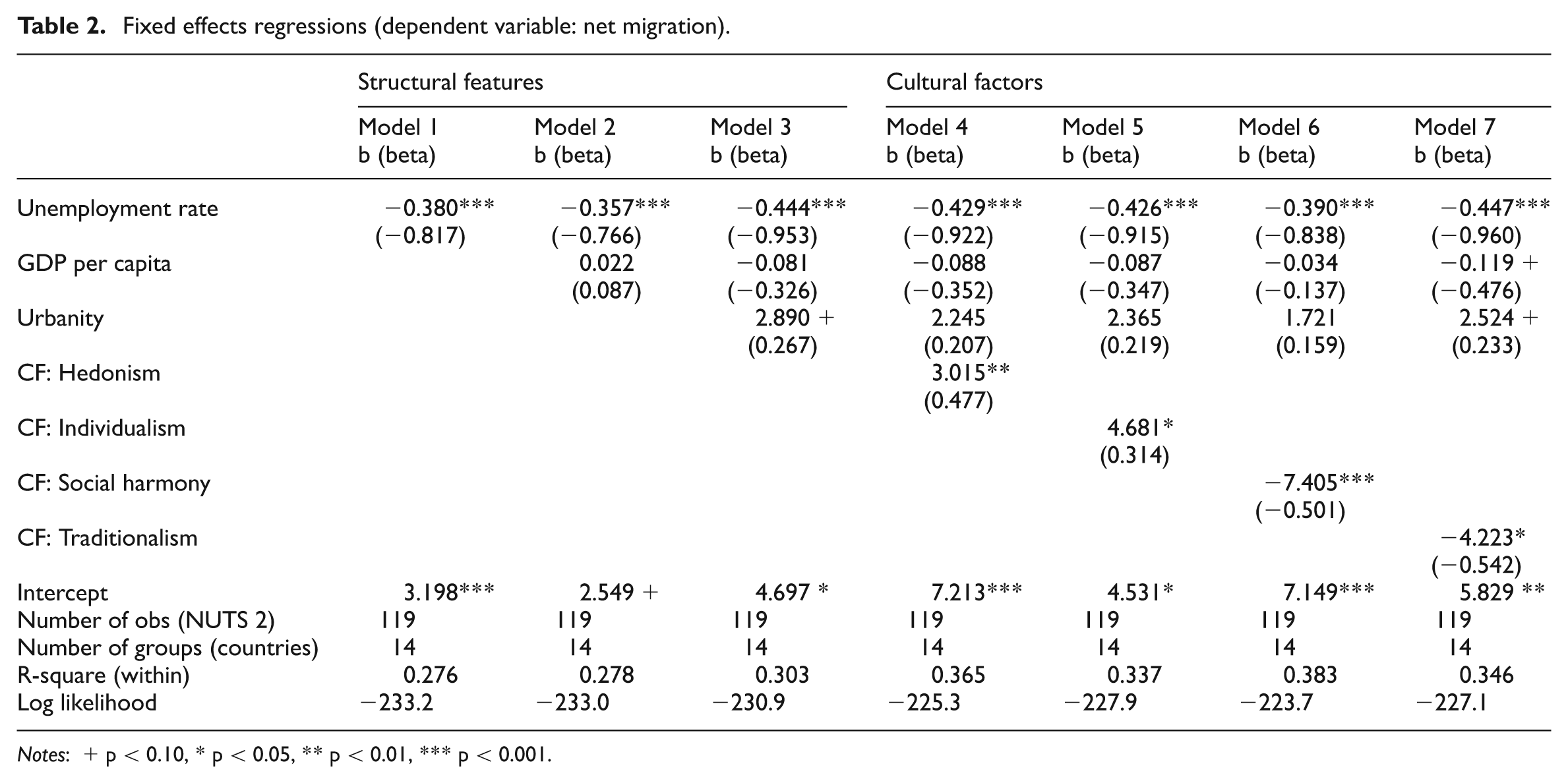
Table 2 presents findings from a series of FE-regression models with the net migration rate acting as the dependent variable. The models are extended stepwise in terms of the independent variables. Models 1 to 3 test the impact of the structural variables. Models 4 to 7 test the independent effect of each cultural factor when controlling for structural variables. 11
Fixed effects regressions (dependent variable: net migration).
Notes: + p < 0.10, * p < 0.05, ** p < 0.01, *** p < 0.001.
Model 1 begins by assessing the impact of unemployment rates on net migration in order to determine the explained variance due to this central structural variable (Huber, 2004: 622). As expected, unemployment is significantly negatively associated with net migration rates, suggesting that individuals move to regions with low rather than high unemployment rates. Moreover, unemployment alone accounts for almost 28% of the (between-NUTS 2, within-country) variances in net migration.
Model 2 extends model 1 by including GDP per capita as an explanatory variable. It is revealed that the coefficient is neither significant, nor does it contribute to increasing the explained variance of the overall model. This does not mean that the prosperity of a region does not play a role in explaining interregional migration. When creating a model using GDP as the sole explanatory variable, one receives a significant and strongly positive coefficient of GDP (not presented in Table 2). However, since unemployment and prosperity are intercorrelated, and given that model 2 controls for unemployment, the effect of GDP vanishes.
Model 3 adds urbanity (the proportion of individuals living in a big city) as a further structural NUTS 2 descriptor. As expected, the coefficient has a positive value, which is only significant at the 10% level. Similar to what was observed with GDP, it seems that unemployment (and GDP) partly absorbs the effects of urbanity. 12 As a consequence, model 3 is only slightly improved in terms of overall explanatory power when compared to model 2 (R-square increases by 2.5 percentage points).
With model 4 we begin testing the impact of cultural factors. The first factor included is hedonism. It is revealed that its coefficient is positively and significantly (1% level) correlated with net migration and increases the R-square measure by approximately 6 percentage points (from 0.30 to 0.36).
Model 5 tests for the impact of individualism. Results show that this cultural variable is also significantly positively associated with the dependent variable at the 5% level. However, it only explains around 3% of the variance of net migration rates.
Model 6 tests social harmony instead of individualism. Surprisingly, the effect coefficient indicates that this value is significantly negatively associated with net migration rates, suggesting that individuals are attracted to places where individuals are rather indifferent in terms of other people’s well-being or treatment (we discuss the possible meaning of this effect in the section below). Moreover, the effect is highly significant (0.1% significance level) and has the strongest impact of all tested cultural values; adding social harmony as an independent variable increases the explanatory power of the overall model by 8 percentage points (model 6 versus model 3).
Model 7 examines the impact of traditionalism. It is revealed that this variable is negatively associated with net migration (significant at the 5% level) and increases R-square by around 4 percentage points.
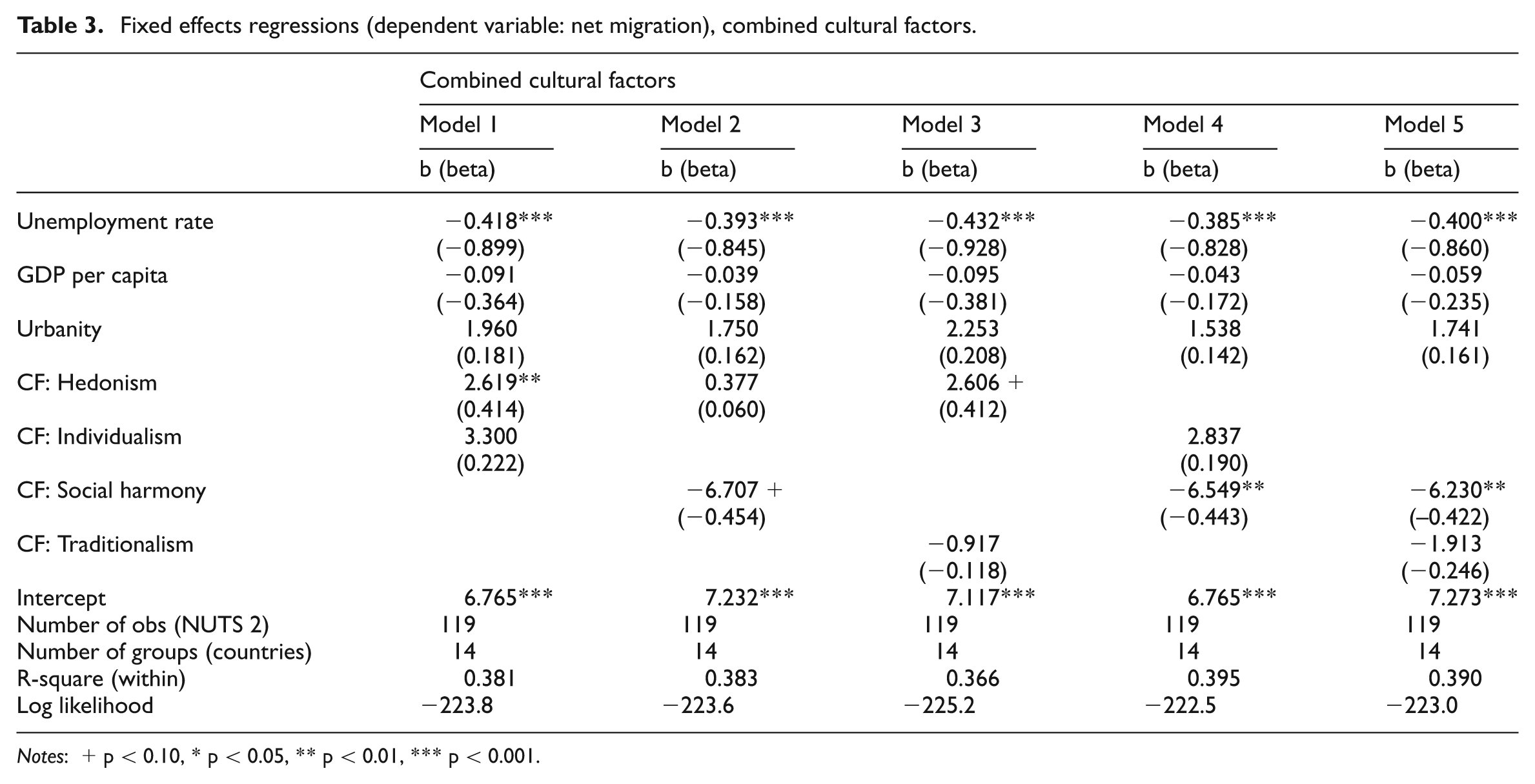
Next, we proceed with the regressions analyses presented in Table 3, which test for the genuine impact of the cultural factors when combining them as explanatory variables in the regressions.
Fixed effects regressions (dependent variable: net migration), combined cultural factors.
Notes: + p < 0.10, * p < 0.05, ** p < 0.01, *** p < 0.001.
What this series of regressions mainly shows is that when including two cultural factors as explanatory variables in the same model, only one remains significant. 13 Social harmony and hedonism are revealed to be most robust since they have stable and significant effects when combining them with both individualism (model 1 and model 4) and traditionalism (model 3 and model 5). When testing these two factors against each other, only the negative impact of social harmony remains significant at the 10% level (model 2). 14
In conclusion, we find that while all four cultural value factors are significantly correlated with net migration rates when adjusting for structural aspects of regions, the analyses revealed that social harmony and hedonism have the strongest impact. Moreover, their impact is stable when adjusting for individualism or traditionalism in the same models.
Discussion
The results of the regression models suggest two basic aspects that may explain interregional residential mobility. First and most important are structural features, especially unemployment rate, which alone accounts for approximately 28% of interregional differences in net migration. As expected, individuals are more likely to move to regions with comparatively low unemployment rates. It was revealed that against the strong effect of unemployment, both the GDP and urbanity measures – which in separate models were significantly correlated with net migration – were only of marginal relevance. It is uncertain at this point whether unemployment itself is the central leverage in net migration, or whether the unemployment index mediates a variety of other, economic-related structural features.
A second set of independent variables were the cultural properties of regions. The series of regressions revealed that the cultural composition of populations in terms of hedonism explains around 6% of the total variance, while social harmony explains 8% of the total variance (in addition to the structural features) in net migration. Moreover, we found that traditionalism was significantly negatively associated and individualism was significantly positively associated with migration; both factors, however, only explained a small proportion of variance. In sum, social harmony has the most stable impact on intra-country net migration, followed by hedonism.
The positive effects of hedonism and individualism, and the negative effect of traditionalism were in line with our hypotheses. We were expecting hedonism to have a positive effect on migration patterns because we assumed hedonistic attitudes were a more general proxy of a vibrant social and cultural life of a particular region, which in turn would become visible and manifest in a positive regional image. The cultural factor of individualism represented the dimension of a populations’ open-mindedness in trying different (traditionally independent) cultural lifestyles and behaviours. In contrast, traditionalism under modern and post-modern conditions represents a form of cultural backwardness.
It was, however, surprising to discover that social harmony was significantly negatively associated with net migration even when controlling for structural features (Table 2) and other cultural factors (Table 3). This result suggests that regions are more enticing places to live when individuals who inhabit these communities are not only more indifferent in relation to their fellow citizens, but when they are also more indifferent as to whether ‘people are treated equally and have equal opportunities’. 15 We offer three possible explanations for this finding.
First, social indifference may be a byproduct of other, positively evaluated cultural features. Correlation analyses reveal that social harmony is significantly negatively associated with hedonism. In the same way, it may also be related to other latent cultural features that we cannot operationalize in the analyses by means of the available cultural value indicators.
A second possibility is that social indifference itself operates as a type of cultural amenity. In this vein, social indifference represents the idea of a community life that is characterised by loose networks in which weak ties to friends, open partnership models, and living apart together arrangements prevail. Individuals therein conceive of traditional forms of social integration – where individuals have to commit to and care for each other – as obstacles, and not necessarily benefits, in the realisation of one’s personal lifestyle and dreams. Individuals are scared of feeling ‘socially trapped’ and therefore prefer what Florida called ‘quasi-anonymity’ (cf. Florida, 2003: 5) over ‘tightly connected communities’ (Florida, 2005: 31). However, while Florida conceives of this form of community life as an inclusive mode of integration in which – in comparison to Putnam’s conception of social capital (Putnam, 2000) – weaker ties that ‘are more open to newcomers’ (Florida, 2003: 6) prevail, the negative element of our index operationalizes a liberal-individualistic version of ‘the right to be let alone’. Solidarity is, in other words, absent rather than relaxed or realised in a different way. The negative correlation between social harmony and hedonism can also be interpreted in this way: pleasure-seeking, as an intrinsically-oriented activity is, by definition, an egoistic and not a socially-oriented behaviour; therefore, it is negatively associated with taking responsibility for other people.
If solidarity plays a role in that societal concept, then anonymous societal institutions and the welfare state (rather than family members, neighbours, or friends) have to provide social services in times of need (Esping-Andersen, 1997). 16
A third possibility is that we have to think of social harmony as the dependent rather than the independent variable when interpreting the results from the regression analyses. In this interpretation, places characterised by positive net migration rates are more likely to become places with below-average social harmony values, which is contrary to the idea that a culture that scores low on measures of social harmony leads to more individuals moving to these places. This is in accordance with Georg Simmel ([1903] 2002) and Louis Wirth (1938), who assume that a socially indifferent mentality is a consequence of urban life. The ‘reserve, indifference, and the blasé outlook which urbanites manifest in their relationships’ (Wirth, 1938: 12) should exist particularly under conditions where residents are in permanent flux. To be sure, given a certain degree of residential stability, an urban setting itself (defined by the size of the population aggregate) may well be able to create a stable community. A place that permanently exchanges its inhabitants, however, creates an atmosphere where social indifference prevails because individuals are regularly confronted with new neighbours, coworkers, and service staff in shops, restaurants, and cafés, and they are always developing or redeveloping local networks of acquaintances. This is true for both sides: those who are residentially mobile themselves and those who are passively confronted with a constantly changing population are likely to become indifferent to ongoing changes and are less likely to get too involved in new relationships.
Conclusion
The central aim of our study was to test the independent effectiveness of the cultural values – as well as the economic and ecologic (structural) properties – of regions, as factors in attracting interregional migrants.
We argued that latent cultural values become manifest in individual behaviour, thereby creating institutionalized cultural patterns that shape the image of a region. Such regional images might inspire individuals to move to a place, as these individuals expect to access certain amenities associated with this image.
Using data from the European Social Survey, we derived four cultural value factors in order to describe 119 NUTS 2 regions from 14 countries in terms of their cultural makeup. To operationalize cultural values, we used the Human Value Scale developed by Schwartz (2006). Next, we tested the impact of these cultural factors on net interregional migration rates when controlling for structural factors (unemployment rates, GDP, and urbanity).
From the findings of our analyses, we derived three conclusions. The first conclusion is that cultural values can be considered independent and relevant indicators that explain region-specific differences in net migration. Apart from the structural elements at the core of each region, we found that regional mentalities make their own contributions to the explanation of net migration patterns.
Second, our analyses revealed that interregionally mobile individuals in the investigated countries are more likely to move to destinations characterised by hedonistic and individualistic attitudes, while they avoid places inhabited by individuals with traditional or harmonious values. The individual effects of these indicators were robust when controlling for economic and structural factors.
Third, we found that there was a significantly negative impact of social harmony on net migration. We offered three possible explanations as to why these results were obtained. First, these results could be an outcome of unobserved heterogeneity. A second possibility is that loose social relationships are attractive because they are associated with freedom, self-development, and the absence of confining network inclusions. Third, the empirical result can be interpreted as a consequence rather than as a cause of residential mobility. Regions characterised by above-average inflow rates may develop an atmosphere of social indifference, since social relationships change too often for individuals to get involved in deep and meaningful friendships. Thus, under conditions characterised by a permanent exchange of residents and by unstable networks, individuals are likely to develop reserved attitudes toward social relationships. Further analyses will have to clarify which of these explanations grasps best.
Footnotes
Funding
This research received no specific grant from any funding agency in the public, commercial, or not-for-profit sectors.