



Abstract
Life course events such as new offspring or job loss affect a household’s demand for housing. At the same time, dynamics in the real estate market constrain where households find affordable housing. In a quasi-experimental design, this study examines the effect of increasing local housing prices on the relocation behaviour of low- and medium-income households. Difference-in-difference panel regressions using propensity score matching show that with rising local rental prices, low-income households are more likely to remain in their current housing and sustain higher levels of housing cost burden. If they move, they relocate further out of the city centre and to neighbourhoods with high unemployment rates. Rising housing markets facilitate socio-spatial segregation as middle-income households remain in economically better-off neighbourhoods. The findings highlight the additional costs of increasing housing prices in terms of the misallocation of housing and the spatial concentration of vulnerable households at the outskirts of cities.
Introduction
Housing affordability and rising social inequality in cities have become a major global problem (UN Habitat, 2011). In the past decades, inner cities have regained attraction not only among students and youngsters but across many demographic groups who benefit from the economic and cultural opportunities. National and international migration flows to cities have increased the competition for affordable housing. At the same time, speculative purchasing prices and reduced availability of social housing makes finding affordable housing increasingly difficult. The affordability crisis started with low-income and migrant households but has already reached middle-income families and key workers (Morrison and Monk, 2006). House market developments can potentially enhance social inequalities. Rising prices in attractive districts have been shown to displace former residents (Lees, 2008), affordable and social housing on the outskirts have increased the concentration of poverty there (Hochstenbach and Musterd, 2017) and the limited availability of large apartments forces even native middle-class families to move to the periphery (Busch, 2016). However, the way housing markets shape the residential choice of households is little understood (see Baker et al., 2016).
This study investigates how increasing housing prices affect the residential choice of low- and medium-income households. Using a quasi-experimental methodology, the results show that low-income households react differently to increasing prices than do middle-income households. The former endure the housing burden, namely, excessive high rent-to-income and space-to-occupant levels, and stay put. If they move, they are more likely to end up further away from the city centre and in areas with higher rates of unemployment. The results highlight the importance of incorporating the local housing market as a key dimension in understanding residential mobility (Coulter et al., 2015).
The study advances previous research on residential mobility and displacement in several ways: (1) uniquely detailed data on price, demand and supply of housing are linked to the largest household panel in Germany, the German Socio-Economic Panel (SOEP). This enables fine-grained analysis of the influence of housing market dynamics at the household level; (2) a difference-in-differences research design with household fixed-effects is applied to extract the effect of housing prices on residential mobility from other known predictors of moving such as partnership and family events; (3) a central critique when studying the effect of neighbourhood change on residential choices is the definition of a proper comparison group (Newman and Wyly, 2006; Slater, 2009). In this study, control units are selected based on propensity score matching on pre-treatment variables. This way, selected households in stable versus tight housing markets are structurally similar with respect to their life course, housing and neighbourhood contexts.
Residential mobility and the housing market
The life course perspective on mobility emphasises the interaction of life course trajectories in the decision to move (Mulder and Hooimeijer, 1999). A large empirical body of literature associates several life course events with a higher probability of moving, such as planning and starting a new family (Kulu and Milewski, 2007; Vidal et al., 2017), forming partnerships and separation (Clark, 2013; Clark and Lisowski, 2017), beginning a new job (Böheim and Taylor, 2002) or leaving the workforce (Kramer and Pfaffenbach, 2016).
Several authors have raised the criticism that research on residential choice has put a one-sided focus on the consumption of housing, namely, the residential preferences and aspirations of households (Allen, 2010; Hedman et al., 2011). Being unable to realise the housing that is aspired to is usually attributed to a household’s limited resources. A contrasting view would be to make the tight housing market the subject of concern. Socio-spatial theories highlight that the housing market is not naturally produced but, rather, specific actors such as landlords, banks, agents, housing associations and politicians consciously and unconsciously restructure the local housing market and therefore produce spatial outcomes (Aalbers, 2006). Coulter et al. (2015) argued that residential mobility should be reconsidered as a relational practice that rests more strongly on ‘linked lives’ and structural contexts than is currently conceptualised. The role of neighbourhoods in residential choice has received increasing attention in the last decade (Clark et al., 2006; Hedman et al., 2011; Pinkster et al., 2014; van Ham and Feijten, 2008), however, few studies exist that model housing market processes explicitly in the residential choice of households (Ioannides and Zabel, 2008).
Literature on gentrification and displacement recognises the housing market as a decisive factor in the residential decisions of households. Rising demand and local housing prices put pressure on vulnerable households particularly. However, the relationship between rising local housing prices and displacement is inconclusive. Several empirical studies show similar relocation rates between households in gentrifying and non-gentrifying neighbourhoods (Ellen and O’Regan, 2011; Freeman and Braconi, 2004; Vigdor et al., 2002). Suggested reasons for this are a preference for better neighbourhood amenities and residents who are able to increase their social standing as a result of better economic opportunities (Hamnett, 2003; McKinnish et al., 2010) Accordingly, gentrification is interpreted as beneficial not only for higher-income households but also for less privileged households.
In contrast, ethnographic studies repeatedly highlight the hardship and struggle of vulnerable households when the neighbourhoods they live in start to gentrify (Boyd, 2005; Curran, 2018). Studies found that residents spent a greater proportion of income on rent (Newman and Wyly, 2006) and faced higher levels of overcrowding (Koch et al., 2016). However, there is a lack of longitudinal and causal investigation on whether this excessive housing burden can be attributed to higher housing prices or whether it rather reflects structural differences between residents in tight versus stable housing markets.
The present study investigates the influence of local housing market developments on residential mobility. It is guided by the question: do rising local housing prices have a differential effect between low- and medium-income households on when and to where households decide to move? In particular, do low-income households endure an excessive housing burden because of rising local housing prices or is this relationship attributable to other individual factors? The second part of the analysis focuses on the question: if low-income households relocate, can they improve their neighbourhood context, or do they move to areas further away from the city centre and to areas of high unemployment?
To separate the impact of rising housing markets from other life course determinants, a quasi-experimental methodology is applied that relates changes in the housing burden of households to changes in local housing prices. Studies on displacement are often criticised for their inability to find comparable households in affected versus non-affected areas (Slater, 2009). To make households structurally comparable regarding their initial life course, housing and neighbourhood situation, control units are selected based on propensity score matching.
In the past decade, large German cities have experienced a sharp increase in housing prices. 1 Particularly in the for-sale sector, prices have increased by 60% in the seven largest cities (Just et al., 2017). Eventually, this translates into pressure on rental prices, which increased by more than 5% per year in the seven largest cities while nominal wages rose by only around 2.5%. 2 According to Eurostat, 15.6% of households in Germany suffer a high housing-cost burden, that is, they spend more than 40% of their disposable income on housing. 3 This is the third highest value in the European Union. Although strong tenant rights make direct displacement less of a concern, a decrease in affordable housing in inner cities and an increase in vulnerable households at the periphery of cities has been observed (Goebel and Hoppe, 2015; Häußermann et al., 2004; Holm, 2013). 4
Empirical approach
Method
The study focuses on two questions: First, how do rising local housing prices affect the probability of relocation? Second, how do rising prices affect the decision of which neighbourhoods households relocate to, regarding distance to the city centre and local unemployment rates? A difference-in-differences (DID) design with household fixed-effects is used to assess the behaviour of households over time. Local rent price increases resemble the continuous treatment dose. 5 Pre-treatment matching is applied to make treatment and control units more comparable with regard to the household and neighbourhood structure. In line with previous research, the cut-off points for low- and medium-incomes are the 40th and 80th income percentiles (see Pinkster et al., 2014). 6
For the first part, two situations are examined that usually put pressure on households to relocate. In particular, excessive housing cost burden, which occurs when a household is required to pay more than 40% of income on rent; and excessive space burden, which occurs when a household has fewer rooms than appropriate for the size of the household. 7 The difference in relocation probability of households in steady markets before and after these excessive housing burdens is compared with that of households in rising markets.
For the second part, the distance to the city centre and the local unemployment rate are compared before and after relocation. In a cross-sectional analysis, the correlation between local prices and outcomes might be spurious, as changes due to social mobility of existing residents and changes due to migration cannot be distinguished. Household fixed-effects incorporate all unobserved time-invariant changes at the household level that potentially alter both the variable of interest and the outcome.
The regression model can be written as follows:
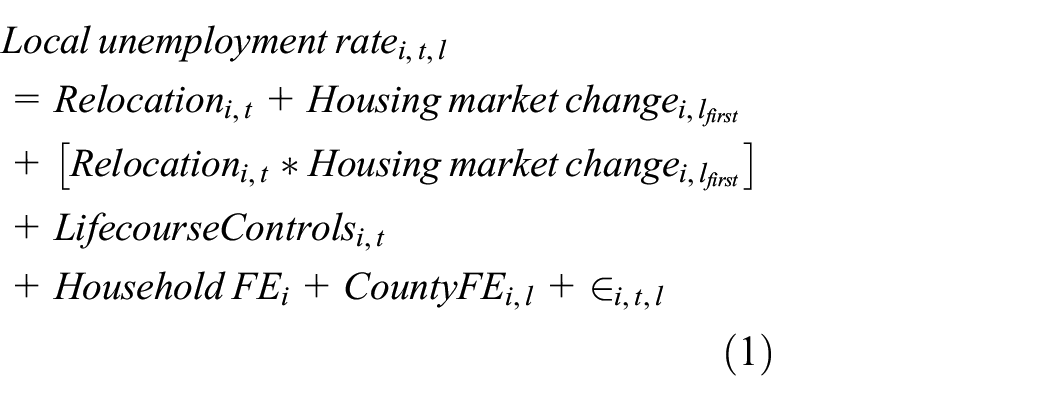
with i indicating a household observed at year t and location l. The location l_first indicates the original location of a household, that is, the first housing and neighbourhood setting before any relocation. The set of variables LifecourseControls captures changes in the life course of a household over time, such as becoming widowed or having children. NUTS3 region fixed-effects account for different average levels of the outcome variable when moving between 402 counties.
Burden indicators are evaluated with respect the housing costs and space of the initial dwelling. In this way, the direction of the effect from outcome to cause is ruled out. Following Hainmueller et al. (2019) for applying multiplicative interaction models, marginal effect plots are shown to interpret the estimated results over the relevant range of local price changes. Histograms are attached to the plots to evaluate the common data. Estimates for low-, medium- and high-price changes (binning estimator) make it possible to assess the linearity assumption of the interaction effects.
Data
The SOEP is the largest household panel in Germany. It started in 1985 in West Germany and was extended to East Germany by 1990 (Wagner et al., 2007). It provides comprehensive information about the economic, residential and social situation of households and their members. For the analysis, 56,210 observations of 12,837 households are considered for the years 2007 to 2016. 8 Observations located in the top and bottom 1% of local price changes are removed to improve common data support and limit the influence of extreme values (2,229 observations). As home ownership requires extensive financial security and is often considered a once-in-a-lifetime decision in Germany, the analysis focuses on initial tenant households.
The postcode information of each household is used to link the SOEP to the regional housing market. ImmobilienScout24.de is the largest online market platform in Germany. As a market leader with around 1.2 million listings per month, ImmobilienScout24 covers the vast majority of housing offers in Germany. 9 For each listing, information on rental price, number of rooms, contact request, social housing status and location is aggregated at the postcode level.
Additional neighbourhood indicators such as the local unemployment rate are provided by MICROM GmbH (Goebel et al., 2014). By consolidating several public and private data sources, MICROM offers fine-grained information on neighbourhood structures. In cooperation with the SOEP, yearly MICROM variables are linked to SOEP household-year observations. Several variables are employed in the pre-treatment matching to better capture the neighbourhood contexts such as the share of migrants, neighbourhood status and the relocation volume in the fine-grained postcode-8 area. 10
Pre-treatment matching
In an ideal natural experiment, treatment is assigned randomly and does not depend on any pre-treatment variables nor the outcome. This is the case if the control and treatment groups differ only in their treatment assignment but are otherwise similar (Imbens and Wooldridge, 2009). However, this is often not the case with observational data. Matching is one method to reduce model dependency by balancing treatment and control groups on observed covariates (Rubin, 1973).
Although the DID research design with household fixed-effects mitigates the effect of group differences, they could still differ in more substantial terms. Nearest neighbour matching is performed to make treatment and control units more comparable with regard to household structure and initial neighbourhood context. Each household enters the matching sample in their first year of observation. A regression-based propensity score is estimated to select the best control match for each observation in the treatment group. Observations outside the support of the distance measure are discarded (15 households). The 70th percentile of the price change distribution (or a price increase of 3.9% per year) distinguishes rising and steady housing markets. For the main analysis, local price change is entered as a continuous variable. 11
The results show an overall improvement in the comparability of control and treatment units. 12 Before matching, households in rising (versus steady) housing markets experience higher average levels of housing cost burden and room stress. They are less often retired and widowed, and reside in areas closer to city centres with a higher share of migrants and purchasing power. After matching, the means and standard deviation of all life-course-related variables are not significantly different according to a two-sided t-test. Pre-treatment matching also removes control units in less expensive and less popular regions.
Results
Descriptive results
Table 1 provides summary statistics of variables by income group and local housing demand.
Descriptive statistics.
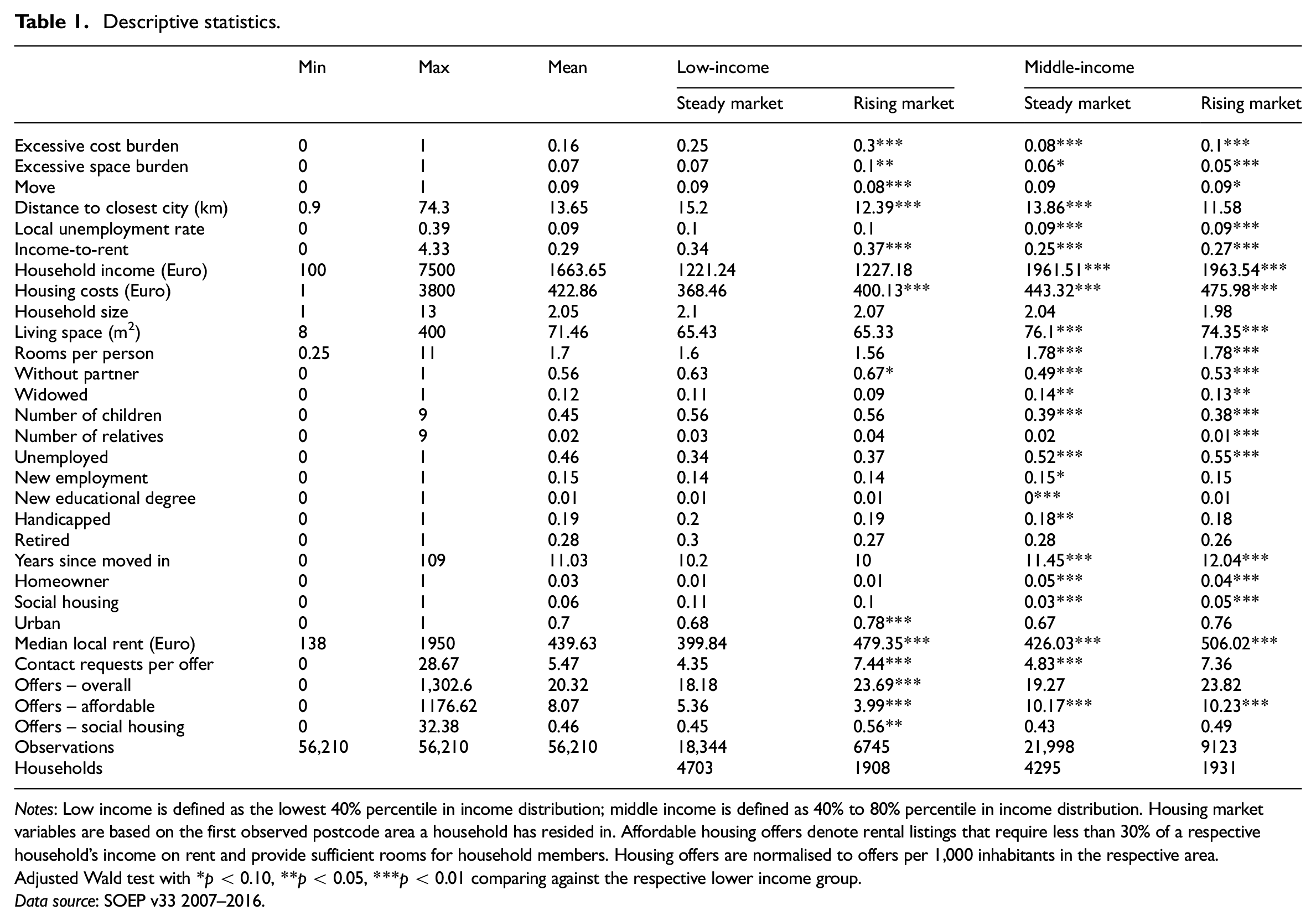
Notes: Low income is defined as the lowest 40% percentile in income distribution; middle income is defined as 40% to 80% percentile in income distribution. Housing market variables are based on the first observed postcode area a household has resided in. Affordable housing offers denote rental listings that require less than 30% of a respective household’s income on rent and provide sufficient rooms for household members. Housing offers are normalised to offers per 1,000 inhabitants in the respective area.
Adjusted Wald test with *p < 0.10, **p < 0.05, ***p < 0.01 comparing against the respective lower income group.
Data source: SOEP v33 2007–2016.
In rising housing markets, low-income tenants are more likely to suffer excessive housing costs and space burdens than middle-income tenants by 20 and 5 percentage points, respectively. At the same time, they face greater room stress as on average they reside in smaller dwellings and with more household members. Regarding neighbourhood context, they live in neighbourhoods with a higher average unemployment rate. The differences between income groups still exist for households in steady housing markets but are much less pronounced.
Households in rising housing markets are primarily located in urban regions and in neighbourhoods with a higher average unemployment rate and that are closer to the city centre. Around 70% of households in rising markets live in urban regions. As 67% of households in steady markets live in urban areas, rising prices neither apply to all neighbourhoods of a city nor to all cities in general. Regarding the tenure structure in those markets, 10% of low-income households reside in subsidised housing while this is the case for only 4% of middle-income households.
Differences in life course contexts exist mainly between but not within income groups. For example, independent of whether households reside in steady or rising housing markets, the number of children, cohabitation, level of handicap or retirement status do not show differences within low-income samples.
Rising housing markets and the probability to relocate
Figure 1 visualises the marginal effects of excessive cost and space burden on the probability of relocation, moderated by local rent price increases. 13 The underlying regression models include household and county fixed-effects as well as life course control variables. The 95% confidence intervals are displayed in grey. The histograms at the bottom of Figure 1 indicate common data support for price changes between −5% and +15% for movers (grey histogram) and stayers (white histogram).
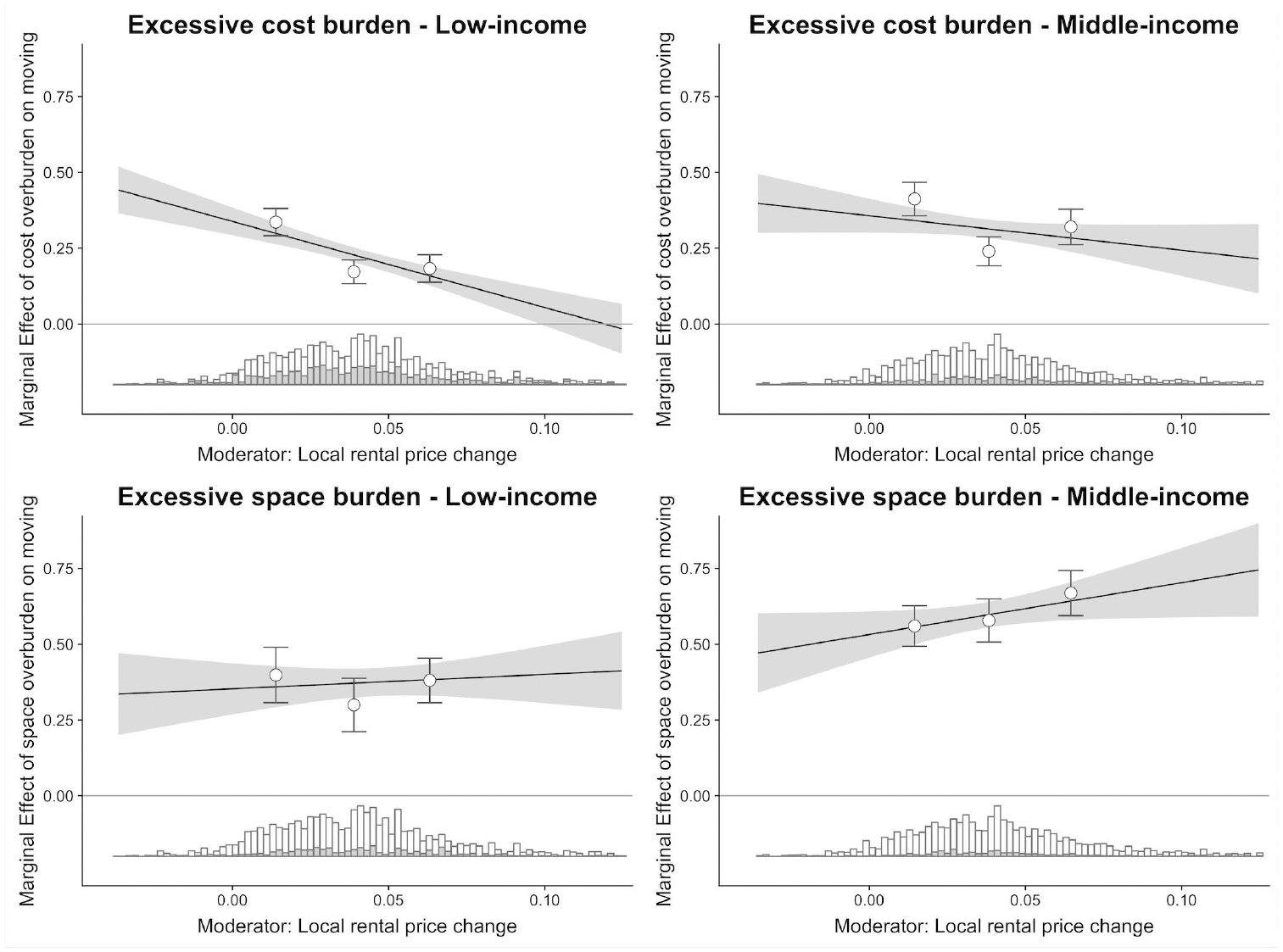
Marginal effects plot – excessive housing burden.
In the case of zero price changes, excessive costs and space burdens relate to a similarly higher probability of relocation for both income groups. In other words, households move if they face too little space or too high costs. For an excessive cost burden, rising local prices dampen the probability of relocation for both income groups. However, low-income households are much more strongly affected by this dampening effect: according to the estimates, for them a 10% local price increase per year makes relocation less likely by −28.5 percentage points. For middle-income households, this effect is much lower at around 10 percentage points but not significant in the full model. Binning estimates for the lowest-, middle- and highest-third of price increases indicate a U-shaped rather than a linear effect (white points and 95% confidence interval, Figure 1). Households in markets with very little or even negative price changes might be eager to move away. The marginal effect becomes stronger again in the top rising markets, particularly among middle-income households.
Excessive space burden has a positive effect on relocation for both income groups. For low-income households, the regional housing market barely alters the strength of the effect. Middle-income households are much more likely to move when prices increase. As described above, household units are selected based on propensity score matching. Regression results for the unmatched sample (see Appendix A2, available online) show much stronger effect sizes. This suggests structural differences in the treatment and control group that are mitigated by propensity score matching.
Rising housing markets and relocation outcomes
Figure 2 visualises the marginal effects of moving on distance to the closest city centre (top) and on the local unemployment rate (bottom) for low- and middle-income households. There is strong evidence from the regression estimates that low-income movers relocate further away from the city centre. If local prices increase by 10% per year, low-income movers end up in neighbourhoods that are on average 1.5 km further away. The effect for middle-income households is not significantly moderated by local rental price changes.
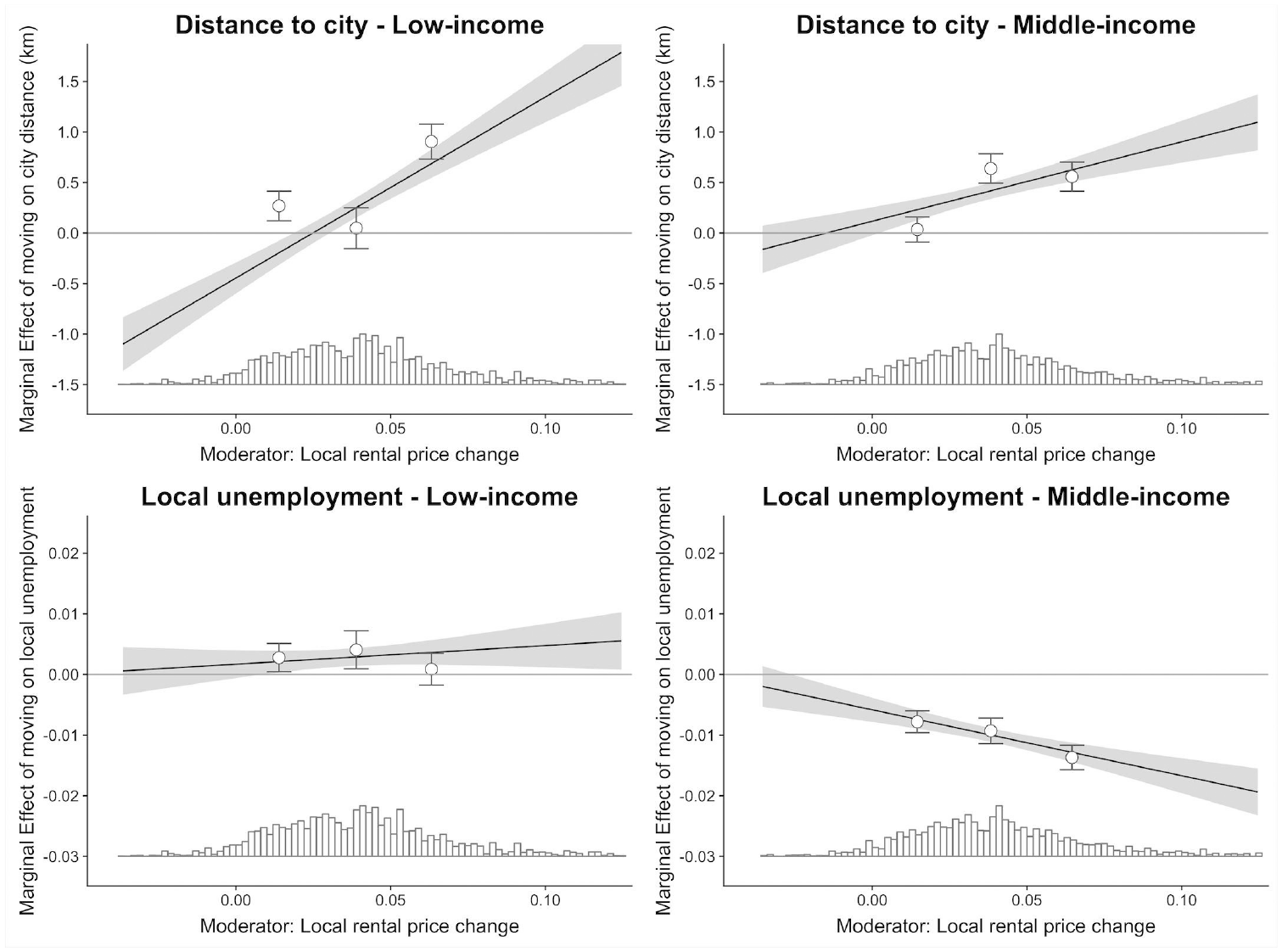
Marginal effects plot – moving.
The estimates support the argument that rising housing markets foster social segregation through selective mobility. Accordingly, there is significant indication that low-income households end up in neighbourhoods with higher unemployment rates when local housing markets are rising. If prices increase by 10% per year, low-income households move to neighbourhoods where the local unemployment rate is 60 percentage points higher than before.
Again, estimation based on the unmatched sample revealed a much stronger effect size (see Appendix A2, available online). Comparing affected households with all other households seems to overestimate the effect as it does not account for structurally different household contexts. Propensity score matching helped to mitigate selection effects.
Discussion
The hidden costs of rising housing markets
Access to affordable housing defines in what kind of dwelling and neighbourhood a household can reside. At the same time, where people live has lasting effects on their life chances (Chetty et al., 2016; Stephens and Leishman, 2017). Therefore, dynamics in the housing market might enhance spatial inequalities (Pawson and Herath, 2015). The present study shows that rising housing markets affect the residential choice of low- and middle-income households differently. In times of rising local housing prices, low-income households become less likely to relocate when faced with excessive housing burdens.
This has several implications. First, lower mobility means a potential misallocation of housing. Households are likely to remain in housing that is too small or too large if moving is costly. The aggregated effect would be to restrict supply and raise prices even further. Reduced mobility would affect not only vulnerable households but would also extend to other income groups. There are early signs that this is the case in Germany. Mobility rates in the 20 largest cities have declined from 15% to 8.6% in the last 7 years. 14 Second, the lack of affordable housing can change where households search for new jobs. Low-skilled labour might be prevented from moving into regions with high labour demand as housing costs are too high. Past research shows that limitations in labour mobility have substantial adverse effects on aggregated productivity (Glaeser and Gyourko, 2018; Hsieh and Moretti, 2017). Third, residing in low-price housing segments on the outskirts of the city imposes additional costs on their residents. Longer commuting times have implications for fuel and car maintenance costs as well as intangible costs such as less time for recreation or time spent with the family (Belsky et al., 2005). If such neighbourhoods correlate with high crime rates and levels of pollution, residents are also exposed to additional health risks (Galster, 2012). Fourth, a social-spatial concentration at the periphery creates costs for the municipality (Galster et al., 2008). Direct public costs occur to maintain local infrastructure and transport systems that allow access to city centres. Potential indirect costs arise if educational and career opportunities of residents are limited. This would require additional social welfare transfers and lower income tax in the long run.
If preventing social residential segregation is a political goal, creating affordable and accessible housing options for mixed-income households is critical. According to the OECD, however, a reverse trend can be observed: […] rising socio-economic inequalities are gentrifying and dividing European and North American cities and making adequate housing increasingly unaffordable for low- and middle-income households. A near unanimous belief in homeownership has drastically reduced rental housing stock which is a vital tenure option for many households […] Governments in European and North American countries have largely retreated from providing ‘social’ housing in favour of ‘enabling the market’, yet the market has not provided land and housing that is affordable to low-income households. (UN Habitat, 2011: xii)
While subsidised housing requires proof of eligibility based on income, this is not the case for other types of housing. An increase in private housing supply alone is not necessarily successful in providing affordable housing when demand is high (Fingleton et al., 2018; van den Nouwelant et al., 2016: 161). Better-off households offer more steady employment and financial conditions which make them more attractive for landlords. A more sustainable approach requires the extension of housing supply to be accompanied by additional measures. For example, inclusionary policies link the construction of market-rate housing to the creation of affordable homes for less privileged households (Thurber et al., 2018). In several countries such as Germany and France, it is a requirement of any new development project that a share of social housing should be provided. A relaxation in building requirements and additional rent cap regulations are frequently discussed in German policy debates (Hendricks, 2016).
Robustness checks
Some limitations of this research need to be pointed out. Potential concerns could arise regarding the measurement of excessive housing burden. First, the indicators enter the regression in a binary fashion with respect to official thresholds for excessive housing cost and space burden. For example, the threshold of excessive cost burden is 40% of income spent on rent. Changes in the rent-to-income variable from 39% to 41%, therefore, enter the regression in the same way as changes from 20% to 60%. The perceived burden is arguably much greater in the latter case. In a sensitivity analysis, housing cost burden and room stress enter as continuous variables. 15 The results are in line with the main findings.
Second, changes in the intensity of housing cost burden are measured similarly across income groups. As pointed out by Nepal et al. (2010), middle-income households might be willing to spend more on amenities without perceiving it as an additional burden. The findings are in line with the criticism and underline that low-income households are a much more vulnerable group particularly in rising housing markets.
Third, the anticipation of a future burden might lead to relocations before the actual event. For example, households who plan to have another child might relocate to a larger dwelling some years in advance. If anticipation effects are randomly distributed across households in steady and rising markets, estimates in the DID design would not be biased. However, if anticipation effects are stronger in rising markets, the estimates would indicate that there would be less relocation resulting from excessive burden though relocation took place before. Figure 1 suggests the opposite as anticipation effects seem more prevalent in steady housing markets. In a sensitivity regression, the indicators for excessive housing burden are lagged by 1 year. The estimates are in line with the results presented here.
Another concern regards the use of price data from the largest property portal in Germany as it does not necessarily capture the entire housing market. A share of housing offers might appear on other platforms or marketing channels. If such marketing channels are used randomly across regions and price segments, effects would still be estimated consistently. If they are more popular among affordable housing offers in rising housing markets, however, the moderator variable would overstate the actual local rental price change. For the years 2017 to 2018, price increases could be computed based on the three major online real estate portals in Germany. However, results from the sensitivity regression are in line with the main findings.
In the analysis, the treatment dose is based on the median price of a postcode region. Changes in the median could originate from price changes of similar apartments or from changes in the housing stock offered. It is argued that the origin of price changes is not crucial here as they reflect the de facto supply of housing. Even if it would be more accurate to extract the conditional price development from hedonic prices, movers still rely on what is offered in the market.
Another concern regards the exogeneity of the local housing market development. Households may relocate to neighbourhoods because of preferences for particular neighbourhood amenities. If the same amenities make future rental price increases more likely, the estimated interaction effect would be biased. Pre-treatment matching is applied to make selected households in steady and rising housing markets more comparable. The development of the housing market is generally beyond the control of single residents. However, the in-movement of households with certain dispositions that trigger price increases can still not be entirely ruled out. In a sensitivity regression, only households who have lived at the same address for 3 years or longer are considered. The results are in line with the main findings.
Conclusion
This article examines the effects of increasing local housing prices on the relocation behaviour of households. The proportion of income spent on housing has increased substantially in many countries and has made housing affordability a pressing urban problem. Previous research had difficulty in explaining why mobility rates of low-income households are similar between neighbourhoods with rising and stable prices. Explanations ranged from a preference of households for better local amenities to a limited ability to find adequate housing. The present study sheds light on the validity of these arguments by applying methods that causally relate local price developments to the decision of when and where to move. A unique data set is used that links online housing offers to the largest representative household panel in Germany. A difference-in-differences research design with household fixed-effects is applied to reduce the influence of confounding explanations. A central critique when studying the effect of neighbourhood change on residential choices is the definition of a proper comparison group. In this study, control units are selected based on propensity score matching on pre-treatment variables. This way, selected households in stable versus tight housing markets are structurally similar with respect to their life course, housing and neighbourhood contexts.
The results show that housing affordability has a differential effect on the relocation behaviour of households. Low-income households are less inclined to move when local housing prices increase and therefore they endure excessive housing costs. The levels of sustained burden do not support the interpretation that rising neighbourhoods are beneficial. Not moving and paying more than 40% of income on rent is not sustainable for low-income households, even those with a high willingness to pay for local amenities. Rather, explanations other than preferences seem more reasonable, such as the inability to find an affordable apartment and the fear of being pushed out of inner cities. If they move, they relocate further out of the city centre to neighbourhoods with high unemployment rates. Rising housing markets facilitate socio-spatial segregation as middle-income households remain in economically better-off neighbourhoods.
Some limitations of the study should be pointed out. First, while Germany shares socio-economic and demographic characteristics with other Western countries, differences exist, for example, with respect to the housing regime and the intensity of residential segregation. Future research should investigate if the observed relationships remain across different housing regimes and periods. Second, the motivation of the study is to extract the effect of housing prices on residential mobility from other known or unobserved factors. Some previous conclusions have been drawn from descriptive correlations rather than causal inference methods as applied here. Even then, the fundamental meaning of a neighbourhood and the struggles experienced cannot be fully grasped by standardised surveys. The estimated relations can support ethnographic enquiries to better understand residential processes. Third, concerns can arise from the way housing burden and regional price changes are measured and implemented. However, several sensitivity checks presented above underline the robustness of the findings.
Rising housing prices can lead to housing over- and under-consumption as households reduce their mobility and the residential concentration of vulnerable households is fostered. This implies social costs on different levels. On the individual level, where people can afford to live can have lasting effects on their life chances. On the municipal level, disadvantaged neighbourhoods can suffer from high levels of crime and concentrated school problems. On the regional level, economic inequalities across regions might foster social and political polarisation.
The results of this study highlight the importance of integrating dynamics of the housing market into the study of residential mobility and spatial processes. Such dynamics are not given but are shaped by actors in the housing market. The ‘choice’ in residential choice should, therefore, be treated with caution. Future quantitative research on residential choice and social-spatial segregation should attempt to model the supply side of housing more explicitly. This would help to better understand the structural roots of residential outcomes and inform policies that can prevent displacement.
Supplemental Material
09_HousingAffordabilityApart_SupplementaryTables – Supplemental material for Housing affordability sets us apart: The effect of rising housing prices on relocation behaviour
Supplemental material, 09_HousingAffordabilityApart_SupplementaryTables for Housing affordability sets us apart: The effect of rising housing prices on relocation behaviour by Tim Winke in Urban Studies
Supplemental Material
10_HousingAffordabilityApart_SupplementaryFigureA6 – Supplemental material for Housing affordability sets us apart: The effect of rising housing prices on relocation behaviour
Supplemental material, 10_HousingAffordabilityApart_SupplementaryFigureA6 for Housing affordability sets us apart: The effect of rising housing prices on relocation behaviour by Tim Winke in Urban Studies
Supplemental Material
10_HousingAffordabilityApart_SupplementaryFigureA7 – Supplemental material for Housing affordability sets us apart: The effect of rising housing prices on relocation behaviour
Supplemental material, 10_HousingAffordabilityApart_SupplementaryFigureA7 for Housing affordability sets us apart: The effect of rising housing prices on relocation behaviour by Tim Winke in Urban Studies
Supplemental Material
Winke_09_HousingAffordabilityApart_SupplementaryMaterial – Supplemental material for Housing affordability sets us apart: The effect of rising housing prices on relocation behaviour
Supplemental material, Winke_09_HousingAffordabilityApart_SupplementaryMaterial for Housing affordability sets us apart: The effect of rising housing prices on relocation behaviour by Tim Winke in Urban Studies
Footnotes
Acknowledgements
I would like to thank André Schmelzer, Johannes Hemker, Clara Welteke, Anette Fasang and Martin Kroh for providing valuable comments. I am grateful to SOEP/DIW Berlin and Immobilien Scout GmbH for providing data and facilities.
Funding
The author received no financial support for the research, authorship, and/or publication of this article.
Declaration of conflicting interests
The author declared no potential conflicts of interest with respect to the research, authorship, and/or publication of this article.

Supplemental material
Supplemental material for this article is available online.
Notes
References
Supplementary Material
Please find the following supplemental material available below.
For Open Access articles published under a Creative Commons License, all supplemental material carries the same license as the article it is associated with.
For non-Open Access articles published, all supplemental material carries a non-exclusive license, and permission requests for re-use of supplemental material or any part of supplemental material shall be sent directly to the copyright owner as specified in the copyright notice associated with the article.


