



Abstract
The phrases ‘new uses need old buildings’ and ‘old buildings require new uses’ emphasise the mutually reinforcing relationships between historic buildings and new activities in cities. What the phrases do not say are the challenges and incompatibilities that are part of the urban redevelopment process. Singapore’s inner city has been transformed since the 1990s with the introduction of new economies. This paper focuses on one precinct that has undergone land use change – Little India. The concept of ‘gentrification aesthetics’ provides a suggestive frame to explore the form and outcome of urban change, as well as its contestations when new arts and cultural activities occupy historic buildings. Gentrification aesthetics as conceptualised in the West takes on different perspectives in Singapore, prompting questions on whether a ‘Singapore style gentrification’ is evolving – one that melds urban redevelopment with state ideology in arts enhancement and aesthetic regulation.
Introduction
Jane Jacobs’ aphorism ‘new uses need old buildings’ and its inverse ‘old buildings require new uses’ underscore the mutually reinforcing relationships between historic buildings and emerging activities in cities. However, these phrases also mask the challenges that old buildings and neighbourhoods can pose to fledgling economies, as well as the incompatibilities of such activities in historic structures and landscapes. This paper explores an emerging economy in Singapore – arts/cultural services – which has transformed downtown neighbourhoods in significant ways. The old buildings in question are shophouses first developed in 19th century Singapore as work/residential spaces for an immigrant population. Today, the remaining few shophouses represent an indigenous architectural form that is fast vanishing in a globalising city. At the same time, these historical buildings have also emerged as spaces for burgeoning businesses in the creative, entertainment and tourism sectors (Chang and Teo, 2009).
The gentrification discourse derived from a Western/developed urban context has spawned alternative interpretations in novel settings (Atkinson, 2003). Although the term gentrification is seldom used in Singapore, urban redevelopment efforts have been massive and often state-led as evident by the government’s lifting of the Rent Control Act (in 1989) which precipitated a wave of adaptive reuse in the 1990s, and the establishment of the Arts Housing Scheme (in 1985) which provides state-subsidised rentals to select cultural organisations. Unlike residential-oriented gentrification in pioneering cities, the scenario in Singapore has been mainly commercial, with activities and businesses deemed compatible dominating historic neighbourhoods. In some cases, ‘new-build’ and ‘tourism gentrification’ (Davidson and Lees, 2005; Gotham, 2005) have also taken place, with ‘new old-looking’ hotels constructed on the sites of demolished buildings.
This special issue interrogates the derivative nature of the gentrification discourse and its application in East Asia. Even though ‘gentrification’ is a seldom-used term in Singapore, the unmistakable shape, form and aesthetics of normative gentrification (as understood in the literature) have appeared in many inner-city neighbourhoods especially since the 1990s. The concept of gentrification aesthetics offers a way to frame the similarities and differences in urban redevelopment process and outcomes between Western and Asian cities. To do so, the geographical contingencies of planning in Singapore must first be understood. We also need to ask whether gentrification suitably denotes the processes of change in Singapore and if not, what other forms of development are taking place and are thus deserving of more appropriate indigenous expressions.
The next section contextualises the gentrification literature as it pertains to arts/culture. Rather than rehearse the ideas on ‘classic’ gentrification (for reviews, see Lees, 2012a; Lees et al., 2008), a brief overview suffices as I focus specifically on aesthetics and how/why it matters. Aesthetics is an important dimension in Singapore’s urban change and the concept of gentrification aesthetics provides a suggestive frame to apprehend how arts and culture have aestheticised the city. The geographical contingencies of Singapore’s development are then acknowledged followed by the empirical case of Little India. The conclusion revisits questions about the relevance of gentrification discourse and the possibility of an evolving Singapore style transformation that marries artistic development with state control in urban planning.
Gentrification aesthetics and the urban experience
The term gentrification was originally coined by Ruth Glass in 1964 to describe changes taking place in 1950s London. Its classical view speaks of rehabilitation of working-class neighbourhoods in urban centres by middle-class developers and home owners, resulting in a reinvestment of capital in the city and replacement of original inhabitants by a more affluent community (first wave gentrification). The phenomenon has since expanded to include cities further down the urban hierarchy as well as changes in rural locations, infill housing and brownfield sites (second wave gentrification). A third wave has since been observed, linking gentrification to broader systems of capital accumulation and globalisation. Lees (2003) identifies five characteristics here. Spatially gentrification has transcended the core of familiar Anglo-American cities, and locationally gentrification is no longer restricted to the downtown but has spread to suburbs and beyond. In terms of agency, gentrifiers include a widening array beyond middle-class individuals and involve business organisations, coalition interest groups and neoliberal governments. Gentrification outcomes also go beyond the renovation of old buildings to include new-build structures supporting multiple uses/functions such as residential, commercial and cultural.
With evolving forms of gentrification, Atkinson (2003: 2348) argues that ‘a new language of gentrification is needed that is subtle enough to distinguish between a range of types that may play out differently in different contexts’. The multiple geographies of gentrification and their differing agents, motivations and impediments offer fertile ground for new research. We witness novel adjectival gentrifications ranging from Lees’ (2003) study of ‘super gentrification’ by ‘financifiers’ in Brooklyn (USA) to Visser and Kotze’s (2005) work on ‘new-build gentrification’ in Cape Town. Others have explored ‘positive gentrification’ through social mixing (Lees, 2008), ‘commercial gentrification’ where the replacement of familiar businesses by new ones has led to social dislocation (Davidson, 2008), ‘tourism gentrification’ where hotels and corporate entertainment infiltrate historic urban cores (Gotham, 2005), as well as ‘impeded gentrification’ where the focus is on retarders of the process (Ley and Dobson, 2008).
This paper offers another piece to the gentrification puzzle by looking at experiential economies and the role of aesthetics in urban change. While this theme is not exactly uncharted territory, neither has it been exhaustively researched. Florida’s (2002) thesis of the creative class postulates that urban landscapes evolve to cater to this group’s desire for social diversity and work/live environments filled with authentic street life and historic architecture. It is believed that as creative entrepreneurs increase, the historical element of a city gets a boost. Creative people and businesses are said to prefer inner-city locales, old buildings and cultural environments that pique their innovative streak and ‘aesthetic curiosity’ (Jacobs, 1985, cited in Heebels and van Aalst, 2010: 351). The inner city is not just a site of production and labour but also of consumption, experience and aesthetic realisation (Caulfield, 1989).
Ideas on the experience economy offer further insights into the process of creative urban change. According to Pine and Gilmore (1999), the experience economy refers to industries dealing with experiences and they include retail, food/beverage, entertainment, arts, culture and hotels. They theorise four realms of experience – entertainment (enjoyable consumption of services), education (learning something through participation), escapism (doing something outside the ordinary) and aesthetic (immersing in the environment). The aesthetic realm is relevant here as it refers to consumption of a physical setting where ‘aesthetic’ matters. Indeed, the aesthetic can be engineered in very specific ways to brand cities as diverse, socially mixed and tolerant. Rather than view aesthetics as a neutral environmental element, it can serve strategic roles in extracting capital returns (e.g. attracting people to a site and getting them to spend more) or ideological roles in identity formation and community building. For consumers, partaking in aesthetically charged experiences may serve as a way to distinguish themselves as refined and knowledgeable, as members of an elite group. Producers of aesthetic goods and environments also get to delimit their clientele, further defining their consumers as a niche group.
Gentrified neighbourhoods provide the setting for producing and consuming experiences. More than just food, services or retail goods, gentrified zones are defined by their ‘consumption factors, taste, and a particular aesthetic outlook towards the city’ (after Ley, in Lees et al., 2008: 92). Architecture, façadal design, interior décor and neighbourhood ambience become critical elements that attract visitors to experience a site. However, the aesthetic can also be limiting as it exudes ‘a certain “feel” to it, a certain look, a landscape of conspicuous consumption’ that not all can partake in or are welcome to (Lees et al., 2008: 113). Jager’s (1986) study of the ‘aestheticisation of Victoriana’ in Melbourne reveals that gentrification is as much about adding in the requisite right look as it is about expunging undesired looks, particularly those of a working-class past. ‘Aesthetic-cultural themes’ conveyed through the arts, food, lifestyle goods or quirky design thus become ‘a form of investment, status symbol and means of self-expression’ as much for the consumer as for the business producer (Jager, 1986: 86 cited in Lees et al., 2008: 113).
In an overview of three cities, Carpenter and Lees (1995) argue that design elements exhibit a gentrifier’s status and aspirations. What a house looks like, its architecture and interior decor define the owner and his/her social station and aspiration. This aesthetic ranges from an anti-snobbish, ‘conspicuous thrift’ look in Barnsbury (London) to an upmarket aesthetic in Park Slope (New York) and a worldly wise ambience in the Marais (France) (Carpenter and Lees, 1995: 299). The gentrification aesthetic also depends on displays and maintenance of ‘objectified cultural capital’ in the form of art, books, exotic carpets and other ‘stylistic aspects of interior decoration and furniture’ that serve as extensions of an individual’s class position (Bridge, 2006: 1966). Objectified cultural capital extends beyond individual possession to exterior fixtures in and decor of restaurants, hotels, shops and cultural institutions in gentrified buildings and environments.
Artists and cultural professionals are often regarded as first stage gentrifiers – the first to return to the inner city to work/live and in the process, transform buildings and neighbourhoods. Artists are attracted to ‘marginal spaces of the downtown’ because of their centrality, low living costs, social tolerance and aesthetic reasons such as authenticity and edgy vibe (Matthews, 2010: 663). For many creative workers, the aesthetic of old buildings also serves as an inspiration. Creative entrepreneurs prioritise architecture, neighbourhood image and the mix of old and new, all of which represent their organisation and themselves in a positive light. In Berlin, creative workers delight in neighbourhoods that are ‘lively, rich in contrasts, and continuously changing’, environments that stimulate experimentation and self-expression (Heebels and van Aalst, 2010: 359).
The role of the state in culture-led gentrification must be recognised. There is a tendency to over-fetishise artistic agency as if cultural practitioners operate alone to effect urban change. Rather, local and municipal states often play key roles in engineering gentrification usually for ideological reasons. Hackworth and Rekers (2005: 215) observe that ethnic communities and arts neighbourhoods in Toronto, for example, are ‘strategically produced, rather than organically chosen by autonomous consumers’ as developers and entrepreneurial governments strive to valorise real estate. Gentrification can also serve social agendas by ridding a neighbourhood of undesired tenants and filling them with a middle class that is amenable to civilising and controlling. In Shanghai for example, state-led new-build gentrification is often aimed at the burgeoning middle class and is accompanied by enforced outmigration of inner-city residents and the clearance of low-density unaesthetic housing (He, 2007; see Uitermark et al., 2007 for a similar case of Rotterdam).
A developmentalist approach in gentrification is evident in many East Asian cities. State intervention in large-scale redevelopment is common in ‘property states’ such as Hong Kong and Singapore where huge amounts of land are owned by the government, which wields its ownership to subsidise desirable development (e.g. public housing, redevelopment zones), capture rental values and control real estate speculation (Haila, 2000). In Seoul, for example, a market-oriented, profit-led approach has led to neighbourhood transformations that privilege real estate developers and speculative landlords, at the expense of owner-occupiers who have been priced out of the market (see Shin, 2009a). The economic reductionism of such an approach negatively affects local arts and culture. In Lee’s (2007) study of Gwangju, a designated Korean city of culture, it is shown that neoliberal creative city approaches have consigned culture to an economic industry while subverting vital neighbourhood histories that were deemed detrimental to cultural tourism and foreign investments (in Gwanju’s case, its tradition as a city of pro-democratic political resistance). Such ‘elite-led exhibitionism of urban regeneration’ and ‘market-driven designs of cultural policy’ often leave neighbourhoods poised for tourism and the international arts, but denuded of local histories and political traditions (Lee, 2007: 344).
State supported aesthetically inclined gentrification has also created massive social and spatial displacements. In the run up to the Beijing Olympics (2008), for example, urban aestheticisation saw old neighbourhoods transformed by ‘real estate capital that has greater interests in the aesthetic value that historic quarters and courtyard houses provide’ and little or no interest in the fate of residents affected by change (Shin, 2010: 553). The aestheticisation of historic enclaves was guided by an elite interpretation of post-reform Chinese cultural identity that is attractive to corporate investors and tourists, but which fails to reconcile the social needs and legal rights of affected residents (Shin, 2009b, 2010).
By way of summary, the above has offered an overview of key ideas in art/cultural gentrification and the role of aesthetics. Three points are noteworthy: (a) artists as first wave gentrifiers drawn to the city because of the urban aesthetic but also precipitated by state sponsored schemes; (b) gentrification aesthetics as a way to set apart a neighbourhood (and its inhabitants) as trendy and culturally vibrant; and (c) gentrification as giving rise to spatial and social conflicts between people of different values, land claims and aesthetic inclinations within the city. Literature from the Global North provides a suggestive frame to interrogate urban processes occurring elsewhere. However, we need to ask what can be made of this literature and its conceptualisations, and how they may be applicable to other sites. In Singapore, the contingencies of urban planning and recent state ideology in creative city policy must be contextualised against the normative gentrification discourse. The reasons that brought arts gentrifiers into the city and how they fit into a pre-existing urban community are not necessarily the same as those proffered by classical gentrification discourses. It is these contingencies that we will now address.
Contextualising Singapore’s urban planning history
Singapore’s gentrification experience is best appreciated within the context of its urban planning history and the ideological role of the state in conservation and creative city formulations. While inner-city transformation was first observed in the Global North in the 1950s, it began in Singapore two decades later with a ‘demolish and rebuild’ agenda in the 1970s followed by a ‘conserve and reuse’ philosophy from the late 1980s. Since its establishment as a British colonial port in 1819 until independence in 1965, Singapore was home to a multi-ethnic community that populated its low-rise, shophouse-dominated inner city. By the 1970s, deterioration in housing stock, congestion and pollution in the central area as well as establishment of new, government-subsidised residential projects in the suburbs led to a two-pronged transformation. They include the outmigration of populations from the inner city and the clearance of slum residences to make way for new developments in offices, retail, commercial and select housing.
The term gentrification is never officially used but what might be recognised as such appeared with the unveiling of the URA’s (Urban Redevelopment Authority) Central Area Structure Plan in 1986 featuring, for the first time, a Master Plan for conservation. Up until then, Singapore’s planning ethos had led to the razing of many old inner-city buildings, a concern for the tourism industry and local interest groups (Singapore Heritage Society, 2000). Criticisms about the irreversible loss of architectural heritage, fears of a ‘soulless’ people coupled with a need to reverse the dip in tourism numbers in the mid-1980s gave pause to the government’s modernisation programme (see Kong, 2011: 38–53 for an exposition on state rationale for conservation). In 1988, Conservation Manuals were published by the URA to explain why and how restoration of shophouses in Chinatown, Little India and Kampong Glam were to be undertaken. In 1989, these three precincts along with three more were officially gazetted as Singapore’s key historic areas. A list of desirable new uses (and also prohibited activities) was drawn up for the historic ‘cores’ of these neighbourhoods to prevent further dilution of their architectural and land use heritage.
The state’s ideological intent was clear. In order to garner local support, the URA devised its conservation plans after gathering feedback through public exhibitions and community consultations. Two aspects were particularly monitored – land use and architectural design of buildings. Stringent regulation was responsible for introducing new life into historic areas in the form of arts/cultural businesses, hotels, offices, restaurants and select retail; at the same time, activities such as car-sale/repair shops and businesses dealing with machine parts etc. were prohibited. Unlike some cities where artists enter/leave the central area according to free market forces, the Singapore case reflects an ideology of selective ‘new uses for old buildings’. In particular, the government heavily subsidised shophouse rentals for arts groups and ‘worthy’ tenants were selected from a competitive pool of applicants to occupy the historic precinct. There was nothing spontaneous about the first inflow of artists into the historic areas.
While this study focuses on Little India, the dynamics of conservation and land use/aesthetic regulation applies to other historic neighbourhoods too. As a multi-ethnic country comprising three dominant groups (Chinese, Malay and Indian), planning policies are applied across all districts affiliated to each community – Chinatown for the Chinese, Kampong Glam for Malays and Little India/Serangoon Road for Indians. The arts/cultural belt concept is found in other historic precincts such as Chinatown, the Singapore River and Waterloo/Bras Basah too. While the specificities of arts development may differ across precincts, the provision of space and stringent conditions for selection and housing in historic areas remain consistent.
As historic shophouses are becoming a rarity in Singapore, aesthetic control is deemed necessary to conserve a slice of the country’s architectural heritage. When the URA released its Master Plan for conservation in 1986, Singapore’s historic areas totalled 55 hectares in size, comprising a mere 3201 shophouses (Kong, 2011: 254). Traditional trades and activities that used to occupy the old buildings are not always viable because of changing market demands; new activities are thus required to populate the buildings, ensuring their continual use. While the URA and other state agencies restored many old shophouses including those in the Little India Arts Belt (which was restored by the Housing and Development Board (HDB)), private owners and property developers were also encouraged to restore their own buildings under the ‘Conservation Initiated by Private Owners’ scheme (1989). This scheme is in turn regulated by the URA Conservation Guidelines which steer owners, architects and engineers to undertake independent but appropriate restoration.
The ideological stance of the state continued into the 2000s as arts/cultural policies took on a creative city dimension. In 2000, the then Ministry of Information and the Arts (MITA) outlined plans to develop Singapore as a ‘Renaissance City for the Arts’ (MITA, 2000; the Renaissance City vision was in turn parlayed into three separate plans, the latest being the ‘Renaissance City III’ covering 2008 through 2012). Arts and culture are seen as ways to enliven downtown spaces and creative clusters are regarded as an avenue to bring artists together in a single location. Unlike many gentrifying cities where artists are attracted to low-rent, vibrant neighbourhoods, the ‘arts belt’ is not a spontaneous phenomenon in Singapore. The Little India Arts Belt is one of many creative clusters provisioned and funded by the state with clear ideological intent at seed-bedding a creative city. Gentrified neighbourhoods where arts facilities are interspersed with commercial businesses project healthy multi-use environments where culture and commerce can comingle with ease (see Kong, 2009a, 2009b).
While these examples involve refurbishment of old buildings, relocation of former residents/activities and adaptive reuse, the Singapore government has never used the term ‘gentrification’, preferring instead verbs such as ‘develop’ and ‘re-develop’ (NAC, 2010), or the phrase ‘identifying and converting old buildings into suitable housing for arts use’ (NAC, 2013). When probed, a URA officer explained that ‘in the early phases of our conservation and general planning work, gentrification was not a process or outcome that we deliberately wanted’ (email communication, 29 August 2013). Instead of the emphasis on ‘upgrading’ which smacks of elitist transformation, the government focus was on creating new uses and bringing people back to historic zones. ‘Gentrification’ is thus left to researchers and journalists to capture changes in the city as they see it – the social, cultural and inevitably economic and class-based transformations (see for instance The Business Times Weekend, 2013).
Urban transformation and the Little India Arts Belt
This section examines how arts/cultural activities entered the historic district of Little India and how they have adapted to ‘life’ in the conservation buildings, cultural environment and local community. Unlike the spontaneous in-filling of central area by artists seeking low rents and authentic environments in some pioneering cities, the process in Singapore has been guided by the state for social, cultural and ideological purposes. Buildings have been restored and clusters created specifically for the arts; the state also controls shophouse rentals to keep costs low for cultural organisations. This is to stem the out-flow of artists as neighbourhoods evolve or when shophouse rentals escalate.
Little India offers a way to examine the (in)compatibilities of new experiential economies in historic shophouses. The findings are based on primary materials derived from on-site fieldwork and interviews with cultural organisations. A total of six out of seven arts organisations in the Little India Arts Belt were interviewed in 2010/2011 followed by tours of their spaces. Field visits on weekdays and weekends were undertaken to observe visitation patterns, problems of overcrowding and cultural events. Attendance at a closed-door forum involving the Little India Shopkeepers Association and Singapore Tourism Board (STB) in early 2012 also provided some insights into the functioning of the arts enclave and relationships between artists and local businesses. A request to interview personnel at the National Arts Council (NAC) in charge of managing the arts belt was declined but email enquiries with URA and NAC personnel provided some essential background information on Little India.
Since 1985, the NAC’s Arts Housing Scheme (AHS) has identified and refurbished old buildings for arts uses through offering single-tenant buildings to individual arts groups (usually old shophouses acquired and refurbished by the state), and re-developing old properties to house different arts groups/artists together (often in vacated old school buildings). A third approach involves new developments in which arts and non-arts tenants are co-located in customised buildings. Five arts belts have developed under the AHS including in historic Chinatown, Little India and Singapore River. In 2009, a total of 43 arts properties had been created comprising 36 single-tenant properties (seven of which in Little India).
The Little India Arts Belt occupies a few shophouse units along Kerbau Road (Figures 1 and 2). According to the URA, old shophouses were acquired by the government over time for the purpose of urban renewal (after 1959). As leaseholds of shophouses ran out, they were reverted back to government ownership (email communication with URA official, 29 August 2013). The Land Acquisition Act (1966) was also enacted to allow the state to acquire buildings that were considered uneconomic: affected residents were in return compensated with a small nominal fee (Kong, 2011). Two other plans must be noted: the URA’s Master Plan for Conservation (1986) and the lifting of the Rent Control Act (in 1989). Rent control was previously enacted to prevent unscrupulous landowners (including the state) from charging exorbitant rents on the limited residential/commercial building stock in the city. With the lift, private landowners found it economically viable to refurbish their properties for new rentals, or to sell their units at escalated market prices. For government-owned shophouses, the state took the opportunity to demolish overly dilapidated buildings in Chinatown and Little India, while selecting others for refurbishment and conservation. The Kerbau Road shophouses were selected for refurbishment around 1995 by the HDB, the first time the housing agency was involved in a conservation project. The shophouses were subsequently assessed by NAC to be suitable for arts housing, which proceeded to lease the space from the Singapore Land Authority (SLA) around 2002. There is unfortunately no record documenting who the affected tenants were and the compensations given to them (see Kong, 2011 on the URA’s urban renewal schemes).
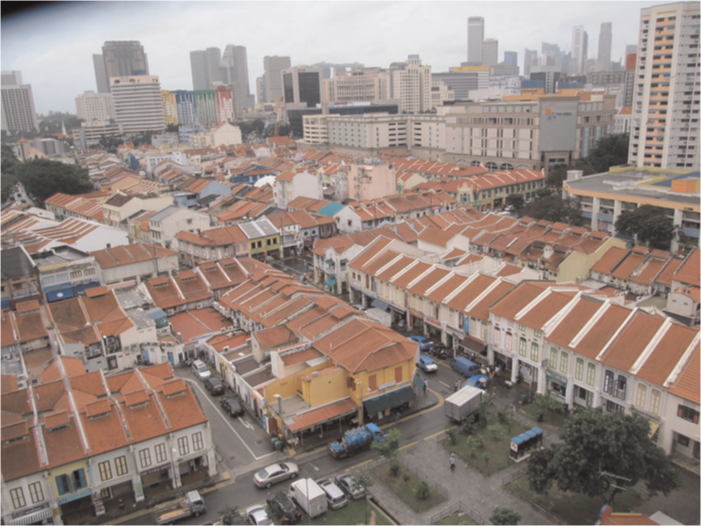
An aerial view of the Little India Arts Belt along Kerbau Road.
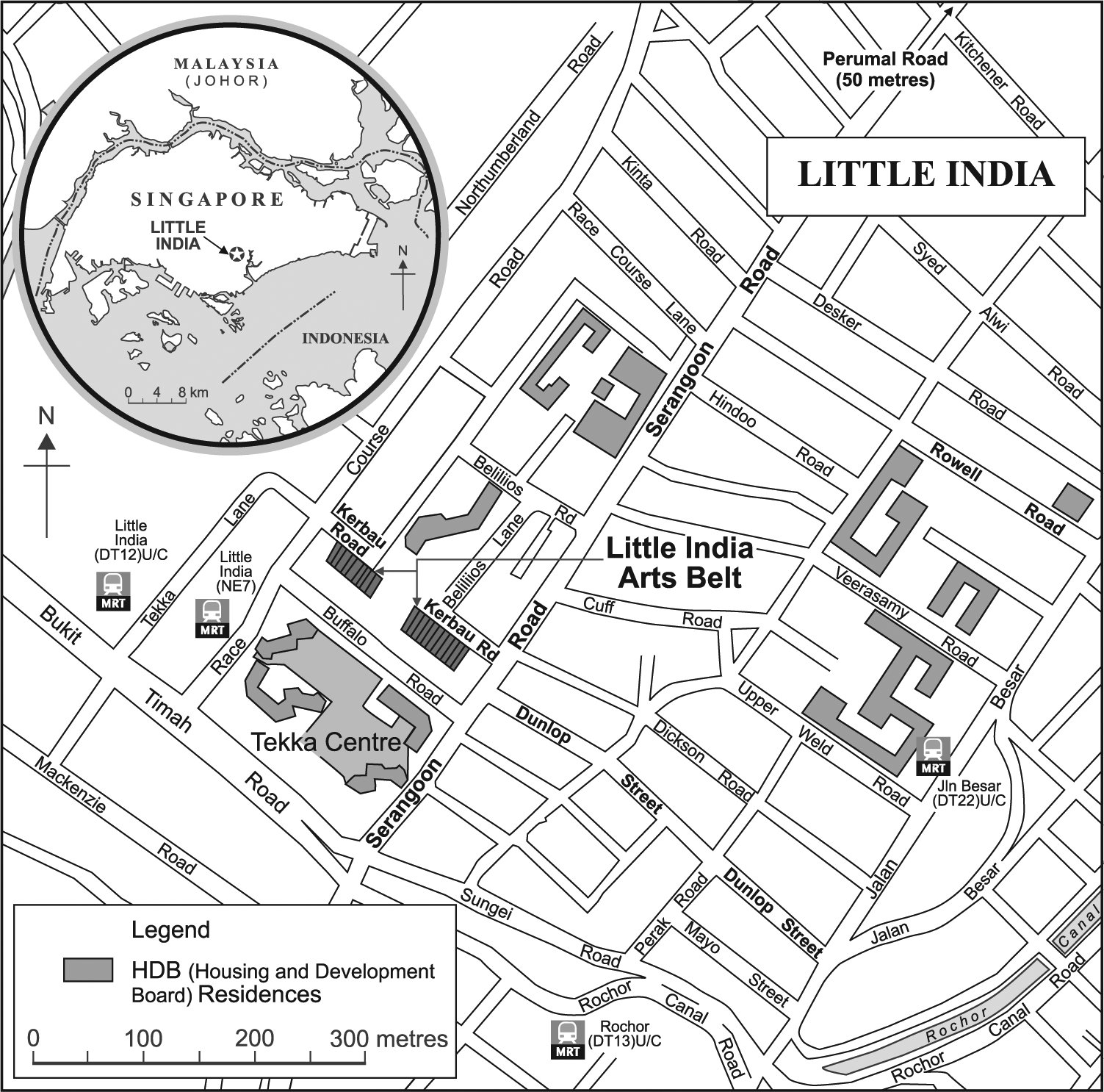
Little India Arts Belt within Singapore’s Little India.
The government played an instrumental role in introducing the arts into Little India. Unlike the spontaneous first wave gentrification of artists drawn to the gritty inner city of New York or Vancouver, the artists were welcomed into Little India through state devices. These included HDB’s restoration of shophouses along Kerbau Road at the cost of S$3.8 million (around US$3.0 million in 2014; Kong, 2011) and the NAC’s rental subsidies of these shophouses to be used as arts offices, studios, administrative and rehearsal spaces. As the number of shophouses was limited, arts organisations were selected according to stringent criteria which included their track record, managerial strength, artistic standard, need for housing, commitment to artistic development, etc. Of the seven arts organisations housed on Kerbau Road, three were contemporary theatre companies while the others specialised in traditional arts such as Malay dance, Indian theatre and gamelan performances (at the time of field work in 2011). Tenants pay only 10% (around S$300) of the monthly market rental to the NAC; the remaining rental charges are paid by the NAC to the government landowner, the SLA.
Urban aesthetics figure prominently in the Little India Arts Belt. First, the NAC justified that conserved historic buildings were aesthetically suited to cultural needs because they provided ‘an impetus for artistic creativity’ while adding ‘new developments in forgotten areas’ (NAC, 2013). By infusing arts in historic areas, non-commercial activities were also introduced into retail/residential environments and old buildings were put to active use. The arts community concur on the aesthetic appeal of historic buildings. In an interview with the owner of an Indian dance academy, he explained that old buildings have ‘historical value’ that fit very well with the traditional dances and cultural performances undertaken by his academy. As he explained, ‘the arts we practice is historical also, and it goes with the old house’ (interview, 18 April 2011). Other artists spoke of the ‘emotional’ fit between their work and heritage buildings. One artist noted that old shophouses need sensitive care and maintenance, and artistic work (as opposed to contemporary office work) rightfully respects the historical integrity of the buildings. However, the term ‘old’ should be used cautiously. Unlike the unvarnished environments of lofts and factory spaces favoured by artists in other arts cities, the Little India shophouses are anything but ‘gritty’, having been restored in the mid-1990s.
Aesthetics and environmental appeal extend beyond individual shophouses. In the gentrification literature, artists are attracted to particular parts of a city not only because of buildings and architecture, but the overall atmosphere of a neighbourhood. In Little India too, artists spoke of their affinity for the larger historical environment. For them, the aesthetic fit comes from being in the heart of a dynamic, mixed-use environment in which their cultural activities are rooted and draw inspiration from. Most artists expressed delight being in an ‘everyday’ neighbourhood where cultural organisations are in the minority. Kerbau Road, for example, has a total of 31 shophouse units occupied by only seven arts enterprises. The artistic director of I-Theatre stressed that being ‘part of a row of normal people is especially appealing, like a community setting’ (interview, 22 June 2010). In his view, a cultural enclave would ‘ghettoise’ the arts, isolating it from the ‘real world’. Another actor/playwright noted that for artists to be creative, they need to be embedded in a ‘properly diverse community’ rather than in a ‘mandated scheme’ populated exclusively by their own kind.
What is ironical about the above responses is that the mix of arts/cultural activities with other ‘everyday’ activities is in actual fact a government mandated scheme. As part of the plan to integrate the arts into mainstream society, it was the government’s intention for arts belts to comprise a mix of diverse businesses and activities, and located adjacent to HDB high-rise residences (see Figure 2). Lees (2012b) observed that such forms of enforced social mixing had become a hallmark in contemporary urbanity, especially in redeveloped zones (including new-build neighbourhoods and gentrified precincts). For the artists, a mixed environmental aesthetic is not only appealing but inspiring. Along Kerbau Road are shops selling groceries, mobile phones and electronic gadgets, drug-stores, picture framing businesses and trading offices. Opposite to the arts belt are coffee shops and restaurants, fabric and jewellery shops, a budget hotel and stores selling music CDs and floral garlands. Artistic inspiration comes from the diversity of the environment. The founding director of Sri Warisan Som Said Performing Arts revealed that she purchases her fabrics, ornaments and faux-flowers in Little India. Although her academy specialises in Malay ethnic dances, Indian fabrics and designs add to the ‘interest and colour’ of her costumes (interview, 10 May 2010). It is this multicultural backdrop that has kept her in Little India since the early 2000s.
The urban aesthetic draws not only from the architecture of old shophouses but the colours, smells and sights of the neighbourhood. The director of a contemporary theatre company revealed that Bollywood songs, colourful saris and people-watching in Little India have greatly inspired his performance ideas. Even though his productions are contemporary and in English, the local influence of Little India is unmistakable (interview, 22 June 2010). Another dance company director shared that round-the-clock availability of cheap food was the main appeal of being in the multi-use neighbourhood. When asked what he liked about working in Little India, he remarked:
We love the Chapati [bread], every time we will eat at the Chapati stall, down the street. They do it fresh. I am not kidding, it’s the best and it’s cheap … For us, in the arts industry we are prepared to work all kinds of hours, there is no fixed time. … So down here, it is very lively till 12 midnight … If we end late, we are hungry, you can eat. (Interview, 12 May 2010)
While gentrification aesthetics talk about ‘a certain “feel” to it, a certain look, a landscape of conspicuous consumption’ (Lees et al., 2008: 113), this look and feel is interpreted by artists as inspirational resources essential to their work. The redeveloped zone with its mix of cafes and restaurants, as well as shops catering to tenants and residents is an unpretentious, working environment. The only aesthetic flourishes come from the restored shophouse architecture and stringent maintenance undertaken to ensure historical integrity of the site.
Although the appeal of historic buildings and the cultural neighbourhood is clear, artists and cultural organisations also expressed aesthetic/architectural challenges. Indeed, working in old buildings and within a gazetted zone such as Little India also has drawbacks. While the AHS offers necessary space to cultural groups, many complained that shophouses are architecturally ill-suited for artistic work. Historic shophouses are elongated in length (from front door to back) but extremely narrow across (often measuring less than 6 m wide). Almost all of the organisations felt that rehearsal and performance possibilities are limited, and have thus relegated the space to storage, meeting rooms and administrative offices. The director of a dance company lamented: ‘there is no way to rehearse, it’s so small, [but] you can’t complain. I mean it’s like the government is offering us space and we shouldn’t be complaining, but the reality is we can’t do a rehearsal in that space’ (interview, 12 May 2010). Unfortunately for many, the practical constraints of working in a shophouse only became apparent after the artists moved into and started using the space.
Redevelopment aesthetics in Singapore also limit what can and cannot be done to the interior and exterior spaces of historic buildings. The URA regulates the exterior colours of conserved shophouses, window awnings and features, and night lighting to prevent unauthorised changes that will mar the historical integrity of the environment. Even practical changes to interior spaces are controlled and monitored. Interviewees opined that they could not install walls, ceilings and lofts in their shophouse spaces as permission will not be granted. Two artists also spoke out against the URA prohibition of converting studios into ‘work–live’ environments. Arts spaces are strictly to be used as offices, performance, rehearsal and storage purposes; they cannot be reconfigured for residential use. This is a concern because artistic work and rehearsals often stretch late into the night and residential quarters would prove most convenient in an arts belt.
By law, shophouse façades, back alleys, roof tiles and exterior fixtures cannot be modified in the ‘historic core’ of conservation areas. This is unlike cultural precincts in other cities where artists are allowed to rework their environment as part of cultural adaptation. As such, the shophouses occupied by the artists look no different from the non-artists along Kerbau Road and it is easy to miss them entirely in the neighbourhood. Even in cases where shophouses are privately owned (as opposed to being owned by the state) and located outside the historic core, individual owners are expected to get permission from the URA before altering colours or decorative features of shophouses. In 2012, this issue emerged as a point of debate in Kampong Glam (the historic neighbourhood of the Malay/Muslim community in Singapore). The Kampong Glam Business Association along with some local artists had wanted to create mural art on selected shophouse units along Haji Lane, a street populated by cafes and boutiques away from the Bussorah Mall core area. The URA was approached and asked for an overall framework to be proposed by the association. The URA explained that public art could be undertaken if it ‘respect[ed] the sensitivity of other stakeholders and the larger community’ (The Straits Times, 28 September 2012). The URA added that well executed art ‘can help shape the character of an area without obscuring its architectural and historical value’ (The Straits Times, 28 September 2012). This is a recent welcome move by the URA which, in time, might possibly inspire greater agency by local neighbourhood communities, including in Little India.
Apart from regulations on restored buildings (i.e. physical environment), another aesthetic tension pertains to the social environment. On weekends, Little India becomes a popular destination for Singapore’s sizeable South Asian migrant crowds. Large numbers of South Asian labourers converge every Sunday to meet with friends, shop and enjoy their only free day of the week (an estimate puts the number at 20,000 and counting). All the artists interviewed complained of the ‘blight’ on the historic zone. Classes at the academies and dance studios are cancelled because of access difficulties and noise. An interviewee observed that many parents were uncomfortable bringing their children to Little India on Sundays, a concern that has been exacerbated by a December 2013 riot involving migrant workers along Race Course Road (less than 150 m away from the arts belt). Another interviewee reflected:
Urban development and gentrification often deal with ‘hardware’ (buildings and landscapes), but the ‘software’ (people) in the landscape is also an important corollary in the city. In Little India, migrant presence is viewed as an aesthetic blot on the environment. While some artists expressed frustration over the litter and leftover food/drinks throughout the neighbourhood, others spoke of ‘unsavoury people’ hanging about and mistaking their offices as brothels. None of the artists interviewed remotely considered the migrants as adding colour, vibrancy and social diversity to Little India. This stands in stark contrast to Bain’s (2003) study of Toronto’s East End where artists view ‘difficult’ and hostile environments as opportunities to carve their creative identities, or Lloyd’s (2002) account of the artistic appeal of ‘authentic urban experience’ filled with noise, crime and danger in Chicago’s Wicker Park Neighbourhood. In Little India, ‘orderly’ aesthetics in the form of music, late night dining and mixed land uses are welcome while the ‘disorderly’ presence of migrant workers is disdained. Some artists even ask whether it was possible to zone the Little India Arts Belt in the way that some residential high-rise flats in the neighbourhood have been zoned with protective fences and Sunday police patrols. What the artists are asking for, in effect, is greater social and spatial regulation that disciplines and ‘aestheticises’ the historic zone in a way that is conducive to their cultural pursuit.
While the focus of this paper is on the Little India Arts Belt, we should note that cultural development has spilled beyond Kerbau Road in what might be termed a second wave of arts gentrification. Without state subsidies or government support, creative specialists have begun using select shophouses as studios along Perumal Road since 2004 and also Dunlop Street and Rowell Road since the late 2000s (see Figure 2). Unlike the first wave orchestrated by state agencies, this second wave appears to operate within a more ‘wild and unruly’ environment where business locational decisions are made according to free market forces as opposed to a state-controlled environment of rental subsidies aimed at artists (Ho, 2009: 1194). It is precisely the lack of government regulations so dominant in historic core areas that have attracted a new cadre of arts/media people beyond the official arts belt (see Ho, 2009 and Chi, 2011).
Conclusion: Towards a Singapore style gentrification
This paper has presented the case of Singapore’s emerging arts/cultural economy in an evolving urban environment. Although the term gentrification is seldom used in official policy statements in Singapore, the unfolding urban transformations – its processes, outcomes and aesthetics – bear some resemblance to gentrification as witnessed in pioneering cities of the Global North. Particularly suggestive is the concept of gentrification aesthetics first alluded to in cities such as Vancouver, New York City and Melbourne, referring to the distinct look and feel of a socio-economically transformed downtown. Some observable elements include the arrival of artists as first wave gentrifiers, the emergence of a trendy environment as people and activities are attracted back to the city, the creative and aesthetic adaptation of spaces by artists, and the potential clashes between different users. However, the experience and outcomes vary across cities. In Singapore, the contingencies of planning history, government ideology of creativity and control, the limited stock of historic buildings and the valorisation of arts clusters are brought to bear in explaining how and why arts/cultural zones have emerged in their distinctive forms.
The question posed at the start of the paper was whether ‘gentrification’ suitably captures the processes of urban change in Singapore, or whether a more appropriate indigenous expression is warranted. Is there a Singapore style of gentrification? Superficially the Little India Arts Belt bears elements of a classic gentrified zone that has witnessed relocation of original residents, urban restoration, infiltration of new groups and inevitable tensions between users with different agendas. However, beyond this veneer of change, we observe a dominant state hand facilitating and regulating urban change through the gazetting of historic conservation zones, lifting of rent control, restoring old buildings and designating select sites for arts groups deemed worthy by the state. This is not unlike other property states in East Asia where the government is a dominant land owner and controls urban planning to fulfil growth agendas. In Little India, the first wave arts gentrifiers were screened by the NAC and their rents subsidised to ensure their viability. In Singapore’s quest to be a Renaissance City of the Arts, the NAC and URA bring new life to historic zones while also infusing residential communities with cultural elements and supporting fledgling artists.
The notion of aesthetics is evident in Singapore’s gentrification experience in various ways. In Little India, artists and cultural organisations find an aesthetic fit with historic buildings and the cultural environment. However, the gritty environment that so inspires artists in the West is not the case here. This is not to say that creative workers are not attracted to ‘authentic’ aesthetics as Ho (2009) has documented in the case of media workers in Little India. In what might be regarded as a ‘second wave’ of arts gentrification occurring beyond Little India’s historic core, the emergence of individual artists and cultural enterprises hint at the possibility of a market-driven (as opposed to state-led) arts development. Aesthetic challenges are also a reality in Little India as artists grapple with different restrictions. The URA’s strict conservation code is aimed at maintaining the historical and architectural integrity of the neighbourhood and aesthetic compliance restricts what artists can and cannot do to their spaces. Unlike other arts quarters in the West where tenants modify their interior and exterior spaces as a mark of identity, the historic core of Little India does not permit the same freedom of expression.
Urban aesthetics is not just about changes in building stock but also the building class. As building form and activities evolve, so too the people and ‘classes’ who call these buildings and neighbourhoods home. The gentrification literature speaks of clashes between people with different agendas and aesthetic inclinations; gentrification aesthetics also involves the adding of requisite ‘right look’ and the expunging of undesired looks. Such socio-spatial conflicts are evident in Singapore and the aesthetic is deployed elastically to refer to people as much as to places and products. Kerbau Road’s reincarnation as a gentrified arts zone has created an aesthetic aura around some people (artists and their service providers) and this enfranchisement has created emotional divides between them and others who they consider ‘out of place’ (e.g. migrant workers). No doubt the migrant public adds colour to the environment, but they are neither the target audiences nor consumers of the arts belt. The aesthetic balkanisation between cultural workers and the migrant public in Singapore is reminiscent of the conflicts between newcomers and in situ communities in other gentrifying zones, underscoring the perpetual condition of cities as crucibles of change and conflict.
While the broad strokes of urban change may be common in cities, specific processes and outcomes unfold in different ways across different sites, warranting semantically diverse terminologies and concepts. A nuanced perspective on urban change that is sensitive to geographical and historical contingencies, and in the case of Singapore the dominant role of the state, must remain a constant in the ever dynamic research on cities.
Footnotes
Funding
I am grateful to the National University of Singapore for funding the project from which this paper is derived (R-109-000-104-101). I also appreciate the assistance of Kyun-Eun Choi.