




Abstract
Most scholarship on informal housing focuses on developing countries and little research investigates how low-income populations in the US participate in homeownership through self-built and self-provided housing. Meanwhile, informally developed areas are increasingly being uncovered in the US, especially in the urban periphery of growing metropolitan regions. This paper documents and analyses largely unknown housing conditions and needs for the growing number of people that live in such communities. Data for this paper were collected through a survey of 133 households in two unincorporated low-income, self-help settlements in Central Texas. In this survey we address (1) household composition, (2) specific housing conditions, and (3) reported structural and infrastructural problems. Through regression analyses we identify factors that mitigate or aggravate the severity of overall housing problems and identify the most significant concerns for residents. Our results offer future lines of action regarding property titles, financing and dwelling upgrading.
Introduction
The first decade of the 21st century has solidified a new definition of the concept ‘urban’. In the USA, demographic processes such as the expansion of cities and concentration of populations beyond core urban areas (Katz et al., 2006) alongside social processes such as the suburbanisation of poverty (Kneebone and Garr, 2010) demand that the concept account for those living in peri-urban areas as well as metropolitan centres. Studies that attempt to make claims about urban processes must address changing definitions of what is ‘urban’ and include communities located at a city’s fringes as well as those within its core. At the same time, new scholarship on metropolitan regions in the USA calls for an overhaul in the way centre cities are imagined, claiming that the new metropolitan reality is a regional, interwoven economic, environmental and infrastructural network of which cities are only one part (Lang and Bradley, 2013). Based on revised definitions of what is considered urban, this paper looks at the important peri-urban phenomena of informal self-help and self-provided low-income housing. In doing so, we also interrogate established definitions of self-help housing (currently defined as a household undertaking the majority of the home construction), and self-managed housing (defined as a household acting as the primary developer of the dwelling, see Duncan and Rowe, 1993). We follow these established definitions in surveying two informally developed peri-urban Texas communities in which residents adopt a hybrid of self-help and self-managed approaches. 1
Many low-income residents make use of peri-urban lands to procure housing that is otherwise unavailable to them within higher-value metropolitan areas (Ward, 2003). This peripheral development is widely recognised as a crucial source of housing production for the world’s poor (Larson, 2002). However, the concept has largely been relegated to squatter and other informal settlements in developing countries, and overlooked as a mechanism for producing owner-occupied housing in Europe (Soaita, 2013) and the USA (Duncan and Rowe, 1993; Harris, 1999, 2001). Somewhere between 25% and 70% of the metropolitan population is estimated to live in informal settlements across Asia, Latin America, sub-Saharan Africa and the Arab states (Durand-Lasserve and Royston, 2002). Additionally, self-provided housing accounts for over 50% of new housing production in European countries such as the Netherlands, Ireland, Belgium and Germany (van der Heijden et al., 2011). Nonetheless, the vast majority of informal housing research remains centred on developing nations, ignoring the importance of informal housing production well beyond the developing world and curtailing the dialogue that may exist between studies of informality in developed and developing nations (Roy, 2003). Housing studies in developing nations, especially in Latin America, affirm the logic and practicality of informal housing as an affordable and flexible alternative, often produced through the invasion and settlement of peri-urban lands. In the USA links have been made to colonia housing along the US–Mexico border (Davies and Holz, 1992; Larson, 1995, 2002; Ward, 2003), where developers sell rural, agriculturally inferior lands to low-income individuals who generally procure their own housing and infrastructure in phases. Yet, the study of US adaptations of informal settlement and homebuilding has stalled there.
Similar to global trends, informality is a growing mode of homeownership in the USA (Mukhija and Loukaitou-Sideris, 2014) not only in US–Mexico border states such as Texas and Arizona but also in ‘gateway cities’ such as Atlanta, Georgia and Charlotte, North Carolina (Ward, 2014). As the social provision of affordable housing is repeatedly slashed in response to neoliberal housing policy, informal housing production may increasingly become a ‘strategy for economic survival’ for US residents (Larson, 2002: 142). Informal, peri-urban communities fly under the radar of for-profit developers, regulating authorities and housing advocates alike (Ward, 2014). In much the same way, investigations of housing processes within these communities have escaped those interested in housing processes among the poor. This paper aims to contribute to the literature of self-help, owner-occupied housing, which has remained on the margins of housing studies (Soaita, 2013) despite the central role owner-building plays in the provision of affordable housing (Duncan and Rowe, 1993). Further, it aims to provide an in-depth look at this form of housing in the US context. Our research is among the first to investigate how residents use informal housing strategies to produce self-help housing well beyond the US–Mexican border regions where they have almost exclusively been studied in the USA and investigates how these practices are adapted in subdivisions outside of dynamic and growing metro regions, of which they form an integral part.
Research on poverty housing in the USA refers obliquely to informality in housing, mainly by highlighting ways in which cities restrict such housing development, effectively regulating informal development and the populations that participate in this development out of their jurisdiction. While these studies hypothesise that urban housing restrictions must ‘deflect’ poor and immigrant populations to other cities (Light, 2006), or to unincorporated peri-urban rural hinterlands, our research shows instead that individuals maintain economic ties to central cities while settling in peri-urban areas whose lax regulatory climates accommodate self-built, low-cost, informal housing. 2
Academic research on self-help housing in the USA has almost exclusively focused on conditions inside colonias (Ward, 2014). While colonias are understood to be a rural phenomenon along the US–Mexico border, researchers have uncovered the spread of similar development patterns in peri-urban areas across the continental USA (Ward and Peters, 2007). As in developing countries, these informal communities follow regular infrastructural layouts, consist of large well laid-out lots, and have an overall development pattern that supports incremental housing upgrading (Mukhija, 2002). These parallels suggest that specific productive links might be made between the literature on housing in developed and developing countries (Roy, 2003). At the same time, our study points to the need to understand how self-help practices are adapted in communities of the type increasingly being uncovered along the urban fringes of US cities, which serve urban-looking populations well beyond the US–Mexico border.
Rather than call these metro-centred, non-border communities ‘colonias’, they are referred to here as ‘informal homestead subdivisions’ (IFHSs): subdivisions of tracts whereby housing and infrastructure are developed incrementally and informally by homesteaders in county lands outside of regulatory standards that prevail in city jurisdictions (Ward and Peters, 2007). These subdivisions are home to low-income residents that, while still relatively impoverished, are less poor than the colonia population. Additionally, like their rural colonia counterparts, these communities are city-centred, in the sense that they rely on (and are relied upon by) employers in metro areas, where they commute to work (Ward, 2014).
To better understand housing conditions and housing processes in IFHSs in the USA this research addresses both informal communities participation in homeownership through self-built and self-provided housing and specific housing conditions and needs in these communities. To do so, we surveyed residents of two prototypical informally developed, low-income communities in Central Texas and recorded: (1) economic and demographic characteristics of the household; (2) lot and housing acquisition and financing; (3) specifics of dwelling structure; (4) perceived problems with the house; and (5) future home plans and prioritisation of household improvement and repair. To investigate specific structural and infrastructural problem areas we test 24 potentially problematic housing conditions commonly found in low-income informal housing (Sullivan and Ward, 2011; Winkler et al., 2002). We model the factors that are related to the severity of structural and infrastructural problems and discuss housing characteristics that are correlated with inferior or improved home environments in these communities. Because informal housing in metropolitan regions remains little studied or understood, these areas have not benefited from policy interventions that have targeted colonia type housing. Investigating these problematic housing conditions is useful as a baseline for targeted policy initiatives for housing interventions in these metro-centred informal communities.
The study sites
The primary data analysed in this paper were collected on behalf of households in two informal, low-income settlements, Rancho Vista and Redwood (collectively they make up Redwood CDP – Census Designated Place) (see map of settlements and surrounding counties in Figure 1). The two adjacent settlements are located 9 miles outside the city centre of San Marcos TX (Hays County), which the 2013 Census ranked as the city with the highest rate of population growth in the USA. Redwood and Rancho Vista are located in unincorporated areas 3 of Guadalupe County beyond San Marcos city limits between the larger metropolitan areas of Austin and San Antonio, TX, which ranked no. 1 and no. 8 on the 2013 Forbes list of America’s fastest growing cities. These communities thus present an ideal case for investigating the ways in which informal practices are adopted to produce affordable housing outside of dynamic and growing metropolitan areas.
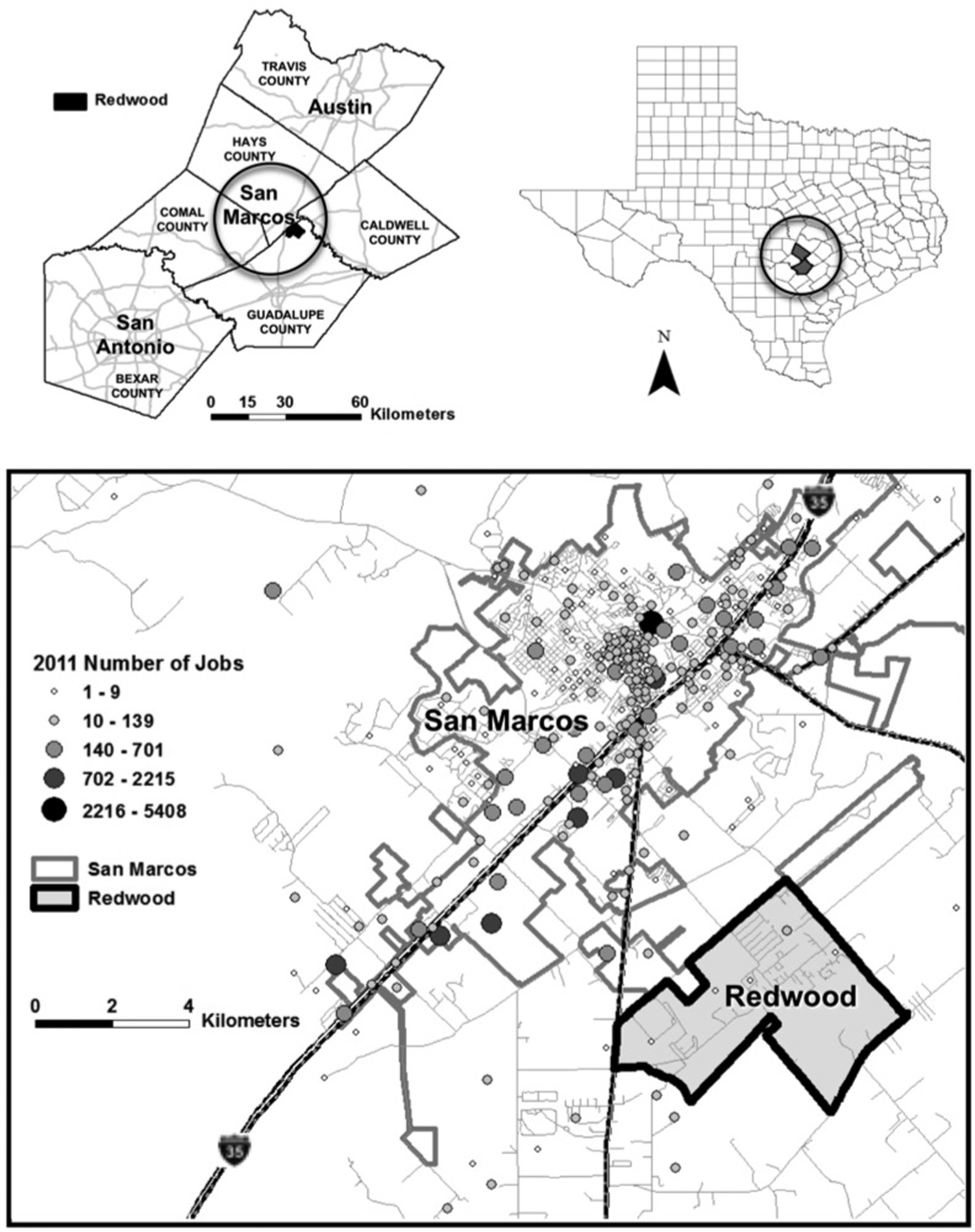
Study sites: Redwood and Rancho Vista (Redwood CDP) work area profile.
Rancho Vista and Redwood are also very typical of informal developments in peri-urban regions of major metropolitan areas in Texas where the majority of land is undeveloped or dedicated to agricultural uses. Here residents acquire lots legally, primarily through seller-financing, for between US$20,000 and $30,000. Most families partially build their own homes through self-help or turn to different forms of manufactured housing, which they buy (new or used) and move to the site. They self-contract for utilities, rely on septic systems, and – as in informal developments throughout the USA and Latin America – add rooms and extensions as time and resources become available.
The resulting settlements are largely though not exclusively Hispanic, poorly serviced and self-provided homesteads on purchased lots. The levels of poverty are not as extreme as in the border, nor are housing conditions and access to important services quite as poor. This process of acquisition and informal development is often the only way households at or below the poverty line can break into the housing market (Ward et al., 2004). At considerable social cost, residents of IFHSs trade off spatial isolation and poorer living conditions to become homeowners; yet they remain ‘urban populations’ whose occupation of land outside metro areas is crucial to maintaining economic ties to city centres (see Figure 1).
Methodology
This study was undertaken by researchers at the LBJ School of Public Affairs and the Law School Community Development Clinic (CDC) at the University of Texas at Austin. It arose in response to a request from community leaders and residents of Rancho Vista and Redwood. 4 In order to help with housing assistance proposals, the CDC proposed the creation of a detailed baseline profile of housing conditions in these two settlements. With this request, we recognised an opportunity to investigate housing conditions within communities that are especially typical of IFHSs (Ward, 2014). To that end, working with local community leaders, the LBJ School designed and implemented a two-wave mail and in-person household survey. 5
The benefits of mail surveys are well established, but a poor response rate (5–7%) is almost inevitable. Hence, in addition to the mail surveys, we included an oversample of face-to-face surveys applied by Spanish-speaking graduate students. While working on the design of the Spanish and English questionnaire, community leaders and volunteers publicised a volante (flyer) that explained the purpose of the survey urging residents to participate. During implementation researchers dropped off mail surveys at every house and conducted a face-to-face interview at every sixth lot starting at a randomly selected point.
Out of 630 mail surveys that were sent out, which comprised approximately three-quarters of the owner-occupied housing units, 93 households returned completed questionnaires – a satisfactory 14.8% response rate. For the oversample, 40 households were interviewed, giving 133 completed surveys in all. Since the mail-back survey was self-selecting, we tested for bias between the two types of survey and found small to modest differences between the two sample populations. The main differences were that households that took the mail-back surveys appear to be slightly poorer within a uniformly low-income population. It is also apparent that they were more likely to provide data about problematic housing conditions than randomly selected face-to-face interviewees.
A focus of the survey was residents’ ratings of 24 housing dimensions meant to ascertain which problems the household experienced with their dwelling unit, services and essential housing systems. These 24 dimensions are based on a survey of structural characteristics and installations determined to be especially problematic in research on low-income housing (Sullivan and Ward, 2011; Winkler et al., 2002) and were further vetted in interviews with residents and community leaders during the construction of the survey instrument. The rating scale for each dimension included: (1) constant or severe problem; (2) occasional problem; (3) satisfactory or minimal problem; (4) not a problem; and (5) not relevant or no opinion. From these responses a categorical housing problem index was developed. To do this, each household survey was given a frequency that counted the number of times that a particular housing dimension was listed as either a ‘constant’ or ‘occasional’ problem with a minimum of 0 and maximum of 24. Constant and occasional problems are grouped together because both have negative downstream effects that require attention. For instance, even occasional septic tank leaks, mould from roof leaks or poor air quality from doors/windows not shutting properly can lead to or exacerbate health problems.
Problem counts were next placed into one of four class intervals. If a household answered a total of between 0 and 6 problem housing conditions, they fell into Category 1 (few); between 7 and 12 problems were placed in Category 2 (modest); between 13 and 18 problems into Category 3 (substantial); and finally between 19 and 24 into Category 4 (serious). The housing problem categories became the response variable in an ordered logit model to analyse which factors help explain the severity of overall housing problems encountered. For the model specification described below, 6 a primary hypothesis was that construction skills positively influence the condition of the home since members are able to make progressive minor fixes before a problem becomes worse. We were also interested in understanding how measured septic, air cooling, garbage and health problems in turn affect housing conditions, as well as the influence of title and finance transactions. Lastly, we included valuation, income and house age control variables with the notion that households with more expensive homes and higher incomes are more able to make needed fixes, and older homes in these communities are more prone to problems.
In complimentary analysis housing problems were treated in a continuous manner taking advantage of the individual constant and occasional problem counts. Linear regression was applied using the same set of independent variables and served as reference to ordered logit results.
Dependent variable:
Independent variables:
Findings: Household characteristics, housing types and home improvement plans
Household demographic and economic characteristics
Notable among the demographic information is the 88% Hispanic composition of Redwood and Rancho Vista, considerable when compared with the 36% of self-identified Hispanics in Guadalupe and Hays Counties. Overall, about nine in ten of Hispanic residents are Mexican American or Mexican-born. Many of the reporting households have few primary wage earners: 46% have one member in paid employment and 16% indicate that no one is employed. Taking into account household size and income, and utilising the poverty threshold by size of family provided by Census, we estimate that slightly over one-half (53%) of all homes live below the poverty line, with greater poverty shares for households with only one and six or more persons.
A key interest of our survey was the potential link between residents’ employment and skill sets and their housing conditions. To this end, two separate questions were asked: (1) the type of work of income earners 7 and (2) if they had any construction skills. More than one in five (22%) income earners reported an occupational field in Construction, followed by 13% of persons who work in Building & Grounds Cleaning & Maintenance. Few if any residents are found in higher paying professions such as managerial, professional, engineering, technical and upper-level office positions. A total of 105 of the 133 households surveyed listed at least one person with construction skills. This is not surprising since many low-skilled, male Hispanics gravitate towards construction as a source of formal and informal income.
While roughly 1300 workers live in Redwood CDP, only 40 jobs are located within its boundaries, almost all of which are tied to a retail trade supermarket and construction establishment (Census, 2014a). Instead, employment opportunities are primarily located in the metro area and I-35 corridor north, northwest and west of Redwood CDP, corresponding to the mean travel time to work in these communities of 25 minutes (Census, 2014b; Figure 1). This spatial depiction substantiates our hypothesis that peri-urban informal settlements such as Redwood and Rancho Vista provide housing for metro-centred workers.
Development, acquisition, and housing structures
As is common in their colonia counterparts in the border region, residents of Redwood and Rancho Vista indicate incremental development and consolidation of the two communities. At the time of survey (2010) over half of the respondents (61%) had lived on their lot for 15 or more years; by 1995 both neighbourhoods were fairly well established. However, 42% of the primary units in which respondents currently live were purchased within the past 10 years. Thus, a portion of those people who have been living on the lot a substantial number of years have a primary unit that has been erected or moved to the lot more recently. This suggests that there is phasing between lot acquisition and occupation, as well as sequencing, such as replacing a camper with a trailer or a dilapidated trailer with a newer model.
The large majority of survey respondents (91%) own or are purchasing their home, 23% of which financed with a bank mortgage and 56% used savings/cash and/or payments to the seller. Taking into account only those that are still paying for their home the median monthly payment is US$450, almost half that of the county. Compared with residents’ incomes, these mortgage payments could account for approximately 30–45% of monthly household income. The maximum mortgage to total household income ratio recommended by the Federal Housing Administration is 31% (FHA Requirements: Debt Guidelines, FHA, 2012). Thus, while most payments are comparatively low for the region, they still represent a large portion of residents’ monthly incomes.
Additionally, 83% indicated using seller-financing to acquire their lots. Forty-eight percent held deed titles to their lands while 45% had a Contract for Deed (CfD) in which the buyer only receives the deed once all payments and transaction costs have been paid in full, a process that often takes many years (note that households who held deeds at the time of survey may also have acquired them through a CfD). Under CfD homeowners are more vulnerable to payment penalties and forfeiture clauses, and are limited in their ability to use their home equity or to be eligible for home improvement assistance because of the lack of clear titles. 8 It is apparent from our research and supported in Ward et al. (2012) that this potentially predatory form of financing is not only a mode of contracting in colonias, but is also common in informal subdivisions in Central Texas. Whether or not these informal arrangements give residents of informal communities greater flexibility to manage high monthly housing-payment-to-income ratios seems intuitive, but needs further research.
The low rate of residents reporting formal mortgage payments likely relates to many households’ insufficient incomes or lack of credit for formal financing, as well as the large number of residents living in manufactured housing, which cannot readily be financed through a traditional mortgage. Two-fifths of all respondents (42%) report purchasing their home from a manufactured home dealer (primarily used or repossessed), indicating the considerable importance of these dealers in housing acquisition. In addition, one-quarter of respondents (26%) report purchasing their home from the former occupant, suggesting that buy-out from former occupants is another significant method of housing acquisition.
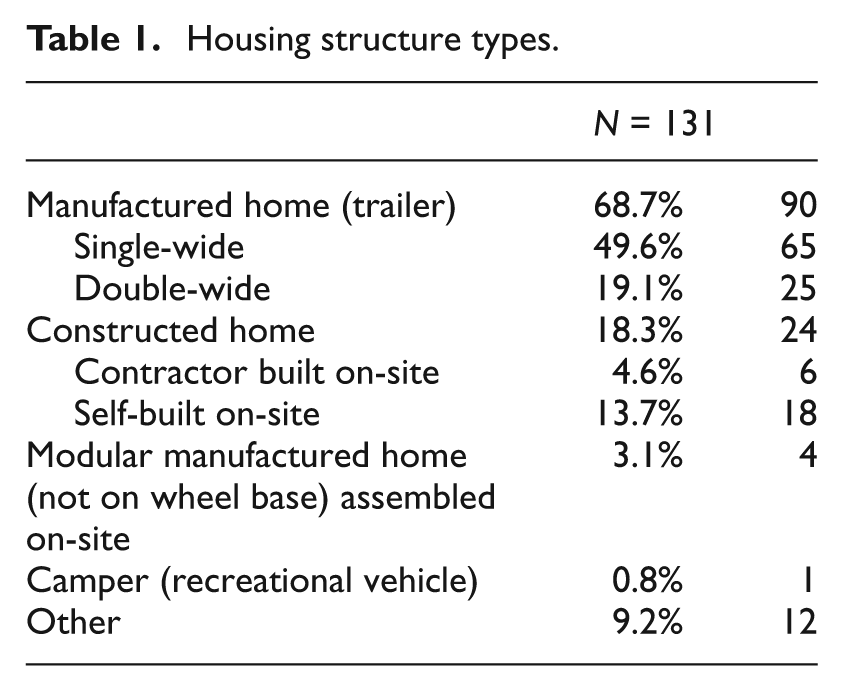
Table 1 demonstrates that roughly two-thirds of respondents reported that their primary dwelling unit is a mobile home (69%), the majority of which are single-wide (50% of the total homes). ‘Other’ answers appear entered as such because the unit is combined with another unit, was built elsewhere and moved onto the lot, or because of uncertainty of how the home was built. The percentage of entirely self-built homes, although small (14%), is notable since self-built homes represent three-quarters of constructed homes. Additionally self-help construction is prevalent in home additions and extensions, in both site-built and manufactured homes. Do-it-yourself and self-help housing plays a central role in reconfiguring lots in these IFHSs. For example, 40% have added to their primary housing unit, with self-built extensions being very common for the purpose of living space – bedrooms, family rooms, etc. Similar to colonia housing in the US and informal housing in Latin America, we found substantial subdivision of lots. One in seven lots contain two housing units, with most of the persons in the second home being close kin to the primary household. This process alongside the finding that most residents have future housing plans underscores research that documents the many ways that residents of informal communities view their homes as real estate worthy of investment and cross-generational accumulation of assets and not merely shelter (Mukhija, 2002).
Housing structure types.
Housing problems
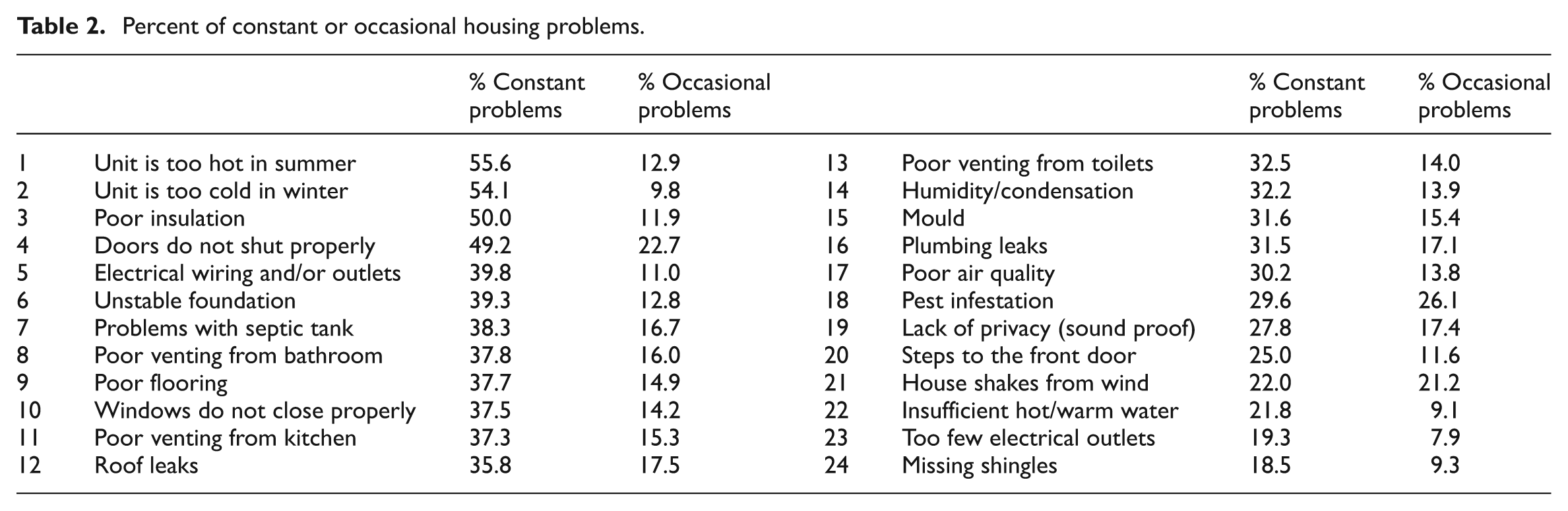
To understand future policy directions for specific home improvements and self-help initiatives, the survey enquired about 24 dimensions of possible housing problems deemed to be frequent in low-income housing (Sullivan and Ward, 2011; Winkler et al., 2002). Residents rated these on an ordinal scale. For this analysis, we considered a housing aspect problematic if the respondent indicated that the housing aspect was either a ‘constant’ or ‘occasional’ problem, as described in the section ‘Methodology’.
Combining constant and occasional, the top four problems are related: 72% said that doors do not close properly; 69% said their dwelling is too hot during the summer; 63% said it is too cold during the winter; and 62% noted poor insulation. These issues are linked to other problems noted elsewhere in the survey, including poor or non-working air conditioning and heating units as well as high electricity costs. Other related problems include roof and plumbing leaks, poor ventilation, mould/humidity/condensation, and poor air quality. Clearly, one key finding for the two informal homestead subdivisions is that multiple benefits can be achieved through a combination of similar and cost-effective do-it-yourself home improvements related to weatherisation, insulation and air circulation. 9 Another notable finding is the unsafe electrical wiring in these homes. Table 2 also shows that 13 of the 24 housing dimensions were rated as problematic by at least half of the respondents.
Percent of constant or occasional housing problems.
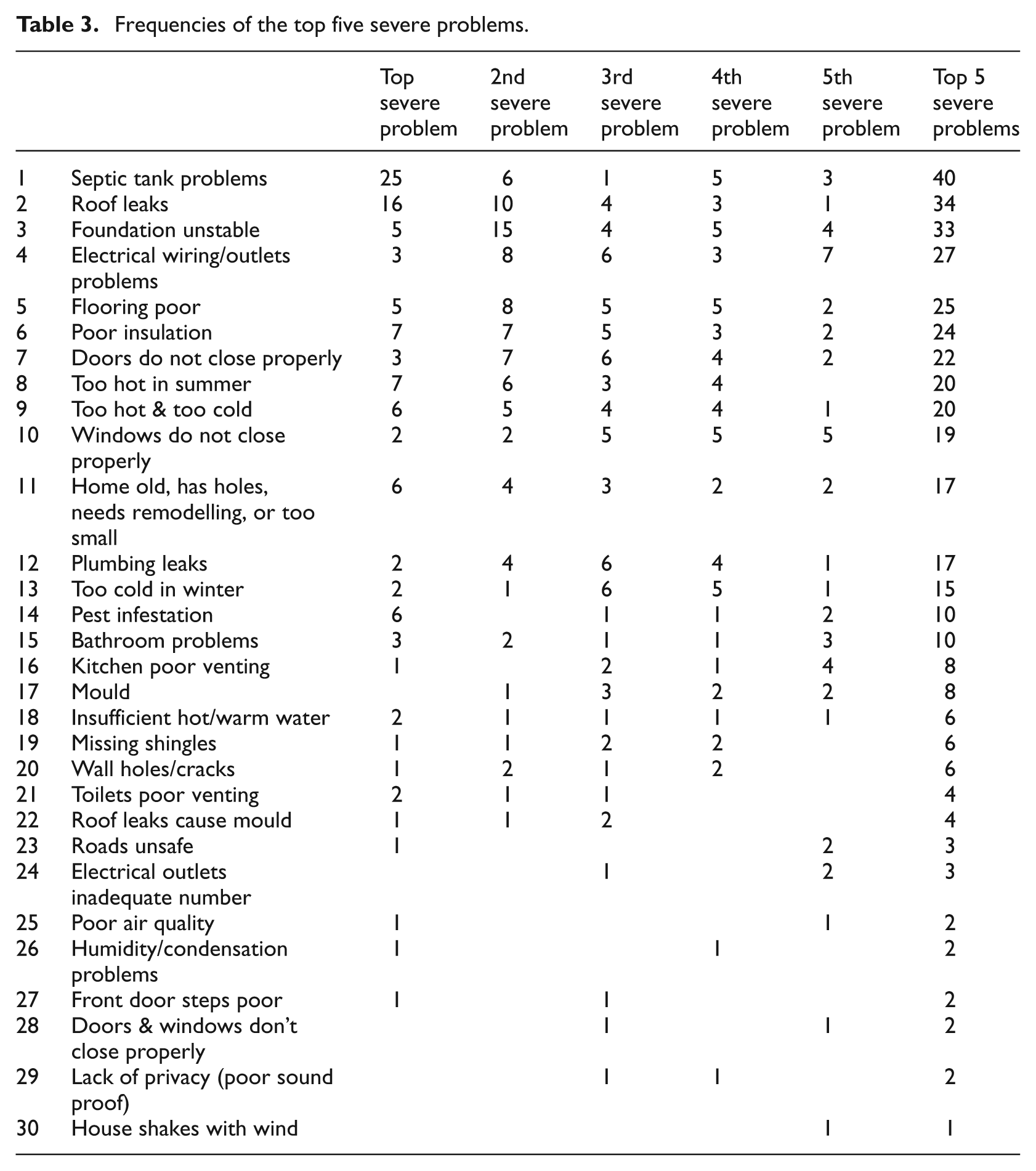
Residents were also asked to list up to five severe problems that they confronted. Our hypothesis is that households will prioritise major structural problem areas since these are the ones of greatest concern, and which if fixed would most improve their living situation. The results in Table 3 confirm this: the topmost severe condition listed is septic tank problems, followed by roof leaks, poor insulation and too hot in summer. Though 92 households (72%) listed a problem with their doors not closing properly, of these 92 households only three mention doors not closing properly as their top severe problem, confirming our hypothesis. If the top five severe problems are combined as shown in the ‘total’ column of Table 3, we see that households are more concerned with large structural, safety and health issues: in this case problems related to the septic tank, roof, foundation, electrical and floor.
Frequencies of the top five severe problems.
Modelling factors that explain housing problems
We present ordered logistic and linear regression to explore factors that are statistically correlated with high or low reported incidences of problems with the dwelling unit. Figure 2 shows results from the housing problem index constructed for the ordered logit response variable. For interpretation, higher categories represent more severe housing problems.

Housing problems grouped into categories of severity.
Table 4 results were calculated with and without contract for deed and seller finance transactions to evaluate their influence separately. A drawback of this approach is a drop in sample size because of missing values. In all regressions, all but one of the parameters have the predicted signs (income is the exception in models 1 to 3). For diagnostics, the variance inflation factor showed a mean of between 1.13 and 1.23 depending on the model, indicating that multicollinearity does not adversely affect regression results. 10 For ordered logistic the Brant test showed that the proportional odds assumption is not violated. Additionally, power analysis indicates sufficient sample size in our linear regressions but low statistical power in the ordered logit, which we acknowledge may undermine statistically significant results. 11 However, similarities in the results for both regression methods provide a level of confidence in the interpretation offered here.
Ordered logistic and linear regression for housing problems.

***p < 0.01, **p < 0.05, *p < 0.10.
The e^b in models 1 and 2 is the proportional odds. A positive coefficient (e^b > 1) indicates an increased chance that a house with a higher score on the independent variable will be observed in a higher category (more housing problems). A negative coefficient (0 < e^b < 1) indicates that the chances that a house with a higher score on the independent variable will be observed in a lower category (fewer housing problems).
In model 1, the number of housing problems is estimated to rise as the house structure ages, when the household reports problems with the septic tank and source of air cooling, and where the household has a member with health issues or disabilities. On the other hand, the number of housing problems is estimated to decline if the household has someone with construction experience (the effect of the home value is significant but negligible). For example, households that have a family member with construction skills are 70.2% (1 − 0.298) more likely to have improved housing conditions (less constant or occasional housing problems), holding all other variables constant. Income not being significant might be influenced by the fact that most of the households are low income and there is little variation among residents, though it is posited that higher income households are more able to maintain their homes than the poorest and very poor. 12 Household practices in garbage removal appear to be unrelated to housing problems even though some rubbish collects for longer periods in some households than in others.
Linear regression results in model 3 mirror ordered logit results in model 1 with the exception of health problems not being statistically significant. Interpretations differ, however, such as in model 3 where a household with a family member with construction skills leads to 3.8 fewer constant or occasional housing problems. In model 5 construction and air cooling problems continue their significant influence this time on constant housing problems only. In models 2, 4 and 6 seller financed home purchases do not statistically affect housing conditions, while CfD does, but only at the 10% level in models 2 and 6, signalling that households with this form of title transaction may experience more dwelling problems.
Overall three study characteristics are particularly meaningful in mitigating or aggravating the number of housing problems experienced within a given home. These are (1) construction expertise of a household member, (2) reported issues with air cooling in the home, and (3) septic problems. Our findings strongly suggest that households with members who have some type of construction experience are more likely to overcome dwelling problems than households with no such skills. This is not surprising, but it is an important finding given the extensive construction skills that we identified in the survey.
The linkage between poor air cooling (AC) and other problems is likely related to inadequate insulation, cracks and holes, and the costs of effective AC, which can be seen as a surrogate for poor quality homes and fittings as well as aggravate problems associated with high temperatures and poor air quality. Ensuring effective cooling and consistent indoor home environments can be difficult and expensive but is likely to have several positive effects.
The influence of septic problems is less easy to discern. Most residents reported insufficiently sized septic systems dating back to the year of lot occupation, likely the reason for ranking septic tanks as the number one issue they (and the local leaders) would most like to correct. They noted problems of back-ups, overflow, leakage or standing sewage, and worried about the negative effects on public health particularly for children and the elderly. If septic problems lead to or exacerbate health problems, they may indirectly affect residents’ ability to physically or economically address dilapidated housing conditions while making them more vulnerable to the adverse effects of those conditions. Clearly there is an urgent need for septic tank replacement and maintenance.
Concluding remarks: Housing priorities identified by the study
This study of two Texas communities demonstrates how informal housing development creates opportunities for owner-occupied housing near growing (and increasingly expensive) metropolitan job centres, but also creates challenges for residents who continue to self-manage both their housing and infrastructure. However, for most residents the opportunities for affordable homeownership evidently outweigh the costs of substandard home conditions and infrastructure in communities where, in the case of Redwood and Rancho Vista, half of residents are living below the poverty line and yet 79% claim some level of construction skills.
One surprising adaptation our study reveals is the significant role of manufactured housing in providing housing that, while self-managed, is not self-constructed. Lax regulations in county jurisdictions and the ability to purchase repossessed manufactured housing allow for self-managed installation of used manufactured units as well as significant self-built renovations and extensions to accommodate growing or multi-generational families’ needs. A hybrid of self-help and self-managed housing stock has resulted in these two informal subdivisions. Our analysis of residents’ self-reported housing problems with this housing stock details specific problem areas requiring priority attention (see Table 3). Some of the most significant are higher cost and not easy to fix through DIY: septic, roofs, unstable foundations, and AC, whereas other frequent problems are cost-effective and can be undertaken by DIY, or by employing local labour to assist.
It is difficult to formulate broad policy prescriptions for the problems we uncovered, since the logic underpinning the production of housing in informal subdivisions is that they fall into weak (fiscal and regulatory) jurisdictions where informality is thus possible. However three major areas of policy intervention merit consideration: (1) those that promote access to financing (especially micro financing); (2) those that promote consumer protection by converting vulnerable Contracts for Deed to Warranty deeds; and (3) those that promote dwelling upgrading and mobilise the considerable local human resources (mainly in construction skills) that we documented, which might be tied to local contracting and community level improvements.
Financing: There is a major need for financing support – lower cost loans and small scale credit – for lot purchase, housing improvements, and infrastructure investment. A very large proportion of our survey population (90%) indicated that they have plans in place to upgrade their home for both present livability and future equity. At the same time, over half live below the poverty line and many have mortgage payments that consume 30–45% of household incomes. Additionally, some structures are so heavily deteriorated as to make them non-viable for home improvement and new homes will be required, either new manufactured or modular homes or self-built homes. Here financing, especially micro financing, is crucial.
Property titles: Almost half of surveyed households were still in the process of acquiring their homes through Contract for Deed, and until they have clear title they are unable to use their home as collateral to access home improvement financing and/or may be reluctant to make timely investments and improvements. Residents in Central Texas would benefit from policy initiatives that convert Contracts for Deed to Warranty Deeds, which give greater legal protection to purchasers and allow them to leverage the equity in their home for needed upgrades.
Dwelling upgrading: Findings show that the top reported problem area for residents (72%) is that doors do not close properly, followed by their dwelling unit is too hot during the summer (69%), too cold during the winter (64%) and poorly insulated (62%). Clearly, it appears that multiple benefits can be achieved through a combination of potentially cost-effective weatherisation improvements in these areas. Increasing the overall energy efficiency of homes can also provide measurable benefits to a segment of the population that is encumbered with a high ratio of household expenditures for energy consumption compared to household incomes. Given the high degree of construction skills found among our survey respondents, these improvements may be undertaken using self-help, or by employing local labour to assist. Indeed, we found that households with a member with construction skills are more likely to have improved housing conditions, demonstrating that self-help improvements are already significant in improving home environments. Here energy efficiency education and self-help resources are crucial.
This analysis of informal peri-urban subdivisions enhances a broader understanding of how such practices are adapted in informal settlements in the USA, and perhaps in other developed nations. It expands our understanding of the ways self-help is approached by poor populations that are not at the lowest rungs of the income ladder (as in US colonias). It also demonstrates how informal housing production is adapted to peri-urban, metro-centred areas, for instance by capitalising on opportunities to produce hybridised (manufactured + self-built + self-retrofitted) structures that are facilitated by the lack of municipal oversight in county jurisdictions. However, these opportunities do not come without costs, as our analysis of reported housing problems and aging infrastructure attests.
The challenges that Redwood and Rancho Vista face may offer lessons for informal developments outside other metro cores just as such communities are increasingly being uncovered in the USA. In growing cities in the USA and elsewhere, dynamic creative classes require extensive, often low-paid, supporting classes. Meanwhile, high demand for property in city centres creates a need for low-cost housing at the urban periphery. If developed in peri-urban jurisdictions, this development may well resemble the communities studied here. In such communities we see a clear adaptation of the logic that spurred housing informality in Latin America from the 1960s onward – settlement of peri-urban lands to secure low-cost property, foster self-managed housing production and avoid municipal regulation. The policy interventions we recommend may forestall future problems in this growing stock of informal peri-urban housing.
Footnotes
Funding
This research received no specific grant from any funding agency in the public, commercial, or not-for-profit sectors.