




Abstract
Though previous studies have examined how formalising land tenure affects housing improvements in informal settlements, the role of tenure security and its long-term influence remain unclear. In response, this paper quantitatively examines the extent to which formalising land tenure by way of slum declaration has stimulated housing improvements during the last three decades in the slums of Pune, India. Since slum declaration guarantees residents occupancy but not full property rights, this study focuses on how tenure security contributes to housing outcomes, such as materials, size, the number of floors and the amount of money spent for the improvements. Using original household survey data, analysis involving propensity score matching and difference-in-differences methods reveals that slum declaration has tripled a household’s likelihood of having added a second floor and, albeit less clear, increased the average amount of money spent on housing improvements. At the same time, slum declaration has not induced any improvement in housing materials, largely since many residents of non-formalised slums have also replaced materials. These results indicate that slum declaration, even in the long run, has continued to influence housing investments in Pune’s slums, in terms of both type and amount spent, though residents of non-formalised slums have also come to enjoy certain de facto tenure security. Among other implications for policy, these findings underscore that governments should at least provide legal assurance of occupancy rights in informal settlements, even if active interventions such as slum upgrading and titling are currently difficult.
Introduction
For many poor city dwellers in the rapidly urbanising Global South, obtaining and incrementally improving housing are activities predominantly performed by individual households (Bredenoord et al., 2014). As John FC Turner (1976) has argued, the risk of housing demolition or forcible eviction, however, discourages such self-help housing construction by otherwise willing and able residents of informal settlements. Accordingly, sustained scholarly attention has since been paid to whether and how security of tenure stimulates residents to make housing improvements in the informal settlements of the developing world (Durand-Lasserve and Royston, 2002; Durand-Lasserve and Selod, 2009; Payne, 2002; UN-Habitat, 2008).
Yet, what can effectively and efficiently assure residents’ security of tenure – minimally defined as the degree of risk of, or protection against, forcible eviction without due legal process and compensation – remains debatable. A strand of economics literature analyses how providing individual property rights can afford such legal protection (de Soto, 2000; Deininger, 2003; Field, 2005; Galiani and Schargrodsky, 2010). As reviewed by Marx et al. (2013) and Payne et al. (2009), however, quantitative evidence is still scarce. In the meantime, a growing body of literature has stressed that many slum dwellers, despite their informal status, enjoy some degree of de facto tenure security as a result of a variety of factors (Gilbert, 2002; Handzic, 2010; Lanjouw and Levy, 2002; Nakamura, 2016; Razzaz, 1993; van Gelder, 2009; Varley, 1987). Such research also often expresses concerns that titling programmes in housing markets can induce rapid changes to social landscapes, thereby devastating the kinds of social capital that the poorest residents depend upon most heavily. From this debate, one possible policy approach has emerged involving the gradual formalisation of informal settlements, starting with the concession of residents’ right to use. In formalising informal land tenure without instantaneously providing full property rights, this approach promises to reduce barriers inhibiting households from upgrading their housing, as well as to mitigate how such swift change impact the poorest residents (Payne, 2001).
In this paper, I analyse this critical issue by assessing how providing residents with formal land tenure but not land titles has affected housing improvement trends in Pune, India. There, as in other parts of India, state and local government agencies have implemented a slum notification policy that legally ensures the occupancy rights of slum dwellers. 1 With this scheme, in which land ownership remains in the hands of the original owners, government agencies can provide infrastructure and basic services to formalised slums without paying compensation to the landowners. In this context, the present study offers evidence of how slum notification in Pune – or in the local legal terminology, slum declaration– has impacted the long-term transformation of slum housing.
Background and hypotheses
Slums in Pune
With a population of more than 3 million people, Pune is the second largest city in the state of Maharashtra and the ninth largest in India (Government of India, 2013). While the city has thrived as a regional hub for the automotive and information technology industries, the living conditions of the lower segment of Pune’s society remain poor (Bapat, 2004; Pune Municipal Corporation, 2006, 2013). In fact, a 2011 survey, the Pune Slum Atlas (MASHAL, 2011), reported that approximately 160,000 households live in slum areas (Figure 1). 2
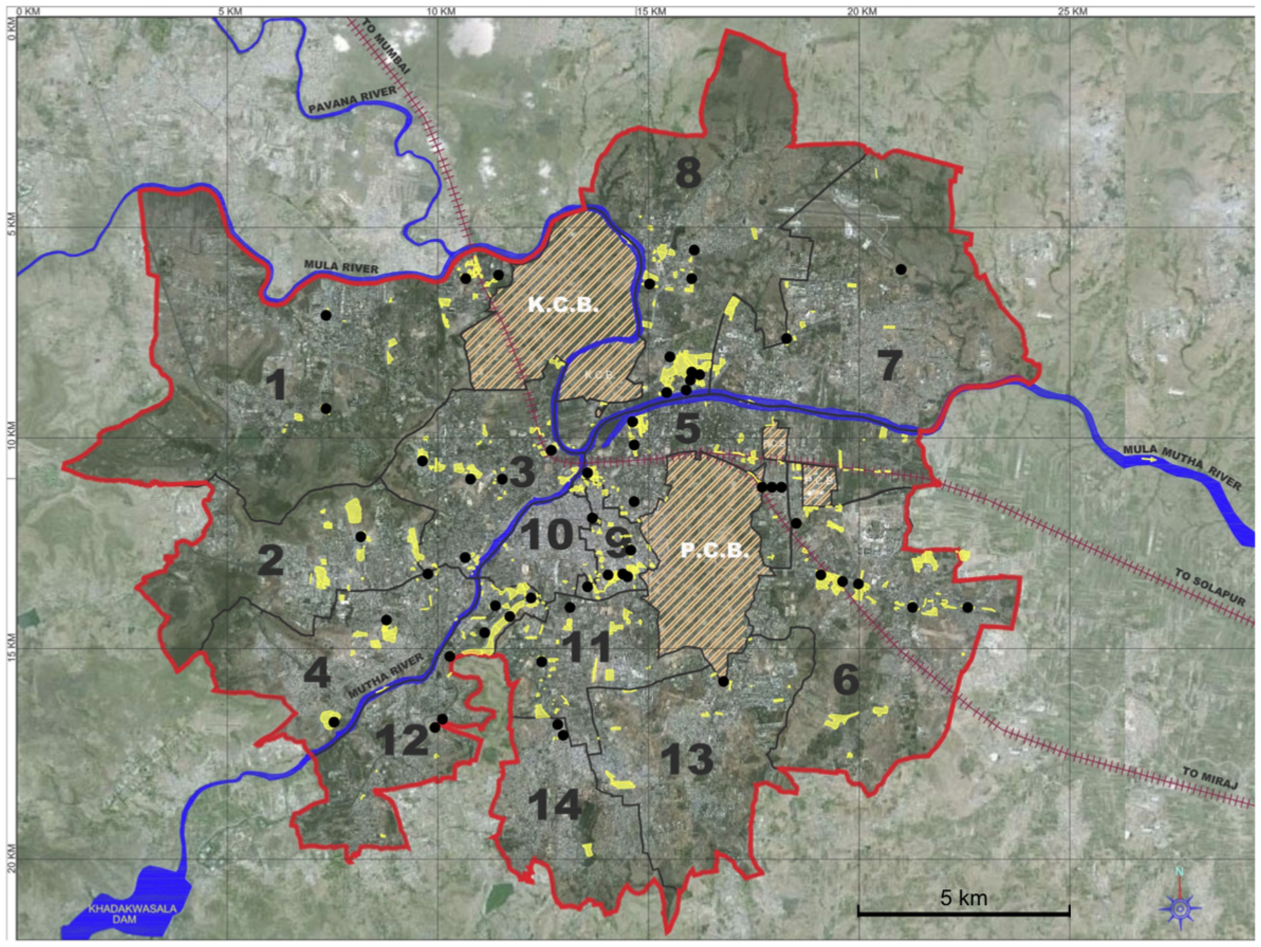
Slum locations in Pune. Areas highlighted in yellow indicate slum areas. Black dots indicate 56 slums surveyed by the author. Pune and Khadki Cantonment Board (PCB and KCB, respectively) are not included in the study area. Numbers on the map indicate 14 administrative wards.
According to the Maharashtra Slum Areas (Improvement, Clearance, and Redevelopment) Act – in short, the Slum Act – Pune’s municipal government, known as Pune Municipal Corporation (PMC), and the Maharashtra state government are responsible for identifying and formalising settlements as declared slums. 3 The Slum Act defines a slum as any area that ‘is or may be a source of danger to the health, safety or convenience of the public of that area or of its neighbourhood, by reason of the area having inadequate or no basic amenities, or being insanitary, squalid, overcrowded or otherwise’ (Government of Maharashtra, 1971). This definition’s ambiguity leaves the implementation of slum declaration in large part to the discretion of government authorities. Among the total 477 slums in Pune today, 238 have been declared as of 2013; approximately 13% were declared before 1980, 68% in the 1980s, and 18% in the 1990s (MASHAL, 2011). Given unabated migration into slums and the implementation of a new slum redevelopment programme, however, the Maharashtra state government has since 1995 suspended the declaration of new slums, with few exceptions.
Nearly 75% of slums in Pune are located on privately owned land (MASHAL, 2011). The relationship of private landowners with slum residents varies, from forcing them to leave by resorting to courts to tolerating their occupancy in return for rent. According to the household survey conducted for this study, 13% of the surveyed households (9% in declared slums and 18% in non-declared slums) pay rent to the owners of their houses. Furthermore, because of some owners’ lack of investment in their properties, in many cases tenants are forced to repair and even improve the houses in which they live. Yet, such owners are not always also the landowners. For instance, some former slum residents who have successfully moved from settlements rent out their houses.
Slum declaration reinforces the legitimacy of slums and their residents in several ways. For one, residents of declared slums are legally protected from forced eviction by local or private parties without due legal process and compensation. Although land ownership remains in the hands of the original landowners, residents in declared slums retain the legal right to stay and to build housing with temporary materials to a maximum height of 14 ft. Under the Slum Act, residents also have a legal basis for appealing in court against any incidence of forced eviction. If the relocation of slum residents is inevitable for public purposes, then government agencies are required to provide them with alternative accommodation or cash compensation, if not both. Moreover, households in declared slums are entitled to basic services provided by municipal agencies. In Pune, for example, PMC delivers a range of infrastructure and basic services, including water, drainage, public toilets and streetlights.
Theory and hypothesis
As discussed in Durand-Lasserve and Selod (2009) and Payne et al. (2009), theories of property rights and self-help housing elucidate how formalising land tenure can stimulate housing investment and improvements in informal settlements. In these theories, the most important four channels in the linkage between tenure formalisation and housing improvement are (1) tenure security, (2) housing markets, (3) access to credit, and (4) subsequent public investment. In line with such theoretical perspective, I discuss how these four channels allow slum declaration to bring about improved housing conditions in the slums of Pune.
First, formalising land tenure has the potential to improve the security of tenure of residents by providing them with legal protection from forced eviction. The consequently reduced risk of housing demolition can thereby motivate households to spend money on improving their housing (Besley, 1995; Demsetz, 1967; Payne, 2001; Turner, 1976). Nevertheless, an often neglected aspect in housing policies is the long-term influence of land tenure formalisation. In addition to legal aspects, time also relates to tenure security, for the level of tenure security increases as the household continues to live in the same residence and not be threatened with forced eviction (Figure 2). As such, it remains partially unclear to what extent the formality of land tenure makes a difference in long-term housing outcomes because residents who remain with informal land tenure also enjoy a certain level of de facto tenure security.
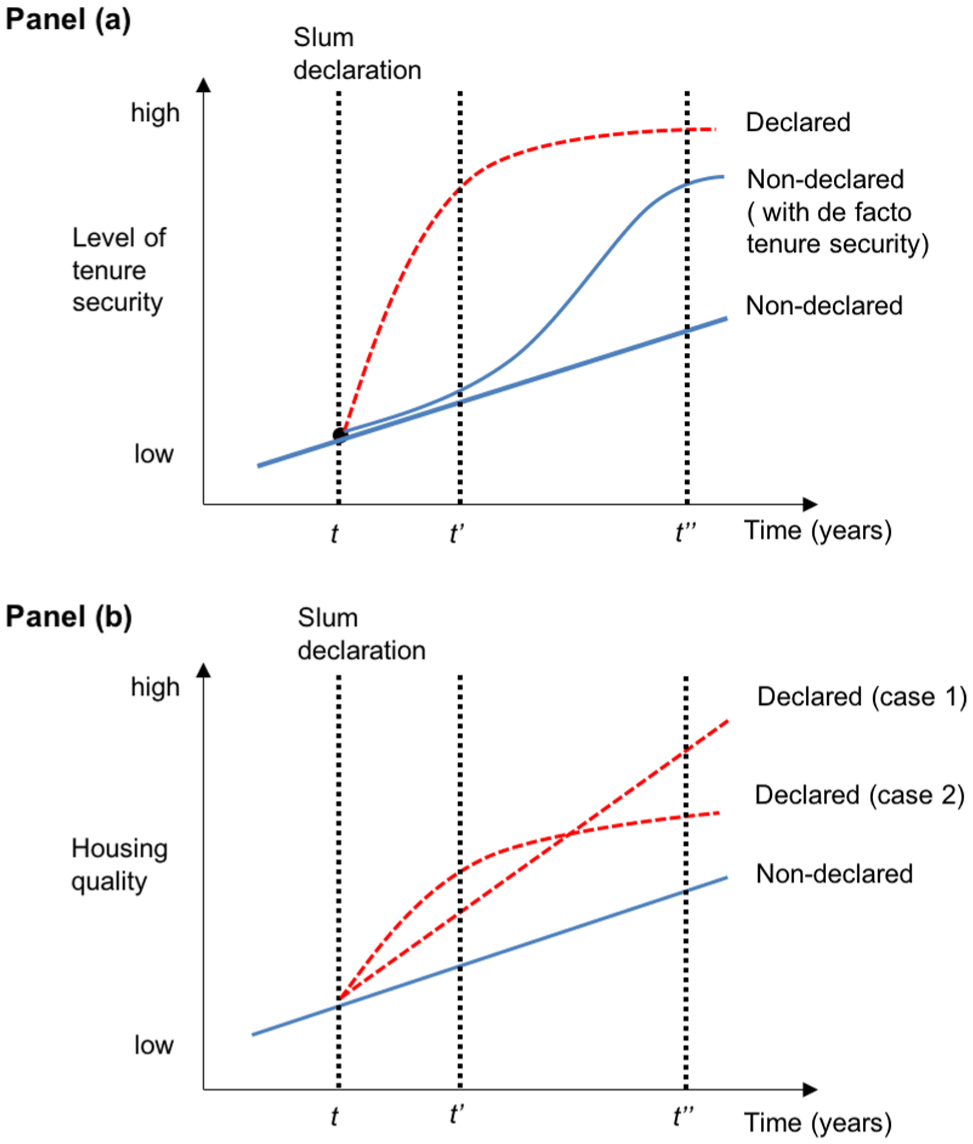
Impact of slum declaration on tenure security and housing quality. Panel (a) describes how slum declaration could affect the level of tenure security of the residents. The effect may be large in the short run (t’), but the level of tenure security in non-declared slums may also catch up in the long run (t”). Panel (b) illustrates how slum declaration potentially affects the quality of housing. The gap in housing quality between declared and non-declared slums may become wider (case 1) or converge (case 2) in the long run (t”).
The second and third channels are market-related ones. On the one hand, formalising land tenure can lead to functioning housing markets (de Soto, 2000; World Bank, 1993). Although housing is traded via informal transactions even in informal settlements, formalising land tenure can further facilitate housing transactions by removing uncertainty and easing the process. Households are more encouraged to improve their housing as tradable assets, while market mechanisms based on legal property rights ensure the efficient allocation of housing. On the other hand, providing titles to residents in informal settlements can improve their access to credit (de Soto, 2000). Accordingly, a primary rationale for providing full property rights via titling programmes is to allow slum residents to use their housing as collateral in order to borrow from formal banks.
Fourth, formalising land tenure can increase the likelihood of residents’ benefiting from infrastructure, basic services and other government programmes. A government’s installation of basic services can more clearly assure residents’ security of tenure, thereby encouraging them to invest in their housing. Enhanced access to basic amenities also increases their expected returns on their housing investment (Strassmann, 1984). At the same time, residents with formalised land tenure tend to be eligible for government assistance, which further expands their capacity to invest in housing.
Based on the theoretical framework supported by these four major channels, the present study hypothesises that slum declaration in Pune precipitates housing improvement in slums. By testing this hypothesis, this paper can clarify the long-term effects of slum declaration and its capacity to enhance tenure security. Unlike common titling programmes, slum declaration, which guarantees only the rights of occupancy and use, does not promise to directly enhance residents’ access to formal credit and the housing trade. In that sense, how slum declaration affects housing improvements via the channels of public investment is not self-evident in Pune, where residents in non-declared slums have received some degree of public investment. Despite law maintaining that only residents of declared slums are eligible for basic services, PMC has installed a range of basic amenities in many non-declared slums, which raises residents’ sense of de facto tenure security. 4 With these expectations in mind, the next section details how I examine the hypothesis.
Method
Empirical strategy
I focus on a cohort of households that lived in non-declared slums in 1980, when the implementation of slum declaration in Pune was not yet rigorous. Some of these households have since experienced the declaration of their settlements, while others have not. To identify both types, I conducted household surveys in Pune’s slums in 2013 and found 255 households that both lived in non-declared slums in 1980 and have since stayed in their respective settlements. Of this group – hereafter called the 1980 cohort – 138 households experienced the declaration of their slums prior to 2013, while the remaining 117 households continued to live in non-declared slums. With the former as the treatment group and the latter as the control, I aim to compare both groups’ current housing conditions, which I argue stem from the difference in the declaration status of their settlements.
To validate the above empirical strategy, several conditions must be met. First, households in both the treatment and control groups need to share similar attributes as of 1980 that have affected their experiences with slum declaration and housing improvement. In this non-experimental study, selection bias due to slum residents’ self-sorting could pose a critical problem (Heckman, 1979). For example, unobserved characteristics could have powerfully motivated households to improve their housing in non-declared slums slated for declaration (i.e. the treatment group). With such a selection mechanism, missing this and similar variables could induce upward bias in estimating the effect of slum declaration on housing investment. To create comparable treatment and control groups of households based on similar observed characteristics, I use propensity score matching and, as explained later in this section, employ a difference-in-differences (DID) matching approach to account for time-invariant unobserved confounders.
Another concern with the study’s empirical strategy stems from the fact that the data include only households living in slums at the time of survey collection in 2013. As discussed, this paper focuses on the extent to which slum declaration makes a difference in housing quality for households who have remained in their respective settlements. Nevertheless, not including households that have either voluntarily or involuntarily moved out of those slums could yield misleading estimates of the effect of slum declaration on housing investment. To assess that possibility’s influence, I exercise the same propensity score matching procedure for the sample that also includes households that have moved into Pune’s slums since 1981.
Propensity score matching
Following Rosenbaum and Rubin (1983), I identify the causal effect of slum declaration – that is, the average treatment effect on the treated (ATT) – by relying on propensity score matching. Propensity score matching is a method used to match treated and untreated individual entities in a sample with similar observable characteristics based on their propensity scores. Of the variety of proposed matching methods, I use the following kernel matching estimator (Becker and Ichino, 2002; Heckman et al., 1998):
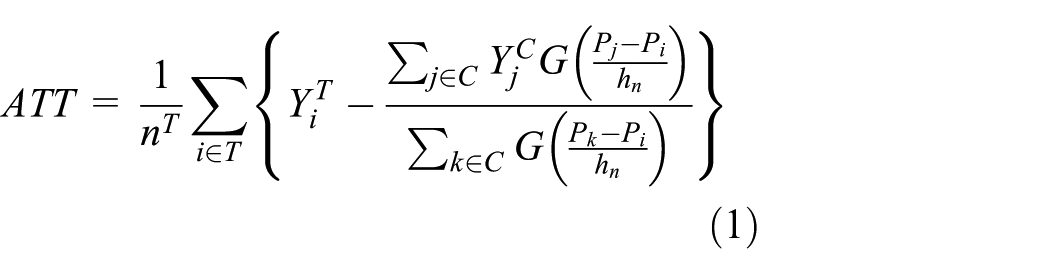
where YiT (YjC) indicates the outcome for household i (j) in the treatment (control) group; P is propensity score; G(·) is a kernel function; and hn is a bandwidth parameter. In essence, this estimator averages multiple units in the control group for each treated units, with weights inversely proportional to the distance of propensity scores between units in both groups. As an alternative to kernel matching, I also exercise one-to-one nearest-neighbour matching.
For estimation with propensity score matching, I first estimate the propensity scores for households in the 1980 cohort using a logit model with the binary indicator of slum declaration status as the dependent variable. The covariates of the propensity score model include a set of housing, slum, and household characteristics that are either time-invariant or indicate pre-treatment status in 1980. Propensity scores are calculated as the predicted probability of declaration for each household. With the estimated propensity scores, I perform kernel matching and examine the adjusted balance in the covariates between matched treatment and control groups. 5 If the balance remains insufficient, then I add both higher-order and interaction terms to the initial propensity score model and recalculate propensity scores. I repeat this process until the balance becomes sufficient.
Identifying any causal effect requires the conditional independence assumption (CIA), which holds that conditional to the observable characteristics, the counterfactual outcome is independent of treatment. The CIA is clearly a strong assumption, for whether it holds depends on the availability of covariates that affect both treatment assignment and outcomes. Despite the rich information gleaned from the survey, it remains possible that unobserved confounders could cause bias in estimation. To account for time-invariant unobserved confounders, I implement the following DID matching estimator for two time periods t and t’:

in which the weighting function W(i, j) is
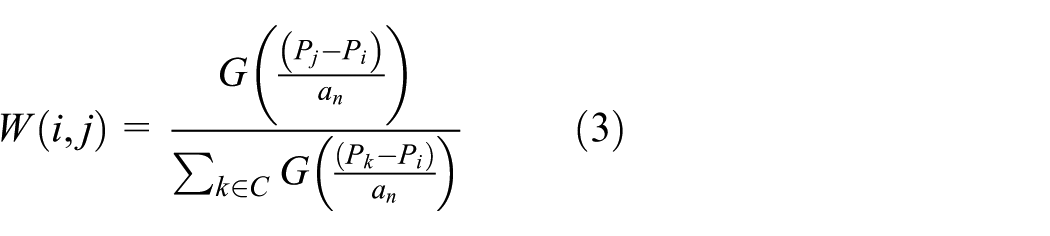
Smith and Todd (2005) have confirmed the superior performance of the DID matching estimator over other matching methods.
Data
Data preparation
I construct the data set for this study by combining household-level information from the original survey conducted in 2013 and slum-level information from the Pune Slum Atlas (MASHAL, 2011). Sampling for the survey is based on a two-stage cluster-sampling scheme. After 56 slums were randomly selected from the 477 slums listed in MASHAL (2011), surveyors visited ten households in each of the 56 slums, while using a random walk method and referring to both geographic information system (GIS) maps (MASHAL, 2011) and Google Earth satellite images. After obtaining respondents’ oral consent to participate in the survey, surveyors read the questionnaires aloud, either in Hindi or Marathi, a local language in the state of Maharashtra, and wrote down respondents’ answers on household-specific forms. Aside from information concerning time-invariant household characteristics, the survey also enquired about both the respondents’ current and previous housing conditions and the years when changes had occurred; for example, surveyors assessed the current condition of a respondent’s housing and asked each respondent about the types of improvement that they had undertaken and when. Survey data were combined with slum-level information from MASHAL (2011).
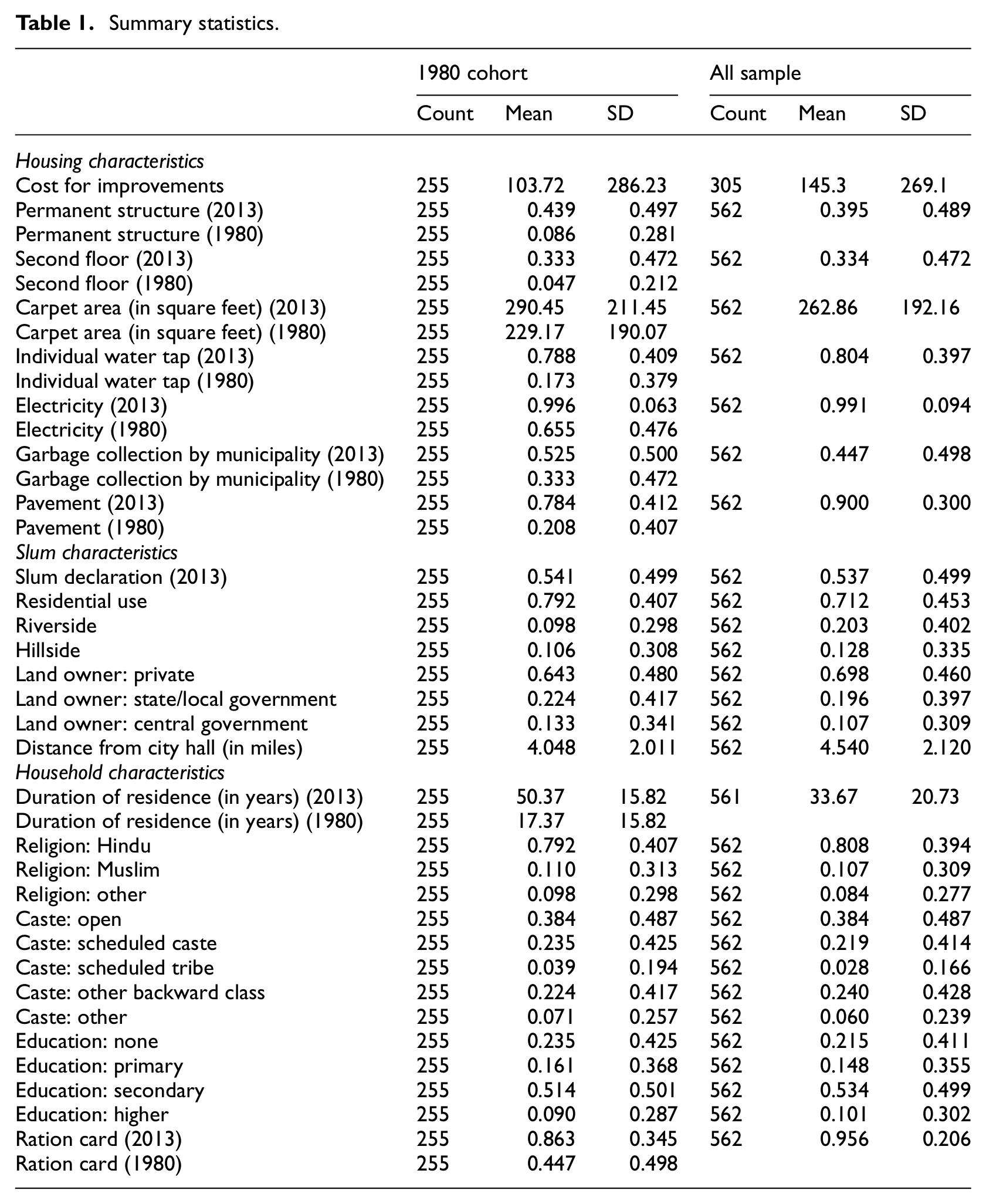
Of the 562 households surveyed, 6 this paper primarily focuses on the 255 households that lived in non-declared slums in 1980 and still live in the same slums. Households in this cohort currently live in 51 slums across Pune: 45 households in six slums in central areas, 82 households in 14 slums in inner suburbs, and 128 households in 31 slums in outer suburbs. Among the 255 households in the cohort, 138 (54%) had experienced the declaration of their settlements by 2013. Table 1 presents summary statistics for housing, slum and household characteristics, whereas plots in Figure 3 illustrate changes in time-variant variables from 1980 to 2013.
Summary statistics.

Plots of time-varying covariates.
Outcome variables
This paper focuses on four indicators that measure different aspects of the amount and types of housing investment made in slums. The first outcome variable indicates the amount of money that households spent on housing improvements since 1980. The survey first asked respondents whether they had replaced the materials of any of the walls, roofing or flooring, as well as whether they had expanded their houses horizontally or vertically, if not both. Respondents were then asked to report the cost of each improvement. Of the 255 households in the 1980 cohort, 146 had spent some money on housing improvements. The mean values for improvement costs are approximately 128,400 rupees for the treatment group and 74,600 rupees for the control group. By contrast, the median values in the two groups are quite similar: 10,000 and 10,500 rupees, respectively. Only 14% of households (13 households in the treatment group and seven in the control groups) that invested in housing improvements had borrowed money from banks, which is unsurprising, since slum declaration, unlike typical titling programmes, does not render properties available for mortgage. Other common financial resources included household savings (137 households, or 94%), financial assistance from relatives (24%), community savings (10%) and loans from informal moneylenders (10%).
The second indicator of housing improvement is changes in structural materials. I classify housing into two types: housing with permanent structure and housing with non-permanent structure. Whereas housing with permanent structure has walls and roofs made of permanent materials such as bricks and cement, housing with non-permanent structure consists of other, less durable, materials such as clay and iron sheeting. In line with the national trend described by Nakamura (2013), slum residents in Pune have since 1980 gradually replaced the non-permanent materials of their housing with permanent ones (Figure 3). In fact, from 1980 to 2013, the proportion of housing with permanent structure in the 1980 cohort increased from 9% to 44%.
The third outcome variable measures the increase in space within housing. The measured carpet area for a house is the total floor area (ft2) within the house, excluding any yard or veranda space. The average carpet area for the treatment group (211 ft2) was smaller than that for the control group (256 ft2) in 1980, though the gap has since narrowed (Figure 3). In 2013, the average carpet area was 289 ft2 for the treatment group and 292 ft2 for the control group.
Another measurement of housing expansion is the number of storeys. When in need of more space, households expand their houses horizontally or vertically, if not both. Given the high population density of major Indian cities, however, constructing additional floors is often the only available option. Thus, the number of floors that households can add significantly influences the quality of their housing. Because housing with a third floor is very rare in Pune’s slums, I recode this variable as a binary indicator purporting whether the house has a second floor (1) or not (0). Most houses in Pune’s slums as of 1980 were single-storeyed, while a third of houses there currently have a second floor (Table 1). While the portion of housing with a second floor increased in both the treatment and control groups, the speed of expansion was faster in the treatment group (Figure 3).
Covariates
I include in my propensity score estimation a host of covariates that could affect a household’s tendency to experience slum declaration and housing improvement. Only either time-invariant or pre-treatment status are included as covariates in order to prevent bias in estimating ATT.
A variable regarding slum-level characteristics indicates whether Pune’s master plan, the Development Plan, designates an area as a zone where residential activities are permissible. In Maharashtra, municipal bodies are required to prepare master plans every 20 years (Kulabkar, 2002), and Pune’s most recent plan designating areas for various uses between 1987 and 2007 is currently under revision. According to the Development Control Rules that stipulate building regulations under the Development Plan, housing construction is permitted only in residential and commercial zones (Pune Municipal Corporation, 1987). To accommodate the poorer population, the Development Plan also reserves land that in India is referred to as the economically weaker section. Approximately 79% of households in the 1980 cohort live in one of the above areas that permit residential use (Table 1).
From MASHAL (2011), I retrieved information concerning land ownership in Pune’s slums. Approximately 64% of slum households in the 1980 cohort live on privately owned land, 22% on land belonging to either the state or local government, and 13% on land owned by a central government agency. 7 The gap in the proportion of landownership of state or local governments between the treatment (33%) and control group (7%) implies that state and local government agencies are more likely to declare slums on the land they own. I rely on propensity score matching to adjust for this difference, as well as estimate the ATT for the subgroup of households living on privately owned land.
The data also include other slum and locational characteristics. About 10% and 11% of households in the 1980 cohort live on riversides and hillsides, respectively. Given Pune’s relatively monocentric development pattern, the distance from the central area is an important locational parameter. I calculate the distance from each household to City Hall in central Pune, which ranged from 0.9 to 10.3 km.
Along with the slum and locational characteristics described above, I include various other housing and household attributes as the covariates in my propensity score models. I use several indicators of housing conditions in 1980, including the availability of water taps for individual use, electricity, garbage collection by the municipal government, and the pavement or unpaved status of the path in front of the house. Except for water taps, the gap in the availability of these amenities between declared and non-declared slums has gradually converged (Figure 3). Covariates for household characteristics include duration of residence at the current address (in years), caste (open category), 8 scheduled caste (SC), scheduled tribe (ST), other backward class (OBC), or other, religion (Hindu, Muslim, or other), and the educational attainment of the household heads (primary, secondary, higher, or none) and their possession of ration cards.
Results
Propensity score and difference-in-differences matching
I first calculate propensity scores by estimating a logistic regression model, as explained in section ‘Method’, and then perform kernel matching that imposed common support condition and in which the bandwidth equalled 0.06. 9 I examine the balance among covariates between the matched treatment and control groups and test several propensity score models by including different sets of both higher-order and interaction terms until the balance becomes sufficient. Table 2 reports the estimation results of the final propensity score models for the 1980 cohort living on privately owned land and for all households in the 1980 cohort. 10 The matching algorithm for the sample of households living on privately owned land results in 48 households in the treatment group matched with 79 households in the control group within the range of common support. The matched units for all households in the 1980 cohort are 103 households in the treatment group and 99 households in the control group.
Estimation results of propensity score models.

Notes: *p < 0.1, **p < 0.05, ***p < 0.01. Column 3 is only for the illustration of the factors related to the likelihood of receiving slum declaration.
I examine the balance among the covariates following matching based on several indicators. First, I confirm that the standardised difference of the mean (or proportion for categorical variables) is less than 0.2 for all covariates (Austin, 2011). The mean value of standardised differences is reduced from 0.199 before matching to 0.045 following matching for the sample living on privately owned land and from 0.179 to 0.042 for the full sample. After matching, 19 of 28 variables in the sample on privately owned land and 27 of 38 variables in the full sample show a standardised difference of less than 0.05. No variable poses a statistically significant difference in its mean value between the treatment and control groups after matching. All but two covariates exhibit a variance ratio within the range from 0.5 to 2 recommended by Stuart and Rubin (2007).
Table 3 summarises estimation results. Specifically, Column 2 reports the ATT estimates based on kernel matching for the sample living on privately owned land. Bootstrapped standard errors based on 500 replications are also reported. For the sake of comparison, I also include before-matching values in Column 1, while Column 3 reports the results of DID matching. Column 4 also reports the results of DID matching, though the model additionally includes covariates for basic amenities and beneficiary status of government programmes as of 2013. This arrangement helps to clarify the effect of slum declaration on housing improvement resulting from enhanced tenure security, chiefly by controlling for the channels via infrastructure development and government programmes. To assess the robustness of estimates against the choice of matching method, I also report the results of one-to-one nearest-neighbour matching DID in Column 5.
Summary of estimated average treatment effects on the treated.

Notes: Bootstrapped standard errors (500 replications) in parentheses for kernel matching. Robust standard errors in parentheses for DID matching. *p < 0.1, **p < 0.05, ***p < 0.01. Kernel matching is based on bandwidth 0.06 and common support. One-to-one nearest neighbourhood matching (1:1 NNM) is based on common support, no replacement and caliper (0.05).
As Table 3 reveals, the results demonstrate that slum declaration has prompted the vertical expansion of housing. The estimated ATT for having a second floor based on kernel matching (Column 2) is 0.224 (p < 0.05, 95% confidence intervals (CI) = [0.032, 0.416]), meaning that slum declaration has increased the proportion of houses with a second floor by 22.4 percentage points. Put differently, slum declaration has increased a household’s likelihood of living in multistorey housing by nearly threefold. The results of DID matching based on kernel and nearest-neighbour matching yielded similar ATT estimates (0.219 in Column 3 and 0.206 in Column 5). Adding covariates as of 2013 did not change the estimate much, either (0.226, Column 4).
However, the effect of slum declaration is less clear regarding the other outcome variables. For one, slum declaration’s impact upon the amount of money spent on housing improvements is a bit ambiguous. Before matching, the mean value of investment cost in the treatment group (86,000 rupees) is greater than that in the control group (53,000 rupees), and the difference increases after kernel matching (38,890 rupees with 95% CI ranging from −12,860 to 90,630 rupees). By contrast, adding covariates as of 2013 makes the ATT larger and statistically significant (43,930 rupees, p < 0.1). The ATT estimate based on nearest-neighbour matching DID is even larger: 60,060 rupees (p < 0.05). The ATT estimate for permanent structure is −0.029 (95% CI from −0.252 to 0.195), while the estimated ATT for carpet area is similarly insignificant – 12 ft2 (95% CI from −62 to 86 ft2) – suggesting that residents of both declared and non-declared slums have expanded their houses, albeit in different directions. More specifically, while residents in declared slums have expanded their housing by adding a second floor, those in non-declared slums have expanded their houses horizontally – for example, by adding rooms.
Although the study’s primary interest is the effect of slum declaration on privately owned land, Table 3 also reports the ATT estimates for all households in the 1980 cohort (i.e. on privately owned land and government land). Column 6 reports the ATT estimates based on DID matching, for which there are 103 matched units in the treatment group and 99 in the control group. Adding households living on government land to the sample renders the ATT for housing investment cost neutral: −12,050 rupees (95% CI from −95,360 to 71,250 rupees). The cause of this result is most likely that government assistance allows households to enjoy housing improvements by spending less money. The ATT estimate for having a second floor remains significant (0.187, p < 0.05).
Sensitivity analysis
As mentioned in section ‘Method’, a concern with this study’s empirical strategy is that its data exclude households that have moved from slums since 1980. To mitigate this potential problem, I perform kernel matching with an augmented sample that also includes households that have moved into slums since 1981. Column 6 of Table 3 reports the ATT estimates of this procedure; the numbers of matched units increase to 165 in the treatment group and 150 in the control group. As shown by estimates for the 1980 cohort in Column 3 of Table 3, slum declaration’s impact upon the amount of money spent on housing improvements is estimated to be positive, though not statistically significant (43,060 rupees with 95% CI from −15,830 to 101,960 rupees). The ATT estimate regarding having a second floor is positive, yet becomes moderate at 0.160 (p < 0.01). Similar to estimation results for the 1980 cohort, the effects of slum declaration on permanent structure material and carpet area are negligible. At the very least, the above results demonstrate that overlooking households that have moved out would not have critically altered the conclusions of the study.
To assess the sensitivity of the result of the above propensity score matching against hidden bias due to unobserved heterogeneity, I rely on Rosenbaum’s (2002) boundary approach. This strategy involves introducing an artificial factor Γ to simulate an unobserved confounder that affects both treatment assignment and outcome. As a result, researchers can examine to what extent Γ needs to be influential in order to change the statistical significance of the estimated ATT. To perform this analysis, I use the mhbounds command in Stata developed by Becker and Caliendo (2007).
My primary concern in this context regards the possibility of positive selection: that is, an unobserved confounder may positively influence both the likelihood of experiencing slum declaration and housing improvement, which could cause an upward bias in ATT estimates. The result of sensitivity analysis shows that if an unobserved confounder increased the chance of treatment assignment by 1.09 times, the ATT for having a second floor estimated via kernel propensity score matching loses its statistical significance at the 5% level. In that sense, an unobserved confounder needs to be 1.26 times as influential as observed covariates in order to undermine the significance of ATT estimates at the 10% level. However, this result does not necessarily indicate the existence of unobserved heterogeneity, but instead recommends caution in the interpretation of results.
Discussion and conclusion
Despite prolonged debate over the roles of security of tenure and land tenure in housing improvements in informal settlements, quantitative evidence has remained scarce because of various methodological challenges (Marx et al., 2013; Payne et al., 2009). Of particular interest to researchers and policymakers alike has been the extent to which formalising land tenure in informal settlements, even without providing full property rights, can facilitate general housing improvement.
To estimate the long-term impact of slum declaration on housing improvement in Pune, this study focuses on 255 households living in non-declared slums in Pune in 1980 that lived in the same slums at the time of data collection in 2013. The estimation results show that slum declaration has promoted the vertical expansion of housing; the likelihood of having added a second floor has tripled in declared slums. By contrast, the effect of slum declaration on the cost of housing improvements is less clear. Slum declaration has increased the average amount of money spent on housing improvements in slums on privately owned land by nearly 39,000 rupees, or 3.7 times the amount of average monthly expenditure of households in the sample. This effect, however, disappears when households living on government land are included in the sample. My analysis has not detected the impacts of slum declaration on the improvement of housing materials and increase in size.
Several possible reasons can explain why residents of declared slums are more likely to add second floors to their houses. First, since adding a second floor is more costly than replacing temporary with permanent material, residents considering adding a floor need to be more confident in their security of tenure. Second, government agencies and landowners are less tolerant of the construction of multistorey housing than of housing made of cement. The highly visible construction of multistorey housing worries landowners and government officials that it could signify to other residents that construction activities are becoming permissible. Third, it may simply be too difficult to expand housing horizontally in declared slums. Slum declaration reduces the availability of vacant plot space because it induces the in-migration of people seeking better security of tenure. 11
In answering whether slum declaration has stimulated housing improvement in Pune’s slums since the early 1980s, it should be emphasised that housing conditions have improved overall in Pune’s slums regardless of declaration status. Residents who continue to stay and who are not threatened with eviction for a certain period of time enjoy de facto security of tenure (Figure 1). Nevertheless, for households that have arrived in slums on privately owned land prior to 1980, slum declaration has prompted the vertical expansion of their houses and, though less clearly, increased the amount of money that they have spent on housing improvements. As Figure 4 shows, the gap in housing quality measured by carpet area and having a second floor between declared and non-declared slums has not been converging, but widening. This finding underscores the important role of formalised land tenure in enhancing tenure security and facilitating housing improvements in the long run.

Housing outcomes of the 1980 cohort (weighted). The values of the outcomes are weighed based on the result of kernel matching.
Findings thus suggest that the assurance of occupancy rights, even without the provision of full property rights, can encourage residents to upgrade their housing in informal settlements. With these findings, the study informs a closely related but limited body of literature that quantitatively investigates land tenure formalisation policies. Field (2005) and Galiani and Schargrodsky (2010) exploit quasi-experimental settings, finding that titling programmes prompted housing investment in urban slums in Peru and Buenos Aires, respectively. A cross-sectional study by Nakamura (2014) shows that slum notification has increased the amount of money spent on housing improvements across India. Focusing on Pune, Nakamura (2016) argues that slum declaration, among other legal and non-legal factors, influences slum dwellers’ perceptions about their property rights and thereby their housing investment behaviours. The hedonic price analysis of slum housing by Nakamura (2015) shows that slum dwellers’ willingness to pay for living in such declared slums is worth 19% of the average (imputed) rent in slums in Pune. The present study further adds empirical insights into the linkage between slum declaration, tenure security and housing improvements by analysing how slum declaration has changed housing conditions over the last few decades.
The chief policy implication from this paper’s findings is that government should at least guarantee occupancy rights in informal settlements, even when active intervention such as in situ slum improvement is difficult for now. Albeit preferable to clearing informal settlements, simply leaving them as they are can undesirably constrain housing investment made by residents in the long run. This strategy could also be integrated into a gradual formalisation approach, starting with the legal assurance of occupancy rights and, after a certain period, providing full property rights to the residents (Payne, 2001).
I end this paper with a statement of the study’s limitations. This research relies on data from a household survey addressing housing characteristics prior to slum declaration via retrospective questions. Since most changes in housing conditions occurred after 1980 and were tangible in nature, I assume that the answers of respondents are reasonably reliable. Nevertheless, recovering pre-treatment information in such a way remains susceptible to measurement errors. Related to this issue is the exclusion of key variables, such as household expenditure levels, that could have affected the propensity to experience slum declaration or engage in housing investment, if not both. If households with higher expenditure levels in 1980 tended to be in the treatment group, then the ATT estimates would be biased upward.
Footnotes
Acknowledgements
I express appreciation to Siddhartha Benninger, Anita Benninger, Abhishek Telang, Ashutosh Sathe, Amruta Kher-Godse and the members of FLOW, Ganaraj TaTe, and Pravin Nikam for their support of my field research in Pune. I also thank Sharad Mahajan for sharing the data in the Pune Slum Atlas. The author would also like to thank Gavin Shatkin, Raj Arunachalam, Scott Campbell, Lan Deng and anonymous referees for their insightful comments.
Funding
This is a part of a research project supported by the National Science Foundation’s Doctoral Dissertation Research Improvement Grants (award number 1303019).