



Abstract
This paper concentrates on universities as important actants in the neoliberal city, specifically through their engagement of development activities. The paper visualises universities as an entrepreneurial subject: a neoliberal institution which adopts the responsibility to redevelop. Towards that end, the paper situates the redevelopment activities of universities and their politics in the context of the neoliberal city. It subsequently identifies the causal structures that underpin the growth logic of universities, which form the condition for their engagement in redevelopment as entrepreneurial subjects. The paper argues that the pressures coming out of the accumulation process act as an impetus for universities to expand, for instance, to accommodate the increasing student enrolments that generate revenues for them. Given their size, specialised infrastructure and the localised logic of bringing students to campus, expansion often means expansion in situ. This puts the spotlight on universities’ politics of redevelopment and the challenges they face as it typically means destruction of existing living and workplaces. Being entrepreneurial, universities maximise their efficiency in the politics of redevelopment to produce minimal resistance. This they do through alliance-building by creating amenable subjectivities that facilitate redevelopment. This is constituted by drawing upon and exacerbating existing cleavages of class and race. The paper presents a case study of redevelopment activities of The Ohio State University, located in Columbus, Ohio. The case study will illustrate why this university became an entrepreneurial subject and how, that is, through what discursive-material mechanisms the politics of persuasion unfolded, producing subjectivities that created (non)acquiescence around redevelopment.
Introduction
A characteristic feature of the transforming space economy of American cities since the 1970s has been the increasing market-disciplining of urban processes, giving rise to neoliberal urbanism. In this context, several neoliberal experiments of place-making and marketing have been carried out by various entrepreneurial actors to generate profit (Brenner and Theodore, 2002). Redevelopment has become an important neoliberal strategy for the generation of surplus value (Hackworth, 2007). This paper concentrates on universities as important actants in the neoliberal city, specifically through their engagement of development activities. The pressures coming out of the accumulation process act as an impetus for universities to expand, for instance, to accommodate the increasing student enrolments that generate revenues for them. Given their size, specialised infrastructure and the localised logic of bringing students to campus, expansion often means expansion in situ. This puts the spotlight on universities’ politics of redevelopment and the challenges they face as it typically means destruction of existing living and workplaces.
The first part of the paper will discuss the literature on university involvement in redevelopment projects, highlighting the common approaches and substantive issues that emerge therein. It then critiques the theoretical thinness of that literature, in particular its limited understanding of the development logics of universities and the underlying calculations that are made by universities to instantiate their redevelopment politics. The paper then offers a nuanced view, one where the university is visualised as an entrepreneurial subject: a neoliberal institution which adopts the responsibility to redevelop. Towards that end, the paper situates the redevelopment activities of universities and their politics in the context of the neoliberal city. It subsequently identifies the causal structures that underpin the growth logic of universities, which form the condition for their engagement in redevelopment as entrepreneurial subjects. The argument is that universities are part of a wider social division of labour such that expansion, similar to a capitalist firm, is essential if they are to retain their position in that division of labour. Given their spatial entrapment, universities engage in a distinct politics of land development that can elicit protests from those whose work or living places are imperilled. Yet the university may also find that it can ally with other actors in furthering its expansion. The politics of alliance-building is predicated on the formation of amenable subjectivities, constituted strategically by drawing upon and exacerbating existing cleavages of class and race (Mayer and Kunkel, 2012b) that facilitate redevelopment, or not. The second part of the paper will present a case study of redevelopment activities of The Ohio State University, located in Columbus, Ohio. The case study will illustrate why this university became an entrepreneurial subject and how, that is, through what discursive-material mechanisms the politics of persuasion unfolded (Jessop and Sum, 2012), producing subjectivities that created (non)acquiescence around redevelopment.
The redevelopment activities of universities in neoliberal cities
Theorising universities as urban redevelopers
Academic interest in the development politics of universities is not new (Bromley, 2006; Bromley and Kent, 2006; Lafer, 2003; Perry and Wiewel, 2005; Rodin, 2007). Most analyses comprehend universities’ real estate practices beyond respective borders in terms of their ‘mission’, ‘culture’ or ‘enlightened self-interest’ (Perry and Wiewel, 2005). The chief reasons given for university involvement is areal expansion to accommodate new student housing, new schools and so on, or ameliorate the social conditions in the surrounding neighbourhood as they find themselves enclosed by deteriorating neighbourhoods with prevalence of crime (e.g. Lafer, 2003; Perry and Wiewel, 2005). In this respect, the fixity of the university within cities is considered problematic: hence their participation in redevelopment practices. Also noted, however, is the fact that universities get involved in land use transformation so as to compete with other universities more effectively: to attract high calibre students and faculty, to secure funding through grants, government endowments, private corporations, alumni, donors and so on (e.g. Bromley, 2006; Bromley and Kent, 2006).
The literature is explicit about how the redevelopment efforts of universities in their neighbourhoods need active collaboration with certain social groups in the area, particularly home owners and some local businesses, who might also envision this expansion to be beneficial. Universities typically strive out of necessity to put together a coalition of forces behind their redevelopment projects. Despite the coalition being composed of disparate interests (Mollenkopf, 1983), each may find a motive to unite around university-led redevelopment projects, though some may be more reluctant than others and even turn to opposition. In some cases, universities, like the University of Pittsburgh and Columbia University, have strategically allied with residents. In other cases, universities have also collaborated with commercial neighbours. Aurora Higher Education Center at Denver and the University of Washington at Tacoma collaborated with downtown businesses in their adjacent area to expand, which propitiously led to the commercial growth of the CBD (Perry and Wiewel, 2005). Meanwhile universities, like the University of Illinois at Chicago, have sought help from local governments to utilise the state’s coercive power of eminent domain for assembling land (Lipman, 2011). The state offers support to stimulate growth in declining areas (Logan and Molotch, 1987). In all such cases, the literature examines the actual practices in terms of the kind of community relations that they engage in, which often have a classist and racist slant (e.g. Bromley and Kent, 2006; Rodin, 2007).
The studies enunciate how the resultant land redevelopment programmes can evoke opposition (Cox and Mair, 1988), given the threats they can pose to the living or workplaces of homeowners, renters and local businesses. The opposition can arise due to displacement of residents (see Lafer, 2003 for opposition to Yale University’s expansion efforts); or inadequate compensation (Perry and Wiewel, 2005); or when smaller single location businesses suffer due to disruption of their local markets and/or lack of amortisation of fixed investments of long life (Cox and Mair, 1988).
This literature on universities is useful to understand the internal pressures within universities driving redevelopment and an account of the practices that lead to specific alliances and contradictions. However such an understanding obscures larger questions, namely, the broader context of social relations structuring the pressures towards involvement. The literature typically explains that the rationale behind university expansion is to increase student enrolment, secure more funds and so on. These however are proximate reasons with no attempts to connect these pressures to the accumulation process under neoliberalism. Furthermore, what remains invisibilised in the account of alliance-building by universities is the undergirding calculus through which alliances get constructed. In light of these gaps, this paper offers a nuanced perspective, one that envisages the university as an entrepreneurial subject (Foucault, 2008), a responsible efficient actor that engages in redevelopment.
The paper proposes that universities as emergent entrepreneurial subjects seeking to expand, is an outcome of the pressures to maintain and improve their niche in capital’s social division of labour. This imperative gets amplified within a neoliberal context of greater competition for the flow of values. Therefore the neoliberal university assumes the responsibility to engage with its surrounding space and thus gets drawn into a politics of redevelopment. The university seeks to maximise its efficiency in this politics by building alliances through engaging in the classed and racialised technology of producing subjectivities that facilitate redevelopment. Hence the category of the entrepreneurial subject allows an understanding of how larger questions of the accumulation process, its division of labour, class and race identities are articulated in university redevelopment. This entrepreneurial university shares a dynamic relationship with the neoliberal city, by facilitating urban restructuring amenable to the circulation of values. The paper will now situate this entrepreneurial subject within the neoliberal city. It will then discuss how the accumulation process and the logics of class and race are implicated in the becoming of the entrepreneurial subject.
Growth and redevelopment politics in the neoliberal city
Cities in the United States have been transforming since the 1970s giving rise to the neoliberal city. Neoliberalism is a market logic, centred on self-responsibility, efficiency, competition and entrepreneurialism (e.g. Brenner et al., 2010, Hackworth, 2007) that permeates multiple social processes. Urbanism has been evolving under neoliberalism (Hackworth, 2007; Lipman, 2011) with urban processes disciplined by market rationalities. As cities assume crucial positions in the global division of labour and consumption under neoliberal capitalism (Brenner and Theodore, 2002; Harvey, 2008), they have become more entrepreneurial (Harvey, 1989). They compete with each other to attract capital through various forms of experimentation (Brenner et al., 2010), including redevelopment (Peck et al., 2008, cited in Lipman, 2011).
Redevelopment has become a salient ‘accumulation strategy’ (Smith, 2002), which is engendered politically (Brenner et al., 2010) giving rise to a ‘new urban politics’ (Keil, 2009). What is ‘new’ in this politics is the increasing importance of new actors who are engaging in redevelopment experiments (Hackworth, 2007). Such experiments have given rise to ‘creative destruction’, that is, destruction of older institutions to be replaced by profit-oriented new institutions (Brenner and Theodore, 2002). This has produced geographies of inequalities (Smith, 2002) and attendant politics. Universities are one of the ‘new’ redevelopers within this ‘enabling’ context of neoliberal urbanism (Hackworth, 2007; Lipman, 2011).
Universities are increasingly becoming the arenas for neoliberal ‘experimentation’ through the adoption of corporate models of functioning for profit (see Lipman, 2011). As universities increasingly operate like businesses, their reproduction, despite their common public status, is contingent upon values circulating through them. Accordingly they are inserted in a structure of competition with other universities for students and faculty alike as well as for the contributions of donors to endowment funds. Growth for universities through building new schools, office buildings, parking lots, stadia and so on, becomes a competitive strategy. The problem however is accommodating this growth physically. Expansion can happen vertically or at their margins or through geographic dispersal by formation of regional campuses.
Universities located in central cities or near them often get locationally rooted. They get ‘confined’ there to maintain spatial coherence for easier student mobility or to provide an ‘on-campus’ cultural experience instead of being spread across the city (Hillier, 1996 [2007]). This means that they get locationally fixed because of the massive, specialised physical infrastructures needed for this coherence and co-location: lecture halls, specialised laboratory spaces (Jamieson, 2003), dormitories, stadia, gymnasiums, and recreational facilities. Such facilities are hard to sell being too specialised to be attractive for other uses. Moreover, such are their internal synergies that breaking one part off for relocation to solve its space needs can often be highly problematic. This results in tremendous pressure on their borders.
In the context of this locational rootedness, these institutions become catalytic in the initiation of redevelopment politics (e.g. Mollenkopf, 1983) for in situ expansion. Areas contiguous to a university may represent an opportunity: built structures to be cleared to make way for new university offices, student dormitories and the like. They can also, however, be a threat to the university, particularly where there are threats to the physical security of faculty and students; threats that in virtue of the way universities are locked in space may be hard to avoid. All universities in central cities do not inevitably face threats. In case they do, the problem then may become one not so much of creating room for expansion to retain existing students. The issue then may be one of creating cordons sanitaires, a purified space free of criminal aberrations, under the social control of universities (Keil, 2002), so that students can feel safe. The paper will now explain the underlying structure of social relations that propels universities to compete and become entrepreneurial redevelopers to surpass the limits of spatial rootedness and its subsequent politics.
Universities and the social division of labour
Scholarship on the corporatisation of universities (e.g. Castree and Sparke, 2000; Harvey, 1998; LaCapra, 1998; Marlantes, 2000; Mitchell, 1999; Roberts, 2002) elucidates it in terms of the commodification of social relations. Since universities are a part of capitalist societies, they internalise the logic to accumulate (Smith, 2000; Yates, 2000) which leads to their expansion. While this observation is useful it needs to be more specific for understanding the growth mantra of universities. Universities are part of the social infrastructure of capitalist societies, performing different functions, some of which facilitate accumulation in more mediated ways than others. Values from diverse sources, including the surpluses which arise in production and the fees from wage earning parents, circulate through universities sustaining them materially (Harvey, 1982). Through this value flow universities create or improve the socially necessary conditions for the ongoing extraction of surplus value, particularly as it generates a credentialised labour market needed in capitalist societies. In brief, they are part of capital’s social division of labour and are internal to the accumulation process (e.g. Sayer and Walker, 1992; Walker, 1985).
The functions that universities perform for the capitalist division of labour are many. Firstly, they produce commodifiable knowledge (Castree and Sparke, 2000; Yates, 2000) often supported by grants from pharmaceutical, engineering, insurance companies and so on. Patentable discoveries are made along with the development of new ways of collecting/communicating information. They contribute in devising new managerial techniques (Harvey, 1982) and act as business incubators (Yates, 2000). Such scientific and business knowledge is required to develop the forces of production under capitalism (e.g. Castree and Sparke, 2000; Smith, 2000).
Secondly, universities contribute in the generation of certain professional skills. Medical, law and business schools, education colleges and so on equip students and researchers with skills that are marketable. Universities thus fulfil the role of reproducing labour power in a very direct way (Harvey, 1982; Smith, 2000; Yates, 2000). Universities attempt to improve the quality of labour power through education, inculcate work ethics, skills, discipline and so on. In this way they create the social conditions conducive to the production of surplus value through the creation of a skilled labour force.
This role of universities in the accumulation process is enforced through the logic of competition between them which is a dimension of neoliberalism. Accordingly, universities not only seek out and hire presidents, deans and chairs that can attract talented students and prestigious faculty, but attempt to meet ranking benchmarks in the United States. University officials feel this pressure of the ‘Darwinian world’ of competition (Harvey, 1998) and understand the challenges it presents to their careers. They are not only caught in the rationale of profit making through expansion (Harvey, 1998) but also see the accomplishment of expansion as an opportunity to build their reputations and CVs. These upper echelon administrators thus engage in strategic marketing (Readings, 1998), promoting a brand image. They want to preside over expansion of enrolments, moving up in the global ranking of universities. They want prestigious hires, which require money. University officials are thus keen to attract the flow of value, that is, research funds, alumni donations, grants, patent sales, and more student enrolments.
Universities attempt to expand, therefore, in order to defend and improve their position within capital’s division of labour. In light of the increased funding crisis (Standing, 2011), the neoliberal logic of competition amongst universities becomes binding, enhancing the pressure to preserve the niche in this division. The expansion can be of a spatial sort, involving encroachment and intervention into contiguous neighbourhoods and real estate operations of various kinds. Through redevelopment, universities participate in neoliberal urbanism via spatial restructuring that attracts values.
University redevelopment politics: Producing subjects of redevelopment
The becoming of an entrepreneurial subject is realised through the actual politics of redevelopment. The telos of this politics is to build allies that offer minimal resistance to spatial restructuring. The literature on university-led redevelopment discusses that alliances and exclusions are made along axes of class and race. However it is silent on the technologies of power used to achieve this. This paper purports that classed and racial cleavages are strategically manipulated, both discursively and materially, to produce subjectivities (Jessop and Sum, 2012; Keil, 2002, 2009; Lipman, 2011). Subjectivities are constituted not only by virtue of objective positions in social-material relations of class, race and gender. They are malleable and produced through strategies of power (Jessop and Sum, 2012). The production of amenable subjectivities by universities enrols ordinary stakeholders to produce consent (Keil, 2009). Internal to this process is the simultaneous production of a ‘deviant other’: an ‘irresponsible’ being, who is a hindrance to the circulation of values. These bodies have to be spatially exteriorised (Foucault, 1975 [1995]) to actuate redevelopment.
The politics of producing subjectivities thus reanimate class and racial fractures, emphasising negative experiences, anxieties and aspirations (Keil, 2002; Lipman, 2011). Often discourses are used to decontextualise (Adam, 2003) the ‘deviants’ from their existing social relations in the neighbourhood and pathologise them (Giroux, 2014). This facilitates their policing and expulsion, normalising (Foucault, 1975 [1995]) dispossession. Universities legitimise this through the secular idea of welfare for ‘all’. This justifies not having any concern for the ‘other’ (Giroux, 2014), creating ‘inverse cosmopolitanism’ by magnifying othering based on essentialising identities (Petitjean, 2014). Thus, fear based on existing divisions becomes an ‘organising principle’ that validates extirpation of the ‘disposable’ (Giroux, 2014) and effaces democratic deliberation (Petitjean, 2014). However, such calculations can fail too. In summary, the key element in the politics of redevelopment is manipulating subjectivities, not coercively but subtly within the space of freedom, that produce governable subjects or not (Foucault, 1975 [1995]). The paper will now focus on The Ohio State University’s redevelopment politics to explicate why and how this university became an entrepreneurial subject.
The Ohio State University and redevelopment
Introduction
Ohio State University (henceforth OSU) is a prominent public university with international visibility. The university is located within the city of Columbus, three kilometres north of downtown (Figure 1). Enrolment at the university has been increasing since World War II (Sterret, 2009), which has led to expansion into the surrounding area. Since the 1990s, the university has been actively engaging with a neighbourhood on its southeast side in order to deal with problems of crime and disinvestment there. This has been with the explicit goal of safeguarding its continuing ability to attract students (Perry and Wiewel, 2005; Sterret, 2009).
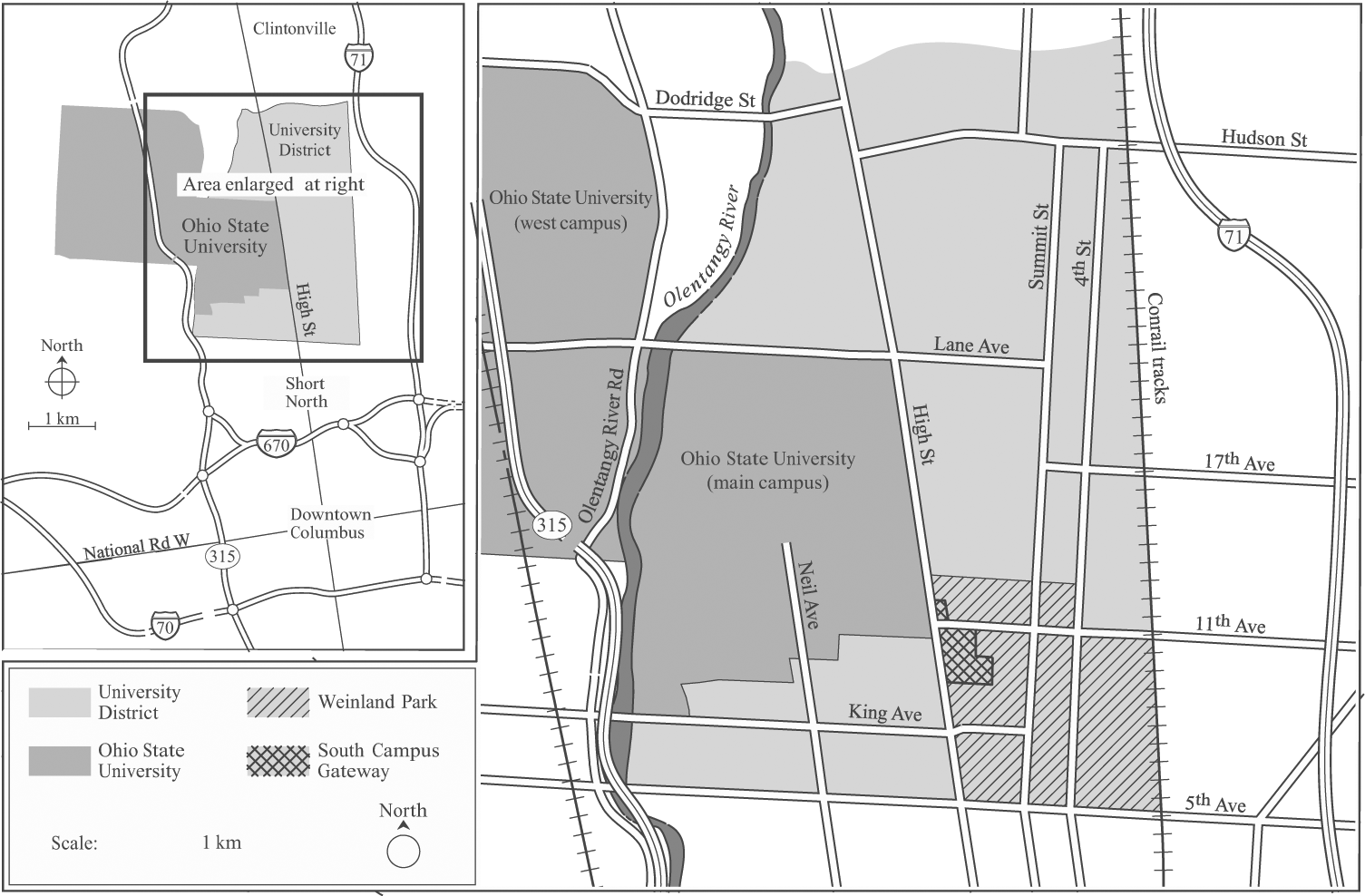
The university district and surrounding area.
I carried out empirical research on OSU’s redevelopment politics over a period of three months in 2010. Documentary evidence from university archives, especially multi-sourced newspaper articles, was my primary data source. The research was supplemented by several informal interviews with neighbourhood residents and university officials, and by participant observation at a local church-cum-homeless shelter and at meetings organised by local community members.
The context
OSU is bordered on the west by large experimental farms that it owns, with buildings sporadically developed. In contrast to this, on its remaining three sides the university is surrounded by heterogeneous neighbourhoods. Together these comprise the University District (UD) (Figure 1). Its northern part is dominated by middle class homeownership and student rentals. The south and southwestern portions have student rentals and have also undergone some gentrification. The southeastern part, called Weinland Park, has Section 8 rentals, 1 limited homeownership with a majority of poor African Americans (Bromley and Kent, 2006; Sterret, 2009). High density Section 8 housing for low income families has been accompanied by increased crime and physical deterioration (Campus Partners for Community Urban Redevelopment Inc, 2000). By the 1990s this had become a major concern for the university (Campus Partners for Community Urban Redevelopment Inc, 2008). The murder of an undergraduate student in the area in 1994 raised anxieties about student enrolments. Enrolment data indicated that the number of students living in the campus neighbourhood dropped from 14,000 in 1986 to 10,500 in 1995 (Sterret, 2009). Home ownership declined further, leading to more disinvestment (Perry and Wiewel, 2005).
This suite of problems threatened the flow of student fees and surplus value for research programmes, diminishing OSU’s competitiveness. There was an existential threat to OSU’s ability to participate as capital’s division of labour within the accumulation process. University officials attempted to make OSU competitive to preserve its position in this division and ensure value circulation. This enforced its role as an entrepreneurial subject with expansion/revitalising the area becoming a competitive manoeuvre. OSU thus adopted the responsibility to alter the social composition of the area: a spatial fix to attract values. It then materialised this responsibility by engaging in classed and racial calculus to produce subjectivities that yielded consent. This ‘eugenicised’ politics of social purification was an attempt to achieve efficiency in this politics and reduce resistance. In other words, OSU’s politics involved manipulating subjectivities to produce governable subjects. As will be seen in the following part of the paper, OSU was not essentially interested in either developmentalism or racism. Its intervention was part of the calculus of expansion to attract revenues. It therefore acted as an entrepreneurial subject that adopted the responsibility to efficiently redevelop through specific technologies of power.
To maintain its competitive edge, the university established Campus Partners for Community Urban Revitalization in January 1995. This organisation spearheaded ‘improvement’ in the University District (Sterret, 2009), especially the area where the university abutted on Weinland Park (Figure 1). Through Campus Partners the university adopted a collaborative approach seeking the support of those that might support its goals, like the few remaining middle class residents, local businesses and the city from who planning resources were sought. This array of agents, anticipating that redevelopment might benefit them, was eventually, if not initially, receptive to the university’s plans.
Early planning and execution
In 1995–1996, Campus Partners initiated a community-based comprehensive planning process to formulate the University Neighborhoods Revitalization Plan (UNRP) (Campus Partners for Community Urban Redevelopment Inc, 2000, 2004). This early planning document targeted not only the redevelopment of the potentially problematic Weinland Park because of perceived and substantiated criminal activities and its failing infrastructure; but also the other neighbourhoods around the university, to make them, as university officials claimed in unison, ‘neighbourhoods of choice’ for potential homeowners and businesses. The university saw the homeowners, some renters and rental property owners’ cooperation as necessary to carrying out its redevelopment plans (Sterret, 2009). It paid particular attention to their demands of better services, historic preservation, improvement of retail establishments and crime prevention. However some were sceptical about OSU’s motives behind redevelopment. A homeowner anxiously expressed that OSU ‘should not gentrify the area to build a core of student housing’. The university attempted to remove such doubts (Perry and Wiewel, 2005) before adopting a draft plan (Campus Partners for Community Urban Redevelopment Inc, 2004; Sterret, 2009) and starting its redevelopment projects.
Redevelopment projects
Three redevelopment projects were initiated in Weinland Park: The South Campus Gateway Redevelopment Project, Broad Street Portfolio Revitalization Project and the creation of mixed-income neighbourhoods. In each of the projects the political calculation was to build alliances by producing commensurate subjectivities through artful manipulations that can materialise redevelopment. In the case of the South Campus Gateway project, cleavages of class were mainly invoked and magnified, while in the latter two, class and racial fractures were pronounced.
The South Campus Gateway Redevelopment project
The South Campus Gateway Redevelopment Project attempted to revitalise a commercial stretch on the chief commercial corridor of the University District (High Street), specifically a three-block area located southeast of campus (Figure 1) which had been identified as blighted (Sterret, 2009). This area had bars, fast food restaurants, record stores and some vacant commercial properties, but without an affluent clientele (e.g. Grabmeier, 1996; Racey, 1995). The buildings were too small to house modern retail units, the store mix lacked diversity along with a shortage of parking space (Sterret, 2009). Furthermore, the area had become notorious for crime and drug trafficking (Long, 1994). The university aimed at displacing the existing commercial establishments, to bring in upscale retail stores and restaurants to attract affluent consumers. The belief was that this would free the area of crime and drugs. Thus, OSU was trying to commercially gentrify in the name of ‘redevelopment’, with the ultimate goal of creating an anchor point for further residential gentrification in Weinland Park.
The university’s plans were met with resistance from large business owners who feared that they would be driven out by national and regional chain stores that the university wanted to bring in. The university tried to assuage these concerns and forge strategic alliances with the more powerful stakeholders of the area, particularly those whose vision of the future of Weinland Park fitted well with its own. Accordingly, Campus Partners set up an Advisory Steering Committee, which included members of the University Community Business Association (UCBA), representing more strongly the powerful businesses, community associations (University Area Commission (UAC) and University Community Association (UCA)) composed of homeowners, older renters and few students (Campus Partners for Community Urban Redevelopment Inc, 2004; Perry and Wiewel, 2005). In this committee, the university discursively shifted focus away from its own strategic goals of expansion, instead appealing to its members by stating that a ‘safe liveable neighbourhood’ must be constructed (Sterret, 2007). This recommendation was seductive to the powerful constituents, like homeowners and larger businesses who had similar aspirations because of their desires to have an attractive neighbourhood and attract high-end customers respectively. The university also promised to internalise various recommendations towards liveability mooted by businesses and residents. It made the steering committee responsible for outreach in order to include the recommendations of the neighbourhood community (Campus Partners for Community Urban Redevelopment Inc, 2004). Despite this, the suggestions of the more influential members of the committee were privileged. Hence attention was given to some of the demands of powerful businesses and middle class home owners rather than those of neighbourhood constituents like poorer renters, homeowners, students and owners of smaller businesses. The discourse of ‘safe liveable neighbourhood’ and the simultaneous practice of setting up a steering committee with greater representation of powerful constituents played on and increased the extant class divides in the neighbourhood. The university engaged in creating subjectivities based on ‘strategic essentialising’ (Spivak, 1987) favouring the class identity of the well-heeled over the others and foregrounding their interests (Jessop and Sum, 2012).
The process of building class-based solidarity othered the store owners of the blighted stretch, some of whom opposed the university’s move due to inadequate compensation and investment losses (Racey, 1996; Striff and Forcina, 1995). In response the university made a political calculation by appointing an influential member of the UCBA as the chair of the steering committee to find an amicable solution to the issues raised (Racey, 1996). When that failed, the threat of using the city’s right of eminent domain was invoked (Bennett, 1996). Despite, these oppositional moments the university succeeded in driving through the Gateway project (Figure 2): a mixed-use project, combining retail, entertainment, student housing and office facilities (Sterret, 2007, 2009).
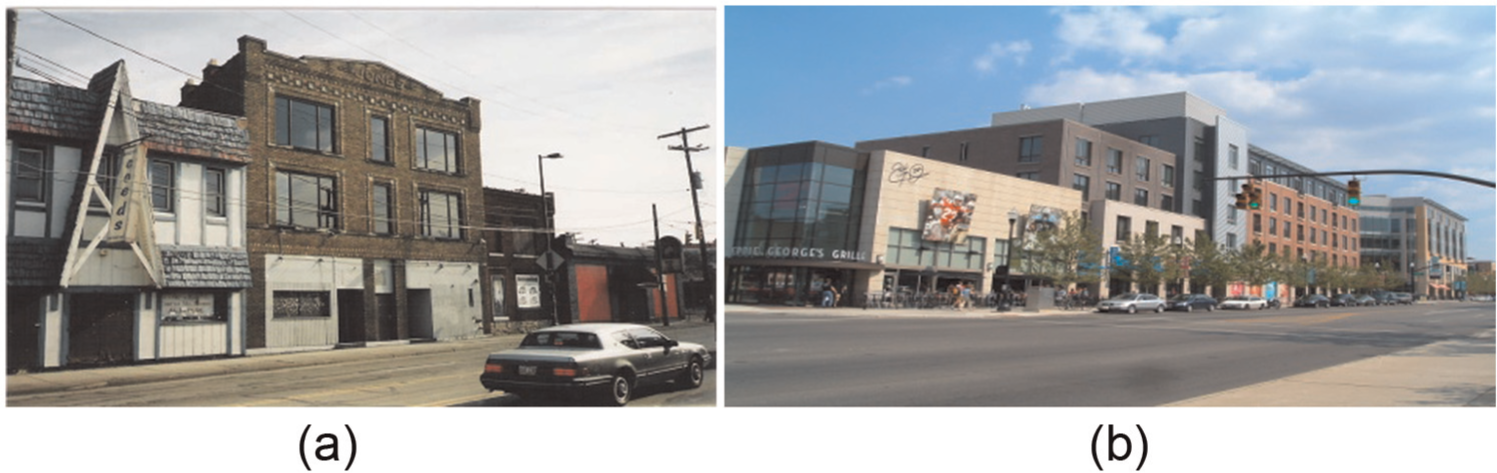
The south campus gateway landscape (before and after gentrification).
In its attempt to construct a class-driven ‘imagined community’ (Anderson, 1983), OSU showed ‘selective’ sensitivity to the demands of middle class home owners and some remaining businesses albeit to the extent it fitted in with its own plans. For instance, the university included the construction of a parking garage and maintained the historic features of the street through partial retention of earlier architectural features in the design of the Gateway centre (Campus Partners for Community Urban Redevelopment Inc, 2000; Racey, 1995; Sterret, 2009).
The discourses, negotiations and practices that ensued in this project, coded in the name of safety and liveable neighbourhoods concealed the university’s class-based technologies of power (Lipman, 2011) that produced particular subjectivities and useful allies. OSU attempted to socially control and produce a space for the well-heeled (Brenner and Theodore, 2002) which generated new ‘landscape[s] of power’ (Zukin, 1991) marked by new cultures. The university determined who belonged, or not, and how space was used and by whom (Lipman, 2011). It exacerbated class inequalities (Hackworth, 2007) by displacing ‘undesirable’ businesses and commodifying the space (Zukin, 1991). After this spatial purge, the university directed its attention towards revitalising Section 8 housing in Weinland Park, to complement the Gateway project, and pave the way for eventual residential gentrification in that ‘blighted’ neighbourhood. In these two programmes, the university manipulated both class and racial divides producing subjectivities to push through its goals of expansion.
The Broad Street Portfolio Revitalization project
A relatively large proportion of the Section 8 housing in Weinland Park was owned by Broad Street Management Inc (BSMI), which was widely regarded as having neglected the maintenance of the properties, eschewing property management and tenant oversight (Hassen, 2005). The Section 8 vouchers of the Department of Housing and Urban Development (HUD) covered 90% of the rents which allowed BSMI to operate profitably (Webb, 2007). The housing had become ‘housing of last resort’ for the distressed poor, mainly African Americans (Campus Partners for Community Urban Redevelopment Inc, 2006). The original UNRP document acknowledged the problems of concentrated poverty, distressed housing and crime (Sterret, 2009) as having a ‘blighting influence’ on that part of the University District, repelling prospective students due to safety concerns (Webb, 2007).
The universities’ plans to revitalise Section 8 housing was facilitated by the vulnerability of public housing in general to neoliberal restructuring (Hackworth, 2007). Particularly propitious for the university in revitalising the Section 8 housing were a couple of fortuitous events: firstly, the city was about to condemn the housing on grounds of its dilapidation; secondly, the BSMI, which so far had been extracting higher-than-market rents, felt its financial stability threatened with an impending reduction in federal subsidies. This happened when the HUD instituted its Mark-To-Market programme in 1997. Under this programme, with the expiry of renter contracts of Section 8 housing, financial help was offered to landlords to improve their properties and make them competitive in the rental market. The Mark-To-Market programme not only allowed for the rehabilitation of these housing units but enabled them to be made available at comparable market rents, and not higher-than-market rents as was the case before (Danter Company, 1998). The university saw in both these events an opportunity to rehabilitate and control the troubled Broad Street Portfolio, clearly with a view to its own purposes and not those of the tenants (Hassen, 2005; Perry and Wiewel, 2005; Webb, 2007). Accordingly the university purchased the portfolio and drew up a Mark-To-Market restructuring plan (Sterret, 2009). In developing the plan, the university conferred with the powerful stakeholders of the area as before, including community leaders and social service agencies, held off objections and made some concessions (e.g. Perry and Wiewel, 2005; Sterret, 2009).
The object of rehabilitation, that is, the Section 8 residents, were highly vulnerable bodies. Their vulnerability was due to their poverty, welfare dependency and race. The interdigitation of these ‘negative’ classed and racialised positionalities resulted in a general prejudice against them in the neighbourhood. They were viewed as undesirable. This elitist and racialised logic was sharpened by the university through an iteration of this discursive-ideological position in the process of alliance-building amongst neighbourhood stakeholders. This happened through the discursive moralising of poverty by university officials during the community participation stage wherein the poverty of Section 8 residents was projected as cultural and not structural (Lipman, 2011). One university official later implied in an interview that the residents ‘were like that and required help’ while patronisingly stating that ‘OSU was doing its bit to improve their housing and not gentrifying the area’! This production of a racialised/classed immoral other with its pernicious associations with blight was engineered by pronouncing existing divisive logics, as noted above. This had effects: it consolidated classed and racist ideologies by building on the existing classed and racial anxieties. This created subjectivities amongst the more powerful constituents in the neighbourhood that procured consent for rehabilitation and social regulation. The cultural projection of poverty condoned a paternalistic justification that such rehabilitation was necessary as the lives of Section 8 residents could be improved, while simultaneously concealing the structural racism that produced these inequalities. Paradoxically, the university projected itself as neutral despite its cultural politics of class and race (e.g. Lipman, 2011).
Subsequently, in 2003, Campus Partners started rehabilitating the housing and developed an alternative model of ownership and administration with the help of a non-profit organisation called Ohio Capital Corporation for Housing (OCCH) (Sterret, 2009; Webb, 2007). The OCCH created an entity called Community Properties of Ohio (CPO), to renovate and manage its Section 8 housing (Webb, 2007). The renters of the Section 8 housing were relocated for two years so that the properties could be rehabilitated (BSMP, 2001). Crucially CPO made it mandatory for these tenants to reapply for tenancy, if they wished to return. This was the start of tenant disciplining aimed at mitigating problems of social control in the area. Strict pre-screening of tenants started with scrutiny of credit and criminal records (Hassen, 2005; Webb, 2007). Those with past felony convictions or those who had relatives who were convicted felons could not get their leases renewed. Those who had substance abuse problems could not survive the screening. In addition, new regulations were established for those who were offered leases, which included a code of conduct for the tenants. Remarkably, according to the rules, tenants had to keep the CPO informed about who was entering their homes. Further, the management could enter their homes at any time and inspect for criminal activities or undocumented residents. In short, the CPO engaged in extraordinary practices of tenant surveillance. Finally the CPO was allocated a mobile, sub-unit police force by the city in order to enhance police presence at the site and deter criminal activities (Hassen, 2005). This was part of their ‘Eliminate the Elements’ crime prevention plan (CPO, 2005).
Due to this disciplining, within the first few months of the opening of the renovated properties, 320 non-compliance eviction notices were served and 150 tenants were evicted (CPO, 2005). The remaining tenants found it difficult to resist the new disciplinary regime as they were aware that there was a three year waiting list to be re-housed in another subsidised unit, and thus were substitutable as renters. Likewise they could not seek the support of other residents of the area to oppose CPO’s imperiousness, because of the stigmatised status within the neighbourhood (Hassen, 2005). In short, the university took advantage of the support of the other residents of Weinland Park, producing conducive subjectivities that favoured redevelopment. This was done by engaging in a virulent politics of class, race and social control of space (Lipman, 2011). It exploited with impunity the political weakness of the Section 8 renters, which illustrates how institutional racism aligns with structural racism to accentuate it (Roberts and Mahtani, 2010). This determined the tenant mix in an ongoing manner consistent with their aims for the neighbourhood.
Creation of a mixed-income neighbourhood in Weinland Park
Following the success of the renovation of Section 8 housing, the city, university and some neighbourhood residents turned to exploring opportunities for further ‘revitalisation’ of the neighbourhood (Sterret, 2009). Most stakeholders wanted the creation of a mixed-income neighbourhood without displacing current residents, to make it more attractive to middle class homeowners and stimulate private investment through establishment of banks, recreation centres and exclusive retail outlets (Hassen, 2005). A plan envisaging the renovation of deteriorating properties, construction of new market rate housing, infill housing on vacant plots, and transformation from rental to owner-occupied properties was instituted (City of Columbus, 2006; Sterret, 2009). OSU contributed to this project ostensibly to produce a desegregated ‘vibrant neighbourhood’. However in effect it was trying to gentrify the area. OSU’s discourse of a ‘vibrant neighbourhood’ through home ownership drew upon the aspirations of some people in the neighbourhood towards the same in consonance with the widespread ideology of the American Dream of owning homes. A Campus Partner official noted that ‘home ownership was needed to improve and stabilise’ the area. Mixed-income housing projects despite its promise of class and race equality, is a class-based racialised project (Roberts and Mahtani, 2010). It is an attempt to deconcentrate poverty through the scattering of poor residents, who are usually African Americans. The concentration of poverty of African Americans is understood as incubating moral deprivations. The classist and white supremacist ideology is that mixed-income housing will facilitate class mixing, and therefore moral learning (Lipman, 2011). OSU reproduced the same ideology by taking advantage of these hopes and fears through its discourse of a ‘vibrant neighbourhood’. This reinvigorated subjectivities that favoured mixed-income housing.
Campus Partners purchased and demolished several rental properties to convert them into single-family homes (Hassen, 2005). This eliminated crack houses which drove out criminals. However, when low-income single-family homes were targeted for purchase and conversion to market rate housing, Campus Partners faced resistance from their poor owners. Despite an emphasis on class-based ‘social mixing’ (Lipman, 2011), this move to demolish poor homes exemplifies that OSU’s goals were not about social mixing but were about social homogenisation. OSU attempted to materialise that through this exacerbation of class and race differences (Lipman, 2011). The move by Campus Partner led to complaints from the area’s civic organisations, questioning the basis on which the properties were chosen for acquisition. The residents saw this move as a threat: a means to gradually enable gentrification and community displacement. In face of this resistance, Campus Partners retreated, stopping its purchases (Sterret, 2009).
The university-led project of mixed-income housing is not only about changing neighbourhood composition to attract enrolments, but this articulates with producing/reproducing subjectivities by the university, that tap into the American Dream, class-based and racialised politics of exclusion. Here poverty, race and pathology are concatenated through the discourse of a ‘vibrant neighbourhood’ to produce identities of the ‘other’ to legitimise redevelopment. This mixed-income housing project was about continuation of social separations while disarticulating the issue from the histories of class and race (Lipman, 2011). These recast universities’ activities as class neutral, post-racial and just a matter of technical need (Weber, 2002).
Through the implementation of all the redevelopment projects, the university tried to attract the circulation of values and extended neoliberal spatial restructuring. However, this produced struggles. Through such redevelopment, the process of urbanism itself evolved. In this emergent neoliberal urbanism, the accumulation process, class, race, the politics of space and power relations come together to dialectically materialise urban evolution (Lipman, 2011). The neoliberal move of redevelopment by the university attempted to gentrify the area, by seeking support from the more powerful actors of the area, whose material interests were quite close to its own. This involved a political process of manipulating subjectivities to enrol these allies, drawing on and pronouncing class and racialised logics (Roberts and Mahtani, 2010). It involved calculations that drew upon feelings, aspirations, and lived experiences of disinvestment, crime and anxieties (Keil, 2002) of particular constituencies. This created a social imaginary (Jessop and Sum, 2012) that aligned with the universities’ goals, legitimating its actions. The creation of liveable, safe, vibrant neighbourhoods was certain, but what remained silent was who got excluded and bore the cost (Roberts and Mahtani, 2010). There was resistance to such politics, which were sometimes absorbed through co-optation, or were too recalcitrant to being co-opted (Mayer and Kunkel, 2012a).
Conclusion
This paper critically looks at the role of universities as urban developers. The existing literature on university redevelopment is weak in terms of wider determinations. The paper addresses this lacuna by understanding the expansionist logic of universities situated within neoliberal accumulation. The paper posited that universities expand in order to retain and bolster their position in the social division of labour. This expansionist impulse compels universities to become entrepreneurial subjects that attend to their immediate surroundings through a politics of redevelopment. Such projects require alliance-building which is carried out by constituting specific subjectivities, using fractures of class and race. Such politics in turn can engender protests. The case study of The Ohio State University looked at the development strategies of the university to highlight its politics of persuasion. The university co-opted powerful stakeholders like middle class home owners and business owners, while exploiting the political weakness of poor renters. It manipulated subjectivities through subtly invoking classed and racial cleavages, to generate consent towards its projects and creating exclusions (Lipman, 2011). There were limits to this politics too, as it faced its share of resistance.
This study facilitates an understanding of the neoliberalisation of universities, the political economy of neoliberal redevelopment by universities, neoliberal urbanism and their co-evolution. More specifically, this paper contributes to an understanding of universities’ redevelopment politics under neoliberalism. As the paper indicates, manipulating subjectivities is a crucial conceptual category to understanding this politics. It considers how structural issues and class and racial power dynamics are part of this politics that spatio-materially transform the city, produce uneven development and resistance (Lipman, 2011). This analysis raises questions about ‘right to the city’ (Lefebvre, 1968 [1996]) to underscore the possibilities of a just future (Harvey, 2003). This paper suggests an effective politics that requires relentless labour (see Lipman, 2011). Such politics may include building solidarities across space; or challenging the normalisation of neoliberal redevelopment (Hackworth, 2007; Lipman, 2011; Mayer and Kunkel, 2012a). This can decentre the all-knowing gaze of redevelopers (Lipman, 2011; Weber, 2002) demanding profit not for a few but benefit for all (Purcell, 2002).
Footnotes
Acknowledgements
I want to express my deepest gratitude to Dr Kevin Cox and Dr Becky Mansfield of The Ohio State University. Both worked with me across different times, patiently reading and commenting on various iterations of the paper. I would like to thank my roommate Emily Scarborough for helping me with the maps in this paper. I want to also express my gratitude towards The Ohio State University official ‘map maker’ Jim Degrand, for reproducing the maps with a high degree of professional expertise and precision. Finally, the encouragement of my committee members, particularly Dr Nancy Ettlinger and that of my family, was indispensable towards writing this paper! Their unstinted support and helpful critique helped me refine my argument and make it more cogent. The three anonymous reviewers further helped reshape the argument of the paper, offering valuable suggestions and references towards the same.
Funding
This research received no specific grant from any funding agency in the public, commercial, or not-for-profit sectors.