



Abstract
Shareholding Cooperatives (SCs) are the officially recognised organisations responsible for managing villagers’ collectively owned assets. In recent years, massive land requisitions in the Pearl River Delta region have led many villages to experience a rapid expansion in their collective assets, highlighting the indispensable role of SCs in reshaping the landscape of local governance. Based upon an in-depth case study of the Guangzhou Luogang District, this study shows that the local state has engaged with shareholding reforms to achieve two main objectives: inducing compliance amongst villagers and promoting the accountability of village cadres in the management of collective assets. These empirical findings suggest that shareholding reforms were not simply a process of market building or property rights reforms driven by local initiatives. Rather, they should also be interpreted as a process of state power reconsolidation, whereby the local government sought to regain its control over the urbanising villages.
Introduction
Shareholding Cooperative (SC) emerged in rural China during the early years of the reform era. Most policy-makers and scholars tend to view SC as a spontaneous, grassroots institution driven by local initiatives. The policy documents highlight SC as a great grassroots institution innovated by rural farmers and cadres. This stereotype, according to Li (2009), was a well-tried tactic by the socialist state to justify the necessity and legitimacy of its reform policy in the countryside. Much literature on China’s urban transformation has also underscored the bottom-up nature of SC in their attempts to illuminate how China was able to attain an unprecedented level of market and urban development within an authoritarian political setting. During the 1980s, Township and Village Enterprises (TVEs) experienced a rapid growth under the successive fiscal decentralisation promoted by the Chinese government. They offered ample non-agricultural employment opportunities and spearheaded small town development (Xu and Zhang, 2011), creating what Guldin (1997) calls ‘rural grassroots dynamism’ to empower an unprecedented process of in situ urbanisation in reform China. Offering a hybrid institution, SC allowed collective rural enterprises to engage in a shareholding system without having to subvert the established national ideology which proclaimed a collective regime as the bedrock of socialism (Fu, 2006; Guo, 1999; Li, 2004; Ma, 1998; Tang and Chen, 2003). SC is therefore viewed as a key contributor to the tidal wave of bottom-up development that occurred in the 1980s.
In the 1990s, TVEs experienced a severe decline. However, SC as a specific ownership and organisational structure continued to thrive in the urbanising villages. Recent studies tend to highlight SC as a driving force for the development of self-governance. For instance, based on the study in Guangzhou Chen Village, Chung and Unger (2013) suggests that SC provided an effective mechanism for villagers to centrally manage their collective properties for leasing purposes, leading villagers to become what they call the ‘new middle class’ of urbanising China. Based on the study in Jiangsu Huaxi which was once the richest village of socialist China, Hou (2013) views SC as a form of ‘community capitalism’ initiated by the villagers to embrace market, kinships and collectivism, by which they could effectively mobilise and distribute their collective assets for the pursuit of common prosperity. Looking through the land conflicts in some urbanising villages of Guangzhou Tianhe, Hsing (2010) treats SC as a form of ‘village corporatism’ by which the villagers self-organised to relentlessly fight against land expropriation from the extractive local state.
When explaining the impact of SC on the self-governance movement in these wealthy, autonomous villages, researchers generally infer that villagers are no longer powerless as shareholding reforms have strengthened the social cohesion of villagers and enhanced their power to stand up to the state. However, what is often missing in their accounts is the response of the state in the process of shareholding reforms. Faced with this self-organisation movement, how has the socialist state restructured itself and revised its governance strategy as a response? Has it just simply ceded its power to the villagers who have been increasingly aware of their social and economic rights, or sought to regain its control over urbanising villages? Existing scholarship in political science has gained important insights into the transforming role of the Chinese state at both the central and local levels (see, for example, Lu, 1997; Smith, 2013; So, 2007; Walker, 2006). However, they pay very little attention to the issues of local state building, premising on the notion that the central state has lost its former strength and thus its local agencies always run out of its control to pursue ferocious land grabbing for local economic development.
This study provides an alternative perspective on local state restructuring through exploring the complex impact of shareholding reforms on the landscape of local governance. In this study, the local state refers to the governments at the lowest level (i.e. township/district), which have direct interaction with villagers in the implementation of state policies and decisions. Drawing insights from the Guangzhou Luogang District (GLD), this study shows that shareholding reforms have been a process of state power reconsolidation, whereby the local state sought to regain its control over potential social unrest through encouraging compliance amongst villagers and promoting accountability of village cadres in the management of collective assets.
Urban development and growth of autonomous villages
Different approaches to urbanisation have shaped a variety of SCs at different localities. This study, therefore, takes departure from exploring the process of urbanisation that occurred in the GLD, which has been primarily driven by industrial development made possible by the extensive state-led land requisitions for overseas investors. Traditionally, the villagers in the GLD relied on growing rice and fruits to make a living. In the early 1980s, all villages in the area started to implement the Household Responsibility System. After private farming was restored, the village collectives actively developed rural enterprises to engage in a range of industrial production, such as processing local fruits, making furniture, making electroplating products and so on. As revealed by the statistics compiled by the Luogang Town Gazetteer, the total industrial output of TVEs in the area increased from 5,697,800 yuan in 1983 to 26,154,000 yuan in 1990. As some villagers remembered, these industrial enterprises did not pay them dividends but provided local employment opportunities and funded the construction of village facilities. In one such instance, a village cadre suggested that their village collective had invested as much as 900,000 yuan in the late 1980s in building a tap-water system for every household.
However, the TVEs in the GLD quickly experienced a decline in the 1990s. Past studies highlight two major reasons for this decline. First, the Chinese government deliberately suppressed TVEs by limiting their access to bank loans in the formal financial market, as TVEs not only directly competed with state-owned enterprises but were also creating serious pollution problems (Huang, 2008; Zhao and Wong, 2002). Second, many TVEs were subject to the constraints of their ambiguous ownership structure, which lacks both the key features of a shareholding company and an ordinary cooperative, limiting their abilities to pursue growth in the 1990s (Ho, 1994; Naughton, 1994; Vermeer, 1999). This study suggests one more reason. With the rapid growth of foreign direct investment (FDI) in the area, the villagers quickly found that direct land leasing was more profitable than running their own TVE business. More and more village collectives, therefore, simply closed down their factories and leased their land to overseas investors from Hong Kong and Taiwan.
Alongside the decline of TVEs, massive land requisitions for the industrial expansion of the Guangzhou Development District (GDD) led many villages to have more non-agricultural land for leasing purposes. After land requisitions, the village collectives received land compensation fees. As arable lands are collectively owned, after paying the compensation for the value of any agricultural products grown on the requisitioned land (i.e. Qingmiaobuchangfei) to the affected villagers, all compensations were centrally held and managed by the economic organisations of Villagers’ Group (formerly known as Production Team in the Maoist era) to pay for villagers’ future social welfare services. Moreover, under the ‘reserved development land (ziliu fazhan yongdi)’, a certain portion of the requisitioned land (about 10%) was returned to the village collectives as part of their overall compensation. All ‘returned land’ remained collectively owned. These lands were not allowed to be sold in the market but were legally allowed to be leased for non-farming uses such as hotels, factories and storage buildings.
This policy provided a self-help approach for the affected villagers to generate recurrent rental income so as to sustain an improvement in livelihood after land requisitions. Over the years, with the expansion of income derived from land compensation fees and the use of ‘reserved development land’, social welfare provision by village collectives was extended from the construction of village roads and water supply system to a much wider scope of social facilities and services, such as kindergartens, elementary schools, medical clinics and nursing homes for the elderly. After adopting the ‘reserved development land’ as part of compensation, the township government largely reduced their presence in the villages; it devoted major effort to attracting outside investors rather than assisting villagers in developing rural enterprises. Throughout the 1990s, village collectives were therefore given a relatively high degree of autonomy in the management and distribution of collective land and assets, turning these urbanising villages into fiscally independent entities. With the expansion of the nearby industrial zones, more and more villagers lost their land to urbanisation in the early 2000s. Consequently, villagers have undergone an in situ urbanisation process to become urban residents without having to move to cities.
Growing out of this specific context, the SCs in the GLD bare resemblances to their counterparts in the Pearl River Delta (PRD) region. The economic and urban development of the PRD has been mainly driven by foreign investment rather than local capital (Chan, 1992; Him and Unger, 2013; Lin, 1997). The existing literature has identified two key institutional characteristics of SCs in the PRD. First, their core business is leasing collective land and properties, envisaging the purpose of not only producing recurrent dividends for land-losing villagers but also generating stable income to support their village facilities and social welfare provisioning (Chan et al., 2009; Guo and Zhou, 1997). Second, their organisational structure was inherited from the former Production Team (now Villagers’/Residents’ Group), which was officially recognised as the legal holder of collective land and assets (Tang and Chen, 2003; Li, 2004; Po, 2008). Addressing these features, policy-makers and scholars in China tend to classify the SCs in the PRD as ‘Neighbourhood SCs (shequxing gufen hezuoshe)’ in order to differentiate them from their counterparts in other regions.
In Sunan and Wenzhou, urbanisation was primarily driven by TVEs which had developed very close business relationships with the local state. As Parris (1993) suggests, local governments in Wenzhou colluded with local stakeholders to pursue rapid industrial development by assisting rural enterprises in obtaining raw materials, technology and loans. In Sunan, TVEs were formerly known as commune-bridge enterprises, resulting in an upward power restructuring which combined ‘commune’ and ‘brigade’ of the Maoist bureaucracy into a single entity, by which the local government had direct control over local production (Ho, 1994). Oi (1992) describes this interdependent relationship of the township governments with the rural enterprises as ‘local state corporatism’. Comparatively, the local governments in the PRD did not directly get involved in the operation of SCs; they acted less as a dominant corporate authority and more as a regulator and provider of administrative services. Yet, how the transforming role of the local state has in turn reshaped the process of shareholding reforms remained under-explored.
Taking GLD as a specific case, this study intends to elucidate how the local state has engaged with shareholding reforms to exert its influence over these urbanising villages, which became increasingly wealthy and autonomous in the process of urbanisation. In 2005, the municipal government merged the township government with the authority of the nearby development zones to form the present district government. The villages under this study are currently urban neighbourhoods (shequ). Despite these administrative reforms, the Villagers' Committees (Now Residents’ Committees) and the SCs in these transitional neighbourhoods continue to centrally manage villagers’ collective land and assets. In addition, the operation of these grassroots organisations is not entirely independent of their village communities; the informal norms and rules, such as villagers’ sense of collective identity and their shared assumptions about kinship relations, continue to inform the daily interactions among villagers. This is also evident by the fact that all interviewees participated in this study still referred to themselves as ‘villagers (cunmin)’ and ‘villager cadres (cunganbu)’ rather than ‘urban residents (jumin)’ and ‘neighbourhood cadres (shequganbu)’. For these reasons, this article calls them ‘villagers’ and ‘village cadres’, even though their villages were already converted to shequ.
Top-down shareholding reforms
It is true that many SCs that emerged in the early 1980s were driven by local initiatives. For instance, the Shenzhen Municipal Government offered land to the affected villagers as part of their compensation: a residential site of 150 m2 for each household and 15 m2 of non-agricultural land for each person for self-development. Drawing on the ‘Elementary Cooperative’ that they had experienced in the early 1950s, the villagers unified the management of their land to form a so-called SC (Tang and Chen, 2003). They therefore become shareholders and received dividends at the end of each year. However, starting in the mid-1990s, shareholding reforms in the GLD have been a state-led rather than bottom-up process. Baum and Shevchenko (1999) suggest that the promotion of democratic village elections during the 1980s was indeed a strategy adopted by the socialist state to ward off political disability by reinvigorating village self-governance to keep local cadres in check. Indeed, the municipal government had similar considerations in its promotion of shareholding reforms. When more and more arable land was requisitioned, village cadres were responsible for the management of all collective assets including land compensation fees and the rental income derived from ‘reserved development land’, which constitutes an essential source of funding for the villagers’ medical services and pension schemes created after land requisitions. To put village cadres under local control was considered necessary to avoid the mismanagement of collective assets by incompetent or corrupt village cadres that would put the local social welfare system at risk.
The shareholding reforms in the GLD area were divided into two major rounds. The first began in the mid-1990s with the aim of regulating the management of the ever-growing collective assets arising from land requisitions. The second took place in 2003 when the local government managed to integrate these urbanising villages into the urban administrative system. In what follows, this study will explore how the local practices had interacted with the shareholding reform policies to shape the process and outcome of SCs in the urbanising villages.
Shareholding reforms in the 1990s
At the national level, the first official document about SC was the Chinese Communist Party Decree No.1 of 1985. In Article 8 of the document, the central state commented positively on the grassroots nature of SC and encouraged local officials to adopt it as a model of incorporation for rural enterprises. This article was to formally recognise SC as a unique ownership and organisational structure rather than to impose rigid control on its development. In 1987, the municipal government started to experiment with its shareholding reform policy in two villages, Yangji and Dengfeng, which had experienced rapid expansion in their collective assets and income as a result of urbanisation. From the early 1990s onward, the central government began to tighten control over SCs by setting up standardised rules and procedures for their operation. As Huang (2008) noted, China’s reform followed a non-linear process of state power decentralisation, witnessing a reversal of state policy to tighten control over localities during the 1990s. The same trajectory was also seen in the development of shareholding reform policies. In February 1990, the central government promoted Provisional Regulations on Farmers’ SCs. Following this national legislation, the Guangdong Provincial Government introduced the Organic Law on Rural Neighbourhood Economic Cooperatives later in the same year. Coming into the mid-1990s when the higher level governments made attempts to strengthen SCs as a manageable system, shareholding reforms in the GLD were not a bottom-up process. Rather, they were a planned process imposed by the municipal government through its agent at the township level to regulate the management of the ever-growing village collective wealth arising from land requisitions.
Some village cadres, who had experienced the shareholding reforms of the 1990s, suggested that they themselves did not understand what SC was about before they were asked to implement them. After the introduction of the Regulations Concerning Audit on Village Collective Assets at the municipal level in 1995, the township government required the Villagers’ Committees to verify and report all their collective assets (including land, landed properties and cash) held by their cooperatives. Village cadres were instructed by the township government to reorganise their production teams into SCs by converting villagers’ entitlements to these assets into shares by two major criteria. First, indigenous identity and hukou registration were instrumental in determining a villager’s entitlement to his/her shareholding benefits (see Table 1). Only indigenous villagers who had registered their hukou with the village could enjoy full benefits from their shareholdings. Indigenous villagers generally meant those resident villagers who were descended through a male line of a clan within the village. If an indigenous villager relocated his household registration away from his village, he would only have a partial entitlement to his shareholding benefits. The same principle was also applied to non-indigenous villagers who had registered their hukou with the village. Most villagers in this group belonged the ‘sent-down youth (zhiqing)’ of the Maoist era, who had returned to the city but had retained their household registrations in the village. These ‘ex-villagers’ and ‘non-indigenous villagers’ received partial shareholding entitlements because they were considered to have once made some contribution to the village. But what is ‘a contribution’ to the village? Cadres explained that contributions might include the participation in collective agricultural production during the Maoist era or participation in the Household Responsibility System during the 1980s. In the latter period, villagers were still required to pay rural taxes and meet the grain production quota imposed by the state, and in a departure from the Maoist era, the System allowed them to keep the remaining harvest for their own consumption. Therefore, the Household Responsibility System was not only about the household rights of leasing land from the village collective for the purpose of family farming, but also the family obligations to cooperatively assist the village collectives in meeting agricultural tax levies and state production quotas.
Share classification and distributions under SCs.
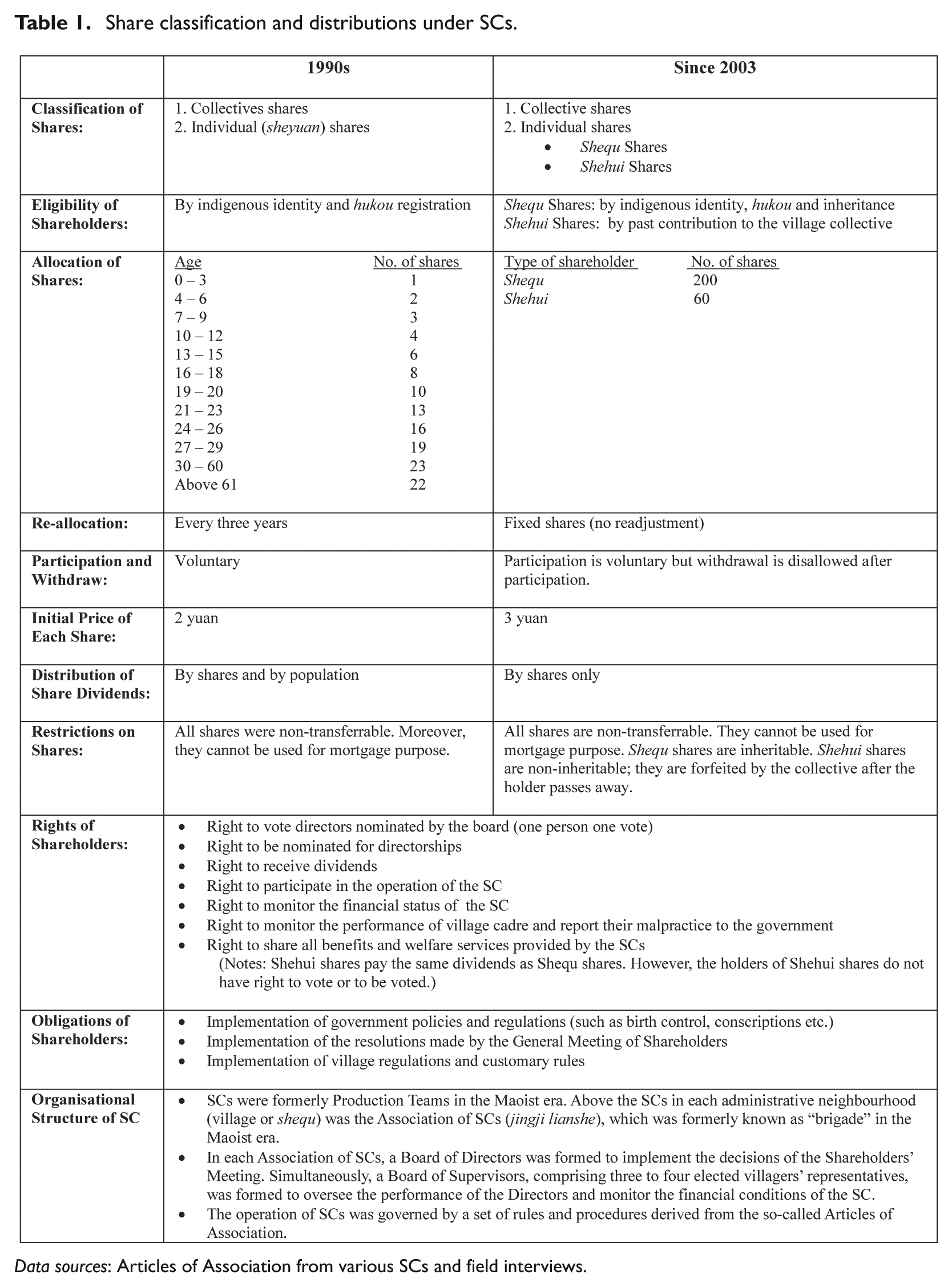
Data sources: Articles of Association from various SCs and field interviews.
The age of a villager was another important factor that determined his/her share allocation. As shown in Table 1, a villager’s share entitlement usually varied according to his or her age in three different phases of the life cycle: it increased in direct proportion to one’s age in Phase 1 (between 1 and 29 years), reached the height in Phase 2 (between 30 and 60 years) and slightly decreased in Phase 3 (above 61 years). Under this formula, villagers were able to earn more shares as they grew older. This arrangement inherited some similar principles of the work point system of the Maoist period. But it took into consideration the economic needs of the individual at different stages of his/her life cycle, rather than his/her labour contribution under collective agricultural production. In the Maoist period, the principle of equal remunerations for male and female villagers was adopted to promote gender equality so as to win the support of women (Ngo, 2009). The same principle of equal treatment continued to be adopted in shareholding reforms, allowing female villagers to obtain the same shares as male villagers. To accommodate the changes in age and village population, the SC would re-adjust the share entitlements of all eligible individuals every three years.
Internal conflicts: Village cadres versus villagers
Despite the policy intent to regulate the management of collective assets, shareholding reforms in the 1990s did not prescribe all the implementation details of shareholding reforms at the local scene, permitting the revival of informal village traditions to inform share allocation in daily practice. A case in point is the way share entitlements of female villagers were calculated. Ancestral lines and kinship networks constituted the foundation in organising village society (Fei, 1953). Villagers acquired their eligibility to participate in village affairs as well as their entitlement to village assets mainly through birth or marriage. These village traditions, informal norms and rules, which had been suppressed by the state during the Maoist period, began to revive and influence village governance during the reform period. One vivid example was related to gender inequality in traditional villages.
The long-standing dominance of men over women in village affairs made the actual process of share distribution much more complex than was stated to be the case in their Articles of Association. When a village man married a woman from another village, his family acquired additional shareholding entitlements to the collective income from that village. But, when an indigenous female villager married a man outside the village and moved her hukou registration out of her own village, her original entitlements and rights were forfeited. This rule originated from the traditional village norm that a married daughter no longer belonged to her village. A Chinese saying that ‘a married daughter is just like water that has been thrown out (jiachuqu de nver, pochuqu de shui)’ aptly described such a traditional way of thinking. Another practice is that an indigenous female villager did not move out from the village after getting married; instead, she invited her husband to move to her village. In traditional Chinese village society, this was called ‘uxorilocal marriage (ruzhui)’. The bridegroom was asked to reside with the bride’s clan because her family did not have any male descendants. This served the purpose of maintaining the family line and taking care of the elders in the bride’s family. This son-in-law, however, was not eligible to enjoy shareholding benefits even if he adopted the surname of his wife’s clan and registered his hukou with the village. Application of village traditions to the shareholding reforms thus resulted in inequitable gender discrimination and aroused the discontent of some villagers.
More prominent problems were associated with the management of collective assets. One problem, for example, was that a periodic re-adjustment of share entitlements among villagers created loopholes for village cadres to manipulate the allocation of shares. Village cadres had great discretionary power in dealing with share allocations, especially for female villagers and non-indigenous villagers whose entitlements were not clearly stipulated under the formal state policy. For example, some village cadres were found to have given favourable treatment to those who were their own family members or close relatives in share re-allocation. Another major problem was that the dividend policy did not reward the village cadres for good management of collective assets. During the 1990s, village cadres were not paid dividends during their terms of appointment. The initial objective of this policy was to avoid possible conflicts of interest. However, it turned out that village cadres had little incentive to enhance the operational efficiency of the SCs because their remunerations were not dependent on the business performance of the collectives. Even worse was that some cadres abused their power in the negotiation and deal-making with external partners in order to line their own pockets. The leasing out of collective landed properties was usually made through the personal networks of local cadres rather than public tender. Consequently, the ‘reserved development land’ of the villages was usually contracted out at extremely low rents, compromising the financial wellbeing of the village collectives.
Villagers’ lack of interest in shareholding reforms was another major reason for the increasing malpractice of village cadres in the management of collective assets. Villagers were generally uninterested in the shareholding system of the 1990s primarily because it generated only tiny, unstable dividend income. Under the collective land system, compensation for land requisition by the local state was legally claimed by all members of the Villagers’ Group. After deducting the payment of qingmiao buchang fei to the affected farming households, the remaining portion of land compensation fees and all income derived from the ‘reserved development land’ were shared by all eligible villagers, including not only those whose farmland was requisitioned but also those other villagers whose land remained untouched by land requisition. Throughout the 1990s, land requisitions in many villages were conducted in several phases. At the very beginning, when only a small portion of village land was requisitioned, the interest income generated from compensation fees and the rental income from the ‘reserved development land’ were both very limited. When this small amount of income was shared by all villagers, it was not surprising that the annual dividend payment to each villager was low. Some villagers recalled that they had received only 300 to 400 yuan of annual dividends at that time.
In addition, as the village population kept growing, dividends per capita kept decreasing in some villages. Under these circumstances, not many villagers were enthusiastic about the operation of SCs. As some village cadres explained, only those villagers whose arable land had been requisitioned were interested to know about shareholding reforms. After having lost their farmland and, in turn, their livelihood, the distribution of dividends became a matter of extreme importance, as they became more and more dependent on such income for their livelihood. Those villagers who could still make a living out of cultivating their farmland did not actively participate in the meeting of shareholders. They had a general perception that the results of such meetings, whatever they were, had little bearing on their lives. The fact that most villagers paid scant attention to monitoring the operation of SCs created ideal conditions for some corrupt village cadres to easily pursue their own self-interested undertakings in managing collective assets. In the late 1990s, as more and more arable land was requisitioned and the amount of ‘reserved development land’ under the management of village collectives expanded enormously, mounting problems about the management of collective assets were brought to the surface.
‘Ossification of share rights’ in 2003
Against such a background, strengthening control over the management of collective assets continued to stand at the core of the second round of shareholding reforms. In the 2003, a new policy was introduced to fix the numbers of shares and shareholders at a static, unchanging point. The apparent purpose of ‘ossifying share rights’ was to promote accountability and transparency in the management of land compensation fees and the ‘reserved development land’. Yet, this policy also aimed to create some downstream consequences, especially the dissolution of clan ties, with the intention of transforming villages into urban neighbourhoods.
Under this new policy, all SCs were required to reclassify their shares into two categories: shequ shares for indigenous villagers and shehui shares for villagers who had previously made contributions to the village but had relocated their hukou registration elsewhere. In redefining the share entitlements, the local government sought to change the old system by imposing a new regulatory framework to formalise prevailing practices. Under the shareholding system of the 1990s, indigenous villagers who had moved their hukou elsewhere and non-indigenous villagers who had registered their hukou with the village where they now resided received only ‘partial entitlements’ to shareholding benefits. However, the number of shares they received depended greatly on the discretion of the village cadres.
After the shareholding reforms initiated by the district government in 2003, both groups of villagers were formally designated as shehui shareholders and their rights to the shareholding system were put under legal protection. To better balance the interests of indigenous and non-indigenous villagers, however, the government differentiated these two types of shares by limiting shehui shares to receive only dividends while withholding their rights to vote in the Shareholders’ Meetings. In other words, shehui shares received the same dividends as shequ shares, but their holders were not entitled to the voting rights that were held by shequ shareholders only. Furthermore, shehui shares were not inheritable, and thus reverted automatically to the corresponding SCs after the death of the shareholders.
Subsequently, a new regulatory framework, which was called ‘ossifying the share rights (guhua guquan)’, was adopted for the management of shequ shares. Shequ shares were now inheritable. However, the total amount of shares no longer fluctuated with respect to age (sheng bu zeng), the growth in village population (jin bu zeng), or changes in identity status (chu bu jian). Moreover, villagers could designate their shares to be inherited by any recipient of their choosing upon death, whereas in the previous system shares had to be permanently returned to the SCs. This principle was called si bu jian in Chinese. The implementation of these four principles for share allocation and management required amendments to the Articles of Association of every SC. In this regard, each Association of SC was required to revise its own Articles of Association to satisfy the local contexts of the village that it belonged to. To ensure legitimacy of the Articles, the draft had to be endorsed by the Meeting of the Shareholders’ Representatives and then submitted for formal registration at the Community Management Bureau (Shequ Guanliju). Once the Articles were registered, if the amendments and the revisions would result in changes in the appropriation of shares, they had to be supported by open ballots of more than 95% of qualified voters in the shareholders’ meeting. This new institutional arrangement provided the clear and stable structure of share rights. Yet, it limited the power of SCs in share allocation, given that SCs could not engage in periodical share reallocations to determine the entitlement of villagers to shareholding benefits based on traditional norms.
Reconsolidation of state power through shareholding reforms
Po (2011) views shareholding reforms as a means adopted by the local state to fix governance crises, as shareholding reforms not only better delineate villagers’ ownership rights to their collective assets but also provide villagers with formal channels to better defend their economic interests in grassroots elections. The same was also true in the GLD, as evidenced by the fact that many villages achieved voter turnover of more than 80% in the recent grassroots elections. However, the experience of the GLD shows that the empowerment of villagers occurred in conjunction with the ongoing attempts by the local state to strengthen its direct supervision of both ordinary villagers and local cadres in order to regain control over the management of collective assets in the increasingly autonomous villages.
Shareholding reforms as social control
One strategy adopted by the local state to strengthen its control was attaching compliance conditions to the villagers’ entitlement to share dividends. Since its inception in the 1990s, the SC system has been adopted by the local government as a means to secure the villagers’ support in the implementation of unpopular state policies. For instance, from the 1980s onwards, the central government began to require its local agents to strictly enforce the one-child policy. Birth control was adopted as a key criterion for assessing the administrative performance of local officials. Situated at the lowest echelon of the formal bureaucracy, local officials at the township level were obliged to carry out this unpopular policy, but were given very few policy instruments with which to implement it. Under these circumstances, what the local state usually did was to impose non-negotiable birth control targets on village cadres. To comply with this mandatory directive, some village cadres relied on the use of coercive measures. For example, once an unplanned pregnancy was detected, the cadres could compulsorily send the woman to have a surgical abortion.
These harsh measures were not only unpopular with villagers, but were also demanding on local officials and village cadres. Introduction of SCs provided local officials an amicable mechanism to carry out this challenging task. In practice, this was done by establishing the link between compliance of villagers and their shareholding benefits. During the 1990s, for instance, villagers with an agricultural hukou were allowed a second child. But, if a couple gave birth to a third child, their dividend payments could be suspended for three years as a penalty. And if a couple gave birth to a fourth, dividend payments would be suspended for another six years. Similar punishments were also imposed on villagers serving a prison sentence. On the other hand, credits were granted to those villagers who were law-abiding and performed well in carrying out national policies and serving the village collective. For example, a couple who voluntarily received a ligation surgery after giving birth to their first child could receive extra dividends as bonuses. Active participation of villagers in military services and state affairs might also be counted as ‘good’ behaviour worthy of additional monetary rewards from SCs.
In the ‘ossifying share rights’ programme, this penalty and reward system was strengthened through the attachment of new compliance conditions to villagers’ dividend entitlements in its second round of shareholding reforms. Linking villagers’ employment with dividend payment was one of the examples. After their land was taken away, many villagers lacked incentives to look for jobs. One reason was that it was difficult for villagers to find new jobs in the non-farming sectors. Another reason was that they could receive dividends and rental income from leasing their houses to migrant workers. In order to encourage jobless villagers to join the job market, the government stipulated that their share dividends would be reduced if they refused to take up the government job referrals more than three times in a given year. A villager explained that this was the key reason why she was still working as a janitor in the hotel, even though she had been able to receive a significant rental income from leasing premises to migrant workers.
Moreover, once their hukou status was changed to ‘urban’, villagers had to strictly comply with the one-child policy, as did all urban residents. Many villagers whose first child was a girl, therefore, tried to use all sorts of methods to escape from the surveillance of village cadres in order to have a second child. The government had substantially increased the fines in order to deter potential violators. But as some villagers suggested, while the one-off fine was undoubtedly a heavy burden, it was not insurmountable. Many could still pay it off with financial support from family networks. Faced with the increasing number of violations, the local state continued to make use of the SC system as a means of social control to secure compliance. It turned out that the increasing dividend income proved to be an effective incentive to villagers. As a female villager suggested that, though she desperately wanted to have another child, she could not afford to do so because this would cause her family to lose a dividend income amounting over 40,000 yuan per year.
Shareholding reforms as governing capacity-building
A direct consequence of these shareholding reforms was that villagers needed to comply with the laws, regulations and state policies at both national and local levels in return for their share dividends and voting rights. To enforce this contract, however, required the local state to exercise an increasingly restrictive level of control over village cadres, who were acting in the front lines to monitor and evaluate the villager’s compliance. It is worth noting that village cadres are not salaried officials but intermediaries between the state and villagers. On the one hand, they are required to promote and implement state policies. One the other hand, they are embedded in the interests of local communities for two main reasons. First, cadres and villagers have lived together in the same village for generations, inheriting strong inter-familial ties cultivated by their ancestors. Second, cadres must act in the interests of their fellow villagers in hopes of securing villagers’ votes in grassroots elections, especially when shareholding reforms have empowered villagers to monitor their performance in collective asset management. Under such circumstances, it is not surprising that the local sate sought to strength its supervision, worrying that the village cadres might eventually break away from its sway.
After the ‘Ossification of Share Rights’ exercise, village cadres remained as non-salaried officials. However, the district government provided them with financial subsidies and regulated their bonus payment. As a party secretary explained, he had received a monthly subsidy of about 4100 yuan from the district government in recent years. Between 2011 and 2012, he and his colleagues received the highest rating for their performance in the areas of birth control, social security and building a ‘civilised neighbourhood’. They therefore were allowed to receive a handsome year-end bonus, which was approximately equivalent to five times the average dividends allocated to each shareholder. Simultaneously, the local government moved to develop a new accounting system with the aim of improving the transparency and accountability in the management of collective assets. To this end, the district government further implemented a two-tier accounting system to reduce the opportunity of misconduct in financial management. The first tier was shezhang cunguan, which meant that all the accounts of the SCs had to be audited by the Villagers’ Committee. The second tier was cunzhang zhenguan, which meant that all the accounts of the Villagers’ Committee had to be audited by the township. Moreover, both monthly and quarterly auditor reports had to be made public, allowing villagers to inspect the actual amount of expenses and transactions involved. Through these reforms, the local government imposed its direct control over the management of village financial affairs.
Alongside these reforms, the village cadres could now enjoy better remuneration, but at the expense of more constraints imposed by not only the prescribed rules and procedures of the Articles of Association, but also the direct supervision of the district government. In the policy paper ‘Opinions on Improving Rural SCs’ of 2003, it was officially announced that henceforth all SCs were placed under the administrative purview of the district government. Moreover, they are required to accept guidance from whichever is the Party Committee of their respective village. One can expect that these so-called spontaneous village organisations, which are supposed to be the self-governing units of villagers, do not remain wholly autonomous from the local political institutions and the supervision by the local state.
Villagers’ acceptance and resistance
In these state-led shareholding reforms, there are obvious possible reasons why the autonomous villages are willing to accept the penetration of state power. First, shareholding reforms in the GLD started with an evolutionary rather revolutionary approach. During the 1990s, shareholding reforms left room for the SC to manage share allocation based on informal norms and traditions indigenous to the rural community, making it easier for both village cadres and villagers to accept a new shareholding system imposed by the state. Second, the internal conflicts between the cadres and the ordinary villagers in the management and distribution of the ever-growing collective assets provided the opportunity for the local state to intervene as the major external authority for arbitration and mediation in the shareholding reforms. Third, having received steadily growing dividends from SCs over the decade, most villagers have been convinced that shareholding reforms in general promised to safeguard their entitlement to the revenues derived from their collective land and assets.
However, it is worth noting that villagers’ acceptance is not always unanimous. Recently, more and more villagers have argued for the restoration of periodic share re-allocation. The ‘ossification of share rights’ reform changed the traditional principle of entitlement through birth and marriage and thus failed to meet the demand for shares from either new-born villagers or villagers who had married locally. The rule of inheritance imposed by the ‘ossifying share rights’ policy was expected to gradually weaken the lineage network. This might occur in two ways. By inheritance, the number of indigenous shareholder in each nuclear family would be reduced to from two to one under the one-child policy. And shares might be transferred out of the village if they were inherited by non-indigenous persons. Moreover, the ossification of share rights aimed to increase the mobility of indigenous villagers. As villagers’ entitlement to shareholding benefits would not be affected even if they chose to leave the village, it is hoped that more and more villagers would look for their fortune elsewhere. The major concern of some villagers was that future leaders of their SC might one day be non-indigenous villagers, leading to an erosion of their lineage-based social networks.
The struggle of the indigenous villagers to sustain shareholding benefits for not only the present generation but also their future generations have inevitably led to the exclusion of non-indigenous newcomers such as migrant workers who are living in the same community. Since the late 1980s, more and more migrant workers in the nearby development zones have come to rent houses from villagers. Nevertheless, they remained socially and economically excluded from local communities. The proliferation of these autonomous, exclusionary settlements, as suggested by Zhu and Guo (2015), has resulted in an unwanted form of urbanisation which discouraged integrated urban–rural development. However, from the villagers’ perspective, their shareholding benefits as well as those village facilities and services were not public property but their private holdings which had been built with the sacrifice of their land for urbanisation. As mentioned earlier, not only the share dividends but also the basic facilities (such as village roads and community) were mainly funded by SCs which actually generated revenues from villagers’ land compensation fees and their ‘reserved commercial land’. The villagers, therefore, did not agree that it was obligatory for them to share these benefits with outsiders.
Recently, the new district government has adjusted its shareholding reform policy, as evidenced by the fact that those newly established SCs have been allowed to make share re-allocation every five years. 1 With this policy adjustment, some ex-villagers who had moved to the cities were trying to relocate their household registrations to their home village in hopes of obtaining the entitlement to shareholding benefits. Simultaneously, the district government increased its financial inputs in the provision of not only village facilities but also local security. Historically, villages received little assistance from police forces. Many village collectives, therefore, organised teams of security guards (zhibaodui or hucundui) to maintain local order. The operation of these security teams were all at the expense of SCs. At the request of villagers for sharing the costs of local security, the district government has built a police station in each village. In what ways these changes are going to reshape the terrain of local governance remains to be seen.
Conclusions
To recapitulate, shareholding reforms in the GLD have been a state-led process, whereby the local state sought to strengthen its control over the urbanising villages. Consequently, the empowerment of villagers does not necessarily lead to a weaker state and a shift of power from the state to villagers. It is true that SC as a specific form of ownership and organisational structure in rural China had come into being before its legal framework was formally established. However, with the ongoing attempts of the state to formalise and regulate the management of collective assets and the operation of SCs, shareholding reforms are no longer a process mainly driven by the initiatives of villagers to defend their economic and social interests. Rather, they have been a process combining both top-down and bottom-up initiatives to reconfigure the institutional arenas for the contestation among the local state, village cadres and ordinary villagers in grassroots governance.
In this context, to better understand local governance restructuring through the lens of shareholding reforms, one must impose a focused inquiry on how government intervention has interacted with the informal rules that embedded in a kinship-based community to recast the institutions for the redistribution of villagers’ entitlement to shareholding benefits. This finding has a boarder theoretical implication. That is, local state capacity-building has constituted an increasingly significant dimension of state transformation in urbanising China. The conventional wisdom argues that the governability and legitimacy of the socialist state has been undermined by its rapacious, incompetent local agencies whose land expropriations for local economic development have been causing restless land conflicts across the country. However, the fact is that socialist China has been able to continue with rapid urbanisation without causing widespread social upheavals. The experience of the GLD just reminds us that a new path of inquiry needs to be explored to understand the strategies and tactics adopted by the local state in dealing with the various problems arising from rapid urbanisation and their actual impact on reshaping local politics.
Footnotes
Acknowledgements
I feel indebted to all anonymous interviewees who participated in this study. I am grateful to John Friedmann, Michael Leaf, Terry McGee, Bo-sin Tang, Jinlong Liu and three anonymous referees for their valuable comments on my work.
Funding
The financial support from the Four Year Fellowship of the University of British Columbia, the Brahm Wiesman Memorial Scholarship and the Bottom Billion Fieldwork Fund is gratefully acknowledged.