




Abstract
This article challenges the presumed benevolence of mixed-income public housing redevelopment, focusing on the first socially-mixed remake of public housing in Canada, at Toronto’s Don Mount Court (now called ‘Rivertowne’). Between 2002 and 2012 the community was demolished and replaced with a re-designed ‘New Urbanist’ landscape, including replacement of public housing (232 units) and 187 new condominium townhouses. While mixed redevelopment is premised on the hope that tenants will benefit from improved design and mixed-income interactions, this research finds that many residents were less satisfied with the quality of their housing, neighbourhood design, and social community post-redevelopment. Drawing on in-depth qualitative interviews and ethnographic participant observation, this article finds that tenant interviewees missed their older, more spacious homes in the former Don Mount, and were upset to find that positive community bonds were dismantled by relocation and redevelopment. Challenging the ‘myth of the benevolent middle class’ at the heart of social mix policy, many residents reported charged social relations in the new Rivertowne. In addition, the neo-traditional redesign of the community – intended to promote safety and inclusivity – had paradoxical impacts. Many tenants felt less safe than in their modernist-style public housing, and the mutual surveillance enabled by New Urbanist redesign fostered tense community relations. These findings serve as a strong caution for cities and public housing authorities considering mixed redevelopment, and call into question the wisdom of funding welfare state provisions with profits from real estate development.
Now, it’s pretty much no good here in the community. (Anita, long-time resident of Don Mount Court)
Introduction
Toronto’s small Don Mount Court is one of Canada’s premier sites of planning experimentation on the poor. In 1968 it was one of the last communities to be bulldozed for redevelopment under the Urban Renewal program, amidst widespread opposition. Less than four decades on, it was selected as the first Canadian site to undergo the latest redevelopment trend – socially mixed public housing revitalisation. Underway between 2004 and 2010, this round of revitalisation has involved the demolition and full replacement of 232 social units, the construction of 187 new market condominiums and the re-design of the modernist site in a ‘New Urbanist’ style, with new roads and a new park. While officials often view mixed-income redevelopment as a panacea for the problems facing public housing, tenant experiences in Don Mount Court (now called Rivertowne) tell a different story. Based on interviews and data from ethnographic participant observation, this article outlines the revitalisation outcomes faced by tenants, many of whom were unsatisfied with their new homes, preferring their former (now-demolished) apartments. Many also regretted the loss of the positive social ‘community’ in the old Don Mount, and reported the development of tense social relations in the physically intensified, mixed-income ‘Rivertowne’. Many interviewees who had loved the ‘old’ Don Mount even expressed a wish to leave the community altogether. This article challenges the ‘myth of the benevolent middle class’ that underpins mixed-income revitalisation, finding that tenants do not automatically benefit from having higher income neighbours. It also questions the promise of neo-traditional re-design, which was intended to ‘normalise’ the community and enhance safety and inclusivity. Instead, it was the formerly modernist design that fostered sociability and a sense of safety, while the new landscape has sparked some tensions and insecurity. The article builds on a growing evidence base that documents the drawbacks of mixed-income public housing redevelopment, and concludes that planners and policy makers should discontinue efforts to experiment in this way on poor people and their communities.
Mixed-income revitalisation: A flawed model
By the time mixed-income redevelopment was adopted in Don Mount Court in 2002, it was already becoming the go-to strategy for restructuring public housing worldwide (August, 2008; Goetz, 2013), adopted in the UK, Western Europe, Australia, and most famously in the US with the HOPE VI program. 1 While local variants differ, the common features of public housing redevelopment include the demolition of modernist projects and their replacement with new (but usually fewer) rebuilt social units, ‘mixed’ in with brand new market housing. This is usually accomplished through private-public partnerships, and involves the redesign of communities in line with contemporary planning and design trends. Supporters of redevelopment tend to draw on a common set of ideas and theories to support and justify redevelopment, including neo-traditional design ideals, academic ‘deconcentration’ theory and planning wisdom favouring ‘social mix.’ Neo-traditional design (also called the ‘New Urbanism’) emphasises the importance of grid-patterned streets, front porches and mixed land uses; and advocates ‘crime prevention through environmental design’, in which enclosed common spaces and interior walking paths are replaced with roadways subject to ‘eyes on the street’ (Jacobs, 1961; Newman, 1972). Planners hope that changes in the physical design of public housing will engender social and behavioural change, by eliminating ‘criminogenic’ spaces and fostering mutual surveillance and civil engagement. Changing the social composition of public housing is also expected to produce improvements for tenants. Drawing on academic theory that pinpointed ‘concentrated poverty’ as the root of urban social problems (such as Wilson, 1987), policy makers hope that deconcentrating poverty will re-connect the inner-city ‘underclass’ with middle class ‘role models’ and job opportunities, and provide social and economic uplift as a result. Finally, redevelopment is supported by the planning ideal of ‘social mix’, which accepts that ‘healthy’ cities and neighbourhoods have a balance of people from different classes and social categories.
Public housing redevelopment and the ideas that support it have been subject to a range of critiques by academics (e.g. Crump, 2002; Goetz, 2013; Smith, 1999) and community organisations (e.g. Right to the City Alliance, 2010). The design promises of the New Urbanism have come under fire for over-stating the potential for physical change to produce desired social outcomes (e.g. Hanlon, 2008; Harvey, 1997). Critics have challenged deconcentration theory for resting on the problematic concept of the ‘underclass,’ which is seen as a ‘phony category’ (Wacquant, 2008) that has served to demonise racially marginalised African American inner city residents (Goldberg, 1993; Katz, 1989). Deconcentration theory also overlooks the forces that have produced (and that sustain) concentrated urban poverty and residential segregation – including racist planning and lending practices, federal urban policy and renewal programs and political economic forces that have replaced social welfare with the carceral state (Gilmore, 2007; Sugrue, 1996). Rather than confronting these forces, deconcentration policy offers a misguided (Bennett and Reed, 1999), punitive, and geographical solution, which simply moves poor people in space around while doing nothing to meaningfully address poverty and racial inequality (Crump, 2002). For their part, critics of the ‘social mix’ ideal note that the pursuit of ‘balanced’ communities can be paradoxically exclusionary, and can justify the removal of undesirable social groups (Blomley, 2004), while positioning gentrification as necessary and even benevolent (see also Lees, 2008).
Public housing redevelopment is also seen as a troubling trend in the context of broader political economic shifts and global neoliberal restructuring that emerged in the 1970s (in the US and UK) and accelerated in the 1990s. This restructuring has involved the ‘roll back’ and dismantling of the Keynesian welfare state and the ‘roll out’ of neoliberal institutions and arrangements (Peck and Tickell, 2002). For public housing, funding and construction programs were ‘rolled back’ beginning in the 1970s, and neoliberal approaches – such as program elimination, demand-side subsidies, and linking housing assistance to punitive welfare reform (Crump, 2003) – have been ‘rolled out.’ In cities, neoliberal restructuring has manifested in the uptake of entrepreneurial approaches to urban governance (Brenner and Theodore, 2002; Harvey, 1989), which promote inter-city competition, market-oriented policies, and budgetary austerity. The key urban trend associated with neoliberal restructuring is gentrification, defined by Hackworth (2002: 815) as the ‘production of space for progressively more affluent users’. Emerging as a marginal trend in the 1970s, gentrification is now ‘generalised,’ operating as the ‘leading edge’ of neoliberal restructuring, and widely embraced as ‘global urban strategy’ (Smith, 2002) by policy makers eager to clean up inner cities and attract investment. Mixed-income redevelopment emerged out of this context as a thoroughly neoliberal policy tool. A form of state-driven gentrification, redevelopment demolishes public housing – a remaining vestige of the Keynesian welfare state and barrier to private investment – and forcibly remakes low-income communities to permit middle class investment and consumption (Bridge et al., 2012; Crump, 2002; Lees et al., 2008; Wyly and Hammel, 1999).
The widespread adoption of mixed-income redevelopment signals a new era for housing policy in Western nations. While public investment formerly funded the expansion of affordable housing supply, it now supports the reduction or simple maintenance (but not increase) of housing subsidies, and the reshaping of public housing communities in the interests of private accumulation. Mixed-income redevelopment is problematic also for its inequitable model for allocating investment. Because this model harnesses profits from gentrification processes, it is only viable for communities on potentially valuable real estate. ‘Revitalising’ projects according to the uneven geography of land values will therefore reinforce and intensify broader patterns of urban socio-spatial polarisation, rather than contributing, as some hope, to de-segregation and poverty deconcentration.
Putting theoretical critiques aside, other scholars have sought to evaluate whether or not these policies work in the way that officials promise they will. In a meta-analysis of nearly 200 empirical studies, August (2014b) found that low-income tenants do not tend to benefit from ‘socially mixed’ redevelopment in the ways that are expected, and that improvements are not generally registered in the areas of income, employment, educational outcomes, behaviour and delinquency, social capital or health. Similarly, Goetz and Chapple (2010: 223) reviewed the literature, reporting: ‘there are conspicuously no benefits in employment, income, welfare dependency or physical health,’ and that ‘further, many of the families suffer significant interruptions in their social networking’. Goetz (2013) also found evidence for race-based impacts of redevelopment, with African Americans suffering disproportionately from negative displacement effects.
In addition, many studies have reported tensions between market housing and public residents in mixed projects, instead of ‘role modeling’ and positive cross-class interactions (August, 2014a; Fraser and Kick, 2007; Joseph and Chaskin, 2010). Researchers have found that revitalisation leads to improvements in housing quality, neighbourhoods and safety – but that the most marginalised public housing tenants are the least likely to experience any gains (Popkin et al., 2005). While low-income tenants do not tend to benefit in expected ways (and may even be worse off), it is clear that benefits flow to other actors in the process (including realtors, politicians, developers and higher-income in-movers). Mixed-income public housing redevelopment tends to improve property values, enhance safety and (in some cases) spur economic development, while also redesigning spaces to appeal to the aesthetics of higher-income buyers (August, 2014b: 90). Based on this record, it should be clear to progressive planners and housing scholars that we have enough evidence, and that we must stop experimenting on low-income residents of public housing.
Methods
The findings in this article draw on data from ethnographic participant observation and qualitative, in-depth interviews with tenants and key informants. Participant observation was conducted by the author for over a year, involving attendance at over 30 community meetings and gatherings in Rivertowne. My participation lasted from April 2010 until November 2011, but was most intense during the summer of 2010, when I was in the community at least one night per week. I spent time at community governance meetings (attended by tenants and market housing residents), BBQs, consultations, and so on. During meetings I took detailed notes (on meeting content, interpersonal dynamics and private conversations). I also spent additional hours setting up before, cleaning up afterwards and chatting with participants (including tenants, market housing residents and housing authority staff). I also participated in numerous events not directly related to my research (such as a youth-led theatre production), which gave me insights into life in the community and helped me to build relationships. The themes discussed in this article were topics of frequent discussion in these settings, and also in private, informal conversations over the course of my fieldwork.
To strengthen these findings, I conducted interviews (n = 11) with tenants living in the redeveloped Rivertowne. A criterion for inclusion was that participants be from the ‘old’ Don Mount Court (to permit comparisons), which turned out to be a challenge for recruitment. After many delays and a lengthy (seven-year) relocation process, the proportion of returning tenants was quite low (many estimated around 50%). I delivered recruitment letters and made follow-up phone calls to the units (n = 98) that potentially housed ‘original’ residents. During my fieldwork, only 138 of 232 units had been rebuilt and re-occupied. Of these, approximately 40 held relocatees from another redevelopment site. Among the 98 units that potentially housed returning residents, many turned out not to be from the ‘old’ Don Mount, making them ineligible for participation. While residents from all 98 potentially eligible housing units were contacted, many people were not interested in participating. As I was later to discover, tenants had serious concerns about trust and surveillance in the community, which helps to explain why there were more refusals to participate than were expected. While a small sample, my interviews were rich in information, and the themes that emerged were bolstered by my ethnographic findings. Interviews were also conducted with key informants (n = 14) including planners, developers, politicians and representatives from community agencies and the housing authority. All interviews were transcribed and analysed with the aid of NVivo qualitative data analysis software.
Interviews were conducted with an interview guide, with questions that did not lead participants to either support or critique redevelopment. I remained neutral during interviews, to gain an understanding of tenants’ own experiences. The largely negative reviews of redevelopment that emerged in Don Mount were not a result of my methods or questions – indeed the same interview guide was used in Regent Park (the other case study site for this research project), where respondents (n = 86) presented a variety of thoughts on redevelopment, ranging from glowing, to mixed, to deeply critical reviews.
Tenant interviewees were all women (although one man joined his partner in the interview), and had all lived in the community for over two decades. 2 Interviews were conducted between February 2011 and August 2012, meaning that tenants had lived in their new homes in the redeveloped community for 2–3 years at the time of participation.
Public housing redevelopment in Don Mount Court
The adoption of public housing redevelopment in Canada has emerged as a neoliberal response to welfare state retrenchment and social housing cuts. Like many nations, social housing policy in Canada reached a progressive highpoint in the mid-1970s, followed by decades of retrenchment and funding reductions. In 1993 the federal government eliminated future commitments to social housing, and devolved responsibility (and funding – frozen at 1995–1996 levels) to the provincial governments. In 1995 the Ontario government downloaded the portfolio once again, saddling municipalities with poorly maintained stocks of public housing and no revenue generation powers to support them. In the nation’s largest city, the Toronto Community Housing Corporation (TCHC) was created in 2002 to manage over 58,000 units of downloaded housing and given a mandate to seek entrepreneurial solutions (Hackworth and Moriah, 2006). That same year, TCHC announced bold plans to ‘revitalise’ Don Mount Court into a mixed-use, mixed-income community, although public attention has focused much more on the subsequently announced revitalisation of Regent Park, the nation’s first and largest public housing community.
Don Mount Court’s history is one of recurrent and cataclysmic planning experimentation. Across the river from downtown Toronto, the area was built up with ‘first class’ residences in the 1880s, and transitioned over the decades into a working class community. In 1965 it was targeted for slum clearance and Urban Renewal, and within six months the planning, approvals, expropriations and demolitions had been completed, leading officials to boast that it was ‘Canada’s quickest and cheapest urban renewal project’ (Keating, 1975: 15). While resident protests failed to stop its demolition, a movement was building against Urban Renewal, and the federal government cancelled the program in 1969. The ‘renewed’ Don Mount embodied the hallmarks of Modernist design that were denounced by a growing number of critics. Interior streets were removed, and the apartments were arranged around secluded courtyards. In north Don Mount Court, buildings with outdoor elevated walkways enclosed a park, accessible by tunnel-ways. The buildings of South Don Mount Court were arranged in a Y-shape, surrounded by grass and parking (Figure 1).
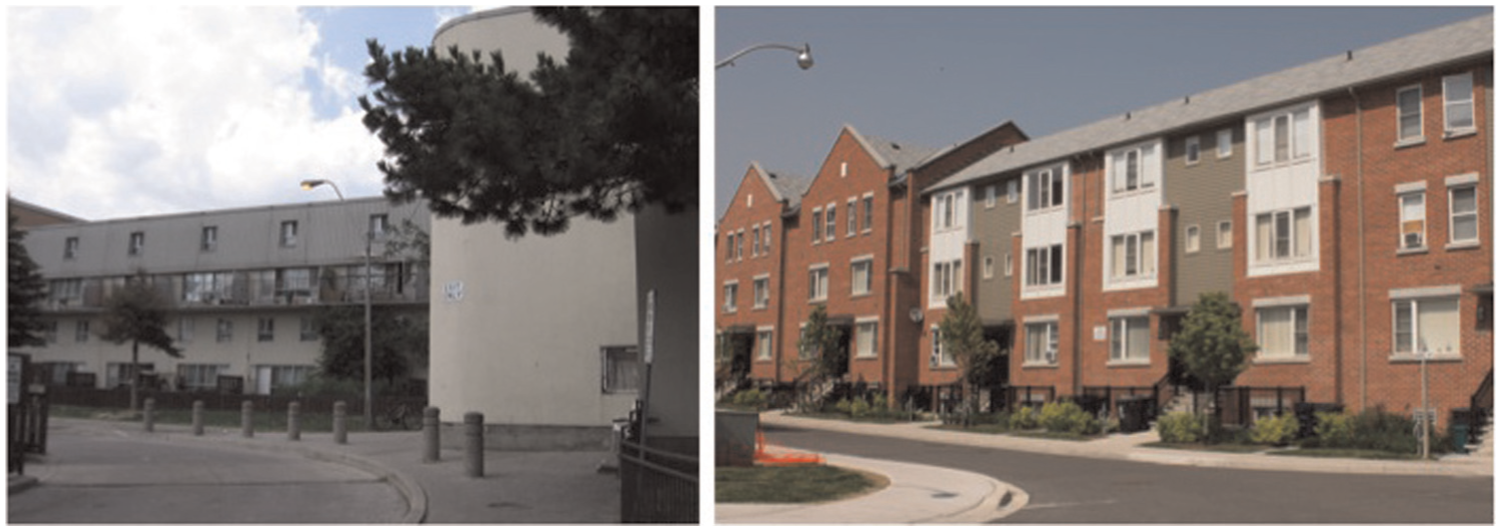
The old Don Mount Court buildings (at left) and new ‘Rivertowne’ public housing townhouses (at right).
One of the last areas bulldozed for Urban Renewal in 1968, Don Mount Court would be the first in Canada to undergo socially mixed public housing redevelopment. In 2000, the former public landlord (preceding TCHC) had discovered structural damage caused by water leakage, and made plans to relocate tenants during repairs. Two years later, the newly-formed TCHC saw in Don Mount Court the opportunity to try out the latest planning trends. According to a TCHC manager, the Corporation’s new mandate was to redevelop ‘problematic sites’, inspired by New Urbanism and ‘social mix’ ideals. These ideals were so influential that the Board promoted pricier ‘regeneration’ over simple repair. A TCHC report (2002: 5) explained: ‘while it is more costly, [redevelopment] is the best decision,’ because of the opportunity to ‘normalise’ the planning, update the design, eliminate ‘indefensible’ common spaces and ‘integrate’ the project into the surrounding community. Don Mount Court would also provide a test run for this model, which TCHC was eager to implement in Regent Park. In 2004 the plan was approved and a developer-partner was selected. The plan included 187 market condos and replacement of all 232 social units, as well as new streets and a new park.
The regeneration plans were not popular with everyone. According to long-time resident Marlene,
3
the proposals caused a ‘panic’ in Don Mount Court because ‘nobody wanted to move’. Residents feared they would lose their community and possibly not be able to return. Marlene explained: When we heard it we just thought, ‘they want to get rid of us’. They just want us out of here, because this is prime property. They just want to build condos and all market rent; they want to get more money, they want to make it look nice. And where are we? Stuck out in Scarborough [an outlying suburb]. There had been a rumour of this happening for years. You can just feel it.
To prevent displacement, tenants worked with staff to plan a phased redevelopment, in which the ‘south’ buildings would remain occupied until the ‘north’ was rebuilt. According to Marlene: ‘that was our strategy, they can’t kick us out if we are still living here, and if we have some type of connection.’ This turned out to be judicious, as redevelopment stretched out for seven years. While many had been relocated off-site prior to 2002, in 2004 the remaining tenants were consolidated into 75 units in the south while north Don Mount Court was redeveloped. The Phase I ‘north’ units were re-occupied in 2008, and the Phase II south homes in 2011.
Opposition to redevelopment also emerged from a small group of neighbours in the surrounding area, who launched an appeal to stop the project in 2003. The group, calling themselves the Riverside Area Resident’s Association (RARA), argued that fewer social housing units should be built back on the site. While TCHC had won the local support of many community members, RARA’s anti-public housing sentiments had a powerful impact. Elizabeth, a long-term resident, described the cross-class tensions that emerged: Some of the neighbours from north of Dundas St. and Hamilton St. did not want [TCHC] to build back the [subsidised] housing. They found a lot of faults with us – ‘drugs, killing, this and that’ – it was a total mess. At one town hall, the woman at the head of the group came and said that she … did not want ‘those kind of people’ back in the neighbourhood. … [Her group] did not want Housing back on that spot, because … It’s an expensive spot! So …‘move them away! Send them away! Don’t bring back the same people!’ Yeah, there was all of that in the town hall meetings.
Marlene agreed that it was hurtful to see such opposition, based on anti-tenant sentiments: ‘you’re thinking “Oh, I see what you’re up to, you don’t want Housing, you just don’t want people who live in Housing … you want to kick out one group of people and move in another group”’.
Indeed, mixed-income redevelopment was dependent on the reality of gentrification that had begun to encircle Don Mount Court since the mid-1970s (Walks and August, 2008). The community’s central location and rising real estate values made it a viable asset for TCHC to partially privatise, and since redevelopment, gentrification in the area immediately surrounding ‘Rivertowne’ has intensified (Figure 2). According to Councilor Paula Fletcher: Regeneration like that sets off a chain reaction. So on the backs of the tenants … there is all of this incredible redevelopment. Streetcar [Developments] has two buildings. Also, [Condo developer] Brad Lamb has a building at 90 Broadview that has really taken off. It has caught fire. Well, that was all started by redevelopment. (Personal communication, February 2012)
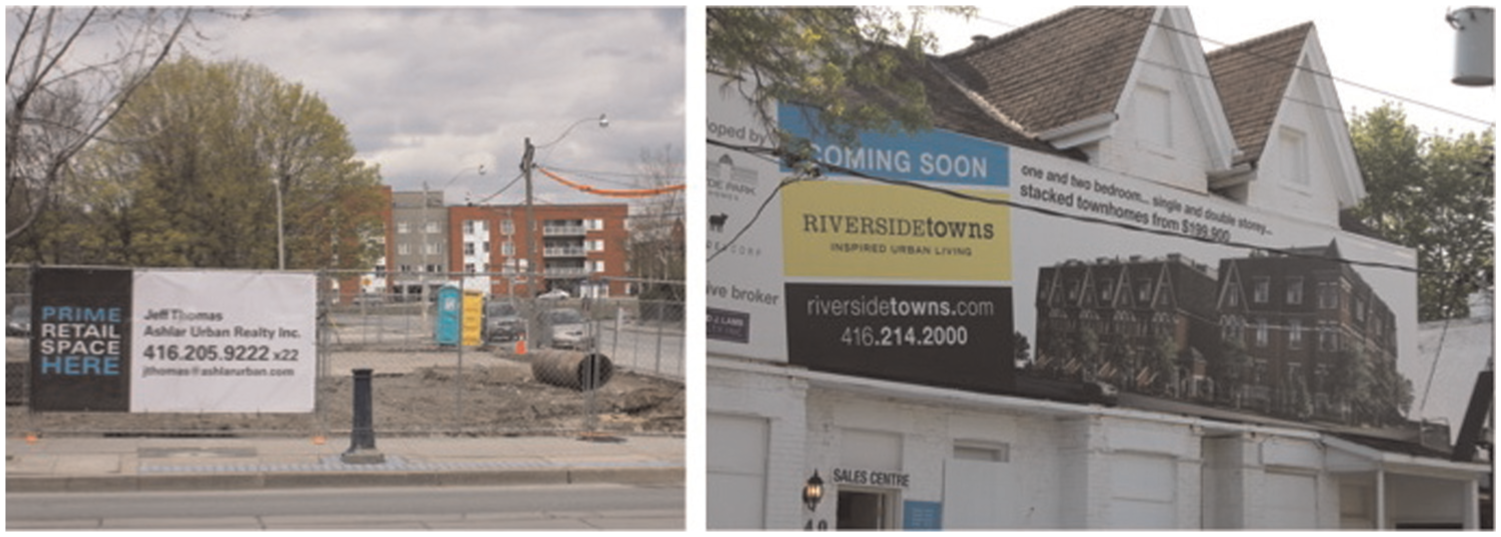
Signs of condo development south (at left) and east (at right) of Don Mount Court.
While revitalisation was trumpeted as an opportunity to socially integrate low-income and wealthy people, social and market housing are barely ‘mixed’ on-site, with the latter segregated in the northwest corner. In addition, at the southern boundary of the condo section, a steep grade elevates the market residents above their public neighbours. When asked about this design, one redevelopment planner did not anticipate much cross-class interaction, but said Don Mount Court would be ‘fairly integrated in terms of car and traffic flow’. In a paradoxical design choice, the condos in Rivertowne do not front onto public streets, but onto interior pedestrian-only paths, reproducing the very design ‘flaws’ that were used to justify the demolition of Don Mount Court (Figure 3).
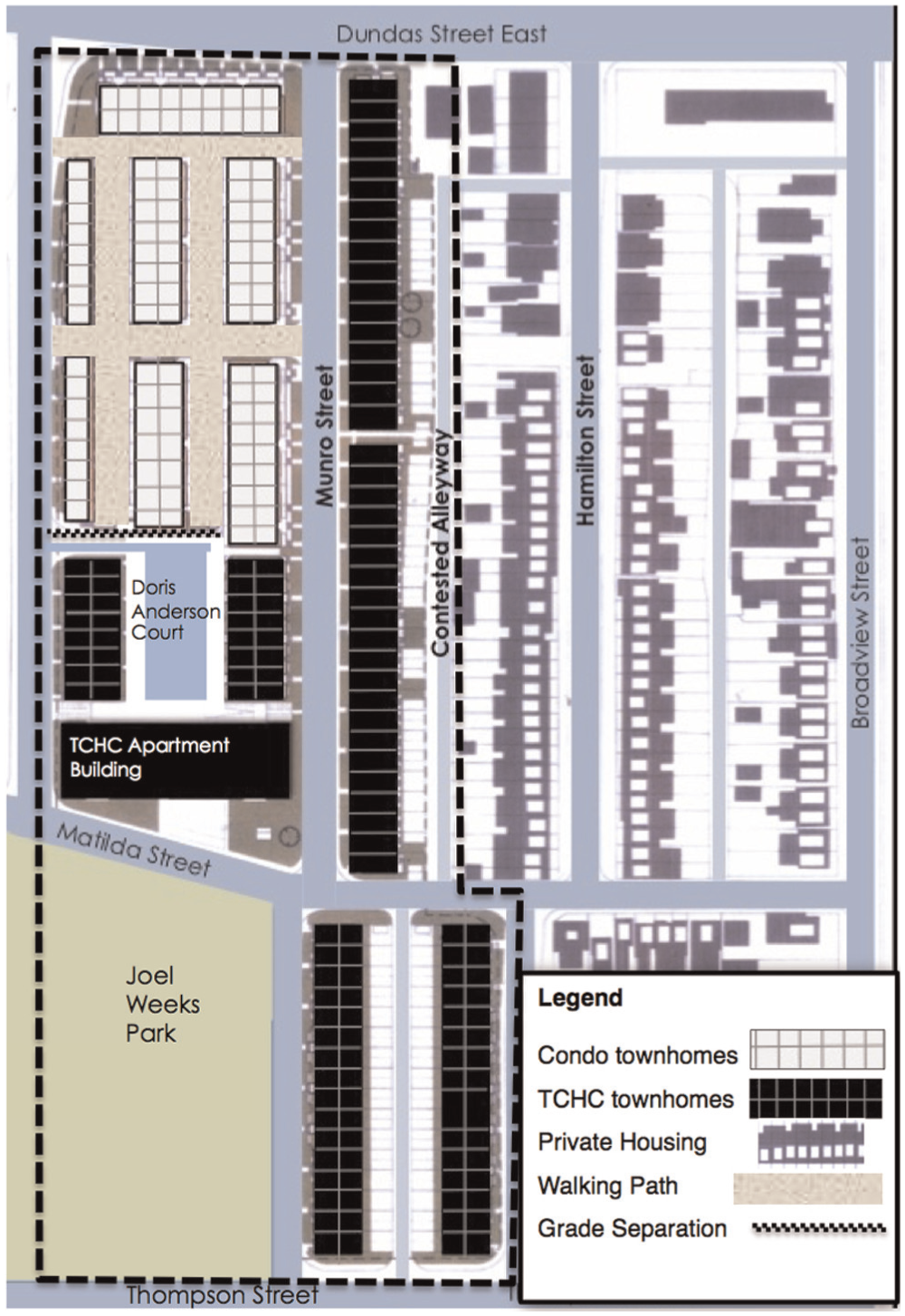
Map of the new Rivertowne and surrounding neighbourhood.
Among politicians and planners, Rivertowne is seen as somewhat of a failed project. From their perspective, redevelopment was a ‘pilot’ or ‘guinea pig’, where mistakes were made and corrected before Regent Park. As Councilor Fletcher put it: ‘if you’re going to make mistakes, make them on the $35 million project … rather than on the $500 million project that is Regent Park’. As the following sections show, being a ‘pilot’ community has had negative impacts. Tenants were dissatisfied with the quality and size of the replacement housing, the physical design of the community and its impact on social life.
Housing, community and the failure of design
The inescapable theme that emerged from tenant interviews was that residents preferred the old Don Mount to the newly configured and re-built ‘Rivertowne’. Indeed, many felt that redevelopment was a negative force that had destroyed a well-functioning community. This section begins with tenant perspectives on new (and old) housing, and finds that people were dissatisfied with: (1) quality, (2) size and layout, and (3) reduced privacy in the redeveloped community. Next, I discuss tenant thoughts on their community, and find that residents mourned the loss of a positive social atmosphere in the old Don Mount Court, and were upset by infighting and tensions in the new project.
‘Packed in like sardines’: Dissatisfaction with new housing
In the old Don Mount Court buildings, chronic under-maintenance had created a dangerous and unhealthy living environment for tenants. TCHC’s official communications described how problems with water penetration had rendered the structures uninhabitable, but tenant interviews suggested that even more serious problems were afoot. Asbestos exposure had caused chronic health problems for many residents (and possibly even death), and some were given payments by the housing company and told not to speak about their health problems. Donna, a long-term resident explained: ‘Housing tried for years to deny it – asbestos. I knew one lady who had trouble with her lungs. But for years they said, there is no asbestos, there is no asbestos’. One interviewee explained: ‘they gave me money and I’m not supposed to discuss it’. Another said that because of asbestos exposure ‘I’ve never been the same’, and ‘they had people sign papers that we wouldn’t sue them’. Elizabeth remembered one particularly toxic apartment: What is asbestos? At the time nobody really knew. Your kids would be sick, and you would think ‘it’s the flu, it’s a cold’. But I knew someone who moved into a particular apartment, and she was sick from that time on. She died after … they say it causes cancer. Who knew that? Another friend moved into that same unit, and she got carbon monoxide poisoning.
Clearly, there was a pressing need to address the physical conditions in the old Don Mount Court. As described earlier, however, TCHC had reasoned that repair was less costly than demolition and redevelopment. From my interviews, it appears that tenants would have been much happier with this first option, because they quite liked their old apartments.
Among the long-term residents interviewed, 10 (of 11) had returned to Don Mount Court, and of those 10, eight preferred their old apartments. Two residents liked the old and new homes equally, but no one preferred their new unit. In the old Don Mount, tenants recalled that their homes had been spacious, with many large rooms and private outdoor space in front and back yards. Anita explained: We had lots of space. We had our own arch, our doorway opened under an arch. We had our own little side-yard with lots of green area for ourselves. We also had our own backyard, so there was a place to put tables and chairs.
Lisa described her old home: ‘We had a big back yard. I loved my space … I had a big garden with tulips and roses. I packed it with fresh mint, it was gorgeous’. Rachel also described the advantages of the old apartments: In the old Don Mount you had a separate kitchen, a separate living room. There was a basement with a laundry room. Upstairs there were bedrooms – you had room, there was privacy between the rooms. There was a front door and a back door, a front yard and a back yard.
Marlene explained: ‘I preferred that old place … I was on a walkway, and I used to open the door and get that Don Valley breeze that blew right through’. Like other respondents, Rachel’s perspective on her old apartment was shaped by her dissatisfaction with the new one: ‘I really liked it. Especially now that I’m here I can say that I liked it that much more – because I have something to compare it to’. Tenants were uniformly frustrated with several aspects of their new apartments in Rivertowne, and quality was a major issue. Lisa put it this way: Everything is weak: the heater, the boiler, the walls – you can hear everything … this apartment needs repairs, there is leaking in the bathroom and the water doesn’t drain away. The cupboards were never put together in the laundry room … Rivertowne is not going to last, because of the construction. Soon, everything is going to break. It’s going to be bad.
Anita described her disappointment: ‘I thought it was great and grand, and it wasn’t. Right away it was breaking – the shelves falling, the doors breaking, water leaking. It wasn’t built right. The foundation is cracking and shifting’. Even a City Councilor spoke to the poor quality, explaining: ‘the lesson learned is that when you get a suburban developer with no commitment to the people they are housing, you get doors that are falling apart already, and railings coming off – just really shoddy stuff’ (Pam McConnell, personal communication, 29 March 2012). Almost every respondent described dysfunctional heating and cooling, and how sweltering hot apartments were exacerbating health conditions and causing discomfort.
A second source of housing dissatisfaction was related to size and layout. Respondents were upset that their new homes were small, with little space to hold their belongings. Tenants were frustrated with open-concept layouts, in which the kitchen, living and dining areas were all in one relatively small room. The ‘stacked townhouse’ and ‘back-to-back’ construction also led to unusual interior configurations. Many tenants were upset to find that bedrooms were in the basement, or that there was only one entrance rather than front and back doors. Marlene described her dissatisfaction: They made our places a lot smaller … I know times have changed, but I don’t like open concept. I don’t want cooking grease on my TV. It doesn’t make sense. And you can’t get any privacy unless you go in your bedroom … and it’s a ‘one-sided’ house, so you don’t get any airflow.
Caitlyn also disliked her home: ‘I don’t like the fact that the rooms are downstairs, it doesn’t have that ‘home’ feeling. And there is no sound-proofing, so I can hear all my neighbours … plus, we’re roasting in here, and it’s only January’. Anita had similar problems: ‘I wish it were the old way. The houses weren’t paper-thin. The homes were more of a home. You can hear everything in here … it’s mentally frustrating, it’s stressful’.
The third problem, which seemed to bother tenants the most, was that they had no outdoor space and no privacy from their neighbours. The lack of indoor privacy (due to tiny units, thin walls and open-concept design) made the lack of outdoor space – a potential escape – all the more frustrating. For townhouse residents, every doorstep was shared between two to four different units (Figure 4). The ‘yards’ in front of each unit were only a few square feet, and were used to store garbage bins (which the project designers had forgotten to account for). Some units also had back entryways, but these opened onto parking and offered little additional space. Taken together, these aspects of the housing design were tremendously frustrating for tenants. Anita explained: Everyone here is packed in like sardines, it is to the point of not having your own space. You can’t walk on your doorstep because there are children, or people from another unit smoking. It is not ‘privacy built’… there is no space, there is no yard and there is no privacy. We can walk out through the back but it’s a parking lot. We can’t even fit a BBQ, or a table and chairs … they say it’s called ‘condo-stacked houses’– more like ‘condo stacked sardines’!
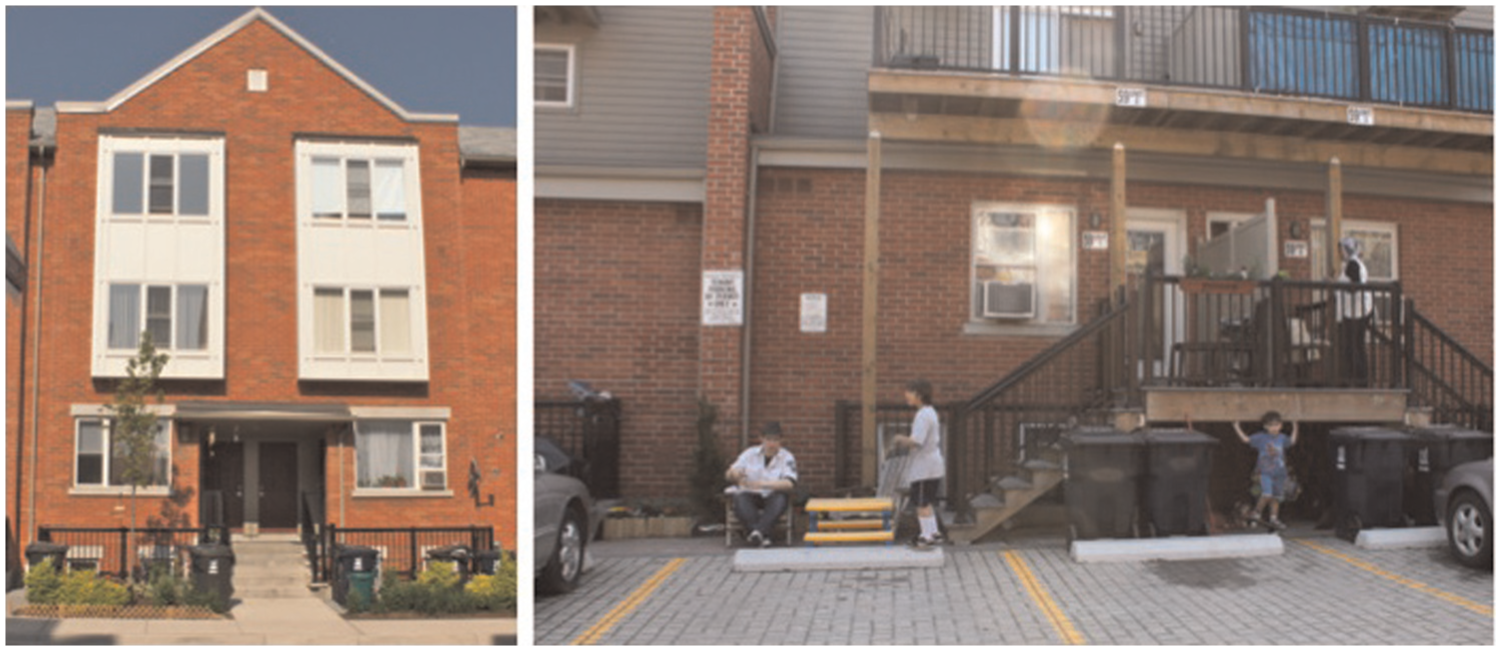
Front of TCHC townhouses with four units sharing one doorstep, with a small yard dominated by garbage bins (at left); Limited outdoor space in the back alleyway (at right).
Sheryl and her partner Christopher were planning to leave the community, because of their concerns with privacy. Sheryl explained: I really can’t handle it here. No one has a back yard or a front yard. It is too close to the neighbours, everyone is in your business. There is no privacy at all. If you open the balcony door, people can see right inside. There are four units around you, you can’t do anything, you can’t even talk.
Rachel felt similarly: ‘Something as simple as having a cigarette on your doorstep causes a problem, because the smoke goes into the other unit. And if the neighbour comes home, you’re in their way’. Many tenants believed that the intensified site plan and removal of private common spaces was causing tensions between tenants, and stimulating ‘drama’. According to Anna: ‘This new Don Mount causes too much conflict. You’ve got four doors to one doorstep! So people are arguing with each other, no back yards, no front yards, nowhere for kids to play … you’ve got no privacy’. Rachel felt that these problems were entirely caused by the design: It comes down to the structure, the way it is set up. It might not seem like a big deal, but I don’t think everybody needs to know what I’m doing and when I’m doing it. In the old Don Mount things were separate, you could do things without eyes on you… [now] I have only one door, only one exit – everybody sees everything … I had a few ‘out-and-abouts’ with one of the neighbours, and now [they] watch me, everything I do. I have no privacy. I hate this place.
Being visible also fanned the flames of conflict, according to Rachel: ‘It’s much easier to step to someone if they are sitting on a doorstep, but not a lot of people would open your gate and come [bother you] in your back yard’. Sheryl disliked that tenants were monitoring each other: We are being watched here. Everything that everybody does, someone talks about it, someone says something. It’s not good … here if you check your mail, people know how much mail you’re getting, the colour of the envelopes, what you are getting in the mail. It’s crazy!
According to Marlene, tenant drama and in-fighting were new to Don Mount Court, and had been ramped up as a result of the community’s design, and the loss of privacy: ‘I don’t come out as much as I used to … there is a lot of drama. People talking, angry at everybody, back-stabbing. People are uncomfortable. … It’s the way they built it’. Sheryl felt the same: ‘I feel like I’m getting mean too! I don’t want to involve myself with anybody anymore, even to say “hi”’. Caitlyn put it this way: Stuff has been going on with police and kids, or even adults … you come out of your door and you have no privacy. You decide to stay in your house because there might be too much people outside, or kids running reckless, or an argument – so you just stay inside. I noticed how now everyone is like ‘I’m going to stay inside’. You feel like you don’t even want to go on your porch and catch a breeze.
Caitlyn added that the old community had ironically looked like a jail – with a high tower on the corner and bars over laundry-room windows – but that ‘it didn’t have the feeling of a jail, and now you have a feeling that you are in a jail and not really in your home’.
‘It’s not the same Don Mount’: The loss of community
The tense, stressful experience of living in ‘Rivertowne’ is very different from the old Don Mount Court. Respondents recalled a positive sense of community and a supportive social atmosphere in the old area, which appears to have been a victim of redevelopment.
The long period of relocation (seven years for some), had much to do with the destruction of community in Don Mount Court. After so much time apart from former neighbours, many residents chose not to uproot themselves, but to remain in their relocation units. Elizabeth was one of them: ‘Don Mount was a home. But here [in my new place] I have everything that I need. I was gone from 2002 to 2008, so am I going to pack up again? I don’t have the strength’. By most accounts, at least half of the original residents never returned. Anita explained: Most people never came back. It was a lot of friendships gone lost … we all thought it would be fun when we came back, but we were wrong. It wasn’t really the old Don Mount, family friendly anymore. It’s not all the same people. It’s not the same for me because the original people aren’t here.
Many tenants spoke fondly of the ‘old’ Don Mount, and the special bonds of community in the area. Elizabeth’s description was representative: Everybody watched everybody’s back. We got to know one another. If you have to go away, send your kids to Miss Elizabeth and she’ll look after them until you get back. Or I would say to my kids, go to Miss Georgina and she’ll babysit you while I’m out. It was a very close-knit community …
According to Marlene, this positive community was hard won: ‘We loved Don Mount. We made that community and it took us a lot of years to make a community where everyone was comfortable with each other’. In her opinion, however, ‘a lot’ of the community feeling was lost because of redevelopment: ‘I would say the majority of people didn’t come back. It’s really hard now’. In addition to the loss of people, the destruction of the community’s former buildings and layout had damaging impacts. Marlene explained: In the old Don Mount the buildings were on the outside, around a park where people sat. You couldn’t see the streets were you sat, and the kids would be running up and down, doing whatever. When someone walked by, you’d kind of look and say ‘who is that?’– like, you were aware of who was walking through – who lives here and who doesn’t. That is what makes a community comfortable. We knew every single child in the court. If they needed help, somebody was there to help them. They weren’t in the open, where someone could hurt them. That is how we used to sit – in groups of people, where you knew your kids were safe – and you could sit comfortably without being bothered.
Caitlyn also felt that the old design had fostered a positive social environment: It was spacious and there was a big park in the middle. There was a wading pool, lots of grass, and hills with people playing – that is where we would go sledding. There were lots and lots of trees … everybody was happier, there was more sense of community.
Ironically, the former ‘modernist’ community design had enabled the exact type of passive surveillance that redevelopment planners in 2002 were advocating for. Tenants felt safe in their enclosed common spaces; they knew that their children were safe. They kept an eye on people passing through and could recognise strangers. At the same time, however, the design allowed for individual privacy (in front and back yards), and seclusion from the surrounding streets. This had protected tenants from the dangers of traffic, and from undue surveillance by higher-income neighbours who were quick to look down on them.
Lisa explained the paradoxically unpleasant post-redevelopment impacts of turning the neighbourhood ‘inside-out’: ‘It was safer before, more private. Kids could play inside [the court] and not on the streets. But now it has been cut open like a piece of cake, and the “inside” has been turned into roads’. The roads presented a new source of danger, and speeding cars caused several pedestrian accidents.
4
Marlene had been skeptical about the plan from the beginning: Even then I thought, ‘this is going to break the community’. It makes us feel like they don’t want us to sit outside and have that community bond. Because that is what you need, to make people feel secure. … [Now] it is harder to build community. People used to reunite out in the park, ‘in the court’– it’s what brings people together. But with streets, it’s harder to bring people together … it’s not the same Don Mount. People aren’t communicating together. Everyone knows it.
Anita also felt the loss of shared spaces for adults, explaining: ‘We have nowhere to congregate. There are no yards. There is no privacy. Where can we get together? There is no space’. She also lamented the loss of safe spaces for children, a recurring theme raised by interviewees: It’s not the way it used to be. Everyone watched out for their kids before, and now we have to watch out for cars. We don’t have a private area to put the kids. We used to tell them ‘stay within the tunnel ways’– and they would stay in the area and play. Now, it’s pretty much no good here in the community. When you send your kids out to play, it doesn’t work now.
The new design created an opportunity for surveillance not only from other tenants (described earlier), but also from the new condo residents. Sheryl described how they were constantly watching tenants and calling security: They feel like they are superior to us. They are owners and we are in housing, so it’s like they don’t respect us as neighbours … they call Housing on us all the time, they call security. If they see us having a conversation with a neighbour, they will call and say ‘it’s too late’. When it gets a little dark they expect us to go into our house. Why? … They look down on us, like we should listen to them and not disturb them.
The elevated design of the condo townhouses allowed for clear surveillance of tenants below. One tenant explained: ‘they stand up on that ledge and say, Quiet your noise!’ Tenants also had civil and friendly interactions with new condo neighbours, but tensions were frequently described. A particularly frustrating occurrence – with obvious symbolism – was the tendency for market residents to drive to Don Mount to illegally dump their garbage in the receptacles on the public housing side. Lisa was disappointed in the outcomes of ‘social mix’: I was one of the ones that agreed to it! But now we see that it is rare for the condominium people to like ‘Housing’ people … it’s not helping us that they sold. It’s not helping in any way that I can see.
Another failed promise of redevelopment was to improve safety through re-design. Interviewees described feeling less safe in the new community, and perceived there to be more criminal activity. While some respondents described how drugs had come into the old Don Mount Court in the 1980s, few had felt any impacts on their personal safety. With the ‘opening up’ of the community, however, activities that had formerly been discreet were suddenly in plain view. Post-redevelopment, Rachel noticed more police raids and drug activity: ‘I just find that there is more criminal activity … I’m not saying it wasn’t happening before. Either it is happening more now or the [new] set-up makes it more visible, so it seems like it’s happening more’. Tenants also felt less safe due to a concerted campaign on the part of market residents to report ‘incidents’ to TCHC security and Toronto police, which led to ramped up patrols and police harassment, and compromised tenant safety and quality of life (see August, 2014a for a detailed account). These dynamics were also due in part to the community’s redesign, as it was the visible presence of tenants on the streets and in public spaces (an intentional goal of redevelopment) that made some market residents feel afraid, and eager to call the police. In this sense, having ‘eyes on the street’ made tenants more fearful, as they were subject to a new type of mixed-income surveillance that put them directly at risk.
Based on these interviews, it would seem that the redevelopment in Don Mount Court has not been a success for tenants. Underlining this point is the reality that tenants have moved away, and that more want to leave. Like many, Rachel felt that overall redevelopment had not been ‘worth it’ for her: ‘I hate it here now … I just want to leave. I have considered giving up my subsidy, and renting a basement apartment somewhere, seriously’. Sheryl felt the same: ‘to be honest, I want to move from here. I don’t want to stay in Don Mount at all. They didn’t do it proper’. Anna felt the same: ‘the new Don Mount will never be the old Don Mount. It’s just a new Don Mount with troubles. It’s not the same feeling. It’s not the same as before’. Marlene and Caitlyn both wished they could return to their old, now demolished apartments. So did Christopher, Sheryl’s partner who told me: ‘the old design in Don Mount was the best’. Sheryl’s response to him was quite poignant, and very sad: ‘yeah, well just because we liked it better doesn’t mean that they will build it like that again. You know? So I just want to move’.
Conclusion
This article has explored the impacts of socially mixed redevelopment on both housing and ‘community’ in Toronto’s Don Mount Court. Overall, the findings from tenant interviews were quite sad. Many tenants were disappointed with their new apartments, which were small, cramped and poorly built. The lack of privacy was leading to personal stress and community discord. Many tenants lamented the loss of spaces that had fostered a positive social atmosphere, and the loss of friends that had provided support and companionship. These findings undermine two of the core promises related to the promotion of mixed-income redevelopment. First, these findings challenge the notion that ‘social mix’ will foster an improved social environment. In Don Mount Court, the tight-knit and ‘family’-like pre-redevelopment community described by tenants was in many ways dismantled by revitalisation, and is now mourned by some of those who have returned to a social landscape with new tensions (see also August, 2014a). Contrary to the expectations of planners, middle class neighbours have not always productively contributed to positive social relations, and (some) have acted in ways that are out of step with the benevolent character ascribed to ‘role models’ in poverty concentration literature and social mix lore. Second, this article challenges the promise of neo-traditional design as a solution to social problems. The re-design of Don Mount Court has produced the opposite outcomes of what planners intended. Turning it ‘inside-out’ has reduced the space for tenants to engage in both community bonding and private repose. It also ensures that tenants are more likely to be visible and exposed to surveillance, by public and private neighbours. While forcing people onto public streets was intended to increase safety, it has paradoxically had the opposite effect.
The story of Don Mount is more than just a story of bad design and poor planning. It is certainly the case that housing authorities can do a better job with planning processes, community and housing design and construction quality; and it is advisable that where redevelopment is being implemented, policy makers should learn from the mistakes made in other jurisdictions. However, the findings in this article do not suggest that the shortcomings of mixed-income public housing redevelopment are related to implementation, or that perfecting this approach is a matter of tweaking aspects of planning and design. Instead, I argue that mixed-income public housing redevelopment is fundamentally ill-suited to meaningfully address the social and economic problems facing public housing and its residents. Indeed, this article adds to the growing body of literature that calls into question the wisdom of this approach. The empirical record demonstrates that low-income and racially marginalised residents of public housing have not, for the most part, benefited from redevelopment projects in the way that policy makers expect (and in fact promise) that they will. Tenants may even suffer from the disruption of their community bonds and supportive social networks, and from the experience of physical, social and cultural displacement. While not a poverty amelioration strategy or boon for tenants, redevelopment tends to work well for others – including politicians, developers, the real estate industry and higher-income newcomers – who benefit from gentrification. These benefits are real, and help to explain why there is widespread mainstream support for this approach, despite its questionable record in advancing urban social justice agendas.
Mixed-income public housing redevelopment is an inadequate replacement for welfare state investments in social housing. In Don Mount Court and other revitalisation sites, investment in ageing social housing is dependent on geographies of gentrification and the existence of a ‘rent gap’ (Slater, 2015) that can be exploited by private developers who partner with housing authorities. Relying on the profits of real estate speculation is a deeply inequitable (and risky) way to allocate investment into public housing, which will only serve to reinforce – rather than to disrupt – existing patterns of socio-spatial polarisation and inequality. It is also an approach with clear limits, as the profits that are available to the public partner in a public-private-partnership are necessarily limited by the amount of development that can be squeezed onto the footprints of former projects. In addition, the notion that gentrification can be used to solve social and economic problems in public housing is somewhat of a cruel joke, given that the process is known to have negative social and political effects on low-income and racially marginalised groups (Atkinson, 2004; Slater, 2006).
The negative outcomes that were reported by many tenants in Don Mount also offer important lessons to urban policy makers. Armed with the ideals rooted in the ‘anti-Modernist’ sentiments of contemporary planning and design wisdom, decision makers imposed a thoroughly top-down planning approach in the community. In favour of contemporary planning orthodoxy and professional ‘expertise’, decision makers willfully ignored that modernist spaces in Don Mount Court had nurtured positive interactions and community relationships, and chose instead to argue that the community and its design were pathological and ‘indefensible’. Mixed-income redevelopment imposed a middle-class design aesthetic and updated planning trends on the community, and has essentially repeated the same mistakes made by mid-century advocates for Urban Renewal, who imposed demolition and redevelopment (amidst public outcry) four decades earlier. The lesson from both of these efforts at renewal, separated by nearly half a century, is clear: it is time to stop experimenting on poor people and communities.
Footnotes
Acknowledgements
The author would like to thank Alan Walks and the peer reviewers for their insightful and helpful comments.
Funding
This research was generously supported by the Trudeau Foundation and by the Social Sciences and Humanities Research Council of Canada (SSHRC).