



Abstract
Based on the 2006 wave of the China General Social Survey, this paper analyses interregional disparities in residential satisfaction in urban China. It also explores whether the determinants vary across the coastal, central and inland regions by means of a multi-group structural equation model (SEM). We find that residential satisfaction in the coastal region is lower than in the central and inland regions. Housing quality, home ownership, community type, socioeconomic status and Hukou in all three regions have positive impacts on residential satisfaction, while the presence of children has a negative effect. The magnitude of each variable’s impact on residential satisfaction varies across regions due to the disparities in economic, social and physical conditions. Housing quality is the most important determinant of residential satisfaction in the coastal region, whereas community type and Hukou are the most important in the central and inland regions.
Keywords
Introduction
Over the last 30 years, economic development and housing reform have brought substantial improvements to quality of life in China, particularly to residential conditions. Before the housing reforms in 1998, the ‘welfare housing supply’ system dominated housing policy. A distinguishing feature of this policy was that state-owned companies and institutions were in charge of housing financing, construction, maintenance and allocation. Houses were allocated to urban households 1 according to the social status of the head of the household (Zhao and Bourassa, 2003). As rent was extremely low, state-owned institutions could not adequately finance the construction of new housing and the maintenance of existing housing (Wang and Murie, 1999; Wu, 1996). As a result, overcrowding and lack of facilities were typical of urban living conditions. To improve living conditions, the national government launched a housing reform programme which substituted the welfare system for a market system. Private real estate enterprises were allowed to construct housing and new houses were permitted for trade (Wang and Murie, 1999). The housing reform has substantially improved the living conditions of urban residents. For instance, per capita living space increased from 6.7 m2 in 1978 to 32.9 m2 in 2012.
While the reform has greatly improved average urban living conditions such as living space, interregional disparities have widened because of differences in economic, social and physical conditions (Demurger, 2001; Li and Fang, 2014; Yu, 2006). Urban residents in the less densely populated central and inland regions have, on average, larger houses than those in the economically more developed coastal region who, on the other hand, enjoy better local amenities and housing facilities (Yu, 2006). 2 Meanwhile, home ownership in the coastal region is lower than in the central and inland regions (Yi and Huang, 2014). These interregional disparities may have resulted in disparities in residential satisfaction (Mohan and Twigg, 2007).
Chinese housing satisfaction studies are limited in time and space. Most studies are cross-sectional analyses which focus on a population in a particular city. For instance, He and Yang (2011) analysed residential satisfaction in Wuhan, Chen et al. (2013) in Dalian, Fang (2006) in a redeveloped neighbourhood in Beijing and Yang et al. (2013) in Beijing. Few researchers have systematically analysed variation in residential satisfaction across regions, with the exception of Hu (2013) and Li and Wu (2013). However, differences among the coastal, central and inland regions have not yet been analysed.
Previous studies suffer from two methodological shortcomings. One is multicollinearity. For instance, housing size and the number of bedrooms are highly correlated, which affects their standard errors and the significance levels of their estimated coefficients. Secondly, it has been common practice for cross-region comparisons to estimate different models for different cities or for different groups of cities, as in Li and Wu (2013). Consequently, any differences found may be attributable to differences in satisfaction, their determinants, the models applied or to all of these. To reduce this kind of ambiguity, the same model needs to be used; in other words, multi-group analysis should be applied (Koufteros and Marcoulides, 2006; Schumacker and Marcoulides, 1998).
This paper assesses disparities in residential satisfaction and identifies their determinants across the coastal, central and inland regions in China. Multi-group structural equation modelling (multi-group SEM) is applied to reduce the problem of multicollinearity and to estimate and test differences among the three regions on the basis of a common model. The research is based on the 2006 Chinese General Social Survey (CGSS) which provides detailed, nationwide information on residential conditions and household and personal characteristics. 3
The remainder of the paper is organised as follows. The next section describes the conceptual model. The multi-group SEM is then discussed, followed by the data and the estimated models. Conclusions and policy implications are presented in the final section.
Conceptual model
In this section, we develop the conceptual model based on a literature review and ad hoc considerations. The model, presented in Figure 1, consists of the endogenous variables Residential satisfaction, Housing quality, Home ownership and Community type, and the exogenous variables Gender, Children, and Socioeconomic status. Below, we first discuss the endogenous variables and their relationships, then the exogenous variables and their impacts.

The conceptual residential satisfaction model. *
The main endogenous variable is Residential satisfaction. It is a latent variable 4 defined as a household’s subjective assessment of their living environment (Galster, 1987; Lu, 1999). We take Housing satisfaction and Community satisfaction as the two observed indicators of Residential satisfaction. They represent related dimensions of Residential satisfaction (Lu, 1999). Both indicators are measured on a four-point scale ranging from very unsatisfied to very satisfied.
Housing quality is a determinant of Residential satisfaction with a positive impact. It is a latent variable measured by the following indicators. The first is Living space. Larger per capita living space not only meets basic physical but also psychological needs (Harris et al., 1996). Particularly, it reflects an individual’s social status (Opoku and Abdul-Muhmin, 2010). Chen et al. (2013) and Fang (2006) showed that residential satisfaction increases with per capita living space in Beijing and Dalian, respectively. The Number of bedrooms, Number of bathrooms and Number of living rooms are the other Housing quality indicators. James (2008a, 2008b) showed that the presence of separate bedrooms for parents and children contributes to more private space. In a similar vein, bathrooms provide privacy and convenience whereas living rooms offer space for common household activities.
The next endogenous explanatory variable of Residential satisfaction is Home ownership. Homeowners tend to be more satisfied with their housing and community characteristics than tenants (Deurloo et al., 1994; Diaz-Serrano, 2009; Parkes et al., 2002) because they generally have fewer incentives to move out of their current community (Dietz and Haurin, 2003; Helderman et al., 2004; Lu, 1998). They are therefore more likely to participate in community activities and management and to construct social bonds with their neighbours (Diaz-Serrano and Stoyanova, 2010; DiPasquale and Glaeser, 1999). In addition, home owners are at less risk than renters of being involuntarily moved from their homes. Chen et al. (2013) showed that the impact of home ownership on residential satisfaction is significant and positive in the Chinese city of Dalian. Thus, we hypothesise that Home ownership has a positive impact on Residential satisfaction.
The final endogenous explanatory variable of Residential satisfaction is Community type. Residents highly appreciate safe communities with good leisure facilities; local shops; public facilities such as transportation, schools and healthcare; and good environmental quality (Dekker et al., 2011; Hipp, 2010; Lu, 1999). The dataset does not include information on the above community facilities. However, information is captured from each respondent on the type of community they live in, which corresponds to the presence of the above characteristics. Therefore, we consider community type as a proxy for community facilities. There are four categories: (i) shanty communities; (ii) affordable housing communities (state-developed communities for low-income urban households), resettled housing communities (state-developed communities for households whose houses have been demolished because of a public project) and old communities; (iii) commodity housing communities (communities constructed by private real estate development companies) and state-built communities; and (iv) upscale communities (single-family detached house communities). A shanty community is crowded and has poor public transportation and insufficient sanitary and leisure facilities. An affordable, old or resettled housing community is better than a shanty community in terms of sanitary facilities, but lacks adequate public transportation and leisure facilities. A commodity housing or state-built community has good public transportation and sanitary and leisure facilities. An upscale community has green space, in addition to good sanitary, transportation and leisure facilities.
We take Housing quality as an endogenous variable which is positively affected by the endogenous variables Home ownership and Community type. The rationale for the former relationship is that homeowners tend to take more actions to improve the quality of their housing (Davidson and Leather, 2000; Dekker et al., 2011). Henderson (1985) showed that Community type positively impacts on Housing quality. The implications of these hypothesised relationships are that Home ownership and Community type, in addition to their direct impacts, have indirect impacts on Residential satisfaction (via Housing quality).
We now turn to the exogenous variables. An important positive determinant of Residential satisfaction is Gender. The rationale is that women generally spend more time in their communities than men and thus have more friends and acquaintances in their neighbourhoods (Reid and Comas-Diaz, 1990). Women also spend more time at home than men and thus adapt their homes more to suit their needs. Several studies support the hypothesis that women tend to be more satisfied with their houses and communities than men, for example Lu (1999) and Ibem and Aduwo (2013).
Although there is no consensus about its impact in the literature, we consider Children as a determinant of Residential satisfaction. Brodsky et al. (1999) and Dekker et al. (2011) found that parents with children are less satisfied with their residential conditions than those without children because of their additional demands for amenities such as playgrounds, a safe and healthy environment and extra rooms. However, Guest and Wierzbicki (1999) and Parkes et al. (2002) argue that children are an important intermediary in generating social bonding, which in turn results in higher Residential satisfaction.
We also hypothesise that Children have an impact on Housing quality and Community type since most families in urban China have only one child. Therefore, families pay a lot of attention to their child’s wellbeing, inter alia by providing decent housing and community conditions for them. Parents with children are therefore generally more critical about the size of their house, and the facilities and conditions of their house and community (Brodsky et al., 1999). Therefore, ceteris paribus, we expect households with children to be less satisfied with their houses and communities than those without.
We assume the latent variable Socioeconomic status– measured by Income and Education– to indirectly impact on Residential satisfaction via Housing quality, Community type and Home ownership. Since the introduction of the market-based housing supply system, urban residents have been allowed to purchase houses (Wang and Murie, 1996, 1999), which has rendered income an important determinant of Home ownership (Li and Chen, 2011; Logan et al., 2010). Moreover, households with higher incomes could more easily relocate from one community to another to meet their demand for particular community characteristics (Teck-Hong, 2012). High-income households also have more financial means to furnish and decorate their houses, which positively impacts Housing quality. Finally, residents with higher education are better able to find better housing and communities than their less well-educated peers (Fredrickson et al., 1980). On the basis of the above considerations, we expect Socioeconomic status to have positive impacts on Housing quality, Community type and Home ownership.
The final exogenous variable is Hukou which, like Socioeconomic status, indirectly impacts on Residential satisfaction via Home ownership. Without a permanent Hukou, individuals are excluded from the urban welfare system and have no access to public housing or government-subsidised housing (Wu, 2002). Furthermore, individuals without a permanent Hukou are generally poorer than local urban residents and their income is unstable, which hinders them from obtaining mortgages for commercial housing. Therefore, individuals without a permanent Hukou are less likely to be homeowners.
The magnitudes of the impacts of the determinants of Residential satisfaction are likely to differ across the three regions because of socioeconomic disparities. Firstly, because of the higher population density and higher housing prices, the impacts of house size and Home ownership in the coastal region are likely to be larger than in the central and inland regions (see Demurger, 2001; Zhuo et al., 2009). Particularly, urban residents in the coastal region are more likely to live in smaller houses and are less likely to be homeowners. Therefore, because of more severe scarcity, Home ownership and house size will be more appreciated in the coastal region. The opposite holds for the impact of Community type. The relatively favourable economic conditions in the central and especially the coastal region allow more investments in public goods such as public transport, green space (such as parks) and sport facilities (Li and Fang, 2014). Communities in these regions are therefore likely to be in better shape than those in the inland regions. Thirdly, because of approximately equal labour force participation rates, the difference in Residential satisfaction between females and males in the coastal and central regions is likely to be marginal. In the inland region, however, female labour market participation is relatively low (Yao and Xu, 2013). Accordingly, women spend more time at home than men and thus are likely to be more satisfied with their home than men are.
In a similar vein, we expect variation with respect to the determinants of the other endogenous variables across the three regions.
Multi-group SEM
We applied a multi-group SEM to estimate the same satisfaction model simultaneously (presented in Figure 1) for each group and to test the equality of parameters across groups (Deng et al., 2005). As an SEM, a multi-group SEM can handle latent and observed variables and their relationships within an integrated framework (Jöreskog and Sörbom, 1996). A multi-group SEM is a system-of-equations model composed of two measurement models and a structural model.
The measurement models present the relationship between the latent endogenous and latent exogenous variables and their indicators. Measurement model (1) relates to the endogenous variables and model (2) to the exogenous variables: 5


where
The structural model presents the relationships between the latent exogenous and latent endogenous variables as well as the relationships among the latent endogenous variables mutually. It reads:

where
Equations (4) to (6) present the conceptual model as an SEM derived from equations (1) to (3). 6


Note that for each latent variable the variance is fixed at 1 to assign it a measurement scale and render the model identified (see Jöreskog and Sörbom (1996) for details).
The indicators of Housing satisfaction, and the variables Community satisfaction, Home ownership, Gender, Children and Hukou, are ordinal or dichotomous. Therefore, we shall apply the Weighted Least Squares (WLS) estimator based on the matrix of polychoric correlations (see Flora and Curran (2004) and Jöreskog and Sörbom (1996) for details). The LISREL 8 software package was used (Jöreskog and Sörbom, 1996).
LISREL 8 provides a variety of statistical tools to evaluate the goodness-of-fit of a (multi-group) SEM, including the χ2 statistic and the Root Mean Square Error of Approximation (RMSEA), the Goodness-of-Fit Index (GFI), the Adjusted Goodness-of-Fit Index (AGFI) and the Comparative Fit Index (CFI). The χ2 is inappropriate for assessing the goodness-of-fit of the SEM in this study as the number of observations for each group is larger than 1000 and because of the presence of ordinal and dichotomous observed variables (Bollen, 1989; Jöreskog and Sörbom, 1996). Therefore, the model fit will be evaluated by means of the RMSEA, GFI, AGFI and CFI.
However, the χ2 can be used to test nested constraints, particularly whether or not the same model holds for all three regions. In that case the test statistic is:

where
Data and empirical results
Data
The dataset analysed comes from the national Chinese General Social Survey (CGSS), which was conducted in 2003, 2004, 2005, 2006, 2008 and 2010 (Bian and Li, 2012). The CGSS contains detailed information on personal characteristics and household and housing conditions. However, information on residential satisfaction was only collected in 2006. In the 2006 wave, 6013 urban residents in 28 provinces in mainland China were interviewed. 7 Eight hundred and eighty observations (14.63%) were excluded because of incomplete information, leaving a total of 5133 observations for empirical analysis.
To account for disparities in residential conditions and local physical and socioeconomic conditions across the coastal, central and inland regions, we divided the 5133 observations into three groups according to region: 2383 observations (46.43%) in the coastal region, 1519 (29.59%) in the central region and 1231 (23.98%) in the inland region. 8
Descriptive statistics on housing and community satisfaction, housing characteristics and household characteristics are presented in Table 1. The table shows that residents in the coastal region have higher education and income levels than their counterparts in the central and inland regions but enjoy smaller housing. In addition, home ownership is lower in the coastal region, which is consistent with Yi and Huang (2014). This is most likely due to substantially higher housing prices in the coastal region.
Descriptive statistics for the observed variables.
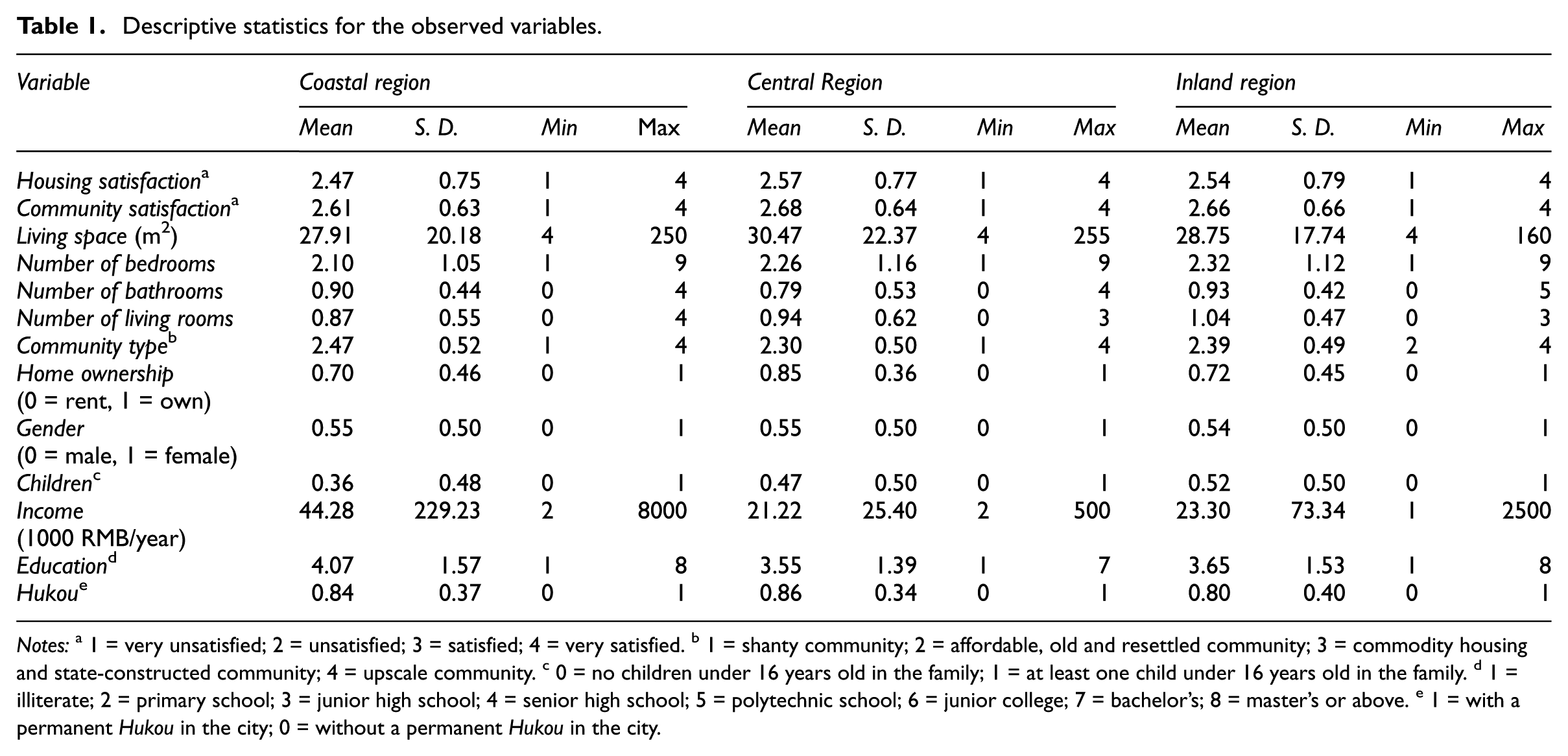
Notes: a 1 = very unsatisfied; 2 = unsatisfied; 3 = satisfied; 4 = very satisfied. b 1 = shanty community; 2 = affordable, old and resettled community; 3 = commodity housing and state-constructed community; 4 = upscale community. c 0 = no children under 16 years old in the family; 1 = at least one child under 16 years old in the family. d 1 = illiterate; 2 = primary school; 3 = junior high school; 4 = senior high school; 5 = polytechnic school; 6 = junior college; 7 = bachelor’s; 8 = master’s or above. e 1 = with a permanent Hukou in the city; 0 = without a permanent Hukou in the city.
The table shows furthermore that housing satisfaction and community satisfaction in the coastal region are lower than in the central and inland regions. A nonparametric Kruskal-Wallis One-way ANOVA led to the rejection of the hypotheses that there are no differences among the three regions in housing satisfaction and community satisfaction: χ2 = 14.20, df = 2, p-value = 0.00 and χ2 = 9.43, df = 2, p-value = 0.01, respectively. 9
Invariance tests
As a first step, we shall test invariance of the determinants of Residential satisfaction across the three regions. In other words, we shall test the hypothesis:
H1 The same model holds for all three regions.
If H1 is rejected, we will test whether the same model holds for two regions (H2: coastal and central; H3: coastal and inland; and H4: central and inland).
The results of the χ2 difference tests are presented in Table 2. The table shows that all four hypotheses are rejected at the 0.01 level, implying that the impacts of the determinants on residential satisfaction vary between the three regions. Interpretations are provided below.
Invariance tests of residential satisfaction across regions.

The region-specific SEMs
Before going into detail, we observe that the estimated coefficients are standardised or beta coefficients. 10 As a consequence, the scales of the explanatory variables are irrelevant and the estimated coefficients are directly comparable.
The overall goodness-of-fit indices of the SEM models for the three regions, specifically RMSEA = 0.07, GFI = 0.99, AGFI = 0.97 and CFI = 1.00 for the coastal region; RMSEA = 0.07, GFI = 0.99, AGFI = 0.97 and CFI = 1.00 for the central region; RMSEA = 0.07, GFI = 0.98, AGFI = 0.97 and CFI = 1.00 for the inland region, meet their critical values: < 0.08 for the RMSEA, > 0.95 for the GFI, > 0.95 for the AGFI and > 0.95 for the CFI, indicating that the empirical models have good overall fit (see e.g. Hooper et al. (2008) for details).
The measurement equations of the endogenous and exogenous latent variables – consisting of factor loadings, standard errors and R2s – are presented in Table 3. The loadings are significant at the 0.01 level for all three regions and exceed the recommended minimum magnitude of 0.20 (Jöreskog and Sörbom, 1996). The table furthermore shows that while the loadings of Housing satisfaction, Living space, Number of bedrooms and Education only vary slightly across the three models, the loading of Income varies from 0.27 in the coastal region to 0.82 in the central region. The reliabilities or R2s (i.e. the proportion of the variance of an indicator explained by its latent variable) of the indicators Housing satisfaction, Living space and Number of bedrooms are quite stable across the models. For Community satisfaction, Number of bathrooms and Number of living rooms, there is quite some variation. The indicators Income and Education have relatively low reliabilities (Income in the central region is an exception). We therefore substituted the latent variable Socioeconomic status for its directly observed indicators. The substitution only marginally changed the structural model and the other equations of the measurement models. Therefore, we retained the model with Socioeconomic status. 11
Standardised coefficients of the measurement models.

Notes:***p < 0.01. S.E.: standard error.
The main results in Table 3 are the estimated loadings of Housing satisfaction and Community satisfaction. The estimated loadings of the former are uniformly larger than those of the latter, indicating that Residential satisfaction manifests itself more strongly via Housing satisfaction than via Community satisfaction. The R2s of Housing satisfaction are also uniformly larger. The rankings of the loadings and R2s of the other indicators vary across the regional models unsystematically. Nevertheless, the results show that Living space is the indicator of Housing quality with the highest loading and reliability in all three models. Income is the indicator of Socioeconomic status with the largest loading and highest reliability, except in the inland region model where Education has the highest reliability.
We now turn to the structural models presented in Table 4, the residential satisfaction equation in particular. The first feature to note is that the R2s indicate that 16%, 21% and 13% of the variation in Residential satisfaction is explained by the explanatory variables in the three structural models. This outcome is higher than in Chen et al. (2013) and Hu (2013), indicating that SEM may have more explanatory power than conventional approaches. A second feature is that the magnitudes and significance levels of the impacts of the determinants of Residential satisfaction vary across regions.
Standardised coefficients of the structural models.
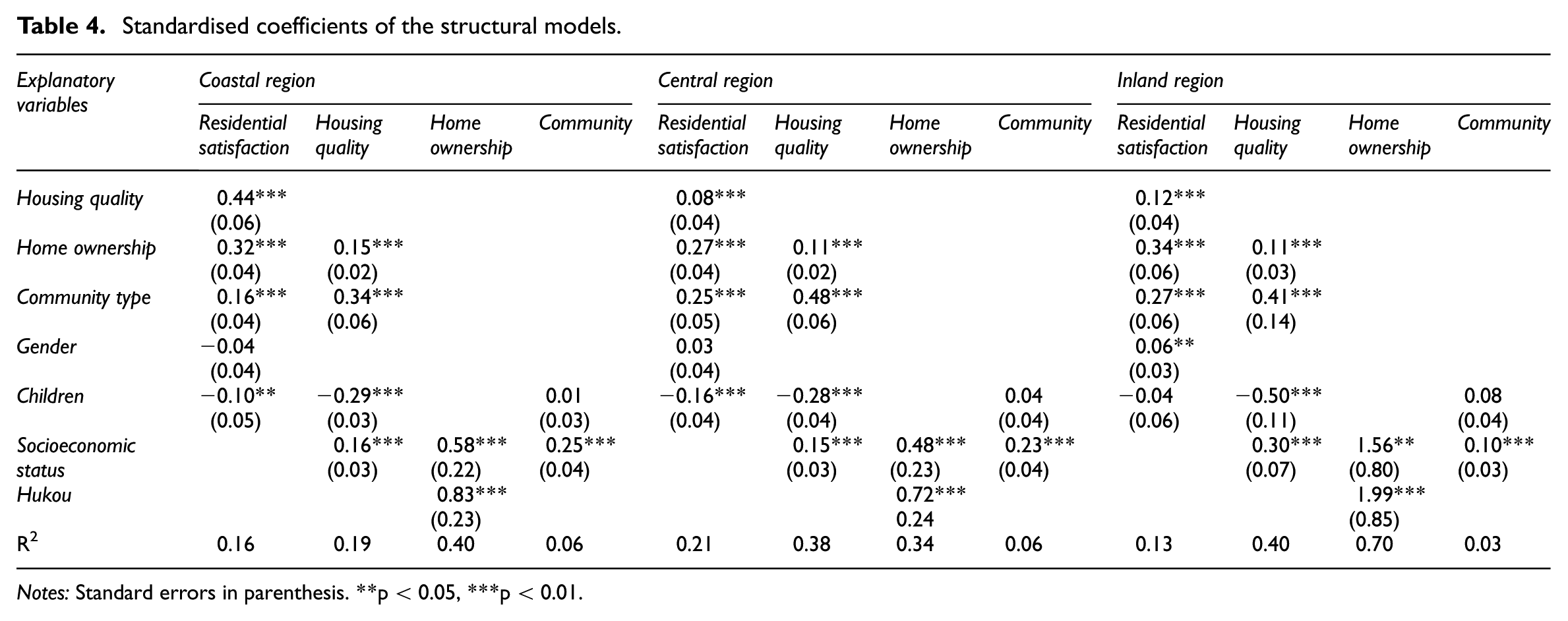
Notes: Standard errors in parenthesis. **p < 0.05, ***p < 0.01.
Consistent with the existing literature (including Dekker et al., 2011), Housing quality positively and significantly impacts Residential satisfaction in all three models, indicating that more living space, bedrooms, bathrooms and living rooms result in more residential satisfaction. The impact in the coastal region is much greater than in the central and inland regions. A possible explanation is that on average, Housing quality in the coastal region is poorer than in the other two regions (see Table 1) and is thus more appreciated.
Home ownership also has a positive and significant impact on Residential satisfaction in all three models, which confirms the hypothesis in the conceptual model that homeowners are more satisfied than renters. The results also show that the impact in the coastal and inland region models is somewhat larger than in the central region model. This could be because the home ownership rate in the former regions is lower than in the central region (see Table 1).
Community type has a significant and positive impact in all three models, as hypothesised. Its impact in the coastal and central region models is lower than in the inland region model. This could be because compared to the inland region, more public goods (such as public transport, schools and hospitals) are provided in the coastal and central regions to improve community facilities, notably in the shanty, old and resettled housing communities (Zhang and Kanbur, 2005), which reduces the differences between communities.
In the inland region model, Gender is significant as expected. In the coastal and central regions, however, the difference between women and men is insignificant, which is probably related to the fact that female labour force participation in these regions is high, meaning that females spend approximately as much time in their residential communities as males.
The presence of Children has a negative and significant impact on Residential satisfaction in the coastal and central regions, which is in line with the hypothesis postulated above and also with Brodsky et al. (1999) and Dekker et al. (2011). In the inland region, however, it has an insignificant impact. A possible explanation for the latter result is that parents with young children are less critical about their surroundings as mothers spend more time with their children (Yao and Xu, 2013) because of lower female labour force participation.
Home ownership, Community type and Socioeconomic status have significant and positive impacts on Housing quality in all three models, while the presence of Children has a negative, significant impact. 12 The main determinants of Home ownership are Socioeconomic status and Hukou all three models, with significant, positive effects, while the only significant determinant of Community type is Socioeconomic status. 13
Table 5 presents the standardised indirect and total impacts 14 of the explanatory variables on Residential satisfaction and on its indicators Housing satisfaction and Community satisfaction. 15 Below we discuss only the total effects.
Standardised indirect and total impacts.
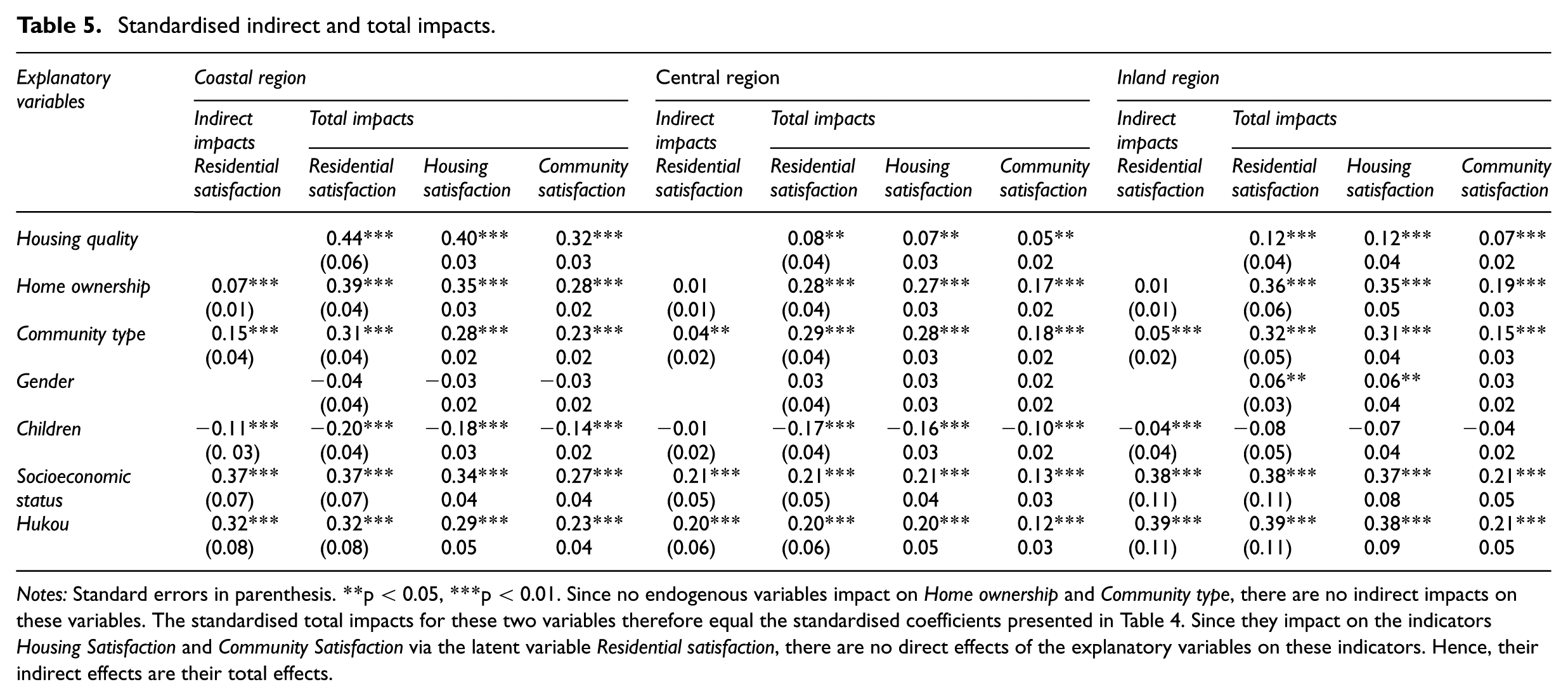
Notes: Standard errors in parenthesis. **p < 0.05, ***p < 0.01. Since no endogenous variables impact on Home ownership and Community type, there are no indirect impacts on these variables. The standardised total impacts for these two variables therefore equal the standardised coefficients presented in Table 4. Since they impact on the indicators Housing Satisfaction and Community Satisfaction via the latent variable Residential satisfaction, there are no direct effects of the explanatory variables on these indicators. Hence, their indirect effects are their total effects.
In descending order of magnitude, Housing quality, Home ownership, Socioeconomic status, Hukou and Community type have positive, significant total impacts on Residential satisfaction in the coastal region. Furthermore, the presence of Children has a negative, significant impact and Gender an insignificant effect. Similar observations apply to the indicators Housing satisfaction and Community satisfaction. The impacts on the latter are somewhat lower (in absolute values for Children) because of its smaller loading. In the central region, Community type has the greatest impact on Residential satisfaction, followed by Home ownership, Socioeconomic status, Hukou and Housing quality. Again, Children has a negative total impact and Gender an insignificant one. The same order holds for the indicators. In the inland region model Hukou has the largest impact on Residential satisfaction, followed by Socioeconomic status, Home ownership, Community type and Housing quality. Furthermore, Gender has a significant, positive impact and Children a negative, though insignificant impact.
The magnitude of the total impacts on Residential satisfaction and its indicators varies across the three models. It is nevertheless clear that Home ownership and Community type are major determinants with substantial positive direct impacts and smaller indirect effects in all three models. Socioeconomic status has substantial positive effects on Residential satisfaction via Housing quality, Home ownership and Community type and Hukou via Home ownership. The results indicate that the market factor Socioeconomic status and the institutional factor Hukou play an important role in shaping residential satisfaction in transitional China, which is consistent with Market Transition Theory (see Nee, 1996). The total impact of Housing quality on Residential satisfaction varies from 0.44 in the coastal region model to 0.08 in the central region model. This difference is due to the fact that on average, housing quality in the coastal region is less than in the other two regions (see Table 1) and is thus more appreciated. Meanwhile, the total Gender impact is only significant in the inland region model due to low female labour market participation. Consequently, the time females spend in their residential communities is significantly more than for males. In the coastal and central regions females have full-time jobs, like males, and spend the same amount of time in their communities as males. Finally, the total impact of Children is significant and negative in the coastal and central regions and insignificant in the inland region. This variation is due to the fact that mothers in the inland region are less likely have full-time jobs and thus spend more time on caring for their children, which compensates for poor living conditions.
Conclusions and policy implications
This paper analyses interregional disparities in urban residential satisfaction in the coastal, central and inland regions in China, based on the 2006 wave of the China General Social Survey. It applies structural equation modelling (SEM) to reduce the problem of multicollinearity, and multi-group analysis to reduce the risk that disparities in residential satisfaction are wrongly ascribed to differences in model specification.
The paper’s main finding is that Housing quality, Home ownership, Community type, Socioeconomic status and Hukou in all three regions have positive impacts on Residential satisfaction, while the presence of Children has a negative effect. The results furthermore indicate that the sizes of the impacts of the determinants of Residential satisfaction strongly differ across the regions. Housing quality is the most important determinant of Residential satisfaction in the coastal region, and Community type and Hukou in the central and inland regions, respectively. Meanwhile, Home ownership has a larger total impact in the coastal and inland regions than in the central region, which is related to the fact that home ownership is lower in the former two regions. Community type has a larger impact in the inland region than in the costal and central regions, where investments in public goods have improved community facilities, notably in shanty, old and resettled housing communities, such that the differences between communities have been reduced. The impact of Gender on Residential satisfaction in the coastal and central regions is insignificant and smaller than in the inland region because female labour market participation is high in the former regions. Consequently, the time females spend in their residential communities is not significantly more than that of males. The presence of Children has a smaller impact on Residential satisfaction in the inland region than in the coastal and central regions because females in the inland region spend more time with their children, which compensates for housing and community disamenities.
The paper confirms the findings in Yu (2006) that residents in coastal regions have smaller housing, and fewer bathrooms and living rooms. It furthermore shows that housing satisfaction and community satisfaction in the coastal region are lower than in the central and inland regions.
The findings in this paper have some important policy implications. Firstly, to increase residential satisfaction, policymakers should pay more attention to increasing community satisfaction, as it has lower loading on residential satisfaction than housing satisfaction in all three regions. Secondly, differentiation of policy across the regions is needed as the impacts of the determinants of residential satisfaction vary. Particularly, in the central region and especially in the coastal region, the focus should be on housing quality improvement. In contrast, community improvement is needed in the inland region. Furthermore, in the coastal and central regions, property speculation should be dealt with to increase housing affordability and to increase the living space available to urban residents. In the inland regions, investment in public goods should be encouraged to improve community satisfaction. Thirdly, housing subsidies and social housing policies should be implemented to help immigrants without a Hukou obtain decent accommodation.
Footnotes
Appendix
Acknowledgements
The authors thank the Department of Sociology of Renmin University of China and the Social Science Division of Hong Kong Science and Technology University for data provision. The views expressed herein are the authors’ own.
Funding
This research received no specific grant from any funding agency in the public, commercial, or not-for-profit sectors.