



Abstract
Chinese cities have witnessed enormous neighbourhood changes as a result of housing reforms, rapid urban expansion and massive rural-to-urban migration. Migrants, without local hukou status, are confronted with many constraints in accessing urban housing. While previous studies have focused on migrants’ poor housing conditions, relatively little is known about their self-selection into different neighbourhood types, as well as their subjective evaluation of the living environment in local areas. Drawing upon a large-scale questionnaire survey conducted in Beijing in 2013, we examine the factors influencing migrants’ residential choices, in particular urban villages versus other neighbourhood types, in a multinomial logit model, and the sources of residential satisfaction in a multilevel framework. The results show that migrants sort themselves into different neighbourhoods contingent on demographic and socio-economic factors, and express different levels of satisfaction after controlling for individual attributes and geographical context. Moreover, their self-selection significantly influences residential satisfaction.
Introduction
Enormous neighbourhood changes have taken place in Chinese cities since the initiation of housing reforms in the 1980s. Work-unit housing was sold to existing tenants at a heavily subsidised price. A fast-growing real estate market provides residents with housing choices. Unprecedented urban expansion has engulfed rural settlements, resulting in villages within the city. Meanwhile, millions of migrants have moved from the countryside to cities to seek job opportunities and a better life. The household registration (hukou) system, the most important institution influencing migration, has been under reform. However, it remains difficult for migrants to transfer their hukou status to their destination. Without local hukou status, they are not entitled to many local social benefits and services, including the minimum living allowance and subsidised housing. Many migrants are concentrated in low-paid jobs and live in low-cost neighbourhoods. In particular, urban villages have become migrant enclaves due to their affordable housing and convenient location.
Previous studies have primarily focused on migrants’ limited housing choices and poor housing conditions in Chinese cities (Logan et al., 2009; Wu, 2002). Relatively little is known about migrants’ self-selection into urban villages and other neighbourhood types, and their satisfaction with their residential environment. Residential satisfaction reflects the extent to which migrants’ residential needs are fulfilled from their own perspective. Understanding how migrants evaluate their living environment is an important area for research because residential satisfaction has been proven to be a key component of life satisfaction and happiness (Cao and Wang, 2016). Compared with many local urban residents whose housing may be influenced by welfare housing allocation or family settlement patterns, migrants, as newcomers in the city, tend to sort themselves into certain neighbourhoods, taking into account choices and constraints in the housing market as a result of lacking local hukou status. Such self-selection may influence their expectation of and, therefore, their satisfaction with their residential environment.
This article addresses the above gap by examining the determinants of migrants’ residential choices and the sources of residential satisfaction, while taking into account the self-selection effect. Residential satisfaction in this article is defined as residents’ satisfaction with their living environment in the local area, including their immediate neighbourhood and the wider geographical area relevant to them in terms of daily activities and the use of facilities and services. Consistent with previous studies, ‘migrants’ refers to those who are away from their places of origin and do not have local hukou status at their destination (Wu, 2002). The focus on migrants is important because their number has increased dramatically since 1978, resulting in enormous challenges in urban housing provision. Moreover, the majority of current migrants were born after 1980. They exhibit a strong demand for a decent residential environment, which was an area of compromise for migrants in the 1980s and 1990s, whose primary purpose of migration to cities was to seek higher income (Cheng et al., 2014). Study of the determinants of migrants’ residential choice and satisfaction will inform policies aimed at improving their living environment in cities.
Drawing on data from a random questionnaire survey conducted in Beijing in 2013, we first employ a multinomial logit model to examine migrants’ residential choices. Four distinctive types of neighbourhoods are identified according to the dominant housing type, that is, urban villages, neighbourhoods dominated by commercial properties, work-unit housing and affordable housing. These constitute residents’ immediate living environments. Then we investigate the sources of residential satisfaction; in particular, we use the Heckman two-stage method to control for migrants’ self-selection into different neighbourhood types. A methodological contribution is that we employ multilevel models to disentangle the effects of individual socio-economic and demographic characteristics, neighbourhood attributes and sub-district-level (jiedao in Chinese) contextual variables on residential satisfaction in a Chinese city, while taking into account the self-selection effects. Multilevel models have been recognised as a reliable approach to decomposing the variations of residential satisfaction to different scales/levels and to producing reliable statistical inference on model parameters (Snijders and Bosker, 2012). The method results in more accurate estimates and a better understanding of the impacts of factors at different scales on residential satisfaction.
The rest of the article is organised as follows. The second section reviews the theoretical and empirical studies on residential satisfaction. The third section provides specific context by discussing migrants’ housing choices and constraints in Chinese cities. The fourth and fifth sections introduce methods and the Beijing questionnaire survey, respectively. Empirical findings are reported in the sixth section. The article concludes with a brief summary and policy implications.
Previous studies on residential satisfaction
Residential satisfaction is regarded as an important yardstick for measuring the impacts of the perceived attributes of the residential environment, including physical attributes such as location and access to amenities and services, and social attributes such as safety and social support (Parkes et al., 2002). Some researchers regard residential satisfaction as a cognitive concept, while others treat it as behavioural because individuals reveal their satisfaction or dissatisfaction by staying at or moving out of their residence. In the latter case, studies examining decision-making in residential mobility claim that residential dissatisfaction may result in housing mobility (Clark et al., 2006). However, people may not necessarily move home even if they are dissatisfied with the living environment, due to financial constraints and family circumstances. A widely accepted definition describes residential satisfaction as residents’ perception of the adequacy of their living environment in satisfying their needs and expectations, reflecting the nature of a cognitive concept. According to Galster (1987), people construct ‘an ideal standard’ of residential environment based on their needs and experience and then compare their residential area with this. When the former is consistent with the latter, they have a high level of residential satisfaction. Cao and Wang (2016) further indicate the important role of residential preference, and state that a match between perceived attributes and residents’ preference results in residential satisfaction.
Residential satisfaction is therefore subjective, as individuals’ needs and preferences differ. In the case where individuals’ residential environments are inconsistent with their ideal ones, they may feel dissatisfied. However, they can improve their satisfaction by revising their aspirations while taking into account their choices and constraints in the housing market. They may develop an unconventional residential preference and adjust their expectations accordingly. They then sort themselves into a neighbourhood which matches their revised preference and express satisfaction despite having a poor residential environment (Jansen, 2013). Thus, self-selection into different neighbourhoods may influence residential evaluation, because satisfaction may result from revised preference or low expectations rather than the actual quality of the living environment.
Numerous empirical studies have shown that individuals’ demographic and socio-economic characteristics and neighbourhood contexts affect residential satisfaction. For example, older people are more likely to report residential satisfaction (Ibem and Aduwo, 2013). The relationship between duration in a place and satisfaction is less definite. Kasarda et al. (1974) reported a positive relationship between duration and residential satisfaction, while Lu (1999) indicated a negative one. Previous studies have used both objective and subjective measures of the physical and social attributes of residential environment, such as crime rate and perceived neighbourhood safety, to explain satisfaction (Ibem and Aduwo, 2013; Liu et al., 2017). The results show that perceptions of attributes have stronger impacts on satisfaction than the attributes themselves. Homeowners are reported to be more satisfied with their residential environment than renters, as they may invest more time in participating in local activities (Elsinga and Hoekstra, 2005). However, Parkes et al. (2002) find that homeowners express a low level of residential satisfaction in areas with a low share of homeownership in the UK. This is confirmed by Greif (2015), who reveals that homeowners are more satisfied than renters only in economically advantaged areas, using data from the 2001 Los Angeles Family and Neighborhood Survey.
There are debates about the spatial boundary of the area relevant to individuals’ assessment of residential environment. This is particularly true for the concept of a neighbourhood, as people living in the same place may vary markedly in their perceptions of a neighbourhood (Chaskin, 1994; Lee and Campbell, 1997). A neighbourhood can be defined as several building blocks with shared open space and/or recreational facilities, such as a residential area (juzhu xiaoqu in China); the lowest-level government administrative area, such as for a residential committee (juweihui in China), which is composed of one or more residential areas; or an area within a 15-minute walk or drive from home. In many empirical studies (e.g. Chapman and Lombard, 2006; Parkes et al., 2002), respondents were asked to decide on the area most relevant to them in terms of daily activities when answering questions about residential satisfaction. Lee and Campbell (1997) find that results of surveys on neighbourhood life are not sensitive to respondents’ own definitions of a neighbourhood. One implication is that residential satisfaction is likely to be influenced by residential characteristics at different spatial scales, including the immediate neighbourhood and the wider geographical context. In this article, we examine the impacts on residential satisfaction of attributes at both scales. A neighbourhood refers to a residential area with several building blocks (juzhu xiaoqu), which constitutes residents’ immediate residential environment. Attributes at the sub-district level (jiedao) are used to capture the impacts of the wider geographical context. A sub-district is the fundamental census administrative unit in a Chinese city, larger than a residential area or that of a residential committee. The average population of a sub-district in urban Beijing in 2010 was about 86,000, with a standard deviation of about 48,000 (Beijing Municipal Bureau of Statistics, 2012).
Migrants’ choices and constraints in China’s housing market
Housing was regarded as a form of welfare provided by work units or municipal housing bureaux to urban residents before 1978. Most housing was constructed near workplaces, forming cellular neighbourhoods where residents lived in a relatively homogeneous residential environment. Work-unit housing was gradually sold to existing occupants at heavily discounted prices during the post-1980 housing reforms (Wang and Murie, 1999). A real estate market has boomed, especially since the end of welfare housing allocation in 1998, resulting in rapidly rising house prices in major Chinese cities. Most commercial property estates have good quality housing and residential environments including landscaped gardens and access to amenities and services. To support low- and middle-income residents, the government developed affordable housing schemes including Economic and Comfortable Housing, Capped-Price Housing and Low-Rent Public Housing. Most affordable housing estates are located in remote areas without adequate access to amenities and services such as good schools and hospitals (Dang et al., 2014). Despite the housing inequality and affordability problems, the housing reforms have improved housing quality and living space for many urban hukou residents (Yi and Huang, 2014).
However, such benefits have not yet been fully received by millions of migrants who are confronted with various socio-economic constraints due to their lack of local urban hukou status. In particular, they are denied access to affordable housing schemes (Wu, 2002). In order to gain homeownership, they have to purchase properties via the market. As most migrants have low-paid jobs in factories, on construction sites and in the service sector, commercial properties are beyond their affordability. Urban villages gradually become enclaves where migrants develop social networks and create job opportunities. However, various sources of informality exist, such as ambiguity arising from land property rights due to illegal building extensions, lax land management and development control, overcrowding and informal and insufficient service provision (Wu et al., 2013). There are wide regional disparities in terms of the geographical size and built environment of urban villages. In the rapidly expanding city of Shenzhen, many urban villages exist, providing homes to numerous migrants. However, in cities where local governments have stricter controls over land, such as Beijing and Shanghai, urban villages are not as widespread as in Shenzhen. Migrants find low-cost housing in neighbourhoods dominated by work-unit housing and affordable housing, as well as urban villages. Most migrants cannot afford to buy commercial properties or subsidised housing, but rent them via the market.
Migrants’ living conditions are much poorer than those of local residents (Wang et al., 2009). According to surveys in both Beijing and Shanghai in the early 21st century, the average living space per migrant was one-third that of a local resident (7.8 m2 versus 22.9 m2) (Wu and Wang, 2002). Migrants are more likely to live in places without kitchens or bathroom facilities. Using the recent Rural–Urban Migration in China survey of migrants in 15 major cities in nine provinces, Niu and Zhao (2018) reported that migrants’ housing conditions improved over time, especially in inland cities; for example, between 2008 and 2014, migrants’ average per capita floor space rose from 16 m2 to 27 m2 in inland cities and from 13 m2 to 15 m2 in coastal cities. However, their data confirm migrants’ persistent disadvantage when compared with local residents. Though most studies focus on migrants from the countryside, they acknowledge that migrants are a heterogeneous group and their housing conditions vary significantly (Niu and Zhao, 2018; Wang et al., 2009). Those with higher educational qualifications and income tend to have better housing conditions.
Previous studies have primarily focused on migrants’ poor living conditions. The evaluation of residential environment is under-researched. An exception is Li and Wu (2013), which examines residential satisfaction in urban villages in Guangzhou, Shanghai and Beijing and concludes that migrants’ residential satisfaction is not lower than that of non-migrants and that social attachment is the most important determinant. Our article will add to the literature by examining the determinants of migrants’ residential satisfaction, using data from different neighbourhood types in Beijing, that is, urban villages and those dominated by commercial properties, work-unit housing and affordable housing. When a neighbourhood is initially constructed, most properties have similar tenure. Changes occur over time, for example flats in an affordable housing neighbourhood can be transacted as commercial properties after residents have bought them and held them for five years, and a building block of affordable housing may be required by a local government to be constructed in a commercial property estate. Despite the emergence of mixed tenure communities, the dominant housing type still defines a residential environment in terms of location, access to amenities and residents’ socio-economic attributes.
Guided by existing studies, our expectation is that residential satisfaction is likely to be influenced by the individual socio-economic characteristics and attributes of the immediate and the wider residential environment. In addition, migrants, as newcomers in the city without local hukou status, tend to sort themselves into different neighbourhood types after considering choices and constraints in the housing market. Their self-selection may influence their expectations and evaluation of their residential environment. We employ multilevel models to disentangle the effects of individual, neighbourhood and sub-district characteristics on residential satisfaction, while controlling for the self-selection effect.
Method
We first use a multinomial logit model to examine migrants’ neighbourhood choices. The dependent variable is the choice of four neighbourhood types. Denote yi as the observed neighbourhood type of individual i, then the probability of choosing neighbourhood type m is expressed as (Greene, 2002):

where xi is a vector of independent variables and

where m = 1, 2, M-1 with
Once we have estimated migrants’ neighbourhood choices, we examine their residential satisfaction by employing the following linear multilevel model:


where i and j are individual and sub-district indicators, respectively;
We use a two-level model rather than a three-level one (individual/neighbourhood/sub-district) because the sample size is lower than five in many neighbourhoods. Using a three-level model for such a data structure could result in unstable results (Goldstein et al., 2002). The multilevel models are fitted using the Markov chain Monte Carlo (MCMC) methods, implemented in MLwiN (Rasbash et al., 2012).
We further employ the Heckman two-stage method to control for possible self-selection effects on residential satisfaction (Heckman, 1976). At the first stage, a probit model is used to estimate the selection equation using the whole sample, that is, whether a particular neighbourhood type (e.g. urban village) is chosen by migrants. The same set of independent variables as in the residential choice model is used. Job-related variables including occupation and company ownership are not used at the second stage to fulfil the exclusion restriction requirement (Greene, 2002). Then the inverse Mills ratio for each observation (see below) is calculated based on the first-stage probit model. At the second stage, the selection bias is controlled for by inserting the inverse Mills ratio into the residential satisfaction model in the sub-samples of different neighbourhood types. The updated second-stage model becomes:

where the superscript (m) indicates neighbourhood type and
Data
Our data come from a questionnaire survey conducted by the Chinese Academy of Sciences in Beijing in 2013. This targeted residents who had lived in Beijing for more than six months. The survey covered all sub-districts (jiedao) in urbanised areas, using the PPS sampling method (Probability Proportionate to Population Size). Initially, 5000 questionnaires were distributed, with the sample size in each sub-district determined by its population. Within a sub-district, streets and neighbourhoods were randomly selected, and then residents were invited to participate in the survey at random. The questionnaire recorded information on demographic and socio-economic characteristics, as well as satisfaction with the residential environment. Both migrants and local residents were included in the survey, but the focus of this study is on migrants only. The survey resulted in 1819 valid questionnaires on migrants. Figure 1 shows the spatial distribution of the surveyed neighbourhoods in Beijing.
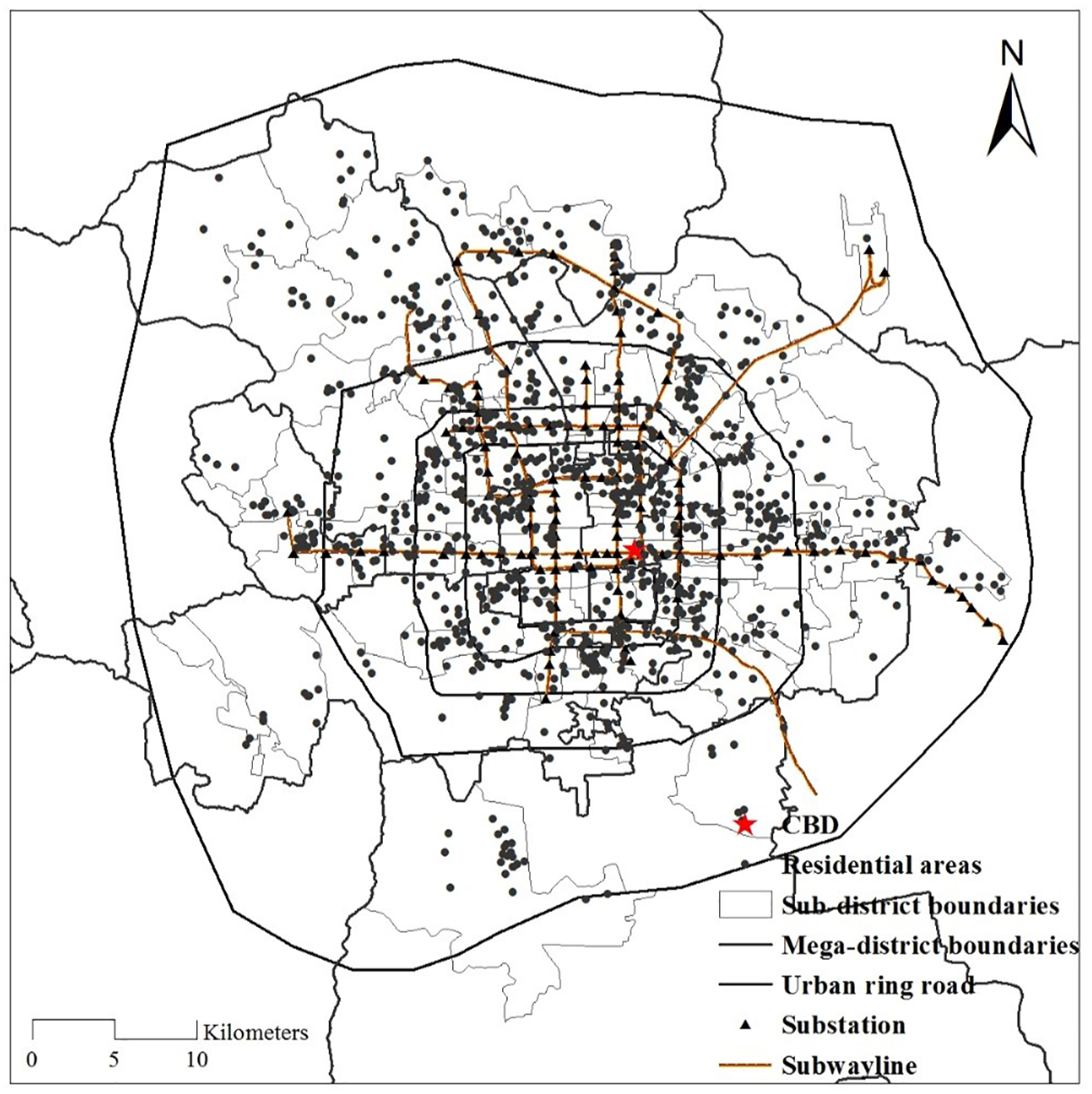
Spatial distribution of the surveyed residential areas in Beijing.
About 41.8% of the respondents live in neighbourhoods dominated by commodity properties, followed by those dominated by affordable housing (27.4%), work-unit housing (14.2%) and urban villages (12.4%) (Table 1). This is somewhat in contrast to the common belief that migrants tend to live in urban villages (Zheng et al., 2009). As the survey selects residents living in urban households at random in all sub-districts, urban villages are not over-sampled. Residential satisfaction is measured by the following question: ‘All things considered, how satisfied are you with your residential environment as a whole?’ Respondents were asked to record a score ranging from 0 to 100. This differs from a complex construct derived from several correlated items measuring different dimensions of satisfaction, such as location, accessibility and social interaction (Ibem and Aduwo, 2013). As individuals may put different weights on different attributes, an overall evaluation of residential environment takes into account a variety of priorities held by individuals. Most migrants reported satisfaction, with an average score of 70.9 and a standard deviation of 12.9. Those living in different neighbourhood types showed significantly different satisfaction levels, according to an initial ANOVA test (F = 3.725, p = 0.011).
Summary of variables used in the study.

Most respondents were young: about 57.5% were below 30 years old. This is consistent with previous studies, as young people tend to migrate and seek opportunities outside their hometown. About half of the sample are in single households. A third of respondents had completed senior high school (12 years), and 51% had been to college or university. This is higher than the average educational attainment in migrant surveys, which is senior high school (Fan and Chen, 2014). One explanation concerns our sampling method. The survey targeted residents living in urban households only, excluding those residing in temporary shelters on construction sites or in irregular places, most of whom have low educational levels. Another explanation is that Beijing attracts many young university graduates nationwide who try to seek career opportunities in the capital. This may push up the average educational level of migrants living in Beijing’s households. However, compared with other migrant surveys (Niu and Zhao, 2018), our survey is biased towards those with high educational attainment. When examining residential satisfaction, we differentiate migrants with low and high educational levels and check potential heterogeneity among these groups. The majority of migrants are renters (85.6%), with only 14.2% owning homes. Most migrants are employed as ordinary staff in private companies; those in managerial positions only accounting for 28.3%. This is consistent with previous studies (Chen, 2011).
Empirical results
Residential choices
Table 2 displays the results of the multinomial logit model on residential choices, with commercial property estates as the default. Age is negatively related to the probability of living in urban villages versus commercial properties. This corresponds to existing studies stating that urban villages act as an entry point for young migrants (Zheng et al., 2009). Migrants without tertiary education are associated with higher probabilities of living in urban villages and work-unit housing neighbourhoods compared with those with university experience. Couples with or without children tend to reside in urban villages. It is not surprising to find that those with higher incomes are more likely to choose commercial property estates relative to other neighbourhoods. Consistent with previous studies, migrants employed in publicly owned companies are more inclined to live in work-unit or affordable housing neighbourhoods relative to commercial properties, compared with those in private companies. Ordinary staff have a higher probability of living in urban villages versus commercial properties, compared with middle-level managers. Migrants who have stayed in Beijing for over 15 years are more likely to stay in urban villages, work-unit housing or affordable housing estates as opposed to commodity properties. In terms of homeownership, renters tend to live in urban villages, work-unit housing and affordable housing estates, while homeowners tend to reside in commercial properties. This is because migrants are confronted with restrictions on purchasing subsidised housing and properties in urban villages.
A multinomial logit model of residential choices.

Notes: * significant at 10%; ** significant at 5%; *** significant at 1%. Standard errors are in brackets. Default categories are female, Bachelor’s degree and above, single household, privately-owned company, ordinary staff and renters.
In summary, migrants with a high probability of living in urban villages are characterised by young age, low education, low income, living with families and long duration. This can be explained by two reasons. First, it is easier for low-income migrants to find affordable housing to support the whole family in urban villages compared with other areas. Second, migrants provide low-cost consumer products and services and develop social networks in urban villages. It is likely that those from the same place of origin live together to support each other (Liu et al., 2015). Such networks may prolong migrants’ stay in their urban village.
Residential satisfaction
The results of the multilevel models of residential satisfaction are presented in Table 3. Model 1 shows that neighbourhood types are significantly associated with residential satisfaction. Compared with migrants in commercial property estates, those in urban villages reported the lowest satisfaction level, followed by those in work-unit and affordable housing neighbourhoods. This can be explained by the inferior living conditions in urban villages, such as overcrowding, poor sanitation conditions and lack of public goods (Zheng et al., 2009). Regarding individual-level variables, age has a non-linear association with residential satisfaction; younger and older migrants tend to report higher levels of satisfaction than the middle-aged. Household income is significantly and positively related to satisfaction, consistent with previous studies (Lu, 1999). While the effect of duration is mixed in the existing literature, our study shows that migrants who had stayed in Beijing for over 15 years tended to report a lower level of residential satisfaction than others. One explanation is that migrants’ expectations of their residential environment might increase with the length of stay. Nevertheless, they are confronted with institutional constraints similar to those of new migrants without local hukou status, and are thus unable to improve their living environment significantly. This may lead to a mismatch between their aspired to and actual residential environments and a low level of satisfaction.
Multilevel models of residential satisfaction.

Notes: * significant at 10%; ** significant at 5%; *** significant at 1%. Default categories are female, Bachelor’s degree and above, single household, duration in Beijing < 8 years, privately-owned company, ordinary staff, not homeowner, commercial properties and located in north outer suburb.
Table 3 shows that migrant homeowners are less satisfied with their residential environment than renters. This is surprising, as homeownership is expected to enhance neighbourhood attachment, which might improve residential satisfaction. However, as discussed previously, the impact of homeownership on residential satisfaction is contingent on neighbourhood context; homeowners in an adverse neighbourhood may not report a higher level of satisfaction than renters in an advantageous one (Grief, 2015). In a megacity like Beijing where house prices increase rapidly, migrants tend to make a trade-off between homeownership and residential environment. They might compromise on residential environment in order to purchase a property. We will further discuss the relationship between homeownership and residential satisfaction in different neighbourhood types as shown in Table 4.
Heckman two-stage models of residential satisfaction.

Notes: * significant at 10%; ** significant at 5%; *** significant at 1%. Standard errors are in brackets. Default categories are female, Bachelor’s degree and above, single household, duration in Beijing < 8 years, privately-owned company, ordinary staff, not homeowner, commercial properties and located in north outer suburb.
Commuting time is significantly and negatively related to residential satisfaction, consistent with previous studies (e.g. Ma et al., 2018). In contrast to the significant effects of proximity to subway stations and parks, which are usually reported in satisfaction studies for the general population (e.g. Ma et al., 2018), access to these amenities is not significantly linked to migrants’ residential satisfaction. However, we do observe spatial variability in reported satisfaction even after controlling for a range of individual- and neighbourhood-level variables. Compared with residents living in the northern outer suburbs, residents living elsewhere tend to report a higher level of satisfaction, especially those in the south.
As for sub-district-level variables, only the proportion of migrants is found to be significantly and negatively associated with residential satisfaction. Sub-districts with a high proportion of migrants may be characterised by relatively low housing costs and inferior residential environment. However, when an interaction term between the percentage of migrants and duration in Beijing is added in Model 2 (Table 3), we find that migrants who had lived in Beijing for over 15 years tended to report higher satisfaction in sub-districts with higher percentages of migrants. Previous studies indicate that migrants with longer duration at their destination may develop wider social networks, and many of their social ties are with migrants rather than local residents (Yue et al., 2013). Those who stay longer in a sub-district with many migrants may be more socially attached to the area, which enhances residential satisfaction (Li and Wu, 2013). However, the finding may not hold true for all migrants, an issue we shall discuss later.
Table 4 displays the Heckman two-stage models for different neighbourhood types. The results show that the coefficient of the inverse Mills ratio is significantly negative for commercial property estates, significantly positive for urban villages, but insignificant for work-unit and affordable housing neighbourhoods. This is an important finding. First, it shows that self-selection has significant impacts on residential satisfaction, and its impact is more salient for commercial property estates and urban villages than for the other two types. Second, while migrants with a higher probability of choosing commercial property estates are more likely to express dissatisfaction with their residential environment, migrants who tend to choose urban villages are more inclined to report satisfaction, all else being equal. This suggests that migrants who choose commercial property estates are more fastidious about their residential environment compared with others, while those opting for urban villages have lower expectations of their living environment.
After controlling for self-selection effects, some variables have similar effects on residential satisfaction to the results in Table 3, though the sample sizes are reduced. For example, older people are more likely to express residential satisfaction. Income has positive impacts in commercial property and affordable housing estates. However, homeownership exerts heterogeneous effects on residential satisfaction in different neighbourhood types. Homeowners are more likely to report satisfaction than renters in commercial property estates, but more likely to report dissatisfaction in affordable and work-unit housing estates. 1 As discussed previously, commercial property estates have better residential environments than others. The finding is consistent with previous studies showing that homeowners are only satisfied where a decent residential environment exists (Grief, 2015).
Robustness check
Migrants are a heterogeneous group who originate both from the countryside and the cities and have different educational attainments and occupations. Our questionnaire does not allow us to distinguish between those from the countryside and those from the cities. Since different educational attainment may have significant impacts on migrants’ life prospects in a city, we estimated separate models of residential choices and satisfaction for migrants with educational levels above and below college level to check the robustness of our findings. The models of residential choices show similar patterns to those in Table 3. 2 Regarding residential satisfaction (Table 5), 3 urban villages are significantly negatively associated with satisfaction for both groups. Noticeable differences exist for the effects of the percentage of migrants in a sub-district and its interaction with duration in Beijing. For migrants with above-college degrees, the percentage of migrants in a sub-district has significantly negative effects on residential satisfaction. Such negative effects are reinforced for highly educated migrants who had stayed in Beijing for over 15 years. In contrast, for migrants with low educational levels, those with longer duration reported a higher satisfaction level in a sub-district with a higher percentage of migrants. This hints that social networks may be more useful in enhancing residential satisfaction for migrants with lower educational attainment. This is supported by Wu and Logan (2016), who find that migrants are more likely to conduct neighbouring activities than local residents and to depend on their local social networks to survive in cities. Such neighbouring activities strengthen their neighbourhood sentiment.
Multilevel model results of residential satisfaction for migrants with high and low educational attainment.

Notes: * significant at 10%; ** significant at 5%; *** significant at 1%. Default categories are female, Bachelor’s degree and above, single household, duration in Beijing < 8 years, privately-owned company, ordinary staff, not homeowner, commercial properties and located in north outer suburb.
Conclusions
Drawing on data from a random questionnaire survey in Beijing in 2013, this article extends the literature by examining the sources of migrants’ residential satisfaction using multilevel models, while taking into account their self-selection into different neighbourhood types. There are three main findings. First, significant heterogeneities in residential satisfaction exist in different neighbourhood types after controlling for demographic, socio-economic characteristics and sub-district-level contextual variables. Migrants tend to report the highest satisfaction level in commercial property estates, followed by those dominated by affordable housing and work-unit housing, and finally urban villages. Second, migrants choose to live in different neighbourhood types contingent on age, gender, household composition, income and job-related factors. Their self-selection has significant impacts on residential satisfaction. Those who are more likely to live in commercial property estates tend to be more fastidious about their residential environment, and to report a lower level of satisfaction with similar residential environments. In contrast, those choosing to live in urban villages tend to have lower expectations of their living environment and to report a higher level of satisfaction with similar residential environments. The findings suggest that migrants tend to revise their residential preference after taking into account the choices and constraints in the housing market and report their residential satisfaction accordingly. This provides a plausible explanation for the high average score of residential satisfaction in the survey. Moreover, as self-selection is shown to significantly influence residential satisfaction, the results concerning the determinants of residential satisfaction are more reliable when self-selection is controlled for. For example, we find that migrant homeowners reported higher satisfaction levels than renters only in commercial property estates. One explanation is that migrant homeowners without local hukou status may make compromises on their residential environment when they are confronted with financial constraints and limited housing choices. Those who are unable to purchase properties in their preferred neighbourhoods may report a low satisfaction level. This challenges the universal positive impact of homeownership on residential satisfaction and demonstrates the importance of neighbourhood context when analysing the impact of homeownership on residential satisfaction.
Third, besides neighbourhood types and self-selection, migrants’ residential satisfaction is influenced by demographic and socio-economic characteristics, as well as sub-district-level contextual variables. Age, household income, duration, commuting time and location in the city significantly influence residential satisfaction. The proportion of migrants at the sub-district level also matters, as it negatively influences satisfaction for migrants with high educational attainment. However, migrants with low educational levels and a stay of over 15 years reported higher levels of satisfaction in sub-districts with higher percentages of migrants.
Urban villages provide low-cost rental housing, but migrants are least satisfied with the residential environment there compared with other neighbourhoods, even after taking into account their choices and constraints in the housing market and adjusting their expectations. It is important to improve facilities and services in urban villages to enhance residential satisfaction. In some cities, local governments demolished urban villages during the redevelopment process and forced migrants to live in more remote areas with similar or even worse living environments. Such redevelopment fails to provide alternative low-cost housing to migrants. Innovative policies, such as upgrading urban villages and affordable housing projects, are needed to satisfy migrants’ demand for decent residential environments. Our study also shows that income has positive effects on residential satisfaction, and commuting time has negative effects. In contrast, access to museums and parks is insignificant. These results suggest that housing costs and proximity to workplace are important to migrants’ residential satisfaction. Affordable housing projects need to pay particular attention to access to employment.
Our study has limitations. First, as the survey targets migrants living in urban households, the findings may not be applicable to all migrants. Second, due to data constraints, we are unable to control for all the physical and social characteristics of a neighbourhood. For example, the survey does not record the floor area ratio, density or green areas of a neighbourhood, which might significantly influence residential satisfaction. These variables are not included in the model. Neither is information on migrants’ social networks available in the survey. We can only use duration in Beijing to proxy some of the network effects. But we cannot examine the impacts on residential satisfaction of migrants’ different social ties, such as ties with local residents and migrants from the same place of origin. Third, migrants’ residential satisfaction might be influenced by their previous housing experiences in their hometown. All these may provide areas for future research when relevant data become available. Despite these limitations, this study provides a rigorous multilevel analysis of migrants’ residential satisfaction in a Chinese city while controlling for their self-selection into different neighbourhood types.
Footnotes
Declaration of conflicting interests
The author(s) declared no potential conflicts of interest with respect to the research, authorship, and/or publication of this article.
Funding
The author(s) disclosed receipt of the following financial support for the research, authorship, and/or publication of this article: This work is funded by the National Natural Science Foundation of China (Grant numbers 41701184 and 41871170).
