




Abstract
Energy retrofit of the existing building stock has a key role in responding to climate change. In light of a recent experience in Northern Italy, this article examines a new tool based on land development rights with which to support the reduction of energy consumption and the production of renewable energy in urban areas. The market stimulation tool is discussed in terms of an integrated conceptual model that starts from the similarities and differences between national and international uses of ‘non-financial instruments’. The research results show how difficult it is to transfer a theoretical concept to local realities. Nevertheless, a new role of the public administration whereby it activates private actors in addressing climate change goals will be even more challenging.
Introduction
In recent years, there has been a closer focus on the energy performance of the existing building stock and its impact on climate change. In Italy, the annual potential energy saving expected by the National Energy Efficiency Action Plan (PAEE, 2014) from the refurbishment of the building stock in 2020 is 48.9 TWh for residential buildings and around 17.2 TWh for non-residential ones. A number of different perspectives and paradigms have been developed in order to address this challenge – retrofitting (Jones et al., 2013), sustainable transitions (Eames et al., 2013; Naess and Vogel, 2012) and regeneration and regenerative design (Cole, 2012) – but the question now is ‘how to break the policy inertia and set the necessary policies in motion’ (BPIE, 2013: 17), specifically for private residential buildings.
In Italy, despite increased awareness and understanding of the potential impact of energy retrofit, the realisation has not been uniform across the country’s major cities (Zanon and Verones, 2013). The ENEA (2013) report underlined that the role of initial costs is dominant among housing owner-occupiers. Generally speaking, the barriers to retrofit are mainly related to financial aspects, a lack of information and skills, collective decision problems and uncertainty in measurement and verification (Caputo and Passetti 2015). In this regard, regulation has shown its limitations, which mirror the distinctive features of the residential sector, namely private properties covered by civil law, a fragmented ownership structure and an emphasis on the role of tax deductions and grants in encouraging investments.
On the other hand, the Final Report (2014) of the Energy Efficiency Financial Institutions Group (EEFIG, 2015) states that existing economic and financial instruments for owner-occupied housing are scant, and it suggests the institution of dedicated credit lines and on-bill finance mechanisms. In the case of Italy, ENEA (2013) reports the shrinkage of public funds due to uncertainty in the establishment of next future annual tax deductions (which are temporary but modified every year) and grants from local authorities (which subsidise single technological elements also in the case of low cost effectiveness), and it highlights the barriers to access to conventional loans.
Under these conditions, specific contextual challenges arise for the Italian system. Refurbishment of the existing housing stock needs the activation of private actors, owners and builders, independently of financial aid from the state and/or local authorities.
Scholars, planners and practitioners have focused their attention on the new modes and tools of urban governance which foster the shift of the role of public administrations from regulation to facilitation, and which introduce a neutral approach to market actions in order to orient them towards public interest goals. This has largely influenced Italian planning activities, resulting in the introduction of novel practices that use market development rights and public-private partnerships according to a non-financial compensation approach. The process has also partially involved the local toolbox concerning energy policies and planning with the introduction – in 2008 by the Italian Annual Financial Act and in 2009 by the National Housing Plan – of a reward-based mechanism based on the assignment of additional land development rights related to building refurbishment and to urban renewal, including energy efficiency goals.
Zanon and Verones (2013) states that the process of including energy goals in spatial planning and urban policies requires tailor-made solutions able to encompass the legal, economic and social aspects of energy. By contrast, national and regional laws provide standardised procedures; as a result, municipalities – which are strong centres of local autonomy – operate with great difficulty, highlighted in the marginal use of this novel tool. This perspective requires redefinition of the usual methods of development rights assignment, and the activation of new planning procedures based on the assessment of actions in terms of performance instead of conformance with pre-defined rules.
In light of these main findings of Zanon and Verones (2013), the article contributes to further discussion on how replacement of the traditional command-and-control planning mechanisms with new practices based on the assignment of extra land development rights can boost the energy retrofit of building stock and urban areas. It does so by adopting the conceptual model proposed by Tiesdell and Allmendinger (2005), who develop, within a neo-institutional economics perspective, ‘a typology of planning tools based on their relationships to particular market characteristics’ (p. 57). In particular, the article investigates how effective new practice is in achieving this goal, i.e. the way in which the partial market of development rights is designed and implemented. The article develops a framework for the evaluation and analysis of the new Italian plan implementation mechanism. It distinguishes and selects themes and key drivers from the Italian and international debates that correspond to successful programme implementation. Despite the differences among the characters of phenomena and outcomes among and within countries (such as Italy and other countries with a federal governance structure), the focus remains on similarities in the use of ‘non-financial instruments’ (Spaans et al., 2011) as means to achieve certain planning goals.
The article is divided into six main sections. The first three sections set out the conceptual model adopted to read the Italian municipal energy planning toolbox in accordance with Tiesdell and Allmendinger’s planning tool typology, and explore the Italian reward-based mechanism and the case study of the Province and the City of Bolzano. The fourth section describes the analytical framework comprising the successful elements recurrent in the several research studies analysed and which also fit the Italian context. In the fifth section the analytical framework is applied to an Italian case study: the City and the Province of Bolzano. Finally, the conclusions discuss the role played by the new practice – the reward-based mechanism – in activating private owners for the retrofit of buildings and in mobilising citizens to achieve the more general planning goals of reducing carbon emissions and greater energy efficiency.
Reading the Italian local energy planning toolbox
Most recent studies have broadened the scope of planning, and they have deconstructed the notion of it as a homogeneous and regulatory activity. This hypothesis is based on the consideration that the usual top-down, public-led, authoritative tools are no longer effective owing to the re-allocation of competencies and resources among a number of politico-administrative levels (ranging from the EU to the state, regions and municipalities) and semi-private agencies and private companies as well, to the shrinkage of public money, and to the increasing number of conflicts that arise when authoritative instruments (such as regulation and expropriation) are used by public authorities. In particular, regulation (that is, the definition of rules to be enforced by means of conformance control) is a key planning instrument, but it is considered no longer effective for orientating actions, changing behaviours and stimulating the market. The involvement of the private sector in the attainment of planning goals is related to the tendency of public authorities to retreat from the role of regulators (Cars et al., 2002), instead becoming facilitators of new actions preferably to be performed by the market (van der Veen et al., 2010). Thus, in recent years, the sharp separation between public and private sector development has begun to break down, and development has increasingly become a process of co-production between the public and private sectors (Tiesdell and Adams, 2011). The conceptualisation proposed by Tiesdell and Allmendinger (2005) suggests a model which links the conceptual and empirical issues in order to show how particular planning tools affect the decision-making environment of land and property market actors. This conceptualisation of planning tools and market recognises the role played by property in influencing the performance of the market and the consequent relationships among planning, public policy and structure and the operation of the property market. The effectiveness of public strategies and actions depends on the ability to make use of the appropriate tools, considering the leverages that can be activated in the diverse contexts. Thus, they do not operate in isolation; rather, new tools are frequently introduced ‘within an already crowded policy context’ (Tiesdall and Adams, 2011: 15), and deployed in bundles of packages.
In short, Tiesdall and Adams (2011: 57) identify tools intended to shape markets; to regulate markets; to stimulate markets; and to develop the capacity of market actors.
Market-shaping tools work by moulding the context within which market actions and transactions occur. Among these policy tools, plans, especially land-use ones, are the principal directive market-shaping tools. Market regulation tools seek to regulate and control market actions and transactions by restricting the set of choices available by defining the boundaries of the actors’ opportunity space. Generally, they are operated by the state, which requires compliance with minimal regulatory standards.
Market stimulation tools seek to enable the market to work better by changing the contours of the opportunity space so that some strategies are more (or less) advantageous to market actors. As Tiesdell and Adams (2011) write, such tools operate ‘by making developers realise either they “want to” provide better quality development [design stimulus instruments], or that they “have to” or that it is “worth it” because of remunerative advantage [development stimulus tools]’ (Syms and Clarke, 2011: 146).
Capacity building tools enhance the ability and capacity of market actors. They are means to facilitate the operation of other planning tools through development of the skills and abilities of individuals and organisations.
In Italy, where the legal-administrative tradition is characterised by the prior definition of rules and subsequent conformance control, novel instruments have been introduced. They especially concern urban planning and the mobilisation of land, such as equalisation, compensation and the reward-based mechanism. In particular regard to energy policies and planning, the Municipal Energy Plan (Law no. 10/1991) has been recently associated with the voluntary planning instrument entitled the Sustainable Energy Action Plan promoted by the Covenant of Mayors. Besides the traditional Building Code, sometimes enriched with the ‘Energy Code’, fiscal and economic incentives play the main role with projects and initiatives supported by EU funds.
In a zoning approach perspective, the use of market regulation tools is widespread in Italy: they assign building opportunities by allocating development rights and imposing constraints in order to affirm a superior ‘public interest’ (i.e. spaces for public utilities, highways, railways, etc.). Then, by adopting transfer titles (such as expropriation), public authorities acquire properties also without the owner’s consent, granting only a monetary compensation.
Table 1 shows how the Italian local energy planning toolbox can be interpreted in terms of Tiesdell and Allmendinger’s international conceptual model.
The policy tool typology applied to the Italian local energy planning toolbox.
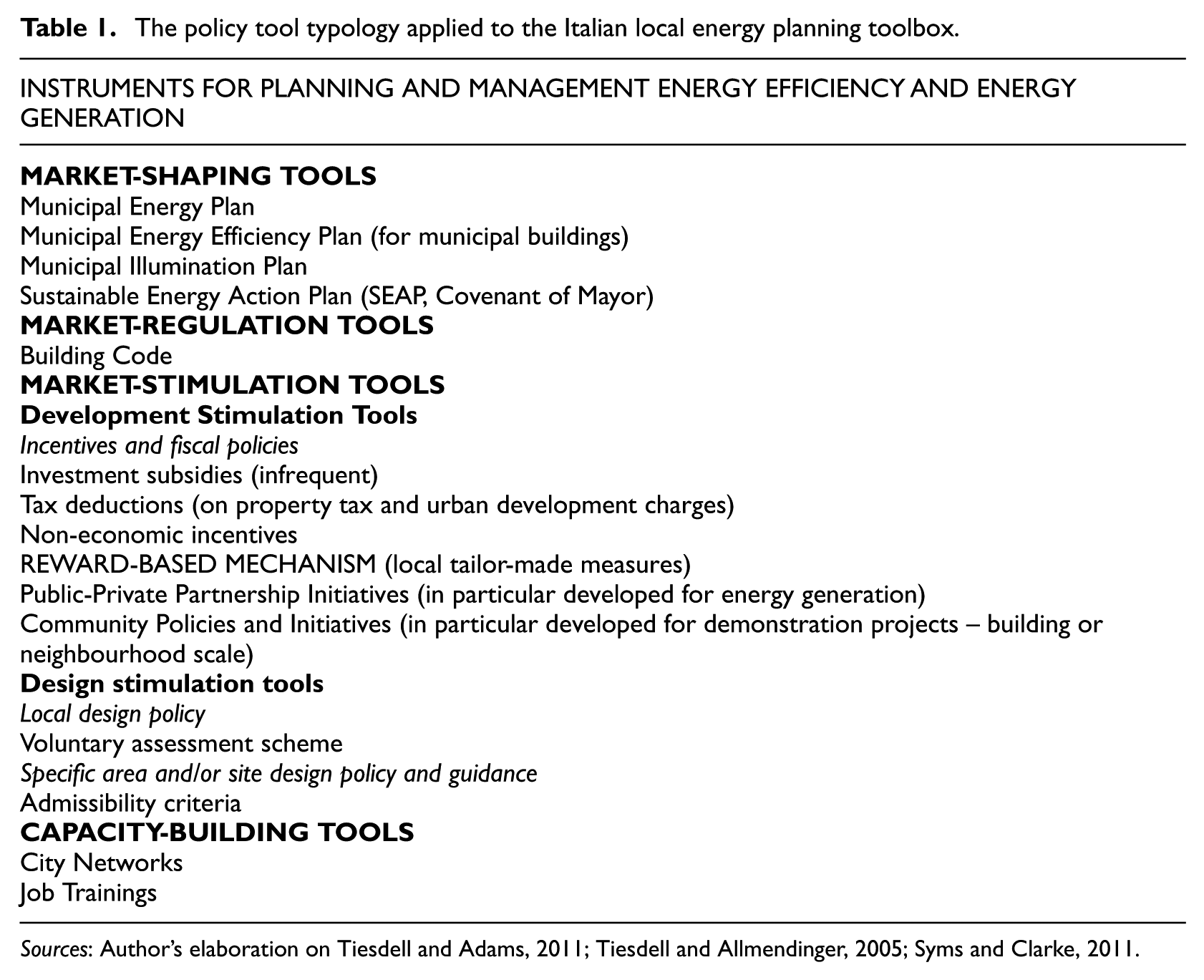
Sources: Author’s elaboration on Tiesdell and Adams, 2011; Tiesdell and Allmendinger, 2005; Syms and Clarke, 2011.
Besides fiscal measures and subsidies, there is a large amount of evidence (Bulkeley and Kern, 2006) on the use of a variety of devices, from more ‘traditional’ ones, such as promotional activities (education campaigns) to public-private partnerships, in order to provide guidance for architects and developers on energy efficiency and energy production from renewable resources. Design stimulus tools may also include such regulations and policy statements as guidance on the design and the form of new developments and interventions at the site-specific level by local planning authorities (Syms and Clarke, 2011).
The market stimulation tool: The reward-based mechanism
Whilst development stimulus tools generally concern incentives and disincentives, a key role among the policy tools used for consensual planning is increasingly played by mechanisms that use the market of land development rights, in particular the density bonus (Premialità Edilizia in the Italian context) (Spaans et al., 2011). They can be understood as constituting a ‘Coase-inspired’ property rights paradigm for the achievement of spatial planning goals. By stimulating the market (private initiative), the use of reward-based mechanisms can change the ‘contours of that opportunity space making some strategies more (or less) advantageous to market actors’ (Tiesdell and Allmendinger, 2005: 68).
In 2008 the Italian Annual Financial Act (Law no. 244/2007) introduced into the national legal framework incentives in the form of additional development rights. This provision (article 1, subsection 259) states that: ‘so as to encourage the implementation of interventions aimed at the realization of social housing, urban and housing regeneration schemes, improvement of the environmental quality of settlements, the local authority, within its planning instruments, can grant a bonus-increase in buildable volumes’ (author’s translation). Thereafter, with the introduction of an extraordinary and temporary (two-year) measure by the National Housing Plan (Piano Casa, 6 March 2009) and its subsequent transposition into regional legislations, the granting of bonus-rights has also encouraged the ‘green’ refurbishment of buildings. In particular, the reward-based system introduced by the National Housing Plan supports refurbishment operations with extension, as well as the re-construction of buildings, on the condition that energy efficiency is improved. The focus of these provisions is the residential sector, and in particular single-family and small multi-family buildings, with some regional exceptions. In regard to the amount of density bonus, a reward scale has been defined. For refurbishment with extension, a bonus of up to 20% of the building’s existing volume is granted, whereas for demolition with replacement and extension, up to 35% is granted. The energy efficiency requirements for obtaining the density bonus are higher than the minimum ones set by the municipal building codes.
The precise amount of density bonus to assign is an important consideration. In the national law and in the regional interpretations, calculation of the amount of density bonus is undifferentiated with respect to the land and urban features – with the exception of historic centres and areas with pre-existing constraints, where a density bonus system is precluded – whereas the bonus percentage can be progressively differentiated with respect to the existing building’s volume and the additional incentive percentages.
In regard to land development rights transferability and trading, there are significant differences from region to region, so that there is no single position. Some authors and legal practitioners are amenable to considering bonus-rights as autonomous from the land, whereas others stress the difficulty of implementing such a provision because the development right is considered strongly related to the accomplishment of planning goals and, therefore, to the specific plot of zoned land. Accordingly, the transfer of development rights should not be possible. Theoretically, the bonus provided by the new legislation cannot be traded as such, because it is connected to ownership of the building. Owners can take advantage of the bonus, and after the refurbishment and extension, they can use or sell the improved building (or its extended part).
However, the uncertain nature of bonus-rights in Italy has not prevented interesting experimentation: the Venetian Region has approved a law defining a ‘TDR bank’, thereby creating a development rights market.
Generally, the regional legislations have been more constraining than the national one. They limit the space for local actions due, in part, to the lack of general strategies. Within this context, the measures enacted at the regional level become a normative model that can/should be implemented with a regulatory model at the local scale. Hence, the exact structure of a density bonus system can vary according to how the municipality handles density in its zoning and building code. The Basilicata, Emilia-Romagna, Lazio, Liguria, Lombardy, Piedmont, Puglia, Umbria and Veneto regions have set a deadline for the transposition of the regional text by means of municipal deliberations. However, although some regions and municipalities have jointly devised the systems, there may exist two parallel density bonus incentive models not coherent in growth and development. In addition, the majority of regional models permit exceptions to the development standards of the local planning instruments, in order to simplify and boost private interventions. Even if these two systems are homogeneous, they are not cumulative; rather, they exist at the same time and are subject to a choice by citizens.
In particular, the detailed situation of the Province and the City of Bolzano has been highlighted, rather than drawing on highly general national surveys of the local real interpretation and implementation.
The case study: The Province and the City of Bolzano
The focus in what follows is on the case of the Province and the City of Bolzano. This is the main example in Italy of the application of European energy directives to the local context and urban tools, since the Province of Bolzano was the first, in 2004, to introduce obligatory building energy performance certificates with the CasaClima protocol. In compliance with the latter, the Province of Bolzano promulgated legislative decrees focused on a bonus-reward mechanism exclusively aimed at energy refurbishment works, an accomplishment without parallel in Italy.
The current situation with respect to the above-discussed market stimulation tool is the result of an on-going process. Hence, implementation of the National Housing Plan in the legislation system of the Autonomous Province of Bolzano, in Northern Italy, has varied significantly in recent years. Approved in 2013, resolution no. 362/2013 significantly modified previous local legislation on the reward-based mechanism by introducing a 20% density bonus for residential buildings in the case of energy retrofitting and demolition with rebuilding. In order to obtain an increase in building volume, these buildings must achieve a Building Energy Performance Class C (< 70 kWh/m2y). According to European Directive 2010/31/EU on building energy performance, this novel system is a temporary measure that will end in 2020. Its technical application is strictly regulated by national civil law and municipal regulations, in addition to the admissibility criteria imposed by provincial resolutions on building distance and height. The combination of these regulations and criteria results in an extremely complex framework. In regard to building distance, the national law imposes the minimum of 10 metres without exceptions for envelope insulation, whereas provincial resolutions stipulate that the height of refurbished buildings must not exceed the distance from adjoining buildings (height = distance). If this is not the case, the upper level must respect this rule by moving back. As regards height, the municipal regulations identify the maximum permitted for each local zoning area and which, following provincial resolutions, can be exceed of 3 metres. If the existing building is already higher than defined by the local plan, a detailed plan for the plot must be submitted in order to use the additional building rights.
The system’s legal application is less clear. When this provision concerns detached or semi-detached houses, the configuration of private property is entirely solved, but when the building to be retrofitted is an apartment block, a controversial branch of Italian civil law comes into play. Especially, the agreements between owners and the majorities needed in residents’ resolutions are currently matters of court judgments.
The uncertainty of the provincial body’s resolutions has significantly interfered with the development of municipal regulations in these terms. It has given rise to a situation in which local progress is mainly related to the results of market regulation tools (Energy Appendix to the recently introduced municipal Building Code) and stimulation tools, namely Community Policies and Initiatives. The city planning authority has focused public actions on developing scenarios to reduce greenhouse emissions through the ‘Neutral Climate City Bolzano – Zero CO2 Emissions’ research project, and by promoting education campaigns and demonstration projects like the EPOurban Central Programme Europe Project and the SINFONIA FP7 Project. In regard to the reward-based mechanism, the municipality of Bolzano has only restricted its use to the historic centre, where a detailed plan is needed, and to agricultural areas, where the density bonus is only 200 m3.
Hence, a more detailed analysis of the implementation mechanism is necessary in order to devise more effective new practice in achieving this goal.
The integrated analytical framework
This section develops a framework for the evaluation and analysis of the Italian plan implementation mechanism, applied to the case study of the Province and the City of Bolzano in the section ‘Discussion’. It distinguishes and selects themes and key drivers from the Italian and international debates that correspond to successful programme implementation in the use of property rights as instruments to encourage the achievement of certain public goals (Bartolini, 2007, 2008; Boscolo, 2010; Camagni, 1999; Jacobs, 1997; Kaplowitz et al., 2008; Machemer and Kaplowitz, 2002; Micelli, 2002, 2010, 2011; Pruetz and Standridge, 2009; Renard, 2007, 2008; Spaans et al., 2008; Stanghellini, 2010; van der Veen et al., 2010), according to the Italian economic, legal and institutional context, as well as the planning system. The Italian and international empirical studies stress four main themes concerning the conditions under which the use of the land development rights market with a view to greater energy efficiency and production can be efficient and effective.
Table 2 shows the framework comprising themes and key drivers drawn from juxtaposition of the Italian and international literature. These are debated in turn in the following subsections.
The integrated framework.
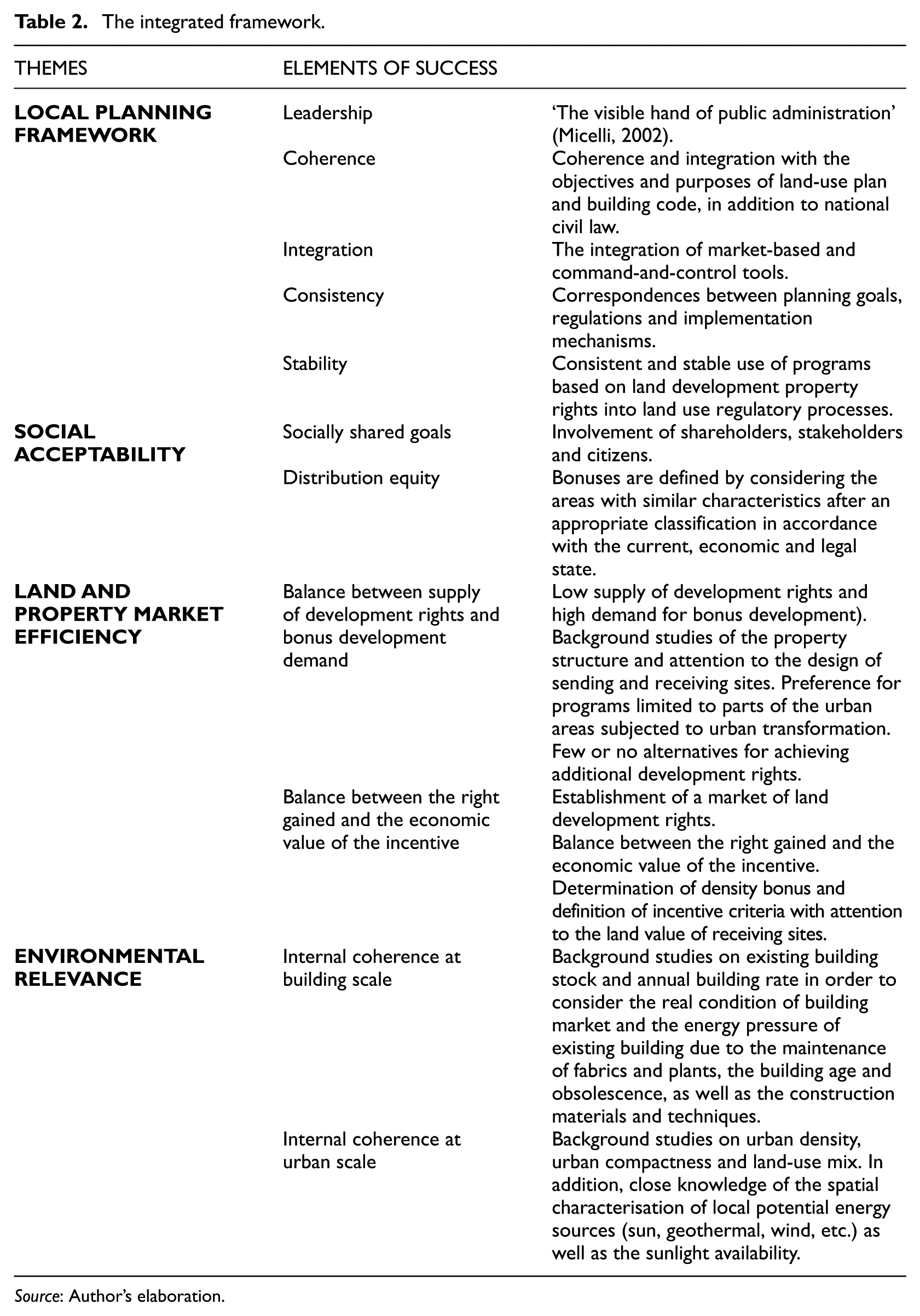
Source: Author’s elaboration.
Local planning framework
Despite the new role assigned to the public administration, authors generally agree that planning authorities significantly condition the elaboration and implementation of policies based on stimulating market tools. It is the administration that identifies the urban areas designated for transformation as well as what strategy to apply (Bartolini, 2008; Boscolo, 2010; Micelli, 2002, 2014) in generating land development property rights by the land use plan.
As a result, the ‘visible hand of public administration’ (Micelli, 2002) is a significant factor. Indeed, the market for land development rights does not work automatically; rather, it works after the establishment of market rules and public initiatives that can facilitate, support and encourage the involvement of private developers and owners in these operations.
The coherence and the integration of such planning mechanisms with the purposes and objectives of land-use plans are factors identified as successful by both Italian and international scholars. The use of land development rights should be based on planning decisions so as to ensure the adequate legal consistency of the instrument. In addition to this point but closely related to it, the capacity of policy instruments to shape, regulate and stimulate the market, as well as to foster the capacity building of the actors involved, significantly influences the implementation phase. The combination of different features and different operational paths (Camagni, 2011, 2014) enables the public administration to consider a number of possibilities in view of achieving a predetermined goal.
The consistency among planning goals, regulations and implementation mechanisms reflects firstly the appropriate identification of the urban areas involved in the policy, secondly the design of sending and receiving sites, and thirdly the definition of transfer rules by local authorities. The consistent and stable use of stimulating tools in land use regulatory processes allows actors to be confident in the maintenance of established objectives and regulation integrity. The legal foundation of such planning practices in the national/regional legislation system is regarded by all authors to be essential for the initial establishment of development rights markets. In the case of both Italy and the USA, the absence of a national or regional legislative framework has not prevented the use of land development rights with interesting and pioneering outcomes.
Social acceptability
All authors argue that social acceptability is a necessary condition for the real implementation of urban public policies. The inclusion of stakeholders and shareholders in the design process makes it possible not only to fit the programme to the specific needs and goals of the area but also to keep the attention focused on the implementation phase. Furthermore, an inclusive approach which searches for socially shared goals can have significant effects on public decisions, participants and institutions. In regard to a land development rights market, the contribution of landowners to the policy elaboration process is decisive. Boscolo (2010) maintains that they should be involved in the phase when criteria are defined for identification of the categories of urban areas, as well as during the attribution of building indexes, through the promotion of occasions for encounter, dialogue, discussion and group sharing. Specifically, the definition and design of sending and receiving sites should take place through public-private negotiation under conditions of information transparency and public accountability (Camagni, 2011).
Land and property market efficiency
Traditionally, the real interaction between supply and demand determines the market price, and the market balance can be obtained in the case of demand and supply equilibrium. The introduction of a policy option based on a market-based approach can shape the demand and supply sides of the housing and land market. Ideally, for a stimulating market tool to be successful, there should be a large market for development rights, including many buyers and many sellers, all with a sufficient amount of information regarding the prices and opportunities available to them.
The most difficult objective is the generation of sufficient demand. Since this type of tool is added to existing zoning rules, the supply of and demand for land development rights also depend on the profitability of development, and the demand (or lack thereof) for higher density in some areas. Local zoning rules usually set density limits. They should therefore affect the choice and the design of receiving (large receiving areas) and sending (small sending areas) sites as well as the selection of particular market segments. All authors agree that knowledge of the existence of rapidly growing areas with high demand and a wealthy real estate market must be made available by background studies on development demands and patterns, market dynamics and property structure. Few or no alternatives for achieving extra development rights should be considered.
In addition, scholars recognise that the balance between the land development rights gained and their economic value is the key driver and initiator of such initiatives. In the particular case of the reward-based mechanism, only Micelli (2011) has empirically investigated the feasibility conditions that make the operation economically viable for the owners and developers. The main condition is the added value assigned with the extra land development rights. To summarise Micelli’s main findings, it can be stated that the density bonus should increase with respect to the growth of building density and quality, whereas it should decrease with respect to the land value related to the location. This implies that an efficient implementation should consider the possibility of assigning different bonuses on the basis of economic criteria. Moreover, Fuerst (2009) indicates that higher rents, higher occupancy rates, lower operational costs and a lower risk premium may influence the willingness-to-pay of occupiers and investors, and the need to consider the pay-back period and retrofitting costs in the balance. Furthermore, determination of the density bonus and definition of incentive criteria must pay attention to the land value of receiving sites if the public administration establishes a market of land development rights and their transferability.
Environmental relevance
Inexpensive social rental apartment blocks built between the end of the Second World War and the mid-1970s according to functionalist schemes and making use of aged technologies dominate Italy’s existing housing stock, and they account for 37% of the country’s final energy consumption (Eurostat, 2015). Space heating, cooling and electricity represent the energy demand of buildings, and construction materials, age and obsolescence of fabrics and plants; and occupants’ behaviour in the use of energy systems influences that demand. Moreover, the energy performance of buildings is affected by the urban heat island effects consequent on winter urban warmth and summer heat stress (Oke, 1988). According to Baker and Steemers (2000), they account for an 80% variation in energy consumption.
Environmental impact is important/significant at the building and urban scales.
At building scale, high quality decisions can only be delivered by the improvement of information flows. This requires developing an open source energy and cost database for buildings, and effective systems for sharing information and technical experiences – with standardised processes for the database’s collection and organisation, in line with Eurostat and Inspire Directive standards (EEFIG, 2015). Background analysis and studies determining the characteristics of the building stock, such as the energy cadastre (Dall’O’ et al., 2012), support the definition of which energy retrofit interventions are feasible, not only from technical point of view. Hence, EU Directive 2012/27/EU introduced a cost-efficient approach to the priorisation of limited resources and identification of high potentialities. Ma et al. (2012), among others, have investigated the most cost-effective retrofit measures for standardised building typologies (Filogamo et al., 2014), developing for the purpose a methodology similar to that of Dall’O’ et al. (2012).
From the urban scale perspective, Ratti et al. (2005) and Carneiro et al. (2014) demonstrated the importance in terms of energy consumptions and potential from renewable sources of urban form. Sunlight and daylight are key generators of solar passive gains, electricity demands and the potential of solar and photovoltaic panels on building roofs and building facades.
Background studies on urban density and reciprocal overshadow – and, in addition, close knowledge of the spatial characterisation of local potential energy sources (sun, geothermal, wind, etc.) as well as sunlight availability – enrich the above-mentioned database to develop an energy cadastre. These studies argue that improvement of the energy performance of the existing urban fabric by means of technological solutions does not exclude a morphological redesign of urban districts in light of a more efficient urban energy balance (Carneiro et al., 2014).
Discussion
According to the National legislation and local energy efficiency building protocol, in Bolzano the reward-based mechanism has been interpreted by introducing a 20% density bonus (limited to 200 m3 if the application is in agricultural areas or historical centres) for residential buildings in the case of energy retrofitting and demolition with rebuilding. These buildings have to achieve a Building Energy Performance Class C (< 70 kWh/m2y). Furthermore, the application on the ground of this tool is strictly regulated by national civil law, municipal regulations and the admissibility criteria imposed by provincial resolutions on building distance and height. Given the peculiar situation – the City of Bolzano has not developed any proper measure notwithstanding the research conducted during elaboration of the Master Plan of the City of Bolzano, approved in 2009 – the provincial incentive system as applied in the City of Bolzano will now be analysed, and in particular in light of a survey carried out by the author on projects authorised by the local administration since the provincial resolution (March 2013).
At the time of the empirical survey in Bureau of Private Buildings at the Municipality of Bolzano, only 21 projects had been submitted to the local administration since the provincial resolution of March 2013. Fifteen projects concerned detached or semi-detached houses in agricultural areas (with the use of 200 m3, while one used additional development rights for 20% of the volume); three concerned small apartment blocks with one owner in the historic centre (with the use of 200 m3); and three concerned apartment blocks in central areas, one with a single owner and the other two with several owners (with a 20% increase in volume).
A profile of those projects that maximised the profit of the provincial measure emerges from these data: an apartment block with 5/6 owners or one located in a central area. Apart from these exceptions, all the other projects submitted gained marginal advantages from the reward-based mechanism. This highlights the distance between a conceptual idealisation of the market stimulation tool and its real impact. The elements of the integrated conceptual framework are now discussed within the context of the City of Bolzano.
In regard to leadership, the Province of Bolzano legislated for the reward-based mechanism without the involvement of local administrations and, in particular, without negotiation with the municipality of Bolzano, the largest town in the province. This also affected the social acceptability of the measure, for which there was no involvement of the main stakeholders and citizens.
In regard to coherence, the reward-based mechanism appears incoherent with the planning instruments of the City of Bolzano. The provincial administration has deliberately introduced a tool with intrinsic technical (regulatory) barriers inconsistent with a complex urban reality like the City of Bolzano and existing municipal planning instruments. In particular, the complex framework of legal requirements concerning building distance and height greatly limits its application. Moreover, the provincial resolution, like the National Housing Act, exhibits limited knowledge of the legal barriers to the re-allocation or re-assignment of development opportunities in the case of fragmented property rights.
The analysis of cases and the projects submitted reveals that the mechanism is inconsistent with real matters concerning property rights in accordance with the national Civil Code. Furthermore, there are no further analyses and supporting documents from the Province that provide guidelines on the main issues concerning the use of development rights in situations of multi-owner and fragmented properties, such as those that can occur in an apartment block.
Although rhetorically used in political debate, this market stimulation tool is not integrated into the already crowded policy set; rather, it appears to be a residual tool. There is still a real dichotomy between market-based and command-and-control instruments, between obeying the law, where the freedom of one person is restricted, and the freedom of private actors within a well-defined legislative framework. The market-based mechanism is neither, in any way, related to existing command-and-control ones nor included in strategies for further future urban regeneration projects currently under discussion.
The land and property market efficiency of the reward-based mechanism, affected by the economic crisis and, especially, the crisis of the building sector in Italy, does not appear blindingly obvious. Projects submitted to the municipality of Bolzano confirm that, in accordance with Micelli’s findings (2011), the balance between the amount of additional development rights gained and their economic value is rarely achieved.
Moreover, although an efficient implementation tool should consider the possibility of assigning different bonuses on the basis of economic criteria, or use correction factors, the provincial law does not provide for differences in the attribution of development rights, whereas this suggests designating areas following legal criteria and the zoning approach. Hence, although the provincial system largely balances total costs through extra rights, the significant difference in income between suburban and central conditions raises questions as to the potential inequity of an equal approach to different conditions.
In addition, the economic profitability of actions is guaranteed in the central areas of Bolzano by the high land and building value, and by the limited costs of restructuring compared with the construction costs of the extra volume. It therefore appears that, with the increase in building quality, the operation gradually becomes more and more convenient, illogically with respect to the objectives of this policy tool. The provincial approach is viable from the economic point of view but it produces substantial unfairness of building value treatment from the periphery to the centre if a building in normal condition is considered as a sample. There are differences in the real estate value simulations obtained in city areas, with greater benefits for buildings in central areas of the City of Bolzano. The incentive system appears unprofitable for private action in particular if the property is located in a suburban or semi-central area.
Regarding environmental relevance, the potential impact on single buildings is high, but the main risk is that of losing a more comprehensive approach to the energy retrofit of rundown urban areas, or where a potential for energy production from renewable sources is evident and could be easily exploited, such as heating and cooling districts or solar and pv panels.
To sum up, these research results show that in the provincial and local administration, the potentialities and the limitations of this market stimulation tool have not yet been fully understood, and that this limits its use and complete integration with the tools available to the municipality. Yet the issues highlighted in this article help demonstrate the difficulty of transferring a theoretical concept generally included in the national and regional levels to local realities. Municipalities can implement and define measures with respect to the regional law and play a key role in all the steps: determination of the incentive scheme, definition of urban areas subject to the measures, development of rules for the allocation of land development rights, the transfer, if any, and the market of property rights rewarded owners or developers. On the other hand, evidence from the case study has shown that an active local government and community are lacking although needed. The same lesson can be learned from the provincial administration.
Conclusions
The article has analysed whether the market stimulation tool approved in Italy in 2009 is effective in achieving the land use goals identified, namely the way in which the partial market of development rights is designed and implemented to allow the energy retrofit of existing building stock.
Starting from the conceptual model of policy instruments developed by Tiesdell and Allmendinger (2005), the market stimulation tool has been discussed in an integrated framework. The latter has selected themes and key drivers from descriptions of national and international experiences, maintaining the focus on the similarities and differences between their uses of ‘non-financial instruments’ (Spaans et al., 2011). The framework has then been applied to a recent experience in Northern Italy, the Autonomous Province of Bolzano and the City of Bolzano.
To manage urban growth also in terms of retrofit and regeneration, planners must ensure that the reward-based mechanism operates in alignment with local comprehensive plans and urban law. A market of development rights should neither take the place of the command-and-control instruments traditionally used in planning, nor should it work in isolation. In fact, its success seems to depend significantly on the ability to work with other, alternative and complementary, tools.
Webster and Lai assume that the ‘market needs of the state’ (Webster and Lai, 2003: 52) and that, therefore, ‘the spontaneous markets require governments responsible in creating legal environments that support innovation, competition and private wealth’ (Webster and Lai, 2003: 6). Consequently, the existence and efficiency of a market are primarily dependent on rules created by the legislature and enforced by the state. In accordance with Buitelaar (2003), the only interesting question concerns the mix of planning and, consequently, how the market should be structured with existing instruments activated in the same context, as well as what could be the best mix. The synergy between the types of instruments that shape, regulate and stimulate the market and support the intervention capacity of the actors influences the implementation phase. After establishing market rules, local governments, in close collaboration with other levels of government, should outline interactions and relationships between instruments with the aim of pursuing the same goal of greater efficiency in existing urban areas (Zanon and Verones, 2013; Verones, 2015).
To conclude, the concept of a market stimulation tool based on the assignment of development rights discussed in this article may have the potential to grow into a well-developed policy instrument for both the integrated planning of urban renewal and building retrofit, as well as their financing. Substantial changes are needed, but this situation can offer an interesting departure point for analysis of innovative ways to involve private actors able to deal more efficiently and effectively with complex situations in urban redevelopment.
Footnotes
Acknowledgements
The author is grateful to anonymous referees for their helpful comments and suggestions on an earlier version of the article.
Funding
This research received no specific grant from any funding agency in the public, commercial, or not-for-profit sectors.