



Abstract
This article explores two contrasting perspectives on the role of informal settlements in urban labour markets. One proposes that they help to lift households out of rural poverty and onto a path to prosperity through affordable access to urban opportunities. The other suggests that the debilitating conditions confine residents to enduring hardship and insecurity. South Africa is an important test case because of the extent of social and spatial inequalities, and the policy ambivalence towards shack settlements. Preliminary evidence indicates that employment rates are much closer to formal urban areas than to rural areas, but conditions of employment are noticeably worse. Other forms of data are required to assess the magnitude and timescale of economic progression for households.
Introduction
About one in three urban residents (over 900 million people) in the global South currently live in ‘slums’, i.e. informal settlements with makeshift dwellings, deficient basic services and insecure tenure (UN-Habitat, 2010, 2013). Southern cities are projected to accommodate the bulk of the world’s population growth over coming decades, and slums are expected to absorb most of them (UN-Habitat, 2012; UNDESA, 2015; World Bank, 2013). Therefore the difference these places make to people’s chances in life is crucial to the future well-being of a large section of global humanity. Put simply, will these settlements help to lift households out of poverty and onto a path to greater material prosperity through access to urban assets, services and livelihoods? Or will they confine people to enduring hardship and vulnerability in unsafe and unsanitary environments with little prospect of upward mobility?
Considering the magnitude of the issues at stake, the causes and consequences of urban slums are surprisingly under-researched, sensationalised and subject to preconceived opinions (Bolay et al., 2016; Fox, 2014; Marx et al., 2013; Parnell et al., 2009). The existing literature tends to focus on static assessments of their physical and social problems (e.g. Davis, 2006; Richards et al., 2007; UN-Habitat, 2003, 2012, 2014), rather than their impact on the capabilities and income trajectories of residents. A better understanding of the relationship between slum characteristics and household life chances is important, set in the context of local labour market conditions. The dynamic interactions between these phenomena – place, people and economy – are bound to exercise a decisive influence on whether informal settlements help or hinder human progress by linking individuals to the opportunities concentrated in cities.
In sub-Saharan Africa, over 60 per cent of urban residents live in slums and the depth of their physical deprivation is far more acute than elsewhere in the South (Arimah, 2010: UN-Habitat, 2013, 2014). The number of shack dwellers is also growing faster than anywhere else, yet the subject receives less attention than climate change, food insecurity and terrorism threats (Myers, 2011; Parnell et al., 2009; Stren, 2014). With little understanding of how shack areas affect human development, all kinds of implicit assumptions and misperceptions flourish. A common stereotype is that they are isolated enclaves or ‘no-go areas’ formed in hazardous places by squatters who are desperate, uneducated and anti-social (Harber, 2011; Parsons, 2010). Stigma really matters when held by powerful elites who target slums for eviction because they are blamed for crime and pollution (Huchzermeyer, 2011). The opposite view is that slums are sites of remarkable aspiration, resourcefulness and self-sacrifice in the face of adversity (De Soto, 2000; Perlman, 2014; Saunders, 2012); their social vibrancy and energy make them worthy of special policy attention. Neither of these notions recognises that the prospects of slum dwellers are intimately bound up with the wider labour market context of the city.
As well as polarised opinions about the inherent qualities of informal settlements, there are contrasting perspectives on how they evolve over time and influence residents’ opportunity structures. These conceptions of the role of slums suffer from a serious dearth of systematic research. The distinctive fortunes of ‘people’ and ‘place’ lie at the heart of the conundrum. An influential notion dating back several decades is that slums are transitory phenomena in fast-growing economies (World Bank, 2009). They perform a vital function by helping migrant workers to access urban labour markets as nations transform from rural, agrarian societies to industrial nations (Saunders, 2012; Turner, 1968). They are affordable entry points into city economies where people obtain essential skills (Frankenhoff, 1967). In due course their residents advance upwards and outwards to more salubrious neighbourhoods: ‘urban slums often serve as springboards to middle-class prosperity’ (Glaeser, 2011: 74). Maintaining their substandard character helps to contain the cost of living for low income groups and relieve over-population in rural areas (Payne, 2005; Turner, 1968; World Bank, 2009). In short, slums are part of the temporary growth pains of societies in transition that gradually disappear as living standards rise. They are essentially symptoms of poverty, but also potent vehicles for reducing poverty.
An alternative perspective holds that slums are permanent features that reveal the inability of cities to absorb population growth satisfactorily (Davis, 2006; Obudho and Mhlanga, 1988). The increase in labour supply exceeds the rate of growth in cities’ demand for labour because many people migrate in response to rural crises. Concentrated populations do not automatically generate agglomeration economies because of congestion and structural constraints (Buckley and Kallergis, 2014; Turok and McGranahan, 2013). The formal housing market and public infrastructure cannot keep pace with household growth, resulting in bottlenecks and increasing informality as people provide their own solutions (Arimah, 2010; MacKinnon, 2015). Most important, squalid slum conditions worsen human well-being and curb social progress. Hence they operate as ‘cul-de-sacs’ or poverty traps, hampering people from grasping the economic possibilities of cities. Rather than constituting the first rung on the social mobility ladder, they become the end point, and risk lapsing into pressure cookers of disillusionment and discontent.
The purpose of this article is to elaborate these propositions and explore which are more prevalent in practice. The question at the heart of the matter concerns the extent to which informal settlements enable people to move out of rural poverty, or restrict their ability to get ahead in life. The focus is on South Africa (SA), which is an interesting case for at least three reasons: the stark social and spatial inequalities, policy ambivalence towards informal settlements and rising social unrest within poor communities (Bundy, 2014; Leibbrandt et al., 2010; Wilson and Cornell, 2014). Evidence that these places help people to improve their livelihoods could shift attitudes among policy-makers and prompt recognition that they are here to stay and warrant a more considered government response.
The article is structured as follows. The next section expands upon the contrasting explanations for the growth of informal settlements and how they function. The second section outlines the SA context. The following section describes the methods and data sources used in the article. We then present the main findings in relation to the scale or quantity of employment, after which we consider the quality of jobs. The concluding section offers some suggestions for further research.
Alternative theories for the growth of informal settlements
At the risk of oversimplification, previous research and commentary on the role of informal settlements in urban economies can be synthesised into two distinct perspectives, summarised in Table 1. The reality on the ground in any particular place is unlikely to correspond exclusively to one or the other, but to some combination of both sets of processes. The balance is likely to vary depending on many factors, such as the dynamism of the labour market, the employability of residents and the locational attributes of the settlement. It is also likely to shift over time depending on the relative growth rates of employment and population in the city. The choice of time horizon is vital in judging the extent of economic progression occurring because conditions may appear stagnant in the short term but more dynamic if a longer view is taken.
Contrasting perspectives on the role of informal settlements.

Informal settlements as pathways-out-of-poverty
This is a fundamentally sanguine perspective suggesting that slums are reception areas for migrants where they develop connections to the city and become integrated into its social life and economy. They function as pathways out of poverty because urban land and labour markets are fluid and adjust smoothly to the entry of successive cohorts of working age adults. There are many factors and forces at work that can be categorised under four broad rubrics related to:
people – including their aspirations, capabilities and behaviour,
place – including the location, physical structures and environmental conditions,
economy – including externalities, investment, jobs and incomes, and
governance – including institutional coordination and public spending.
The first set of propositions is that the people moving to urban slums are motivated, tenacious and resourceful (Frankenhoff, 1967; Saunders, 2012; Turner, 1967). They migrate out of choice rather than compulsion, and in response to a well-functioning labour market that signals higher demand in cities (World Bank, 2009, 2013). Living in the city gives people greater hope and optimism than in the countryside because of all the opportunities and amenities (CDE, 2014; Pithouse, 2009). Their ambitions for a better life spur a sense of purpose and determination to overcome hurdles to personal development and to learn how to become more productive. They devise ingenious strategies to limit their costs – such as finding small unused sites on which to erect shacks – and to adapt to the rigours of slum living (Perlman, 2014). In the absence of traditional sources of security (extended families and subsistence farms), people are forced to help each other out by building social networks and sharing resources (Turner, 1968). Cooperation develops community resilience to withstand adversity and to engage in self-improvement. Voluntary organisations emerge that can assist with loans, emergency supplies, childcare and other social support. Most important, these settlements provide incomers with the contacts to pursue economic opportunities by obtaining entry-level jobs or starting small enterprises (Cross, 2013). Some become self-employed traders, cut people’s hair, repair clothes, look after children or fix vehicles. Others secure a toehold in menial work at the bottom-end of the labour market and gradually upgrade their skills and experience over time to advance to better-paid, more secure positions.
Second, informal settlements facilitate the first step in this process of progression by providing affordable and appropriate shelter for new urban settlers (Cross, 2013; Frankenhoff, 1967; Turner, 1967, 1968). Renting is most common and payment arrangements are flexible to suit people’s irregular earnings. The makeshift dwellings are small and often crowded, but they satisfy the basic need for protection against the elements and theft, and leave people with some income to meet other domestic requirements. Residents may club together to fund shared equipment and to organise connections to the electricity grid so that they can study at night and operate electrical devices. Their settlements are reasonably well-located in relation to industrial precincts and employment hubs in order to save on transport costs (World Bank, 2013). Some are close to middle-class suburbs where residents can get jobs as domestic workers, gardeners or security guards. People sacrifice inferior living conditions temporarily in order to enhance their economic standing by acquiring new competences and knowledge and by sheer hard work (Payne, 2005; Turner, 1968; World Bank, 2013). When their earnings and savings permit, they move to superior accommodation in better neighbourhoods, or upgrade and improve their own properties in situ (Frankenhoff, 1967).
Third, the growing concentration of population in cities generates benefits for firms in lower costs, improved efficiencies and enlarged consumer markets (Glaeser, 2011; Polese, 2009; World Bank, 2009). Slums reinforce the competitive advantages of urban agglomerations by continually refreshing and expanding the supply of low-cost industrious labour. Rising productivity attracts further investment and reinforces the cycle of economic growth. Expanding employment opportunities filter through to poorer communities and boost consumer spending (Perlman, 2014). This is matched by a bottom-up, endogeneous process of economic dynamism driven by the energy and ingenuity of aspiring entrepreneurs with new-found confidence and skills (De Soto, 2000; Mahajan, 2014). Informal enterprises derive competitive advantages from cheap premises, central locations and few regulatory restrictions on how they operate (Economist, 2007). 1 Over time, rising incomes and greater stability encourage households, landowners and property developers to start investing in what were marginal locations. They renovate and rehabilitate rudimentary dwellings, consolidate fragmented sites and redevelop single-storey structures into multi-storey units – building upwards rather than outwards to stop cramming more shacks into confined spaces. This starts to create more habitable accommodation, additional living space for families, higher economic densities and more liveable environments (Turner, 1967, 1968). The particular informal settlements that are well-located and have an efficient internal layout are most likely to experience physical and social consolidation and rising investment over time (Hillier et al., 2000).
Fourth, the government ought to perform little more than a residual role in this virtuous process of social mobility and incremental upgrading, at least in terms of traditional place-based interventions and urban planning (World Bank, 2009, 2013). There are perceived to be no serious market failures occurring, and government action can misjudge the priorities of urban migrants. Even well-intentioned state programmes can supplant and displace benign self-help initiatives. Informal settlements may be sub-optimal living environments, but they are affordable and reasonably efficient economically (Economist, 2007; Turner, 1967, 1968). The government should invest in the people and allow them to choose where and how they live, and where they can find a productive niche in the economy (World Bank, 2009). It should enable slum upgrading to proceed organically and in sync with rising household incomes to minimise social dislocation and the displacement of poor families. Comprehensive slum improvement programmes will only raise living costs, obstruct in-migration and undermine the viability of informal enterprises (De Soto, 2000; Payne, 2005; Turner, 1968; World Bank, 2013). Simply trying to apply conventional land-use regulations and building codes may drive private investment into other informal settlements in order to avoid these restrictions. It is better for the state to do nothing than to enforce unrealistic standards and inflexible by-laws that penalise the poor (Amis, 1984).
Several other policies are also relevant without being confined to slums. One is to improve schools and clinics everywhere so as to raise basic living standards and prevent forced rural-urban migration (Saunders, 2012; World Bank, 2009). Another is to simplify the legal framework so that shack dwellers have some security of tenure, which will encourage them to improve their own housing (De Soto, 2000; Nakamura, 2014). Tenure formalisation or regularisation should also streamline land transactions so that low income groups and developers can access urban land, ideally in small affordable parcels (Payne, 2005; Turner, 1967; World Bank, 2013). A third measure is to improve the transport connections between slums and other parts of the city to facilitate decongestion, assist outward commuting and reduce social divisions and tensions between slums and neighbouring communities (Frankenhoff, 1967; World Bank, 2009, 2013). These are low-key activities intended to gradually normalise and incorporate slums over time, not comprehensive programmes.
Informal settlements as cul-de-sacs
The second set of ideas summarised in Table 1 is sceptical about the role of informal settlements in human development. They are seen as enduring features of the urban landscape that demonstrate the structural impediments to social inclusion and the persistence of poverty and inequality. 2 Urban labour and land markets are segmented rather than fluid, and self-reliance is no match for the systemic barriers and shortfalls in labour demand that restrict upward mobility. The fragmented spatial form of the city is another serious constraint on the achievement of inclusive growth, so societies cannot rely on growth alone to reduce inequality and cut poverty. A bigger role is necessary for government institutions both to facilitate social progress and to unleash the economic potential of growing cities.
The first proposition is that many people move to informal settlements under duress. They may be pressurised to migrate through rural hardship, food insecurity, countryside droughts and civil conflicts. 3 People end up at the back of the queue in competing for jobs, because they lack education, training and the ‘soft’ skills employers expect. Relatives and friends furnish contacts, but their best chances are for the lowest-paid, least desirable positions. The surfeit of unskilled labour keeps wages low and working conditions poor, thereby reinforcing inequality (van der Berg, 2014). People are confined to dead-end or casual jobs, and battle to acquire new skills or accumulate savings for the future (MacKinnon, 2015). It is virtually impossible to start a business providing quality products without any capital, premises, education or knowledge of suppliers and customers (La Porta and Shleifer, 2014). Some eke out a living scavenging garbage and scrap metal on landfill sites, keeping small livestock or collecting wood to sell on the roadside, but progressing beyond this is very difficult (Bundy, 2014; Seeliger and Turok, 2014). Repeated job rejections sap morale and self-esteem; people get discouraged and increasingly detached from the world of work; boredom, inactivity and risky behaviours increase; and the stress damages mental well-being and employability. Exposure to recurring shocks of neighbourhood crime, violence and ill-health further undermine hopes, expectations and incomes (Jansen et al., 2015). The social fabric of the community is corroded by the constant strain on households, the ongoing competition for scarce resources and the actions of ‘slumlords’, i.e. powerful gate-keepers who enrich themselves by extracting excessive rents from residents (Fox, 2014).
Second, informal settlements are unauthorised and tend to be on marginal land, subject to environmental hazards. The rudimentary shelter, crowding and lack of infrastructure mean that residents are exposed to severe storms, flooding, shack fires and the spread of disease (Seeliger and Turok, 2014). They suffer physical harm, psychological setbacks, disruption to livelihoods, lost property, unexpected costs and temporary displacement (Holloway and Roomaney, 2008). The risk of eviction and other insecurities limit their attachment to the place and deter investment in immovable assets. The inhospitable environment encourages people to behave as temporary migrants and remit any spare money to their families in the countryside, rather than consolidate their position in the city (Mabin, 1990; Philip et al., 2014). Migration is circular rather than linear because people retain attachments in rural areas to provide insurance and to spread the risks of unemployment and poverty (Posel and Marx, 2013). In addition, the shacks tend to be laid out haphazardly, so internal circulation is difficult and access is a problem for emergency vehicles. It is much more costly and socially disruptive for public authorities to retrofit the infrastructure than to start from scratch and undertake greenfield development. The informal landowners and power-brokers often discourage, delay or prevent the government from upgrading these settlements because of the sizeable profits they make from slum rents (Amis, 1984). The comparisons shack dwellers make with more affluent adjacent neighbourhoods fuel resentment and disaffection.
Third, even in the fastest-growing urban economies there tends to be a mismatch between the skills of migrants and those demanded by employers. There are also transaction costs arising from the physical, economic and social disconnection between informal settlements and the wider urban system (Fox, 2014; Marx et al., 2013). For example, high transport costs raise the reservation wage and hence the cost of labour (Philip et al., 2014). Yet the resulting wage premium is not translated into improved living conditions, just paying for travel. In addition, the new informal enterprises are typically inefficient, survivalist and produce low quality products (La Porta and Shleifer, 2014). They add little value and therefore generate subsistence-level earnings. Insecure household incomes discourage private investment in new and improved housing in and around shack settlements. Banks avoid lending to shack households because of the risks involved. Without the city expanding the stock of decent affordable accommodation, few shack dwellers manage to step onto the formal housing ladder. Meanwhile, burgeoning informal settlements exacerbate urban congestion, overload the bulk infrastructure and hold back city-wide economic progress. There is a burden on the local tax base because whatever costs are incurred in providing public services to them cannot easily be recovered (Buckley and Kallergis, 2014).
Fourth, there are acute negative externalities, conflicts of interest and coordination problems in shack areas because of the weak governance arrangements (Seeliger and Turok, 2014). The sensitivities and uncertainties surrounding these neighbourhoods mean that no-one offers reassurance about their long-term future. Many countries have little technical and financial capacity at the local level to extend essential public services (Buckley and Kallergis, 2014). There are also few formal safeguards and legal protections for vulnerable residents, who get second-class treatment from the state (Huchzermeyer 2011). Their access to land, basic amenities and transport in the city are blocked by all kinds of exclusionary practices (Parnell and Pieterse, 2010). Children who grow up in informal settlements are seriously disadvantaged in access to education, health care, infrastructure and jobs (World Bank, 2012). Equality of outcomes is impossible where there are extensive inequalities in opportunity and life chances. Government neglect also leaves a vacuum for undemocratic actors to exert control, thereby perpetuating entrenched interests. Buckley and Kallergis (2014: 175) summarise the predicament facing many concentrated slums in stark terms: ‘Density can be deadly if the foundation for a well-functioning city is not in place. It can bring disease and chaos rather than innovations and human development’.
According to this perspective, only robust, impartial institutions can begin to tackle the underlying disadvantages facing shack dwellers. Capacity building is required to deliver investment in infrastructure and services. More transparent and inclusive procedures are needed to manage land. Some settlements require redevelopment of the existing shack structures to rationalise layouts and install proper utilities. Phased in situ upgrading and intensification may be more appropriate elsewhere. Measures to integrate these areas into the broader urban system – physically, economically and socially – are also vital. The point is that informal settlements can contribute to human progress if they provide improved living and working environments, but this rarely happens spontaneously. It is especially difficult for residents to get ahead where urban economies are stagnant and offer only precarious livelihoods.
To summarise, the pathways notion suggests that individual endeavour and market adjustment will overcome the problems of rural poverty through migration to city slums, followed by upward mobility to better jobs and homes. Informal settlements act like social escalators by strengthening human capital and raising household incomes through personal networks. In contrast, the cul-de-sac idea suggests that systemic obstacles impede individual and collective progress. Slums foster insufficient human capabilities to overcome the hurdles and general jobs shortfall, so people don’t experience socio-economic integration and progression. These places remain as concentrations of poverty, largely detached from the rest of the urban system.
The context of South Africa
These debates are highly pertinent to SA, given its persistent social and spatial inequalities and high levels of population movement (Keswell et al., 2013; Liebbrandt et al., 2010; Piraino, 2015; Posel and Marx, 2013; Wilson and Cornell, 2014). Government ambivalence towards informal settlements can be traced back to the apartheid history of stringent controls on rural-urban migration and enforced urban segregation, leaving a legacy of fragmented and exclusionary cities (Hunter and Posel, 2012). Urbanisation rebounded when influx controls were lifted in the 1980s, coincident with rural employment decline and entrenched deprivation (Turok, 2014). This resulted in burgeoning shack areas through the invasion of vacant sites, many of which are located on the urban outskirts but close to major roads or railway lines. Pressure to occupy urban land in order to access economic opportunities means that these areas are densely populated and highly contested. There is periodic social protest and conflict, but also a degree of social vitality and buzz (Bundy, 2014; Harber, 2011; Noble and Wright, 2013; Presidency, 2014).
Compared with many other African countries, the post-1994 SA government has had more capacity and resources to upgrade living conditions in informal settlements (UN-Habitat, 2014). The challenge is also more manageable, with ‘only’ 18 per cent of the metropolitan population living in shacks in 2011 (Table 2). The government’s principal response has been to try and provide everyone occupying inadequate housing with new fully-serviced houses. Until recently there was little effort to upgrade informal settlements or to connect them to established economic hubs (Bradlow et al., 2011; Landman and Napier, 2010; NUSP, 2009; Seeliger and Turok, 2014). The housing programme has cost tens of billions of dollars and produced roughly three million new units, which now house about one in five citizens (National Treasury, 2013; Presidency, 2014). Yet, it has failed to keep pace with household growth and has also been running out of steam with escalating costs, resulting in more shack dwellings in the major cities (Table 2). The focus on free owner-occupied housing has neglected the need for flexible, low-cost (rental) accommodation for mobile households seeking to escape rural poverty and access urban labour markets.
Informal housing in South African cities, 2001–2011.

Source: Statistics South Africa – Census of Population, 2001 and 2011.
Many municipalities have acted aggressively to prevent the growth of squatting, with periodic clearances of new and existing settlements (Huchzermeyer, 2011; Hunter and Posel, 2012; Tissington et al., 2013). Leading politicians have talked about eliminating or ‘eradicating’ slums, and labelled them illegal and linked with undesirable activities (Clark, 2013; Groenewald, 2011; Harber, 2011). It is assumed that these places are themselves the fundamental problem, rather than poverty or inadequate housing. This focuses on the symptoms of informality and neglects the root causes in low incomes and under-investment. Evictions overlook the possibility that shacks may be the only way for poor households to enter the cities, in the absence of other affordable accommodation. The possibility that informal settlements are part of the solution to poverty is ignored, and it has usually been left to non-governmental organisations to assist. The recent introduction of a National Upgrading Support Programme provides some belated government funding and capacity building assistance to municipalities for in situ upgrading (Presidency, 2014).
The existing literature on informal settlements in SA is uneven in its coverage, with more attention devoted to human rights, social movements and political protests than to economic and demographic processes (Huchzermeyer, 2011; Kornienko, 2014; Parnell and Pieterse, 2010; Pithouse, 2009; Strauss and Liebenberg, 2014). There has been more work on informal urban land and housing markets (Cross, 2013; Landman and Napier, 2010; Napier et al., 2014) than on urban labour markets, and little on the links between them (Hunter and Posel (2012) is an exception). Case studies of particular settlements have been quite popular (Charlton, 2006; Lemanski, 2011; Massey, 2014; Richards et al., 2007; Tavener-Smith, 2012). Little use has been made of national datasets to provide a broader analysis from which more general conclusions can be drawn.
Methods
There are different ways of analysing the processes outlined earlier. One could unpack the individual propositions and assess them separately, or evaluate each set of ideas in the round. The latter approach is pursued here on the basis that many of the causal processes interact and are difficult to measure directly. 4 To disentangle the different mechanisms is to risk missing these interrelationships and cumulative effects. It is important not to lose sight of the overall outcome, i.e. the relative position of different types of human settlement, and whether informal areas improve well-being. Comparing the economic circumstances of shack dwellers with rural inhabitants can help to assess this aspect. It is also important to identify how much worse off shack dwellers are than the residents of formal urban areas. Both groups inhabit the same local labour market and face similar opportunity structures, at least in principle. This three-way comparison provides insights into the extent of progression achieved. It also offers clues to the importance of demand-side factors, i.e. the superior economic conditions in cities. Some account needs to be taken of household characteristics (such as education levels) since these also affect employment outcomes.
In the absence of readily available longitudinal data tracking the circumstances of a large cohort of people before and after they migrate from rural to urban areas, we rely on cross-section data comparing labour market conditions in the three types of areas over a six-year period. This provides an overall assessment of the quantity and quality of employment outcomes in the different areas, capturing both ‘people’ and ‘place’ dimensions. It offers insights into whether conditions in informal settlements are a significant step up from rural poverty, and to what extent they lag behind formal urban areas. The main disadvantage is that cross-section data does not permit direct analysis of household trajectories, i.e. the flows of people into and out of informal settlements and any accompanying changes in economic status. We take this important limitation into account in the following analysis, which should be regarded as preliminary since it relies more on inferences than on direct observation of household progression.
The most reliable source of information on labour market conditions is the Quarterly Labour Force Survey (QLFS). This is a household-based sample survey conducted by Statistics SA focused on individuals aged over 15 years. A redesigned QLFS was introduced in 2008, based on a new questionnaire and more frequent data collection. The sample comprises about 30,000 dwelling units divided equally into four groups that are rotated each quarter, thereby providing some continuity over time. The sample is designed to be representative at the provincial level and within provinces at the metro/non-metro level. The sample is further sub-divided by geography type: urban formal, urban informal, farms and tribal areas. The farms and tribal areas have been combined into a single rural category for present purposes.
The following assessment focuses on the level and nature of employment in the different areas and the characteristics of working age adults (aged 15–64). ‘Employment’ encompasses people working for someone else (employees), people employing others (employers) and own account workers not employing anyone else (self-employed). These categories are aggregated together for simplicity. The profile of each group is not sufficiently different to warrant separate treatment. The employee category also constitutes 85 per cent of total employment, so outnumbers the other groups combined by about six to one.
The next section examines the employment rate of the three types of area, i.e. the proportion of shack dwellers who have jobs compared with people living in rural and formal urban areas. It also considers whether this is partly explained by compositional effects. The issue addressed subsequently concerns the quality of the jobs – how much better off are shack dwellers than rural residents, and how much worse off than formal urban residents are they?
Employment and employability in different types of area
The pathway theory implies that informal settlements should be more similar to formal urban areas than to rural areas in terms of employment rates and quality, whereas the cul-de-sac perspective implies the opposite. If shack dwellers make little progress, employment conditions in informal settlements should be more similar to those in rural areas than to formal urban areas. Shack residents may be disadvantaged by inferior education, poorer living conditions, discrimination and high transport costs to access jobs.
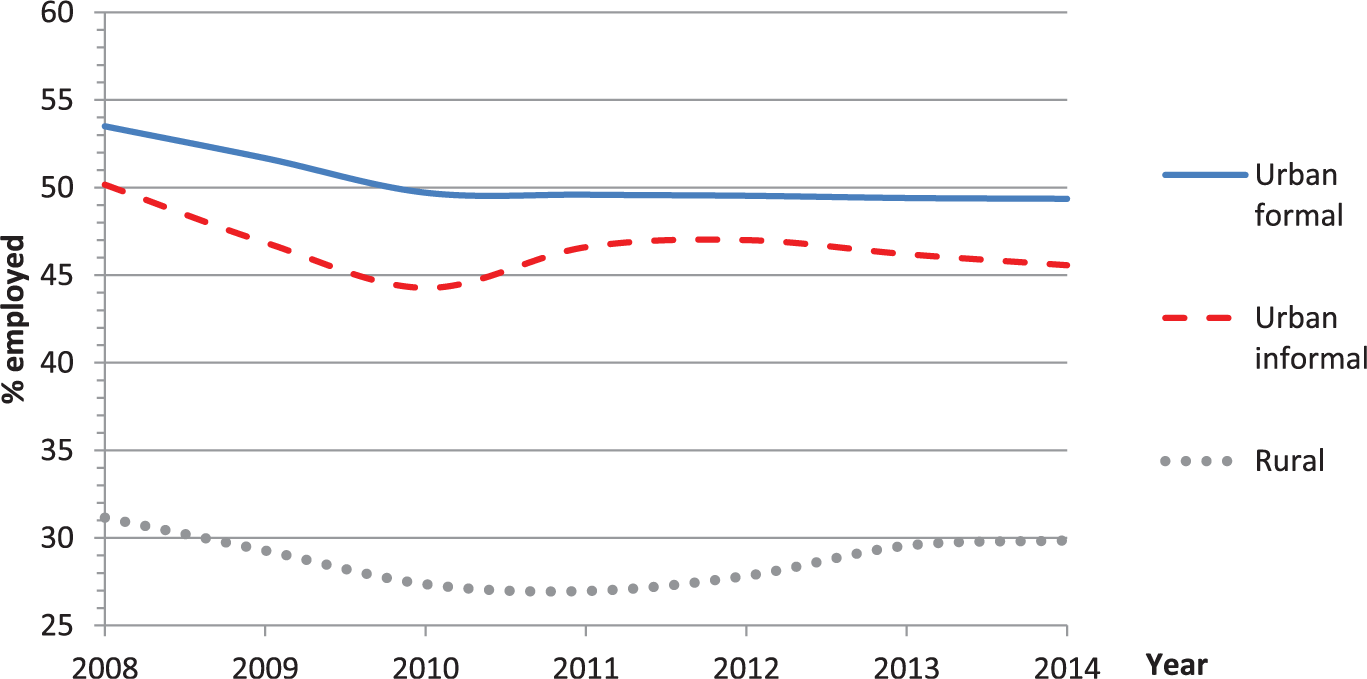
Figure 1 shows the employment rate for successive quarters over the period 2008 to 2014 for residents of the three types of area. It is a four quarter moving average in order to accommodate sampling variability. The most striking feature is the much larger gap between rural and informal urban areas than between informal and formal urban areas. The average difference between the employment rate in rural and informal urban areas is almost 18 per cent, compared with less than four per cent between informal and formal urban areas.
Employment rate by type of area, 2008–2014.
The employment rate in rural areas has been consistently very low. Less than a third of rural working age adults (28.9 per cent on average) were in work at any point in the period 2008–2014. The actual rate varied over time between 27–31 per cent. The proportion of urban shack dwellers who were in employment was nearly double that, ranging between 44–50 per cent over time. This is a very sizeable gap, providing a strong incentive for rural-urban migration. Meanwhile the proportion of adults in formal urban areas who were in work varied between 49–53 per cent.
The small gap between informal and formal urban areas indicates that shack dwellers have only slightly weaker chances of obtaining work than formal urban residents, but much better prospects than rural residents. This initial piece of the jigsaw seems to offer more support for the notion that shack areas function as pathways than dead-ends because of the apparent extent of progression. A fair proportion of shack dwellers seem to have prevailed over their tough living conditions to gain a foothold in the urban labour market. Figure 1 also shows that all three types of area suffered during the global economic downturn which hit the country between 2009 and 2010. The subsequent recovery has been very patchy.
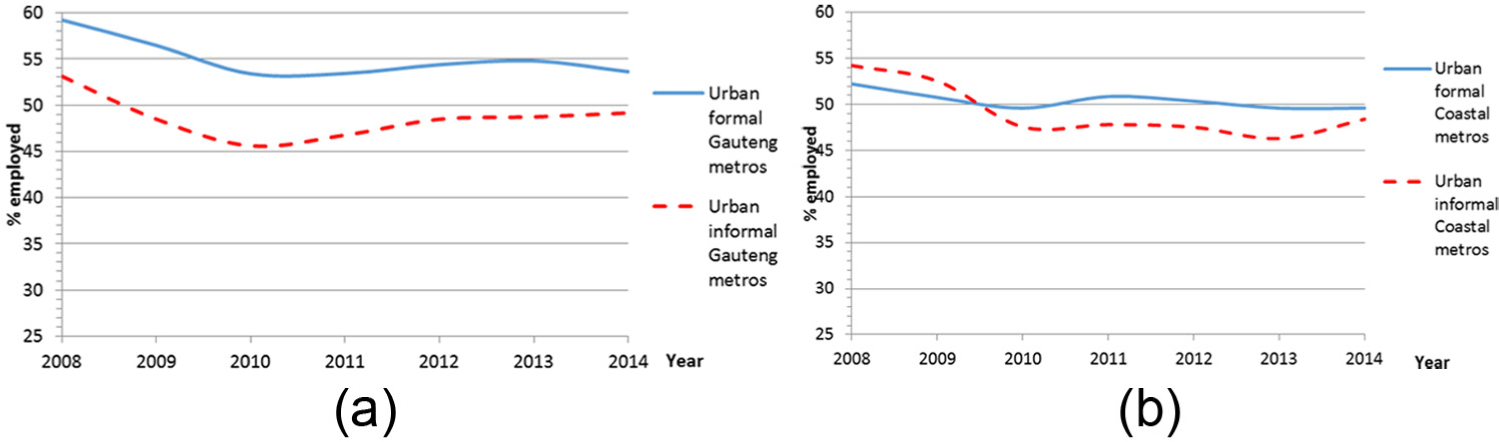
Different cities have performed unevenly during the last decade and more. Gauteng is SA’s economic heartland and its three metros (Johannesburg, Tshwane and Ekurhuleni) have experienced faster employment growth than the coastal metros of Cape Town, eThekwini and Nelson Mandela Bay. Figure 2a shows that the employment rate in Gauteng’s formal urban areas has averaged 55 per cent over the period 2008–2014 compared with 48.6 per cent in Gauteng’s informal urban areas. In contrast, Figure 2b shows that the employment rate in formal urban areas in the coastal metros has averaged 50.4 per cent compared with 49.2 per cent in the informal urban areas. These disparities suggest that informal settlements in Gauteng are not functioning as well as elsewhere, despite the stronger economy. There may be bigger obstacles to inclusion in the Gauteng labour markets, perhaps because of disproportionate in-migration flows, larger skills mismatches and/or wider spatial barriers. Further research is required to explain this puzzle.
(2a) Employment rate by type of area in Gauteng, 2008–2014. (2b) Employment rate by type of area in coastal metros, 2008–2014.
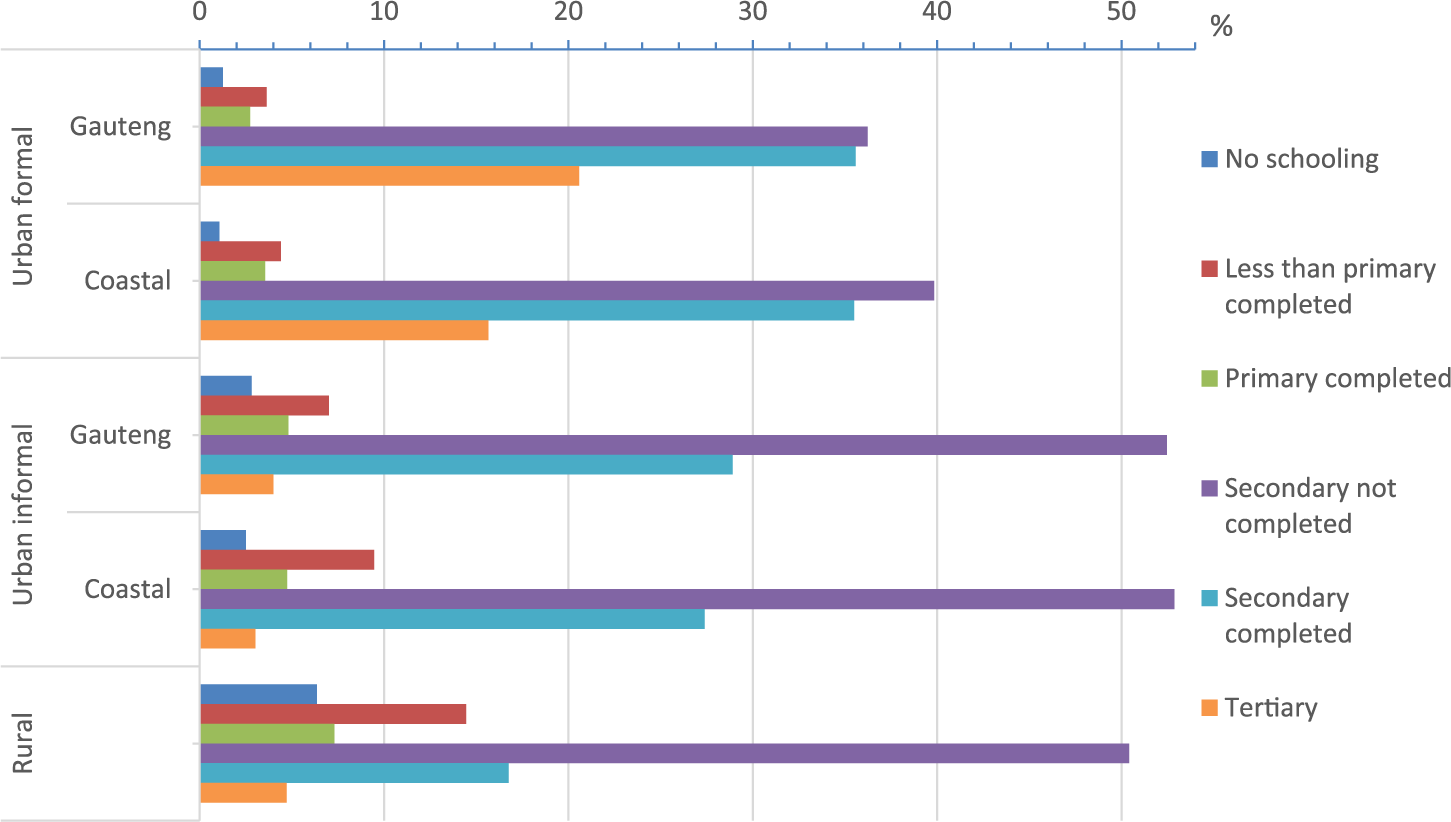
The immediate issue arising is whether differences in the personal characteristics of residents (affecting their employability) are responsible for the employment gaps between areas. Figure 3 compares the education of shack dwellers in Gauteng and the coastal metros with households in the other areas. Both theories imply that shack settlers should be far less qualified than people in formal neighbourhoods and somewhat better qualified than rural residents. Figure 3 shows the highest educational qualifications of working age adults, and reveals that residents of informal settlements are far less qualified than people in formal urban areas. Two-thirds of shack dwellers had not completed secondary education (67 per cent in Gauteng; 70 per cent in coastal metros), compared with under half of adults in formal urban areas (43 per cent in Gauteng; 49 per cent in coastal metros) and nearly four-fifths of adults in rural areas (78 per cent). In other words, the educational profile of shack dwellers is closer to rural residents than to formal urban areas, suggesting that some kind of sorting process takes place between different settlement types.
Education of working age adults by type of area, 2014.
An important implication of these data on employment and education patterns is that the relatively high employment rate of shack dwellers is achieved despite their inferior qualifications compared with formal urban residents. Their ability to secure jobs is perhaps surprising considering their worse education. This lends more backing to the pathways notion than the cul-de-sac, although evidence presented in the next section reveals that shack dwellers occupy inferior jobs compared to those of other urban residents.
A third issue concerns the age profile of different groups. The pathways proposition implies that there should be more young adults among shack dwellers than among the residents of formal urban areas because of the tendency for people to move from informal to formal areas as they get older. In fact the age differences between groups are quite small. Just over half (56 per cent) of working age adults in shack areas are aged between 25–44, compared with 49 per cent of adults in formal urban areas and 42 per cent in rural areas. This does not provide strong support for the pathway idea because the similar age profiles suggest that mobility between the shack areas and formal urban areas is restricted, and most people remain in informal settlements as they get older. The small age differentials are likely to have little bearing on the employment rate differences between the areas.
The gender profile of the three areas does not vary much either. Just over half (50.5 per cent) of adult shack settlers are men compared with 49.7 per cent of formal urban residents. The proportion of men in rural areas is slightly smaller – only 47.7 per cent. These marginal differences cannot have much effect on the differential employment rate between the three types of area.
The final characteristics issue is whether levels of economic inactivity are higher in one area than another. More students, retired people or people with illnesses, disabilities or family responsibilities could mislead the employment rate comparisons, because there would be fewer active job-seekers. The pathway idea implies lower economic inactivity rates in shack areas because people are strongly motivated to find work. The cul-de-sac notion implies the opposite because of discouragement and discontent. In fact the proportion of adults who are economically inactive is between 2–3 per cent lower in shack areas than in formal urban areas (Table 3). It is also lower in Gauteng’s informal settlements than in the coastal metros, perhaps because there are more jobs in the region. These findings lend slightly more support to the pathway theory.
Employment status of adults (%) (2014).

Source: Derived from StatsSA QLFS.
Table 3 also shows an extremely high rate of economic inactivity in rural areas at 43 per cent. The QLFS asks why people are not looking for work. The biggest difference that emerges between rural and urban areas is the proportion of discouraged work-seekers. This group amounts to 18 per cent of non-employed adults in rural areas compared with 11 and 7 per cent in informal and formal urban areas respectively. It seems that more people in the countryside have given up looking for jobs because of the dearth of opportunities. In addition, 15 per cent of adults in rural areas have family responsibilities (home-makers) compared with 10 and 12 per cent in informal and formal urban areas. The relatively small differences in the rate and composition of economic inactivity between formal and informal urban areas appear to be more consistent with the pathway notion than the cul-de-sac. Basically, shack dwellers seem to be relatively active in the labour market.
In summary, the employment rate gap between formal and informal urban settlements is surprisingly small considering the worse education and living environments of shack dwellers. There is a much bigger differential with rural employment rates. It appears that shack dwellers are actively seeking to gain access to economic opportunities in the cities, and many manage to get some kind of job. This supports the pathway idea more than the dead-end. The next section considers whether shack dwellers occupy inferior jobs compared to those of formal urban residents.
The quality of employment held by residents of different areas
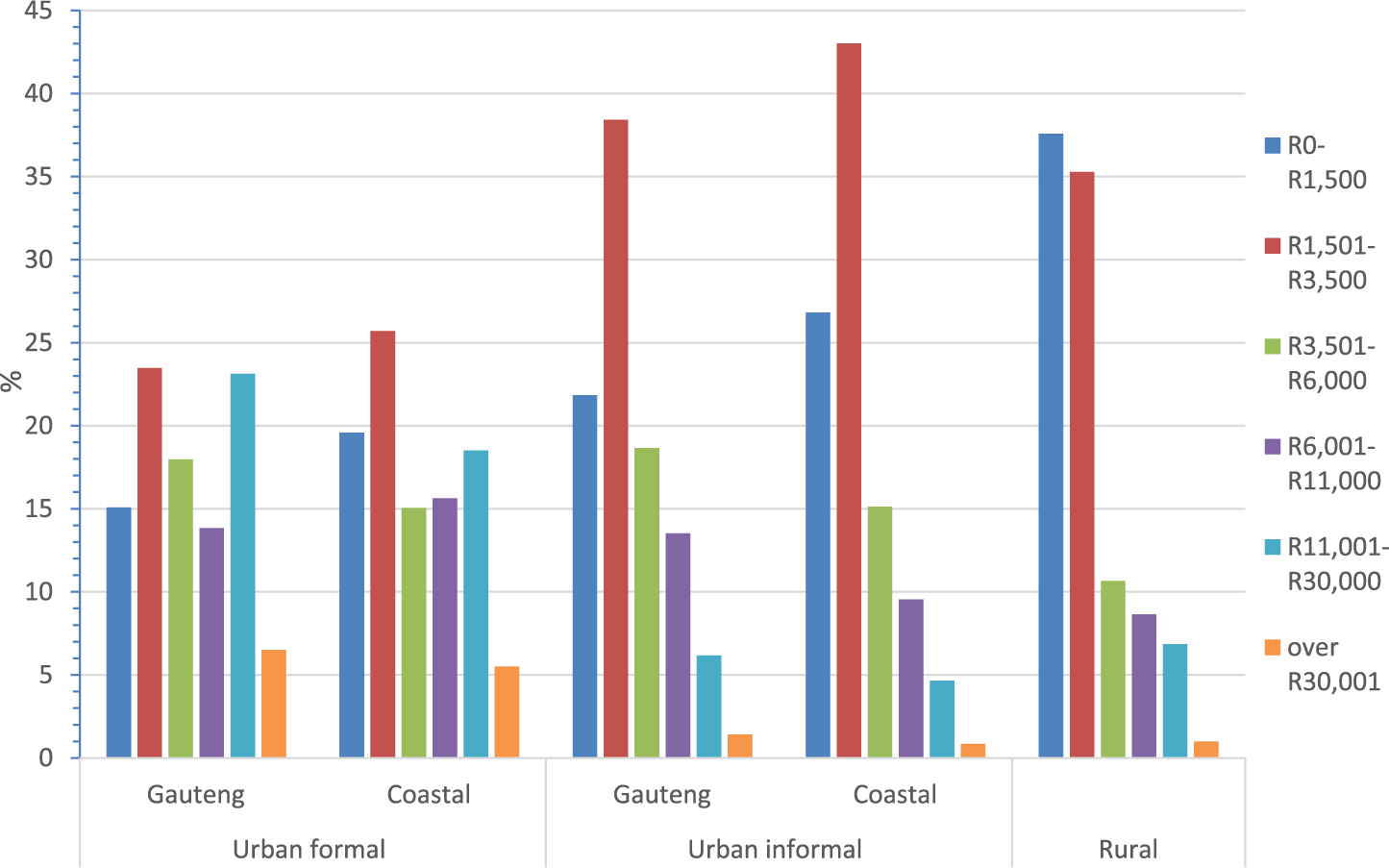
There are several ways of comparing employment quality. The discussion begins with the income earned, followed by occupation and job security. Figure 4 shows the distribution of income for employed adults in the different areas. The main finding is that there are far more low-paid workers in informal settlements than in formal urban areas: between 79–84 per cent earn less than R6000 per month (gross) (roughly US$450), compared with 56–60 per cent in formal urban areas. Conversely, there are few middle-income earners (above R11,000 per month gross (roughly US$800)) in shack areas. This is unsurprising since people who could afford to do so would normally move into formal housing. The income profile of shack dwellers is closer to rural workers, 84 per cent of whom earn less than R6000 per month. It seems that shack dwellers have slightly higher incomes on average than rural workers, although this could be offset by the higher cost of living in urban areas (Posel and Marx, 2013). Summing up, the income evidence suggests that most shack dwellers are restricted to low-paid, entry-level jobs. Those in Gauteng are slightly better off than those in the coastal metros. Overall, shack dwellers appear to have made little progress in terms of income, which is more consistent with the cul-de-sac notion than the pathway.
Monthly income profile of employed adults by type of area (%), 2014.
The second aspect of job quality is occupation. Figure 5 considers the types of position filled by workers in the different areas. The categories are drawn from the SA Standard Classification of Occupations, which is based on the required skill level. The most striking feature is that there are far more shack settlers in low-skilled occupations than residents of formal urban areas, and far fewer in highly-skilled positions. For example, 49 per cent of workers in formal areas are in senior managerial, professional, technical or clerical occupations (51 per cent in Gauteng; 47 per cent in the coastal metros), compared with only 14 per cent of shack dwellers. Conversely, 67 per cent of workers in shack areas have manual jobs, such as elementary occupations, craft, assembly work and domestic work. The equivalent proportion in formal urban areas is 36 per cent, whereas in rural areas it is 66 per cent. The other notable feature of Figure 5 is the narrower spread of occupations in shack areas than in formal urban areas, implying that shacks are more homogeneous in terms of social composition. The dominance of low-skilled workers suggests low upward mobility and is more in line with the cul-de-sac perspective.
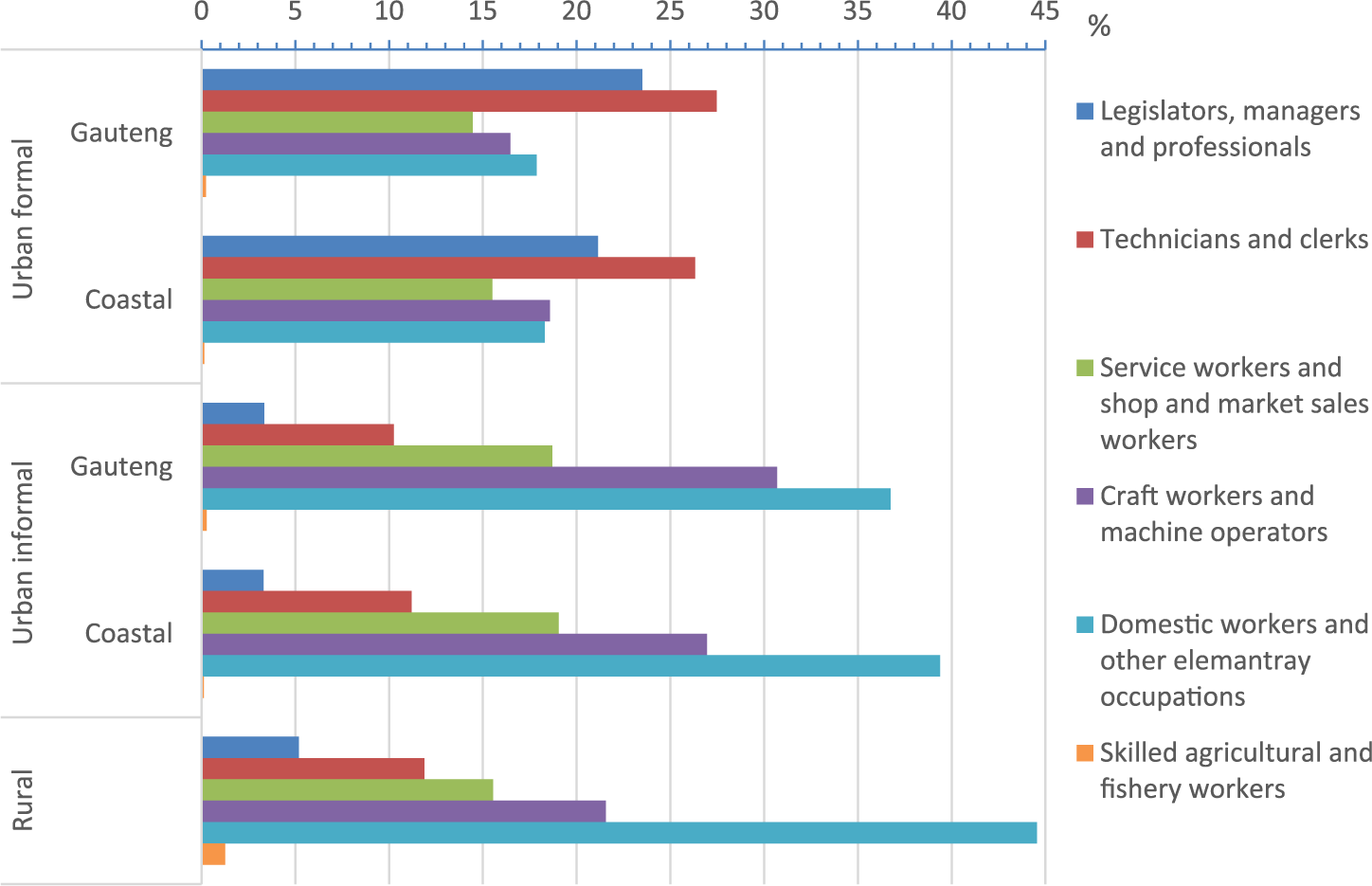
Occupational profile of employed adults by type of area, 2014.
The QLFS defines a category of informal employment specifically to highlight precarious jobs. It includes everyone working in the informal sector and people assisting unpaid in their family business. It also includes employees in the formal sector without a pension, medical aid or employment contract. Figure 6 shows that there is a difference between formal and informal urban areas. More than one in three shack dwellers are in precarious jobs (33 per cent in Gauteng; 38 per cent in the coastal metros), compared with less than one in five workers in formal areas (19 per cent in Gauteng; 18 per cent in the coastal metros). The proportion in rural areas is 42 per cent. Conversely, less than two-thirds (64 per cent) of workers in shack areas have more secure (‘formal’) employment, compared with three-quarters (76 per cent) in formal urban areas. Shack dwellers are less secure than formal urban residents, although the difference is not very large.

Formal/informal employment status by type of area, 2014.
The final distinguishing feature is the length of workers’ employment contracts. The QLFS identifies the proportion of jobs that are permanent, temporary or unspecified. The differences between formal and informal urban areas are sizeable. Nearly two-thirds (61 per cent) of jobs held by formal urban residents are permanent, compared with only 39 per cent of those held by shack dwellers. Conversely, only one in four jobs (26 per cent) in formal urban areas are of limited or unspecified duration, compared with nearly half of all jobs (47 per cent) held by shack settlers. The remainder are unknown. The proportion of jobs in rural areas that are temporary or unspecified is 43 per cent.
Summing up, there appear to be important differences between the quality of the jobs held by people in informal and formal urban areas. There are fewer shack dwellers in well-paid, skilled occupations, and more in low-paid, insecure positions. Taken together, the evidence on the quality of employment seems more compatible with the cul-de-sac proposition in that people appear restricted to inferior jobs. This function of informal settlements could chime with a broader shift that has been occurring at the bottom end of the labour market towards more casual and informal forms of employment in many service industries, the proliferation of labour brokers and contractors and the growth of low-value-added activities such as recycling scrap metal, cardboard and other waste products (Hunter and Posel, 2012).
Concluding remarks
In the absence of systematic research into the impact of informal settlements on people’s economic prospects, all kinds of arguments and opinions coincide, often with deleterious policy consequences. Within the body of previous research and commentary, two quite contradictory perspectives co-exist. One suggests that slums help to lift households out of rural poverty and onto a path to prosperity through affordable access to urban opportunities. Another holds that the debilitating conditions confine residents to enduring hardship and insecurity. Measuring the impact on household trajectories is difficult because of people’s complex movement patterns and the multiple, interacting factors and forces involved. The appropriate timescale by which to assess progress is also uncertain and open to debate. It is hard to obtain direct evidence of the processes at work and their magnitude. Using cross-sectional data enables an overall assessment of the economic outcomes, although interpreting what lies behind them is not straightforward.
The article is a preliminary attempt to assess the relative significance of informal settlements as pathways or cul-de-sacs. SA is an important case because shack areas have grown in response to large rural-urban inequalities and may play a part in narrowing social and economic disparities. The sheer physical pressure on many informal settlements suggests that they are endowed with resources and that there are opportunities available to people living there, but also that there is considerable scarcity and rivalry. Government policies are ambivalent, seemingly torn between eviction/relocation/redevelopment, benign neglect and incremental upgrading.
The findings of the article are necessarily suggestive. There is consistent evidence provided that households are better off in informal urban areas than in rural areas, but worse off than in formal urban areas. Shack settlements appear therefore to offer a step up for former rural households, but conditions are clearly inferior to those in formal urban areas. It seems that a fair proportion of shack dwellers are able to access the opportunities available in urban labour markets. However, most are limited to lower-paid, manual, casual and precarious jobs. The contrasting circumstances of shack dwellers and formal urban residents are likely to be among the reasons for community frustration and unrest.
Further research is needed to examine the relationship between informal settlements and household trajectories more directly, including how these place-people interactions vary in different contexts. Access to longitudinal data is necessary to verify current findings and to be more precise about the extent and timescale of economic progression accompanying migration between rural, informal urban and formal urban areas. There are outstanding questions about the different ways in which shack settlements foster or frustrate the transition out of poverty for rural households, and whether progress is sustained through further increases in human capabilities and incomes. It may be that SA’s anaemic economy, highly segmented labour market and inferior schools and other public facilities in and around informal settlements hamper upward mobility and leave most people in vulnerable positions. The additional possibility of substantial flows of circular and return migration in these circumstances also needs careful investigation (Posel and Marx, 2013).
Longitudinal data should help to understand how the processes of socio-spatial mobility are influenced by the characteristics of different settlements and labour markets, and by different government policies. More disaggregated analyses by particular cities, types of settlement and social groups would permit more subtle and sophisticated distinctions to be drawn. Gauteng’s stronger economy seems beneficial for shack dwellers in some respects, but sizeable obstacles to inclusion also exist. The significance of different aspects of informal settlements should be explored: is it the form of shelter, location, quality of public services or insecure tenure that most undermine progress? An additional avenue for further research would be to combine longitudinal data on households with time-series data on settlement characteristics in order to examine the interacting dynamics of change affecting people and places. Developing ways of estimating the absorptive capacities of informal settlements and cities would be particularly useful for policy purposes. This is the rate of local population growth beyond which the costs of congestion, infrastructure bottlenecks and settlement overcrowding outweigh the economic benefits and ability of government systems to manage growth in a way that can be sustained.
Footnotes
Funding
This research was funded by the National Research Foundation and the University of Cape Town.