



Abstract
This research investigated the uneven geography of gentrification and the derived community-based conflicts in Taipei’s urban renewal after 2006, which has chiefly been boosted by transferable development rights (TDR). In this context, we argue that TDR has developed a monetary function, and we introduce the notion of strategic monopoly rent to reconceptualise TDR. Accordingly, we propose an institutionalised rent gap model from the perspective of investigating the institutional increase and social dispossession of the rent gap, which have been boosted by the financialised TDR and strategically structured by the state and developers under the regulation of property rights exchange. This system appreciates the potential ground rent and depreciates the building value institutionally – a practice not related to the actual occurrence of its physical deterioration. Landowners are either encouraged or coerced to participate in the distribution of the enlarged rent gap. Two forms of the social dispossession of ground rent have occurred, including the dispossession of the landowners as a whole by the developer and the dispossession of one landowner by another. We argue that the gentrification system has produced the mal-effects of surging housing prices, enclosure, dispossession, displacement and social antagonism.
Introduction: Virtual estate, real property
The practice of floor area ratio (FAR, also known as the plot ratio or building bulk ratio) and transferable development rights (TDR) has a long history in many countries including Japan, South Korea, Spain, the Netherlands and the USA (Janssen-Jansen et al., 2008; Pruetz and Standridge, 2009). In the US context, for example, TDR is mainly adopted to protect places that should be preserved (such as natural pinelands and architectural merits) by relocating their development potential to places in need of growth. Currently, the scope of TDR application is continuing to expand, especially in developing countries such as Brazil, India and Taiwan, for the purposes of land management, transportation financing and built-environment coordination (Macedo, 2008; Mathur, 2015; Shih and Chang, 2016). In addition, urban experts and financial consultants from the World Bank have proposed treating TDR as a common instrument for financing urban infrastructure and affordable housing, together with other planning portfolios such as tax increment financing 1 and land banks (Andrews and Childress, 2015; Hasselt and Robinett, 2010; Smolka, 2013; White and Kotval, 2013).
Extant literature mainly conceptualises TDR as a ‘market-oriented nonfinancial compensation device’ (Janssen-Jansen et al., 2008: 2). This perspective emphasises the importance of TDR as the ‘incentive structure for spatial development’, especially that ‘the government does not compensate landowners by paying them an amount of money but by granting them a right that is worth a certain sum’ (Janssen-Jansen et al., 2008: 3). Some planning scholars have warned that such instruments should not be overused without considering specificity; otherwise, they could become ‘tax toys’, resulting in negative outcomes (Renard, 2007; Van der Veen et al., 2010: 1016). Although planning scholars have noted the phenomena of TDR being treated as a currency (Renard, 2008: 206), because of the limitation of their conceptual frameworks in providing causal explanations, 2 they have not attempted to further explore how and why TDR has been transformed into a quasi-currency.
Arguably, as an instrument that was initially designed to control growth, the possible tendency of TDR being transformed from non-financial compensation to a means for refinancing could be viewed as being embedded in a broader process of financialisation, perceived from the underpinning definition of ‘land is treated as a pure financial asset’ (Harvey, 1982: 347). Can transforming TDR be understood as a form and process of land financialisation rather than just a non-financial compensation or incentive device? To date, scholars have not explored the transforming TDR practices from the perspective of financialisation. However, despite the growing interest in exploring the process of financialisation in relation to urban redevelopment (Guironnet et al., 2016; Rutland, 2010; Weber, 2010), few studies have investigated the role of TDR and its enabling power. The present study contributes to this field by critically examining Taipei’s urban renewal between 2006 and 2014.
For the last decade, the central and local governments in Taiwan have been creating a new system of TDR as leverage to facilitate urban redevelopment. In contrast to the traditional large-scale urban renewal adopted in the city’s older districts, since 2006, new instruments of urban renewal based on the TDR ‘bonus’ and ‘property rights exchange’ have been introduced on a citywide level (Lin, 2008). It is under this new institutional arrangement that the authorities and private developers have sought to reprogram landowners, instilling the idea that landowners should treat their properties as purely financial assets to achieve their highest and most efficient use. Between 1998 and 2013, more than 700 projects proposed their urban renewal business summaries to the Taipei City Government, among which 179 sites proposed urban renewal implementation plans and passed their evaluations (Figure 1). In total, these 179 sites cover 50.61 ha of public and private lands, on which 8147 original households were displaced and 20,550 new housing units were created (Taipei City Urban Regeneration Office, 2014). Their locations are widely dispersed, and their units in terms of absolute space are relatively much smaller (on average, 2827.37 m2) than those in other countries (Figure 2).
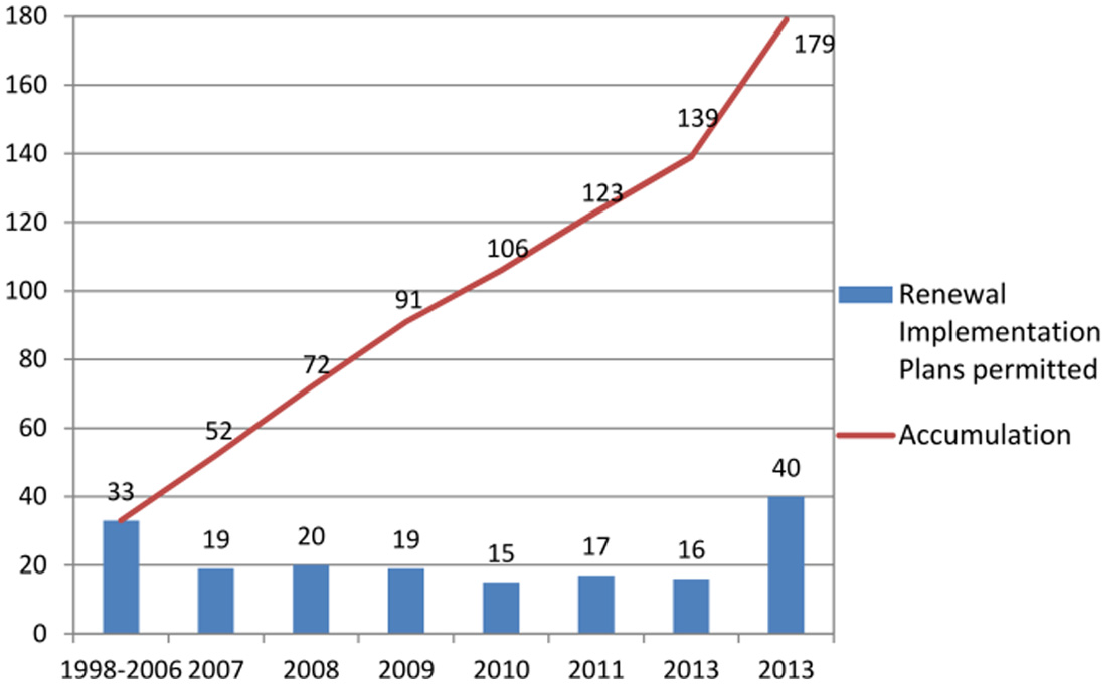
Permitted numbers of urban renewal implementation plans before 2013.
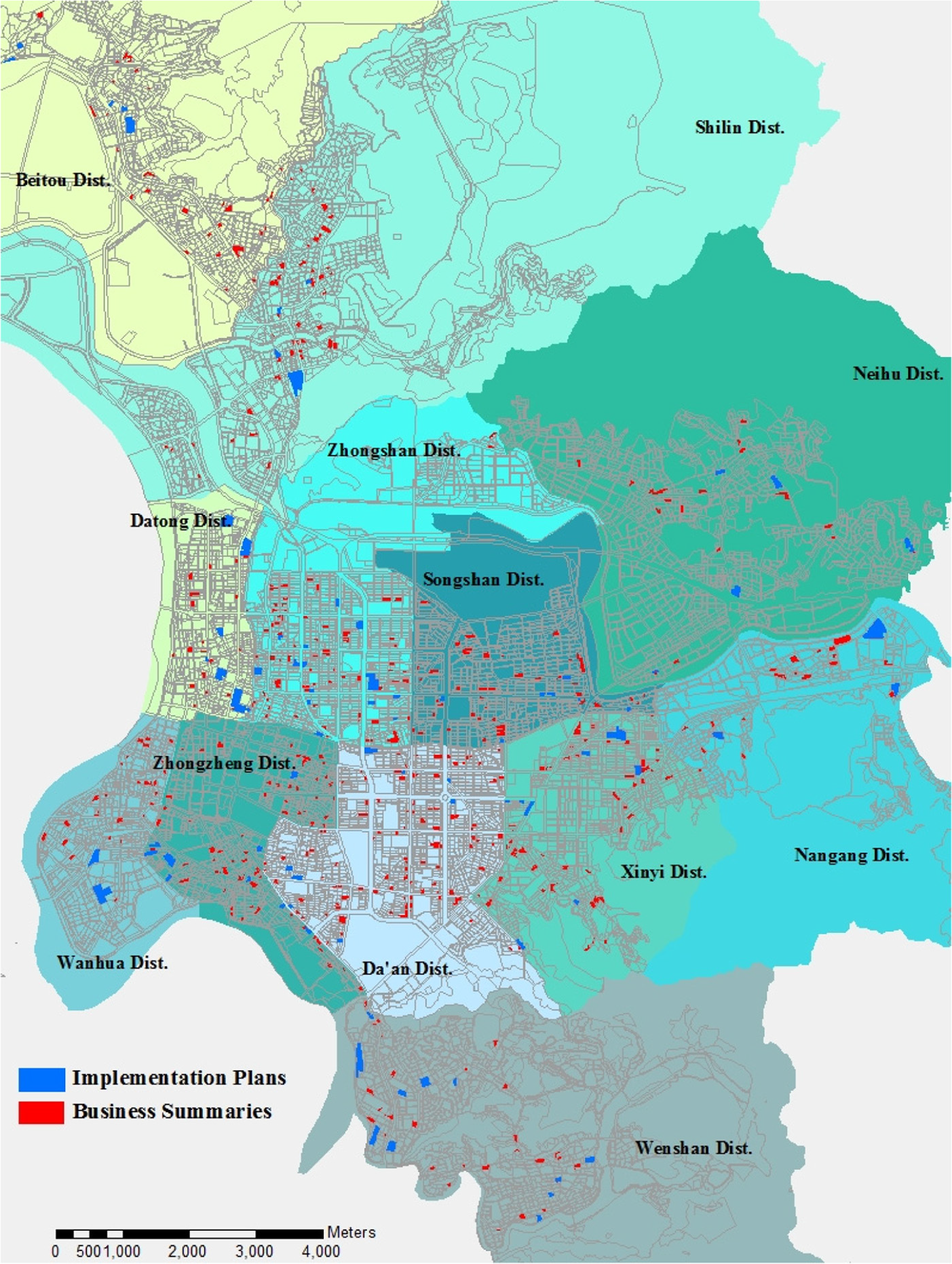
Geographic pattern of urban renewal implementation plans and business summaries before 2013.
On average, one in every 30 households in Taipei has experienced or been confronted with deliberations and difficulties associated with urban renewal. This provides a general context for us to understand the trend of isolated attempts to resist renewal projects between 2006 and 2016, of which the confrontation surrounding the Wenlin Yuan project is best known for its scale of mass mobilisation (Figure 3). This confrontation has caused massive debates in Taiwan. Some people have argued that these few protesting households were seeking their personal interests so as to obstruct the interests of the public and most landlords, and others have even alleged that the legal system in Taiwan has over-protected these few protesters’ property rights. However, other specialists have criticised the urban renewal regime, and have even raised the arguments to the level of constitutional debates over property rights, the public interest and due process.

Depiction of the Wenlin Yuan renewal project and photographs of the resistance.
This article explores the following research questions: How and why has the transforming FAR governance been reconstructed and strategically incorporated as an essential part of Taipei’s urban renewal? How has TDR coevolved historically with the urban renewal system and aligned with financial strategies to activate widespread property-led redevelopment after 2006? How has the renewal system operated institutionally to achieve excessive profits and cooperate with or coerce landowners to treat their houses as purely financial assets? What impacts has this renewal system had on Taipei’s gentrification pattern and social relations?
To address these questions, we revisit the theoretical perspectives of fictitious capital, class-monopoly rent, and rent gap, and argue that TDR should be understood as a type of fictitious capital and class-monopoly rent in Taipei’s case. We introduce the notions of ‘TDR land’ and ‘strategic monopoly rent’ to conceptualise TDR in this context. Accordingly, we propose the concept of an ‘institutionalised rent gap’ in explaining the essential mechanisms and conflictions in Taipei’s urban renewal.
Financialising space through TDR: Fictitious capital, class-monopoly rent
Financialisation is a contested concept that is broadly defined as ‘the increasing dominance of financial actors, markets, practices, measurements and narratives, at various scales, resulting in a structural transformation of economies, firms, states and households’ (Aalbers, 2015: 214). The present study adopted the increasing tendency of landowners to treat the land as a purely financial asset as the underpinning definition of financialisation (Haila, 1988; Harvey, 1982: 347). Harvey argued that circulation of interest-bearing capital through land markets coordinates the use of land regarding surplus value production in much the same manner as it facilitates coordinating allocations of labour power and equalising the rate of profits across different production lines in general. Once the land has been treated as a purely financial asset, it becomes a form of fictitious capital open to all investors, similar to stocks and government bonds (Harvey, 1982: 347). We take the land being treated as a purely financial asset as a tendency; it, too, must address those countervailing tendencies, the contingency, and interaction between the structure and agency, to enable an adequately understanding of the ‘actually-existing financialization’ (Aalbers, 2015: 218).
Accordingly, the present research suggests the notion of TDR land to describe the land subject to development rights’ ‘moving out’ transfer under state intervention. In addition, a research agenda of TDR is proposed in terms of fictitious capital, which contingently involves the monetary function in various degrees. There are certain rationales behind our conception of TDR with the perspective of financialisation. An increasing tendency is evident that in addition to the real estate receiving TDR in ‘hotspot’ development areas being treated as purely financial assets, TDR lands are treated as purely financial assets open to capital investment, as observed in Taiwan. TDR could become alienated from a means of transfer payment in city planning and could evolve into an independent category of fictitious capital. Moreover, it could bring new financial instruments into practice in land development (e.g. bank loans, trusts, securitisation, and the government’s ‘FAR banking’). In a radical scenario, the transferable ‘development rights’ might be transformed into the ‘real rights’ through reorganisation of the property rights framework, opening landowners to all forms of manipulation in the financial market, such as mortgages and securitisation.
In approaching the financialisation of TDR, this study stresses financial and institutional manipulation by agencies (such as speculator-developers, speculator-landowners, financial institutions, governments, professionals and market devices) and their contingent interplays with the broader structural configuration, which results in a variegated geographical effect, capital switching and social change. Our approach critically incorporates Harvey’s theoretical framework of class-monopoly rent, 3 which describes any situation in which the rate of return to a class of providers of an urban resource (such as housing) is set by the outcome of conflict with a class of consumers of that resource (Harvey, 1974: 239). The concept of class-monopoly power highlights a subjective class 4 of resource providers who hold power over another class of consumers in a situation of structured scarcity, and resource providers are willing to release those urban resource units, such as land, only if they receive a positive return above some arbitrary level. The point is neither natural scarcity of land supply nor inherent monopoly associated with the legal status of ownership, but man-made scarcity that guarantees a rate of return (Harvey, 1974, 1985: 63–67).
In this framework, Harvey argued that, under urbanisation, subjective class-consciousness appears to have become fragmented. In such a context, the relational class power could be characterised by the present subclass with internal differentiation to achieve various possible combinations, such as ‘speculator–developer’ and ‘speculator–landlord’ (Harvey, 1974: 243–246, 251, 1985: 86). In addition, space, whether absolute, social or relational, matters. Assisted by factors of ethnicity, sociocultural status and neighbourhood solidarity, the structure of absolute space contributes to the formation of a class-monopoly rent in those submarkets, a series of ‘man-made islands’ on which class power produces artificial scarcity. Another locus of class-monopoly rent is financial–institutional engagement, especially that which exists in a hierarchical structure of financial institutions operating through governmental regulations and allowing the multiplier effect of monopoly rent to occur between different submarkets (Harvey, 1974: 244, 1985: 81).
To highlight the state’s intervention, we introduce the notion of strategic monopoly rent to more clearly contextualise and conceptualise TDR as a specific form of class-monopoly rent. First, the formation of this rent is strategic in that it needs institutional and active interventions on the part of the state and the local governments’ respective strategic needs. Second, the institutional intervention is time–space contingent, subject to structural constraints, conjectural opportunities, and the strategic calculation 5 of state officials. Moreover, given this path dependence, institutional embeddedness is structurally inscribed with the strategic selectivities that may privilege some social forces, strategies and spatiotemporal horizons over others (Jessop, 2008: 236). Accordingly, individual or collective actors in the private sector might consider this differential privileging. This study stresses the strategic selectivity of the institutional regime in Taiwan in shaping the TDR spatial structure as well as the aligning of the subgroup’s interests to consider this differential privileging.
The formation of TDR first requires state intervention based on its monopoly power to control and allocate the intensity of land development through spatial planning. As a strategic monopoly rent, TDR is subject to institutional manipulation under a certain strategic context and conjuncture, with the capacity of articulating different submarkets and creating a multiplier effect, even with the capacity of disturbing existing submarkets in the municipal area. Therefore, as suggested by class-monopoly rent theory, the urbanisation and extraction of class-monopoly rent boosted by strategic TDR could contribute to shaping new residential differentiation and new forms of community-based conflict (Harvey, 1974: 251–252).
The realisation of class-monopoly rent remains a significant institutional practice structuring urban landscapes today; however, the modalities through which it operates and the social relations and agents involved are constantly evolving under contemporary financialisation (Anderson, 2014; Wyly et al., 2009). To date, only a few scholars have claimed and demonstrated that the shaping and enclosure of the rent gap 6 in gentrification is the ‘epitome of class-monopoly control of rent’, for instance, through ‘institutional redlining’ (López-Morales, 2011: 338). The classic rent gap thesis, which highlights the capital depreciation in the inner city and the manner in which ‘this depreciation produces the possibility of profitable reinvestment’ (Smith, 1979: 12), has focused less on how the potential ground rent (PGR) can be shaped or manipulated to enlarge the rent gap institutionally (Bourassa, 1993; Hammel, 1999; Smith, 1979). Extant accounts have mainly treated the PGR and land’s highest and best use exogenously, depending on locational factors at the metropolitan scale (Clark, 1988; Hammel, 1999). Moreover, it is the PGR, not the capitalised ground rent (CGR), that some neoclassical land economists have argued is the main reason why gentrification occurs (e.g. Bourassa, 1993).
López-Morales (2011) elaborated on the mechanism of increasing the PGR through the liberalisation of local building regulations, as well as that of decreasing the building value through the deliberate underperformance of the housing upgrading programme in Santiago de Chile’s large-scale urban renewal. He argued an unequal capitalisation of ground rent between current owner-occupiers and large developers, which is viewed as a type of social dispossession and a necessary condition for gentrification. He also called for refocusing on more ‘participatory forms’ of the rent gap’s distribution in urban renewal. Echoing this critical approach, we propose an institutionalised rent gap concept that explicitly integrates the institutionalised appreciation of the PGR along with the depreciation of building value in Taipei’s context. It also comprises a seemingly participatory pattern of appreciation and distribution of the ground rent, operated as a mechanism of social dispossession, as the study will reveal.
On the basis of this theoretical discussion, we build up our analytical framework of strategic monopoly rent and the institutionalised rent gap to explain Taipei’s TDR-boosted gentrification and social conflict. As this research corroborates, Taipei’s urban renewal has adopted the instruments of monetarised TDR transfer and TDR bonus to raise the PGR and intentionally create excess profits. This value appreciation through TDR essentially embodies the financial manipulation of class-monopoly rent, and it is through the institutionalised rent gap in urban redevelopment that the class-monopoly rent is realised. We demonstrate the institutional increase and patterns of ground rent’s dispossession, and the manner in which they involved the rearrangement of various property rights frameworks and community-based conflicts.
Regarding the research methodology, we collected secondary data from academic papers, documents of state regulations and policies, officials’ statements, property rights exchange schemes for government-approved renewal projects, real estate statistics, news reports and official publications. We also analysed the texts of legal verdicts, constitutional interpretations, unpublished transcripts of consultation records and ethnographic memoirs of key participants in the social movement. In addition, we conducted first-hand participatory observation and in-depth interviews from February 2012 to December 2015. We identified ourselves as senior researchers in urban renewal policies and we have been involved in previous urban movements for years; hence, we have built social relations with many actors related to the confrontation. A total of 33 interviews were conducted, including those of experienced urban renewal practitioners, public officials, scholars of urban planning, the Wangs from the Wenlin Yuan case, consultants, NGO members and activists. We also carefully compared and validated the empirical data through the triangulation method to achieve credibility (Silverman, 2006).
Historical transformation of Taiwan’s FAR governance
During the 1980s, the FAR – the ratio of a building’s total floor area to the size of the land upon which it is built – was introduced as a means of managing urban growth in Taiwan. It was supported by zoning and other planning tools to form a capacity control system. To spearhead this initiative, on 25 April 1983, the Taipei City Government announced its Land Zoning Policy and became the first city in Taiwan to implement FAR controls. In 1993, Taipei City Government enhanced its total capacity control through FAR regulation. By June 1999, every county and city in Taiwan had adopted FAR controls and set standard FAR caps on urban planning areas (Chang, 2007: 24–25; Hsieh and Juang, 2009: 24). FAR has since been playing an even more crucial role in Taiwan’s city planning.
In the late 1980s, urban land prices in Taiwan exhibited strong growth. The Kuomintang (KMT) regime’s land tax reform in 1992 failed to resolve the land speculation problem (Lee, 2012: 99–122). Consequently, the authorities placed themselves in a situation where they could no longer afford to acquire private lands of historical merit before they were torn down, nor could they afford to acquire private lands that had previously been designated for public facilities in city planning. On the other hand, after the Taipei City Government implemented the total capacity control in 1993, the remaining FAR became scarcer and potentially more valuable. The FAR, originally used as a means of controlling urban development, was gradually treated as a part of a certain landowner’s development rights, because it was systemically allowed to be transferred and traded in the market.
Here, we provide a condensed strategic contextual analysis that emphasises the political strategy and its institutional context to examine the historical transformation of FAR governance. We highlight six historical conjunctures between 1997 and 2006 when the FAR system was transformed strategically and relationally from a growth control instrument to an incentive device for urban renewal.
Introduce TDR to address the crisis of private historical buildings (1997–1998). The government was faced with difficulties in preserving historical heritage sites over the course of urban development during the 1990s. This was when Taiwan’s planners began to draw on the experience of New York City, resulting in the Cultural Heritage Preservation Act being implemented in Taiwan in 1997, in which TDR was made conceivable for the first time (Too, 1999). In 1998, the Ministry of the Interior enacted the Floor Area Ratio Transfer Policy for Land of Historical Value. At this time, TDR was systematically treated as compensation for landowners. Those unbuilt floor areas surrendered by the owners of historical buildings could be transferred to all other construction projects anywhere within Taipei City’s administrative boundary (Chang and Lin, 2008; Lin, 2008).
Introduce privately initiated urban renewal and TDR bonus to revitalise deadlocked urban renewal (1998–1999). From the 1960s to mid-1980s, several large-scale renewal projects were introduced by the Taipei City Government. However, these bureaucrat-led projects were often criticised for lacking efficiency and failing to meet expected outcomes. Following the beginning of Taiwan’s liberalisation policy in the mid-1990s, searching for private participation in public projects has been a major element in the country’s urban renewal policy (Hsu and Hsu, 2013). The Ministry of the Interior announced the Urban Renewal Act in November 1998, according to which landowners of a particular site can initiate a renewal project application and assign the renewal unit on their own. Moreover, this legislation gave legal power to private developers to implement renewal projects directly and to become the main player, whereas the public sector withdrew its traditional role of implementation (Hsiao, 2013: 99–104). In March 1999, the Urban Renewal Floor Area Ratio Preference Enforcement Regulation was implemented to make the TDR bonus an economic incentive for the first time.
Introduce TDR to address the crisis of public facility lands’ expropriation (1999–2002). In the late 1990s, the totality of private lands planned for public facilities yet to be expropriated in Taiwan’s city planning area, especially those for road networks, amounted to over 12,000 ha, and the total cost of expropriation was NT$4.6 trillion (Hsieh and Juang, 2009: 25). Consequently, the rights of these landowners were significantly affected. In June 1999, the Ministry of the Interior spearheaded creating Regulations Governing the Transfer of Urban Floor Area Ratio, which further allowed TDR transfers for owners of lands planned for public facilities. This regulation was enforced in December 2002 on a nationwide scale. Therefore, developers could purchase public facility lands from private owners through the intermediary TDR market operated by the private sector and then donate the land to the local government in exchange for TDR (Hsieh and Juang, 2009: 24–25; Lin, 2008: 34).
Impose majority rule in urban renewal to address the 921 earthquake crisis (1999–2003). To effectively rebuild those collapsed condominiums in the disastrous earthquake in 1999, the Temporary Statute for 921 Earthquake Reconstruction adopted urban renewal as a method to endorse itself with the effectiveness of enforced majority rule and the incentive of the TDR bonus. This conjuncture gave interested groups and their political agents a pretext to push through a strengthened version of enforced majority rule articles in the Urban Renewal Act in January 2003, 7 in the name of accelerating housing reconstruction in heavily affected areas (Hsiao, 2013: 107–112).
Apply TDR at the citywide level (2004–2006). As unused FAR became scarce under the capacity control, the TDR release created wealth and made the owners of public facility lands more willing to accommodate the urban planning approach. The developers and investors, who then saw TDR transfer as a benefit, continued pressuring the Executive Yuan to expand the scope of TDR applications (Lin, 2008: 34–35). The Central Government and Taipei County (now New Taipei City) Government were keen to meet their demands, because the system had contributed to their finance and provision of public service. 8 Despite the warnings of scholars, the Taipei City Government eventually incorporated this incentive and implemented Taipei City Floor Area Ratio Transfer Criteria in September 2006, which allowed citywide TDR transfers (see Lin, 2008: 38). 9
Remove the TDR bonus cap to encourage major urban renewal players in 2006. After the article of enforced majority rule in the Urban Renewal Act was passed in 2003, large construction companies still generally had no interest in urban renewal, instead preferring to purchase land from owners in a traditional manner, keeping it for a few years before developing a realisable project. In April 2006, the Ministry of the Interior amended the Urban Renewal Floor Area Ratio Preference Enforcement Regulation to remove the cap that prohibited the total amount of allowed FAR to exceed its baseline by 1.5 times. TDR bonuses were then regularly and frequently offered to the private sector as subsidies for providing parking lots, green areas, open spaces, and so on, which gave developers an abundant source of supplementary TDR.
In summary, the TDR system has established a specific rent monopoly structure and a dynamic for self-expansion in Taiwan. The cause for releasing TDR as a form of rent is related to the aforementioned conjunctures of urban crises, amidst which TDR was proposed as a pragmatic solution. In 1998, the TDR bonus had been bundled strategically into the new institutional framework of the Urban Renewal Act, which gave private developers privileged power to implement renewal projects. In addition, those who have benefited from TDR, such as landlords, investors, dealers, builders and even local governments, along with their political agents (including the KMT, Democratic Progressive Party, and Taiwan Solidarity Union), have articulated themselves into a subjective class interest with power, seeking to expand the scope of TDR applications. In 2014, more than 13,000 private-sector employees worked in Taiwan’s specialised TDR transaction market. The spatial structure of TDR has translated itself from those TDR lands (e.g. historical buildings and infrastructure reservation lands) into the cream of downtown. The system has built up a class-monopoly rent’s multiplier effect between different submarkets: the landlords sell TDR to the brokers, the brokers sell it to the developers, and the developers realise its value through high-priced real estate.
What is more, the marketised TDR has absorbed considerable monetary capital, aiming to further realise the fictitious value. 10 Thus, the use value of TDR must be created to ensure the exchange value and embedded fictitious value of TDR. As the scope of TDR application was increased and the regulations for TDR receiving areas were liberated, it became easier to obtain a breakthrough on the capacity control of standard FAR regulations. More developers became eager to obtain more TDR. We argue that the extended application of TDR served as the foundation for the historical introduction of the TDR bonus in urban renewal. As we discuss in the following section, urban renewal developers do not need to purchase land from the renewal site’s landlords; the TDR they purchase can translate directly into the projects’ floor area, which can potentially create considerable profits. This has, in turn, promoted the effectiveness of TDR as an incentive device. After 2006, the TDR bonus for urban renewal was transformed into a highly effective policy instrument guiding real estate investment.
State-subsidised and developer-led urban renewal system in Taipei
Taipei’s urban renewal projects in the old inner city districts, where they are supposedly the most needed, had difficulty proceeding because their landownership was too fragmented to be reintegrated for the purpose. Before 2006, there was a lack of participation by private developers (especially major companies) because the rate of return was expected to be unsatisfactory. To adopt property-led regeneration, the situation could change when sufficient incentives were introduced to raise the rate of return to meet developers’ expectations.
Strategies: TDR bonus, property right exchange and eviction article
As Mayor Hau Lung-pin took office on 25 December 2006, after former Mayor Ma Ying-jeou, he sought to bring the city’s urban renewal to a higher level by increasing the TDR bonus. According to our interviews with government officials, the policy initiative was launched with a view to mainly enhance Mayor Hao’s political credit for future campaigns (i.e. to receive support from local constituents through physical construction and built-environment revitalisation). Under the strategic judgement of core KMT political aides and staff, the mayor adopted the TDR bonus as a key instrument from the portfolio provided by the planning bureau, and then assigned suitable technocrats to implement the policy. The TDR instrument was supported with simplified administrative procedures to maximise efficiency and police violence to enforce the law where necessary. All of these measures were taken with a view to shorten the urban renewal period from 7 to 3 years.
The renewal policy has also been strategically integrated into the city government’s efforts to host large-scale international events and produce mutual amplification effects. For example, to help improve the city’s image during the 2010 Taipei International Flora Exposition, the Hau administration announced a scheme called ‘Taipei Beautiful’ in March 2009, to give landowners and developers of renewal sites up to an additional 10% TDR bonus, provided that proper greening efforts were taken to improve the appearance of these future construction sites. Subsequently, in April 2010, Mayor Hau announced a project where four- or five-storey buildings at 30 years old were entitled to as much as double the standard FAR allowance. This policy gave house owners the idea that, by working with developers in urban renewal, they could exchange their old houses for new ones free of charge and even earn considerable profits.
Working closely with the TDR bonus, the institutionalisation of property rights exchange, which was introduced from Japan and then largely modified in the Urban Renewal Act in 1998, has significantly changed the bargaining relationship between developers and landowners. Developers have gained domination over the property rights exchange, especially after the majority rule article was imposed in 2003 and the forced eviction article in 2008. 11
According to the regulations, landowners of renewal units must agree to submit their houses and lands, and the developer must agree to pay for the totality of ‘commonly shared costs’ in order to cover the expenses for demolition, compensation, design, purchasing TDR, construction and management. The owners and developer should be repaid with their respective shares of the new building when the project is completed. On principle, they are distributed in proportion to what the owners and developer have contributed in the process; that is, to the rights value of each block of land or building owned by the owner before the renewal, which is to be evaluated by three appraising companies hired by the developer, and to the commonly shared costs reported by the developer.
As a model of joint development, property rights exchange has appeared to be the mainstream method for urban renewal in Taiwan because it allows developers to proceed with their projects without obtaining consent from all landowners, which is contrary to the more time-tested, traditional method of consensual construction, in which 100% agreement is necessary. Most importantly, under the method of property rights exchange, the government can enforce the approved project with the forced eviction article in the Urban Renewal Act. In other words, this joint development between landowners and developers is mandatory, although advocates of property rights exchange (e.g. Urban Regeneration R&D Foundation) have claimed that the system provides stakeholders a relatively clearer pricing method that will ensure fair exchange of interest.
However, the business potential of urban renewal has transformed the economic sector, providing a platform for a new type of developer. Some small and medium developers who participated in the 921 earthquake reconstruction programmes found that, as a method of land acquirement, urban renewal was very profitable. They favoured the idea that they no longer needed to purchase land from private owners, and that, once a loan was arranged to cover their initial construction costs, they could also charge the landowners for any interest paid to the bank by listing it as part of the commonly shared cost. In summary, the real cost was literally almost zero. Thus, since 2004, small and medium private developers with a modest capital of no more than NT$60 million have emerged.
In addition, the Deliberation Committee of Urban Planning Renewal has the power to determine the amount of the TDR bonus in an opaque review process according to the regulations. Even a small amount of TDR bonus can make a considerable profit difference for developers, yet it is uncertain how much of a TDR bonus each project can be given. 12 Developers must always bid for this monopolised TDR bonus rent. Such a structure has shaped an environment that promotes rent-seeking. Moreover, to ensure their profit margins in the face of uncertainty, developers tend to exaggerate the commonly shared cost so as to be rewarded with a greater share of building floors, an act we refer to as ‘stretching cement’. Finally, the mayor, who has the exclusive right to select the committee members, whose term of service lasts 1 year, can easily expedite the whole process by appointing those who are most likely to support his policies.
Operational modalities
Starting from 2007, Taipei’s urban renewal entered a golden age as major developers appeared on the scene. Under the institutional framework of the TDR bonus and property rights exchange, the general expectation of developers – the providers of the renewal service – is to receive a net profit of at least NT$1 billion in any project, 13 or else they will not participate in the development. We want to highlight the following four pragmatic modalities of this renewal system. They contribute to ‘absolutising’ and dividing the social space into parcels and segments of pure financial assets.
Small and self-designated renewal units dominated by developers. According to the law, any area larger than 2000 m2 in Taipei is eligible to be designated by its landlords and developer as a renewal unit to make a renewal proposal in the form of an urban renewal business summary. Developers and landowners may propose renewal projects anywhere in the city, instead of sticking to the official urban renewal areas identified by existing city plans. Provided that consent is given by one out of ten owners of a delimited unit, a proposal can be made.
Manufactured majority consent. The property rights exchange system allows an implementation plan to proceed with a selective majority of landowners representing more than two-thirds of households and three-quarters of the land. This institutional arrangement enables developers to manipulate the process by working with only a few landowners and redefining the renewal area to obtain consent. Once the plan is approved, the local government can exercise its authoritative power to demolish buildings owned by those who object. Thus, the developers can aggressively seek out the most profitable locations and dominate the land enclosure game. In other words, by selecting which boundaries to draw, the developer can manipulate the denominator to minimise the proportion of objecting households.
Flexible contract transaction and business network. Communities are often approached by multiple developers for renewal projects. It appears that the residents could strengthen their bargaining power in this way. The truth is, however, based on tacit understandings reached in the past, these developers will eventually work out a non-zero sum collaboration through flexible contraction transactions, so as to maintain their power asymmetry to the community and their profit rate.
Absence of public interest monitoring. Although the Urban Renewal Act requires at least three public hearings, both the first and the second hearings are held in private. Only the third hearing, which is held after the property rights exchange is finalised and just before a proposal is submitted for the authority’s approval, requires governmental involvement. There is also a lack of any alternative or meaningful public participation.
Financial engagements: Real estate management companies, investment trust and FAR banking
Banks benefit directly from urban renewal, which has become their major means of financing loans. They have become influential agents in urban renewal and have involved themselves even more directly by establishing real estate management companies, promoting urban renewal trusts and TDR transfer trusts. The banks established real estate management companies to which the landlords’ properties and land must be kept in trust. The bank provides the construction loan to the developer who, however, does not own the project’s land for securing the loan. The management company that keeps the land trust can monitor the project’s progress; it can immediately assume control over the whole project and outsource the building work to other construction companies if the developer fails to realise the project. When the project is complete, the bank loan must first be repaid by the developer. In some cases, once a renewal plan has been permitted by the government, the role of the developer even fades out, and the bank directly funds the construction company monitored by the real estate management company.
Banks have also established financial instruments to attract more private capital input. Money from underground finance has also been invested in urban renewal. For example, the Financial Supervisory Commission approved the securities investment trust enterprise to run urban renewal investment trusts in 2006. The Land Bank of Taiwan eagerly became involved in establishing an urban renewal trust fund, and it had collected enough founder members to issue beneficiary certificates in the capital market in 2012. The reason for establishing these financial instruments to draw additional capital into urban renewal is the hyper profits of real estate developments realised through the TDR bonus system. At that time, the TDR bonus had become a financial industrial policy, and the class-monopoly rent it created was a source for the interest-bearing capital to exploit.
In December 2008, the central government amended its urban planning regulations to grant local governments even greater power to market the FAR, as long as a certain amount of cash equivalent has been credited by the developers (Hsieh and Juang, 2009: 24–25). As a direct result of this approach, in 2013, Taichung and Kaohsiung established their new FAR banking 14 systems, followed by Taipei in July 2014. This meant that if a developer sought to get FAR-cum-TDR for a certain piece of land, this could be achieved either by donating to the government TDR lands purchased from the transfer market (e.g. public facility lands), or by providing the cash equivalent of the FAR to the government. Moreover, the Taipei City Government is heading toward a system of total monopoly, which is ‘cash for TDR only from the City Government’ after July 2017. The cash equivalent received in this manner will be used to create a special fund to finance purchasing lands assigned for public facilities or other needed urban infrastructure.
The legitimacy of FAR banking lies in public outcries that the private sector’s TDR transactions have been characterised by information opacity, that the profits have been received by only a few brokers, and, finally, that the received public facility lands do not meet the real needs of urban development (Shih and Chang, 2016). The government claims that establishing FAR banking will overcome these problems by concentrating and monopolising all possible benefits of FAR banking, so as to redirect these benefits for funding public infrastructure. In Taipei, according to the Taipei City Government, there are floor areas of approximately 592 ha to be transferred in the future. The Taipei City Government expects to capitalise on this to the amount of NT$1 trillion. 15 In this sense, the working of FAR banking characterises a municipal bond for raising capital for the city government. 16
The institutionalised rent gap
Judging from the renewal’s location pattern (Figure 1), on appearance, there was no obvious physical wear and tear of the buildings in prime locations before renewal. There is no significant depreciation concerning the property itself (Smith, 1979), despite the fact that gentrification has occurred. However, we argue that it is adequate to explain Taipei’s gentrification in terms of an adapted rent gap thesis (Figure 4), with the perspective of an institutional increase and the social dispossession of the rent gap (López-Morales, 2011). The prerequisite of this institutionalised rent gap is to meet the profit level set by the developers. In the following, we discuss four organic components of the institutionalised rent gap: the increase of the PGR, the depreciation of the building, the dispossession of the ground rent of the landowners as a whole by the developer, and the dispossession of ground rent of one landowner by another. The first element is related to TDR, whereas the other three, which are forms of social dispossession, are more related to the practices of property rights exchange – the property pricing and estimating the proportion of the contribution made by stakeholders.
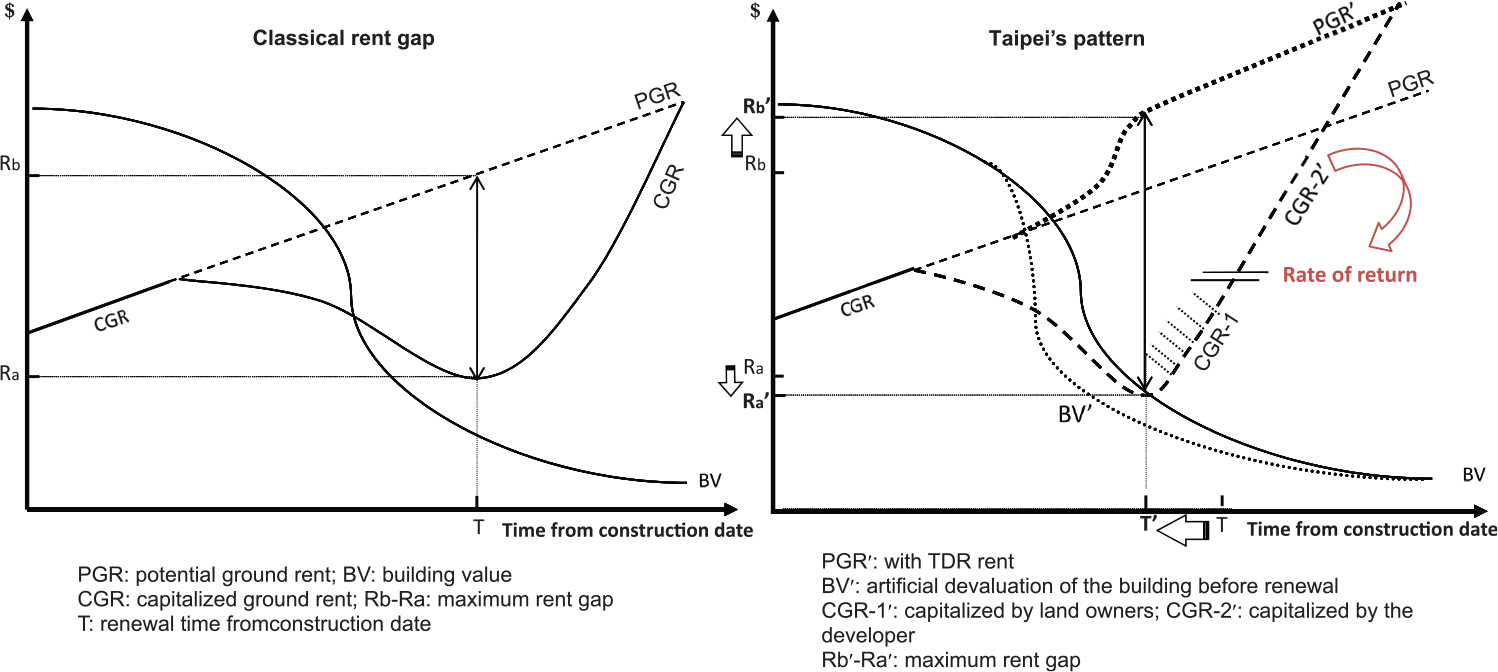
Comparing Taipei’s institutionalised rent gap with the classic pattern.
First, under the renewal’s formal regulations, the PGR of the renewal project can be explicitly increased from the distinct TDR rent through both TDR purchasing from the transaction market and TDR bonus bidding from the renewal’s reviewing commission (PGR′ in Figure 4). Second, under the formal regulations, the rights value of an individual stakeholder’s property before renewal is evaluated in terms of the empty land’s value by appraisal companies hired by the developer. Apart from the land, the building’s rights value is evaluated according to the ‘building cost’. Such a scheme virtually downplays the house-owner’s proportion of distribution in the joint development. We label this ‘man-made underestimation’ of the building’s rights value as ‘Artificial Devaluation-1’ (BV′ in Figure 4). This artificial devaluation of the building virtually lowers the ground rent that can be capitalised by the house owners.
In this regard, individual stakeholders do not want their rights value to be underestimated. The stakeholder seldom willingly and actively depreciates his or her property. Even when they do, it is not the key to triggering urban renewal. This artificial depreciation of the building value can produce a devaluation effect that is unrelated to the actual physical deterioration of the building. By contrast, in classic rent gap theory, this devaluation effect is typically accounted for by mechanisms related to physical deterioration, such as landlordism, blockbusting and blowout, redlining and abandonment (López-Morales, 2011; Smith, 1979). The renewal institution in Taipei does not in its regulations stipulate a minimum house age for the participating neighbourhood houses, which accelerates gentrification and the reduction of the average building age (T′ in Figure 4).
Third, regarding the seemingly participatory form of the rent gap’s distribution apart from the owners of houses on leased lands (i.e. only the landowners and developer are considered), the portion of commonly shared costs paid by the developer translates into a percentage of the property that the developer is rewarded with after renewal. The actual manner in which the distribution of land and buildings is handled after the renewal must be conducted in accordance with the Urban Renewal Act, which states:
After deducting the common sharing of the discounted price substitute payment of the land and buildings after the rights transformation, the remaining lands and buildings shall be allocated to the original landowners according to the rights value proportion before each piece of land rights was transformed. (Article 31)
Under such regulations, we ascertained two notorious while general malpractices:
‘Stretching cement’. The developer reports a monetary commonly shared cost higher than the actual cost, as discussed.
‘Artificial Devaluation-2’. The developer underestimates the value of all properties after renewal.
These two practices, which are not clearly implemented through the law – in contrast to the methods of TDR and building depreciation – are commonly adopted by developers to raise their proportion of contribution to the value of the property after renewal and to ensure that the net profit they expect is generated. This should be considered as a type of ground rent dispossession by the developer from the landowners as a whole (CGR-2′, CGR-1′ in Figure 4).
Finally, there is an even more subtle yet possible practice of artificial devaluation that is frequently observed, although related stakeholders tend to be reluctant to admit that it occurs. After the developer has obtained the net profits as expected (CGR-2′, with the satisfactory rate of return), to ensure that it will obtain the sufficient number of household agreements, the developer might recourse to manipulating the ground rent distribution received by the landowners. This could be achieved by influencing the appraisal companies it hired in pricing the property’s rights value before renewal (for instance, under-grading that of the ‘nail household’ or over-grading that of the active co-operator). We term it as ‘Artificial Devaluation-3’. Under the monopoly power, the appraised rights value per metre-squared of an individual stakeholder’s piece of land before renewal could be differentiated relationally and strategically. This could be considered a possible type of the social dispossession of the ground rent of one landowner by another, and it might create internal conflicts among the landowners in their competition for a more favourable share of the ground rent (i.e. within CGR-1′). ‘Artificial Devaluation-3’ enables the developer to create a condition of possibility for exercising the power to dominate the social ‘gift exchange’ in a neighbourhood that benefits the redevelopment.
The renewal project, equipped with the institutionalised rent gap, produces luxury apartments. From this, the developer and landowners receive their respective proportions of the profit according to the uneven bargaining power. Finally, the developer realises the greater proportion of the profits.
The consequences of urban renewal and the new form of social antagonism
Six main lessons can be drawn from our analysis of Taipei’s urban renewal. First, the renewal projects exhibited ‘man-made islands’ that were prioritised according to real estate potential. Unsurprisingly, developers are more interested in renewing districts that are considered prime locations. As shown in Figure 2 and Table 1, renewal projects in Taipei City mostly targeted the districts with prime locations such as Da’an, instead of deteriorated older communities such as Wanhua and Datong. The renewal unit’s geographical structure of ‘man-made islands’ also strengthens the power asymmetry between developers and communities in actual need of renewal.
Accumulated renewal unit applications, building ages, and housing prices by district in 2013.
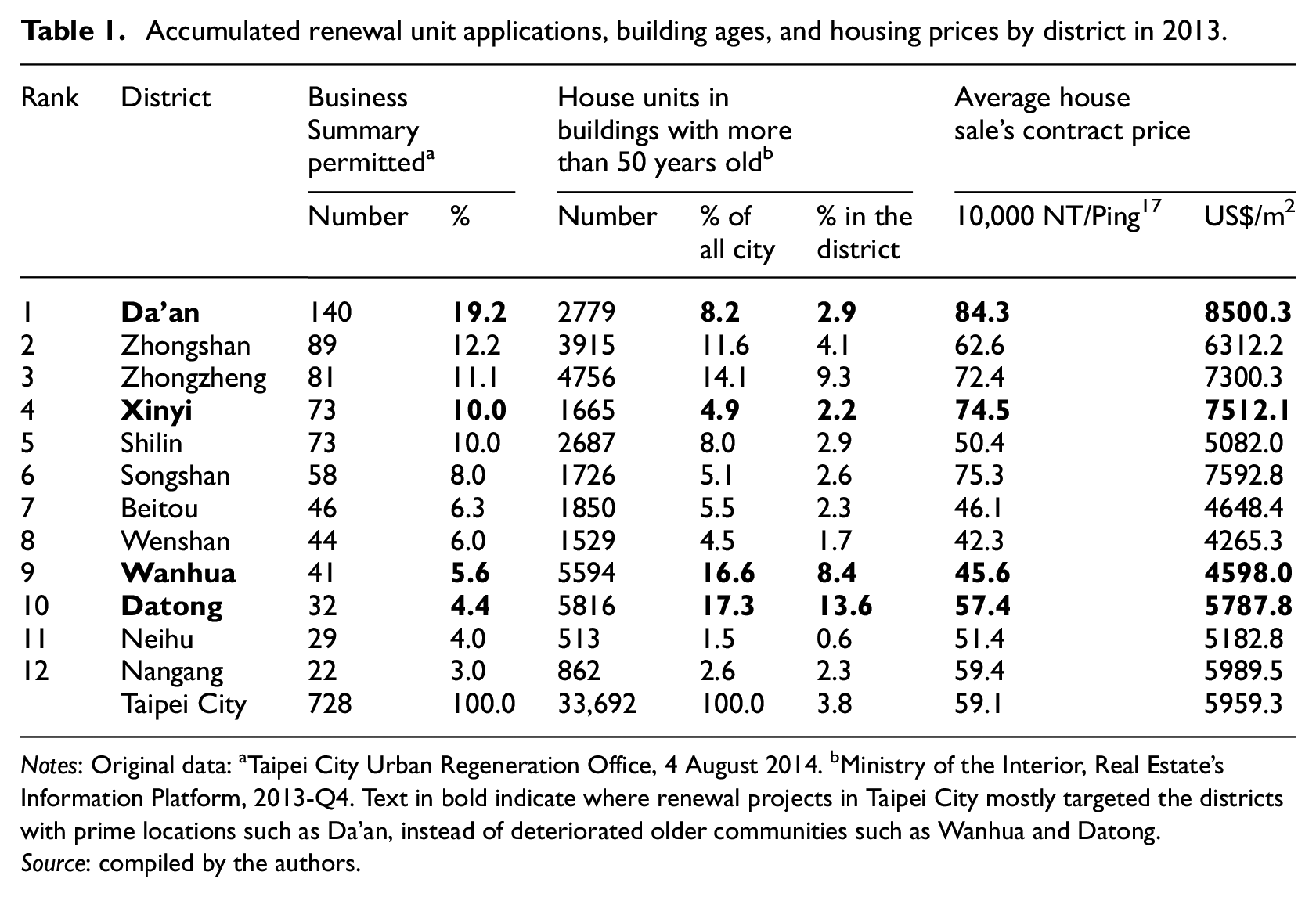
Notes: Original data: aTaipei City Urban Regeneration Office, 4 August 2014. bMinistry of the Interior, Real Estate’s Information Platform, 2013-Q4. Text in bold indicate where renewal projects in Taipei City mostly targeted the districts with prime locations such as Da’an, instead of deteriorated older communities such as Wanhua and Datong.
Source: compiled by the authors.
Second, the urban renewal contributed significantly to a deep surge in housing prices in Taipei. Since 2007, Taipei’s house prices have increased substantially from already high prices. Although the prices went through a revised growth rate during the 2008 financial crisis, the compound annual growth rate reached 10% between 2007 and 2014. From 2010-Q3 to 2011-Q1, increases of up to 40% in the average housing price were observed in Taipei. 18 This is closely related to the investment in urban renewal projects. Thus, in 2010, the National Audit Office criticised the Taipei City Government and the Executive Yuan for approving its urban renewal action plan.
Third, this renewal has driven new types of dispossession, displacement and gentrification. We discussed the three forms of social dispossession and their mechanisms in the previous sections. Regarding residents who objected to the new projects, developers provided them with only cash compensation, based on their emptied lands’ rights values before the renewal. Those whose redistributed value was insufficient to exchange for any new housing unit were also compensated with cash or were required to pay additional money to purchase the new units. Those who could not afford to pay the additional money were deprived of their settlement rights.
Therefore, despite the renewals having produced more than 20,000 new housing units, the stock of affordable housing was diminishing. The renewal projects in Taipei are mostly luxurious condominium developments with large floor areas per unit. According to our interviews, between 2007 and 2014, there was at least a 3-year period when 90% of annual new development projects in Taipei were for high-end apartments valued at over NT$50 million each. They are commonly treated by investors and developers as purely financial assets and are unaffordable for regular families.
Fourth, there has been an over-expansion of the TDR bonus. The offering of the TDR bonus soon became part of the nation’s economic policy instrument. Urban renewal was even included as one of the nation’s ten major service industries, 19 with both local and central governments allocating an overabundant amount in TDR bonuses. The Control Yuan corrected the Ministry of the Interior in November 2010 for failing to control the total FAR amount in cities under the urban renewal project. 20
Fifth, the renewal has activated the privatisation of public lands. Public lands in the renewal units were obligated to be incorporated into the property rights exchange programme, reimbursed by acquiring a part of the houses built by the developer with the remaining lands (Hsiao, 2013: 114). This would be identical to selling part of these lands (e.g. 50%) to developers (in exchange for a new house), which would have reduced the public land from the outset. For the authorities who do not want to be reimbursed according to the corresponding proportion of the house, they can always sell the public land to the developer. Smaller pieces of public land are often purchased directly by developers. Thus, the developers have easier access to scarce urban land than it would be to acquire private land.
Finally, the renewal has led to land enclosures, forced evictions and considerable social antagonism. The land enclosure and consensus manipulation permitted by the institutions gave the developers more bargaining power over the residents. The urban renewal has given rise to a substantial number of disputes. What these cases have in common is that, once the developers had completed the necessary proportion of the agreement, it was almost impossible for the residents enclosed in the renewal project to object, withdraw or exempt themselves from the renewal, even if they had objected in the first place. These ‘artificial minority’ nail households who objected to the urban renewal were set up by the system and easily slandered as the greedy few. In response, they organised themselves, seeking advice from radical urban planners, and formed support groups such as the Alliance for Victims of Urban Renewal in 2009.
The explosive Wenlin Yuan 21 conflict in 2012 disclosed the structural contradiction intrinsic to Taipei’s urban renewal. This project embodied many characteristics of Taipei’s urban renewal: it was not a deteriorated community, it received a TDR bonus, it was involved in mandatory joint development, public land was sold off, and it adopted the practices of Artificial Devaluation-2 and stretching cement. 22 The Wangs had refused to participate in the project since 2006, when they had just spent NT$2 million on renovating one of the two ancestral terrace houses that were enclosed. However, the developer refused the Wangs’ continuing demand to exempt them from the project. The government officials reiterated the ‘rule by law’ position by citing court decisions against the Wangs (Wang, 2015: 62). After succeeding in collecting sufficient consensus agreements, the developer asked the government to implement the forced eviction (Figure 3).
The Wenlin Yuan conflict revealed that the renewal’s institutional and strategic operation caused further antagonism among the residents and complicated the community politics. For example, a certain Wenlin Yuan support group, who claimed to represent a group of 36 households consenting to the project and arguably had support from the developer, was organised to stand against the Wangs, who were stigmatised as troublemakers sabotaging the community. This community-based conflict showed how developers had been coercing and enticing residents into depriving the rights of those who do not want to participate. The growth in urban renewal projects is what has caused such social conflicts in Taipei, and many communities have been torn as a result.
Conclusion: Theorising TDR
The findings of this research contribute to debates on contextualising and theorising gentrification in the Global East through the lens of class-monopoly rent (Jou et al., 2016; Shin, 2016; Shin and Kim, 2016; Shin et al., 2016; Wu, 2016). We argue that it is difficult to explain Taipei’s urban renewal without an adequate reconceptualisation of TDR and of gentrification, as well as a connection with multiple urban historical processes (Shin et al., 2016; Smith, 2002). First, we theorise that TDR is an instrument of financial manipulation, managed as a form of fictitious capital and class-monopoly rent, which we conceptualise as strategic monopoly rent. We argue that this alternative conceptualisation has not been properly theorised in the extant research. We demonstrate that the urban (re)development regime in Taiwan actively transformed TDR from a type of non-financial compensation into a tradable financial asset, open to the investment of interest-bearing capital. The regime mobilised its monopolistic power to strategically shape the TDR monopoly rent, which is based on the man-made scarcity in urban planning as well as on the adaptive spatial structure of TDR.
Second, we reconceptualise the overt gentrification system of an institutionalized rent gap. This system is boosted by the financialised strategic TDR with the purpose of meeting the profit levels set by developers. As we carefully analysed, this institutionalised rent gap appreciates the PGR and devalues the building value institutionally without any physical deterioration actually occurring under the regulation of property rights exchange. Based on the flexible enlargement of the rent gap, the regime creates the strategic spatial units that characterise the man-made islands, in which the developer exerts its monopolistic power to dominate the land enclosure, majority consent manufacturing, and asymmetric range of choice for gentrification. Ironically, this gentrification system has produced social dispossession and antagonism within the seemingly participative form of distribution concerning the rent gap (López-Morales, 2011). We have clarified the forms and mechanisms of social dispossession of the ground rent within the gentrification system.
In the context of the Global East, gentrification systemically boosted by TDR is part of a longer process of Taiwan’s land financialisation since the state decided to introduce TDR in the late 1990s. As a strategic monopoly rent, TDR developed a monetary function in Taiwan’s capitalist urbanisation. Moreover, TDR governance then evolved into an instrument of financial manipulation that has articulated the submarkets of TDR transfer and urban renewal. To this extent, not only is gentrification boosted by TDR, TDR is also boosted by gentrification. By proposing the concepts of strategic monopoly rent and institutionalised rent gap as well as connecting the renewal’s experience with the multiple urban historical processes, this study contributes to a better understanding of gentrification in the context of Global East and land financialisation.
Finally, we suggest that the three elements of the classic class-monopoly rent thesis – class-monopoly power, spatial structure, and financial–institutional engagement – can be used to construct an analytical framework for gentrification in the Global East. Taipei’s TDR-boosted gentrification can be more accurately analysed and explained in the process of contingent coevolution to stably achieve the realisation of the monopoly rent with these three elements. For instance, as we analysed, the relational articulation of TDR involves the strategic-relational monopoly power, the production of TDR’s institutional space, and the financialised TDR as an instrument of financial–institutional manipulation. The process of gentrification witnessed the role of strategic TDR governance in triggering the multiplier effects between man-made submarkets of TDR transfer and urban redevelopment, as well as that of the residential relocation and eviction. In the process of realising the monopoly rent, the state’s strategic selectivity and the aligning of subgroups’ interests historically resulted in the strategic monopolistic power, the inevitable conflicts in urban renewal’s social dispossession, and a subjective class struggle that is spatially fragmented and complex.
‘Urban renewal, Taipei-style’ has produced the negative effects of surging housing prices, enclosure, dispossession, displacement, privatisation of public land and community-based conflict. As an instrument of financial manipulation and a form of fictitious capital in Taiwan, TDR has a tendency toward self-expansion. We criticise that the financialised TDR is subject to regulative defects, governance fallacies and institutional incoherence, all of which could contribute to potentially serious distortions and become the speculative ‘fountainhead of all manner of insane forms’ (Harvey, 1982: 369, cited from Capital Volume 3, chapter 29). The experience and contradiction derived from Taipei’s TDR-boosted gentrification have embodied such a speculative distortion.
Footnotes
Funding
This research received funding from the Ministry of Science and Technology, R.O.C. MOST 104-2628-H-029-001-MY2.