




Abstract
This article provides new insights into the politics of water provisioning in Karachi’s informal settlements, where water shortages and contaminations have pushed ordinary citizens to live on the knife edge of water scarcity. We turn our attention to the everyday practices that involve gendered insecurities of water in Karachi, which has been Pakistan’s security laboratory for decades. We explore four shifting security logics that strongly contribute to the crisis of water provisioning at the neighbourhood level and highlight an emergent landscape of ‘securitised water’. Gender maps the antagonisms between these security logics, so we discuss the impacts on ordinary women and men as they experience chronic water shortages. In Karachi, a patriarchal stereotype of the militant or terrorist-controlled water supply is wielded with the aim of upholding statist national security concerns that undermine women’s and men’s daily security in water provisioning whereby everyday issues of risk and insecurity appear politically inconsequential. We contend that risk has a very gendered nature and it is women that experience it both in the home and outside.
Introduction
Everything was not the same before. There was buffalo farming everywhere, and our houses and roads were katcha (informal). We strived hard to make better lives. There was no electricity or water. The water shortage persists even today. Nowadays we buy water from private tankers. Despite having government lines for past six years, water supply is scarce. Without water, there is no life. We get water first then food, as water is most important. I keep an eye on the kids, so they don’t waste water while bathing. Even if government water comes every 15 days for one hour, we still manage. But government water is unavailable during electricity breakdowns. We can’t pump or store water. Sometimes I stay awake all night collecting water from the line because supply is sporadic. (Shaista, 53 years old, Ghaziabad, Orangi Town, Karachi)
This article provides new insights into the politics of water provisioning in Pakistan’s urban informal settlements, where water shortages, contaminations, and dry taps for hours combined with climate change-related heat waves, have pushed ordinary citizens to live on the knife edge of water scarcity. We turn attention to the everyday – gendered – negotiations and insecurities of water infrastructures in the globally visible landscape of Karachi, which has been Pakistan’s security laboratory for decades (Anwar, 2014a; Kaker, 2014; Khan, 2010). Our inquiry into gender and urban violence in Karachi led us to explore the shifting securitisation logics that strongly contribute to the crisis of neighbourhood-level water provisioning. Our findings illuminate the interlocking of four security logics affecting everyday negotiations with water infrastructures: (1) a ‘right to water’ logic promoted by the judiciary; (2) a human security logic to save lives from environmental risks promoted by NGOs; (3) a national security ‘securitised water’ logic to contain terrorists/mafias who allegedly control water valves, hydrants and tankers; and (4) an entrenched, everyday patriarchal logic that constrains women’s mobilities. Gender maps the antagonisms between these security logics, so we elucidate – through empirical insights – how these security logics are gendered, creating and compounding risks and insecurities for the everyday woman and man. Such gendered risks and insecurities are embodied and visceral manifestations of urban life. Our research applies a feminist lens to capture what securitisation logics exist and how they impact access to water that must be ‘secured’ in Karachi. This relates more broadly to South Asian megacities where the realities of water provisioning are complex. A key question underlies our discussion: given the daily disruptions in water in Karachi’s informal settlements, how is risk negotiated and mitigated inside and outside the home, where water politics is constituted by social relationships, such as those around gender?
Experiences such as Shaista’s are not unique in Karachi, nor in the broader urban landscapes of South Asia. This led us to bring into conversation three strands of literature for theorising water security in urban South Asia: on water infrastructures in South Asia (Anand, 2017; Björkmann, 2014; Graham et al., 2013); on national securitisation as a mode of governance in a post-9/11 world (Amar, 2013; De Goede, 2008; Enloe, 2013; Goldstein, 2010); and, given that gender forms the central organising structure for these processes and related impacts, on feminist political economy (FPE) work that interrogates masculinist visions of water provisioning (Ahlers and Zwarteveen, 2009; Davidson and Stratford, 2007; Mollett and Faria, 2013; Sultana, 2009; Truelove, 2011; Zwarteveen, 2008). Pakistan’s contemporary security politics provides a compelling object of study to understand the gendered insecurities of urban water infrastructures that are conditioned by securitisation logics. This is salient given Pakistan has made a drastic leap from protracted military rule to democratic governance. Yet, there is ambiguity about what an ideal future looks like. Does Pakistan uphold its democratic ascendance as an advocate of ‘human security’ by championing universal water access? Or does it re-define and scale back ‘human security’ through a national security lens of risk management – by focusing on a discourse of ‘terrorism’ that enhances the power of paramilitary forces to define the limits of water provisioning in cities? Terrorism is a way bigger issue than the water crisis – if someone suggested otherwise, they would be thrown out of the assembly. (Governor of Sindh, 21 November 2017 at the 3rd International Water Conference held in Karachi) Why there is a shortage of water in Karachi … and how come water tankers are not affected by it? … have some fear of the Almighty, how can poor purchase two tankers in a month? … Tankers will be shut down at any cost … Fulfil your obligations or quit. We will deal with the tanker mafia. (Chief Justice of Pakistan, Mian Saqib Nisar addressing the Karachi Water and Sewerage Board in a hearing on 14 January 2018)
The above interventions from judicial and senior government representatives underscore that within the story of risk perception, while the state uses the language of universal water access, in practice it deviates from a human security approach. It privileges the threat of non-state armed groups over that posed to millions of residents: persistent water shortages in Karachi, where low-income residents are disproportionately affected. This materialises through the state’s monopolisation of the ‘risk’ discourse in relation to the politics of water provisioning. To this end, the masculinised tropes of ‘terrorist’, ‘militant’ and ‘mafia’ are a key instrument of state power. In this risk imagination, human security is at stake in Karachi’s informal settlements; women are at particular risk of harm when searching for water. We embed our argument in a wider socio-cultural context where a masculinised notion of security prevails in relation to the moral and sexual regulation of women by kin-networks and community, a common feature in patriarchal societies (Shaheed, 2010; Toor, 2014). Karachi’s history of violence and securitisation informs the high stakes of these securitisation logics and leaves open the ultimate outcome of struggles for water.
We start this paper by describing the methods and the rationale for focusing on certain locations in Karachi. In the second section, we sketch a history of Karachi’s water provisioning and long history of political-economic violence and securitisation, in which water is enmeshed. Next, we locate the article in the theoretical literature on risk and security from geography, urban studies, political science and anthropology and align this with FPE work. In the fourth, we explore, through our ethnographic style, repeated qualitative interviews, the everyday negotiations with water infrastructures as they reveal gendered embodiments of risk and insecurity in the public and private spheres. Relatedly, we underscore that in the Pakistani context, the operations of the public sphere and the home are often blurred. Certain scholars (Datta, 2016) illustrate how experiences of precarity in the public sphere lead men and women to redefine the moral boundaries of the home and the outside, a particularly relevant point to our findings concerning women’s experiences of water shortages. Finally, we ask how Karachi’s experience with water scarcity has implications for cities more generally.
Methods
We draw on data generated from our 3-year research project from 2013 to 2016, where we investigated the material and discursive drivers of gender roles and their relevance to configuring violent geographies among seven working-class neighbourhoods in Karachi (Anwar et al., 2016). We undertook 1750 household questionnaire surveys, 30 in-depth qualitative interviews, media monitoring in major newspapers and online media, and key informant interviews. We also used participant photography (with eight residents), where we encouraged them to take pictures and share stories about their lives along the themes of ‘fears, comforts, irritants, sadness and happiness’; some of which are presented here. The primary research was led by the authors, who managed five research assistants (RAs) who engaged with neighbourhoods on an almost daily basis, and weekly observation and reflection sessions were held with the RAs to discuss their findings as well as their positionalities. The authors selected this approach, aware of their positionality as academics and ‘outsiders’, and worked with RAs who represented a range of similar socio-economic and ethnic backgrounds to the studied neighbourhoods (for a detailed discussion on this, see Anwar and Viqar, 2017).
According to the 2017 Census, Karachi’s population is 16 million. We studied neighbourhoods in three districts: Orangi Town in Karachi West; Bin Qasim Town in Malir; and Jamshed Town in Karachi Central (Figure 1). In selecting the districts, the objective was to capture Karachi’s ongoing expansion due to migration, urban sprawl and political-administrative readjustments, and to locate the social geography of water supply. This produced a nuanced understanding of how uneven water supply is in relation to the city’s expanding periphery, where informal settlements are experiencing extreme disruption.
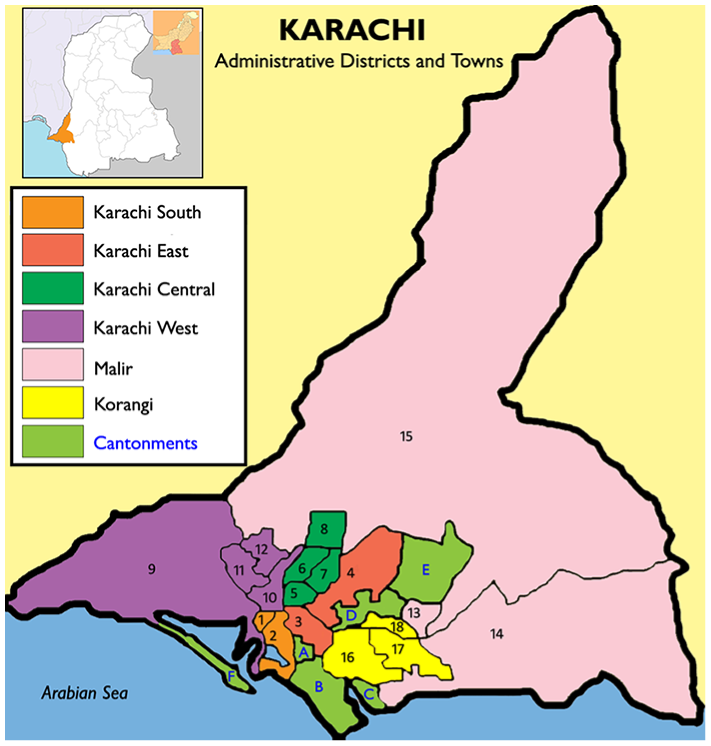
Map of Karachi’s Districts. Courtesy of Karachi Municipal Corporation.
Situating Karachi’s water provisioning
Karachi’s social geography is intimately tied with its water provisioning and inequality is inseparable from the city’s fluvial contours. The population needs 1000 million gallons of water, daily, but supply is around half. Increased private speculation, hoarding and monopoly over water rights by a so-called ‘water mafia’ together with the impact of droughts, degraded infrastructure, and an intransigent water utility – the Karachi Water & Sewerage Board (KWSB) – have led to city-wide water scarcity and contamination, with disproportionate effects on informal settlements. Karachi is marked by a division between an urban centre and an expansive periphery that has grown extensively throughout the second half of the 20th century (Anwar, 2014b). While Karachi’s increasingly vertical urban core is hardly the epitome of uninterrupted water supply, its horizontal periphery, marked by the expansion of dense, single-storey settlements, is afflicted by chronic water shortages.
Karachi’s decrepit water infrastructure contributes to water scarcity for poor and rich populations, but to differing degrees. Experiences are further differentiated by uneven geographies of water provisioning within informal settlements. For instance, in Orangi Town (Karachi West), residents experience water supply in markedly different ways compared with Jamshed Town (Karachi Central), thus producing uneven outcomes, especially for the poor. For residents in the working-class neighbourhood Ghaziabad, Orangi, erratic water supply ranges from no supply at all, to broken supply with water coming once or twice in a fortnight for 30–60 minutes. Umar, a 42-year-old man from Ghaziabad, laments: Is this not psychological violence? A man comes home from work after a long day of hardship and then he finds there is no water in his house. Even his family has spent the whole day at home, worrying about water.
Water scarcity is caused by a lack of supply on the KWSB’s end or illegal extraction of water before it reaches households. Certain authors (Ahmed and Sohail, 2003) note that since its establishment in 1983, KWSB’s water provisioning has remained inadequate, mainly because of increasing distances of informal settlements from the mains and ineffective pumping procedures. Climate change is also transforming provisioning arrangements. Variable and reduced precipitation, longer droughts, depleting water reservoirs and an aging, insufficient piped network have triggered a particularly precarious supply. The main piped supply for Orangi Town, the Hub Dam, experienced near zero water level from 1995 to 2003 due to a drought. Moreover, in 2015, an unprecedented five-day heat wave, with daily temperatures of 45°C in Karachi, killed over 2000 people – mostly poor and elderly. The combination of a ‘heat island effect’ and water scarcity apparently exacerbated the impacts (GOP, 2015). NGOs and federal agencies have since assisted Karachi’s local government to mitigate risk and promote ‘human security’ through capacity-building programmes, but this is interpreted by our respondents as insignificant against the backdrop of insufficient government investment into water provisioning. Nadra, from Mansor Nagar, Orangi Town, raised this as a priority issue: Masses do not even get water. We pay the tanker for water and we also pay a monthly 200 PKR bill to the KWSB. Women have also protested for water. The day the protest was held, water supply was resumed for half an hour and then it stopped. How much can we fight? Men stay silent because of the fear that they might get killed.
The KWSB serves approximately 90% of Karachi’s population through pipelines or tankers. The remaining 10% depend on groundwater. With a deepening budget deficit (Maher and Ilyas, 2015), and only 30% of the city paying water bills, the KWSB’s financial hollowing out mirrors its deteriorating technical capacity whereby faulty cables, broken generators, decaying pipes, pumps and propellers signal an incapacitated utility. It is little surprise that the poorest service is experienced in peripheral settlements. In Orangi, residents complain that they have always faced poor, but worsening water supply; nonetheless, many felt pressured to pay KWSB bills. While the private water tanker service was meant to be a ‘troubleshooting tool’ for the KWSB, it is now perceived to literally rule the network.
Securitising ‘illegal’ water and gendered lives
Our interviews and observations led us to consider how water was being securitised, the shifting logics of that security, and what theoretical work might inform our analysis of these processes. Whether designated legal or illegal, water is brokered by the state. Karachi’s so-called ‘tanker-hydrant mafia’ or ‘water mafia’ comprises a constellation of actors that straddle the state/non-state divide. Evidently, tanker operators (Figure 2) create artificial crises in alliance with KWSB officials, to expand their business potential. A male respondent from Orangi took the photograph (Figure 2) of an ‘illegal pump’ station and noted: ‘This is an artificially created water shortage; there is no real shortage of water, just an active mafia.’

Photograph of an ‘illegal’ water pump station in Karachi’s periphery. Printed with respondent’s permission.
It would be straightforward to comprehend this dynamic in terms of an absent state and an extant ‘water mafia’; an explanation that easily slides into the common trope of ‘state failure’. Such a reading elides the securitisation logics that condition access to water in Karachi. Informed by Foucault’s ([1979] 1990) use of the term, we take ‘logics’ of security as a notion of discursive power that circulates and reconfigures state governance, with risk as a political rationality that governs according to predictive calculations of future harm.
This discursive power can be understood through KWSB-sanctioned water brokers as a dominant provisioning pathway, which signals the messy entanglements of water-brokers and state officials; drawing both into subversive forms of political agency and contingencies based on quiet negotiations (Anwar, 2014b; Fuller and Benei, 2012). With the ‘water-tanker-hydrant mafia’s’ reach expanding, the KWSB is now primarily a bulk supplier, which has led to the increased presence of local strongmen or water-brokers in informal settlements, backed by regionally powerful – and often violent – political parties such as the Muttahida Qaumi Movement (MQM). In the form of union councillors and valve men, local leaders, middlemen or strongmen (note the gender dynamic), these figures play an important role in the financing of new water supply schemes and timing water deliveries through private tankers. The valve men are perceived as manipulative, predatory, opportunistic figures who take advantage of the community’s goodwill; as gaming the system and acting deviously and illegally, while the vulnerable, especially women, children and those with disabilities, are considered passive victims of this corrupt masculine force. These actors constitute an essential albeit fraught conduit for the flow and control of water in Karachi.
A feminist informed interrogation of the security state locates these actors within gendered and militarised practices that shape water provisioning in Karachi’s informal settlements. Such settlements are often seen as threats to political stability; as risks to the city but, as we show, contain large concentrations of men and women living at risk. This feminist lens allows us to remain mindful of the gendered politics of security; the realities of which support a statist brand of patriarchal security. In Karachi, a patriarchal stereotype of the militant- or terrorist-controlled water supply is wielded with the aim of upholding statist national security concerns that undermine women’s and men’s daily security in water provisioning, whereby everyday issues of risk and violence appear politically inconsequential.
Water, terrorism and security in Karachi
Certain scholars (Goldstein, 2010; Lutz, 2014; Masco, 2010; Pain, 2014) describe the 21st century as an age of multiple, overlapping crises involving conflict, human insecurity, climate change, capital, law and institutions; an age in which everyday violence has been normalised in relation to the ‘war on terror’. Masco pinpoints the Cold War era as shaping a specific security concept: nuclear fear elevated to be the core instrument of state power. This vision of national security – which Enloe astutely calls masculinised and statist – rivals the human security notion of danger associated with environmental risk, scarcity, even disaster. Ultimately, the image of the armed ‘terrorist’ trumps global warming as a threat to human existence. The concept ‘human security’ is also historically contingent: starting with the Cold War end, it emerged from the human development paradigm by bringing the human rights agenda into development discourse (Gupta, 2015).
Pakistan’s security discourse since Independence in 1947, has been defined largely in terms of a sovereignty-obsessed state with the power to shape citizens’ fates, and a security agenda that goes back to the inscription of war between India and Pakistan (Jalal, 1990). Prominent are the actions and agendas of military generals and an administrative machinery during Marshal Ayub Khan’s military rule (1958–1969) when Karachi’s slums were cleared to resettle the urban poor (Daechsel, 2011). Sovereignty, territorial integrity and ‘national security’ shaped Pakistan’s nuclearisation. Since 9/11, national security concerns have dovetailed with the complex dynamics of the ‘war on terror’, complicating urban governance, especially as related to Karachi’s water provisioning. As the conceptual power of ‘war’ overrides all concerns, nuclear threat organises politics and experience with powerful effects on security culture. Hence, we live in an age where the cultural landscape of security is dominated by risk and premediation, a process in which the future has already been mediated by every possible aspect of war. Security premediation denotes ‘the discursive economies through which terrorist futures are imagined’ (De Goede, 2008: 158).
The state’s response for managing Karachi’s water crisis has unfolded via three interlocking logics: first, the Supreme Court’s discourse of water as a basic citizenship ‘right’ (Dawn, 2018), where failure of provision creates human security risks to the health and prosperity of Karachi’s residents; second – and much more powerful – a ‘securitised water’ logic to contain terrorists/mafias who allegedly control valves, hydrants and tankers. A third logic perpetuated through NGO projects is the ‘human right’ to water – a concept that has been collapsed into state-led or sanctioned projects that avoid dealing with the systemic causes of water scarcity. Despite commitment from environmental NGOs, journalists and donors, the state’s response to systemic issues, such as failing to adapt to climate change, has been piecemeal at best (Herald, 2015; Lead Pakistan, 2016). Climate change has become a convenient narrative for urban water scarcity – especially in working-class and informal settlements – as it masks endemic problems of weak municipal water governance and accountability, and significant impacts of corporate activities on Karachi’s groundwater resources, especially sand mining and extraction by mineral water companies.
The presence of informal water brokers in Karachi has activated state anxieties about security as they are seen to operate ‘outside’ of the state apparatus and collude with terrorists. This is framed by the state – sometimes – as a ‘human security’ issue: risking individual citizens’ abilities to access their basic needs. Literature in political ecology and critical security studies finds that when governments pursue human security through natural resource-related infrastructures, their underlying aims are ‘imbued with statist logics’ (Fagan, 2017). In Pakistan, government narratives on water supply for human security arise in dialogues with multilateral donors and civil society, but practically the logic underpinning the state’s response appears much more grounded in national security concerns. Noteworthy are media and ‘security’ experts who envision possible terrorist futures. In Karachi, security premediation fosters a landscape of securitised water as the state endeavours to eradicate water mafias, criminals and terrorists who allegedly control the water supply.
De Goede emphasises that, unlike risk, premediation is about enabling action now by drawing on an imaginable future. This is precisely how judicial action concerning the eradication of ‘water mafias’ works in Karachi to enable the ‘right to water’, by emphasising a call to action in the present. Besides, judicial action intersects with and amplifies the national security logic of securitised water as it provides succour to the masculinised, elite Ranger’s efforts to eradicate mafias and terrorists. Since 2015, Supreme Court-backed paramilitary operations have shut down alleged ‘illegal’ hydrants in peripheral settlements such as Orangi Town and attempted to ‘break’ the ‘water mafia’ (Dawn, 2017). Regarding the city’s periphery, the media reports the water mafia are ‘militants’, a greater threat because billions of rupees earned from illegal water are being channelled into terrorist activities in Karachi (Tribune, 2015a). While the city-wide paramilitary operation was initiated in 2013 to bring down violence, particularly in connection with terrorism and criminal activities that also involve the MQM, by extending the operation’s remit to water, the state’s discourse has blurred the boundary between ‘water mafia’ and ‘militant’.
As we deliberate the relationship between security, risk, gender and water provisioning, we take a cue from Amar’s (2013) and Enloe’s (2013) gendered conception of state governance that critiques the state’s power to rescue and police; notably of patriarchal security states such as Pakistan, which not only sit on an authoritarian–democratic spectrum but have been at the frontline of the ‘war on terror’. Pakistan has been the USA’s main ally since the war on Al Qaeda and other terrorist outfits in 2001. With time, Pakistan’s role has become more important because of threats in Afghanistan that have expanded into Pakistan (Siddiqa, 2011). As militancy threats peaked in the later 2000s, even under the civilian dispensation, the military assumed control of the national plan to address terrorism, largely without civilian oversight (Rumi, 2015). Military operations were launched in Pakistan’s northern regions, bordering Afghanistan, and in Karachi where informal settlements have been a source of constant media speculation. The anxieties about an exodus of terrorists and/or Taliban invading the peripheral belts has kept alive a sensation of fear (Anwar, 2014b).
While the paramilitary operation brought down levels of non-state violence and crime in Karachi (Ur-Rehman, 2015), the remit of state violence has expanded. As the discourse of terrorist-militant dovetails with water mafia, the spectre of threat is amplified. A senior KWSB official notes that the paramilitary Rangers are the only force that can ‘abolish these water hydrants and underground network of water pipelines for the city’s peace’ (Tribune, 2015b). Ironically, more people in Karachi have died of water contamination and scarcity (human security issues) than terrorism. The Supreme Court’s own militant rhetoric of shutting down illegal hydrants ‘at any cost’ (Tribune, 2018) to ensure the ‘right to water’ for citizens, because the ‘water crisis issue in Pakistan is turning into a bomb’ (Samaa, 2017) and the ‘court will solve the problem’ (Tribune, 2018), has boosted the Rangers efforts to unilaterally eliminate water supply threats.
This shifting security logic has had distressing effects on socio-economically and environmentally vulnerable populations in geographies where KWSB supply is absent. In the periphery, the legally authorised closure of illegal hydrants has exacerbated uncertainty and constraints on household water rationing and increased the price of private tankers. Federal and provincial authorities, even the media, see this as beneficial to rooting out corruption and improving security but, within targeted informal settlements, there has been intensified exclusion and embodied hardships despite the curtailment of crime and violence. We elaborate later, illustrating through our findings how in their search for water, ordinary men’s and women’s lives are put at risk, even as provisioning is securitised to mitigate risk associated with ‘illegal’ or terrorist-controlled water. The experiential dimensions of risk manifest in the frustrations, grievances and anxieties over the search, distribution and use of potable water, as these involve residents’ gender expectations related to local cultures and livelihood strategies.
The third security logic – the ‘human right’ to water – although affirmed by Pakistan with the United Nations, has been applied predominantly by civil society through small-scale water projects and advocacy. For example, WaterAid Pakistan held a ‘Dialogue on Prioritising WASH in Political Parties Manifestos 2018’. Perhaps as a result, the Pakistan’s People’s Party (PPP) did include water as a human right in its manifesto. Nonetheless, their practical politics demonstrate a securitised water logic. During the opening winter session of the National Assembly in 2018, a debate on water shortages between PPP and other parties circled around the water tanker ‘mafia’ and the ‘civil war’ over water in Karachi (Wasim, 2018). Further, NGO projects cannot operate in isolation from political actors and the ‘water mafia’. Permissions and patronage are necessary to be able to operate. This was tragically demonstrated by the 2013 assassination of Orangi Pilot Project Director, Perveen Rahman. It has been alleged through investigations and media reports that her killing was to shut down her mapping of water and land grabs in Orangi Town (Syed Ali, 2017).
Water, security and urban risk
Scholars (Anand, 2017; Björkman, 2014; Graham et al., 2013) writing on water infrastructures in South Asia, note the everyday disruptions involved in negotiating water shortages underpinned by the increasing volatility and unpredictability of pipes in cities such as Mumbai. Akin to those of Mumbai and New Delhi, Karachi’s residents obtain water either by claiming rights through procedural channels, or through informal and illegal processes – theft, corruption or political negotiation. Bjorkman underlines that an unhelpful fantasy is that someone is in control of water access – whether an organisation such as the KWSB, the Rangers, terrorists or the water mafia. The realities of water infrastructures in South Asian megacities, she emphasises, are more complex, multifaceted and increasingly opaque.
A feminist analytical lens is critical to understanding the complexities of urban lives and governance (Butcher and Maclean, 2018). For our analysis, it elucidates how water infrastructures are deployed and securitised by the state, and how women and men experience and negotiate water (in)security in Karachi. FPE emphasises the relationships men and women have with water in a specific political economic context, which leads to different material outcomes (Cleaver, 1998; Davidson and Stratford, 2007). As we show, at the household, community and state levels, decisions around how to deal with water supply are made by men and informed by patriarchal visions of managing risk. As emphasised by Enloe (2013), using the example of policing: different forms of masculinities can be inculcated within a specific context – which may compete for resources and power but simultaneously reinforce masculinity as a governing principle. This ‘game of masculinities’ places women at the bottom of the hierarchy, thus most exposed to risk.
Certain scholars highlight the gendered embodiment of water scarcities and contaminations, leading to psychological and physical suffering for working-class women (Sultana, 2009). Others call for an intersectional FPE, demonstrating how gender overlaps with other social identity markers to impact relative positions of power for different women and men vis-à-vis water (Mollet and Faria, 2013). We bring an intersectional lens to our analysis, considering the overlaps of gender, ethnicity and age; illustrating that overlapping systems of discrimination are critical constructors of everyday experiences of risk and (in)security.
Bringing paramilitary Rangers into the broader schema of managing water supply in Karachi exemplifies an instance of security premeditation in a 9/11 context, where the control of an uncertain water future is sought by the judiciary, the media and the security state. Poignantly, premediation has become a human security disaster, disrupting ordinary citizens’ daily lives and feeding feelings of insecurity in a landscape where histories of violence persist, and where informal water provisioning systems – now destroyed – have long been relied upon. Despite the state’s efforts to designate terrorism as the ultimate existential threat, there has been increasing scientific evidence of the effects of climate change on water shortages. Pakistan is predicted to become a water-scarce country, with declining per capita water availability and overall environmental insecurity (Mustafa et al., 2013).
Hidden within these numbers are acute security issues that the Pakistani state has faced – from debilitating floods, heat waves, storms, to sectarian violence and the killing fields of post-9/11 suicide bombers. In Karachi, these security issues have coalesced with other concerns, from extrajudicial killings to criminal violence and extortion whereby the ‘writ of the state’ is routinely undermined. Hence, in Karachi, histories of violence and military interventions have produced an enduring fear culture. In Karachi’s informal settlements, risk management is part of a broader shift in how futures are imagined, especially in relation to water as it intersects with the imperatives of state security (Amar, 2013; Enloe, 2013; Masco, 2010).
As the logics of securitised water, the judicial right to water and human rights intersect, effects on the ground are devastating. In June 2015, just after the five-day heat wave, Nusrat, a 25-year-old housewife from Ghaziabad, angrily described how her household’s dependence on private water tankers had been disrupted because of the Rangers’ operations: My children can’t bathe, I can’t cook or clean, can’t wash clothes; our lives have come to a standstill! You can’t imagine our anger. The line has no water and we can’t find a tanker. We have depended on water tankers supplied by the water mafia. But now there are hardly any tankers. Ever since the Rangers operations started, the water supply has worsened.
A heatwave returned in 2018, but with a lesser death toll of 65. Since 2015, NGOs and federal agencies have been assisting local governments in heatwave management plans, to mitigate risk. Implementation so far appears to have focused on citizen capacity building to navigate heatstroke risk – rather than ensuring more equitable delivery of water and electricity.
Gendered insecurities, everyday risks
According to Siraj Bhai, who runs an NGO – Technical Training Resource Center (TTRC) – in Ghaziabad, Orangi, the Rangers ‘cracked down against illegal hydrants to demolish the “water mafia”. But this strategy has created a new set of problems. Public water supply doesn’t work. How can ordinary people get water now?’ In endeavouring to securitise Karachi’s water from ‘terrorists’ and ‘mafias’, the paramilitary operation disrupted longstanding neighbourhood water practices. The stories of our female respondents exemplify the increasing anxieties, struggles and risks involved in managing everyday life around securitised water. Nusrat elaborated: Nowadays if tankers deliver water, we ask, where is the water coming from? We know the hydrants are shut. A woman who lives a few lanes away from my house, her youngest child got sick; severe gastrointestinal sickness after a water tanker delivery. Later she learnt it was waste-water from an ice factory. She had to pay expensive medical bills and seek help from neighbours, borrow money.
The loss of her normal routine forced Nusrat to mitigate risk as she struggled to locate water. With TTRC’s help, she formed a savings group to construct a borehole in the neighbourhood lane. The group now has 33 women who took an interest-free loan from TTRC to build it. But this risk management strategy was hardly a boon. When the first borehole was constructed at 125 feet, the water came up bitter. The next at 82 feet brought water fit only for washing clothes and mopping. Through conversations with respondents, we learned that women have mobilised to contest local officials about water services through protests at local government offices. When we asked Shaista if she or female family members had participated, she hesitated. Her gestures emphasised that she considered protests a risk to women’s safety. Her explanation resembled similar elucidations from mothers, fathers and brothers in all neighbourhoods: Everyone is not the same; all households bear sons and daughters. Where will the daughters go? I have a daughter and a daughter-in-law; if I participate in a public water protest, I can’t leave them alone in the house because it is not safe. In any case, my husband and sons won’t allow us to go outside for such reasons. Such actions would undermine our daughters’ reputations. What would our neighbours say? Young women can’t be seen outside wandering alone.
Shaista’s response demonstrates the enduring process of risk calculation over women’s security inside and outside the home, where inscriptions of patriarchy permeate the moral and sexual regulation of women (Shaheed, 2010; Toor, 2014). Interestingly, such a calculation did not pertain to her daughters’‘human security’: when we probed the cause for concern, Shaista explained that given the unregulated nature of public space, the major cause of anxiety was the threat against maintaining proper sexual conduct; young women’s presence in public might lead to transgressive social behaviour, such as pre-marital relations. The risk is around violating social norms of appropriate inter-gender relations in the public space – especially women’s ‘purity’. But anxieties around risk and danger concerning water also involve men. Risk conditions the relations between residents and designated water-brokers or ‘valve men’, especially male residents, who compete for resources in a ‘game of masculinities’ (Enloe, 2013). Salma, 20, explained how frustrated men thrashed the municipal ‘valve man’ in Ghaziabad: These valve men are mostly political party workers. A few days back the valve man was beaten by men from our community. They beat him because water supply had completely stopped. The valve man ran off. The political party workers claim there is no water in the pump, but we know they are selling water through private tankers.
This account demonstrates how men use force to defend their communities and households against the danger caused by a – presumed to be artificial – water shortage. This security logic, at the neighbourhood level, is informed by a patriarchal notion of masculinity (as protectors of the family/community) and is calculated as a lower risk option than allowing their community or households to continue struggling without water. But in the hierarchy of males who police/protect (Amar, 2013; Enloe, 2013), it is the Rangers who, because of their authoritarian, elite, professionalised security, trigger the greatest anxiety. When he took the photograph in Figure 3 of a ‘legal’ water hydrant controlled by the Rangers, Umar noted: ‘This is a legal hydrant, so you cannot go close or the Rangers take the camera.’
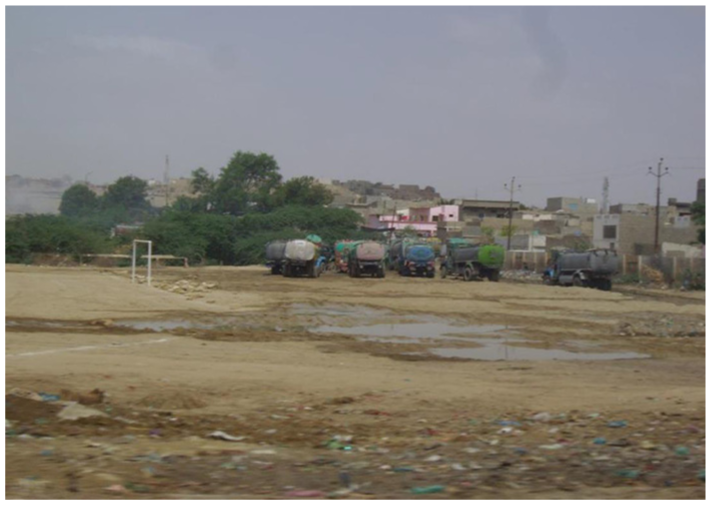
Photograph of a ‘legal’ water pump station controlled by the Rangers in Karachi’s periphery. Printed with respondent’s permission.
Our female respondents’ accounts illustrated how such gendered frustrations bleed into the home. Women have little control over water procurement but are expected to manage the household water economy. Daily anxieties around insufficient household water become a source of domestic conflict and problematise the gendered division of labour. Women recount, with great frustration, concerns over accessing enough water to fulfil what is expected of them. In a focus group in the informal settlement of Raees Amrohi, Orangi, Ishrat, 20, recounted: ‘My husband left the house in the morning when there were four full cans of water. When he returned the water was finished. He asked what happened? Where did the water go?’ At this point in the focus group conversation, another woman, Parveen, 25, responded: ‘You should say: I drank all the water!’
The undercurrent of being unfairly held responsible for household water scarcity highlights how men’s inability to ensure stable access to water from the public sphere spills over into the private by displacing responsibility onto women. It is precisely in the issue of deviation from socially prescribed norms around ‘female’ and ‘male’ roles and mobilities that the nexus between water provisioning and everyday risk emerges. When women deviate from the private sphere, in taking on water procurement, the interplay with patriarchal cultural norms around female mobility and ‘purity’ can put them at risk. Hareem, 18, from a neighbourhood in District Malir, narrates: We don’t have water and need money for this. My husband gave me my mobile phone and asked me to give it to my friend Gul Bahar [so she can sell it for water]. I gave the phone to Gul Bahar, but she kept it with her for four hours. My husband got angry why it was taking her so long (he slapped me twice). Gul Bahar returned the phone without selling it. My husband is jobless. We don’t have a single drop of water in the tank. I can only borrow a tiny quantity of water from my parents’ household. If I take extra, my Father will break my leg.
Constant fear and risk calculation in accessing water also exemplifies how gender expectations blur the assumed boundaries between the public sphere and the home. Many women and men described the impacts of water scarcity as zehni tashhadud (psychological burden), not only because of the lack of support in a crisis, but how it challenges gendered roles and expectations. Our respondents told us that domestic violence between men and women increased during water scarce times, and they often articulated it as an outcome of zehni tashhadud.
Risking loyalties
Analogous to cities such as Mumbai and Delhi, the involvement of political parties in Karachi’s water supply constantly embroils residents in power struggles to control the streets and neighbourhoods to ensure vote banks (Anand, 2017; Björkman, 2014; Graham et al., 2013). Social and political power structures are fundamentally reproduced and used through water, thus enmeshing men and women in multiple forms of risk. There is clear awareness that water is a political issue. Jamshed, 32, from Raees Amrohi, Orangi, recounted: ‘There is no water issue. It is all artificial; just created for money-making … Whenever Pakistan People’s Party is in power, ghunda gardi (criminal activity) is at its peak.’ However, it is generally known that Orangi is under the overall patronage of the MQM. The expression of support or opposition for local political actors should be understood as a discourse more than anything else. Discourses of blame, corruption, responsibility, are deployed strategically to ensure residents’ survival in a climate fraught with risk and shifting security logics, where compromised loyalties can have fatal consequences. Expressing loyalties also provides opportunities to negotiate water access.
As demonstrated in the valve man case, the forceful interplay between groups is enforced and played out through masculinised notions of policing public spaces (Enloe, 2013). This creates further opportunity to police women’s mobilities, as men see it as within their remit to ensure women behave properly and are ‘secure’ in public. This becomes the most hindering experience in women’s lives, preventing them from accessing education, social life, even clean water without facing physical and verbal threats. While FPE work recognises that water supply schemes often misunderstand restricted female mobilities (Sultana, 2009), there is a gap in investigating how changing urban female mobilities for water supply are shaped by perceptions of risk, and importantly ‘intersectionality’. In these working-class neighbourhoods, only women of a certain age (deemed too old for sexual relations) can navigate the streets for water; most other women are left at home to deal with the ‘undrinkable’, ‘smelly’, ‘dirty’, water that comes sporadically through the pipes or tankers. This is distinct from middle-class or elite women who can take a car or send drivers. Gender discrimination, intersecting with class discrimination, leads to a compounded form of risk and (in)security; it is not the working-class men that must drink, cook and bathe in this water throughout the day, as they are free to roam outside.
Mitigating risks, gambling futures
Respondents repeatedly described living in ‘unsanitary’ or ‘filthy’ conditions at home as zehni tashhadud. Following certain FPE authors’ (Sultana, 2009; Truelove, 2011) findings, women literally embody the disadvantages and inequalities of water scarcity. This was demonstrated across neighbourhoods, but in Mansoor Nagar, on the outer boundary of Orangi Town, there is a more intensified landscape of insecurity. The hills flanking the settlement provide cover for illicit activities and opportunities for surveillance, whether by the (male dominated) Rangers, police, criminals or political groups. Consequently, people living in this locality, especially women, express a greater sense of danger. The location ensures that basic services such as water and sewerage find their way there last, or never. This is convenient for the state narrative that expanding informal settlements and illegal groundwater tapping are the problem behind inadequate supply to certain localities, rather than the actual ‘cherry-picking’ of wealthier neighbourhoods for supply.
Cherry-picking materialises through the exclusion of minority community neighbourhoods who are not deemed citizens by the state, and hence unworthy of services. For example, Hassan, his wife Nadra and his mother live in a house located at the end of a steep road that goes up one of Mansoor Nagar’s hills. Despite living in Karachi since 1974, and residing in a well-furnished, newly constructed two-room house, they remain at risk by their exclusion. A state of contingency has permeated all their attempts to gain access to citizenship rights and mitigate risks – the two most important are access to identity cards and infrastructure, both of which are denied by the state. Owing to their economic and citizenship status, they are also subject to extortion attempts by police and local criminals.
But most of all, it is water scarcity that comes up again and again. Efforts to locate water embroil the family in constant battles with councillors, politicians, valve men and private tanker operators. These interactions result in hope and disillusionment. After many promises from politicians, Hasan and Nadra subsequently started investing their capital and taking out loans on other things, such as house improvements and making payments on their land. But they found themselves in trouble when none of the promises came through and, instead, they were left with a huge debt. Efforts to access water become part of the overall calculation of risk and what essentially becomes a process of gambling with their future.
Conclusion
In this article, our discussion on water security has served as a proxy for security more broadly. We have endeavoured to show that survival in Karachi’s informal settlements in the periphery is not just a struggle to locate water, but a condition of daily calculation of risk and trade-offs vis-à-vis gendered insecurities. The search for water combines with experiences of everyday life that are conditioned by four interlocking security logics enforced by the state and non-state actors and affecting all facets of urban life. The search for water begins as a calculated risk and often transpires into an urgent need, which puts people in danger in different ways according to the imperatives of security. Importantly, risk has a very gendered nature, and it is women who experience it both in the home – by embodying water scarcity and absorbing male frustrations – and outside – by risking their public reputation and physical security.
On the other hand, it is men who face public sphere risks where they are expected to procure water in often violent political-economic contexts. Living in risky zones conditions their expectations of the future; everything is incomplete and can quickly become violent. In the Pakistani state’s response to define who is worthy of protection from violence and risk, and who is not, it is the low-income, informal settlements that tend to suffer. In the state’s attempts to both regularise basic services and deal with urban ‘security’, it again tends to be these residents who suffer, again in gendered ways. Importantly, regardless of neighbourhood or gender, the issue of water scarcity is repeatedly emphasised as a driver of both psychological and physical dangers. Hence, the intertwined nature of water scarcity, gender and security in urban Pakistan.
The pressure of living in an environment with water scarcity impedes peoples’ abilities not only to live a secure life, but also to maintain a sustainable livelihood. These dynamics call into question the subordination of citizenship rights to the political rationality of ‘state security’ in the context of Pakistan’s protracted security predicament in the new millennium. How do we understand ‘security’ in an environment where people’s vulnerability can be manipulated and traded for political advantage, and where household or individual assets are never enough to change anything? Where there are constant alerts for possible threats? We contend that external readings of the nexus between water, security and gender in Pakistan’s cities – and in other cities of the Global South – lack this much needed understanding of the contextual realities and fail to ask these kinds of key questions. We believe such questions are of overriding importance not only for understanding the major transformations underway, but also the related implications for urban citizenship and democracy in 21st century Pakistan and in South Asia.
The tools for surmounting water scarcity are diametrically opposed to those informing war on the ‘militant’ or terrorist or mafia. A response to water scarcity and ecological crisis requires a new kind of political cooperation, an innovative technological change and a shared vision of ecological sustainability combined with a willingness to substitute ordinary citizens’ concerns for national interests. Rather than sustaining securitised water, engaging water scarcity requires a new form of local and national governance in Pakistan. Fundamentally, the imbrications of securitisation and water governance are so profound as to block thought and action, allowing the security implications of water scarcity to elude the security state. In Pakistan, security remains embedded within a narrow concept of threat and national advantage, which are legacies of the Cold War and postcolonial nation building. But the lessons of water scarcity in urban Pakistan are that more profound changes are at hand, and that securing water requires nothing less than a post-national vision of the Pakistani state.
Footnotes
Acknowledgements
We are immensely grateful to the three anonymous reviewers for their insightful and deeply helpful comments that greatly improved the manuscript. We also thank our colleague, Dr Sarwat Vigar, who commented on an early version of this paper.
Declaration of conflicting interests
The author(s) declared no potential conflicts of interest with respect to the research, authorship, and/or publication of this article.
Funding
The author(s) disclosed receipt of the following financial support for the research, authorship, and/or publication of this article: This research was supported by IDRC Grant No.: 107363-001.
